My Neighbor Started My Tractor at 6:45 A.M.—Then I Saw What She Was Dragging Toward My Property Line
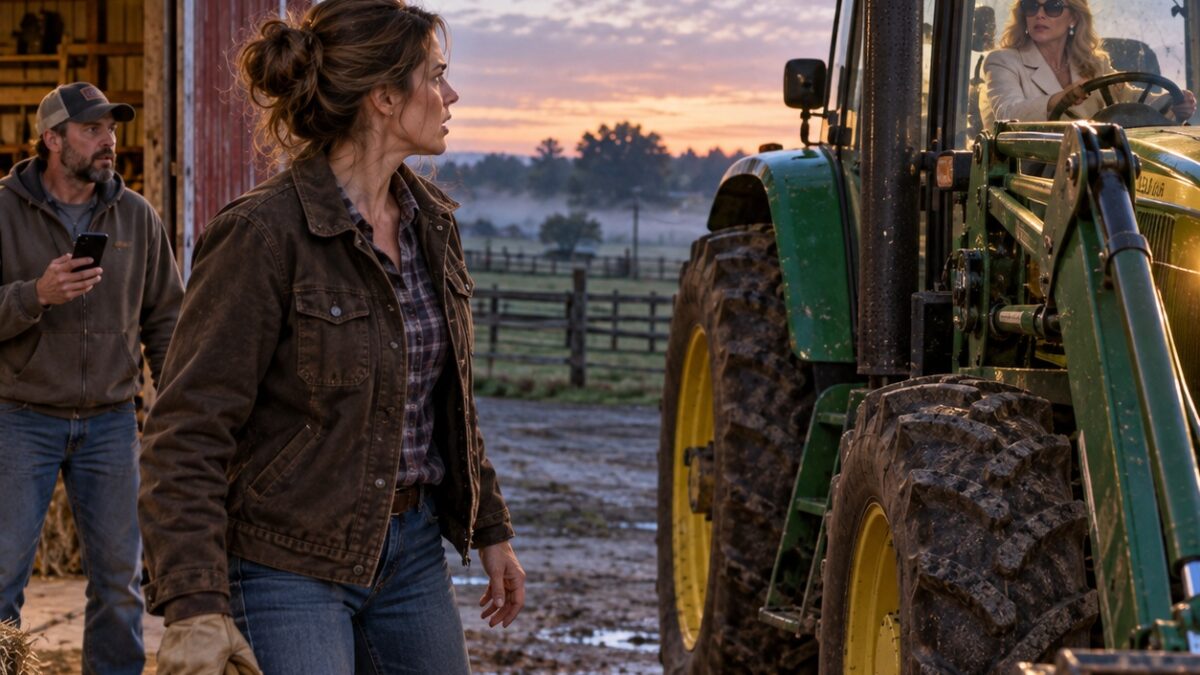
My Neighbor Started My Tractor at 6:45 A.M.—Then I Saw What She Was Dragging Toward My Property Line
At 6:45 on a Monday morning, my farmhand texted me four words that made me run out of the barn: Someone’s in the tractor.
The woman behind the wheel had spent three months insisting that forty feet of my pasture should become her subdivision’s private access road, and now she was using my own machine to move the fence after every survey, email, and county warning had told her no.
What she didn’t know was that the commissioner had warned me about her months earlier, six cameras were already recording, and the thing hanging from my tractor bucket was about to prove exactly what she had been planning all along.
My name is Owen Hale, and my family has owned the same piece of land outside a fast-growing county in the American South since my grandfather bought it in 1968.
Back then, the road in front of our place was gravel.
There were five houses within a mile.
My grandfather raised Herefords, planted hay, fixed everything twice before buying it once, and believed property lines were among the few things in life that should never depend on someone’s memory.
So when he bought the farm, he had it surveyed.
When my father took over, he had it surveyed again.
And when I inherited the place, I paid for a third survey even though every old marker was exactly where my father said it would be.
People laughed.
My wife Claire definitely laughed.
“You have inherited your father’s paranoia,” she told me.
“Preparedness.”
“Paranoia with a filing cabinet.”
She wasn’t wrong.
I had folders.
Deeds.
Old aerial photographs.
Fence records.
Drainage maps.
Survey plats.
Easements.
Utility agreements.
And after Stonebrook Ridge was built along our western boundary, I added another folder.
STONEBROOK.
At first, I thought that folder would hold nothing more dramatic than a few county letters and construction notices.
Stonebrook was a new subdivision with 128 expensive homes, decorative stone entrances, a clubhouse, a man-made pond, matching mailboxes, and residents who had paid serious money to live somewhere that looked rural without requiring them to actually deal with cattle, mud, fencing, or the smell of manure after rain.
Most of the homeowners were fine.
Some became friends.
The problem was their HOA president.
Rebecca Mallory.
Rebecca was the kind of person who never raised her voice until she had already decided you were the obstacle.
She wore white boots to muddy site meetings.
Carried rolled plans under one arm.
Spoke about “community needs” the way a general might discuss troop movement.
And three months before she started my tractor, she stood in my northwest pasture and told me Stonebrook needed forty feet of my land.
Not wanted.
Needed.
The subdivision had only one practical emergency-access route.
A second connection had been required as later phases expanded, but the original developer went bankrupt before building it.
Stonebrook now wanted the cheapest solution.
A straight corridor across my farm to County Road 14.
It would cut through my calving pasture, cross a drainage swale, pass beside my equipment yard, and take a strip of land my father had fenced thirty years earlier.
Rebecca offered money.
I said no.
She increased the offer.
I said no again.
Then she stopped treating my answer like an answer.
That was when Commissioner Harold Briggs called me one night.
Harold had known my father.
He had sat through the county meeting where Rebecca claimed an “old agricultural road” gave Stonebrook historic access across my farm.
There was no such road.
Harold knew it.
So did the records.
But before hanging up, he said something I did not forget.
“You might want to watch your property line, Owen.”
I asked why.
He sighed.
“That woman didn’t look like someone who takes no for an answer.”
Three months later, my tractor engine turned over before sunrise.
And Harold’s warning suddenly stopped sounding paranoid.
FULL STORY CONTINUATION 👇👇
The first thing I did was not run toward the machine.
That surprises people when I tell the story.
They imagine I charged across the yard yelling.
Maybe grabbed the tractor door.
Maybe stood in front of it like a movie hero protecting his land.
I grew up around farm equipment.
That teaches you very quickly that pride weighs nothing against twenty thousand pounds of steel.
The John Deere 6155M sitting in my equipment yard that morning was nearly eight feet tall at the cab, heavier than several pickup trucks combined once the front weights were mounted, and powerful enough to pull a loaded hay wagon through mud.
I wasn’t stepping in front of it.
Neither was Benny.
Benny Alvarez had worked with me for eleven years.
He was fifty-eight, built like an old fence post, and had the particular calm that comes from spending most of your life around livestock and machinery that can kill you if you mistake confidence for control.
He came around the corner of the barn with his phone in one hand.
“Gate chain’s cut.”
I looked toward the equipment entrance.
Sure enough, one side of the galvanized chain hung from the post.
The other lay in the gravel.
The tractor’s cab light glowed pale yellow.
Engine idled.
Then the headlights came on.
“Who’s driving?”
Benny looked at me.
“You’re not going to like it.”
The tractor rolled forward.
Gravel popped beneath the front tires.
Then the cab cleared the shadow of the shed.
Rebecca Mallory.
White jacket.
Dark hair pulled back.
Both hands on my steering wheel.
For one second, my brain rejected the picture.
People threaten legal action.
They move stakes.
They send letters.
They don’t usually climb into your tractor before breakfast.
Then Rebecca saw me.
The machine slowed.
Stopped.
She opened the cab door and leaned out.
“Morning, Owen.”
Like we had arranged this.
I pulled out my phone and started recording.
“Turn it off.”
“I just need it for five minutes.”
“No.”
She smiled.
“Don’t be dramatic.”
“Turn my tractor off.”
Benny whispered:
“You want me to call the sheriff?”
“Yes.”
“911?”
“Tell them somebody entered locked agricultural property, cut a chain, and is operating equipment without permission.”
He nodded and stepped away.
Rebecca watched him.
“What’s Benny doing?”
“Calling law enforcement.”
Her smile disappeared.
“Seriously?”
“Yes.”
“Owen, this is a civil access dispute.”
“You’re sitting in my tractor.”
“I am moving an obstruction.”
“What obstruction?”
She pointed toward the western pasture.
My stomach tightened.
The fence.
Four days earlier, orange survey stakes had appeared across the northwest corner of my property.
Not boundary stakes.
Engineering layout.
A straight line running from Stonebrook toward County Road 14.
I photographed each one before pulling them.
Then I emailed Rebecca.
No one associated with Stonebrook Ridge has permission to enter my parcel, place markers, conduct survey work, remove vegetation, disturb fencing, or perform construction. Please provide any legal authority you believe permits entry.
Her answer came less than an hour later.
YOU HAVE INTERFERED WITH AUTHORIZED ENGINEERING MARKERS.
I replied:
Please send the authorization.
She did not.
Now she was looking toward the same corridor.
“Shut the machine off and get down.”
“Owen.”
“No.”
“We have county authorization to preserve the historic route.”
“There is no historic route.”
“You don’t get to decide that.”
“Neither do you.”
She sighed.
“Harold has poisoned this process.”
Commissioner Briggs.
“Harold told you the same thing the survey did.”
“The county needs emergency access.”
“The county has procedures.”
“And you’ve delayed them for months.”
“I said no to selling you land.”
“You’re holding an entire neighborhood hostage.”
That phrase had shown up before.
At public meetings.
HOA newsletters.
An email from one Stonebrook board member who later apologized after reading the actual documents.
Holding the neighborhood hostage.
As though I had built the subdivision with only one access road.
As though I had promised them a second.
As though my family farm existed as an emergency reserve for somebody else’s planning failure.
I said:
“Last warning. Turn it off.”
Rebecca sat back.
Closed the cab door.
Then put the tractor in gear.
The machine started forward.
Benny came back.
“Deputies are coming.”
“Good.”
“She’s moving.”
“I see.”
“You want the truck across the gate?”
“No.”
“We could block—”
“No.”
He clenched his jaw.
“She’s stealing the tractor.”
“I know.”
“But we’re just watching?”
“We’re recording.”
He hated that answer.
So did I.
But my cameras were recording too.
That mattered.
After Harold’s warning, I had added two cellular cameras to the equipment yard, another aimed along the western fence, and upgraded the barn system.
Claire called it the Fort Knox phase.
I told her cattle rustling still happened.
She said:
“You own thirty-two cows.”
“Thirty-four.”
“My point stands.”
Now every dollar suddenly seemed intelligent.
Rebecca drove through the pasture gate.
Morning light was just beginning to clear the trees.
Then I noticed the chain hanging from the loader bucket.
Not one of ours.
Heavy logging chain.
Hooked at both ends.
She had brought it.
Benny saw it too.
“What the hell is she doing?”
“She’s moving the fence.”
“You know that?”
“I do now.”
The western fence ran along a line my father had maintained since I was a teenager.
But here was the important part.
It was not the legal property line.
It sat between twelve and twenty-two inches inside our parcel in most places.
Dad built it that way so we could maintain both sides without stepping onto neighboring land.
When Stonebrook arrived, the subdivision’s survey confirmed exactly that.
Rebecca knew.
She had seen the plat.
She had argued anyway that the old agricultural fence represented “historic occupation.”
That theory had gone nowhere.
So apparently she had decided to create a different fence.
I started walking parallel to the tractor, keeping distance.
“Rebecca!”
She stopped near the corner post.
Opened the cab.
“What?”
“What are you planning to do?”
“Restore the historic line.”
“That is not the historic line.”
She pointed toward where the orange markers had been.
“The county engineers disagree.”
“No. Their proposed access corridor is not a boundary.”
She stared at me.
“They marked it.”
“For a proposed road.”
“Exactly.”
“No.”
That word had become the entire conflict.
No.
Rebecca seemed genuinely offended by it.
She climbed out.
Took the chain from the bucket.
Wrapped it around my corner post.
Benny swore.
I said:
“Do not touch that fence.”
She ignored me.
The post was six inches thick.
Creosote-treated.
Braced diagonally.
Four strands of high-tensile wire ran south.
A gate line ran east.
Rebecca climbed back into the tractor.
I zoomed the phone camera.
“Rebecca!”
She raised the loader.
The chain snapped tight.
The corner post moved half an inch.
Then another.
Soil cracked around the base.
One brace groaned.
“Stop!”
The loader rose again.
Wood splintered.
The post ripped out.
Wire whipped loose.
Two heifers near the mineral feeder bolted.
Benny yelled:
“Watch the cattle!”
We moved toward them, staying clear of the machine.
The heifers ran deeper into the pasture instead of toward the road.
Good.
Rebecca dragged the corner post maybe twenty feet.
Then thirty.
She lowered it close to the alignment where the orange stakes had been.
Benny stared.
“She’s not removing it.”
“No.”
“She’s relocating it.”
“Yes.”
He looked at me.
“She’s trying to make it look like that was the fence line.”
That was exactly what I believed.
And suddenly Harold’s warning made even more sense.
Property disputes often turn into arguments about history.
Old roads.
Fence lines.
Use.
Maintenance.
Who crossed where.
Who objected.
Rebecca had lost on deeds and surveys.
But if she could create a physical line that matched the corridor Stonebrook wanted, photograph it, perhaps claim restoration of an older fence pattern, she could muddy the story.
Maybe not win legally.
But complicate it.
Complication creates pressure.
Pressure creates settlements.
She pulled a second post.
Then a third.
Each one moved east.
Into my property.
Creating a wider strip along Stonebrook’s side.
Forty feet.
Almost exactly what the proposed road required.
I called Harold.
He answered sleepily.
“Owen?”
“You remember telling me to watch my property line?”
Silence.
“What happened?”
“She’s here.”
“Who?”
“Rebecca.”
Harold’s voice sharpened immediately.
“What is she doing?”
“Driving my tractor.”
“What?”
“She got into my equipment yard. She’s using it to move my fence.”
There was a pause.
Then:
“Call the sheriff.”
“Already done.”
“I’m coming.”
“You don’t need—”
“I’m coming.”
He hung up.
That was Harold.
County commissioner second.
Old family friend first when he was angry.
The sheriff’s cruiser arrived at 7:02.
Deputy Caleb Ruiz drove.
Another deputy followed.
Caleb knew me.
Not close friends.
But his father bought hay from us sometimes.
He stepped out.
Looked across the pasture.
Then at me.
“Owen.”
“Morning.”
“That your tractor?”
“Yes.”
“She have permission?”
“No.”
“Entry permission?”
“No.”
“Gate locked?”
“Yes.”
I pointed toward the cut chain.
He walked over.
Photographed it.
Then looked at my phone.
“You recording?”
“Since I came outside.”
“Good.”
He and the other deputy headed into the pasture.
Rebecca saw uniforms.
Finally shut the tractor down.
Caleb approached from the left side of the cab.
“Ma’am, step down.”
She opened the door.
“This is a civil property matter.”
“Step down.”
“You don’t understand what’s happening.”
“We can talk on the ground.”
She climbed down.
Straightened her jacket.
Composed.
That was Rebecca’s greatest talent.
She could make trespass look like a zoning conference.
“I’m Rebecca Mallory, president of the Stonebrook Ridge Homeowners Association.”
Caleb nodded.
“Okay.”
“We are preserving a historic emergency access corridor currently under county review.”
Caleb pointed toward the tractor.
“Is this yours?”
“No.”
“Did the owner give you permission to operate it?”
“The equipment was necessary to remove an obstruction.”
“That wasn’t my question.”
Rebecca’s jaw tightened.
“No.”
“Did he give you permission to enter the equipment yard?”
“The gate was open.”
I spoke from behind Caleb.
“No, it wasn’t.”
Caleb held up a hand without turning.
“I’ll talk to you in a minute.”
Fair.
He asked Rebecca:
“Was the chain already cut?”
“I didn’t cut anything.”
“Who did?”
“I don’t know.”
“Where did you get the tractor key?”
“The key was in the cab.”
“No, it wasn’t.”
This time I couldn’t stop myself.
Caleb looked back.
“Owen.”
“Sorry.”
But I knew.
Friday evening, I had placed both tractor keys in the office safe.
One primary.
One spare.
Unless Benny used one Saturday.
I looked at him.
He shook his head.
“No.”
Caleb asked:
“You’re certain?”
“Yes.”
“Both keys secured?”
“Yes.”
Rebecca said:
“That’s not true.”
I stared at her.
“How would you know?”
She froze.
Tiny moment.
But Caleb noticed.
“Ms. Mallory, where did you get the key?”
She folded her arms.
“I already answered.”
He glanced toward his partner.
“Okay.”
Then Harold’s pickup came bouncing down the farm lane.
He parked near the pasture gate.
Got out wearing jeans and an old county jacket.
Rebecca saw him.
Her expression changed.
“Harold.”
“Rebecca.”
He looked at the tractor.
The pulled fence posts.
The chain.
Then at me.
“Oh, hell.”
Rebecca walked toward him.
“You know exactly why I’m here.”
“I sincerely hope I don’t.”
“The county has been dragging its feet.”
“The county has been following a process.”
“Families are living in Stonebrook without compliant secondary access.”
“I know.”
“So you know this corridor is necessary.”
“No.”
Her face tightened.
“The engineers—”
“The engineers identified it as one option.”
“The best option.”
“The cheapest option.”
That was the first time I heard someone say it that directly.
Rebecca glanced at me.
Harold continued.
“That does not make it public.”
“The old farm lane—”
“There is no recorded farm road through Owen’s parcel.”
“You know there was access.”
“I know cattle crossed there.”
“Exactly.”
“Cattle are not emergency vehicles.”
Benny snorted.
Caleb turned slightly.
Benny looked away.
Harold pointed toward the moved posts.
“Did you do that?”
Rebecca said:
“I restored the fence alignment.”
“No.”
He shook his head.
“You moved Owen’s fence to the engineering corridor.”
“You’re not a surveyor.”
“No.”
He pointed toward the small metal cap visible near the western corner.
“But that monument has been there since before Stonebrook existed.”
Rebecca looked away.
Caleb asked Harold:
“Any county authorization for her to enter this property?”
“No.”
“Operate equipment?”
“No.”
“Move fence?”
“No.”
“Survey work?”
“Not without property-owner permission. County staff has not issued any entry authorization.”
Rebecca’s confidence cracked.
Only slightly.
She reached for her phone.
“I’m calling counsel.”
Caleb nodded.
“You can.”
She stepped away.
I looked at the tractor.
Something still bothered me.
The key.
Benny must have been thinking the same.
He leaned close.
“You want me to check the safe?”
“Yes.”
He jogged toward the office.
Two minutes later, he came back.
His face was wrong.
“What?”
“Primary is there.”
“And spare?”
“Gone.”
“Safe forced?”
“No.”
My stomach tightened.
Only a handful of people knew the combination.
Me.
Claire.
Benny.
And my nephew Mason, who helped during summers and weekends.
Mason was twenty-two.
Good kid.
A little careless.
But he would not give Rebecca anything.
“What about the log?”
Benny said:
“No entry since Friday.”
The office safe had an electronic keypad that logged openings.
Friday.
Me.
Nothing after.
Meaning the spare key had been missing before then.
I tried to remember the last time I physically saw it.
Rebecca finished her call.
Her attorney had apparently told her to cooperate because she returned and handed Caleb the tractor key.
He placed it in an evidence bag.
Then issued a clear trespass notice verbally and in writing.
She was not to enter my property again without permission.
No HOA agent acting under her direction either.
She objected.
“What about the markers?”
I said:
“Tell me what belongs to Stonebrook and I’ll put it at the road.”
“This is not over.”
Caleb stepped closer.
“Ms. Mallory.”
She looked at him.
“You need to stop.”
For once, she did.
She walked back toward Stonebrook on foot.
No arrest.
No handcuffs.
No dramatic confrontation.
That disappointed Benny.
“Thought they’d haul her off.”
“For what?”
“Grand theft tractor.”
“She didn’t drive it off the farm.”
“Emotionally, she did.”
I laughed despite myself.
Harold stayed.
We walked the moved fence.
He looked sick.
“I’m sorry.”
“For what?”
“I warned you.”
“That does not make this yours.”
“The county should have shut down this access discussion sooner.”
“The county didn’t move the fence.”
“No.”
He stared toward Stonebrook’s rooftops.
“But we let the developer keep acting like this was the easiest answer.”
“That’s because it was.”
Harold looked at me.
“Yes.”
There.
Again.
Cheapest.
Not only route.
Cheapest route.
“What aren’t you telling me?”
He sighed.
“There’s an alternative through the developer’s north parcel.”
I stared.
“What?”
“Preliminary engineering.”
“How long have you known?”
“A few months.”
“Rebecca?”
“Likely.”
“How much more?”
“Maybe eight hundred thousand. Maybe a million. Small bridge. Drainage work.”
I laughed.
Not humor.
Disbelief.
“So all the speeches about public safety…”
“The access issue is real.”
“But my land isn’t the only answer.”
“No.”
I looked toward the pulled fence.
Rebecca had just risked criminal charges to save her subdivision’s developer roughly a million dollars.
That changed the conflict.
Before that morning, part of me still wondered whether I was being selfish.
I knew I had the legal right to refuse.
But Rebecca had used emergency vehicles, evacuation, wildfire, ambulance delay.
She was skilled at turning a land negotiation into a moral test.
What if somebody died?
What if fire trucks needed a second route?
What if children were trapped?
Those questions work because decent people do not want to be the reason someone gets hurt.
Now I knew.
There was another route.
Harder.
More expensive.
Still viable.
Rebecca hadn’t been asking me to save Stonebrook.
She was asking me to subsidize it with my land.
That made me angry in a cleaner way.
By 8:30, the tractor was back in the yard.
The fence was temporarily repaired enough to hold cattle.
Benny and I used portable panels at the damaged corner.
The sheriff collected statements.
Harold left for county offices.
Claire arrived from town after I called.
She walked across the yard.
Looked at the severed chain.
The tractor.
Then at me.
“You okay?”
“Yes.”
She hugged me anyway.
“What happened?”
I gave her the short version.
She stared.
“She drove the tractor?”
“Yes.”
“She moved the fence?”
“Yes.”
“With our tractor?”
“Yes.”
Claire looked toward Stonebrook.
Then:
“I’m going to prison.”
I laughed.
“No.”
“I’m serious.”
“You are not going anywhere.”
“She touched Dad’s fence.”
That mattered.
The western fence had been built by my father.
Not alone.
We had hired help for the long runs.
But Dad set the corner posts himself.
He was stubborn about corners.
“Everything depends on corners,” he used to say.
Fence.
Business.
Marriage.
He believed the place where two lines met deserved extra attention.
He died seven years before Rebecca moved into Stonebrook.
Heart attack.
Fifty-nine.
Too young.
We fought sometimes.
A lot when I was in my twenties.
But the farm was full of him.
Gate hinges he welded.
Names scratched beneath old shelves.
The oak tree where he tied my first calf.
The corner post Rebecca ripped out.
Property isn’t sacred because wood is sacred.
It matters because time accumulates there.
Claire understood that better than Rebecca ever could.
“I’m calling Sarah,” she said.
Sarah Gaines was our attorney.
Property law, agricultural disputes, county matters.
I had hired her when Stonebrook first approached us.
“Already texted.”
“Good.”
“And the surveyor.”
“Good.”
“And camera company.”
“Good.”
Claire smiled.
“You were born for this level of paperwork.”
“I wish I hadn’t been.”
That was partly true.
By noon, we had three unexpected pieces of evidence.
The first came from the tractor.
The John Deere telematics system recorded engine start, GPS position, operating time, and movement.
Dealer portal showed:
6:44:53 a.m. engine start.
6:47 movement from equipment yard.
6:53 entry into western pasture.
Loader activity.
7:08 engine shutdown.
Precise.
The second came from the barn camera.
At 6:31, before Benny noticed anything, a dark SUV entered along the back farm lane.
Rebecca got out.
So did a man.
Tall.
Baseball cap.
Reflective vest.
He stayed near the equipment office while Rebecca went toward the yard.
Then he walked west.
Camera lost him behind the hay shed.
At 6:40, he returned to the SUV.
Left.
Rebecca stayed.
The third came from a camera mounted above the shop door.
Not enough resolution for a face.
Enough to show Rebecca carrying something small toward the tractor.
The key.
Sarah watched the footage in our kitchen.
Then asked:
“Who’s the man?”
“No idea.”
Harold knew.
I emailed him a still.
He called five minutes later.
“Where did you get that?”
“Camera.”
“His name’s Travis Cole.”
“Who is he?”
“Survey technician.”
“For county?”
“No. Landmark Civil.”
Stonebrook’s engineering consultant.
Of course.
Sarah said:
“Do not contact him.”
“I wasn’t going to.”
“Do not contact Rebecca.”
“Definitely not.”
“Do not post the video.”
“I don’t post.”
“Good.”
Benny said:
“I could post.”
Everyone looked at him.
He raised both hands.
“Joke.”
The sheriff contacted Travis.
His first statement was bad.
Not criminally dramatic.
Just evasive.
He said he had been near Stonebrook but not on my farm.
Then investigators showed him video.
His story changed.
He admitted Rebecca asked him to meet before work because she wanted him to “verify proposed access alignment.”
He said he believed they would stand on the Stonebrook side.
Instead, Rebecca drove him through a service lane toward our rear boundary.
He claimed he told her he did not have permission to survey my parcel.
She said she only needed him to point where the proposed corridor ran.
He did.
Then she showed him a tractor key.
He said he told her:
“Do not use his equipment.”
She allegedly replied:
“He leaves keys in everything.”
That made me laugh when I heard it.
I leave keys in nothing.
Farmers who leave $150,000 tractors unlocked tend to stop owning them.
Travis said he realized she planned to move fencing.
He refused to participate.
Left.
Why didn’t he call me?
He panicked.
Why not call police?
Same answer.
Sarah wasn’t impressed.
Neither was I.
But then Travis gave investigators access to the relevant text exchange through his attorney.
Those messages changed everything.
Sunday, 8:14 p.m.
Rebecca:
Need to confirm west corridor before board meeting.
Travis:
I can point out proposed alignment from Stonebrook side.
Rebecca:
Owen pulled the markers again.
Travis:
They were not boundary markers.
Rebecca:
He is obstructing county process.
Travis:
You need permission to enter.
Rebecca:
Need the tractor only long enough to restore old fence line.
Travis:
You cannot use his equipment.
Rebecca:
He leaves keys in everything.
Travis:
Do not involve me in that.
Rebecca:
Just show me where posts should go.
Travis:
Proposed access is not property boundary.
Then Rebecca’s final message:
If Owen sees stakes he pulls them. Fence will force county to deal with reality.
Sarah read that twice.
Then leaned back.
“There.”
“What?”
“Intent.”
Claire looked at me.
“Force county to deal with reality.”
Sarah nodded.
“She was not confused.”
That distinction mattered.
Rebecca would later claim she believed she was preserving a historic line.
Her own message showed she knew the corridor was proposed and that she wanted the physical fence to create leverage.
The key mystery remained.
Until Mason came home two days later.
He walked into the kitchen while Sarah was there.
We asked when he last used the spare tractor key.
He went pale.
“Uh.”
That was enough.
“Mason.”
“I borrowed the Deere two Saturdays ago.”
“I know.”
“I used the spare because Benny had the primary.”
“Then?”
He rubbed the back of his neck.
“I put it in my jacket.”
“What jacket?”
“Brown work jacket.”
“Where is it?”
He looked at Claire.
Then me.
“I took it to the cleaners.”
I closed my eyes.
Of course.
Mason had spilled hydraulic oil on it.
Dropped it at a small dry cleaner near town.
The key apparently fell from the pocket.
The cleaner found it.
Placed it in an envelope.
Mason called after realizing it was missing.
An employee said they had it.
He promised to pick it up.
Forgot.
“Who works there?” Sarah asked.
Mason shrugged.
“Two ladies. Older guy. Some college girl on weekends.”
I felt it before I knew.
“What girl?”
He named her.
Mallory.
Rebecca’s daughter.
The sheriff obtained the store’s security footage.
Sunday afternoon.
Rebecca entered.
Spoke to her daughter.
Her daughter went behind the counter.
Returned with an envelope.
Handed it over.
Rebecca left.
When investigators interviewed the daughter, she cried.
That bothered me.
She was nineteen.
Had no idea what she was stepping into.
Rebecca had told her the key belonged to “farm equipment authorized for the access project.”
She believed her mother.
Why wouldn’t she?
That was the part of the whole story I eventually hated Rebecca for most.
Not moving my fence.
Not taking the tractor.
Using her daughter’s trust.
The prosecutor reviewed everything.
Unauthorized use of equipment.
Trespass.
Property damage.
Key acquisition.
Intent.
No one was injured.
The tractor wasn’t stolen permanently.
Rebecca had no record.
The charges were serious enough to matter but not the dramatic felony spectacle local gossip wanted.
That was fine.
I did not need prison.
I needed the behavior stopped.
The HOA board became a separate explosion.
Stonebrook’s bylaws required officers to disclose legal matters related to association business.
Rebecca initially told the board she had been “temporarily detained while preserving emergency access.”
One board member, Laura Chen, called me.
“I’m sorry to bother you.”
“What do you need?”
“I need to ask whether Rebecca had permission to be on your land.”
“No.”
“To use your tractor?”
“No.”
“Was she acting under any written agreement with the HOA?”
“Not with me.”
Laura was quiet.
“She told us county staff had authorized field restoration.”
“They didn’t.”
“I figured.”
“Why?”
“Because Harold Briggs called our counsel.”
There it was.
The board had finally realized their president might have created liability for the association.
I told Laura:
“You need your own attorney.”
“We have one.”
“Good.”
“I also want you to know not everyone supported what she was doing.”
“I know.”
“Some of us thought the access negotiations had gotten out of hand.”
“Then why didn’t anyone stop her?”
That hurt.
Laura didn’t answer immediately.
“Because she kept telling us she had it handled.”
Exactly.
Confidence is intoxicating in groups.
A person says:
I’ve got this.
Leave it to me.
The attorney agrees.
The engineer agrees.
County will sign off.
Owen is bluffing.
Eventually, people stop asking for documents because the confident person becomes the document.
Stonebrook’s board suspended Rebecca’s authority pending review.
She fought.
Claimed political retaliation.
Accused Harold.
Accused me.
Accused Landmark Civil.
Then the text message became known to their counsel.
Fence will force county to deal with reality.
Hard to call that misunderstanding.
The board scheduled a recall vote.
Rebecca resigned first.
Her resignation letter accused “hostile interests” of undermining her efforts to protect residents.
Benny printed it.
Pinned it inside the barn.
I made him take it down.
“Why?”
“Because I don’t want her living in here too.”
He stared.
Then nodded.
That idea became important.
A conflict can occupy physical space for weeks.
Your desk.
Phone.
Kitchen table.
Then, if you let it, it occupies every conversation.
Every meal.
Every quiet moment.
I started noticing that Claire and I were talking about Rebecca more than cattle, weather, our daughter at college, or anything else.
That was too much.
One night, Claire closed my laptop.
I looked up.
“What?”
“No.”
“What?”
“It’s nine-thirty.”
“I’m organizing emails.”
“You’ve organized them three times.”
“I found another—”
“Owen.”
She sat across from me.
“She already took three fence posts.”
“I know.”
“Don’t give her our evenings.”
I stared.
That landed.
I closed the computer.
We opened wine instead.
The next morning, I put everything into one legal folder.
Then I stopped checking Rebecca’s social media.
I had never followed her, but neighbors kept sending screenshots.
No.
Sarah handled what mattered.
That helped.
The survey came next.
Again.
Not because I doubted the line.
Because Sarah wanted a fresh stamped survey tied to the dispute.
Westland Surveying sent two people.
They located the monuments.
Ran the boundary.
Confirmed my fence sat inside our parcel.
The new markers were almost painfully clear.
Metal stakes with bright flagging.
The proposed Stonebrook corridor ran through my land exactly where we said.
No easement.
No public right-of-way.
No ambiguity.
Sarah commissioned a title search going back decades.
Nothing.
No recorded farm lane.
No emergency road.
No access deed.
The old aerial photographs showed cattle paths that shifted year to year.
One faint track crossed the pasture in 1987 because my father used it to reach a temporary feeding area.
Rebecca had used that image at a county meeting as proof of “historic vehicular use.”
Sarah laughed.
“So one tractor path creates a public road?”
“Apparently.”
“My grandfather drove across the yard to burn trash. Should the county claim that too?”
I smiled.
The county’s engineering memo became even more important.
Harold was careful about what he personally sent me.
Public records had procedures.
Sarah requested them.
We received three access-option studies.
Option A crossed my farm.
Shortest.
Cheapest.
Estimated cost low compared with the others.
Option B used land owned by the failed developer’s successor entity along Stonebrook’s northern edge.
Required drainage work and a small bridge.
About $900,000 more.
Option C reconfigured internal roads and connected through another parcel under negotiation.
Most expensive.
Rebecca had received the same memo six months before she first came to my farm.
Her email response to the developer representative was included.
Option A is obvious. Farmer will sell once pressure builds.
I stared at that sentence.
Claire read it over my shoulder.
“Farmer?”
“That’s me.”
“She makes you sound like an obstacle in a board game.”
“Maybe I should get overalls.”
“You already wear overalls.”
“More stereotypical ones.”
Then another email.
Developer:
Hale has declined preliminary outreach.
Rebecca:
He’ll reconsider when residents understand he’s blocking safety access.
There.
The moral pressure was not accidental.
It was strategy.
She wanted Stonebrook residents to believe I was endangering them so public pressure would lower my resistance.
Then:
If county begins formal discussion, he won’t want the legal cost.
She had calculated that too.
Sarah looked at me.
“Still feel guilty?”
“No.”
Good.
Stonebrook’s new board saw the same records.
Their tone changed dramatically.
Laura came to the farm.
No attorney.
No rolled plan.
She stood at the gate.
“I want to apologize on behalf of the board.”
“You don’t have to.”
“I do.”
“You weren’t president then.”
“I was treasurer.”
She looked embarrassed.
“I approved legal bills supporting some of this.”
“Did you know about the pressure emails?”
“No.”
“Did you ask?”
She looked down.
“Not enough.”
I appreciated that answer.
Not defensive.
“We need emergency access,” she said.
“I understand.”
“We’re pursuing the north route.”
“Good.”
“The cost may raise assessments.”
“That’s your business.”
“Yes.”
No accusation.
No plea.
Just fact.
Then:
“I also want to make sure our contractors know they have zero access across your farm.”
“Correct.”
“We’re putting it in writing.”
“Thank you.”
“Can we have contact information for scheduling if drainage inspections near the boundary become necessary?”
“Yes. Ask first.”
“Every time.”
“Every time.”
That meeting lasted fifteen minutes.
No shouting.
No lawyers.
No tractor.
Respect is astonishingly efficient.
The civil case with Rebecca and the HOA’s insurer took longer.
Stonebrook’s insurer questioned whether Rebecca’s conduct was within the scope of her role.
The HOA argued she had exceeded board authority.
Rebecca argued she was acting to protect the association.
Everybody had lawyers.
Everybody had definitions.
I had a broken fence.
Sarah’s advice remained simple.
“You want restoration?”
“Yes.”
“Professional fees?”
“Yes.”
“Security costs?”
“Reasonable.”
“Punitive crusade?”
“No.”
“Good.”
She built the claim around actual harm.
Fence replacement.
Post and wire.
Surveying.
Temporary cattle panels.
Labor.
Lost work time.
Attorney expenses to the extent recoverable or negotiated.
Security upgrades triggered by the incident.
Minor damage to the tractor bucket from chain contact.
Soil repair where the posts had been dragged.
Nothing absurd.
That helped.
Reasonable claims make unreasonable conduct look clearer.
Rebecca’s attorney asked for mediation.
We agreed.
First mediation was terrible.
Rebecca sat across from me in a conference room.
She still called the corridor “historic.”
Sarah slid the title report across the table.
“No.”
Rebecca’s lawyer whispered to her.
She changed wording.
“Traditional.”
Sarah:
“No evidence.”
“Practical.”
“That is not a property right.”
“Necessary.”
“Alternative route exists.”
Rebecca’s jaw tightened.
“You’re enjoying this.”
I answered before Sarah could stop me.
“No.”
Rebecca stared.
“I’ve spent six months and thousands of dollars because you could not accept a boundary.”
“You could have solved this by selling.”
“There.”
“What?”
“That sentence.”
She looked confused.
“You still think the problem was my refusal.”
“It was.”
“No.”
I leaned forward.
“The problem was you believed refusal was something you were entitled to overcome.”
Her attorney interrupted.
“We’re here to resolve damages.”
Sarah touched my arm.
I sat back.
He was right.
Mediation is not therapy.
We eventually settled the civil side.
Rebecca contributed personally.
Insurance contributed where coverage applied.
The HOA paid part of the legal-resolution costs without admitting broader responsibility.
The fence was fully rebuilt.
Boundary acknowledgment recorded.
No HOA claim to access.
No future entry without written permission.
No placement of stakes or markers on my parcel without consent or lawful authority.
That last clause made Benny laugh.
“Specific.”
“Experience.”
The fence went back where my father had placed it.
Inside the property line.
Not on the line.
Rebecca’s lawyer initially objected.
“Why are you leaving space outside the fence if you’re worried about access?”
Sarah smiled.
“Because fence location and ownership are different.”
That became part of the recorded acknowledgment.
Anyone reading later would know.
The fence was a convenience barrier.
Not boundary.
My father would have loved that paragraph.
The prosecutor’s case moved separately.
Rebecca eventually entered a negotiated plea to reduced charges involving unauthorized equipment use and property damage.
Restitution.
Probation.
Community service.
No jail.
Some Stonebrook residents complained that was too lenient.
Others thought the whole thing should have remained civil.
I had no interest in becoming their moral referee.
I attended one hearing because I was required.
Rebecca stood before the judge.
No white boots.
No HOA title.
Just a defendant.
The judge asked whether she understood that a belief in a future easement did not authorize use of another person’s property.
She said:
“Yes.”
That one word meant more to me than punishment.
Yes.
Finally.
The alternative road began construction the following spring.
Benny treated it like a sports season.
He kept binoculars in the barn.
“They’re driving piles.”
“Good.”
“Bridge deck next month.”
“Good.”
“They’ve got three excavators.”
“Don’t get ideas.”
He laughed.
The road curved north through land the developer already controlled.
It was longer.
It cost more.
It worked.
Nobody died because I said no.
No ambulances trapped.
No families abandoned.
No moral apocalypse.
Stonebrook paid assessments.
Developer financing covered part.
County required compliance.
The system functioned exactly the way it should have before Rebecca decided pressure was cheaper.
That road healed something in me.
For months, despite evidence, I carried a tiny fear that maybe I had been too rigid.
When you live in a community, property rights cannot be the only value.
Roads.
Utilities.
Emergency services.
Society sometimes needs land.
There are lawful processes for that.
Compensation.
Public hearings.
Eminent domain in some circumstances.
Negotiation.
Engineering.
I was not opposed to all cooperation.
I was opposed to being bullied into giving Stonebrook the cheapest path.
The bridge proved the distinction.
Later that year, the county needed a temporary construction easement along my south ditch for a culvert replacement.
Harold called.
“Owen.”
“What did somebody steal?”
He laughed.
“Nothing.”
“Good.”
“We need ten feet along your south edge for three weeks.”
I paused.
“Temporary?”
“Yes.”
“Documents?”
“Yes.”
“Payment?”
“Yes.”
“Restoration?”
“Yes.”
“Survey?”
“Yes.”
“Send it.”
Silence.
“That easy?”
I smiled.
“It’s my land.”
“I know.”
“That means I can say yes.”
He laughed.
“That may be the healthiest thing you’ve said all year.”
We signed a limited temporary easement.
Contractor entered exactly where permitted.
Installed construction mats.
Replaced culvert.
Reseeded grass.
Finished four days early.
No conflict.
Benny stood beside me as the last truck left.
“That’s it?”
“That’s it.”
“No one moves a fence?”
“No.”
“No police?”
“No.”
“No HOA president in the tractor?”
“No.”
“This is a terrible story.”
I laughed.
Normal often is.
Normal had become beautiful.
Rebecca listed her Stonebrook house four months after the plea agreement.
I learned from the sign.
Not gossip.
For once.
A couple considering the property came to my fence one Saturday.
The man called:
“Are you Owen?”
“Yes.”
“We’re looking at the Mallory house.”
“Okay.”
He hesitated.
“She said there’s an access road planned through here.”
I stared.
Even now.
“No.”
His wife frowned.
“No?”
“There is an access road being built north of the subdivision.”
“She said county plans still show this route.”
“They may show old alternatives. There is no approved road or easement across my farm.”
The man looked toward his wife.
I added:
“Ask for current recorded documents before relying on anything about adjacent land.”
They thanked me.
Their contract on Rebecca’s house later fell through.
Was I responsible?
No idea.
I didn’t ask.
Eventually the house sold to another family.
Before moving, Rebecca called.
I almost let it go to voicemail.
Then answered.
“Owen.”
“Rebecca.”
“I’m at the road.”
I looked from the barn.
Her SUV was parked outside the gate.
“I can see you.”
“Can we talk?”
Claire was beside me.
She mouthed:
Do you want to?
I shrugged.
“Stay on the public road,” I told Rebecca.
“I’ll come down.”
I walked.
Rebecca stood beside the SUV wearing jeans and a gray sweater.
No makeup that I could see.
Tired.
Less like the woman who had commanded county meetings.
More like a person who had spent a year learning that confidence cannot repeal consequences.
“I’m leaving Thursday.”
“I heard.”
She looked toward the western pasture.
“The bridge road got final approval.”
“It’s almost done.”
“Costs more than they expected.”
“Not my problem.”
“No.”
She nodded.
That was new.
Agreement without attack.
Then:
“I was wrong.”
I waited.
“I thought you were being stubborn.”
“I was.”
She almost smiled.
“Still are.”
“Sometimes.”
“I thought the road was inevitable.”
“That was the problem.”
“I know.”
“Do you?”
She looked at me.
“Yes.”
I crossed my arms.
“What changed?”
She considered.
“The court.”
“Which part?”
“When the judge asked whether believing an easement would happen gave me the right to act as though it already had.”
“That seems straightforward.”
“It didn’t feel that way then.”
“Why?”
She looked toward Stonebrook.
“Because every meeting was about delay.”
“Delay costs.”
“Safety.”
“Residents.”
“Developer deadlines.”
“Assessments.”
“I started thinking anybody slowing the solution was causing the problem.”
“And?”
“You became the delay.”
There it was.
Not a person.
A delay.
“That made it easier.”
“To take my key?”
She flinched.
“To tell myself I was only speeding up something that was going to happen anyway.”
I nodded.
“That’s how people justify crossing lines.”
“I know.”
“You know now.”
“Yes.”
Wind moved through the grass.
She said:
“I’m sorry.”
I did not answer immediately.
“For what?”
She looked almost offended.
Then realized why I asked.
“For entering your property.”
“Using the tractor.”
“Moving the fence.”
“Damaging it.”
“Involving Travis.”
“Putting my daughter in the middle of the key.”
Her voice broke slightly on that one.
Good.
Not because I wanted pain.
Because that was the part worth regretting.
“She believed me.”
“I know.”
“I told her the key was authorized.”
“I know.”
“She trusted me.”
“Yes.”
Rebecca looked down.
“That’s the part I hate.”
I believed her.
She reached into her bag.
Pulled out an envelope.
“I brought this.”
“What is it?”
“Five thousand dollars.”
“No.”
“It’s not settlement money.”
“No.”
“For whatever wasn’t covered.”
“No.”
“Owen.”
“I don’t want another financial relationship with you.”
She went still.
Then slowly put the envelope away.
“Fair.”
We stood there.
Years earlier, I would have imagined the perfect ending included Rebecca begging.
Maybe me delivering a speech.
Reality was quieter.
I did not need her humiliation.
I needed distance.
She extended her hand.
I looked at it.
Then shook.
Not friendship.
Not absolution.
Just acknowledgment that the conflict was over.
Before getting into the SUV, she lowered the window.
“For what it’s worth…”
I waited.
“Your fence looks better where it was.”
I laughed.
She smiled once.
Then drove away.
I never saw her again.
Stonebrook’s new president, Laura, became exactly the neighbor Rebecca should have been.
She called before contractors approached the boundary.
Sent maps.
Asked.
Once, an HOA drainage contractor needed to inspect a swale near my fence.
Laura emailed:
Would Tuesday at 10 work? No equipment will enter unless you approve.
I replied:
Yes. Benny will meet them.
Done.
Ten minutes.
No attorneys.
No commissioner.
No courtroom.
Amazing.
The criminal case, civil settlement, HOA dispute, road issue—everything gradually stopped being daily life.
Fence repaired.
Grass grew over dragged soil.
Cattle stopped caring immediately.
Farm life has no patience for human drama.
A cow can be standing twenty feet from a legal dispute worth tens of thousands of dollars and remain interested only in whether you brought feed.
That helped.
We had calving season.
A drought year.
Then too much rain.
One heifer decided fences were philosophical suggestions.
I spent two hours chasing her while Benny laughed.
“Maybe she joined Stonebrook.”
“Shut up.”
Claire planted lavender near the house.
I complained bees would take over.
She planted more.
Our daughter, Emily, graduated college and moved two states away.
My mother slowed down.
Life expanded again.
Rebecca became a story instead of an active emergency.
That was healthy.
For a while, I struggled with letting go.
I kept opening the evidence folder.
Reading messages.
Watching the tractor footage.
Not because I needed anything.
Because being right can become addictive after someone spends months telling you you’re wrong.
Claire noticed.
One night, she closed my laptop.
“What?”
“You’ve watched that video enough.”
“I’m organizing files.”
“No.”
“I found—”
“Owen.”
She sat beside me.
“You won.”
“I didn’t—”
“Fine. The boundary is secure.”
“Yes.”
“The fence is fixed.”
“Yes.”
“The road is somewhere else.”
“Yes.”
“She apologized.”
“Yes.”
“Then why are you still in the pasture with her every night?”
I didn’t answer.
Claire tapped the laptop.
“She took three posts.”
Then touched my chest.
“Don’t give her this too.”
That hit.
I archived everything.
External drive.
Cloud backup.
Attorney records.
Then stopped opening it.
Justice had done its job.
Obsession would only keep collecting rent.
Years later, I understood that better.
The tractor stayed on the farm another six years.
Every time I turned the key, I remembered that morning at first.
Then less.
Eventually, weeks passed without thinking of Rebecca.
Benny never let it disappear completely.
When the tractor needed new rear tires, he said:
“Mallory damage.”
“It has four thousand hours.”
“Trauma ages equipment.”
When the seat cracked:
“Mallory.”
“When the radio died?”
“Definitely Mallory.”
I threatened to fire him.
He had heard that before.
When he retired, we held a barbecue.
Stonebrook’s Laura came.
Harold Briggs came.
Deputy Caleb came off duty.
Even Travis Cole sent a card through someone, which surprised me.
He had left Landmark Civil and moved to another firm.
Benny raised a beer.
“To the only farmhand who watched an HOA president steal a tractor and didn’t tackle her.”
I said:
“Because I told you not to.”
“Cowardly management.”
Everyone laughed.
That was when I knew the story no longer owned us.
We could laugh.
Not because what happened was funny.
Because it had become safely past.
The tractor finally left when it reached a point where repairs no longer made economic sense.
The dealer offered decent trade value.
I agreed.
The morning they came for it, Benny—retired but apparently incapable of staying away—showed up.
“You’re selling history.”
“It’s steel.”
“That tractor survived a criminal conspiracy.”
“It survived one angry HOA president.”
“Legend.”
I climbed into the cab one last time.
The interior smelled like dust, vinyl, grease, and every Deere I had driven since childhood.
I put my hand on the steering wheel.
For a second, I saw Rebecca again.
White jacket.
Morning light.
Chain on the bucket.
Then the image changed.
Dad teaching me to back a wagon.
Emily riding beside me as a child.
Benny asleep during late hay.
Claire bringing coffee during harvest.
Machines carry whoever drove them.
We decide which memory gets the front seat.
I handed the key to the dealer.
“Take care of her.”
He smiled.
“I thought farmers never got sentimental.”
“Drive away before I change my mind.”
He did.
Diesel faded down the road.
That afternoon, I walked the western boundary.
Fence straight.
Survey markers outside.
Stonebrook roofs beyond.
Their emergency road curved north across the bridge.
Trees had begun growing along it.
It looked permanent now.
Which was ironic.
Rebecca had spent so much energy trying to make her route inevitable.
The actual permanent solution came from following the process she refused to trust.
I stopped at the corner where she pulled my father’s post.
The replacement post had weathered silver.
New wood becoming old.
That’s what happens.
Even damage gets absorbed.
I touched the top.
Dad used to say:
“Corners matter because that’s where direction changes.”
At fifteen, I thought he was talking about fences.
Maybe he was.
But I thought about Rebecca.
A conflict reaches corners too.
Moments when it can turn.
First offer.
My no.
Her second offer.
My survey.
County meeting.
Formal notice.
Orange stakes.
Commissioner’s warning.
Sunday-night texts.
The tractor key.
Every corner offered a different direction.
She kept choosing escalation.
By the time the engine started, the story felt inevitable.
It wasn’t.
That may be the biggest lesson.
People love saying:
It had to happen.
There was no choice.
She left me no option.
The road was inevitable.
The confrontation was inevitable.
Usually there were choices earlier.
Quiet ones.
Unexciting ones.
Respect a no.
Pay more for the other route.
Ask.
Wait.
Use process.
Accept inconvenience.
Those choices rarely become stories because nothing explodes.
Normal does not go viral.
But normal saves fortunes.
Families.
Friendships.
Court costs.
Maybe dignity.
A few years after Rebecca moved, a new Stonebrook homeowner knocked on my door.
Young guy.
Name was Matt.
He looked nervous.
“I hope this isn’t weird.”
“Depends.”
He laughed.
“My daughter’s getting a horse.”
“That sounds expensive.”
“I’m discovering that.”
He wanted to know whether I would ever lease three acres of pasture near his property.
Not buy.
Lease.
He brought a rough map.
He had marked an area.
Completely inside my parcel.
He said:
“If no, that’s fine.”
That sentence almost made me rent it to him by itself.
We talked.
The acreage wasn’t useful for my cattle rotation anymore.
His daughter needed space.
We wrote a proper agricultural lease.
Insurance.
Fencing responsibility.
Access.
Term.
Payment.
Everything clear.
He thanked me.
Benny heard and said:
“You gave Stonebrook land?”
“I leased pasture.”
“You said no forever.”
“I said no to Rebecca’s road.”
“So boundaries can change?”
“By agreement.”
He grinned.
“Character development.”
Maybe.
Ownership means choice.
Not permanent isolation.
The difference between Matt and Rebecca was not that one wanted something from me.
Both did.
Matt asked and accepted the possibility of no.
Rebecca treated no as the beginning of a campaign.
That distinction defines more relationships than property law.
The fence never moved.
Matt’s daughter rode her horse inside the leased area for three years.
When the lease ended, they thanked us.
No dispute.
No tractor theft.
Again, boring.
Again, beautiful.
Harold Briggs retired from the commission.
At his retirement dinner, he saw me across the room.
Raised a glass.
Later, he came over.
“Still watching the property line?”
“Always.”
He laughed.
“You know I regretted that phone call for months.”
“Why?”
“Felt like I put ideas in your head.”
“You were right.”
“That doesn’t make it better.”
“You didn’t make her do anything.”
He nodded.
“County could’ve handled the developer better.”
“Maybe.”
“We should have forced the alternative route earlier.”
“Maybe.”
He looked older.
Gray hair.
Softer voice.
“Government often delays expensive decisions until someone makes delay impossible.”
“Rebecca tried.”
“She did.”
He smiled.
“Wrong way.”
We both laughed.
Then he became serious.
“You did one thing right that I wish more people did.”
“What?”
“You didn’t make the dispute personal in public.”
I stared.
“It felt personal.”
“I know.”
“But you kept asking for documents.”
“Survey.”
“Authority.”
“Permit.”
“Record.”
“You made everyone answer facts instead of personality.”
I thought.
“That’s because Sarah threatened me.”
“Good lawyer.”
“Expensive lawyer.”
“Same thing sometimes.”
I remembered that later when people asked how to deal with neighbors like Rebecca.
I never tell them:
Set traps.
Fight harder.
Embarrass them.
I say:
Know the line.
Write things down.
Use the right professionals.
Don’t make threats you don’t need.
Don’t touch their property.
Don’t create your own bad evidence because anger feels satisfying.
And if a twenty-thousand-pound tractor is moving, stay out of its way.
That last one sounds obvious.
You’d be surprised.
Emily, my daughter, eventually moved back closer.
She had grown up on the farm but never loved cattle.
She became an accountant.
Dad would have enjoyed that.
One Thanksgiving, she brought her fiancé.
We walked the farm after dinner.
He saw the boundary markers.
“What are those?”
Emily said:
“Oh no.”
“What?”
“My dad has a story.”
“I do not.”
Claire, behind us, said:
“He absolutely does.”
So I told the short version.
Rebecca wanted access.
I refused.
She took tractor.
Moved fence.
Police.
Court.
Alternative road.
Her fiancé stared.
“She stole a tractor?”
“Borrowed according to her first statement.”
Emily laughed.
“Dad.”
“What?”
“You love that line.”
He asked:
“Did you hate her?”
I thought.
“No.”
“Really?”
“I was furious.”
“Different?”
“Yes.”
“How?”
I looked toward the western field.
“Hate makes you want someone to keep paying after the debt is settled.”
He considered.
“And anger?”
“Anger tells you something needs attention.”
Emily stared at me.
“Therapy?”
“Your mother.”
Claire raised her glass.
“Correct.”
That was maybe the best thing to come from the entire mess.
I became less interested in permanent enemies.
Rebecca had been wrong.
Profoundly.
Documentably.
Expensively.
Then she faced consequences.
Apologized.
Left.
What else did I need?
A lifelong villain?
Too much work.
People deserve room to become something besides the worst thing they did.
That does not mean automatic trust.
Rebecca was not coming back onto my farm.
But I did not need her suffering indefinitely to prove my boundary mattered.
The boundary stood by itself.
The farm remains in our family.
Emily may take it one day.
Or we may place it in conservation.
Or sell part.
I don’t know.
That uncertainty no longer bothers me.
Property is stewardship for a time.
That makes consent more important, not less.
You decide what happens while it is yours.
Not an HOA president.
Not a developer.
Not a commissioner.
Not a neighbor with a plan.
There are lawful public processes when broader needs exist.
Rebecca tried to skip those because they were slower and more expensive.
That was the entire conflict in one sentence.
She wanted the result without paying the full cost.
My land was the discount.
I refused.
One autumn morning, long after everything, I woke before sunrise.
Couldn’t sleep.
Went to the barn.
Same hour.
Same blue-dark sky.
For a second, when an engine started in the distance, my body tensed.
Then I realized it was a delivery truck on the county road.
I laughed at myself.
Walked outside.
The equipment yard was quiet.
New tractor parked under the shed.
Gate chain intact.
Western fence barely visible through mist.
No cab light.
No stranger.
No crisis.
I stood there until sunrise.
That morning made me realize how much the old incident had faded.
Not disappeared.
Integrated.
The nervous-system memory remained.
But it no longer controlled the meaning of dawn.
That is how healing often works.
The event does not vanish.
It stops being the first explanation your body offers.
I went back inside.
Made coffee.
Claire came down.
“You’re up early.”
“Couldn’t sleep.”
“Everything okay?”
“Yes.”
She looked suspicious.
“No HOA presidents?”
“None.”
“No tractors stolen?”
“All present.”
“Good.”
She poured coffee.
Then:
“You know what I always thought was the strangest part?”
“What?”
“That she called you stubborn like it was an insult.”
I laughed.
“My father would’ve agreed.”
“Your father raised you.”
“Exactly.”
Claire looked toward the window.
“That farm survives because somebody is stubborn.”
She was right.
But stubbornness alone isn’t virtue.
Rebecca was stubborn too.
The difference is what stubbornness protects.
I was protecting a boundary and process.
She was protecting a shortcut.
That distinction mattered.
There is one email I still remember word for word even though I no longer keep it open.
The first one Rebecca sent after I rejected the easement.
She wrote:
Owen, eventually the county will require this route. It would be easier for everyone if you accepted reality now.
Accepted reality.
Months later, she moved my fence because she wanted reality to match her expectation.
That was her mistake.
Reality does not become true because you act confident around it.
A survey monument doesn’t move because a board votes.
A deed doesn’t disappear because emergency language sounds compelling.
A key in your hand doesn’t become permission.
A tractor does not become yours because you believe your project is important.
And a fence you move at dawn does not rewrite history.
It only records what you were willing to do when history refused to cooperate.
Sometimes I think about the moment she turned the key.
Maybe she expected a five-minute job.
Start tractor.
Move three posts.
Photograph corridor.
Force meeting.
Maybe back home before most Stonebrook residents finished coffee.
Instead:
Cameras.
Sheriff.
Commissioner.
Texts.
Survey.
Board removal.
Court.
Settlement.
New road.
House sold.
All because she believed speed could outrun consent.
It can’t.
Not forever.
The tractor engine turning over at 6:45 that Monday morning sounded like she had finally taken control.
That is what Benny thought.
For one second, maybe I did too.
But the truth was the opposite.
By starting that machine, Rebecca stopped being the persuasive HOA president arguing over maps.
She became the person physically crossing the line.
Everything she had kept vague became visible.
The proposed road.
The moved stakes.
The fence strategy.
The unauthorized key.
The assumption underneath all of it.
She thought my no would matter only until she created enough facts on the ground.
So she created one fact too many.
And from that morning forward, nobody had to guess what she was trying to do.
The camera saw it.
The sheriff saw it.
The commissioner saw it.
Her board saw it.
The court saw it.
Eventually, Rebecca saw it too.
Years later, if somebody asks me what saved the farm, they expect me to say the survey.
Or cameras.
Or lawyer.
Those helped.
But none of them “saved” anything alone.
The survey defined.
The cameras preserved.
The emails warned.
The deputies documented.
The commissioner clarified.
The lawyer organized.
The court enforced.
The HOA corrected.
The alternative road proved there had always been another way.
Systems work best when people use them before anger convinces them they are above them.
And me?
I did the least dramatic thing possible.
I kept saying no.
Not louder.
Not crueler.
Just clearly enough that when Rebecca crossed the line, there was never any honest question about whether she knew it existed.
That is why the final image I keep from the story is not her in my tractor.
It is not the deputy.
Not the courtroom.
Not the resignation letter.
It is the western fence years later.
Sunset.
Cattle behind it.
Stonebrook beyond.
And the new emergency road far to the north, curving exactly where the engineers said it could have gone from the beginning.
Two different properties.
Two different solutions.
Everyone still standing.
Nobody trapped.
Nobody unsafe.
No emergency vehicles blocked.
No community destroyed because one farmer said no.
Just a more expensive road.
That was all Rebecca had been trying to avoid.
Money.
The great emergency.
I sometimes laugh when I remember.
She spent months calling my refusal selfish because the alternative would cost Stonebrook and the developer more.
Then her shortcut created lawyers, criminal charges, surveys, restoration, insurance disputes, board chaos, and enough public embarrassment to drive her out of the neighborhood.
All to avoid paying what the real solution cost.
That is not tragedy.
It is arithmetic.
Dad would have appreciated that.
The last thing he ever taught me about land came a year before he died.
We were repairing a gate after a storm.
I complained that the fence line was awkward.
He said:
“Could move it.”
I asked:
“Why don’t we?”
He looked at me.
“Because the easy line ain’t always yours.”
At the time, I thought he was being annoyingly philosophical about posts.
Years later, watching Stonebrook’s bridge road curve around our farm, I finally understood.
The easy line wasn’t theirs.
Rebecca tried to move it anyway.
And at 6:45 on a Monday morning, she started my tractor to prove she could.
By sunset, the tractor was back in my yard.
The fence would be rebuilt.
The road would go somewhere else.
And the woman who believed enough confidence could turn another man’s property into her solution had finally created the one thing she could never argue away:
proof.








