200 Bikers Came to Our Children’s Hospital With Gifts—But One Old Rider Carried Something He’d Been Waiting 3 Years to Give
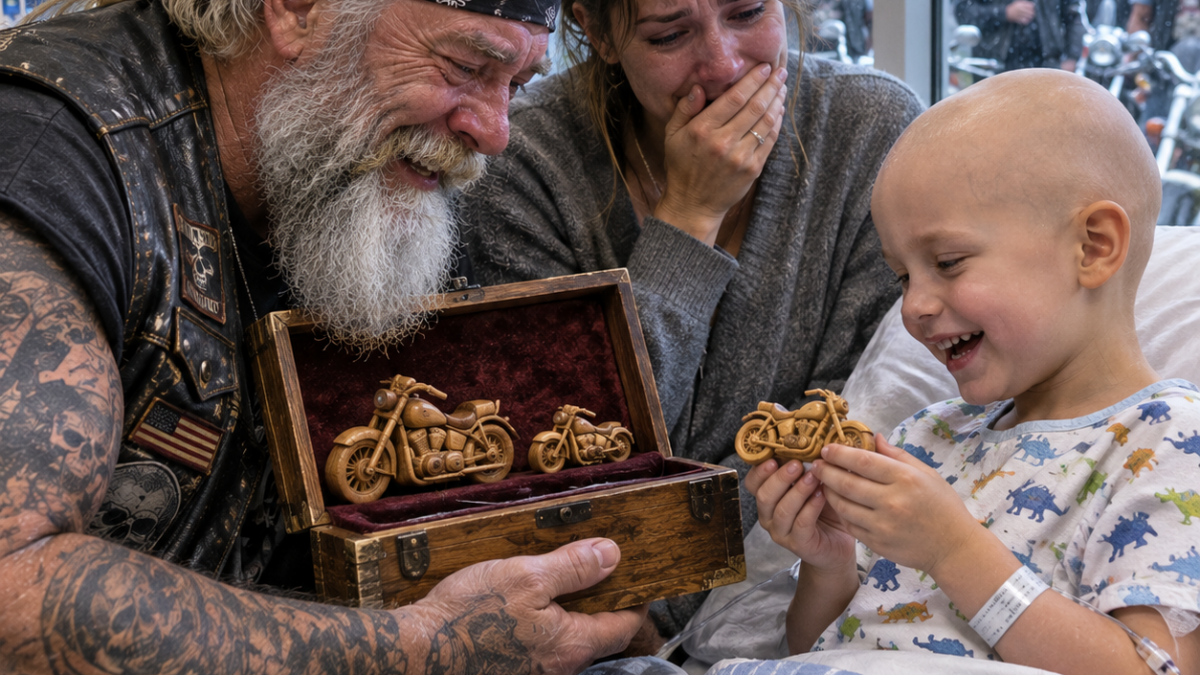
200 Bikers Came to Our Children’s Hospital With Gifts—But One Old Rider Carried Something He’d Been Waiting 3 Years to Give
More than two hundred bikers rolled into our children’s hospital carrying stuffed animals, toys, and enough wrapped gifts to fill half the lobby—and every child who could reach a window pressed against the glass to watch them arrive.
But one sixty-one-year-old biker stood apart from the others with a small wooden box hidden inside his vest and asked me for only one room: 4B.
Then he looked at me with tears gathering beneath a gray beard and said, “That’s my grandson in there. He’s six years old, he has leukemia, and he doesn’t know I exist.”
I’ve been a pediatric nurse for eleven years.
Long enough to know that people misunderstand children’s hospitals.
They imagine sadness first.
They imagine hallways where everyone whispers.
Bald heads.
Wheelchairs.
IV poles.
Parents sleeping upright in chairs because they’re afraid to go home.
And yes, all of that exists.
I’ve held mothers while their children went into surgery.
I’ve watched fathers stare at lab numbers as if staring hard enough could make them change.
I’ve watched toddlers learn to say “port” before they could properly pronounce their own last names.
I’ve watched teenagers lose their hair and pretend not to care because their younger siblings were watching.
There are days when I drive home after a twelve-hour shift and sit in my car for ten minutes before going inside because I don’t want to carry what happened on the unit into my kitchen.
But children’s hospitals are not only sad places.
They are loud.
Messy.
Funny.
Stubborn.
Full of kids who have figured out how to play hide-and-seek while dragging IV poles behind them.
Full of nurses who know which vending machine gives two snacks when you hit the button a certain way.
Full of parents who celebrate a bowel movement like somebody just won the lottery because chemo has made everything harder.
And every November, our hospital gets even louder.
That’s when the bikers come.
The first year I worked there, nobody warned me.
I was standing at the medication station on the third floor when the windows started vibrating.
I thought construction equipment had pulled into the parking lot.
Then one of the older nurses smiled.
“They’re here.”
“Who?”
She pointed outside.
Motorcycles.
Dozens.
Then more.
Then so many I stopped counting.
Chrome.
Black paint.
Red paint.
Flags.
Leather.
Rain gear.
Engines rumbling across the hospital lot.
PART2:
The annual toy run had been happening for years.
Different clubs.
Independent riders.
Veterans groups.
Retired firefighters.
Construction workers.
Mechanics.
Truck drivers.
Grandfathers.
Young riders.
Women riders.
Anybody who wanted to join and met the hospital’s rules.
They collected toys all year.
Then one morning in November, they rode them in.
I remember thinking it was going to frighten the children.
I was wrong.
Kids came alive.
The ones who could walk ran to the windows.
The ones who couldn’t asked to be wheeled over.
One little girl who had spent three days refusing physical therapy stood up because she wanted to see the motorcycles.
Her therapist later joked that insurance should reimburse Harleys.
The bikers came upstairs in small approved groups.
No chaos.
No barging into rooms.
Everything coordinated with child-life specialists.
They sanitized their hands.
Checked gift restrictions.
Asked permission.
Some children wanted visitors.
Some didn’t.
Both answers were respected.
The image stayed with me.
Men the world might cross a street to avoid, sitting on tiny plastic chairs while five-year-olds explained Pokémon to them.
Bearded riders wearing glitter stickers because a child demanded it.
Tattooed arms holding stuffed unicorns.
Leather vests covered in patches standing beside hospital gowns covered in cartoon dinosaurs.
Every November, I remembered why I stayed.
But the year I met Frank Dolan was different.
It was a cold Wednesday.
Rain had started before dawn.
By eight that morning, more than two hundred motorcycles had filled nearly every section of the designated parking lot.
The sound reached us before the riders did.
Deep, rolling thunder beneath the rain.
A boy named Mateo on the third floor had barely spoken for weeks.
He was nine.
Complications after a bone marrow transplant.
Pain.
Fatigue.
Isolation.
His mother told me he used to narrate everything he did at home.
Breakfast.
Video games.
Getting dressed.
Then somewhere during treatment, he had gone quiet.
That morning, he heard the motorcycles.
He pulled himself out of bed.
Dragged his IV pole toward the window.
His mother started to help.
He shook his head.
Did it himself.
When he saw the parking lot, his mouth opened.
He didn’t speak.
But he smiled.
That was enough to make his mother cry.
On the fourth floor, a four-year-old named Ava had a brain tumor.
She was tiny.
Barely thirty pounds.
She wore a purple knit cap most days because she hated people seeing the patch where surgery had taken her hair.
A biker named Bear entered carrying a stuffed rabbit.
I don’t know his real name.
Everybody called him Bear.
Six foot four.
Maybe six foot five.
Huge shoulders.
Gray beard.
Skull tattoos on both forearms.
Ava stared at him.
Bear stopped several feet away.
“Hi.”
She pointed at the rabbit.
“This?”
She nodded.
He knelt.
Held it out.
Ava took the rabbit.
Then reached forward and grabbed his beard.
Hard.
Bear made a noise that sounded like a wounded animal.
Ava laughed.
First real laugh her father had heard in days.
Bear started crying.
Right there.
On the floor.
He tried to hide it by pretending his eye was itchy.
Nobody believed him.
That was the toy run.
Loud outside.
Soft inside.
By ten, gifts were moving through every approved unit.
Then a man stepped away from the group and approached the nurses’ station.
I noticed him because he wasn’t carrying a toy bag.
He was holding the front of his vest closed with one hand.
Gray beard halfway down his chest.
Sixty-ish.
Thick arms.
Old tattoos.
Worn boots.
He had the look of someone who had spent thirty years outside in weather most people avoid.
“Ma’am?”
“Yes?”
“Can I ask you something?”
“Sure.”
“Room 4B.”
My attention sharpened.
“What about it?”
“I’d like to give something to the boy in there.”
“Do you know him?”
He swallowed.
“His name’s Noah.”
That made me cautious.
Patients’ room numbers and names are not casual information.
“Who are you?”
He pulled out his wallet.
Didn’t hand it to me yet.
“My name’s Frank Dolan.”
Then:
“I think I’m his grandfather.”
Think.
Not exactly a word you want connected to a pediatric patient.
“I’ll need more than that.”
“I know.”
He nodded quickly.
“I’m not asking you to let me walk in.”
Good answer.
“I just want you to ask his mom.”
He reached inside his vest.
Pulled out a wooden box.
Dark brown.
Hand-carved.
Maybe ten inches long.
Initials carved into the lid.
F.D.
R.D.
The box looked old.
Not antique-store old.
Family old.
Edges worn smooth from hands.
He held it like something fragile.
“What’s inside?”
He opened it.
Faded red velvet.
Two tiny carved motorcycles.
One dark with age.
One lighter.
Then he reached into another pocket.
Pulled out a third.
Fresh wood.
Small enough to sit in my palm.
Detailed handlebars.
Tiny seat.
Even little wooden wheels that turned.
He set it beside the other two.
“Three generations.”
I looked at him.
He exhaled slowly.
“That boy in there is my grandson.”
Then his voice broke.
“And he doesn’t know I exist.”
I had taken care of Noah for almost three months.
Six years old.
Acute lymphoblastic leukemia.
He loved dinosaurs.
Specifically triceratops.
If you called every dinosaur a T-Rex, he corrected you with the exhausted disappointment of a college professor dealing with an unprepared student.
He had a collection of drawings taped to the wall.
Some were his.
Some came from nurses.
His favorite was a green stegosaurus one of our respiratory therapists drew badly enough that Noah declared it “probably a lizard.”
His mother, Rachel, stayed constantly.
Early thirties.
Thin from stress.
Hair always tied up.
The same gray sweatshirt at least four days a week.
She slept in the foldout chair.
Ate cafeteria soup.
Read Noah stories even when he was too tired to listen.
Noah’s father had left when he was three.
I knew that much.
I had never heard Rachel mention her own father.
I asked Frank:
“Does Rachel know you’re here?”
“No.”
That was a problem.
“She may not want you here.”
“I know.”
“You can’t use the hospital to force contact.”
“I know.”
“You can’t go near that room unless she gives permission.”
“I know.”
He answered every restriction without arguing.
That mattered.
“How long has it been?”
“Five years.”
“Since you saw your daughter?”
He nodded.
“Why?”
Frank looked down at the box.
“Depends who you ask.”
“That means I should probably ask her.”
He almost smiled.
“Probably.”
I should have ended the conversation there.
Taken his name.
Asked Rachel privately.
Let the family decide.
That was the appropriate thing.
But something about the box bothered me.
Not suspiciously.
Emotionally.
“Why three motorcycles?”
Frank touched the oldest one.
“My father made this for me when I was two days old.”
He held up the tiny bike.
“My old man was a rider. Carpenter too. Not professionally. Just liked making things.”
He touched the second.
“I made this one when Rachel was born.”
I looked at him.
“She had it?”
“No.”
“You never gave it to her?”
He shook his head.
“Long story.”
Then he held up the newest motorcycle.
“This one’s Noah’s.”
“How long have you had it?”
“Three years.”
I stared.
“You carved it when he was three?”
“When I found out he existed.”
“You’ve been carrying it for three years?”
“Not every day.”
He almost smiled.
“Just every November.”
Then he told me something that made my chest tighten.
This was his third toy run since learning Noah was sick.
Actually, Frank corrected himself.
His third toy run since learning Noah existed.
The first year, Noah wasn’t hospitalized.
Frank simply rode with the club because he knew Rachel lived somewhere nearby and he had heard she had a little boy.
The second year, Frank learned Noah had been diagnosed with leukemia.
A mutual acquaintance told him.
He didn’t call Rachel.
He had tried before.
Letters returned.
Messages unanswered.
So he joined the hospital toy run.
Walked through our fourth-floor hallway.
Saw Noah through the glass.
Did not enter.
The next year, same thing.
He came with toys.
Passed Room 4B.
Saw his grandson asleep.
Kept walking.
“Why didn’t you ask then?”
Frank looked at me.
“Because I told myself I was respecting Rachel.”
“And now?”
“Now I don’t know if that was respect or cowardice.”
Rain tapped against the windows.
Behind us, bikers were unloading stuffed bears.
Frank continued.
“A buddy told me Noah’s been here three months.”
His voice lowered.
“The cancer.”
He looked down.
“I know the doctors are hopeful. I know kids beat this.”
Then:
“But people also say ‘good prognosis’ right before bad things happen.”
I understood that fear.
Every hospital family does.
“I kept thinking I’d wait until he went home.”
Frank rubbed the motorcycle with his thumb.
“Then I thought, what if I wait too long?”
He couldn’t finish.
I let the silence sit.
Then I asked:
“Why did Rachel stop speaking to you?”
Frank looked like he had expected the question.
“I was a bad father.”
Simple.
No defense.
No blaming her.
Just that.
“How bad?”
“Not violent.”
He looked at me quickly.
“Never hit her. Never hit her mom. Never scared her like that.”
“Then?”
“Gone.”
He said it quietly.
“I was gone a lot.”
Rides.
Club events.
Road trips.
Work.
Weekend runs.
He told himself he was providing.
Told himself Rachel’s mother understood who she married.
But there were birthdays he missed.
School events.
Weekends he promised to be home and wasn’t.
Rachel used to stand by the window waiting for the sound of his motorcycle.
Sometimes it came.
Sometimes it didn’t.
“When she was little, she loved the bike.”
Frank smiled faintly.
“Used to sit on it in the garage wearing my helmet.”
Then school started.
Other parents.
Other families.
Rachel became embarrassed.
She asked him to use his pickup when collecting her from school.
Asked him not to wear his vest to school events.
Asked him not to let club brothers crowd the driveway when friends came over.
Frank took those requests personally.
“I thought she was ashamed of me.”
“Was she?”
“Yeah.”
He shrugged.
“But kids are allowed to be embarrassed by their dads.”
That sentence told me he had spent a long time thinking.
His marriage collapsed when Rachel was fourteen.
Her mother left.
Frank did not fight hard enough for custody.
That was how he described it.
He accepted every-other-weekend visitation.
Then missed some weekends.
Not intentionally, he claimed.
Work.
Club funerals.
Breakdowns.
Bad planning.
Excuses.
Rachel noticed only one thing.
Dad wasn’t there.
When she turned eighteen, she moved away.
At twenty-three, Rachel met David.
Corporate job.
Clean haircut.
Wealthy parents.
Frank knew immediately they disliked him.
Not because he was cruel.
Because he looked wrong in their family photographs.
Rachel asked him to come to the wedding without the vest.
Frank refused.
She asked his club not to come.
Frank argued.
She told him maybe he should not come at all.
He went anyway.
Sat in the last row.
Vest on.
Two club brothers outside with motorcycles.
The groom’s family whispered.
Rachel saw them.
Frank saw her see them.
He left before reception.
Afterward, she stopped taking his calls.
Two years later, David left Rachel and one-year-old Noah.
Frank reached out.
No response.
Sent letters.
Returned.
Birthday cards.
No answer.
Then:
Nothing.
“You ever think about showing up at her house?”
“Every week.”
“Why didn’t you?”
“Because a locked door is still a boundary even if you’re the father on the other side.”
That sentence stayed with me.
Then he added:
“I just wish I’d understood boundaries when she was eight instead of when she was twenty-eight.”
I looked at the wooden motorcycle.
“What do you want from her now?”
“Nothing.”
“Frank.”
“I mean it.”
“Forgiveness?”
“If she gives it.”
“Relationship?”
“If she wants one.”
“What about Noah?”
His face broke.
“That’s different.”
“Why?”
“He’s six.”
“And?”
“He didn’t choose any of this.”
Frank looked through the hallway toward the patient rooms.
“I don’t need him to call me Grandpa.”
Then:
“I just don’t want him to die without knowing there was one more person in this world who loved him.”
That was the sentence.
The one that made me say:
“Wait here.”
I should be clear.
Hospital policy did not suddenly disappear because I was moved by his story.
I could not let him into Noah’s room.
I could not give him information.
I could not announce a new relative to a child.
Rachel had control over who entered that room.
As she should.
I found Noah sleeping after a difficult chemotherapy week.
Pale.
Breathing evenly.
A dinosaur book lying open beside him.
Rachel sat near the window scrolling on her phone.
I asked:
“Can we talk outside?”
She immediately looked worried.
“Is he okay?”
“Yes. He’s stable.”
Parents in hospitals learn to fear “Can we talk?”
I hated using it.
We stepped into the hallway.
“I need to ask you about someone.”
“Who?”
“There’s a man here with the toy run.”
Rachel’s expression stayed neutral.
“He asked specifically for Noah.”
Neutral disappeared.
“Who?”
“He says his name is Frank Dolan.”
Rachel went white.
Then red.
Then completely still.
“No.”
I hadn’t even asked the question.
“No.”
“Rachel—”
“No.”
She looked toward Noah’s door.
“He cannot come in here.”
“I understand.”
“How did he find us?”
“I don’t know.”
“Did you tell him anything?”
“No.”
“Did anyone give him Noah’s information?”
“Not from me.”
She started pacing.
“No. Absolutely not. He doesn’t get to do this.”
“Okay.”
“He doesn’t get to show up because Noah is sick and suddenly play grandfather.”
“Okay.”
“He had years.”
I stayed quiet.
“He had my entire childhood.”
Her voice cracked.
“Do you understand?”
“I’m listening.”
“My father is not some sweet old biker from a Christmas movie.”
“I didn’t say he was.”
“He chose that club over us.”
She pointed vaguely toward the parking lot.
“Those motorcycles. Those people. That life.”
I let her talk.
She needed to.
“My mother sat at home crying while he disappeared for weekends.”
“Sometimes a week.”
“He promised he’d pick me up and didn’t.”
“School events.”
“Birthdays.”
“One Christmas he came home two days late because someone’s bike broke down in Tennessee.”
Rachel laughed bitterly.
“Some guy’s motorcycle mattered more than his kid’s Christmas.”
I knew enough not to defend Frank.
Not my job.
“He embarrassed me constantly.”
She wiped her face.
“I used to beg him to pick me up in the truck.”
“He’d pull up on that Harley and rev it because he thought it was funny.”
“Kids stared.”
“I hated him for it.”
Then the wedding.
She told the same story.
Different perspective.
Frank had been asked to attend without club colors.
Her future in-laws had already made cruel comments.
She was trying to avoid a scene.
Frank refused.
“He said if they couldn’t accept who he was, they didn’t deserve me.”
Her eyes filled.
“I didn’t need him to fight them.”
“I needed him to choose me once.”
That sentence hit hard.
“He came in the vest.”
“His friends waited outside.”
“My mother-in-law whispered through half the ceremony.”
“My husband looked furious.”
“I spent my own wedding wondering what my father was going to do.”
“He left before the reception.”
Rachel shook her head.
“That was it.”
After David left, Frank called.
Rachel ignored him.
“I didn’t want to need him.”
She looked embarrassed by the admission.
“That sounds stupid.”
“No.”
“I was twenty-six with a one-year-old, no husband, barely enough money, and my father was offering help.”
“I said no because I didn’t want Noah around that world.”
She looked toward the bikers.
“I thought if I opened the door an inch, the club would come through it.”
“And now?”
“Now he uses my son’s cancer?”
“He hasn’t asked me to pressure you.”
“He asked for the room.”
“Yes.”
“That’s pressure.”
Fair.
I nodded.
“He said he would leave if you say no.”
Rachel looked surprised.
“He did?”
“Yes.”
She sat in the family consultation room.
Hands shaking.
I sat across.
“Why are you telling me all this?”
“Because he asked me to ask.”
“You think I should let him in.”
“I think the decision is yours.”
She looked angry.
“That’s a nurse answer.”
“Yes.”
“What would you do?”
“I don’t know.”
“You do know.”
“No.”
I leaned forward.
“Because I didn’t live your childhood.”
That softened her slightly.
I continued.
“I can tell you what I saw.”
“What?”
“A man who has come here three years.”
Her eyes lifted.
“What?”
I explained.
The toy runs.
Walking past Noah’s room.
Not entering.
The wooden motorcycle.
The box.
The one made by Frank’s father.
The second made for Rachel when she was born.
Her face changed.
“He made me one?”
“Yes.”
“No.”
“That’s what he said.”
“He never gave me anything like that.”
“It’s still in the box.”
Rachel covered her mouth.
For a moment she looked less like Noah’s exhausted mother and more like somebody’s hurt daughter.
“Why didn’t he give it to me?”
“I don’t know.”
Tears rolled.
She didn’t wipe them.
I told her about the third motorcycle.
Noah’s.
Three years in Frank’s vest every November.
Waiting.
Rachel whispered:
“That’s not fair.”
“No.”
“He can’t do something sentimental and erase twenty years.”
“No.”
“He doesn’t get to use Noah.”
“No.”
“He doesn’t get forgiven because he made a toy.”
“No.”
She stared at me.
“You agree with everything I say.”
“I’m not here to argue you into forgiving somebody.”
That finally made her breathe.
We sat in silence.
Then she asked:
“What does he want?”
“To give Noah the motorcycle.”
“Anything else?”
“He wants Noah to know he exists.”
Rachel closed her eyes.
“How does he know Noah has cancer?”
“A friend told him.”
She flinched.
Then:
“How long has he been standing out there?”
“Maybe twenty minutes.”
“Did he ask about Noah’s prognosis?”
“No.”
“Did he ask me to talk to him?”
“No.”
“Did he blame me?”
“No.”
She looked toward the door.
“Five minutes.”
I waited.
“If Noah wakes, he doesn’t tell him everything.”
“Okay.”
“He does not say I kept them apart.”
“Okay.”
“He does not make me the villain.”
“Okay.”
“He doesn’t touch Noah unless Noah asks.”
“Okay.”
“I stay in the room.”
“Of course.”
“And this does not fix anything.”
I stood.
“I’ll tell him.”
Rachel grabbed my wrist lightly.
“One more thing.”
“Yes?”
“If I change my mind…”
“He leaves.”
She nodded.
I returned to the nurses’ station.
Frank had not moved.
The wooden box on his lap.
He looked up.
I said:
“Five minutes.”
His eyes closed.
He whispered something.
Maybe thank you.
Maybe a prayer.
Then I gave him the rules.
He listened.
Every one.
“Understood.”
I walked him to Room 4B.
Rachel stood by the window.
Arms crossed.
Noah slept.
Dinosaur drawings everywhere.
Frank stopped at the doorway.
He saw his grandson for the first time up close.
Not through hallway glass.
Not across a nurses’ station.
Not as a name somebody mentioned.
A six-year-old boy.
Bald head.
Thin arms.
IV tubing.
One hand resting near a plastic triceratops.
Frank’s fingers tightened around the door frame.
His knuckles went white.
He didn’t enter immediately.
Rachel said:
“You can come in.”
Two words.
Frank looked at her.
“Hi, Rachel.”
Her face trembled.
“Hi, Dad.”
I had been present for codes.
Trauma activations.
Parents receiving diagnoses.
There are small sentences heavier than medical emergencies.
Those two words were one of them.
Hi, Dad.
Frank entered.
Pulled a chair beside the bed.
Did not sit too close.
Placed the wooden box on his knees.
He looked at Noah.
Then at Rachel.
“He looks like you.”
She didn’t answer.
Frank opened the box.
He took out the oldest motorcycle.
“Dad made this when I was born.”
Rachel watched.
Then the second.
“I made this when you were born.”
Her lips parted.
Frank held it toward her.
She did not take it.
Not yet.
He set it beside the first.
Then removed Noah’s.
Fresh wood.
Tiny wheels.
He placed it on the bedside table.
No speech.
No dramatic explanation.
He just sat.
Rain struck the window.
Finally, Frank rested his hand on the mattress.
Several inches from Noah’s.
Not touching.
“Hey, buddy.”
His voice barely existed.
“I’m your grandpa.”
Rachel turned away.
Frank continued.
“You don’t know me.”
He swallowed.
“But I know about you.”
His beard trembled.
“I knew the day you were born.”
Rachel covered her mouth.
“I’m sorry I’m late.”
Frank stopped.
Collected himself.
“But I’m here now.”
He pointed toward the motorcycles.
“Your great-grandpa made the old one.”
“I made the middle one for your mom.”
Then:
“And the little one’s yours.”
Frank picked it up.
Put it on the pillow near Noah’s hand.
“When you wake up, it’ll be here.”
He whispered:
“So you know somebody was thinking about you.”
Noah’s eyes opened.
Barely.
Chemo sleep is different from ordinary sleep.
Heavy.
Slow.
He blinked at Frank.
Then at the motorcycle.
One hand moved.
He picked it up.
Turned it.
“Cool.”
Frank laughed.
Not because it was funny.
Because his body had to do something with the emotion.
“You like it?”
Noah spun a wheel.
“You made it?”
“Yes.”
“Is it a Harley?”
Frank stared.
“How’d you know?”
Noah’s voice was raspy.
“The bikers.”
He pointed weakly toward the window.
“We watch them.”
Rachel wiped her face.
Noah continued.
“I like the loud ones.”
Frank glanced at Rachel.
“Your mom always hated the loud ones.”
Rachel almost smiled.
Almost.
Noah studied Frank’s arms.
“You have lots of tattoos.”
“I do.”
“Are you a biker?”
“Yeah.”
Noah considered this.
Then:
“Are you somebody’s grandpa?”
Frank’s face collapsed.
He nodded.
“Yeah.”
“Whose?”
Long silence.
Rachel stepped closer to the bed.
Frank looked at her.
She gave one tiny nod.
Frank turned back.
“Yours.”
Noah blinked.
“My grandpa?”
“If that’s okay.”
Noah looked at Rachel.
“Mom?”
Rachel sat on the edge of the bed.
“This is my dad.”
Noah looked between them.
“You have a dad?”
Rachel laughed through tears.
“Yes.”
“Why haven’t I seen him?”
There it was.
The question every adult had feared.
Rachel looked at Frank.
Frank started to speak.
She stopped him gently.
“Because grown-ups sometimes get mad at each other for a long time.”
Noah frowned.
“How long?”
“Too long.”
Frank looked at her.
That was the first gift Rachel gave him.
Not forgiveness.
Not yet.
But she did not make him a monster.
Noah turned the wooden motorcycle.
“Can he stay?”
Rachel closed her eyes for half a second.
Then:
“For a little while.”
Frank nodded quickly.
“Whatever your mom says.”
Noah hugged the motorcycle against his chest.
“Cool.”
Thirty seconds later, he was asleep again.
Frank did not move.
Rachel came behind the chair.
For a long time she just stood there.
Then she put one hand on Frank’s shoulder.
He froze.
Slowly, he covered her hand with his.
Neither spoke.
I left the room.
Some moments don’t need a nurse watching.
Five minutes became fifteen.
Rachel eventually came out.
Eyes swollen.
“You okay?”
“No.”
Fair answer.
“What now?”
She looked through the glass.
“I don’t know.”
That was honest too.
Frank did not suddenly become part of the family.
Not that day.
Hospital reconciliation is not a miracle cure.
People love stories where one emotional moment erases twenty years.
That is not how people work.
Frank left after twenty minutes.
Rachel kept the motorcycle.
Not hers.
Noah’s.
The box went with Frank.
The next day Rachel asked me:
“Did he come back?”
“No.”
She looked surprised.
“He told me he would wait for you to ask.”
Three days passed.
No Frank.
On the fourth, Rachel called him.
She still had his number memorized after five years.
That surprised her more than anyone.
She did not invite him over.
She said:
“Noah asked about you.”
That was enough.
Frank returned Tuesday.
Approved visitor.
One hour.
He brought a dinosaur drawing.
It was terrible.
Noah looked at it.
“What dinosaur is that?”
“Triceratops.”
“No.”
“What do you mean no?”
“It has four horns.”
Frank stared.
“That’s extra protection.”
“That’s not how dinosaurs work.”
Frank looked at Rachel.
“He’s judgmental.”
“He gets it from me.”
That was the first time I saw them laugh together.
Tiny moment.
But real.
Thursday, Frank returned.
Another dinosaur.
Worse.
Noah loved it.
The week after that, Rachel asked Frank to bring the wooden box.
She sat by the window while Noah slept.
Frank placed it in her lap.
She opened it.
Touched the motorcycle he made for her more than thirty years earlier.
It was lighter wood than his father’s.
One wheel slightly uneven.
Her initials underneath.
R.D.
She rubbed her thumb over them.
“Why didn’t you give this to me?”
Frank looked at the floor.
“I was going to.”
“When?”
“Your first birthday.”
“What happened?”
“You had too many toys.”
Rachel stared.
“That’s your excuse?”
“No.”
He smiled sadly.
“The real answer is I kept thinking I’d give it to you when you were old enough to understand it.”
“Then?”
“Then I put it away.”
“Why?”
“Life.”
She looked angry.
“Life is what you called it every time you didn’t come home.”
Frank nodded.
“Yes.”
No defense.
Rachel’s anger grew because he wasn’t fighting.
“You missed my eighth birthday.”
“I know.”
“My school concert.”
“I know.”
“You told me you’d be there.”
“I know.”
“You always knew.”
“Yes.”
“Then why?”
Frank rubbed both hands over his face.
“Because I was selfish.”
Rachel looked stunned.
No explanation about the club.
No breakdown.
No friend in trouble.
No work emergency.
Just:
Selfish.
“I thought being a good man to everybody else meant I was a good father.”
He looked at her.
“It didn’t.”
Rachel cried.
Frank continued.
“Your mom asked me for less riding.”
“I told her she was trying to control me.”
“You asked me not to embarrass you.”
“I decided you were ashamed.”
“You needed me to prove I could choose you.”
“And I kept proving something else.”
Rachel covered her eyes.
Frank’s voice broke.
“I’m sorry.”
She shook her head.
“I needed that when I was fourteen.”
“I know.”
“Not now.”
“I know.”
“You don’t get those years back.”
“I know.”
Frank looked toward Noah.
“I’m not asking for them back.”
“Then what are you asking for?”
He answered quietly:
“Whatever time you’re willing to give me next.”
That was the beginning.
Not the end.
Some weeks Rachel allowed two visits.
Some weeks one.
Once Frank said something dismissive about Noah’s father and Rachel asked him to leave.
He left.
Did not argue.
The following visit he apologized.
When Noah got a fever and treatment was delayed, Frank sat outside the room for six hours.
Rachel slept.
When she woke, Frank was still there.
“Why didn’t you go home?”
“No place I needed to be more.”
That sentence hurt her.
I could see it.
Because it was what she had wanted to hear when she was eight.
Healing can hurt even when it’s happening.
Noah’s treatment continued.
Some days good.
Some terrible.
One morning his counts were low and he could barely speak.
Frank came with no dinosaur drawing.
Just sat.
Noah whispered:
“Grandpa?”
Frank’s entire face changed.
First time.
“Yes?”
“You got a motorcycle?”
“Yes.”
“Big?”
“Very.”
“Can I ride?”
“When you’re thirty-five.”
Noah frowned.
“Mom said maybe when I’m ten.”
Frank looked at Rachel.
Rachel smiled.
“I said sit on one when you’re ten.”
“That’s different.”
Noah closed his eyes.
“We’ll negotiate.”
Frank later told half the club:
“My grandson called me Grandpa.”
Every rider pretended not to get emotional.
They failed.
The toy run bikers started asking about Noah.
Frank never shared medical details without Rachel’s permission.
That mattered.
They sent dinosaur toys.
A dinosaur helmet.
Books.
One biker who painted motorcycles made Noah a small canvas showing a T-Rex riding a Harley.
Noah declared it scientifically impossible and hung it above his bed.
Rachel gradually met some of the club.
Not the version she remembered from childhood.
Many of those men were gone.
Older.
Grandfathers.
One owned a bakery.
One volunteered at an animal shelter.
One still looked terrifying and knitted baby hats because his late wife taught him.
Rachel watched them carry toys into hospital rooms.
Watched them sanitize hands.
Ask permission.
Leave when children were tired.
Eventually she said to Frank:
“I think I spent years believing the club was why you weren’t there.”
Frank nodded.
“It made it easier.”
“For who?”
“Both of us.”
“What was the real reason?”
“I chose badly.”
She looked at him.
“That simple?”
“Probably.”
Then:
“The club didn’t miss your birthdays. I did.”
Rachel had spent decades hating leather because it was easier than admitting the man inside it had disappointed her.
Frank had spent decades hiding behind leather because it was easier than facing how much his choices had hurt his daughter.
Noah’s cancer forced them into the same room.
But cancer did not heal them.
They did that themselves.
Slowly.
Painfully.
One conversation at a time.
Three months after that first meeting, Noah completed an important phase of treatment.
The doctors used the phrase:
“Excellent response.”
Not cured.
Not finished.
But excellent.
Rachel cried in the hallway.
Frank was there.
She hugged him before she realized she was doing it.
Then froze.
Frank did not squeeze harder.
Did not turn it into a moment.
He simply held her until she stepped away.
“Sorry.”
“Don’t be.”
The kid-sized motorcycle Frank was building became a running joke.
He had announced the idea after Noah said he wanted to ride.
Rachel said:
“Absolutely not.”
Frank said:
“It’s electric.”
“No.”
“Five miles per hour.”
“No.”
“Training wheels.”
“No.”
“Remote kill switch.”
“No.”
“Three miles per hour?”
Rachel stared.
Frank:
“Two?”
Noah whispered from the bed:
“One?”
Rachel laughed.
Eventually, the compromise became a small electric balance bike designed for children, with proper safety equipment, supervised use, and no resemblance to the machine Frank originally imagined building.
He complained.
Then built it exactly according to Rachel’s rules.
That mattered too.
Old Frank would have built what he wanted and insisted everyone accept it.
New Frank asked.
Waited.
Listened.
One evening I passed Room 4B.
Noah was laughing.
Real laughter.
Not polite.
Not tired.
Frank was holding the wooden Harley and making engine noises.
Noah crashed it into a stuffed triceratops.
“You killed him!”
Frank protested.
“He ran into traffic.”
“He’s extinct!”
“Exactly.”
“That doesn’t make sense!”
Rachel sat beside them smiling.
On the windowsill:
The wooden box.
Open.
Three motorcycles arranged in a line.
Frank’s father.
Frank.
Rachel.
Noah.
Three generations of wood.
Four generations of people, depending how you count Dale’s memory and family lines differently.
The oldest motorcycle worn smooth from Frank’s childhood.
Rachel’s untouched for decades.
Noah’s fresh.
One family had spent years apart.
The box had kept the pieces together even when the people weren’t.
Christmas arrived while Noah was still in treatment.
Frank asked Rachel if she wanted him there.
Not assumed.
Asked.
She said yes.
The club organized a small visit.
Not two hundred riders.
Four.
Noah was immunocompromised.
Hospital rules.
The men followed every one.
Frank gave him a dinosaur book.
Noah gave Frank something.
A drawing.
A motorcycle.
Frank on it.
Rachel standing beside him.
Noah in front.
The proportions were terrible.
Frank’s beard reached his knees.
Underneath Noah had written:
MY GRANDPA.
Frank stared so long Noah asked:
“Do you hate it?”
Frank shook his head.
“Kid, this is going in my house forever.”
It did.
Months later, Noah went home.
Not cancer-free.
But stable enough to continue treatment outpatient.
The day he left, nurses lined the hall.
Small celebration.
No huge fanfare.
Some children hate noise after months in hospitals.
Noah wore a dinosaur hoodie.
Held the pink hospital discharge folder.
Carried his wooden Harley in one pocket.
Frank waited downstairs.
Not because Rachel had excluded him.
Because he was doing something outside.
I walked Noah and Rachel toward the entrance.
The glass doors opened.
No motorcycles running.
But motorcycles everywhere.
Maybe thirty.
Not two hundred.
Every rider standing silently beside his bike.
No engines.
No revving.
Just people.
Frank stood at the front.
Beside him:
The little electric balance bike.
Green.
Dinosaur decals.
Rachel stopped.
“Frank.”
He raised both hands.
“Before you yell.”
“I’m going to.”
“Helmet.”
He held it up.
“Knee pads.”
Another hand.
“Remote limiter.”
“Frank.”
“One mile per hour.”
Noah screamed:
“IT HAS DINOSAURS!”
Argument over.
Rachel covered her face.
She was laughing.
Frank crouched.
“Not today, buddy.”
Noah’s smile faded slightly.
“When?”
“When your mom says.”
Noah looked at Rachel.
She sighed.
“When your doctor says and when I say.”
Frank nodded.
“Two bosses.”
“That’s right.”
Old Frank might have challenged her.
He didn’t.
That may have been the most important thing Rachel saw all year.
He had learned who got to make decisions about her child.
Not the grandfather.
Not the biker club.
Her.
Noah continued improving.
Then another scan.
Another test.
Another milestone.
I try to be careful with words like miracle.
Children’s hospitals teach you not to promise endings.
Noah’s treatment continued for years.
There were scares.
Fevers.
Unexpected admissions.
One infection that put him back on our floor for nine days.
A month when his counts refused to cooperate.
A night when Rachel called Frank at 2:00 a.m. without thinking.
He answered before the second ring.
“I’m coming.”
She said:
“I didn’t ask you to.”
“I know.”
Then:
“Do you want me?”
There was a long silence.
“Yes.”
He came.
That conversation meant as much as any apology.
Rachel had spent years refusing to need him.
Frank had spent years confusing being needed with being entitled to enter.
Now he asked.
She answered.
That is what reconciliation looks like when it is real.
Not forgetting.
Not pretending.
Choice.
Over time, Rachel talked about her mother.
Frank listened to things he did not enjoy hearing.
How lonely his wife had felt.
How Rachel learned not to expect him.
How the rumble of motorcycles had once made her angry because sometimes it meant he was leaving again.
Frank did not defend every memory.
Sometimes he corrected details.
Sometimes Rachel did.
Memory is imperfect.
But whenever the central truth appeared, Frank owned it.
“I should have been there.”
That phrase repeated often.
One day Rachel asked:
“Why didn’t you fight for custody?”
Frank stared at the floor.
“Because I thought you’d choose your mom anyway.”
“You didn’t ask.”
“No.”
“You just gave up.”
“Yes.”
“I thought you didn’t want me.”
Frank’s eyes filled.
“I thought letting you choose without a fight was loving you.”
“It didn’t feel like love.”
“I know that now.”
Rachel nodded.
Nothing fixed.
Yet something moved.
The next November, the toy run came again.
Two hundred motorcycles.
Maybe more.
Rain again.
Apparently bikers and bad weather have some kind of agreement.
Noah was home that year but came for a short approved visit as part of a hospital survivorship event.
Mask when needed.
Doctor approved.
He stood near the lobby doors wearing a dinosaur jacket.
Frank rode in with the first group.
When Noah saw him through the glass, he shouted:
“THAT’S MY GRANDPA!”
Half the lobby heard.
Frank definitely heard.
He climbed off the bike.
Turned away.
Pretended to adjust his helmet.
I knew better.
By then I had seen him cry enough times to recognize the technique.
Noah ran toward him.
Frank knelt.
Noah hugged him.
Rachel walked behind.
No hesitation.
No crossed arms.
Not everything forgotten.
But something rebuilt.
The toy run remained enormous.
Stuffed animals.
Books.
Games.
Gift cards for teenagers who did not want toys.
Infant supplies.
Donations for families staying long-term.
The bikers learned over the years to coordinate with child-life specialists so gifts actually matched hospital needs.
It wasn’t simply dumping toys into a lobby.
It became organized.
Useful.
Respectful.
That day Bear returned.
Same enormous man.
Less hair.
Same beard.
Ava, the little girl who once pulled it, was no longer our patient.
She had finished treatment.
Her family sent a photograph every year.
Bear carried it in his wallet.
He showed it to anyone foolish enough to make eye contact.
I watched all those riders fill our hospital again.
Then I watched Frank.
Noah had one hand in his.
Rachel stood beside them.
The wooden motorcycle was tucked into Noah’s coat pocket.
And I realized something.
The first time Frank came to our hospital, he thought he had come to give Noah a gift.
He was wrong.
The motorcycle was not the important thing.
The box was not the important thing.
Even the reconciliation was not the first gift.
The first gift was restraint.
Frank could have forced himself into Rachel’s life years earlier.
Shown up at her house.
Demanded grandparent rights.
Created scenes.
Used friends.
Sent people.
He didn’t.
Maybe part of that was fear.
Maybe guilt.
Maybe cowardice, as he called it.
But when he finally stood at our nurses’ station, he did something his younger self might not have done.
He asked.
And then he accepted that the answer might be no.
That difference was what allowed Rachel to eventually say yes.
Noah’s treatment officially ended when he was nine.
Not every child gets that day.
I wish they did.
The hospital held a small bell ceremony.
Noah was old enough now to understand why adults were crying.
He rang the bell three times.
Rachel cried.
I cried.
Every nurse within sight cried.
Frank cried before Noah even touched the bell.
Afterward, Noah handed him something.
The small wooden Harley.
The one Frank carved years earlier.
Frank frowned.
“This is yours.”
“I know.”
“Then why are you giving it to me?”
“Keep it.”
“No.”
“Grandpa.”
Frank stopped.
Noah said:
“When I get old, you give it back.”
Frank smiled.
“How old?”
“Like thirty.”
Frank looked offended.
“I’ll be dead.”
Rachel slapped his shoulder.
“Dad.”
“What?”
Noah rolled his eyes.
“You’ll be like a hundred.”
“That’s not better.”
They laughed.
Frank kept the motorcycle.
For six months.
Then gave it back on Noah’s tenth birthday.
“I decided thirty was unreasonable.”
Noah put it back in the wooden box.
By then Rachel’s motorcycle had finally been removed too.
She took it home.
Thirty-some years after Frank carved it.
She put it on her dresser.
One afternoon I asked her:
“Why there?”
She looked embarrassed.
“I don’t know.”
Then:
“I think part of me likes seeing proof that he thought about me even when he was bad at showing it.”
That sentence explained a lot about reconciliation.
People are rarely all one thing.
Frank had failed her.
Repeatedly.
He also loved her.
Both were true.
Rachel did not need to erase one truth to accept the other.
Frank never got his missed birthdays back.
Never got her childhood back.
Never got the wedding reception back.
Noah’s illness didn’t magically absolve him.
What he got was the opportunity to behave differently now.
He took it.
Years later, Noah barely remembers the first day Frank entered Room 4B.
He remembers the wooden motorcycle because adults told the story.
He remembers chemo in fragments.
The smell of sanitizer.
Dinosaur stickers.
A nurse named Sarah who sang badly.
The toy-run motorcycles outside the windows.
He remembers Frank later.
Building things.
Teaching him how to sand wood with the grain.
Arguing about dinosaurs.
Taking him to his first motorcycle show at thirteen.
Rachel went too.
Frank arrived in his truck.
Noah asked:
“Why not the Harley?”
Frank pointed at Rachel.
“Your mother traumatized me.”
Rachel answered:
“You learned.”
He smiled.
“Yes, ma’am.”
That single exchange would have been impossible years earlier.
Frank became the grandfather he wished he had been a father.
Not perfect.
Nobody is.
He still overpromised occasionally.
Difference was:
He followed through.
If he told Noah:
Saturday at ten.
He arrived at 9:45.
Every time.
Rachel noticed.
One day she asked him:
“Why are you always early?”
Frank answered:
“Because you remember every time I was late.”
She had no response.
Neither did I when she told me.
Frank eventually gave her the wooden box itself.
On Noah’s fifteenth birthday.
The oldest motorcycle belonged to Frank.
Rachel’s beside it.
Noah’s beside hers.
He handed Rachel the box.
“You keep it now.”
“Why?”
“I had it long enough.”
She ran her fingers over F.D. and R.D. carved into the lid.
“Who’s R.D.?”
“My dad. Robert Dolan.”
Rachel smiled.
“Not me?”
“No.”
“That’s rude.”
“You weren’t born.”
“Still.”
Then Frank said:
“Add yours.”
Rachel looked up.
“What?”
“Your initials.”
The box represented three generations.
Rachel had never been carved into the lid.
Only into the motorcycle inside.
Frank handed her his pocket knife.
She carved:
R.D.
Again.
Same initials as her grandfather.
Then Noah added:
N.D.
Frank laughed.
“Now nobody will know who anything belongs to.”
“That’s family,” Rachel said.
Maybe it was.
I’m still at the hospital.
Eleven years became twelve.
Then thirteen.
Some nurses leave pediatric oncology because it is too much.
I understand.
Others stay because the good days become impossible to abandon.
I stayed.
Partly because every November the parking lot starts shaking.
Children move toward the windows.
Motorcycles fill the rain.
Stuffed animals appear.
People the world has already judged walk through hospital doors and ask:
“Who needs something?”
Not:
Who deserves it?
Not:
Who has parents with money?
Not:
Who looks grateful?
Just:
Who needs something?
The toy run has changed.
Some original riders are gone.
Some too old to ride.
Younger members arrive now.
Some women lead groups.
Electric motorcycles occasionally appear, which makes the Harley guys deeply offended.
Bear still comes when his knees allow it.
Frank still comes.
Older.
Beard whiter.
Slower walking.
He doesn’t carry Noah’s motorcycle anymore.
No need.
The boy knows him.
That was the only thing Frank ever truly wanted.
A few years ago, Noah came with him as a teenager.
Healthy.
Tall.
Hair thick.
Nobody looking at him would know he once spent months in Room 4B unless he told them.
He carried a bag of dinosaur toys.
I asked:
“Still dinosaurs?”
He looked offended.
“Dinosaurs remain objectively superior to motorcycles.”
Frank was behind him.
“After everything I’ve done.”
Noah laughed.
Then they started handing gifts out.
At one point, Noah met a six-year-old boy who had just been diagnosed.
Scared.
Quiet.
Noah sat with him.
Pulled a little wooden dinosaur from his pocket.
Hand-carved.
I recognized Frank’s work immediately.
Except Frank hadn’t made it.
Noah had.
He handed it over.
“I was here when I was little too.”
The boy looked at him.
“Did you get better?”
Noah glanced at me.
Then at his grandfather.
“Yes.”
Simple answer.
Not a promise.
Not every story ends the same.
But that child needed hope in that moment.
Funny word.
Hope.
Hospitals are full of it.
Careful hope.
Measured hope.
Hope with lab values and disclaimers.
Hope that understands fear and stays anyway.
I watched Noah give that child the dinosaur.
Frank stood behind him crying.
Of course.
Rachel eventually stopped apologizing for crying too.
She joined him at the next toy run.
Then the next.
She never became a biker.
Frank offered to teach her to ride.
She said:
“I spent my entire childhood begging you to stop bringing motorcycles into everything.”
He said:
“So that’s a maybe.”
“No.”
“Strong maybe.”
“Dad.”
He grinned.
She called him Dad easily now.
Not always.
Sometimes Frank.
Sometimes Dad.
Reconciliation has no straight line.
But she calls.
Birthdays.
Holidays.
Random Tuesdays.
When his blood pressure medication changed, she called every night for a week.
Frank complained.
She said:
“You disappeared on me for twenty years. You can tolerate one week of phone calls.”
He shut up.
When people hear their story, they often want to make Rachel the difficult daughter who kept a loving grandfather away.
That bothers me.
Rachel was not cruel.
She was hurt.
There is a difference.
Children remember who shows up.
They also remember who doesn’t.
Frank’s regret did not erase her childhood.
Noah’s illness did not require her to forgive him.
She chose to open the door because Frank finally approached it differently.
He did not kick it.
Did not demand.
Did not tell her that blood entitled him to enter.
He waited.
He asked.
Then, when she said five minutes, he treated those five minutes like a gift.
That is why there was a sixth.
And a seventh.
And years.
The day Frank first approached my nurses’ station, I thought the story was about a grandfather meeting a sick grandson.
It wasn’t.
Not entirely.
It was about a father finally learning how to come back without demanding that the person he hurt pretend nothing happened.
It was about a daughter discovering she could remember the pain without refusing every future possibility.
It was about a six-year-old boy who did not know enough about adult pride to understand why his mother and grandfather had wasted five years apart.
All Noah knew was:
This old man makes terrible dinosaur drawings.
This old man carved me a motorcycle.
This old man keeps coming back.
Children simplify what adults complicate.
Maybe sometimes we need that.
Frank told me once, years later:
“The biggest mistake I made with Rachel was thinking love was something she was supposed to know.”
I asked:
“What do you mean?”
He said:
“I figured she knew I loved her.”
“I worked.”
“I fixed things.”
“I came home eventually.”
“I thought she should understand.”
He shook his head.
“Kids don’t need to understand love.”
“They need to experience it.”
Then he looked toward Noah.
“So now I show up.”
That was all.
Show up.
Hospitals teach the same lesson.
You cannot always cure.
Cannot always fix.
Cannot always say the right thing.
Sometimes all you can do is stay.
At the bedside.
In the waiting room.
Beside a frightened parent.
In a rain-soaked parking lot with two hundred motorcycles and bags of toys.
The first Wednesday I watched those riders roll into our hospital, I thought the motorcycles were the story.
The noise.
The leather.
The tattoos.
The contrast.
Years later, I know better.
The bikes get the children to the window.
The gifts make them smile.
But the thing that matters most cannot be wrapped.
Presence.
A four-year-old with a brain tumor grabbing a biker’s beard and discovering she can still laugh.
A quiet boy walking his IV pole toward a window because something outside caught his attention.
A mother sleeping in a chair for three months.
A nurse eating lunch beside a child because his parent had to go home for one afternoon.
A sixty-one-year-old man carrying the same carved motorcycle for three Novembers because he was terrified he had already lost too much time.
That first day, Frank thought the wooden box held the gift.
It didn’t.
The gift was the fact that he had finally learned to knock.
And Rachel, after everything, chose to open the door.
Only five minutes.
That was enough.
Because five minutes became Tuesdays.
Then Thursdays.
Then a kid-sized motorcycle.
Then hospital discharge.
Then birthdays.
Then ordinary phone calls.
Then years.
The box still exists.
Frank showed it to me last November.
The velvet is almost completely faded now.
Four sets of initials are carved into different parts.
The motorcycles sit in a row.
His father’s.
His.
Rachel’s.
Noah’s.
And tucked into the corner is something new.
A tiny wooden triceratops.
Noah carved it.
Frank hates that it is in the motorcycle box.
He keeps it there anyway.
That Wednesday, more than two hundred bikers rolled into the hospital again.
The parking lot trembled.
Children crowded the windows.
Some clapped.
Some cried.
Some simply stared.
Frank stood near the entrance carrying two bags of stuffed dinosaurs because apparently he has finally accepted defeat.
Noah stood beside him.
Rachel too.
I watched them enter together.
Three people who once spent years separated by pride, shame, disappointment, and silence.
Now Frank held the elevator for his daughter.
Rachel reached back to make sure Noah was following.
Noah complained that both of them were walking too slowly.
An ordinary family argument.
The kind nobody appreciates until they have almost lost the chance to have one.
People often ask why the bikers come every year.
I could give the official answer.
They collect gifts.
Support families.
Raise awareness.
Bring joy.
All true.
But after eleven years on a children’s floor, I think there is another reason people keep coming back to hospitals even when hospitals hurt.
Because walking into a place full of fear and carrying something good is one of the few things ordinary people can always choose to do.
Sometimes that good thing is a teddy bear.
Sometimes a dinosaur.
Sometimes a bag of toys.
Sometimes a bad drawing.
Sometimes five minutes.
And sometimes it is a small wooden box that has been waiting three years inside a leather vest.
Frank once told me he wished he had a dramatic way to explain how he got his daughter back.
He doesn’t.
There was no miracle speech.
No instant forgiveness.
No single apology big enough.
He simply kept arriving after the door opened.
And Rachel kept deciding, one visit at a time, whether to let him stay.
That is how they rebuilt it.
Not all at once.
Not because cancer made old pain unimportant.
But because Noah’s illness reminded both of them that time is never something you should assume you have.
The first day Frank walked into Room 4B, he bent over Noah’s bed and whispered:
“I’m sorry I’m late. But I’m here now.”
Years later, I think that may be the most honest apology he ever gave.
He was late.
Very late.
But he came.
And this time—
he stayed.








