A Biker Slept Outside My Daughter’s Hospital Room for 9 Nights—Then the Director Read One Piece of Paper and Went White
A Biker Slept Outside My Daughter’s Hospital Room for 9 Nights—Then the Director Read One Piece of Paper and Went White
My eight-year-old daughter had relapsed leukemia, no home left to return to, and an insurance company saying she was “stable enough” to be discharged by Friday.
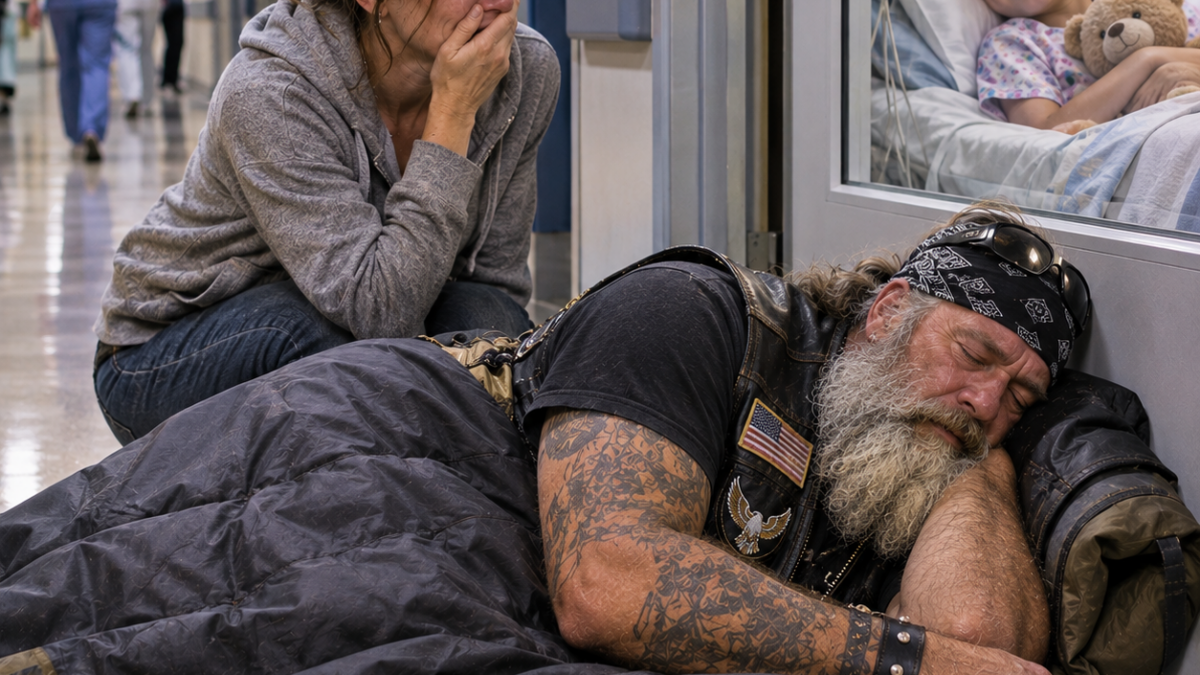
Then a gray-bearded biker I had never met unrolled a sleeping bag across the hallway outside her room and told hospital security, “That child isn’t leaving until somebody remembers what this place promised.”
On the ninth night, the hospital director arrived with two police officers to remove him—until the biker handed him a ten-year-old document bearing the name of another little girl who had once been sent home to die.
My daughter Emma was eight years old when the doctors stopped saying “when.”
When she goes into remission.
When her hair grows back.
When she goes back to school.
When she gets strong enough to ride her bike again.
The first time she had leukemia, every sentence sounded like that.
When.
Not if.
It mattered more than I understood.
Words become furniture in hospital rooms.
You lean on them.
Build your whole future around them.
The first time Emma got sick, she was six.
She had bruises that didn’t make sense.
Fevers that came and went.
A tiredness no amount of sleep fixed.
One Friday afternoon she fell asleep on the kitchen floor while I was making grilled cheese.
Not curled up with a blanket.
Just sat down beside the refrigerator and closed her eyes.
I carried her to bed.
The next morning I took her to urgent care.
By Sunday night, we were in pediatric oncology.
Acute lymphoblastic leukemia.
I remember the doctor speaking carefully.
I remember staring at his tie because if I looked at his face, I thought I might stop breathing.
I remember Emma asking:
“Do I still have to go to school Monday?”
PART2:
That was the first thing she wanted to know.
The doctor laughed gently.
“No school Monday.”
She smiled.
For about ten seconds, leukemia sounded like a vacation.
Then treatment began.
Needles.
Steroids.
Lumbar punctures.
Nausea.
Hair loss.
Fevers.
Hospital admissions.
Blood counts.
A vocabulary no mother should have to learn but every cancer parent eventually speaks like a second language.
Emma fought.
That word gets used too casually with sick children.
People say:
She’s a fighter.
He’s so brave.
As if children choose battle.
Emma didn’t choose anything.
She cried during port access.
Hated medicine.
Complained about hospital food.
Threw up.
Got angry.
Refused to talk to nurses when she was tired.
Then she did what children do.
She kept waking up.
Kept coloring.
Kept laughing sometimes.
Kept living.
After treatment, remission.
We celebrated.
I made cupcakes shaped like flowers.
Emma went back to school.
Hair grew in darker and curlier.
I went back to work at a dental office.
For a while, I let myself believe we had paid whatever terrible price life demanded.
Then March came.
Routine bloodwork.
A phone call.
Doctor asking us to come in.
No details over the phone.
If you’ve ever lived through cancer once, you know exactly what “come in” means.
Relapse.
This time, everything felt different.
The doctors were still kind.
Still professional.
Still trying.
But the language shifted.
They discussed options.
Response rates.
Additional chemotherapy.
Transplant possibilities.
Complications.
Comfort.
Goals.
One night after Emma fell asleep, Dr. Anand sat beside me.
She had treated Emma since the first diagnosis.
Small woman.
Fast talker.
Always moving.
That night, she sat.
I knew before she said anything.
“We are still treating her.”
I nodded.
“But…”
She paused.
“There is a real possibility that this disease may not respond the way it did the first time.”
I stared at the blanket covering Emma’s legs.
“What are you saying?”
“I’m saying we hope.”
I hated that word.
Hope sounded smaller than when.
“How much hope?”
Dr. Anand didn’t answer with a percentage.
I appreciated that later.
At the time, I wanted a number.
I wanted somebody to tell me exactly how many days I had left with my child.
Instead, she squeezed my hand.
“We keep going.”
So we did.
By May, I had missed so much work that the dental office could no longer keep my position open.
They were kinder about it than they had to be.
That almost made it worse.
Medical bills had swallowed my savings.
Then came mortgage payments.
Utilities.
Car repair.
Gas to the hospital.
Food.
Every ordinary expense becomes offensive when your child might die.
You look at an electric bill and think:
How dare the lights cost money right now?
I sold our house.
Not some beautiful family estate.
A small two-bedroom place with yellow siding Emma always called “the lemon house.”
It was the only home she remembered.
We sold it because equity meant medicine, transportation, bills, survival.
I told Emma we were “moving in with Aunt Claire for a little while.”
She asked if she could paint her new room purple.
I said:
“Probably.”
There was no room.
My sister Claire had a two-bedroom apartment and two children of her own.
Emma and I slept in what had technically been a storage room.
Twin mattress.
Old dresser.
Boxes stacked against one wall.
A small plug-in space heater because the vent barely worked.
Claire gave us everything she could.
I will never be ungrateful.
But it was not a safe place for a medically fragile child who was increasingly in pain and needed medication around the clock.
Then one Tuesday afternoon, a case manager walked into Emma’s hospital room carrying a clipboard.
Her name was Ms. Pratt.
Late forties.
Tired eyes.
She sat beside me.
That always means something bad in a hospital.
“Ms. Dalton?”
“Jenna.”
“Jenna. I need to discuss discharge planning.”
I looked at Emma.
She was watching cartoons with the volume low.
“Discharge?”
“Your insurance has declined further inpatient coverage after Friday.”
I thought I misheard.
“She’s still sick.”
“I understand.”
“She has leukemia.”
“Yes.”
“She needed breakthrough pain medication twice last night.”
“She is considered medically stable for discharge with outpatient and home-care support.”
Home.
One word.
I almost laughed.
“Home where?”
Ms. Pratt glanced at her paperwork.
“Your address says—”
“That house is gone.”
She looked up.
“I sold it.”
Silence.
“I sold our house to pay for treatment.”
“I’m sorry.”
“We’re living at my sister’s.”
“Then we can coordinate—”
“You don’t understand.”
My voice rose.
Emma glanced over.
I lowered it.
“My sister’s spare room barely has heat.”
Ms. Pratt’s expression changed.
“Does the home have working utilities?”
“Yes.”
“Running water?”
“Yes.”
“Electricity?”
“Yes.”
Technically habitable.
Technically safe.
That word technically has probably hurt more families than anyone knows.
“Emma needs pain medication every four hours.”
“We can arrange instructions.”
“I am one person.”
“Home nursing may be available depending on—”
“Depending on insurance?”
She didn’t answer.
I started crying.
Not gracefully.
Months of fear came out.
“I don’t know how to do this.”
Ms. Pratt put down the clipboard.
“I know.”
“No, you don’t.”
She took that without defending herself.
“I’m sorry.”
“Then don’t send her.”
“I don’t make coverage decisions.”
“Who does?”
She gave me department names.
Insurance appeals.
Utilization review.
Discharge planning.
Financial counseling.
A maze.
Everybody responsible for one small piece.
Nobody responsible for the whole frightened child.
Finally Ms. Pratt said:
“I’m sorry, ma’am. It’s policy.”
I walked into the hallway because I did not want Emma seeing me collapse.
I leaned against the wall.
Then slid down.
I cried so long I didn’t notice the man sitting near the elevator.
Big.
Really big.
Gray beard.
Leather vest.
Boots.
Hands folded between his knees.
He watched me once.
Not in a creepy way.
More like somebody checking whether I was physically okay.
I wiped my face.
Stood.
Went back into Emma’s room.
Ten minutes later, I heard something dragging across the floor.
I stepped out.
The biker was back.
Sleeping bag under one arm.
He unrolled it directly outside Emma’s doorway.
Not blocking the hall.
Not blocking the room.
Just along the wall.
He set down a small duffel.
Then looked at the nurse behind the desk.
“You tell whoever runs this place that little girl ain’t going nowhere.”
The nurse blinked.
“Excuse me?”
“Until somebody thinks better of sending her out, this right here is where I sleep.”
I stared.
The nurse stared.
The biker sat down.
Crossed his boots.
That was it.
No introduction.
No explanation.
No dramatic speech.
Emma saw him before I could decide what to do.
She lifted her head.
“Mama.”
“Yes?”
“There’s a giant.”
I almost laughed despite everything.
“He’s not a giant.”
“He’s huge.”
“He can probably hear you.”
The biker’s mouth twitched.
Emma whispered louder:
“Do giants have motorcycles?”
He looked through the doorway.
“Good ones do.”
Emma smiled.
That was how she met Deacon.
Not his real name.
Everyone called him that.
I learned his real name much later.
Raymond Kessler.
But for nine nights, he was Deacon.
And to Emma, he became Mr. Hallway.
That first night, security arrived around nine.
Two guards.
I thought:
Good. Now this ends.
Part of me wanted it to.
Strangers do not normally sleep outside your child’s hospital room.
The older security guard wore a name tag:
LEWIS.
He had gray hair and the posture of someone who had spent years in the military.
He approached Deacon.
Deacon stood.
They spoke quietly.
I couldn’t hear.
Five minutes later, Lewis put a hand on Deacon’s shoulder.
Then left.
No removal.
No argument.
I stepped into the hall.
“You don’t have to do this.”
Deacon sat back down.
“I know.”
“I don’t know you.”
“That’s all right.”
“That’s not really reassuring.”
He looked almost embarrassed.
“Fair.”
I handed him vending-machine coffee.
He accepted with both hands.
Up close, he looked older.
Maybe sixty.
Deep lines.
Scar through one eyebrow.
His vest had patches from places I recognized.
Sturgis.
Daytona.
Veterans ride.
One patch:
DESERT STORM.
“What’s your name?”
“Folks call me Deacon.”
“Why?”
“Long story.”
“Why are you doing this?”
He looked past me toward Emma.
She waved.
Whole arm.
Deacon lifted two fingers.
“Go be with your girl, ma’am.”
“That’s not an answer.”
“No.”
Then:
“I got the hall.”
That was all.
Around midnight Emma asked:
“Is Mr. Hallway still there?”
“Yes.”
“Why?”
“I’m not sure.”
“He’s funny.”
“He hasn’t done anything.”
“That’s why.”
Child logic.
She fell asleep.
I didn’t.
Every few hours I looked out.
Deacon was still there.
Sometimes awake.
Sometimes asleep.
Never gone long.
The next morning, he was still there.
Day two.
Security returned.
Different guard plus Lewis.
Same conversation.
Same result.
Day three, I cornered Lewis near the vending machines.
“Why do you keep letting him stay?”
Lewis fed a dollar into the machine.
Watched a candy bar fall.
“He isn’t violating any immediate safety rule as long as he remains clear of exits and follows staff instructions.”
“That’s the official answer.”
“Yes.”
“What’s the real one?”
Lewis sighed.
“I’ve worked here twenty-two years.”
“Okay.”
“Every October, about forty motorcycles roll into our parking lot.”
I waited.
“That man rides in front.”
“For what?”
Lewis picked up his candy.
“That’s his story.”
“Everybody keeps saying that.”
“Maybe ask him.”
I did.
He wouldn’t tell me.
Friday was supposed to be discharge day.
Thursday morning, Dr. Anand entered.
Sat.
Again.
I hated her sitting.
“I heard about the discharge.”
“Everybody has.”
“I also heard about your hallway guest.”
I rubbed my face.
“Apparently he lives here now.”
She almost smiled.
Then became serious.
“I can document that discharge to your current housing situation is medically unsafe because of pain-management complexity and lack of adequate support.”
“What does that do?”
“Maybe buys us time.”
“How much?”
“Days.”
“Days.”
She squeezed my hand.
“Sometimes days matter.”
Friday came.
No wheelchair.
No discharge packet.
Emma looked at me.
“I thought we were leaving.”
“Not yet.”
“Because Mr. Hallway?”
“Partly because your doctor.”
Emma nodded solemnly.
“Mr. Hallway helped.”
I looked outside.
Deacon was reading a motorcycle magazine.
“He may have.”
By then Emma and Deacon had become pen pals across eight feet.
He never entered.
Not once.
Even when she asked.
“Come see my dinosaur.”
He shook his head.
“Your mama’s room.”
“She said you can.”
I had not.
Emma looked at me.
I sighed.
“I haven’t invited him.”
Deacon pointed.
“See?”
Emma frowned.
“Why do you need an invitation?”
“Because polite people don’t walk into somebody’s room without one.”
That sentence stuck with me.
So Emma drew pictures.
Purple motorcycle.
Dog with wings.
Stick man with giant beard asleep beneath stars.
Night nurse Tasha carried them out.
Deacon folded each carefully.
Inside vest pocket.
Over his heart.
In return, he told stories through the doorway.
His 2004 Road King.
Bertha.
“She’s old, loud, and mean.”
Emma asked:
“Like you?”
Tasha nearly choked.
Deacon nodded.
“Exactly.”
He told her about Monument Valley sunrise.
A dog named Biscuit who rode in his saddlebag.
A rainstorm in Oklahoma that flooded his boots for three days.
Emma asked:
“Can I ride Bertha?”
He became quiet.
“We’ll see, darlin’.”
His voice roughened.
“We’ll see.”
Saturday, two bikers arrived.
One enormous man carrying lasagna.
Another skinny bald man carrying toothpaste, socks, charger, dry shampoo.
The big one said:
“My wife says you ain’t eating.”
“I eat.”
“When?”
I opened my mouth.
Nothing.
He handed over the lasagna.
The skinny one gave me the bag.
“Deacon says you’ve been wearing the same sweatshirt four days.”
I stared at him.
“No offense.”
I laughed.
First time in weeks.
Then cried so hard I had to sit down.
Neither man acted uncomfortable.
The big one balanced lasagna while I cried.
That is a very specific kind of kindness.
Later that night, I heard Deacon talking in the stairwell.
“Carol.”
Pause.
“I know.”
His voice different.
Small.
“I know it’s been eleven years.”
I stopped.
“I wouldn’t call if it wasn’t important.”
Long silence.
“Please.”
Deacon breathed hard.
“It’s in the blue box.”
Another pause.
“The one with her bracelet.”
Then:
“I need it.”
I backed away.
I knew what begging sounded like.
I had been doing it all week.
Monday, Ms. Pratt returned.
She looked worse than I felt.
“Good news.”
Her voice said bad.
“We found placement.”
My stomach dropped.
“A family shelter on the east side has a bed available.”
“A shelter.”
“It meets discharge criteria.”
I stared.
“Emma has an infusion port.”
“I know.”
“She has pain medication every few hours.”
“I know.”
“Her nose bleeds sometimes for an hour.”
“I know.”
“You want me to take my dying daughter into a shelter?”
Ms. Pratt flinched.
“We would coordinate services.”
“Would you send your daughter?”
Wrong question.
Unfair.
She was not the system.
She looked down.
“I don’t make these decisions.”
I hated that answer because she hated it too.
After she left, I stepped into the hallway.
Deacon stood by the wall.
He had heard everything.
He said nothing.
Walked toward the elevator.
One hour later, he returned.
Red face.
Jaw tight.
“Where did you go?”
“Administration.”
“What happened?”
“They wouldn’t see me.”
I almost laughed.
“You just marched into administration?”
“Attempted.”
“What did they say?”
“Make an appointment.”
“When?”
“Two weeks.”
He laughed once.
No humor.
“Two weeks.”
Then sat down.
Tuesday, somebody filed a complaint.
“Non-visitor intimidating staff.”
Tasha read it.
Tore her copy in half.
“Intimidating?”
She pointed toward Deacon.
“That man carried my empty coffee cups to the trash for seven days.”
But Tuesday night was the night everything changed for me.
Emma’s pain broke through around three.
The pump was not enough.
She screamed.
Not loud.
Thin.
High.
A sound I had never heard from my daughter.
“Mama, make it stop.”
I pressed call button.
Nurses came.
Resident came.
Medication adjusted.
Forty minutes.
Maybe less.
Felt like four years.
I held Emma.
She dug her fingers into my shirt.
“Mama.”
“I’m here.”
“Make it stop.”
“I’m trying.”
That sentence still visits me.
Eventually medication took hold.
Her body relaxed.
Eyes closed.
Breathing slowed.
I walked into the hallway because I thought I might vomit.
Deacon sat against the wall.
Head down.
His shoulders shook.
I slid down beside him.
Neither spoke.
For a long time.
Then he said:
“I had a little girl once.”
I turned.
“She cried like that.”
Once.
Past tense.
I understood.
“What was her name?”
He didn’t answer.
Not yet.
Wednesday afternoon, a FedEx envelope arrived.
Deacon’s name.
He opened it at the nurses’ desk.
Inside:
A folded paper.
A note.
Something else I couldn’t see.
He read the paper.
Closed his eyes.
Pressed it against his chest.
Then took the elevator downstairs.
Twenty minutes later he returned.
“They still won’t see me.”
“You showed them?”
“Front desk wouldn’t send me past security.”
“What is it?”
“Something they forgot.”
That night, ten o’clock, elevator doors opened.
Hospital director.
Gray suit.
Tie.
Two police officers.
Lewis walked behind.
I stood in Emma’s doorway.
Tasha froze at the desk.
Deacon rose from his sleeping bag.
The director introduced himself.
“Mr. Kessler?”
First time I heard his last name.
“Raymond Kessler?”
“Yeah.”
“You’ve been asked to leave hospital property.”
Deacon nodded.
“I heard.”
“We cannot permit an unauthorized individual to maintain an encampment in a clinical corridor.”
Deacon looked at his sleeping bag.
“Encampment’s a little generous.”
One officer almost smiled.
The director continued.
“You’ve also contacted administrative offices repeatedly.”
“Yep.”
“We need you to leave tonight.”
Deacon did not argue.
He reached inside his vest.
For half a second, both officers shifted.
Then Deacon moved slowly.
Pulled out folded paper.
Held it toward the director.
“Read that first.”
The director took it.
Opened it.
Read.
Then read again.
His face changed.
He looked up.
“Sir…”
Deacon’s jaw tightened.
The director whispered:
“I had no idea you were Katie Kessler’s father.”
I didn’t know who Katie was.
But Lewis did.
One police officer apparently did too.
He took a small step back.
Not fear.
Respect.
Deacon said:
“Read the rest.”
The director looked around.
“Mr. Kessler—”
“Out loud.”
Then he pointed toward me.
“I want her mama to hear.”
The director read.
It was an agreement signed ten years earlier between the hospital and a charitable fund called the Katie Kessler Fund.
Each October, participating motorcycle clubs would raise money for pediatric patients facing catastrophic illness.
In return, the hospital had agreed that money from that fund would be reserved partly to prevent children receiving end-of-life or complex pediatric care from being discharged into medically unsafe conditions solely because coverage ended.
Hotel if necessary.
Extended inpatient support when clinically justified and properly approved.
Hospice coordination.
Transportation.
Temporary housing.
Whatever the medical team and fund administrators could legally arrange.
No child was supposed to be pushed into an unsafe place simply because insurance stopped paying.
The agreement carried two signatures.
The former hospital director.
And:
Raymond “Deacon” Kessler.
Our director stared at the page.
“We merged with Valley Health two years ago.”
Deacon said nothing.
“The foundation accounts were consolidated.”
Still nothing.
The director swallowed.
“I believe this fund was rolled into general pediatric assistance.”
Deacon’s voice stayed quiet.
“We know.”
“Mr. Kessler—”
“Forty riders come here every October.”
The director lowered the paper.
“For twelve years.”
Deacon stepped closer.
“Last check was three weeks ago.”
“How much?”
“Sixty-one thousand dollars.”
Nobody breathed.
Deacon’s voice never rose.
That somehow made it heavier.
“Every year we handed this hospital money because this hospital signed its name and told us no little girl would ever be put out the way mine was.”
The director looked at me.
Wrinkled sweatshirt.
Unwashed hair.
Barely standing.
Then past me.
Emma asleep.
Stuffed rabbit beneath her chin.
Something changed.
Not fear.
Recognition.
He had been looking at systems.
Now he saw a child.
He turned toward the officers.
“I apologize for wasting your time.”
Then to Lewis:
“There’s no security issue here.”
Then to me.
“Ms. Dalton?”
“Yes.”
“Your daughter’s discharge is canceled.”
I stopped breathing.
“She remains admitted while we conduct an immediate medical and financial review.”
I stared.
“Does that mean—”
“It means she is not going to a shelter Thursday.”
My legs weakened.
He continued.
“And if her care transitions outside the hospital, we will identify a medically appropriate placement with appropriate support.”
I covered my mouth.
The director looked at Deacon.
“And tomorrow morning, I want every record related to the Katie Kessler Fund brought to my office.”
Deacon nodded.
“This gets fixed,” the director said.
“Not only for Emma.”
“No,” Deacon said.
“Not only Emma.”
After everyone left, Deacon sat down.
Not gracefully.
Like his legs failed.
I sat beside him.
“Katie.”
He nodded.
For a long time, nothing.
Then he told me.
Fourteen years earlier, Katie Kessler had been seven.
Same age range.
Same leukemia.
Different time.
Different hospital administration.
Deacon worked as a welder.
Plant closed.
Insurance gone.
Katie got sicker.
Hospital discharge came because there was little more treatment could accomplish and finances had become complicated.
Their home was a single-wide trailer.
Furnace barely worked.
Hospice could not start immediately.
“They sent her home Tuesday.”
Deacon looked toward Emma’s room.
“Same day they told you.”
His voice cracked.
“Katie lived six more days.”
I closed my eyes.
“Six.”
He nodded.
“She got scared at night.”
He wiped his face.
“Always hated the dark.”
“So I slept outside her bedroom.”
He looked at the sleeping bag beneath us.
“Right outside the door.”
“Every night?”
“Every night.”
“Why?”
He laughed sadly.
“Because I was stupid enough to think if anything came for her, it had to get through me first.”
My chest hurt.
“Did she hurt?”
He looked away.
“Yes.”
One word.
That was enough.
“We had medication. Not enough support.”
“Hospice arrived eventually.”
“She was warm some of the time.”
“Cold other times.”
“She kept asking if we could go back to the hospital.”
His voice broke.
“I told her we couldn’t.”
Deacon covered his eyes.
“I hated myself for that for years.”
“You didn’t send her home.”
“I couldn’t stop it.”
“That’s different.”
“Doesn’t feel different when it’s your kid.”
I knew exactly what he meant.
Katie died in that trailer.
Deacon on the floor outside her room.
Carol, his wife, beside her.
Afterward, their marriage disintegrated.
Not because either blamed the other.
Grief simply hollowed out everything.
Carol left a year later.
Deacon drank.
Two years.
Stopped riding.
Stopped working regularly.
Then one night forty bikers arrived at his house.
His brothers.
They took his liquor.
Dragged him into a shower.
Fed him.
Didn’t leave.
“Annoying bastards.”
He smiled.
“They saved me.”
The first Katie Ride raised $3,000.
Then $8,000.
Then $17,000.
By year three, enough money existed to create a permanent fund.
Deacon went to the hospital.
Sat in a conference room.
Made administrators listen to what happened to Katie.
Then asked for one promise.
Don’t let money alone decide where a dying child spends her last days.
The hospital signed.
For years, the program worked.
Case managers knew it.
Social workers knew it.
Foundation staff knew it.
Then administrations changed.
Systems merged.
Employees retired.
Database categories changed.
The account remained.
The purpose disappeared.
Money continued coming in.
Nobody remembered the rule attached to it.
Except Deacon.
“And Carol?”
I asked.
He looked at the paper.
“She kept the original copy.”
“For eleven years?”
“Yes.”
“Why didn’t you have one?”
“I did.”
“What happened?”
“Flood in my garage.”
“Of course.”
“Yep.”
“So you called her.”
“First time in eleven years.”
“What did she say?”
Deacon almost smiled.
“Not much.”
“She sent it?”
“Overnight.”
He reached into his vest.
Pulled out a folded note.
I didn’t read it.
He told me.
Three words at the end:
Go get ’em, Ray.
I started crying.
Deacon looked embarrassed.
“Don’t.”
“I can’t help it.”
He stared at the ceiling.
Then I asked the question I had wondered since Tuesday.
“Why were you here before I started crying?”
He looked toward the elevator.
“Every year on the date Katie was discharged, I come sit in that chair for an hour.”
I followed his eyes.
The chair by the elevator.
“You just sit?”
“Yeah.”
“Why?”
“I don’t know.”
He rubbed his beard.
“Maybe because this was the last place I still felt like somebody might save her.”
Then:
“I heard you talking to Ms. Pratt.”
“The word policy.”
“I heard that.”
His jaw tightened.
“And I thought—”
He stopped.
“What?”
“Not again.”
Then I looked at his sleeping bag.
“Why this?”
He touched the edge.
“Lawyers take time.”
“Appeals take time.”
“Meetings take time.”
“Your girl didn’t have time.”
He shrugged.
“A man sleeping in a hospital hallway becomes hard to ignore.”
I smiled through tears.
“That was your master plan?”
“Pretty much.”
“It’s terrible.”
“It worked.”
Then his face changed.
“Also…”
“What?”
“Sleeping outside a little girl’s door is the only thing I ever knew how to do when I couldn’t fix what was hurting her.”
He looked toward Emma.
“It didn’t save Katie.”
His voice fell.
“I needed to know maybe this time it could matter.”
Emma lived twenty-six more days.
Not twenty-six years.
Not twenty-six months.
Days.
I wish I could change that sentence.
I can’t.
But they were better days than the ones we had been heading toward.
That matters.
Pain management improved.
A palliative-care specialist joined the team.
Not because we were giving up.
Because suffering is not a requirement for fighting.
Dr. Anand explained that to me.
“We can treat pain and still hope.”
I nodded.
“Those aren’t opposites.”
Emma’s room became warmer somehow.
Not literally.
Emotionally.
No suitcase packed for a shelter.
No fear about where her medication would go.
No wondering whether the space heater would work.
On the second morning after the director’s visit, Ms. Pratt came carrying donuts.
She stood in the doorway.
“I owe you an apology.”
I shook my head.
“You didn’t know.”
“I should have.”
“How?”
She looked exhausted.
“I have forty-two active cases.”
She laughed bitterly.
“Sometimes more.”
“Every screen tells me what program exists now, not what somebody promised ten years ago.”
She cried.
“I thought the shelter was better than the room you described.”
“It probably was.”
“I hated saying it.”
“I hated hearing it.”
We hugged.
That surprised both of us.
People want villains in stories like this.
Sometimes there isn’t one.
Sometimes there is just an insurance denial.
An overloaded case manager.
A forgotten fund.
A hospital merger.
A mother with no house.
A child running out of days.
Systems can hurt people without one person waking up intending to be cruel.
That does not make the hurt less real.
It does mean fixing it requires more than finding one person to hate.
On day five, Emma looked into the hallway.
“Mr. Hallway?”
Deacon sat on his sleeping bag.
“Yeah, darlin’?”
“You can come in.”
He looked at me.
Not Emma.
Me.
Permission.
I nodded.
Deacon stood.
Then did something that still makes me smile.
He took off his boots.
“Why?”
He looked at the room.
“Feels like somebody’s house.”
He stepped inside in socks.
Emma laughed.
“You’re smaller without boots.”
“Don’t spread that around.”
He sat beside her bed.
She examined his vest.
“What’s Desert Storm?”
“Long story.”
“What’s this patch?”
“Ride.”
“This?”
“Another ride.”
“This one?”
“Memorial.”
She pointed to a small pink ribbon I hadn’t noticed.
“Katie?”
Deacon went still.
“Yes.”
Emma touched it carefully.
“Your little girl?”
“Yes.”
“Did she die?”
Children ask what adults circle.
“Yes.”
“Cancer?”
“Yes.”
“Like mine?”
“Yes.”
Emma thought about that.
Then reached out.
“Come closer.”
Deacon leaned in.
She wrapped both thin arms around his neck.
The biggest man on our floor closed his eyes.
Held her so gently I barely saw his hands move.
Emma whispered something.
He never told me what.
Maybe it wasn’t mine to know.
She fell asleep half on his chest.
IV line between them.
Deacon stayed frozen for almost an hour.
When his leg went numb, Tasha told him to move.
He whispered:
“No.”
“You’ll fall.”
“No.”
“You’re sixty-two.”
“Sixty.”
“Your knee disagrees.”
Eventually we rearranged them safely.
After that, Deacon came inside every day.
Still slept in hallway most nights.
Not because he had to.
Because Emma liked asking:
“Still there?”
He answered:
“Still here.”
One afternoon, Dr. Anand asked Emma:
“If you could do one thing outside this room, what would it be?”
Emma thought.
“Ride the motorcycle.”
I closed my eyes.
Of course.
Deacon looked at me.
I pointed.
“No.”
Emma frowned.
“Not drive.”
“No.”
“Just sit.”
I hesitated.
“Outside?”
“Yes.”
Dr. Anand looked thoughtful.
“This could possibly be arranged.”
I stared at her.
“You’re the doctor.”
“I’m also tired of being unpopular.”
Two weeks later, a warm November afternoon arrived.
Hospital coordinated everything.
No reckless ride.
No road.
No moving motorcycle.
Ambulance bay.
Medical staff beside us.
Pain pump.
Wheelchair.
Blankets.
And Bertha.
Deacon’s Road King.
Black and chrome.
Polished so bright sunlight bounced onto the brick building.
Forty bikers lined the street.
Not blocking traffic.
Just there.
Emma wore a child-size pink helmet with orange flames.
I don’t know who found it.
Probably every biker in three counties.
Deacon lifted Emma carefully.
She weighed almost nothing by then.
That hurt.
He placed her on the seat.
Sat behind her.
One arm around her waist.
“I’m not moving this bike.”
He looked at me.
“Promise.”
“You better not.”
Emma put both hands on the handlebars.
“Start it.”
Deacon looked at me again.
I nodded.
He turned the key.
Engine came alive.
Deep rumble.
Emma’s entire face changed.
For one moment she was not a child with leukemia.
Not a patient.
Not a girl whose mother sold a house.
Not somebody dying.
She was eight.
On a motorcycle.
Laughing.
“LOUDER!”
Deacon grinned.
He gave the smallest controlled rev.
Emma screamed with joy.
The forty bikers started their engines together.
Hospital windows rattled.
Lewis stood at the entrance.
Arms folded.
Then saluted.
Emma talked about Bertha every day afterward.
She called it her ride even though the motorcycle never moved an inch.
“That counts.”
She told me.
“Why?”
“Because I was on it.”
Fair.
The last week came quietly.
Emma slept more.
Ate less.
Spoke less.
Doctors explained what was happening.
I did not want explanations.
I wanted a cure.
There wasn’t one.
Deacon stayed.
His brothers rotated through.
Not crowding.
One brought coffee.
Another food.
Someone fixed my sister’s broken heater.
I didn’t even know they knew about it.
One afternoon Claire called me crying.
“Two bikers are installing a new furnace.”
“What?”
“They said it’s already paid.”
“By who?”
“They won’t tell me.”
I looked at Deacon.
He stared at the ceiling.
“Deacon.”
“What?”
“Did you—”
“No idea.”
Terrible liar.
Emma’s final night was Sunday.
She had been restless in the afternoon.
Medication adjusted.
By evening, peaceful.
Dr. Anand came in despite not working that day.
Tasha came early.
I lay beside Emma.
Careful of lines.
She was so light.
Her face looked younger somehow.
Deacon sat near the window.
Holding the first picture Emma drew him.
Purple motorcycle.
Giant bearded stick man.
Around two in the morning Emma woke.
“Mama?”
“I’m here.”
“Cold.”
We adjusted blanket.
“Better?”
She nodded.
Then:
“Mr. Hallway?”
Deacon stood instantly.
“I’m here, darlin’.”
“You still in hall?”
He laughed softly.
“Nah. Your mama finally let me upgrade.”
Emma smiled.
“Good.”
She closed her eyes.
A while later she whispered:
“Don’t go.”
I didn’t know which of us she meant.
So both answered.
“I won’t.”
Deacon:
“I ain’t going nowhere.”
Those were almost the last words she heard.
Emma died a little after six Sunday morning.
Warm bed.
Clean sheets.
Pain controlled.
My arm around her.
Dr. Anand nearby.
Tasha holding my hand.
Deacon in the chair.
No shelter.
No freezing spare room.
No fear about whether I could manage medication alone.
No case manager telling us the clock had run out.
She simply stopped breathing.
I knew before the monitor changed.
Mothers know.
I pressed my face into her hair.
She didn’t have much left.
I told her everything I should have said more often.
You were good.
You were funny.
You were brave when you didn’t have to be.
You made my life worth living.
I’m sorry.
I love you.
I love you.
I love you.
Somewhere behind me, Deacon cried.
Not loudly.
I heard the vest patches move as his shoulders shook.
After the nurses disconnected equipment, after Dr. Anand left us time, after the hospital became impossibly quiet, I looked at Deacon.
“You stayed.”
He wiped his face.
“I told her I would.”
Those words almost destroyed me.
At Emma’s funeral, bikers filled the back rows.
Not forty.
More.
I never counted.
Deacon sat beside me.
No vest during service.
Dark suit.
Pink ribbon on lapel.
The purple motorcycle drawing folded in his pocket.
Afterward, he walked to Emma’s casket alone.
Placed something beside her flowers.
A small patch.
MR. HALLWAY.
His brothers had made it.
Three weeks later, hospital board met.
I attended.
So did Deacon.
Lewis.
Dr. Anand.
Ms. Pratt.
Foundation staff.
Administrators.
Nobody yelled.
There was nothing left to yell about.
The Katie Kessler Fund still had money.
More than anyone expected.
Years of contributions.
Interest.
Donations.
The problem was not absence of resources.
The problem was that the purpose had disappeared inside bureaucracy.
The board voted to restore the original designation.
Create written discharge safeguards.
Flag the fund in every relevant case-management system.
Train social workers.
Set up an emergency review process.
No child in end-of-life or similarly fragile care would be discharged into a medically inappropriate environment simply because families couldn’t pay, without every available charitable and medical option being reviewed first.
Then the board chair asked Deacon whether he wanted to say anything.
He stood.
“I do.”
He looked at me.
Then at a photograph they had placed on the table.
Katie.
Seven years old.
I had never seen her before.
Blonde braids.
Missing front tooth.
Huge smile.
Deacon said:
“I want one change.”
The board chair nodded.
“What?”
“The name.”
Silence.
He continued.
“It shouldn’t just be Katie anymore.”
I started shaking my head.
“Deacon.”
He looked at me.
“Yes.”
“No.”
“Yes.”
“It was Katie’s.”
“And Katie would share.”
His voice cracked.
The board chair asked:
“What name?”
Deacon said:
“The Katie and Emma Fund.”
I cried before the words finished.
The vote was unanimous.
The next October, I went on the ride.
I had never ridden a motorcycle.
Had never wanted to.
Deacon showed up at my sister’s apartment on Bertha.
Helmet for me.
Black jacket.
No pressure.
“You sure?”
“No.”
“You don’t have to.”
That was Deacon.
Always asking after Emma taught him the importance of doors and permission.
I climbed on.
Held his vest.
Forty-three motorcycles gathered.
The ride raised more money than any previous year.
When we entered the hospital parking lot, Lewis stood outside.
Retired by then.
He came anyway.
He saw Deacon.
Then me.
Saluted.
I cried before the bikes even stopped.
Inside the lobby was a plaque.
KATIE AND EMMA FUND
Beneath it:
NO CHILD SHOULD FACE THEIR HARDEST DAYS WITHOUT SAFETY, DIGNITY, AND SOMEONE BESIDE THEM.
I touched Emma’s name.
Deacon stood behind me.
For a while, neither spoke.
Then I noticed something strapped to his motorcycle.
Sleeping bag.
Same kind.
Rolled tightly.
“You still carry that?”
“Yep.”
“Why?”
He looked toward the fourth-floor windows.
Long time.
Then:
“You never know.”
“Never know what?”
His eyes stayed on the glass.
“When some little girl’s gonna need somebody in the hallway.”
Years have passed.
Not enough to make Emma’s absence smaller.
People say grief changes.
That is true.
It doesn’t shrink.
Your life grows around it.
Claire’s children got older.
I eventually moved into an apartment.
Went back to work part-time.
Then full-time.
I started volunteering with the fund.
Mostly helping families navigate things I wish somebody had explained to me.
Insurance appeals.
Housing resources.
Transportation.
Palliative care.
Food.
Paperwork.
The stupid little things that become impossible when you have not slept.
Sometimes I sit beside mothers crying in hallways.
I do not tell them:
Everything will be okay.
That sentence can be cruel.
I say:
You don’t have to solve the entire future tonight.
Then we solve one thing.
One form.
One meal.
One ride home.
One phone call.
One warm room.
Deacon kept riding.
Slower as he aged.
Bertha eventually needed more repairs than she was worth.
He refused to sell.
“She’s family.”
Of course.
Carol came to one fundraiser.
First time I met her.
Small woman.
Silver hair.
She stood beside Deacon awkwardly.
Eleven years of silence doesn’t disappear because one FedEx envelope crossed the country.
They did not remarry.
Did not pretend.
But they started speaking occasionally.
Katie’s name stopped being something they could only carry alone.
Carol told me:
“Ray blamed himself because she died at home.”
I nodded.
“I blamed myself because I was relieved when she stopped hurting.”
Her eyes filled.
“Imagine hating yourself for being relieved your child isn’t in pain anymore.”
I held her hand.
No words.
There are feelings only grieving parents recognize.
Deacon eventually told me what Katie said on her last night.
I had wondered.
Never asked.
“She said, ‘Daddy, you can sleep in your bed.’”
He smiled sadly.
“I told her I liked the floor.”
Then:
“She knew I was scared too.”
That was why the hallway mattered.
Not protest alone.
Not charity.
Deacon had spent fourteen years returning mentally to one doorway.
Katie in bed.
Him on floor.
A father trying to guard a child from something no father can physically fight.
When he heard me begging Ms. Pratt, he was no longer a sixty-year-old biker in a hospital hallway.
He was Katie’s father again.
Tuesday.
Discharge.
Cold home.
Policy.
Same words.
Same fear.
He could not save Katie.
He could not save Emma either.
That truth hurt him.
But saving was never really what the sleeping bag accomplished.
It gave us time.
Time for Dr. Anand to document what insurance language missed.
Time for Carol to find the agreement.
Time for administration to remember a promise.
Time for Emma to stay warm.
Time to sit on Bertha.
Time to laugh.
Time to call him Mr. Hallway.
Twenty-six days.
To most people, twenty-six days sounds small.
To me?
It is enormous.
Twenty-six mornings I opened my eyes and Emma was still there.
Twenty-six nights without wondering whether the heater would fail.
Twenty-six days of nurses who knew her pain.
Twenty-six days where I was allowed to be her mother instead of nurse, pharmacist, case manager, and emergency planner all at once.
One motorcycle rumble.
One purple drawing.
One new friend.
One last peaceful night.
People sometimes ask whether the hospital “killed” Emma by trying to discharge her.
No.
Cancer killed Emma.
The staff loved her.
Ms. Pratt wasn’t cruel.
The director wasn’t evil.
The insurance company did not give her leukemia.
But systems can still fail sick people.
And when they do, somebody has to notice.
Sometimes it’s a doctor.
Sometimes a nurse.
Sometimes a case manager who keeps pushing.
Sometimes a mother too exhausted to stand.
And sometimes it’s a biker with a sleeping bag.
The Katie and Emma Fund has helped dozens of children since then.
Not all stay in the hospital.
That was never the point.
Some go to pediatric hospice facilities.
Some receive home nursing.
Some families get temporary housing with proper heat and electricity near the hospital.
Some receive transportation.
Medication support.
Equipment.
Meals.
One family got hotel rooms for six weeks because their house had mold and their son was immunocompromised.
Another mother received overnight nursing assistance so she could sleep four uninterrupted hours for the first time in months.
Small things.
Huge things.
Depends who needs them.
Deacon insists the fund does not exist to keep children in hospital unnecessarily.
“It exists so money ain’t the reason they go somewhere unsafe.”
That distinction matters.
He says it at every fundraiser.
Last year, a new hospital administrator asked him to speak.
Deacon hates public speaking.
He stood at a microphone.
Gray beard now almost white.
Hands shaking.
He told Katie’s story.
Then Emma’s.
Not dramatically.
No blame.
Just facts.
At the end he held up the sleeping bag.
People laughed.
He didn’t.
“This is not medical equipment.”
Silence.
“This is not a treatment.”
He looked toward the pediatric-floor windows.
“It’s what a father used when he didn’t know what else to do.”
Then:
“The point of this fund is to make sure the next parent has better options than a hallway floor.”
That received a standing ovation.
Deacon looked furious about it.
Emma would have loved that.
She loved embarrassing him.
I still have the purple motorcycle drawing.
Deacon gave me a copy before framing the original at his house.
On the bottom, Emma had written:
MR HALWAY
She forgot one L.
I never corrected it.
The original hangs over Deacon’s workbench.
Right beside Katie’s photograph.
Two girls.
Never met.
Names now printed together on hospital paperwork.
Sometimes I think about how strange life is.
Katie died before I knew Deacon existed.
Her suffering led to a fund.
The fund got forgotten.
Deacon kept riding.
Years passed.
Then one Tuesday, I cried in exactly the wrong hallway at exactly the right moment.
A man who had spent fourteen years remembering one little girl heard me.
He went to his motorcycle.
Got a sleeping bag.
And lay down.
That was all.
No superhero.
No millionaire.
No politician.
No lawyer.
A grieving father who had once failed to change what happened decided he would at least make himself impossible to ignore this time.
On Emma’s last night, she asked:
“Is Mr. Hallway still here?”
I sometimes hear that sentence when I can’t sleep.
Then Deacon’s answer.
“I’m here, darlin’.”
I ain’t going nowhere.
There are promises that cannot stop death.
I wish they could.
But some promises can make dying less frightening.
They can keep a room warm.
Keep medication available.
Keep a mother beside her child instead of searching for shelter.
Keep a lonely hallway from feeling empty.
And sometimes that is the only miracle left.
Deacon could not save Katie.
He could not save Emma.
But he changed the place where both of them died from being meaningless loss into something that now protects other children.
That doesn’t make their deaths fair.
Nothing could.
It simply means love kept working after they were gone.
Every October, I ride behind Deacon into the hospital parking lot.
I still don’t love motorcycles.
Too loud.
Too cold.
My back hurts afterward.
Emma would laugh at me.
But when those engines start together, I remember her little hands on Bertha’s handlebars.
Pink helmet.
Orange flames.
Face brighter than it had been in weeks.
I remember forty bikers watching an eight-year-old girl laugh.
I remember a man sleeping outside her door because he had already learned what happened when everybody else stepped over a family and called it policy.
And whenever we park, Deacon unstraps that sleeping bag from the back of Bertha.
He carries it inside.
He never uses it anymore.
The fund works now.
The staff know his name.
The hallway doesn’t need guarding.
Still, he brings it.
Every year.
Just in case.
Because fourteen years ago, Katie needed somebody outside her door.
Years later, Emma did too.
And somewhere in that hospital, there may always be another mother crying against a wall because the system has given her a deadline her child’s illness never agreed to.
If that happens, Deacon wants the sleeping bag ready.
Not because he thinks sleeping in a hallway can cure anything.
Because sometimes the first step toward changing something is refusing to walk away from it.








