The Biker Sat Outside the NICU for 11 Days Holding a Pink Blanket—Then the Doctor Finally Asked, “Do You Want Her?”
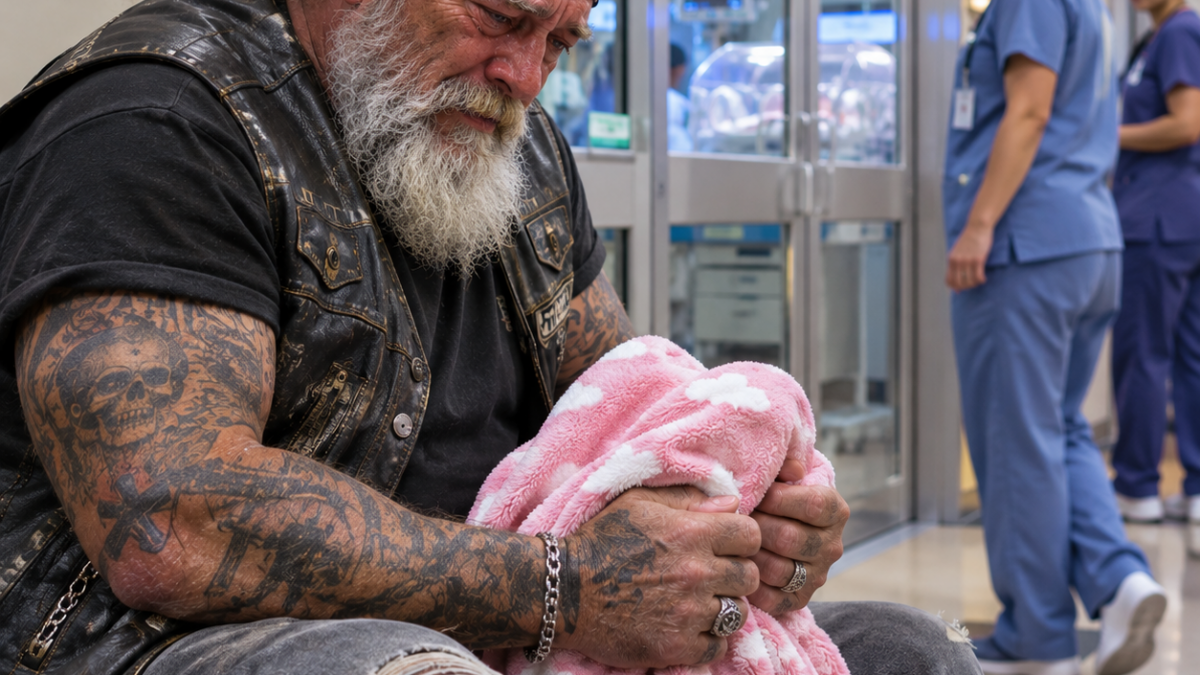
The Biker Sat Outside the NICU for 11 Days Holding a Pink Blanket—Then the Doctor Finally Asked, “Do You Want Her?”
For eleven days, a sixty-one-year-old biker slept on a cold metal bench outside the NICU holding a tiny pink blanket nobody had ever used.
The baby behind those locked doors had lost her mother before sunrise, her father was sitting in jail, and legally the man refusing to leave the hallway was nobody to her at all.
Then on the eleventh day, a doctor walked out, looked at the scarred old man who had kept his promise longer than anyone expected, and asked him one question that changed both of their lives: “Do you want her?”
My name is Frank Mercer.
I’m sixty-one years old, six foot two, two hundred and thirty pounds on a good week, and I’ve been riding motorcycles for forty years.
I have scars on both hands.
One across my chin.
Two bad knees.
A left shoulder that predicts rain better than the local weather station.
I’ve buried two brothers from my club.
I once rode through a snowstorm in Montana with a fever because a friend’s wife had died and he told me he couldn’t face the funeral alone.
People have called me stubborn.
Stupid.
Loyal.
Reckless.
Sometimes all four in the same sentence.
But none of the miles I’ve ridden prepared me for that hospital bench.
Cold metal.
Gray wall.
Vending machine humming twenty feet away.
Double doors leading into a place where a three-pound baby girl was fighting for her life.
And me sitting outside holding a blanket with little white clouds on it.
For eleven days.
That story did not begin at the hospital.
It began with a man named Dale.
Dale Tucker was my closest friend for fifteen years.
We met at a motorcycle repair shop after he accused me of putting the wrong oil in an old Harley.
I told him to mind his business.
He told me bad maintenance became everybody’s business when your engine exploded in traffic.
I told him he talked too much.
He laughed.
We became friends before lunch.
That was Dale.
He could make himself part of your life before you realized you had given him permission.
He had one daughter.
Marie.
Her mother left when Marie was twelve.
Not the kind of leaving where somebody moves across town.
She disappeared into another state with another man and sent birthday cards when she remembered.
Dale raised Marie alone.
He wasn’t perfect.
Neither am I.
PART2:
But that man loved his daughter with every part of himself.
He learned to braid hair.
Badly.
He learned which feminine products to buy after once coming home with an entire shopping bag of everything except the thing Marie had actually requested.
He sat through dance recitals.
Parent-teacher conferences.
Driver’s-ed classes.
Boyfriend interrogations.
When Marie turned sixteen, Dale made me teach her how to change a tire because he said she should never have to wait beside a highway for a man to rescue her.
She was furious.
Two years later, she changed a flat by herself during a rainstorm and called us afterward to brag.
Dale looked at me like we had personally raised an astronaut.
Marie wasn’t my daughter.
But sometimes family sneaks up on you through repetition.
Birthdays.
Christmas dinners.
Broken cars.
Phone calls.
Arguments.
Hospital waiting rooms.
I was Uncle Frank.
Not because anybody sat down and decided it.
Just because one day Marie called me that and nobody corrected her.
Then Dale got sick.
Pancreatic cancer.
By the time doctors found it, there wasn’t much road left.
Dale hated hospitals.
He complained about every machine.
Every meal.
Every nurse who told him he couldn’t walk around without assistance.
Then one night near the end, I sat beside him.
Marie had gone home to shower.
Dale looked smaller than I had ever seen him.
He reached over and grabbed my wrist.
Weak grip.
Still Dale.
“Frank.”
“Yeah?”
“Marie’s alone.”
“She’s nineteen, not alone.”
“You know what I mean.”
I did.
“Her mama’s gone. I’m going.”
“Don’t.”
“Don’t what?”
“Talk like that.”
He smiled.
“You’ve always been terrible at reality.”
I looked away.
Then he squeezed my wrist.
“Promise me.”
“What?”
“You stay close.”
I knew immediately.
“Dale—”
“Promise.”
“I’m not her father.”
“No.”
His voice weakened.
“But you’re Frank.”
That was apparently enough explanation.
He continued.
“She’ll act like she doesn’t need anybody. She got that from me.”
“Unfortunately.”
“She’ll stop calling when life gets bad because she won’t want to be a burden.”
I nodded.
“Don’t let her disappear.”
“I won’t.”
“Whatever she needs.”
“I promise.”
Dale closed his eyes.
Then opened them again.
“Say it right.”
I hated him for that.
Even dying, the man wanted exact wording.
“I promise I’ll be there for Marie. Whatever she needs.”
He relaxed.
“Good.”
Dale died three days later.
Marie was nineteen.
I kept my promise.
At least I thought I did.
I drove her to job interviews.
Fixed her old Honda.
Helped her move into a tiny apartment over a laundromat.
Brought groceries without calling them groceries.
I would show up carrying bags and say my freezer was full.
She knew I was lying.
I knew she knew.
Neither of us mentioned it.
When her transmission died, I found a used one and installed it with Eddie from my club.
When she got the flu, I left soup outside her door because she refused to let anybody inside.
When she worked two jobs for almost a year, I pretended not to notice how tired she looked until she finally let me pay one utility bill.
She was good people.
Soft-spoken.
Funny when she trusted you.
Stubborn enough to make Dale look reasonable.
Then she met Cody.
I disliked him before I had a reason.
That is not evidence.
I know that.
I’ve been wrong about people before.
Cody was thirty.
Clean haircut.
Nice pickup.
Strong handshake.
Too strong.
The kind of guy who watches your face during a handshake to see if you react.
He smiled constantly.
His eyes didn’t.
First time I met him, he looked at my vest.
“You one of those biker gang guys?”
“No.”
“What kind?”
“The kind eating dinner.”
Marie kicked me under the table.
Afterward she said:
“Please try.”
“I tried.”
“You answered four questions with one word.”
“That’s efficient.”
“He thinks you hate him.”
“I don’t know him well enough to hate him.”
She stared.
“You don’t like him.”
“No.”
“Why?”
I could not give her something concrete.
That mattered.
So I said:
“Maybe I’m old.”
She smiled.
“You are.”
I let it go.
Four months later, I saw the first bruise.
Upper arm.
Marie said she slipped carrying laundry.
Second bruise came near her ribs.
Doorframe.
Third time she wore long sleeves in July.
I stopped pretending.
“Marie.”
She looked at her coffee.
“What?”
“What happened?”
“Nothing.”
“Look at me.”
She didn’t.
That terrified me more than any bruise.
I reached across the table.
She pulled her arm back automatically.
I felt something inside me turn cold.
“Did Cody hurt you?”
“No.”
Too fast.
“Marie.”
“He gets angry.”
There it was.
Not yes.
Not no.
He gets angry.
“How angry?”
“Frank.”
“Did he hit you?”
“He didn’t hit me.”
That was the sentence she used.
Years later, I would understand how carefully people living with abuse choose words.
He didn’t hit me.
Maybe he grabbed.
Maybe shoved.
Maybe blocked a doorway.
Maybe threw something.
Maybe punched a wall beside her head.
Marie could still tell herself she had answered honestly.
I asked her to come stay with me.
She refused.
I offered money.
Refused.
I offered a hotel.
Refused.
I offered to call someone.
She got angry.
“You think I’m stupid.”
“No.”
“You think I’m weak.”
“No.”
“You always look at me like I’m nineteen.”
“I look at you like Dale’s kid.”
“I’m not a kid.”
“I know.”
“Then let me make my own choices.”
That stopped me.
Because adults have the right to make choices.
Even bad ones.
Even choices people who love them hate.
A week later I found Cody outside a gas station.
Alone.
I made a mistake.
I confronted him.
I didn’t touch him.
I didn’t threaten to kill him.
But I stepped too close and told him if I ever saw another bruise on Marie, we were going to have a problem.
He laughed.
“Old man, mind your business.”
“She is my business.”
“She’s my girlfriend.”
“That doesn’t make her property.”
His smile disappeared.
For one second I saw what Marie saw.
Cold.
Then he smiled again.
“Go ride your little motorcycle.”
I went back to Marie.
Begged her again.
She cried.
Told me she loved him.
Told me he had apologized.
Told me he was under stress.
Then she said:
“I’m pregnant.”
Everything changed.
I sat down.
“How far?”
“Ten weeks.”
“Does Cody know?”
“Yes.”
“How did he react?”
“He’s happy.”
I wanted to believe her.
Maybe a baby would change him.
People say that sometimes.
Babies do change people.
They also add stress, money problems, exhaustion, fear, and pressure.
A baby does not cure violence.
But I wanted to believe.
Marie was carrying Dale’s granddaughter.
A little girl.
At the twenty-week scan, Marie sent me a blurry ultrasound picture.
Under it:
Her name is Hope.
I called immediately.
“Hope?”
“Yes.”
“You know there are eight million names.”
“I like Hope.”
“That’s very subtle.”
“Shut up.”
“Why Hope?”
She went quiet.
Then:
“Because I need some.”
I drove forty miles the next week to buy a blanket.
I had not bought baby anything in my entire life.
A saleswoman asked if I needed help.
“No.”
Ten minutes later she asked again because I was still standing in the same aisle holding three nearly identical pink blankets.
“Granddaughter?”
“Something like that.”
“What does she like?”
“She’s not born.”
The woman smiled.
“Then you’re safe.”
I picked the softest one.
Pink.
Little white clouds.
I hid it in my saddlebag because I did not want the guys seeing me carrying baby stuff.
They eventually found out and laughed for three weeks.
The baby shower was scheduled for April.
It never happened.
Thursday morning.
2:03 a.m.
My phone rang.
Hospital number.
A nurse asked:
“Are you Frank Mercer?”
“Yes.”
“Are you related to Marie Tucker?”
“I’m her uncle.”
Not legally true.
Emotionally close enough.
“You need to come to County Memorial.”
“What happened?”
“Please come.”
Those two words.
Please come.
I don’t remember dressing.
I don’t remember the first ten miles.
I remember rain hitting my face.
I should not have ridden that fast.
I know that.
The engine screamed.
My mind repeated one thing.
Please let them both be okay.
Please let them both be okay.
Please let them both be okay.
When I entered the hospital lobby, a police officer stood near the desk.
The second he looked at me, I knew.
Maybe not everything.
But enough.
“Mr. Mercer?”
“What happened?”
He asked me to sit.
I refused.
“Tell me.”
There had been an argument.
Neighbors heard shouting.
Cody pushed Marie.
She fell down a flight of apartment stairs.
A neighbor called 911.
Marie was unconscious when paramedics arrived.
She went into premature labor.
Emergency C-section.
Seven weeks early.
Baby delivered alive.
Three pounds, two ounces.
NICU.
“What about Marie?”
The officer looked at the floor for half a second.
That half second told me before his mouth did.
“She died during surgery.”
4:47 a.m.
Severe head injury.
Massive bleeding.
Doctors tried.
Marie never woke up.
I do not remember what I said.
The next clear memory I have is the parking lot.
Rain.
Sitting on a curb.
Screaming until my throat hurt.
Dale’s daughter.
The girl he made me promise to protect.
Gone.
And all I could think was:
You promised.
You promised.
You promised.
Cody was arrested.
I learned that later.
At that moment it meant nothing.
Police could arrest him a thousand times.
Marie would still be dead.
Eventually I stood.
Walked back inside.
Asked to see the baby.
The nurse behind the desk looked uncomfortable.
“Relationship?”
“I’m her uncle.”
“Maternal uncle?”
“No.”
“Paternal?”
“No.”
“Are you legally related?”
I stared at her.
“No.”
“Guardian?”
“No.”
“I’m sorry.”
“My best friend was her grandfather.”
The nurse’s face softened.
“I’m sorry.”
“He died.”
“I understand.”
“No. You don’t. He made me promise.”
She looked genuinely hurt for me.
But rules exist.
And sometimes rules are cruel without being wrong.
I was not blood.
Not guardian.
Not legal family.
Marie had named no one in emergency paperwork.
Cody was the legal father.
He was in custody and would eventually face charges related to Marie’s death.
Hope had no living maternal grandparents.
Marie’s mother was effectively absent and later could not be immediately located.
The baby had nobody who could simply walk through those doors and say:
She’s mine.
Social services became involved.
The words “temporary state custody” entered the conversation.
I felt sick.
“She has me.”
The social worker looked at me.
“I understand that you care.”
“No. She has me.”
“Mr. Mercer—”
“I made a promise.”
She spoke gently.
“Promises are important. But they aren’t legal guardianship.”
I hated her for saying it.
For maybe ten seconds.
Then I realized she wasn’t insulting me.
She was telling me the truth.
Hope needed legal protection too.
Not just love.
I asked:
“What can I do?”
“We’ll have to review options.”
“How long?”
“I can’t tell you.”
“Can I see her?”
“Not yet.”
So I sat down.
Cold metal bench outside the NICU.
Pink blanket in my hands.
And I stayed.
Day one.
Nurses passed.
Some looked at me.
Some did not.
I asked every few hours if Hope was alive.
That was the only question I could manage.
One nurse said:
“She’s stable.”
Another:
“She’s being supported.”
Another:
“She’s where she needs to be.”
I didn’t know what any of that meant.
I wanted:
Yes.
She’s alive.
Day two.
Eddie arrived.
He found me holding the blanket.
Said nothing.
Sat beside me.
After thirty minutes:
“You eat?”
“No.”
“Good talk.”
He returned with a sandwich.
I didn’t eat it.
He left it anyway.
Day three.
A young nurse named Dana stopped.
Maybe twenty-eight.
Dark hair.
Blue scrubs.
She had walked past me six times.
Finally:
“Sir?”
“Yeah?”
“Who are you waiting for?”
I tried to answer.
Nothing came.
I looked at the NICU doors.
My jaw started shaking.
That embarrassed me.
Dana sat beside me.
“Baby?”
I nodded.
“Yours?”
I shook my head.
Then somehow managed:
“Her mama died.”
Dana didn’t ask more.
She stood.
Returned with coffee.
“I’m not supposed to give medical information to people who aren’t authorized.”
“I know.”
She hesitated.
“But I can tell you the team is taking good care of her.”
I nodded.
That became our system.
She never violated privacy.
Never gave me details she wasn’t permitted to share.
But sometimes she would walk by and say:
“She had a peaceful night.”
Or:
“Keep sitting.”
Once:
“She’s tough.”
That was enough.
Day four.
Security came.
Two guards.
Professional.
Respectful.
Someone had reported an unknown man sleeping outside the NICU.
Fair.
They asked for identification.
I gave it.
Asked why I was there.
I explained.
One guard looked at the blanket.
Then at me.
“You causing any trouble?”
“No.”
“You planning to?”
“No.”
“Then don’t block the hallway.”
I moved my boots six inches.
They left.
Day five.
The club arrived.
Not all at once.
Thank God.
Danny brought a change of clothes.
Eddie brought food.
Carl brought a pillow from his couch that smelled like cigarettes even though he swore nobody had smoked in his house in ten years.
Mason tried to convince me to go home and shower.
I told him to leave.
He did.
Returned two hours later with deodorant.
“People are complaining.”
“Nobody’s complaining.”
“I am.”
I almost laughed.
First time since Marie died.
Day six.
More whispers.
Father?
Grandfather?
Homeless?
Security again.
Different shift.
Same explanation.
Still no trouble.
That night I talked to Hope through the doors.
Quietly.
I felt ridiculous.
“Hey, kid.”
Nothing.
Obviously.
“I’m Frank.”
I held the blanket.
“Your grandpa Dale would’ve liked you.”
My throat tightened.
“He would’ve bought you noisy toys. I would’ve told him not to. Then I would’ve bought worse ones.”
A nurse passed.
Pretended not to hear.
“Your mama picked your name.”
I closed my eyes.
“She loved you.”
That mattered.
I needed Hope to know that someday.
Whatever happened next.
Marie loved her.
The fact that Marie stayed with Cody too long did not mean she didn’t love her daughter.
People can be trapped and still love.
People can make mistakes and still love.
Sometimes love is not enough to save you.
But it was there.
Day seven.
Social worker named Cynthia Blake sat beside me.
She carried a clipboard.
“Mr. Mercer.”
“Frank.”
“You’re serious about staying involved?”
“Yes.”
“What does that mean?”
I didn’t understand.
“Whatever she needs.”
“That’s not an answer.”
I got angry.
“What do you want me to say?”
She stayed calm.
“Do you want visitation if allowed? Foster placement? Guardianship? Adoption? Do you understand those are different things?”
Adoption.
The word hit me strangely.
I was sixty-one.
Single.
Motorcycle club.
Small house.
No crib.
No bottles.
No idea what size diaper a three-pound baby needed.
I said:
“I don’t know.”
Cynthia nodded.
“Good.”
“Good?”
“That’s more useful than pretending you do.”
She asked about my home.
Job.
Income.
Health.
Criminal history.
Club.
Relationships.
Support system.
I answered everything.
One arrest at twenty-three after a bar fight.
Charge reduced.
Nothing since.
No drugs.
No domestic violence.
No children.
Never married.
Owned my house.
Ran a motorcycle-repair shop.
Health decent.
Blood pressure treated.
She wrote notes.
Then asked:
“Why do you want to do this?”
I looked at the doors.
“I promised Dale.”
“That’s about Dale.”
I looked at her.
She didn’t flinch.
“Why do you want Hope?”
I didn’t have an answer yet.
That scared me.
Day eight.
I showered.
Hospital locker room staff let me use facilities after Cynthia arranged it.
Eddie nearly celebrated.
I ate half a sandwich.
Dana said Hope was improving.
I held the blanket.
Day nine.
Cynthia returned.
Background-check forms.
Home-study information.
Emergency foster-care requirements.
Kinship placement normally prioritizes relatives.
I wasn’t kin.
But existing significant relationships could sometimes matter.
Especially where no suitable relative was available.
No promises.
I filled out everything.
Day ten.
I went home for three hours.
First time since the call.
My house looked wrong.
Too quiet.
Marie had sat at my kitchen table a hundred times.
One coffee mug she liked still sat in a cabinet.
I opened the room I used for storage.
Boxes.
Motorcycle parts.
Old jackets.
I stood there imagining a crib.
Then I felt terrified.
Not emotional terrified.
Practical.
What if I die?
I’m sixty-one.
What if Hope needs a mother?
What do I know about hair?
School forms?
Fevers?
Teenage girls?
What if she hates motorcycles?
What if I make Dale’s mistake and think love automatically makes me capable?
I called Danny.
He answered:
“You finally leave the hospital?”
“For three hours.”
“Congratulations.”
“I can’t do this.”
Silence.
Then:
“Okay.”
That annoyed me.
“Okay?”
“You said you can’t.”
“You’re supposed to argue.”
“Why?”
“I don’t know.”
Danny waited.
Then asked:
“Do you want to?”
“Yes.”
“Then the question isn’t whether you know how.”
“What is it?”
“Whether you’re willing to learn.”
I sat on the edge of the storage-room bed.
“What if I’m too old?”
“Probably.”
“Danny.”
“What?”
“I’m serious.”
“So am I. You are old.”
“You’re two years older.”
“Exactly. I have authority.”
I almost hung up.
Then he said:
“Frank, nobody raises a kid alone. Not even people who think they do.”
I looked around.
“You offering to change diapers?”
“No.”
“Then shut up.”
“I’ll pay someone.”
That night, I returned to the bench.
Day eleven.
The doctor came out.
Clipboard.
Expression I could not read.
I stood so fast the bench scraped.
The blanket fell.
I thought:
She died.
I knew that thought before he spoke.
Not Hope too.
Please.
The doctor stopped in front of me.
“Mr. Mercer?”
“Yes.”
“We need to talk about the baby.”
My knees weakened.
He saw it.
“She’s stable.”
I exhaled.
“She’s off the ventilator.”
I grabbed the back of the bench.
“She’s breathing on her own.”
I started crying before he finished.
Then he said:
“That’s not why I came out.”
I wiped my face.
“What?”
“I came because of you.”
I didn’t understand.
He explained nurses had documented my presence.
Not medically.
Socially.
Eleven days.
Social worker had spoken with staff.
Reviewed my forms.
Started background work.
The doctor said:
“Most premature infants have somebody calling every hour.”
I looked down.
“Hope has had someone sitting outside almost continuously for eleven days.”
“I can’t leave.”
“I know.”
Then:
“Do you want her?”
I stared at him.
He clarified.
“Do you want to pursue placement?”
My mouth opened.
No words.
“It’s not a promise,” he said. “The hospital does not decide adoption. Social services and the court do. There will be a process. A serious one.”
I nodded.
“But if you’re asking whether there is a path for someone like you to be considered—yes.”
I looked through the glass.
“I made a promise to her grandfather.”
He waited.
“I failed her mama.”
My voice broke.
“I can’t fail this baby too.”
The doctor nodded.
Then said:
“I think it’s time you met her.”
Dana helped me scrub.
I washed my hands until the skin turned red.
“Frank.”
“What?”
“They’re clean.”
“I know.”
“You’re going to bleed before you touch her.”
I stopped.
Gown.
Mask.
Instructions.
Everything suddenly felt too serious.
Then Dana wheeled me toward an incubator.
There she was.
Hope.
Three pounds, a little more by then.
Tiny tuft of dark hair.
Nose barely bigger than the tip of my finger.
Wires.
Monitor leads.
Tape.
She looked breakable.
She looked exactly like Marie.
I stopped breathing.
Dana whispered:
“You okay?”
“No.”
“Good. That means you’re paying attention.”
She opened an access port.
“Finger only.”
I put my index finger inside.
Hope moved.
Her hand opened.
Closed around the tip.
That was it.
That tiny grip.
I came apart.
Not dignified crying.
Not one manly tear.
I sobbed.
Forty years of riding.
Broken bones.
Funerals.
Cancer.
Dale.
Marie.
Nothing had ever dropped me the way one three-pound baby holding my finger did.
“Hey there, little one.”
Hope’s fingers stayed closed.
“I’m Frank.”
I swallowed.
“Your grandpa Dale was the best man I knew.”
I looked at her.
“Your mama was stubborn. Funny. Terrible at checking her oil.”
Dana laughed quietly.
“She loved you.”
My voice shook.
“I’m sorry I wasn’t there when she needed me.”
The machine beside Hope beeped.
I froze.
Dana checked it.
“Normal.”
I nodded.
Then whispered:
“But I’m here now.”
I placed the pink blanket over the edge of the incubator where staff allowed it.
The one with white clouds.
It had waited eleven days too.
The process after that was not magical.
People like stories where a doctor says:
Do you want her?
And then a week later an old biker rides home with a baby.
Real life does not work like that.
Thank God.
Children need more than good intentions.
I had fingerprints taken.
Background investigations.
Home inspection.
Financial review.
Medical clearance.
Interviews.
References.
Training.
Infant CPR.
Safe-sleep class.
Car-seat class.
Feeding instruction.
Premature infant care.
I learned words I never expected to know.
Adjusted age.
Reflux.
Fortifier.
Apnea.
Tummy time.
Wake windows.
I attended a parenting class where every other person was at least twenty years younger.
One young father asked:
“Your daughter having a baby?”
“No.”
He looked at me.
“You?”
“Yes.”
He spent the next two hours avoiding eye contact.
My club was interviewed as part of my support network.
That might have been my favorite day.
Cynthia sat across from Danny, Eddie, Carl, and Mason.
“If Frank becomes Hope’s guardian, what support can you provide?”
Danny answered:
“Anything.”
“That’s vague.”
He nodded.
“Fair.”
Then they got specific.
Eddie’s wife had raised four children and was willing to help with infant care.
Danny’s daughter was a pediatric nurse.
Mason lived six minutes from me and could respond in emergencies.
Carl owned a truck large enough to move furniture.
Cynthia stared.
“Furniture?”
Carl shrugged.
“Babies need stuff.”
Turns out they need a lot of stuff.
My brothers renovated the storage room.
I came home one afternoon and found six bikers arguing over paint samples.
“Why are you in my house?”
Danny held up two cards.
“Cloud White or Morning Mist?”
“I don’t care.”
The room went silent.
Eddie looked offended.
“You absolutely care.”
“Why?”
“Because one looks gray.”
“It’s a baby.”
“Exactly.”
I walked out.
They chose Morning Mist.
Later, I learned they spent four hours researching crib safety.
These men had ridden motorcycles at 120 miles per hour in their twenties.
Now they were arguing about slat spacing.
One club member, Gary, installed childproof cabinet latches everywhere.
Including one cabinet eight feet off the ground.
I asked why.
“Future-proofing.”
“For a climbing baby?”
“You don’t know.”
I let him.
Hope stayed in the NICU for weeks.
I visited every day I was allowed.
At first I could only touch her through the incubator.
Then one afternoon Dana asked:
“You ready?”
“For what?”
“To hold your daughter.”
My daughter.
Nobody had called her that yet.
I looked at Dana.
“She’s not legally—”
“I said what I said.”
Dana helped position Hope against my chest.
Skin-to-skin was not practical with my tattoos apparently frightening nobody except me, so we used a blanket and proper positioning.
Hope settled beneath my chin.
The world changed.
I could feel each breath.
Tiny.
Fast.
I barely moved.
Dana smiled.
“You can relax.”
“No.”
“Frank.”
“No.”
She laughed.
Hope slept there for forty-five minutes.
I cried for twenty.
The first court hearing was terrifying.
Not because anyone attacked me.
Because nobody owed me the outcome I wanted.
Cody was still legally Hope’s father.
He was being held in connection with Marie’s death.
His attorney reserved his rights.
There were procedures.
Investigations.
Potential relatives searched for.
Marie’s estranged mother was located.
She had not seen Marie in years.
She told the social worker she was not able to take an infant.
Cody’s sister expressed interest briefly, then withdrew after learning Hope would require frequent medical appointments.
None of that made them bad people.
Raising a medically fragile infant is enormous.
The court approved me for temporary foster placement once Hope was medically ready, pending continued review.
That night I sat beside her incubator.
“Kid, you are causing paperwork.”
Her tiny face did not care.
“You better be worth it.”
Dana walked by.
“She is.”
“I know.”
Then came the criminal case.
I tried not to follow every detail.
I failed.
Cody was charged in connection with Marie’s death and with domestic violence.
The neighbor had heard the argument.
Police documented the scene.
There were messages on Marie’s phone.
Photographs she had never shown me.
Bruises.
Apologies from Cody.
Then another message.
I found out because investigators asked whether I could identify a phrase Marie used.
One text from Cody read:
YOU MAKE ME DO THIS.
I had to sit down.
People who hurt someone often find ways to hand the responsibility back to the person they hurt.
You made me angry.
You made me grab you.
You made me push you.
You make me do this.
No.
Cody made choices.
Marie paid for them.
Hope almost did too.
I carried guilt.
I still do.
I should have pushed harder.
I should have called someone earlier.
I should have done more.
A domestic violence counselor later told me something that took years to understand.
“You couldn’t make Marie leave.”
I hated hearing that.
“She died.”
“Yes.”
“I promised her father.”
“You kept offering help.”
“Not enough.”
“Frank, if you make yourself responsible for every choice the abuser made and every choice Marie couldn’t make safely, you are taking responsibility away from the person who hurt her.”
That shut me up.
I still wish I had saved her.
Wish is not the same thing as responsibility.
Hope finally reached discharge weight.
The day the doctor said she could go home within seventy-two hours, I panicked.
Not emotionally.
Completely.
“What do you mean home?”
The doctor stared at me.
“You’ve been trying to take her home for two months.”
“Yes, theoretically.”
“It’s no longer theoretical.”
“Can’t she stay one more week?”
“No.”
“What if she stops breathing?”
“You call emergency services.”
“What if she won’t eat?”
“You call the pediatrician.”
“What if I’m terrible at this?”
Dana answered from behind him:
“You will be terrible at parts of it.”
I stared.
“Thank you.”
“Everyone is.”
That helped more than reassurance.
I installed the car seat wrong three times.
A twenty-four-year-old nurse fixed it while trying not to laugh.
Danny arrived carrying a teddy bear larger than Hope.
I made him take it home.
Safe sleep.
Nothing loose in crib.
I knew rules now.
On discharge day, I dressed Hope in a tiny white outfit with pink trim.
The hospital social worker walked us through paperwork.
Follow-up appointments.
Medication.
Feeding.
Emergency contacts.
Dana brought the cloud blanket.
I wrapped Hope in it only for the trip out, following every safety rule they gave me.
Then we reached the hospital entrance.
Motorcycles.
Twenty-seven of them.
I stopped.
“What is this?”
Danny looked innocent.
“Support.”
“You brought twenty-seven motorcycles to a premature baby’s hospital discharge?”
“They’re parked.”
“Why?”
“Escort.”
“No.”
“Yes.”
“No loud engines.”
“We know.”
“No revving.”
“We know.”
“No riding close to the car.”
“We know.”
I looked at Hope.
She was asleep.
“You people are idiots.”
Eddie smiled.
“Family idiots.”
I had borrowed a car.
Yes.
The lifelong biker brought a premature baby home in a car.
I was not putting her on a Harley.
I mention this because every time somebody hears the story, some genius asks.
Twenty-seven bikes followed us from a respectful distance.
No noise beyond ordinary engines.
No blocking traffic.
No nonsense.
When I turned into my driveway, my whole club was there.
Nursery finished.
Freezer full of food.
Diapers stacked in the garage.
Formula.
Bottles.
Burp cloths.
Clothes.
A rocking chair.
One handmade wooden sign over her bedroom door.
HOPE.
I stood in the hallway holding her.
Couldn’t speak.
Danny put his hand on my shoulder.
“You good?”
“No.”
“Good.”
First night was disaster.
Hope cried at 1:03.
1:28.
2:11.
2:40.
3:07.
By four, I was convinced something was medically wrong.
I called the after-hours nurse line.
The nurse asked a series of questions.
Then said:
“She may be hungry.”
“I fed her.”
“When?”
“Two hours ago.”
“Frank.”
“What?”
“Babies eat again.”
This seemed inefficient.
I fed her.
She slept.
I felt betrayed.
At 6:00, Eddie’s wife, Ruth, found me sitting in the rocking chair wearing yesterday’s shirt.
“How much did you sleep?”
“Maybe seventeen minutes.”
She took Hope.
“Go shower.”
“No.”
“Frank.”
“No.”
Ruth had raised four children.
She looked at me.
I went to shower.
The next months were the hardest thing I have ever done.
Also the best.
Hope had reflux.
She hated one formula.
Liked another.
Needed frequent appointments.
I learned how to pack a diaper bag.
Badly.
Then efficiently.
I learned babies produce impossible amounts of laundry.
I learned every public bathroom should have a changing table and many do not.
I learned strangers become very interested in a tattooed biker pushing a stroller.
Older women smiled at me.
Teenagers stared.
One man asked:
“Babysitting?”
“No.”
“Granddaughter?”
“No.”
“Then?”
“My daughter.”
His face changed.
I stopped explaining.
Hope became chubby.
Healthy.
Loud.
Her first laugh happened because Eddie sneezed.
He spent three hours afterward trying to sneeze again.
Her first tooth arrived while we were at a club barbecue.
Fourteen grown men examined her gum like a medical conference.
Her first word was not Dad.
Not Frank.
Not bottle.
It was:
Bike.
I blame everyone.
At the adoption hearing, I was more frightened than I had been outside any operating room.
By then Cody’s parental rights had been addressed through the legal process.
His criminal case was moving separately.
Hope had been with me for months.
Home study complete.
Every report positive.
Still, a judge had to decide what was in her best interest.
There were questions about my age.
Fair questions.
“What happens if your health declines?”
I had life insurance.
Will.
Guardianship plan.
Danny and his wife named as first backup caregivers.
Then Eddie’s daughter and husband.
Financial trust established.
The judge looked impressed.
“Mr. Mercer, you prepared.”
“I had help.”
“A lot?”
I looked behind me.
The courtroom had permitted only a few supporters.
Outside stood forty bikers.
“Yes, ma’am.”
Dana testified.
The NICU doctor submitted a letter.
Cynthia spoke about my home.
My parenting training.
Support network.
Consistency.
Then the judge asked me:
“Why adoption?”
I had been expecting the question.
Still, my prepared answer disappeared.
I looked at Hope sitting with Cynthia.
Eight months old.
Pink cloud blanket in her lap.
Then said:
“Because I don’t want her growing up thinking she was the child nobody could keep.”
The courtroom went silent.
“I want her to know her mother loved her.”
My voice shook.
“I want her to know her grandfather loved her before she existed.”
I swallowed.
“And I want her to know I didn’t take her because I felt sorry for her.”
The judge waited.
“I want her because somewhere between that hospital bench and three in the morning bottles and doctor appointments and learning that apparently babies need different size clothes every twelve minutes…”
The judge smiled.
“…she became my daughter before the paperwork caught up.”
The judge looked down at the file.
Then:
“Mr. Mercer, the paperwork has caught up.”
I cried.
Again.
I have cried more since Hope entered my life than in the previous forty years combined.
I am comfortable with that now.
The adoption became final.
Hope Mercer.
My daughter.
Legally.
Permanently.
Forever.
Outside, the club waited.
Danny asked:
“Well?”
I held up the papers.
Forty grown men started cheering.
Hope cried.
Everybody stopped instantly.
Ruth yelled:
“You idiots scared the baby.”
Forty bikers apologized to an eight-month-old.
Cody’s case ended later.
He accepted a plea that resulted in a lengthy prison sentence.
I attended sentencing once.
Only once.
I wanted to look at him.
I imagined rage.
Instead I felt tired.
He looked smaller than I remembered.
His attorney spoke.
Prosecutor spoke.
Judge spoke.
I was allowed to submit a victim-impact statement regarding Marie and Hope.
I wrote five pages.
Read none of them aloud.
The prosecutor read portions.
When court ended, Cody looked toward me.
I walked past.
I realized revenge would not raise Hope.
Anger would not teach her to read.
Hatred would not show up at parent-teacher conferences.
My responsibility was no longer to Cody.
It was to the little girl waiting at home.
Every night, I rocked Hope.
I told her stories.
Dale.
Marie.
Not the horrible ending.
Not yet.
I told her about Marie changing her first tire.
Marie laughing so hard she fell off a kitchen chair.
Marie burning pancakes and insisting they were “caramelized.”
Dale teaching her to ride a bicycle.
Dale pretending not to cry at her high-school graduation.
Hope would know them.
I refused to let Cody become the most important fact about her mother’s life.
Marie was more than the way she died.
She was a daughter.
Friend.
Hard worker.
Woman who loved her baby enough to pick the name Hope when she desperately needed some.
The pink blanket went everywhere.
Doctor appointments.
Trips to the grocery store.
Club barbecues.
Eventually the fabric faded.
White clouds became almost invisible.
One corner frayed.
Ruth offered to repair it.
I refused.
Then Hope chewed a hole in it.
Ruth repaired it anyway.
When Hope learned to crawl, my house became a war zone.
Every dangerous object suddenly seemed to exist at knee height.
I installed gates.
Covers.
Corner guards.
Locks.
My club mocked me until Mason’s grandson visited and shoved a fork toward an electrical outlet.
After that, everyone became safety experts.
When Hope took her first steps, she walked between my knees and Danny’s.
Three steps.
Fell.
Looked offended.
Tried again.
When she turned one, we held a party.
Not huge.
Maybe fifty people.
For bikers, that is small.
I placed a framed photograph of Marie on a table.
Another of Dale.
Hope smashed cake into her hair.
Everyone took pictures.
After the party, I sat alone on the porch holding her.
Sunset.
She had frosting behind one ear.
I looked at Dale’s photograph through the window.
“I’m trying, brother.”
Hope slapped my beard.
“Thanks.”
I kissed her forehead.
Two years old.
Hope became fearless.
Terrifyingly fearless.
Climbed everything.
Ran everywhere.
Loved motorcycles only when parked.
Hated engine noise.
That amused the club.
She called Danny “Uncle D.”
Eddie became “Eddy Bear” because he accidentally bought her a teddy bear once and the name stuck to him instead.
Carl was “Papa Carl.”
Nobody knew why.
He cried privately the first time.
I pretended not to know.
At three, Hope asked:
“Where Mommy?”
I knew this question would come.
I had worked with a child therapist and adoption counselor beforehand.
No lies.
Age appropriate.
Truth in layers.
“Your mommy’s name was Marie.”
“Where she?”
“She died when you were born.”
Hope thought about that.
“Why?”
“She got hurt very badly.”
“Doctor fix?”
“They tried.”
She climbed into my lap.
“Mommy love me?”
My throat closed.
“Yes.”
“How know?”
“Because she picked your name.”
“What name?”
“Hope.”
“That me.”
“That’s you.”
“Why Hope?”
I almost smiled.
“Because she needed some.”
Hope accepted that and asked for applesauce.
Children save you from emotional moments by immediately demanding snacks.
Years passed.
I did not become younger.
That part was inconvenient.
At sixty-five, my knees got worse.
At sixty-six, doctor told me to lose twenty pounds.
Hope told the club.
They removed donuts from meetings for almost two weeks.
Then mutinied.
I lost eleven pounds.
At sixty-seven, I taught Hope to ride a bicycle.
Not motorcycle.
Bicycle.
She fell.
Scraped her knee.
Cried.
I picked her up.
She said:
“Don’t tell Uncle Danny.”
“Why?”
“He’ll make me wear football pads.”
Accurate.
At school, forms were sometimes awkward.
Father:
Frank Mercer.
Mother:
Blank.
One teacher assumed I was grandfather.
Hope corrected her.
“He’s my dad.”
Teacher apologized.
Hope said:
“He’s old, so it’s confusing.”
Children are cruel.
The hardest conversation came when Hope was eight.
She had known for years she was adopted.
That was never secret.
She knew Marie died.
She knew her biological father was not part of her life.
Then another child at school heard something from an adult and told Hope:
“Your real dad killed your mom.”
Hope punched him.
Not proud.
A little proud.
Mostly not proud.
School called.
I picked her up.
She sat in the Jeep with arms crossed.
“He deserved it.”
“Probably.”
She looked at me.
“You’re supposed to say no.”
“I’m working on parenting.”
She almost smiled.
Then stopped.
“Did he?”
I pulled over.
Couldn’t have that conversation while driving.
“Yes.”
Her face went blank.
The same shutdown I had seen in Marie once.
“What did he do?”
I told her carefully.
There had been violence.
An argument.
He pushed Marie.
Marie fell.
She died.
Hope was born early.
Her biological father went to prison.
Hope looked out the window.
“Did he want me?”
“I don’t know.”
That was the honest answer.
“Did Mom?”
“Yes.”
“How do you know?”
“I was there before she died?”
“No.”
“Then?”
“She talked about you. Named you. Planned for you.”
I reached into my wallet.
I had carried Marie’s ultrasound picture for years.
I handed it over.
On the back, in Marie’s handwriting:
My little Hope. Can’t wait to meet you.
Hope read it.
Started crying.
Then asked:
“Why didn’t you save her?”
That question found every wound I had spent eight years covering.
I could have lied.
Could have defended myself.
Instead:
“I tried to help her leave.”
“Not enough.”
“No.”
She looked at me.
I nodded.
“Not enough.”
Hope cried harder.
“So you failed her?”
I breathed.
“I used to think that meant I was responsible for what happened.”
“Are you?”
“No.”
That answer took me years.
“Your biological father chose to hurt her. That was his responsibility.”
I paused.
“But I’ll always wish I had known how to help better.”
Hope stared at the ultrasound.
Then asked:
“Was Mom mad at you?”
“I don’t think so.”
“Did she love you?”
I smiled.
“She tolerated me.”
Hope laughed through tears.
That was Marie too.
That evening we went to Dale’s grave.
Hope carried flowers.
She had been before.
This time she understood more.
I showed her where Marie was buried beside him.
She sat on the grass.
No words.
Eventually:
“Grandpa Dale made you promise?”
“Yes.”
“What exactly?”
“To be there.”
“Did you?”
I looked at Marie’s grave.
“Not every time I should have.”
Hope slipped her hand into mine.
“You were there for me.”
I cried.
Again.
Of course.
The club never let Hope forget she had family.
School plays became ridiculous.
Ten bikers in the audience.
One year she played Tree Number Three.
No lines.
The club gave her a standing ovation.
The teacher banned us from future standing ovations for non-speaking vegetation.
Softball?
Entire row of leather.
Science fair?
Mason spent three days helping her build a baking-soda volcano despite having no scientific knowledge beyond “add more vinegar.”
Middle-school graduation?
Twenty-two motorcycles.
Hope complained.
“You guys are embarrassing.”
Danny nodded.
“Our work here is complete.”
The story of Hope’s beginning spread farther than I expected.
Dana once asked permission to tell a de-identified version at a hospital volunteer event.
I agreed.
More cuddle volunteers signed up.
A local motorcycle association started a NICU support fundraiser.
Another club collected car seats for foster families.
People wanted to call me inspiring.
I hated that word.
I sat on a bench.
Filled forms.
Learned diapers.
Got lucky enough to be allowed to love a kid.
Hero?
No.
The heroes were nurses who kept Hope alive.
The neighbor who called 911 for Marie.
The surgeon who delivered Hope.
The social worker who did not dismiss me because I looked wrong for parenthood.
The judge who looked at a sixty-one-year-old biker and considered evidence instead of stereotype.
The club wives who taught me everything.
Even Dana, who later admitted she thought I might be dangerous the first day she saw me.
“You had neck tattoos.”
“You still let me stay.”
“You had a baby blanket.”
“That saved me?”
“It helped.”
Hope found that hilarious.
When she turned twelve, we returned to County Memorial.
Dana still worked there.
Charge nurse now.
Hope wanted to see the hallway.
The bench was gone.
Renovation.
New chairs.
Hope looked disappointed.
“That’s where you slept?”
“Sat.”
“You said slept.”
“I occasionally lost consciousness while seated.”
“That’s sleeping.”
Fine.
Dana brought us near the NICU entrance.
Not inside patient areas.
Hope stood looking through the glass.
“So I was that small?”
“Smaller.”
She looked at me.
“You were scared?”
“Terrified.”
“Did you cry?”
“No.”
Dana coughed.
I glared at her.
Hope grinned.
“How much?”
Dana said:
“A lot.”
Betrayal.
Then Hope asked:
“Can we donate blankets?”
That became our tradition.
Every year on Marie’s birthday, Hope chose blankets.
Not always pink.
We delivered them to programs serving NICU and foster families.
Hope insisted each one be soft.
“It matters.”
She knew.
At sixteen, Hope wanted a motorcycle.
I said no.
She stared at me like I had personally betrayed freedom.
“You own four.”
“I’m an adult.”
“You were riding at sixteen.”
“Exactly why you aren’t.”
Danny sided with her.
I removed him from my will.
Temporarily.
We compromised.
Safety course at seventeen.
Small bike at eighteen if she maintained grades and completed training.
She maintained grades with unprecedented enthusiasm.
The first time she rode legally beside me, I had never been more afraid.
She was careful.
Helmet.
Jacket.
Gloves.
Proper boots.
Dale would have cried.
Marie would have yelled at me.
Probably both.
We rode to the cemetery.
Hope parked.
Removed her helmet.
Placed the pink cloud blanket—now folded inside a protective bag—beside Marie’s headstone for one photograph.
Then put it away again.
She still slept with it sometimes.
She would deny that.
At eighteen, she asked to read every document about Marie.
I let her.
With therapist support.
Police reports.
Court records.
Texts.
She cried for days.
Then she said:
“I want to meet him.”
Cody was still incarcerated at that point.
Every protective instinct I had screamed no.
But Hope was eighteen.
An adult.
I had spent her life telling her truth mattered.
I could not suddenly make truth conditional on my comfort.
We arranged everything through proper channels.
Supervised.
Secure.
I waited outside.
Hope went in.
Forty minutes later she came out.
Her face unreadable.
I stood.
She walked straight into my arms.
We stayed like that.
Finally I asked:
“You okay?”
“No.”
“Want to talk?”
“No.”
“Okay.”
We drove home.
Three days later she told me.
Cody apologized.
Said he was young.
Angry.
Drinking.
Said he loved Marie.
Said he never intended for her to die.
Hope asked why he pushed her.
He had no answer she accepted.
Then he called himself her father.
Hope said:
“No.”
That hurt me to hear.
Not because I needed the title.
Because I knew what it cost her to say.
She told him:
“Frank is my father. You’re the man I needed answers from.”
Then she left.
I did not celebrate.
Cody was part of her.
Biology doesn’t disappear because somebody behaved terribly.
I told Hope:
“You’re allowed to feel whatever you feel later. Even if it changes.”
She nodded.
“You’d be okay if I forgave him?”
“Yes.”
“If I never do?”
“Yes.”
“What if I don’t know?”
“Yes.”
She looked annoyed.
“Stop being emotionally healthy.”
“I paid a therapist a lot of money.”
She laughed.
Hope went to nursing school.
NICU.
Of course.
The first time she told me, I said:
“No.”
She stared.
“You don’t choose my career.”
“I know.”
“Then why no?”
“Because hospitals.”
“Dad.”
“Because sick babies.”
“Dad.”
“Because I will worry.”
“You worry when I drive to Target.”
“That store is chaotic.”
She became a nurse anyway.
The day she graduated, the club filled nearly an entire section.
By then many original brothers were gone.
Dale long gone.
Eddie gone.
Carl using a walker.
Danny on oxygen.
Mason still obnoxiously healthy.
Younger members came too.
Hope crossed the stage.
Name called.
Frank Mercer’s daughter.
Registered nurse.
I cried.
Obviously.
A year later, she started in the same NICU where she had once weighed three pounds, two ounces.
Dana was preparing for retirement.
On Hope’s first day, Dana sent me a photo.
Hope in scrubs.
Standing near the replacement chairs outside the unit.
Holding the pink cloud blanket.
Caption:
Full circle.
I sat in my kitchen for ten minutes.
Then my phone rang.
Hope.
“Dad?”
“Yeah?”
“You crying?”
“No.”
“Dana said you would.”
“Dana talks too much.”
“She says hi.”
“Tell her retirement can’t come soon enough.”
Hope laughed.
Then:
“I met a baby today.”
“What baby?”
“Can’t tell you.”
“Right.”
Privacy.
I knew the rules.
“But nobody’s visited yet.”
My chest tightened.
“Okay.”
“I held him on my break.”
Silence.
Then Hope said:
“Now I understand.”
“Understand what?”
“The bench.”
I leaned back.
“No, you don’t.”
“I think I do.”
“You weren’t waiting for a baby you already loved.”
She was quiet.
“What do you mean?”
“I loved the idea of protecting you because of Dale and Marie.”
I looked at the old photograph of my friend on the wall.
“But I didn’t know you yet.”
“When did you?”
I smiled.
“The finger.”
She knew exactly.
“When I grabbed you?”
“Yes.”
“So I trapped you.”
“Basically.”
Hope laughed.
Then her voice softened.
“Thanks for staying.”
I could not answer immediately.
Eventually:
“There was nowhere else to go.”
By then I was seventy-nine.
Still riding.
Less.
Slower.
Doctor hated it.
Hope hated it more.
At eighty, I sold two bikes.
Kept one.
At eighty-one, I gave the last one to Hope.
She refused.
“That’s yours.”
“Not if I give it to you.”
“You’ll regret it.”
“Probably.”
She cried.
I pretended not to notice.
My health declined after that.
Heart.
Kidneys.
Age collecting debts.
One evening I ended up back at County Memorial.
Different hallway.
Different floor.
Hope came in wearing scrubs.
Sat beside me.
I looked at her hands.
Strong hands.
Nurse hands.
Hands that had held hundreds of babies by then.
I asked:
“You scrub enough?”
She rolled her eyes.
“Yes.”
“Rules matter.”
“Dad.”
“Just saying.”
She adjusted my blanket.
The pink one wasn’t there.
That belonged to her.
Good.
“Hope.”
“Yeah?”
“You know the story?”
“Every version.”
“Dale?”
“Yes.”
“Marie?”
“Yes.”
“You know she wanted you?”
Hope’s eyes filled.
“Yes.”
“Good.”
I reached for her hand.
My grip weak.
Not like Dale’s had been.
Funny how life circles.
“Promise me something.”
She immediately shook her head.
“No.”
I smiled.
“Smart.”
“I know what happens when dying old bikers demand promises.”
“I’m not dying tonight.”
“You better not.”
“Still.”
She sighed.
“What?”
“Don’t let guilt become a religion.”
She looked confused.
I continued.
“I worshipped mine for years.”
“Dad—”
“I thought feeling terrible about Marie proved I loved her.”
I breathed carefully.
“It didn’t help her. It didn’t help you.”
Hope squeezed my hand.
“Your mom deserved better than what happened.”
“I know.”
“You deserved better.”
She nodded.
“And I got more than I deserved.”
“No.”
I smiled.
“Maybe.”
“No.”
“Fine.”
She looked exactly like Marie when angry.
“Promise me you’ll live your life because you want it, not because you think you owe dead people.”
Hope started crying.
“That’s rich coming from you.”
“Learn from my mistakes.”
“You adopted me because of a promise.”
“At first.”
I looked at her.
“Then I kept you because you were mine.”
She covered her mouth.
“Dad.”
“You know what I mean.”
She leaned over.
Forehead against mine.
“I know.”
I recovered enough to go home.
Lived another two years.
Hope visited constantly.
Too constantly.
I told her she had a job.
She told me I had become a difficult patient.
Fair.
I died at eighty-three.
At home.
In my sleep.
At least that’s the version Hope later told people.
I obviously cannot narrate that part myself.
So maybe I should say this story belongs to her too.
Because before I died, I wrote her a letter.
I left it inside the same saddlebag where I once hid that pink blanket because I was embarrassed for the club to see it.
Hope found it after the funeral.
The letter said:
Hope,
If you’re reading this, I finally took a ride you can’t follow yet.
Don’t be mad.
I had a good run.
I need you to know one thing.
When Dale asked me to look after Marie, I thought promises were about protecting people from everything.
That is impossible.
You cannot stop every bad choice.
You cannot stand between everyone you love and every staircase.
You cannot keep death out by wanting it hard enough.
For years I thought I broke my promise because Marie died.
Then you came along.
You taught me something.
A promise isn’t always “I will save you.”
Sometimes it’s just “I will be there.”
I was there for you.
And you were there for me.
That was enough.
Your mother loved you.
Your grandfather loved you.
I loved you more than either of us knew was possible when I sat outside those NICU doors holding a ridiculous pink blanket.
Keep the blanket.
Keep the bike.
Keep yelling at old men when they don’t take their medication.
And if you ever see somebody sitting alone outside a hospital room looking like the world ended, sit beside them for a minute.
You don’t have to fix anything.
Just don’t let them be invisible.
Love,
Dad
P.S. Danny still owes me forty dollars. Collect it.
Hope did.
Danny denied everything.
She collected fifty.
Interest.
The pink blanket is still with her.
Faded almost white now.
Little clouds barely visible.
She keeps it in a cedar box with Marie’s ultrasound photograph, Dale’s picture, my old club patch, and the first legal document that called her:
Hope Mercer.
My daughter.
Some people still remember me as the biker who sat outside a NICU for eleven days.
They tell the story like the eleven days were the extraordinary part.
They weren’t.
Anybody can sit on a bench when grief leaves them nowhere else to go.
The extraordinary part came afterward.
Getting up.
Filling out the forms.
Passing the background checks.
Learning the bottles.
Admitting when I needed help.
Waking at three in the morning.
Showing up at school.
Losing arguments about teenage motorcycles.
Answering questions about a mother I wished I had saved.
Watching a child become a woman without trying to make her grief look like mine.
Love is not proven in one dramatic moment.
It is proven in repetition.
Breakfast.
Baths.
Doctor visits.
Nightmares.
Parent-teacher conferences.
Apologies.
Showing up.
Again.
Again.
Again.
I bought the pink blanket because I thought I would hand it to Marie at a baby shower.
Marie never saw it.
Dale never saw Hope.
I never kept my promise the way I thought I would.
Life almost never follows the version we prepare for.
But that blanket eventually reached a three-pound baby girl in an incubator.
And that baby eventually grew into a nurse who now walks through those same NICU doors and holds other people’s children when they need her.
Maybe promises do not always travel in straight lines.
Maybe sometimes they take eleven days on a metal bench.
A lifetime of guilt.
A stack of paperwork.
A thousand sleepless nights.
A motorcycle club arguing about nursery paint.
And one tiny hand wrapped around one scarred finger.
That was how Hope became my daughter.
Not because we shared blood.
Not because I saved her.
Because when almost everyone she had started life with was gone, I stayed.
And eventually the law caught up with what my heart already knew.
She was mine.
And I was hers.








