HOA President Used My Lawn as Her Private Shortcut — Then She Hit the Boundary She Swore I Didn’t Own
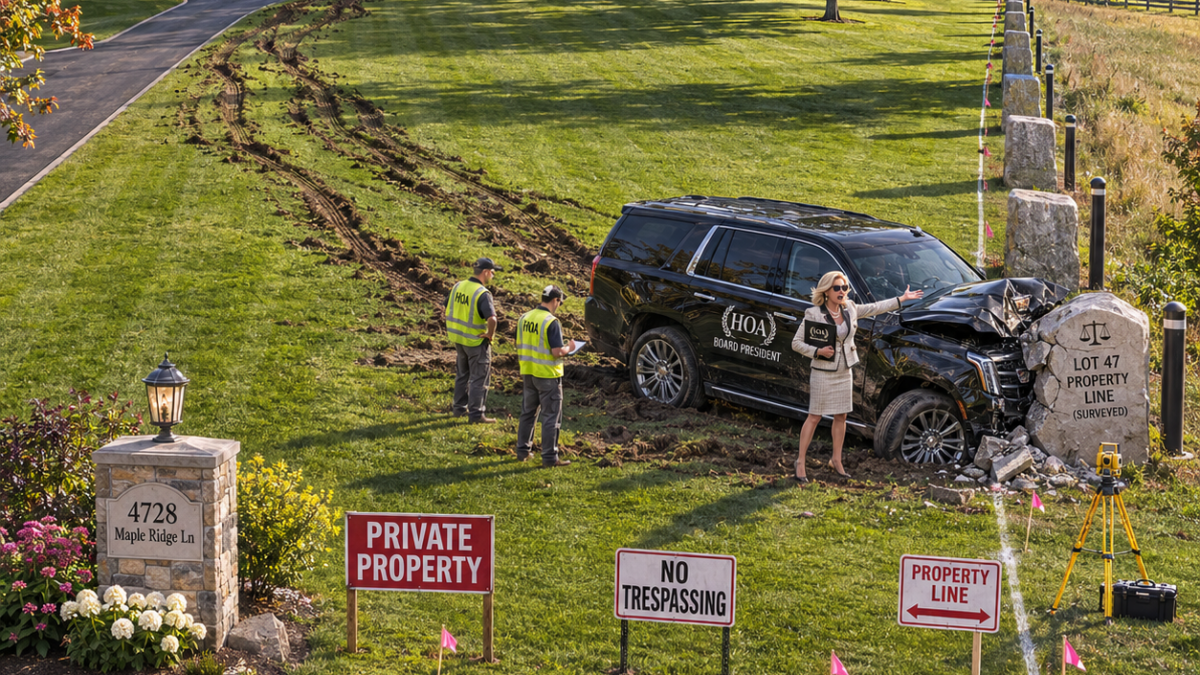
Every morning at 7:47, Anna Edwards cut the same corner across my lawn in her white BMW, tearing through new sod, clipping sprinkler heads, and leaving muddy tire tracks across the one patch of green my wife Laura could still sit by the window and enjoy while Parkinson’s slowly took things from her. I asked Anna politely to stop, put up signs, installed cameras, called the HOA, and even had an officer document the trespassing, but she answered every boundary with the same smug claim—that she was HOA president, her husband had built Maple Ridge Estates, and I would eventually learn that people like her decided where everyone else’s property ended. What Anna didn’t know was that one damaged sprinkler had brought an insurance adjuster to my yard, and the moment he looked at the old survey markers and frowned, the entire fight changed from an argument about grass into a question that could destroy far more than the front end of her luxury SUV.
My name is Samuel Bell, though everyone called me Sam. I was sixty-one, retired after thirty years as an electrician, and I had moved to Maple Ridge because Laura and I wanted our last chapter to be quiet.
Laura had always loved gardening. Roses, tomatoes, ridiculous little herbs she could identify by smell from twenty feet away. Parkinson’s changed that. Her hands shook. Her balance went. Long afternoons outside became short trips to the porch.
So we built the lawn together.
Nothing fancy. Good sod, irrigation, a curved flower border, and two chairs near the front window where she could watch the sprinklers catch sunlight in the mornings.
Then Anna started driving through it.
The first time, I assumed she had missed the turn.
The second time, she broke a sprinkler head.
The third morning, I waited outside.
Her BMW came around the curve and rolled straight over my corner.
I raised one hand.
She stopped halfway across the grass and lowered her window.
“Mrs. Edwards, this is private property.”
She looked toward the curb.
“It’s an easement.”
“No, it isn’t.”
“My husband built this subdivision.”
“That doesn’t make my lawn a road.”
Her lips curled.
“I’m HOA president, Mr. Bell. I know where the property lines are.”
I pointed toward the survey stake.
“That line says otherwise.”
She smiled.
“If you’re smart, you’ll stop making problems.”
Then she drove away.
The following week, I received an HOA violation notice accusing my sprinkler system of creating a “community disturbance.”
Fine: two hundred fifty dollars.
Laura read it at the kitchen table.
Her fingers trembled around her tea.
“She’s not worth this, Sam.”
“I know.”
“Do you?”
I looked at the tire tracks outside.
“No.”
She smiled faintly.
“Let karma handle her.”
I wasn’t much of a believer in karma, but I did believe in wiring, documentation, and making sure the current went exactly where it was supposed to.
So I installed cameras and motion-activated lighting along the edge of my property. Nothing dangerous. Nothing hidden. Just enough light and recording coverage to make every crossing obvious.
Anna hated it.
One night, my cameras caught her walking onto the lawn and yanking at the low-voltage fixtures.
The next morning, she fined me for “excessive illumination.”
That was when the insurance adjuster came to inspect the damaged equipment.
He walked the corner twice.
Then stopped.
“Mr. Bell?”
“Yeah?”
“Who set these property markers?”
“Developer, I assume.”
He took out a measuring device.
Checked again.
Then looked toward Anna’s decorative stone retaining wall.
“Something’s wrong.”
My stomach tightened.
“How wrong?”
“Your recorded plat appears to put this boundary farther out.”
“How far?”
He measured.
“Could be fifteen feet. Maybe more.”
I stared at the corner Anna had driven across almost every morning for three months.
He pointed toward her retaining wall.
“And if the recorded plat is right, part of that may be on your land too.”
For several seconds, neither of us spoke.
Then he said the words that turned my irritation into something colder.
“Get a licensed surveyor, Sam. Before anybody moves another inch.”
[END OF FACEBOOK OPENING]
[FULL STORY CONTINUATION]
I called Peter Hall before the adjuster had even left my driveway.
Pete and I had worked together on municipal projects twenty years earlier. He was a licensed surveyor before retirement and still did occasional private work when old union friends called with problems.
He answered on the fourth ring.
“Sam Bell.”
“You still have that expensive laser rig you wouldn’t shut up about?”
“Depends. You finally building that workshop?”
“No.”
“Pool?”
“No.”
“Secret bunker?”
“Pete.”
He laughed.
“What do you need?”
“I think someone moved my property line.”
The laughter stopped.
“What makes you think that?”
I told him about the adjuster.
The markers.
The recorded plat.
Anna.
The daily shortcut.
The retaining wall.
Pete was quiet for several seconds.
Then he said, “Don’t touch anything.”
“I wasn’t planning to.”
“Don’t remove stakes. Don’t confront the neighbor. Don’t move the wall.”
“Pete.”
“I know you.”
“I’m sixty-one.”
“You were reckless at forty.”
“That was twenty years ago.”
“Exactly. You’ve had twenty years to become creative.”
Despite myself, I smiled.
“When can you come?”
“Tomorrow morning.”
I slept badly.
Not because I was excited about taking land from Anna.
I had no interest in her property.
I wanted mine to stop being treated like hers.
But once you start questioning a boundary, you start questioning everything built around it.
The sprinkler damage.
The HOA notices.
Anna’s confidence.
Her husband’s development company.
Why the survey stakes sat where they did.
Laura noticed I was awake around two.
“You’re staring at the ceiling.”
“I’m thinking.”
“That’s what you call it.”
“What do you call it?”
“Building a courtroom in your head.”
I turned toward her.
Moonlight outlined her face.
Parkinson’s had changed her movements more than her expression. The woman I married still lived in those eyes, amused by me, worried about me, unwilling to let me become dramatic without mocking it.
“What if the adjuster’s right?”
“Then you deal with it.”
“What if he isn’t?”
“Then you apologize to your lawn for getting its hopes up.”
I laughed quietly.
She reached for my hand.
It took her longer than it used to.
That hurt in ways Anna never could.
“Sam.”
“Yeah?”
“Promise me something.”
“What?”
“Don’t turn this into a war.”
I almost said it already was.
Instead:
“I promise I won’t start one.”
Laura sighed.
“That answer sounds like a contract.”
“Thirty years around engineers.”
“You were an electrician.”
“Close enough.”
“No. That’s exactly the kind of thing an electrician says right before a building loses power.”
The next morning, Pete arrived with two younger surveyors.
Orange vests.
Tripod.
Digital equipment.
A stack of recorded documents.
Anna’s BMW was gone.
Good.
I didn’t want theater.
Pete started at the street monument.
Then worked backward through the subdivision plat.
He checked one point.
Then another.
He muttered something I couldn’t hear.
Around noon, I brought coffee outside.
“Well?”
Pete didn’t answer immediately.
That worried me.
“Pete.”
He pointed toward an orange flag his crew had placed beyond the old marker.
“Your corner is out.”
“How far?”
“Closer to eighteen feet at the widest point.”
I looked at the flag.
Then toward Anna’s stone wall.
Pete walked with me.
“Here.”
He marked another location.
“And here.”
Another.
The wall crossed the line.
“How much?”
“About four feet at the worst section.”
I rubbed both hands over my face.
“So she’s been driving—”
“Across your parcel.”
“For months.”
“Yes.”
“And her wall—”
“Appears to encroach.”
I looked at him.
“Appears?”
“You want absolute words, hire a politician. I’m a surveyor.”
He handed me the field notes.
“Sam, get a full signed report and have your lawyer review the recorded plat before you do anything.”
“I don’t have a lawyer.”
“You will.”
“I’m retired.”
“So?”
“Lawyers cost money.”
“So do wars.”
Laura’s promise came back.
Don’t turn this into a war.
“Fine.”
I called Rachel Kim.
Rachel had handled a contract dispute for the electrical company I worked with before retiring. She was sharp without being theatrical, which immediately put her in my top five attorneys.
I sent her Pete’s preliminary survey.
She called twenty minutes later.
“You haven’t confronted anyone?”
“No.”
“You haven’t touched the retaining wall?”
“No.”
“You haven’t posted anything online?”
“I barely know how.”
“Good. Stay boring.”
“I’m excellent at boring.”
“Your file says you once rewired an entire warehouse because the foreman told you your plan was impossible.”
“That was professionally necessary.”
“I’m sure.”
She asked for my deed, title report, HOA covenants, purchase documents, and every violation notice Anna had sent me.
By evening, Rachel had enough to say one important thing.
“Your parcel is not owned by the HOA.”
“I knew that.”
“Your corner is not listed as an HOA common easement.”
“I knew that too.”
“No, Sam. You believed it. Now we document it.”
That difference mattered.
The next evening, Pete returned with the formal survey.
I was standing near the newly flagged line when Anna came down the sidewalk.
She saw the orange flags.
Stopped.
Then walked straight toward me.
“What are these?”
“Survey markers.”
Her face tightened.
“Who authorized this?”
“I did.”
“You can’t alter association boundaries.”
“I didn’t.”
She pointed.
“That line is wrong.”
“Licensed survey says it isn’t.”
“My husband built Maple Ridge.”
“You’ve mentioned that.”
“He knows exactly where every lot ends.”
“Then he should recognize the plat.”
I handed her a copy.
She did not take it.
“You think you can move property lines because some retired friend says so?”
“Pete is licensed.”
Her eyes moved toward the wall.
She had noticed.
I saw it.
“What are you planning?”
“Right now?”
“Yes.”
“Getting legal advice.”
She stepped closer.
“You have no idea who you’re dealing with.”
That sentence would have intimidated me more if she hadn’t already used it twice.
I said, “Anna, I spent three decades working around electrical systems that could kill me if I got one measurement wrong. You’re not frightening because you own a clipboard.”
Her jaw tightened.
“People who challenge this HOA regret it.”
“People who move survey markers might too.”
Her face changed.
“Are you accusing me?”
“No.”
I pointed to the report.
“I’m reading measurements.”
She turned and walked away.
Laura had watched from the window.
When I came inside, she said:
“You were enjoying that.”
“A little.”
“Sam.”
“She threatened me.”
“And you poked her.”
“I used words.”
“So does she.”
That bothered me because Laura was right.
The next day brought another violation notice.
Unauthorized survey activity.
Five hundred dollars.
Rachel laughed when I emailed it.
“Keep it.”
“For what?”
“My scrapbook.”
“You lawyers are weird.”
“Do not pay it.”
“I wasn’t going to.”
“I’m sending the HOA a letter.”
“What kind?”
“The kind that uses complete sentences and makes people call their insurance carrier.”
Rachel’s letter did three things.
It formally disputed HOA jurisdiction over the newly surveyed strip.
It demanded suspension of fines related to my property boundary.
And it instructed the association to preserve all records concerning the original subdivision survey, Edwards Development, property-line modifications, and any complaints against my address.
Anna responded personally.
She called my home at 7:30 that evening.
Laura answered.
I saw the expression on her face change.
Then she handed me the phone.
“It’s the queen.”
I nearly laughed.
“Hello?”
Anna’s voice was tight.
“You’ve made a mistake.”
“Good evening.”
“Do not patronize me.”
“I said good evening.”
“You brought lawyers into a neighborhood matter.”
“You filed a lien-like assessment notice against property outside your boundary.”
“I filed violations.”
“You threatened enforcement.”
“Because you refuse to comply.”
“With what?”
“Community standards.”
“On my own land.”
“Your land is part of Maple Ridge.”
“The deed says otherwise.”
“The HOA has rights.”
“Show me.”
Silence.
Then:
“You are creating unnecessary conflict.”
That one almost impressed me.
“I’m creating conflict?”
“You installed hostile lighting.”
“On my land.”
“You confronted me.”
“After you drove over my lawn.”
“You’re harassing a woman in her own neighborhood.”
I looked at Laura.
She raised an eyebrow.
“Anna, stop driving through my property. Stop sending violations you don’t have authority to send. Let the survey issue go through the proper process.”
“You think that concrete and paperwork will protect you?”
“What concrete?”
Another pause.
Too long.
I felt something tighten in my chest.
“Anna?”
“I’m speaking generally.”
“Sure.”
She hung up.
I told Rachel.
Her response:
“Cameras.”
“Already have them.”
“More coverage.”
“Done.”
“Good lighting.”
“Done.”
“Do not confront anyone at night.”
“Fine.”
“And Sam?”
“Yeah?”
“No traps.”
“I’m an electrician, not Wile E. Coyote.”
“I’m serious.”
“So am I.”
The word trap mattered because anger makes people stupid.
I had imagined things.
Not illegal things exactly.
Just satisfying things.
A ditch.
A barrier.
Something that made Anna stop the hard way.
Then I pictured Laura watching from the window.
That changed the question.
I did not need Anna injured.
I needed my lawn protected.
So instead of improvising, I asked Rachel what I was legally allowed to place inside a surveyed boundary.
She sent me back to the county.
I spoke to zoning.
Then public works.
Then a residential safety officer.
I showed them Pete’s report.
The recorded plat.
Photographs of the vehicle tracks.
I asked about a visible decorative landscape barrier inside the property line.
Not hidden.
Not sharpened.
Not disguised as something fragile.
Something stationary that kept vehicles off a corner they had no right to drive across.
The answer was simple.
A properly located, visible landscaping bollard or protective post could be allowed depending on setback and sightline requirements.
So I hired a contractor.
That surprised Tony Ramirez more than anything.
Tony owned the hardware store where I had bought half my electrical supplies since moving to Maple Ridge.
“You’re paying somebody?”
“I’m retired.”
“You wired your own security system.”
“That’s electrical.”
“You rebuilt a lawn irrigation controller.”
“That was easy.”
“You’re hiring someone to install one post?”
“I want paperwork.”
Tony stared.
“Anna broke you.”
“Rachel educated me.”
The contractor installed a solid decorative bollard well inside Pete’s surveyed line.
Professional.
Permitted where required.
Visible from the street.
Reflective marker at night.
No concealed hardware.
No trick.
No ambush.
It looked like landscaping.
Because that was what it was.
A boundary made physical.
I put a small garden bed around it and a plaque:
BELL GARDEN CORNER.
Laura saw it from the window.
“You named a post.”
“It needed dignity.”
“It’s concrete.”
“So was Hoover Dam.”
“Sam.”
“You married me.”
“That was before I understood the full situation.”
For three days, Anna avoided the corner.
I almost believed she had finally understood.
Then Monday came.
7:47.
Laura and I were eating breakfast.
The familiar BMW appeared at the top of the curve.
I saw it through the front window.
My stomach tightened.
The car approached.
Slowed slightly.
The driver could see the bollard.
There was no question.
Anna steered toward the grass anyway.
I stood.
Laura whispered:
“Sam.”
“I’m not doing anything.”
The BMW crossed the curb.
Entered my lawn.
Then Anna tried to cut the same path she had used dozens of times before.
The right front side of the vehicle struck the fixed barrier.
The sound was ugly.
Metal.
Plastic.
Tire.
Not some cinematic explosion.
Just the sharp violence of a moving car hitting something stationary that had every right to be there.
The BMW stopped.
Airbag deployed.
For one terrible second, my anger disappeared completely.
“Call 911.”
Laura already had the phone.
I ran outside.
Anna’s door opened.
She stumbled out.
Shaken.
Furious.
But standing.
“Are you hurt?”
She stared at me like I had spoken another language.
“You did this.”
“Are you hurt?”
“You put that there!”
“Yes.”
“You tried to kill me!”
“No.”
“You knew I drive here!”
“That’s why I told you not to.”
Her hands were shaking.
I kept my distance.
“Sit down until paramedics arrive.”
“I’m not sitting anywhere on your property.”
“That would be a first.”
I regretted it immediately.
Wrong moment.
Anna pointed at me.
“You think this is funny?”
“No.”
The airbag powder floated inside the BMW.
One wheel sat crooked.
Coolant dripped under the front.
Laura stood at the doorway, pale.
That grounded me.
I stopped talking.
Officer Rodriguez arrived with EMS.
He had handled one earlier trespass report.
He walked the scene.
Looked at the curb.
Tire tracks.
Survey markers.
Bollard.
Then me.
“Don’t say anything clever.”
“I wasn’t going to.”
“You have that face.”
Paramedics checked Anna.
No serious injury.
She refused transport.
Then launched into her story.
“He built a trap because he knew I use this route.”
Rodriguez looked at the post.
“It’s visible.”
“He put it exactly where I drive.”
I said nothing.
Rodriguez looked at the street.
Then the tire tracks.
“Mrs. Edwards, you left the roadway.”
“This is an easement.”
“Do you have documentation?”
“I’m HOA president.”
“That isn’t documentation.”
“My husband developed this neighborhood.”
“That also isn’t documentation.”
“He planned this.”
Rodriguez turned toward me.
“Mr. Bell?”
I handed him Pete’s survey.
County correspondence.
Photographs of the installation.
Rachel’s letter.
The previous trespass reports.
The officer looked from the documents to the post.
“Did you ever tell Mrs. Edwards she could cross here?”
“No.”
“Did you conceal this?”
“No.”
“Was it visible when she approached?”
“Yes.”
The camera answered that too.
Rodriguez watched the footage on my phone.
Anna’s BMW clearly approached.
Clearly changed direction.
Clearly crossed the lawn.
Clearly hit a stationary object.
He sighed.
“Mrs. Edwards, you drove onto private property and struck a fixed landscaping feature.”
Anna looked like he had slapped her.
“So he gets away with this?”
“He isn’t getting away with anything. We’re documenting an accident.”
“He caused it.”
“You were driving.”
“This is unbelievable.”
The tow truck arrived.
Neighbors appeared.
I hated that part.
Phones.
Whispers.
A few smiles.
Someone clapped once.
I turned.
“Stop.”
The clapping ended.
Anna looked at me.
For a moment, the anger in her face became something else.
Humiliation.
I almost felt sorry for her.
Then she leaned closer and whispered:
“I’ll ruin you.”
There she was again.
I said quietly:
“Anna, you’ve been trying.”
The BMW left on a flatbed.
My lawn was torn up again.
The bollard was scratched.
Still standing.
I went inside.
Laura was crying.
That scared me more than the crash.
“What’s wrong?”
She shook her head.
“I hate this.”
“Laura.”
“I hate what she’s turning our home into.”
I sat beside her.
“I know.”
“No, Sam.”
Her hands trembled harder.
“This was supposed to be where we got old quietly.”
That broke something in me.
Not anger.
Grief.
I had been so focused on winning the boundary fight that I had forgotten what the boundary was supposed to protect.
Our peace.
I held her until her shaking eased.
“I’m sorry.”
“You didn’t drive the car.”
“I know.”
“But you’re enjoying fighting her.”
That landed.
“Sometimes.”
“I don’t want you spending whatever time we have left enjoying a fight.”
I closed my eyes.
“I don’t either.”
“Then finish it.”
The HOA violation arrived the next morning.
UNAPPROVED STRUCTURE.
One thousand dollars.
I forwarded it to Rachel.
She replied:
Good.
I called.
“Why does every lawyer say good when something terrible happens?”
“Because Anna keeps creating evidence.”
“She crashed yesterday.”
“I know.”
“Laura’s upset.”
Rachel’s tone changed.
“Then we move faster.”
She filed for preliminary injunctive relief against further HOA enforcement related to my boundary dispute.
She also challenged the HOA’s authority to fine me over improvements located outside its jurisdiction.
Meanwhile, Anna called code enforcement.
Inspector Ethan Cole arrived on Wednesday.
Reflective vest.
Clipboard.
Expression already decided.
“Anonymous complaint.”
“Let me guess.”
“Electrical installations.”
I looked at my low-voltage landscape lights.
“Those?”
“And structural modifications.”
“The bollard?”
He nodded.
I handed him the county correspondence.
He barely glanced.
“I’ll need to conduct my own review.”
“Do that.”
He walked around.
Measured.
Photographed.
Then looked at the floodlights.
“You may be required to remove these.”
“Why?”
“Improper installation.”
“What voltage?”
He looked at me.
“What?”
“You’re citing electrical work. What voltage is the system?”
“I’d have to check.”
“I installed it.”
“That doesn’t mean it’s compliant.”
“I was a licensed electrician for thirty years.”
“Retired.”
There was that word again.
Anna loved it too.
“You’re still going to need to document the violation.”
His eyes narrowed.
“I am documenting it.”
“Good.”
I took out my phone.
“So am I.”
His tone changed.
“You’re recording?”
“On my property.”
He handed me a citation.
Two hundred dollars.
Ten days to remove the lights pending review.
I looked at it.
Then at him.
“I’ll appeal.”
“You can.”
“Who handles appeals?”
“The department.”
“You?”
“Sometimes.”
I smiled.
“Excellent.”
That evening, I called Big Jim Parker, my former electrical foreman.
He knew every inspector, contractor, and union rumor within a hundred miles.
“Ethan Cole?”
Jim snorted.
“Still employed?”
“Apparently.”
“What’s he doing?”
“Citing low-voltage landscape lights.”
“Yours?”
“Yes.”
Jim laughed so loudly I moved the phone away.
“Why?”
“Neighbor problem.”
“Edwards?”
I froze.
“You know the name?”
“Everybody in development knows Edwards.”
“Greg?”
“Greg likes inspectors who don’t ask difficult questions.”
“That sounds like gossip.”
“It is.”
“Anything provable?”
Jim went quiet.
“Check permit histories.”
That was useful.
The next morning, I filed public-records requests.
Rachel helped narrow them.
Inspection complaints in Maple Ridge.
Code enforcement initiated by Anna Edwards.
Permits involving Edwards Development.
Corrections ordered after HOA complaints.
I expected a few coincidences.
I got dozens of pages.
Anna had submitted complaints against residents for bird feeders, driveways, sheds, fences, drainage, mailbox placement, exterior lighting.
That alone wasn’t illegal.
HOA presidents complain.
But another pattern appeared.
After several complaints, homeowners hired Edwards Development or affiliated contractors to perform the required “corrections.”
Mrs. Brooks had paid for removal and reconstruction of a small garden structure.
The Hendersons had paid for driveway modifications.
The Martinez family had paid for retaining-wall work.
Different complaints.
Same network of contractors.
I called Rachel.
“This looks bad.”
“It looks interesting.”
“You lawyers need stronger adjectives.”
“We need evidence before adjectives.”
So we gathered evidence.
That Friday, Tony’s Hardware closed an hour early.
Not because we planned a rebellion.
Because half the neighborhood had heard I was comparing records.
Evelyn Brooks arrived first.
Seventy-three.
Former librarian.
Weaponized organization.
She brought a three-ring binder.
“You keep records?”
She looked insulted.
“I was a librarian.”
Fair.
The Hendersons brought invoices.
The Garcias brought photographs.
Mr. Chen brought an old survey.
The more we compared, the more questions appeared.
Property stakes that had shifted.
HOA violations followed by Edwards Development bids.
Fine notices based on boundaries inconsistent with recorded plats.
No single document proved a conspiracy.
Together, they demanded explanation.
Laura sat behind Tony’s counter drinking tea.
She had insisted on coming.
“You’re supposed to rest.”
“So are you.”
“Different.”
“No.”
Evelyn opened her notebook.
“Anna fined me for bird feeders in 2022.”
“Why?”
“Rodent attraction.”
“Did you have rodents?”
“No.”
“What happened?”
“Greg’s company removed a garden bed beside the feeder and installed gravel.”
“How much?”
“Twenty-seven hundred dollars.”
“For gravel?”
“I was afraid of daily fines.”
The Hendersons had a similar story.
The Garcias had a property-line problem.
Their fence had been moved inward during an Edwards Development project.
Pete surveyed it two days later.
Their recorded boundary extended almost six feet farther than the line they had been told to use.
Then another homeowner.
And another.
Rachel joined by video.
She listened.
Asked questions.
Told everyone to preserve originals.
Then she said:
“We may be dealing with more than overaggressive HOA enforcement.”
Tony leaned toward the laptop.
“What do you call it?”
“Right now?”
Rachel looked at the screen.
“A reason to investigate.”
That was less satisfying than fraud.
More responsible.
By Monday, the county assessor’s office had begun comparing original plats with later submissions.
Rachel called at noon.
“You sitting?”
“No.”
“Sit.”
I sat.
“Multiple plats involving Edwards projects show inconsistencies.”
“How many?”
“Six so far.”
“Clerical errors?”
“Possible.”
“Rachel.”
“Some changes benefit parcels tied to Edwards Development work.”
My chest tightened.
“So Pete was right.”
“Pete was right about your lot.”
“And the rest?”
“Under review.”
I looked out the window.
Anna’s retaining wall.
Four feet into my property.
The BMW was gone while insurance evaluated it.
For the first time, her driveway looked ordinary.
“What happens now?”
“The county checks originals.”
“Then?”
“If records were altered improperly, the district attorney gets involved.”
That same afternoon, Anna appeared at my porch.
Pink coat.
Heels sinking into wet grass.
No BMW.
She had arrived in Greg’s black SUV.
I stayed seated.
“You’ve been busy.”
“So have you.”
“You’re turning neighbors against me.”
“They brought their own documents.”
“This is a smear campaign.”
“Then the records will clear you.”
Her expression hardened.
“My husband built this community.”
“So you keep saying.”
“Do you know how many families he employed?”
“No.”
“How much value he created?”
“No.”
“How many favors people around here owe him?”
That one interested me.
“Is that a threat?”
“It’s reality.”
I set my coffee down.
“Anna, county records are being reviewed.”
Her face changed.
Tiny.
But I saw it.
“Why?”
“Property plats.”
“You have no authority to demand that.”
“I didn’t.”
“Rachel Kim did.”
“Through lawful process.”
She took one step closer.
“You think a concrete post makes you untouchable?”
“No.”
“What does?”
“Nothing.”
That confused her.
I continued.
“I’m not trying to be untouchable. I’m trying to have the same rules apply to everybody.”
She laughed bitterly.
“That’s childish.”
“Maybe.”
“My husband knows council members.”
“Okay.”
“He knows inspectors.”
“Okay.”
“He knows the county.”
I looked directly at her.
“Then those people should be very careful right now.”
Her mouth tightened.
“This isn’t over.”
“No.”
I picked up my coffee.
“It’s finally getting started.”
She left.
The next two weeks were the ugliest stretch of the entire fight.
HOA bulletins accused “certain residents” of vigilantism.
New fines appeared across Maple Ridge.
Unauthorized meetings.
Unapproved signs.
Improper landscaping.
Wind chimes.
One hundred fifty dollars.
Evelyn brought that one to my house.
“Wind chimes.”
“I saw.”
“I am seventy-three years old.”
“I know.”
“I survived colon cancer.”
“I know.”
“My husband died.”
I nodded.
“And this woman thinks little metal birds are going to break me?”
I smiled.
“What are you going to do?”
She lifted the chimes.
“Buy another set.”
For the first time, resistance became funny.
That helped.
Fear had isolated everyone.
Laughter connected them.
But Anna escalated.
A neighborhood bulletin warned residents against “unauthorized organizing” and “defamatory accusations concerning elected board members.”
Rachel read it.
“They’re panicking.”
“How can you tell?”
“They’re trying to regulate conversations.”
A preliminary court order arrived two days later.
The HOA was restrained from enforcing disputed fines against me relating to the newly confirmed parcel boundary until the property case was resolved.
Inspector Cole’s citation was separately under administrative appeal.
Then the county announced an internal review of several permits tied to Edwards Development.
No criminal accusation.
Yet.
Still, construction crews stopped at one townhouse project.
Greg Edwards showed up at my house that night.
He had the same confidence as Anna but none of her polish.
Black overcoat.
Broad shoulders.
Jaw clenched.
“You Sam Bell?”
“You know I am.”
“My wife says you’re accusing my company of fraud.”
“I haven’t publicly accused you of anything.”
“You’re digging through permits.”
“Public records.”
“You’re stirring up homeowners.”
“They’re adults.”
“You think because you wired hospitals you understand development?”
“No.”
“You think because some surveyor moved a flag—”
“He didn’t move anything. He located the recorded line.”
Greg stepped closer.
I stayed behind the threshold.
“You need to stop.”
“Why?”
“Because you don’t understand the damage you’re doing.”
“To who?”
“My company.”
“That’s not an answer.”
His hand tightened.
“You live in a neighborhood I built.”
“I live on land I bought.”
“You benefited from our infrastructure.”
“I pay taxes.”
“You think you’re clever.”
“No.”
“I think I’m documented.”
He laughed.
“Anna warned me about you.”
“Funny. Laura warned me about Anna.”
He pointed at my chest.
“You’re going to regret this.”
I looked down at his finger.
Then at him.
“Greg.”
“What?”
“You’re on camera.”
His hand dropped.
He walked away.
Rachel had me file an incident report.
Not because he committed a dramatic crime.
Because patterns matter.
That became the sentence of my year.
Patterns matter.
Three days later, I woke to my mailbox knocked down.
Not the first vandalism.
The camera caught only a dark vehicle.
No plate.
No face.
No accusation.
I replaced the box.
Tony asked:
“Concrete?”
“No.”
“You’ve changed.”
“Steel post.”
He laughed.
“Halfway.”
Laura named it Mailbox Two.
I painted that on the side just to make her laugh.
It worked.
Her laugh had become quieter as Parkinson’s progressed.
Every time I heard it, I felt time narrowing.
That changed how I saw the fight.
Anna thought everything was about winning.
I started understanding that time was the only thing I truly couldn’t replace.
So I stopped attending every argument.
Rachel handled legal filings.
Pete handled surveys.
Neighbors gathered records.
I took Laura to physical therapy.
We ate lunch at the diner.
We sat by the window overlooking the lawn.
She watched the sprinklers.
“You know,” she said one afternoon, “the grass is coming back.”
I looked.
Green shoots had begun filling the tire scars.
“It is.”
“Maybe you should look at that more than the post.”
I smiled.
“You don’t like my post?”
“I married an electrician.”
“So?”
“You’ve spent three months emotionally attached to concrete.”
“Temporary phase.”
“Good.”
Then the excavator appeared.
Friday morning.
Yellow machine.
Two workers.
Orange vests.
Parked beside my corner.
Anna stood with them.
Pink coat.
Clipboard.
I walked outside slowly.
Laura called from the doorway.
“Sam.”
“I’m only asking questions.”
“Ask from far away.”
I did.
“Morning.”
Anna smiled.
“Emergency utility maintenance.”
“What utility?”
“Gas.”
One worker looked toward her.
Then at me.
“I thought water.”
Anna’s head snapped toward him.
“Combined service inspection.”
I took out my phone.
Started recording.
“Where’s the city vehicle?”
“Contractors.”
“Permit?”
“Emergency.”
“Work order?”
Anna’s smile disappeared.
“Do not interfere.”
The excavator operator climbed into the cab.
The bucket lifted.
My pulse accelerated.
Not because of the bollard.
Underground utilities ran nearby.
“I’m calling the utility company.”
Anna rolled her eyes.
I called the gas utility emergency number.
Gave the address.
They checked.
No scheduled work.
No reported leak.
The representative told me not to allow excavation until proper authorization could be confirmed.
I called police.
Then told the operator:
“Sir, the utility company says there is no authorized work.”
He shut the engine off immediately.
Anna shouted:
“Don’t listen to him.”
The man climbed down.
“I’m not losing my license.”
“You were hired.”
“For utility repair.”
“That’s what this is.”
“No.”
He pulled out his phone.
“You told me remove the concrete landscaping because the city needed access.”
Anna froze.
Officer Rodriguez arrived.
Same tired expression.
He looked at the excavator.
Then the bollard.
Then me.
“No.”
“I didn’t do anything.”
“I know. That’s why I’m worried.”
He spoke to the operator.
Asked for contracts.
Messages.
Payment records.
The operator handed over his phone voluntarily.
One message from Anna read:
Make the corner look like utility access. I need that post gone before Friday.
Another:
Greg will handle paperwork if anyone asks.
Anna watched Rodriguez read.
Her face drained.
“This is being taken out of context.”
Rodriguez looked at her.
“What context makes this better?”
She said nothing.
No dramatic arrest on the lawn.
Real investigations take longer.
But officers stopped the excavation.
Statements were taken.
The operator cooperated.
The incident went to investigators alongside the property-record review.
Within days, the county suspended Inspector Cole pending an internal audit.
His inspection history showed several irregular approvals involving Edwards Development.
Again, irregular did not automatically mean criminal.
That came later.
The district attorney opened a broader investigation.
Anna was removed temporarily from HOA enforcement decisions because the board’s insurer demanded it.
That was the first crack in her power.
The second came from her own board.
Cynthia Parker resigned.
Then another director.
The remaining members scheduled an emergency meeting.
This time homeowners showed up carrying binders.
Evelyn had hers.
The Hendersons.
Garcias.
Tony came even though he did not live in Maple Ridge.
He claimed moral residency.
Rachel told me not to attend.
“Why?”
“You’ve become the center of the story.”
“I started it.”
“No.”
“Anna did.”
“Exactly.”
“So why stay home?”
“Because this meeting is about their board, not your revenge.”
That word again.
Revenge.
I didn’t like hearing it anymore.
I stayed with Laura.
Tomatoes simmered on the stove.
We watched an old mystery movie.
Halfway through, my phone buzzed repeatedly.
I ignored it.
Laura pointed.
“Answer.”
“No.”
“You’re dying.”
“Probably neighbors.”
“You’re worse than me.”
I checked.
Twenty-three messages.
ANNA REMOVED.
BOARD VOTE 81%.
GREG RECORDS SUBPOENAED.
EVELYN DESTROYED HER.
I called Evelyn.
She answered on the first ring.
“Well?”
“What happened?”
“I asked questions.”
“That’s never good.”
“She couldn’t answer them.”
The homeowners had presented the original plats.
Invoices.
Complaints.
Fine records.
Evidence of conflicts with Edwards Development.
Anna denied wrongdoing.
Then HOA counsel made a statement.
The association had no evidence supporting Anna’s claim that my disputed corner was common HOA property.
According to Evelyn, you could feel the room change.
Anna stood.
“You’re all letting one bitter old man destroy this community.”
Evelyn answered:
“No. We’re finally reading our own paperwork.”
That line spread around Maple Ridge by morning.
Anna was removed as president pending investigation.
The HOA froze contested enforcement actions.
An independent audit began.
Still, Greg was the larger problem.
The county found multiple plat alterations associated with Edwards projects.
Some turned out to be legitimate revisions.
Others did not match recorded approvals.
A notary seal on several filings was questioned.
Inspector Cole’s signature appeared repeatedly.
The district attorney expanded the investigation.
Then a federal financial-crimes task force became involved after investigators found payments moving through companies across state lines.
That was when Special Agent Patricia Rodriguez came to my house.
No relation to Officer Rodriguez.
She made that joke before I could.
“You’re Samuel Bell?”
“Depends.”
She smiled.
“Special Agent Patricia Rodriguez.”
“You related to the officer?”
“No. We already established this six times today.”
I liked her immediately.
She looked at my famous bollard.
“So that’s it.”
“That’s what?”
“The concrete post.”
“It’s landscaping.”
“Of course.”
“It is.”
“Mr. Bell, I’m not here about the crash.”
“What are you here about?”
“Edwards Development.”
We spent almost three hours going through records.
She asked exact dates.
Where I obtained files.
Who had originals.
Metadata for videos.
Whether anything had been altered.
She cared less about dramatic stories than timestamps.
That reassured me.
When we finished, she said:
“This may be useful.”
“For what?”
“Several investigations.”
“Is Greg going to prison?”
She closed her notebook.
“Don’t jump ahead.”
“You sound like Rachel.”
“Smart woman.”
She stood.
“One more thing.”
“What?”
“Stop talking to reporters.”
“I’m not.”
“Good.”
“Can I talk to my wife?”
“Strongly encouraged.”
Laura was in the kitchen.
She had heard everything.
When Rodriguez left, she said:
“You like her.”
“She respects records.”
“You have a type.”
“What?”
“Women who tell you what not to do.”
I stared.
Laura smiled.
“Your mother. Rachel. Me. Federal agent.”
“That’s unfair.”
“And accurate.”
The city council hearing came in February.
By then, Maple Ridge was split between anger and exhaustion.
News vans lined the street.
The old clubhouse parking lot overflowed.
Rachel wanted me to testify.
“Just facts.”
“I know.”
“No speeches.”
“I know.”
“No electrical metaphors.”
“That feels personal.”
“It is.”
Councilwoman Elena Gonzalez chaired the hearing.
The room held nearly two hundred people.
Anna sat in the front beside Greg.
No pink coat.
No smug smile.
Navy suit.
Hands folded.
Greg whispered constantly to counsel.
Evelyn sat two rows behind them with her binder.
I took the podium.
“My name is Samuel Bell. I’m a retired electrician. My wife and I moved to Maple Ridge because we wanted peace.”
I explained the lawn.
Anna’s shortcut.
The HOA notices.
The survey.
The visible boundary barrier.
The collision.
The attempted excavation.
Then Rachel presented overlay maps showing the recorded property lines against later disputed versions.
Several changes benefited Edwards projects or HOA-controlled buffers.
Not every change was fraudulent.
But enough lacked proper documentation to justify deeper investigation.
Then the operator’s messages appeared.
Make the corner look like utility access.
I heard people gasp.
Anna stared at the table.
Councilwoman Gonzalez asked:
“Mrs. Edwards, did you send these messages?”
Anna’s attorney whispered.
Anna answered:
“Yes, but—”
Greg slammed one hand against the table.
“Don’t.”
The microphones caught it.
The entire room heard.
Anna turned.
Her face changed.
“Don’t what?”
“Anna.”
“Don’t tell the truth?”
The attorney stood.
“We request a recess.”
Gonzalez banged the gavel.
“Sit down.”
That was the moment their united front broke.
Not because I exposed them.
Because pressure made them turn toward each other.
Anna said:
“You told me the plats were handled.”
Greg’s lawyer put his head in one hand.
Greg hissed:
“Stop talking.”
Anna’s eyes filled.
“You said everybody did it.”
People murmured.
Gonzalez said:
“Mrs. Edwards, do not continue without advice of counsel.”
The hearing recessed.
By evening, the city suspended several development approvals pending review and placed Maple Ridge HOA financial operations under temporary independent oversight.
Not dissolved forever.
Not seized by dramatic government force.
Just stripped of the unchecked authority Anna had used like a weapon.
That was enough.
Then Greg sued me.
Two million dollars.
Defamation.
Business interference.
Intentional infliction of emotional distress.
When Rachel told me, I laughed.
She did not.
“This is serious.”
“It’s ridiculous.”
“Those are not mutually exclusive.”
“What did I say that was false?”
“That’s our defense.”
“I have evidence.”
“That’s why we’re going to win.”
“Then why aren’t you smiling?”
“Because litigation costs time.”
I looked toward Laura.
She was asleep in her chair.
Time.
Again.
“Can we make this go away quickly?”
“We can try.”
We responded.
Documents.
Truth defenses.
Protected statements to officials.
Public records.
No exaggerated accusations.
Rachel refused to let me become what Greg wanted.
A loud enemy he could blame.
Then the anonymous letter arrived.
MR. BELL,
YOU DESTROYED MY LIFE.
EVERYONE HATES ME.
MY HUSBAND BLAMES ME.
I HOPE YOU’RE HAPPY.
ANNA EDWARDS.
I read it twice.
Laura watched.
“What does it say?”
I handed it to her.
She read slowly.
Then returned it.
“Are you?”
“Happy?”
“Yes.”
“No.”
“Good.”
That surprised me.
“You want me miserable?”
“No.”
She touched my hand.
“I want you human.”
I filed the letter.
Spring came.
The lawn grew green.
The bollard remained.
Laura spent more afternoons by the window.
Her tremor had worsened.
Walking became harder.
One Saturday, neighbors organized a barbecue near my corner.
I objected.
They ignored me.
Evelyn raised lemonade.
“To Sam Bell, who proved concrete is stronger than corruption.”
Everyone laughed.
I shook my head.
“No.”
They quieted.
I stood.
“It wasn’t the concrete.”
Evelyn sighed.
“Here comes the speech.”
“The post stopped one car.”
I pointed toward the folders people had brought to hearings.
“Those stopped the rest.”
Laura smiled.
That was enough for me.
The darkest moment came in June.
Not from Anna.
From Greg.
Friday night.
I was grilling steaks when motion lights came on behind the garage.
Then a crash.
Fence board breaking.
Laura called from inside.
“Sam?”
“Stay there.”
I looked at the camera feed first.
Two figures near the rear property line.
I called 911.
Did not chase.
Did not confront.
That mattered.
One figure carried a fuel container.
Another moved toward my detached workshop.
The motion lights triggered fully.
Both ran.
One dropped the container.
Officers arrived within minutes.
Security video showed enough facial detail for investigators to identify one man as a subcontractor who had worked for Edwards Development.
The second figure looked like Greg.
I did not announce it publicly.
Investigators did.
Later.
After evidence.
Phone-location data.
Messages.
Vehicle cameras.
Greg was arrested in connection with attempted arson and retaliatory conduct.
That changed everything.
His civil lawsuit against me collapsed almost immediately.
His own lawyers withdrew after his financial position deteriorated and the criminal investigations expanded.
Anna cooperated.
Some people called that betrayal.
I called it survival.
Her testimony helped establish what Greg knew about the disputed surveys and how certain HOA complaints had been used to generate work for Edwards-connected contractors.
Not every allegation became a conviction.
Several did.
Greg eventually pleaded guilty to a package of federal and state fraud-related charges along with the retaliation case.
He received a lengthy prison sentence.
Not because of my lawn.
Because investigations uncovered a much larger pattern.
Inspector Cole pleaded to lesser offenses and cooperated.
Several homeowners received restitution.
The city required correction of property records.
The Garcias regained a strip of land they had thought was gone forever.
Evelyn’s bird-feeder fine disappeared.
She celebrated by installing three feeders.
“One for each year she annoyed me.”
The Hendersons got their driveway issue corrected.
Maple Ridge held new elections.
No Anna.
No Greg.
No candidates connected to Edwards Development.
The new board’s first resolution was almost boring.
Independent audits.
Transparent bids.
Appeal rights.
Property disputes required licensed surveys.
No HOA officer could initiate enforcement against a property they had a financial interest in.
Meetings were recorded.
Residents laughed about how dull everything had become.
Laura called that success.
Then came Anna’s plea.
She avoided prison through cooperation, restitution obligations, probation, and community service.
Some neighbors were furious.
Evelyn called me.
“She got off easy.”
“Maybe.”
“Maybe?”
“She lost her office. House. Reputation. Marriage. Money.”
“She deserves prison.”
“I’m not the judge.”
“You’re irritating.”
“I’ve been told.”
Anna eventually moved.
The Edwards house sold under the weight of legal costs and civil claims.
A young family bought it later.
The day the FOR SALE sign disappeared, I expected satisfaction.
Instead I thought about the night Anna had stood on my porch threatening me.
She had believed power meant people moved when she entered the room.
Now somebody else was unpacking children’s bicycles in her driveway.
Power is temporary.
Property lines, apparently, take paperwork.
Laura laughed when I told her that.
“Terrible slogan.”
“I’m working on it.”
“You have time.”
Her words caught both of us.
Neither spoke for several seconds.
Parkinson’s had progressed.
We had started talking about things we once avoided.
Handrails.
A downstairs bedroom.
Future care.
The fight with Anna had become background noise compared with that.
One afternoon, Rachel called.
“Remember Bell v. Maple Ridge?”
“I’m unfortunately familiar.”
“The appeal on the fraudulent annexation issue was published.”
“What does that mean?”
“The court affirmed that an HOA cannot impose covenants or assessment authority over adjacent property merely through internal maps or unrecorded assumptions when the parcel was never lawfully annexed.”
I sat down.
“So?”
“So lawyers may cite it.”
“My lawn is legal precedent?”
“Parts of your lawsuit are.”
“Does this mean I get a robe?”
“No.”
“Parking?”
“No.”
“A plaque?”
“Please don’t.”
Of course, Maple Ridge found out.
They held a council recognition.
I tried to refuse.
Laura wanted to go.
That settled it.
We sat in the front row.
She used a wheelchair for the longer distance.
Her hand shook in mine.
The councilwoman gave me a small plaque.
DEFENDING PROPERTY RIGHTS AND COMMUNITY INTEGRITY.
I hated the wording.
Laura loved it.
When asked to speak, I walked to the microphone.
Looked at the room.
People expected something about standing your ground.
Concrete.
Justice.
Instead I said:
“My wife and I moved here because we wanted a quiet place to grow old.”
I looked toward Laura.
“That didn’t go exactly to plan.”
Laughter.
Then silence.
“I spent months thinking this fight was about a lawn.”
“It wasn’t.”
“It was about whether a person with authority could rewrite facts simply because everyone else was too tired to argue.”
I paused.
“But I also learned something I didn’t expect.”
“The goal isn’t to become better at fighting.”
“It’s to build a community where ordinary disagreements don’t become wars.”
I looked at Evelyn.
Tony.
Garcias.
Hendersons.
Rachel.
“None of this ended because one retired electrician poured concrete.”
“It ended because people compared notes.”
I stepped away.
Laura was crying.
I panicked.
“What?”
She shook her head.
“Nothing.”
“Are you okay?”
“You finally gave a speech without an electrical metaphor.”
I laughed so hard I nearly dropped the plaque.
Anna’s letter came months later.
Real handwriting.
No HOA seal.
No attorney.
Sam,
I wanted to hate you.
For a long time I did.
I blamed you for my accident, my removal, Greg’s investigation, our marriage, and everything that came afterward.
It was easier than admitting I had become somebody I did not recognize.
Greg told me the boundary records could be fixed.
He told me the community needed the additional land and that everyone would eventually benefit.
I wanted to believe him because it made me important.
Every time you said no, I felt humiliated.
Every time you showed a document I couldn’t answer, I became more determined to prove that I still had authority.
The morning I hit the post, I saw it.
That is difficult to admit.
I saw it.
I knew it was there.
I drove across your lawn anyway because turning onto the street would have felt like admitting you had won.
I was wrong.
About the property.
About the HOA.
About you.
I am especially sorry for what I did to Laura’s peace.
You did not destroy my life.
I helped Greg and then helped myself destroy it.
I am trying to become somebody different.
I don’t expect forgiveness.
Anna.
I sat on the porch holding the letter.
Laura was beside me.
She had trouble reading long pages now.
I read it aloud.
When I finished, she was quiet.
“Well?”
I asked.
“She finally learned something.”
“Do you believe her?”
“Maybe.”
“What should I do?”
Laura smiled.
“You’re asking me?”
“You’re smarter.”
“Took you long enough.”
I waited.
“Write back.”
“What?”
“Not a novel.”
“What do I say?”
“The truth.”
I wrote:
Anna,
I received your letter.
Thank you for acknowledging what happened.
The boundary dispute is over.
I hope the life you build next is quieter and kinder than the one we all lived through here.
Sam and Laura.
I showed Laura.
She nodded.
“Good.”
“Too forgiving?”
“No.”
“Too cold?”
“No.”
“What then?”
“Finished.”
I mailed it.
That word mattered.
Finished.
The concrete bollard remained at the corner.
But over time, it stopped looking like a weapon in some HOA revenge story.
Laura planted lavender around it.
Technically, I planted it.
She supervised aggressively.
“You’re crowding them.”
“They’re plants.”
“They need space.”
“So did our property.”
She stared at me.
“Do not compare my lavender to Anna Edwards.”
“Yes, ma’am.”
The next year, Laura’s walking got harder.
We added a ramp.
No HOA argument.
New board approved the exterior modification in one meeting.
Actually, they asked why I bothered submitting it.
“Trauma,” I said.
Evelyn, now board secretary, replied:
“Approved before you finish complaining.”
The ramp let Laura reach the porch more easily.
On spring mornings, she sat outside.
Sprinklers hissed.
Lavender moved around Bell Garden Corner.
Children rode bicycles past.
Nobody cut across the grass.
One morning, she pointed toward the bollard.
“You know what I like about it now?”
“My engineering?”
“No.”
“The granite cap?”
“No.”
“My impeccable taste?”
She sighed.
“The flowers.”
I looked.
Purple lavender had softened the concrete almost completely.
She was right.
“Funny,” I said.
“What?”
“I spent months making it impossible to ignore.”
“And now?”
“Now I barely see it.”
Laura leaned back.
“That’s peace.”
Years later, people still told the story wrong.
They said I had built a hidden trap.
I hadn’t.
It had been visible.
Legal.
Marked.
Inside the surveyed line.
Anna simply refused to accept that the path she preferred was not hers.
Others said the concrete post brought down the Edwards empire.
It didn’t.
Records did.
Neighbors did.
Investigators did.
Anna and Greg did most of it themselves.
The post simply made one boundary impossible to pretend away.
That difference matters.
Because if revenge had been the goal, I might have built something dangerous.
If humiliation had been the goal, I might have wanted Anna hurt.
I didn’t.
Not really.
What I wanted was the lawn back.
Laura’s window.
Our quiet mornings.
The sound of water through sprinklers instead of BMW tires tearing sod.
Eventually, I got all of that.
Not forever.
Nothing is forever.
Laura died four years after the first tire tracks appeared.
Parkinson’s did what Parkinson’s does.
Slowly.
Then suddenly.
The last summer was hard.
She spent most days near the front window.
The lawn stayed green.
Lavender surrounded the corner.
One afternoon, rain began.
Soft.
She watched it.
“Sam?”
“Yeah?”
“You remember when you wanted to build a fortress out there?”
“I never said fortress.”
“You thought fortress.”
“Maybe.”
She smiled.
“I’m glad you built a garden instead.”
I held her hand.
“So am I.”
After she died, the house became unbearably quiet.
For months, I stopped caring about the lawn.
Sprinkler head broke.
I left it two weeks.
Tony came over and fixed it without asking.
Evelyn brought food.
Rachel checked on me.
The Garcias mowed.
The Hendersons shoveled snow.
Maple Ridge—the place Anna once used as a kingdom—became the community Laura and I had wanted all along.
Not because there were no rules.
Because people mattered more than rules.
That first spring without Laura, I stood at Bell Garden Corner.
The lavender had survived winter.
One plant had died.
I replaced it.
A little boy from the Edwards house—the family who bought it years later—rode his bicycle over.
“Mr. Bell?”
“Yes?”
“My mom says I’m not supposed to ride on your grass.”
“Your mom is smart.”
He looked at the bollard.
“Is that the famous concrete thing?”
“Apparently.”
“Did a bad lady crash into it?”
I thought about Anna’s letter.
About Greg.
About Laura.
“No.”
He frowned.
“No?”
“A woman made a bad choice and hit it.”
Children dislike nuance.
“Was she bad?”
I looked toward the house she once owned.
“I think she was wrong for a long time.”
“That’s not the same?”
“No.”
He considered that.
Then pointed toward the lavender.
“Can I smell those?”
I smiled.
“Sure.”
He got off his bicycle.
Left it on the sidewalk.
Walked around the grass instead of across it.
Bent toward the flowers.
That simple act touched me more than the court decisions.
He had asked.
I had answered.
He respected the answer.
That was all Anna and I had ever needed.
Years later, when I finally sold the house, the buyers asked whether I planned to remove the bollard.
I looked at the granite cap.
The lavender.
Bell Garden Corner plaque.
“No.”
“Is it necessary?”
“Not anymore.”
“Then why keep it?”
I thought about Laura.
“Because my wife liked the flowers.”
They left it.
Last I heard, it still stands.
Not as a trap.
Not as a monument to an HOA president’s wrecked BMW.
Just a solid post at the edge of a garden, exactly where the recorded property line says it belongs.
Sometimes boundaries need signs.
Sometimes they need lawyers.
Sometimes they need surveys.
And sometimes the most important thing about a boundary is not how hard it is.
It’s that everyone finally agrees to see it.
The last morning I spent in Maple Ridge, I stood beside the corner with my car packed.
The house behind me was empty.
Laura’s chair gone.
Her garden tools boxed.
The sprinklers came on automatically.
Water arced across the lawn in the early sun.
For a second, the droplets caught the light exactly the way they had when Laura and I first moved in.
I could almost see her behind the window.
Tea in both hands.
Watching.
I rested my palm on the granite cap.
The concrete was cold.
Solid.
Unremarkable.
Exactly what it should have been all along.
I smiled.
“Still here.”
Then I walked to the car.
Not angry.
Not triumphant.
Just grateful that after everything Anna tried to take from that little corner, the memory I carried away was not the crash.
It was Laura’s lavender growing around the thing that had once divided the entire neighborhood.
[END OF STORY]








