I Called Airport Security on the Biker Following Me and My Sick Baby—Then I Woke Up and Found My Son Sleeping on His Chest
I Called Airport Security on the Biker Following Me and My Sick Baby—Then I Woke Up and Found My Son Sleeping on His Chest
I called airport security on a massive biker who had been following me and my sick five-month-old son through Denver International Airport for almost two hours.
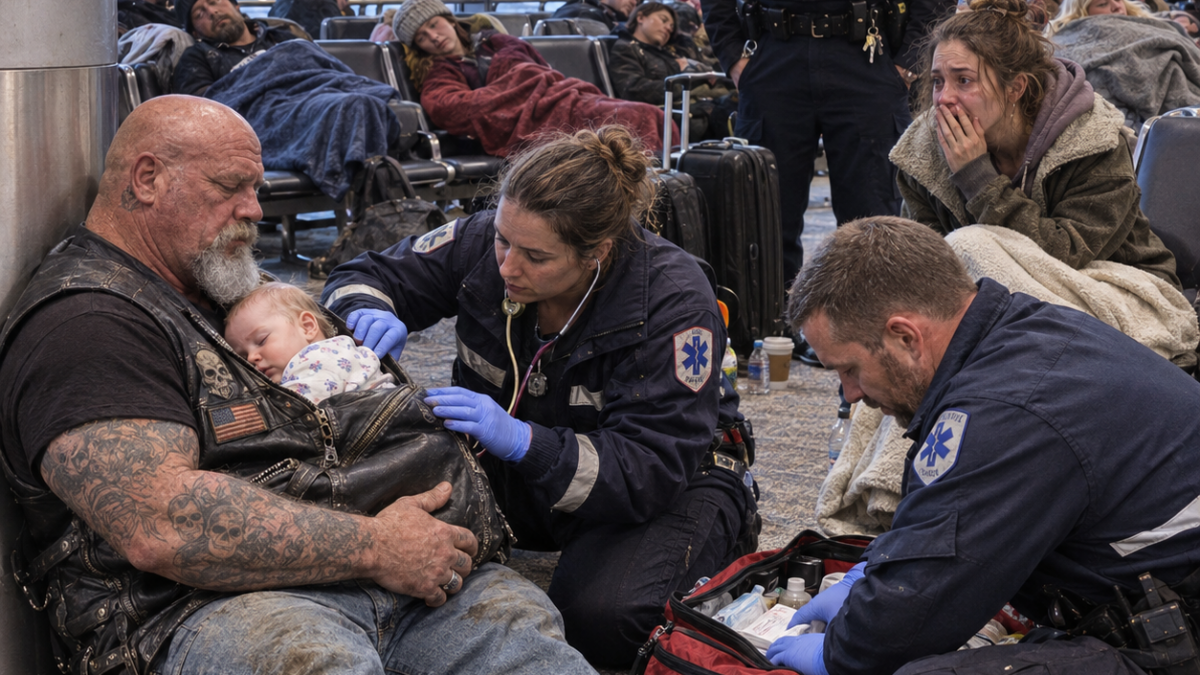
Twelve hours later, I woke up on the floor at Gate B14 with empty arms and started screaming—until I saw the same biker sitting against a pillar with my baby asleep on his chest and two paramedics kneeling beside them.
Then the officer I had complained to looked me in the eyes and said, “Ma’am, that man caught your son before he hit the floor—and around two this morning, he stopped breathing in that man’s arms.”
Every flight out of Denver was canceled that afternoon.
Not delayed.
Canceled.
The departures board turned red one line at a time while snow hammered the terminal windows hard enough to erase the runways.
People groaned.
Phones came out.
Children cried.
Airport employees started making announcements nobody could understand because every gate seemed to be making one at the same time.
I stood near Gate B14 with my five-month-old son Noah pressed against my chest and felt something inside me go numb.
I had been awake almost forty hours.
My mother had died two days earlier.
I was trying to get home to Ohio to bury her.
And Noah was getting sick.
Those three facts should have been enough to make me ask for help.
Instead, I did what exhausted people often do.
I told myself I could handle one more thing.
My name is Emily Carter.
I was twenty-nine years old, newly separated from Noah’s father, and had spent the previous five months discovering that motherhood can reduce a person to a collection of small calculations.
How much formula is left?
When did he last sleep?
Is that cry hungry or tired?
How many diapers are in the bag?
Can I shower before he wakes?
How sick is sick enough to call the pediatrician?
When my sister called to tell me Mom had suffered a massive stroke, I was standing in my kitchen sterilizing bottles.
By the time I got to the hospital, she was already gone.
Not my hospital.
The hospital in Ohio.
I was in Colorado.
My sister had been with her.
That became another fact I couldn’t think about directly.
Mom died without me there.
She had a ticket booked for Christmas.
PART2:
She was supposed to fly out and meet Noah for the first time.
She had already mailed me three different baby outfits even though she hadn’t held him yet.
One said:
GRANDMA’S FAVORITE.
I had teased her.
“You only have one grandchild.”
She said:
“Exactly. No competition.”
Now the outfit was folded in Noah’s suitcase.
And my mother would never see him wearing it.
I booked the earliest flight I could.
Denver to Chicago.
Chicago to Columbus.
My sister said she would pick us up.
We would stay at Mom’s house.
Funeral Saturday.
I packed too quickly.
Four diapers more than I thought I needed.
One extra sleeper.
Formula.
Bottles.
Noah’s medicine.
My black funeral dress stuffed into a side pocket.
I forgot my own winter gloves.
Forgot phone charger.
Forgot the second container of formula on the kitchen counter.
That last mistake became very important.
Noah had a cold.
At least that was what the urgent-care clinic told me.
Two days before the flight, he had started coughing.
Nothing dramatic.
Runny nose.
Low fever.
Fussy feeding.
The nurse listened to his chest.
Checked oxygen.
Said his lungs sounded clear enough.
“Babies get colds.”
I asked whether he could fly.
She said based on what she was seeing then, probably yes, though if symptoms worsened I should have him reevaluated.
I heard the part I needed to hear.
Probably yes.
By the time we reached Denver International, Noah felt hotter.
I took his temperature in a family restroom.
100.8.
Not terrifying.
But rising.
He was breathing strangely too.
Short breaths.
A tiny little sound at the end of each one.
Almost a grunt.
I had noticed it earlier.
I even called my sister.
“He sounds like a little old man.”
She laughed.
“He always makes weird noises.”
“He’s extra weird today.”
Neither of us understood what we were hearing.
The biker did.
I first noticed him at security.
He was impossible not to notice.
Huge.
At least six-two.
Maybe sixty-five years old.
Gray beard.
Black leather vest covered in patches.
Heavy boots.
Tattoos covering both forearms.
A white scar cut through one eyebrow.
His vest had an American flag patch on the front and another one that said DOC.
At the time, I assumed Doc was a road name.
There were other patches I didn’t recognize.
I was trying to balance Noah, diaper bag, backpack, folded stroller, shoes, ID, and boarding pass.
He stood behind me.
When Noah coughed, the man looked up.
Not casually.
Focused.
I noticed.
Mothers notice strangers staring at their babies.
Especially mothers traveling alone.
I pulled Noah closer.
A few minutes later, the biker leaned toward me.
“Ma’am, your baby—”
I turned my entire body away.
“Please don’t talk to us.”
The words came out sharper than I intended.
His eyebrows lifted.
Then he nodded once.
“Okay.”
That should have ended it.
Except after security, I saw him again.
Near the train.
Then at the concourse.
Then near Gate B14.
When I moved away from the gate because I wanted somewhere quieter, he eventually appeared nearby too.
Maybe twenty yards back.
Never close.
Always there.
When I took Noah into a family restroom to change him, I stayed inside longer than necessary because I was afraid the biker might be waiting outside.
When I finally came out, he was standing across the hall.
My stomach dropped.
He immediately looked away.
That somehow frightened me more.
I walked faster.
He walked too.
Not directly behind me.
But same direction.
I stopped near a coffee shop.
He stopped.
I moved toward another gate.
Eventually he did too.
I could feel panic growing.
I was alone.
Exhausted.
Carrying an infant.
Thousands of people around me, yet somehow vulnerable in a way I had never understood before becoming a mother.
Every news story about missing children.
Every warning from my parents.
Every true-crime documentary I should never have watched.
All of it started shouting inside my head.
I saw an airport police officer near the gate podium.
I walked directly to him.
“I need help.”
He looked at me immediately.
“What happened?”
“That man is following me.”
I pointed.
The biker stood near a pillar maybe thirty feet away.
He saw me pointing.
Didn’t move.
The officer followed my finger.
“The man in the leather vest?”
“Yes.”
“He’s been following me and my baby for almost two hours.”
The officer’s posture changed.
“Did he threaten you?”
“No.”
“Touch you?”
“No.”
“He speak to you?”
“He tried.”
“What did he say?”
“He said something about my baby. I told him to leave us alone.”
The officer nodded.
“Stay here.”
His name tag said REYES.
Officer Reyes walked toward the biker.
I watched every second.
The men spoke.
The biker pointed once in my direction.
Then pulled something from his wallet.
A card.
Reyes looked at it.
Then looked at Noah.
Then back at the biker.
They spoke for another minute.
I expected the officer to send him away.
Instead, Reyes returned alone.
“He’s not going to bother you, ma’am.”
That was all.
I stared at him.
“What does that mean?”
“He understands you don’t want him approaching.”
“Why was he following me?”
Reyes hesitated.
That hesitation made everything worse.
“He gave me an explanation.”
“What explanation?”
“He isn’t going to bother you.”
I hated that answer.
At the time, I thought he was protecting the biker.
Later, he would admit he handled that moment badly.
But right then, all I heard was:
You’re overreacting.
Sit down.
Stop causing trouble.
I moved to the far side of the gate.
The windows there looked over a runway already disappearing beneath snow.
Passengers were spreading across the carpet and tile.
Airline employees handed out thin blankets.
A family built a nest out of coats near an outlet.
Two college students ordered pizza to the terminal.
A businessman yelled into his phone about a meeting in Phoenix.
Noah cried.
I rocked him.
His skin felt too hot.
I gave him a little formula.
He took some.
Not enough.
Then he pushed the bottle away.
The departures board showed everything canceled through morning.
The airport announced ground transportation was severely limited.
Highways were closing.
Hotels nearby were full or unreachable.
I had one bottle of formula left.
That scared me more than the canceled flight.
I checked every store.
No infant formula.
One convenience kiosk had baby food for older babies.
No formula.
I called every pharmacy inside the airport.
Nothing.
My sister told me to find another mother.
“Somebody will help.”
“I hate asking.”
“Emily, you have a baby.”
“I know.”
“Then stop being proud.”
Mom would have said exactly the same thing.
That almost made me cry.
I sat on the floor against the window because every seat was taken.
I put my backpack under one elbow.
Diaper bag under the other.
Wrapped Noah inside my coat.
Then I saw the biker again.
Across the gate.
Sitting against another pillar.
Watching.
Not staring constantly.
But checking us.
I looked toward Officer Reyes.
He was still nearby.
That made me feel slightly safer.
I promised myself I would stay awake.
That became my entire plan.
Stay awake.
Watch Noah.
Watch biker.
Wait for morning.
Simple.
Except I had not slept properly in almost forty hours.
Mom’s death.
Packing.
Flights.
Airport.
Noah coughing all night before we left.
My own throat hurt.
My body ached.
I was starting to run a fever too, though I did not know how high.
At maybe six, a woman offered me half a sandwich.
I ate three bites.
Noah cried.
I bounced him.
At some point, the biker moved closer.
Still far enough not to threaten me.
Maybe fifteen feet now.
I glared at him.
He didn’t look back.
Around seven, I checked my phone.
17 percent battery.
I texted my sister.
STILL STUCK. NOAH HOT. I’M EXHAUSTED.
She replied almost immediately.
GET HELP. DO NOT TRY TO BE SUPERWOMAN.
I typed:
I’M FINE.
The last lie I remember telling before I fell asleep.
I didn’t mean to sleep.
I was sitting up.
Noah against my chest.
One arm beneath him.
Other wrapped around him.
I remember hearing an announcement.
Remember feeling his head under my chin.
Then nothing.
When I woke, pale morning light was coming through the windows.
For a few seconds, I did not know where I was.
Then I felt my arms.
Empty.
I looked down.
No Noah.
My brain detonated.
I screamed before I was fully standing.
“NOAH!”
People turned.
Someone moved toward me.
I knocked my bag over.
“NOAH!”
Then I saw the biker.
Ten feet away.
On the floor.
Back against a pillar.
His leather vest was no longer on him.
It was wrapped around my son.
Noah was asleep on his chest.
Two paramedics were kneeling beside them.
Clear tubing.
Tiny oxygen mask near Noah’s face.
Small red monitoring light on his toe.
Officer Reyes stood above them.
His eyes were red.
I ran.
I don’t remember deciding to.
I think I intended to hit the biker.
Get my son.
Scream.
Something.
Reyes caught me by both shoulders.
“Ma’am!”
“Give me my baby!”
“Listen.”
“GET YOUR HANDS OFF ME!”
“Ma’am, listen to me!”
I fought him.
Then he said:
“You passed out.”
I stopped.
“What?”
“You passed out sitting up.”
He pointed toward the place where I had been sleeping.
“Your baby slid out of your arms.”
My stomach dropped.
“This man caught him before he hit the floor.”
I stared at the biker.
He looked exhausted.
Bloodshot eyes.
Face gray beneath the beard.
One enormous tattooed hand spread across almost Noah’s entire back.
Reyes continued.
“He’s been watching your son’s breathing since security.”
My knees weakened.
“He’s been what?”
“He heard something wrong.”
I looked at Noah.
His back rose.
Fell.
Rose again.
A tiny hiss came from the oxygen.
Reyes said:
“He hasn’t moved off that floor in twelve hours.”
I could not understand the sentence.
“What?”
“He’s been holding him upright almost the whole night.”
Then Reyes swallowed.
“Because around two this morning your son stopped breathing.”
My knees went.
Reyes held me up.
“No.”
“He’s breathing now.”
“No.”
“Look at him.”
I did.
Noah’s back rose beneath the black leather.
Again.
Again.
Again.
One of the paramedics stood.
Her name was Tasha Brooks.
She had that calm voice medical people develop when they have to say terrifying things without terrifying people more.
“Mom?”
I looked at her.
“I need you to hear me.”
I nodded.
“Your son is stable right now.”
Stable.
I clung to that word.
“His oxygen is ninety-four with support. We’re concerned he has RSV. In babies his age, RSV can sometimes cause serious breathing problems, including episodes where they stop breathing.”
“He had a cold.”
My voice broke.
“The clinic said he had a cold.”
“Two days ago, it may have looked exactly like a cold.”
“They said he could fly.”
Tasha nodded.
“They made the call based on what they saw then. Babies can change fast.”
“Why isn’t he at a hospital?”
Her expression hardened slightly.
“The roads.”
I had forgotten the storm.
“Nothing has been getting out since yesterday afternoon. An ambulance is coming behind a snowplow now. About twenty minutes.”
I looked at Reyes.
“Why didn’t anyone wake me?”
“We did.”
“What?”
“Tried twice.”
“I would have woken up.”
“You opened your eyes.”
“I don’t remember.”
“You said ‘Mom.’”
My heart stopped for a different reason.
“Mom?”
Reyes nodded.
“Then you went back under.”
Tasha touched my arm.
“I checked you too. You had a fever of one-oh-two and you were severely dehydrated.”
“I was sleeping while my baby—”
“I was going to wake you again,” Tasha said.
She looked toward the biker.
“He asked me not to.”
I finally looked directly at him.
For the first time since security, he met my eyes.
His head rested against the pillar.
His legs stretched straight in front of him.
His jeans were stained with something.
Formula maybe.
His hands looked stiff.
One stayed on Noah’s back.
He spoke.
“Morning, Mom.”
His voice barely existed.
“He’s all right.”
My mouth opened.
No sound.
“Tough little guy.”
I dropped to my knees.
I wanted to take Noah.
Of course I did.
Tasha touched my wrist.
“Give us a second.”
“Why?”
“We tried laying him flat.”
Her eyes moved to the monitor.
“His oxygen drops and he becomes distressed.”
She nodded toward the biker.
“He stays calm and pink on his chest.”
I looked at the man.
“You’ve been holding him all night?”
He shrugged slightly.
“For twelve hours?”
Officer Reyes answered.
“Pretty much.”
“I offered to take over,” he said.
The biker almost smiled.
“I didn’t want to wake him.”
I stared at his legs.
“You haven’t stood up?”
“Not recently.”
“Why?”
“Can’t feel much below the knees.”
I gasped.
He added:
“Quit feeling them around midnight. Makes it easier after that.”
I started crying.
Not graceful tears.
Not movie tears.
Ugly sobbing.
My shoulders shaking.
“I called the police on you.”
“Yes, ma’am.”
“I told him you were following me.”
“I was.”
He almost smiled.
“I’d have called the cops on me too.”
That made me cry harder.
His name was Walter Kowalski.
Walt.
Sixty-five.
The card he had shown Reyes was not a motorcycle-club membership card.
It was his Denver Fire Department retirement identification.
Thirty-one years as a paramedic.
He had retired four years earlier.
The patch on his vest that said DOC wasn’t a nickname somebody gave him because he carried aspirin on motorcycle rides.
He had earned it.
Walt had been behind me at security when he first heard Noah.
“Your boy was grunting.”
I looked down.
“The little sound?”
“Yeah.”
“I thought it was cute.”
His expression softened.
“Lots of parents do. Sometimes babies make harmless noises. But he was doing it with nearly every breath.”
Then:
“When you lifted his shirt at the gate, I saw his belly pulling in under his ribs.”
I remembered changing Noah.
Setting him on the changing pad.
The little dips beneath his ribs.
I had thought babies just breathed like that.
Walt said:
“That’s a baby working harder than he should.”
“I told you to leave us alone.”
“Yes.”
“You tried to tell me.”
“Yes.”
“Why didn’t you just say it anyway?”
He looked almost amused.
“Big ugly stranger following a young mom through an airport yelling that something’s wrong with her baby?”
He shook his head.
“You’d have run.”
“I did run.”
“Exactly.”
“So you followed me instead?”
“I stayed close enough to hear him.”
Officer Reyes cleared his throat.
“He told me when you flagged me down.”
I turned.
“You knew?”
“I knew what he was concerned about.”
“Then why didn’t you tell me?”
His face tightened.
“Because I made a bad call.”
He did not defend himself.
“I checked his ID. He told me what he was hearing. I radioed for airport medics.”
I looked at Tasha.
She nodded.
“We were tied up.”
Reyes continued.
“There was a cardiac call in Terminal A and a multi-vehicle crash on the access road.”
He looked down.
“Your baby was awake, feverish, still moving air. It got triaged behind the immediate emergencies.”
My anger returned.
“You should have told me.”
“Yes.”
One word.
No excuse.
“Yes, I should have.”
He rubbed his forehead.
“You were already frightened of him. I thought telling you this biker had decided your baby’s breathing sounded dangerous would scare you worse.”
“It would have.”
“I know.”
“Maybe I would have gotten help.”
“I know.”
His eyes reddened.
“That’s on me.”
There are apologies that change nothing because the person giving them wants relief.
And there are apologies where somebody simply accepts responsibility.
Reyes did the second.
I couldn’t forgive him yet.
But I heard him.
He told me what happened after I fell asleep.
Around eight, Noah woke crying.
I didn’t.
A woman nearby tried shaking my shoulder.
I mumbled something.
Walt walked over but stayed back.
Then Noah shifted.
My arm slipped.
His body started sliding sideways.
Walt moved before anyone else understood what was happening.
He caught Noah inches before his head reached the tile.
That image still makes me sick.
My son falling from my arms.
Me asleep.
Walt sat down.
Not because he planned to keep Noah.
Because I was barely conscious and Noah was screaming.
Reyes came over.
Tasha’s crew was still occupied.
They tried waking me again.
I opened my eyes.
Said:
“Mom.”
Then fell back asleep.
Tasha arrived later and evaluated both of us.
My fever.
Dehydration.
Noah’s breathing.
She wanted to move Noah to a stretcher area.
He screamed.
Oxygen dipped.
Walt held him upright.
Numbers improved.
They compromised.
Monitor him.
Oxygen ready.
Keep him positioned upright and calm until transportation was possible.
Around nine, Noah became hungry.
My bottle was empty.
The last formula I had packed was gone.
A grandmother at the next gate had formula.
She heard what was happening and brought it over.
Same brand Noah used.
She mixed a bottle.
Walt fed him.
Still sitting on the tile.
“He burped him too,” Reyes said.
I looked at Walt.
He shrugged.
“Still remember some things.”
He hummed to Noah.
Old country song.
Same one.
Again.
Again.
Reyes said half the gate eventually recognized the melody but nobody knew the words because Walt never sang loudly enough.
“What song?”
Walt looked embarrassed.
“‘You Are My Sunshine.’”
I covered my mouth.
My mother used to sing that to me.
Of course she did.
Every mother apparently receives the same three songs at childbirth.
Around midnight, most stranded passengers were sleeping.
Snow still buried the windows.
Airport lights turned everything pale yellow.
Walt sat against the pillar.
Noah on his chest.
Reyes checked occasionally.
Tasha’s crew moved between calls.
At two, something changed.
“What happened?”
Nobody answered immediately.
Then Walt did.
“A baby sleeping on your chest is like a clock.”
He looked at Noah.
“You don’t think about it.”
His hand moved slightly with every rise of my son’s back.
“Tick.”
Breath.
“Tick.”
Breath.
“Tick.”
Then:
“The clock stopped.”
I felt sick.
Walt said he waited a few seconds because babies sometimes pause briefly.
Then longer.
Too long.
He rubbed Noah’s back.
No response.
Flicked the bottoms of his feet.
Nothing.
Called his name.
Noah’s color changed.
Walt didn’t wait for equipment.
He turned Noah along his forearm.
Stimulated him again.
Then gave two carefully controlled rescue breaths.
“After the second breath, he coughed.”
Walt smiled.
“And screamed at me.”
Tears filled his eyes.
“Best sound I’ve heard in thirty-five years.”
Tasha’s team reached them four minutes later.
Oxygen.
Monitor.
Suction.
They stabilized Noah.
At around four, he had another episode.
This time the monitor sounded almost simultaneously.
Walt felt the change first.
Again they intervened.
All of this happened ten feet from where I slept.
I was lying on the airport floor beneath a jacket somebody had put over me.
Later I learned the jacket belonged to Reyes.
That detail made it harder to stay angry at him.
Not impossible.
Harder.
At 7:30, the ambulance finally arrived behind a snowplow enormous enough to look like construction equipment.
Tasha moved quickly.
“We’ve got transport.”
I stood.
Almost fell.
Walt started to move Noah.
The baby screamed.
His oxygen number dipped.
“Take him in the vest,” Walt said.
Tasha lifted Noah with the leather still wrapped around him.
“Mom rides.”
I grabbed my bag.
Then looked back.
Walt tried to stand.
Couldn’t.
His knees buckled.
Reyes caught one arm.
Another medic grabbed the other.
They pulled him upright.
He hung between them.
Face gray.
Legs refusing to cooperate.
He looked like somebody being carried away from a battlefield.
Tasha called:
“Sir! Your vest.”
Walt waved one hand.
“Keep him wrapped.”
“But—”
“It’s freezing outside.”
He looked at me.
“I know where it’s going.”
At the time, I did not understand what that meant.
I knew bikers valued their vests.
I did not understand that for some riders, the leather carried decades of identity.
Club history.
Memorial patches.
Road miles.
People who had died.
Things you didn’t casually hand to strangers.
In the ambulance, Noah lay inside an infant transport setup with oxygen.
I couldn’t hold him.
So I held the edge of the vest.
It smelled faintly like smoke.
Motor oil.
Cold air.
On the front:
DOC.
Then I saw something sewn inside.
Small white rectangle.
Blue thread.
Right where Noah’s head had rested.
DANIEL
MARCH 9, 1989
JULY 22, 1989
I stared.
Four months.
I counted three times.
March.
April.
May.
June.
July.
Four months old.
Almost exactly Noah’s age.
Tasha saw me reading.
She didn’t explain.
She only said:
“You know how many people I’ve worked with who can feel a baby stop breathing before the monitor catches it?”
I looked at her.
“One.”
Noah spent five days at Children’s Hospital.
RSV.
The doctors were careful explaining it.
Respiratory syncytial virus.
For many people, cold-like symptoms.
For very young infants, sometimes serious.
Noah needed respiratory support.
Warm humidified oxygen through small nasal tubes.
Monitoring.
Suctioning.
Fluids.
He hated every second.
His screaming became music to me.
Every complaint meant breathing.
Every time his tiny hand fought a nurse, I wanted to celebrate.
A nurse took one look at me and said:
“You’re getting checked too.”
“I’m fine.”
“You look terrible.”
“Thank you.”
“That’s not a compliment.”
Fever.
Dehydration.
Exhaustion.
They gave me fluids.
I slept in a reclining chair beside Noah’s crib with an IV in my arm and one hand through the rails.
On the second morning, the doctor came by.
Dr. Patel.
Small woman.
Tired eyes.
Kind without pretending things were easy.
I asked the question I had been avoiding.
“If Walt hadn’t been there…”
She waited.
“If Noah had been lying in my coat beside me when it happened.”
I couldn’t finish.
She understood.
“When he stopped breathing?”
I nodded.
“You were profoundly exhausted and febrile.”
“Would I have woken up?”
She did not lie.
“Maybe not.”
My chest folded inward.
She pulled a chair closer.
“He had someone with him.”
“But it should’ve been me.”
“That isn’t medically relevant.”
“It is to me.”
“I know.”
She spoke gently.
“But your body was sick too.”
I looked at Noah.
“If he hadn’t been there?”
Dr. Patel paused.
“I can’t tell you exactly what would have happened.”
Then:
“But prolonged apnea in a baby that age is an emergency. Immediate recognition mattered.”
Immediate recognition.
Walt.
I missed my mother’s funeral.
Saturday morning, my sister propped her phone against a hymnal in the church pew.
I watched from a plastic chair beside Noah’s hospital crib.
The video froze twice.
The audio echoed.
I saw Mom’s casket.
Flowers I had chosen online.
My sister speaking.
My uncle reading Psalm 23.
I held Noah’s tiny hand.
Mom had died from a stroke on Tuesday.
She had planned to visit us at Christmas.
Her plane ticket was already booked.
She would never hold him.
I watched them close her casket on a four-inch screen.
Then looked at Noah.
And thought about how close I had come to another funeral.
That afternoon, someone knocked softly on the hospital-room door.
I looked up.
Walt stood in the hallway.
No vest.
Flannel shirt.
Jeans.
Holding a stuffed bear that looked like it came from a gas station.
A nurse was pointing toward my room.
He wasn’t coming in.
He was waiting.
I walked to the door.
He took one step backward.
“I just wanted to know he made it.”
“He did.”
Walt looked over my shoulder.
Noah slept with oxygen tubing in his nose.
His expression changed.
“Good.”
Then:
“I can go.”
I stared at him.
“What?”
“I don’t want to bother you.”
Those words.
Almost exactly what Reyes said.
He’s not going to bother you.
I had turned this man into something that needed permission not to bother me.
“You missed your flight.”
He shrugged.
“There are other flights.”
“Where were you going?”
“Spokane.”
“Why?”
“My daughter’s.”
“For Christmas?”
“Yes.”
“You missed Christmas with your daughter because you were sitting with my son?”
“I’m late. Not dead.”
He turned the stuffed bear around in his hands.
“She’ll keep.”
I grabbed his sleeve.
Not hard.
“Come inside.”
He hesitated.
“Please.”
So he came.
He sat in the plastic chair beside Noah.
The leather vest had been folded on the windowsill.
Cleaned as best as possible.
The white patch inside faced upward.
Walt saw it.
His entire body changed.
“You saw.”
I nodded.
“Who’s Daniel?”
He looked at Noah for a long time.
“My boy.”
Nothing prepared me for that answer.
He told me slowly.
He was thirty.
Two years into the Denver Fire Department.
Paramedic.
Married to a woman named Carol.
Their son Daniel was born March ninth.
Healthy.
Beautiful.
Difficult sleeper.
Had a little cowlick that wouldn’t stay down.
Walt worked a double shift one July day.
Came home exhausted.
Carol left for her hospital shift.
Walt fed Daniel.
Put him in the crib.
Then sat on the couch to remove his boots.
“I woke up because the house was quiet.”
His voice changed.
“I don’t know how long.”
He rubbed both hands together.
“Clock said four hours.”
I stopped breathing.
“I walked into the nursery.”
He looked toward Noah but was not seeing him anymore.
“I knew before I touched him.”
Daniel was not breathing.
Walt began CPR.
Called emergency services.
Worked on his own son for nearly forty minutes.
Colleagues arrived.
People he knew.
People he had saved lives beside.
Nobody could bring Daniel back.
“I’d brought eleven people back that year.”
His eyes stayed on the floor.
“Drunks. Car wrecks. One kid pulled out of a swimming pool.”
He swallowed.
“I could breathe for strangers.”
Long silence.
“Couldn’t breathe life back into my own boy.”
My eyes filled.
“Walt.”
“Carol never blamed me.”
He laughed once without humor.
“She didn’t need to.”
Their marriage lasted another year.
Then collapsed.
Not because they stopped loving each other.
Because sometimes two people cannot survive the same empty bedroom together.
Walt bought a motorcycle.
“Why?”
“Couldn’t stand being in houses.”
He stared at his hands.
“Engine was loud enough that I didn’t hear quiet.”
That sentence stayed with me.
He kept working as a paramedic.
Another twenty-nine years.
Whenever infant calls came in, he volunteered.
Babies not breathing.
Choking.
Fevers.
Seizures.
He took them.
Again.
Again.
Again.
“I thought maybe if I saved enough…”
He stopped.
“Enough what?”
“Babies.”
My throat tightened.
“Did it help?”
He shook his head.
“Doesn’t work like that.”
Then:
“You don’t balance one kid against another.”
“So why keep doing it?”
He thought.
“Because somebody still needed me.”
Thirty-five years of listening to babies breathe.
Grocery stores.
Restaurants.
Church.
Airports.
He could not switch it off.
Most babies sounded normal.
He went on with his day.
Noah didn’t.
“Noah sounded like Danny.”
That broke me.
Everything I had been holding since the airport came apart.
“I slept through it.”
Walt looked up.
“My son stopped breathing and I slept through it.”
“No.”
“I was right there.”
“No.”
“I’m his mother.”
His voice sharpened so suddenly Noah stirred.
“No, ma’am.”
Then softer:
“You listen to me.”
I cried harder.
“You were sick.”
“I should have—”
“You had been awake two days.”
“I should have known.”
“Your mother had just died.”
“I should’ve—”
“Your body quit.”
He leaned forward.
“That’s not a sin.”
I stared at him.
“That’s a body.”
The room went quiet.
Then I said something cruel without meaning to.
“You slept through it too.”
Walt froze.
“Daniel.”
My hand covered my mouth.
“I’m sorry.”
He looked down.
“Yes.”
“You never forgave yourself.”
“No.”
“Then how can you tell me to?”
He was quiet for a long time.
Then:
“Because nobody was awake for my boy.”
I stopped.
His eyes filled.
“That’s the difference.”
He wiped his face.
“Somebody was awake for yours.”
He looked toward Noah.
“I’ve been trying to be awake for somebody ever since.”
Neither of us spoke for a while.
The oxygen machine hummed.
Noah breathed.
In.
Out.
In.
Out.
Finally I said:
“I’m sorry.”
“For what?”
“For what I saw when I looked at you.”
Walt shook his head.
“Don’t.”
“I called security.”
“You should’ve.”
“You saved him.”
“You didn’t know that yet.”
“I judged you.”
“You were a young woman alone in an airport with a baby.”
He pointed at himself.
“And a man my size kept appearing every time you turned around.”
Despite everything, I almost smiled.
“That did look bad.”
“Looked terrible.”
“You scared me.”
“You did exactly what I’d tell my daughter to do.”
“But you were trying to help.”
“And you didn’t know that.”
He leaned back.
“Don’t apologize for protecting your kid.”
Then his mouth twitched.
“Just maybe next time let the ugly stranger finish his sentence.”
I laughed.
First laugh since Mom died.
It hurt.
But I laughed.
Walt stayed an hour.
No more.
He held Noah only after I asked.
I watched him lift my son.
One hand supporting the head automatically.
Other beneath his body.
The ease of a man who had held hundreds of babies in emergencies and still remembered one he couldn’t save.
Noah opened his eyes.
Looked at Walt.
Then yawned.
Walt whispered:
“You scared the hell out of me, little man.”
Noah sneezed on his beard.
I laughed again.
Walt looked offended.
“Your son has no respect.”
“He’s five months old.”
“Old enough.”
Before leaving, he picked up his vest.
I stopped him.
“Wait.”
He looked back.
“I haven’t washed it.”
“Good.”
“What?”
“You don’t wash leather like laundry.”
“I know that.”
“You were going to put it in a washing machine, weren’t you?”
“No.”
I absolutely had been.
He narrowed his eyes.
“I’ll take it.”
But when I handed it over, I didn’t let go immediately.
My fingers stayed on the edge.
“You gave this to Noah.”
“I loaned it.”
“For twelve hours.”
“He was cold.”
“Is it important?”
Walt looked at the patches.
“Yes.”
“Then why?”
He met my eyes.
“Because he was more important.”
I released it.
He folded the vest over one arm.
The Daniel patch disappeared inside.
“I want to see you again.”
Walt hesitated.
“You don’t owe me anything.”
“I know.”
“Seriously.”
“I know.”
“You don’t have to turn me into some honorary grandfather because I happened to be there.”
I smiled.
“Were you planning on being difficult about everything?”
“Yes.”
“Then give me your number.”
He did.
Noah went home on oxygen nine days later.
Only nine.
Then he didn’t need it.
His lungs recovered.
His appetite returned.
He gained back the weight he had lost.
I checked his breathing constantly.
Too constantly.
For months, I woke every hour.
Touched his chest.
Put my hand near his nose.
Listened.
If he paused for even a second, my heart jumped.
The pediatrician eventually told me gently:
“You survived a frightening event. Your nervous system hasn’t figured out that the event ended.”
I started therapy.
That helped.
Not immediately.
But eventually.
Walt made it to Spokane three days late.
His daughter, Rebecca, called me that night.
I didn’t know how she got my number until she said:
“My dad gave it to me and then told me not to call you.”
I laughed.
“That sounds like Walt.”
She was crying.
“Thank you.”
“For what?”
“For making him talk.”
“I didn’t.”
“You did something.”
She told me she had been born years after Daniel.
Walt remarried.
Second marriage lasted.
Rebecca grew up knowing she had an older brother who died as a baby.
There was one photograph.
The memorial patch.
That was almost all.
Her father never talked about him.
Not really.
At Christmas dinner, three days late, Walt had finally told the whole story.
How Daniel died.
How he blamed himself.
How he stayed on the ambulance.
How he heard Noah breathing in the security line.
How he sat on an airport floor and felt another baby’s breathing stop beneath his hand.
Rebecca said:
“He talked about Daniel for two hours.”
I sat silently.
“He’s never done that in my entire life.”
“Maybe he was ready.”
“Maybe Noah made him ready.”
I looked at my son sleeping in his bassinet.
“Maybe they helped each other.”
In January, I flew to Ohio.
Noah came with me.
I stood beside my mother’s grave while snow covered the cemetery.
I held Noah on my hip.
The wind was terrible.
I told Mom everything.
That felt ridiculous at first.
Talking to dirt.
Then less ridiculous.
I told her about the canceled flights.
My fever.
The biker.
Calling security.
Walt catching Noah.
The night.
RSV.
The hospital.
Daniel.
I said:
“You never got to hold him.”
My voice broke.
“But somebody did.”
I cried.
Noah tried eating the edge of my scarf.
Mom would have laughed.
The following December, Walt visited.
December fourteenth.
Not the exact anniversary of the airport incident, but close enough that it became our date.
He drove.
Complained the entire time because he hated driving when he owned perfectly good motorcycles.
“There was ice on the road.”
“Motorcycles work on roads.”
“Not like that.”
“Government propaganda.”
He brought Rebecca.
She hugged me like we had known each other for years.
Noah was walking by then.
Not well.
More falling with intention.
The second Walt sat on the living-room floor, Noah climbed onto him.
No hesitation.
Grabbed his beard.
Walt yelped.
“You raised a criminal.”
“He remembers your face.”
“He remembers assault opportunities.”
That December visit became a tradition.
Every year.
Walt came.
Sometimes Rebecca.
Sometimes a club brother.
Sometimes alone.
Noah began calling him Grandpa Walt before anybody suggested it.
Walt objected for approximately eleven seconds.
Then bought him a tiny motorcycle jacket.
Not leather.
Something soft.
No club patches.
Only one:
DOC’S BUDDY.
Officer Reyes stayed in our lives too.
That surprised me.
A month after the airport, I received an envelope.
No return note.
Inside was a photograph.
Reyes had taken it around four in the morning.
I don’t know why.
Maybe because he understood the moment mattered.
Maybe because he needed proof for himself.
The picture shows Walt sitting on the airport floor.
No vest.
Black T-shirt.
Head against the pillar.
Eyes closed.
Noah wrapped in leather against his chest.
Snow falling beyond the giant window.
A tiny oxygen tube near my baby’s face.
One of Walt’s hands covers almost all of Noah’s back.
No drama.
No hero pose.
Just a tired old man keeping himself awake because a baby needed somebody to feel the next breath.
That picture hangs on my refrigerator.
Reyes eventually visited too.
He apologized again.
This time I told him I had forgiven him.
He said:
“Still should’ve explained.”
“Yes.”
“I thought I was protecting you from panic.”
“You were protecting yourself from a difficult conversation.”
He smiled.
“Probably.”
Then he looked at Noah.
“I’m glad Walt was stubborn.”
“So am I.”
Noah is two now.
Healthy.
Loud.
Runs everywhere.
Breathes like a freight train when he’s excited.
Every time he catches a cold, I become irrational for about forty-eight hours.
Walt tells me:
“Watch the kid, not your fear.”
It’s annoying when he’s right.
He also taught me what to look for when babies are struggling to breathe.
Not because he wants me diagnosing Noah myself.
The opposite.
“When something looks wrong, get medical help.”
Simple.
No shame.
No waiting because you’re afraid of looking dramatic.
I wish I had understood that at the airport.
But guilt is easy after the fact.
What matters is what I know now.
People sometimes hear this story and tell me:
“You should’ve trusted your instincts about Walt.”
No.
I disagree.
My instincts told me a strange man was following me and my infant.
I did what a woman traveling alone should be allowed to do.
I sought security.
Walt agrees.
He has never once mocked me for that.
The lesson wasn’t:
Trust scary strangers.
That would be stupid.
The lesson was more difficult.
Appearances contain information.
They are not all the information.
Ask for help when you feel unsafe.
Let professionals check.
Then stay willing to update what you believe when new facts arrive.
I thought Walt was dangerous.
I was wrong.
But I didn’t owe him trust before I knew who he was.
What I owed him afterward was gratitude.
And eventually friendship.
People also tell me:
“You must feel terrible for sleeping through Noah’s crisis.”
I do.
Sometimes.
But Walt won’t let me live there.
Once, when Noah was about eighteen months old, I apologized again.
We were sitting on my porch.
Noah was asleep inside.
“I still think about it.”
“The airport?”
“Sleeping.”
Walt groaned.
“We’ve discussed this.”
“I know.”
“Your body shut down.”
“I know.”
“You were sick.”
“I know.”
“Your mother died.”
“I know.”
“So what are we doing?”
I looked at him.
“You still blame yourself for Daniel.”
His face tightened.
I regretted saying it.
Then he nodded.
“Yeah.”
“So we’re both hypocrites.”
That surprised him.
Then he laughed.
“Fair.”
We sat quietly.
Finally, Walt said:
“Maybe guilt is just love looking backward.”
I stared at him.
“That’s surprisingly poetic.”
“Don’t repeat it.”
“Absolutely repeating it.”
“I have a reputation.”
“Your reputation already includes holding babies for twelve hours.”
“Damn.”
Then he became serious.
“I can’t change Danny.”
“I know.”
“You can’t change Denver.”
“I know.”
“So maybe we stop using love to punish ourselves for things we can’t change.”
I looked at him.
“Can you?”
“No.”
“Me neither.”
He nodded.
“Work in progress.”
That’s what we are.
Works in progress.
Walt still carries Daniel’s patch.
Always.
He never moved it.
Never replaced it.
When Noah was old enough to ask what it said, Walt told him:
“That was my first boy.”
“Where is he?”
“He died when he was a baby.”
Noah thought about that with the blunt seriousness of a three-year-old.
“Did you love him?”
“Very much.”
“Do you love me?”
Walt’s eyes filled instantly.
“Very much.”
“Okay.”
Then Noah asked for crackers.
Children can move through grief more gracefully than adults.
One Christmas, Rebecca brought an old photograph.
Walt holding Daniel.
Thirty years old.
Black hair.
No beard.
Baby in his arms.
I stared at the picture.
Noah looked nothing like Daniel.
That mattered somehow.
Walt had never mistaken one child for another.
He had not saved Noah to replace Daniel.
He knew replacement was impossible.
Noah simply gave him somewhere for all that old knowledge to go.
Somewhere useful.
Walt once said:
“I spent thirty-five years thinking every baby call was about the one I lost.”
Then he looked at Noah.
“Turns out every baby was just themselves.”
I understood.
Grief wants symbols.
Life keeps handing us people.
Actual people.
Different people.
Needing different things.
My mother died before she met Noah.
Daniel died before Walt knew what kind of father he might become.
Those losses never disappeared.
But neither loss prevented something new from happening in an airport during a blizzard.
Sometimes I wonder what Mom would have thought of Walt.
She was tiny.
Five-foot-one.
Church every Sunday.
Terrified of motorcycles.
She would have hated his vest for approximately fifteen minutes.
Then fed him.
Within an hour, she would have known everything about Rebecca.
By dessert, she would have found some shelf in his house that needed organizing.
Walt says:
“I wish I’d met her.”
“So do I.”
He pauses.
“But maybe I did.”
I hate when he says things like that because then I cry.
He claims this is one of his hobbies.
Last December, on the anniversary visit, Noah climbed onto Walt’s chest while we were watching a movie.
Same position.
Head beneath his beard.
One hand gripping his shirt.
Walt froze.
Not because he was afraid.
Because he remembered.
I could see it.
The airport floor.
The pillar.
Snow.
Tiny breath.
Tiny breath.
No breath.
Then life again.
He put one hand on Noah’s back.
I watched his fingers move almost imperceptibly.
Counting.
Still listening.
“Walt.”
“What?”
“You’re doing it.”
“Doing what?”
“Counting breaths.”
He looked guilty.
“Habit.”
“You can stop.”
He looked down at Noah.
“No.”
I smiled.
“I figured.”
When Noah is old enough, I will tell him everything.
Not all at once.
I will tell him his grandmother died before she could meet him.
I will tell him his mother tried to fly across the country in a blizzard while sick and exhausted because grief made her believe she had to keep moving.
I will tell him there was a biker standing behind us in the security line.
I will describe the vest.
The tattoos.
The scar.
I will tell him his mother looked at that man and saw danger.
I will tell him she moved gates.
Went into bathrooms.
Watched over her shoulder.
Then pointed him out to a police officer.
I will also tell Noah that I was not foolish for protecting him.
Walt insists on that part.
Then I will tell him what happened when my body could not stay awake anymore.
How he slipped.
How Walt caught him.
How a stranger sat on cold airport tile while hundreds of other passengers slept.
How a grandmother from another gate shared formula.
How Officer Reyes gave his jacket to a sick mother.
How Tasha monitored a baby when roads were buried.
How Walt hummed the same song for hours.
How at two in the morning, the tiny clock against his chest stopped.
How he knew.
How he breathed for Noah.
How Noah screamed.
How Walt called it the best sound he had heard in thirty-five years.
Then I will show Noah the patch.
Daniel.
Four months.
A child he never met.
A child whose absence shaped the hands that saved him.
I will tell him Walt sat there until morning even though his legs went numb.
Even though his own daughter was waiting in Spokane.
Even though the woman sleeping ten feet away had called security on him.
And I will tell him why.
Not because Walt was a saint.
He would hate that.
Not because bikers are secretly angels.
He would hate that even more.
Because he noticed.
Then stayed.
That’s it.
Sometimes saving somebody begins with extraordinary skill.
CPR.
Paramedic training.
Knowing what struggling breathing sounds like.
But sometimes the first act is simpler.
Notice.
Stay close.
Don’t look away.
Walt had spent thirty-five years trying to be awake for somebody because once, long ago, nobody was awake when his own little boy needed him.
He could never change that night in 1989.
He knows that now.
Mostly.
But on one December night in Denver, another baby’s breathing stopped against his chest.
And Walt was awake.
The photograph on my refrigerator catches none of that history.
It only shows a giant man on a cold airport floor.
Black T-shirt.
Tattooed arms.
Snow behind him.
A five-month-old baby wrapped inside a leather vest.
If you saw the photograph without knowing the story, you might make assumptions.
I did.
I looked at the best man I had ever met and saw a threat.
Then twelve hours later, I woke up and learned that while I slept, he had been holding my entire world together.
And he never once asked me to be ashamed for getting him wrong.








