HOA Built a Private Park on My Land—Then Their $200-a-Day Fine Made My Lawyer Smile
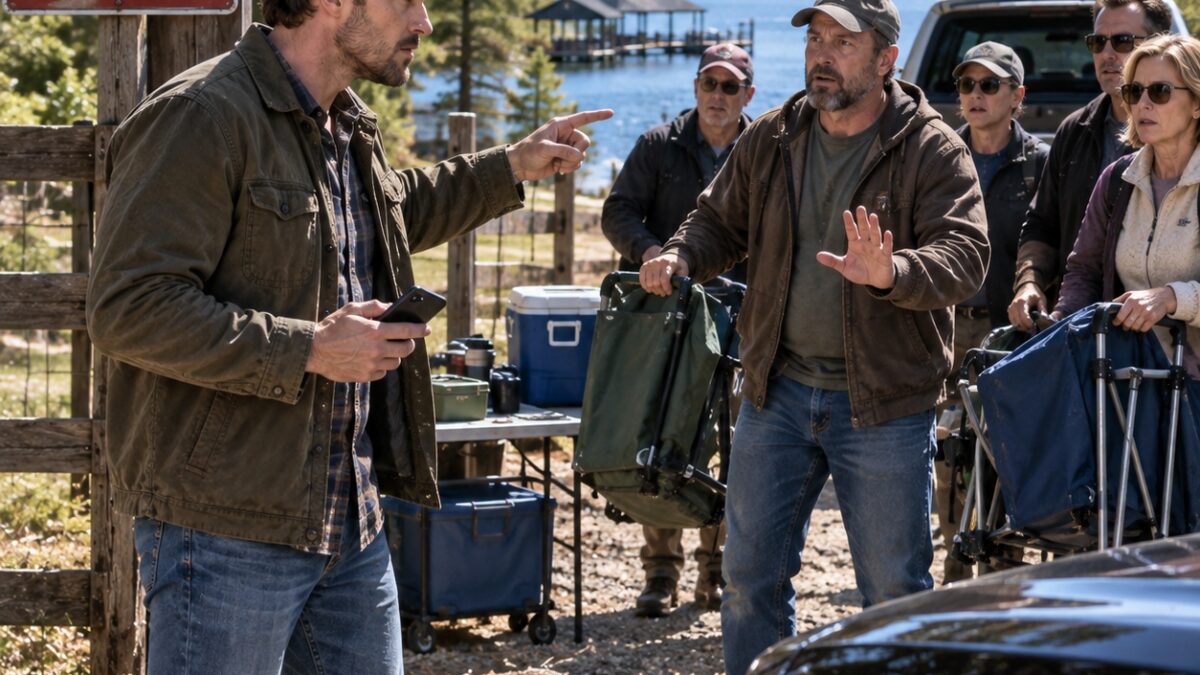
HOA Built a Private Park on My Land—Then Their $200-a-Day Fine Made My Lawyer Smile
The HOA president sent contractors onto six acres my family had owned for nearly thirty years, planted a sign calling it “community recreation space,” and then fined me $200 a day when I ordered everyone off my property.
She thought five board signatures and a certified envelope would scare me into unlocking the gate, but my attorney read their letter twice, smiled, and asked a question none of them seemed prepared to answer: “Do they realize they just admitted all of this in writing?”
What started with a few fence posts in my meadow eventually uncovered an old developer warning, a hidden $355,000 assessment, a consultant tied to the HOA president’s family, and one sentence in a forgotten file proving Cedar Grove had known for years that the land was never theirs.
The first truck arrived at 7:18 on a Saturday morning.
I know because my driveway camera recorded it.
White Ford F-250.
HARRISON OUTDOOR SERVICES printed across both doors.
Two men climbed out, dropped the tailgate, and began unloading pressure-treated lumber into the meadow east of my house.
At 7:31, another truck arrived pulling a utility trailer.
At 7:46, somebody started driving steel posts into the ground.
I wasn’t home.
I had left shortly after seven to buy feed, hydraulic fluid, and a replacement belt for the old finish mower I kept pretending was worth repairing.
When I returned a little before nine, I slowed halfway down my driveway because something looked wrong beyond the cottonwoods.
At first, I thought one of my neighbors was having a party.
Then I saw the fencing.
Orange flags cut across the grass in two long rows.
Fresh lumber lay in stacks near the creek.
Three men were assembling picnic tables beneath one of the cottonwoods my mother had loved.
And beside my gravel lane stood a professionally painted sign that had not been there when I left.
CEDAR GROVE COMMUNITY RECREATION AREA
RESIDENT ACCESS 7 A.M.–9 P.M.
NO TRESPASSING AFTER HOURS
I stopped my truck.
Read it once.
Then again.
The irony of a NO TRESPASSING sign installed by trespassers on my property would have been funny under different circumstances.
My name is Daniel Carter.
I was forty-three when this happened.
The six-acre meadow had belonged to my family since 1996, when my parents bought thirty-five acres along an old county road outside Franklin, Tennessee.
Cedar Grove Estates did not exist then.
Neither did its clubhouse.
Its ornamental entrance walls.
Its HOA.
Its architectural committee.
Its Facebook group where grown adults could argue for seventy comments over whether a charcoal-gray mailbox was actually “slate.”
The subdivision came later.
My family’s land came first.
And the meadow in front of me had never been sold.
Never dedicated.
Never leased.
Never annexed.
Never given to Cedar Grove.
There was no recreation easement.
No pedestrian easement.
No HOA covenant covering it.
No agreement allowing residents to use it.
Nothing.
Yet three contractors were standing on it with a work order.
I parked.
Took out my phone.
Started recording before I said a word.
The nearest worker was attaching a tabletop to a metal frame.
“Morning.”
He looked up.
“Morning.”
“Who gave you permission to work here?”
He glanced at the other men.
Then toward the subdivision.
“HOA.”
“Who at the HOA?”
“Cheryl.”
Of course.
Cheryl Madison had been Cedar Grove’s HOA president for three years.
She was the kind of person who never seemed to raise her voice because she had mastered something much more effective: speaking as though disagreement had already been reviewed and denied.
She wore perfectly coordinated clothes to Saturday meetings.
Used phrases like community standards and established procedure.
And somehow managed to make every board decision sound as though it had arrived from a higher authority rather than five homeowners sitting behind folding tables.
The contractor wiped his forehead.
“She said this was common ground.”
I looked at the grass.
At the tire tracks.
At the posts.
At one of my young dogwoods bent beneath a trailer ramp.
“This is private property.”
He frowned.
“We’ve got a work order.”
“You have five minutes to pack up.”
“Sir, we were told—”
“I heard what you were told.”
I pointed toward the road.
“You were told wrong.”
Another worker stepped closer.
“We’re just following orders.”
“Then follow the next one.”
I pulled out my phone.
“Pack up.”
They hesitated.
So I called the sheriff’s non-emergency line.
I gave my name.
Address.
Parcel number.
Explained that contractors were installing structures on private property after being told to leave.
The moment the first worker heard me giving the dispatcher my information, his attitude changed.
“Okay.”
He raised both hands.
“No need to make this a thing.”
“It became a thing when you started building a park on my land.”
“We didn’t know.”
“I believe you.”
That was true.
I didn’t blame the workers.
They had a signed order.
The problem was whoever signed it.
They started collecting tools.
I filmed everything before they touched it.
The work sign.
Post holes.
Fence material.
Picnic tables.
Tire ruts.
Damaged dogwoods.
Trailer plates.
Truck plates.
Then I asked the supervisor to hold up the work order.
He hesitated.
“I don’t think I can give you this.”
“I’m not asking you to.”
I kept the camera pointed at it.
“Just let me see who authorized you.”
He turned the first page.
There it was.
PROJECT: CEDAR GROVE RECREATION EXPANSION
SITE: NORTH MEADOW COMMON AREA
AUTHORIZED BY: CHERYL MADISON, PRESIDENT
CEDAR GROVE HOMEOWNERS ASSOCIATION
North Meadow Common Area.
They had renamed my land before entering it.
The contractors left at 9:24.
A deputy arrived six minutes later.
He photographed the remaining materials.
Took my statement.
Asked for the deed.
I showed him a scanned copy on my phone.
He looked toward the subdivision.
“Any chance there’s an easement?”
“No.”
“You sure?”
“Completely.”
“HOA property?”
“No.”
“Then document everything.”
“I am.”
He gave me an incident number.
No one was arrested.
No shouting.
No handcuffs.
Nothing dramatic.
Just a trespassing report.
That afternoon I removed the HOA sign and put it inside my barn.
That evening I emailed every photo and video to my attorney, Laura Mendel.
Then I went to sleep believing Cheryl would call Monday, blame a contractor mistake, and quietly retreat.
I should have known better.
Three days later, a certified letter arrived.
Heavy paper.
Cedar Grove seal.
Five signatures.
The letter accused me of:
Obstructing a designated recreation area.
Removing association signage without authorization.
Interfering with contracted community improvements.
Preventing resident access to common facilities.
It ordered me to “restore access immediately.”
Then came the threat.
FAILURE TO CURE WILL RESULT IN A FINE OF $200 PER DAY UNTIL ACCESS IS RESTORED.
Two hundred dollars every day.
For refusing to let an HOA use property it did not own.
All five directors signed.
Cheryl Madison.
Daniel Price.
Melissa Grant.
Linda Foster.
Robert Haines.
I did not call Cheryl.
I drove to Laura’s office.
She read the letter.
Once.
Then again.
Then she turned the envelope over and studied the certified-mail receipt.
“What?”
I asked.
“This is not merely an HOA dispute anymore.”
“Why?”
She tapped the page.
“They entered private property.”
“Yes.”
“Afterward they created a violation based on your refusal to allow that entry.”
“Yes.”
“They threatened to manufacture a recurring financial obligation unless you surrendered access.”
“Yes.”
“And five board members put their names underneath it.”
“Yes.”
She looked at me.
Then, very slowly, she smiled.
Laura did not smile during disputes.
That was when I knew Cedar Grove had made a mistake.
“Most people spend months trying to prove what an HOA board knew, authorized, or intended.”
She slid the certified letter toward me.
“Yours mailed it to you.”
FULL STORY CONTINUATION 👇👇
I had known Laura for almost nine years.
She had represented the construction company I worked for during a right-of-way dispute near Murfreesboro, then helped me review the documents when I built my house inside Cedar Grove.
She was fifty-seven, wore reading glasses she constantly misplaced while they were sitting on top of her head, and had a habit of becoming calmer as everyone else became angrier.
My father used to say there were two professionals you should distrust immediately: surgeons who looked excited about complicated operations and lawyers who described litigation as fun.
Laura described litigation as “expensive paperwork performed while angry people slowly become tired enough to negotiate.”
So the smile concerned me.
“What exactly did they give us?”
“Several useful things.”
“Such as?”
“First, proof this was not simply a landscaping contractor wandering onto the wrong parcel.”
“I already had Cheryl’s work order.”
“Yes.”
She held up the certified letter.
“This proves the board adopted the position.”
“All five signed.”
“Exactly.”
She laid my deed beside it.
“Second, they are asserting jurisdiction over a parcel that appears to sit outside the declaration.”
“Appears?”
“Daniel.”
“I have the deed.”
“I know.”
“The subdivision plat excludes the meadow.”
“I know.”
“No covenant.”
“I know.”
“So why does every lawyer say appears when the answer is sitting on the table?”
“Because judges enjoy being the ones who officially decide what is sitting on the table.”
I leaned back.
“Fine.”
“Third, Cedar Grove is threatening a fine against you based on conduct occurring on separate property.”
“I am an HOA member.”
That was the only detail keeping the situation from being absurdly simple.
My house sat on a two-acre residential lot at Cedar Grove’s western edge.
When I built it in 2010, I voluntarily annexed those two acres into the subdivision so I could connect to Cedar Grove’s water, sewer, and road network.
That became Lot 114.
I paid the same annual dues as everybody else.
I followed the same architectural rules on that two-acre lot.
But the remaining twenty-eight acres from my parents’ original tract remained outside Cedar Grove.
Separate parcel.
Separate legal description.
Separate tax account.
Laura nodded.
“Cedar Grove has jurisdiction over Lot 114 to the extent permitted by its declaration.”
“Correct.”
“The meadow is Parcel 17-B.”
“Correct.”
“Being the same owner does not merge the legal restrictions.”
“Correct.”
She smiled faintly.
“Good. Now you’re doing my job.”
“What’s fourth?”
“The fine itself.”
She tapped the demand.
“If they merely send a stupid letter, that’s one thing.”
“They threatened two hundred dollars every day.”
“Yes. If they actually post those amounts to your account, attempt a lien against Lot 114, interfere with refinancing, claim delinquency, or try to suspend legitimate amenities because you won’t give them access to another parcel, that creates additional issues.”
“So tell them to withdraw it.”
“I will.”
“And tell Cheryl to stay off my property.”
“I will.”
“Then we’re done.”
“No.”
I frowned.
Laura folded her hands.
“I want to know why they believe this meadow belongs to them.”
“Because Cheryl believes any land near Cedar Grove should eventually become Cedar Grove.”
“That is emotionally satisfying and legally useless.”
“It’s probably true.”
“Maybe.”
She slid a yellow legal pad toward me.
“But nobody spends more than fifty thousand dollars mobilizing contractors based solely on a president’s imagination.”
I stared at her.
“Fifty thousand?”
“Those picnic tables were not being installed by volunteers.”
“Fair.”
“They have a project budget. A map. Planning documents. Maybe a bad survey. Maybe a preliminary subdivision plan. Maybe some twenty-year-old reference somebody misunderstood.”
“You think there’s an actual document.”
“I think there is something.”
“And if there isn’t?”
“Then this becomes even more interesting.”
She told me to gather everything.
Original family deeds.
Closing documents.
Surveys.
Final Cedar Grove plats.
Supplemental annexation for my house.
Every piece of correspondence my father had received from Harwell Communities, the original developer.
“Dad kept paper like it was ammunition.”
“Good.”
“He also filed things according to a system nobody else understood.”
“Less good.”
As I stood to leave, Laura called after me.
“Daniel.”
“Yeah?”
“Do not contact Cheryl.”
“I wasn’t planning to.”
“You were planning to send her a photograph of your deed with a sarcastic caption.”
I smiled.
“That had crossed my mind.”
“No Facebook.”
“I muted the group.”
“No texts.”
“Fine.”
“No standing at the board president’s driveway holding a survey flag.”
“That seems oddly specific.”
“You are not my first HOA client.”
I left.
The county recorder’s office occupied the ground floor of an old brick administration building downtown.
A clerk named Marjorie recognized my surname.
“Carter tract?”
“That obvious?”
“Your dad used to come in here every time Harwell recorded something.”
I smiled.
“That sounds like him.”
“He’d ask us to pull the newest plat and then stand at that counter for an hour checking every line.”
“What was he looking for?”
“To make sure they hadn’t invented a road through his pasture.”
“Did they?”
“Not successfully.”
My father, Thomas Carter, distrusted developers by instinct.
Not because he thought they were evil.
Because he thought every person working from a plan eventually forgot there was a real piece of land underneath it.
He had bought our thirty-five acres in 1996 after twenty-two years working as a lineman.
My mother, Helen, wanted space.
Dad wanted a barn.
They both wanted distance from neighbors after living in a subdivision where the man across the street pressure-washed his driveway at six every Saturday morning.
Then Harwell Communities bought hundreds of acres around them.
Dad could have sold.
They offered good money.
He sold five acres along the western edge because the county wanted a wider entrance alignment.
That paid off the mortgage.
He refused everything else.
I started with Harwell’s preliminary plan from 1998.
There it was.
Six acres of my family’s meadow shaded pale green.
Proposed playground.
Tennis courts.
Picnic lawn.
Trail.
The words:
FUTURE COMMUNITY OPEN SPACE.
If I stopped reading there, Cheryl’s claim almost made sense.
Then I saw the note.
SUBJECT TO ACQUISITION FROM T. CARTER.
I photographed the page.
Marjorie leaned over.
“That’ll matter.”
“Exactly.”
Next came the final recorded plat from 2000.
The proposed six-acre park was gone.
Harwell had redesigned the recreation area around two acres adjacent to the future clubhouse.
Our family boundary remained untouched.
No common area.
No dedication.
No trail easement.
No park.
I went through Phase Two.
Phase Three.
Amended plats.
Utility easements.
Road dedications.
Same answer.
Then I pulled my 2010 annexation.
The language was painfully specific.
The supplemental declaration subjected only Lot 114, approximately two acres, to Cedar Grove’s covenants.
It even contained a sentence preserving the remaining Carter tract outside the planned community.
I called Laura from the recorder’s hallway.
“You’re going to enjoy this.”
“I enjoy nothing.”
“Final plat removed the park.”
“Good.”
“Preliminary map says subject to acquisition.”
“Better.”
“My annexation expressly excludes the rest.”
“Excellent.”
“Can I text Cheryl now?”
“No.”
I hung up.
Before leaving, Marjorie asked:
“You checked GIS?”
“Property layer?”
“Yes.”
“Years ago.”
“Turn on historic planning.”
That changed everything.
The county GIS site had multiple layers.
Current parcels.
Zoning.
Floodplain.
Utilities.
Historical development plans.
When I turned on the planning overlay, pale green appeared across my meadow.
COMMON/OPEN SPACE.
There was Cheryl’s visual.
I clicked it.
Source:
CEDAR GROVE PRELIMINARY OPEN SPACE PLAN — 1998.
Status:
CONCEPTUAL / SUPERSEDED.
Then a disclaimer in capital letters:
PLANNING REFERENCE ONLY. DOES NOT ESTABLISH OWNERSHIP, EASEMENT, DEDICATION, OR PUBLIC ACCESS.
I stared.
Somebody could screenshot the map without opening the metadata and make the meadow look like common space.
Somebody had.
Still, a larger question remained.
That overlay had existed for years.
Why had Cheryl suddenly decided to build on it now?
The answer arrived at my front door around six that evening.
Kevin Morales.
Kevin lived three houses down.
Youth-baseball coach.
Insurance salesman.
Collector of outdoor cooking equipment.
And Cedar Grove’s unofficial intelligence service.
He stood on my porch holding a beer.
“You know you’re famous.”
“That sounds terrible.”
“Neighborhood Facebook.”
“I muted it.”
“That explains your peaceful complexion.”
He handed me his phone.
Cheryl had posted:
COMMUNITY RECREATION EXPANSION DELAYED BY PRIVATE OBSTRUCTION.
I read.
The HOA had supposedly spent eighteen months planning additional recreational space.
Cedar Grove’s existing park had become overcrowded as more young families moved in.
The project would provide:
Picnic tables.
Open lawn.
Walking paths.
Future pickleball courts.
Nature-play area.
Cheryl referred to my six acres as:
Historically designated Cedar Grove common space.
Then:
One resident has unexpectedly obstructed contractor access despite decades of established community planning.
I scrolled.
Hundreds of comments.
Some were predictable.
Who is this guy?
He probably wants the HOA to pay him for land we already own.
Selfish.
Our kids need space.
One homeowner should not control community amenities.
Others were better.
Does the HOA have a deed?
Why didn’t we vote on final construction?
Was the land purchase already completed?
Where did our $850 go?
I stopped.
“What $850?”
Kevin blinked.
“You seriously don’t know?”
“No.”
“Special assessment last year.”
“For?”
“The new recreation parcel.”
My stomach tightened.
“How many homes?”
“Four hundred eighteen.”
I calculated.
$355,300.
“You paid more than three hundred fifty thousand dollars toward a project on my property.”
“When you say it like that—”
“How did the HOA say it?”
Kevin searched his email.
He found the assessment packet.
CEDAR GROVE RECREATIONAL CAPACITY INITIATIVE.
SPECIAL ASSESSMENT: $850 PER LOT.
Funding included:
Land acquisition.
Surveying.
Site engineering.
Community engagement.
Fencing.
Picnic facilities.
Multiuse lawn.
Trail connection.
Future courts.
Expected total project cost:
$612,000.
Land acquisition.
I read those words twice.
“Did they tell you what land they were acquiring?”
“The north meadow.”
“Mine.”
“Apparently.”
“Did they tell residents they already owned it?”
“I think they said it was historically designated common area that needed formalization.”
“Formalization.”
Kevin looked uncomfortable.
“That’s what I remember.”
“Did anybody ask why you needed land-acquisition money for land the HOA already owned?”
“Probably.”
“What was the answer?”
“No idea.”
He took a drink.
“I voted yes.”
“Congratulations.”
“Hey.”
“You funded the invasion.”
“I’ll bring wire cutters next time.”
“You’re not helping.”
I called Laura.
Her first question:
“Do you have the assessment packet?”
“Yes.”
“Send it.”
I did.
Two minutes later:
“Now this is interesting.”
“Because?”
“If the HOA believed it already owned the meadow, why did its budget include land acquisition?”
“Exactly.”
“Still don’t contact Cheryl.”
“You are ruining this for me.”
The next morning, Laura sent Cedar Grove a records demand.
She wanted everything.
Recorded deed.
Purchase agreement.
Option contract.
Easement.
Lease.
License.
Title report.
Survey.
Appraisal.
Closing statement.
Board resolution.
Legal opinions.
Consultant reports.
Special-assessment records.
Contracts.
Planning correspondence.
Permit applications.
Emails.
And any communication describing Parcel 17-B as common property.
She also demanded immediate withdrawal of the $200-per-day fine.
The HOA’s attorney called before lunch.
Marcus Hale.
Laura put him on speaker.
“My client believes the parcel was dedicated during original development.”
Laura stared at me.
“Recorded instrument?”
“We are reviewing the historical file.”
“Final plat?”
“The preliminary open-space plan supports community designation.”
“Preliminary.”
“Yes.”
“Do you have the final?”
“Not in front of me.”
“I do.”
Laura opened it.
“Parcel 17-B is not common area.”
“There may be equitable-dedication issues.”
“Based on what?”
“Historical planning, reliance, long recognition by the community.”
“Did Thomas Carter sign anything?”
“I understand your client disputes that.”
Laura’s face became almost expressionless.
“The county recorder disputes it too.”
Marcus sighed.
“Laura, I received this yesterday.”
“Then let me save you time. Withdraw the fine.”
“I need board direction.”
“Five board members signed it.”
“I know.”
“Withdraw it.”
He called again that afternoon.
The fine was “temporarily suspended pending title review.”
Not withdrawn.
Suspended.
Cheryl posted within twenty minutes.
HOA VOLUNTARILY PAUSES ENFORCEMENT WHILE COUNSEL CONFIRMS HISTORICAL RIGHTS.
I sent Laura the screenshot.
She replied:
Please continue allowing her to communicate freely.
That was lawyer sarcasm.
The first production from Cedar Grove arrived two days later.
Budget spreadsheets.
Board packets.
Vendor proposals.
Contracts.
And enough internal email to explain why the park existed.
The assessment had collected $355,300.
Expenses or commitments included:
$42,000 design.
$18,500 legal and administrative work.
$63,000 Harrison Outdoor mobilization and site-preparation deposit.
$47,000 fencing and fabricated materials.
$36,000 consultant fee.
$21,000 resident-engagement and planning expenses.
$92,000 land-use acquisition reserve.
The rest remained in cash.
I pointed to the $92,000.
“If they owned it, what were they buying?”
Laura nodded.
“That will be one of my questions.”
Then she opened the consultant file.
Madison Civic Strategies LLC.
Owner:
Robert Madison.
Cheryl’s husband.
I stared.
“Of course.”
“Careful.”
“Thirty-six thousand dollars.”
“There may have been actual work.”
“Her husband.”
“Related-party vendors are not automatically unlawful.”
“Did she disclose it?”
Laura read the minutes.
“Initial vote records Cheryl abstaining.”
“Then everything is fine?”
“I didn’t say that.”
The consultant had produced actual deliverables.
Resident surveys.
Site comparisons.
Preliminary designs.
Vendor coordination.
Meeting decks.
This was not a fake company sending empty invoices.
But the relationship mattered.
Especially because another document showed Robert had been involved before formal selection.
Then came the appraisal.
Prepared fourteen months earlier.
Six-acre Carter meadow.
Value:
$96,000.
Purpose:
POTENTIAL OPEN-SPACE ACQUISITION.
Somebody had appraised my land.
Never contacted me.
Never made an offer.
Then proceeded toward construction.
“Why?”
I asked.
Laura opened an email.
From Cheryl to the board.
Owner may resist direct sale based on longstanding family attachment. We should first establish the historical common-area designation and proceed under existing community rights.
My stomach tightened.
“She knew they might need a sale.”
“Yes.”
Another email.
Cheryl to Robert:
Old man refused Harwell back in the day. Son probably won’t be easier. Planning map is favorable. Once the space is improved and residents are using it, nobody will realistically unwind the project.
I read it.
Then again.
My father had been dead six years.
Old man.
I hated that phrase more than I should have.
“Daniel.”
Laura noticed my face.
“I’m fine.”
“No, you’re angry.”
“Very.”
“Good. Don’t do anything with it today.”
“They planned this.”
“They planned to create physical and community reliance before ownership was resolved.”
“Same thing.”
“Not exactly.”
I paced toward the window.
“They knew I might say no, so they decided not to ask.”
“That appears fair.”
“They intended to get kids using it so I’d look like the villain if I closed it.”
Laura looked at the sentence.
“That is certainly one concern raised by the email.”
More messages made it worse.
Daniel Price, one of the directors:
Do we have written confirmation this parcel transferred with the common areas?
Cheryl:
County plan identifies it as designated open space.
Daniel:
That is not what I asked.
Cheryl:
Harwell intended acquisition and community expectations have existed for years. Counsel can formalize after physical restoration begins.
Daniel:
I am uncomfortable spending assessment money without title.
Cheryl:
We are not acquiring raw land in the conventional sense. We are restoring designated space that should have transferred originally.
Should have.
That word did a lot of work.
Melissa Grant had also objected.
If the owner challenges, stop until counsel confirms rights.
Cheryl responded:
Stopping invites challenge. Visible improvement strengthens reliance and our negotiating position.
Laura put down the pages.
“That is not a good sentence for them.”
“No.”
“Still not a criminal conclusion.”
“You take all the fun out of anger.”
“I am protecting you from becoming quotable in a bad way.”
The strangest part was that Daniel and Melissa later signed the fine letter.
I asked Laura why.
She shrugged.
“Boards are social organisms.”
“Meaning?”
“One person frames the issue. Others assume staff or counsel checked. Somebody wants unity. Someone is tired. Somebody signs because everyone else signed.”
“So five signatures might mean one person decided.”
“Possibly.”
“That sounds pathetic.”
“It often is.”
Laura filed for emergency injunctive relief.
Before the hearing, Cheryl released a community fact sheet.
It included the 1998 preliminary plan.
But not all of it.
The bottom had been cropped.
Gone:
SUBJECT TO ACQUISITION FROM T. CARTER.
Gone:
PRELIMINARY.
The fact sheet claimed the property had been intended and recognized as Cedar Grove recreation space “from inception.”
Laura forwarded it to Marcus.
He replied:
I did not approve this communication.
That was the beginning of Cheryl’s separation from the association’s legal defense.
At the injunction hearing, the judge looked tired before our case began.
I quickly learned judges are rarely impressed by HOA drama.
Laura presented the cleanest facts.
My deed.
Final plat.
My supplemental annexation.
Parcel map.
Preliminary plan.
The missing acquisition.
The assessment.
Contractor photographs.
Fine letter.
Marcus argued Cedar Grove needed discovery to evaluate possible historical dedication, estoppel, and implied community rights.
The judge asked:
“Does the Association currently hold recorded title?”
“No, Your Honor.”
“Recorded easement?”
“None located.”
“Written license?”
“None located.”
“Did Mr. Carter authorize construction?”
“No.”
“Did Cedar Grove nevertheless send contractors?”
“Yes.”
“Did Cedar Grove then threaten daily fines when he removed them?”
Marcus looked toward Cheryl.
“Yes.”
The judge did not lecture anybody.
That disappointed Kevin, who had wanted “a television moment.”
Instead, the court issued a temporary order.
No entry onto Parcel 17-B.
No construction.
No contractors.
No resident access.
No fines arising from denial of access.
No liens based on those fines.
No representation that Cedar Grove owned the meadow while the title question remained unresolved.
Preserve every record.
Simple.
Effective.
Outside court, Cheryl approached me.
Laura stepped between us.
“You’re going to cost your neighbors hundreds of thousands of dollars.”
I stared.
“How?”
“Canceled contracts. Engineering. Materials. Litigation.”
“You signed the contracts.”
“Because that recreation space was promised to Cedar Grove decades ago.”
“Promised by whom?”
“Harwell.”
“Not my father.”
“The original plan—”
“Was subject to acquisition.”
She stopped.
“Your family has held this neighborhood hostage since the beginning.”
I almost laughed.
“We owned land.”
“Your father refused every reasonable attempt to complete the development plan.”
“So?”
“The existing park is too small because he refused to cooperate.”
There it was.
Not confusion.
Resentment.
“Are you saying Cedar Grove gets the land now because Dad should have sold it in 1999?”
Her face hardened.
“He should have.”
Even Laura went quiet.
For one second, Cheryl seemed to realize how that sounded.
Then she recovered.
“Communities evolve.”
“Ownership doesn’t evaporate because a board dislikes an old answer.”
She turned away.
Laura watched her leave.
“That was useful.”
“Because?”
“She just connected current actions to resentment over your father’s refusal.”
“You lawyers have a strange definition of useful.”
“We collect sentences.”
The old developer records arrived next.
Harwell Communities no longer existed, but Laura located a former regional executive named Lawrence Bell.
Eighty-two.
Arizona.
He remembered my father immediately.
“Tom Carter?”
“Yes.”
“That stubborn son of a gun.”
I laughed despite myself.
“What did he do?”
“Refused to sell us the field.”
“The six acres.”
“We wanted ten originally.”
“Why?”
“County planners wanted more active recreation for the planned density.”
“Did Dad agree to any portion?”
“No.”
“Dedication?”
“No.”
“Easement?”
“No.”
“Why put it on the concept plan?”
Lawrence looked confused.
“Because concept plans show proposed acquisitions.”
“So the green park did not mean Harwell owned it.”
“Absolutely not.”
“Did Cedar Grove know?”
“Yes.”
That made me sit straighter.
“How?”
“We told them during turnover.”
“Written?”
“Probably.”
Lawrence spent twenty minutes trying to remember where Harwell’s closed regional-office records went.
Two days later, he emailed Laura.
Blue Ridge Document Archive in Kentucky.
Twenty-nine boxes.
Laura subpoenaed them.
Her paralegal Jess looked happier than any human should look while discussing boxes from 1999.
Three documents mattered immediately.
The first was a Harwell letter to my father.
Mr. Carter,
We acknowledge your decision not to sell or dedicate the proposed recreation acreage depicted on earlier conceptual plans.
Future final subdivision documents will reflect the Carter tract as private property outside Cedar Grove.
Signed by Lawrence Bell.
Dad had won that argument twenty-six years earlier.
The second was Cedar Grove’s 2001 transition memorandum.
Important clarification:
The grassy tract north of proposed Trail B is not Association common area. It remains privately owned by Thomas Carter. Early concept plans depicting recreational use were superseded after acquisition negotiations were unsuccessful.
Superseded.
The third document nearly ended the dispute by itself.
It was from 2018.
Cedar Grove had apparently considered using my meadow years before Cheryl became president.
The HOA’s former attorney had written:
We reviewed the Association’s inquiry concerning possible expansion of recreation facilities into Parcel 17-B.
The parcel is not included in the Declaration, any recorded common-area deed, the final subdivision plats, or any easement located in our review.
The 1998 conceptual planning map does not establish ownership or access rights.
The Association should not enter, improve, maintain, advertise, or permit member use of Parcel 17-B without written authorization from the owner.
Distribution list:
Board president.
Community manager.
Amenities committee.
Cheryl Madison.
I stared at her name.
“She had this.”
“She was copied.”
“She knew six years before the contractors.”
“She had access to the opinion.”
“What possible defense is left?”
“People can argue they relied on later advice.”
“Did they have later advice?”
“We’ll find out.”
There wasn’t much.
Marcus had never given Cedar Grove an opinion saying it owned the meadow.
A management consultant had written that “historic planning designation may support negotiation leverage.”
That was not title.
Then Jess found county emails from three months before construction.
Madison Civic had submitted a site-planning request.
Applicant:
CEDAR GROVE HOA — OWNER/AUTHORIZED LAND MANAGER.
County planner Denise Harper replied:
Please provide recorded deed, easement, or written authorization from the current Carter parcel owner. Historic planning overlays are informational and do not establish ownership or development rights.
The email had been forwarded directly to Cheryl.
Her response:
Proceed with non-structural mobilization while ownership formalization is handled separately.
That was it.
No credible misunderstanding remained.
County says:
Show owner authorization.
Cheryl says:
Proceed anyway.
Laura sent the documents to Cedar Grove’s insurer.
The directors-and-officers carrier appointed separate coverage counsel.
Marcus represented the HOA.
Cheryl hired her own attorney.
For the first time, the board president and the association she had led no longer had identical legal interests.
Residents sensed it before anyone explained it.
The emergency HOA meeting was packed.
Cedar Grove’s clubhouse comfortably held maybe 180.
At least 250 residents arrived.
People stood in hallways.
Another hundred watched online.
I sat in the back with Laura.
Cheryl sat in the center of the board table.
Daniel Price looked exhausted.
Melissa Grant had three folders open.
Linda Foster kept rubbing her hands.
Robert Haines looked straight ahead.
Cheryl began.
“We are here tonight to address significant misinformation surrounding the recreation expansion.”
People groaned.
She raised a hand.
“The board acted in good faith based on more than twenty-five years of planning history showing the meadow as intended community space.”
Someone shouted:
“What about the 2018 lawyer letter?”
Applause.
Cheryl waited.
“That was one conservative legal interpretation made before the current project was developed.”
Another homeowner yelled:
“It says we don’t own it!”
Cheryl’s jaw tightened.
“Our legal rights are more complex than deed ownership alone.”
Laura whispered:
“Technically true. Politically terrible.”
Kevin stood.
“Did Cedar Grove own the land when you collected $850 from every house?”
Cheryl looked at him.
“The land has been historically designated—”
“Yes or no?”
The room erupted.
Cheryl tried again.
“This is not a simple yes-or-no issue.”
“It is if you’re charging us to buy it.”
More applause.
Then Daniel Price reached for his microphone.
Cheryl leaned toward him.
“What are you doing?”
“I need to clarify something.”
The room quieted.
“I asked before the assessment vote whether Cedar Grove had title.”
Cheryl’s face changed.
“Daniel, board communications—”
“I asked.”
He continued.
“I was told the preliminary designation and historical development plan created a sufficient community claim to move forward while formalization occurred.”
Someone shouted:
“Who told you?”
Daniel looked at Cheryl.
Nothing else needed to be said.
Melissa spoke next.
“I asked whether the Carter owner had agreed to sell.”
A woman near the front called:
“And?”
“I was told direct acquisition was only one of several possible methods of formalization.”
I felt my jaw tighten.
“Why did you sign the $200 fine?”
another homeowner asked.
Melissa looked toward the crowd.
“Because the violation packet described Mr. Carter as obstructing established association property.”
“And you didn’t check?”
“No.”
She swallowed.
“I should have.”
That mattered.
Not enough to erase responsibility.
But honesty mattered.
Linda admitted she had assumed counsel had reviewed the fine.
Marcus immediately said into his microphone:
“My office did not draft or approve the violation letter.”
The room became louder.
Robert Haines said almost nothing.
Then Alice Warren stood.
Retired banker.
Sixty-eight.
She held the assessment budget.
“I have a question.”
Cheryl visibly disliked her already.
“Go ahead.”
“If the six acres were already community property, why did we reserve ninety-two thousand dollars for land-use acquisition?”
Silence.
It lasted maybe one second.
Then the room exploded.
Alice continued.
“If we owned it, what were we buying?”
Cheryl leaned toward the microphone.
“Acquisition reserve was a broad accounting category that could include formalization costs, legal rights, easements—”
“Then we didn’t own it.”
“We had historical rights.”
“Then why did you send contractors before those rights were formalized?”
People clapped.
Alice sat.
She had done more damage with two questions than I could have done with twenty minutes of anger.
Then somebody asked:
“Who owns Madison Civic?”
Cheryl answered carefully.
“My husband.”
“Did residents know?”
“The relationship was disclosed to the board.”
“Did you vote on paying him?”
“I abstained from the original vendor selection.”
“Did you sign invoices later?”
“My signature appears on routine payment approvals.”
The crowd grew ugly.
Words like theft began appearing.
Laura leaned toward me.
“Do not repeat any of that.”
“I’m not.”
“Some of the consulting work was real.”
“I know.”
“Conflict is not automatically theft.”
“I know.”
Good facts did not need exaggeration.
The recall petition began before the meeting ended.
Cedar Grove’s bylaws required signatures from twenty-five percent of owners.
By midnight, thirty-eight percent had signed.
Cheryl refused to resign.
She campaigned.
Hard.
Her letter to residents listed everything she had accomplished.
Pool renovation.
Reserve improvements.
New entrance lighting.
Road resurfacing.
Security-camera upgrades.
Vendor modernization.
Some of it was true.
That made the situation more complicated.
People wanted villains to be incompetent at everything.
Cheryl wasn’t.
She had improved Cedar Grove in several measurable ways.
She also decided a popular project mattered enough to proceed without the owner’s consent.
Both facts could exist.
At the recall vote, seventy-one percent voted to remove her.
Daniel Price resigned voluntarily.
Melissa stayed temporarily to help transfer records, then declined to run again.
Linda resigned.
Robert Haines remained until the next election.
Alice Warren became interim president.
Her first community email was six sentences.
The last one said:
The Association exists to manage property and obligations it actually owns or lawfully controls, not property it wishes it had.
I printed it.
Removing Cheryl did not make the financial consequences vanish.
The contractor still had a contract.
The design firm had performed work.
Materials had been ordered.
Consultants had been paid.
Residents wanted their $850 back.
Alice told them the truth.
“Some money can be recovered.”
People murmured.
“Some cannot.”
People became angry.
“We will show you every dollar.”
That was the difference.
The forensic review took six weeks.
The $355,300 assessment had been divided among legitimate work, questionable decisions, recoverable deposits, and conflicts.
Madison Civic’s $36,000 got the most attention.
The firm was real.
It had conducted surveys, meetings, vendor coordination, schedule development, and concept work.
But the review found Cedar Grove’s conflict process weak.
Robert Madison had been involved in early planning before the formal bid.
The competing consultant had a separate business relationship with him.
Cheryl’s abstention from one vote did not remove her influence from later decisions.
Madison Civic eventually returned $14,000 as part of a civil resolution, admitting no wrongdoing.
Harrison Outdoor initially demanded $68,000 for termination.
Settlement:
$41,000.
Unused fencing material was returned.
The design firm agreed to waive part of its cancellation charge.
Some legal expenses were covered by insurance.
Some weren’t.
In the end, Cedar Grove credited homeowners roughly $430 each against future assessments.
Kevin showed me his statement.
“So I paid four hundred twenty dollars to discover your field is your field.”
“Education is expensive.”
“I hope the trail has complimentary coffee.”
“There is no trail.”
“Yet.”
I glared.
He smiled.
My own case became simpler once Alice’s board took over.
Cedar Grove stopped claiming ownership.
The new counsel agreed Parcel 17-B was not HOA property.
Laura drafted the recorded disclaimer.
I cared more about that document than money.
Cedar Grove Homeowners Association hereby disclaims any ownership interest, easement, common-area designation, license, possessory right, or member-access right in or across Parcel 17-B except as may hereafter be created through a written instrument executed by the property owner.
I read the last phrase again.
Written instrument.
Executed by owner.
Permission.
Actual permission.
Not planning intention.
Not board vote.
Not social expectation.
Not green GIS shading.
Laura asked:
“Happy?”
“Very.”
“That worries me.”
“Why?”
“You ignored the settlement number.”
“I saw it.”
“You could pursue more.”
“I know.”
“Against the association and possibly individuals.”
“I know.”
She leaned back.
“Why aren’t you?”
“Because most of the people paying the deductible are neighbors who got lied to too.”
Laura nodded.
“You want restoration and fees.”
“Correct.”
“And a clean record.”
“Yes.”
“And you’re done.”
“Yes.”
“You are a disappointing plaintiff.”
“Thank you.”
The settlement covered the damaged dogwoods, soil restoration, attorney fees within negotiated limits, security expenses, and a modest amount for loss of use and interference.
Every fine was withdrawn.
My HOA account for Lot 114 was corrected.
No violation.
No delinquency.
No lien.
The association recorded the disclaimer.
That ended the title issue permanently enough for me.
The county had its own problem.
Madison Civic had submitted the recreation plan describing Cedar Grove as OWNER/AUTHORIZED LAND MANAGER.
Denise Harper at county planning had asked for proof.
They never supplied it.
Instead, contractors mobilized under the idea that fence work and site preparation did not need full project approval.
The county issued a $2,500 civil violation.
Not dramatic.
But it corrected the permit file.
Parcel 17-B remained listed as private Carter property.
No HOA authority.
I visited Denise after the case settled.
She recognized my name.
“You finally got my email.”
“Eventually.”
“I thought the project died when they couldn’t show ownership.”
“So did common sense.”
She laughed.
“You’d be surprised.”
“How often do people try this?”
“Not exactly this.”
She leaned back.
“But people confuse planned use with legal rights constantly.”
“Developers?”
“Developers. churches. nonprofits. utility groups. neighborhood associations. Sometimes government departments.”
“What do you tell them?”
“Bring the deed.”
I liked Denise.
The meadow took longer to repair than the paperwork.
Twenty-three post holes.
Six deeper excavations.
Compacted tire lanes.
Dead patches.
Three broken dogwoods and three badly damaged ones.
One picnic-table footing had been started near the larger cottonwood.
Nothing catastrophic.
Still personal.
My mother, Helen, loved that meadow.
When my parents bought the acreage, it was mostly rough pasture.
Mom planted dogwoods along the edge of the woods.
Dad complained they would get in the way of mowing.
Then spent the next twenty years protecting them.
My sister Anna got married beneath the biggest cottonwood.
We hung white lights between the branches.
Dad cried during the ceremony and denied it until he died.
I learned to drive his old Massey Ferguson in the same field.
At fourteen I almost put it into the creek.
Dad made me reverse all the way back without helping.
“Now you’ll remember.”
I did.
Cheryl saw six underused acres.
I saw a place where my family had lived portions of our lives.
Legal descriptions cannot capture that.
Maybe they shouldn’t.
A deed does not need sentiment to establish ownership.
But sentiment explains why an owner sometimes refuses money that outsiders consider reasonable.
I started restoration alone.
Kevin arrived the first Saturday with a shovel.
“What are you doing?”
“Helping.”
“You voted for the assessment.”
“I was misled.”
“Convenient.”
He filled a post hole.
Alice arrived later.
Then two more neighbors.
Then Melissa Grant.
That surprised me.
She parked near the driveway and walked over carrying grass seed.
“I wasn’t sure you’d want me here.”
“I’m not sure either.”
She nodded.
“Fair.”
She looked toward the damaged dogwoods.
“I’m sorry.”
“For signing the fine?”
“For not checking before any of it.”
She swallowed.
“The packet said the land was Cedar Grove’s.”
“You had doubts.”
“Yes.”
“Then why sign?”
Melissa looked toward the subdivision.
“Because Cheryl sounded certain.”
That answer annoyed me.
She saw it.
“I know how weak that sounds.”
“It sounds dangerous.”
“It was.”
She placed the seed bag down.
“I thought board unity mattered.”
“More than accuracy?”
“At the time, apparently.”
I considered telling her to leave.
Instead:
“Grab a rake.”
She did.
Not forgiveness.
Work.
By afternoon there were eight people repairing the meadow.
No committee.
No logo.
No reimbursement request.
Somebody brought sandwiches.
Alice sat beneath the cottonwood at lunch.
“What are you going to do with all this land?”
“Keep it.”
“No recreation area?”
“No HOA recreation area.”
“What about a walking trail?”
Kevin smiled.
“Here we go.”
I pointed at Alice.
“You have been president three weeks.”
“I’m asking as a neighbor.”
That distinction mattered.
“I’ll think about it.”
I did.
For months.
My instinct after the dispute was to close everything.
No walkers.
No shortcuts.
No neighborhood kids chasing balls past the property line.
No one.
Laura noticed.
“You’re turning permission into danger.”
“I just spent a year proving permission matters.”
“Exactly.”
“So?”
“Clear permission protects generosity. Total withdrawal isn’t the only safe option.”
“I don’t want somebody twenty years from now claiming historical access.”
“Then put the permission in writing.”
I stared.
“Now you’re telling me to create paperwork for people walking?”
“You framed an HOA fine.”
“Point taken.”
The next spring, I opened a simple walking route.
Saturday mornings.
Sunrise to noon.
No vehicles.
Dogs on leashes.
No organized event without asking.
No structures.
No permanent improvements.
I posted a sign.
CARTER MEADOW
PRIVATE PROPERTY
NEIGHBOR WALKING ACCESS BY PERMISSION
ACCESS MAY BE CLOSED AT OWNER’S DISCRETION
PLEASE LEAVE IT BETTER THAN YOU FOUND IT
Kevin read it.
“This feels personal.”
“It is.”
“Duke hates leashes.”
“Then Duke hates my meadow.”
“You’ve become a tyrant.”
“My land. My dictatorship.”
He laughed.
The trail became more popular than I expected.
Older residents walked early.
Parents brought children.
Bird watchers came in spring.
A photography group asked permission for a sunrise session.
Cub Scouts requested a nature walk.
Every organized group asked.
Usually I said yes.
That felt completely different from Cheryl’s park.
I had never hated neighbors.
I hated somebody else deciding my yes was unnecessary.
One Saturday, a woman stopped near the creek.
I recognized her name from the old Facebook argument.
She had posted:
One selfish homeowner should not be allowed to block something that benefits hundreds of families.
She looked embarrassed.
“I owe you an apology.”
“You don’t.”
“I do.”
I waited.
“I assumed the HOA had the deed.”
“Most people did.”
“I thought you were trying to get more money.”
“I wasn’t.”
“I know.”
Her children were twenty yards ahead collecting leaves.
“The park sounded good.”
“It did.”
“That’s why I didn’t question it.”
I frowned.
She explained.
“Playground. Picnic area. trails. It sounded like something a good neighbor would support.”
“That doesn’t make the land free.”
“I know that now.”
Then she said something I never forgot.
“It’s easy to assume anyone blocking a good idea must have a bad reason.”
That was the whole conflict in one sentence.
A park is good.
A playground is good.
A trail is good.
More outdoor space for children is good.
But a good goal does not manufacture consent.
You cannot build a playground in someone’s backyard because children deserve playgrounds.
You cannot take six acres because four hundred families would enjoy them.
Property rights matter most when violating them would be popular.
“The park wasn’t the problem,” I told her.
“What was?”
“Skipping the word yes.”
She nodded.
Two years later, Cedar Grove built the park it actually needed.
Not on my property.
Four acres came up for sale on the southern side of the subdivision.
Alice’s board made an offer.
The owner countered.
The board negotiated.
Residents voted.
Title company reviewed.
Survey completed.
Deed recorded.
Permits obtained.
Revolutionary stuff.
The new park had two pickleball courts, a playground, a covered shelter, and an open lawn.
It cost less than Cheryl’s projected project even after purchasing the land.
Because they did not spend hundreds of thousands on lawyers, canceled contracts, emergency consultants, and insurance disputes.
Honest ownership turned out to be cheaper.
Alice invited me to opening day.
Kevin handed me a hot dog.
“See?”
“What?”
“They built one without invading you.”
“A technological miracle.”
Alice overheard.
“Deeds.”
“Incredible.”
“Surveys.”
“Stop showing off.”
Someone suggested naming it Cheryl Madison Park.
Cheryl was still alive.
Alice threatened to remove humor from the meeting agenda forever.
Cheryl moved away about eighteen months after the recall.
I saw her once before she left.
Grocery store.
Produce aisle.
She was inspecting avocados when she noticed me.
“Daniel.”
“Cheryl.”
No lawyers.
No board table.
No residents.
Just fluorescent lights and vegetables.
She looked older.
Not destroyed.
Not ruined.
Just tired.
“I hear you opened the meadow for walking.”
“I did.”
“That surprised me.”
“Why?”
“After everything.”
“I never wanted to keep people out.”
She gave a short laugh.
“You made that difficult to believe.”
I stared.
“You sent contractors onto my property.”
“Yes.”
“You fined me for removing them.”
“Yes.”
“What should have made me seem welcoming?”
She set down the avocado.
“Fair.”
We stood there awkwardly.
Then I asked:
“Why didn’t you call me?”
She knew exactly what I meant.
“Before the assessment?”
“Before any of it.”
Her expression changed.
“We believed you’d refuse.”
“You didn’t know.”
“Your father refused Harwell.”
“So?”
“The land was important to the project.”
“So make an offer.”
“We believed the historical designation gave Cedar Grove leverage.”
“Leverage isn’t permission.”
“I know.”
That surprised me.
“You know now.”
“Yes.”
She looked toward the shelves.
“The project became important to me personally.”
Finally.
Honesty.
“I promised residents I would solve the recreation-space problem.”
“And if I said no?”
“Then I failed.”
There it was.
Not land.
Identity.
Cheryl had become the president who got things done.
New pool deck.
Road repairs.
Security.
Landscaping.
Then a new park.
My possible refusal threatened the image she had built.
Rather than risk hearing no, she found a theory that made my answer unnecessary.
A preliminary map.
Historical intention.
Community expectation.
Equitable rights.
Anything except asking.
“I should have called.”
“Yes.”
“And if you refused?”
“Buy somewhere else.”
She gave a tired smile.
“Seems obvious now.”
“It was obvious then.”
She nodded.
Then:
“I’m sorry about the dogwoods.”
Of all the things she could have apologized for, that almost got me.
“Thank you.”
We did not hug.
I did not tell her everything was forgiven.
She left with groceries.
I bought tomatoes.
That was enough.
The certified letter still hangs in my office.
All five signatures.
Laura once asked why.
“Because you smiled.”
“I did not.”
“You absolutely did.”
“I may have experienced a moment of professional satisfaction.”
“Same thing.”
I framed the first page.
Not as a trophy.
As a reminder.
It looked official.
Heavy paper.
HOA seal.
Formal language.
Five directors.
Certified mail.
$200 per day.
RESTORE ACCESS IMMEDIATELY.
Imagine receiving that without knowing the records.
Imagine being elderly.
Or intimidated.
Or unable to afford a lawyer.
Maybe you unlock the gate.
Maybe you pay.
Maybe you assume five signatures must mean somebody checked.
That is why official appearance deserves verification.
Who has jurisdiction?
Which parcel is actually covered?
What covenant authorizes the rule?
Where is the easement?
Where is the deed?
Where is the written permission?
A logo is not jurisdiction.
A board vote is not ownership.
Certified mail does not transform an invalid demand into a valid one.
Five signatures can still be five mistakes.
Cedar Grove changed afterward.
Not perfectly.
No neighborhood populated by human beings will ever become perfect.
A later board tried to regulate storage sheds in a way the declaration probably did not allow.
Residents immediately asked for the section.
Someone posted:
SHOW US THE DOCUMENT.
That became the neighborhood reflex.
Annoying.
Healthy.
Alice created a public document library.
Declarations.
Amendments.
Recorded plats.
Budgets.
Capital contracts.
Common-property deeds.
Meeting packets.
Conflict disclosures.
You could click.
No secret binder.
No “trust us.”
Governance got better not because every future director became brilliant.
Because residents became able to verify.
When Alice finished her term, people begged her to stay.
She refused.
“Why?”
Kevin asked at the annual meeting.
“Because nobody should enjoy being HOA president enough to keep the job forever.”
That received the largest applause of the night.
The meadow changed too.
Not legally.
It remained Parcel 17-B.
Private.
But socially, something better happened.
People used it respectfully because they understood access was chosen.
Cub Scouts walked the creek.
A teacher brought twelve children to collect leaves.
A photography club came twice a year.
A church youth group picked trash after a storm.
Every group asked.
One scout troop gave me a paper certificate.
THANK YOU FOR SHARING YOUR MEADOW.
I framed it.
Beside the $200 fine.
Two pieces of paper.
Same property.
Completely different relationship.
One said:
You owe us access.
The other said:
Thank you for choosing to share.
That difference became more important to me than the lawsuit.
Years passed.
The post holes vanished beneath grass.
The dogwoods grew.
The tire tracks disappeared.
The cottonwoods aged.
One lost a huge limb in a storm.
Kevin arrived with a chainsaw.
I made him text first.
May I enter sovereign Carter territory to remove storm-damaged tree limb?
I replied:
Permission granted. No permanent arboricultural rights are created.
He called me several names I cannot print.
Then removed the limb.
Community survived.
Laura retired seven years later.
At her farewell dinner, I gave her a framed copy of the fine letter.
She stared.
“You are a deeply annoying man.”
“You smiled.”
“I deny that.”
“I have witnesses.”
“No admissible ones.”
On the bottom of the frame I added a brass plate.
THE LETTER THEY SHOULD NOT HAVE SENT.
She laughed.
Then asked where I had the frame made.
The original still hangs in my office.
Contractors ask about it sometimes.
“What happened?”
“HOA tried to fine me $200 a day for blocking access to property it didn’t own.”
“What did you do?”
I point toward the window.
“Kept owning it.”
That is the ending I prefer.
Not Cheryl destroyed.
Not board members bankrupt.
Not a fantasy judgment where I somehow collected ten million dollars because people installed picnic tables.
The land remained mine.
The records were corrected.
Neighbors were okay.
The HOA got healthier.
Residents recovered part of their money.
A legal park was built elsewhere.
Nobody needed to lose everything for the behavior to stop.
I did not always feel that reasonable.
During the first month, I imagined dramatic outcomes.
Sheriff escorting Cheryl away.
Judge humiliating the board.
Huge damages.
Criminal charges.
Anger likes clean endings.
Real accountability is mostly paperwork.
Recorded disclaimer.
Refund credits.
Conflict policy.
Contract settlement.
Corrected permit.
Board recall.
Insurance claim.
Boring.
But boring procedure is what keeps the next president from repeating the same thing.
Drama gets attention.
Systems prevent repetition.
Laura taught me that.
The strangest artifact is still the original park sign.
CEDAR GROVE COMMUNITY RECREATION AREA.
I never threw it away.
It lies in my barn behind two sawhorses.
Professional paint.
HOA logo.
Hours.
Rules.
NO TRESPASSING.
It had looked permanent.
Authoritative.
Three bolts held it together.
Remove them and it became painted metal sitting on land that had never changed ownership.
That sign taught me something.
Authority is often visual before it is legal.
Letterhead.
Uniform.
Gate.
Sign.
Color-coded map.
Board seal.
Contractor work order.
The more organized something looks, the more reluctant people become to ask whether the organization actually has a right to be there.
That is how Cedar Grove got as far as it did.
First a preliminary map.
Then the phrase common ground.
Then consultant presentations.
Then a budget.
Then an assessment.
Then contracts.
Then a sign.
Then fence posts.
The next stage would have been people.
Families.
Children.
Picnics.
Photographs.
Memory.
“We have always had a park here.”
Cheryl understood that.
Her email proved it.
Once the space is improved and residents are using it, nobody will realistically unwind the project.
That sentence bothered me more than the $200 fine.
Because she understood the power of finished facts.
Had I been away for two months instead of two hours, I might have returned to a functioning park.
Tables installed.
Fence finished.
Trail cut.
Maybe a ribbon ceremony already scheduled.
Then I would have been the angry landowner telling children to leave.
Legally, my deed would still matter.
Politically?
Much harder.
Emotionally?
Ugly.
Cheryl had intended reliance to become pressure.
That is why stopping the contractors immediately mattered.
Not violence.
Not confrontation.
Documentation.
Five minutes.
Leave.
Sheriff.
Photos.
Work order.
That prevented a bad decision from becoming an established scene.
Laura later said:
“Calling law enforcement before arguing with Cheryl may have been the best thing you did.”
“I didn’t know it was a legal strategy.”
“Most good evidence is created before people know they need it.”
The contractor video was clean.
I asked who authorized them.
They said Cheryl.
I told them the land was private.
Gave them an opportunity to leave.
They hesitated.
I called the sheriff.
They left.
No threats.
No damaged equipment.
No dramatic shouting.
Then the HOA sent the certified letter.
That eliminated ambiguity.
The board had not accidentally sent contractors to the wrong address.
It claimed the right.
In writing.
That was why Laura smiled.
Intimidation is strongest when authority remains vague.
The letter made authority specific.
Parcel.
Demand.
Penalty.
Theory.
Five names.
Once a claim becomes specific, it can be tested.
Show us the deed.
They couldn’t.
Show us the easement.
They couldn’t.
Show us the dedication.
They couldn’t.
Show us the final plat.
It contradicted them.
Show us owner permission.
None.
Show us the lawyer opinion.
It warned them not to proceed.
Show us the county authorization.
County asked them for mine.
Specific questions destroyed broad confidence.
That became the lesson I carried forward.
Whenever someone tells me an HOA notice “must be enforceable because it looks official,” I don’t tell them to fight their HOA.
Most HOAs are not Cedar Grove under Cheryl.
Most board members are volunteers trying to get a pool pump repaired while three neighbors complain about landscaping.
I tell them:
Read it.
Identify the property.
Identify the restriction.
Find the authority.
Ask for the recorded instrument.
Know which lot is actually subject to the rules.
Do not confuse a GIS planning overlay with a deed.
Do not confuse “intended” with “acquired.”
Do not confuse historical use with legal ownership.
And never assume confidence is evidence.
Dad understood that before I did.
He kept every document.
Receipts.
Plats.
Letters.
The original Harwell correspondence finally surfaced in one of his old steel filing cabinets.
I found it months after settlement.
Filed under:
HARWELL — NONSENSE.
Of course.
Inside was the original 1999 letter.
Harwell acknowledging his refusal to sell.
Dad had written in pencil at the bottom:
Told them field stays with us. Helen likes trees.
That was it.
The entire twenty-seven-year conflict summarized by my father in eight words.
Helen likes trees.
Mom had been dead eight years by then.
I sat on the floor holding the letter.
For a long time, I couldn’t move.
Cheryl saw an inefficient use of six acres.
The planning map saw future open space.
Harwell saw recreation capacity.
My father saw a place my mother loved.
That did not give him stronger legal title.
He already had that.
But it explained why he refused.
People assume every refusal has a price if you negotiate long enough.
Sometimes the answer is simply no.
No is a complete property decision.
That was the lesson Cheryl refused to accept.
Not because she hated me.
Because she never let herself hear the answer.
She predicted it.
Then treated the predicted no as an obstacle to solve.
There is an arrogance in that which has nothing to do with HOAs specifically.
It appears in companies.
Families.
Governments.
Relationships.
“We know what you will say, so we’ll proceed without asking.”
That was the real violation.
The six acres were only where it became visible.
Years later, my niece Emma visited.
She was sixteen.
She stared at the framed fine letter.
“What is that?”
“HOA tried to make me pay two hundred dollars a day.”
“Why?”
“I wouldn’t let them use the meadow.”
“Did they own it?”
“No.”
“Did they have an easement?”
“No.”
“Then why would you pay?”
I laughed.
“Exactly.”
She looked confused.
“So what was their argument?”
I explained the preliminary plan.
Historical intent.
Community reliance.
She listened.
Then said:
“So Cheryl thought if she built it fast enough, you’d have to let her keep it.”
I stared.
“All those lawyers and you got there in one sentence.”
“Adults make everything weird.”
Correct.
We walked out to the meadow afterward.
Kids from Cedar Grove were on the trail.
Emma noticed.
“I thought you didn’t want them here.”
“I didn’t want the HOA deciding they could be here.”
“What’s the difference?”
“I said yes.”
She considered.
“That’s it?”
“That’s everything.”
Permission sounds small until it disappears.
The trail eventually became one of my favorite parts of the property.
Not because it increased value.
Not because it turned me into some noble land-sharing hero.
I liked hearing people.
A father teaching his daughter to ride a bike along the flat section.
Two older women who walked every Saturday and talked loudly enough that I learned far too much about their families.
A boy obsessed with frogs.
A widower who sat beneath the cottonwood for twenty minutes every week.
No fees.
No reservations.
No Cedar Grove branding.
Just neighbors.
One day, Alice suggested placing a bench near the creek.
I stared at her.
She raised both hands.
“I am asking.”
“Who pays?”
“I was going to.”
“Permanent structure.”
“Okay. Forget it.”
I thought.
Then:
“One bench.”
She smiled.
“In writing?”
“Absolutely.”
We wrote a one-page permission.
Owner permits Alice Warren to install one removable bench at designated location. Permission creates no easement, public dedication, or HOA right.
Kevin saw it.
“You two need help.”
The bench is still there.
People use it.
No one owns my meadow because of it.
Amazing.
The Cedar Grove South Park eventually expanded.
They added a small basketball court.
This time, every capital packet included a page titled:
PROPERTY RIGHTS CONFIRMATION.
Residents started joking that I had traumatized the HOA.
Good.
A little institutional memory is useful.
At one annual meeting, a board member announced a plan to replace playground fencing.
A man in the back yelled:
“Do we own the fence?”
Everyone laughed.
The board member held up the deed packet.
“Yes, Harold. We own the fence.”
Progress.
Another small change mattered.
Cedar Grove stopped using the word vacant for neighboring private parcels.
Alice started it.
A meeting packet once described a pasture east of the subdivision as:
vacant acreage.
She corrected it to:
privately owned undeveloped acreage.
Someone asked why.
“Because vacant makes people think available.”
That was exactly right.
Language creates expectation.
Common ground.
Vacant land.
Unused meadow.
Future park.
Each phrase can quietly reduce the presence of the owner.
My land had never been empty.
It was simply not being used the way Cedar Grove wanted.
Those are different things.
I became much more suspicious of passive language after that.
“The property has been designated.”
By whom?
“The space is intended.”
By whom?
“Access is established.”
How?
“Community rights have evolved.”
Where?
Sometimes the most useful word in a dispute is who.
Who signed?
Who owns?
Who agreed?
Who paid?
Who benefits?
Who gave permission?
That was the first question I asked the contractor.
“Who gave you permission?”
“Cheryl.”
Wrong person.
The whole story grew from those two words.
Cheryl had authority inside Cedar Grove.
She chaired meetings.
Signed vendor contracts.
Enforced covenants.
Approved routine expenses.
That authority was real.
But real authority has boundaries.
She crossed one.
Then instead of retreating, she treated my resistance as a violation.
That is when authority becomes dangerous.
Not when someone makes a mistake.
When they punish the person who points it out.
If Cheryl had called the next morning and said:
Daniel, we screwed up. Contractors were sent before land rights were resolved. We’ll repair everything.
There would have been no lawsuit.
No recall.
No forensic review.
No $430 credits.
No insurance fight.
Probably no permanent damage to her reputation.
The cover-up instinct cost more than the original error.
Except by the emails, maybe it wasn’t an error.
That remains the hardest part.
Still, even intentional overreach could have ended the moment I objected.
She chose escalation.
The certified fine transformed the dispute.
I think about that whenever I’m tempted to defend a bad decision simply because admitting it would be embarrassing.
Sometimes the cheapest sentence in the world is:
I was wrong.
Cheryl waited years to say anything close.
By then, she was standing beside avocados.
Too late to save her presidency.
Not too late to become more honest.
That counts for something.
I never became friends with her.
I also stopped needing to hate her.
Anger had done its job.
It got me moving.
Evidence did the rest.
That was another lesson.
Anger is fuel.
It is a terrible navigator.
Laura handled navigation.
My father handled history.
The records handled truth.
I just happened to be the owner who came home while the posts were still going into the ground.
Sometimes I wonder what would have happened if I had stayed at the co-op another hour.
Probably nothing dramatically different that day.
More posts.
More tables.
Maybe part of the fence.
What if I had traveled for work that weekend?
A week?
A month?
That bothers me.
By the time I returned, Cedar Grove might have held its opening event.
Parents taking photographs.
Kids playing.
The HOA might have posted:
NEW COMMUNITY PARK NOW OPEN.
Then the social reality would have existed before I could object.
My legal rights would remain.
But the human cost of enforcing them would rise.
That is exactly what Cheryl wanted.
Finished facts.
It is why people should take unauthorized entry seriously before it becomes normalized.
Not every trespass requires a lawsuit.
But every property owner should understand that delay can alter the practical problem even when it does not alter title.
I got lucky.
I was home.
I documented.
I called.
I stopped work without creating a scene.
That clean first morning mattered more than any clever courtroom moment.
There never was a dramatic courtroom moment.
The judge did not call Cheryl corrupt.
No deputy dragged board members out.
No prosecutor burst through the meeting.
Real disputes are rarely that theatrical.
What mattered was a temporary injunction signed in black ink.
A recorded disclaimer filed under a parcel number.
A corrected permit file.
A refunded assessment credit.
New policies.
Not exciting.
Effective.
One summer evening, years after settlement, I sat beneath the big cottonwood with Kevin.
He had brought coffee.
“People like this place better than the HOA park.”
“Don’t tell Alice.”
“She knows.”
“Why?”
Kevin looked around.
“No rules board.”
“There is literally a sign with rules.”
“You know what I mean.”
“Not really.”
“No reservation portal. No wristbands. No committee deciding where to put a trash can.”
I laughed.
He continued.
“Feels like somebody’s land.”
“It is somebody’s land.”
“Exactly.”
That was interesting.
Because people often assume private means less welcoming.
Sometimes knowing you are a guest creates more care.
The meadow had less litter than the HOA park.
People rarely moved things without asking.
Someone once left a folding chair under the tree.
A note was taped to it:
Daniel — okay if we leave this here for Mrs. Palmer? She needs to sit during walks. If not, text me and I’ll take it home.
I texted:
Fine.
One chair remained for three years.
No easement emerged.
No revolution.
Just kindness with permission.
Dad would have understood.
His old notebook contained a line from 2001.
Cedar Grove asked about trail again. Maybe someday if they ask right.
I found it long after everything settled.
Maybe someday if they ask right.
For years I had treated Dad’s refusal as stubbornness.
Maybe he wasn’t refusing community.
He was refusing entitlement.
Twenty-four years later, neighbors finally asked right.
I said yes.
That may be my favorite part of the story.
Not winning.
Not stopping the park.
Finishing the conversation Dad never got to finish.
My parents’ land remained private.
The neighborhood remained next door.
The line between them became clearer, not harsher.
People crossed it when invited.
Community survived.
The $200-a-day letter still makes people laugh when they hear the story.
It wasn’t funny when it arrived.
I remember standing in my kitchen reading:
$200 PER DAY UNTIL ACCESS IS RESTORED.
For a second, even knowing I owned the meadow, I felt doubt.
What if I missed something?
What if Dad signed a document?
What if my annexation somehow pulled the whole tract into the HOA?
What if a court considered it common property?
Official paper can create uncertainty even when you know better.
That is probably why Laura’s smile mattered.
She did not see authority.
She saw a claim that could be tested.
That changed my fear into questions.
And questions were manageable.
What gives them authority?
Nothing.
What parcel is restricted?
Lot 114.
What land are they entering?
Parcel 17-B.
Do they have a deed?
No.
Easement?
No.
Dedication?
No.
Written permission?
No.
Final plat?
Excludes it.
Old legal opinion?
Warns them.
County?
Asked for owner permission.
Once the facts were organized, intimidation shrank.
That is the value of good counsel.
Not someone who promises revenge.
Someone who turns panic into categories.
Laura never said:
We’re going to destroy them.
She said:
Get the final plat.
Preserve the email.
Do not text Cheryl.
Document the contractor.
Ask for the budget.
Boring instructions.
They worked.
At her retirement dinner, I thanked her publicly.
She hated it.
“I taught Daniel the most important legal principle of his life.”
People waited.
She continued:
“Stop texting when you’re angry.”
Everyone laughed.
She wasn’t wrong.
I gave her the framed fine.
THE LETTER THEY SHOULD NOT HAVE SENT.
She took it home.
Her husband later sent me a picture of it hanging in her study.
So she did smile.
I have proof.
The old community-recreation sign stayed in my barn for years.
Eventually I pulled it out.
Dusty.
Scratched.
I turned it over.
The back was plain metal.
I painted one sentence across it.
WHO GAVE YOU PERMISSION?
Then hung it inside the barn.
Kevin called it dramatic.
He was right.
I still like it.
Because that question applies far beyond land.
Who authorized this?
Who agreed?
Who was asked?
Who benefits?
Who has the right?
Systems become dangerous when nobody asks because the answer appears obvious.
Cedar Grove had a board.
Therefore people assumed it controlled community-adjacent land.
Cheryl had a title.
Therefore contractors assumed she could authorize work.
The county map was green.
Therefore residents assumed common ownership.
An assessment had been collected.
Therefore everybody assumed acquisition was handled.
Fence posts appeared.
Therefore the park felt real.
Each assumption reinforced the next.
Nobody stopped at the first question.
Who owns the meadow?
My family.
Once that answer returned, the whole chain changed.
The developer file mattered because it proved Cedar Grove had not simply forgotten.
Harwell told the first board.
The 2018 lawyer told Cheryl.
County planning told her again.
Each warning was an opportunity to stop.
She kept going.
That is why the dispute mattered to residents beyond my property.
They had trusted the board to perform basic due diligence before taking $850 from every household.
The betrayal was not merely trying to take six acres.
It was spending community money to manufacture leverage against an owner instead of acquiring the land honestly.
Once residents understood that, the recall became inevitable.
They did not remove Cheryl because I was persuasive.
Most barely knew me.
They removed her because her decisions exposed their money to unnecessary risk.
That is another truth about HOA disputes.
Property principles matter.
But budgets get attention.
The $355,300 assessment turned the issue from:
Daniel versus Cheryl
into:
What exactly did we pay for?
That question changed the room.
And the best version came from Alice.
If we already owned it, what were we acquiring?
There was no good answer.
Years later, Alice told me she had thought of it while brushing her teeth.
I told her she had wasted everyone’s legal education.
She said:
“Bankers know money stories fall apart when nouns don’t match.”
Land acquisition.
Common property.
Both could not be true in the way Cheryl presented them.
Simple.
The recorded disclaimer still appears in my title report.
I like that.
Future buyers of my land will see it.
Future Cedar Grove boards will see it.
The dispute becomes part of the chain.
Not a rumor.
Not oral history.
Record.
That protects both sides.
Nobody twenty years from now can say:
I thought the meadow was always ours.
The paper says otherwise.
Clarity is a gift to people you may never meet.
Dad left me that gift accidentally by saving records.
I tried to leave the same.
One day, I may sell Parcel 17-B.
Maybe not.
If I do, whoever buys it will know Cedar Grove has no rights except whatever permissions are then documented.
If the walking trail continues, I will make sure that arrangement is described correctly.
No surprises.
No green-map mythology.
No future Cheryl needing to “restore” something that was never hers.
That is stewardship too.
Not just protecting land.
Protecting the truth about land.
I used to think deeds were dull.
Then someone tried to build picnic tables over mine.
Perspective changes.
The real Cedar Grove park is busy every Saturday now.
Sometimes I walk there.
Nobody finds that strange anymore.
The basketball court is loud.
Pickleball louder.
The shelter has birthday parties.
Children run everywhere.
It is a good park.
I am glad it exists.
That matters.
I never wanted Cedar Grove to have less.
I wanted Cedar Grove to obtain what it wanted without pretending my consent was optional.
A mature community can do both.
Respect boundaries.
Build amenities.
Those are not opposites.
Cheryl treated them as opposites because she believed my no would kill her project.
It didn’t.
It delayed the right project.
The legal park ended up better located anyway.
Closer to most homes.
Better parking.
Less creek flooding.
Sometimes being forced to respect a boundary improves the plan.
No one put that in the settlement.
Still true.
If I could go back to the morning the workers arrived, I would do almost everything the same.
Film first.
Stay calm.
Ask who authorized them.
Tell them to leave.
Call sheriff when they hesitate.
Do not touch equipment.
Do not threaten anyone.
Preserve work order.
Photograph damage.
Call Laura.
The one thing I might change?
I would save the look on my own face when I first read NO TRESPASSING on a sign installed by trespassers.
Kevin says he would pay for that photograph.
I would not.
Certain humiliations do not need archives.
One night, long after Cheryl moved away, I received an email from Robert Madison.
Her husband.
We had never spoken directly.
Daniel,
I have debated sending this for a long time.
My company’s involvement in the recreation project was a mistake. We did perform the contracted work, but I should have recognized that my relationship to Cheryl made our involvement inappropriate once ownership became disputed.
I believed Cedar Grove would resolve the land issue before construction.
I was wrong.
I am sorry for my part.
Robert.
I read it twice.
Then forwarded it to Laura even though she was retired.
She replied:
You are constitutionally incapable of letting me retire.
Then:
It’s a decent apology.
I agreed.
I wrote Robert back.
Thank you for saying it plainly.
Nothing more.
Accountability did not require friendship.
That was enough.
Melissa apologized too.
Daniel Price eventually ran for the board again five years later.
That surprised everyone.
At the candidate forum, someone asked about the meadow dispute.
He did not dodge.
“I signed a letter I had not independently verified because I trusted the president’s presentation and wanted board unity.”
Silence.
“That was a failure of judgment.”
Then:
“If elected, I expect residents to remind me of it whenever I become too comfortable signing something.”
He won narrowly.
I voted for him.
Kevin nearly fell over.
“You voted for one of the five?”
“He admitted what he did.”
“Still.”
“People can learn.”
“Who are you and what have you done with Daniel?”
I regret nothing.
Daniel became a careful director.
Painfully careful.
Every meeting took longer.
Maybe I created that monster.
Fine.
He once called me before a drainage project.
“Do we have permission to stage equipment near your fence?”
“Yes.”
“Can you email that?”
“Absolutely.”
We both laughed.
That is institutional memory functioning correctly.
Not shame forever.
Learning.
Cheryl’s worst decision did not need to become everyone else’s permanent identity.
The board members made different choices.
Their consequences differed.
That felt more just than treating all five signatures as identical forever.
At the beginning, I wanted all five punished equally.
Evidence changed my mind.
That is another reason documentation matters.
It complicates anger.
Daniel had questioned title.
Melissa advised stopping.
Linda barely understood the issue.
Robert chose silence.
Cheryl pushed forward.
All signed the fine.
All responsible for that act.
Not equally responsible for the entire scheme.
Reality resists clean villains.
That does not make accountability weaker.
It makes it accurate.
If someone tells this story now, they usually shorten it.
“HOA tried to steal Daniel’s field.”
Close enough for a barbecue.
The full truth is stranger.
A preliminary plan from 1998 became institutional memory.
A future park was mistaken—or deliberately reframed—as historical community ground.
A president wanted to deliver a popular project.
She expected the owner would refuse.
Instead of negotiating, she built a theory that the owner’s answer was unnecessary.
Residents paid into that theory.
Contractors acted on it.
Then I came home.
Asked one question.
Who gave you permission?
Everything after that was the system being forced to answer.
Not Cheryl.
Not Harwell.
Not the planning map.
The owner.
Me.
Nobody had asked.
That remains astonishing.
Four hundred eighteen households.
Five board members.
A consultant.
Design firm.
Contractor.
County application.
Hundreds of thousands of dollars.
And the entire project reached physical construction without one person calling the owner and saying:
May we use your land?
Large systems can fail over very small missing steps.
Permission was one phone call.
Maybe I would have said no.
That possibility did not make the phone call optional.
If anything, it made it more important.
The inability to tolerate no is where the trouble began.
I think about that whenever I pass the trail sign.
PRIVATE PROPERTY.
ACCESS BY PERMISSION.
Some people find the wording severe.
I don’t.
Permission is a generous word.
It means yes remains possible.
It means relationships can exist across boundaries.
It means ownership does not require exclusion.
It simply means the choice belongs where it should.
Dad probably understood that.
His notebook:
Maybe someday if they ask right.
I keep a photocopy inside the barn beneath my painted question.
WHO GAVE YOU PERMISSION?
Underneath, in Dad’s handwriting:
Maybe someday if they ask right.
Between those two sentences sits the whole story.
Ask right.
That is all Cedar Grove had to do.
The last time I walked the meadow before putting this story down, the dogwoods were blooming.
Six of them.
The replacements.
I planted one for each acre involved in the dispute.
Kevin called that “aggressively symbolic landscaping.”
He was correct.
Near the creek, Mrs. Palmer sat on the one permitted bench.
Two children ran along the trail.
A man I didn’t know stopped when he saw me.
“You Daniel?”
“Yes.”
“Thanks for letting us walk here.”
I nodded.
“You’re welcome.”
That was all.
No gate code.
No assessment.
No HOA logo.
No daily fine.
A simple exchange.
The way community should have begun.
I continued toward the cottonwoods.
The larger tree still had a faint metal hook high in one branch from my sister’s wedding lights.
Dad never removed it.
Mom would have complained about the trail being muddy near the creek.
Then she would have served lemonade to everyone walking it.
I know that.
I stood there thinking about how close Cedar Grove came to turning that field into something permanent without us.
Playground.
Fence.
Picnic tables.
Maybe pickleball courts.
None of those things are bad.
But if they had been installed through coercion, I would have hated them every time I looked outside.
Instead, children walk through now and I like hearing them.
Consent changed the view.
That is why I never accepted the argument that I had opposed community.
I opposed compulsion.
There is a difference.
Cheryl took years to see it.
Cedar Grove learned faster.
I learned something too.
Owning property does not make every defensive instinct wise.
I could have closed everything forever.
Nobody could have blamed me.
But I would have let Cheryl’s mistake define my relationship with hundreds of people who did not make it.
Opening the trail was not surrender.
It was taking back the choice she tried to remove.
That felt better than any judgment.
My yes mattered precisely because my no had finally been respected.
That is the ending I wanted Dad to have too.
He never got it.
He spent years watching Cedar Grove grow while protecting his field through documents and stubbornness.
I inherited both.
The documents helped more.
If your family owns land long enough, somebody eventually tells a story about it that is not true.
A neighbor remembers a handshake differently.
A fence moves.
A trail becomes “public.”
A concept map becomes “common space.”
A developer promise becomes a right.
Time gives stories confidence.
Records give them limits.
Keep the records.
That is my practical advice.
Keep deeds.
Surveys.
Letters.
Old emails.
Recorded plats.
Especially anything saying no.
Dad saved Harwell’s acknowledgment because that was who he was.
Decades later, it answered a question after he was gone.
The dead cannot attend HOA meetings.
Their documents can.
I sometimes imagine Dad sitting beside Laura at that first meeting.
She would have liked him.
He would have distrusted her billable rate.
When she read the $200 fine and smiled, Dad probably would have asked:
“What’s funny?”
Laura would have said:
“They put the whole mistake in writing.”
He would have understood immediately.
Dad loved writing things down when other people preferred memory.
The HOA believed its certified letter was leverage.
It was.
Just not against me.
It locked their story into a date and a document.
That gave us something solid to test.
They failed the test.
Every institution needs moments like that.
Not failure.
Testing.
Show your authority.
Show your process.
If it is legitimate, verification strengthens it.
If it collapses under one request for a deed, it was never strong.
Cedar Grove is stronger now.
Ironically, that may be Cheryl’s unintended legacy.
The board is more transparent.
Projects are verified.
Residents participate.
The legal park exists.
The meadow remains private.
People know the difference.
One mistake changed the culture.
Expensive lesson.
Useful result.
I still would not recommend the method.
The old certified letter says:
FAILURE TO CURE WILL RESULT IN A FINE OF $200 PER DAY UNTIL ACCESS IS RESTORED.
I never restored HOA access.
I never paid one dollar.
The fine was erased.
The land remained mine.
And the people who walk through it now do so under a completely different sentence.
NEIGHBOR WALKING ACCESS BY PERMISSION.
That is the difference between entitlement and community.
Between assumption and consent.
Between an HOA president saying “this is ours” and an owner saying “you’re welcome here.”
The first required lawyers.
The second requires courtesy.
I know which one costs less.
And every time someone stops beneath that sign, reads it, then continues onto the trail, I remember the contractors standing beside half-built picnic tables on that first Saturday morning.
“We’re following orders.”
“Then follow the next one.”
Pack up.
They did.
Three days later, Cedar Grove mailed me the letter they thought would make me surrender.
Laura read it twice.
Then smiled.
They thought five signatures proved their authority.
What those signatures actually proved was that nobody on that board had stopped long enough to ask the only question that mattered.
Who gave you permission?
The answer was nobody.
And after twenty-seven years, hundreds of thousands of dollars, five board signatures, two attorneys, one recall election, a county violation, and more paperwork than any six acres of Tennessee grass should ever require, the final answer was still exactly the same.
My land.
My choice.
Ask first.








