A 9-Year-Old Pointed at the Clubhouse Ceiling—And 20 Armed Bikers Realized the “Rat” Wasn’t One of Them
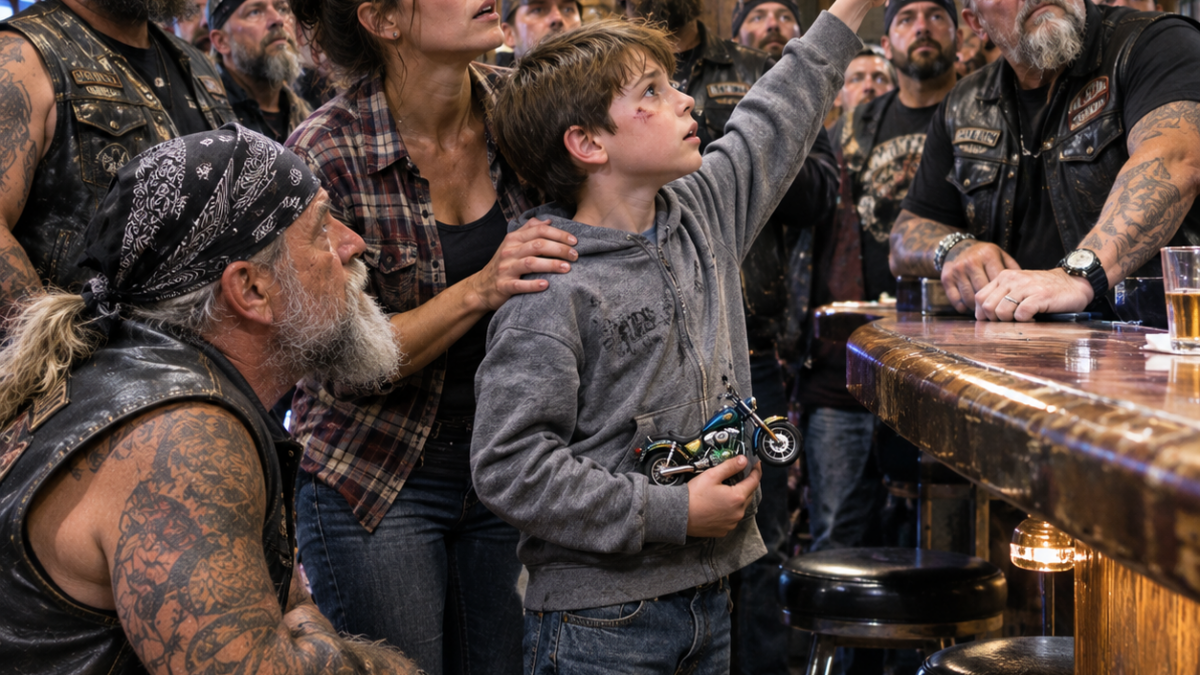
A 9-Year-Old Pointed at the Clubhouse Ceiling—And 20 Armed Bikers Realized the “Rat” Wasn’t One of Them
A whole clubhouse full of armed bikers went silent because a nine-year-old boy pointed one shaking finger at the ceiling and whispered a single word.
We had spent months hunting for a brother we believed had betrayed us, and our president was one sentence away from accusing the wrong man when that child saw something none of us had noticed.
Then Eli told us why he recognized the hidden camera—and suddenly the federal case hanging over our club mattered a lot less than what might have been watching that boy sleep.
My name is Walt Grayson.
I’ve worn the Black Harbor Riders patch for twenty-six years.
That sentence means different things to different people.
Some hear motorcycle club and imagine crime.
Some imagine old men drinking beer and arguing over carburetors.
The truth is less cinematic.
Most of us worked ordinary jobs.
Mechanics.
Truckers.
Electricians.
Roofers.
A retired firefighter.
A welder.
One accountant everybody made fun of until tax season.
We rode hard.
We drank too much when we were younger.
Some brothers carried legal firearms.
Some did not.
We had rules.
We had tempers.
And we had history.
Too much of it, sometimes.
Our clubhouse sat behind an old machine shop at the edge of town.
Concrete floors.
Oak bar.
Pool table.
Old jukebox that only worked if you kicked the left side.
Twenty years of photographs covered one wall.
Brothers who moved away.
Brothers who died.
Charity rides.
Christmas toy drives.
Weddings.
Funerals.
A hundred ordinary moments that meant more to us than they would to anybody else.
The night Eli pointed at the ceiling, none of us were thinking about any of those pictures.
We were thinking about betrayal.
Our president, Boone Carter, was facing federal charges.
Conspiracy.
Racketeering.
Several allegations tied to businesses and people around the club.
I’m not going to pretend everything every brother had ever done was clean.
We were not saints.
But the case had become strange.
Things said privately in the clubhouse appeared in documents outside it.
Arguments.
Names.
Dates.
Boone’s lawyer knew about conversations that had happened with no outsiders present.
One federal filing even referenced a joke Tank made at the bar three months earlier.
That was when paranoia took over.
Somebody was leaking.
That was the only explanation we could imagine.
A rat.
A brother.
Maybe somebody arrested quietly.
Maybe somebody scared.
Maybe somebody bought.
Maybe somebody facing his own charges.
Suspicion changes a room.
Men who had ridden together for twenty years stopped speaking freely.
People watched each other.
Conversations died when somebody entered.
PART2:
Boone became convinced the leak had to be internal.
The federal case had put him under pressure.
Sleep disappeared.
Temper shortened.
He called a private meeting.
Twenty members.
No wives.
No girlfriends.
No visitors.
No phones on the bar.
No one leaves until we talk.
That was the plan.
Then Dana’s babysitter canceled.
Dana worked behind our bar two nights a week.
Twenty-six years old.
Single mom.
Always five minutes early.
Never stole a dollar.
She had a nine-year-old son named Eli.
His father had disappeared when the boy was three.
Not died.
Not kidnapped.
Just decided fatherhood interfered with his freedom and stopped showing up.
Dana had no parents nearby.
No sister.
No backup money for last-minute childcare.
Usually one of the club wives helped.
That night, nobody could.
Dana called Boone.
“I’ll stay home.”
He told her:
“No. Bring him.”
I heard him.
I said:
“Boone, tonight?”
“He’ll sit in the back.”
“Not exactly kid-friendly.”
“He’s been here before.”
“Not during this.”
Boone looked at me.
“Dana needs the shift.”
That ended it.
Boone had a weakness for kids.
Always had.
His daughter died years earlier in a car accident.
He never talked about it.
But any child near the clubhouse could get away with things grown men could not.
Eli came in carrying a toy motorcycle.
Black plastic.
One wheel slightly bent.
He sat beneath the far end of the oak bar where Dana could see him from the service area.
He had headphones.
Coloring book.
Juice box.
Nobody paid much attention.
That was probably why he saw what we missed.
Kids notice rooms differently.
Adults look at people.
Children look at everything.
The meeting started ugly.
Boone stood at the head of the bar.
Tank, our sergeant-at-arms, leaned against the wall.
Cisco sat alone.
That mattered.
Cisco had been acting wrong for weeks.
Quiet.
Irritable.
Missing rides.
Always checking his phone.
Leaving early.
His dues were late for the first time in twenty years.
He stopped inviting brothers to his house.
Stopped talking about his wife.
Boone noticed.
So did everyone else.
Nobody said the word rat.
Not yet.
But every eye moved toward Cisco whenever Boone talked about leaks.
Cisco knew.
His face tightened more every minute.
Boone started laying out examples.
Information that had escaped.
Dates.
Conversations.
He asked:
“Who here has been talking?”
Nobody answered.
Boone’s voice got lower.
Worse.
“I’m going to ask one time.”
Silence.
I looked at Cisco.
He was staring at the floor.
One hand shaking slightly against his knee.
I thought:
There it is.
Guilt.
That assumption almost destroyed a man.
Boone began saying his name.
“Cis—”
A small voice interrupted.
“Camera.”
Nobody reacted at first.
Then Eli said it again.
“Camera.”
I turned.
The boy had set his toy motorcycle on the floor.
He stood beside the bar.
One finger pointed toward the ceiling.
His hand shook.
Every man in the clubhouse followed that finger.
Dark corner above the oak shelves.
Smoke detector.
Water stain.
Ceiling tile.
Nothing obvious.
Then Tank moved.
Dragged a barstool under the corner.
The metal legs scraped the concrete.
In that silence, the sound felt enormous.
Tank climbed.
He was six foot four and probably three hundred pounds.
The stool complained.
He pushed up one ceiling tile.
Reached into the darkness.
Then froze.
“Son of a…”
Boone snapped:
“What?”
Tank slowly pulled his hand down.
Small black camera.
About the size of a matchbox.
Glass lens.
Thin wire.
Pointed directly at the bar.
At us.
At every meeting.
Every conversation.
Every argument.
Nobody moved.
Then the room exploded.
Chairs scraped.
Someone yelled:
“Feds!”
Another:
“Who put that there?”
Cisco jumped up.
Mason grabbed his shirt.
Cisco shoved him.
Tank came off the stool.
Two men moved toward the door.
Boone slammed both hands onto the bar.
“QUIET!”
It wasn’t loud compared with some things I’ve heard.
But Boone had a voice that made people obey.
The room stopped.
You could hear the beer refrigerator humming.
Boone took the camera from Tank.
Turned it carefully.
Wire still attached.
Then placed it on the bar like it could detonate.
That was when I remembered Eli.
He had backed into the corner.
Toy motorcycle against his chest.
Eyes wet.
Boone saw him too.
Everything about Boone changed.
He crossed the room slowly.
Crouched.
A six-foot biker with a gray beard folding himself down until his eyes were level with a nine-year-old.
“Hey.”
Eli’s chin trembled.
“You’re not in trouble.”
The boy looked toward the men behind Boone.
“All of you are mad.”
“Not at you.”
Boone glanced back.
“Anybody mad at Eli?”
Twenty grown men shook their heads.
Boone looked at him again.
“I give you my word. You did nothing wrong.”
Eli relaxed maybe one inch.
Boone pointed toward the camera.
“How’d you see it?”
The boy swallowed.
“Because I saw one before.”
Boone’s expression changed.
“Where?”
Eli stared down.
“At home.”
The room went cold again.
“In your house?”
Eli nodded.
“Where?”
Long pause.
“My room.”
I felt my stomach turn.
Boone stayed calm.
“What kind?”
“Black.”
“Like this one?”
Eli nodded.
“Who put it there?”
He clutched the toy tighter.
“Greg.”
Dana had mentioned Greg before.
Not much.
Guy helping her with computers.
Fixed her car once.
Installed a doorbell camera.
Brought groceries when Eli had the flu.
Boone asked carefully:
“Who is Greg?”
“Mom’s friend.”
“Does he live with you?”
“No.”
“Does he come over?”
“Sometimes.”
“Did your mom know about the camera?”
Eli shook his head.
“No.”
“How do you know?”
“He told me not to tell.”
Boone closed his eyes for one second.
I remember that.
One second.
Then opened them.
“What did he tell you?”
Eli’s voice got small.
“He said it was so he could keep me safe.”
Nobody behind Boone moved.
“He said cameras help good people watch bad stuff.”
Boone nodded slowly.
“Anything else?”
“He said Mom would get mad if I told her.”
“Mad at who?”
“Me.”
That answer hit harder than everything else.
Eli continued.
“He said it was our secret.”
Boone’s jaw tightened.
“He said secrets are what friends have.”
I saw Tank’s hands close into fists.
Boone turned his head slightly.
“Tank.”
“I know.”
“Do nothing.”
Tank looked like the instruction physically hurt.
Boone returned to Eli.
“You listen to me.”
Eli looked up.
“A grown person should never make you scared to tell your mom something happening in your room.”
The boy stared.
“You understand?”
“I think.”
“You are allowed to tell.”
“What if Mom gets mad?”
“She won’t be mad at you.”
“You sure?”
“Yes.”
Boone’s voice cracked.
“I’m sure.”
Dana came out of the storeroom carrying a case of beer.
She stopped.
Twenty men silent.
Eli crying.
Camera on the bar.
“What happened?”
Boone stood.
“Dana.”
She dropped the case onto a counter.
“Is Eli okay?”
“He didn’t do anything.”
She rushed toward him.
“What happened?”
Eli buried his face against her.
Boone asked:
“You know a guy named Greg?”
She stared.
“Greg Miller?”
“Comes to your apartment?”
“Yes.”
“Computers?”
“Yes.”
“Fixes things?”
“Yes.”
“Was he ever alone here?”
Dana looked confused.
“Why?”
Boone lifted the camera.
She stared.
Then shook her head.
“No.”
“Dana.”
“I don’t—”
Her face changed.
“My car.”
“What?”
“Last month. It wouldn’t start.”
She looked at the camera.
“Greg came to look at it.”
“Here?”
“Yes.”
“Was he inside?”
“I gave him my spare key because I had to take Eli to school.”
“How long?”
“Maybe an hour.”
Nobody said anything.
Dana looked at Eli.
Then at Boone.
“What did he say?”
Boone hesitated.
Dana became frantic.
“What did he say?”
Eli whispered:
“Mom.”
She crouched.
“Baby?”
“There’s one in my room.”
Dana stopped breathing.
I watched her face go from confusion to disbelief to horror.
“What?”
“Greg put it up.”
She shook her head hard.
“No.”
“He said it keeps me safe.”
Dana covered her mouth.
“He told me not to tell you.”
She started crying instantly.
Not soft tears.
Her whole body folded.
“No.”
She grabbed Eli.
“No, no, no.”
Boone put one hand on her shoulder.
Dana looked at him.
“He was in Eli’s room last week.”
Nobody moved.
“He said the Wi-Fi was bad.”
Her voice broke.
“He was up there alone.”
Tank turned away and punched the wall once.
Boone snapped:
“Enough.”
Tank nodded without looking back.
Dana held Eli.
“He installed my front-door camera.”
Boone’s eyes narrowed.
“Did he install anything else?”
“My router.”
“Anything in the living room?”
“I don’t know.”
“Do you have his passwords?”
“No.”
“Does he have yours?”
Dana looked terrified.
“Maybe.”
Boone turned to me.
“Phones.”
“What?”
“Everybody’s.”
He told every brother to put his phone on the bar.
Not because he suspected us anymore.
Because Greg knew computers.
We had no idea what else might be compromised.
Cisco still stood near his chair.
Pale.
Boone looked at him.
For several seconds, nobody spoke.
Then Boone walked across the room.
“Cisco.”
Cisco’s jaw tightened.
“What?”
Boone looked at the floor.
That was rare.
“I owe you an apology.”
Cisco stared.
“You were about to call me a rat.”
“Yes.”
“You were about to do more than call me one.”
Boone did not lie.
“Maybe.”
Cisco’s eyes filled with something between rage and relief.
“Twenty-five years.”
“I know.”
“You knew me twenty-five years.”
“I know.”
“So why?”
Boone looked around.
“Because I got scared.”
That answer changed the room.
Boone Carter admitting fear.
“I had a federal case. I thought somebody inside was feeding them everything. You started acting different.”
Cisco laughed bitterly.
“You want to know why?”
Boone nodded.
Cisco reached into his pocket.
Pulled out a folded paper.
Hospital invoice.
Then another.
Another.
His wife Maria had stage-three breast cancer.
Chemotherapy.
Surgery.
Insurance deductibles.
Thousands in bills.
Cisco had been working nights after his regular job.
Selling equipment.
Borrowing money.
He had told nobody.
“Why didn’t you tell us?” I asked.
“Because I’m not a charity.”
Tank said:
“You’re family.”
Cisco looked at him.
“That’s worse.”
Some men understand that answer.
Pride is useful until it makes you lonely.
Boone stepped closer.
“Maria sick?”
Cisco nodded.
“How bad?”
“Treatment’s working.”
“Bills?”
Cisco laughed without humor.
“Enough.”
Boone held out his hand.
Cisco did not take it.
Not yet.
Boone said:
“I was wrong.”
Cisco looked at him for a long time.
Then took his hand.
But forgiveness is not the same thing as forgetting.
Boone knew that.
We all did.
Then Boone looked toward the camera.
“We call police.”
A few brothers reacted immediately.
“No.”
“Boone.”
“Federal case already—”
He held up one hand.
“This thing was in a child’s bedroom.”
Silence.
“This is not club business.”
That ended the argument.
The old version of us might have handled it ourselves.
The younger men expected that.
Some probably wanted it.
But Boone understood something the rest of us were still catching up to.
If Greg had hidden cameras around a child, we did not need vengeance.
We needed evidence preserved.
Children protected.
Devices seized legally.
Accounts traced.
And Greg unable to claim a bunch of angry bikers had fabricated everything after beating him half to death.
Boone called the sheriff.
He told the dispatcher:
“We found an unauthorized surveillance camera inside a private clubhouse, and a nine-year-old says the same man put one in his bedroom without his mother’s knowledge.”
That got attention.
Fast.
Deputies arrived.
Then a detective.
Then someone from crimes against children.
They asked us not to touch the camera again.
Too late for Tank’s fingerprints.
But better late than never.
They photographed everything.
Ceiling.
Wire.
Connection point.
Router.
Power supply.
We gave consent for a search of the clubhouse.
Boone’s federal lawyer nearly died when he heard.
“What do you mean you gave the sheriff access?”
Boone answered:
“A kid was involved.”
That was all.
The camera’s wire led through the ceiling into a small transmitter mounted behind the office wall.
Wireless backup.
Local storage card.
Remote connection.
Someone had planned it properly.
Not a federal device.
At least not according to the serial number and hardware.
The detective did not jump to conclusions.
Neither did Boone.
We had done enough of that.
Dana gave permission for police to inspect her apartment.
She refused to go home first.
Couldn’t.
One of the club wives took Eli to her house.
Dana went with detectives.
Boone.
Me.
Nobody else.
At the apartment, officers found the bedroom camera exactly where Eli said.
High shelf.
Hidden behind a decorative speaker.
Pointed toward his bed.
Dana almost collapsed.
Then they found another in the living room.
Another device attached to the router.
Greg had created remote administrator access.
Dana kept saying:
“How did I not see this?”
The detective answered gently.
“Because it was designed so you wouldn’t.”
They seized the devices.
Changed passwords.
Advised Dana not to contact Greg.
Not to warn him.
Not to confront him.
That part was difficult.
She wanted to call.
Scream.
Demand answers.
Boone told her:
“Let them do their job.”
She looked at him.
“You’d wait?”
Boone glanced toward Eli’s room.
“No.”
Then:
“That’s why I’m telling you to.”
Greg did not know we found the cameras.
That mattered.
Investigators monitored account activity.
They obtained warrants.
Digital forensics took time.
Too much time for our nerves.
Three days.
Then five.
Then an investigator came to the clubhouse.
Detective Sarah Holden.
Forty-something.
No patience for biker theatrics.
She sat across from Boone.
“We need you to listen before you react.”
Nobody likes a sentence starting that way.
Greg was not working alone in the sense we first imagined.
He had not been feeding information to federal investigators as an official informant.
The clubhouse camera had been streaming to a private account.
But stored files had also been accessed from multiple devices.
One belonged to Greg.
Another connection came from a private investigator working for a law firm tied indirectly to one of the parties in Boone’s federal case.
The detective was careful.
“We’re still determining whether anybody besides Greg knew how the recordings were obtained.”
Meaning:
Do not assume lawyers ordered illegal surveillance.
Do not assume federal agents planted it.
Do not assume every person who eventually received information knew its source.
Evidence first.
Boone nodded.
“What about Eli?”
Sarah’s face changed.
“That’s the bigger problem.”
Greg’s cloud account contained recordings from more than Dana’s apartment.
Other residences.
Some adult clients who hired him for smart-home installations.
At least two homes where children lived.
Investigators were notifying families.
The content was still being reviewed.
Sarah did not give details.
Did not need to.
My stomach turned anyway.
Boone’s face went completely still.
“Is Eli…”
“He’s safe right now.”
“That’s not what I asked.”
“I know.”
She looked at Dana.
“We have specialists reviewing the material. We will tell you what you need to know when we can do it without causing unnecessary harm.”
Dana began crying.
Eli had already started therapy through a child advocacy center.
That was important.
Not because we thought he was broken.
Because having an adult manipulate secrecy around surveillance can damage a child’s sense of safety even without anything else happening.
The therapist explained something Boone later repeated to every member.
“There are good secrets and unsafe secrets.”
A birthday surprise?
Temporary.
Ends in happiness.
A grown person saying:
Don’t tell your mom or she’ll be mad at you?
Unsafe.
A grown person making a child responsible for keeping the adult out of trouble?
Unsafe.
Eli needed to hear that none of this was his fault.
Again.
And again.
Because children will invent responsibility where adults leave confusion.
Greg was arrested six days after the discovery.
Police picked him up after he logged into one of the remote accounts from his apartment.
Search warrant found computers.
Storage drives.
Networking equipment.
Tools.
More cameras.
He was charged with multiple offenses related to illegal surveillance and other crimes investigators uncovered through digital evidence.
I will not describe everything.
Eli is not a horror story.
He is a person.
That distinction matters.
The federal case around Boone changed too.
His attorney obtained information through proper legal channels showing some statements attributed to club “insiders” appeared to originate from illegally captured audio.
That did not magically erase the entire case.
Some evidence had independent sources.
Some allegations had nothing to do with Greg.
Some counts continued.
But prosecutors had to reassess what could be used and how it had been obtained.
Boone ultimately faced consequences for things the government could prove independently.
He also beat several accusations that depended on tainted or unreliable information.
The story was not:
Child finds camera and every charge disappears.
Life is messier.
The camera did something more important.
It stopped us from destroying each other over the assumption that the leak had to be one of us.
Cisco came back to the clubhouse two days after Greg’s arrest.
He stood by the door.
Nobody knew what to say.
Boone approached.
“I’m sorry.”
Cisco nodded.
“You said that.”
“I need to say something else.”
“What?”
“You should’ve told us about Maria.”
Cisco’s face hardened.
“Don’t turn this around.”
“I’m not.”
Boone took a breath.
“I was wrong to suspect you.”
“Yes.”
“And you were wrong to think being scared alone made you stronger.”
Cisco stared.
Then laughed once.
“Go to hell.”
Boone nodded.
“Probably.”
That was the beginning of repairing things.
The club paid Maria’s insurance deductibles.
Cisco objected.
We ignored him.
He threatened to pay everybody back.
We ignored that too.
Some money came from a benefit ride.
Some anonymously.
One envelope appeared in his mailbox containing enough cash to cover a month of treatments.
Cisco asked Boone who sent it.
Boone said:
“No idea.”
I sent half.
Never told him.
Maria finished chemotherapy.
Then surgery.
Then radiation.
She survived.
Years later, she told me:
“The cancer was easier than listening to Cisco pretend he wasn’t scared.”
Accurate.
Dana and Eli moved within a week.
Not because police told them they had to.
Because Dana could not sleep in that apartment anymore.
Every vent looked suspicious.
Every smoke detector.
Every blinking light.
The club rented them a new place before she could argue.
New locks.
New router.
Professionally inspected.
No smart cameras inside.
Dana tried to pay us back.
Boone said:
“You already worked enough free shifts over the years.”
“I never worked free.”
“You overpoured Eddie’s bourbon for five years.”
Eddie shouted from across the room:
“I knew it!”
Dana laughed for the first time in days.
The hardest part was Eli.
After the camera came down, he became afraid of ceilings.
That sounds strange until you understand.
At home, he checked smoke detectors.
Hotel rooms.
School classrooms.
If something had a tiny dark circle, he stared at it.
He stopped changing clothes in his bedroom.
Slept with his blanket over his head.
Therapy helped.
So did control.
One counselor gave him a flashlight.
Whenever he entered a new room, he was allowed one safety check with Dana.
Not endless checking.
One.
They would identify normal devices.
Smoke detector.
Sprinkler head.
Vent.
Then stop.
Slowly the fear shrank.
The clubhouse changed too.
Nobody wanted Eli there for a while.
Not because we blamed him.
Because we wanted that place to stop being part of his fear.
Then one Saturday he asked Dana:
“Can I go see Boone?”
She called first.
Boone said yes.
Eli entered holding the same toy motorcycle.
The bent wheel was still bent.
He looked toward the corner above the bar.
The ceiling tile had been replaced.
No camera.
Boone had actually removed the entire section and installed a light fixture.
Eli pointed.
“What’s that?”
“Light.”
“Why?”
Boone shrugged.
“I got tired of dark corners.”
The boy smiled.
Then Boone handed him something.
A wooden plaque.
Our club carpenter had made it.
Small.
Nothing dramatic.
It read:
ELI’S SEAT.
They mounted it beneath the safest stool in the clubhouse.
No alcohol service at that end when he visited.
No weapons within reach.
Dana nearly cried.
Eli climbed onto the stool.
Looked around.
“You guys were really mad that night.”
Tank coughed.
“A little.”
“Were you going to fight?”
Nobody answered.
Kids ask questions adults avoid.
Boone finally said:
“We almost did something stupid.”
“Because of Cisco?”
“Yes.”
“Did Cisco do something bad?”
“No.”
“Then why?”
“Because we thought we knew something we didn’t know.”
Eli considered this.
Then said:
“You should check first.”
Twenty grown bikers stared at him.
Boone nodded.
“That is apparently the lesson.”
The boy became our conscience without trying.
Not in some magical way.
He was still a kid.
He spilled soda.
Cheated at cards.
Once drew a mustache on Tank’s face when Tank fell asleep.
Tank chased him around the clubhouse for ten minutes.
Dana yelled at both of them.
Life slowly became ordinary again.
But Eli’s discovery changed our rules.
Phones and electronics inspected.
No unauthorized surveillance.
Nobody accused of serious wrongdoing without evidence.
No physical confrontation over internal suspicion.
Legal problems go through lawyers.
Child-safety concerns go through professionals.
Some old members complained.
Said we were becoming soft.
Boone answered:
“No. We’re becoming less stupid.”
Hard to argue with that.
Eli grew.
Ten.
Eleven.
Twelve.
At twelve, he learned basic motorcycle maintenance from me.
Not riding.
Maintenance.
Dana had rules.
At thirteen, he helped rebuild the carburetor on an old Honda.
At fourteen, he started lifting weights because he wanted arms like Tank.
Tank told him:
“Get better goals.”
At fifteen, he grew suddenly.
By sixteen, he was nearly six feet.
Still thin.
Still observant.
He noticed everything.
One afternoon I found him staring at the ceiling of the rebuilt back room.
I asked:
“You okay?”
He nodded.
“Just checking.”
One check.
Like the therapist taught him.
Then he looked away.
Progress does not mean never remembering.
It means remembering without being controlled.
Dana married when Eli was sixteen.
Not another Greg.
A man named Thomas.
Paramedic.
Patient.
Took almost two years before Eli fully trusted him.
Thomas never pushed.
That mattered.
First time Eli called him Dad was apparently by accident while asking where the car keys were.
Thomas walked into the garage and cried.
Eli pretended not to notice.
Boone told everybody.
Thomas threatened him.
The club had opinions about everything.
Greg’s case ended years earlier.
The evidence was extensive.
He was convicted on multiple charges related to illegal surveillance and exploitation.
Other families came forward.
Some civil cases followed.
I won’t give sentence details.
That part belongs to courts and victims.
What mattered to us was:
He could not quietly return to Dana’s home.
Could not convince Eli the secret had been normal.
Could not keep watching people who had never agreed to be watched.
Eli once asked Boone:
“Did you want to kill him?”
He was seventeen by then.
Boone answered honestly.
“Yes.”
Dana looked horrified.
Boone held up a hand.
“Wanting something and doing it are different.”
Eli waited.
“If we had gone after him ourselves, we might have destroyed evidence.”
Boone looked toward me.
“Might have put brothers in prison.”
Then toward Eli.
“Might have made your mom explain why the men you trusted hurt somebody.”
Eli nodded.
Boone continued.
“And maybe we never would’ve found the other cameras.”
That was true.
The disciplined choice had protected more children than revenge ever could.
Boone learned that late.
We all did.
Cisco’s wife Maria lived another thirteen years after her diagnosis.
Every year on the anniversary of the camera discovery, she sent Eli a birthday-style card even though it was not his birthday.
Inside:
Thanks for saving my husband from his idiot friends.
Cisco hated those cards.
Eli loved them.
When Maria eventually died from an unrelated stroke, Eli came to the funeral.
He was twenty-two.
Tall.
Broad shoulders now.
No motorcycle patch.
He had chosen computer security as a career.
That surprised nobody.
He said he liked finding things people tried to hide.
At Maria’s funeral, Cisco hugged him for a long time.
Then whispered:
“You know you probably saved my life?”
Eli looked uncomfortable.
“I found a camera.”
“You found the truth.”
Cisco released him.
“That was enough.”
Eli never joined the club.
People assume he did.
No.
He rode occasionally with Boone.
Bought a used motorcycle in college.
Dana complained.
But he built his own life.
Cybersecurity.
Eventually child-safety technology.
He worked with a nonprofit teaching families how to secure home devices.
Cameras.
Routers.
Smart speakers.
Passwords.
He never turned his childhood into a speech every five minutes.
But when he talked to parents, he always said one thing:
“Teach your kids that adults don’t get to make secret rules about their bodies, bedrooms, or safety.”
Simple.
Powerful.
Boone got older.
We all did.
The federal case became something people rarely mentioned.
The club survived.
Smaller.
Quieter.
More charity rides than fights.
Less drinking.
More blood-pressure medication.
Time humbles everybody.
Boone developed heart problems in his seventies.
The first time he was hospitalized, Eli flew home.
Boone woke and found him sitting beside the bed.
“Why are you here?”
Eli shrugged.
“You looked lonely.”
Boone smiled.
“You still notice everything?”
“Pretty much.”
Then Eli pointed at the ceiling.
Boone’s eyes widened.
“Don’t you dare.”
Eli laughed.
“Smoke detector.”
Boone laughed so hard the nurse came in.
That became their joke.
Every birthday, Eli called.
Every Christmas.
Every time Boone answered:
“Camera?”
Eli:
“Still watching you.”
Maybe that sounds dark.
To them, it became something else.
A reminder.
The thing that once terrified a child had become a joke he controlled.
That matters.
Boone died at seventy-eight.
Heart failure.
Not dramatic.
Home.
Sleep.
At the funeral, Eli stood near Dana.
He was twenty-nine.
Married.
One little daughter.
Her name was Grace.
After the service, he walked to Boone’s casket.
Placed something beside the flowers.
The old toy motorcycle.
Same one from the clubhouse.
Black plastic.
Bent wheel.
He had kept it all those years.
I stood behind him.
He touched the casket once.
Then whispered:
“You kept your word.”
I knew what he meant.
Boone told a nine-year-old:
You’re not in trouble.
I give you my word.
Then spent the rest of his life proving it.
After the funeral, Dana hugged me.
“You remember that night?”
“How could I forget?”
“I still feel stupid.”
“For what?”
“Letting Greg into our lives.”
I shook my head.
“No.”
“I trusted him.”
“That’s what people like him use.”
“I should’ve known.”
“Dana.”
She looked at me.
“Your son saw something wrong and told you.”
She started crying.
“That means somewhere along the way you taught him he could.”
That was the truth.
Even though Greg tried to teach Eli secrecy, the boy still spoke.
Because underneath the fear was something stronger.
He trusted his mom.
He trusted the room.
Maybe, strange as it sounds, he trusted us.
The armed bikers.
The men Dana had been warned not to bring him around.
We were dangerous in some ways.
I will not romanticize that.
Tempers.
Weapons.
Federal investigation.
A room where a bad accusation could have ended badly.
Eli should not have needed to save us from ourselves.
That is the part people miss when they tell the story.
They say:
A brave boy saved twenty bikers.
True.
But adults should not need a nine-year-old to remind them to check the ceiling before destroying a brother’s life.
Cisco nearly paid for our fear.
Eli exposed Greg.
But he also exposed us.
Our paranoia.
Our assumptions.
Our belief that loyalty meant never questioning Boone.
Our belief that strength meant acting fast.
Sometimes strength is waiting for evidence.
Sometimes loyalty means telling your president he’s wrong.
Sometimes protecting someone means dialing 911 even when every old instinct says handle it yourself.
That night changed the Black Harbor Riders more than any arrest, funeral, or federal investigation ever did.
We stopped confusing silence with loyalty.
Cisco had been silent about Maria’s cancer.
That almost destroyed him.
Dana had been kept unaware by Greg.
That endangered Eli.
Eli had been told secrets were proof of friendship.
He broke that rule.
Good.
Some secrets deserve breaking.
Especially secrets built from fear.
Eli once told me, years later:
“I thought you guys would be mad.”
“Why?”
“Because Greg said grown-ups get mad when kids tell things they’re not supposed to.”
I asked:
“What made you point anyway?”
He thought about it.
Then:
“The camera was watching Boone.”
“So?”
He smiled.
“Boone always watched out for me.”
That answer almost broke me.
A nine-year-old child saw danger pointed at a man who had been kind to him.
So he spoke.
Not because he understood federal investigations.
Not because he knew about Cisco.
Not because he knew what Greg had done.
Because somebody he trusted might be in danger.
He warned us.
That one word—
Camera—
stopped Boone before he said Cisco’s name.
Stopped two brothers from fighting.
Stopped us from making a terrible mistake.
Exposed an illegal surveillance network.
Protected children we did not even know existed.
And changed the way a room full of stubborn men understood strength.
People ask me whether Eli was a hero.
Boone always said yes.
I’m more careful with that word.
Heroes sound like people who are never afraid.
Eli was terrified.
His hand shook.
His eyes filled with tears.
He thought we might blame him.
He spoke anyway.
Maybe that is a better definition.
Not someone who feels no fear.
Someone who refuses to let fear decide what stays hidden.
The old clubhouse is still standing.
Different bar stools.
New cameras outside only, clearly marked and legally installed.
No cameras inside.
Boone’s old chair sits in the corner.
Above the oak bar, where Greg’s camera once hid in darkness, there is now a bright light.
Under it hangs a small wooden plaque.
Most visitors assume it is some biker motto.
It isn’t.
Two words.
CHECK FIRST.
That rule came from Eli.
A nine-year-old.
The kid we said did not belong in the clubhouse.
The kid we thought was not listening.
The kid sitting under the bar with a plastic motorcycle while twenty armed grown men nearly tore their brotherhood apart.
We used to tell ourselves we protected him.
That night proved something else.
He protected us.
Not with fists.
Not with a weapon.
Not by being tougher than anybody.
He looked up.
Saw something wrong.
And told the truth.
Sometimes that is enough to save a whole room.








