They Tried to Cremate My Pregnant Wife Before Sunset—Then I Saw What Her Mother Was Desperate to Burn With Her
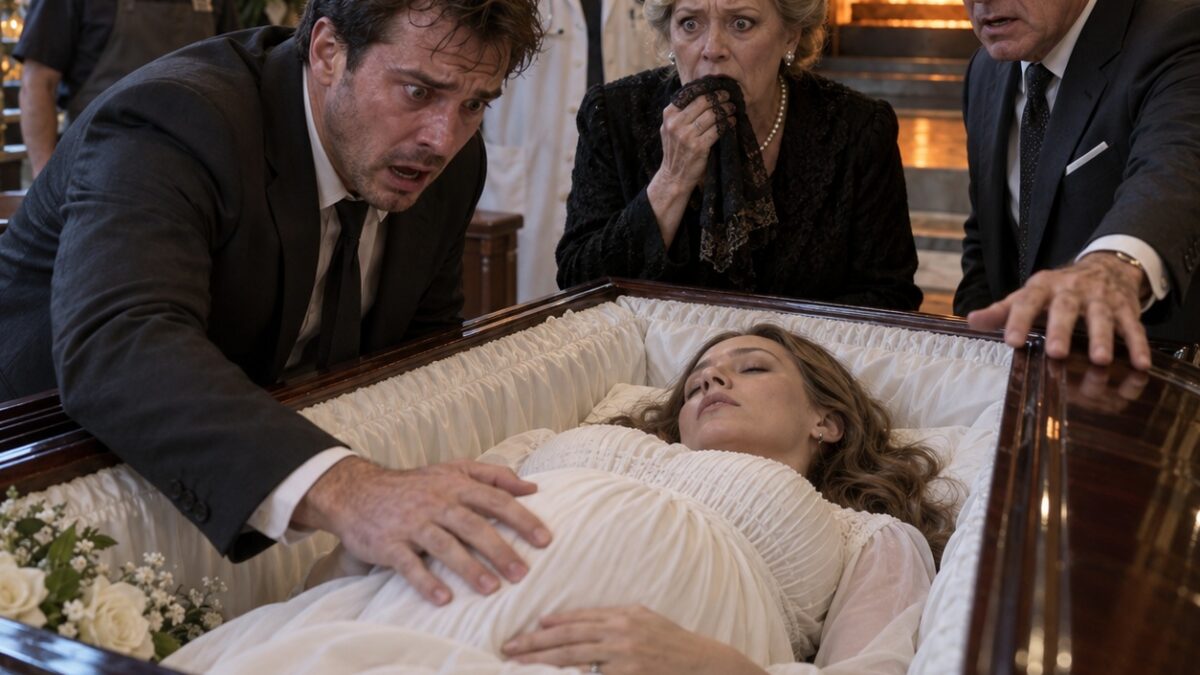
“Call 911!” I shouted again.
For one unbelievable moment, nobody moved.
Nearly forty people stood in that chapel. Some were Vale relatives. Others were hospital executives, politicians, foundation donors, and employees who had spent years learning that when Helena Vale spoke, everyone else obeyed.
They stared at me as though I were the danger.
The crematorium employees looked toward Helena, waiting for her permission to save her daughter.
That was the moment I understood how much power she possessed.
Even with Clara’s stomach moving inside an open coffin, they were more afraid of Helena than they were of letting an innocent woman burn.
I pulled out my phone.
Marcus struck it from my hand.
The device skidded beneath a row of chairs.
“Close the coffin,” he ordered.
I stepped between him and Clara.
“Touch that lid and I’ll break your arm.”
His expression changed.
Marcus was six feet three and built like a man who paid someone to make him look dangerous. He spent his mornings in a private gym and his evenings drinking with people who laughed before he finished speaking.
I was two inches shorter and forty pounds lighter.
But for six years, before I became a fire investigator, I had worked as a paramedic in neighborhoods where violence arrived before the ambulance. I knew how bodies failed. I knew how panic changed movement. And I knew Marcus had never faced anyone who was not paid to let him win.
He stopped.
Helena moved closer.
“You are threatening my son at my daughter’s funeral.”
“I’m protecting my wife from the people trying to cremate her alive.”
“She is dead.”
“Then why are you afraid of an ambulance?”
Her eyes hardened.
“I am afraid of what your hysteria is doing to her dignity.”
A moan came from the coffin.
Barely a sound.
Just a thin breath escaping Clara’s throat.
But everyone heard it.
Dr. Crane flinched.
I leaned over her.
“Clara?”
Her eyelids remained closed.
Her chest looked motionless, but when I put my palm against her ribs, I felt an irregular contraction.
Once.
Then nothing.
Then another.
She was breathing two or three times a minute.
The movement beneath her dress came again.
Our daughter was still alive too.
I grabbed the folded satin beneath Clara’s neck, removed it, and tilted her head to open her airway.
Dr. Crane rushed forward with a syringe.
“I need to administer medication.”
I caught his wrist.
“What is that?”
“Epinephrine.”
The syringe was already filled.
There was no label on it.
“What concentration?”
“The standard cardiac dose.”
“Which standard?”
His fingers trembled.
“Move aside, Daniel.”
“Show me the vial.”
“There is no time.”
“Then you won’t mind if the paramedics administer their own.”
“She won’t survive until they arrive.”
“You declared her dead an hour ago. Why did you bring emergency medication to a crematorium?”
His face went blank.
Marcus tried to take the syringe from him.
I twisted Crane’s wrist until he released it.
The syringe fell onto the carpet.
Marcus crushed it beneath his shoe.
Glass cracked.
Clear liquid soaked into the dark fibers.
Several people gasped.
I looked at the broken syringe, then at Crane.
“What was in it?”
He backed away.
“Epinephrine.”
“No,” I said. “It wasn’t.”
One of the mourners—a woman I recognized as Clara’s former college roommate—retrieved my phone and called 911.
Helena turned on her.
“You will leave this building immediately.”
The woman stared at her.
Then she looked at Clara.
“No.”
It was a simple word.
But something shifted in the room.
Another guest took out his phone.
Then another.
Helena’s authority had depended on everyone believing resistance was impossible. The instant one person refused, others remembered they had choices too.
Marcus saw it happening.
He reached inside his jacket.
A black remote slipped from his hand and struck the floor.
The crematorium director bent to pick it up.
“That controls the chamber doors,” he said.
All eyes turned toward Marcus.
He snatched for it, but I stepped on the remote.
“Why do you have this?”
“The director gave it to me.”
“I did not,” the man said quickly.
Marcus pointed at him. “You’re lying.”
The director’s face turned gray.
“You told me Mrs. Reyes had an infectious condition. You said the family needed the service completed before state officials arrived.”
“What infectious condition?” I asked.
He shook his head.
“They never gave me a name.”
“You agreed to cremate a pregnant woman without the legally required waiting period?”
Marcus moved toward the side exit.
Two police officers entered before he reached it.
The older one ordered everyone to stay where they were.
“Who called about a living person inside a coffin?”
“I did,” Clara’s friend said.
I raised my hand.
“My wife has a faint pulse and severely depressed respiration. She is thirty weeks pregnant. She may have been poisoned.”
Dr. Crane pushed past me.
“I am her physician. She experienced cardiac arrest at my clinic. This man is having an acute grief reaction.”
I looked at the officer.
“Ask him for the electrocardiogram that confirmed death.”
Crane’s jaw tightened.
“The clinic retains medical records.”
“Ask why he brought an unlabeled syringe to the crematorium.”
“It was emergency medication.”
“Ask why he crushed it.”
Marcus answered. “It was an accident.”
The sirens came closer.
Their sound rose above the rain and filled the chapel.
Helena closed her eyes.
Not with relief.
With calculation.
She was already planning the next story.
The ambulance crew rushed in carrying equipment. A paramedic named Collins took my position at Clara’s head while another cut open part of her dress to place monitor leads on her chest.
The screen remained almost flat.
Then a narrow electrical complex appeared.
Seven seconds passed.
Another appeared.
Collins looked sharply at Crane.
“She has cardiac activity.”
“She didn’t at the clinic,” Crane said.
“Her skin temperature is extremely low.”
“She was refrigerated after death.”
“For how long?”
“Approximately forty minutes.”
“Her core temperature is eighty-eight degrees. Refrigeration alone doesn’t explain that.”
The second paramedic tried to take a blood pressure.
“Nothing palpable.”
“Start assisted ventilation.”
They lifted Clara from the coffin.
Her hand slipped to one side, and her wedding ring tapped against the metal frame.
That tiny sound almost destroyed me.
Six hours earlier, she had kissed me in our kitchen.
Now strangers were forcing air into her lungs while her own mother watched without shedding a tear.
An obstetric kit opened.
A sensor pressed against Clara’s stomach.
Static crackled through the speaker.
Then a rapid rhythm filled the chapel.
Our daughter’s heartbeat.
Fast.
Uneven.
Alive.
I covered my mouth with one hand.
The room blurred.
I had been holding myself together through anger, suspicion, and the need to act. That heartbeat broke through everything.
I bent over Clara and whispered into her ear.
“I found you. Do you hear me? I found you.”
Her face did not change.
But the fetal heartbeat continued.
Marcus moved toward the exit again.
The younger officer blocked him.
“You need to remain here.”
“My sister requires a specialist. I’m going to the hospital.”
“You can follow after we take your statement.”
“Do you know who I am?”
“Yes, sir.”
“Then you know better than to detain me.”
The officer glanced at the remote control beneath my shoe.
“I know enough not to let you leave.”
Helena approached Crane.
Their conversation was too quiet to hear, but I saw the doctor shake his head.
She touched his arm.
He looked at her.
Whatever passed between them made the last color drain from his face.
The paramedics wheeled Clara toward the doors.
I followed.
One officer grabbed my shoulder.
“We need your statement.”
“You can take it in the ambulance.”
“Sir—”
“My wife is alive after her doctor declared her dead, my brother-in-law had the cremation remote, and someone tried to inject her with an unidentified drug. If you want to stop me from staying with her, arrest me.”
He released my shoulder.
I climbed into the ambulance.
Rain hammered the roof as we sped toward St. Catherine’s Medical Center.
Collins squeezed the ventilation bag in a steady rhythm. His partner established an IV and called vital signs to the receiving hospital.
“Heart rate twenty-eight.”
“Prepare atropine.”
“Fetal rate one-ten and falling.”
“Come on, Clara.”
I held her cold hand.
There was no response.
I began talking because silence felt like surrender.
I reminded her of the day we met.
A small electrical fire had broken out in the basement of the Vale Foundation’s downtown office five years earlier. Clara was supposed to be attending a board meeting on the twelfth floor. Instead, I found her near the lobby elevators with soot on her cheek, one broken high heel, and a fire extinguisher in her hand.
A security guard was trapped inside an elevator.
The battalion chief ordered her to evacuate.
She refused until I promised I would personally find the man.
After the guard was rescued, Clara waited in the rain for two hours to make sure he reached the hospital safely.
Three weeks later, she appeared at my station carrying coffee for the entire crew.
She remembered I took mine black.
That was the beginning.
The Vales hated me before they met me.
Helena called my work admirable but unsuitable for a serious future. Marcus asked whether I had married Clara because firefighters did not earn enough to buy houses in her neighborhood.
Clara answered by moving out of the Vale estate and into my two-bedroom apartment.
For the first time in her life, she learned how to unclog a sink, compare grocery prices, and live without an employee arranging her days.
She loved every part of it.
The night I proposed, I could only afford a small diamond.
She stared at it for so long I thought she was disappointed.
Then she cried and said it was the first piece of jewelry anyone had given her without expecting obedience in return.
I told these stories while the ambulance raced through rain.
I reminded her of the cheap diner where we held our wedding dinner after Helena refused to attend.
I reminded her of the morning we learned she was pregnant and how she laughed so loudly our neighbor knocked on the wall.
I promised there were still nursery walls to paint.
I promised our daughter would need her.
I promised anything that might give her a reason to stay.
At the hospital, a trauma team took Clara through double doors.
A nurse stopped me.
“You can’t enter the resuscitation room.”
“I’m her legal representative.”
“You can speak with the physician as soon as she is stabilized.”
Through the glass, I watched doctors surround my wife.
They removed the white dress.
They placed a breathing tube in her throat.
Warming blankets covered her body. Heated fluid entered her veins. An obstetrician pressed an ultrasound probe against the curve of her stomach.
I could not hear what they said.
Then the obstetrician looked toward me and raised one hand.
The baby still had a heartbeat.
My knees gave way.
I sat on the floor in my rented suit, surrounded by strangers’ shoes, and cried for the first time.
Detective Lena Ortiz found me there forty minutes later.
She was in her late forties, with dark hair threaded in silver and eyes that looked permanently tired of lies.
“Daniel Reyes?”
I stood.
“Yes.”
“I need to ask you about what happened.”
“My wife is inside.”
“We can speak here.”
She sat across from me and opened a notebook.
“Who arranged the cremation?”
“Helena Vale.”
“Your mother-in-law?”
“Yes.”
“Who chose the facility?”
“Marcus.”
“Your brother-in-law?”
“Yes.”
“Did Clara ever tell you she wanted to be cremated?”
“No. She was terrified of fire.”
Ortiz’s pen stopped.
“Why?”
“Her father died in a fire when she was eight.”
“What was his name?”
“Arthur Vale.”
“I know the case.”
The way she said it made me look at her more carefully.
“Were you involved?”
“I was a patrol officer then. I secured the scene.”
“What happened?”
“The official ruling was accidental ignition caused by faulty wiring.”
“Official?”
“I saw burn patterns that did not look accidental. The lead investigator removed my observations from the report.”
“Who was the lead investigator?”
“Richard Sloan. He is now a captain.”
I knew Sloan.
He attended Helena’s Christmas parties. The Vale Foundation had funded a new training center bearing his name.
Ortiz continued.
“When did you last see Clara conscious?”
“Seven-fifteen this morning.”
“How did she seem?”
“Nervous.”
“Did she tell you where she was going?”
“She said she was having breakfast with Helena.”
“Was that unusual?”
“They rarely spent time alone.”
“Did you argue?”
“No.”
“Did she take any medication?”
“Prenatal vitamins and low-dose aspirin.”
“Anything else?”
“No.”
“What did she eat or drink?”
“Tea.”
“What kind?”
“A pregnancy blend Helena sent three days ago.”
Ortiz’s expression changed.
“Is the tea still at your house?”
“Yes.”
“I’ll send a team.”
“Not from Sloan’s department.”
“You don’t trust the local police?”
“I don’t trust anyone who owes the Vales money or favors.”
Her gaze held mine.
“That may include more people than you know.”
The emergency-room doors opened.
A physician removed her mask as she approached.
“I’m Dr. Sarah Malik. Are you Clara’s husband?”
“Yes.”
“Your wife is alive, but she is critically ill. Her heart rate has improved with rewarming and medication. She is not breathing adequately on her own.”
“What caused it?”
“We found a sedative and a beta blocker in her blood. Those could explain part of her condition, but not all of it. We suspect an additional toxin.”
“And the baby?”
“The fetal heart rate has stabilized for now. If either of them deteriorates, we may need to deliver immediately.”
“Will Clara wake up?”
“We don’t know yet.”
I looked through the doors.
“Can I see her?”
“When we move her to intensive care.”
Ortiz asked, “Doctor, is there any natural condition that could cause someone to be mistakenly declared dead for this length of time?”
“Profound hypothermia combined with drug-induced respiratory and cardiac suppression might make vital signs extremely difficult to detect without proper equipment.”
“Would an electrocardiogram have detected activity?”
“Yes.”
“Dr. Crane claims he used one.”
“Then either her condition changed after his examination, the equipment failed, or his claim is inaccurate.”
I knew which answer I believed.
A uniformed officer approached Ortiz and whispered to her.
She listened without expression.
Then she looked at me.
“Marcus Vale says you poisoned your wife.”
I laughed once.
It was not amusement.
“He tried to cremate her alive.”
“He says you recently discovered the baby may not be yours.”
“That is a lie.”
“He also says you threatened Clara last night.”
“We discussed whether the nursery should be green or yellow.”
“Which did you choose?”
“Green.”
Dr. Malik looked between us.
Ortiz wrote the answer in her notebook.
“Marcus claims Clara asked her family to arrange the cremation because she feared you would interfere with her wishes.”
“She signed a directive naming me as her representative.”
“Do you have the original?”
I handed her the paper.
She examined it.
“This signature is notarized.”
“Clara wanted no uncertainty after a bleeding complication during her first trimester.”
“Who knew about the directive?”
“Her obstetrician, our attorney, and Helena.”
Ortiz’s eyes narrowed.
“Then Helena knew you could legally stop the cremation.”
“Yes.”
“So why invite you?”
The question settled heavily between us.
If they knew I had authority, why tell me where the funeral was happening?
Maybe they believed grief would make me obedient.
Or maybe my presence served another purpose.
“They needed me seen near the body,” I said.
Ortiz waited.
“If Clara was cremated, there would be no toxicology evidence. The tea remains in our kitchen. Marcus is already claiming jealousy and threats. They planned to blame me.”
Dr. Malik folded her arms.
“That is speculation.”
“Yes,” Ortiz said. “But it is intelligent speculation.”
The officer returned.
This time, he handed Ortiz a clear evidence bag.
Inside was the broken syringe from the crematorium.
“The lab found traces of potassium chloride,” he said.
Dr. Malik’s expression hardened.
“A concentrated dose could stop her heart.”
I stared at the bag.
Crane had not rushed forward to save Clara.
He had tried to finish the job.
Clara was moved to intensive care shortly after midnight.
She lay beneath warming blankets while a ventilator breathed for her. Tubes entered both arms. A fetal monitor remained strapped around her stomach.
I sat beside the bed and held her hand.
Her fingers were beginning to warm.
That felt like a miracle.
The swelling around her wedding ring had increased, so a nurse removed it and placed it in a small plastic bag.
I turned the ring beneath the light.
Inside the band, beside our wedding date, someone had scratched three numbers.
4-1-7.
The marks were fresh and uneven.
Clara had made them herself.
I searched my memory.
Room 417?
April 17?
Then I remembered finding a bank receipt inside her winter coat two months earlier.
Vale Central Bank.
Safe-deposit box 417.
When I asked, she said Helena had requested that she store family jewelry.
I had believed her because marriage required trust.
Now I understood that Clara had been leaving a path in case she could no longer speak.
I called Ortiz.
She returned before dawn.
When I showed her the ring, she did not dismiss it.
“I’ll request a warrant.”
“How long?”
“A judge outside this county can approve it when court opens.”
“That could be hours.”
“Then we use the time to learn who we are fighting.”
She pulled a chair beside mine.
“Clara contacted me three months ago.”
I turned toward her.
“What?”
“She asked about the fire that killed Arthur.”
“You spoke with my wife?”
“Four times.”
“And you never told me?”
“She requested confidentiality.”
“I’m her husband.”
“She believed knowing would place you in danger.”
“She was already in danger.”
“I told her that.”
Anger rose through me.
“You should have protected her.”
“Yes.”
The answer stopped me.
Ortiz did not defend herself.
“She promised not to meet anyone alone,” she continued. “Yesterday morning, she sent me a message saying she had found proof. I called twice. She didn’t answer. I went to Captain Sloan and requested officers at the Vale clinic.”
“What did he do?”
“He told me Clara was attending a private family appointment and ordered me not to harass foundation donors.”
“You obeyed?”
“For forty minutes.”
Her voice tightened.
“Then I drove there anyway. By the time I arrived, the clinic staff said Clara had suffered a fatal heart attack and her family had removed the body.”
“You let them take her?”
“I demanded the death certificate. Crane produced one. Sloan ordered me away from the property.”
“And now Sloan controls the investigation.”
“Not for long.”
A sound came from Clara’s bed.
Her heart monitor sped up.
We both stood.
Her eyelids trembled but did not open.
The nurse checked her pupils.
“She may be responding to voices.”
I leaned close.
“Clara, it’s Daniel. You are at St. Catherine’s. You are safe.”
A tear appeared at the corner of her closed eye.
The nurse saw it too.
“That could be reflexive.”
It could have been.
I chose to believe otherwise.
At nine that morning, Ortiz and I entered Vale Central Bank with a warrant.
The bank manager was a thin man named Frederick Lowe. When Ortiz asked for box 417, he claimed it did not exist.
She placed the warrant on his desk.
“Try again.”
His hands trembled over the keyboard.
“The box was closed yesterday.”
“By whom?”
“The account holder.”
“Clara Reyes was unconscious yesterday.”
“I can only tell you what the records show.”
Security footage revealed Marcus entering the vault at 12:36 p.m.—after Clara was declared dead and before I was informed.
He carried a key and signed Clara’s name.
When he emerged nine minutes later, he held a leather case.
My hope collapsed.
Whatever Clara had hidden was gone.
Ortiz asked to inspect the box anyway.
It appeared empty.
Then I noticed scratches on the rear panel.
“Can that wall be removed?”
The manager shook his head. “It is part of the box.”
I pressed it.
The panel shifted.
Behind it was a narrow compartment no deeper than my finger.
Inside lay a folded envelope and a memory card.
Clara had anticipated that Marcus might find the obvious contents.
The envelope carried my name.
Daniel,
If you are reading this without me, then either I finally found the courage to tell you everything, or my family discovered what I was doing first.
My father’s death was not an accident.
For twenty-three years, I believed the story my mother repeated until it replaced my own memories. She said faulty wiring started the guesthouse fire. She said Dad had been drinking and could not escape.
But I remember hearing him argue with her that night.
I remember Marcus carrying a red gasoline can toward the maintenance shed.
Most of all, I remember Dad kneeling in front of me and saying, “If anything happens, hide beneath the east stairs. Your mother cannot know what you heard.”
Last year, while reviewing records for the Vale Foundation, I found payments to Dr. Crane beginning one week after the fire. The amounts increased whenever someone questioned Dad’s death.
I investigated quietly.
Dad had discovered that Helena and Marcus were using foundation clinics to move money through false patients, shell companies, and construction contracts. He planned to meet a federal investigator the morning after the fire.
He never made it.
Under Grandfather’s trust, control of Vale Medical Group passes to the first grandchild who produces a direct heir. When our daughter is born, my mother loses control of the voting shares.
Two weeks ago, Marcus told me no child of yours would ever inherit the Vale name.
Yesterday, Crane called and claimed there was a dangerous abnormality in my blood work. He insisted I come to the clinic alone.
I know it may be a trap.
I am going because I need evidence that will survive their influence.
If anything happens to me, trust Detective Lena Ortiz.
Do not trust a death certificate signed by Edwin Crane.
The files Marcus removed were decoys. The real archive is stored in the place where you first promised to save someone for me.
Daniel, I wanted to tell you. Every day, I almost did. I was afraid knowing would put you in danger. Then I became pregnant, and fear began making my choices for me.
Please understand that every lie was born from terror, never from a lack of love.
Clara
I read the letter twice.
Then a third time.
“The place where you first promised to save someone,” Ortiz said. “What does that mean?”
“The Vale Foundation building.”
“The fire where you met?”
“The security guard trapped in the elevator. Clara made me promise I would save him.”
“What part of the building?”
I remembered the basement.
The damaged electrical cabinet.
The elevator control room.
The foundation had moved offices two years earlier, but the old building remained under Vale ownership and awaited demolition.
“The elevator,” I said.
The memory card contained only one file.
An audio recording.
Marcus spoke first.
“You should have left it alone.”
Clara answered, “You stole from sick women.”
“We moved family money.”
“It came from grants and donations.”
“Donors received their photographs. Politicians got their ribbon cuttings. Everyone got what they paid for.”
“Dad found out, didn’t he?”
Silence.
Then Helena’s voice.
“Your father was sentimental. Sentimental people confuse principles with strength.”
“You killed him.”
“Be careful, Clara.”
“I remember the gasoline.”
“What you remember would not survive five minutes in court.”
“And Daniel?”
My breathing stopped.
Marcus asked, “What about him?”
“If something happens to me, he releases everything.”
Helena laughed.
“Your husband cannot release what he does not understand.”
“He understands more than you think.”
“He inspects burned buildings and comes home smelling like smoke. Do not mistake physical courage for intelligence.”
“You’ve underestimated him since the day we met.”
“No, darling. You overestimated what love can protect.”
The recording ended.
Ortiz looked at me.
“They believed you possessed the evidence.”
“But I didn’t.”
“They didn’t know that.”
“They needed Clara dead and me arrested before I could find it.”
My phone rang.
Dr. Malik’s name appeared.
“Mr. Reyes, you need to return to the hospital.”
“What happened?”
“Your wife is stable, but Helena Vale has filed for emergency guardianship. She wants Clara transferred to Vale Memorial.”
“Do not move her.”
“I have refused. But she has a court order signed by Judge Bellamy.”
Ortiz muttered something under her breath.
“Bellamy’s wife sits on the Vale Foundation board.”
We hurried from the bank.
Two patrol cars blocked us in the parking lot.
Captain Richard Sloan stepped from the first vehicle.
He was in his late fifties, broad and silver-haired, with the polished confidence of a man accustomed to cameras. Four officers spread behind him.
“Daniel Reyes,” he called. “You are under arrest for the attempted murder of Clara Reyes.”
Ortiz moved in front of me.
“On whose evidence?”
Sloan held up a warrant.
“Toxic substances were found in his home.”
“You searched without notifying the assigned detective.”
“You are no longer assigned.”
“Who removed me?”
“I did.”
She raised her phone.
“I have a warrant authorizing the seizure of evidence from safe-deposit box 417.”
“And I have an arrest warrant signed by Judge Bellamy.”
The same judge who had given Helena control over Clara.
Sloan extended one hand toward me.
“Turn around.”
“Is Clara alive?” I asked.
He hesitated.
“You know she is.”
“Then why did your department release a statement saying she died?”
His expression did not move.
“What statement?”
I showed him the news alert.
PREGNANT VALE HEIRESS DEAD; HUSBAND SOUGHT IN POISONING.
The report had been published twelve minutes earlier.
Sloan’s officers looked at one another.
He recovered quickly.
“A media error.”
“No,” Ortiz said. “It’s cover for the transfer.”
Sloan’s hand moved toward his weapon.
“Detective, step aside.”
She did not.
“Richard, I saw the guesthouse twenty-three years ago. I saw the pour patterns. I wrote the report you destroyed.”
His eyes hardened.
“You were a rookie who did not understand fire behavior.”
“And now?”
“Now you are obstructing a lawful arrest.”
The bank’s doors opened behind us.
Frederick Lowe stepped outside with two security guards.
“Captain Sloan,” he called, “this property is private.”
Sloan turned.
The distraction lasted less than a second.
Ortiz pushed me toward a narrow passage between buildings.
“Run.”
We ran.
I heard Sloan shouting behind us.
An officer followed us into the alley. Ortiz stopped, displayed her badge, and ordered him to let us pass.
He hesitated.
That saved us.
We crossed a loading yard, climbed a chain-link fence, and reached the next street, where Ortiz’s unmarked car was parked.
Within minutes, I became a wanted man.
Sloan’s department issued alerts accusing me of poisoning Clara, assaulting Marcus, stealing evidence, and fleeing arrest.
They used our wedding photograph in every report.
Marcus gave an interview outside the hospital.
“My sister was afraid of Daniel,” he told the cameras. “We tried to help her, but she kept returning to him. Now our family is praying for a miracle.”
Helena stood beside him wearing the same black dress from the crematorium.
This time, there were tears on her cheeks.
She could produce them when cameras required it.
“We forgive Daniel,” she said. “We only want Clara and her baby protected.”
I watched from the back office of an auto-repair shop owned by Ortiz’s brother.
“They are moving her while the public thinks she is dead,” I said.
Ortiz nodded.
“If she disappears after the transfer, they can claim she died from your poison.”
“And cremate her legally.”
“The order authorizes Helena to make medical and funeral decisions.”
I thought of Clara trapped inside that coffin, hearing her mother’s voice.
“What time is the transfer?”
“Four o’clock.”
It was 2:18.
Ortiz contacted an assistant United States attorney named Miriam Walsh and sent photographs of Clara’s letter, the audio file, the bank footage, and the crematorium evidence.
Walsh promised to seek federal warrants.
“How long?” I asked.
“Several hours.”
“We don’t have several hours.”
“Then we delay the transfer,” Ortiz said.
“How?”
She placed a maintenance badge on the table.
“St. Catherine’s is under renovation. My brother’s company holds the fire-door contract.”
I changed into blue coveralls and drove one of the company vans into the hospital’s service garage.
My photograph was already circulating.
I wore a cap, safety glasses, and a respirator hanging around my neck. With a clipboard in one hand and a tool case in the other, I became almost invisible.
People notice fear.
They notice hesitation.
They rarely notice someone who looks irritated about a maintenance schedule.
I took the freight elevator to intensive care.
Two police officers stood outside Clara’s room.
One was young and unfamiliar.
The other, Sergeant Nolan, had appeared in photographs beside Helena at Vale Foundation fundraisers.
I continued down the corridor without looking at them.
A medical transport team waited near the nurses’ station with a stretcher.
Helena stood beside Dr. Crane.
He had somehow avoided arrest.
His attorney had convinced Sloan that the syringe contained emergency medication, despite the laboratory result.
Dr. Malik argued with them.
“Moving Clara in her condition is medically irresponsible.”
Helena held up the court order.
“I am her legal guardian.”
“Her husband’s directive predates your order.”
“Her husband is a fugitive wanted for attempted murder.”
“The charges do not erase his authority.”
“They do under Judge Bellamy’s ruling.”
Crane touched Malik’s shoulder.
“Sarah, Vale Memorial has specialized toxicology staff.”
Dr. Malik removed his hand.
“The same staff who declared a living woman dead?”
His face tightened.
I entered a utility closet at the end of the hall.
Behind a shelf was an access panel leading into the maintenance corridor that ran between the intensive-care rooms.
I had inspected the passage during a fire-safety review the year before.
The corridor was narrow, dark, and hot from the pipes.
I crawled forty feet until I reached the panel behind Clara’s room.
Voices came through the wall.
The transport team entered.
A nurse disconnected one monitor.
Clara’s heart rate accelerated.
“She’s reacting,” the nurse said.
“Sedate her,” Crane ordered.
Dr. Malik replied, “No additional medication without my authorization.”
“She could become unstable during transport.”
“Then she should not be transported.”
Helena’s voice cut through them.
“Everyone leave except Dr. Crane. I wish to speak privately with my daughter.”
“She is unconscious,” Malik said.
“I still have that right.”
“No,” Malik answered. “You do not.”
For a moment, nobody spoke.
Then Sergeant Nolan said, “Doctor, the court order is clear.”
I heard several people leave.
The room became quiet.
Through a small ventilation gap, I saw Helena beside the bed. Crane stood near the door. Nolan remained with them.
Three people.
All connected.
Helena looked down at Clara.
“You always made everything difficult,” she said.
Crane whispered, “We should wait until the transfer.”
“The federal prosecutor could act before then.”
“Sloan said he has it contained.”
“Sloan said Daniel would be in custody by noon.”
Nolan shifted.
“We’re searching the county.”
“You are searching where he expects you to search.”
“What do you want me to do?”
Helena reached into her purse.
“Finish what Edwin failed to finish.”
Crane stepped backward.
“No.”
She looked at him.
“No?”
“The first dose nearly killed the fetus too soon. Another injection here will be detected.”
“Not if she arrests.”
“Malik will demand an autopsy.”
“Sloan will assign the examiner.”
Crane shook his head.
“I have done enough.”
Helena smiled without warmth.
“You accepted money for twenty-three years, Edwin. Enough stopped being a relevant word long ago.”
I switched on my phone’s recorder.
Nolan moved toward the door.
“I’m not staying for this.”
Helena stopped him.
“You helped remove Arthur’s file.”
“That was evidence, not murder.”
“You altered the dispatch log yesterday.”
“Because Sloan ordered me.”
“And now I am ordering you.”
Nolan looked at Crane.
The doctor would not meet his eyes.
Behind them, Clara’s fingers moved.
Tiny.
Almost invisible.
Her eyelids trembled.
Helena removed a loaded syringe from her purse.
I opened the panel.
“Put it down.”
All three turned.
Nolan reached for his weapon.
I held up my phone.
“Every word is being transmitted.”
It was a bluff.
The phone was recording locally.
Nolan hesitated anyway.
Crane raised both hands.
Helena did not.
“You continue to surprise me,” she said.
“Move away from Clara.”
“You cannot leave this hospital without being arrested.”
“Then I’ll be arrested.”
“You think that makes you noble?”
“No. It makes me her husband.”
Her hand tightened around the syringe.
“You know nothing about what she has done.”
“She exposed you.”
“She is destroying thousands of jobs and generations of work because she cannot understand difficult decisions.”
“You stole from clinics.”
“We redirected resources.”
“You murdered Arthur.”
Crane closed his eyes.
Nolan whispered, “Helena, stop talking.”
She ignored him.
“Arthur intended to confess. He would have brought down every hospital, every charity, every person who depended on us.”
“So you burned him alive.”
“The fire was supposed to frighten him.”
“You locked the rear door.”
Her pupils tightened.
Clara’s letter had not mentioned the door.
I had guessed.
Helena’s reaction confirmed it.
“Marcus locked it,” she said.
The admission hung in the room.
Crane stared at her.
Nolan cursed.
I held the phone steady.
“You sent your eighteen-year-old son to trap his father inside a burning building.”
“Arthur was not Marcus’s father.”
The words stopped me.
Helena smiled faintly.
“There are truths Clara did not uncover.”
“Whose son is he?”
“Richard Sloan’s.”
The pieces shifted into place.
Sloan had not merely protected the Vales for money.
He had protected his own child.
“Arthur discovered the affair,” Helena continued. “He threatened to disinherit Marcus and expose Richard. He gave me no choice.”
“There is always a choice.”
“That is something powerless people say because no one fears the consequences of their decisions.”
Clara’s eyes opened.
They were unfocused, heavy, and frightened.
But open.
Her heart monitor accelerated.
Helena turned.
For the first time, I saw true terror on her face.
Clara looked directly at her mother.
The breathing tube prevented speech, but her hand lifted weakly from the blanket.
One finger pointed toward Helena.
I pressed the nurse-call button.
Helena lunged for Clara’s IV line.
I crossed the room and caught her wrist.
She drove the syringe toward my neck.
I blocked it with my forearm.
The needle tore through my coveralls but missed my skin.
Nolan drew his pistol.
“Get down!”
I twisted Helena’s hand until the syringe fell.
Crane kicked it beneath the bed.
The door opened.
Dr. Malik entered first.
Behind her came Ortiz and four federal agents.
“Drop the weapon!” an agent shouted.
Nolan froze.
His pistol fell onto the floor.
Helena stopped fighting.
She looked at Ortiz as though the detective were an employee who had entered without knocking.
“This man attacked me.”
Ortiz collected the syringe with a gloved hand.
“We recorded the room from the nurses’ station.”
Helena’s face changed.
Malik had never fully left.
She had activated the hospital’s emergency recording system when Nolan forced her out.
Every admission had been captured.
Clara made a strained sound around the breathing tube.
I moved to her side.
“You’re safe.”
Her eyes found mine.
A tear slid toward her ear.
I took her hand.
She squeezed once.
Weakly.
But deliberately.
Federal agents arrested Helena, Crane, and Nolan inside the room.
Sloan was taken into custody at police headquarters forty minutes later. Marcus attempted to leave the country on a private plane, but federal officers stopped him on the runway.
Judge Bellamy resigned after investigators found payments hidden through his wife’s foundation account.
By sunset, the story the Vales had created collapsed.
The media announced that Clara Reyes was alive.
My arrest warrant was withdrawn.
For the first time since the coffin opened, nobody was trying to take her away.
Clara remained on the ventilator for three more days.
The poison had been a carefully measured mixture of sedatives, insulin, beta blockers, and tetrodotoxin—an extremely dangerous substance capable of causing paralysis while leaving a person conscious.
Crane had combined the drugs with external cooling to slow her heart and breathing until they were almost impossible to detect without proper monitoring.
He had falsified an electrocardiogram by using a recording from another patient.
The clinic nurse who helped prepare Clara for examination believed she was receiving routine medication. When Clara became unresponsive, Crane ordered everyone from the room.
Only Helena, Marcus, Crane, and Nolan knew she remained alive when she left the clinic.
The funeral home director knew the cremation violated the waiting period, but claimed he had been told Clara carried a dangerous infection.
Marcus paid him fifty thousand dollars.
Investigators later found another payment scheduled for the following morning.
Clara had been conscious through most of it.
When the breathing tube was finally removed, her throat was too damaged for more than a whisper.
I sat beside her.
She stared at the ceiling for nearly a minute before looking at me.
“I heard you,” she said.
My throat closed.
“At the crematorium?”
She nodded.
“I thought I was dreaming.”
“I was there.”
“I heard Mother say you agreed.”
“She lied.”
“I knew.”
Her eyes filled.
“But I couldn’t move. I kept telling my hand to move. Then I tried my foot. Nothing worked.”
I brought her fingers to my lips.
“You’re moving now.”
“The baby?”
“Still with us.”
Clara closed her eyes and began crying.
I pressed my forehead against hers.
“Our daughter moved beneath your dress,” I whispered. “That is why I knew.”
“She saved me.”
“You both saved each other.”
For several minutes, the only sound was the fetal monitor.
Then Clara looked at me again.
“I’m sorry.”
“For what?”
“I lied to you.”
“We can talk about that later.”
“No. If later disappears again, I need to say it now.”
I sat back.
She struggled for breath between sentences.
“I found the payments after Grandfather’s trust attorney contacted me. He said control would transfer when the baby was born. I began reviewing old foundation records because I didn’t want to inherit something I didn’t understand.”
“And you discovered the shell clinics.”
“At first, I thought Marcus was hiding personal spending. Then I found government grants assigned to patients who never existed.”
“Why didn’t you tell me?”
“Because two accountants who questioned the records died.”
I stared at her.
“One fell from a parking garage. The other disappeared while hiking. Mother called both tragedies.”
“Did Ortiz know?”
“Some of it.”
“You should have trusted me.”
“I did trust you.”
“Not enough to let me help.”
Pain moved across her face.
“You had already lost your first partner in that warehouse fire.”
My former investigation partner, Samuel Brooks, had died three years before I met Clara. A roof collapsed while we were examining an illegally converted apartment building.
“You thought protecting me required lying.”
“I thought if Mother believed you knew nothing, she would leave you alone.”
“She planned to frame and kill me anyway.”
“I know.”
Her voice broke.
“I was wrong.”
I wanted to tell her it did not matter.
But it mattered.
Love did not become stronger by pretending injuries were harmless.
“I forgive you,” I said. “But when you recover, we rebuild the part of our marriage fear damaged.”
She nodded.
“No more secret investigations.”
“No more visiting possible murderers alone.”
“No more accepting tea from my mother.”
“That rule should be easy.”
A faint smile appeared.
“What color did you choose for the nursery?”
“Green.”
“I wanted yellow.”
“You said green.”
“I was poisoned. You cannot trust my memory.”
I laughed for the first time in days.
The sound startled both of us.
Then Clara laughed too, though it hurt her throat.
For one brief moment, the intensive-care room became ours rather than theirs.
The investigation continued while Clara recovered.
Federal accountants uncovered more than one hundred million dollars diverted from public health grants, donations, and insurance reimbursements. Marcus used shell companies to purchase land, aircraft, artwork, and luxury properties.
Helena had authorized every transfer.
Vale Medical Group operated seventeen hospitals and dozens of outpatient centers. Most doctors and employees knew nothing about the fraud. Helena hid the stolen money inside construction projects and fake rural clinics.
The most painful discovery involved the prenatal-care program Clara had helped create.
She believed it provided free examinations to low-income mothers in underserved counties.
Some clinics were real.
Others existed only in photographs.
Helena used images from legitimate facilities, changed the signs digitally, and claimed thousands of appointments that never occurred.
Women had been denied care while the foundation celebrated its generosity at televised galas.
Arthur Vale discovered the first false clinic twenty-three years earlier.
He confronted Helena and threatened to report everything.
At the time, the fraud was small enough that he believed the company could survive.
Helena disagreed.
She had been having an affair with Richard Sloan, then a detective assigned to financial crimes. Marcus was Sloan’s biological son, a secret Arthur discovered shortly before his death.
Arthur planned to divorce Helena, remove Marcus from the family trust, and cooperate with federal investigators.
The night before his meeting, Helena sent eighteen-year-old Marcus to pour gasoline around the guesthouse.
She claimed the smell would frighten Arthur into abandoning his plan.
But Marcus locked the rear door.
Helena waited outside.
Arthur lit a cigarette without smelling the fuel vapor in time.
The explosion shattered windows throughout the estate.
Eight-year-old Clara watched flames climb the walls from beneath the east staircase.
Richard Sloan arrived before firefighters.
He removed Arthur’s briefcase, altered witness statements, and pressured the fire marshal to classify the death as accidental.
Ortiz had written a report describing pour patterns along the floor.
Sloan deleted it.
Dr. Crane falsified Arthur’s blood test to show severe intoxication. Helena told Clara her father caused his own death.
For twenty-three years, the lie stood.
Until Clara began remembering.
“Why now?” I asked her during one of our hospital conversations.
She rested both hands over her stomach.
“Pregnancy.”
“What about it?”
“I kept dreaming about the fire. In every dream, I was under the stairs, but I wasn’t eight anymore. I was holding our baby.”
She looked toward the rain outside the window.
“I would hear Dad calling my name. Mother would stand outside telling me not to move. When I woke up, I could smell gasoline.”
“You never told me.”
“I thought it was anxiety.”
“Then what changed?”
“I found Dad’s handwriting on an old patient ledger. He had circled six names and written false beside them. Those names appeared in current foundation reports too.”
“The same fake patients?”
“Used for more than twenty years.”
She closed her eyes.
“I understood that whatever killed him had never stopped.”
Clara underwent physical therapy each morning.
The poison left her with weakness in both legs and numbness along her right hand. She hated needing help to stand.
Her therapist, Maya Chen, refused to pity her.
“Your muscles remember how to work,” Maya said. “Your brain needs to trust them again.”
“Trust is becoming a complicated subject,” Clara replied.
The first time she took three steps, I walked beside her without touching.
“Catch me if I fall,” she said.
“I will.”
“But don’t carry me.”
“I won’t.”
She fell on the fourth step.
I caught her beneath the arms.
She cried—not from pain, but fury.
“My body still feels like the coffin.”
I helped her sit.
“What do you mean?”
“When I tell my leg to move and it doesn’t, I’m back there. I can hear them. I can feel the lid. I know the fire is waiting.”
Maya knelt in front of her.
“Then every step is evidence that you are not there anymore.”
Clara wiped her face.
She stood again.
That time, she made it six steps.
At thirty-five weeks, her blood pressure rose dangerously.
Dr. Malik explained that the poisoning had damaged Clara’s kidneys and increased the risk of seizures. The baby’s growth had slowed.
“We should deliver today,” she said.
Clara gripped my hand.
“Is she ready?”
“Her lungs have developed well. Waiting creates more danger than delivery.”
Clara looked at the operating-room doors.
They were white.
Everything medical was white.
The dress.
The coffin lining.
The clinic walls.
Her breathing accelerated.
“I can’t.”
I turned her toward me.
“Yes, you can.”
“No white dress.”
“You’re wearing blue.”
“No closed room.”
“I’ll be inside.”
“What if they tell you I died?”
“I won’t believe anyone until I touch you myself.”
She stared at me.
“I need you to promise.”
“I promise.”
“No cremation.”
“Never.”
“Daniel.”
I held her face between my hands.
“You and our daughter are leaving this hospital with me.”
“You cannot know that.”
She was right.
False certainty had nearly killed her.
So I changed the promise.
“Whatever happens, neither of you will be alone for one second.”
Her breathing slowed.
“That is the truth,” she whispered.
“Yes.”
“Stay with the truth.”
I wore scrubs and sat near her head during the emergency cesarean.
The anesthesiologist explained every medication before administering it. No unlabeled syringe entered the room.
Clara watched each movement.
When fear tightened her hand around mine, I counted her breaths.
One.
Two.
Three.
Then a cry rose behind the surgical curtain.
Sharp.
Angry.
Alive.
Our daughter entered the world protesting it.
Dr. Malik lifted her high enough for Clara to see.
“She’s beautiful,” I said.
Clara cried.
“She’s loud.”
“She gets that from your family.”
“My family is quiet when committing crimes.”
“Then she gets it from me.”
Our daughter weighed five pounds, six ounces. Her lungs were strong, but she spent four days in neonatal care for observation.
We named her Hope Arthur Reyes.
Hope for what came after terror.
Arthur for the grandfather who tried to tell the truth before either of us could hear him.
When Clara held her for the first time, she traced every finger and toe.
“I felt that foot,” she whispered.
“What?”
“This one.”
She touched Hope’s left heel.
“In the coffin. She kicked beneath my ribs when your voice came closer.”
I placed my hand over theirs.
“That kick changed everything.”
“No,” Clara said. “Your refusal changed everything.”
We were both right.
Hope kicked.
I saw.
The employees listened.
Clara’s friend called for help.
The paramedics questioned a death certificate.
Dr. Malik refused to surrender her patient.
Ortiz refused to abandon a truth her superiors had buried twenty-three years earlier.
Survival had not come from one heroic moment.
It came from a chain of people deciding not to obey the wrong voice.
Clara returned home seventy-three days after she left for breakfast with her mother.
The nursery walls were green.
I had painted one yellow stripe because marriage required compromise.
Hope slept in a bassinet beside our bed.
For the first week, Clara could not sleep unless every door remained open.
Closed spaces terrified her.
She stopped using the closet and asked me to remove the lid from the laundry hamper.
The first time the furnace turned on, the smell of heated dust sent her crawling beneath the kitchen table.
I found her there clutching Hope.
“The fire,” she whispered.
“There is no fire.”
“I can smell it.”
I turned off the furnace, opened the windows, and sat on the floor beside her.
It was February.
Snow blew into the kitchen.
Neither of us cared.
I did not tell her she was safe as though saying it could make her body believe.
I showed her.
I walked through each room.
I checked every outlet.
I opened the furnace compartment.
I tested the smoke alarms while she watched.
Then I returned to the floor.
“What do you need?”
“Count.”
So I counted her breaths.
One.
Two.
Three.
Hope slept between us, unaware that her mother was learning how to inhabit her own life again.
Some nights Clara woke convinced she could not move.
Her eyes opened, but her body remained frozen by memory.
I placed her hand against my chest.
“Feel that?”
She nodded.
“Where are you?”
“Home.”
“What is beneath you?”
“Our bed.”
“What do you hear?”
“Hope breathing.”
“What do you smell?”
“Your soap.”
“Can you move one finger?”
She did.
“Now another.”
Slowly, the coffin released her.
The criminal case took more than a year to reach trial.
Helena hired three of the most expensive defense attorneys in the country. They attacked the evidence, the investigators, the doctors, and Clara.
They argued that Helena believed her daughter was truly dead.
They claimed Marcus alone arranged the early cremation.
They described the syringe in the hospital as medication Helena carried for a heart condition.
They accused Ortiz of pursuing a personal vendetta because of the old fire investigation.
They accused me of manipulating a traumatized woman to seize her inheritance.
Television commentators debated whether Clara’s memories could be trusted after poisoning.
Strangers sent letters calling her a liar.
Others said she had destroyed a great philanthropic family.
One envelope contained ashes.
The note inside read, This is what should have happened to you.
After that, federal agents remained outside our house.
Clara tried to hide the letter from me.
I found it beneath a stack of therapy papers.
“No more secrets,” I said.
“I didn’t want to upset you.”
“That is still a secret.”
“I know.”
We sat at the kitchen table while Hope slept nearby.
Clara looked exhausted.
“What if they’re right about me?”
“Who?”
“The people who say thousands will lose care because I exposed the foundation.”
“They’re not.”
“Vale clinics employ twelve thousand people.”
“And most are innocent. That is why the federal court appointed an independent board instead of closing them.”
“What if donations disappear?”
“Then we build trust again.”
“With whose name?”
“Not Helena’s.”
She looked toward the silver tea tin on the counter.
Police had returned it after testing.
The tea inside contained sedatives and trace amounts of the same beta blocker found in Clara’s blood. Investigators believed Helena sent it so police could find poison in our kitchen after Clara’s cremation.
“Throw that away,” I said.
Clara picked up the tin.
For several seconds, she stared at the painted flowers around its sides.
Then she emptied the tea into an evidence disposal bag.
She washed the tin three times.
The next morning, she filled it with soil and planted basil seeds.
“Why keep it?” I asked.
“Because I don’t want every object they touched to remain theirs.”
Weeks later, green shoots appeared.
The tea tin became the first thing Clara looked at each morning.
The white baby-shower dress remained in evidence until shortly before trial.
When it was returned, it still carried marks from the coffin, the paramedics, and the emergency room.
I expected Clara to destroy it.
Instead, she spread it across our dining table.
“I chose this dress because Mother hated it,” she said.
“Why?”
“She said white made pregnant women look larger.”
“That sounds like her.”
“I wore it because the baby moved whenever I touched the fabric.”
Clara ran her fingers over the skirt.
“Then they turned it into burial clothing.”
“You don’t have to keep it.”
“I’m not keeping it like this.”
She cut away the damaged sections.
From the clean fabric, she created a small patch shaped like a star. She stitched it into the back of a green quilt for Hope.
“The dress almost went into the fire,” she said. “Now it keeps our daughter warm.”
That was how Clara survived.
She did not deny what objects had meant.
She chose what they would mean next.
The financial case exposed crimes far beyond our family.
Captain Sloan had suppressed reports involving Marcus for more than two decades. He erased security footage after a fatal hit-and-run, intimidated witnesses in an assault case, and redirected investigations away from foundation accounts.
Judge Bellamy received payments disguised as consulting fees to his wife.
The county medical examiner admitted Crane pressured him to accept questionable death certificates involving two foundation accountants.
One accountant had supposedly died from an accidental overdose.
The other allegedly suffered a heart attack while swimming.
Both had discovered fraudulent clinics.
Their bodies had been cremated within twenty-four hours.
Helena had used the same method before.
Not the poison.
The speed.
Death certificate.
Private funeral home.
Immediate cremation.
No evidence.
No second questions.
Clara had not been their first victim.
She was simply the first whose child moved before the chamber doors closed.
Dr. Crane pleaded guilty and agreed to testify.
His confession was more horrifying than I expected.
He had known Helena since medical school. Arthur hired him to oversee foundation clinics. When Crane accumulated gambling debts, Helena offered to pay them in exchange for altering records.
The first lie concerned a minor billing irregularity.
The second covered Marcus’s drug use.
The third helped conceal Arthur’s murder.
After that, Helena owned him.
“She never asked for everything at once,” Crane told the prosecutor during a recorded interview. “She asked for one small compromise, then used it to demand the next.”
“Why did you agree to poison Clara?” the prosecutor asked.
“Helena said the dose would create a medical emergency. She said Clara would awaken after signing over control of the trust.”
“Did you believe her?”
“At first.”
“And when did you realize she intended to cremate Clara?”
“At the clinic.”
“What did you do?”
“Nothing.”
“Why?”
Crane stared at his hands.
“Because admitting the truth meant admitting what I had become.”
That sentence stayed with me.
People imagined monsters as creatures who woke one morning eager to destroy lives.
Crane had become one small surrender at a time.
Helena offered him a way to avoid one consequence, then another, until avoiding consequences became more important than any human life.
Marcus refused to cooperate.
He continued insisting Arthur’s death had been accidental, despite Helena’s recorded admission.
His attorneys claimed he had locked the guesthouse door to prevent Clara from entering during the fire.
The physical evidence contradicted him.
The door had been locked from outside before the ignition.
An old groundskeeper named Thomas Reed came forward after seeing the news.
He had worked at the Vale estate the night Arthur died.
Reed was seventy-eight now, living in Arizona.
He told investigators that Marcus ordered him to purchase gasoline that afternoon. After the fire, Sloan threatened to arrest him for arson unless he left Pennsylvania.
Reed had remained silent for twenty-three years.
When he testified before the grand jury, he carried a photograph of Arthur in his wallet.
“He paid for my wife’s cancer treatment,” Reed said. “I repaid him by being afraid.”
Clara met Reed privately before trial.
He could barely look at her.
“I am sorry,” he said.
She sat across from him, still using a cane.
“You were threatened.”
“So were you.”
“I had help.”
“I could have found help.”
“You cannot change what happened.”
“No.”
“But you can tell the truth now.”
He cried.
Clara reached across the table and took his hand.
She did not tell him his silence had been harmless.
She gave him a way to make his remaining years different.
The trial began fourteen months after the crematorium.
By then, Hope could stand while holding furniture. Clara had regained most strength in her legs, though her right hand still became numb when she was tired.
Helena entered the courtroom wearing a dark blue suit and pearls.
She looked exactly as she had at Clara’s funeral.
Controlled.
Elegant.
Untouched.
Marcus sat beside her.
Sloan occupied another defense table.
Their attorneys had fought successfully for a combined trial on some charges and separate proceedings on others. The first trial focused on the conspiracy against Clara.
The courtroom filled before sunrise.
Reporters stood outside behind barricades.
Inside, I sat beside Clara.
She wore navy blue.
Never white.
The prosecutor began with the crematorium video.
It showed me entering after the service had already begun.
It showed Helena preventing me from reaching the coffin.
It showed Marcus checking his watch.
Then came my voice.
Open it.
The director’s hesitation.
The coffin lid rising.
Clara’s stomach moving.
The jury watched Helena’s face.
She did not gasp.
She did not reach for her daughter.
She turned toward Marcus and said, Close it now.
The defense argued she believed the movement was a postmortem contraction and wanted to protect Clara’s dignity.
Then the prosecutor showed Marcus holding the chamber remote.
She presented the payment to the director.
She displayed the false infectious-disease form.
She introduced the potassium chloride from Crane’s broken syringe.
Each fact removed another place for the lie to hide.
Dr. Malik testified about Clara’s condition.
“In your medical opinion, was Clara Reyes dead when she arrived at St. Catherine’s?” the prosecutor asked.
“No.”
“Could she have died if cremated?”
Dr. Malik looked toward the jury.
“Cremation exposes a body to temperatures exceeding fourteen hundred degrees. Neither Clara nor her unborn child could possibly have survived.”
“Could the defendants have mistaken her for dead after seeing the fetal movement and hearing her vocalize?”
“No.”
The defense attorney objected.
The judge overruled him.
Dr. Malik continued.
“Once those signs appeared, any reasonable person would seek emergency treatment. Attempting to continue the cremation was not a medical error.”
Clara testified on the twelfth day.
She walked to the stand without her cane.
I knew how much the choice cost her.
Her hand trembled as she took the oath.
The prosecutor guided her through childhood, her father’s death, the financial records, and the appointment at Crane’s clinic.
“What happened after you entered the examination room?”
“Dr. Crane said he needed to draw blood from a different site because my veins were difficult.”
“Was that true?”
“No. I had never had that problem.”
“What did he do?”
“He injected something behind my ear.”
“What did you feel?”
“Coldness first. Then weakness. I tried to stand, but my legs folded.”
“Who was present?”
“Dr. Crane, my mother, and Marcus.”
“What did you say?”
“I asked what they had given me.”
“What did they say?”
“Marcus asked where I stored the records.”
Clara paused.
“I told him Daniel had them.”
“Was that true?”
“No.”
“Why did you say it?”
“I thought they would be afraid to hurt me if they believed my husband could expose them.”
“What happened next?”
“My mother told Dr. Crane to give me the rest.”
The courtroom was silent.
“Did he?”
“Yes.”
“What did you experience?”
“I could hear everything. I could feel people touching me. But I could not move or open my eyes.”
“Did you hear Dr. Crane pronounce you dead?”
“Yes.”
“Did he examine you?”
“He listened to my chest for a few seconds. Then he told a nurse to leave.”
“Did you hear your family discuss cremation?”
“Yes.”
Clara’s voice became thinner.
“Marcus said the earliest appointment was six-thirty. My mother said that was too late. She told him to pay whatever it cost.”
“What do you remember about the coffin?”
Clara looked down at her hands.
“The lid closing.”
“Were you conscious?”
“Yes.”
“Could you breathe?”
“Barely.”
“Were you afraid?”
The defense objected that the question was prejudicial.
The judge allowed it.
Clara looked at Helena.
“I was more afraid than I knew a human being could be.”
Helena showed no reaction.
“I tried to move my fingers,” Clara continued. “I tried to make a sound. I could hear the hearse engine and rain striking the roof. Every turn pushed my shoulder against the coffin lining.”
“Did you know where they were taking you?”
“I heard Marcus say we had forty minutes before the chamber was ready.”
A juror covered her mouth.
“What happened at the crematorium?”
“I heard people speaking. I heard my mother tell everyone I had died peacefully.”
“Had you?”
“No.”
“Did you hear your husband?”
“Yes.”
“What did he say?”
“He asked them to open the coffin.”
Her voice broke.
The prosecutor gave her water.
I stared at the floor because if I looked at her, I might not remain seated.
“What did you do when you heard him?” the prosecutor asked.
“I tried to move again. Nothing happened. Then the baby kicked.”
“Could you feel it?”
“Yes.”
“What happened after that?”
“I heard Daniel shout that I had a pulse.”
Clara turned toward me.
“I knew he had found me.”
The defense attorney approached for cross-examination.
He began gently.
“Mrs. Reyes, the drugs affected your perception, correct?”
“They affected my movement and breathing.”
“But hallucinations are possible with severe oxygen deprivation.”
“Yes.”
“Your memories could be inaccurate.”
“Some details could be.”
“You cannot be certain every statement you remember was actually spoken.”
“I recorded many of them.”
The attorney moved on.
“You concealed your investigation from your husband.”
“Yes.”
“You lied about where you were going that morning.”
“Yes.”
“You secretly recorded family members.”
“Yes.”
“You entered Dr. Crane’s clinic intending to provoke a confession.”
“I entered hoping my mother would tell me I was wrong.”
“But you wanted control of Vale Medical Group.”
“No.”
“You now possess that control.”
“The court-appointed board possesses operational control.”
“Your daughter stands to inherit billions.”
“My daughter almost inherited a coffin.”
The attorney paused.
Several jurors looked toward Helena.
He tried another approach.
“Your relationship with your mother had been strained for years.”
“Yes.”
“You resented her disapproval of your husband.”
“I resented her treatment of him.”
“Mr. Reyes came from a social and financial background very different from yours.”
“Yes.”
“And your marriage was an act of rebellion.”
“No. My marriage was an act of love. Leaving my mother’s control was a result, not the reason.”
“Isn’t it true that Daniel encouraged you to remove your family from the company?”
“No.”
“He benefited from your decisions.”
“He begged me to walk away from the money.”
That was true.
After she awakened, I asked her to surrender every share and let the federal court dismantle the company. I wanted no fortune connected to the people who had tried to kill her.
Clara refused because thousands of innocent employees and patients depended on the hospitals.
She did not keep control for wealth.
She kept responsibility because abandoning everyone else would have allowed Helena’s crimes to cause one final wound.
The attorney’s voice sharpened.
“You expect this jury to believe your mother knowingly sent you into a cremation chamber while you were alive?”
“No,” Clara said.
Everyone waited.
“I expect them to believe the evidence.”
The prosecutor played the hospital recording next.
Helena’s voice filled the courtroom.
Arthur was not Marcus’s father.
Then her description of the affair.
Her admission that Marcus locked the guesthouse.
Her order to finish what Crane had failed to do.
Finally, the sound of the struggle and federal agents entering.
Helena’s composure cracked for the first time.
She leaned toward her attorney and whispered urgently.
Marcus stared at her.
Although he had known about Sloan, he apparently had never heard her admit that Arthur’s death was intentional.
His face collapsed.
The trial lasted nine weeks.
The jury deliberated for eleven hours.
We returned to the courtroom after dark.
Hope stayed with Ortiz’s brother and his wife.
Clara’s hand rested inside mine.
Helena stood for the verdict.
Guilty of attempted murder.
Guilty of conspiracy.
Guilty of kidnapping.
Guilty of falsifying medical records.
Guilty of obstruction.
Marcus received the same verdicts.
Sloan was convicted of conspiracy, obstruction, evidence tampering, and attempted murder.
The separate trial for Arthur’s death followed three months later.
Helena and Marcus were both convicted of murder.
At sentencing, families of the two dead accountants spoke.
Former clinic employees described patients who had gone without care because grant money disappeared.
Thomas Reed apologized publicly for his silence.
Then Clara stood.
She carried no notes.
“My mother taught me that our family name was a gift,” she said. “She said it opened doors and protected people. What I learned was that she used it to close doors behind anyone who threatened her.”
Helena watched without blinking.
“For years, I believed surviving my father’s death meant obeying the person who remained. I called fear loyalty. I called silence respect. I called control love because admitting the truth would have left me without a mother.”
Clara touched the faint scar behind her ear.
“When I lay inside that coffin, I could hear my mother telling people I had died peacefully. I could hear her accepting condolences. She was already rewriting my life while I was still living it.”
Her voice trembled, but she continued.
“My husband asked for the coffin to be opened. My daughter moved. For the first time, other people saw what my mother could not control.”
Clara looked directly at Helena.
“I do not ask the court for revenge. Revenge is what my mother called justice whenever she wanted permission to hurt someone.”
Helena’s mouth tightened.
“I ask for a sentence that prevents her from ever purchasing another silence, signing another false death certificate, or standing beside another coffin while a living person waits to be believed.”
When Clara returned to her seat, Helena spoke without permission.
“You destroyed this family.”
The judge ordered her to remain silent.
Clara turned.
“No, Mother. I survived it.”
Helena received life in prison without parole for Arthur’s murder, plus consecutive sentences for the conspiracy against Clara.
Marcus also received life, though the possibility of parole remained after decades because he had been eighteen when Arthur died.
Sloan would spend the rest of his useful years in federal prison.
Crane received thirty-two years after cooperating.
The crematorium director received seven.
Outside the courthouse, reporters shouted questions.
Clara did not stop.
We entered the waiting car.
Ortiz sat in the back with Hope.
Our daughter saw her mother and reached both arms forward.
Clara gathered her close.
For months, I had imagined the verdict as an ending.
It was not.
Endings do not arrive in courtrooms.
They arrive slowly, in ordinary mornings when fear no longer decides what happens next.
Clara assumed leadership of a new charitable board after every Vale relative was removed. She sold the private aircraft, the unused estates, Marcus’s art collection, and Helena’s jewelry.
The money repaid stolen grants and funded real clinics.
She renamed the prenatal-care division the Arthur and Hope Initiative.
Its first permanent center opened in the same county where Helena had claimed to operate three false clinics.
On opening day, Clara stood beside women who had driven hours for prenatal appointments.
There were no marble walls.
No giant portrait of a donor.
No chandelier purchased with public money.
Just examination rooms, nurses, ultrasound equipment, and a play area for children.
A reporter asked why Clara kept any connection to the organization after what her family had done.
“Because the people they stole from should not lose twice,” she answered.
I stood at the back holding Hope.
Our daughter had begun walking three weeks earlier.
She escaped my arms and crossed the room toward Clara with both hands raised.
The cameras captured Clara kneeling to embrace her.
That photograph appeared in newspapers around the country.
Not the coffin.
Not Helena.
Not the white dress.
Clara and Hope in a clinic built from recovered money.
For once, the image told the right story.
Our marriage required work.
Forgiveness had come quickly.
Trust returned more slowly.
When Clara received a threatening email, her instinct was to hide it. She printed it instead and placed it in front of me.
When I grew suspicious of every unfamiliar car near our home, I told her rather than patrolling alone at night.
We attended therapy separately and together.
During one session, our counselor asked what each of us feared most.
“That I will fail to protect her again,” I said.
Clara turned toward me.
“You didn’t fail.”
“I almost arrived too late.”
“But you arrived.”
“I should have known sooner.”
“How?”
“The tea. Your nervousness. The bank receipt.”
“You were my husband, Daniel, not my investigator.”
“I am trained to notice inconsistencies.”
“And I was trained by my mother to hide them.”
The counselor allowed the silence to remain.
Then Clara said, “My greatest fear is that he loves the woman he saved more than the woman I actually am.”
I stared at her.
“What does that mean?”
“You see me as brave now. What happens when I’m tired? Angry? Secretive? What happens when I am not surviving beautifully?”
“I don’t need you to survive beautifully.”
“Sometimes you look at me like I came back from the dead for a purpose.”
“You did.”
“What if my purpose is ordinary? What if I want to complain about laundry and watch bad television?”
“Then I’ll complain with you.”
She laughed through tears.
The counselor smiled.
Ordinary became our goal.
Not perfection.
Not a heroic life.
Just the right to have unimportant problems.
We argued about dishes.
We forgot to buy diapers.
Hope drew on the hallway wall with a green marker.
Clara blamed me for leaving it within reach.
I blamed the marker company for making the cap too easy to remove.
We stood in the hallway trying not to laugh while our daughter looked up at us with green hands.
Those moments mattered because nobody was trying to kill us.
Ordinary frustration was a privilege.
Three years after the crematorium, we visited Arthur’s grave.
Investigators had corrected his death certificate. The old headstone, which mentioned an accidental fire, had been replaced.
Arthur James Vale
Beloved Father and Physician
He Chose Truth When Silence Was Safer
Clara placed white lilies beside the stone.
Hope chased a butterfly through the grass.
“Do you remember him?” I asked.
“Pieces,” Clara said. “His hands. The way he whistled while reading. The smell of peppermint in his office.”
She knelt and touched the engraved letters.
“For years, Mother told me he was drunk. She said he caused the fire and nearly killed me too.”
“You know the truth now.”
“I know facts.”
“What is the difference?”
“Truth is what facts become after you finally believe them.”
She stood and leaned against me.
“Do you ever think about what would have happened if Hope hadn’t moved?”
Every night.
I saw the chamber doors.
I felt the heat.
I imagined arriving one minute later and receiving an urn instead of my wife.
“Yes.”
“So do I.”
I took her hand.
“But that is not what happened.”
“No.”
“You were found.”
“You found me.”
“We found each other.”
Hope returned carrying a small yellow flower.
“For Mommy.”
Clara accepted it as though it were priceless.
Our daughter touched the scar behind Clara’s ear.
“What’s that?”
Clara looked at me.
We had promised not to build Hope’s childhood around secrets. But truth did not have to arrive all at once.
“It is from a time when Daddy helped me wake up,” Clara said.
“Were you sleepy?”
“Very sleepy.”
“Did Daddy kiss you?”
“Many times,” I answered.
Hope considered that.
“Did Grandma Helena make you sleepy?”
The question surprised us.
Children collected fragments even when adults believed they were protected from them.
Clara knelt.
“Yes.”
“Why?”
“Because she was afraid Mommy would tell the truth.”
“Was the truth bad?”
“The thing she did was bad. The truth helped stop it.”
Hope frowned in concentration.
“Is Grandma sorry?”
Clara’s face tightened.
“I don’t know.”
Helena had sent eleven letters from prison.
Clara opened none.
She kept them inside a locked drawer, unable to destroy them and unwilling to read them.
That evening, after Hope slept, Clara removed the letters.
“I think I’m ready.”
“You don’t owe her that.”
“I know.”
“Do you want me here?”
“Yes.”
The first letter blamed Marcus.
The second blamed Crane.
The third described Helena’s childhood and the poverty she escaped.
The fourth accused Clara of allowing outsiders to steal the family legacy.
The fifth said prison doctors mistreated her.
None contained the words I am sorry.
In the ninth letter, Helena wrote about the crematorium.
I knew you were alive when Daniel opened the coffin. For one moment, I wanted to stop everything. Then I saw the future collapsing around us and understood there was no path backward. You think that makes me a monster. Perhaps it does. But every empire is built by someone willing to finish what weaker people begin.
Clara stopped reading.
Her hands shook.
“Do you want me to continue?”
“No.”
She placed the remaining letters into the fireplace.
Then she hesitated.
The papers rested against unburned wood.
I waited.
Fire remained complicated for her.
“I don’t want to be afraid of it forever,” she said.
“You don’t need to prove anything tonight.”
“I’m not proving it to anyone.”
She struck a match.
The flame trembled near her fingers.
She touched it to the corner of Helena’s first letter.
Fire moved slowly through the paper.
Clara stepped back.
I stood beside her but did not hold her until she reached for my hand.
We watched Helena’s words become ash.
Not Clara.
Not Hope.
Only the lies.
When the last letter disappeared, Clara released a breath.
“I kept waiting for her to explain something that would make her human again.”
“Did she?”
“No.”
“I’m sorry.”
She looked at the fire.
“I think she was human all along. That is the frightening part.”
Helena had loved certain things.
Her reputation.
Her control.
Her idea of family.
Perhaps she had even loved Clara in a damaged, possessive way.
But love without respect had become ownership. Ownership threatened became violence.
Calling Helena a monster made her crimes feel distant from ordinary choices.
Clara refused that comfort.
Her mother had been human.
So was Crane.
So was Marcus.
Each had chosen one compromise after another.
That meant other people could choose differently.
The following year, Clara created a patient-advocacy program requiring independent confirmation of death before any rapid cremation, especially in private clinics or cases involving pregnancy, poisoning, or hypothermia.
The policy became state law.
She testified before legislators wearing the small diamond ring I had given her.
One senator asked whether such rare cases justified new procedures.
Clara answered calmly.
“Rare does not mean impossible. I was rare. My daughter was rare. We were still worth saving.”
The legislation passed unanimously.
Dr. Malik helped write the medical standards.
Ortiz, now chief of a new public-integrity unit, created training for officers handling suspicious deaths involving influential families.
I returned to fire investigation after a long leave.
My first case involved an apartment blaze caused by an overloaded extension cord. No conspiracy. No hidden body. No powerful family.
Just an elderly man who had lost his kitchen and needed someone to explain what happened.
I was grateful for the simplicity.
When I came home smelling like smoke, Clara met me at the door.
For the first few months, the smell triggered panic.
Eventually, she began associating it with my return rather than her father’s death.
“You smell terrible,” she said one evening.
“Nice to see you too.”
“Hope wants a bedtime story.”
“Which one?”
“The dragon who is afraid of fire.”
“That feels psychologically aggressive.”
“She picked it.”
Hope sat beneath the green quilt while I read.
In the story, the dragon believed being afraid made him defective. By the end, he learned courage did not require enjoying the thing that frightened him.
Clara listened from the doorway.
After Hope fell asleep, she touched the white star sewn into the quilt.
“I remember choosing that dress,” she said.
“You looked beautiful.”
“I looked enormous.”
“You looked pregnant.”
“My mother said the same thing, but cruelly.”
“I have more talent.”
She smiled.
“Do you know what I remember most from the coffin now?”
“What?”
“Not the darkness.”
I waited.
“Your voice.”
My throat tightened.
“What did I say?”
“You said you found me.”
“I did.”
“No,” she whispered. “You believed I was still there before you had proof.”
“I had the movement.”
“You asked them to open it before that.”
She was right.
The movement confirmed my fear.
But suspicion began earlier—with the rushed funeral, Crane’s face, Marcus’s watch, Helena’s dry eyes, and the refusal to let me say goodbye.
More than anything, it began with knowing Clara.
She would never have chosen a secret cremation.
She would never have left without touching our nursery walls, without reminding me to water the fern, without saying our daughter’s name.
The story they gave me did not fit the woman I loved.
Powerful people relied on that gap.
They expected documents to matter more than knowledge, authority more than instinct, and social obedience more than one husband’s doubt.
They gave me a signed death certificate.
They gave me a doctor.
They gave me a coffin and a room full of witnesses.
They expected grief to make me compliant.
But grief did something else.
It stripped away every reason to be polite.
Ten years after the crematorium, Hope asked to see the building.
It had closed after the investigation. A nonprofit later purchased it and converted part of the property into a memorial garden for victims whose deaths had been concealed or mishandled.
The steel chamber had been removed.
Trees grew where the service entrance once stood.
Hope was old enough to understand most of the story.
She had Clara’s eyes and my refusal to accept simple answers.
“Was I really the one who moved?” she asked.
“You kicked,” Clara said.
“How do you know it was me?”
“I felt you.”
“Maybe it was your muscle.”
I laughed.
Clara placed both hands on her hips.
“I recognize my own daughter’s kick.”
Hope walked toward the memorial wall.
Arthur’s name appeared there, along with the two accountants and others whose cases were reopened after Helena’s conviction.
At the center was a simple inscription:
QUESTION THE STORY WHEN THE LIVING HAVE NOT BEEN HEARD.
Hope read it twice.
“Are you scared to be here?” she asked Clara.
“A little.”
“Why did you come?”
“Because being scared and being controlled are not the same thing.”
Hope considered that.
“Can I see where the coffin was?”
“The room is gone,” I said.
“Good.”
We sat beneath a maple tree.
The afternoon sun moved through the leaves.
Clara rested her head against my shoulder.
For years, strangers called what happened a miracle.
I understood why.
A child moved at the exact moment her mother needed to be seen. A husband noticed. An ambulance arrived before Clara’s heart stopped. An honest doctor refused a transfer. A detective recovered evidence buried for decades.
It felt miraculous.
But miracles alone did not explain it.
Clara survived because she prepared.
Because she signed the directive.
Because she scratched a number inside her ring.
Because she hid evidence behind a false panel.
Because she trusted one detective when institutions failed her.
She survived because people made choices.
The wrong people chose money, silence, and control.
The right people chose to question them.
When the sun began lowering, Hope walked toward the memorial wall again.
Clara watched her.
“My mother wanted to erase her before she was born,” she said.
“She failed.”
“She wanted to erase Dad too.”
“She failed there.”
“She almost erased me.”
I took her hand.
“Almost is not the ending.”
Clara looked at me.
“No,” she said. “It isn’t.”
The real ending was not the coffin opening.
It was not the ambulance, the arrest, or the verdict.
It was Hope growing tall enough to read her grandfather’s name.
It was basil growing from the tin that once held poison.
It was a white burial dress becoming part of a child’s blanket.
It was Clara entering a medical clinic without panic and helping another frightened woman ask questions.
It was our family eating dinner in a house where no one needed permission to speak.
On the night of our fifteenth anniversary, Clara and I sat on the porch after Hope went to bed.
The neighborhood was quiet.
She held a cup of tea from the basil garden.
I checked the label before brewing it.
She noticed.
“You still do that.”
“I always will.”
“Does it make you feel safer?”
“No.”
“Then why?”
“Because love can include reasonable paranoia.”
She laughed.
The sound carried into the warm darkness.
After a while, she took off her wedding ring and handed it to me.
The numbers 4-1-7 remained visible inside the band.
“I used a safety pin,” she said.
“To scratch the numbers?”
“Yes. My hand was shaking so badly I almost dropped the ring beneath the clinic sink.”
“When did you do it?”
“The week before they poisoned me. I knew if something happened, you would inspect everything.”
“You trusted me to notice.”
“I trusted you to refuse the obvious answer.”
I returned the ring to her finger.
“What if I hadn’t?”
“You did.”
“But what if?”
She thought for a moment.
“Then someone else would have needed to ask the question.”
“What question?”
“Why?”
Why no ambulance?
Why no autopsy?
Why a sealed coffin?
Why before sunset?
Why was Marcus watching the clock?
Why did Helena refuse one final goodbye?
Why did a doctor carry an unlabeled syringe beside a cremation chamber?
Evil rarely depended on nobody seeing it.
It depended on everyone agreeing not to ask why.
I had spent my career studying burned buildings. Fire consumed surfaces, but it also revealed hidden structures. Paint peeled away. Walls opened. Weak beams collapsed. What remained often told a clearer story than what existed before.
The Vale family believed fire would erase Clara.
Instead, the threat of it exposed them.
It stripped away Helena’s grief, Marcus’s loyalty, Crane’s professionalism, Sloan’s authority, and every polished lie holding their empire upright.
Nothing about them survived the moment Clara moved.
The following morning, I woke before sunrise.
Clara slept beside me.
For a few seconds, an old fear returned.
She was too still.
The room was quiet.
I placed two fingers against her wrist.
Her pulse met them immediately.
Steady.
Warm.
Alive.
Her eyes opened.
“Are you checking again?”
“Yes.”
“I’m breathing.”
“I know.”
“You could watch my chest like a normal person.”
“This is more accurate.”
She took my hand and placed it over her heart.
“Better?”
“Yes.”
Hope called from the hallway.
“Are you both awake?”
“No,” Clara answered.
The door opened anyway.
Hope climbed onto the bed between us, all long legs and tangled hair now.
“You promised pancakes.”
“I promised your father would make pancakes,” Clara said.
“I heard no such promise.”
“Open the coffin,” Hope said dramatically.
I stared at her.
Clara covered her mouth, trying not to laugh.
“That is not a phrase we use to demand breakfast.”
“It worked before.”
“Technically,” I said, “she has a point.”
Clara threw a pillow at me.
The three of us laughed until the heaviness in the words disappeared.
That was another kind of victory.
The worst moment of our lives no longer belonged only to fear.
We could touch it without falling inside.
I made pancakes.
Hope burned the first one.
The smoke alarm sounded.
Clara froze for half a second.
Then she took a breath, opened the window, and waved a towel beneath the alarm.
“I’m fine,” she said before I could ask.
I believed her.
Not because fear had vanished.
Because she had learned fear did not get the final word.
They had been seconds away from cremating my pregnant wife when I begged them to open the coffin just once.
Everyone looked at me as though grief had broken my mind.
Helena ordered the lid closed.
Marcus reached for the chamber.
Crane prepared another injection.
But our daughter moved.
And beneath Clara’s cold skin, I found a pulse so faint the people around us had already decided it did not matter.
They were wrong.
That pulse carried Clara home.
It carried Arthur’s truth into court.
It carried Hope into the world.
It outlived Helena’s empire, Marcus’s cruelty, Crane’s cowardice, Sloan’s badge, and every document declaring my wife dead.
For years, people asked how I knew.
I could have told them about medical training, body temperature, breathing patterns, or the tiny mark behind Clara’s ear.
Those details mattered.
But they were not the whole answer.
I knew because the story did not sound like her.
Clara would not leave without fighting.
She would not allow her mother to decide her final words.
She would not choose ashes before holding our daughter.
The woman I loved was still somewhere inside that silent body, listening while everyone else spoke for her.
All I had to do was refuse to stop listening too.
I once believed saving Clara began when the coffin opened.
Now I know it began with a question.
A question Helena’s money could not silence.
A question Marcus’s threats could not close.
A question no signed certificate could answer for me.
What if they were wrong?
They were.
Clara was alive.
Hope was alive.
And the people waiting beside the flames had mistaken their control over the funeral for control over the ending.
But the ending was never theirs.
It belonged to the woman who woke.
It belonged to the child who moved.
And it belonged to every quiet morning afterward when I opened my eyes, felt Clara breathing beside me, and understood that fire had come within seconds of taking everything—yet had left us with a truth no one could ever bury again.








