They Laughed at the Limping Dog Nobody Wanted—So I Took Him Home, and He Changed More Lives Than Anyone Expected
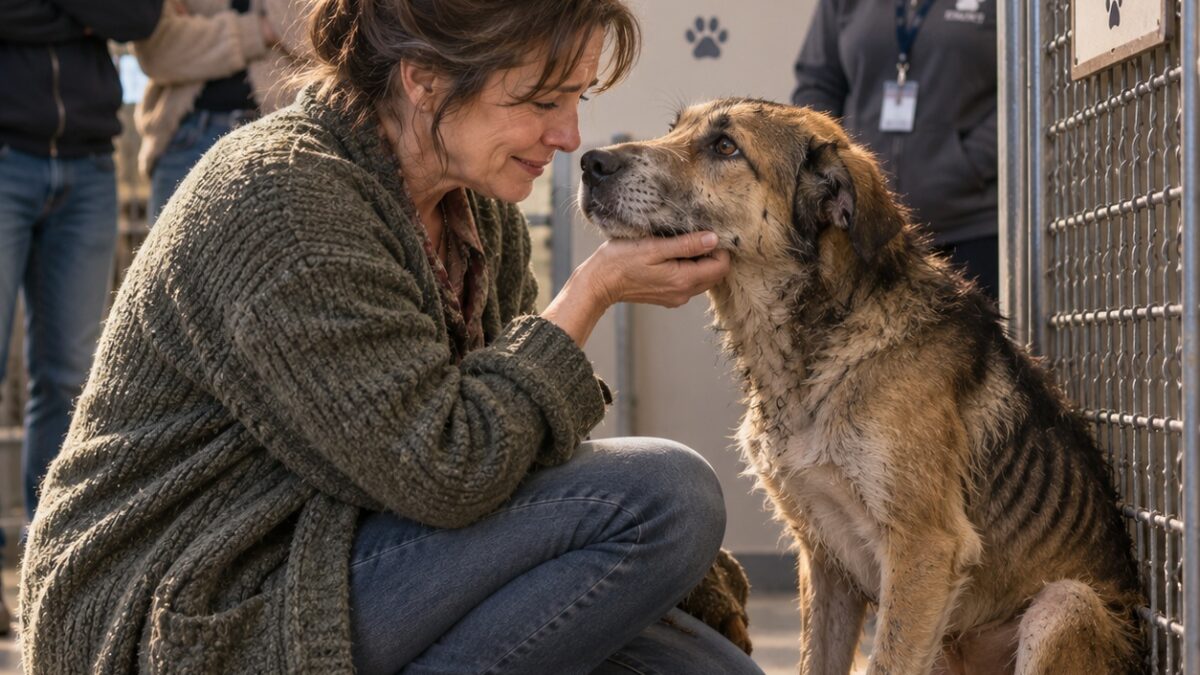
The first problem was the porch.
My farmhouse had four wooden steps leading to the front door.
Four.
I had climbed them thousands of times without thinking.
Oliver stood at the bottom like I had brought him to the edge of a cliff.
I held the leash loosely.
“Come on.”
He looked at the first step.
Then at me.
Then the step again.
His front paw lifted.
Stopped.
He lowered it.
I tried encouragement.
“You can do it.”
Nothing.
I tried food.
A small piece of chicken.
His nose moved.
His feet did not.
I sat on the second step.
The afternoon was cool, with a thin breeze moving through the maples.
Oliver stood in the gravel.
Five minutes.
Ten.
Fifteen.
I could have picked him up.
He was thin enough.
But everything about his body told me he had spent too much of his life having choices made for him.
So I waited.
Eventually, he placed one front paw on the first step.
Then another.
His hind leg dragged.
He slipped.
Panic flashed across his face.
He jumped backward and nearly fell.
I didn’t reach for him.
Every instinct told me to help.
But I stayed still.
“Okay.”
He stared at me.
“No rush.”
Ten minutes later, he tried again.
This time he made the first step.
Then stopped.
I sat beside him.
We stayed there like two ridiculous statues.
By sunset, Oliver had climbed all four steps.
It took nearly forty minutes.
When he reached the porch, he didn’t celebrate.
He walked to the corner, curled into a tight circle, and watched me unlock the door.
I felt absurdly proud.
Inside was worse.
Hardwood floors.
Every click of his nails made him tense.
The refrigerator hummed.
He flinched.
A grocery bag shifted in the breeze from an open window.
He dropped to the floor.
I closed the window.
Moved slowly.
Set food and water in the den.
Then stepped away.
Oliver stood in the doorway.
He would not approach the bowl while I was there.
I went to the kitchen.
Pretended not to watch.
Nothing.
I walked upstairs.
Five minutes later, I heard the faint sound of metal.
When I returned, half the food was gone.
Oliver had retreated behind the couch.
That first night, I made a bed from one of the quilts I had meant to donate.
He ignored it.
I left the den door open.
Around midnight, I woke to scratching.
Oliver was pacing downstairs.
I came halfway down the staircase.
He froze.
“Hey.”
His chest rose quickly.
I sat.
Didn’t approach.
After several minutes, his breathing slowed.
I slept on the couch that night.
Oliver slept behind it.
The next morning, I found him exactly where I had last seen him.
His eyes opened when I moved.
No tail wag.
No excitement.
Just awareness.
“Good morning.”
Nothing.
“I’m Maryanne, by the way.”
His ear lifted slightly.
“I realize I skipped introductions.”
I made tea.
For myself.
Water for him.
Breakfast.
For both.
I narrated everything.
“I have absolutely no idea what I’m doing.”
Oliver watched.
“I’ve kept houseplants alive for twenty years. That’s not the same.”
One ear moved.
“Don’t be judgmental.”
That became our first routine.
Talking.
Not because he responded.
Because silence around him felt too much like abandonment.
I told him what I was drawing.
What was in the mail.
How much I disliked my neighbor’s leaf blower.
Why the old kitchen faucet whistled.
He learned my voice before he learned my touch.
For three days, he wouldn’t eat unless I left the room.
On the fourth, I sat fifteen feet away.
He ate.
The fifth day, ten feet.
A week later, I sat at the kitchen table while he ate near the doorway.
That was our progress.
Not miraculous.
Measured in feet.
The veterinarian, Dr. Lawrence, examined him five days after adoption.
Oliver trembled so hard on the metal table that I could feel it through my hand.
Dr. Lawrence was in his late fifties, patient, quiet.
He watched Oliver walk twice.
Then three times.
Checked reflexes.
Manipulated the hip.
Ran imaging.
The news was mixed.
“No fracture.”
“Good.”
“Old spinal or nerve damage, likely.”
“Fixable?”
Dr. Lawrence looked at me.
“Probably not completely.”
I swallowed.
“Pain?”
“Some stiffness. Maybe intermittent nerve discomfort. But he has sensation.”
“What does that mean for him?”
“It means he may always walk like this.”
Oliver stood beside my leg.
The doctor continued.
“He can still have a good life.”
That sentence mattered more than anything else.
Not normal life.
Not fixed.
Good.
“What do I do?”
“Keep him lean. Build strength gradually. Rugs on slick floors. Harness instead of neck collar. Watch his paws because dragging can injure nails and skin.”
“Stairs?”
“Minimize if you can.”
I thought of the porch.
That afternoon, I built the ugliest temporary ramp in North Carolina.
Three plywood boards.
Old outdoor carpet.
Too steep.
I rebuilt it the following day.
Oliver tested version two.
One paw.
Then another.
Slow.
Halfway up, he stopped.
I stood at the top.
He stared.
“Your architectural criticism has been noted.”
He continued.
When he reached the porch, his tail moved.
One small sweep.
My heart did something ridiculous.
“Did you just wag?”
Oliver looked away.
“Don’t pretend you didn’t.”
That first month changed my house.
I put runners across the hardwood.
Moved furniture to create wide pathways.
Bought a supportive harness.
Raised his food dish slightly.
Placed beds in three rooms even though he ignored two of them.
I learned that he hated the fireplace popping.
Metal pans.
Men wearing baseball caps.
Trucks with diesel engines.
Children moving too quickly.
He loved boiled chicken.
Sunlight.
My old wool cardigan.
And, strangely, the sound of pencils moving across paper.
When I worked at the kitchen table, Oliver gradually began sleeping nearby.
First in the doorway.
Then halfway into the room.
Then under the window.
One morning, about seven days after he came home, I opened my bedroom door and almost stepped on him.
He was lying across the threshold.
I stopped.
He opened one eye.
“You came upstairs?”
His tail tapped once.
There were fourteen steps.
I had no idea when he’d climbed them.
I sat on the floor.
Oliver didn’t move away.
I extended one hand.
He placed his nose against my fingers.
Progress.
Three weeks in, I found him on the couch.
I walked into the den carrying tea.
There he was.
Stretched across the cushions like he’d made three mortgage payments.
I stopped.
Oliver lifted his head.
His eyes widened.
For one second, his whole body tightened.
As if he expected punishment.
That nearly broke me.
I set the tea down.
Walked over.
Sat on the floor beside the couch.
“Comfortable?”
He watched me.
“You know, that’s technically my seat.”
Nothing.
“I suppose rent can be negotiated.”
Slowly, his head lowered.
He went back to sleep.
I smiled for the rest of the afternoon.
My cousin Abby visited that Sunday.
She brought her two children.
I had warned her.
“Oliver’s nervous.”
“He’ll be fine.”
“Abby.”
“We know dogs.”
Children hearing “nervous dog” apparently translate it as “animal desperate for hugs.”
The front door opened.
Two small bodies rushed in.
“DOG!”
Oliver bolted behind the couch.
The children stopped.
Abby frowned.
“What’s wrong with him?”
“He’s scared.”
Her son crouched.
“Can I get him?”
“No.”
Abby watched Oliver’s hind leg dragging as he moved.
“Is he always like that?”
“Yes.”
“What happened?”
“We don’t know.”
She lowered her voice.
“That looks like a lot of work.”
I didn’t answer.
Then she said it.
“Why didn’t you get one that’s, I don’t know… normal?”
The room became very still.
I don’t think Abby meant to be cruel.
That almost made it worse.
I crouched near the couch.
Oliver’s face was barely visible.
I held out my hand.
He leaned forward.
Touched my fingertips with his nose.
“Because he’s worth it.”
Abby looked embarrassed.
The children, to their credit, adapted faster.
I told them to sit on the floor.
Ignore him.
No touching.
No chasing.
Within thirty minutes, Oliver came out.
Not close.
But visible.
By the end of the visit, he took one treat from Abby’s daughter.
After they left, I sat beside him.
“I apologize for my relatives.”
Oliver leaned his shoulder into my knee.
It was the first time he had deliberately pressed against me.
I stopped breathing.
Then very carefully laid my hand on his back.
He stayed.
Over the next month, Oliver changed.
Not in the dramatic way rescue videos compress into thirty seconds.
No sudden transformation.
No joyous running montage.
Some mornings, he still hid when the mail truck came.
Some nights, he woke trembling.
One thunderstorm sent him into the bathtub where I found him wedged beneath a towel rack.
But slowly, fear stopped occupying every inch of him.
He began following me.
At first room to room.
Then yard to porch.
One evening, I opened the pantry.
Behind me:
Click.
Drag.
Click.
Drag.
I turned.
Oliver stood there.
“You’re spying.”
His tail moved.
I gave him a biscuit.
That was how corruption began.
He barked for the first time at a squirrel.
The sound startled him so badly that he jumped.
I laughed until I cried.
Oliver stared at me, offended.
“I’m sorry.”
He barked again.
Bolder.
The squirrel remained unimpressed.
Neighbors began seeing him on walks.
Most were kind.
Some were not.
“That’s the limping one, right?”
“Poor thing.”
“Probably won’t live very long.”
“Can’t believe she chose him.”
I heard every word.
Sometimes Oliver did too.
I started carrying better treats.
Not because dogs understand pity.
Because I did.
Each whisper became another reason to kneel beside him and say, “You’re okay.”
One afternoon, in the attic, I found my old Nikon.
I had bought it in my thirties when I thought I might become serious about photography.
Life had other plans.
The camera sat in a box for almost fifteen years.
I cleaned it.
Bought film.
Took it outside.
Oliver sat on the porch.
Late afternoon light hit one side of his face.
One ear up.
One bent.
I raised the camera.
Click.
He tilted his head.
Click.
In the garden.
Click.
Beside lavender.
Click.
Lying in sunlight.
Click.
Walking awkwardly across grass.
Click.
Not hiding the limp.
Not framing around it.
Oliver exactly as he was.
When I developed the photographs, something surprised me.
On camera, he didn’t look broken.
He looked thoughtful.
Gentle.
Dignified.
I started a small blog.
Nothing ambitious.
A photo.
A few sentences.
Finding joy one paw at a time.
Another:
Progress isn’t always straight.
Another:
Today Oliver barked at a squirrel and frightened himself.
I expected my cousin and perhaps four friends to read it.
Within a week, strangers were commenting.
Your dog reminds me of mine.
He is beautiful.
Thank you for not hiding his leg.
My daughter walks differently too.
This made me cry.
I posted more.
The audience grew.
Then I received an email from Michigan.
A mother.
Her son had cerebral palsy.
Used a walker.
She had shown him Oliver’s photographs.
Her message read:
He says he wants a dog who understands how he walks.
I read that sentence three times.
Then carried my laptop to the floor beside Oliver.
“Look what you did.”
He licked one paw.
“I’m serious.”
He looked at me.
I printed the email.
Pinned it near my desk.
Not because Oliver understood it.
Because I needed to.
We weren’t alone.
By spring, he greeted some visitors.
Cautiously.
A small wag.
He knew his name.
Came when I whistled.
Sometimes.
He still had opinions.
One morning, I found him attempting the porch steps instead of using the ramp.
“Oliver.”
He climbed one.
Stopped.
Another.
His back leg trembled.
“Use the ramp.”
He ignored me.
Third step.
Pause.
Fourth.
He reached the top.
Tongue out.
Tail wagging.
I sat beside him.
“You impossible thing.”
He leaned against me.
That became my photograph that week.
Oliver sitting proudly at the top of four steps.
Caption:
Sometimes the mountain is four stairs high.
Messages poured in.
People saw themselves in him.
That’s something I had never expected.
I had adopted a dog.
Other people saw a mirror.
A boy with braces.
A woman after spinal surgery.
A veteran learning to walk with a prosthetic.
An older man ashamed of his cane.
Parents of children who moved differently.
People living with bodies that didn’t obey the world’s preferred rhythm.
Oliver wasn’t inspirational because he conquered disability.
He didn’t.
His leg remained damaged.
His gait remained uneven.
He inspired people because he stopped apologizing for taking up space.
Though, to be fair, dogs rarely apologize for existing.
Humans invented that.
One Saturday, we walked into town.
Near the diner, three teenagers noticed him.
“That dog walks funny.”
Another laughed.
“Looks broken.”
Oliver’s body tightened.
Maybe from voices.
Maybe coincidence.
My face burned.
I kept walking.
Then a man near the bus stop spoke.
“Maybe so.”
The boys turned.
He was in his fifties.
Work jacket.
Gray beard.
“But that dog’s got more heart than most people I know.”
Silence.
The boys looked away.
I turned.
The man nodded.
I nodded back.
That night, Oliver and I sat on the porch under a clear sky.
I scratched behind his ear.
“They don’t laugh as much anymore.”
His head rested against my thigh.
“We’ve still got work to do.”
The next stage began with the farmers market.
Crowds terrified Oliver.
I knew that.
But by spring, he had become more curious about town.
We practiced.
Short walks.
Quiet streets.
Parking lot.
Then one cloudy Saturday, I took him to the market.
I brought treats.
Water.
Soft cloth.
Harness.
More anxiety than he had.
At first, Oliver stayed against my leg.
Body low.
Eyes everywhere.
Then an older woman selling honey saw him.
“Well, aren’t you handsome?”
Oliver froze.
She didn’t reach.
Smart woman.
“Would he take apple?”
I nodded.
She lowered her hand.
Oliver sniffed.
Took the piece.
Nothing terrible happened.
The market became easier.
A man in a wheelchair smiled and gave us a thumbs-up.
A child asked to pet him.
I said no.
The mother thanked me for protecting his space.
That felt important.
By the end, Oliver’s tail was halfway up.
His mouth relaxed.
I crouched.
“That was big.”
He licked my cheek.
At home, he climbed the porch steps without help.
I cried.
Quietly.
Oliver did not care.
The next weeks brought small firsts.
Pet store.
Oliver selected a squeaky duck by accidentally stepping on it and then refusing to leave without it.
Park.
Coffee truck.
A barista handed him whipped cream and called him Sir Oliver.
He became Sir Oliver for three days on the blog.
Then came the stick.
I was trimming lavender.
Looked up.
Oliver had found a branch.
He tossed it.
Awkwardly.
Pounced.
Missed.
Tried again.
His front half moved faster than his back half.
He looked ridiculous.
And joyful.
I laughed out loud.
My neighbor Mr. Watkins leaned over the fence.
“That yours?”
“Sure is.”
“He walks kind of funny.”
“Yeah.”
Oliver tossed the stick again.
“But he plays like a champion.”
Mr. Watkins nodded.
“Fair enough.”
A week later, I received an email from a local therapy dog organization.
Someone had sent them Oliver’s blog.
They wanted to evaluate him.
I stared at the message for two days.
Therapy dog?
Oliver still hid from thunder.
Still sometimes flinched when strangers reached too quickly.
Was therapy work for him?
Or was I turning his popularity into a job he hadn’t chosen?
That question mattered.
I almost declined.
Then I remembered the boy from Michigan.
A friend who understands his walk.
I called.
The evaluator, Barbara, listened.
“We don’t need perfect dogs.”
I smiled.
“Good.”
“We need stable dogs.”
“He’s becoming stable.”
“Then let him tell us.”
“How?”
“We evaluate him. If he’s stressed, we stop.”
That Sunday, we drove to the training center.
Oliver sniffed every inch of the parking lot.
Barbara crouched.
Didn’t reach.
“Kind eyes.”
“He’s got a good heart.”
The evaluation wasn’t circus tricks.
Touch.
Noise.
Wheelchairs.
Walkers.
Children.
Unusual movement.
Recovery from surprise.
A stranger touched his collar.
Oliver flinched.
Looked at me.
I stayed calm.
He allowed it.
A wheelchair rolled past.
He backed up.
Then approached.
Sniffed the wheel.
The volunteer seated in it extended one hand.
Oliver rested his chin on the person’s knee.
Barbara wrote something.
“What?”
She smiled.
“Nothing.”
“What?”
“He’s not like the others.”
My stomach dropped.
Then she continued.
“I think that’s his strength.”
Oliver entered training.
Slowly.
Short sessions.
No pressure.
We learned signals.
When his ears went back.
When his breathing changed.
When he needed space.
I had thought therapy training would teach Oliver how to work with people.
Mostly it taught me to listen to Oliver.
Our first school visit was quiet.
A reading room.
Beanbags.
Five children.
Oliver lay beside a girl named Maggie.
She had trouble reading aloud.
Stumbled.
Stopped.
Started again.
Oliver watched.
No correction.
No embarrassment.
Halfway through, Maggie leaned toward his ear.
Whispered something.
I couldn’t hear.
Oliver lifted his front paw.
Placed it on her knee.
She smiled.
Finished the page.
Afterward, her teacher said, “She usually quits after one mistake.”
I looked at Oliver.
He was asleep.
Nursing home came next.
An older man who hadn’t spoken much in days looked down.
“Doggy.”
One word.
A nurse cried.
A retired librarian with tremors stroked Oliver’s bent ear and told us about a collie she owned in 1954.
Another resident fell asleep with one hand on his back.
A nurse pulled me aside.
“I don’t know what he does.”
“Mostly lies there.”
“No.”
She smiled.
“He makes them remember.”
The blog exploded after that.
Local newspaper.
THE DOG WHO TAUGHT US TO SLOW DOWN.
Strangers recognized us at the market.
Some cried.
Some told stories.
People sent gifts.
I opened one envelope with no return address.
Inside:
I used to laugh at dogs like him.
I don’t anymore.
Thank you.
I read it twice.
Then slipped it into my leather journal.
That night I wrote:
Today, someone changed.
I didn’t mean Oliver.
Summer arrived.
We walked the creek behind the farmhouse.
Oliver loved shallow water.
He would stand knee-deep and stare at his reflection.
“You know people are watching you now.”
He looked up.
“They’re softening.”
Gray had begun appearing around his muzzle.
I ran my fingers through it.
“We don’t choose how we start.”
He licked my hand.
“But maybe we get some say in what we become.”
More messages arrived.
Vermont.
A mother whose daughter had been injured in a bicycle accident.
Permanent damage.
New limp.
The girl read Oliver’s stories every night.
She says if Oliver can be happy walking differently, maybe I can too.
I cried at the kitchen table.
Then looked at him.
“You understand what they’re doing to me?”
Oliver sighed.
I began writing more than captions.
Small stories.
Oliver chasing a bird for three seconds and reconsidering.
Oliver stealing my slipper.
Oliver sleeping under the magnolia tree.
Teachers shared them.
Children drew him.
A middle school class in Tennessee sent ten letters.
Dear Oliver, my grandma has a limp too. She says you look wise.
Oliver, you are like a knight but your sword could be a stick.
If you visit us, I want to hug you, but only if you want one.
I read them aloud.
Oliver slept with his head against my leg.
That became our ritual.
Letters.
Stories.
Quiet.
By late summer, therapy visits tired him.
I reduced them.
People asked why.
“He’s not a machine.”
Most understood.
A few didn’t.
That taught me something uncomfortable.
Even kindness communities can become demanding.
More Oliver.
More photos.
More stories.
When is the next post?
Why haven’t you updated?
I began protecting him from people who loved him.
That’s a strange sentence.
Necessary.
Oliver did not owe the world inspiration.
He was a dog.
He needed naps.
He needed ordinary days.
So we slowed down.
At a park after one nursing-home visit, I shared turkey sandwich crust with him.
A young couple pushing a stroller stopped.
“Is that Oliver?”
I smiled.
“Yes.”
“We read your blog every Friday.”
The woman knelt.
Oliver approached.
Pressed his nose into her palm.
“He’s more beautiful in person.”
Their baby waved.
Oliver lay beside the stroller.
No performance.
Just there.
Those moments became my favorites.
Not speeches.
Recognition.
People seeing value where once strangers had seen damage.
That fall, a library asked me to speak.
I nearly said no.
Public speaking terrified me.
Then I looked at Oliver sleeping with his head inside one of my slippers.
“Fine.”
Thirty people.
Folding chairs.
Oliver in therapy vest.
I stood behind a small podium.
My hands shook.
“I didn’t rescue Oliver.”
People looked up.
“I know that’s how people tell these stories.”
Oliver shifted beside me.
“But he wasn’t a broken thing I repaired.”
I paused.
“He came to me as he was.”
The room stayed silent.
“And I learned how to meet him there.”
I told them about food bowls.
Porch steps.
Fear.
The first bark.
The couch.
His first market.
Then I said the sentence people later quoted most.
“Trust is built in moments, not milestones.”
A woman cried into Oliver’s fur afterward.
A teenager asked to draw him.
A man showed me a photograph of a collie dead twenty years.
Oliver listened to each person as if there were nowhere else to be.
More invitations came.
Bookstores.
Shelters.
Community centers.
I accepted some.
Declined many.
Oliver’s schedule mattered more than visibility.
At every event, he became a strange center of gravity.
Voices softened.
People crouched.
Children slowed down.
Maybe that’s what disability sometimes does to the impatient when compassion wins.
It changes the speed of the room.
Oliver had changed the speed of my life.
I no longer rushed walks.
No longer measured days by productivity.
If he stopped to sniff grass for four minutes, I waited.
If he needed ten minutes to reach the mailbox, that became the walk.
I began noticing things.
Cloud shadows.
Birdsong.
The way mountain air changed before rain.
How often I had once moved through my own life without actually inhabiting it.
Oliver’s limp didn’t slow him.
It slowed me.
That turned out to be one of his greatest gifts.
Then came the first morning he didn’t get up.
Late October.
Before sunrise.
I walked into the den.
“Morning.”
Nothing.
Oliver lay curled in his bed.
I touched his shoulder.
His eyes opened.
No rise.
His nose felt dry.
His breathing shallow.
Fear moved through me so fast I became cold.
“Okay.”
I lifted him carefully.
He didn’t resist.
Dr. Lawrence let us in before opening.
Fluids.
Bloodwork.
Examination.
“He’s dehydrated.”
“Why?”
“Could be stomach upset.”
“Could be what else?”
The doctor looked at Oliver.
“Age.”
That word landed badly.
“What age?”
“I’d guess older than we originally thought.”
“How much older?”
“Maybe eight. Maybe nine. Hard to know.”
That wasn’t ancient.
But damaged bodies sometimes age unevenly.
We went home after several hours.
Oliver drank.
Ate a little.
Slept in sunlight.
For three days, I stopped blogging.
People noticed.
Messages came.
I ignored most.
Not cruelly.
I needed one experience in our life to belong only to us.
When I posted again, it was one photograph.
Oliver lying in a warm patch on the rug.
Caption:
Some days are slower. We just stay close.
Hundreds of messages.
Prayers.
Poems.
Stories.
A crocheted blanket arrived from Oregon.
Apples from a neighbor.
Card from a child.
The world wrapped itself around us.
That comforted me.
And frightened me.
Because love from strangers can make impending loss feel even larger.
Oliver recovered.
Enough.
He brought me a branch at the creek.
Not a stick.
A branch nearly his size.
He dropped it.
“Absolutely not.”
He nudged it.
“You are ridiculous.”
He nudged again.
I threw it.
Oliver went after it.
Slow.
Awkward.
Determined.
Brought it back.
Again.
Again.
For an hour, we played.
Sun moving through trees.
Creek talking beside us.
I laughed like a child.
That night I wrote:
Even now, he surprises me.
Even now, he teaches me joy.
Winter came.
Oliver stepped into the first snow and looked back at me.
Permission.
I nodded.
He walked a wide circle.
Uneven prints.
One foot dragging.
I followed.
We stayed outside nearly an hour.
Inside, I warmed a towel by the heater.
Dried his paws.
Removed ice from fur.
He leaned against me.
Therapy visits paused.
The market closed.
Our world became smaller.
House.
Porch.
Fire.
Tea.
Snow.
Oliver.
I started writing a children’s book.
Not because I had dreamed of publishing.
A small publisher contacted me.
They suggested Oliver’s story.
At first, I hated the idea.
Turning him into a product felt wrong.
Then I thought about letters.
Children seeing themselves.
I wrote a fictional dog named Olly.
He walked crookedly.
He wanted to belong.
Not to become normal.
Belong.
The illustrations were watercolor.
Soft.
Honest.
I refused to draw Olly running perfectly at the end.
The editor asked.
“Wouldn’t that be uplifting?”
“No.”
“Why?”
“Because his leg isn’t the problem the story needs to solve.”
Silence.
Then:
“Good point.”
Olly remained crooked.
Happy.
Loved.
Whole.
I read a draft to children at our local elementary school.
Oliver stayed home resting.
One boy raised his hand.
“Is Olly real?”
“Yes.”
“Where is he?”
“Waiting at home.”
“Can we see him again?”
“In spring.”
Outside, the teacher stopped me.
“One of my students uses a leg brace.”
I listened.
“He stopped hiding it after we read your blog.”
I didn’t know what to say.
She continued.
“He said, ‘Oliver walks different and nobody makes him stay home.’”
I drove back crying.
Oliver greeted me with one slow wag.
I sat on the floor.
“You’re making this very difficult.”
He rested his head on my knee.
Snow deepened.
Our routine became beautifully small.
Mornings by fire.
Afternoons painting.
Evenings reading letters.
A child wrote:
I walk different too. Now I don’t feel weird.
I placed that one in a blue felt box.
Then another.
Then another.
The box filled.
Near February, a regional magazine contacted me.
Journalist named Julia.
Gentle.
Respectful.
She came to the porch with a blanket around her shoulders.
“What has Oliver taught you most?”
I looked at him.
He was sleeping beside the railing.
“To slow down.”
I thought more.
“To pay attention.”
More.
“To love without needing someone to become perfect first.”
Julia nodded.
“What do you think Oliver wants?”
I almost laughed.
People asked questions like he had a philosophy.
I looked at him again.
“To be near me.”
That was the truth.
“That’s it?”
“That’s enough.”
The article appeared with Oliver on the cover.
THE DOG WHO WALKED DIFFERENTLY AND TAUGHT US TO SEE.
It reached more people than anything before.
Veteran.
Single father.
Teen recovering from crash.
Older woman adjusting to a walker.
A man after stroke.
Parents.
Children.
Same message.
Thank you for showing us broken doesn’t mean less.
I struggled with that phrase.
Broken.
People meant well.
But Oliver wasn’t broken.
His nerve was damaged.
His gait was unusual.
He had trauma.
None of that made him less complete.
I began correcting language gently.
“He isn’t broken.”
People learned.
So did I.
One snowy night, Oliver disappeared from the house.
Not far.
I found paw prints leading toward the barn.
I panicked.
Pulled on boots.
Followed.
He stood inside beside my grandfather’s old sleigh.
“Oliver?”
He looked at me.
The sleigh had not moved in fifteen years.
I laughed.
“You cannot be serious.”
The next afternoon, with help from a friend and a borrowed pony, we padded the sleigh with blankets.
Oliver sat in the back.
We moved slowly across the field.
Snow.
Sun.
Cold air.
He watched everything.
Ears moving.
Head high.
I laughed the entire time.
“You’re spoiled!”
He looked at me as if to say obviously.
That night:
Even now, he asks for adventure.
I will keep saying yes.
Spring arrived.
Mud.
Birds.
Crocuses.
Open windows.
Oliver rested near the back door in sunlight.
We still walked.
Short distances.
Blanket in my bag.
Tea.
Frequent stops.
One day he climbed onto a mossy log.
Bad leg and all.
Balanced.
Looked at me.
“Show-off.”
Tail wag.
He jumped down.
Tiny moment.
I wrote it anyway.
March 4.
He stood on a log for no reason except his own.
Maybe that’s the most beautiful kind.
I began filling a notebook.
Not a blog.
Not content.
For me.
Things I wanted to remember.
Sounds.
Habits.
His breathing when asleep.
The way he lifted his nose before standing.
His annoyed look when I sang.
The fact that he hated bananas.
How his right ear warmed faster than the left in sunlight.
Details.
Because love becomes afraid of forgetting before loss even arrives.
I also wrote letters.
Dear stranger,
If you ever feel behind, find someone willing to walk at your speed.
Dear Oliver,
I hope I never made you feel like your healing existed for other people.
Dear myself,
Do not turn the ending into the whole story.
Spring visitors came.
Children.
Neighbors.
People bringing jam.
Flowers.
Notes.
Dear Miss Maryanne, thank you for letting us love Oliver.
I read that twice.
Letting us love Oliver.
Not watch.
Not follow.
Love.
He still had energy bursts.
Small.
Nudge my elbow.
Porch.
Garden.
Walk.
Then nap.
At a community reading event, a boy who rarely spoke sat beside him.
Didn’t pet.
Just sat.
After a minute, Oliver placed his head on the boy’s knee.
The teacher cried.
I didn’t.
Not until the car.
The book published in April.
I called it Olly’s Own Way.
At the bookstore signing, Oliver rested on a cushion.
People came slowly.
A grieving man handed me a book.
“My brother died last year.”
I looked up.
“Your stories helped.”
I wrote:
In honor of the love that stays.
That phrase became important.
Love that stays.
Not bodies.
Not dogs.
Not people.
They don’t.
Love can.
By May, Oliver moved more slowly every week.
No long hikes.
No hills.
No unnecessary outings.
Creek.
Porch.
Town bench occasionally.
At dusk, we walked maybe a block.
Sometimes half.
Sometimes he sat in the road and watched moonrise.
I matched him.
No pulling.
No “come on.”
His pace had become our pace.
One night:
He’s quieter now.
So am I.
Maybe that’s the lesson.
Love doesn’t have to shout.
June came warm.
Fireflies.
Long evenings.
Oliver’s hind leg dragged more.
I placed rugs everywhere.
Moved water bowl.
Built a better ramp.
Pain medication after Dr. Lawrence saw him.
“Not in severe pain.”
“Yet?”
The doctor’s silence answered.
“Cart?”
“Maybe eventually.”
I looked at Oliver sleeping.
“We keep going.”
Dr. Lawrence nodded.
“As long as good days remain good.”
That phrase frightened me.
Good days.
Now I had a scale.
Food.
Interest.
Comfort.
Mobility.
Connection.
I started measuring without wanting to.
Did he eat?
Drink?
Want outside?
Respond?
Pain?
Quality of life is love forced into arithmetic.
It’s terrible.
Necessary.
I posted less.
Spent more time simply being.
People understood.
Most.
One evening, Oliver and I lay under the stars.
Blanket beside the gravel road.
His body against mine.
“Remember the shelter?”
His ear moved.
“You looked like you thought nobody would see you again.”
I touched his shoulder.
“I saw you.”
Pause.
“I still do.”
That night I dreamed he was running through sunflowers.
No limp.
I woke crying.
Oliver was beside the bed.
Watching.
I laughed through tears.
“Don’t worry.”
He blinked.
“I’m not trying to fix you in real life.”
Summer deepened.
Children visited.
A girl named Emma came with a sketchbook.
“Can I draw him?”
“Yes.”
She sat.
No posing.
No touching.
Just watched.
Her drawing showed Oliver asleep.
One paw tucked.
Bent ear.
Bad leg visible.
“He looks peaceful.”
“He is.”
I pinned the drawing above my desk.
I declined more speaking events.
“Oliver needs quiet.”
I wrote a letter for the children instead:
Watching the world with soft eyes can be just as brave as chasing it.
They mailed paper flowers back.
My sunroom slowly became full of love from people Oliver would never meet.
One afternoon, I found an unfinished painting from years earlier.
A meadow.
No figure.
I brought it to the porch.
Painted Oliver.
Not young.
Not repaired.
As he was.
Gray muzzle.
Bent ear.
Crooked leg.
Resting in wildflowers.
I worked for a week.
It became the best thing I had ever painted.
I never posted it.
Some things belong at home.
Late June, I woke before dawn.
Oliver didn’t follow.
I found him lying near the heater.
Eyes open.
I knelt.
“Not moving today?”
Blink.
I lifted him.
Carried him to the porch.
Wrapped us both in a quilt.
He rested against my hip.
We sat through sunrise.
Then morning.
Then almost noon.
I didn’t check my phone.
Didn’t work.
Didn’t photograph him.
Just stayed.
That afternoon, I wrote:
There is nothing to fix.
Nothing to change.
Only the quiet joy of sitting beside the one who taught me how.
July arrived.
Heat.
Oliver stayed mostly in the cool sunroom.
I moved my chair there.
Our world shrank again.
At dawn one morning, he stood on his own.
Walked to the door.
I opened it.
He went down the ramp.
Across yard.
Toward magnolia tree.
Slow.
Fragile.
Intentional.
I followed.
He lay beneath it.
Head against my ankle.
Sunrise rose rose-gold across hills.
“This is nice.”
His breathing was even.
I sat with him.
The moment felt ordinary.
Which is why it became sacred later.
I returned to the painting.
Added butterflies.
Shadows.
Grass.
His paw.
That night, I wrote:
Some love stories never use the word love.
They speak in steady breathing.
In waiting.
In the place someone chooses to rest.
Messages continued.
Sanctuary in Oregon.
Teacher in Ohio.
Woman whose mother died.
A ninety-three-year-old in Maine:
Oliver is the first dog I have never met who made me feel seen.
I read that aloud.
Oliver’s eyes half closed.
“They see you.”
His ear moved.
“They really do.”
By August, standing cost him effort.
Every movement deliberate.
I worked less.
Sat more.
People asked if I was afraid.
Yes.
I didn’t say it publicly.
I was terrified.
Not of death itself.
Of the decision.
Would I know?
Would I wait too long?
Would love become selfish?
Dr. Lawrence and I talked.
“If he stops eating.”
“Yes.”
“Can’t settle.”
“Yes.”
“Pain despite medication.”
“Yes.”
“No interest in you.”
I hated that one.
“What if he just sleeps?”
“Sleeping isn’t suffering.”
“What if he can’t walk?”
“Mobility alone isn’t everything.”
“What if—”
Dr. Lawrence touched my hand.
“You know him.”
I cried then.
“I don’t want to know.”
“I know.”
That’s the cruelty of caring for an aging animal.
They spend their lives trusting us.
Then they leave us with responsibility they cannot carry themselves.
Oliver kept eating.
Less.
Drinking.
Responding.
Wanting touch.
Watching outdoors.
He wasn’t ready.
Neither was I.
One evening, I read the Maine letter by candlelight.
Oliver’s head rested near the window.
Slow breathing.
Outside, crickets.
I laid my hand on him.
No blog.
No audience.
No message.
Just us.
The next morning, he lay near the door.
First light coming through the crack.
“Outside?”
He closed his eyes.
No.
I understood.
I brought blanket.
Lay on the floor beside him.
I talked about memories.
Porch steps.
Couch.
Squirrel.
Whipped cream.
Maggie.
Sleigh.
Branches.
Snow.
“Remember that huge stick?”
His ear moved.
“You were an idiot.”
Small huff.
I laughed.
Maybe coincidence.
I’ll take it.
Over several days, I kept talking.
Not because he needed memory.
I did.
Then came Sunday.
Before dawn.
Something in me woke.
No sound.
No alarm.
I looked at Oliver.
He was awake.
Very still.
I knew.
Not intellectually.
In my body.
I lifted him carefully.
Carried him to the porch.
Cushions.
Heavy quilt.
Sky still dark.
Stars fading.
I lay beside him.
His head against my arm.
The sun began rising behind the hills.
Warmth reached the boards first.
Then our feet.
Then his fur.
Oliver breathed out.
Long.
Soft.
His body relaxed.
I put my hand over his heart.
“I’m here.”
Another breath.
“You don’t have to do anything.”
His eyes half closed.
“You already did enough.”
The same words I had told him before therapy visits ended.
Before aging.
Before fear.
I don’t know whether he heard.
I choose to believe the sound of my voice was familiar.
His breathing became slower.
Long spaces.
I stayed.
No panic.
Not yet.
Then one breath came.
And another didn’t.
I kept my hand over his chest.
Waited.
Nothing.
The morning continued.
Birds.
Wind.
Sun.
Somewhere down the road, a truck passed.
The world had the nerve to keep moving.
I whispered, “Oliver?”
No response.
I knew.
Still, I said his name again.
Then I folded over him and cried.
Not gracefully.
Not quietly.
For hours.
There are losses you know are coming and still cannot prepare for.
Knowledge is not armor.
I had spent months telling myself love meant allowing the ending when it came.
That did not make the porch less empty.
Eventually, I covered him with the quilt.
Made tea because I didn’t know what else to do.
Didn’t drink it.
Sat beneath the magnolia tree.
Went inside.
Came back.
Touched him again.
As if warmth might reverse reality.
It didn’t.
Dr. Lawrence came to the house.
He hugged me.
We arranged cremation.
I kept one lock of fur.
Not because Oliver was in it.
Because grief likes objects.
That afternoon, I opened my notebook.
My hands shook.
I wrote:
He left exactly as he lived—quietly, with grace, teaching me even in his final breath how to hold joy and sorrow in the same hand.
Then I closed it.
No more words.
The next day, I posted one photograph.
Oliver in the spring field.
Eyes closed.
Wind in his ears.
Caption:
Thank you for walking with us.
I turned my phone off.
When I turned it back on two days later, hundreds of messages waited.
Flowers appeared.
Cards.
Drawings.
A school in Illinois held a reading circle.
The Oregon sanctuary planted a tree.
A woman sent a photograph of her daughter standing with a walker beside Oliver’s book.
A veteran wrote:
He helped me stop being ashamed of needing a cane.
A mother:
My son asked whether Oliver can meet our dog in heaven.
A teenager:
I wore shorts in public for the first time because I stopped hiding my leg scar.
I read until I couldn’t.
Then stopped.
Grief needs boundaries too.
For weeks, I still woke listening for his breathing.
That’s the strangest part of losing an animal.
Your body memorizes them.
The nails on floor.
Collar tag.
Sigh.
Breathing.
Water bowl.
You continue hearing absences.
I walked the trail alone.
At first, unbearable.
Then less.
I talked to him.
“Squirrel in the barn.”
“You would’ve lost your mind.”
“Emma sent another drawing.”
“I put your blanket in the sun.”
People told me to get another dog.
Quickly.
“You have so much love.”
“Oliver would want you to.”
I smiled.
Changed subject.
Nobody knew what Oliver would want.
And another dog was not medication.
The space he left deserved to exist.
I placed a small wooden plaque beside the magnolia tree.
Sent by a woman in Colorado.
HERE RESTED THE HEART THAT LIMPED BUT LED.
Too poetic.
I loved it.
The blog continued.
Not frequently.
Photographs.
Memories.
Reflections.
One October post:
Grief is not a wall to climb.
It is a room you learn to live in.
Sometimes, if you’re lucky, that room has windows looking out onto fields of memory.
Thousands shared it.
I didn’t care about numbers anymore.
But stories came.
People losing parents.
Dogs.
Mobility.
Marriages.
Health.
Oliver’s community became less about Oliver and more about people learning to sit beside one another.
That felt right.
In November, I gathered his stories and letters into a small collection.
Soft gray cover.
Watercolor Oliver asleep beneath a tree.
I didn’t market it aggressively.
Just placed it online.
People bought it.
Some ordered braille.
Large print.
Audio.
Teachers requested classroom copies.
A boy in New York sent a photograph with a limping beagle.
His note:
We adopted him because of Oliver.
His name is Miles.
I sat on the floor and cried again.
Different tears.
Not only loss.
Continuation.
That winter, snow came heavy.
I placed a cushion near the window where Oliver used to sleep.
Empty.
No shrine.
No urn displayed.
Just a place.
One night, candle lit, I opened a letter from the boy with Miles.
He wrote about how slowly the beagle trusted them.
How his sister sat on the floor and waited.
How Miles finally put his chin on her knee.
I stopped reading.
That was exactly what Oliver had done at the shelter.
Chin on my knee.
Warm.
Trembling.
Real.
The whole circle arrived at once.
I had thought that day I was taking him home because nobody wanted him.
Years later, I understood something else.
Oliver had not needed me to make him valuable.
He was already valuable.
I simply became the first person in that room willing to behave as though it was true.
And once one person did, other people learned to see him.
Then Oliver taught them to see themselves.
That’s what changed everything.
Not rescue.
Recognition.
A year after he died, the local school invited me back.
They had created an inclusion week.
Different bodies.
Different abilities.
Different ways of learning.
The librarian asked me to read Olly’s Own Way.
I almost declined.
Then I went.
Children sat on the floor.
At the end, a boy raised his hand.
He wore braces on both legs.
“Was Oliver sad because he couldn’t walk normal?”
The room went still.
I closed the book.
“No.”
He looked surprised.
“He was scared at first.”
I continued.
“And sometimes frustrated.”
“But sad because of his leg?”
I thought.
“Not the way people assumed.”
The boy looked at his braces.
“So he was okay?”
“Yes.”
“Even like that?”
I smiled.
“Especially like that, because that was him.”
The teacher looked away, emotional.
The boy nodded.
“Good.”
One word.
Good.
That was enough.
Afterward, another child asked:
“Did you save him?”
I said no.
“But you adopted him.”
“Yes.”
“So you saved him.”
I crouched.
“Oliver needed a safe home.”
The child nodded.
“But he saved parts of me too.”
“Like what?”
“My patience.”
That got a laugh.
“My attention.”
I touched my chest.
“And maybe the part that thought love had to fix things.”
The child didn’t understand all of it.
Maybe someday.
Years passed.
My work changed.
I illustrated less for scientific journals.
More children’s books.
Plants remained.
Oliver entered almost everything somehow.
Not literally.
A crooked branch.
Uneven leaf.
Things beautiful because of shape, not despite it.
I began volunteering at shelters.
Not to collect damaged dogs.
That’s another mistake rescuers make.
We can become addicted to being needed.
I learned that from Oliver too.
My role wasn’t to save everything.
It was to see clearly.
Choose responsibly.
Help sustainably.
At adoption events, people often walked past older dogs.
Disabled dogs.
Shy dogs.
I never pressured.
I told stories.
“This one may need ramps.”
“This one needs quiet.”
“This one might never become cuddly.”
Honesty.
Love does better with truth.
One Saturday, a family met a three-legged hound.
Their daughter whispered, “He’s missing something.”
I crouched.
“Is he?”
She studied the dog.
Then smiled.
“No.”
They adopted him.
I went home and sat beneath Oliver’s magnolia.
“Still working.”
Wind moved leaves.
No answer.
Didn’t need one.
I never adopted another dog for five years.
People were shocked.
Then, one November afternoon, I returned to the shelter with blankets.
Same reason as the first time.
Different building now.
Renovated.
A senior beagle mix sat quietly in one kennel.
Gray face.
Normal gait.
Nothing dramatic.
She saw me.
Tail moved.
I kept walking.
Then stopped.
“Don’t do this.”
Her tail moved again.
The shelter worker smiled.
“Her name is June.”
“How old?”
“Ten.”
“Medical?”
“Arthritis.”
I laughed.
Of course.
I sat.
June approached immediately.
No fifteen minutes.
No fear.
Placed one paw on my shoe.
I began crying.
The worker panicked.
“Ma’am?”
“I’m okay.”
June leaned against me.
This was not Oliver.
Important.
Different face.
Different body.
Different story.
I visited three times before deciding.
I did not ask what Oliver would want.
He was gone.
June was here.
I adopted her because I wanted June.
Not because she filled space.
The first night, she climbed onto my bed without permission.
I laughed.
Oliver would’ve taken three months.
June took three minutes.
She snored like machinery.
Hated cameras.
Loved bananas.
Opposite Oliver.
Perfect.
The blog readers welcomed her.
Some wrote:
Oliver sent her.
I did not correct them publicly.
Privately, I thought:
No.
June arrived because June needed a home and I had one.
That is enough.
Love doesn’t need supernatural permission.
But sometimes I looked at the magnolia tree and smiled anyway.
June lived four years.
Quiet.
Comfortable.
No national following.
No therapy certification.
No book.
She deserved no less love.
That mattered too.
Oliver’s fame had taught me another danger.
We celebrate animals for what they do for humans.
Service dogs.
Therapy dogs.
Rescue heroes.
Comfort animals.
But worth should not depend on usefulness.
June did nothing extraordinary.
She slept.
Ate.
Snored.
Loved sun.
She mattered.
Oliver would’ve mattered if he never inspired anyone.
If the blog had received zero views.
If he never became a therapy dog.
If he simply lived on my porch and learned not to fear grocery bags.
That’s a lesson I make sure to include now when people ask about him.
The world loved Oliver because his story became meaningful.
I loved Oliver before meaning.
In the kennel.
Thin.
Dragging one leg.
Doing nothing.
That’s the most important part.
The first act of love was not admiration.
It was refusal to look away.
I grew older.
The farmhouse aged.
Porch rebuilt.
Ramp remained even after June because by then my own knees appreciated it.
That made me laugh.
Oliver’s accessibility modification became mine.
Life has humor.
At sixty-three, I stopped taking illustration deadlines entirely.
I taught workshops.
Wrote.
Gardened.
Read letters.
Oliver’s blog archive stayed online.
New people kept finding it.
Years after his death, a teacher emailed:
I found Oliver while recovering from a stroke.
A father:
My daughter was born with spina bifida. She calls Oliver her first famous friend.
A woman:
My husband died. Your porch entries taught me not to rush grief.
Oliver became history for strangers.
Still present tense for me.
That’s how memory works.
One winter, the magnolia was damaged in an ice storm.
A large branch broke.
I stood outside staring.
The plaque remained.
HERE RESTED THE HEART THAT LIMPED BUT LED.
My neighbor suggested removing the entire tree.
I couldn’t answer.
Attachment rose immediately.
No.
Oliver’s tree.
Then I caught myself.
Tree was not Oliver.
We trimmed damaged limbs.
Saved what was healthy.
No dramatics.
Again, lesson.
Preserve what lives.
Release what doesn’t.
My cousin Abby visited that spring.
We sat on the porch.
She was gray now too.
She looked at the plaque.
“You remember what I said?”
I knew.
“What?”
“At the beginning.”
I made her say it.
“That you should get a normal dog.”
“Yes.”
She looked ashamed after all these years.
“I’ve thought about that a lot.”
“I know.”
“How?”
“You apologize every five years.”
She laughed.
Then serious.
“I didn’t understand.”
“Most people didn’t.”
“You did.”
“No.”
I shook my head.
“I just didn’t like the way you said it.”
She looked toward the field.
“Did you know what he’d become?”
“Not remotely.”
“Would you still have adopted him if he never trusted you?”
Hard question.
I thought.
“I hope so.”
“That’s not yes.”
“No.”
I appreciated that question because it challenged the heroic version.
Adoption is not morally pure automatically.
I wanted Oliver to love me.
Of course.
What if he never did?
Would I have resented him?
I don’t know.
Human beings like imagining their compassion has no expectations.
Usually it does.
Oliver rewarded mine with trust.
That made the story easier.
Some animals never recover fully.
They still deserve care.
That truth made me more humble.
I used it in shelter talks.
Don’t adopt the traumatized dog because you want a dramatic transformation.
Adopt only if you can love the dog who may stay afraid.
Don’t choose disability because you want inspiration.
Choose the animal.
Actual animal.
Needs.
Limits.
Personality.
Oliver wasn’t a project.
He was Oliver.
People appreciated hearing that less than the inspirational lines.
Good.
Not everything useful needs to be shareable.
At sixty-seven, I was invited to a national conference on animal-assisted therapy.
Huge ballroom.
Hundreds.
I almost laughed remembering thirty folding chairs at the library.
The organizer introduced me as “the woman who rescued Oliver.”
I walked to microphone.
First sentence:
“I didn’t rescue Oliver.”
Some people smiled.
They had read the story.
I continued.
“He was not a broken object waiting for my virtue.”
The room quieted.
“I gave him a home.”
“Yes.”
“He gave me trust.”
“Eventually.”
“But neither of us owed the other transformation.”
I spoke about consent.
Animal stress.
Rest.
The pressure placed on therapy animals.
Social media.
Narratives.
How disabled animals are often celebrated only when their disability can become motivational content.
Then I showed the first photograph.
Oliver hunched.
Thin.
No heroic pose.
“This dog mattered before he helped anyone.”
Silence.
“Before children read to him.”
“Before the newspaper.”
“Before the therapy vest.”
“Before he inspired strangers.”
“He mattered when he was sitting alone in the far corner of a shelter and most people walked past.”
I swallowed.
“That is the part I never want us to forget.”
Standing ovation.
I disliked standing ovations.
Too loud.
Oliver would’ve hated one.
I imagined him hiding under the podium.
That made me smile.
Afterward, a young therapist approached.
She used forearm crutches.
“I grew up with Oliver.”
I blinked.
“What?”
“Your blog.”
She smiled.
“My mother read it to me.”
I felt old immediately.
She continued.
“I hated physical therapy.”
“I don’t blame you.”
“She showed me Oliver trying the steps.”
“Oh.”
“I thought if he could stop and rest, I could too.”
I started crying.
She hugged me.
Then said:
“You know, he never made me feel like I needed to overcome my body.”
That sentence was everything I had hoped.
Not overcome.
Live.
Years later, I wrote one final Oliver book.
Not children’s.
Essays.
Title:
The Pace We Keep.
The opening line:
I thought I adopted a dog who needed me to slow down, but really he exposed how much of my life I had been rushing through without noticing.
I wrote about aging.
Grief.
Disability.
Care.
Silence.
No viral hero stories.
Mostly ordinary moments.
The couch.
Four steps.
Snow.
Branch.
Porch sunrise.
The first review called it “quiet.”
Best compliment.
I donated part of royalties to shelters’ medical funds and accessibility equipment.
Ramps.
Harnesses.
Carts.
Pain management.
Boring, practical things.
Love needs infrastructure too.
A soft sentiment without resources doesn’t help a dog climb stairs.
Oliver taught me both.
Tenderness.
And carpet strips on plywood.
When I turned seventy, I walked to the shelter one last time with donations.
No adoption.
I knew my limits.
A volunteer recognized me.
“Maryanne?”
“Yes.”
“Oliver’s Maryanne?”
I laughed.
“Apparently.”
She was maybe twenty.
“He died before I was born.”
That sentence hurt and delighted me.
“Rude.”
She laughed.
“My mom had your book.”
We walked kennels.
I stopped beside a dog with a twisted front leg.
Young.
Energetic.
Jumping.
A couple nearby watched.
The man said, “Does the leg bother him?”
Volunteer answered honestly.
“Some. He’ll need monitoring. Maybe surgery later.”
The woman crouched.
Dog licked her hand.
She smiled.
“Let’s meet him.”
I stepped away.
No speech.
No intervention.
No dramatic line.
Progress sometimes looks like not being needed.
Outside, I sat in my Subaru.
Not the original Subaru.
That one had died heroically at 240,000 miles.
I thought about the first drive.
Oliver curled behind me.
My eyes checking the mirror.
You don’t have to trust me yet.
I’ll earn it.
Did I?
I hope so.
He earned nothing.
That’s the difference I understand now.
Love isn’t wages.
He didn’t need to earn home.
Neither do we.
I drove back to the farmhouse.
Magnolia older.
Plaque weathered.
Oliver’s painting still in hall.
Blue felt box now containing hundreds of letters.
First Michigan email faded.
I took it out.
Her son wanted a dog who understood his walk.
I had eventually learned what happened.
Years after the email, his mother wrote again.
They adopted a mixed-breed dog with a malformed front leg.
Named him Archer.
Her son grew up.
Went to college.
Studied graphic design.
She sent a photograph.
Young man with walker.
Older dog beside him.
Caption:
Still walking together.
I placed it beside Oliver’s first photograph.
Two stories connected by chance.
That’s enough immortality for anyone.
No monument needed.
In my seventies, I stopped asking what Oliver “taught the world.”
Too grand.
The world is enormous.
Most people never heard his name.
They lived perfectly meaningful lives anyway.
Oliver changed a small network.
Then that network changed others.
That’s more realistic.
Kindness rarely transforms the world all at once.
It moves person to person.
Woman to dog.
Dog to child.
Child to parent.
Photo to stranger.
Stranger to another animal.
Small.
Local.
Accumulating.
Like roots.
I understand roots.
I spent a career drawing them.
The most important part of a plant is often hidden.
Support doesn’t advertise.
Oliver was like that.
His greatest work was not public.
It happened beside one frightened reader.
One older hand.
One grieving woman.
One child with braces.
One lonely illustrator.
Small contacts.
Root system.
Maybe that’s why botanical work prepared me for him.
I knew to look closely.
Eventually.
Not enough at first.
Oliver trained my attention.
One final letter arrived when I was seventy-four.
Handwritten.
From a man named Caleb.
He had been Maggie’s younger brother.
Maggie—the shy girl from Oliver’s first reading visit.
She had died from cancer in her thirties.
I had not known.
Caleb wrote:
She kept a photo of Oliver all her life.
When she was in hospice, she asked me to bring it.
She said, “This was the first creature I ever read to who never made me feel stupid.”
I put the letter down.
Went outside.
Sat beneath magnolia.
Cried.
Loss layered over loss.
Oliver dead decades.
Maggie now.
Yet one afternoon in a beanbag room still mattered.
That’s when I finally understood something I had been circling for years.
We never know which ordinary moment becomes permanent inside someone else.
Oliver certainly didn’t.
He laid beside a girl.
Listened.
Placed paw on knee.
That was all.
She carried it to her death.
Be careful what you call small.
I wrote back to Caleb.
Thank you for telling me.
Your sister mattered to Oliver’s story too.
Because she trusted him enough to read.
It was not one-way.
People often talk about therapy animals as givers.
They receive too.
Touch.
Purpose.
Safety.
Oliver became more confident because people treated him gently.
Maggie helped heal him while he helped her.
Mutual.
That’s the version I prefer.
Nobody a hero above another.
Companions.
When my own walking slowed, I thought about him constantly.
Left knee.
Arthritis.
Cane eventually.
First time I used it in public, I laughed.
“Well, Oliver.”
Now I walked funny.
A woman held door.
I almost refused out of pride.
Then accepted.
“Thank you.”
Receiving help is another kind of grace.
Oliver never seemed embarrassed by his harness.
Humans could learn.
At eighty, I moved from farmhouse.
That was harder than any book prepared me for.
Too much maintenance.
Stairs.
Distance from medical care.
My niece helped.
We packed.
Plants.
Paintings.
Books.
Oliver’s letters.
Blue felt box.
His painting.
The magnolia plaque stayed.
I left it with the house.
Why?
Because the tree and place belonged together.
His ashes, which I had kept quietly in a wooden box, went with me.
I had never known what to do with them.
At the new apartment, smaller, bright windows, I finally decided.
Not mountain trail.
Not dramatic.
I returned to farmhouse one spring morning.
New owners knew the story.
They gave me privacy.
Magnolia blooming.
I scattered a small portion beneath it.
Then another near creek.
Kept none.
People might find that surprising.
Objects had served their purpose.
I didn’t need to carry dust.
Oliver was not in the box.
He had been gone for decades.
Memory was enough.
As I stood, a dog barked from neighboring field.
I smiled.
“Very subtle.”
Wind moved flowers.
No sign.
No miracle.
Just spring.
Good.
I sat on porch one last time.
The rebuilt ramp still existed.
New owners used it for stroller.
I loved that.
Infrastructure continuing.
I closed my eyes.
Could almost hear:
Click.
Drag.
Click.
Drag.
First weeks.
Oliver following me to kitchen.
I saw him at every age.
Shelter.
Couch.
Therapy vest.
Snow.
Sleigh.
Gray muzzle.
Sunrise.
People tend to remember loved ones at the end.
I deliberately practiced remembering beginnings and middles.
Not denial.
Balance.
Death gets one day.
Life gets thousands.
Oliver had thousands.
That proportion matters.
So if somebody asks me today what the most important moment was, they expect the shelter declaration.
“If nobody wants him, I’ll take him.”
Dramatic.
Shareable.
But no.
The most important moment came fifteen minutes later.
Oliver placed his chin on my knee.
That was his choice.
Not mine.
I could offer a hand.
He decided whether to come.
Our whole life began there.
Trust is not something one person gives.
It is built between.
I had said I’d earn it.
For years, he kept giving me chances.
I hope I did.
I know he earned mine.
Actually, no.
Old habits.
He didn’t earn it either.
We built it.
That’s better.
At the end of my life—whenever that comes—I don’t expect some grand revelation.
Maybe no meadow.
No sunflowers.
No perfectly running Oliver waiting.
Those images are comforting.
Not knowledge.
What I know is enough.
A dog existed.
He was abandoned.
He was afraid.
He walked differently.
I saw him.
He eventually saw me as safe.
We built a life.
Other people were touched.
He aged.
He died.
I grieved.
I continued.
Love continued changing shape.
No supernatural ending needed.
Reality is beautiful enough.
Still, on nights when snow falls quietly, I sometimes hear the old floorboards in memory.
A soft scratch.
The imagined sound of a dog shifting near heater.
I smile.
Not because I think he is there.
Because once he was.
That’s astonishing on its own.
Once, in this enormous world, our lives overlapped.
A woman delivering blankets.
A dog nobody wanted.
One decision.
Then years.
Trust.
Work.
Laughter.
Letters.
Children.
Old people.
Pain.
Joy.
And one sunrise.
People sometimes tell rescue stories as though kindness moves in one direction.
Human saves animal.
I know better.
I gave Oliver a house.
He gave that house life.
I gave food.
He gave routine.
I gave medical care.
He gave me patience.
I gave him a ramp.
He gave me a slower world.
I gave him photographs.
He gave strangers recognition.
I gave him my hand at the end.
He gave me the courage not to turn away from it.
Balanced.
Not equal in measurable units.
Love isn’t accounting.
But mutual.
The couple who laughed at the shelter?
I never learned their names.
For years, readers asked whether I wished they knew what Oliver became.
At first, yes.
I imagined showing them newspaper.
Therapy vest.
Letters.
See?
You laughed.
Look now.
That feeling faded.
They were strangers who reacted badly for several seconds.
They don’t need to become villains for my story to work.
Maybe they changed.
Maybe not.
Oliver’s worth didn’t depend on proving them wrong.
That is another lesson age gave me.
Vindication is a poor foundation for love.
I did not adopt Oliver to win an argument.
I adopted because I couldn’t stand the idea that his difference had become a reason not to see him.
That’s all.
Enough.
So if you are reading this because you saw a photograph of a crooked-legged dog and wondered whether his life became meaningful, here is my answer.
It already was.
Before the blog.
Before the therapy work.
Before the letters.
Before the book.
Before the newspaper called him inspiring.
Before children saw themselves in him.
Before strangers softened.
Before he ever trusted me.
He was alive.
He felt fear.
Comfort.
Cold.
Warmth.
Pain.
Pleasure.
He wanted safety.
Food.
Rest.
Connection.
That is enough to matter.
Everything else was bonus.
And if you ask what I remember most after all these years, I won’t say the applause at the library.
I won’t say the magazine cover.
I won’t even say the final sunrise.
I remember his first week.
Kitchen table.
Rain outside.
My pencil moving.
Oliver lying in the doorway.
Not close.
Not hidden.
Halfway.
He watched me.
I looked over.
“Want to come in?”
He didn’t.
So I kept drawing.
Ten minutes later, I heard:
Click.
Drag.
Click.
Drag.
Oliver crossed the room.
Slowly.
Lay near my chair.
Not touching.
But close.
I didn’t reach down.
Didn’t celebrate.
Didn’t take a picture.
I kept drawing.
Because sometimes love’s most important moment is proving you can let trust arrive without grabbing it.
He fell asleep.
I stayed.
That was us.
Everything that followed was already inside that afternoon.
Patience.
Distance.
Choice.
Presence.
A pace we would keep together until his last breath.
And if I could return to that shelter now, to the woman I was before Oliver, I wouldn’t tell her what was coming.
I wouldn’t tell her about therapy visits.
Letters.
Books.
Loss.
None of it.
I would simply stand beside her while she watched that thin dog dragging his leg across concrete.
I’d let the couple laugh.
Let the staff warn her.
Let doubt come.
Then, when Oliver finally reached her and placed his trembling chin on her knee, I would whisper only this:
Don’t ask what he might become.
Just see who is already here.
Because that was the gift.
Not fixing him.
Not turning pain into purpose.
Not proving anybody wrong.
Seeing him.
And being seen back.
Everything else grew from there.








