The Sheriff Shattered My Son’s Knees—Then the Courthouse Janitor Remembered the Man He Used to Be
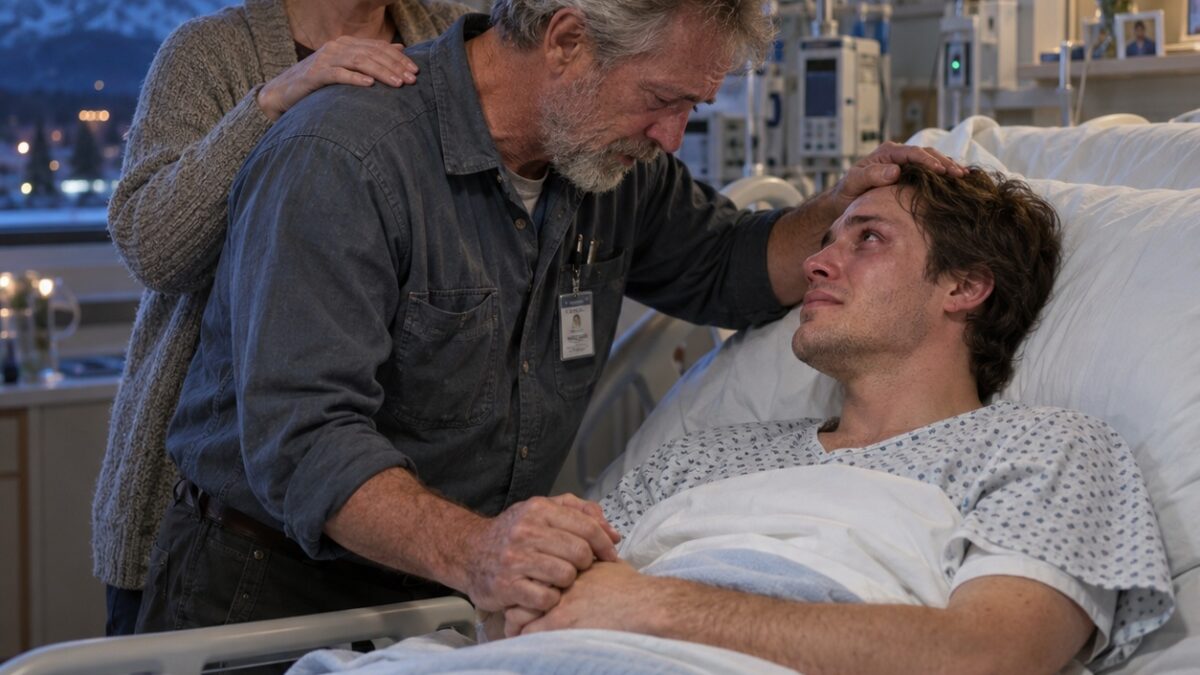
Harold found me twenty minutes later in a deserted family waiting room.
“He’s in surgery,” he said. “It will be several hours.”
Sarah sat curled in a chair with Tyler’s blood dried on her hands. A nurse had offered to help her wash it away, but she had refused. I understood. Cleaning it off would have felt too much like abandoning him.
I asked Harold to tell me exactly what he knew.
He closed the door before answering.
“An ambulance brought Tyler in from Miller’s Gas and Grocery at approximately eight forty. Sheriff Barnes told the paramedics Tyler attacked him with a tire iron.”
“That’s a lie.”
“I know.”
I looked at him sharply.
Harold reached into his coat and removed a clear evidence bag. Inside was a small, jagged fragment of metal.
“I pulled this from the tissue above Tyler’s right knee. It’s a deformed projectile fragment. The wounds are almost perfectly symmetrical, Dennis. One shot into each kneecap from close range.”
My stomach tightened.
“That wasn’t self-defense.”
“No. It was punishment.”
Sarah lifted her head.
“Tyler went to buy milk,” she whispered. “I asked him to stop after practice. Why would the sheriff even be there?”
Harold looked at me.
“Barnes claims he was responding to a robbery.”
“What robbery?”
“No one seems to know.”
I walked to the window. Snow drifted through the hospital parking lot, dissolving beneath the emergency lights.
“Where are Tyler’s clothes?”
“The deputies took them.”
“His phone?”
“Also taken.”
“As evidence?”
“That’s what they said.”
I turned back toward Harold.
“Who authorized it?”
“Barnes.”
Of course he had.
The shooter was controlling the crime scene, the witnesses, and the evidence.
“Were there powder burns on Tyler’s hands?”
“No.”
“Defensive wounds?”
“A bruise on his cheek and a split lip. Someone hit him before he was shot.”
“Any injuries consistent with him swinging a tire iron?”
“None.”
Sarah began to tremble again.
I sat beside her and took her hand.
“I’m going to find out what happened.”
She looked into my face for a long moment.
Perhaps she saw the change before I did.
“Dennis,” she said quietly, “don’t become that man again.”
Only Sarah knew pieces of my former life. Not operational details, names, or locations, but enough to understand that the gentle courthouse janitor was a choice I made every morning.
“I’m not going to hurt Barnes.”
“What are you going to do?”
“I’m going to make sure he can never hurt anyone else.”
That promise sounded simpler than it was.
Men like Rick Barnes did not survive through strength alone. They survived by building systems around themselves. They collected secrets, rewarded loyalty, and convinced ordinary people that resistance was more dangerous than silence.
Destroying one man would have been easy.
Proving what he was would require patience.
At 12:43 a.m., while Tyler remained in surgery, I walked into the hospital parking lot and sat inside my truck.
I scrolled through contacts I had not touched in nearly two decades.
Some numbers belonged to dead men. Others had been disconnected years earlier. Near the bottom, I found one listed only as Gabe.
Gabriel Mercer had been my second-in-command. On our final mission, he carried me three miles through enemy territory after shrapnel opened my side. When I retired, he remained in government service and eventually joined the Inspector General’s office.
I pressed call.
He answered after one ring.
“Reaper?”
No one had called me that in seventeen years.
I stared at the window above the surgical wing.
“Get the team together.”
Silence filled the line for three seconds.
Then Gabe asked, “Who are we bringing home?”
“My son.”
His voice changed.
“Tell me everything.”
I gave him the facts without emotion: the location, the wounds, Barnes’s statement, the missing phone and clothes. Gabe interrupted only once to ask if Tyler was alive.
“For now.”
“He’ll stay alive,” Gabe said. “And we’ll find the truth.”
“This isn’t an operation.”
“Everything is an operation when powerful men control the evidence.”
“I don’t want weapons.”
“You won’t need to ask.”
“I mean it, Gabe. We do this legally.”
“I understood you the first time.”
After we disconnected, I sat alone while snow covered the windshield.
My hands were steady.
That frightened me more than anger would have.
Tyler’s surgery lasted five hours and eleven minutes.
Harold emerged shortly after dawn. His shoulders sagged with exhaustion, but there was cautious hope in his eyes.
“We stabilized both knees. The left has better circulation than we expected. The right is badly damaged, but the primary nerve wasn’t completely severed.”
“Will he walk?” Sarah asked.
“I can’t promise what kind of recovery he’ll have. But I’m not ready to say he won’t.”
Sarah collapsed against me, crying.
I closed my eyes.
It was not victory, but it was enough air to survive another hour.
Two deputies were waiting when Tyler awoke.
One was Deputy Wade Coleman, a broad man with pale eyes who had worked under Barnes for eight years. The other was a younger officer I recognized from the courthouse, Deputy Luis Ortega.
Coleman carried an arrest warrant.
“Tyler Irwin is being charged with armed robbery, aggravated assault on a peace officer, and resisting arrest.”
Sarah stepped between him and our son’s bed.
“He just came out of surgery.”
Coleman showed no reaction.
“He’ll remain under guard until he can be transferred.”
I read the warrant. Judge Carlton Pierce had signed it at 5:12 that morning—three hours before the courthouse normally opened.
Pierce and Barnes played golf together every Sunday.
“Where’s the tire iron?” I asked.
Coleman’s eyes shifted toward me.
“What?”
“The weapon my son supposedly used. Where is it?”
“That’s evidence.”
“Whose fingerprints are on it?”
“You’ll get that information through your attorney.”
“Was it found in Tyler’s hand?”
Coleman’s mouth tightened.
“You need to step aside.”
“No.”
Luis Ortega looked at Tyler, then at the bloodless anger in my face.
Coleman placed one hand near his holster.
“You’re interfering with a lawful arrest.”
I moved close enough that he had to look slightly upward.
“I have spent seventeen years watching you walk through my wet floors without seeing me. Do not mistake courtesy for weakness, Deputy.”
He tried to hold my gaze.
He failed.
Harold entered with the hospital’s chief counsel and ordered both deputies out. Coleman protested until the attorney explained that moving Tyler could kill him and turn an armed-robbery investigation into a wrongful-death case.
Before leaving, Coleman pointed at me.
“This isn’t over.”
“No,” I said. “It isn’t.”
By eight that morning, local television stations were reporting that a “violent teenage suspect” had attacked Sheriff Barnes during a robbery.
They used Tyler’s school photograph.
The sheriff appeared outside his office with his left wrist wrapped in a white bandage. He claimed Tyler had approached him behind Miller’s Grocery, demanded his wallet, and swung a tire iron when Barnes identified himself.
“I feared for my life,” Barnes told the cameras. “Any officer would have responded the same way.”
No reporter asked why a trained lawman had fired twice into a teenager’s knees instead of stopping the alleged threat with a center-mass shot.
No one asked why Barnes had been behind a grocery store late at night.
No one mentioned that the sheriff’s “injured” wrist was the same hand he used to adjust the microphone.
By noon, strangers were calling Tyler a thug online.
Parents from his school posted that they had always sensed something dangerous about him. A man Tyler had never met wrote that the sheriff should have aimed higher.
Sarah read three comments before I took the phone from her.
“How can they say those things?” she whispered.
“Because Barnes gave them a story that made fear easier than thought.”
“What do we do?”
“We replace his story with the truth.”
Gabe arrived that afternoon.
He looked older, heavier through the shoulders, and more tired around the eyes, but he still scanned every entrance before crossing a room.
He hugged me once and then knelt beside Tyler’s bed.
“My name’s Gabe. I served with your father.”
Tyler looked at me.
“You were really in the military?”
“I told you I was.”
“You said you handled logistics.”
Gabe almost smiled.
“That is one way to describe it.”
Tyler studied the scar above Gabe’s left eyebrow.
“What did he do?”
“He brought people home.”
The answer spared me from lying.
Gabe stood and handed me a plain folder.
“Barnes has been sheriff for twelve years. Before that, he served as a deputy under his uncle. There have been twenty-seven formal excessive-force complaints against him and at least four times as many informal allegations.”
“What happened to the complaints?”
“Most were ruled unfounded by his own internal review board. Three complainants later withdrew their statements. Two left the county. One died in a supposed hunting accident.”
Sarah went still.
Gabe continued.
“Barnes’s campaign received large donations from construction companies, mining firms, and a private prison contractor. Judge Pierce’s brother owns one of those companies.”
“What about the state police?”
“They opened an inquiry five years ago. It ended when the primary witness recanted.”
“Why?”
“We’re finding out.”
I opened the folder.
The first photograph showed a nineteen-year-old ranch hand named Samuel Reed. His jaw had been broken during an arrest. The report said he had fallen down courthouse stairs.
I knew those stairs. I had cleaned Samuel’s blood from them before sunrise.
The next file belonged to Elena Cruz, a motel owner who accused Barnes of taking cash from her office. Her motel failed a fire inspection two weeks later and closed within a month.
Then came Travis Cole, a mechanic who claimed Barnes planted methamphetamine in his truck after he refused to repair a patrol vehicle for free.
Each story carried the same pattern: accusation, intimidation, silence.
“Tyler isn’t the first,” I said.
“No,” Gabe answered. “He’s simply the first Barnes didn’t expect to survive with someone willing to fight for him.”
A third man joined us that evening.
Marcus Bell had once been the youngest member of my unit. He was now a cybersecurity investigator who worked financial crimes for the Department of Justice. He wore glasses, carried no visible weapon, and complained about the hospital coffee before saying hello.
He placed Tyler’s phone on the table.
Sarah gasped.
“How did you get that?”
“I didn’t steal it,” Marcus said. “A deputy named Ortega logged it into evidence, then requested that state investigators take custody because he was concerned about chain-of-custody violations. Gabe arranged the transfer.”
“Can you recover what was on it?” I asked.
“If Barnes’s people deleted something, probably.”
“Probably?”
Marcus looked offended.
“Definitely. I was attempting humility.”
He connected the phone to a laptop.
The screen was cracked, and dark stains marked one edge of the case. After several minutes, the device powered on.
Tyler gave us his passcode.
There were no recordings in the camera folder.
Marcus checked the deletion history.
“One video was erased at 10:06 last night, after Tyler arrived at the hospital.”
“Recover it.”
“I’m working.”
The file reappeared slowly, first as a thumbnail and then as seventy-four seconds of corrupted footage.
The image shook violently. Tyler had apparently started recording while the phone remained inside the chest pocket of his basketball warm-up jacket. Most of the frame showed darkness and occasional slices of light.
But the audio was clear.
Barnes’s voice came first.
“Give me the phone, boy.”
Tyler answered, “I wasn’t recording you.”
“Then you won’t mind handing it over.”
“I didn’t do anything.”
A heavy impact followed.
Tyler cried out.
Sarah gripped my arm.
Barnes spoke again, closer now.
“You saw something that doesn’t concern you.”
“I just came to get milk.”
“You think people will believe you over me?”
There was a scuffle, followed by Tyler’s frightened voice.
“Please put the gun away.”
Then Barnes laughed.
“You boys need to learn respect.”
The first shot exploded through the tiny speakers.
Tyler screamed.
Sarah turned away, pressing both hands over her ears.
The second shot came six seconds later.
Tyler begged him to stop during every one of those seconds.
Then Barnes said the words Tyler had repeated from his hospital bed.
“Shouldn’t have looked at me wrong, boy.”
The recording ended.
Nobody spoke.
I had heard men die over radios. I had listened to captives being tortured while my unit raced to reach them. Nothing had ever entered me as deeply as my son begging for mercy.
Gabe rested one hand on my shoulder.
“Dennis.”
“I’m all right.”
“No, you aren’t.”
“I need a minute.”
I walked into the hospital restroom, locked the door, and gripped the sink.
The mirror showed a gray-haired man with sunken eyes.
Then the image seemed to change.
For one dangerous moment, I saw Reaper staring back at me.
I knew how easily Barnes could disappear. A failed brake line on a mountain road. A hunting accident in the national forest. No witnesses. No evidence. No trial where a defense attorney could humiliate Tyler.
I could end him before sunset.
But death would let Barnes escape the truth.
It would also give the county another story: a grieving father had murdered a heroic sheriff.
Tyler deserved more than revenge.
He deserved to hear Barnes admit what he had done.
I washed my face and returned to the room.
“Make copies of the recording,” I told Marcus. “Encrypted, timestamped, and sent to people Barnes can’t reach.”
“Already done.”
“We need the rest of the video.”
“The physical storage is damaged. I may recover fragments.”
“Do it.”
Gabe watched me carefully.
“And you?”
“I’m going back to work.”
Sarah stared at me.
“You’re going to mop floors?”
“I’m going to listen.”
The courthouse felt different when I entered that night.
Yellow light spilled across the marble lobby. The county seal hung above the security desk. A deputy glanced at my identification badge and waved me through without searching my bag.
Invisible men rarely appeared dangerous.
I collected my mop cart and began on the first floor.
At 8:30, Judge Pierce entered through the side door.
At 8:37, Sheriff Barnes arrived with Deputy Coleman.
Barnes wore no bandage.
They went upstairs to Pierce’s chambers, locked the door, and turned on a white-noise machine often used to protect confidential discussions.
It would have blocked an ordinary listening device.
Marcus had never built ordinary devices.
Earlier that afternoon, he had hidden a vibration sensor inside the rubber wheel of my cart. When I parked against the wall outside Pierce’s chamber, the sensor translated minute vibrations from the doorframe into faint, distorted voices through an earpiece.
Barnes spoke first.
“The kid recorded something.”
“I thought you erased it,” Pierce replied.
“I did, but I want the phone destroyed.”
“Evidence has already been transferred.”
“To whom?”
“State investigators.”
A chair scraped across the floor.
Barnes cursed.
Pierce lowered his voice.
“If you had handled this quietly, we wouldn’t have a problem.”
“I handled it exactly the way I’ve handled every problem for twelve years.”
“You shot a high school basketball player in both knees.”
“He saw me with Danner.”
That name caught my attention.
Elias Danner owned Danner Development, the largest construction company in the county and the sheriff’s biggest political donor.
“What did he see?” Pierce asked.
“The exchange.”
“What exchange?”
“Don’t play innocent with me, Carlton. The envelope and the ledger.”
For several seconds, only the white-noise machine hummed.
Pierce finally said, “Where is the ledger now?”
“Danner has it.”
“And the boy?”
“If he survives, he’ll be a convicted felon before he leaves that hospital.”
“What about his father?”
Barnes laughed softly.
“The janitor?”
“You said he threatened Coleman.”
“He’s an old man with a mop. I think we can manage him.”
I lowered my head and continued cleaning.
The conversation established motive but not enough context. What exchange had Tyler witnessed? What was inside the ledger?
I moved down the hallway when Pierce opened the door.
Barnes saw me first.
He stopped.
For a fraction of a second, uncertainty passed across his face.
Then he smiled.
“Dennis, isn’t it?”
I nodded.
“I heard about your boy. Terrible business.”
I tightened my grip on the mop handle.
“Yes, sir.”
“I want you to know that I never enjoy using my weapon.”
The lie came easily to him.
“My understanding is that you fired twice.”
“He kept coming.”
“After the first bullet destroyed his knee?”
Barnes’s smile weakened.
Pierce stepped between us.
“You should be with your family.”
“I needed the hours.”
Something bright and cruel returned to Barnes’s eyes. My poverty, or what he assumed was poverty, restored the world to an order he understood.
“Well,” he said, “legal bills aren’t cheap.”
He patted my shoulder.
The old instinct rose so quickly that my vision narrowed. I imagined breaking his wrist, driving him into the wall, and asking how brave he felt without armed deputies around him.
Instead, I lowered my eyes.
“Yes, Sheriff.”
He walked away laughing with Coleman.
Judge Pierce lingered.
For years, he had passed me in these halls without learning my first name. Now he studied me as though trying to decide whether grief had made me dangerous.
“Justice will take its course,” he said.
“Whose course is that, Judge?”
His expression hardened.
“Be careful, Mr. Irwin.”
Then he closed his chamber door.
At two in the morning, I entered the evidence records office with a ring of authorized janitorial keys.
I had no intention of stealing anything. Marcus had warned me that unlawfully acquired evidence could poison the entire case.
Instead, I photographed the evidence intake log displayed on a clerk’s desk.
Tyler’s phone had been entered at 9:36 the previous evening by Deputy Ortega.
His clothing had been logged.
The alleged tire iron had not.
It first appeared on an amended evidence sheet at 3:14 that morning, signed by Coleman. According to the entry, it had been discovered behind Miller’s Grocery almost seven hours after the shooting.
I took photographs of the amendments and left everything untouched.
On my way out, I found Luis Ortega waiting in the dark hallway.
His hand rested near his holster.
“You shouldn’t be in there,” he said.
“My key authorizes me to clean the office.”
“At two in the morning?”
“That’s when I work.”
He glanced at the phone in my hand.
“Did you photograph something?”
I studied him.
He was twenty-eight, married, with a daughter whose drawings were taped beside his desk. I had once overheard him refusing an envelope Barnes offered after a traffic stop.
“Did Coleman find that tire iron,” I asked, “or place it there?”
Fear moved across Ortega’s face.
“You need to go home.”
“You transferred Tyler’s phone to state custody.”
“I followed procedure.”
“You protected it.”
“I followed procedure,” he repeated.
“Then keep following it.”
I pushed the cart past him.
He spoke before I reached the stairs.
“The store has four security cameras.”
I stopped.
“The report says they weren’t working.”
“The report is wrong.”
“Where is the footage?”
“Barnes took the recorder.”
“Did you see him take it?”
Ortega’s voice dropped to a whisper.
“I saw Coleman carry it out.”
“Where would they put it?”
“I don’t know.”
That was not true.
I waited.
Ortega looked toward the staircase.
“Barnes owns a hunting cabin near Black Pine Reservoir. No official documents are ever stored there.”
Then he walked away.
Gabe rejected the cabin immediately.
“We don’t have authority to search private property.”
“We don’t need to search it ourselves.”
“We also don’t have enough probable cause for a warrant. An anonymous tip from a frightened deputy won’t carry it.”
“Then we find another path.”
Marcus recovered seventeen more seconds of Tyler’s video the next morning.
The image showed the ground as Tyler’s phone fell from his jacket. Through the upper corner of the frame, we saw Barnes standing beside a black SUV. Elias Danner faced him, holding an envelope.
Behind them sat three blue industrial barrels stamped with the logo of Summit Mineral Processing.
Danner noticed Tyler first.
The video captured him saying, “Someone’s there.”
That explained the shooting, but not the barrels.
Gabe searched public records. Summit Mineral Processing had a contract to dispose of toxic solvents from an abandoned mine north of town. Danner Development handled transportation and cleanup.
Six months earlier, county inspectors declared the contaminated materials safely removed.
The federal government had paid the company $8.4 million.
Miller’s Grocery sat along an unmarked road leading toward an old quarry on land owned by Danner’s brother.
“They never disposed of the waste properly,” Sarah said when we showed her the image. “They buried it.”
“That’s my suspicion,” Gabe answered. “The ledger may document payments.”
“And Tyler saw Barnes being paid to protect them,” I said.
Gabe nodded.
The story had grown larger than an abusive sheriff. Barnes had shot my son to conceal corruption involving a federal cleanup contract, poisoned land, and millions in stolen money.
We needed the ledger.
We also needed living witnesses.
I began with Elena Cruz, the former motel owner.
She lived in a small apartment above a laundromat in the next county. When she opened the door and recognized my courthouse uniform, she tried to close it.
I stopped the door with my palm.
“I’m Tyler Irwin’s father.”
Her expression changed.
“You shouldn’t be here.”
“My son was shot because he saw something Barnes wanted hidden.”
“I’m sorry.”
“You accused Barnes of stealing from you six years ago.”
“I withdrew the accusation.”
“Why?”
She looked over my shoulder toward the parking lot.
“My daughter was twelve. A deputy followed her home from school for four days. On the fifth day, Barnes called and asked whether I wanted her to arrive safely.”
Sarah had come with me. She moved closer.
“You were protecting your child.”
Elena’s eyes filled with tears.
“I told myself losing the motel was better than losing her.”
“It was,” Sarah said. “You made the only choice you could.”
Elena let us inside.
She had kept copies of everything: her original complaint, photographs of Barnes removing cash from her office safe, and a voicemail in which he advised her to reconsider “before someone she loved made a tragic mistake.”
“Why didn’t you release this?” I asked.
“To whom? His friend the judge? His deputies? The newspaper owned by Danner’s cousin?”
“To someone outside the county.”
“I didn’t know anyone outside the county.”
“You do now.”
The next witness was Travis Cole.
He operated a repair garage fifty miles south of Coldwater. At first, he denied knowing Barnes. Then I showed him Tyler’s hospital photograph.
His face softened.
“He did that?”
“Yes.”
Travis led us into his office and opened a locked metal cabinet.
Inside was a dashboard camera removed from one of Barnes’s old patrol vehicles.
“The sheriff ordered me to disconnect it after he beat a handcuffed prisoner,” Travis said. “I made a copy first. Two days later, they found meth in my truck.”
“Why keep it all these years?”
“Because some nights, knowing the truth still exists is the only way I sleep.”
Samuel Reed’s mother gave us photographs of her son’s injuries and the bloody clothes Barnes had ordered destroyed.
A former dispatcher provided audio of Barnes instructing deputies to delay ambulances for people he considered troublemakers.
Each witness had carried a small piece of the sheriff’s history in isolation.
Together, those pieces formed a weapon stronger than anything in my old arsenal.
Truth.
Barnes felt the walls moving before he could see them.
Three days after the shooting, Sarah and I returned home from the hospital to find our front door open.
Nothing valuable had been taken.
Tyler’s bedroom had been destroyed.
His mattress was slashed. Trophies lay broken on the floor. His basketball jerseys had been torn from the wall.
Across his mirror, someone had written a message in red paint.
GUILTY BOYS DON’T WALK.
Sarah made a sound I had never heard from her.
I guided her outside without touching anything.
A state investigator arrived, followed by Ortega. He examined the broken lock and photographed the message.
“There’s no sign of forced entry,” he said.
“They used a key,” I replied.
Only two keys were missing—the copies Barnes’s deputies had taken from Tyler’s pocket after the shooting.
Ortega understood.
He looked physically ill.
That night, he called me from a disposable phone.
“I know where the store recorder is.”
“Tell Gabe.”
“I can’t. Barnes monitors department calls.”
“Where are you?”
“The old church on Jefferson Road.”
I found him sitting alone in the last pew beneath a dark wooden cross.
His uniform was gone. He wore jeans and a hooded sweatshirt.
“My wife took our daughter to her mother’s house,” he said. “I didn’t tell them why.”
“You think Barnes will come after you.”
“He knows someone transferred Tyler’s phone. Coleman asked me about it this morning.”
“Where is the recorder?”
Ortega handed me an address.
“Danner’s warehouse near the railway yard. Barnes took it to the upstairs office. I saw the label.”
“You’ll have to give a statement.”
His hands began to shake.
“If I do, my career is over.”
“If you don’t, my son may spend his life branded as the man who caused his own shooting.”
“I have a family.”
“So do I.”
His eyes flashed.
“You think I don’t know that? I’ve watched Barnes destroy people for six years. Every time I told myself I was staying because the department needed one decent deputy. But I stood there while Coleman planted evidence. I watched Barnes wash Tyler’s blood from his hands.”
“Then decide what kind of man your daughter believes you are.”
“That’s easy for you to say.”
“No, it isn’t.”
I sat beside him.
“I spent seventeen years telling myself I had escaped the worst part of my life. But every night I cleaned that courthouse, I heard pieces of what Barnes was doing. I saw frightened people leave Pierce’s chambers. I cleaned blood from the stairs. I looked away because I wanted peace.”
“You were a janitor. What could you have done?”
“More than nothing.”
The church remained silent around us.
Finally, Ortega removed a small memory card from his pocket.
“What is that?” I asked.
“My body-camera backup. Barnes ordered me to turn off the camera at the store, but I activated a secondary recording function after the ambulance left.”
“What did you record?”
“Barnes and Coleman discussing the tire iron.”
I looked at him.
“Why didn’t you turn it over?”
“Because I was afraid.”
“And now?”
He wiped both hands over his face.
“I’m still afraid.”
He placed the card in my palm.
“I’m just more ashamed than afraid.”
The recording showed Coleman removing a tire iron from his patrol vehicle.
Barnes wiped the handle with a cloth and pressed Tyler’s limp fingers around it while my son lay unconscious on the pavement.
Coleman asked, “What if he wakes up?”
Barnes answered, “Then shoot him somewhere useful.”
The state attorney general opened a formal investigation the next morning.
Federal agents became involved when Gabe submitted evidence connecting Danner Development to the fraudulent toxic-waste contract. A judge from outside Livingston County authorized warrants for Danner’s warehouse, his corporate offices, and Barnes’s hunting cabin.
The store’s security recorder was recovered exactly where Ortega said it would be.
But the hard drive had been smashed.
Marcus examined the fragments.
“I can’t promise anything,” he said.
Coming from Marcus, that meant the damage was serious.
While he worked, investigators searched the quarry.
They found sixty-three barrels buried beneath six feet of gravel. Several had leaked into the soil. Toxic solvent had entered a tributary that fed wells used by forty rural families.
Children in that area had suffered unexplained skin conditions for months.
Barnes had not merely protected stolen money.
He had protected poison.
Still, the ledger was missing.
So was Elias Danner.
He disappeared hours before federal agents reached his house.
Barnes responded by calling a press conference.
He stood on the courthouse steps surrounded by loyal deputies and claimed that “outside political forces” were attacking him for defending the county from a violent criminal.
“Tyler Irwin assaulted me,” he declared. “His father has used former military associates to fabricate evidence and intimidate witnesses.”
A reporter asked about the video recording.
“Manipulated.”
The planted tire iron?
“Taken out of context.”
The toxic barrels?
“Nothing to do with my department.”
Barnes looked directly into the camera.
“Dennis Irwin is a dangerous, highly trained man. Citizens should not approach him.”
Within an hour, my photograph was everywhere.
The janitor had become the threat.
Federal agents offered my family protection. Sarah and I moved into a secure apartment attached to the hospital while Tyler underwent his second surgery.
Tyler had seen the news.
“Is this my fault?” he asked when I entered his room.
“No.”
“If I hadn’t stopped at that store—”
“Then Barnes would still be poisoning people and destroying anyone who noticed.”
“But Mom can’t go home. You lost your job.”
“I didn’t lose it.”
“The courthouse suspended you.”
“That gives me more time to annoy your doctors.”
He tried to smile, but tears filled his eyes.
“I can’t move my right foot.”
I pulled a chair beside him.
“Not yet.”
“What if it never comes back?”
The question required more than false reassurance.
“Then we face that truth together.”
“Basketball was everything.”
“I know.”
“No, you don’t.” His voice rose. “You don’t know what it’s like to have your future taken in six seconds.”
I let the anger reach me.
“You’re right.”
He turned his face toward the window.
“I was going to leave this town. I was going to get a scholarship. I had a plan.”
“So did I.”
Tyler looked back.
“When I was thirty-eight, I thought I would remain in the military until they buried me. Then your mother told me she was pregnant. Suddenly, every plan I had made belonged to someone I no longer wanted to be.”
“That’s different.”
“Yes. My life changed because of love. Yours changed because of cruelty. It isn’t fair, and I won’t insult you by pretending it is.”
His jaw trembled.
I continued.
“But what Barnes took from you is not the same as everything you are. You are still my son. You are still the kid who tutored freshmen who were failing algebra. You are still the boy who carried Mrs. Bennett’s groceries every Sunday without telling anyone. Whether you walk, run, or use a wheelchair, none of that disappears.”
“I’m scared.”
“So am I.”
“You never look scared.”
“That’s because I had years of practice hiding it.”
He reached for my hand.
For the first time since the shooting, he squeezed with something close to his old strength.
The following evening, Marcus recovered the store footage.
We watched it inside a secure conference room with state investigators and federal prosecutors.
The first camera showed Tyler entering Miller’s Grocery at 8:31 p.m. He bought milk, a sports drink, and a pack of cinnamon gum.
There was no robbery.
The second camera showed him leaving through the side door because the main entrance was being cleaned.
In the rear parking lot, Barnes stood beside Danner’s SUV.
Danner handed him a thick envelope and opened a leather ledger. Tyler rounded the corner, saw them, and froze.
Barnes noticed him.
Tyler raised both hands.
Although the camera had no sound, the body language was unmistakable. Barnes advanced. Tyler backed away. Barnes struck him across the face with his pistol.
Tyler fell.
He never touched the tire iron because there was no tire iron.
Barnes stood over him and fired into his left knee.
Tyler rolled across the pavement, trying to crawl away.
Barnes waited.
Then he walked closer and fired into the right knee.
Even without sound, I heard my son’s screams.
The room blurred.
A prosecutor stopped the footage, but I told her to continue.
Coleman arrived four minutes later. He spoke with Barnes, returned to his patrol car, and retrieved the tire iron.
The final camera recorded Danner leaving with the ledger.
It was enough to clear Tyler.
It was enough to charge Barnes with attempted murder, evidence tampering, aggravated assault, conspiracy, and civil-rights violations.
But before agents could arrest him, Barnes disappeared.
Coleman vanished with him.
At 6:10 the next morning, a nurse entered Tyler’s hospital room and found his guard unconscious in the hallway.
Tyler’s bed was empty.
Sarah’s scream brought me running from the family room.
An oxygen tube lay on the floor. One of Tyler’s monitors had been disconnected carefully to prevent an alarm. A wheelchair was missing from the supply alcove.
Security footage showed a man wearing hospital scrubs pushing Tyler through a service exit.
Coleman.
They had taken my wounded son.
A disposable phone began ringing on Tyler’s empty mattress.
I answered.
Barnes’s voice filled my ear.
“You should have stayed behind your mop.”
“Where is he?”
“You brought outsiders into my county.”
“Where is my son?”
“He’s alive. Whether he stays that way depends on you.”
Sarah gripped my arm.
“What do you want?”
“All copies of the store footage and Ortega’s recording.”
“That evidence is in federal custody.”
“You’re Reaper. Make something happen.”
“You know who I am.”
“I know what you were. That’s why I’m disappointed. Men like us shouldn’t hide behind courts.”
“We are nothing alike.”
Barnes laughed.
“Meet me at the Black Pine quarry at noon. Come alone. Bring proof the evidence has been destroyed.”
“If you hurt him—”
“I already hurt him. You saw what happened. At noon, we decide whether he gets the chance to heal.”
The call ended.
Gabe entered seconds later.
“You’re not going alone,” he said.
“He’ll kill Tyler if he sees agents.”
“He may kill him regardless.”
“Then I need to be close enough to stop him.”
Sarah moved in front of me.
“What are you planning?”
“To bring our son home.”
“You promised you wouldn’t become that man again.”
“I’m not becoming him.”
“You called your old team. You’re preparing to walk into a quarry where armed men are holding our child. Tell me what else I’m supposed to call it.”
I took her face gently between my hands.
“Reaper was trained to complete a mission at any cost. Tyler is not a mission. He is my son. That difference is how I know I can come back.”
Tears filled her eyes.
“Bring both of you back.”
“I will.”
My old team assembled before ten.
There were only four of us now: Gabe, Marcus, Naomi Reed, and me.
Naomi had served as our intelligence specialist and long-range observer. After retirement, she became a federal marshal. She arrived with satellite maps of the quarry and a list of every vehicle connected to Barnes and Coleman.
No one carried military weapons. This was a federal rescue operation, and tactical agents would remain beyond sight until Tyler’s location was confirmed.
Barnes expected Reaper.
We would give him Dennis Irwin.
Marcus created a false digital confirmation showing that the evidence servers had been erased. Naomi placed a tracking transmitter inside my belt buckle and another beneath the sole of my boot.
Gabe handed me a pair of glasses.
“Camera and microphone,” he said. “Signal may drop inside the quarry.”
“Rules of engagement?”
“You’re a civilian hostage negotiator until the tactical team enters. Do not engage unless Tyler faces an immediate threat.”
“And if he does?”
Gabe held my eyes.
“Bring him home.”
Snow had stopped, but a hard wind swept across the mountains when I reached Black Pine.
The quarry lay between steep walls of gray stone. Rusting machinery stood half buried in drifts. A processing building leaned near the eastern ridge, its broken windows reflecting the pale sky.
Barnes waited in the center of the yard.
He wore body armor over his sheriff’s uniform and held a pistol at his side.
Coleman stood on a metal platform above him with a rifle.
Tyler was tied to a chair inside the open processing shed.
His legs were stretched in front of him. Blood seeped through fresh tears in his bandages.
I forced myself not to run.
Barnes smiled.
“There he is. The legend with a mop.”
“Let him go.”
“Evidence first.”
I held up Marcus’s tablet.
“The servers are erased. The copies are gone.”
Barnes motioned with his pistol.
“Put it on the ground and slide it over.”
I obeyed.
He examined the screen.
“You always were supposed to be good.”
“Who told you about me?”
“Elias Danner.”
That surprised me.
Barnes enjoyed the reaction.
“Danner had federal contacts. He researched you after your friends started digging. Imagine my shock when I learned the old man cleaning toilets had once led one of the deadliest teams in the military.”
“Where is Danner?”
“Somewhere your government will never find him.”
Tyler raised his head.
“Dad, don’t believe him.”
Coleman struck Tyler across the shoulder with the rifle stock.
I stepped forward.
Barnes aimed at my chest.
“One more step, and your boy gets a third bullet.”
I stopped.
“You wanted me here. Now tell me why.”
“I wanted to see what was hiding beneath that uniform. I’ve spent twelve years breaking men in this county. Some begged. Some ran. Some died. But you watched me walk through that hospital, and something in your eyes bothered me.”
“So this is pride?”
“Everything is pride.”
“No. This is fear.”
His smile vanished.
“You were afraid of a seventeen-year-old with a phone. You were afraid of Elena Cruz. Afraid of Travis Cole. Afraid of Luis Ortega. Every person you hurt reminded you that without the badge, you’re just a small man holding a gun.”
Barnes raised the pistol toward Tyler.
“Careful.”
I could see the trap in his posture. He wanted me angry. He wanted Reaper to rush him so he could shoot me and claim self-defense one final time.
I breathed slowly.
“You can still surrender.”
“To whom? Your federal friends hiding beyond the ridge?”
Coleman turned toward the quarry entrance.
Barnes laughed.
“You really think I brought you here without watching the roads?”
The camera in my glasses transmitted everything: his confession, Tyler’s condition, and Coleman’s position.
But Barnes had still not said where Danner was.
I needed time.
“You shot my son over a ledger,” I said. “Was Danner paying you to bury the waste?”
Barnes glanced toward Tyler.
“The boy already heard too much.”
“That isn’t an answer.”
“You want an answer? Yes. Danner paid me. He paid Pierce. He paid half the county commission. Everyone got rich, and nobody cared about a few farmers with bad well water.”
Behind him, Tyler began working one wrist against the plastic tie holding him to the chair.
I kept Barnes’s attention on me.
“And when people complained?”
“They learned to stop.”
“Samuel Reed?”
“He should have watched his mouth.”
“Elena Cruz?”
“She chose her daughter over a motel. Smart woman.”
“The hunter who died?”
For the first time, Barnes hesitated.
“Accidents happen in the mountains.”
The words were almost an admission.
A voice whispered through the tiny receiver inside my ear.
“We have enough. Tactical team moving.”
Barnes’s expression changed.
Perhaps he noticed my attention shift. Perhaps he heard something in the distance.
He looked at my glasses.
Then he fired.
The bullet struck the frame beside my left eye and tore the glasses from my face.
I fell backward.
Coleman raised his rifle.
Tyler broke one hand free and threw his weight sideways. The chair crashed to the floor as Coleman fired.
The shot passed over him.
I rolled behind an abandoned engine block while Barnes fired twice more.
Federal agents entered the quarry from the western ridge.
“Drop your weapons!”
Coleman turned his rifle toward them.
Naomi fired once from her position above the quarry.
The round struck Coleman’s rifle, tearing it from his hands without hitting him. Tactical agents swarmed the platform and forced him to the ground.
Barnes ran into the processing shed.
Toward Tyler.
I reached the entrance seconds behind him.
He dragged Tyler upright by the back of his hospital gown and pressed the pistol beneath his jaw.
Blood ran down Barnes’s cheek where flying glass from the first exchange had cut him.
“Back away!” he shouted.
I raised my empty hands.
Tyler’s face was gray with pain.
“Dad.”
“I’m here.”
Barnes pulled him closer.
“You were right about one thing,” he said. “This is fear.”
I took a slow step forward.
“Then let him go and take me.”
“You think you’re worth more?”
“To you, I am. You didn’t bring me here for evidence. You brought me here because you wanted to defeat the man I used to be.”
His eyes narrowed.
I had found the wound beneath his rage.
Barnes needed dominance more than escape.
“Untie him,” I said. “Let him crawl out, and I’ll stay.”
“You expect me to trust you?”
“No. But you want to prove you’re stronger than Reaper.”
Tyler looked at me.
I gave the smallest shake of my head, warning him to remain still.
Barnes considered the offer.
Then vanity won.
He released Tyler and shoved him across the concrete.
My son cried out as his knees struck the floor.
The pistol turned toward me.
I moved before Barnes could fire.
My left hand trapped his wrist. My right drove into the nerve above his elbow. The gun discharged into the ceiling.
Barnes slammed his forehead into my face. Light burst behind my eyes, but I maintained control of the weapon.
He was younger and heavier.
I had spent seventeen years trying to forget how men like him moved.
My body remembered.
I rotated his wrist, swept his leg, and drove him onto the concrete. The pistol slid away.
Barnes reached for a knife strapped beneath his vest.
I struck his forearm and pinned him.
His face was inches from mine.
“Do it,” he hissed. “You know you want to.”
My hand tightened around his throat.
Behind me, Tyler cried, “Dad.”
One word.
That was all it took.
I saw my son not as the wounded boy on the floor, but as a six-year-old standing at the edge of a swimming pool, trusting me to catch him. I saw Sarah in the hospital corridor asking me not to become that man again.
I released Barnes’s throat, twisted both arms behind his back, and held him until federal agents entered.
Gabe placed the handcuffs on him.
Rick Barnes looked up at me with hatred and disbelief.
“You should have killed me.”
“No,” I said. “You’re going to live long enough to hear every person you silenced tell the truth.”
Tyler spent another four hours in surgery.
Barnes’s kidnapping had torn several repairs in his right knee, but Harold managed to restore circulation. When Tyler awoke, Sarah sat on one side of the bed and I sat on the other.
He looked at the bruises on my face.
“Did you get him?”
“The law got him.”
“That sounds like something Mom made you say.”
Sarah laughed and cried at the same time.
I smiled.
“We got him.”
Elias Danner was arrested two days later at a private airfield in Wyoming.
Barnes had lied about helping him disappear. Federal agents discovered that he had been hiding in a hangar while waiting for forged travel documents. The leather ledger was inside his luggage.
It contained twelve years of payments.
Sheriff Barnes had received more than two million dollars. Judge Pierce received nine hundred thousand. Coleman, three county commissioners, two inspectors, and the district attorney were also named.
The conspiracy unraveled quickly after that.
Coleman accepted a plea agreement and described every planted weapon, falsified report, and threat he had carried out for Barnes. Judge Pierce attempted to destroy financial records but was arrested before reaching the courthouse furnace.
County workers found him with a box of files and a can of gasoline.
The evidence against Tyler was formally dismissed.
The prosecutor appointed from Denver stood beside his hospital bed and apologized on behalf of the state.
Tyler listened quietly.
When she finished, he asked, “Will everyone hear that I didn’t rob the store?”
“Yes.”
“Not just in court?”
“We’ll issue a public statement.”
“I want the sheriff to say it.”
That request eventually became part of Barnes’s trial.
Eight months after the shooting, Tyler entered the federal courthouse in a wheelchair.
He could stand with braces and take several steps between parallel bars, but walking into the courtroom would have required more strength than his doctors allowed. He wore a dark suit, a blue tie, and the same stubborn expression he had carried onto every basketball court.
Barnes sat at the defense table.
Without his uniform, he looked smaller.
The prosecution played Tyler’s recovered recording.
Every person in the courtroom heard him beg Barnes to put the gun away. They heard the first shot, his scream, the six terrible seconds before the second shot, and Barnes laughing above him.
Sarah held my hand.
I did not look at Barnes.
I watched the jury.
Several members cried openly.
Then the store video played.
There was no ambiguity left. No missing context. No possible claim of self-defense.
Tyler took the stand.
The defense attorney tried to provoke him.
“You were angry when Sheriff Barnes asked for your phone, weren’t you?”
“I was scared.”
“But you refused a lawful order.”
“He never gave me a lawful order.”
“You resisted.”
“I backed away.”
“You expect this jury to believe an experienced sheriff simply shot you without cause?”
Tyler looked toward Barnes.
“No. I expect them to believe what they just watched.”
The courtroom went silent.
The attorney changed tactics.
“Your father is a former special operations soldier, correct?”
“My father cleans courthouses.”
A few jurors glanced at me.
“Isn’t it true he used his military connections to target Sheriff Barnes?”
“My father used his friends to find evidence your client tried to destroy.”
“Did he teach you that answer?”
“No. He taught me to tell the truth even when powerful people don’t want to hear it.”
The attorney had no more questions.
Barnes was convicted on every major count.
Before sentencing, the judge allowed victims to speak.
Elena Cruz described watching deputies follow her twelve-year-old daughter.
Travis Cole explained how a planted drug charge destroyed his business and marriage.
Samuel Reed’s mother held up the bloodstained shirt her son had worn when Barnes broke his jaw.
Families from the quarry area spoke about poisoned wells, hospital bills, and children who developed illnesses while county officials assured them the water was safe.
Then Tyler rolled to the front of the courtroom.
Barnes refused to look at him.
“My name is Tyler Irwin,” my son began, “and I was seventeen when Rick Barnes shot me through both knees.”
His voice trembled, but it did not break.
“For months, I thought the bullets were the worst thing he did to me. They weren’t. The worst thing was hearing people call me a criminal while I lay in a hospital bed. It was knowing he had a badge, a judge, and a whole department standing behind his lie.”
Barnes stared at the table.
Tyler continued.
“You told me no one would believe me over you. You were almost right. If my father had been the helpless old janitor you thought he was, maybe you would have won.”
Barnes finally looked up.
“But my dad taught me something while I was learning to stand again. Power isn’t making people afraid to speak. Power is speaking even when you are afraid.”
Tyler placed both hands on the wheelchair arms.
Slowly, painfully, he pushed himself upright.
Gasps moved through the courtroom.
Metal braces supported his legs. His entire body shook with the effort.
Sarah covered her mouth.
Tyler faced Barnes while standing.
“You tried to make sure I would never do this again.”
He took one step.
Then another.
Each movement was awkward and agonizing, but the courtroom remained completely silent as my son crossed the few feet between his wheelchair and the witness rail.
“You were wrong,” he said.
Barnes received multiple life sentences.
Judge Pierce was sentenced to twenty-eight years. Coleman received sixteen after cooperating. Danner forfeited his company and most of his fortune, which funded medical monitoring, environmental cleanup, and restitution for affected families.
Luis Ortega became interim sheriff.
His first official act was to reopen every use-of-force case Barnes had closed.
His second was to hire an independent civilian review board.
He visited Tyler often during rehabilitation. The shame never disappeared entirely from his face, but he had learned to use it honestly.
“I should have spoken sooner,” he told me once.
“So should I.”
“You weren’t wearing a badge.”
“Silence doesn’t care what uniform you wear.”
The courthouse offered me my job back.
I accepted.
People were confused by that decision. Reporters expected me to become a consultant, write a book, or run for sheriff. Gabe offered me a position training federal investigators.
But I had not spent seventeen years cleaning those halls because I lacked other choices.
I liked honest work.
I liked the quiet.
And I wanted everyone entering that building to remember that no person inside it was truly invisible.
The county installed new security systems, transparency rules, and outside evidence audits. Judge Pierce’s portrait was removed from the second-floor hallway. In its place, officials mounted a plaque bearing the names of the citizens whose testimony exposed the corruption.
Elena.
Travis.
Samuel.
Luis.
Tyler.
They tried to include mine.
I asked them not to.
“This wasn’t one man’s victory,” I told the county commission. “That was the lie Barnes built his entire life around—the belief that only one powerful man mattered.”
Two years after the shooting, Tyler walked across his high school gymnasium during graduation.
He still wore a brace on his right leg. He still endured nerve pain, and cold weather made both knees ache. His basketball career was over, a truth he had mourned with anger, silence, and more tears than anyone outside our family ever saw.
But his life was not.
He had become an assistant coach during his senior year. Sitting beside the court, he discovered he understood the game differently than he had while playing it. He noticed frightened freshmen, hidden injuries, and lonely kids who stayed after practice because they did not want to go home.
Colorado State offered him an academic scholarship.
He chose to study physical therapy.
“I want to work with injured kids,” he told me. “The ones who think their lives are finished.”
On graduation night, the gymnasium erupted when his name was called.
Tyler stood from his chair.
He crossed the stage without crutches.
His steps were slow, but every one belonged to him.
Sarah cried against my shoulder.
I had seen cities liberated and men rescued from impossible places. I had watched helicopters rise beneath enemy fire with every member of my team alive.
Nothing compared to watching my son walk toward his diploma.
After the ceremony, we returned to the empty gym.
Tyler moved to the free-throw line and asked for a basketball.
“You sure?” I said.
“No.”
I handed it to him anyway.
He bounced it once.
His damaged right knee trembled, but held.
He lifted the ball and released.
It struck the rim, circled once, and fell through the net.
Tyler laughed.
The sound echoed through the gym.
For the first time since that terrible night, it carried no pain.
Later, while Sarah and Tyler waited in the truck, I stood alone beneath the parking-lot lights. The mountains formed a dark wall beyond the town, and stars burned in the clear Colorado sky.
Gabe called.
“How’s the graduate?”
“Stubborn.”
“Like his father.”
“No. Better.”
He was quiet for a moment.
“Do you ever miss it?”
I knew what he meant.
The team. The operations. The terrible clarity of a world divided into threats and objectives.
“Sometimes,” I admitted.
“And Reaper?”
I looked through the windshield at Sarah laughing while Tyler pretended not to be embarrassed by something she had said.
“Reaper did his job,” I answered. “Dennis brought his son home.”
After we disconnected, I returned to the truck.
Life did not become perfect.
Tyler still woke from nightmares in which he heard Barnes laughing. Sarah still panicked when the phone rang during my night shift. I still had moments when anger arrived without warning, hard and cold enough to make my hands shake.
Healing was not a door we walked through once.
It was a road we chose every morning.
Some days we moved forward.
Some days we rested.
But we never surrendered the road to the man who had tried to end it.
Years later, people still told the story of the courthouse janitor who brought down the most powerful sheriff in Colorado.
They usually told it wrong.
They made it sound as though I had summoned a secret army and defeated Barnes alone. They focused on my old name, my military record, and the moment I disarmed him inside the quarry.
But Barnes was not destroyed by Reaper.
He was destroyed by a frightened deputy who finally surrendered his recording. By a motel owner who had protected a voicemail for six years. By a mechanic who kept an old dashboard camera locked in a cabinet. By mothers who saved bloodstained clothes, doctors who documented wounds, investigators who refused bribes, and citizens who discovered that fear became smaller when they carried it together.
Most of all, he was destroyed by a wounded seventeen-year-old who stood in court and told the truth.
Barnes had believed power lived inside his badge.
He had believed my worth ended with a mop in my hands.
He never understood that a uniform could conceal a man without defining him—and that the people he treated as invisible had been watching him all along.
I still work nights at the Livingston County courthouse.
My boots are newer now, but the blue shirt is the same. The mop bucket still squeaks across the marble, and distracted attorneys still leave coffee cups on their desks.
Some people recognize me.
Most do not.
That suits me fine.
Every morning, just before sunrise, I finish outside the courtroom where Tyler testified. Sometimes I pause beside the plaque bearing the names of those who finally spoke.
Then I switch off the hallway lights and walk outside.
My son is waiting for me more often than not.
He stands beside his truck with a brace beneath his jeans and two cups of coffee in his hands. His steps are not perfect, and they never will be.
But they are strong.
They are free.
And every time he walks toward me, I remember the promise I made beside his hospital bed.
That night was not where his life ended.
It was where the silence did.








