The Same Stray Dog Waited Under Our Streetlight for Nine Rainy Nights—Then A Girl Did The UNIMAGINABLE
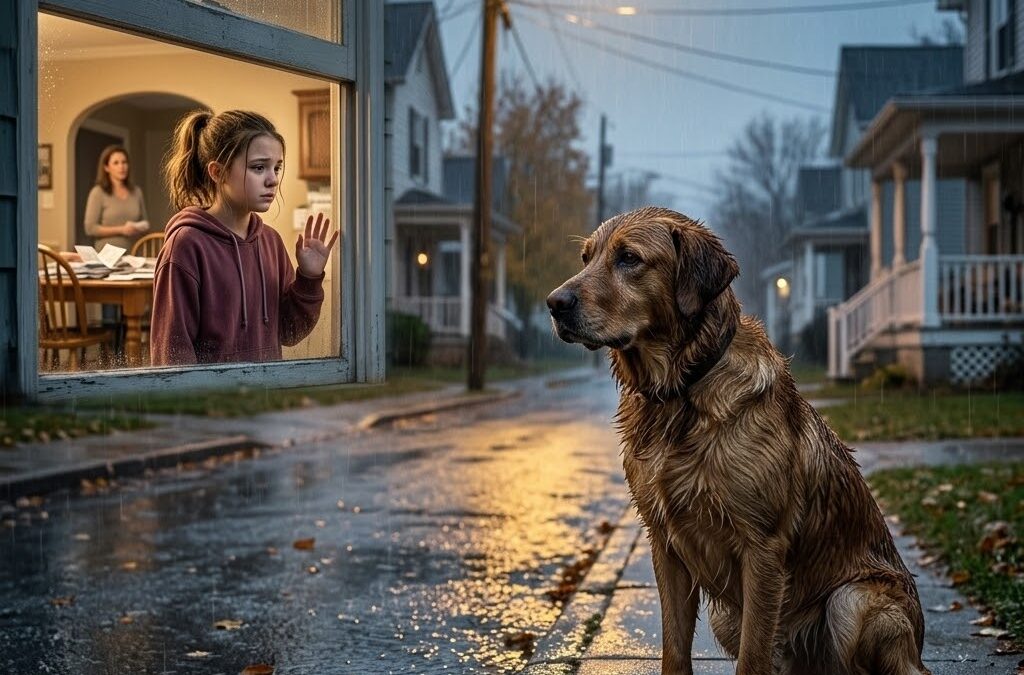
The next morning, I woke before my alarm.
Rain tapped softly against my bedroom window.
I had fallen asleep at my desk with my comforter wrapped around my shoulders and my forehead pressed against my science notebook.
My neck hurt.
My room was cold because I had left the window cracked.
I sat up.
Then remembered.
The dog.
I stumbled to the window and pulled the curtain aside.
He was still there.
Curled beneath the streetlamp.
Soaked.
Small in the gray light.
I felt something twist behind my ribs.
I dressed without turning on the overhead light.
Sweatpants.
Old hoodie.
Rain boots.
My hair still looked ridiculous when I went downstairs.
Mom had already left for work.
She worked mornings at the county records office and three evenings a week at a pharmacy.
On the kitchen counter, she had left a piece of toast beneath a paper towel and a note.
ELLIE—
Bus at 7:32.
Please remember your science folder.
Love you.
Mom
I looked at the toast.
Then through the window.
The dog was awake.
I wrapped the toast in the paper towel and slipped outside.
Cold air hit my face.
Everything smelled like wet leaves and asphalt.
My rain boots made little splashing sounds as I crossed the street.
The dog saw me immediately.
His head came up.
I stopped maybe fifteen feet away.
“Hi.”
No reaction.
I crouched.
“You know, you’re causing a lot of trouble.”
One ear moved.
“Mom says you might belong to someone.”
Nothing.
“I think if you belonged to somebody good, they’d probably be here.”
His eyes stayed on me.
They were darker than I expected.
Brown with little amber pieces.
Sad eyes.
That sounds stupid when people say it.
Eyes aren’t sad.
People are.
But his were.
I pulled out the toast.
“Breakfast?”
His nose moved.
I placed the bread on the sidewalk and backed away.
He didn’t move at first.
I waited.
My school bus would come soon.
I knew Mom would kill me if I missed it.
Still I waited.
Finally, the dog stood.
Slowly.
He stepped toward the toast.
His body looked thin under all that wet fur.
He sniffed the bread.
Looked at me.
Then picked it up very carefully.
He didn’t eat beside me.
He carried it back to the streetlight.
Lay down.
Then ate.
I smiled.
“Okay.”
His eyes stayed on me.
“I’ll see you after school.”
I stood.
He watched me walk away.
At the corner, I looked back.
Still watching.
That became our routine.
Every morning, I carried him something.
A piece of ham.
Half a sandwich.
Leftover pancake.
One morning, a scrambled egg wrapped in foil.
Mom found out on the third day.
“You’re feeding him.”
I froze with deli turkey in my hand.
“No.”
She stared.
I looked at the turkey.
Then back at her.
“This is for me.”
“You hate turkey.”
“I’m changing.”
“Ellie.”
I sighed.
“He’s hungry.”
“So are you before lunch.”
“I can buy lunch.”
“With what?”
That was unfair because she knew I had six dollars.
I folded the turkey into a napkin.
“Mom.”
She leaned against the counter.
There were dark circles beneath her eyes.
“I’m not trying to be mean.”
“I know.”
“If you keep feeding him, he’ll stay.”
“Good.”
“No, sweetheart.”
“Why not?”
“Because what happens when somebody comes for him?”
“What if nobody does?”
“What happens if we can’t afford another mouth?”
“He’s a dog.”
“Dogs eat.”
“I’ll pay.”
“You are twelve.”
“I can do chores.”
“You already live here. Chores are not employment.”
I crossed my arms.
“You sound like Grandma.”
“That may be the meanest thing you’ve ever said.”
Despite myself, I smiled.
Mom almost did too.
Then she became serious.
“I know you want to help him.”
“He needs somebody.”
Her eyes flicked toward the front window.
The dog was sitting beneath the lamp again.
“I called animal control again.”
“When?”
“Yesterday.”
“What did they say?”
“They’ll send somebody when they can.”
“They’ve said that all week.”
“I know.”
I looked down at the turkey.
“Can I at least feed him until they come?”
Mom exhaled.
“One small meal in the morning.”
I smiled.
“And no trying to touch him.”
“Okay.”
“And no bringing him inside.”
“Fine.”
“And if someone says he’s theirs, you come get me.”
“I know.”
She pointed at me.
“I mean it.”
“I said okay.”
That afternoon, Mrs. Gley from two houses down put out a bowl of water.
The Hallsteads left kibble beneath their porch.
People had begun noticing him.
But he still belonged to no one.
Or everyone.
Depending on how you looked at it.
By the seventh day, he started wagging his tail when I approached.
Barely.
A tiny movement.
But I saw it.
“Oh my God.”
His ears lifted.
“You like me.”
Tail again.
“You totally like me.”
I sat cross-legged on the sidewalk.
He stayed near the lamp.
I talked.
That became almost as important as feeding him.
I told him about school.
About Jill Patterson, my best friend, who had decided she wanted to marry a boy named Connor because he let her borrow a pencil.
I told him about Mr. Reeves assigning a science project on erosion.
I told him our cafeteria pizza tasted like cardboard dipped in tomato sauce.
Then one morning, without planning to, I told him about Dad.
“My dad left.”
The dog watched me.
“He says he didn’t leave me.”
I picked at a loose thread on my sleeve.
“He says he left the marriage.”
The words sounded like Mom because that was exactly how she explained it.
“But I was in the house too.”
The dog moved his front paws.
“He calls every Sunday.”
I swallowed.
“Sometimes Wednesday.”
Rain dripped from the edge of my hood.
“He keeps saying he’ll come visit when things settle down.”
I laughed quietly.
“Adults love saying that.”
The dog tilted his head.
“When things settle down.”
I looked at him.
“You know what I think?”
Tail flick.
“I think that means they don’t know what else to say.”
The dog slowly stood.
For the first time, he walked toward me without food between us.
One step.
Then another.
He stopped three feet away.
I held completely still.
His nose stretched forward.
Sniffed my knee.
Then he returned to the lamp.
I smiled so hard my face hurt.
“You get it.”
That was the day I named him Rainey.
Not Rainy with a Y, though I didn’t decide the spelling until later.
R-A-I-N-E-Y.
Because he always appeared in the rain.
And because somehow the extra E made him seem more like a person.
“You’re Rainey,” I told him.
His ears perked.
“See?”
Tail wag.
“Perfect.”
On the ninth night, the storm arrived.
Not normal rain.
A real storm.
Wind bent the maple trees.
Lightning flashed.
Our power blinked off twice before midnight.
Mom fell asleep on the couch with the television on low because she had worked fourteen hours between both jobs.
I was in bed.
Or pretending to be.
Every thunderclap made me think about the streetlight.
Rainey hated loud noises.
I had learned that much.
A delivery truck backfired one afternoon and he had disappeared behind the hedge for almost an hour.
At 1:47 a.m., I sat up.
Rain hammered my window.
I looked across the street.
The streetlamp was empty.
My heart stopped.
I threw on jeans.
Boots.
Coat.
Grabbed a flashlight.
At the front door, I hesitated.
Mom would kill me.
Then lightning flashed.
The empty patch beneath the lamp appeared bright as daylight.
I opened the door.
Rain hit me sideways.
“Rainey!”
Nothing.
I ran across the street.
The grass where he usually slept was flattened.
Paw prints led along the sidewalk.
Then disappeared in water.
“Rainey!”
Wind tore my hood backward.
I kept going.
Past Mrs. Gley’s house.
Past the gas station.
Toward the old bookstore.
My flashlight flickered.
“Rainey!”
A sound.
Faint.
I stopped.
Another whimper.
Behind the dumpster in the alley.
I ran.
Rainey was wedged between the brick wall and a metal trash bin.
His whole body shook.
Blood showed along one side.
His front paw twisted strangely beneath him.
“Oh no.”
I dropped to my knees.
He tried to move.
Couldn’t.
“Don’t.”
I reached toward him.
He flinched.
Then saw my face.
Stopped.
“It’s me.”
I took off my coat.
Wrapped it around him.
“You’re okay.”
His body was heavier than I expected.
Maybe seventy pounds.
I was twelve.
Small.
Scared.
But adrenaline makes impossible things negotiable.
I got my arms beneath his chest and hips.
Lifted.
My knees nearly buckled.
“Okay.”
One step.
“Okay.”
Another.
Rain blurred everything.
Rainey didn’t fight.
His head rested against my shoulder.
I carried him.
Halfway home, I started crying.
Not because he was heavy.
Because he trusted me.
Mom opened the front door before I reached the porch.
Her face was pure terror.
“ELLIE!”
“He’s hurt!”
“What are you doing outside?”
“He’s hurt!”
She ran down the steps barefoot.
Together, we carried Rainey inside.
Water pooled across the floor.
Mom looked at me.
I expected anger.
Instead she grabbed towels.
“Put him by the heater.”
We dried him.
His paw was swollen.
Scrapes along his ribs.
No deep bleeding.
Mom called the emergency veterinary line.
They said if his breathing remained normal and there was no uncontrolled bleeding, we could bring him first thing in the morning.
Mom wrapped his paw loosely.
I sat beside him.
She stood in front of me, hands on hips.
“You went outside alone.”
“I know.”
“In a severe thunderstorm.”
“I know.”
“At two in the morning.”
“I know.”
“Without waking me.”
“I know.”
Her voice broke.
“Do you have any idea what could have happened?”
I looked down.
“I’m sorry.”
Mom covered her face.
For a second, I thought she was crying.
Then she sat beside me.
Rainey lifted his head.
Rested it against my leg.
Mom stared.
“You carried him home?”
I nodded.
“Mostly.”
She laughed once through tears.
“You’re impossible.”
“I know.”
We spent the rest of the night on the living room floor.
At dawn, Rainey was asleep between us.
The house didn’t feel empty.
The veterinarian’s name was Dr. Stanwick.
He had white hair around the sides and glasses that kept sliding down his nose.
He examined Rainey while I held his head.
“Good news.”
I held my breath.
“No fractures.”
“Really?”
“Sprain. Probably twisted it running or slipping.”
“And the scratches?”
“Surface wounds.”
He looked at us.
“No microchip.”
Mom nodded.
“We’ve been trying animal control.”
“Any missing-dog reports?”
“None matching him.”
Dr. Stanwick looked at Rainey.
“How long has he been hanging around?”
“More than a week.”
“Hungry?”
“Yes.”
“Scared?”
“Sometimes.”
“Any aggression?”
“Never.”
He smiled.
“Someone taught him manners.”
My stomach tightened.
“Then someone owned him.”
“Probably.”
I wrapped my arms around Rainey’s neck.
Mom noticed.
Dr. Stanwick did too.
“There’s a mandatory hold period if he’s officially taken in as a found dog.”
“How long?”
“Depends on local ordinance and circumstances.”
“What happens during it?”
“You keep looking for an owner.”
“And after?”
He looked toward Mom.
“If nobody can establish ownership…”
I interrupted.
“I want him.”
Mom closed her eyes.
“Ellie.”
“I do.”
Dr. Stanwick smiled.
Rainey licked my wrist.
“Seems mutual.”
We went home with anti-inflammatory medication, wound cleanser, and instructions to keep him quiet.
Rainey followed me through our front door without hesitation.
No fear.
No stopping.
He walked inside as though he already knew.
That evening, he fell asleep beside my bed.
For the first time since Dad moved out, I didn’t leave the hallway light on.
I woke with Rainey snoring softly beneath me.
And somehow, overnight, our house had learned how to breathe again.
The next two weeks were torture.
Not because Rainey was difficult.
Because every phone call scared me.
Mom posted notices.
The veterinarian contacted nearby clinics.
Animal control added him to their found-dog log.
Photos went online.
No one responded.
Every day that passed made me more hopeful.
Which made me feel guilty.
Somewhere, maybe somebody loved him.
Maybe some kid was crying over a missing dog.
I knew what losing somebody felt like.
I didn’t want my happiness to depend on someone else’s pain.
Then the phone rang on a Friday night.
Mom answered.
I was upstairs reading to Rainey.
I heard her voice change.
“Yes.”
Pause.
“Brown?”
Pause.
“No chip.”
My chest tightened.
I stopped reading.
Rainey lifted his head.
Mom came upstairs after the call.
Her face told me before she spoke.
“Someone saw the flyer.”
“No.”
“Ellie.”
“No.”
“They have a cousin who lost a dog.”
“He’s mine.”
“Sweetheart.”
“He waited here.”
“That doesn’t mean—”
“He chose here.”
“We have to let them see him.”
I wrapped my arms around Rainey.
“What if he knows them?”
Mom sat beside me.
“Then we figure out what’s right.”
“What if what’s right hurts?”
Her eyes softened.
“It usually does.”
I hated that answer.
The blue pickup arrived Saturday at ten.
A woman stepped out.
Forties.
Tired face.
Teenage boy beside her.
They looked nervous.
The woman introduced herself as Marlene.
“This is my nephew Caleb.”
Mom invited them to the porch.
I kept Rainey inside.
Marlene showed photographs.
A brown dog.
Similar size.
Name Charlie.
Lost several months earlier after a gate had been left open.
The markings looked close.
Not exact.
I convinced myself.
Then she walked toward the front window.
“Charlie?”
Rainey’s ears lifted.
My stomach dropped.
“Charlie?”
He tilted his head.
Caleb stepped closer.
“Hey, boy.”
Rainey backed away from the glass.
Mom opened the door.
Rainey came outside.
Slowly.
Marlene crouched.
“We thought you were gone.”
Rainey sniffed her hand.
No fear.
No excitement.
Caleb’s eyes filled.
“Charlie.”
Rainey looked at him.
Then turned.
Walked directly to me.
Pressed against my legs.
I dropped to my knees.
Marlene stared.
“He used to jump all over us.”
No one spoke.
She showed Dr. Stanwick the photographs later.
Different white markings beneath the chest.
Different age estimate.
No vet documentation because Charlie belonged mostly to her cousin, who had moved.
We couldn’t prove Rainey wasn’t Charlie.
They couldn’t prove he was.
Marlene finally called Mom two days later.
“We’re not going to pursue it.”
Mom put the phone on speaker.
I sat frozen.
“Are you sure?” Mom asked.
Marlene’s voice shook.
“If it’s him, he doesn’t remember us the way we remember him.”
I hugged Rainey.
“He’s safe?”
“Yes.”
“Happy?”
I whispered,
“Yes.”
A pause.
“Then maybe that’s enough.”
Afterward, I cried.
Not because I had almost lost him.
Because somewhere out there Charlie was still missing.
Marlene had wanted the same thing I wanted.
To know the dog she loved had found home.
Sometimes love makes people hold tighter.
Sometimes it makes them let go.
After the legal waiting period ended, Mom signed the adoption paperwork.
I got to sign as witness even though my signature looked ridiculous.
When Dr. Stanwick handed me Rainey’s new tag, I read it three times.
RAINEY HARPER.
Our last name.
Mom noticed me staring.
“He’s official.”
I slipped the collar around his neck.
“There.”
Rainey shook himself.
Tag jingled.
I kissed his head.
“Now nobody can say you don’t belong somewhere.”
Mom looked away quickly.
Dad called that Sunday.
I told him about Rainey.
“You adopted a dog?”
“Yes.”
“Your mom agreed?”
“Yes.”
“Wow.”
I hated the surprise in his voice.
Like Mom and I had become some distant television show he was watching.
“I’ll meet him next time I’m there.”
“When’s that?”
Pause.
“Soon.”
“You said that last month.”
“Ellie.”
“What?”
“I’m trying.”
I looked at Rainey.
He was asleep on my foot.
“Okay.”
Dad didn’t come that month.
Or the next.
Rainey stayed.
Maybe that was why I loved him so fiercely.
People talk about dogs as though their greatest quality is loyalty.
I think that’s too simple.
Rainey’s greatest gift was presence.
He was where he was.
Completely.
When I got home from school, he didn’t care that I had been gone only seven hours.
He celebrated.
When we sat outside, he wasn’t thinking about tomorrow.
When thunderstorms scared him, he didn’t pretend they didn’t.
When they ended, he stopped being scared.
Humans are terrible at that.
We carry storms into clear days.
Rainey helped me stop.
Our house changed in tiny ways.
His nails clicked across the kitchen tile while Mom made coffee.
His tail thumped the bedroom wall each morning.
He waited at the front window when the school bus brought me home.
I would see his ears appear before the rest of him.
Then the door opened.
Backpack down.
Me on the floor.
Rainey circling once before leaning against me.
Every day.
No exceptions.
Wednesdays became ours because Mom worked late.
I called it Backyard Movie Night.
Old blanket.
Tablet balanced on a chair.
Popcorn.
Rainey curled beside me.
I picked movies mostly based on whether they contained dogs.
Once we watched a movie about a sled dog.
I spent half the film watching Rainey instead of the screen.
“Do you miss whoever had you?”
He blinked.
“I’d miss you.”
His head lowered onto my chest.
“Like, a lot.”
Mom came home around ten.
She opened the back door.
Saw us asleep together.
She didn’t wake me immediately.
I know because I later found a photograph on her phone.
Me lying under the stars.
Rainey’s head across my shoulder.
I looked peaceful.
I barely recognized myself.
Storms were different.
Rainey was terrified of thunder.
The first storm after he officially became ours, he tried to crawl under my bed.
He was too big.
Only his head and shoulders fit.
The rest of him stuck out trembling.
I crawled down.
“Hey.”
His body shook.
I built what became the storm fort.
Blankets draped over chairs.
Pillows.
Flashlight.
Book.
Treats.
Rainey crawled inside.
Pressed against me.
Every thunderstorm after that, we rebuilt it.
Sometimes Mom joined us.
Once the power failed and all three of us slept inside the fort.
In the morning, Mom’s back hurt so badly she declared Rainey could face future storms with me alone.
I laughed for ten minutes.
At school, people noticed I had changed.
Mrs. Greer asked if things were “better at home.”
I knew she meant Dad.
I told her yes.
That wasn’t exactly true.
Dad still existed as a wound we carefully avoided touching.
But Rainey gave me something else to talk about.
Jill teased me.
“Rainey this. Rainey that.”
“You’re jealous.”
“Of a dog?”
“Yes.”
“Maybe.”
She came over eventually.
Rainey loved her.
Traitor.
The bookstore started a Reading Buddies program that winter.
Kids who struggled reading aloud could practice with calm dogs.
I saw the little hand-painted sign in the window.
KIDS + DOGS WANTED.
I dragged Mom inside.
“Please.”
“You already have school.”
“Thursday afternoons.”
“You have homework.”
“I can do it later.”
“You say that about everything.”
“Rainey would be amazing.”
Mom looked at the dog.
Rainey sat politely beside the history section.
Mrs. Landers, the bookstore owner, laughed.
“He’s calmer than some adults.”
Rainey had to be evaluated.
A volunteer touched his paws.
Ears.
Tail.
Made noises.
Dropped a book nearby.
Introduced another dog.
Rainey passed everything.
“Therapy-dog material.”
I nearly exploded with pride.
Our first reader was a boy named Max.
Eight.
Glasses.
He held a train book with both hands.
“Do I have to read to you?”
I shook my head.
“You read to him.”
Max looked at Rainey.
“Does he judge?”
“Constantly.”
Max looked terrified.
I laughed.
“Kidding.”
He sat beside Rainey.
Started.
Slowly.
Stumbled over “locomotive.”
Stopped.
Rainey didn’t move.
Max tried again.
“Lo-co-mo-tive.”
Tail thump.
Max smiled.
“He likes trains.”
“Apparently.”
Max returned every Thursday.
Same book at first.
Then new ones.
His voice got louder.
He stopped covering mistakes with coughs.
One afternoon, he finished an entire page without help.
Rainey wagged.
Max hugged him.
“I did it.”
I had never realized listening could be something you gave another person.
Rainey did.
He didn’t correct.
Didn’t hurry.
Didn’t finish anyone’s sentence.
He stayed.
Adults are bad at that too.
By spring, the bookstore nominated Rainey for a community award.
I laughed when Mom read the letter.
“The dog gets awards before I do.”
“You have honor roll.”
“Not framed.”
“We can frame it.”
“Too late.”
The library ceremony was small.
Mrs. Landers explained that Rainey had helped children build confidence.
They gave me a certificate.
Rainey got a ribbon.
He lay down during applause.
Max hugged him afterward.
“Thanks for helping me read.”
I cried in the bathroom because apparently that had become my personality.
The local newspaper ran an article.
SILENT SUPPORT: HOW ONE DOG HELPED YOUNG READERS FIND THEIR VOICE.
I cut it out.
Added it to Rainey’s folder.
Vet papers.
Adoption papers.
Photographs.
Certificate.
Mom started saving everything too.
For a while, our lives became wonderfully ordinary.
Fall fairs.
Halloween.
Rainey dressed as a lion.
He hated the mane.
His expression in every photograph looked like he was reconsidering our friendship.
Thanksgiving.
He sat beneath the table pretending he had never been fed.
Mom slipped him turkey.
I caught her.
“You’re encouraging bad behavior.”
“He’s had a difficult life.”
“You say I can’t use that excuse.”
“You’re not a dog.”
Unfair.
Christmas was the first one after Dad left.
I had dreaded it for weeks.
Our old traditions felt dangerous.
Dad used to carry the tree inside.
Dad put the star on top because I was too short.
Dad cooked breakfast.
Dad complained about wrapping gifts.
His absence lived in every box we opened from the attic.
Mom knew.
She changed things.
We bought a smaller tree.
I put the star on top using a chair.
We made sugar cookies badly.
I created a red felt stocking for Rainey using glitter glue.
Mom pretended to complain.
Then filled it.
Christmas morning, Rainey received a stuffed bear, treats, a navy collar, and a silver tag.
He barked when I opened the package.
One happy bark.
I put the new collar on.
“Now you’re extra official.”
Mom sat on the couch watching.
Rainey walked over.
Rested his head in her lap.
She stroked him.
Her eyes filled.
I sat beside her.
Neither of us said Dad’s name.
We didn’t have to.
We missed him.
But for the first time, missing him didn’t swallow everything else.
That mattered.
Winter deepened.
Rainey loved snow.
I expected him to hate it because of the rain.
He didn’t.
Snow was different.
He would step into the yard cautiously.
Sniff.
Then explode.
Circles.
Leaps.
Face buried in powder.
One morning he jumped into a drift and came out sneezing so hard he startled himself.
I fell down laughing.
We built a snow dog.
It was terrible.
Stick ears.
Pebble eyes.
Rainey sat beside it while Mom took pictures.
December passed.
January.
The Reading Buddies program expanded.
Then my school announced a community service project.
One option was volunteering at the senior center.
Dogs allowed if approved.
I looked at Mom.
“No.”
“Mom.”
“You already have the bookstore.”
“Once a week.”
“You have school.”
“I have straight As.”
“Mostly.”
“Rude.”
Rainey stared at her.
She pointed at him.
“Don’t recruit the dog.”
He wagged.
Mom lasted twenty-four hours.
Our first senior-center visit happened on a snowy Wednesday.
Rainey wore a blue scarf.
I wore the sweater Grandma gave me.
The lounge smelled like coffee and furniture polish.
Older people sat in chairs.
Some talking.
Some reading.
Some simply looking toward windows.
I suddenly felt shy.
Then Rainey walked toward a man reading a paperback.
Sat beside him.
The man lowered his book.
“Well, hello.”
I smiled.
“His name’s Rainey.”
The man scratched behind his ears.
“Walter.”
“Nice to meet you.”
Walter looked at Rainey.
“I had a golden retriever when I was a boy.”
Rainey rested beside his shoes.
“Twenty years since I had a dog.”
Walter’s voice changed.
“They never really leave your heart, though.”
At twelve, I didn’t understand that sentence completely.
Later I would.
We came every Wednesday.
Janine brought biscuits.
Walter told stories.
A woman named Ruth sometimes forgot my name but always remembered Rainey.
“Rain dog.”
“That’s him.”
She smiled every time.
I thought I was collecting volunteer hours.
Instead, I collected people.
Their stories.
Old pets.
Old marriages.
Lost children.
Careers.
Wars.
Houses that no longer existed.
Rainey moved between them quietly.
No tricks.
No performance.
Presence.
Again.
At school, I made a presentation.
Someone asked,
“How did you train him to know who needs him?”
I answered,
“I didn’t.”
That was true.
“He just notices.”
By then, Mom and I were doing better too.
Not perfect.
Dad visited twice that year.
The first visit was awful.
He stood in our kitchen like a guest.
Rainey didn’t bark.
Just watched.
Dad crouched.
“So this is the famous dog.”
Rainey sniffed him.
Then returned to me.
Dad laughed awkwardly.
“Guess he knows who his person is.”
I didn’t laugh.
Later, Dad tried to talk about Natalie.
I didn’t want to hear it.
We argued.
I yelled.
“You left.”
He said,
“I never left you.”
“You did.”
“Ellie—”
“You weren’t at Christmas.”
His face changed.
“I know.”
“You weren’t at my science fair.”
“I had work.”
“You always say that.”
Mom came into the room.
“Enough.”
I ran outside.
Rainey followed.
I sat behind the garage.
Cried into his fur.
Dad eventually came outside.
Stopped several feet away.
“Can I sit?”
I shrugged.
He sat.
Rainey stayed between us.
Dad looked older than I remembered.
“I handled everything badly.”
I said nothing.
“I thought giving you space was better.”
“For who?”
He looked down.
“You’re allowed to be angry.”
“I know.”
“I miss you.”
“Then show up.”
That was all I said.
He nodded.
After that, he did better.
Not perfectly.
But better.
Rainey didn’t fix my family.
I hate stories where animals magically repair everything humans break.
Life doesn’t work that way.
Dad remained elsewhere.
Mom never took him back.
Natalie eventually disappeared from the story.
Dad moved into an apartment.
He came for birthdays.
School events.
Some weekends.
The wound became a scar.
Rainey simply gave me somewhere safe to put my hands while it healed.
In February, on one of our walks, we found a girl sitting on apartment steps.
Maybe nine.
Thin coat.
Red eyes.
Rainey stopped.
I stopped.
“Hi.”
She looked up.
Rainey’s tail moved.
“He’s pretty.”
“His name’s Rainey.”
“Can I pet him?”
“Sure.”
Rainey walked to her.
Sat.
She buried her fingers in his coat.
“He’s warm.”
“I’m Ellie.”
“Gracie.”
We sat together.
No big conversation.
Her mother eventually called her inside.
Before leaving, Gracie hugged Rainey.
“Thank you.”
On the walk home, I looked at him.
“How do you know?”
Rainey glanced up.
“Seriously.”
Tail wag.
“What is it?”
Nothing.
“You’re weird.”
He leaned against my leg.
My thirteenth birthday came.
Dad sent money.
Mom gave me art supplies.
Rainey stole a piece of cake.
The first road trip followed in May.
Mom managed three days off.
We rented a little cabin by a lake.
Rainey sniffed every board.
Every tree.
Every rock.
He sat by the fire pit while we roasted marshmallows.
At night, I woke and found him sitting on the porch.
A raccoon passed.
Rainey watched.
Didn’t chase.
Mom called him “the security guard who refuses to intervene.”
I said he was management.
That summer, a DNA test said he was mostly Golden Retriever and Australian Shepherd with some Collie and other breeds.
I read it aloud.
“Forty percent Golden.”
Mom nodded.
“Explains the friendliness.”
“Thirty-five Australian Shepherd.”
“Explains the watching.”
“Collie.”
“Explains the judging.”
Rainey wagged.
“You’re a mystery.”
I added the results to his folder.
Summer became our season.
Morning porch breakfast.
Farmers market.
River walks.
Dog festival.
At the festival, I entered him in an obstacle course.
Rainey completed three obstacles.
Reached a fabric tunnel.
Stopped.
Looked at me.
Walked around it.
The crowd laughed.
I bowed.
“We call that independent thinking.”
Rainey looked pleased.
Hot weather led to a plastic kiddie pool in the yard.
Rainey stepped in.
Stood knee-deep.
Closed his eyes.
Mom took a photograph.
“Living his best life.”
One evening, fireflies flashed across our lawn.
I said it out loud for the first time.
“I think I want to be a veterinarian.”
Mom looked up.
“Really?”
I nodded.
“Because of Rainey?”
“Kind of.”
I scratched his chest.
“I want to help animals the way he helped me.”
Mom smiled.
“You’d be good.”
Rainey’s tail thumped.
I took that as approval.
July fireworks were miserable.
Rainey hated them more than thunder.
Storm fort.
Blankets.
Music.
I wrapped a soft scarf around his ears.
He trembled against me.
“You’re safe.”
Pop.
Boom.
“You’re safe.”
Boom.
“I’m here.”
That phrase became ours.
Sometimes I said it to him.
Sometimes, without words, he said it to me.
August brought flash floods.
Rain slammed the windows.
Sirens.
Water crossed part of our street.
I looked through the glass toward the crooked streetlight.
The place where Rainey had waited.
For a second, I saw him there again in memory.
Soaked.
Alone.
I knelt.
Pressed my face into his fur.
“Thank you for finding me.”
He licked my cheek.
Seventh grade began.
Life got busier.
Homework.
Friends.
Drama.
Science fair.
A girl I had been close to started spending time with somebody else.
I came home furious one day.
“She acts like I don’t exist.”
Rainey listened.
“I know this sounds stupid.”
He placed one paw on my foot.
“See? You agree.”
I eventually learned that being thirteen means every emotion arrives at full volume.
Rainey lowered it.
He lay beneath my desk while I wrote essays.
If I cried, he leaned closer.
If I yelled, he waited.
If I laughed, tail.
The town dog show in September gave him another little plaque.
The librarian introduced him.
“This dog may not perform tricks or complete agility courses, but he listens.”
Everyone laughed.
“For children learning to read, sometimes listening is everything.”
Rainey stood beside me.
I felt absurdly proud.
The newspaper wrote another article.
I added it to his folder.
By then the folder had become a box.
Halloween.
Bumblebee costume.
Terrible.
Thanksgiving.
Special plate.
Christmas.
Custom bed with his name.
I saved allowance for weeks.
Christmas morning, I dragged it into the living room.
“Merry Christmas.”
Rainey sniffed.
Circled.
Lay down.
Long sigh.
Mom laughed.
“I think he approves.”
“He deserves everything.”
That night, I lay on the bed beside him.
“Thanks for choosing me.”
Rainey’s eyes closed.
Years later, I would remember saying that and understand I had it backward.
We chose each other.
Again and again.
The next year brought more Reading Buddies.
More senior center visits.
More school presentations.
Max became a confident reader.
Walter’s health declined.
One Wednesday, his chair was empty.
I asked Carla.
She looked sad.
“He went to the hospital.”
We visited when allowed.
Walter was thinner.
Rainey rested beside his bed.
Walter touched his head.
“Good fellow.”
He looked at me.
“Remember what I told you?”
I did.
“Dogs never leave your heart.”
He nodded.
“Neither do people, if you let them stay.”
Walter died that spring.
His daughter sent me his old paperback.
Inside the cover he had written:
For Ellie—keep reading to the ones who listen.
I cried.
Rainey stayed beside me.
That was the first death he helped me understand.
Not solve.
Understand.
Grief is love with nowhere obvious to go.
So you find somewhere.
A memory.
A story.
A dog.
My young-author story began almost accidentally.
Miss Greer saw my journal.
I had started writing about Rainey.
Opening line:
The dog waited in the rain all night.
She read two pages.
“This is good.”
“No, it’s not.”
“It is.”
“It’s just about my dog.”
“That’s what makes it yours.”
She encouraged me to enter a contest.
I didn’t want to.
Then I asked Rainey.
“Would you care if people read about you?”
Blink.
“Great.”
I submitted it.
The story won second place.
I was furious for approximately ten minutes because first place went to a poem about a grandmother’s garden.
Then Mom reminded me I had claimed not to care.
I said that was before judging corruption.
Dad came to the ceremony.
On time.
That mattered more than the ribbon.
My story was printed in the school literary booklet.
I gave a copy to Dr. Stanwick.
He said,
“Maybe vet school isn’t your only option.”
“I can do both.”
He laughed.
“Of course you can.”
Rainey became older so slowly that at first I didn’t notice.
That sounds strange because only a few years had passed since we found him.
But we never knew his true age.
Dr. Stanwick originally guessed middle-aged despite how energetic he later became.
Maybe five.
Maybe six.
Maybe older.
The gray started around his muzzle.
His walks shortened.
He still worked at the bookstore.
Still visited the senior center.
But he slept longer afterward.
One November, at the shelter, I saw a brown hound sitting against kennel bars.
Something about his eyes took me backward.
Streetlight.
Rain.
Waiting.
I crouched.
“Hi.”
The hound wagged.
Mom stood behind me.
“No.”
“I didn’t say anything.”
“You were about to.”
“I know we can’t adopt.”
“Good.”
“But we can help.”
I made flyers.
Told his story at school.
Mrs. Landers posted his photo.
Two weeks later, he was adopted by a retired couple.
When the shelter called, I cried.
Mom shook her head.
“You cry constantly now.”
“I care deeply.”
“You’re exhausting.”
Rainey sat beside me.
“He understands.”
The second Christmas after his community award, Max’s mother sent a note.
Max had moved up a reading level.
Joined a book club.
Asked questions in class.
“He says Rainey made him brave.”
I read it three times.
Then to Rainey.
“You make people better.”
His tail moved once.
I corrected myself.
“No.”
I touched his face.
“You help people remember they can be better.”
That felt more accurate.
Another year passed.
High school approached.
My relationship with Dad improved.
Mom laughed more.
She eventually dated a man named Andrew who owned a plumbing company and was terrified of dogs.
Rainey cured him in about twenty minutes.
Andrew entered our house.
Rainey sat.
Andrew froze.
“Does he bite?”
“Only plumbers.”
Andrew looked at me.
“I’m leaving.”
Mom laughed harder than I had heard in years.
Rainey walked over.
Sniffed Andrew.
Leaned against him.
Andrew looked down.
“I guess we’re friends.”
Dad disliked Andrew at first.
Not because of anything Andrew did.
Because humans are complicated.
I told Dad,
“You left, remember?”
That ended the argument.
Andrew never tried to replace him.
That helped.
Rainey accepted everybody who treated us gently.
One winter morning, I opened my eyes.
Rainey wasn’t at the bedroom door.
That was the beginning.
I found him on his bed.
Head up.
Eyes watching.
Tail moved weakly.
“Hey.”
I knelt.
“You okay?”
He licked my hand.
Slow.
Mom called Dr. Stanwick.
We rode in the back seat together.
Rainey’s head in my lap.
Just like after the storm.
The clinic smelled exactly the same.
I hated that.
Blood tests.
X-rays.
Ultrasound.
Waiting.
Dr. Stanwick entered.
Closed the door.
My hands turned cold.
“He’s older than we initially thought.”
Mom reached for me.
“What does that mean?”
“Arthritis. Some age-related changes.”
He sat.
“But there’s something else.”
My heart began pounding.
“A mass near his spleen.”
I stared.
“What kind?”
“We need additional testing, but I’m concerned.”
“Cancer?”
“Possibly.”
“No.”
Mom squeezed my hand.
“No.”
Dr. Stanwick kept his voice gentle.
“It’s small.”
“Then remove it.”
“Location and his age complicate surgery.”
“Then treatment.”
“There are options.”
“Good.”
“But Ellie.”
I hated his tone.
“No.”
“Listen.”
“I am listening.”
“We may be talking about managing time and comfort rather than curing him.”
I looked at Rainey.
He sat calmly.
Tail touched the table once.
I started crying.
Not loud.
Tears simply came.
“How long?”
“I don’t know.”
“Months?”
“Maybe.”
“Years?”
He didn’t answer.
“What’s the treatment?”
We tried.
Medication.
Monitoring.
Diet.
Pain control.
Specialists.
Mom spent money she didn’t really have.
I offered savings.
She refused.
Dad paid part of the bills without making it a conversation.
Andrew fixed things around our house for free because Mom missed work for appointments.
Everybody tried.
Rainey accepted every pill hidden in peanut butter.
Every needle.
Every examination.
Every shorter walk.
He trusted us.
That made it harder.
The tumor was aggressive.
Not immediately catastrophic.
But relentless.
I stopped counting future events.
Christmas.
Birthday.
Summer.
Graduation.
Instead, Mom taught me something.
One evening we sat on the porch.
Sky lavender.
Rainey beside us.
“I know what’s coming,” I said.
Mom put an arm around me.
“I don’t know how to get ready.”
“You don’t.”
“What?”
“I don’t think you can.”
“Then what do I do?”
“Stay close.”
I looked at Rainey.
“Love him while he’s here.”
“That’s it?”
“That’s everything.”
So I stayed close.
Reading Buddies.
He kept going as long as he wanted.
Max visited.
Older.
Taller.
Read entire pages without stopping.
“You’re still the best listener.”
Tail wag.
At the senior center, Janine had also died.
New people replaced old ones.
Rainey sat beside them.
Quiet.
I wondered whether he knew time was moving.
Dogs probably do.
Just not the way we do.
Spring arrived.
Rainey moved more slowly.
One April morning, he didn’t get up.
My heart exploded.
I lay beside him.
“You’re okay.”
His breathing was shallow.
“I’m here.”
Mom called Dr. Stanwick.
The drive was silent.
Rainey’s head in my lap.
I stroked the same place over and over.
Clinic.
Exam.
Waiting.
Dr. Stanwick returned.
His eyes told me.
“It’s time to talk.”
“Is he in pain?”
“Yes.”
The word hit me physically.
“Can you fix it?”
“We can relieve it temporarily.”
“How long?”
“Not long.”
I looked at Mom.
She was crying.
“Can I stay?”
Dr. Stanwick knelt.
“Of course.”
They made a place on the floor.
Blankets.
Dim lights.
Rainey lay between us.
I held him.
Mom behind me.
Hands on my shoulders.
Dr. Stanwick explained.
“He’ll relax first.”
I nodded.
“Then he’ll fall asleep.”
I nodded again.
“Then his heart will stop.”
I couldn’t breathe.
Rainey looked at me.
Those eyes.
The same eyes beneath the streetlamp.
The same eyes behind the dumpster.
The same eyes beneath my desk.
At the bookstore.
The senior center.
Snow.
Storm forts.
Christmas.
“You waited in the rain.”
My voice broke.
Rainey’s ear moved.
“You waited for somebody who didn’t come.”
I pressed my face into his fur.
“But I came.”
Mom sobbed behind me.
“I found you.”
That wasn’t exactly true.
“You found me.”
More true.
“You stayed.”
Rainey breathed slowly.
“You stayed when Dad didn’t.”
I had never said that out loud before.
“And I’m sorry if that’s too much to put on a dog.”
I laughed through tears.
Dr. Stanwick cried too.
“You stayed through everything.”
I held his face.
“Thank you.”
The first medication entered.
Rainey relaxed against me.
Heavy.
Warm.
His breathing slowed.
“I love you.”
Mom touched his back.
“We both love you.”
Rainey’s eyes closed.
I whispered,
“You don’t have to wait anymore.”
The second medication came.
One long breath.
Then nothing.
I waited.
For another.
None came.
The room became impossibly quiet.
“Rainey?”
I knew.
Still I said it.
“Rainey?”
Dr. Stanwick placed his stethoscope down.
Then removed it.
“He’s gone.”
I pressed my forehead to his.
No sound came out of me.
Not at first.
Then everything.
I cried until my face hurt.
Mom held me.
Dr. Stanwick left us alone.
Nobody rushed.
Eventually I noticed Rainey’s body had changed.
Still warm.
But no longer him.
That realization was unbearable.
We left without him.
That was worse than the death itself.
The leash in my hand.
Empty back seat.
No head in my lap.
Home.
His bed.
His bowl.
His toys.
Collar.
Blankets.
The custom blue bed.
His stocking still stored with Christmas decorations.
Everything he had touched remained.
He didn’t.
I walked through the house.
Touched each thing once.
Then sat on the porch.
Across the street, the crooked streetlamp stood in afternoon sun.
I stared at it.
Mom sat beside me.
Neither spoke.
For days, I kept hearing him.
Nails on tile.
Tail against wall.
Collar tag.
Breathing.
Once I woke convinced he was beside my bed.
I reached down.
Nothing.
I started setting his bowl out by mistake.
Then intentionally.
Mom never stopped me.
I read aloud at night.
To empty space.
Maybe that sounds unhealthy.
I didn’t care.
Two weeks after he died, Mom brought me into the backyard.
Beneath the maple tree stood a small wooden marker.
I had painted it.
But Mom had installed it.
RAINEY
LOYAL
LOVED FOREVER
A small lantern sat beside it.
I knelt.
Pressed my hand to the earth.
“He’s still here,” Mom said.
“I know.”
That night, I opened my window.
Breeze moved through the curtains.
For the first time since Rainey died, I felt something that wasn’t only pain.
Love.
Pain was part of it.
Not all.
“I’ll be okay,” I whispered.
The promise scared me.
Because being okay felt almost like leaving him behind.
But Rainey had taught me better than that.
Healing isn’t abandoning what hurt.
It’s carrying it differently.
The next morning, I sat in my old reading corner.
Book in my lap.
Sunlight on the floor.
No Rainey.
I opened the first page.
Read aloud anyway.
At school, I stopped going to Reading Buddies for a month.
Couldn’t.
Then Max found me in the hallway.
“You coming back?”
“I don’t know.”
He looked disappointed.
“Rainey would.”
I almost got angry.
He was younger.
He didn’t mean harm.
Then I thought about it.
Rainey would.
So I returned.
No dog.
Just me.
I helped kids read.
It felt different.
Harder.
Good.
Eventually the bookstore partnered with a therapy-dog organization.
New dogs arrived.
A black Lab named Rosie.
A tiny poodle mix named Biscuit.
A retired racing greyhound named Pearl.
None were Rainey.
That was okay.
At the senior center, Walter’s old chair remained for weeks.
Eventually another man sat there.
Life replaces spaces even when hearts object.
I kept visiting.
Rainey had taught me presence.
I could still give it.
My young-author story became something larger after his death.
I rewrote it.
All of it.
The streetlight.
Storm.
Reading program.
Senior center.
Tumor.
Goodbye.
Miss Greer read the final page.
She cried.
“You should submit this.”
“I already did once.”
“This is different.”
“It feels like using him.”
“No.”
She closed the journal.
“It’s remembering him.”
I entered a statewide competition.
Won.
I hated the attention.
Then letters arrived from kids.
One girl had lost her cat.
A boy’s parents were divorcing.
Another had adopted an old shelter dog after reading the story.
I understood.
Rainey was still listening.
Just differently.
At sixteen, I began volunteering at Dr. Stanwick’s clinic.
Cleaning kennels.
Folding laundry.
Holding frightened animals.
I learned veterinary work was not mostly cuddling puppies.
It was blood.
Urine.
Fear.
Bad news.
Owners without money.
Animals you couldn’t save.
I still wanted it.
Especially then.
Dr. Stanwick asked why.
“You know.”
“Say it.”
I rolled my eyes.
“Rainey.”
“He’s not the whole answer.”
I thought.
“No.”
“What’s the rest?”
“I want to be the person who says, ‘I’m here’ when somebody is scared.”
He nodded.
“Better.”
Mom married Andrew when I was seventeen.
Dad came to the wedding.
That sounds strange.
It was.
But life had rearranged itself.
Dad eventually remarried too.
I stopped needing either relationship to restore what had existed before.
Some things end.
Others begin.
Rainey taught me that without trying.
At eighteen, the night before I left for college, I sat beneath the streetlamp.
The same one.
Rust worse now.
Bulb replaced.
Sidewalk cracked in new places.
Mom found me.
“Thought you’d be packing.”
“I am.”
“You have six boxes open.”
“Organized chaos.”
She sat.
“You scared?”
“Yes.”
“Good.”
“What?”
“Means you care.”
I looked at the patch of grass where Rainey used to sleep.
“I don’t want to leave you.”
“I’ll survive.”
“You say that now.”
She smiled.
“Ellie.”
“What?”
“You are allowed to go.”
That sentence mattered.
Dad had left.
For years, leaving felt like betrayal.
Mom understood.
“Leaving isn’t the same as abandoning.”
I looked at her.
She nodded toward the streetlamp.
“He taught you that too.”
Maybe.
I went to college.
Pre-veterinary track.
Hard.
Organic chemistry nearly killed me.
I called Mom crying.
“I’m too stupid.”
“You’re not.”
“I got a sixty-eight.”
“You’ve gotten bad grades before.”
“No.”
“Fine, humblebrag later.”
I laughed despite myself.
On my dorm desk sat Rainey’s photograph.
Snow on his nose.
Eyes upward.
I kept going.
Veterinary school took more years than twelve-year-old me understood.
Debt.
Exams.
Night shifts.
First surgery.
First animal I lost.
That one broke me.
Older dog.
Internal bleeding.
We couldn’t save him.
I sat in my car afterward.
Called Mom.
“I can’t do this.”
“Yes, you can.”
“No.”
“Why not?”
“Because they die.”
Mom was quiet.
Then:
“So did Rainey.”
I cried.
“I know.”
“Did that make loving him a mistake?”
“No.”
“Then go back tomorrow.”
I did.
Eventually I became Dr. Ellie Harper.
The first time I saw the name on my badge, I thought about the wet twelve-year-old girl carrying a seventy-pound dog through a thunderstorm.
She would have lost her mind.
Dr. Stanwick retired two years after I graduated.
I joined another clinic first.
Then returned to town when an opening appeared.
The old bookstore still existed.
Mrs. Landers retired.
Reading Buddies still happened.
The senior center had a newer lobby.
The crooked streetlamp finally disappeared after a truck hit it.
That upset me more than expected.
Mom called.
“They’re replacing it.”
“I know.”
“Do you want it?”
“What?”
“The lamp post.”
I laughed.
“You cannot keep municipal infrastructure.”
“Andrew knows the public works guy.”
“Mom.”
Two weeks later, a six-inch rusted piece of the old lamp post appeared on my porch.
I didn’t ask questions.
I mounted it beside Rainey’s photograph in my office.
Patients sometimes ask.
I tell them.
Not all of it.
Enough.
One rainy October evening, years after Rainey died, a teenage boy entered our clinic carrying an old dog.
Mixed breed.
Gray.
Thin.
The boy’s mother followed.
“He’s a stray,” she said.
“He’s been behind our garage three days.”
The dog trembled.
The boy looked at me.
“We can’t keep him.”
His mother corrected.
“We don’t know if we can.”
I examined the dog.
No chip.
Arthritis.
Ear infection.
Malnutrition.
Nothing immediately fatal.
The boy stroked his head.
“What happens if no one claims him?”
I looked at him.
Those words.
That question.
I was twelve again.
“If nobody claims him, we find the safest next step.”
“Could that be us?”
His mother closed her eyes.
I smiled.
“That sounds like a family conversation.”
The boy whispered to the dog,
“I’m here.”
My hands stopped.
For one second, I couldn’t breathe.
Then I continued the exam.
Rainey’s story never made me believe every stray belongs with the first person who loves it.
Life is more complicated.
Ownership matters.
Safety matters.
Money matters.
Rules matter.
But sometimes, beneath all that, something simple matters too.
Who stays.
That was what Rainey gave me.
Not rescue.
Staying.
He waited beneath our streetlight when nobody came.
I crossed the road.
He trusted me enough to eat toast.
Then enough to approach.
Enough to be carried.
Enough to enter our house.
Enough to sleep.
Enough to help other people.
And eventually enough to die with his head against me because he knew I would stay through that too.
For years, I thought the most important moment of our story was the storm.
The injured paw.
Me carrying him home.
Later, I thought it was the reading program.
Or deciding to become a veterinarian.
Or the moment he died.
I was wrong.
The most important moment was smaller.
The first morning.
Cold sidewalk.
Piece of toast.
I placed it down.
Backed away.
Rainey watched.
Then chose to move one step closer.
That is what trust is.
One step.
Not certainty.
Not guarantees.
One step toward someone who might hurt you because maybe, this time, they won’t.
Dad leaving taught me people could disappear.
Rainey taught me that didn’t mean everyone would.
Mom stayed.
I stayed.
Friends stayed.
Dad learned, slowly, how to come back differently.
Rainey stayed until his body couldn’t.
And even after he was gone, the things he gave us remained.
Max became a teacher.
I learned that years later when he brought his own dog to the clinic.
He laughed when I recognized him.
“You’re Max.”
“You remember?”
“You read trains.”
He grinned.
“I teach third grade.”
“You?”
“Rude.”
“I’m kidding.”
He adopted a gentle Lab and started a classroom reading program.
Walter’s granddaughter donated books to the senior center.
Mrs. Landers kept a photograph of Rainey behind the bookstore counter until the day she retired.
Mom still lights the lantern by the maple tree on the anniversary of his death.
I tell her she doesn’t have to.
She says she knows.
I kept Rainey’s first navy collar.
His silver tag.
My original journal.
The community ribbon.
The piece of streetlamp.
Not because objects contain souls.
They don’t.
They contain memory.
Sometimes memory needs somewhere to sit.
When I visit Mom, I still walk past the maple.
“Hey, buddy.”
I always say it.
No answer.
Obviously.
I don’t need one.
One spring afternoon, almost twenty years after I first found him, it began raining while I stood there.
Soft rain.
Warm.
I looked toward the street.
No lamp.
Different cars.
New families.
A little girl rode a bicycle past wearing a yellow raincoat.
The neighborhood had changed.
Mom’s house had new siding.
Mrs. Gley was gone.
Hallsteads had moved.
Dad lived in Florida.
Andrew complained about his knees.
Time had done what it always does.
Moved.
I sat beneath the maple.
Rain tapped the leaves.
For a second, I remembered Rainey exactly.
Not old.
Not sick.
Not dying.
Soaked beneath the streetlight.
Head lifted.
Watching me cross the road.
That was how I wanted to remember him.
Waiting.
Not because nobody wanted him.
Because our lives had not reached each other yet.
Sometimes I wonder what would have happened if animal control arrived on day one.
Maybe another family would have taken him.
Maybe he would have had a wonderful life.
Maybe I still would have become a veterinarian.
Maybe Mom and I would have healed differently.
There is no way to know.
Life is full of invisible forks.
We only see the road we took.
Mine began with toast in a napkin.
A dog in the rain.
A twelve-year-old girl angry at her father.
A tired mother who finally said yes.
Nothing about it looked important.
Then it became everything.
I once told Rainey,
“You waited in the rain for someone who never came.”
For years, I believed that.
Now I think I misunderstood.
Maybe he had been waiting for someone.
Maybe an old owner.
Maybe the woman who called him Charlie.
Maybe nobody.
Dogs don’t explain themselves.
But I know who eventually crossed the road.
Me.
And I know what happened after.
He brought sound back into our house.
He gave frightened children somewhere to practice words.
He gave lonely older people something warm to touch.
He gave Mom and me laughter when we had forgotten how.
He taught me what I wanted my life to be.
He made Max brave.
He made strangers kinder.
He made a twelve-year-old girl believe being abandoned didn’t mean she was unlovable.
And when the time came, he taught me the hardest lesson of all.
Staying does not always mean preventing someone from leaving.
Sometimes staying means holding them while they go.
I could not keep Rainey alive forever.
I could keep my promise.
I’m here.
I said it in the storm.
I said it during fireworks.
At the vet.
During cancer treatment.
On his last morning.
And every time I stand beneath that maple, I still mean it.
Love doesn’t stay because bodies do.
Love stays because, once it changes you, there is no version of you that exists completely without it.
Rainey waited beneath our streetlight for nine rainy nights.
Then one storm brought him through our front door.
Years later, when that door opened and I came home from veterinary school for the first time wearing my white coat, Mom cried.
She touched the embroidered name.
DR. ELLIE HARPER.
Then she pointed toward the maple tree outside.
“He’d be proud.”
I laughed through my tears.
“He was a dog.”
“I know.”
“He couldn’t read.”
“I know.”
“He would probably think this coat exists for him to shed on.”
Mom smiled.
“Definitely.”
I looked through the window.
Rain had begun.
Soft.
Steady.
The kind of rain that makes streetlights glow and empty sidewalks look lonelier than they are.
For just a heartbeat, I imagined him there.
Brown-gold fur soaked dark.
Head lifted.
Waiting.
I wanted to run across the road again.
Instead I stood beside Mom.
And smiled.
Because this time I knew the ending.
He wasn’t waiting anymore.
He had found home.
And so had I.








