The Moment My Divorce Was Final, I Cut Off My Ex-Mother-in-Law’s Luxury Card—By Sunrise, She Was Pounding on My Door
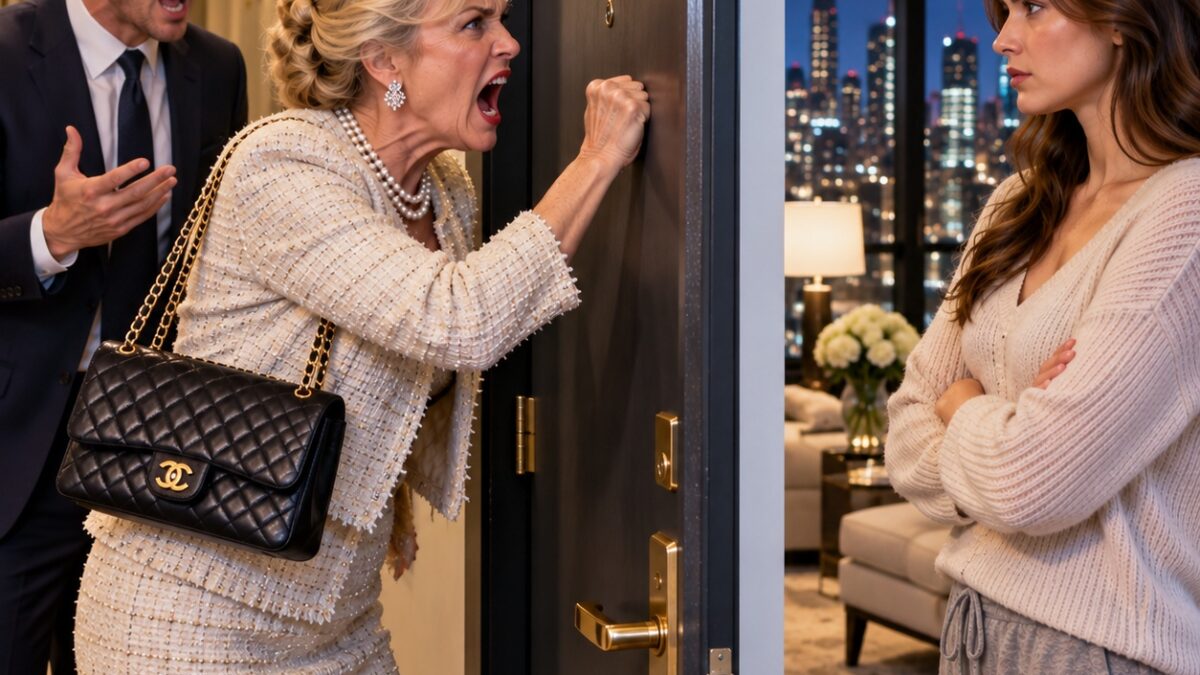
I did not open the door.
Five years earlier, I would have.
Three years earlier, I would have opened it, invited Eleanor in, made coffee, apologized for upsetting her, and somehow ended the conversation agreeing to fix a problem I hadn’t created.
Two years earlier, I probably would have called Anthony first and asked what he wanted me to do.
That morning, I stood in my kitchen holding my phone and watched the little video feed from the security camera outside my apartment.
Eleanor was wearing a camel-colored coat over what appeared to be silk pajamas.
Pearl earrings.
Large sunglasses despite the fact that the sun had barely risen.
Her gray-blonde hair was somehow perfect.
That woman could survive nuclear fallout and still emerge looking ready for brunch at The Pierre.
She raised one gloved fist.
BOOM.
“Marissa!”
I pressed the intercom button.
“Eleanor.”
She froze.
Then looked toward the camera.
“Open the door.”
“No.”
The answer clearly confused her.
Not angered.
Confused.
In all the years I had known Eleanor Whitmore, people had told her no only when they possessed enough power to survive the consequences.
Waiters didn’t.
Drivers didn’t.
Assistants rarely did.
Anthony almost never did.
And I had spent far too long pretending I couldn’t.
Her mouth tightened.
“You will open this door, or I will have building security open it for me.”
“They won’t.”
“This building knows me.”
“It knows me better.”
“I am your mother-in-law.”
“Ex-mother-in-law.”
Something about the word ex seemed to hit her harder than the canceled card.
Her face changed.
“Do not be childish.”
“I’m not.”
“You embarrassed me publicly.”
“You tried to use a canceled card.”
“A card you gave me.”
“As an authorized user.”
Her mouth opened.
I continued.
“The account is mine.”
“I have had that card for five years.”
“That did not make it yours.”
“I was promised continued access.”
That stopped me.
Promised?
By whom?
I moved closer to the intercom.
“Who promised you?”
Eleanor crossed her arms.
“Anthony.”
Of course.
“When?”
“Last week.”
I closed my eyes.
My divorce attorney, Helen Roth, had warned me.
“Do not assume Anthony understands what final means just because he signed something titled final judgment.”
Helen was sixty-one, five feet two, and could make senior partners cry without raising her voice.
She had spent fourteen months watching Anthony treat divorce negotiations like a temporary disagreement that would end once I remembered my role.
When Anthony demanded during mediation that I continue covering Eleanor’s charge account for “a reasonable transition period,” Helen stared at his lawyer and said:
“Your client is requesting post-divorce luxury support for his mother?”
Anthony’s attorney looked like he wanted the carpet to swallow him.
The demand disappeared from the written agreement.
Or so I thought.
I looked at Eleanor on the camera.
“Anthony had no authority to promise you access to my account.”
Her expression hardened.
“Everything became so vulgar with you.”
“Meaning?”
“Money. Ownership. Mine. Yours.”
I almost laughed.
“You’re pounding on my door before seven in the morning because I stopped paying for your handbags.”
“That is not the point.”
“It’s exactly the point.”
“You married into this family.”
“And divorced out of it.”
“Do you think a piece of paper erases your obligations?”
“Yes.”
That answer made her physically recoil.
I had spent years listening to Whitmores talk about family obligations.
The phrase appeared whenever they wanted something.
Not when I needed anything.
When Eleanor needed a driver.
Family.
When Anthony’s sister wanted me to sponsor a charity table.
Family.
When the Whitmore summer house needed a new roof.
Family.
When Anthony missed my mother’s surgery because he had a golf weekend.
Business.
When Eleanor insulted my background at Thanksgiving.
Just her humor.
When I asked Anthony to defend me.
Don’t make everything a conflict.
Family obligations worked in one direction.
Toward me.
Never from them.
Eleanor stepped closer to the camera.
“You have no idea what you’ve done.”
I stared at the screen.
For once, I agreed with her.
I didn’t.
Not yet.
“Leave.”
“I am not leaving.”
“Then building security can help.”
“You wouldn’t dare.”
I tapped the security line.
“Watch me.”
The concierge answered almost immediately.
“Ms. Cole?”
“It’s Marissa. Eleanor Whitmore is outside my door and refusing to leave.”
A pause.
“We saw her come up. Is she threatening you?”
I glanced at the monitor.
Eleanor had started pounding again.
“She’s not invited.”
“We’ll send someone.”
“Thank you.”
I released the button.
Eleanor shouted:
“Who are you calling?”
“Security.”
Her face went red.
“You are having me removed?”
“I’m asking you to leave my home.”
“This apartment was Anthony’s too.”
“No.”
It never had been.
That mattered.
The apartment had been mine before I met Anthony.
My name on the deed.
Purchased with income from the company I had built before he entered my life.
The prenup he had insisted upon made that crystal clear.
One of the many ironies in our marriage was that the Whitmores had demanded a prenup because they assumed I wanted Anthony’s money.
That document ultimately protected mine.
Two security officers arrived.
One was Marcus, a former NYPD officer who had worked in the building for almost ten years.
He knew Eleanor.
Everybody did.
“Mrs. Whitmore.”
She turned.
“This is a private family matter.”
Marcus remained courteous.
“Ms. Cole has asked that you leave.”
“She is hysterical.”
I actually laughed inside my apartment.
Marcus glanced toward my camera.
“I don’t believe Ms. Cole has opened the door.”
“That proves nothing.”
“It proves she isn’t creating the hallway disturbance.”
Eleanor stared at him.
“Do you know who my family is?”
There it was.
Marcus nodded.
“I know who lives in this building.”
Her jaw tightened.
“You’re going to regret speaking to me that way.”
“I haven’t spoken disrespectfully.”
“I want your supervisor.”
“Happy to arrange that downstairs.”
Eleanor remained.
Marcus waited.
For maybe ten seconds, nobody moved.
Then she leaned toward my door.
“This isn’t over.”
I pressed the intercom.
“It is for me.”
Her face twisted.
Then she walked toward the elevator.
Security followed.
The elevator doors closed.
My apartment went quiet.
I stood there.
No triumph.
No satisfaction.
My hands were shaking.
That annoyed me.
I had won the tiny confrontation.
My body still remembered five years of believing upsetting Eleanor meant consequences.
I made coffee.
Didn’t drink it.
Then my phone lit up.
Unknown number.
I ignored it.
Again.
Then a text.
Anthony.
You blocked me?
I stared.
Another message.
My mother is seventy years old and you had security escort her out like a trespasser.
Then:
You are becoming exactly the person she always said you were.
That one almost worked.
Old reflex.
Defend.
Explain.
Prove.
I set the phone face down.
Then called Helen.
She answered on the second ring.
“Why do I suspect your first morning of freedom isn’t peaceful?”
“You’re psychic.”
“No. I met Anthony.”
I told her everything.
The card.
The phone call.
Eleanor.
The promise.
Helen went silent.
“What promise?”
“Eleanor says Anthony told her last week she could keep using my card.”
“When?”
“She didn’t say exactly.”
“Did he make that promise in writing?”
“I don’t know.”
“Save every message.”
“I know.”
“Security footage?”
“Yes.”
“Request a copy.”
“Already planning to.”
“You’re learning.”
I sat at the kitchen island.
“Helen?”
“Yes?”
“Can he have promised her something involving my account without violating the settlement?”
“He can promise his mother the moon.”
“That isn’t what I asked.”
“No.”
Her voice sharpened.
“He cannot bind you to a personal debt not included in the final agreement.”
“Good.”
“Did Eleanor make any other statement?”
“She said a piece of paper doesn’t erase obligations.”
Helen laughed once.
“That family is going to kill me.”
“Please don’t say that.”
“Figure of speech.”
I rubbed my forehead.
“What do I do?”
“Nothing.”
“That feels suspiciously easy.”
“Because you’re used to managing their consequences.”
I looked out the window.
Helen continued.
“Marissa, listen carefully. The divorce is final. The card was yours. Eleanor was an authorized user. You removed her. You do not owe Anthony an explanation beyond what you already gave.”
“What if they show up again?”
“Do not open the door.”
“Police?”
“If they refuse to leave.”
“They’ll say I’m overreacting.”
Helen made a small sound of disgust.
“People who benefit from weak boundaries often describe strong boundaries as cruelty.”
That sentence stayed with me.
I had met Anthony six years earlier at a charity dinner in Midtown.
At the time, I was thirty-four.
He was thirty-eight.
I owned a financial-compliance consultancy called Cole Meridian.
Nothing glamorous.
We helped investment firms, midsized banks, and private companies identify regulatory risk before regulators identified it for them.
I started the company with one client and a borrowed desk in a shared office.
Seven years later, we employed forty-three people.
I worked too much.
Travelled constantly.
Owned good shoes because bad shoes and airports are enemies.
I had money.
Not Whitmore money.
At least, not what I thought Whitmore money was.
Anthony entered that dinner in a navy tuxedo and made everyone around him look slightly less polished.
He was handsome in the way certain men become handsome because rooms react to them.
Dark hair.
Tall.
Calm smile.
Old-family confidence.
Someone introduced us.
“Anthony Whitmore, Whitmore Residential.”
I knew the company.
Luxury developments.
Historic renovations.
Properties in Manhattan, Westchester, Connecticut.
His grandfather had built the company.
His father expanded it.
Anthony was executive vice president.
He asked what I did.
I told him.
He listened.
Actually listened.
That was unusual.
Most men at those events heard “compliance” and looked for someone more entertaining.
Anthony asked:
“What do clients usually call you for?”
“When they’re nervous.”
“What makes them nervous?”
“Usually something they should’ve been nervous about six months earlier.”
He laughed.
We talked for forty minutes.
He called the next day.
Our first date lasted four hours.
Our second involved a tiny Italian restaurant in the West Village where Anthony knew the owner.
Third, Central Park.
Fourth, my apartment.
Within months, I loved him.
I can admit that now without feeling stupid.
Love that ends wasn’t necessarily fake.
Anthony could be funny.
Generous.
Curious.
He remembered my coffee order.
He brought soup when I was sick.
He read documents I wrote for work even when he didn’t understand why anyone cared about risk controls.
He held my hand at my father’s memorial service.
There were good years inside the bad ones.
That made leaving harder.
Eleanor entered our relationship three weeks after Anthony and I became serious.
Lunch at La Grenouille.
She wore cream.
Pearls.
Everything about her communicated that she had never once wondered whether a bill would clear.
“Marissa.”
She kissed the air beside my cheek.
“Anthony tells me you work in finance.”
“Compliance consulting.”
“How industrious.”
Industrious.
Not impressive.
Not interesting.
Industrious.
Like a woman sewing uniforms during a war.
She asked where I grew up.
“Queens.”
Her eyebrows rose slightly.
“What did your father do?”
“He owned a small commercial printing business.”
“Ah.”
One syllable.
I heard the entire social hierarchy inside it.
Anthony squeezed my knee beneath the table.
I interpreted that as solidarity.
Later I realized it was management.
He knew his mother.
He was asking me not to react.
At the end of lunch, Eleanor smiled.
“You’re very self-made.”
“Thank you.”
“It wasn’t entirely a compliment.”
Anthony laughed.
I did too.
That was the first mistake.
I told myself humor was easier.
Eleanor tested boundaries the way children test locked doors.
Tiny pressures.
Comments about my clothes.
My accent.
I did not have an accent.
Apparently Queens counted.
She told me which charities “people like us” supported.
Corrected the way I pronounced the name of a French designer.
Wrongly.
Explained which forks to use at a dinner where I had already been attending formal events for years.
Anthony always said the same thing afterward.
“She’s old-fashioned.”
“She likes you.”
“She’s just protective.”
“Don’t take it personally.”
I wanted peace.
So I swallowed.
When Anthony proposed, Eleanor became unexpectedly warm.
That should have scared me more.
She helped with wedding planning.
Introduced me to florists.
Suggested a venue.
Then, two weeks after the engagement, Anthony said:
“Mom thinks we should have a prenup.”
I remember staring at him across my kitchen.
“Your mother?”
“I think it’s sensible.”
“Do you?”
“Yes.”
His tone was careful.
“We both have assets.”
That was technically true.
I owned my apartment.
My company shares.
Investments.
Anthony had interests in Whitmore family entities.
I said:
“Fine.”
He looked surprised.
“You’re not upset?”
“Why would I be?”
“I don’t know.”
“Anthony, I’m not marrying you for your money.”
“I know.”
“Good.”
I hired my own attorney.
Not Helen.
A man named David Morse.
He read the draft.
Then called me.
“Do they know what your company is worth?”
“Probably not.”
“Interesting.”
“Why?”
“Their proposed agreement protects family interests aggressively.”
“As expected.”
“It also protects yours.”
I laughed.
“Then why do you sound suspicious?”
“Because they seem to believe they’re the wealthy side.”
At that moment, Cole Meridian had been independently valued higher than Anthony’s personal stake in Whitmore Residential.
Not family-wide wealth.
His stake.
I didn’t care.
I didn’t tell Eleanor.
That became the second mistake.
Not because she deserved the number.
Because silence allowed them to build a mythology where I was entering their family for access.
The prenup protected premarital property.
Separate businesses.
Individual inheritances.
My apartment.
His trust interests.
No automatic responsibility for extended family debts.
That last provision had seemed irrelevant.
Years later, it became beautiful.
We married at a hotel overlooking Central Park.
Eleanor wore silver.
My mother cried.
Anthony looked at me like I was the only person in the room.
For a while, I believed him.
The credit card began eighteen months later.
Anthony’s father, Henry Whitmore, died unexpectedly after a stroke.
The family changed overnight.
Henry had controlled money.
Not because Eleanor lacked access.
Because Henry managed everything.
Bills.
Properties.
Investments.
Household accounts.
Estate planning.
After his death, estate administration became complicated.
Anthony sat beside me one evening.
“Mom has a liquidity issue.”
I looked up from my laptop.
“What does that mean?”
“Accounts are temporarily restricted while the estate gets sorted.”
“Does she need cash?”
“She needs something easier.”
He looked uncomfortable.
“Could we add her as an authorized user to one of your cards?”
I laughed because I thought he was joking.
He wasn’t.
“Why mine?”
“My cards have limits tied to different business accounts.”
“So?”
“She’s used to Amex.”
“Anthony.”
“Temporary.”
“How temporary?”
“Two months.”
I stared.
He reached across the table.
“She’s grieving.”
That mattered.
My father had died three years earlier.
I knew what grief did to simple tasks.
So I agreed.
One platinum card.
Eleanor Whitmore.
Authorized user.
No spending limit technically, but Amex monitored patterns.
The first month, she spent $6,800.
Restaurants.
Department stores.
Driver.
Florist.
Nothing catastrophic.
Anthony said:
“See?”
Second month:
$11,400.
Third:
$18,700.
I printed the statement.
Placed it in front of Anthony.
“Temporary.”
He looked.
“Estate is still complicated.”
“She spent nine thousand dollars at Bergdorf this month.”
“She needed clothes.”
“For what?”
“Events.”
“She owns clothes.”
Anthony smiled.
“Tell her that.”
I didn’t.
I should have.
Fourth month:
$24,000.
Then $31,000.
By the first anniversary of Henry’s death, Eleanor had spent more than $220,000 on an account that was supposed to bridge eight weeks.
When I raised it again, Anthony became irritated.
“Why are you tracking her?”
“It’s my account.”
“We pay it.”
I stared.
“I pay most of it.”
“We’re married.”
There it was.
When he wanted access, money was ours.
When his mother insulted me for being interested in Whitmore wealth, money was his.
I should have canceled the card then.
Instead, I reduced arguments by paying.
That became the pattern.
Eleanor discovered my silence had a price limit much higher than anyone expected.
Annual club dues.
$18,000.
Private driver.
$4,000 some months.
Hair salon.
Spa.
Charity tickets.
Champagne.
Jewelry.
A weekend in Palm Beach.
“You paid for Palm Beach?”
I asked Anthony.
“No.”
“She charged the hotel.”
He frowned.
“I’ll talk to her.”
He didn’t.
Or if he did, nothing changed.
The strangest part was how little gratitude Eleanor showed.
She treated the card as though Anthony had inherited it from some ancestral Whitmore vault.
At Christmas, she handed me a scarf.
Beautiful.
Cashmere.
I thanked her.
Later, I saw the charge on my statement.
She had bought my Christmas gift with my card.
I laughed until I cried.
Anthony didn’t understand why it bothered me.
“It’s the thought.”
“Whose thought? Mine?”
“Marissa.”
“She spent my money on my gift.”
“It all comes from household money.”
“No. Your mother’s shopping comes from me.”
“Why do you always make it sound transactional?”
Because transactions were literally occurring.
But I apologized.
Another mistake.
The gold-digger comment happened during our third year of marriage.
Eleanor hosted a luncheon for a museum committee.
I attended because she asked.
Halfway through, one woman complimented my company’s growth.
“We’ve expanded into D.C.,” I said.
Eleanor sipped champagne.
“Marissa has always been ambitious.”
The woman smiled.
“That’s good.”
Eleanor’s mouth curved.
“Depends what she’s ambitious for.”
Several women laughed.
I didn’t.
Someone asked how Anthony and I met.
Eleanor answered before I could.
“At a charity dinner.”
Then:
“She spotted the right table.”
More laughter.
I looked at her.
“Meaning?”
“Oh, darling.”
She touched my arm.
“Don’t become defensive.”
“I’m asking.”
“Women have married Whitmore men for worse reasons.”
I felt heat rise through my face.
One woman suddenly found her plate fascinating.
I said:
“I had more liquid assets than Anthony when we married.”
Silence.
Eleanor stared.
Then laughed.
“How vulgar.”
That was her defense.
Not denial.
Vulgarity.
Money became vulgar only when I described who actually had it.
That evening, I told Anthony.
He sighed.
“Why did you engage?”
“She called me a gold-digger.”
“She implied it.”
“Anthony.”
“Fine.”
He loosened his tie.
“She shouldn’t have.”
“Tell her.”
“Marissa.”
“Tell her.”
He looked exhausted.
“My father is dead. My mother is alone. Can we not create another war?”
I stared.
“She creates it.”
“I know.”
“Then defend me.”
He rubbed his face.
“You’re stronger than she is.”
I laughed.
“What does that even mean?”
“It means let it go.”
I did.
For him.
Again.
The marriage eroded in increments.
Not one affair.
Not one explosive betrayal.
A thousand moments where Anthony chose the easiest person to disappoint.
Me.
His mother demanded Thanksgiving.
We went.
My mother got Christmas Eve.
If Eleanor had nothing scheduled.
Eleanor wanted us in Palm Beach.
We went.
My company retreat?
Anthony canceled because his mother had a foundation event.
He promised to attend my promotion dinner.
Then Eleanor’s boiler broke.
She had staff.
Anthony went anyway.
I stopped asking him to choose.
That sounds peaceful.
It isn’t.
The day you stop asking your spouse to choose you because you already know the answer is one of the loneliest days of a marriage.
Money became the visible symptom.
Eleanor’s card climbed higher.
Over five years, she spent hundreds of thousands.
Not every charge outrageous.
Together, absurd.
My accountant once asked:
“Who is EW?”
“Mother-in-law.”
He looked at the statement.
“She work for the company?”
“No.”
“Then why are you paying her transportation?”
“Personal.”
He raised one eyebrow.
“I’m your accountant, not your therapist.”
“Thank you.”
“But you need a therapist.”
Probably.
The event that finally broke the marriage was not the card.
It was a folder.
Anthony came home one Thursday carrying legal documents.
“Can we talk?”
Those words rarely mean anything good.
We sat.
Whitmore Residential had a major development project in trouble.
Costs had risen.
Financing tightened.
Two investors pulled out.
They needed a capital guarantee.
“How much?”
I asked.
“Twenty million.”
I laughed.
He didn’t.
“You want me to guarantee twenty million dollars?”
“Not personally exactly.”
“Then how?”
“Using a portion of your Cole Meridian equity as supporting collateral.”
The room became very quiet.
“My company.”
“Part.”
“My company.”
“We’re married.”
There it was again.
The magic phrase.
I picked up the draft.
My name appeared.
My company.
My apartment listed among potential secondary assets.
I looked at him.
“You already had this prepared.”
“It’s preliminary.”
“You gave lawyers my financial information.”
“They already had some from marital disclosures.”
“Anthony.”
“We need this.”
“We?”
“My family.”
“Not me.”
His expression hardened.
“You are my family.”
“Then why wasn’t I involved before lawyers drafted a guarantee against my company?”
“We needed to know if it was possible.”
“No.”
“Marissa.”
“No.”
He stood.
“You haven’t even read the whole thing.”
“I don’t need to.”
“You always tell clients not to make decisions emotionally.”
“This isn’t emotional.”
I placed the folder down.
“It’s risk.”
“You think my family is a risk?”
“Yes.”
That was the first time I said it.
Anthony looked genuinely wounded.
For one second, I nearly softened.
Then he said:
“My father built that company.”
“And I built mine.”
“You would let Whitmore Residential collapse to protect numbers on a spreadsheet?”
I stood too.
“Those numbers represent forty-three employees, retirement plans, contracts, and fifteen years of my life.”
“My company employs hundreds.”
“Then its owners should recapitalize it.”
“We are.”
“With me.”
“With us.”
“No.”
His face changed.
The Anthony I married disappeared.
In his place was Eleanor’s son.
“You know what my mother always said?”
I waited.
“She said eventually you’d show what mattered more to you.”
That cut.
Not because Eleanor said it.
Because Anthony repeated it.
“What matters more?”
“Control.”
I stared.
“You are asking me to risk my company because yours is in trouble, and you think my refusal is about control?”
“You never truly integrated into this family.”
There it was.
Five years.
Money.
Holidays.
Card bills.
Charity tables.
Emergency loans.
And I had still failed to integrate.
I laughed.
Not because it was funny.
Because something broke cleanly.
“I think I’m done.”
Anthony frowned.
“With this conversation?”
“No.”
He looked at me.
I said:
“With us.”
He did not believe me.
Not then.
He slept in the guest room.
The next morning, I called Helen Roth.
A colleague recommended her.
I explained.
She listened for thirty minutes.
Then:
“Do you want a divorce, or do you want your husband scared enough to change?”
The question hurt.
“I want a divorce.”
“Good.”
“Good?”
“Clarity saves money.”
I hired her.
Anthony reacted exactly the way people react when they have spent years assuming your boundaries are negotiable.
Shock.
Charm.
Anger.
Promises.
Accusations.
He brought flowers.
I reminded him he hadn’t bought flowers himself in three years.
His assistant had.
He offered counseling.
I agreed.
We attended six sessions.
Anthony spent four explaining his mother.
The therapist finally asked:
“Why are you married to Marissa if Eleanor remains the primary relationship in your life?”
Anthony stopped attending.
Then came negotiation.
The prenup simplified property.
My company mine.
His family interests his.
Apartment mine.
Joint investment accounts divided.
No children.
That part was both easier and sadder.
The difficult issues involved expenses Anthony treated as shared despite my paying disproportionate amounts.
He also kept inserting Eleanor.
“She relies on certain arrangements.”
Helen stared across the mediation table.
“What arrangements?”
“Transportation.”
“Paid by Marissa?”
“Sometimes.”
“Credit card?”
Anthony’s lawyer looked down.
Helen continued.
“You are asking your divorcing wife to support your mother?”
“Temporarily.”
“How long?”
“Until everything stabilizes.”
“What is unstable?”
“Family finances.”
That phrase interested Helen.
After mediation, she asked:
“What does that mean?”
“I don’t know.”
“Find out.”
I didn’t.
I was too tired.
That was a mistake I corrected later.
The final agreement contained no obligation toward Eleanor.
None.
When the papers were signed, Anthony shook my hand.
Actually shook it.
Like we had completed a business transaction.
He looked tired.
“So that’s it.”
“Yes.”
He looked at me.
“Do you hate me?”
“No.”
That seemed to hurt more.
I didn’t.
Hatred requires intimacy.
I was exhausted.
He said:
“I hope someday you understand I was trying to protect everyone.”
I answered:
“Everyone except me.”
Then I left.
Canceled Eleanor’s card.
And went home.
Now, less than twenty-four hours later, she had been removed by security.
That should have been the end of the first battle.
It wasn’t.
At 9:12, my office receptionist called.
“Marissa?”
“Yes?”
“There’s a woman named Eleanor Whitmore asking to see you.”
I closed my eyes.
“Do not send her up.”
“She says she’s family.”
“She isn’t.”
A pause.
“She’s not happy.”
“I know.”
“Security?”
“Yes.”
Eleanor left before they arrived.
At 10:03, Anthony emailed.
Subject:
ENOUGH.
Marissa,
You have made your point.
Canceling Mom’s card without notice was vindictive. Having her escorted out of your building was unnecessary. Refusing to see her at your office was cruel.
We need to approach this transition like adults.
My mother has relied on certain financial arrangements for years. Abruptly removing them creates legitimate problems. You cannot spend five years establishing a standard of support and then pretend none of it existed.
Please restore the card for ninety days while I rearrange things.
Anthony
I read the email twice.
Then forwarded it to Helen.
Her response arrived three minutes later.
Do not answer.
Another message.
Actually, frame it.
Then:
He just admitted in writing that his mother relied on you financially.
I called.
“Does that matter?”
“It might.”
“How?”
“What were those ‘family finances’ he said were unstable?”
“I don’t know.”
“Now I want to.”
“So do I.”
Helen paused.
“Gather every statement involving Eleanor for the last five years.”
“That’s a lot.”
“Good.”
“Why good?”
“Because entitlement gets much less philosophical when converted into a spreadsheet.”
She was speaking my language.
I spent the afternoon pulling statements.
Five years.
Charges.
Payments.
Authorized-user history.
At first, I treated it like clerical work.
Then my professional brain took over.
Patterns.
Categories.
Dates.
Reimbursements.
Or lack thereof.
I built a spreadsheet.
Year one: $147,620.
Year two: $189,411.
Year three: $224,870.
Year four: $268,903.
Year five: $311,442.
I stared at the total.
$1,142,246.
Over one million dollars.
Not including things I had paid outside the card.
Charity tables.
A roof repair at Eleanor’s Connecticut property.
Part of her driver’s salary during the estate transition.
A household-staff “temporary payroll bridge.”
A foundation pledge Anthony had asked me to cover because “Mom already announced it.”
My stomach turned.
I knew it was a lot.
I had never totalled it.
Why?
Because totals create clarity.
And clarity would have required action.
I emailed the spreadsheet to Helen.
Her reply:
Call me.
I did.
“You paid Eleanor one-point-one million dollars?”
“She spent it.”
“You paid it.”
“Yes.”
“Did she reimburse you?”
“Maybe twenty or thirty thousand total.”
“Anthony?”
“Some months he transferred money into our joint account.”
“How much?”
“I’d need to trace it.”
“Do that.”
I did.
Three hours later:
Direct reimbursements attributable to Eleanor’s card over five years: $84,000.
Helen went silent.
“So you personally absorbed more than a million.”
“Yes.”
“Why?”
There was no legal answer.
Because I wanted peace.
Because Anthony asked.
Because Eleanor punished resistance.
Because I thought wealthy families operated by strange norms I didn’t understand.
Because I did not want them to call me cheap.
Because I spent years trying to prove a gold-digger did not guard every dollar.
I said:
“Because I was stupid.”
“No.”
Helen’s voice sharpened.
“Don’t do that.”
“What would you call it?”
“Conditioned.”
I frowned.
“She trained you to believe objecting to exploitation confirmed the insult she used against you.”
I sat very still.
That sentence hurt.
Because it was accurate.
Every time I questioned spending, Eleanor implied I cared too much about money.
Every time I tried to protect my assets, Anthony said I was transactional.
They used my desire not to look greedy to keep me paying.
Helen said:
“There may be something else.”
“What?”
“Look at luxury retail charges followed by returns.”
“Returns?”
“Yes.”
“Why?”
“Just do it.”
I filtered.
Bergdorf.
Saks.
Neiman Marcus.
Boutiques.
Returns existed.
But the refunds didn’t always return to my Amex.
Some did.
Others?
Store credit.
Gift cards.
I called the retailers’ fraud departments through my accountant.
It took days.
Then I learned something that made even Helen swear.
Eleanor had occasionally purchased high-value items on my card, returned them, and accepted store credit issued in her own name.
Perfectly legal in some contexts depending on store policy.
Ethically disgusting.
Financially useful.
One $8,900 handbag became store credit Eleanor used months later after Anthony and I separated.
Jewelry.
Coats.
Shoes.
At least $67,000 in identifiable credits.
Maybe more.
Helen stared at the report.
“She was converting your money into her future spending.”
“Yes.”
“Before the divorce.”
“Yes.”
“How early?”
“Eighteen months ago.”
That mattered.
Eleanor had been preparing.
Not for divorce necessarily.
For loss of access.
We dug deeper.
My professional instincts were awake now.
I asked myself the question I asked clients.
What assumption benefits the person telling the story?
The Whitmore story:
Family wealthy.
Estate complicated.
Eleanor temporarily cash-constrained.
Marissa helping.
But five years isn’t temporary.
So what was actually happening?
Whitmore Residential financial reports were private, but some lender filings were accessible through litigation records.
Property liens.
Mortgage documents.
Public debt.
I spent a weekend researching.
The picture was ugly.
Henry Whitmore had left wealth.
But also leverage.
A lot.
Several properties had been refinanced before his death.
Whitmore Residential relied heavily on debt.
The “family fortune” was valuable on paper but illiquid.
Then two major developments underperformed.
Interest rates rose.
Cash flow tightened.
Eleanor’s lifestyle wasn’t being temporarily supported by me.
I had become the bridge keeping her old standard alive while Anthony’s family quietly lost liquidity.
I called Helen Sunday afternoon.
“They’re not broke.”
“Define not broke.”
“Asset rich. Cash weak.”
“How weak?”
“Potentially very.”
“Anthony knew?”
“He had to.”
“Then why was his mother on your card?”
I looked at the spreadsheet.
“Because it was cheaper than telling her no.”
There it was.
Anthony had outsourced the conflict to me.
Instead of telling his mother the family could no longer fund her lifestyle, he let my income absorb the gap.
Then allowed her to insult me for being interested in money.
My anger arrived late.
But when it arrived, it was clean.
Anthony emailed again Monday.
Marissa, this has gone far enough.
Mom’s driver hasn’t been paid.
That confused me.
I replied before Helen could stop me.
Why would I pay your mother’s driver?
Anthony:
The account came from household disbursements.
I stared.
Household disbursements.
I called my accountant.
“Did we pay Charles Benton?”
“Driver?”
“Yes.”
“Let me check.”
An hour later:
Cole Meridian’s family-office payroll service had been paying forty percent of Eleanor’s driver costs under “executive family transport.”
I almost dropped the phone.
“Whose authorization?”
“Anthony originally requested it through the household manager.”
“When?”
“Three years ago.”
“Did I approve?”
“There’s an email.”
He forwarded it.
Anthony to me:
Can payroll cover Charles temporarily? Mom’s estate account is being restructured. Easier for taxes/admin. Okay?
My response:
Fine. Temporary.
Temporary.
The most expensive word in my marriage.
Three years.
$141,000.
I forwarded everything to Helen.
She called.
“You realize we’re no longer talking about a card.”
“I know.”
“We’re talking about a system.”
“Yes.”
“Do you want to pursue reimbursement?”
I stared at Manhattan.
Did I?
Money mattered.
Principle mattered.
But I did not want five more years attached to them through litigation.
“I don’t know.”
“Then don’t decide yet.”
That evening, Anthony showed up in my building lobby.
He did not come upstairs.
Smart.
Marcus called.
“Mr. Whitmore wants to speak with you downstairs.”
“No.”
“He says it’s urgent.”
“No.”
“Understood.”
Five minutes later, another unknown number called.
I answered.
Anthony.
“Please.”
His voice sounded different.
Not angry.
Tired.
“You have two minutes.”
“Mom’s accounts are frozen.”
“What?”
“Not legally frozen. Functionally.”
“Why?”
“The estate distributions aren’t what she thinks.”
“What does that mean?”
He sighed.
“My father’s assets had more debt against them than she understood.”
“I know.”
Silence.
“How?”
“Public records.”
“Of course.”
He sounded almost amused.
Then:
“She doesn’t have enough liquid income to maintain everything.”
“That is not my problem.”
“I know.”
I blinked.
He had never said that before.
“You know?”
“Yes.”
“Then why did you ask me to restore the card?”
Another silence.
“Because I panicked.”
I waited.
“She called me from Bergdorf screaming.”
“And?”
“I’ve spent my entire life solving whatever she screams about.”
That was perhaps the most honest thing Anthony had ever said.
“So you called me.”
“Yes.”
“You wanted me to solve your mother.”
“Yes.”
He sounded ashamed.
Good.
I sat at the kitchen table.
“Anthony, do you know how much she spent on my card?”
“A lot.”
“How much?”
“I don’t know.”
“One million, one hundred forty-two thousand, two hundred forty-six dollars.”
Silence.
“That can’t be right.”
“It is.”
“Over five years?”
“Yes.”
He breathed out.
“I didn’t realize.”
“Because you never looked.”
“That’s not fair.”
“Did you pay the statements?”
“No.”
“Then it’s fair.”
He said:
“I transferred money.”
“Eighty-four thousand dollars.”
“You calculated?”
“Yes.”
“Of course you did.”
“Your family spent five years mocking me for caring about numbers.”
I laughed without humor.
“Turns out somebody should have.”
Anthony didn’t answer.
I continued.
“Do you know I also paid part of Charles’s salary for three years?”
“Marissa—”
“One hundred forty-one thousand.”
“I thought that came from household payroll.”
“Household payroll was mine.”
“Our household.”
“No.”
My voice sharpened.
“Stop doing that.”
“What?”
“Calling my money ours when it benefited your family and mine when you accused me of being greedy.”
Silence.
He said:
“I’m sorry.”
Too small.
Too late.
But still the first genuine apology in years.
I closed my eyes.
“Why didn’t you tell your mother the truth?”
“She didn’t know.”
“About the finances?”
“No.”
“You let her think the family was still funding everything.”
“Yes.”
“While I was.”
“Yes.”
“Why?”
His voice dropped.
“Because my father always handled her.”
There it was.
“He died, and suddenly everything came to me.”
“So you handed part of it to me.”
“Yes.”
The honesty made me angrier than denial.
“You let her disrespect me while I subsidized the lie you were telling her.”
“I know.”
“You called me transactional when I questioned it.”
“I know.”
“You let her call me a gold-digger.”
“I know.”
My voice cracked.
“Why?”
Anthony remained silent.
I nearly hung up.
Then he said:
“Because if I admitted you were carrying us financially, I had to admit the Whitmore name didn’t mean what we pretended it meant.”
I sat frozen.
That was it.
Not love.
Not family.
Pride.
Image.
Eleanor had built her identity around being above women like me.
Anthony had built his around being heir to something solid.
My success threatened both.
As long as they framed me as the outsider reaching upward, they did not have to confront that they had quietly begun reaching toward me.
“Thank you,” I said.
“For what?”
“For finally telling the truth.”
“Marissa.”
“What?”
“I did love you.”
I closed my eyes.
“I know.”
That was the tragedy.
He did.
Just not enough to disappoint his mother for me.
Not enough to expose family weakness.
Not enough to stop using me.
Sometimes love fails because it is fake.
Sometimes it fails because it is cowardly.
The second is harder to hate.
Anthony asked:
“Can we talk in person?”
“No.”
“Please.”
“No.”
“I’m not asking you to take me back.”
“I know.”
“I need help figuring out Mom’s expenses.”
I almost laughed.
Then I realized he was serious.
“You’re asking your ex-wife to teach you how to budget for your mother.”
“That sounds terrible.”
“It is terrible.”
He sighed.
“You’re better at this.”
“No.”
I spoke carefully.
“I was more willing to do it.”
Difference.
“Hire someone.”
“Marissa—”
“Anthony, this is the first consequence of the divorce you actually have to experience.”
He didn’t respond.
“Goodnight.”
I hung up.
This time, I did not block the number.
Not because I wanted more conversation.
Because Helen wanted records.
Eleanor escalated.
Three days later, I received a letter from her attorney.
Not a lawsuit.
A demand.
She claimed I had made repeated representations that certain support would continue and that abrupt termination had caused “financial and reputational harm.”
Helen read it.
Then looked at me.
“Financial and reputational harm.”
“Apparently.”
“Because Bergdorf declined a handbag.”
“Two.”
“Much worse.”
She turned the page.
“They are implying promissory estoppel.”
“Can she win?”
Helen’s face became delighted.
“Please let them try.”
I laughed.
“Why?”
“Because discovery would be hilarious.”
That word frightened Eleanor’s attorney too, apparently.
Helen sent a response requesting documentation of every alleged promise, every claimed reliance, and every financial loss.
The demand disappeared.
But Eleanor did not.
She called my mother.
That was the mistake.
My mother, Rosa Cole, was seventy-three and possessed exactly none of my tendency to keep peace.
I learned about the call when Mom rang me.
“Your ex-husband’s mother is insane.”
“What happened?”
“She called me.”
“Why?”
“To tell me you’re emotionally unstable.”
I closed my eyes.
“Mom.”
“I told her unstable women don’t build eight-figure companies.”
“Please tell me you didn’t say eight figures.”
“I said successful company. Calm down.”
“What else?”
“She said you’re punishing Anthony because he wouldn’t let you control him.”
I laughed.
Mom continued.
“I asked why his mother needed my daughter’s credit card if he was so independent.”
I sat down.
“What did she say?”
“Something about family standards.”
“And?”
“I told her my family standard is paying your own bills.”
I covered my face.
“Mom.”
“What?”
“Nothing.”
“I also told her if she calls me again, I’m charging her by the minute.”
I laughed until I cried.
Then Mom became serious.
“Marissa.”
“Yes?”
“Why did you pay for that woman for five years?”
I looked at the floor.
“I don’t know.”
“That’s a lie.”
Mothers.
I sighed.
“Because Anthony asked.”
“Not enough.”
“Because I wanted his family to like me.”
“Closer.”
“Because every time I questioned money, Eleanor acted like it proved I married him for money.”
Mom went quiet.
“And you believed you had to prove you didn’t.”
“Yes.”
“My smart daughter.”
There was no judgment in her voice.
That made it worse.
“I know.”
“No.”
She softened.
“Smart people can still be manipulated through the thing they’re most afraid of being.”
I looked out my window.
“What was I afraid of being?”
“Exactly what she called you.”
Gold-digger.
Common.
Unworthy.
My mother said:
“You worked so hard to prove you weren’t after their money that you let them take yours.”
There it was.
In one sentence.
I wrote it down later.
Not because I would forget.
Because some truths deserve to be preserved exactly.
The financial unraveling continued.
Anthony sold his sports car.
Not because I forced him.
Because he finally needed cash.
Eleanor terminated Charles, her driver.
She lasted six days without him before hiring him privately on fewer hours.
The Palm Beach club membership lapsed.
Then the Connecticut property went on the market.
Society gossip noticed.
One columnist wrote:
WHITMORE FAMILY QUIETLY CONSOLIDATES AS REAL ESTATE HEADWINDS CONTINUE.
Nobody mentioned me.
Good.
I did not want public victory.
I wanted separation.
Then Helen discovered the one piece that forced a final confrontation.
Remember the foundation pledge?
Three years earlier, Eleanor had chaired a hospital gala.
She pledged $250,000 publicly in the Whitmore family name.
Afterward, Anthony asked me to fund it “temporarily” because estate liquidity was delayed.
I paid through my charitable foundation.
The hospital receipt listed Cole Foundation.
But promotional materials listed:
Gift of Eleanor and Anthony Whitmore.
At the time, I had shrugged it off.
Now Helen found something else.
Eleanor had used the pledge as evidence of continuing family wealth in an application for a private banking facility.
My money had supported her representation of financial capacity.
“Is that fraud?” I asked.
“Not automatically.”
Helen tapped the document.
“But it’s a problem.”
“What kind?”
“The kind her lawyer will want to resolve privately.”
I didn’t want criminal threats.
I wanted clean separation.
So we proposed one final settlement.
Not the divorce.
Ancillary reimbursement.
Helen drafted it.
Eleanor and Anthony would acknowledge in writing that I had no continuing obligation for Eleanor’s lifestyle, staff, clubs, cards, travel, residence, or charitable commitments.
They would stop representing me as financially associated with Whitmore family entities.
Certain improperly attributed charitable donations would be corrected.
In exchange, I would not pursue reimbursement for the entire million-plus.
Anthony called within an hour of receiving it.
“You’re walking away from the money?”
“Mostly.”
“Why?”
“I want my life.”
“You could sue.”
“I know.”
“For over a million dollars.”
“I know.”
“Then why not?”
I looked at the skyline.
“Because I don’t want to spend three more years proving I was right.”
Anthony was quiet.
“Mom won’t sign.”
“Then Helen can proceed.”
“What does that mean?”
“Discovery.”
Another silence.
“She’ll sign.”
He knew his mother.
A meeting was scheduled.
Neutral conference room.
Midtown law office.
Eleanor.
Anthony.
Their attorneys.
Helen.
Me.
The first time I had seen Eleanor since security removed her from my building.
She entered wearing navy Chanel.
No visible embarrassment.
If anything, she looked offended the room wasn’t hers.
Anthony looked tired.
Older.
He had lost weight.
We did not hug.
Eleanor sat across from me.
“You look well.”
“So do you.”
“This entire thing has been unnecessary.”
Helen touched my arm lightly.
A reminder.
Let counsel handle it.
Eleanor continued.
“Families go through financial transitions.”
I said nothing.
“You seem determined to interpret generosity as exploitation.”
That was too much.
I looked at Helen.
She gave the tiniest nod.
I opened my folder.
Placed one page in front of Eleanor.
Five-year summary.
$1,142,246.
Her eyes moved down.
“What is this?”
“Your charges.”
“That cannot be accurate.”
“It is.”
“Over five years.”
“Yes.”
“That includes family expenses.”
“Which ones?”
She looked at Anthony.
He stared at the table.
I continued.
“Bergdorf Goodman?”
“Clothing.”
“For whom?”
“Myself.”
“Saks?”
“Obviously myself.”
“Palm Beach hotel?”
“A family trip.”
“I wasn’t there.”
Silence.
“Spa?”
No answer.
“Driver?”
Eleanor’s face hardened.
“You’re reducing a marriage to invoices.”
“No.”
I leaned forward.
“I’m reducing your spending to invoices.”
She stared.
“That distinction is why we’re here.”
Her attorney intervened.
“Let’s remain productive.”
Helen said:
“We are.”
Eleanor turned back to me.
“I never forced you to give me a card.”
“No.”
“You volunteered.”
“At Anthony’s request.”
“You agreed.”
“Yes.”
“So this performance about exploitation is rather convenient now.”
I felt anger rise.
Helen touched my wrist.
I breathed.
Then answered carefully.
“You’re right about one thing.”
Eleanor looked almost pleased.
“I agreed.”
Anthony looked up.
“I agreed because your husband had died and Anthony told me you needed temporary help.”
Eleanor’s expression shifted.
“What?”
There it was.
Anthony had never told her.
I looked at him.
He closed his eyes.
Eleanor turned.
“What is she talking about?”
Anthony said quietly:
“Mom.”
“No.”
She looked at me.
“Temporary help?”
“Yes.”
“My card was temporary?”
“Yes.”
She laughed.
“That’s absurd.”
I looked at Anthony.
“Tell her.”
He stared at his hands.
Eleanor’s voice sharpened.
“Anthony.”
He finally looked at her.
“When Dad died, the estate didn’t have the cash flow you thought.”
Eleanor froze.
“What?”
“We had assets.”
“I know what we had.”
“Debt too.”
Her face changed.
“How much?”
Anthony swallowed.
“More than you knew.”
“That’s impossible.”
“No.”
“Your father would have told me.”
“He didn’t.”
She looked genuinely lost.
For the first time since I met her, Eleanor Whitmore looked like an elderly widow instead of a social general.
Anthony continued.
“I put you on Marissa’s card because your usual account couldn’t keep up.”
Eleanor stared at him.
“You told me it was a family card.”
“I know.”
“You told me the estate funded it.”
“I know.”
She looked at me.
I saw the exact second she understood.
The handbags.
The lunches.
The driver.
The champagne.
The trips.
All those years she thought Whitmore money continued flowing around her.
It had been mine.
Her face went pale.
“No.”
I did not enjoy it.
I had imagined I might.
Instead, I felt tired.
Eleanor turned back to Anthony.
“Why would you do that?”
“Because you were grieving.”
“That is not an answer.”
“Because I didn’t know how to tell you things had changed.”
Her voice shook.
“What changed?”
“Everything.”
Anthony stared at the table.
“Dad leveraged properties. Developments were slow. Debt service increased. Cash distributions dropped.”
“And you let me—”
She stopped.
Her eyes moved toward my spreadsheet.
One-point-one million.
Anthony said:
“I kept thinking we’d recover.”
“So you used her?”
The room went still.
Interesting.
Eleanor could finally see exploitation when she understood she had been tricked too.
Anthony looked at me.
“Yes.”
Eleanor whispered:
“My God.”
I laughed once.
Couldn’t help it.
She looked at me.
“What?”
“Nothing.”
“Say it.”
Helen murmured:
“Marissa.”
I shook my head.
“No. She asked.”
I looked at Eleanor.
“For five years, you treated me like I married Anthony for access to your family’s money.”
Her mouth tightened.
I continued.
“Meanwhile, your son was using mine to maintain the illusion that nothing had changed.”
Eleanor looked away.
“You called me a gold-digger while carrying a card attached to my bank account.”
No one spoke.
“That’s what I find funny.”
Eleanor’s eyes filled.
Not tears exactly.
Something close.
Humiliation.
But different from Bergdorf.
There, strangers saw a declined card.
Here, she saw the truth.
Anthony said:
“Mom, I’m sorry.”
She turned on him.
“You made a fool of me.”
“Yes.”
“You lied.”
“Yes.”
“For years.”
“Yes.”
She stood.
Her attorney reached toward her.
“Eleanor.”
She ignored him.
“All those times I asked whether accounts were stable.”
“I lied.”
“All those times—”
Her voice broke.
“You let me think your father had protected me.”
Anthony’s face crumpled slightly.
“I was trying to protect you.”
“No.”
She shook her head.
“You were protecting yourself from telling me no.”
That sentence belonged to her.
And it was exactly right.
I looked at Anthony.
He absorbed it.
Eleanor slowly sat.
The room remained quiet.
Then she looked at me.
“You could have told me.”
I almost laughed again.
“Would you have listened?”
Her chin lifted.
“Yes.”
“No.”
I said it gently.
“You didn’t listen when I asked about spending.”
“You never told me the family couldn’t afford it.”
“Because I didn’t know the family couldn’t.”
That landed.
“I thought Anthony would handle his mother.”
She looked at him.
Then back at me.
“I thought my husband would protect our marriage.”
Anthony closed his eyes.
Eleanor stared at the papers.
Then asked:
“How much did you actually pay?”
Helen answered.
“More than the card total.”
We showed the driver.
Foundation pledge.
Household expenses.
Roof contribution.
Charity tables.
The number approached $1.5 million.
Eleanor covered her mouth.
That was the first moment I believed she truly had not known.
Entitled?
Absolutely.
Cruel?
Often.
But the scale of the deception was Anthony’s.
I had blamed Eleanor for everything because she was loud.
Anthony’s betrayal had been quieter.
More expensive.
Eleanor looked at me.
“I thought Anthony was reimbursing you.”
“Some.”
“How much?”
I told her.
She looked at him.
“Eighty-four thousand?”
He nodded.
She laughed.
A broken sound.
Then:
“What kind of man lets his wife pay for his mother and tells neither woman the truth?”
No one answered.
Anthony whispered:
“A coward.”
I looked at him.
That was the word.
Finally.
The meeting changed after that.
Less combat.
More accounting.
Eleanor signed the acknowledgment.
No continuing support.
No financial association.
Charitable attribution corrections.
No public statements claiming I had cut off an agreed obligation.
No contact at my home or workplace except through counsel for sixty days.
Anthony signed.
Before we left, Eleanor stopped me.
“Marissa.”
I turned.
She looked smaller than usual.
“Did you hate me?”
I considered.
“Sometimes.”
Fair.
“Do you now?”
“No.”
That surprised her.
“Why?”
“Because I don’t need to.”
I picked up my bag.
She looked at the floor.
“I was cruel to you.”
“Yes.”
“I thought you looked down on us.”
That astonished me.
“Why?”
“Because you never seemed impressed.”
There it was.
Another hidden insecurity.
“I was terrified you’d see we weren’t what we looked like.”
I stared.
“You insulted me because I didn’t admire you enough?”
“When you say it like that…”
“It sounds insane?”
“Yes.”
I almost smiled.
Eleanor’s eyes filled.
“You were more successful than Anthony.”
“Yes.”
“I knew that eventually.”
“You never acted like it.”
“No.”
She swallowed.
“It made me dislike you.”
Honesty.
Late.
Ugly.
Useful.
“Why?”
“Because my whole life, the Whitmore name meant something.”
She looked at Anthony through the conference-room glass.
“And you didn’t need it.”
I finally understood her.
Not excuse.
Understand.
My independence had not made her think I wanted their money.
It made her afraid I didn’t need their status.
Calling me a gold-digger reversed the imbalance.
If I was chasing them, they were still above me.
I said:
“Eleanor, I never wanted your name.”
She nodded.
“I know that now.”
“Too late.”
“Yes.”
We left separately.
Outside, Helen and I stood on the sidewalk.
She looked at me.
“You okay?”
“I think so.”
“That was surprisingly human.”
“I preferred when they were cartoon villains.”
“Easier.”
“Yes.”
She smiled.
“Do you regret not suing for everything?”
I looked up at the buildings.
“No.”
“Good.”
“Ask me again when I see my legal bill.”
She laughed.
My life became quieter after that.
Actually quieter.
Not the fragile silence before another Whitmore emergency.
Real quiet.
I removed Eleanor from every account.
Closed the household payroll arrangement.
Changed my estate documents.
Updated emergency contacts.
Sold a set of silver Anthony’s family had given us at the wedding and donated the money to a financial-literacy nonprofit.
My mother called that “aggressively symbolic.”
She approved.
Cole Meridian grew.
I promoted two partners.
Stopped working Saturdays.
Took a vacation alone to Portugal.
Anthony hated Portugal.
That had nothing to do with the decision.
Mostly.
For the first few days, I kept reaching for my phone at dinner.
Habit.
Who needed something?
Nobody.
I sat beside the ocean one evening drinking white wine and realized nobody knew exactly where I was except my mother and assistant.
It felt delicious.
Freedom is often described dramatically.
Doors slamming.
Court judgments.
Suitcases.
For me, freedom became the absence of incoming requests.
No one asking me to solve a boiler.
Pay a driver.
Sponsor a table.
Smooth over Eleanor.
Rescue Anthony.
Just dinner.
Ocean.
Me.
Six months after the divorce, I saw Anthony at a charity event.
We both knew it might happen eventually.
Manhattan pretends to contain millions of people and still somehow seats ex-spouses twelve feet apart at benefits.
He looked well.
Simpler.
No custom tuxedo.
Or maybe still custom and I had stopped noticing.
During cocktails, he approached.
“Hi.”
“Hi.”
“How are you?”
“Good.”
“You?”
He smiled.
“Learning.”
That sounded like Anthony.
“How’s Eleanor?”
He laughed softly.
“Also learning.”
“What does that mean?”
“She has a budget.”
I actually laughed.
“How’s that going?”
“She thinks it’s a personal attack.”
“Of course.”
“But she follows it.”
That surprised me.
“She sold Connecticut.”
“I saw.”
“Moved to a smaller apartment.”
“Smaller by Upper East Side standards?”
“Three bedrooms.”
“Tragic.”
Anthony smiled.
Then became serious.
“She asks about you.”
“Why?”
“I don’t know.”
He put his hands in his pockets.
“I think she misses fighting with you.”
“She can take up tennis.”
“She hates sweating.”
“Chess?”
“She hates losing.”
“Then I’m out of ideas.”
We stood in the strange comfortable discomfort of people who once knew each other intimately and no longer had rights to that knowledge.
Anthony said:
“I started therapy.”
I raised an eyebrow.
“Voluntarily?”
“Mostly.”
“Good.”
He laughed.
Then:
“I’m sorry.”
I looked at him.
Not because I hadn’t heard the words before.
Because this time there was no request behind them.
No restore the card.
No help Mom.
No save the company.
Just apology.
“I know.”
“No.”
He shook his head.
“I want to say it properly.”
I waited.
“I used you because disappointing you was easier than disappointing her.”
That hurt.
Even now.
He continued.
“I told myself you were stronger.”
My throat tightened.
“That’s what you always said.”
“I know.”
“It was a compliment when you wanted it to sound like one.”
“Yes.”
He looked ashamed.
“What it actually meant was I expected you to absorb more damage.”
I looked away.
People moved around us holding champagne.
Laughter.
Music.
Anthony said:
“I loved you.”
“I know.”
“I just didn’t love you bravely.”
There.
The best explanation of our marriage.
I looked at him.
“No.”
He nodded.
“I hope someone does.”
That almost made me cry.
Instead:
“I hope you learn how.”
He smiled sadly.
“Me too.”
We hugged.
Briefly.
Not romantic.
Goodbye without court papers.
Then walked in opposite directions.
Eleanor’s apology arrived in writing.
Of course.
She would never make a vulnerable phone call if stationery could do the job more elegantly.
Cream paper.
Embossed initials.
Marissa,
I have started this letter several times, and every version sounds either defensive or theatrical.
You would probably accuse me of both.
She knew me.
I kept reading.
I was unkind to you because you represented things I spent my life pretending not to value: independence, self-created success, and the ability to walk into rooms without needing a family name to make room for you.
I mistook my discomfort for suspicion.
Then I used that suspicion to justify cruelty.
I believed Anthony was supporting the financial arrangements from family resources. I should still have shown gratitude. Instead, I behaved as though accepting your generosity diminished me, so I diminished you first.
That sentence stopped me.
She continued.
You were correct about the card.
It was never mine.
Neither, I now understand, was the assumption that you owed me anything simply because you married my son.
I am sorry.
Eleanor.
No request.
No “but.”
No invitation.
No excuse.
I folded the letter.
Put it in a drawer.
I did not respond for three weeks.
Then sent one line.
Thank you for saying it plainly.
That was enough.
A year after my divorce, Bergdorf Goodman became funny again.
I was shopping for my mother’s birthday.
A sales associate brought me a handbag.
Beautiful.
Ridiculous price.
I liked it.
Didn’t need it.
While deciding, I heard a familiar voice across the floor.
“Marissa?”
I turned.
Eleanor.
She stood beside a display holding a pair of gloves.
No entourage.
No driver waiting with bags.
She wore a camel coat.
Different from the one she had worn while pounding on my door.
Maybe the same.
I couldn’t tell.
For one second, both of us remembered.
The declined card.
The phone call.
The hallway.
Then Eleanor smiled.
“Don’t worry.”
She raised her own credit card.
“I checked the limit.”
I laughed before I could stop myself.
So did she.
The sales associate looked confused.
“Private joke.”
Eleanor said.
Not private.
Painful.
But now funny.
She looked at the bag in front of me.
“That color is terrible.”
I stared.
“There she is.”
Eleanor smiled.
“Some things don’t change.”
“Apparently.”
She touched the leather.
“Buy the black.”
“I don’t need advice.”
“You never did.”
That sentence held more than handbags.
I bought the black one.
With my own card.
Obviously.
My mother loved her birthday gift.
Not the bag.
I did not spend that much on her.
She got earrings and lunch.
When I told her I had seen Eleanor, Mom said:
“Did she ask you for money?”
“No.”
“Growth.”
“Mom.”
“What?”
“She apologized months ago.”
“I know. I still enjoy disliking her.”
“Healthy.”
“I’m seventy-four. Health is relative.”
Some things stayed simple.
Other things changed.
I started speaking occasionally about financial boundaries.
Not divorce gossip.
Not Whitmore details.
Professional conferences.
Women in finance.
Founder groups.
I was surprised how many successful people quietly funded entire networks of relatives because saying no felt cruel.
Parents.
Siblings.
Adult children.
In-laws.
Friends.
One woman approached after a panel.
“I pay my husband’s sister’s rent.”
“How long?”
“Nine years.”
“Do you want to?”
She looked stunned.
Nobody had asked.
Another executive said:
“My family calls me selfish whenever I say no.”
I thought of Helen.
People who benefit from weak boundaries often describe strong boundaries as cruelty.
I repeated it.
It spread.
I kept the sentence on a note inside my desk.
Not because every family request is exploitation.
Sometimes helping people is beautiful.
I still helped my mother.
Paid for trips.
Gifts.
Medical things she could afford herself because I enjoyed making life easier.
Difference?
Choice.
Gratitude.
Mutual respect.
No threat that saying no meant I was morally defective.
That was what I had lacked with the Whitmores.
Not generosity.
Consent.
I learned generosity without the freedom to stop becomes obligation.
Obligation enforced by guilt becomes control.
The credit card had never been just plastic.
It represented a relationship where Eleanor could spend and I could not question.
Anthony could promise and I was expected to deliver.
Canceling it changed the relationship because it made the hidden structure visible.
The morning Eleanor pounded on my door, I thought she was angry about Bergdorf.
She was.
But beneath that was terror.
If the card could disappear, what else could?
Driver.
Club.
Apartment.
Status.
The belief that someone else would always maintain the floor beneath her feet.
And Anthony’s rage?
Same.
If I stopped paying, he had to become the person who said no.
He had spent years making me do it indirectly.
The divorce didn’t destroy their finances.
It exposed them.
Just like the card.
There is a difference.
Two years after the divorce, Cole Meridian celebrated its fifteenth anniversary.
We rented a rooftop space.
Not because I wanted extravagance.
Because my employees deserved something beautiful.
Some had joined when we worked from folding desks.
We displayed photographs from every year.
First office.
First conference.
First D.C. contract.
My terrible haircut from year three.
My business partner Sam raised a glass.
“To Marissa, who taught us compliance is just professionally asking, ‘Are you sure that’s a good idea?’”
Everyone laughed.
Then:
“And who finally started taking vacations.”
More laughter.
I looked around.
These people had built something with me.
No family name.
No inherited reputation.
No assumption that history guaranteed tomorrow.
Work.
Mistakes.
Trust.
That night, standing beneath lights with Manhattan around us, I realized Eleanor had been wrong about one other thing.
I had not failed to integrate into the Whitmore family because I was too independent.
I had failed because their version of belonging required surrendering independence.
Real family should make room for your strength.
Not punish it.
My mother danced with Sam.
Badly.
I laughed.
My phone remained silent.
No emergency.
No demands.
At 11:00, I went home.
The same apartment.
The same front door Eleanor once pounded hard enough to shake the walls.
I stood in the hallway for a second.
Not deliberately.
Memory arrived.
BOOM.
BOOM.
BOOM.
Open this door right now, Marissa.
I touched the handle.
Then smiled.
That door had become one of the most important objects in my life.
Not because Eleanor stood outside it.
Because I didn’t open it.
People talk about leaving unhealthy relationships as though freedom occurs when you walk out.
Sometimes it occurs when you stop letting someone walk back in.
I entered.
Locked the door.
Not from fear.
Habit.
Poured water.
Kicked off my shoes.
Ordinary night.
I liked ordinary.
Years earlier, I thought wealth meant never worrying about limits.
The Whitmores taught me the opposite.
People who cannot tolerate limits are often the least free.
Eleanor could buy anything when my card worked.
Still miserable.
Anthony could avoid saying no.
Still trapped.
I spent money keeping peace.
Still anxious.
Actual wealth became different.
Time.
Choice.
The ability to say no without constructing a legal argument first.
The ability to say yes because you mean it.
One December, I received a holiday card from Anthony.
No photograph.
Simple.
Marissa,
Mom bought everyone gifts within budget this year.
Please respect the miracle.
I laughed.
Below:
I’m doing well. Whitmore Residential is smaller, but healthier. We sold two projects, refinanced another, and stopped pretending growth was the same thing as stability.
You would approve.
Take care.
Anthony
I wrote back:
I approve of the budget.
Nothing else needed.
Another year.
Another life.
I eventually dated again.
Slowly.
The first man who became serious was Daniel Reed, an architect with two daughters and no interest in old New York social hierarchies.
On our fourth date, he asked:
“What did your marriage teach you?”
Large question.
I thought.
“That being needed and being loved can look similar if you aren’t paying attention.”
He didn’t make a joke.
“What’s the difference?”
“When you’re loved, you can say no and still be safe.”
He nodded.
I liked that answer.
Later, when Daniel’s sister needed help after a medical emergency, he asked if I minded him lending money.
That question alone nearly made me cry.
“Why are you asking me?”
“Because we’re building a life together.”
“Your money is your money.”
“Yes.”
“But major things affect both people.”
Simple.
Adult.
No manipulation.
I almost didn’t know what to do with normal communication.
Healing can be embarrassing that way.
Kindness feels suspicious when you are used to conditions.
Daniel never asked me to rescue anyone.
I never offered automatically.
We learned each other.
Years after the divorce, Anthony and I became the kind of ex-spouses who could exchange occasional messages without reopening anything.
Eleanor sent me a birthday card once.
Inside:
I almost bought you champagne. Then I remembered I’d have to pay for it.
I laughed so hard Daniel asked what happened.
I showed him.
He said:
“I think I like her.”
“You would’ve hated her.”
“Growth?”
“Budget.”
“Powerful force.”
I kept the card.
Not because Eleanor and I became friends.
We didn’t.
Some relationships are best healed through distance, not reunion.
But resentment faded.
What remained was understanding.
She had spent a lifetime believing status protected her.
Then widowhood exposed how dependent she had been on Henry.
Anthony tried to preserve the illusion.
I financed it without understanding.
Everyone played a role.
Nobody spoke honestly.
Then a declined card at Bergdorf forced reality into public view.
Funny how small mechanisms can carry large truths.
A red DECLINED message.
A locked door.
A spreadsheet total.
A signature.
Those were the things that changed our lives.
Not dramatic betrayals.
Not affairs.
Not secret children.
Just years of people refusing to say:
We cannot afford this.
I don’t want this.
This is not my responsibility.
No.
The simplest words often become most expensive when delayed.
I once asked Helen if she thought my divorce could have been avoided.
We were having lunch after she referred a client to Cole Meridian.
She considered.
“Do you want the comforting answer?”
“No.”
“Maybe.”
That surprised me.
“Really?”
“If Anthony had learned boundaries early.”
“With Eleanor?”
“With himself.”
She sipped coffee.
“People always blame the difficult relative.”
“Eleanor was difficult.”
“Very.”
“But your husband’s job was to manage his relationship with her without sacrificing his marriage.”
I nodded.
“He didn’t.”
“No.”
“So yes, maybe.”
“That’s sad.”
“Most divorce is.”
She looked at me.
“Doesn’t mean leaving was wrong.”
I knew.
Regret and correctness can coexist.
Another adult truth.
Sometimes I still remembered good Anthony.
The man who brought soup.
The man who danced with me in the kitchen.
The man who held my hand at my father’s memorial.
He existed.
So did the man who watched his mother humiliate me.
The man who asked for my company as collateral.
The man who turned my generosity into infrastructure.
People are rarely only their worst choices.
But marriages cannot survive indefinitely on memories of best ones.
Eventually, current behavior wins.
Years later, I gave a talk to a group of women founders.
Not about divorce.
Financial autonomy.
I told them:
“Never outsource visibility into your own money.”
A woman laughed.
“Even if married?”
“Especially if married.”
Not because spouses are enemies.
Because adults should know the systems supporting their lives.
I told them:
“Generosity should be intentional.”
“Family support should have an amount, purpose, and review date.”
“If somebody says ‘temporary,’ write down what temporary means.”
That drew laughter.
I smiled.
“I paid a temporary expense for five years.”
More laughter.
Nobody knew the full story.
Good.
Then:
“And never let someone shame you for asking questions about money you earned.”
The room became quieter.
That was the lesson.
Not never help.
Ask.
How much?
How long?
Why?
Who else contributes?
What happens if I stop?
That last question would have saved me years.
What happens if I stop?
If the answer is:
They’ll be disappointed.
Fine.
If:
They’ll suffer genuine hardship.
Then decide consciously.
If:
They’ll insult you, threaten you, call you selfish, question your love, or pound on your door—
You have learned something important.
The day after that talk, an email arrived from a woman in the audience.
She wrote:
I told my brother I can no longer pay his business rent after six years.
He called me selfish.
I almost changed my mind.
Then I remembered your question: What happens if I stop?
Apparently, I find out whether he loves me or my money.
Thank you.
I sat staring at the screen.
That was when I realized the card had become more than my family story.
Many people lived inside similar systems.
Maybe smaller amounts.
Different relationships.
Same guilt.
Love should not require financial anesthesia.
That became a phrase I used sometimes.
Not because money and love cannot mix.
They do.
Every family shares.
Gives.
Supports.
But love should survive transparency.
The Whitmore system could not.
The moment I made spending visible, everything shook.
One-point-one million dollars.
Driver payroll.
Foundation pledge.
Debt.
Illusion.
Each number removed one layer of mythology.
Eleanor wasn’t the independent matriarch she imagined.
Anthony wasn’t the protector he imagined.
I wasn’t the gold-digger they imagined.
We were three adults avoiding reality in different ways.
Eleanor spent.
Anthony hid.
I paid.
The divorce forced us to stop.
Maybe that was why all three of us eventually became better afterward.
Not together.
Separately.
Years later, Anthony told me Eleanor had begun volunteering with a financial-counseling charity for widows.
I almost thought he was joking.
“She does what?”
“She helps women organize documents after their husbands die.”
“Eleanor?”
“Yes.”
“The woman who didn’t know her own estate liquidity?”
“That’s apparently why.”
I smiled.
“That’s actually… good.”
“She tells everyone not to let their husbands manage everything.”
“Hypocritical.”
“Experienced.”
Fair.
He said:
“She mentions you sometimes.”
“What does she say?”
“That a woman she disliked taught her to read her own credit-card statements.”
I laughed.
“That is not what happened.”
“Let her have it.”
I did.
Perhaps Eleanor needed a cleaner version.
We all do sometimes.
When my mother eventually needed help with her own finances, she handed me a folder.
“Everything.”
“Passwords?”
“Manager.”
“Accounts?”
“First tab.”
“Insurance?”
“Second.”
“Will?”
“With attorney.”
I stared.
“You’re terrifyingly organized.”
“I learned from your divorce.”
“Glad my suffering helped.”
She patted my hand.
“Nothing wasted.”
I smiled.
My mother had always been good at turning pain into instruction.
When she passed away years later, her affairs were simple.
No confusion.
No hidden debt.
No adult child guessing what she wanted.
I thought about Henry Whitmore.
About Eleanor.
About Anthony.
Transparency is a gift.
Not glamorous.
But a gift.
The last time I ever discussed the luxury card with Eleanor happened almost a decade after the divorce.
We were both at a museum benefit.
Yes, life is strange.
She was in her late seventies.
Still elegant.
Softer.
I found her near a painting.
“Marissa.”
“Eleanor.”
She looked at my dress.
“Lovely.”
“Thank you.”
“No criticism.”
“Are you feeling well?”
She laughed.
Then:
“I was telling someone the Bergdorf story.”
“Oh God.”
“She thought it was funny.”
“It is now.”
Eleanor looked at me.
“Do you know what I remember?”
“What?”
“Not the card declining.”
I waited.
“Your door.”
My expression changed.
“I remember standing outside your apartment and realizing you weren’t opening it.”
She looked toward the painting.
“I had never understood until then that access could simply end.”
I said nothing.
“I thought if I was angry enough, you’d eventually let me in.”
“That had worked before.”
“Yes.”
Her honesty still surprised me.
“Do you know why I left?”
“Security.”
She smiled.
“Besides security.”
“No.”
“I heard your voice through the intercom.”
“What about it?”
“You weren’t afraid of me anymore.”
I felt something tighten inside my chest.
Eleanor continued.
“That frightened me.”
Not my money.
Not the card.
My lack of fear.
She looked at me.
“You had become unreachable.”
I understood.
“That was the point.”
“Yes.”
She nodded.
“I know.”
We stood quietly.
Then she said:
“For what it’s worth, I’m glad you didn’t open the door.”
I blinked.
“Really?”
“No.”
She smiled.
“I hated it.”
I laughed.
“But I needed it.”
That, perhaps, was the closest thing our strange relationship ever had to closure.
Not forgiveness.
Not friendship.
Recognition.
After the benefit, I returned home.
Different home now.
Daniel and I had moved downtown years earlier.
Smaller view.
Warmer rooms.
His daughters’ photographs everywhere.
No marble kitchen island big enough to host a board meeting.
I liked it better.
Daniel was asleep.
I stood near the window.
Manhattan lights.
I thought of twenty years younger me believing success meant being generous enough that nobody could accuse me of wanting.
I thought of Eleanor outside the door.
Anthony screaming on the phone.
My own voice:
She’s your mother, Anthony—not mine.
At the time, it sounded harsh.
Now I heard something else.
Clarity.
She was his mother.
That did not mean I could not love her.
Help her.
Buy dinner.
Give gifts.
Support her during grief.
But relationship did not erase responsibility.
I had confused closeness with ownership of someone else’s obligations.
Anthony had encouraged that confusion because it benefited him.
Eleanor had accepted it because it benefited her.
I had maintained it because I feared what refusing would say about me.
Then the divorce ended the legal marriage.
The card ended the financial fantasy.
The locked door ended the emotional one.
Three endings.
That was what it took.
People sometimes ask me which moment made me feel free.
Signing the papers?
No.
Canceling the card?
Close.
Hanging up on Anthony?
Satisfying.
Security removing Eleanor?
Important.
The real moment came later.
Sitting alone in my kitchen after the pounding stopped.
My phone facedown.
Coffee cold.
Hands shaking.
And I realized I did not need to fix how angry they were.
That was freedom.
Not making them understand.
Not proving I was good.
Not earning forgiveness.
Letting them be angry.
Letting consequences belong to the people who created them.
That was the lesson I had buried beneath five years of statements.
I didn’t owe Eleanor a luxury life.
I didn’t owe Anthony protection from his mother’s disappointment.
I didn’t owe the Whitmore name financial support because they had once made me feel fortunate to enter their world.
And I definitely did not owe anyone access to money I earned simply because I had been generous before.
Generosity is not a lifetime contract.
Love is not a credit facility.
Marriage is not permission to transfer responsibility indefinitely.
And divorce?
Divorce is sometimes just the legal document confirming a boundary that should have existed long before.
The credit card itself expired years ago.
I kept the old one.
Not Eleanor’s.
Mine.
The account number long dead.
I found it while cleaning a drawer one afternoon.
Heavy metal.
Scratched from use.
I turned it over.
Remembered dinners.
Flights.
Hotels.
Eleanor’s purchases.
All the arguments.
Then I laughed.
I considered cutting it in half.
Instead, I placed it inside a small box with the final divorce judgment and the spreadsheet showing $1,142,246.
Not a shrine.
A record.
Proof that smart people can ignore obvious things when emotions make the cost of seeing feel higher than the cost of paying.
Proof that boundaries can be rebuilt.
Proof that one simple no can expose an entire system built around yes.
Years earlier, Eleanor had stood outside my door screaming:
“No pathetic little gold-digger humiliates me publicly and walks away from it.”
She had been wrong in almost every word.
I wasn’t a gold-digger.
I hadn’t humiliated her.
The card machine had simply told the truth.
And I did walk away.
Not from responsibility.
From responsibility that had never been mine.
The moment my divorce became final, I thought canceling her card was housekeeping.
A practical step.
Separate accounts.
Remove authorized users.
Close one chapter.
I had no idea that tiny action would force everyone involved to confront what our marriage had actually become.
Anthony had spent years financing peace with my money.
Eleanor had spent years confusing access with entitlement.
And I had spent years believing love meant carrying whatever nobody else wanted to carry.
The card declined.
The truth didn’t.
By the time the pounding finally stopped, I understood the difference.
And I never paid another one of Eleanor Whitmore’s bills again.








