The HOA Tore Down My Ranch Fence at 2 A.M.—By Sunrise, They Were Begging Me to Put It Back
I drove north as fast as I could without tearing up the ranch road.
The temporary paddock came into view through the fog.
Most of the herd was standing.
That alone bothered me.
At that hour, some should have been lying down.
Iron Duke stood near the southern corner with his head raised.
The smell of grain was moving with the wind.
Luis arrived in his truck less than five minutes later.
He rolled down the window.
“What happened?”
“Silvercrest cut the south fence.”
He stared at me.
“All of it?”
“About two hundred yards.”
“Why?”
“Wedding.”
He blinked.
“I’m sorry?”
“Marla’s daughter.”
Luis rubbed both hands over his face.
“I haven’t had coffee.”
“You don’t need coffee. You need temporary panels.”
He looked toward the herd.
“How open?”
“Wide enough for all of them.”
“Wonderful.”
Luis had worked Mercer Ridge for fourteen years.
Before that, his father had worked for mine.
He knew every gate and every animal better than most people know their neighbors.
He looked at Iron Duke.
“What’s the wind?”
“South.”
He swore in Spanish.
Exactly.
South wind meant the smell from Silvercrest was moving toward us.
Luis said, “I’ll bring panels.”
“Service gate’s chained.”
“What?”
“They locked it from their side.”
His expression went flat.
“That’s not an accident.”
“I know.”
I guided the herd west using the low whistle they’d followed for years.
Cattle are not theatrical animals.
They don’t charge because a villain deserves it.
They move according to pressure, food, noise, herd behavior, and instinct.
I want that clear.
What happened later wasn’t something I planned.
I did everything I could to stop it.
For about ten minutes, I thought I had.
The herd started drifting west toward a secondary pasture.
Iron Duke moved with them.
Luis left for the panels.
Sheriff Holloway called.
“I’m ten minutes out.”
“Bring deputies.”
“Already did.”
“Marla destroyed the fence.”
“I gathered that from the eighteen messages you sent.”
“There’s a fake survey.”
“Don’t call it fake until we verify.”
“It’s fake.”
“Cole.”
“Fine. Questionable.”
“Better.”
“There’s more.”
“What?”
“Feed sacks near the opening.”
Silence.
“Photographed?”
“Yes.”
“Don’t touch them.”
“I won’t.”
“Any immediate threat?”
I looked toward the cattle.
“Not if everyone stops making noise.”
As if summoned by stupidity, the wedding band started again.
A full sound check this time.
Bass.
Drums.
Then a burst of feedback screamed across the pasture.
Iron Duke stopped.
His head came up.
Several cows turned south.
“Dana.”
“I heard it.”
“That’s from the pavilion.”
“I’ll be there.”
I drove ahead of the herd and angled my truck across the trail.
Most cattle turned.
Iron Duke didn’t.
He walked around the hood.
Not aggressive.
Determined.
Behind him, five cows followed.
Then twelve.
I moved again.
Whistled.
Luis returned with two ranch hands and a flatbed carrying temporary panels.
We began building a funnel toward the west pasture.
Then a white pickup rolled across the golf course.
Wade Halbrook got out.
I knew Wade.
Everybody in the county knew Wade.
He owned Halbrook Event & Landscape, a company that did everything from wedding tents to retaining walls.
His truck had been photographed beside the Silvercrest clubhouse twice in the previous month.
Four men were with him.
Wade shouted:
“You can’t put those there.”
Luis looked at me.
I said, “Ignore him.”
Wade came closer.
“Those panels will block guest access.”
“They’re on my property.”
“Mrs. Whitcomb has a survey.”
“So do I.”
“This has already been handled.”
I stopped.
“What has?”
“The boundary.”
“By whom?”
He looked annoyed.
“The people who know.”
“Which people?”
He turned away.
I pulled out my phone and began recording openly.
“Wade, were you here at two this morning?”
He kept walking.
“Were those your trucks?”
No answer.
“Who ordered the fence removed?”
He spun around.
“You want the truth?”
“Yes.”
“Marla said it had to be gone before three, before Mercer could call the county and gum everything up.”
Silence.
Wade realized.
His eyes dropped to the phone.
Marla’s golf cart was approaching behind him.
Her face changed.
“Wade.”
He looked at her.
“Oh, hell.”
I said:
“Thank you.”
Marla stepped off the cart.
“Delete that.”
“No.”
“You recorded him without consent.”
“Texas is one-party consent.”
She stared.
I added:
“And I’m the party.”
Wade swore again.
Marla looked at one of her security men.
“Take his phone.”
That was the moment everything could have become much worse.
The guard stepped toward me.
Luis moved beside me.
So did two ranch hands.
I held up one hand.
“Everyone stop.”
The guard stopped.
I looked at him.
“You’re employed by Silvercrest?”
“Contract.”
“Good.”
I pointed toward the ground.
“You’re standing north of the recorded boundary on private property while your client is accused of ordering its destruction. If you touch me or my phone, you’ll be explaining that to Sheriff Holloway in about five minutes.”
He looked at Marla.
Not me.
That told me he understood.
Marla said:
“I hired you for security.”
He replied quietly:
“Not evidence seizure.”
Good man.
The second guard backed up too.
Marla’s face flushed.
“Cowards.”
“No,” I said. “Employees with legal instincts.”
She turned on me.
“You are not ruining Celeste’s wedding.”
“I am trying to keep cattle out of it.”
“They’re nowhere near the pavilion.”
A low chorus answered her from the ridge.
Longhorns.
Marla looked north.
I said:
“Would you like to reconsider the fence?”
Her jaw tightened.
“No.”
That word would cost her more than she understood.
Sheriff Dana Holloway arrived at 4:01.
Two deputies with her.
Dana was fifty-two, broad-shouldered, practical, and almost impossible to impress.
She’d gone to high school with my older sister.
She did not care that Marla chaired half the charitable committees in the county.
She also didn’t care that I thought my family history made me right automatically.
Perfect sheriff for a land dispute.
She walked the cut line.
Looked at the map.
Looked at my recorded plat.
Photographed everything.
Then said:
“This is civil title until someone proves criminal conduct.”
Marla smiled.
I said:
“Destruction of fence isn’t criminal?”
“If the boundary is genuinely disputed, prosecutor decides intent.”
Marla’s smile widened.
Dana continued:
“Locking Mr. Mercer’s access gate is a separate problem.”
Smile gone.
“And preventing emergency livestock control may become another.”
I nodded toward the cattle.
Dana looked.
“Can you secure them?”
“If they let us rebuild.”
She turned to Marla.
“Let them put temporary fencing along the historic line.”
“No.”
Dana stared.
“Why?”
“It would obstruct the wedding entrance.”
“Then move the entrance.”
“We have three hundred guests arriving in hours.”
Dana said:
“That is not livestock law.”
Marla’s voice hardened.
“I have a survey.”
“Then your attorney can file it Monday.”
“The wedding is today.”
“Then I suggest you prioritize physical safety over civil positioning.”
Marla looked at the pavilion.
I saw the calculation.
If temporary panels went up, photos would show the old boundary.
If guests stayed off my land, her occupation plan failed.
She said:
“No temporary structure crosses the event footprint.”
Dana looked at me.
“Can you fence farther north?”
“That gives them more of my land.”
“Temporarily.”
I hated it.
But cattle safety mattered more.
“Fine.”
We started setting panels thirty feet north of the original line.
That should have solved it.
Then Marla ordered Wade to stop us.
Not physically.
Procedurally.
His men parked a box truck across the narrow equipment path.
Dana told him to move it.
He claimed mechanical trouble.
Luis looked underneath.
“Your driveshaft seems healthy.”
Wade glared.
Time disappeared.
Sunrise began.
The wedding grounds transformed.
Florists.
Caterers.
Musicians.
Rentals.
A makeup team.
Golf carts everywhere.
Most had no idea they were moving through an active property dispute.
That bothered me.
I told Dana:
“They need to evacuate the part on my side.”
“She says title disputed.”
“Dana.”
“I know.”
“Someone gets hurt, everybody will say I should have controlled the cattle.”
“I know.”
“Then help me.”
She looked toward Marla.
Then the herd.
“I can order people away for immediate safety if I have reason to believe livestock will enter.”
“They’re restless.”
“That’s not enough.”
Then one of my ranch hands shouted.
“Cole!”
I turned.
Iron Duke had pushed through the incomplete western funnel.
Not broken anything.
Simply followed a gap.
Twenty cows moved with him.
The rest followed.
They weren’t running.
Yet.
They were walking south.
Straight toward the missing fence.
I jumped in the truck.
Luis followed in another.
We drove parallel, applying pressure to turn them west.
For a minute, it worked.
Then somebody at the wedding pavilion tested fireworks.
One explosion.
Loud.
Sharp.
Rolling across limestone.
Every longhorn froze.
Iron Duke jumped sideways.
Then ran.
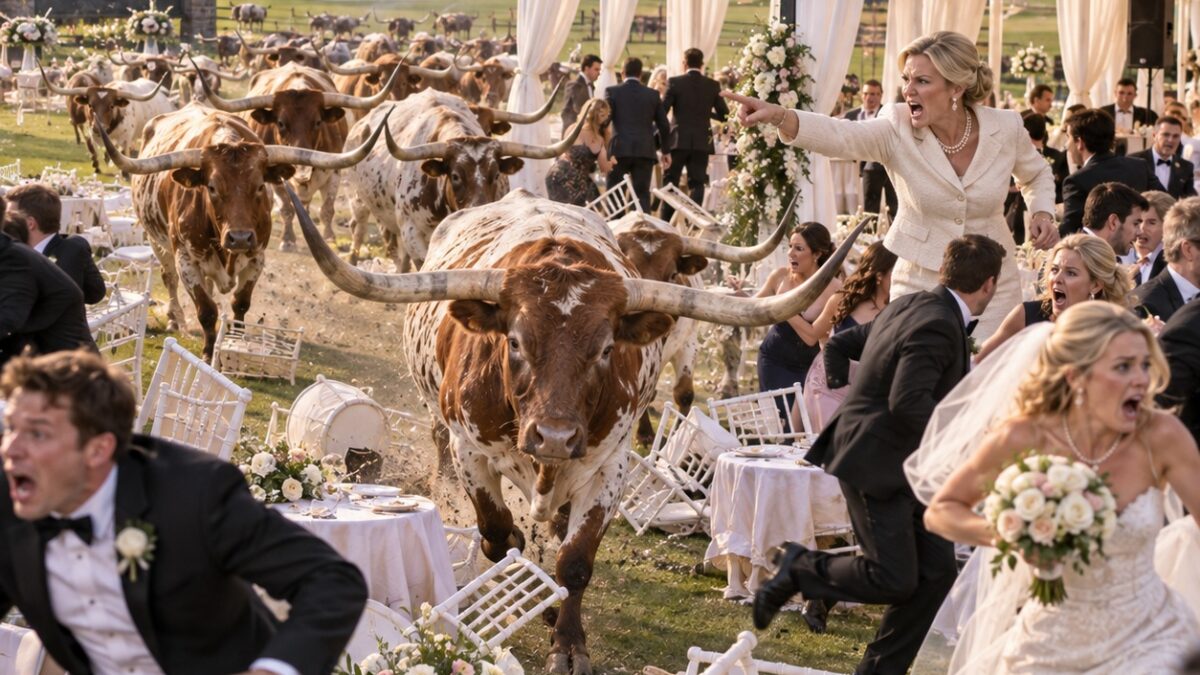
The herd moved as one body.
Seventy animals.
Horns.
Dust.
Weight.
Momentum.
South.
I grabbed the radio.
“Dana, evacuate the wedding grounds now.”
She heard the panic in my voice.
No argument.
Her deputies began shouting for workers to move.
Dana drove toward the pavilion.
Marla intercepted her golf cart.
“What are you doing?”
“Evacuating.”
“No.”
“There are seventy cattle moving toward an unsecured opening.”
“Cole is doing this deliberately.”
I heard that over the radio.
I shouted:
“I am trying to turn them!”
Luis and I drove wide.
We could not get ahead safely.
Longhorns aren’t racehorses.
But when seventy frightened animals decide on a direction, you don’t stop them with optimism.
We needed the barrier.
The barrier Marla removed.
The herd reached the ridge.
Below them:
The golf course.
White flowers.
Music stands.
Food.
People.
Apples.
Grain.
Iron Duke slowed when he saw unfamiliar ground.
That saved lives.
For a few seconds, the herd bunched.
I drove across the slope trying to turn the leaders.
Then another firework went off.
Not intentional, according to later statements.
A technician was disconnecting a test circuit and triggered it.
Boom.
Iron Duke bolted.
The herd followed.
They crossed the old fence line at 7:18 a.m.
The first thing they destroyed was not the wedding.
It was a decorative wall made of white roses.
Iron Duke went through it because it was directly in front of him.
Flowers exploded into the air.
Then three cows veered toward the catering area.
Tables went over.
A stack of champagne glasses collapsed.
Workers ran.
The band abandoned instruments.
A violin ended up in a decorative fountain.
Nobody was trampled.
That remains the most important fact.
Nobody died.
Nobody suffered serious injury.
There were bruises, falls, one sprained ankle, and a caterer who needed stitches after breaking a glass.
Considering what happened, that was a miracle.
The pavilion itself became chaos.
Guests had not arrived yet except family and wedding party.
Celeste Whitcomb was upstairs in the clubhouse getting ready.
Owen Prescott was near the ceremony stage with his groomsmen.
He saw the herd coming.
Unlike Marla, Owen had good instincts.
He started moving people out immediately.
“Get inside! Leave everything!”
Dana later told me his response probably prevented injuries.
Iron Duke entered the pavilion through an open side.
Not angry.
Confused.
His horns caught a curtain.
The curtain tore.
A chandelier swung.
Two cows followed.
Then six.
Temporary flooring buckled.
Chairs scattered.
A longhorn calf—well, not a calf, a young steer around nine hundred pounds—somehow ended up with a white floral garland hanging from one horn.
If the situation hadn’t been so dangerous, it would have been funny.
I parked the truck at the far end and climbed onto the bed.
“Duke!”
He knew my voice.
He stopped.
I whistled.
Long.
Low.
Luis opened a service lane toward the west.
Some cows turned.
Then catering trays hit the floor.
Food.
The herd split.
Half toward me.
Half toward breakfast.
Marla ran onto the fairway screaming.
“Get them out!”
I nearly lost my mind.
“Stop yelling!”
“This is my daughter’s wedding!”
“And those are cattle!”
“Do something!”
“I have been trying to since two-thirteen!”
She picked up a metal serving tray and waved it.
Iron Duke lifted his head.
I shouted:
“Put that down!”
She didn’t.
The tray flashed.
He took two steps toward her.
Marla froze.
I jumped down from the truck slowly.
“Don’t move.”
Her face went white.
Iron Duke wasn’t charging.
He was curious.
But curiosity from nineteen hundred pounds looks different when you’re wearing pearls.
I approached from the side.
“Duke.”
His ear turned.
“Come on, boy.”
I whistled.
He looked at me.
Then at an overturned bowl of apples.
Damn apples.
He walked toward them instead.
Marla backed away.
One step.
Two.
Then ran.
Wrong move.
Duke lifted his head.
I slapped the truck door.
Loud.
His attention shifted.
Luis opened a sack of cubes thirty yards west.
Iron Duke smelled feed.
Turned.
Followed Luis.
The herd slowly began moving.
It took forty-five minutes to clear the golf course.
Forty-five minutes of chaos.
Flowers crushed.
Tables overturned.
A decorative arch split in half.
White aisle carpet turned brown.
One golf cart tipped into a bunker.
A cake taller than some children collapsed after a cow bumped the service table.
No one could later agree whether the cake was worth twelve thousand dollars or twenty.
I did not care.
By 8:05, every longhorn was back on Mercer Ridge.
By 8:20, temporary panels finally stood where the original fence had been.
Marla watched.
She did not object this time.
Her million-dollar wedding site looked like a tornado had attended the rehearsal.
She walked toward me.
Mud on her cream suit.
One pearl missing.
For the first time since I’d known her, she didn’t look powerful.
She looked furious and afraid.
“You did this.”
I stared.
“You cut my fence.”
“You drove them here.”
“I drove them away until fireworks sent them through your opening.”
“My attorneys will destroy you.”
“Tell them to call Russell.”
“This is millions in damages.”
“Then I hope your insurance company likes photographs.”
She stepped closer.
“You will pay for every dollar.”
Dana appeared beside us.
“Mrs. Whitcomb.”
Marla ignored her.
I said:
“Your contractor admitted on video you ordered the fence removed before I could contact the county.”
Her face tightened.
“And we photographed feed placed beside the opening.”
“That was catering.”
“In open livestock sacks?”
Silence.
Dana asked:
“Who placed the feed?”
Marla said:
“I don’t know.”
“Who hired Wade?”
“The events committee.”
“Which you chair?”
“That means nothing.”
Dana looked tired.
“It means I’ll be asking questions.”
Then Celeste arrived.
Wedding dress partly on.
Hair pinned.
No veil yet.
She stopped at the edge of the destroyed pavilion.
I will never forget her face.
Not rage.
Heartbreak.
She looked at her mother.
“What happened?”
Marla immediately pointed at me.
“He released his cattle.”
I said:
“No.”
Celeste looked at me.
Marla continued.
“He’s been fighting the HOA for years.”
“Mom.”
“He intentionally—”
“Mom.”
Celeste’s voice cracked.
“Why is there a fence crew?”
Marla stopped.
Celeste looked toward the temporary panels.
Then at the cut oak posts in the ditch.
Owen walked up behind her.
His shirt was dirty.
One sleeve torn.
He looked at me.
“Did they remove your fence?”
“Yes.”
Marla snapped:
“Don’t talk to him.”
Owen ignored her.
“When?”
“Two-thirteen this morning.”
He looked at Celeste.
Her face changed.
“Mom?”
Marla said:
“The boundary was wrong.”
“Why would you remove it on my wedding day?”
“To fix the layout.”
Celeste stared at the crushed flowers.
Owen said quietly:
“You told me the Mercer strip was leased.”
I looked at him.
“What?”
Marla’s jaw tightened.
Owen continued:
“You said the ranch owner signed a temporary-use agreement.”
“I never signed anything.”
Celeste turned fully toward her mother.
“You said he was being paid.”
Marla said:
“This is not the time.”
That sentence almost made me laugh.
Not the time.
As if there would be a better moment to explain why seventy longhorns had walked through the center of a wedding.
Owen took out his phone.
“I have the contract.”
My attorney arrived at 8:37.
Russell Pike drove an ancient silver Lexus because he believed buying a new car encouraged clients to question invoices.
He stepped out wearing jeans, boots, and a blue dress shirt.
Looked at the pavilion.
Looked at me.
Then said:
“I leave you alone for one Saturday.”
“Good morning.”
“Any fatalities?”
“No.”
“Then it’s a good morning.”
He met Dana.
Reviewed the situation.
Then Owen showed us the temporary-use agreement.
My name was on it.
Cole Mercer.
Signature beneath.
Not mine.
The agreement granted Silvercrest HOA temporary access to 2.4 acres of Mercer Ridge for wedding and event staging in exchange for twenty-five thousand dollars.
I stared.
Russell asked:
“Did you sign?”
“No.”
“Did you receive money?”
“No.”
He looked at Marla.
She said nothing.
Russell photographed every page.
Then he looked at Dana.
“This is no longer only a boundary dispute.”
Dana nodded.
Forgery changes things.
So does fraudulent use of property.
Marla’s attorney arrived within an hour.
By then, the wedding was postponed.
Not canceled entirely.
Celeste and Owen eventually married three days later at a small church.
I learned that afterward.
That morning, they left the property separately from Marla.
I felt sorry for them.
Especially Celeste.
She had not cut my fence.
She had believed her mother when told the land was legally leased.
Her wedding became collateral damage in a fight she didn’t understand.
I never celebrated that.
People later made memes about longhorns crashing a luxury wedding.
Local news loved it.
One headline:
LONGHORNS OBJECT TO HOA WEDDING VENUE.
Luis printed that one and taped it inside the equipment shed.
I removed it.
He put it back.
Eventually I surrendered.
But the wedding destruction was only the beginning.
That afternoon, Russell and I sat in my kitchen with maps covering the table.
The forged temporary-use agreement sat between us.
Dana had already copied it.
Russell read again.
“This signature is bad.”
“I’ve signed enough documents with you that I’d hope you’d know.”
“It’s not just bad visually.”
He pointed.
“Your middle initial.”
I looked.
Cole R. Mercer.
My middle name is Daniel.
I never use a middle initial on legal documents.
Russell smiled.
“Amateurs.”
“Can we prove who made it?”
“Eventually.”
I looked at the boundary map.
“What about Landmark Regional?”
He had already searched.
“No Texas surveying firm by that exact name.”
“Marla invented a company?”
“Maybe. There is Landmark Regional Planning LLC.”
“Surveyors?”
“Consultants.”
“Owned by?”
He turned his laptop.
Whitcomb Advisory Holdings.
Marla’s husband, Gregory Whitcomb, owned fifty-one percent.
I stared.
“She gave me a survey from her husband’s company.”
“Apparently.”
“That’s insane.”
“Arrogance often looks insane after evidence exists.”
Russell zoomed in on the altered boundary.
Then frowned.
“What?”
“This line doesn’t stop at the wedding area.”
I leaned closer.
He was right.
The revised line ran almost three-quarters of a mile along Mercer Ridge.
It shifted different amounts.
Thirty feet.
Seventy.
Then over a hundred near Dry Creek.
Dry Creek was not much of a creek most of the year.
But it mattered because of what lay beneath it.
A permitted well field.
Three wells.
And a senior groundwater allocation my grandfather had secured decades earlier.
Silvercrest had water problems.
Everyone knew.
The development’s primary wells had declined over the past five years.
They supplemented through a municipal agreement that became more expensive every year.
I’d received purchase offers for my water rights.
Rejected them.
Russell tapped the map.
“Cole.”
“I see it.”
The altered boundary swallowed two of my wellheads.
Not all three.
Enough.
I sat back.
“The wedding wasn’t the reason.”
“No.”
“It was cover.”
“Maybe.”
Russell never let me leap faster than evidence.
“We prove first.”
We started proving.
The forged wedding agreement led to the HOA’s records.
Silvercrest residents were furious.
Not at me.
At first, some were.
Videos of cattle destroying the pavilion spread before facts.
I received threats.
Messages.
One voicemail:
You ruined a girl’s wedding because you hate rich people.
I laughed at that.
Mercer Ridge was worth more than most Silvercrest houses combined.
Land-rich is still rich.
The class-war story didn’t fit.
Then Dana’s office released a short statement confirming investigation into destruction of a privately recorded fence and a disputed temporary-use agreement.
Residents started asking Marla questions.
She responded with an emergency HOA meeting.
Russell told me not to attend.
I did anyway.
He came because he didn’t trust me unsupervised.
The clubhouse ballroom held nearly four hundred residents.
Marla sat at the board table with four directors.
Celeste was not there.
Gregory Whitcomb sat in the front row.
Marla opened with a statement blaming “a neighboring landowner’s negligent livestock management.”
Boos started immediately.
Not everyone.
Enough.
A man named Ray Thompson—the plumber who once helped with my pump—stood.
“Did you remove his fence?”
Marla said:
“The boundary structure was improperly located.”
“That isn’t what I asked.”
Applause.
Marla’s face tightened.
“Our survey—”
“What survey?”
Another resident shouted:
“Why is it from your husband’s company?”
There it was.
Information travels.
Marla tried procedure.
“Questions will be taken at the end.”
Nobody cared.
A woman near the back shouted:
“Did the HOA pay for the wedding pavilion?”
Marla said no.
“Then why did my special assessment include event-ground improvements?”
Silence.
Russell looked at me.
That was new.
A man beside us whispered:
“They charged every household twelve hundred dollars last year for drainage, irrigation, and community improvements.”
I did math.
Six hundred homes.
$720,000.
Russell was already writing.
The meeting deteriorated.
Residents demanded invoices.
Board members looked uncomfortable.
One director, Samuel Beck, leaned toward Marla and whispered something.
She snapped at him.
Microphone caught it.
“Not here.”
Everyone heard.
The room erupted.
That was the beginning of Marla losing control of Silvercrest.
Within forty-eight hours, three board members requested an independent financial audit.
One resigned.
Samuel Beck contacted Russell privately.
“I think there’s something wrong.”
Russell asked:
“With what?”
“Everything.”
Samuel had joined the board eight months earlier.
Retired accountant.
He thought volunteering would involve landscaping budgets and pool repairs.
Instead, Marla kept major contracts under an “executive committee.”
Payments moved through management companies.
Capital projects approved in bundles.
Supporting invoices were often delayed.
Samuel had complained.
Marla told him previous boards had established the system.
Now he wasn’t sure.
He brought copies.
Not stolen.
Board documents he was authorized to possess.
Russell wouldn’t touch them until Silvercrest’s independent counsel approved disclosure.
Again, process.
When approved, the numbers were ugly.
Over three years, Silvercrest HOA had paid nearly $4.2 million to companies connected directly or indirectly to Marla, Gregory, Wade Halbrook, or two other board insiders.
Not all fraudulent.
Some companies performed work.
But pricing looked inflated.
A drainage repair billed at $680,000 had county permits showing actual scope closer to $240,000.
A landscaping contract paid twice.
Consulting fees to Whitcomb Advisory Holdings.
Event-development studies.
Water infrastructure feasibility.
There.
Water.
Russell called me at 10:30 one night.
“Come to the office.”
“Tomorrow.”
“No.”
I drove.
He had three maps open.
Silvercrest had commissioned a “western expansion and water-resilience plan” eighteen months earlier.
Never presented to the full HOA.
Prepared by Whitcomb Advisory.
The plan identified Mercer Ridge as “strategic acquisition target.”
I stared at the phrase.
Acquisition target.
Not neighbor.
Target.
The report proposed:
Phase one: establish disputed boundary through historical-access claims and revised survey interpretation.
Phase two: obtain control of Dry Creek well corridor.
Phase three: negotiate easement expansion.
Phase four: acquire southern Mercer acreage through tax, lien, or partition opportunities.
I read “partition” twice.
“How could they partition land they don’t own?”
Russell shook his head.
“They couldn’t, unless they created some ownership interest first.”
“The LLC?”
“What LLC?”
I told him about Marla’s previous offers for “community partnership.”
One proposal, months earlier, had suggested I contribute eighty acres into a joint development entity in exchange for profit share.
I threw it away.
Russell asked:
“Do you still have it?”
“Maybe.”
We found it in my study.
The entity:
Silvercrest Western Land Cooperative LLC.
I had never looked closely.
Russell searched.
Manager: Whitcomb Advisory Holdings.
Minority member: Halbrook Development.
Proposed future member: Mercer Agricultural Holdings.
Me.
If I had signed, they would have gained contractual rights.
I hadn’t.
So Marla shifted to boundary claims.
The wedding was not just a party.
It was an opportunity to establish visible use of the disputed strip.
Temporary pavilion.
Guest access.
Service vehicles.
Photographs.
Possibly later statements that the HOA had historically used the area without objection.
One weekend would not magically create adverse possession in Texas.
Not even close.
But Marla wasn’t building one case.
She was manufacturing layers.
Confusion.
Paper.
Use.
Maps.
Agreements.
Then pressure.
Russell said:
“She doesn’t need a perfect legal claim if she can make fighting expensive.”
That was the strategy.
Wear me down.
Make lenders nervous.
Create title exceptions.
Threaten water access.
Then offer to buy.
I thought about the feed sacks.
“Would she intentionally send cattle through her daughter’s wedding?”
Russell looked at me.
“No.”
That was too far.
“I think the feed was there because caterers or event staff were stupid.”
“Or because they wanted livestock near the opening.”
“Possible.”
“We need evidence.”
Always.
Dana found it.
Not directly against Marla.
Against Wade.
One of his workers, a twenty-two-year-old named Travis Bell, came forward.
He had helped remove the fence.
He told investigators Marla ordered the crew to place “some ranch feed” near the opening so cattle would be visible in wedding photos.
Why?
She wanted photographs of cattle wandering onto Silvercrest.
Then she could argue my livestock regularly crossed an “unfenced disputed boundary,” supporting nuisance complaints and emergency fencing authority.
She had not planned a stampede.
She wanted a few cows.
A picturesque nuisance.
Something she could use.
Instead, fireworks and open space turned manipulation into disaster.
Travis had text messages.
Marla:
Leave two feed bags near south service lane. Need evidence Mercer livestock cross.
Wade:
Fence won’t be down long enough.
Marla:
Long enough.
That message became central.
The wedding had not merely collided with her property scheme.
It had been part of it.
Dana referred the evidence to the county prosecutor.
Meanwhile, the HOA audit expanded.
Residents formed a recall committee.
Marla accused me of orchestrating it.
I had nothing to do with the petition.
I did, however, receive a certified letter from her attorney demanding $3.7 million in wedding damages.
Russell framed it.
Hung it in his office.
I told him that was unprofessional.
He said:
“So is demanding three-point-seven million after cutting the defendant’s fence.”
We responded.
Trespass.
Fence destruction.
Forgery.
Property damage.
Livestock-control interference.
Costs.
Not emotional theatrics.
Numbers.
I claimed actual ranch damages.
Veterinary checks.
Fence replacement.
Lost grazing use.
Labor.
Legal fees where recoverable.
A little over $86,000 initially.
Russell asked if I wanted to sue for punitive damages.
“If evidence supports it.”
“Who are you and what have you done with Cole?”
“My father taught me not to exaggerate invoices.”
“Your father also threatened a feed salesman with a shovel.”
“Context.”
The forged temporary-use agreement was traced through metadata.
Created on a laptop registered to Whitcomb Advisory.
Edited by Marla’s assistant.
The assistant cooperated.
She said Marla gave her an old scan of my signature from a rejected land proposal and told her to “drop it in.”
That was the phrase.
Drop it in.
Forgery reduced to graphic design.
The assistant claimed she believed I had verbally agreed.
Maybe.
Prosecutors would decide.
Then the altered boundary map.
Whitcomb Advisory had hired a legitimate survey technician—not a licensed surveyor—to overlay tax-parcel data for planning.
Marla later removed disclaimers and added the name Landmark Regional Survey.
No such firm.
The “signature” belonged to an engineer who had never seen the map.
More forgery.
The water plan became public during HOA litigation.
That’s when Silvercrest residents learned the scale of the problem.
Their HOA had spent nearly $900,000 studying water acquisition without member approval.
Another $1.3 million had gone to “infrastructure consulting.”
Some money traced to Gregory Whitcomb’s company.
Some to Halbrook.
Some remained unexplained.
The county opened a broader investigation.
Then state regulators became interested because water permits were involved.
Marla’s kingdom began collapsing.
But before it did, she tried one more move against me.
A week after the wedding, my cattle troughs in the southern pasture stopped filling.
The well pump ran.
Pressure low.
Luis checked.
One valve on a buried supply line had been closed.
Not broken.
Closed manually.
The valve sat near the Silvercrest boundary.
Inside my fence.
Temporary security camera caught a man in a Silvercrest maintenance uniform crossing at 4:18 a.m.
Dana identified him.
He said Marla told him the valve served Silvercrest irrigation and needed to be shut during repairs.
He believed her.
Again.
Marla used employees who thought instructions were legitimate.
Russell looked at the video.
“Water.”
“She still wants pressure on the wells.”
“Yes.”
“Why?”
He pulled county planning records.
Silvercrest’s municipal water supplement contract would increase nearly forty percent the next year.
The HOA reserve couldn’t absorb it without raising dues significantly.
Marla had promised residents no major increase.
Election season.
Her solution was Mercer Ridge water.
If she gained access to two wells, Silvercrest could reduce purchased water and stabilize costs.
That alone might have made her popular.
But there was more.
Whitcomb Advisory had negotiated privately with a luxury development group interested in expanding Silvercrest westward.
Across my land.
The deal depended on water.
No water, no expansion.
If Marla delivered the well corridor and enough acreage, her family company stood to receive millions in development fees and equity.
There.
The real target.
Not fence.
Not wedding.
Not even the HOA.
My ranch was the missing piece in a private development plan.
And the southern boundary was where she intended to start cutting.
Literally.
When Russell showed me the term sheet, I felt something colder than anger.
Betrayal is strange when it comes from someone you never trusted.
Marla wasn’t family.
I didn’t feel personally wounded.
I felt invaded.
My grandfather’s land.
My father’s fence.
My water.
Reduced to a line item in a document I had never agreed to.
Strategic acquisition target.
I drove the ranch that night.
From south pasture to Dry Creek.
The land wasn’t dramatic in darkness.
Dust.
Mesquite.
Cattle silhouettes.
A windmill creaking.
People see nine hundred acres and think wealth.
I saw work.
My father repairing water lines at midnight.
Granddad teaching me to stretch wire.
My mother bringing lemonade to branding crews.
Luis’s father digging post holes.
A calf buried near the old pecan stand because my sister couldn’t bear to leave it for coyotes.
Land collects lives.
That’s why people fight over it in ways spreadsheets never understand.
But I also knew sentimental ownership can make people stupid.
Granddad once refused a profitable pipeline easement out of spite.
Cost the family money.
Dad nearly lost pasture during drought because he hated banks.
I promised myself I wouldn’t confuse preservation with ego.
So I asked Russell:
“If Silvercrest made a legitimate offer for water, should I consider it?”
He looked surprised.
“Yes.”
“What?”
“You expected me to say never?”
“Yes.”
“That’s why I’m your lawyer, not your grandfather.”
We commissioned an independent hydrology study.
My wells had capacity.
A carefully structured water-sharing agreement might benefit both properties without surrendering ownership.
That became important later.
Because I didn’t want the lesson to be:
Never cooperate.
The lesson was:
Cooperation without consent is theft wearing a tie.
Marla’s recall vote happened six weeks after the wedding.
I watched online.
Did not attend.
Eighty-one percent voted to remove her.
Three other board members resigned before the vote.
Samuel Beck became interim president.
His first public statement apologized to residents and to Mercer Ridge.
I appreciated that.
Then he called me.
“Can we meet?”
Russell came.
So did Luis because he had earned the right to watch rich people apologize.
We met at Silvercrest clubhouse.
The same building where wedding preparations had started.
The golf course had recovered visually.
Grass repaired.
Pavilion gone.
A few oak posts from my old fence remained in evidence storage.
Samuel sat across from us with the HOA’s new counsel.
“We want to resolve the property dispute.”
Russell said:
“There is no legitimate property dispute.”
Counsel nodded.
“We agree.”
That sentence felt good.
Samuel slid a document across.
Formal acknowledgment of recorded boundary.
Withdrawal of all contrary maps.
Permanent access restrictions.
Payment for fence replacement and livestock-control costs.
Separate negotiation for broader damages.
I read.
“What about the water?”
Samuel looked embarrassed.
“We need water.”
Honesty.
Good beginning.
“How badly?”
“Badly.”
Russell leaned back.
“Now we’re having a real conversation.”
Silvercrest’s municipal cost projections were ugly.
Residents faced dues increases.
Some retirees on fixed incomes were frightened.
I knew several.
None had forged my name.
I could punish community by refusing everything.
Legally.
Emotionally satisfying for about a week.
Or negotiate from strength.
We did.
It took four months.
Independent engineers.
County permits.
Environmental review.
Metering.
Pricing.
Drought protections.
Mercer Ridge retained ownership of wells and all underlying rights.
Silvercrest received a limited purchase agreement for excess capacity.
No permanent easement beyond a narrow pipeline corridor.
Automatic shutoff if aquifer levels fell below thresholds.
Rates indexed fairly.
No development expansion rights.
No transfer to third parties.
Most important:
The agreement specifically prohibited using water availability to support expansion onto Mercer Ridge without my written approval.
Samuel said:
“That is unusually specific.”
I said:
“I’ve met your former president.”
Fair.
The agreement helped Silvercrest.
It also paid Mercer Ridge enough to modernize pumps, fencing, and conservation systems.
My grandfather would’ve called me a sellout for three days.
Then asked the price and become proud.
Luis said:
“Your father would’ve complained you didn’t charge more.”
Probably.
The fence?
We rebuilt it stronger.
Steel pipe braces.
Five-strand wire.
Stone boundary markers every hundred yards.
Not because Marla might return.
Because clarity matters.
Silvercrest paid.
I insisted on one additional condition.
A gate.
Shared emergency gate between the golf course service road and my pasture.
Locked.
Access controlled.
For fire, medical, or livestock emergency only.
Why?
Because the old hostility had made both properties less safe.
A wildfire doesn’t care about deeds.
That surprised Samuel.
“You want a connection?”
“A controlled one.”
Boundaries don’t require isolation.
Just permission.
The criminal cases moved slower.
Marla was charged with multiple offenses related to forged documents, criminal mischief, and financial misconduct.
Gregory faced separate fraud and conspiracy allegations tied to HOA contracts.
Wade cooperated.
His company paid restitution and lost Silvercrest work.
He avoided the worst charges by providing records showing Marla’s instructions.
Some residents wanted him destroyed.
I didn’t care.
He cut my fence knowingly.
He paid.
He testified.
Process.
The financial investigation found roughly $2.8 million in HOA funds had been improperly diverted or obtained through inflated related-party contracts.
Not every dollar personally stolen.
Important distinction.
Some work existed.
Some prices were padded.
Some consulting had little value.
A portion went directly to Whitcomb-controlled entities.
Restitution orders and civil settlements recovered significant amounts.
Insurance covered parts.
Not all.
Marla eventually pleaded guilty to several felony counts rather than face trial on everything.
I attended sentencing because prosecutors asked me to speak about the property offense.
I almost didn’t.
Then I did.
Marla sat at the defense table.
No pearls.
Gray suit.
Hair simpler.
She looked older.
Not destroyed.
Human.
The prosecutor described the fence removal.
The forged agreement.
The fake survey.
The feed placement.
The financial scheme.
Then I stood.
“I don’t want to speak about a wedding.”
The judge looked up.
“That event got attention, but it is not why I’m here.”
I looked at Marla.
“The dangerous part wasn’t seventy cattle crossing a golf course.
The dangerous part was the belief that ownership could be manufactured by confidence.
Mrs. Whitcomb believed that if she created enough paper, enough use, enough pressure, and enough confusion, eventually my no would become inconvenient enough to stop mattering.
That is what harmed me.
It harmed Silvercrest residents too.
They thought she was protecting their community while she was using their dues to build leverage for private deals.
I am not asking the court to punish ambition.
I am asking the court to recognize that consent does not disappear because someone with more money, lawyers, or institutional power finds it inconvenient.”
I stopped.
Then added:
“My ranch survived.
The fence was rebuilt.
Silvercrest and Mercer Ridge now have a legal water agreement that should have been negotiated honestly from the beginning.
None of the damage was necessary.”
That was all.
Marla received prison time followed by supervised release and restitution obligations.
Not decades.
Not some fantasy sentence.
Enough.
Gregory’s case resolved separately.
He lost his advisory company after lenders and clients withdrew.
Wade’s business survived smaller.
Celeste and Owen moved to Colorado.
I learned that through a letter.
Yes.
Celeste wrote me.
About eight months after the wedding.
The envelope arrived at the ranch.
Handwritten.
Mr. Mercer,
I have wanted to write for months but did not know whether contacting you would make things worse.
I am sorry for what happened on your property.
I believed my mother when she told us the land had been leased legally. Owen questioned it, but I told him she had handled everything because that is what she had always done.
We got married three days later with thirty-two people in my aunt’s church.
It was not the wedding I planned.
It may have been better.
I used to think what happened that morning ruined my wedding.
Now I understand the wedding exposed something that had been wrong much longer.
I am sorry your animals were put in danger.
I am sorry you were blamed.
Thank you for trying to protect people even when my mother was refusing to listen.
Celeste Prescott
I read it twice.
Then wrote back.
Congratulations on your marriage.
You do not owe me an apology for decisions you did not make.
I am glad no one was seriously hurt.
Tell Owen he moved people faster than half the security team.
And for what it’s worth, small weddings are cheaper.
I almost added a joke about cattle.
Didn’t.
Growth.
A year after the fence incident, Mercer Ridge looked normal again.
That’s the strange part of major conflict.
Land heals visually faster than people.
Grass covered tire marks.
New posts weathered.
The golf course repaired.
The pavilion site became ordinary fairway.
If you didn’t know, you wouldn’t know.
But relationships between Silvercrest and the ranch had changed.
Better.
Residents started calling before hiking near boundaries.
The HOA stopped sending fake violation notices.
Samuel invited Luis and me to an annual emergency-planning meeting.
I complained.
Then went.
We coordinated wildfire routes.
Water access.
Livestock evacuation.
A ranch and gated development share geography whether they like each other or not.
I learned names.
People learned mine without attaching “difficult rancher.”
Ray the plumber became a friend.
His wife joined a local conservation group working on creek restoration.
Silvercrest children came to Mercer Ridge one spring for an agricultural education day.
I almost said no.
Then remembered boundaries have gates.
We hosted forty third-graders.
Iron Duke stood behind double fencing like a celebrity.
One kid asked:
“Is that the cow that ruined the wedding?”
“Bull.”
“What?”
“He’s a bull.”
“Did he ruin the wedding?”
I looked at Luis.
Luis said:
“Allegedly.”
I nearly died laughing.
Iron Duke lived six more years.
Gentle old tyrant.
We retired him from breeding.
He spent his last summers in a shaded pasture near Dry Creek.
When he died, I buried him on the ridge.
Luis carved DUKE into a limestone marker.
Under it:
2:13 A.M. SECURITY CONSULTANT.
I told him that was disrespectful.
It remains there.
The story followed me longer than expected.
News outlets called.
Podcasts.
Ranching magazines.
Property-rights groups.
One political campaign tried using it in an advertisement about local government overreach.
I refused.
Marla was an HOA president, not government.
Accuracy matters.
Another group wanted me to become a spokesperson against HOAs generally.
Also no.
Silvercrest residents had been harmed by their board.
They weren’t the enemy.
Simple villain stories travel easier.
I didn’t want one.
The truth was more useful.
Bad governance thrives when members stop looking.
Related-party contracts.
No audits.
Concentrated authority.
Emergency powers used for convenience.
Residents had assumed Marla handled everything.
Just like Celeste.
Just like some board members.
Institutional trust without verification became opportunity.
Afterward, Silvercrest changed bylaws.
Term limits.
Conflict disclosures.
Competitive bidding thresholds.
Quarterly financial reporting.
Independent audits.
Member approval for major land acquisitions.
Boring reforms.
The kind that prevent dramatic stories.
Good.
People ask whether I regret not selling the ranch when developers first came.
No.
But I also don’t romanticize ranching.
It’s expensive.
Weather doesn’t care about legacy.
Cattle markets swing.
Equipment breaks.
Land taxes rise.
There were years I considered selling pieces.
I still might someday.
Ownership isn’t a vow to dead people.
That became clearer after the conflict.
Marla tried to take choice.
My response could not become letting my grandfather take it from the grave.
Mercer Ridge is mine to steward while it’s mine.
Not to freeze forever.
Five years after the wedding, I sold twenty-two acres on the eastern edge to a conservation nonprofit.
Granddad would have objected.
The parcel protected creek habitat and paid off equipment debt.
Good decision.
I leased another section to a solar project after negotiating cattle-compatible grazing.
Also controversial.
Still mine to decide.
That’s the point.
Not never change.
Consent.
I eventually married too.
Her name is Rachel Dean.
Veterinarian.
She met Iron Duke before she met me.
Technically.
She came to treat a hoof infection.
Duke liked her immediately.
Suspicious.
Our first date happened after she told me my mineral program was “embarrassingly old-fashioned.”
Romantic.
When I told her the wedding story, she had already heard local version.
“Were there really seventy?”
“Yes.”
“Exactly?”
“Seventy.”
“Including calves?”
“No calves.”
“Then the news got one thing right.”
She married me anyway.
Our wedding?
Twenty-six people.
On Mercer Ridge.
Far from southern fence.
No fireworks.
Luis banned them.
Rachel wore boots under her dress.
Iron Duke was already gone.
His limestone marker visible on ridge.
Someone left a tiny white flower garland on it.
I suspect Luis.
He denies.
The Silvercrest HOA sent a wedding gift.
A framed copy of the new boundary survey.
Official county seal.
Samuel wrote:
WE CHECKED TWICE.
I laughed for ten minutes.
Rachel hung it in the mudroom.
People see it and ask.
We tell short version.
Usually.
The water agreement became one of the most stable income lines on the ranch.
That irony doesn’t bother me anymore.
Marla wanted my water.
Silvercrest eventually got some.
Legally.
Fairly.
With meters.
That doesn’t mean she was right.
Outcome doesn’t excuse method.
If someone breaks into your barn to steal a horse, and later you decide to sell them a horse, the burglary doesn’t become negotiation.
Important.
Samuel once said:
“If Marla had simply brought this proposal to you, would you have agreed?”
“Maybe.”
He shook his head.
“All that for maybe.”
“People who need yes immediately rarely ask questions honestly.”
We sat overlooking golf course.
A sprinkler system ran using water partly from my wells.
Metered.
Paid.
Controlled.
No resentment.
That’s what legitimate agreement looks like.
The forged documents became exhibits in an ethics seminar Russell taught to young lawyers.
He asked permission to use redacted copies.
I said yes.
Title of presentation:
WHEN THE MAP MOVES BUT THE LAND DOESN’T.
Terrible.
He loved it.
Russell retired eventually.
Before he did, he gave me the framed $3.7 million demand letter.
“I don’t want this.”
“Yes, you do.”
“No.”
“It belongs in your office.”
“It belongs in recycling.”
He looked offended.
I took it.
For three years, it sat in storage.
Then Rachel found it.
She framed it beside the official survey.
Now the mudroom has a legal museum.
I blame marriage.
Dana Holloway retired too.
At her retirement party, somebody gave her a toy longhorn wearing a tiny sheriff badge.
She pointed at me.
“You caused that.”
“You chose law enforcement.”
“You chose livestock.”
Fair.
She told me something that night I hadn’t known.
At 4:10 the morning of the wedding, while I was trying to move cattle, Marla had called the county judge asking him to order Dana off Silvercrest property.
He refused.
Then Marla called a state representative.
Then a donor.
Then someone on the sheriff’s campaign committee.
Dana laughed.
“She thought authority was a phone tree.”
“Did it work?”
“No.”
“Good.”
“Not always.”
She became serious.
“Remember that.”
I did.
Marla’s deepest flaw wasn’t greed alone.
It was belief that systems belonged to people who knew how to use them socially.
Call the right person.
Pressure the right employee.
Create the right document.
Make uncertainty expensive.
Most people back down.
She had probably succeeded before.
Not necessarily criminally.
But culturally.
That is why resistance mattered.
Not macho ranch stubbornness.
Documentation.
Calls.
Video.
Attorney.
Sheriff.
Survey.
Process.
If I had driven down there with a rifle and rage, story could have ended very differently.
Maybe with me arrested.
Maybe someone hurt.
Instead, I took photographs.
I say that when people ask what they should do in property conflicts.
Document first.
Escalate carefully.
Know title.
Know boundaries.
Call counsel.
Don’t create your own emergency because someone else created provocation.
Boring advice.
Life-saving.
I was angry enough at 2:13 to do stupid things.
The sound of chainsaws cutting my father’s posts felt personal.
That matters.
Anger often tells us something is wrong.
It does not always tell us what action is right.
Rachel says that’s the wisest thing I’ve ever said.
I tell her Russell said it.
He didn’t.
I can have one.
Ten years after the wedding, Silvercrest built a small plaque near the emergency gate.
Not about Marla.
Not about cattle.
It read:
MERCER RIDGE–SILVERCREST EMERGENCY ACCESS
AUTHORIZED USE ONLY
ESTABLISHED BY MUTUAL AGREEMENT
I liked the last two words.
Mutual agreement.
The entire saga reduced to what had been missing.
No one forced.
No forged signature.
No fake map.
Two parties.
Clear terms.
Gate closed most days.
Exactly as it should be.
One summer, wildfire came within six miles.
Dry wind.
Fast-moving.
County issued evacuation warnings.
The emergency gate opened.
Silvercrest residents used part of my service road to exit west when smoke closed their main route.
No debate.
Agreement already existed.
Later, Samuel called.
“That gate may have saved forty minutes.”
“Good.”
“You realize if Marla hadn’t cut the fence—”
“Don’t.”
He laughed.
“No silver lining?”
“Not for felonies.”
Fair.
Still, conflict produced better infrastructure because people learned.
That can be true without thanking harm.
I never thanked Marla.
I don’t hate her anymore either.
She served her sentence.
Paid restitution.
Moved out of county after release.
I heard Gregory divorced her.
Not my business.
Celeste stayed in Colorado.
She and Owen had two children.
One Christmas card arrived with both kids wearing tiny cowboy boots.
Message:
NO FIREWORKS.
I laughed.
Kept it.
People recover.
Even from weddings destroyed by seventy longhorns.
The luxury wedding cost did not ruin their marriage.
Maybe because ceremony was never marriage.
Useful distinction.
The ranch survived because fence was not ownership either.
Another useful distinction.
Structures matter.
But they represent something deeper.
Fence represented consent.
Wedding represented commitment.
HOA documents represented governance.
When the representations become more important than truth beneath them, people get lost.
Marla cared about appearing to control land more than actually obtaining lawful rights.
She cared about a perfect wedding backdrop more than safety.
She cared about promising stable dues more than honest budgets.
Image outran reality.
Eventually reality charged interest.
That’s the larger story.
Not cows.
Though cows help.
The morning after the wedding disaster, before investigations and audits, I walked the southern line alone.
Sunrise.
Workers gone.
Temporary panels stood ugly against grass.
Cut posts lay in ditch.
White rose petals were caught in barbed wire.
A champagne flute sat unbroken near a mesquite bush.
I picked it up.
Not sure why.
Kept it in the barn for years.
Rachel eventually found it.
“What is this?”
“Evidence.”
“For what?”
“Bad decisions.”
She threw it away.
Probably correct.
Objects don’t need become shrines.
The oak posts mattered more.
I saved one section from the old fence.
Dad’s initials were carved near base.
C.M.
Same initials as me.
He was Charles Mercer.
People sometimes thought I carved them.
No.
He had marked posts during repairs.
I mounted that section inside workshop.
Not revenge.
History.
The new fence does not follow exactly same materials.
Steel where wood was.
Modern wire.
Better braces.
If my father saw it, he’d complain about cost.
Then admit it’s stronger.
That’s preservation done right.
Keep line.
Improve structure.
I think family works similarly.
Ranch too.
Community.
Even institutions.
Not every old thing deserves saving.
Not every new thing deserves suspicion.
The question is whether change is chosen honestly.
Marla never asked.
That was her mistake long before she hired chainsaws.
She believed no would eventually soften under pressure.
Some people treat boundaries as opening bids.
No means negotiate.
No means wait.
No means find another angle.
If enough money involved, no becomes obstacle rather than answer.
That mindset is dangerous.
I learned to recognize it.
When a developer now says:
“We understand you’re not interested in selling, but—”
I stop them.
“If the sentence before but is true, we’re done.”
Saves time.
Rachel calls me rude.
She may be right.
I also say yes more than I used to.
Yes to easements that make sense.
Yes to conservation.
Yes to school tours.
Yes to Silvercrest emergency drills.
Yes to a trail along eastern public road after residents proposed proper fencing and liability coverage.
Boundaries make yes safer.
That’s another thing I didn’t understand before.
If you’re afraid any yes becomes permanent entitlement, you stop cooperating.
Clear no allows generous yes.
Silvercrest learned too.
When they want access, they ask.
Sometimes I say no.
No feud follows.
Healthy.
On the fifteenth anniversary of the wedding incident, Luis retired.
His son Mateo now runs much of ranch operation.
At Luis’s retirement barbecue, somebody brought a cake.
White icing.
Tiny plastic longhorns.
I stared.
Luis said:
“Too soon?”
“Fifteen years.”
“So no.”
We laughed.
Samuel attended.
Dana.
Russell.
Ray.
Even Wade Halbrook came.
That surprised me.
He had sold his company years earlier.
Looked older.
He approached.
“Cole.”
“Wade.”
“I owe you something.”
“You paid restitution.”
“Not that.”
He looked toward old fence line.
“I knew taking it down at night was wrong.”
I said nothing.
“I told myself Marla had attorneys and surveys.”
“You saw the posts.”
“Yes.”
“You knew how old they were.”
“Yes.”
“You still cut.”
He nodded.
“I wanted the contract.”
There.
No excuse.
Money.
“What do you want me to say?”
“Nothing.”
He looked embarrassed.
“I just needed to say it.”
I thought.
Then:
“Okay.”
He nodded.
Started to leave.
I added:
“You gave Dana everything later.”
“Yes.”
“That mattered.”
Not absolution.
Accuracy.
He looked relieved.
People want forgiveness to be one dramatic act.
Sometimes it’s simply letting someone remain more than the worst job they accepted.
Wade stayed for barbecue.
Luis made him sit beside survey marker.
Punishment enough.
That night, after everyone left, I walked to the southern fence.
Rachel came with me.
Moonlight.
Quiet.
No chainsaws.
No chandeliers.
No cameras.
Silvercrest houses glowed across golf course.
Different world, same ground.
Rachel leaned on fence.
“Do you ever wish you’d sold this side before all that?”
“No.”
“Never?”
I thought.
“Sometimes during legal bills.”
She laughed.
Then:
“What if our kids don’t want ranch?”
We have two.
A son, Daniel.
A daughter, Grace.
Both younger then.
I looked across pasture.
“Then we don’t make them.”
Rachel nodded.
“My dad would’ve said inheritance is obligation.”
“Mine too.”
“Grandparents.”
“Worse.”
We laughed.
Land can become emotional debt.
I refuse that.
If Daniel wants engineering, go.
If Grace wants medicine, go.
If neither wants cattle, we sell or lease.
Mercer Ridge existed before them.
It does not own them.
That may sound strange after everything I did to protect it.
But protection and imprisonment are different.
I fought for choice.
Not permanence.
Marla wanted to remove my choice.
That’s why it mattered.
Years later, when my son was sixteen, he asked:
“Dad, why didn’t you just sue Silvercrest into bankruptcy?”
I almost laughed.
“Because six hundred families didn’t cut the fence.”
“But HOA did.”
“Leadership did.”
“Members elected them.”
“Some.”
“Still.”
I looked at him.
“If someone in your class steals, should school close?”
“No.”
“Then organizations need repair, not always destruction.”
He rolled his eyes.
Teenagers hate analogies.
But he remembered.
When Grace was fourteen, she asked if Marla was evil.
“No.”
“Why not?”
“Because that’s too easy.”
“She forged stuff.”
“Yes.”
“She stole money.”
“Yes.”
“She endangered people.”
“Yes.”
“So?”
“She made criminal choices.”
Grace frowned.
“Same thing.”
“No.”
“What’s difference?”
“If I teach you only evil people do harmful things, you’ll look for horns.”
She stared at Iron Duke’s old marker.
“Seriously?”
“Not those horns.”
She laughed.
Then I continued.
“Most harmful people look ordinary. They justify. They rationalize. They think goal makes method acceptable. Better to learn behaviors than labels.”
Grace considered.
“So don’t forge deeds.”
“Excellent start.”
Parenting.
You try.
The wedding story eventually faded locally.
New scandals.
New boards.
New people.
Silvercrest expanded east instead of west after negotiating water and buying land from a willing seller.
Imagine that.
A willing seller.
No chainsaws required.
The development was successful.
Traffic worse.
I complained.
Progress.
Mercer Ridge remained.
Smaller by twenty-two conservation acres.
More efficient.
Better water systems.
New fences.
Same ridge.
At 2:13 a.m. sometimes I still wake.
Not often.
Any distant saw or engine can trigger memory.
Body remembers.
I look at clock.
Then sleep.
The fence alarm system Rachel insisted on helps.
Cameras too.
Technology my grandfather would call nonsense until he saw app.
I can check southern line from bed.
No trucks.
No floodlights.
Just cattle.
Quiet.
Peace isn’t absence of risk.
It’s confidence that boundaries will be respected or defended through systems that work.
That morning, I didn’t know if system would work.
Marla had money.
Connections.
HOA power.
Contractors.
Lawyers.
A fake map.
I had dirt, fence records, cattle, and an attorney who drove an old Lexus.
Turns out enough.
Because facts scale better than arrogance over time.
Not instantly.
Important.
At 3 a.m., arrogance looked powerful.
She had workers.
I had cut wire.
At 7 a.m., she still controlled pavilion.
At 8, cattle had destroyed it.
At noon, lawyers arrived.
But real shift took months.
Audit.
Court.
Recall.
Permits.
Records.
People telling truth.
Movies make truth explosive.
Reality makes truth cumulative.
One receipt.
One text.
One metadata file.
One board member asking why.
One worker saying what he was told.
One forged initial.
Enough pieces and story changes.
That’s why I photograph fences.
That’s why Silvercrest audits contracts now.
Memory is unreliable.
Paper helps.
Though paper can lie too.
Then verify paper.
The old forged survey hangs nowhere.
Russell asked if I wanted it.
“No.”
“Historic.”
“Trash.”
He archived legal copy.
Original destroyed after case.
Good.
Fake maps don’t deserve wall space.
Official survey in mudroom is enough.
When guests ask why, Rachel tells them:
“Cole once had a boundary disagreement.”
Understatement.
I say:
“There were cows.”
Then kids take over.
Daniel exaggerates cake height.
Grace adds that Iron Duke chased Marla.
He didn’t.
I correct every time.
“He did not chase her.”
“She ran.”
“Yes.”
“He followed.”
“He looked.”
“Dad.”
“Accuracy.”
They groan.
Good.
Stories grow horns too.
Pun intended.
I want truth.
The truth is enough.
At 2:13 a.m., Marla Whitcomb ordered contractors to remove nearly two hundred yards of a sixty-year fence because she believed she could turn a fabricated boundary into reality before I had time to stop her.
She used her daughter’s wedding as cover for a broader plan to establish use, pressure my title, reach my water corridor, and support a development deal worth millions.
She forged a temporary-use agreement.
Altered a map.
Used HOA funds through conflicted contracts.
Placed feed near an opening to create photographic evidence of livestock crossing.
She did not intend seventy longhorns to stampede through the wedding.
That was consequence of arrogance meeting animal behavior.
Nobody serious should celebrate the danger.
I don’t.
But symbolism is hard to miss.
She removed a boundary.
Then lost control of what came through it.
People remember that.
So do I.
But the lesson isn’t cosmic justice.
It’s practical.
Boundaries exist for reasons you may not understand.
Property line.
Financial control.
Board procedure.
Safety rule.
Consent.
You don’t get to remove one because it obstructs your plan and then act shocked when consequences cross with it.
That applies far beyond ranch fences.
On the morning of the wedding, after the herd was finally secured, I stood beside the new temporary panels.
Sun fully up.
Marla across fairway speaking with attorneys.
White flowers crushed into mud.
Police vehicles.
News helicopter in distance.
Luis came beside me.
“You okay?”
“No.”
“Good.”
I looked at him.
“Why good?”
“If you said yes, I’d think you hit your head.”
Fair.
He handed me coffee.
Terrible coffee.
I drank anyway.
We stared at Iron Duke grazing like nothing happened.
Luis said:
“He doesn’t know he ruined a million-dollar wedding.”
“He didn’t.”
“Who did?”
I looked across boundary.
“People.”
Luis nodded.
“Usually.”
That may be the cleanest summary.
The cattle weren’t villains.
Not heroes.
Animals.
Fence failed because humans removed it.
Wedding failed because humans ignored warnings.
Fraud happened because humans decided paperwork was flexible.
Community suffered because humans stopped checking leaders.
Repair happened because humans finally did.
People.
Usually.
I kept that coffee cup too?
No.
I threw it away.
Not everything is symbolic.
The day after sentencing, I walked to southern line at sunrise.
Rachel wasn’t in my life yet.
Luis was asleep.
Russell probably billing someone.
I stood alone.
New fence gleamed.
Silvercrest quiet.
I placed my hand on one steel brace.
Cold.
Strong.
Different from oak.
I thought of Dad.
Granddad.
Marla.
Celeste.
All the people whose choices had somehow met at that fence.
Then I opened the gate.
Not the emergency gate.
My ranch gate.
Walked through.
Checked the outside posts.
Came back.
Closed it.
Latched.
Simple.
A boundary doesn’t need drama when everyone agrees where it is.
That’s what I wanted from the beginning.
Not victory.
Clarity.
Years later, Samuel invited me to Silvercrest’s twentieth-anniversary dinner.
I said no.
He said:
“Come on.”
“No.”
“Residents like you now.”
“That sounds dangerous.”
“We’ll have steak.”
“From where?”
“Not your cattle.”
“Then definitely no.”
He laughed.
I eventually went.
Rachel made me.
The ballroom was renovated.
On one wall hung historical photographs.
Construction.
Golf course opening.
Community events.
I scanned them.
No wedding.
Good.
Some history doesn’t need promotional framing.
Samuel gave speech about governance reform.
Then said:
“We learned the expensive way that good fences actually do make good neighbors.”
Everyone looked at me.
I wanted floor to open.
Rachel laughed.
I raised my glass.
That became the public ending.
But privately, ending happened much later.
My daughter Grace was twenty-one.
She came home from college.
We sat on porch.
She said:
“Dad, I don’t want ranch.”
There it was.
The sentence generations of Mercer men probably feared most.
I took a breath.
“Okay.”
She looked shocked.
“Okay?”
“Yes.”
“You’re not mad?”
“No.”
“Daniel might not want it either.”
“Then we’ll make plan.”
She stared.
“I thought you’d say it’s our responsibility.”
“No.”
“Grandpa would’ve.”
“Yes.”
“Why don’t you?”
I looked toward southern fence.
Silvercrest lights beyond.
Because I had spent too many years fighting someone who believed wanting my land gave her rights over my decisions.
I wasn’t going to do same thing to my children in reverse.
I said:
“Ownership only means something if choice is real.”
Grace nodded slowly.
Then:
“Can I still ride here?”
I laughed.
“It’s not disappearing tomorrow.”
That night, I thought about Marla.
Strangely.
All those years earlier she had treated Mercer Ridge as something she could acquire if she applied enough pressure.
I had spent years defending my right to say no.
Now I needed to defend my children’s right to say no too.
Same principle.
Different direction.
That’s when I understood fully what the fence had represented.
Not land.
Consent.
A physical line saying:
This side is mine to manage.
That side is yours.
We can cooperate.
We can trade.
We can open gates.
But nobody crosses by cutting through in darkness.
Not HOA.
Not family.
Not legacy.
No one.
Today, Mercer Ridge still runs cattle.
Fewer than seventy longhorns now.
Different genetics.
Iron Duke’s descendants among them.
The southern fence remains exactly on the recorded line.
Official markers.
No dispute.
Silvercrest buys water through metered agreement.
The emergency gate opens twice a year for drills and occasionally for actual need.
Residents wave when I drive by.
Some still tell wedding story.
They get details wrong.
That’s fine.
Mostly.
Rachel says I need to stop correcting the number of chairs.
I cannot.
There were 312.
Not 350.
Accuracy.
Marla’s fake map is gone.
Forged agreement void.
The development company moved on.
The stolen HOA money became restitution schedules and insurance claims.
Celeste has a good marriage as far as I know.
Wade learned expensive lesson.
Samuel learned never volunteer casually.
Dana enjoys retirement.
Russell complains retirement is boring and still reviews my contracts unofficially while pretending he doesn’t.
Luis fishes more than any retired man deserves.
And me?
I sleep better.
Most nights.
When chainsaws wake me now, they’re usually mine.
Planned work.
Daylight.
Permits.
People who asked.
That’s the difference.
A fence is easy to cut.
Trust takes longer.
Marla cut both before sunrise.
The wood and wire took one day to replace temporarily.
The trust took years.
But it came back stronger too.
Not because everyone became friends.
Because everyone learned process.
Sometimes that’s enough.
The last piece of the original southern fence sits in my workshop.
Oak.
Weathered.
Dad’s initials near the base.
C.M.
Beside it hangs the official Silvercrest-Mercer emergency-access agreement.
Rachel says my workshop looks like a courthouse married a feed store.
Accurate.
I keep those two things for one reason.
The post reminds me boundaries need maintenance.
The agreement reminds me boundaries can include cooperation.
One without the other becomes isolation.
Or chaos.
I want neither.
Every spring, when grass turns green along the southern line, longhorns gather near Silvercrest because golf-course irrigation makes that side smell fresh.
Kids sometimes watch from behind their fence.
My cattle watch back.
No one crosses.
No crisis.
No wedding cake.
Just neighbors separated by wire that both sides respect.
That is the ending Marla could have had from the beginning.
All she had to do was ask.
She didn’t.
At 2:13 in the morning, she chose chainsaws instead.
By sunrise, she thought the missing fence proved she had won.
By noon, she understood the truth.
Removing a boundary does not make what lies beyond it yours.
Sometimes it only gives the consequences a way through.








