The HOA Sold Six Weddings Around My Private Boat Ramp—Then I Asked Who Approved the Access
I looked at Clare.
“What do you mean?”
She turned her laptop toward me.
“I mean exactly what I said.”
On her screen was Victoria’s email.
The sentence was highlighted.
Closing or restricting the Mercer ramp would interfere with the Pavilion at Hawthorne Lake’s approved guest embarkation route and place the association in violation of existing event commitments.
Clare tapped the words.
“Approved guest embarkation route.”
“So?”
“So that isn’t casual HOA language.”
“What is it?”
“Permitting language.”
I sat back.
Clare had practiced waterfront and land-use law for almost eighteen years.
She was not dramatic.
That was one reason I hired her.
She wore black-framed glasses, kept her office colder than any human being needed, and had a habit of going completely silent whenever she found something interesting.
She was silent now.
I didn’t like that.
“Clare.”
She opened another browser window.
“What permits would they need?”
“For a floating commercial event venue?”
“Yes.”
She started counting on her fingers.
“County land-use approvals. Fire review. Occupancy approvals. Water-access plan. Emergency evacuation plan. Possibly environmental sign-off depending on what they installed. Food-service permitting. Marina or dock approvals. Commercial liability documentation.”
“And?”
“And somewhere in that process, somebody almost certainly had to explain how several hundred guests and commercial vendors would get on and off a structure floating in the lake.”
I looked toward the copy of my deed on her desk.
“And they used my ramp.”
“Maybe.”
“They definitely used it.”
“I mean on the application.”
That was different.
I felt something tighten in my chest.
“If they identified my property as their access route…”
“Without your authorization…”
She didn’t finish.
She didn’t need to.
“Can we get the applications?”
“They should be public record.”
“How long?”
“I’m requesting them today.”
I stood.
Clare looked up.
“Where are you going?”
“To work.”
“Ryan.”
“What?”
“Do not confront Victoria.”
“I wasn’t planning to.”
“That sentence from men your age usually means the opposite.”
“I own a marine engine shop, Clare. I am not storming an HOA clubhouse.”
“Good.”
I reached for my folder.
“What I am doing is installing the gate I already ordered.”
She removed her glasses.
“When?”
“Tomorrow.”
“Then send formal notice first.”
“Already drafted?”
She gave me a flat look.
“You hired me for a reason.”
By noon, the HOA had received written notice.
The letter was simple.
The recorded easement remained available for the exact purposes specified in the instrument: construction, inspection, repair, replacement, and maintenance associated with the original community dock facilities.
All informal permission for event-related commercial use was withdrawn.
No catering companies.
No guest shuttles.
No wedding vendors.
No commercial boat launching.
No event trucks.
No rental companies.
No temporary staging.
If the HOA believed it possessed broader rights, it was invited to provide the recorded instrument establishing them.
I thought that would force a conversation.
Instead, Victoria installed another sign.
EVENT ACCESS — THIS WAY.
On my land.
Again.
I came home at lunch, pulled it out of the dirt, and leaned it carefully against the county-road marker.
Then I photographed it.
An hour later, I received an email.
Ryan,
Your continued interference with established association access is becoming unacceptable.
The Hawthorne Cove board expects immediate restoration of all event-related access and reserves all rights regarding damages caused by your obstruction.
Victoria Hail
President
Hawthorne Cove Homeowners Association
I forwarded it to Clare.
Her reply came five minutes later.
Do not respond.
Then, thirty seconds later:
Actually, send me a photo of the sign first.
I sent it.
She replied:
Perfect.
That made me smile.
The iron gate went up Wednesday morning.
Nothing fancy.
Two heavy steel posts.
A black swing arm.
Locking mechanism.
Reflective markers.
I positioned it entirely inside my boundary so nobody could argue it blocked the county shoulder.
When the installer finished, he handed me two keys.
“You expecting trouble?”
“No.”
He looked toward the giant wedding pavilion floating across the water.
“Sure.”
I laughed.
“Maybe a little.”
The first trouble arrived that afternoon.
A white delivery van stopped at the gate.
The driver called the number on the event sheet.
Then he called me.
“Mr. Mercer?”
“Yes.”
“I’m with Coastal Floral.”
“Okay.”
“We’ve been told to deliver to the pavilion from your launch.”
“You can’t.”
A pause.
“Is there another ramp?”
“Public marina is three miles east.”
“My sheet says this is event access.”
“Your sheet is wrong.”
The driver sighed.
“You have no idea how often that happens.”
He backed out without complaint.
Then came a linen company.
Then a caterer.
Then a rental service carrying folding chairs.
Every time, same thing.
None of them were the problem.
They were businesses following instructions given by a client.
I redirected all of them.
By Thursday morning, Victoria called.
Not emailed.
Called.
I answered while rebuilding a carburetor at my shop.
“You need to remove that gate.”
“No.”
“We have events this weekend.”
“I know.”
“Six weddings.”
“I know.”
Her silence was sharp.
“You knew?”
“They’re advertised publicly.”
“Then you know the seriousness of what you’re doing.”
“I also know there’s a public marina.”
“That marina cannot support our event schedule.”
“Sounds like an operational problem.”
“It becomes your problem when your interference causes financial damages.”
I wiped grease from my hand.
“Victoria, send me the document.”
“What document?”
“The one giving the HOA commercial event access across my land.”
“We’ve discussed this.”
“No, you’ve repeated yourself.”
“We have an easement.”
“Then show me the section.”
“I am not conducting legal analysis with you.”
“Fine. Have your attorney send it to Clare.”
A pause.
“Our counsel will respond appropriately.”
“Great.”
“And until then, you are required to maintain access.”
“No.”
“You cannot simply decide what an easement means.”
“Neither can you.”
She hung up.
That afternoon, Clare called.
“I received a letter from their attorney.”
“Finally.”
“You’re going to enjoy this.”
“Why?”
“He did not say the easement authorizes commercial weddings.”
I sat up straighter.
“What did he say?”
“That the association has historically relied on the Mercer ramp for access related to lake facilities and that continued use has created equitable expectations.”
“Equitable expectations?”
“Yes.”
“That sounds like expensive wording for we don’t have it in writing.”
Clare laughed.
“That was also my reading.”
“Can they claim some kind of prescriptive right?”
“They can claim anything.”
“Can they win?”
“Not easily, especially where the original use began permissively under a written easement with defined purposes. But that isn’t the part I care about.”
“What is?”
“I received the county records.”
Her voice had changed.
“Already?”
“Somebody in permitting likes electronic files.”
“And?”
“Ryan…”
I waited.
“The pavilion’s commercial event approval includes your ramp.”
My hand tightened around the phone.
“What exactly does that mean?”
“It means the access plan submitted during permitting identifies the Mercer property as the primary vendor launch, guest embarkation point, emergency shore-access location, and contingency evacuation route.”
For several seconds, I said nothing.
Then:
“They listed my driveway?”
“Yes.”
“My ramp?”
“Yes.”
“As an emergency route?”
“Yes.”
“Did they attach my easement?”
“Yes.”
“Did they attach my permission?”
“No.”
“Because they didn’t have it.”
“Correct.”
I stood so abruptly my chair rolled backward.
“How was this approved?”
“That’s the question.”
“Who submitted it?”
“Application was signed by Victoria as HOA president.”
I closed my eyes.
“Of course.”
“But there’s more.”
There was always more.
“What?”
“The application contains a statement that all required property rights and access permissions had been secured.”
I opened my eyes.
“She signed that?”
“Yes.”
“She certified they had permission?”
“That’s what it says.”
“Did she name me?”
“No.”
“Did she have any document from Dad?”
“Only the old easement.”
“The maintenance easement.”
“Yes.”
I paced the office.
“Maybe they thought it was broad enough.”
“Then why not attach an attorney opinion?”
I stopped.
Clare continued.
“Ryan, the county didn’t independently determine ownership rights. They relied on the applicant’s certification.”
“So Victoria told them access was secured.”
“Correct.”
“And the county assumed it was.”
“Essentially.”
“How important is my ramp to the permit?”
“Very.”
“How very?”
Another pause.
“Without that route, their approved emergency plan may not work.”
I looked through the shop window at three outboard motors hanging from service stands.
“Meaning?”
“Meaning we need to be careful.”
That wasn’t what I wanted to hear.
“I’m not opening the gate.”
“I didn’t say you should.”
“Then what?”
“I’m notifying the county immediately.”
The county responded faster than either of us expected.
Friday morning, two officials came to the property.
One from planning.
One from fire prevention.
The planner was named David Cho.
The fire official was Captain Elena Brooks.
Victoria arrived ten minutes after they did.
Of course she did.
She pulled up in a silver Mercedes SUV wearing the same kind of dark pink suit she always wore.
This one looked new.
She got out before the engine had fully stopped.
“What exactly is happening?”
David introduced himself.
Victoria cut him off.
“I know who you are.”
That told me she had dealt with him before.
He looked at the gate.
“Mr. Mercer has challenged the association’s authority to use this parcel for pavilion operations.”
“This is a private easement disagreement.”
Captain Brooks looked toward the water.
“Not if it affects emergency egress.”
Victoria’s expression tightened.
“It doesn’t.”
Brooks held up the approved plan.
“This shows the Mercer ramp as your primary emergency transfer point.”
“It is.”
I spoke for the first time.
“No, it isn’t.”
Victoria looked at me.
“You don’t get to decide that.”
I almost laughed.
“It’s my property.”
“You granted the association access.”
“For dock maintenance.”
David opened the copy of the easement.
“We’ve reviewed this.”
Victoria’s posture changed.
Not much.
Just enough.
“And?”
David chose his words carefully.
“The language is narrower than what your operational plan represents.”
“Our attorney disagrees.”
“Your attorney can discuss that with Mr. Mercer’s attorney. Right now, we’re addressing the approved event plan.”
Victoria crossed her arms.
“The pavilion has operated successfully for more than a year.”
Captain Brooks asked, “How many events?”
“Dozens.”
“Using this ramp?”
“Yes.”
“With the property owner’s written permission?”
Victoria looked at me.
Then at Brooks.
“The association has established rights.”
Brooks didn’t move.
“That wasn’t my question.”
I liked her immediately.
Victoria sighed.
“The property owner was aware of the use.”
I said, “I objected three times in writing.”
David looked at me.
“You have copies?”
“Clare sent them with the file.”
He nodded.
Victoria’s eyes flashed.
“This is absurd. One disgruntled neighbor is threatening a multimillion-dollar community asset.”
“One neighbor who owns the access point,” I said.
She ignored me.
Captain Brooks walked down toward the locked gate.
“Where do emergency vehicles stage?”
Victoria pointed toward my driveway.
“They come through here.”
“No.”
She turned.
I repeated it.
“No emergency vehicles stage here without permission unless there’s an actual emergency.”
Her face hardened.
“You cannot block emergency services.”
“I’m not.”
I pointed toward the gate.
“Fire, EMS, law enforcement responding to a real emergency can cut that chain, drive through my yard, knock down the fence, or land a helicopter if somebody’s life depends on it.”
Brooks nodded slightly.
“That’s correct.”
Victoria opened her mouth.
I continued.
“What they cannot do is build a commercial business model around my property and then call it emergency access every Saturday.”
David closed the file.
“We need to inspect the pavilion’s alternative routes.”
Victoria’s face paled.
“How long will that take?”
“Depends what we find.”
“We have six weddings this weekend.”
Neither official answered.
She looked at me.
“You planned this.”
“No.”
“You waited until a wedding weekend.”
“I installed a gate on my own property after months of warnings.”
“You knew what would happen.”
“I knew what you told your vendors.”
“This is malicious.”
“No.”
I looked at her.
“This is what happens when somebody builds an operation around land they don’t control.”
The county did not immediately shut down the pavilion.
That surprised Victoria.
It also surprised me.
Instead, they required the HOA to submit a temporary alternative transportation and emergency plan before the first Saturday event.
The public marina could be used for vendor launches.
Guests could board shuttle boats from a commercial dock on the east side of the lake.
But there was a problem.
Capacity.
The marina had only two suitable loading slips.
Parking was limited.
And the shuttle distance nearly tripled.
That might have worked for one wedding.
Not six in two days.
Friday afternoon became chaos.
I could see it from my porch.
Boats crisscrossed the lake.
Vendor trucks drove toward the public marina.
The pavilion’s event staff made phone calls from the dock.
At six, Grant Ellison, one of the HOA board members, came to see me.
I had met Grant twice before.
Retired architect.
Late sixties.
Quiet.
He stood at my gate holding a folder.
“You have a minute?”
“Sure.”
We sat on my porch.
He didn’t waste time.
“Victoria told the board you had already approved commercial access.”
I looked at him.
“When?”
“Before construction.”
“I never did.”
“I know that now.”
“Why did you believe her?”
Grant looked embarrassed.
“She showed us the easement.”
“The maintenance easement.”
“Yes.”
“Did you read it?”
“Not closely enough.”
That answer was more honest than most people would have given.
“What did she say?”
“That the developer had secured permanent lake access rights through your property and that those rights transferred to the association.”
“They did.”
Grant nodded.
“For maintenance.”
“Exactly.”
He opened his folder.
Inside were old board minutes.
One line was highlighted.
President Hail confirmed that all necessary shoreline access rights have been verified and will support both construction and long-term pavilion operations.
I read it twice.
“Long-term pavilion operations.”
“Yes.”
“Did anyone ask for proof?”
Grant looked away.
“Apparently not.”
“Apparently?”
“I wasn’t on the board yet.”
“Who was?”
“Victoria. Paul Denton. Marie Lewis. Two others.”
“Any still serving?”
“Victoria and Paul.”
“What is this?”
I pointed toward another document.
“Original feasibility study.”
I scanned it.
Projected wedding revenue.
Venue rentals.
Catering commissions.
Vendor partnerships.
Boat shuttle fees.
Then I saw a line item.
Primary Water Access Infrastructure: Existing Mercer Ramp — no acquisition cost.
I stared at it.
“No acquisition cost?”
Grant nodded.
“That’s when I realized we had a problem.”
“They built the budget assuming they’d get my ramp for free.”
“That appears to be what happened.”
I laughed once.
Not because it was funny.
“They didn’t even budget for an access agreement.”
“No.”
“Did they budget for improvements?”
“Not initially.”
I flipped pages.
Projected annual event revenue: $742,000.
My eyes stopped.
“How many weddings are they doing?”
“Last year?”
“Yes.”
“Seventy-two.”
I looked at him.
“Seventy-two weddings?”
“Plus corporate events.”
“And resident events?”
“Yes.”
I leaned back.
My quiet family boat ramp had become infrastructure for a business generating close to a million dollars a year.
Without rent.
Without insurance protection for me.
Without indemnity.
Without maintenance contributions.
Without permission.
Grant rubbed his forehead.
“I voted against expansion last year.”
“Why?”
“Too much commercial activity.”
“What happened?”
“Victoria said the revenue was necessary to cover construction debt.”
“How much debt?”
“Almost three million remaining.”
That explained her panic.
The pavilion wasn’t merely a vanity project.
It was financially dependent on private rentals.
And the rentals were operationally dependent on my property.
“Grant.”
“Yes?”
“Why are you showing me this?”
He looked across the lake.
“Because I think she lied to us.”
The words sat between us.
“About what?”
“More than the ramp.”
I waited.
He opened another document.
A contract.
HAWTHORNE LAKE EVENT MANAGEMENT LLC.
I recognized the name from the pavilion website.
“They run the weddings.”
“Yes.”
“Third-party operator?”
“Supposedly.”
“Supposedly?”
Grant pointed to the signature page.
Managing member: Allison Hail-Carter.
I looked at him.
“Hail.”
“Victoria’s daughter.”
My stomach dropped.
“The HOA hired her daughter’s company?”
“Yes.”
“Was that disclosed?”
“Victoria says it was.”
“Was it?”
“Not in the board minutes I’ve found.”
“How much are they paid?”
“Twenty-two percent of venue revenue.”
I sat very still.
That changed the shape of everything.
Victoria wasn’t only protecting an HOA amenity.
Her daughter’s company was taking a percentage of every wedding.
Six weddings this weekend.
Seventy-two last year.
Hundreds of thousands in fees.
And the entire machine depended on my ramp.
“Does Clare know?”
“Not yet.”
“She will in five minutes.”
Grant looked toward the gate.
“I’m not trying to destroy the association.”
“Neither am I.”
“You could.”
“No.”
I closed the folder.
“But I’m not going to let the association use my property to subsidize somebody’s private business.”
The following morning, Saturday, I woke at 7:10 to the sound of boat engines.
The first wedding was scheduled for four.
The second at six-thirty.
Three more were scheduled Sunday, plus one small ceremony Sunday morning.
By ten, the public marina was already overwhelmed.
I drove over just to see it.
Trailers lined the road.
Florists carried boxes down a crowded dock.
A caterer argued with a marina employee.
Wedding guests were being redirected to remote parking.
One shuttle captain recognized me.
“You the ramp guy?”
“That depends who’s asking.”
He laughed.
“Everyone.”
I looked at the boats.
“How bad?”
“Bad.”
“How many shuttles?”
“Four assigned today.”
“And?”
“Two can load here at a time.”
“Could use the north public launch.”
“No passenger dock.”
“South marina?”
“Too shallow for one of these pontoons.”
He pointed.
“Your ramp was perfect.”
“I know.”
“I’m not blaming you.”
“Appreciate it.”
“We were told they had permanent access.”
“So was everybody else.”
At noon, Clare called.
“We have another development.”
“Good or bad?”
“For Victoria?”
“Good point.”
“The county wants revised documents before allowing full-capacity events next weekend.”
“What about today?”
“They’re allowing today and tomorrow under temporary restrictions because reservations were already booked.”
“So the weddings happen.”
“Yes.”
“That’s fine.”
“You sound disappointed.”
“I never wanted to ruin weddings.”
“I know.”
“I want Victoria to stop using my property.”
“Different problem.”
“What else?”
“The event management contract is real.”
“You talked to Grant?”
“He sent it.”
“Conflict of interest?”
“Potentially.”
“Illegal?”
“Depends on disclosure, state nonprofit rules, board approval, financial benefit, and several facts we don’t have.”
“Can we ask?”
“Yes.”
“Today?”
“You enjoy ruining weekends.”
“She scheduled six weddings.”
“Fair.”
At 2:45, I went home.
By three, traffic started appearing on the county road near my driveway.
Not guests.
Vendors.
Apparently the HOA had not updated everyone.
At 3:05, a catering van stopped at my gate.
Then a florist truck.
Then a black SUV marked EVENT COORDINATION.
I walked outside.
The coordinator got out.
Young woman.
Headset.
Clipboard.
Panic already in her eyes.
“Mr. Mercer?”
“Yes.”
“We need to get through.”
“No.”
“We have a wedding at four.”
“I know.”
“They told us access would be restored.”
“Who?”
“Victoria.”
Of course.
“Did she say I agreed?”
“Yes.”
I smiled without humor.
“She was wrong.”
The coordinator closed her eyes.
“Oh my God.”
“I’m sorry.”
She looked toward the lake.
“Two boats are waiting.”
I could see them.
One carried floral structures.
The other had catering crates stacked beneath canvas covers.
They floated a hundred yards offshore.
No place to unload.
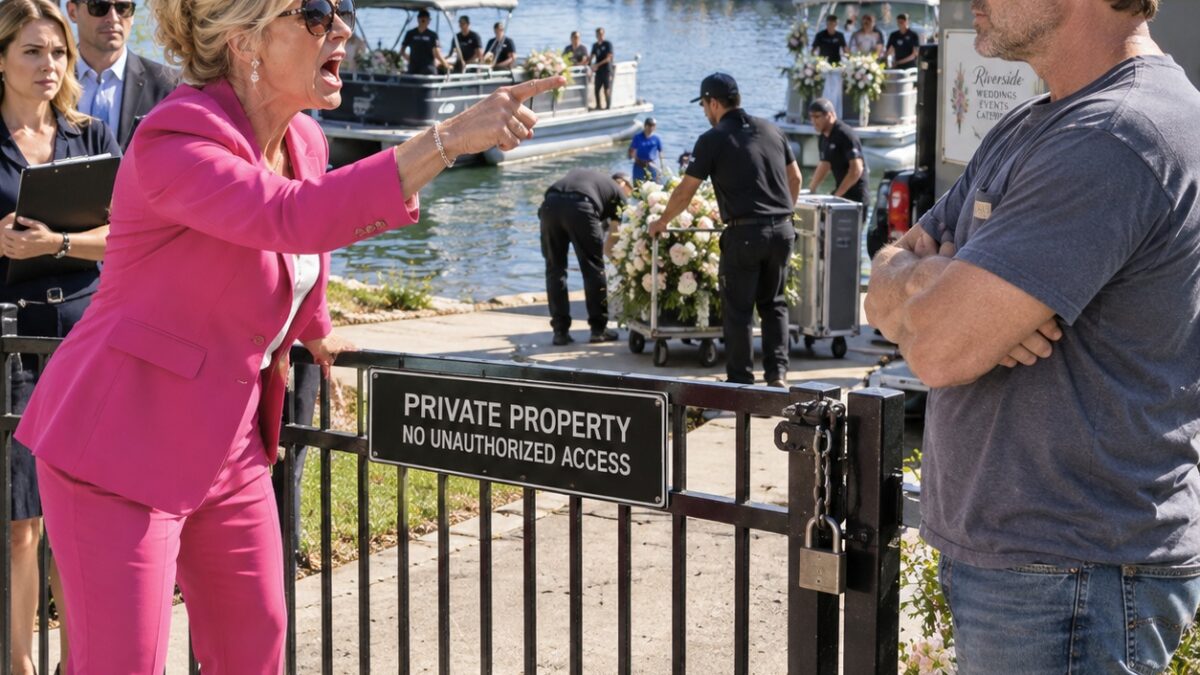
At 3:12, Victoria arrived.
Fast.
Too fast for the gravel road.
Her SUV stopped hard beside the gate.
She stepped out before the driver’s door had fully opened.
Dark pink suit.
Pearl earrings.
Fury.
“Open it.”
I stood behind the gate.
“No.”
“Open the gate, Ryan.”
“No.”
“We have two hundred guests arriving.”
“Then you should send your vendors to the approved temporary route.”
“They cannot make the schedule.”
“That’s unfortunate.”
Her face turned red.
“You are about to ruin six weddings.”
“No.”
“Yes, you are.”
She pointed toward the boats.
“Those flowers are for a bride who paid us eighteen thousand dollars.”
“I didn’t take her money.”
“That food is for one hundred seventy guests.”
“I didn’t book them.”
“You know exactly what you’re doing.”
“I’m enforcing the boundary I gave you written notice about.”
She stepped closer.
“You are enjoying this.”
“No.”
“Don’t lie.”
“I’m not.”
I pointed toward the trapped vendors.
“I feel bad for every one of them.”
“Then open the gate.”
“No.”
She laughed bitterly.
“You’re impossible.”
I reached into my pocket.
“Victoria, I have one question.”
“I don’t have time for your games.”
“You wrote that this ramp is the pavilion’s approved guest embarkation route.”
“Yes.”
“Who approved it?”
She stared at me.
“What?”
“Who approved it?”
“The county.”
“No.”
I shook my head.
“The county approved a plan you submitted.”
She went still.
The coordinator looked between us.
I continued.
“In that plan, you certified the HOA had secured all required access permissions.”
Victoria’s eyes narrowed.
“That is a legal matter.”
“It’s a very simple question.”
I took out a copy of the application.
“Who gave you permission to list my ramp?”
She said nothing.
“Was it my father?”
No answer.
“He died eight years before the pavilion was proposed.”
Her jaw tightened.
“Was it me?”
Silence.
“Was it a written agreement?”
Nothing.
“Lease?”
Nothing.
“License?”
Nothing.
“Amendment to the easement?”
Nothing.
Then I asked the question that changed everything.
“Or did you tell the county you had permission because you knew the pavilion couldn’t be approved without it?”
Victoria’s face changed.
Not anger.
Fear.
Only for a second.
But I saw it.
Clare had taught me something years earlier.
People can prepare for accusations.
What they struggle to prepare for is the exact question they hoped nobody would ask.
Victoria lowered her voice.
“You need to be very careful.”
“Why?”
“You are making statements that could expose you to litigation.”
“Then sue me.”
Her eyes widened.
“I mean it.”
I held up the permit.
“File the lawsuit.”
I pointed toward my house.
“My deed is inside.”
I pointed toward the county road.
“My attorney’s office is twenty minutes away.”
Then toward the floating pavilion.
“And your permit application is public record.”
A truck driver behind her slowly pulled out his phone.
Victoria noticed.
“Turn that off.”
He lowered it but didn’t put it away.
The wedding coordinator looked miserable.
“Mrs. Hail, what do you want us to do?”
Victoria ignored her.
“Ryan, if you open this gate now, we can discuss everything Monday.”
“We discussed it Monday.”
“Not constructively.”
“You fined me seven hundred fifty dollars for removing your sign from my property.”
“We can reverse the fine.”
“I’m not in your HOA.”
She froze.
The coordinator looked at her.
I almost felt sorry for Victoria.
That letter had always been ridiculous.
Now it sounded absurd out loud.
“You fined someone who isn’t even in the association?” the coordinator asked.
Victoria snapped, “This doesn’t concern you.”
Actually, it did.
Her entire event schedule concerned that woman.
I unlocked the small pedestrian side gate.
Not the vehicle gate.
Victoria watched.
“What are you doing?”
“Letting the vendors retrieve anything they already unloaded here.”
“You need to open the vehicle gate.”
“No.”
I turned to the coordinator.
“Public marina knows you’re coming?”
“Yes.”
“Then I suggest you move now.”
She nodded.
“Thank you.”
Victoria’s face tightened.
“For what?”
“For not blaming us.”
The coordinator headed toward her SUV.
Victoria stared after her.
Then at me.
“You’ve made a serious mistake.”
“No.”
I held up the permit.
“You made it years ago.”
The first wedding started thirty-five minutes late.
I know because I could hear the music across the lake.
The bride got married.
The flowers made it.
The food arrived.
The guests laughed.
Nobody’s life was destroyed.
The second ceremony was delayed twenty minutes.
By Sunday, the HOA had rented buses to move guests to the east marina.
Expensive.
Inefficient.
But functional.
Six weddings happened.
Not one was ruined.
Victoria’s prediction failed.
Her business model, however, was another story.
Monday morning, the county issued a formal notice requiring the HOA to provide evidence of lawful access or submit a new permanent transportation and emergency plan.
Until then, pavilion occupancy was temporarily capped.
Not closed.
Capped.
That mattered.
The venue could continue hosting smaller events.
Large weddings required additional approved access.
The HOA board called an emergency meeting for Tuesday night.
Grant invited me.
Clare told me to go.
“Do I speak?”
“Only when asked.”
“What if Victoria lies?”
“Take notes.”
“That sounds unsatisfying.”
“Law is often unsatisfying before it becomes expensive.”
The clubhouse was packed.
Residents stood along the back wall.
Some were angry with me.
I understood that.
Their dues helped build the pavilion.
They had been told wedding income would eventually reduce assessments.
Now revenue was threatened because some guy outside the neighborhood locked a gate.
From their perspective, I looked like the villain.
Victoria sat at the front table.
She looked calm again.
That worried me more than anger.
The board chair called the meeting to order.
Victoria gave a prepared statement.
She described the conflict as a “technical disagreement regarding historic access rights.”
She said the county had overreacted.
She said my attorney was pursuing an “aggressive interpretation.”
She said the association had relied on the easement in good faith.
Then she made one mistake.
She said:
“Mr. Mercer has never objected to association use until recently.”
I looked at Clare.
She whispered, “Wait.”
Grant raised his hand.
“Victoria, can you clarify that?”
“What?”
“You said he never objected.”
“That is correct.”
Grant opened a folder.
“I have three emails from Ryan objecting before the pavilion opened commercially.”
The room changed.
Victoria looked at him.
“Where did you get those?”
“Ryan’s attorney.”
“Those communications were about vendor coordination.”
One resident called out.
“Did he object or not?”
Victoria ignored the question.
Grant continued.
“I also have the certified letter demanding a commercial access agreement.”
“That was after operations began.”
“Exactly.”
The resident spoke again.
“So we knew?”
Victoria’s voice sharpened.
“The board understood we possessed legal access.”
Grant asked, “Based on what?”
“The easement.”
“Have you read it?”
“Of course.”
“Would you read the commercial-event provision?”
Silence.
Victoria said, “That’s an absurd framing.”
“Then read the section allowing wedding vendors.”
“The easement is not written in those terms.”
“Then read the section allowing guest transportation.”
“No single section—”
“Emergency evacuation?”
“Grant.”
“Caterers?”
“Enough.”
The room murmured.
Grant leaned back.
“Okay.”
Another board member spoke.
Her name was Denise Parker.
“Did Ryan ever sign anything?”
Victoria looked at her.
“No separate document was necessary.”
“That wasn’t the question.”
Denise repeated it.
“Did he sign anything?”
“No.”
“Did his father?”
“The original easement.”
“For dock maintenance.”
Victoria’s attorney leaned toward the microphone.
“I advise the board not to engage in piecemeal legal conclusions.”
A man in the audience called out.
“We spent three million dollars. I think we can ask what land rights we bought.”
That got applause.
Victoria looked irritated.
Grant moved to the next item.
“The event management contract.”
Now the room became much quieter.
Victoria’s daughter’s company.
Most residents apparently didn’t know.
Grant displayed the contract on a screen.
Hawthorne Lake Event Management LLC.
Twenty-two percent management commission.
Additional coordination fees.
Preferred vendor commissions.
Renewal option.
A resident asked, “Who owns the company?”
Nobody answered.
Grant did.
“Allison Hail-Carter.”
Voices erupted.
Victoria leaned into her microphone.
“This relationship was disclosed.”
Grant asked, “Where?”
“At the time.”
“Where?”
“In board discussions.”
“Which meeting?”
“I don’t have the minutes in front of me.”
“I do.”
He held them up.
“I found no disclosure.”
Her attorney whispered again.
Victoria ignored him.
“My daughter has twenty years of event-management experience.”
“That isn’t the question.”
“She offered the association favorable terms.”
“Twenty-two percent?”
“Industry standard.”
Someone laughed.
That was bad.
People can tolerate explanations.
They hate feeling manipulated.
Denise looked at the treasurer.
“How much was paid to Hawthorne Lake Event Management last year?”
The treasurer shuffled papers.
“Approximately one hundred seventy-six thousand dollars.”
The room exploded.
Victoria raised her voice.
“That is gross compensation before staffing and operating expenses.”
Grant asked, “How much did Allison personally receive?”
“I don’t know.”
“You signed the contract.”
“As board president.”
“Did you participate in the vote?”
“Yes.”
“Did you disclose that she is your daughter in the written resolution?”
Victoria’s face hardened.
“My relationship with Allison is common knowledge.”
Clare wrote something on a legal pad and slid it toward me.
Common knowledge is not disclosure.
I nearly smiled.
Grant wasn’t done.
He displayed the original financial projections.
There it was.
Existing Mercer Ramp — no acquisition cost.
One hundred eighty people saw it at once.
A resident near the front asked:
“What does that mean?”
Grant answered carefully.
“It appears the feasibility model assumed access to Mr. Mercer’s property without budgeting any payment for acquiring commercial rights.”
Someone shouted:
“Did we ever ask him?”
Victoria spoke.
“The association already had access.”
The same claim.
Again.
Only this time, after everything else, it sounded weak.
Grant turned toward me.
“Ryan.”
Clare touched my arm.
“Facts only.”
I stood.
Every face turned.
I hate public speaking.
I can rebuild a Yamaha lower unit in my sleep.
I would rather do that in front of two hundred people than talk into a microphone.
Grant handed me one anyway.
I cleared my throat.
“My father granted the original developer a written easement in 1994.”
I held up a copy.
“It allows access for construction, installation, inspection, repair, replacement, and maintenance associated with the original community dock facilities.”
I looked toward Victoria.
“It does not give the HOA ownership of my ramp.”
Back to the residents.
“It does not provide general public access.”
I paused.
“And it says nothing about commercial events.”
A woman asked, “Did you know weddings were using it?”
“Eventually.”
“Did you allow them?”
“Initially, I allowed occasional access because vendors were showing up and I didn’t want to punish people who had been given bad instructions.”
Victoria jumped in.
“So you consented.”
I looked at her.
“No.”
“You permitted use.”
“I tolerated isolated use while repeatedly asking you to fix it.”
“That is permission.”
“Then why did I send three written objections?”
She stopped.
I continued.
“I asked the HOA for a commercial access agreement.”
I looked at the residents.
“I never demanded some outrageous price. I never even reached the pricing stage.”
A man asked, “What did they say?”
“That they already had the right.”
Another asked, “Would you have negotiated?”
“Yes.”
The room became quiet.
That mattered.
I wasn’t the neighbor refusing everything.
The HOA had never wanted to negotiate because negotiating required admitting my property had value.
Victoria said, “This is revisionist.”
I looked directly at her.
“Then produce your offer.”
Silence.
“Produce the draft agreement you sent me.”
Nothing.
“Produce one email asking what terms I wanted.”
Nothing.
I handed the microphone back.
That should have ended my part.
Then an older man stood near the middle aisle.
I later learned his name was Harold Simmons.
“Mr. Mercer?”
I turned.
“Yes?”
“How much would access have cost?”
I thought about it.
“I don’t know.”
Victoria gave a sharp laugh.
“Convenient.”
I ignored her.
“I would have required insurance.”
Harold nodded.
“Of course.”
“Indemnity.”
“Yes.”
“Limits on hours.”
“Okay.”
“Traffic controls.”
“Sure.”
“Maintenance contributions.”
A few residents nodded.
“And compensation based on actual commercial use.”
“How much?”
“Maybe thirty or forty thousand a year. Maybe less. Maybe more. Depends on volume.”
The room reacted.
Not because that was huge.
Because compared with the pavilion’s revenue, it wasn’t.
Harold looked at the projected income on screen.
“Victoria, we paid your daughter’s company one hundred seventy-six thousand dollars last year, but we wouldn’t pay the landowner thirty thousand for access the whole operation needed?”
Victoria’s face went white.
That question did more damage than anything I could have said.
Because it translated a complicated legal dispute into something everybody understood.
Priorities.
The board voted that night to suspend Victoria’s authority over pavilion operations pending an independent review.
Five to two.
She remained president temporarily.
But the pavilion was taken out of her hands.
The next three weeks were brutal for Hawthorne Cove.
The independent review found more problems.
Not all of them criminal.
Most were governance failures.
Conflict disclosures were incomplete.
Vendor contracts had been renewed without competitive bids.
Event-management fees were higher than comparable venues.
Several service providers had personal relationships with board members.
The permit application had overstated the certainty of private access rights.
Worst of all, nobody had built a realistic alternative transportation plan.
The pavilion wasn’t badly designed.
It was badly governed.
That distinction mattered to me.
Residents had paid for something beautiful.
They deserved to keep it.
They just needed to operate it honestly.
Meanwhile, Clare and I negotiated with the new pavilion committee.
For the first time since the dispute began, nobody started by telling me what rights they already had.
They asked what I needed.
Amazing how much easier conversations become when one side stops pretending.
We spent two months working out terms.
Commercial vehicle access was limited to specified hours.
No guest parking on my land.
No large buses.
Only licensed vendors.
Shuttle boats could launch during approved windows.
The HOA paid for resurfacing part of the driveway.
They installed drainage improvements.
They carried commercial liability insurance naming me as an additional insured.
They indemnified me for event operations.
They paid an annual access fee.
And most importantly, either side could terminate the agreement with defined notice.
It was a license.
Not an expansion of the easement.
Not ownership.
Not permanent control.
A contract.
Exactly what I had asked for from the beginning.
The county approved the revised access plan.
The pavilion returned to full capacity.
Wedding bookings resumed.
Nobody lost the building.
Nobody lost their home.
Nobody lost the lake.
Victoria, however, lost her presidency.
The independent review recommended a new board election.
She resigned two days before the vote.
Her daughter’s event company contract was terminated without renewal.
Another operator won the work through a competitive bid.
I never learned whether Victoria personally profited from anything improperly.
No prosecutor ever knocked on my door asking me to testify.
As far as I know, there were no criminal charges.
That wasn’t the point.
People sometimes hear stories like this and expect handcuffs.
Real life is usually less theatrical.
Victoria’s downfall wasn’t prison.
It was losing control of the institution she had spent years treating like an extension of herself.
She could no longer sign a document and assume nobody would read it.
She could no longer tell a board, “Our attorney is comfortable,” and end the conversation.
She could no longer call her personal decisions “the association.”
That was enough.
Six months later, I attended my first wedding at the pavilion.
Not as a vendor.
Not as an angry landowner.
As a guest.
Grant’s granddaughter got married there.
He invited Clare and me.
I almost declined.
Then Emily told me I was being ridiculous.
“You fought for months over a wedding venue and now you won’t attend a wedding there?”
“I didn’t fight over the venue.”
“You know what I mean.”
So I went.
It was October.
Cool evening.
Orange light across the lake.
The pavilion really was beautiful.
I understood why people wanted to get married there.
Glass walls reflected the water.
Warm lights hung over the cedar deck.
A string quartet played near the entrance.
The bride arrived by boat.
Through my ramp.
Legally.
The shuttle operator had called three days before.
The coordinator emailed the schedule.
Everything happened within the agreed window.
Nobody blocked my driveway.
Nobody installed signs.
Nobody sent me a violation letter.
Amazing.
Grant found me near the railing before the ceremony.
He handed me a drink.
“Feels strange, doesn’t it?”
“What?”
“You standing here voluntarily.”
I laughed.
“Very.”
He looked across the water toward my property.
“You know, some residents still think you caused all of it.”
“I know.”
“Does that bother you?”
“A little.”
He nodded.
“Victoria told everyone for years that the ramp belonged to the association.”
“It didn’t.”
“I know.”
“She probably believed it eventually.”
Grant looked thoughtful.
“Do you think so?”
“Yes.”
That was the strange part.
By the end, I’m not sure Victoria felt like she was lying.
Entitlement can do that.
Repeat a claim long enough.
Benefit from it long enough.
Watch nobody challenge you long enough.
Eventually, permission starts feeling like ownership.
Convenience starts feeling like law.
And other people’s property starts feeling like something they are selfish for withholding from you.
Grant looked at me.
“You ever regret locking the gate?”
I thought about the florist vans.
The stranded shuttle boats.
The terrified coordinator.
Victoria yelling that I would destroy six weddings.
“No.”
Then I added:
“I regret not doing it earlier.”
The ceremony began.
Everyone turned.
The bride stepped from the dock.
Music filled the pavilion.
For twenty minutes, there were no easements.
No permits.
No board politics.
No lawyers.
Just two people getting married.
That was how it should have been from the beginning.
The funny thing was, the new access agreement actually improved the weddings.
Because once the HOA had to treat my ramp like real infrastructure, they planned around it properly.
Vendor windows were staggered.
Shuttle schedules improved.
Traffic stopped backing up.
A coordinator was assigned to the launch.
Emergency lanes stayed clear.
Noise hours were enforced.
The random chaos disappeared.
My annual access payment covered resurfacing and maintenance.
I installed better lighting.
The HOA contributed to a new retaining wall.
Everybody benefited.
That part never gets as much attention as the conflict.
Boundaries don’t always destroy cooperation.
Sometimes boundaries are the thing that makes cooperation possible.
The old system depended on me quietly absorbing everyone else’s convenience.
The new system required everyone to know what they were responsible for.
That was healthier.
A year after the dispute, I was closing my shop one evening when Victoria walked in.
I almost didn’t recognize her.
No pink suit.
Jeans.
White blouse.
Hair pulled back.
She stood near the counter while I finished writing a service note.
“Ryan.”
“Victoria.”
“I need five minutes.”
I looked at the clock.
“You have five.”
She didn’t smile.
“I’m moving.”
“Okay.”
“Selling my Hawthorne Cove house.”
I nodded.
“I heard.”
“Of course you did.”
Small communities.
News travels.
She looked around at the outboard motors.
“My husband and I are going to Charleston.”
“Hope the move goes well.”
She stared at me.
“You don’t have to pretend to be polite.”
“I’m not pretending.”
“That almost makes it worse.”
I set down my pen.
“What do you want, Victoria?”
She took a breath.
“I want to know if you intended to remove me.”
“No.”
“You expect me to believe that?”
“Yes.”
“You hired attorneys.”
“After you sent commercial traffic across my land.”
“You contacted the county.”
“After I discovered your permit relied on my property.”
“You spoke at the board meeting.”
“Because they asked.”
“You released financial documents.”
“I didn’t.”
Grant had.
She looked away.
“Everything collapsed because of that gate.”
“No.”
She looked back.
“Of course it did.”
“No.”
I leaned against the counter.
“The gate didn’t create the permit problem.”
She said nothing.
“It didn’t create your daughter’s contract.”
Nothing.
“It didn’t create the missing disclosures.”
Her mouth tightened.
“It didn’t create the event maps.”
Silence.
“It didn’t write HAWTHORNE EVENT WATER ACCESS across my property.”
I paused.
“The gate just forced everyone to finally look.”
She stared at me for a long time.
Then she said:
“You could have handled it privately.”
“I tried.”
“No.”
“Yes.”
I opened a drawer.
Pulled out copies of my three early emails.
Placed them on the counter.
“First one.”
I pointed.
“Asked vendors to call before using the ramp.”
Second.
“Asked for a commercial agreement.”
Third.
“Objected to unauthorized shuttle launches.”
Then the violation letter.
“Your response.”
She didn’t touch the papers.
I continued.
“You had a chance to make it private.”
“You had a chance to make it easy.”
“That’s different.”
Her eyes narrowed.
“For whom?”
I let that question sit.
Then answered.
“For you.”
For once, she didn’t argue.
She looked toward the shop windows.
“Do you know why I pushed the pavilion so hard?”
“No.”
“The original project nearly bankrupted the association.”
“I know.”
“No, you know the numbers now.”
She looked at me.
“At the time, everybody loved the idea. Waterfront landmark. Property values. Community prestige.”
Her smile was bitter.
“Then the bids came in.”
“Costs doubled.”
“Almost.”
“So you needed revenue.”
“Yes.”
“That doesn’t explain the ramp.”
“It does.”
“How?”
“Every new expense was another board fight.”
She spoke more quietly now.
“Insurance. Dock work. Kitchen upgrades. Fire systems. Staff. Marketing.”
She looked at the floor.
“Your ramp was the one thing already there.”
I understood.
“You didn’t want another cost.”
“No.”
“So you convinced yourself the easement covered it.”
“At first.”
That phrase caught me.
“At first?”
She looked up.
I said nothing.
Finally:
“At first, I believed the easement was broad enough.”
“And later?”
Her eyes moved toward the papers.
“Our attorney raised concerns.”
My body went still.
“When?”
“Before the commercial launch.”
I stared at her.
“He told you?”
“He said the language was not ideal.”
“Not ideal?”
“He recommended getting a separate agreement.”
For several seconds, the only sound in the shop was the compressor cycling in the back.
“You knew.”
She looked defensive again.
“I believed the association still had arguments.”
“But you knew he recommended an agreement.”
“Yes.”
“And you didn’t contact me.”
“The board was already under pressure.”
“You didn’t contact me.”
“No.”
“Because?”
She hesitated.
“You might have said no.”
There it was.
The whole story in one sentence.
Not confusion.
Not legal interpretation.
Not historic access.
She hadn’t asked because I might have said no.
I laughed softly.
Victoria looked offended.
“What?”
“You spent two years saying I had already given permission.”
“I said we had rights.”
“You didn’t ask because you knew I still had the right to refuse.”
“That is not what I said.”
“It’s exactly what you said.”
She grabbed her purse.
“This was a mistake.”
“Probably.”
She headed toward the door.
“Victoria.”
She stopped.
I looked at her.
“If you had asked, I probably would’ve said yes.”
Her face changed.
“What?”
“I told the board.”
“You would have allowed it?”
“With a contract.”
“For money.”
“For liability protection, scheduling, maintenance, insurance, traffic controls—and yes, money.”
She stared at me.
“How much?”
“Probably less than your daughter’s company charged you in a month.”
Her face flushed.
“That was unnecessary.”
“Maybe.”
I softened my voice.
“But think about that.”
She did.
I could see it.
For all the money, conflict, legal fees, public embarrassment, board fights, lost contracts, and damage to relationships, the original problem had been embarrassingly simple.
She had never asked.
Victoria opened the door.
Before leaving, she said:
“You really think it was that simple?”
“No.”
I shook my head.
“It became complicated because nobody wanted to do the simple thing first.”
She left.
I never saw her again.
At least not in person.
The pavilion is still there.
Still hosting weddings.
More now than before.
They expanded the dock two years later.
Legally.
With permits.
They added another shuttle-loading point on association-owned property.
That reduced dependence on my ramp.
I encouraged it.
People were surprised.
“Why help them make your access less valuable?” Clare asked.
“Because I don’t want them dependent on me.”
She smiled.
“Look at you becoming reasonable.”
“I’ve always been reasonable.”
“You installed an iron gate three days before six weddings.”
“Perfectly reasonable.”
She laughed.
Emily eventually took over more of the repair shop.
She still remembers the weekend because she came home Sunday night and found thirty-six missed calls on my shop phone.
“You’re famous,” she said.
“No.”
“You’re hated.”
“That sounds more accurate.”
She read some of the neighborhood social media posts.
People called me selfish.
Vindictive.
Greedy.
One woman accused me of “holding six brides hostage.”
That one was creative.
Emily wanted to respond.
I told her not to.
“Why?”
“Because the weddings happened.”
“But they’re lying.”
“People are angry.”
“So?”
“So let them be angry.”
She stared at me.
“You’re weirdly calm.”
“Your grandmother used to say never fight with someone who needs the audience more than you do.”
“Grandma was savage.”
“Yes.”
Over time, the anger faded.
Facts have a strange advantage.
They are boring.
Boring things last.
The deed remained the deed.
The easement remained the easement.
The permit remained public record.
The board minutes remained public.
Victoria’s resignation remained official.
The new access agreement remained signed.
People could argue on Facebook all they wanted.
Paper didn’t care.
Years later, one of the brides from that Saturday found me.
Her name was Lauren Pierce.
I didn’t recognize her when she walked into my shop.
Thirtyish.
Brown hair.
She carried a photograph.
“Are you Ryan Mercer?”
“Yes.”
She smiled.
“I think you almost ruined my wedding.”
I groaned.
“Oh, no.”
She laughed.
“I’m kidding.”
“That’s a dangerous joke around here.”
“I was the four o’clock wedding.”
“The first one.”
“Yes.”
I immediately remembered the boats.
Flowers.
Catering crates.
Victoria screaming beside my gate.
“I’m sorry about the delay.”
“Thirty-seven minutes.”
“You remember?”
“I was wearing a wedding dress. Every minute felt like a tax audit.”
“Fair.”
She placed the photograph on the counter.
The pavilion glowing behind her and her husband.
Beautiful picture.
“Why are you here?”
“I finally heard the real story.”
“Oh.”
“My mother lives in Hawthorne Cove.”
That explained it.
“She showed me the board report.”
I nodded.
Lauren looked at the engines behind me.
“That day, we were told you had suddenly blocked association property.”
“Not quite.”
“I know.”
She smiled.
“Apparently not even close.”
I gave the photograph back.
“Still, I’m sorry you got caught in it.”
She shook her head.
“Our wedding was great.”
“I’m glad.”
“Actually…”
She hesitated.
“What?”
“The delay helped.”
“How?”
“The photographer took sunset pictures while we waited.”
She showed me another photo on her phone.
Her and her father standing by the lake.
Orange sky.
Water glowing behind them.
“He died last year.”
My smile disappeared.
“I’m sorry.”
“Thank you.”
She looked at the image.
“That became my favorite picture from the entire wedding.”
For a moment, neither of us spoke.
Then she laughed softly.
“So I guess your gate gave me thirty-seven extra minutes with my dad.”
I didn’t know what to say.
Life does that sometimes.
Turns a conflict into something nobody involved could have predicted.
Lauren put her phone away.
“I just wanted you to know I don’t blame you.”
“Thank you.”
“And my mother says the HOA is less insane now.”
“That may be the highest compliment I’ve ever received.”
She laughed.
Then left.
That evening, I walked down to the ramp.
Same concrete.
Same retaining walls.
Dad’s original grooves were still visible beneath repairs I had made over the years.
I sat on the seawall.
The pavilion lights came on across the water.
Another wedding was starting.
Music drifted faintly toward me.
A shuttle boat approached my ramp.
The captain slowed.
Waited offshore.
My phone buzzed.
A text.
Hawthorne Pavilion Operations:
Ryan, Shuttle 2 requesting scheduled 6:30 launch access. Confirm?
I typed:
Confirmed.
The boat came in.
Two crew members unloaded equipment.
One waved.
I waved back.
Seven minutes later, they were gone.
Gate closed.
No argument.
No threats.
No fines.
No invented rights.
Just an agreement.
That was all I had wanted.
People sometimes ask me whether I locked the gate to make a point.
No.
Points are cheap.
I locked it because a boundary that exists only on paper eventually stops being a boundary if nobody is willing to enforce it.
For months, Victoria had counted on my reluctance to cause trouble.
She knew weddings were emotional.
She knew vendors had schedules.
She knew brides had deposits.
She knew hundreds of guests would create pressure.
Every event made it harder for me to object to the next one.
Because once somebody’s wedding depended on my silence, saying no made me look cruel.
That was the clever part.
Whether Victoria consciously planned it or not, she turned other people’s important days into leverage.
One wedding becomes:
Just let this one happen.
Then another.
Then:
You allowed it before.
Then:
This is established access.
Then:
The county approved it.
Then:
You’re interfering with our rights.
By the time I installed the gate, people were acting as though I had changed the rules.
I hadn’t.
I was the first person in years to ask what the rules actually were.
That question exposed everything.
Not because I was brilliant.
Not because Clare discovered some obscure legal trick.
The easement was one page long.
Anyone could have read it.
That was the most absurd part.
Millions of dollars.
Dozens of weddings.
A commercial operator.
County permits.
Emergency plans.
Board resolutions.
All balanced on a document almost nobody had bothered to read carefully.
Victoria had.
At least eventually.
And according to what she told me in my shop, that was exactly why she never asked me for a new agreement.
Because asking meant admitting the old one wasn’t enough.
Because asking meant I could say no.
And people who get used to authority often fear the word no more than almost anything else.
It reminds them where their power ends.
Mine ended too.
I couldn’t stop the HOA from building a pavilion on property they controlled.
I couldn’t tell residents how to run their neighborhood.
I couldn’t decide who managed their events.
I couldn’t control their finances.
But I could control my ramp.
One strip of concrete.
One iron gate.
One property line.
Sometimes that is enough.
The first wedding was supposed to start at four that Saturday.
At 3:12, Victoria stood at my gate and told me I was about to ruin six marriages before they even began.
She was wrong.
Every couple got married.
The pavilion survived.
The association survived.
The residents survived.
Even the event business survived.
What didn’t survive was the fiction that Victoria could use whatever she needed simply because nobody had stopped her yet.
Forty minutes after she arrived, she was still arguing about schedules, money, guests, flowers, caterers, and all the people she believed I was inconveniencing.
I kept asking the same question.
Who approved my property?
She never answered.
Because there was only one person who could have.
Me.
And she had never asked.








