The HOA Ripped Out My “Private” Pump at Dawn—Twenty Minutes Later, My Phone Started Filling With Addresses
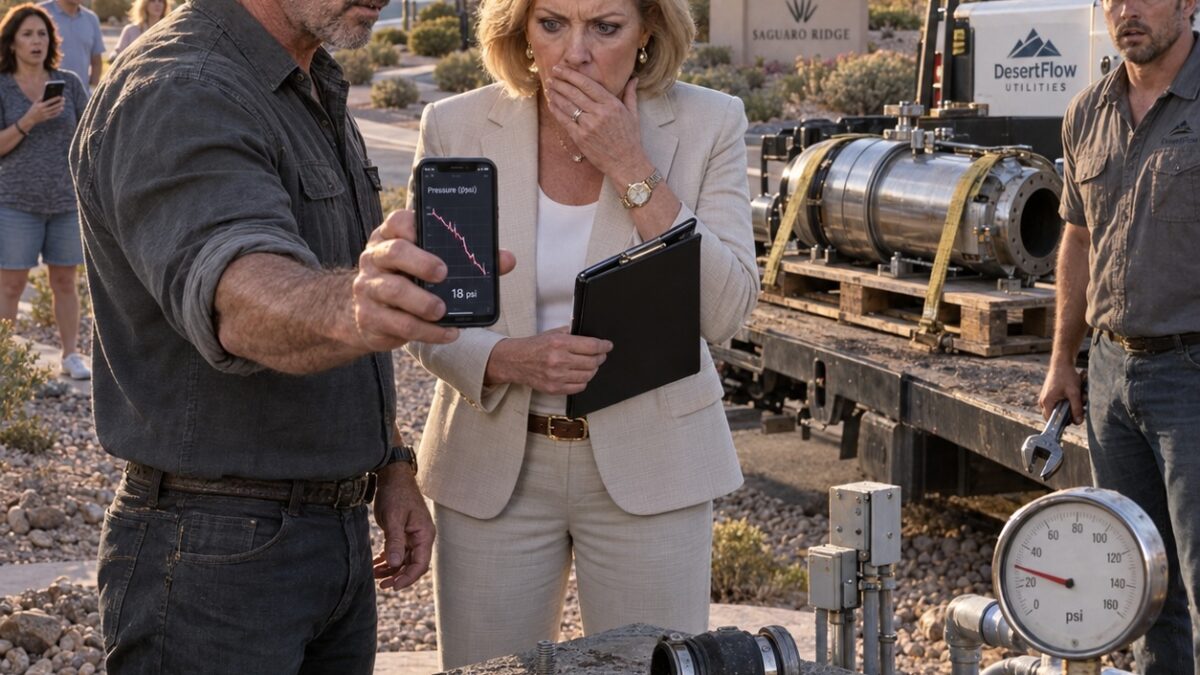
Brent Lawson was the first person to move.
He walked straight to the pallet.
“Unstrap it.”
One of his workers stared at him.
“What?”
“You heard me. Unstrap the pump.”
Susan stepped between them.
“No.”
Brent stopped.
She held up one hand.
“The contract says removal and disposal.”
He looked at her as if she had just spoken another language.
“Lady, I don’t care what your contract says if this thing supplies three hundred houses.”
“It does not supply three hundred houses.”
I said, “Correct.”
Susan looked relieved for half a second.
Then I finished.
“It boosts pressure to the upper distribution zone serving two hundred eighty-seven occupied lots, the community center, the pool building, and two fire hydrant branches.”
Brent closed his eyes.
One of his workers muttered something I couldn’t hear.
Susan stared at me.
“Fire hydrants?”
“There it is.”
“What?”
“The next question you should have asked before sunrise.”
She looked toward the nearest hydrant.
It stood maybe eighty yards down the street beside a flowering palo verde.
Nothing about it looked different.
That was the dangerous part about pressure problems.
Pipes could remain full.
Water could still come out.
Everything looked normal until somebody needed more volume than gravity and residual system pressure could provide.
My phone buzzed again.
Carlos.
I answered on speaker.
“Pressure at the high point is thirty-eight and falling,” he said. “I’ve got crews rolling.”
Brent swore.
Susan snapped, “There is no emergency.”
Carlos heard her.
“Who is that?”
“The HOA president.”
A pause.
Then Carlos said, “Put her on.”
I held out the phone.
Susan didn’t take it.
“You’re on speaker.”
Carlos’s voice sharpened.
“Ma’am, did your association authorize removal of booster unit CR-B2?”
Susan looked at the pump.
“I authorized removal of privately owned equipment located on a homeowner parcel.”
“That wasn’t my question.”
Her jaw tightened.
“Yes.”
“Was the district notified?”
“No.”
“Did you contact our engineering office?”
“No.”
“Did you contact operations?”
“No.”
“Did you review the recorded booster agreement?”
She looked at me.
“What agreement?”
Carlos was silent for almost three full seconds.
Then:
“Do not touch anything else.”
Susan drew herself up.
“You don’t have jurisdiction over private property.”
Carlos exhaled.
“Ma’am, I’m not debating property jurisdiction with you at six-forty-five in the morning. I’m telling you not to alter any more equipment connected to an active public water pressure zone.”
“Public?”
“Yes.”
She looked at me.
I said nothing.
Carlos continued.
“We will have an emergency crew there shortly. Ethan, can you isolate the bypass?”
“Yes.”
“Do it. Don’t attempt reinstall until we inspect the couplings.”
“Understood.”
“And check the transducer feed.”
“Already offline.”
“All right.”
Susan stepped closer to the phone.
“If the district needed this machine, why is the electric meter in his name?”
Carlos answered without hesitation.
“Because that was the operating arrangement recorded when Canyon Ridge was built.”
Susan’s face changed.
“What arrangement?”
“That is a question for your association records.”
I almost laughed.
Not because any of this was funny.
Because for months I had been telling her exactly that.
Check the recorded documents.
Check the development agreement.
Contact the district.
She had called every warning “stalling.”
Now the district was asking why she hadn’t done the same thing.
Carlos continued.
“Ethan, I need photos before anything moves.”
“Already taking them.”
“Good. Crew is fifteen out.”
The call ended.
Susan turned toward me.
“What recorded agreement?”
I crouched beside the header and closed the bypass valve.
“I sent you the instrument number in February.”
“You sent me twenty pages of irrelevant attachments.”
“Twelve.”
“It was excessive.”
“It was the booster easement.”
“You buried the information.”
“It was in the first paragraph.”
Brent made a sound that might have been a laugh, then quickly turned away.
Susan heard him.
“This isn’t helping.”
He looked at her.
“With respect, ma’am, I was told I was removing obsolete landscape equipment.”
“It was on his meter.”
“So is my barn at home. Doesn’t mean my barn is abandoned.”
She stared at him.
He started removing the straps.
This time she didn’t stop him.
I walked behind the enclosure and checked the secondary valve.
The entire installation sat on a narrow parcel along Canyon Ridge’s eastern entrance.
My parcel.
That part was true.
The electric meter carried my name.
Also true.
The pump itself had been purchased by my father and me eighteen years earlier.
True again.
Those three facts had become Susan’s entire case.
What she never bothered to understand was why we bought it.
Canyon Ridge had not always been a neighborhood.
When I was a kid, most of the land had been desert pasture, creosote flats, and low ridges of volcanic rock.
My father, Thomas Mercer, owned thirty-six acres along the county road.
Not enough for cattle.
Too rocky for farming.
He operated a small excavation business and stored equipment there.
In 2005, developer Mesa Vista Communities began assembling land for what became Canyon Ridge.
They bought parcels north and west of us.
Dad sold most of his acreage but kept the house site, workshop, and a narrow utility strip along the entrance road.
At the time, I was thirty-one and working as a mechanical systems engineer.
The original water design for Canyon Ridge depended on district pressure from a lower-zone main.
Then final grading changed.
Several streets at the northern end of the development sat twenty-five to forty feet higher than the early planning elevations.
Pressure modeling showed something ugly.
Under peak summer demand, upper-zone pressure would drop below the district’s design target.
The obvious solution was a booster station.
The district was willing to accept one eventually.
But permanent capital funding and construction scheduling would delay the first homes almost a year.
Mesa Vista did not want that.
So they proposed an interim arrangement.
Dad had the utility strip.
I understood pumps.
The developer would pay for equipment.
Dad and I would own and operate it temporarily.
The district would monitor output, set operating requirements, and reimburse power costs through a credit agreement until a permanent district-owned station could be constructed.
That temporary arrangement lasted eighteen years.
Not because of conspiracy.
Because temporary infrastructure has a strange way of becoming permanent once it works.
The developer finished Canyon Ridge.
Mesa Vista dissolved its local project company.
The HOA took control of common areas.
The district evaluated replacing the station twice.
Both times, other capital projects ranked higher.
So the little booster kept running.
Dad died in 2016.
The parcel and house transferred to me.
The electric account stayed under my name.
Every month, I paid the bill.
Every quarter, the water district credited me based on the recorded operating schedule.
I serviced the motor bearings.
The district calibrated the pressure transducer.
If something failed, Carlos called me.
If district operations needed a change, they notified me.
It was unusual.
It was old-fashioned.
It was fully documented.
And for almost two decades, nobody cared.
Then Susan Whitmore became HOA president.
The district truck arrived at 6:58.
Carlos climbed out before it fully stopped.
Two operators followed him.
He looked at the empty pad.
Then at Brent.
Then at Susan.
“What happened?”
Susan lifted her clipboard.
“We have already established that this was a misunderstanding.”
Carlos stared at her.
“No. We’ve established that the pump is on a pallet.”
He walked to the disconnected suction line.
One of his operators inspected the flange.
“Gasket’s damaged.”
Brent immediately said, “We can replace it.”
Carlos looked at him.
“You remove this?”
“Yes.”
“Why?”
“Because I’m apparently an idiot before coffee.”
That earned him the smallest smile.
Susan said, “You were working under an HOA contract.”
Brent turned.
“I’m not blaming the contract.”
His tone said otherwise.
Carlos checked the control enclosure.
“Who disconnected power?”
“My electrician.”
“Licensed?”
“Yes.”
“Good. Get him back.”
“He’s ten minutes away.”
The pressure gauge read thirty-four.
My phone showed eighteen complaints.
Carlos looked at the district map.
“We need this running before morning demand peaks.”
“What’s peak?” Brent asked.
“Seven-thirty to nine.”
It was 7:01.
Susan looked toward the houses.
Sprinklers had begun shutting off automatically across some streets.
Garage doors opened.
People left for work.
Somebody walking a golden retriever stopped near the enclosure and stared at us.
Then another resident came down the sidewalk holding a phone.
“Are you guys working on the water?”
Carlos said, “Yes, sir.”
“My shower barely has pressure.”
“We’re aware.”
The man looked at the pump.
“What happened?”
Nobody answered.
His eyes moved to Susan.
He recognized her.
“Susan?”
She smiled too quickly.
“Routine infrastructure issue, Mark.”
Carlos turned toward her.
“No.”
She froze.
Mark frowned.
Carlos said, “It is not routine.”
Susan gave him a hard look.
Carlos didn’t care.
“We had an unauthorized removal of active booster equipment. We’re reinstalling it.”
Mark looked at Susan again.
“Unauthorized by who?”
I could almost see her calculating.
The answer mattered.
If she said unauthorized by the district, she admitted the district had authority she had ignored.
If she said unauthorized by me, she admitted she had intentionally removed equipment from my property over my objection.
She chose a third option.
“There is an ownership disagreement.”
Mark stared at the machine.
“About the neighborhood water system?”
“It is not the neighborhood water system.”
Carlos said, “Ma’am.”
She turned.
“You need to stop saying that.”
Her cheeks reddened.
“I am not going to be publicly corrected about HOA property issues by a utility employee.”
Carlos nodded slowly.
“All right.”
Then he looked at Mark.
“This booster regulates pressure to the upper zone.”
Mark’s mouth opened.
“My house is on Canyon View.”
“Then your house is in the zone.”
Mark looked back at Susan.
“What did you remove?”
“I did not personally remove anything.”
That sentence told me exactly how the next few weeks were going to go.
By 7:12, Brent’s electrician was back.
By 7:19, a district supervisor arrived.
By 7:23, so did a white SUV from the county fire department.
That changed Susan’s posture completely.
Deputy Fire Marshal Lena Park stepped out carrying a tablet.
She was compact, calm, and had the unnerving habit of letting people finish saying stupid things before asking simple questions.
Carlos met her beside the enclosure.
“We’re restoring now.”
“How low?”
“High point touched twenty-nine.”
She frowned.
“Hydrant residual?”
“Not tested.”
“Don’t.”
“Wasn’t planning to.”
Susan approached.
“Can someone explain why the fire department is here?”
Lena looked at her.
“Pressure impairment notification.”
“There is still water.”
“Yes.”
“So there is no fire issue.”
Lena’s expression didn’t change.
“Water existing in a pipe and water meeting fire-flow requirements are different things.”
Susan folded her arms.
“That machine is privately owned.”
Lena glanced at the pump.
Then at Carlos.
“Does it affect system pressure?”
“Yes.”
She looked back at Susan.
“Then I don’t care who owns the paint.”
Brent coughed again.
I walked away before Susan could accuse me of encouraging disrespect.
Residents were gathering now.
Not a mob.
Arizona suburbia does not produce mobs before breakfast unless coffee fails.
But enough people had low-pressure showers, slow faucets, and toilets taking forever to refill that the sidewalk near the entrance became a small information center.
Phones came out.
Someone started recording.
My own phone had thirty-one district complaints on the incident dashboard.
Susan saw the residents.
That frightened her more than the pressure gauge.
She went straight into leadership mode.
“Everyone, please return home. The board is handling the situation.”
Mark, the man with the golden retriever, said, “Did the board remove the pump?”
Susan ignored him.
A woman in running clothes asked, “Why would the board touch water equipment?”
“It is not water district equipment.”
Carlos said, “It is connected to the water system.”
Susan rounded on him.
“Would you stop doing that?”
“Doing what?”
“Undermining me.”
He looked genuinely confused.
“I’m restoring pressure.”
That exchange spread through Canyon Ridge faster than anything else that morning.
I knew because at 7:31, my neighbor Nancy Cole texted me.
ARE PEOPLE SERIOUS THAT SUSAN HAD THE PUMP REMOVED???
Then another.
ETHAN WHAT IS GOING ON
Then:
IS THIS WHY MY SHOWER DIED
Then:
MY HUSBAND SAYS FIRE DEPARTMENT IS THERE???
Then someone I barely knew:
DID HOA REALLY THINK THAT THING WATERED YOUR TREES LOL
I put my phone away.
The pump was more important.
Brent’s crew lowered it back onto the pad.
The damaged gasket was replaced.
Flanges aligned.
Electrical conduit reopened.
The electrician reconnected power while a district operator tested insulation resistance.
At 7:48, Carlos stood beside the controller.
“Ready?”
I nodded.
Brent stepped back.
Susan stood twenty feet away with her clipboard hanging uselessly at her side.
Carlos looked at me.
“It’s your disconnect.”
That was another detail she had never understood.
The district could command operation.
But the service disconnect was on my parcel.
I turned the switch.
The motor started.
That familiar low hum returned.
I felt it through the soles of my boots before the pressure gauge moved.
Thirty-one.
Thirty-three.
Thirty-six.
The controller ramped slowly.
Carlos watched amperage.
“Good.”
Pressure climbed.
Thirty-nine.
Forty-two.
Forty-five.
Residents watched the gauge as if it were a scoreboard.
At forty-eight, Mark’s phone rang.
His wife.
He answered.
Listened.
Then looked at us.
“Upstairs faucet is normal again.”
A few people actually applauded.
Susan looked like she wanted the asphalt to open.
Carlos raised one hand.
“Don’t celebrate yet.”
The pressure climbed toward fifty-four.
He monitored the district feed for another ten minutes.
Then nodded.
“We’re stable.”
Lena Park entered a note into her tablet.
“Notify me when full zone verification is done.”
Carlos nodded.
She looked at Susan.
“I’ll need the association’s contact information.”
“Why?”
“For the impairment report.”
“The association didn’t cause a system failure.”
Lena stared at her.
Then looked at the pump on the freshly scratched pad.
“Okay.”
That one word sounded worse than an argument.
She walked away.
Susan turned toward me.
“You are enjoying this.”
I was tired, angry, and still hadn’t had coffee.
“No.”
“Please.”
“You think I wanted three hundred houses losing pressure?”
“You have been waiting for a chance to embarrass this board.”
I stared at her.
“You paid somebody to remove a working pump from my property after I repeatedly told you not to touch it.”
“You never explained it clearly.”
Brent stopped coiling a strap.
Carlos stopped typing.
Even Mark stopped rubbing his dog’s head.
I said, “On February third, I wrote: ‘This booster is an active component of Sonoran Valley Water District’s Canyon Ridge upper pressure zone. Do not disconnect, modify, relocate, or remove it.’”
She looked away.
“On February twenty-second, I attached the recorded operating agreement.”
“You sent legal documents.”
“Yes.”
“I’m not an engineer.”
“No one asked you to be.”
“Then how was I supposed to know?”
“Call the water district.”
She said nothing.
“Which I also told you to do.”
Her jaw tightened.
“This conversation is over.”
She walked toward her white Lexus.
Mark called after her.
“Susan.”
She stopped.
“Did the board vote to remove it?”
She turned.
“That is association business.”
“I am the association.”
He said it quietly.
I watched the sentence hit her.
Mark continued.
“I pay dues.”
Several residents murmured agreement.
“Was there a board vote?”
She got into her car.
That was answer enough.
By nine that morning, Canyon Ridge pressure had fully recovered.
By noon, the incident was everywhere.
The HOA Facebook group.
Neighborhood text chains.
Nextdoor.
Two local community pages.
Someone had uploaded a thirty-eight-second video of Carlos telling Susan the pump served the pressure zone.
The caption read:
WHEN YOUR HOA ACCIDENTALLY TURNS OFF WATER TO 300 HOUSES BECAUSE A MACHINE LOOKED UGLY.
That wasn’t technically accurate.
We never completely lost water.
Accuracy rarely wins on neighborhood social media.
At 12:43, Susan emailed the entire community.
Subject: CLARIFICATION REGARDING MORNING WATER EVENT
Dear Canyon Ridge Residents,
This morning, a contractor performing authorized common-area cleanup encountered privately owned mechanical equipment that had not been properly identified as serving a broader utility function. Upon learning of a potential connection to community water pressure, the Association immediately cooperated in restoration.
There was no intentional disruption of water service.
The Board is reviewing the matter.
Please refrain from speculation or dissemination of inaccurate statements.
I read it twice.
Then forwarded it to Carlos.
He replied:
“encountered” 😂
I forwarded it to Brent.
He wrote:
I did not “encounter” anything. She gave me a picture of the exact pump.
Then I called my attorney.
Her name was Rachel Vance.
She had represented me in a contract dispute years earlier and possessed two qualities I valued.
She read everything.
And she didn’t get excited easily.
After I finished explaining, she asked one question.
“Did you keep Susan’s prior notices?”
“All of them.”
“Emails?”
“Yes.”
“Your responses?”
“Yes.”
“Operating agreement?”
“Yes.”
“Recorded easement?”
“Yes.”
“Contractor work order?”
“I don’t have it.”
“Get it.”
I looked toward the entrance from my kitchen.
Brent’s truck was gone.
The pump hummed normally.
“What are you thinking?”
“I’m thinking I’d like to understand why an HOA believed it had authority to remove equipment from your parcel in the first place.”
“They said architectural enforcement.”
“That’s not an answer.”
“They think the pump violates the entrance appearance standards.”
“Does your parcel belong to the HOA?”
“No.”
“Is it subject to the declaration?”
“Partially complicated.”
“Ah.”
That word from a lawyer is never comforting.
“What does partially complicated mean?”
“You tell me.”
So I did.
When Mesa Vista developed Canyon Ridge, Dad sold most of his land.
The developer recorded easements across our retained parcel for utilities, drainage, and monument-sign landscaping.
The HOA maintained the decorative entrance wall and desert plants within a defined easement.
But Dad retained the underlying parcel.
The booster sat outside the landscaping easement, inside a utility access area benefiting the water district.
The HOA had the right to maintain certain plants.
It did not own the utility strip.
Rachel said, “Send me every recorded document.”
“I will.”
“And do not argue with Susan by email.”
“I wasn’t planning to.”
“Good.”
“She already emailed the whole neighborhood blaming unidentified equipment.”
Rachel paused.
“Was it labeled?”
I looked toward the enclosure.
A metal plate on the controller read:
CR-B2
PRESSURE BOOSTER
AUTHORIZED PERSONNEL ONLY
Another sign listed the Sonoran Valley Water District emergency number.
“Yes.”
Rachel laughed.
That was the first time she sounded excited.
The next HOA board meeting was scheduled for Thursday evening.
Normally, six people attended.
That week, the community room reached capacity forty minutes before the meeting began.
I almost stayed home.
Rachel told me to go.
“Say very little.”
“That will disappoint everyone.”
“Especially me if you ignore it.”
So I sat in the third row beside Nancy Cole.
I had known Nancy for twelve years.
She leaned toward me.
“I brought popcorn.”
“You did not.”
She opened her purse.
A sandwich bag full of popcorn.
“You are seventy-two years old.”
“I have earned the right.”
The board filed in at seven.
Susan took the center seat.
To her right sat Treasurer Martin Ellison and Director Gail Foster.
To her left were vice president Howard Bell and secretary Denise Carter.
All five looked like they had slept badly.
Susan tapped the microphone.
“This meeting will come to order.”
Mark called from the back.
“Are you going to explain the pump?”
Applause.
Susan’s face tightened.
“There will be a homeowner comment period.”
Mark said, “There are two hundred people here.”
“There are seventy-three chairs.”
“You know what I mean.”
Someone laughed.
Susan continued through the agenda.
Landscaping contract.
Pool resurfacing.
Reserve study.
Nobody cared.
Then she reached “utility event review.”
The room went silent.
Susan read from prepared notes.
“On Tuesday morning, an association contractor removed equipment believed to be privately owned and unrelated to community infrastructure.”
A voice called, “It said pressure booster on the box.”
Laughter.
Susan hit the microphone.
“Please.”
She continued.
“Upon discovering that the equipment had been incorporated into a water district pressure arrangement without adequate association documentation—”
I felt Rachel’s warning in my head.
Say very little.
I stayed quiet.
Mark did not.
“What does incorporated mean?”
Susan looked annoyed.
“The pump apparently supports water pressure.”
“Apparently?”
“Yes.”
“Three hundred houses lost pressure.”
“Nobody lost water.”
Nancy whispered beside me, “Oh, she picked the wrong hill.”
Mark stood.
“Susan, did you know Ethan warned you not to remove it?”
Susan said, “Mr. Mercer made numerous claims regarding the equipment.”
I raised my hand.
Every face turned.
Susan did not look pleased.
“Yes, Ethan?”
“Would you like me to read the email?”
The room erupted.
Rachel would have hated me.
Susan stared at me.
“Which email?”
“February third.”
“I’m not going to litigate private correspondence in a board meeting.”
“It went to the full board.”
That changed the room.
Howard Bell looked at Susan.
Martin Ellison lowered his eyes.
Interesting.
I took out my phone.
Susan said, “Ethan—”
I read.
“‘The booster designated CR-B2 is an active component of the Sonoran Valley Water District Canyon Ridge upper pressure zone. It is monitored by district telemetry and should not be disconnected, modified, relocated, or removed without written coordination with district operations.’”
Silence.
Then I added:
“‘If the board has questions regarding function or ownership, please contact Carlos Ramirez at the number below.’”
I lowered my phone.
Someone in the back said, “That seems pretty clear.”
Another person laughed.
Susan’s face flushed.
“You sent that after repeated requests to improve the utility enclosure.”
“Yes.”
“So you agree the board had concerns.”
“About appearance.”
“The association has standards.”
“My parcel isn’t subject to those architectural standards.”
“That is disputed.”
Howard Bell leaned toward the microphone.
“It is?”
Susan turned.
He looked genuinely confused.
She whispered something.
He shook his head.
Then he addressed me.
“Ethan, I thought this was inside the entrance easement.”
“It isn’t.”
Howard looked at Susan again.
“You told us it was.”
The room shifted.
Not loudly.
But I felt it.
Until that moment, most residents assumed the board had collectively made a bad decision.
Now one board member was saying he had been told something different.
Susan said, “The parcel configuration is complex.”
I stood.
“Would you like the recorded map?”
Someone yelled, “YES.”
Susan slammed the gavel.
“This is not a trial.”
Nancy ate popcorn.
Martin Ellison finally spoke.
“I would like the map.”
Susan turned toward him.
He shrugged.
“If we’re being accused of removing equipment from private land, I’d like to know where the easement is.”
Gail Foster said quietly, “So would I.”
Susan stared down the table.
For the first time, the board was no longer one object.
Rachel had told me not to argue.
So I didn’t.
I walked to the front and handed Martin a printed copy.
He studied it.
Then passed it to Gail.
Howard stood and leaned over.
The boundary was simple once you knew what the colors meant.
Entrance landscaping easement in green.
Utility access area in blue.
My retained parcel around both.
CR-B2 marked inside the blue area.
Outside the green.
Howard looked at Susan.
“This isn’t in our landscape easement.”
She said, “That is one interpretation.”
He pointed.
“It has dimensions.”
“The developer’s later site drawings show—”
I said, “Recorded document controls.”
She glared at me.
I sat down.
Mark stood again.
“Who authorized removal?”
Susan said, “The board.”
Howard spoke immediately.
“No.”
Every person in the room went still.
Susan turned slowly.
“What?”
“We approved cleanup of the entrance.”
“You approved removal of unauthorized equipment.”
“I approved removing abandoned irrigation hardware.”
Martin Ellison nodded.
“So did I.”
Gail said, “Same.”
Denise looked at the table.
Susan’s jaw tightened.
“The agenda packet included photographs.”
Howard said, “Of rusted irrigation valves.”
“And the pump.”
“I don’t remember a pump.”
Martin looked at Susan.
“Was the contractor specifically told to remove CR-B2?”
She didn’t answer.
That answer was louder than anything she could have said.
Mark asked, “Can we see the work order?”
Susan said, “Contractor documents are confidential.”
Brent Lawson’s voice came from the doorway.
“No they’re not.”
Every head turned.
He stood against the back wall in work clothes, arms crossed.
Susan went pale.
“What are you doing here?”
“I own a house on Sagebrush Loop.”
I hadn’t known that.
Neither had she.
Brent held up a paper.
“And this is my copy.”
He walked forward.
Susan said, “You cannot distribute vendor records without authorization.”
He stopped.
“You sent me this.”
He handed the page to Howard.
“Read item three.”
Howard looked down.
Then into the microphone.
“‘Remove and dispose of private booster equipment adjacent to east entry monument, including pump, conduit, control box if accessible, and associated piping not required for irrigation.’”
The room exploded.
Susan hammered the gavel.
Brent raised his voice.
“I called your property manager Monday and asked if it was connected to potable water.”
Susan stared at him.
“You did not.”
“I did.”
“Who did you speak with?”
“Tracy.”
The property manager, Tracy Feldman, sat along the wall.
Everybody looked at her.
She looked sick.
Susan said, “Tracy?”
Tracy swallowed.
“Brent called.”
The room became so quiet I could hear the air conditioner.
Susan asked, “And?”
“He asked whether the pump served domestic water.”
“What did you tell him?”
Tracy looked at me.
Then Susan.
“I said I didn’t know.”
Brent nodded.
“And I told her I wanted confirmation before removal.”
Susan said, “That is not what you told me.”
Tracy’s voice shook.
“I emailed you.”
Howard leaned back.
Martin whispered, “Oh my God.”
Susan said, “What email?”
Tracy opened her laptop.
A minute later she read:
“‘Brent Lawson has asked whether the gray booster assembly is tied to potable or fire service. He is reluctant to remove without utility confirmation. Please advise.’”
She paused.
“And your reply?”
Tracy didn’t want to read it.
Everyone knew.
Susan snapped, “Read it.”
Tracy did.
“‘It is on Mercer’s private meter. Proceed. We are not allowing one owner to hold the entrance hostage with scare tactics.’”
Nobody moved.
I felt something unexpected.
Not triumph.
Sadness.
Because the whole disaster had been avoidable with one phone call.
Carlos’s number had been in my email.
The district emergency number had been on the controller.
Brent had asked.
Tracy had asked.
Susan had chosen certainty.
Mark spoke softly from the back.
“You knew there was a question.”
Susan’s voice sharpened.
“I knew Ethan was using technical claims to resist association authority.”
“Authority over what?”
“My responsibility is to enforce community standards.”
Howard said, “Not on property we don’t control.”
She turned on him.
“You approved the project.”
“I approved entrance cleanup.”
“You’re abandoning me now because people are angry.”
“I’m reading the work order.”
“You were at the meeting.”
“So were you.”
Nancy leaned toward me.
“She’s going to eat the whole board alive before she resigns.”
I whispered, “She’s not resigning.”
Nancy smiled.
“Even better.”
She was right.
Susan did not resign that night.
She doubled down.
She insisted the HOA had acted in good faith.
She blamed inadequate records inherited from the developer.
She accused me of allowing “critical infrastructure” to remain deceptively private.
That phrase became her new theory.
If the pump was so important, why did I own it?
Why was the power bill in my name?
Why wasn’t it on common property?
Why had residents never been told?
Those were fair questions.
Just several months too late.
I stood again.
“Susan.”
She looked exhausted.
“What?”
“You’re right about one thing.”
The room went quiet.
“The arrangement is unusual.”
She straightened.
“For the first time tonight—”
“But unusual isn’t secret.”
Her mouth closed.
“The operating agreement was recorded in 2006.”
I held up another document.
“It appears in Canyon Ridge’s original utility disclosure package.”
Martin Ellison turned toward the management company.
“Do we have that?”
Tracy looked at her laptop.
“Yes.”
Susan stared at her.
“You have it?”
“It’s in the archive.”
“How long?”
“Since transition from the developer.”
“Why wasn’t I told?”
Tracy looked stunned.
“You never asked for utility agreements.”
That was the sentence that ended the meeting emotionally.
Not legally.
Not officially.
But emotionally.
Susan had spent months claiming information had been hidden.
The management company had possessed it the entire time.
After the meeting, I went home.
At 11:38 that night, Rachel called.
“You talked.”
“A little.”
“I watched the livestream.”
“Then you know I was restrained.”
“You read exhibits into a microphone.”
“They asked.”
She sighed.
Then:
“The contractor document helps.”
“I figured.”
“The board division helps more.”
“What happens now?”
“We request records.”
“Which ones?”
“Everything concerning the pump, your parcel, the entrance easement, contractor scope, utility communications, and insurance notice.”
“Insurance?”
“If the HOA damaged utility equipment and caused a system impairment, I promise someone called their carrier.”
I looked out the window.
The booster hummed beneath the desert stars.
“And if they didn’t?”
“Then their evening will get worse.”
The water district sent its formal incident report three days later.
CR-B2 had been offline for fifty-seven minutes.
Minimum recorded high-zone pressure: twenty-eight point seven PSI.
Forty-six customer complaints.
No confirmed loss of service.
No contamination event.
No fire incident.
No injuries.
Emergency restoration cost: $8,940.
Replacement gasket, electrical inspection, telemetry verification, staff overtime.
I expected the district to bill me.
They didn’t.
They billed Canyon Ridge HOA.
Susan rejected the invoice.
That lasted six days.
Then the district’s attorney sent a letter.
The HOA paid.
The next surprise came from the fire district.
Lena Park issued a formal notice requiring Canyon Ridge HOA to update its emergency contact and impairment-notification procedures because the association had interfered with equipment affecting fire-flow availability.
Susan called that “government overreach” in another community email.
Residents stopped finding her emails reassuring.
They started saving them.
A petition for a special election appeared ten days later.
Susan fought it.
She claimed the petition violated bylaws.
It didn’t.
She challenged signatures.
Most were valid.
She accused Mark of organizing a “hostile takeover.”
Mark posted one sentence:
It’s an HOA board, Susan, not a country.
Even I laughed.
But while everyone focused on Susan, Rachel found something more important.
She called me on a Monday afternoon.
“Do you remember how you said the district reimburses electricity?”
“Yes.”
“How?”
“Quarterly credit.”
“To your utility account?”
“Usually direct deposit.”
“From district funds?”
“Yes.”
“Wrong.”
I frowned.
“What do you mean wrong?”
“I mean I found the 2006 agreement.”
“So?”
“The district verifies usage.”
“Yes.”
“But Canyon Ridge is supposed to reimburse the district.”
I sat up.
“What?”
“There’s an annual utility assessment obligation tied to the subdivision.”
“That doesn’t sound right.”
“It’s in the development agreement.”
“Why would the HOA pay?”
“Because Mesa Vista negotiated lower upfront infrastructure costs by leaving CR-B2 as an interim privately operated booster.”
I was silent.
Rachel continued.
“The developer funded a reserve during buildout. After transition, the association inherited the cost obligation until permanent facilities were constructed or the district assumed the station.”
I stared at my kitchen wall.
“Then why have I been getting district payments?”
“Because the district has been paying you and billing the HOA through a utility service line item.”
“I’ve never seen that.”
“Why would you?”
“How much?”
“Roughly eleven to sixteen thousand dollars a year depending on energy.”
I stood.
“And Susan thought it was my private machine?”
“Yes.”
“While the HOA was paying for its electricity?”
“Technically reimbursing the district, which reimbursed you.”
I laughed.
It came out ugly.
“No.”
“Yes.”
“She’s treasurer’s nightmare.”
“Speaking of the treasurer…”
“What?”
“Martin wants to talk.”
We met at a coffee shop the next morning.
Martin Ellison looked ten years older than he had at the board meeting.
He brought a binder.
“I’m here personally.”
“Understood.”
“I am not speaking for the board.”
“Understood.”
He opened the binder.
“Do you know what this is?”
“Budget?”
“Three years.”
He showed me a line item.
WATER DISTRICT SYSTEM SUPPORT.
$14,220.
Next year:
$15,040.
Current:
$15,880 projected.
I stared.
“This is the booster reimbursement?”
“Apparently.”
“You approved these budgets.”
“Yes.”
“And nobody asked what system support meant?”
He rubbed his forehead.
“I assumed it was district telemetry and common-area water.”
“Did Susan?”
“I don’t know.”
“You’re treasurer.”
“I know.”
That hurt him.
He looked down.
“I should have known.”
I didn’t rescue him.
After a moment he said, “I reviewed prior audits.”
“And?”
“The line exists all the way back to transition.”
“So the association has been paying indirectly for the pump since it took control.”
“Yes.”
“Did Susan receive the budget?”
“Every year.”
“Did she ever ask about the line?”
“Not that I can find.”
I leaned back.
Martin closed the binder.
“I voted to approve entrance cleanup.”
“I know.”
“I did not vote to remove the booster.”
“I believe you.”
He looked surprised.
“I’m still responsible.”
“For not reading every infrastructure agreement in a subdivision?”
“For trusting Susan when she said she had.”
That was more honest than I expected.
“What are you going to do?”
He looked toward the window.
“Resign.”
“Why?”
“Because people deserve a board they trust.”
“You can fix mistakes without disappearing.”
He looked at me.
“That’s generous.”
“It’s practical.”
“After what happened?”
“You didn’t hire Brent.”
“No.”
“You didn’t ignore his question.”
“No.”
“You didn’t order the removal.”
“No.”
“Then help clean it up.”
He smiled faintly.
“You sound like my wife.”
“She probably has better judgment.”
“She definitely does.”
Martin didn’t resign.
Howard Bell did.
Not because of the pump.
Because he was moving to Colorado.
Gail Foster stayed.
Denise Carter stopped answering Susan’s calls outside meetings.
The recall election occurred six weeks after the outage.
Susan lost.
Seventy-four percent voted to remove her.
Mark Benson became interim president.
His first official email contained six sentences.
No accusations.
No excuses.
He acknowledged the board’s role.
Confirmed that CR-B2 supported the upper pressure zone.
Promised an independent infrastructure review.
And wrote:
The Association apologizes to Mr. Ethan Mercer for entering his parcel and authorizing removal of equipment after receiving written notice that the equipment served an active utility function.
I read that line several times.
Then saved the email.
Rachel called.
“Happy?”
“Surprised.”
“Don’t get sentimental. We still have claims.”
“I know.”
The infrastructure review turned up more than anyone expected.
Not scandal.
Neglect.
Canyon Ridge had been developed in phases between 2006 and 2011.
There were irrigation easements nobody on the current board understood.
A stormwater access route crossing two private lots.
A communications cabinet powered from the pool building.
Three decorative lights wired through a meter owned by the developer’s successor.
And my booster.
None of it was illegal.
Most of it was normal development-era complexity.
The failure was institutional memory.
People changed.
Boards changed.
Management companies changed.
Documents remained unread.
Susan’s mistake was not that she didn’t know everything.
Nobody does.
Her mistake was assuming that not knowing was the same as knowing something wasn’t important.
The most serious finding involved CR-B2’s future.
The district had planned for years to replace it with a permanent station farther west.
Funding had finally been approved.
Construction could begin the following spring.
Carlos showed me the plans.
“This makes you unemployed.”
I looked at him.
“I’ve been unpaid labor for eighteen years.”
“We reimbursed your electricity.”
“You reimbursed electricity.”
He smiled.
“Fair.”
The new station would be district owned.
District metered.
District maintained.
No private parcel.
No HOA confusion.
I should have been relieved.
Instead, I felt strangely sad.
Dad and I had installed the original pump together.
I remembered him lowering the motor with a borrowed engine hoist.
Remembered both of us fighting a flange that wouldn’t align.
Remembered him saying, “Temporary means nobody knows when it ends.”
He was right.
The district offered to buy CR-B2 and the small utility easement for transition.
I agreed.
But before that happened, Rachel scheduled mediation with the HOA.
Mark came with new counsel.
Susan was not there.
The HOA’s insurance carrier was.
Brent’s company attended separately because its insurer had received notice too.
I had no interest in destroying anyone.
Brent had asked the right question.
He had been given the wrong answer.
His crew restored the pump without charging me.
I told Rachel I did not want to pursue him personally.
She nodded.
“Good. His paperwork supports us.”
The HOA offered reimbursement for my legal fees, inspection costs, damage to the pad, and a modest settlement for trespass and interference with equipment.
I didn’t care about the number much.
I cared about one provision.
Rachel read it aloud.
“The association acknowledges that the Mercer utility parcel is not common area and that no HOA officer, employee, agent, vendor, or contractor may enter for enforcement purposes absent owner consent, recorded easement rights, or lawful emergency authority.”
I said, “That.”
Mark nodded.
“Agreed.”
The carrier attorney looked relieved.
Then I added one more.
“I want every future board orientation to include the infrastructure map.”
Mark smiled.
“We already started that.”
“Put it in writing.”
Rachel smiled.
“That’s my client.”
We settled.
No giant courtroom victory.
No million-dollar judgment.
No dramatic judge humiliating Susan.
Just documents.
Money changing hands.
Procedures changing.
A written acknowledgment.
Real disputes often end that way.
Quietly.
But Susan wasn’t finished.
Three months after the recall, I received a certified letter from her attorney.
She claimed I had defamed her by allowing residents to believe she knowingly endangered the community.
Rachel read it.
Then laughed.
“That good?”
“She wants a retraction.”
“For what?”
“Statements you made at the board meeting and afterward.”
“What statements?”
“That the pump served the pressure zone and you warned the board.”
“Both are true.”
“Yes.”
“So?”
“She may be trying to restore her reputation.”
“Through me?”
“Apparently.”
I looked at the letter.
“What do we do?”
Rachel leaned back.
“Nothing dramatic.”
She wrote a four-page response attaching my February email, Brent’s work order, Tracy’s email, the district incident report, the recorded operating agreement, and Susan’s message ordering the contractor to proceed.
The final paragraph said:
Mr. Mercer declines your requested retraction.
We never heard from Susan’s attorney again.
The permanent district booster project started the following April.
For six months, construction trucks occupied a parcel west of Canyon Ridge.
Nobody complained that the equipment was ugly.
Funny how quickly appearance standards change after a water incident.
The new station was larger.
Two pumps.
Redundancy.
Backup generator connection.
Remote telemetry.
Security fencing.
Everything CR-B2 had slowly become responsible for, now designed properly from the beginning.
Carlos invited me to startup testing.
At 5:45 one morning, we stood beside the new station while operators prepared to transfer load.
The old pump hummed from my parcel.
Carlos looked at me.
“Ready to retire her?”
“It’s a pump.”
“You talk about it like a horse.”
“My father installed it.”
He nodded.
“I know.”
Dad had been dead almost a decade by then.
Some mornings I still expected him to call and ask whether I had checked the bearings.
Carlos said, “We’ll ramp the new station first. Then shut CR-B2 down.”
“Okay.”
At 6:02, the new motors started.
Pressure held.
Telemetry switched.
For the first time in eighteen years, Canyon Ridge’s upper zone no longer depended on the machine beside my driveway.
Carlos looked at his screen.
“Stable.”
I walked to the old disconnect.
My hand rested on it.
The same switch I had thrown the morning Susan removed the pump.
Back then, starting it again had felt like recovering something.
Now shutting it off felt different.
Not loss.
Completion.
I turned the handle.
The hum stopped.
This time, the silence didn’t scare me.
Carlos looked at me.
“How’s that feel?”
“Quiet.”
The district crew removed CR-B2 two weeks later.
Carefully.
With permits.
With notice.
With three engineers, two operators, and more paperwork than most people would believe necessary to move one pump.
Brent Lawson did the crane work.
When he arrived, he looked at the old machine.
“We meet again.”
“Try not to accidentally shut down a neighborhood.”
He laughed.
“I added that to the company manual.”
Susan’s removal had left scratches across the stainless housing.
Brent pointed at them.
“You keeping it?”
“The district bought it.”
“Shame.”
“Why?”
“Would make a good lawn ornament.”
I looked at him.
“HOA wouldn’t approve.”
He laughed so hard one of his workers came over to see what happened.
The district kept the pump as an emergency spare.
The concrete pad remained.
I considered removing it.
Instead, I had Hannah Ruiz, a local metalworker, make a small plaque.
Nothing dramatic.
No mention of Susan.
No insult.
It said:
CR-B2
2006–2025
CANYON RIDGE PRESSURE BOOSTER
TEMPORARY, APPARENTLY
Carlos loved it.
Mark Benson laughed for almost a full minute.
Even Rachel admitted it was acceptable.
Life in Canyon Ridge became boring again.
That was a gift.
Board meetings returned to arguments about pool chairs, tree trimming, and whether holiday lights could stay up through January fifteenth.
The infrastructure map became part of every board orientation packet.
Martin Ellison remained treasurer for another year.
Before stepping down, he created a separate infrastructure reserve schedule.
Gail Foster eventually became board president.
Her first rule was simple.
“If you don’t know what something does, don’t remove it.”
People joked.
But they remembered.
Mark and I became friendly.
Not close.
But the kind of neighbors who stop talking for twenty minutes at the mailbox.
One evening he told me something I hadn’t known.
“You know what Susan said after the recall?”
“I’m afraid to ask.”
“She said you set her up.”
I laughed.
“How?”
“She thinks you intentionally kept the pump on your meter so nobody would understand it.”
“I inherited the account from my father.”
“I know.”
“She knows.”
“That doesn’t matter.”
I looked toward the old concrete pad.
“Does she really believe that?”
Mark thought.
“I think she needs to.”
That stayed with me.
Because people like to imagine conflict is about facts.
Sometimes it isn’t.
Sometimes facts are only raw material.
The real fight is over identity.
Susan had built her identity around being the person who knew the rules.
People called her when trash cans stayed out too long.
When a contractor parked overnight.
When somebody painted a garage door the wrong shade.
She loved certainty.
Then she encountered a gray machine that did not fit neatly inside her categories.
Private meter.
Private parcel.
Therefore private equipment.
Once she decided that, every warning became resistance.
Every document became an excuse.
Every question became disrespect.
Admitting she might be wrong would have required more than changing an opinion.
It would have damaged the version of herself she depended on.
So she kept moving forward.
Right up until nearly three hundred faucets started slowing down.
I thought about that a lot.
Especially because I wasn’t completely innocent either.
Not legally.
I was right legally.
But communication?
I could have done better.
My first replies to Susan were technical.
Too technical.
Pressure zone.
Telemetry.
Interim operating agreement.
Recorded utility easement.
I assumed anyone threatening equipment would read the documents before acting.
That assumption nearly cost the neighborhood a much worse morning.
Rachel disagreed when I told her.
“You warned them.”
“I know.”
“You gave contact information.”
“I know.”
“You are not responsible for making another adult curious.”
“I know.”
“But?”
“But if I can prevent a stupid disaster with one phone call, being right afterward isn’t much comfort.”
She smiled.
“That’s annoyingly mature.”
I started labeling things more clearly.
Not because the law required it.
Because people don’t always read recorded agreements before reaching for a wrench.
The new district station had enormous signs.
PUBLIC WATER SYSTEM EQUIPMENT.
AUTHORIZED PERSONNEL ONLY.
CONTACT SONORAN VALLEY WATER DISTRICT BEFORE SERVICE.
You could probably read them from space.
Two years after the incident, Susan moved out of Canyon Ridge.
I learned through Nancy.
“House sold.”
“To who?”
“Nice couple from Flagstaff.”
“And Susan?”
“Scottsdale.”
“HOA?”
Nancy smiled.
“Oh yes.”
I laughed.
“Don’t.”
“I didn’t say anything.”
“You were about to.”
“I was going to say I hope she reads the utility map.”
By then, the story had become neighborhood folklore.
New residents heard versions of it.
Some wildly exaggerated.
According to one version, Canyon Ridge had completely lost water for twelve hours.
False.
According to another, the fire department had threatened to evacuate the neighborhood.
Definitely false.
One story claimed I secretly owned the entire water system.
Not even close.
A teenager told my nephew that I had “turned off the neighborhood to beat the HOA.”
That one annoyed me enough that I finally spoke at a community meeting.
Not because I cared about reputation.
Because people should understand what actually happened.
I stood at the same microphone where Susan had once called the pump’s function inadequately documented.
There were maybe twenty-five residents.
Normal attendance.
Much healthier.
I told them the simplest version.
“My family did not own your water.”
A few people laughed.
“We owned one booster pump under an old operating agreement.”
I explained the development history.
Dad’s parcel.
The elevation problem.
Temporary station.
District monitoring.
HOA reimbursement arrangement.
Then the removal.
No drama.
No villains.
Just sequence.
Afterward, a young man named Aaron approached me.
He had recently bought on Mesa Crest Lane.
“I’m an electrical engineer.”
“Then you probably hated my oversimplification.”
He smiled.
“No. I was thinking the opposite.”
“What?”
“How did nobody know?”
“That’s the interesting part.”
He waited.
“They did.”
He frowned.
“The documents existed.”
I continued.
“The district knew.”
“Okay.”
“The management company had the agreement.”
“Right.”
“The HOA budgets included system support.”
He nodded slowly.
“Brent asked.”
“Yes.”
“Tracy asked.”
“Yes.”
“And you warned them.”
“Yes.”
He looked toward the board table.
“So it wasn’t missing information.”
“No.”
“What was it?”
“Information nobody wanted to stop and understand.”
He nodded.
“That’s worse.”
“Yes.”
It was.
The scariest failures are not always caused by secrets.
Sometimes everything is visible.
People just decide they already know what it means.
One summer morning, years after the incident, I woke at 6:15.
Habit.
Arizona dawn.
Pale sky.
Birds in the mesquite.
For almost two decades, I would have heard the old booster humming.
Now there was only distant traffic and an air conditioner kicking on somewhere.
I made coffee and walked to the old pad.
The plaque had gathered dust.
CR-B2.
TEMPORARY, APPARENTLY.
I wiped it clean with my thumb.
My father would have laughed.
Then he would have told me the plaque was crooked.
Dad believed most problems could be improved with either a level, a wrench, or better documentation.
Sometimes all three.
I sat on the low wall beside the pad and remembered the morning Susan stood there with her clipboard.
What stays with me isn’t her anger.
Not the contractor.
Not even the pressure gauge falling.
It is the confidence.
That complete certainty when she said:
“We removed your private equipment.”
Four words.
Private equipment.
Technically true.
Functionally incomplete.
And those two categories nearly caused a serious problem.
Private ownership did not mean private consequence.
That lesson reached far beyond one water pump.
A private retaining wall can protect a public road.
A privately owned transformer can serve multiple tenants.
A drainage channel on one parcel can protect twenty homes downstream.
A gate can control emergency access.
An old easement can matter more than a brand-new landscaping rule.
Ownership answers one question.
Function answers another.
You need both before you start cutting wires.
That morning changed how Canyon Ridge operated.
But it changed me too.
Before Susan, I thought documentation protected you because it proved you were right later.
Now I understand the better purpose.
Good documentation prevents people from doing the wrong thing earlier.
If they read it.
That final part matters.
So when my nephew Daniel bought his first house, I gave him a gift.
Not money.
Not tools.
A three-ring binder.
He looked at it.
“What is this?”
“House documents.”
“Uncle Ethan, normal people use cloud storage.”
“Use both.”
He flipped through it.
Survey.
Title policy.
HOA declaration.
Utility map.
Warranty information.
“Is this because of the pump?”
“Everything is because of the pump now.”
He laughed.
Then he stopped at the HOA documents.
“You really hate HOAs.”
“No.”
He looked skeptical.
“I hate people exercising authority they haven’t confirmed.”
“That sounds like hating HOAs with extra words.”
“Read your documents.”
He still makes fun of me.
But he reads them.
Canyon Ridge’s new booster station has been running for years now.
Most residents have forgotten CR-B2 existed.
That is how infrastructure should work.
Nobody should think about pressure zones while brushing their teeth.
Nobody should know the name of a booster pump.
Nobody should care who calibrated a transducer.
Systems are successful when ordinary life continues without demanding attention.
The irony is that Susan noticed the old pump because it was visible.
She thought visible meant unnecessary.
Ugly.
Private.
Out of place.
The machine had spent years quietly correcting something most residents never knew needed correction.
Then it disappeared for less than an hour.
Suddenly everyone understood its value.
I have wondered whether that is true of people too.
The quiet person maintaining something nobody notices.
The employee catching errors before anyone sees them.
The parent keeping a family organized.
The neighbor who checks the gate.
The technician who gets called only when something fails.
Good systems hide the work required to keep them good.
That morning exposed the work.
Forty-six water complaints.
A fire-flow notice.
A frantic contractor.
An emergency utility crew.
One angry HOA president.
And nearly three hundred homeowners asking the same question.
What happened?
The answer was embarrassingly simple.
Someone removed a machine before understanding what it did.
Everything after that—the recall, the lawyers, the infrastructure review, the permanent station—came from that one decision.
People sometimes ask whether I regret not fighting Susan harder earlier.
I don’t.
I sent the documents.
I gave the warnings.
I offered the district contact.
There is a point where explanation becomes participation in somebody else’s refusal to listen.
You cannot spend your life proving the same fact to a person committed to misunderstanding it.
What you can do is protect the record.
That mattered.
When Susan later said the equipment had not been properly identified, I had the email.
When she said the board authorized the removal, there were minutes.
When the board members said they thought they approved irrigation cleanup, there was the work order.
When she implied nobody raised a safety concern, Brent had Tracy’s email.
When she questioned whether the HOA should have known about the operating arrangement, the agreement sat in its own archive.
No shouting could have done what those records did.
Truth becomes much less fragile when it has dates.
The old electric meter is still beside my driveway.
After the district bought the equipment, the meter stopped serving the booster.
I use it now for my workshop.
My name remains on the account.
Every once in a while, I look at it and think about the detail that started everything.
MERCER, ETHAN.
To Susan, that name proved the pump was mine.
She wasn’t wrong.
It was mine.
That was simply not the end of the sentence.
The full sentence would have been:
It was my privately owned booster pump, operating under a recorded agreement, monitored by the public water district, supporting pressure for nearly three hundred homes until the permanent system could replace it.
Longer sentence.
Less convenient.
Much more important.
The last time I saw Carlos, we were standing at the new district station during an annual inspection.
He pointed toward the entrance road.
“Remember the old setup?”
“I try not to.”
“You miss it.”
“No.”
“You absolutely miss it.”
“I miss my father.”
Carlos nodded.
That shut down the joke.
After a moment he said, “He built something useful.”
“Yes.”
“Stayed useful longer than intended.”
“Like him.”
Carlos smiled.
We walked along the new pumps.
Everything was clean.
Redundant.
Automated.
Proper.
He tapped the control cabinet.
“You know what my favorite part is?”
“What?”
He pointed to a laminated sheet inside the door.
Emergency contacts.
Utility ownership.
Power source.
Easement reference.
Operating authority.
Everything on one page.
I laughed.
“You made that because of Susan.”
“We made it because of institutional learning.”
“You made it because of Susan.”
“Fine.”
He smiled.
“Because of Susan.”
That was probably the best thing to come from the whole mess.
Not the recall.
Not the settlement.
Not even replacing CR-B2.
People learned.
The HOA learned to check its authority.
The management company learned to flag utility agreements during board transitions.
The district learned that unusual ownership arrangements need clearer field labeling.
Brent’s company added a verification requirement before disconnecting equipment near potable-water systems.
And I learned that assuming people will understand a warning because it is technically precise is not always enough.
Everybody changed something.
Except maybe Susan.
But that was her choice.
One evening, long after she had moved away, I found an old printed copy of her first violation notice in a drawer.
It was dated eight months before the pump incident.
The complaint was almost funny.
UNSCREENED MECHANICAL EQUIPMENT VISIBLE FROM COMMON ENTRY.
Required action:
Remove, relocate, or install approved architectural screening.
I remembered reading it the first time.
I had laughed.
Then I sent back the operating agreement and asked them to leave the pump accessible for service.
Susan responded:
Private mechanical equipment is not exempt merely because the owner claims a utility purpose.
Claims.
That word.
I had forgotten it.
Not documents.
Not agreements.
Not district operations.
Claims.
Once she called them claims, she gave herself permission not to investigate.
I folded the notice and placed it in my house binder.
Not because I expected another lawsuit.
Because it reminded me how conflict actually begins.
Rarely with the dramatic moment.
The dramatic moment is just when everyone notices.
Our story did not begin at 6:18 a.m. when the pump left the concrete pad.
It began months earlier when Susan decided an answer she disliked did not count as an answer.
The rest was momentum.
Letter.
Fine.
Second letter.
Board complaint.
Contractor scope.
Work order.
Truck.
Wrench.
Silence.
Pressure falling.
That sequence could have stopped at almost any point.
One phone call.
One document opened.
One person asking Carlos:
Does this pump matter?
That is what makes the whole thing unsettling.
Disasters are often described afterward as inevitable.
Most aren’t.
They are collections of small moments when somebody could have become curious.
Years later, residents still occasionally joke about the morning the HOA “turned off Canyon Ridge.”
I correct them less often now.
Not because the exaggeration became true.
Because the lesson survives either version.
Do not touch things you do not understand merely because you have convinced yourself they belong to someone less important than you.
That morning, Susan believed the pump was my problem.
Twenty minutes later, houses half a mile away were telling her otherwise.
And that was the detail she never understood until the pressure gauge began falling.
The name on the electric meter told her who paid the bill.
It never told her who depended on the machine.
Those were different questions.
She only asked one.
Nearly three hundred homes answered the other.








