The HOA President Dug 3 Trenches Across My Only Road Home—Then Her Excavator Exposed What Was Buried Underneath
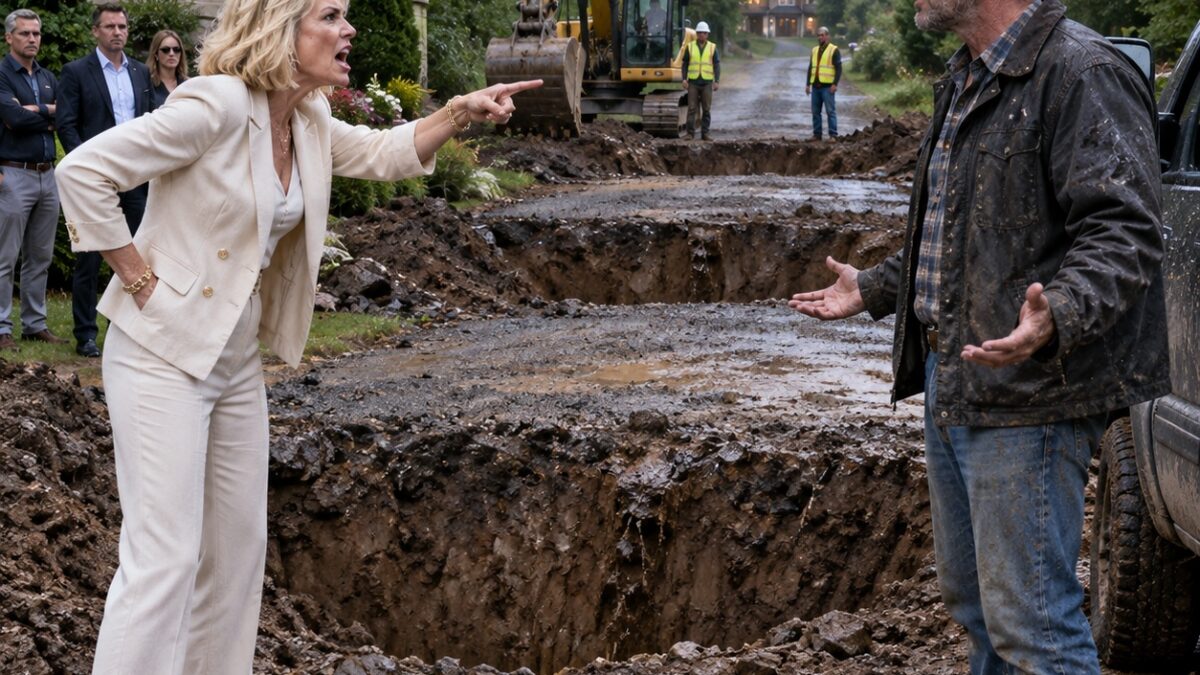
I stood at the edge of that trench for several seconds without moving.
Rain ran down the back of my neck.
My jeans were already soaked below the knees.
Mud clung to my boots.
The flashlight beam shook slightly because I was holding it too tightly.
The pipe was black corrugated plastic, probably thirty inches in diameter, maybe larger. It entered the trench wall from the Cedar Ridge side, passed beneath what had been my driveway, and disappeared toward the forest on my western slope.
Someone had scraped the top of it with an excavator bucket.
Fresh gray scratches showed through the black surface.
Water moved inside.
Not a trickle.
A steady volume.
I could hear it.
That was what bothered me most.
I had lived there long enough to know the sounds of my property.
The seasonal creek.
Rain hitting cedar branches.
Wind moving through fir trees.
The drainage ditch beside Bailey Lane.
This sounded different.
Contained.
Pressurized by gravity.
Artificial.
I walked around the trench carefully.
Fifty yards farther up the lane was the second cut.
Beyond that, the third.
Three trenches.
Each roughly four feet across.
Some sections were deeper than five feet.
Whoever had done it hadn’t scraped away a little gravel.
They had deliberately severed the road.
My house sat another quarter mile beyond them.
No vehicle was getting through.
No ambulance.
No fire truck.
No fuel delivery.
Nothing.
I pulled out my phone.
One bar of signal.
Enough.
I called the sheriff’s non-emergency number.
The dispatcher answered on the third ring.
“County sheriff. What’s your location?”
I gave her the address.
“What seems to be the problem?”
“Somebody excavated my driveway.”
A pause.
“How much damage?”
“They dug three trenches completely across it.”
“How deep?”
“Four or five feet.”
Another pause.
“Is this a shared driveway dispute?”
“No. It’s mine.”
“Do you know who did it?”
“I know who I suspect.”
“Any threats?”
“Not tonight.”
“Any weapons involved?”
“Unless you count an excavator.”
She did not laugh.
“Can emergency vehicles reach your residence?”
“No.”
That changed her tone immediately.
“Stay somewhere safe. A deputy is being dispatched.”
I sat in the cab of my truck with the heater running.
The rain kept falling.
Every few minutes I looked toward the first trench as if it might somehow disappear.
It didn’t.
Twenty-six minutes later, red and blue lights appeared behind me.
Deputy Mark Harris stepped out wearing a dark rain shell and an expression that said he had already seen too much stupidity that weekend.
He walked toward the trench.
Stopped.
Looked at me.
Then looked back at the hole.
“What the hell happened here?”
“Good question.”
He shined his flashlight down.
“Did you do any excavation?”
“No.”
“Contractor?”
“Not mine.”
He crouched near the edge.
Fresh track impressions were still visible in the mud.
“Excavator.”
“That was my guess.”
“How long were you gone?”
“Friday morning until tonight.”
“Anybody know?”
“Friends. My shop manager. Maybe half the town if someone asked.”
He stood.
“You said you suspect someone.”
“The president of the subdivision next door.”
He looked toward Cedar Ridge.
“What’s the history?”
“That depends how much time you have.”
He gave me a dry smile.
“Apparently more than I expected.”
So I told him.
Not everything.
Not yet.
Just enough.
I told him about the first confrontation with Belle.
The fake HOA fines that followed.
The warning letters accusing me of aesthetic violations even though my property was not part of Cedar Ridge.
The complaint about a cord of firewood delivered to my own home.
The letter demanding that I remove an “unauthorized commercial vehicle” from Bailey Lane.
The commercial vehicle had been my own flatbed truck.
Then I told him about the towing incident.
That had happened the previous spring.
My younger brother, Caleb, had come over to help me rebuild the woodshed.
He parked his sedan along the side of Bailey Lane, entirely inside my property line.
At around eleven that morning, I heard diesel engines outside.
A tow operator was positioning his truck beside Caleb’s car.
I ran down the lane.
“What are you doing?”
The driver pointed toward Cedar Ridge.
“HOA called it in.”
“What HOA?”
“Cedar Ridge.”
“This isn’t Cedar Ridge.”
He looked annoyed.
“Sir, I was told the vehicle is illegally parked on association property.”
I went inside, retrieved my deed and survey map, and returned.
The driver studied them.
Called his dispatcher.
Then said several words I won’t repeat about people who waste towing companies’ time.
He lowered Caleb’s car.
Before leaving, he handed me the dispatch record.
Requester:
BELLE EDWARDS, HOA PRESIDENT.
After that, I stopped treating Belle as merely irritating.
I hired Tom Peterson.
Tom was a licensed surveyor who had been working in the county since before most Cedar Ridge residents knew where the Cascade foothills were.
He spent an entire Tuesday locating monuments, verifying coordinates, checking plats, and walking Bailey Lane from the highway to my main parcel.
By sunset, bright pink stakes stood every fifty feet along my boundary.
The conclusion was simple.
Bailey Lane belonged completely to me.
Not mostly.
Not approximately.
Completely.
Tom also discovered something amusing.
Cedar Ridge’s expensive brick entrance monument crossed onto my land by approximately eight inches.
Eight inches wasn’t worth starting a war over.
At least, not then.
Belle arrived while Tom was placing the final marker.
She climbed out of her Range Rover.
“What are you doing?”
Tom didn’t even look up.
“Survey.”
“You can’t place those ugly stakes on HOA property.”
Tom checked his instrument.
“This is Mr. Bailey’s property.”
“No, it is not.”
“It is according to three recorded plats, two monuments, and the deed.”
Belle bent down, grabbed one of the new stakes, and ripped it out.
Tom froze.
Then he slowly lowered his equipment.
“Ma’am.”
“What?”
“Moving survey markers can create serious legal problems.”
“It was on our landscaping.”
“No.”
He pointed toward the mark in the ground.
“It was on Mr. Bailey’s parcel.”
“I disagree.”
“You’re allowed to disagree.”
Tom’s voice stayed calm.
“You are not allowed to destroy my markers.”
She tossed the stake into the grass.
Tom took out his phone.
“Touch another one and I’ll call the sheriff myself.”
Belle stared at him.
Then at me.
Then drove away.
For months afterward, the letters stopped.
No more fines.
No towing companies.
No confrontations.
By Labor Day weekend of 2024, I had almost convinced myself she had accepted reality.
Deputy Harris listened without interrupting.
When I finished, he shined his flashlight toward Cedar Ridge.
“That’s a lot of history.”
“Yes.”
“You have copies?”
“Every letter.”
“Survey?”
“Digital and paper.”
“Photos of the markers?”
“Yes.”
He nodded.
“Good.”
Then we walked to the second trench.
That was where he saw the pipe.
“What’s that?”
“I was hoping you’d tell me.”
“Water line?”
“Too big.”
“Storm drainage?”
“Maybe.”
“You know of any easement?”
“No.”
He looked at me.
“None?”
“There’s a utility easement near the county road for power and telecommunications. Nothing here.”
He crouched.
The rain had exposed more of the pipe.
“Runs toward the subdivision.”
“Yes.”
“Could predate your ownership.”
“Then it should show somewhere.”
“Maybe.”
I could tell he wasn’t going to speculate.
That was probably wise.
We continued toward the third trench.
There we found another pipe.
Smaller.
Maybe eighteen inches.
Also running beneath my property.
Deputy Harris muttered something.
“What?”
“Nothing official.”
“Unofficial?”
He looked at me.
“You may have more than one problem.”
“I was afraid of that.”
He photographed everything.
Then asked about cameras.
My house cameras were too far away.
I had a trail camera near the woods, but it pointed toward a deer path.
Cedar Ridge, however, had entrance cameras.
“Think they’ll cooperate?” he asked.
“With you?”
“Maybe.”
“With me?”
“No.”
He smiled.
“We’ll start with me.”
I walked the rest of the way home carrying a backpack and flashlight.
The road looked worse from the other side.
Fresh excavator tracks scarred the gravel.
At the second trench, a pile of soil had been pushed almost entirely toward Cedar Ridge’s landscaped buffer.
That bothered me.
If someone was simply repairing drainage, why pile the dirt toward the subdivision?
It looked less like construction and more like a message.
You don’t belong here.
I slept badly.
At six thirty the next morning, I called Tom.
He answered with the voice of a man who had not yet met coffee.
“Dobby?”
“Someone dug three trenches across Bailey Lane.”
Silence.
“What?”
“And there are pipes underneath.”
Longer silence.
“Do not touch anything.”
“That seems to be the official slogan.”
“I’m serious.”
“So am I.”
“What kind of pipe?”
“Black corrugated. Big.”
“How big?”
“Thirty inches, maybe.”
“Another?”
“Smaller one in the third trench.”
He was fully awake now.
“I’ll be there.”
“When?”
“Forty-five minutes.”
Then I called Lena Ortiz.
Lena was the attorney I had used during a timber-boundary dispute two years earlier.
She specialized in land use, title issues, construction conflicts, and apparently telling clients when their lives were about to become complicated.
I explained the trenches.
She said, “Send me the deed.”
I explained the pipe.
She said, “Send me the survey.”
I explained Belle’s history.
She said, “Send me everything.”
I emailed a folder large enough to make my internet connection complain.
At 7:38, Tom arrived.
He parked near the highway because he couldn’t cross the trench.
He climbed out with a thermos, rain jacket, tripod, rods, flags, and the deeply offended expression surveyors get when someone ignores a boundary they have already established.
He stood over the first trench.
“She did this while you were gone?”
“I don’t know that yet.”
“You know.”
“I suspect.”
Tom grunted.
“That’s lawyer language.”
“Been learning.”
He set up his equipment.
By eight thirty, Deputy Harris returned.
This time he had copies of the initial incident report.
At eight forty-five, a county road inspector arrived.
At nine ten, a white pickup with orange lettering stopped behind them.
CASCADE EARTHWORKS.
A man in a fluorescent jacket stepped out.
Mid-forties.
Baseball cap.
Weathered face.
He walked toward us.
“Mr. Bailey?”
“Yes.”
“Marcus Yates. Operations manager.”
He looked at the trenches.
Then at me.
“We did this.”
Deputy Harris turned.
“You’re admitting your company excavated the road?”
Marcus nodded.
“Our machine. Our operator.”
That was unexpectedly refreshing.
“Who hired you?” I asked.
He took a folded document from his jacket.
“Cedar Ridge Homeowners Association.”
I didn’t need to ask the next question.
But I did anyway.
“Who signed?”
He opened the work order.
“Belle Edwards.”
Deputy Harris held out his hand.
“May I?”
Marcus gave it to him.
Harris read.
His eyebrows moved.
“What?”
He turned the page enough for us to see.
SITE: CEDAR RIDGE WESTERN BUFFER / FORMER ACCESS TRACK.
SCOPE: EXCAVATE THREE DRAINAGE RELIEF CUTS ACROSS ABANDONED GRAVEL LANE TO RESTORE NATURAL SHEET FLOW AND PREVENT UNAUTHORIZED VEHICLE CROSSING.
I read it twice.
“Former access track.”
Marcus looked uncomfortable.
“That’s what we were given.”
“Abandoned.”
“Yes.”
“Unauthorized vehicle crossing.”
He nodded.
“I’m the unauthorized vehicle.”
“I understand that now.”
“You didn’t check ownership?”
Marcus exhaled.
“We were hired by an established HOA.”
“That doesn’t answer the question.”
“No.”
He looked me straight in the eye.
“We did not independently pull the parcel record.”
At least he didn’t hide behind excuses.
“What map were you given?”
He returned to his truck and brought back a laminated site sheet.
The Cedar Ridge entrance boulevard was shown in gray.
A green strip ran beside it.
My road was inside the green strip.
Label:
WESTERN LANDSCAPE BUFFER.
No Bailey Lane.
No private parcel number.
No owner.
Tom took one look.
“That’s not a recorded survey.”
“What is it?” I asked.
“Conceptual site plan, maybe.”
He pointed.
“See this line? They’re showing the boundary here.”
He moved his finger.
“Actual boundary is over here.”
The difference was almost exactly thirty feet.
The width of Bailey Lane.
Marcus looked pale.
“That’s what they gave us.”
“Who?”
“HOA management.”
“Belle?”
“The email came from the management office. Work order signed by Belle.”
Deputy Harris photographed the sheet.
“When did excavation begin?”
“Saturday morning.”
“I left Friday.”
Marcus nodded.
“First cut around eight.”
“Any problems?”
“Not until the second.”
“The pipe.”
“Yes.”
He pointed.
“The operator uncovered it.”
“What did he do?”
“Stopped.”
“Good.”
“He called me.”
“What did you tell him?”
“Do not touch unidentified utilities. We had a public locate done, but private drainage wouldn’t necessarily show.”
“Then?”
“I called the HOA contact.”
“Belle?”
“Yes.”
“What did she say?”
“She came out.”
That interested all of us.
“Personally?”
“Yes.”
“How fast?”
“Fifteen minutes.”
I looked toward Cedar Ridge.
“So she knew there was excavation happening.”
“Yes.”
“What did she say about the pipe?”
Marcus hesitated.
Deputy Harris said, “Just tell us exactly.”
Marcus nodded.
“She said it was association stormwater infrastructure.”
I felt something cold settle inside me.
“She knew.”
“She knew what it was.”
“What happened next?”
“Our operator said he wasn’t digging through it.”
“Smart.”
“Belle told him the line was inactive.”
“Was it?”
Marcus looked toward the trench.
“You can hear water in it.”
“What did he say?”
“He refused to damage it.”
I almost liked the guy already.
“So how did we get a trench?”
“He widened the cut around it and removed road material without touching the pipe.”
“Then the third?”
“Same instruction.”
“That’s where the smaller pipe was.”
“Yes.”
“Did he finish?”
“No.”
“Why?”
Marcus pointed toward my forest.
“He found an outfall.”
We followed him down a slope beside Bailey Lane.
Blackberries grabbed my jacket.
Ferns brushed our boots.
After maybe sixty feet, the sound of running water became obvious.
Then we saw it.
A black pipe emerged from the hillside.
Water poured from it into a narrow channel cutting downhill through my woods.
I stopped.
That channel had existed for years.
At least, I thought it had.
I remembered walking past it shortly after buying the property.
Back then, it was shallow.
Over the last three winters it had deepened.
One alder had fallen.
Two cedars leaned slightly downhill.
The soil near the channel stayed wet well into summer.
I had blamed heavy rainfall.
Western Washington was not exactly famous for dry winters.
Tom crouched near the outlet.
“This pipe isn’t from 1993.”
“How old?”
“Hard to say from appearance.”
“Cedar Ridge?”
“Would fit the timeline.”
Marcus looked miserable.
“I’m calling our insurer.”
“Probably smart.”
Deputy Harris stepped aside and spoke into his radio.
I looked toward the water.
It was brown from rain.
But the volume was steady.
“Where does it come from?”
Tom pointed east.
“Subdivision.”
An hour later, the county stormwater department sent an engineer.
Her name was Priya Shah.
She wore waterproof boots, a yellow shell, and the expression of someone who expected a routine drainage complaint and instead found six people staring into an unauthorized pipe.
She pulled Cedar Ridge’s development plans on a tablet.
“Do you know which basin this is?”
“No.”
She walked uphill.
Checked coordinates.
Walked back.
Zoomed the map.
Then went silent.
Tom noticed.
“What?”
“The approved plan doesn’t show an outfall here.”
My stomach tightened.
“Where does it show?”
She enlarged the screen.
Cedar Ridge had three main stormwater detention areas.
The western system collected runoff from roofs, roads, driveways, sidewalks, and landscape drains.
On the approved engineering map, water left the detention pond through a controlled outlet and discharged into what was labeled a natural drainage corridor.
“Where’s that corridor?”
Priya pointed.
According to the plan, it ran inside Cedar Ridge.
Tom leaned over her shoulder.
“That line is wrong.”
She looked at him.
“Boundary?”
“Yes.”
Tom opened his survey.
The discrepancy was obvious.
The development plan shifted the property line west by roughly thirty feet.
Exactly enough to absorb Bailey Lane.
Priya stared at both documents.
“Final plat should control.”
“It does.”
“Do you have it?”
“Of course.”
Tom carried half a courthouse in his truck.
He retrieved a copy.
Final recorded subdivision plat.
The Cedar Ridge western boundary stopped east of Bailey Lane.
Clearly.
No ambiguity.
No overlap.
Priya exhaled.
“Then I need to find out why the civil plans show something different.”
“Are the pipes permitted?” I asked.
“The stormwater system was permitted.”
“That wasn’t my question.”
She looked toward the outlet.
“I need to verify the approved as-built drawings.”
“Could an as-built show pipes on my land?”
“Yes.”
“Could that be legal?”
“With property rights.”
“Which I never gave.”
“That’s what we need to determine.”
Tom said, “I already searched the title chain.”
Priya turned.
“You found nothing?”
“No drainage easement benefiting Cedar Ridge or its predecessor.”
She looked back toward the pipe.
That was the first moment I saw real concern.
Not annoyance.
Not bureaucratic caution.
Concern.
At noon, Lena called.
“Are you sitting down?”
“I’ve heard that too many times today.”
“I pulled title.”
“And?”
“No Cedar Ridge drainage easement.”
“I know.”
“How?”
“Tom.”
“Good. I like Tom.”
“Everybody likes Tom until he sends an invoice.”
She ignored me.
“There is also no road easement benefiting the HOA.”
“I knew that.”
“No landscape easement.”
“Good.”
“No recorded right allowing them to alter Bailey Lane.”
“Also good.”
“And there’s something else.”
Of course there was.
“The early engineering plans are inconsistent with the final plat.”
“Priya found that.”
“Exactly. I spoke with county records.”
“You work fast.”
“I bill fast.”
“What does it mean?”
“Possibly a drafting error. Possibly an outdated base map. Possibly a conceptual property boundary that was never corrected in one design set.”
“And the pipes?”
“If they were constructed according to a plan showing the wrong line, somebody may have installed stormwater infrastructure where they had no legal right to install it.”
I sat on a fallen log.
Rain ticked against my hood.
“Who pays?”
“Slow down.”
“I’m asking.”
“Could be HOA. Developer. Engineer. Contractor. Insurers. Some combination.”
“What about Belle?”
“Her excavation is separate.”
“Separate?”
“The original pipe installation may predate her presidency.”
“It does.”
“But ordering work across your known private road after your survey? That is much more directly tied to her.”
I looked toward the trenches.
“What do I do?”
“Document everything.”
“Already am.”
“Do not repair the trenches permanently.”
“I need a road.”
“We can arrange temporary access.”
“I don’t want temporary.”
“You want evidence preserved more.”
She was right.
I hated that.
By afternoon, Cascade Earthworks installed heavy steel trench plates so I could get my truck home.
Marcus refused to charge me.
“My mistake too.”
“You relied on your client.”
“I should have checked the parcel.”
I looked at him.
“You know Belle told your operator my road was abandoned?”
“Yes.”
“You believe her?”
“Not anymore.”
That was the theme of the week.
Not anymore.
The next morning, Cedar Ridge’s attorney contacted Lena.
His name was Warren Pike.
According to Lena, his first letter was twenty-three pages long and managed to say almost nothing.
He described the excavation as “good-faith drainage remediation.”
He said the association disputed my interpretation of the boundary.
He said the HOA reserved “historic and equitable access rights.”
He said I should avoid interfering with existing stormwater systems because doing so could create downstream or upstream damage.
Lena emailed me the letter.
My response:
Can I laugh?
Her reply:
Privately.
Then another message:
Do not touch the pipes.
I called.
“They put pipes on my land and now they’re warning me not to touch them?”
“Yes.”
“That seems backward.”
“It is also strategically useful.”
“How?”
“They’re acknowledging the lines serve their subdivision.”
I smiled.
“Meaning?”
“Meaning later they can’t pretend they belong to you.”
I started learning to enjoy lawyers in very small doses.
Two days later, the county found the original stormwater maintenance agreement.
When Cedar Ridge was built, the developer installed private stormwater infrastructure.
After construction, maintenance responsibility transferred to the HOA.
Which meant Cedar Ridge likely owned the pipes.
That might sound helpful.
It wasn’t.
They owned infrastructure buried on land they did not own.
Without a recorded easement.
The practical consequences became obvious when Priya brought two more engineers to my property.
They inspected the detention pond inside Cedar Ridge.
Then the pipes.
Then the ravine.
One engineer finally said:
“You can’t just plug these.”
“I wasn’t planning to.”
“If flow backs up, the pond could overtop during a major storm.”
“Meaning?”
“Street flooding.”
“Houses?”
“Potentially lower lots.”
I looked at Priya.
“So I’m stuck with them?”
“No.”
She shook her head.
“But any change needs engineering.”
“How long?”
“Depends.”
I hated that answer.
Everyone used it when the real answer was expensive.
Belle appeared on Friday.
She did not call.
Her Range Rover crossed the temporary steel plates.
She parked near my workshop.
I walked out wiping grease from my hands.
She wore a cream-colored coat over black slacks.
No umbrella.
Even rain seemed beneath her.
“Dobby.”
“Belle.”
“We need to resolve this.”
“You have a lawyer.”
“So do you.”
“Then we’re already resolving it.”
She looked toward Bailey Lane.
“This situation is becoming unnecessarily expensive.”
I actually laughed.
“You hired an excavator.”
“I authorized drainage restoration.”
“Across my road.”
“The ownership of that strip has been historically unclear.”
“No.”
“It has.”
“Tom surveyed it.”
“Your surveyor.”
“A licensed surveyor.”
“Cedar Ridge’s original plans show the strip as part of the western buffer.”
“Final plat doesn’t.”
“You’re oversimplifying.”
I stepped closer.
“Belle, you already knew about Tom’s survey before you hired Cascade.”
Her jaw tightened.
“I disputed it.”
“Then file a boundary action.”
“We were advised—”
“Who advised you to excavate my driveway while I was out of town?”
She stopped.
Exactly.
I continued.
“You called it abandoned.”
“It should be.”
That slipped out.
She realized it immediately.
I said nothing.
Her expression changed.
“Bailey Lane is redundant.”
There it was.
“Redundant.”
“You could access your property through Hawthorne Drive.”
“Hawthorne Drive is inside Cedar Ridge.”
“Yes.”
“So I abandon my deeded road and start driving through an HOA that has spent three years trying to regulate me?”
“You would have a paved entrance.”
“I like gravel.”
“It lowers the appearance of the entire development.”
“You don’t own my appearance.”
She exhaled.
“I am trying to solve a planning mistake.”
“My property isn’t a mistake.”
“The layout is.”
“For you.”
“For everyone.”
“No.”
“For Cedar Ridge.”
She stared at me.
I suddenly understood something that had been hiding behind all the fines and letters.
Belle did not simply hate my road because it was dusty.
Bailey Lane was a visible reminder that Cedar Ridge did not control everything around its entrance.
Their perfect boulevard ran beside a narrow gravel road with an old Ford driving up and down it.
Every prospective buyer saw it.
Every visitor saw it.
Belle saw it.
And she hated that she couldn’t regulate it.
“You wanted me to stop using Bailey Lane.”
“I wanted a rational access arrangement.”
“No.”
I shook my head.
“You wanted the road gone.”
“That’s ridiculous.”
“You labeled it abandoned.”
“Because it should eventually be incorporated.”
“Incorporated into what?”
“The entrance buffer.”
“Whose entrance buffer?”
“The community’s.”
“You mean your HOA.”
“Cedar Ridge.”
“And I would drive where?”
“Hawthorne Drive.”
“Under HOA control.”
“Road rules apply to everyone.”
“There it is.”
She crossed her arms.
“What?”
“You finally said it.”
“Said what?”
“This was never just about dust.”
Her face hardened.
I looked toward Cedar Ridge.
“If I use your road, I become easier to regulate.”
“That is paranoid.”
“You tried to tow my brother’s car from my land.”
“A contractor error.”
“You sent me fines.”
“Administrative misunderstandings.”
“You ripped out Tom’s stake.”
She looked away.
“And while I was fishing, you paid somebody to cut three holes across my only access.”
“That was drainage.”
“Stop saying that like we’re both stupid.”
Her eyes snapped back.
For several seconds, neither of us spoke.
Then she said:
“You need to be careful with the stormwater lines.”
I stared.
“Why?”
“If you disrupt them and homes flood, the association will hold you responsible.”
That was so absurd I almost admired it.
“You buried infrastructure on my property.”
“The developer did.”
“Your HOA owns it now.”
“We maintain it.”
“And you’re threatening me because your unauthorized pipes might fail?”
“They are not unauthorized.”
“Show me the easement.”
“Our counsel is addressing that.”
“Get off my property.”
Her eyes widened.
“What?”
“I’m done.”
“I came here to resolve this.”
“No.”
I pointed toward her Range Rover.
“You came here to make your problem sound like my responsibility.”
“You’re being emotional.”
That was nearly impressive.
“Belle.”
“What?”
“Leave.”
She stared at me for a long moment.
Then turned.
At the vehicle, she stopped.
“You’re going to regret making an enemy of this neighborhood.”
I laughed.
“I’m not fighting a neighborhood.”
She looked back.
“I’m fighting you.”
That sentence bothered me later.
Not because it was untrue.
Because I didn’t want to become the person who reduced 150 families to Belle Edwards.
Most of those people had done nothing to me.
They bought homes.
Paid dues.
Planted flowers.
Raised kids.
Walked dogs.
They weren’t the problem.
Belle was.
Or at least Belle was the most visible part of it.
Tom arrived ten minutes after she left.
He had parked behind the barn during our argument.
“How much did you hear?”
“Enough.”
“You record it?”
“No.”
Washington recording law could get complicated depending on circumstances.
Tom was not careless.
“But I got photographs of her vehicle.”
“Useful.”
He looked toward the trees.
“Not as useful as what I found.”
I groaned.
“Please stop finding things.”
“Come on.”
We walked down the eastern slope.
Past the first outfall.
Then farther south.
Nearly eight hundred feet from Bailey Lane, we reached another channel.
This one was much worse.
A deep erosion scar cut through the hillside.
Four feet in some places.
Exposed roots hung over the edges.
Sediment had washed downhill toward a seasonal creek.
At the top was another black pipe.
Larger than the second one.
I stood there.
“There are three?”
“At least.”
“All from Cedar Ridge?”
“Direction says yes.”
“How did I never see this?”
“Dense vegetation.”
He pointed.
“And you probably assumed the channel was natural.”
I had.
That was what scared me.
When I bought the property, that slope had been stable.
After Cedar Ridge was built, little things changed.
A muddy patch stayed wet later into summer.
One alder tipped during a storm.
Then another.
The ravine deepened.
Blackberries disappeared near the strongest water flow.
I had blamed weather.
Now I wondered how much water 150 rooftops, roads, driveways, and sidewalks were concentrating into those pipes.
Tom said:
“You need an environmental engineer.”
“I need fewer professionals.”
“You need this one.”
Dr. Nora Chen arrived Monday.
She was short, serious, and carried more measuring equipment than seemed physically possible.
Two assistants followed.
They mapped each outlet.
Measured channel depth.
Tested soil moisture.
Documented exposed roots.
Inspected the seasonal creek.
Checked sediment accumulation.
Reviewed historical aerial photos.
That last part became important.
Two days later, she showed me images.
Aerial photograph from 2020.
Before Cedar Ridge.
The eastern slope had no major channels.
A small natural drainage swale existed, but it was broad and shallow.
Aerial from 2022.
Construction.
Bare ground.
New detention pond.
Aerial from 2023.
Vegetation returning.
But one dark line had appeared on my slope.
Concentrated drainage.
Current condition.
The line had become a trench.
Nora pointed.
“Stormwater volume didn’t necessarily increase dramatically at the watershed scale.”
“In English.”
“Rain used to spread across a large area.”
“Okay.”
“Now much of it hits roofs, pavement, and streets.”
“Then enters drains.”
“Yes. Detention systems slow peak flow, but outlets concentrate discharge.”
“Onto me.”
“Yes.”
“How much?”
She opened a model.
During a normal storm, thousands of gallons.
During a ten-year storm event, tens of thousands of gallons per hour combined.
During larger events, more.
I stared.
“That comes onto twelve acres.”
“Not evenly.”
“Exactly.”
She nodded.
“It is concentrated in three narrow corridors.”
“Which explains erosion.”
“Strongly.”
“Can it destabilize the slope?”
“Parts already show instability.”
“What about the creek?”
“Sediment transport is occurring.”
“Environmental violation?”
“Possibly. Depends on permits, thresholds, wetlands, fish habitat classification, and other factors.”
“Are the pipes legal?”
“I’m an engineer, not your lawyer.”
“Everybody keeps saying that.”
She almost smiled.
“But I have not found an approved offsite discharge authorization for your parcel.”
That was enough.
Lena organized a joint meeting.
County stormwater officials.
Cedar Ridge’s attorney.
HOA representatives.
Insurance adjusters.
The former developer’s attorney.
Civil engineers.
Tom.
Nora.
Me.
And Belle.
The meeting took place in a county conference room with fluorescent lights and terrible coffee.
For the first twenty minutes, I understood maybe sixty percent of the language.
Reliance interests.
Legacy design assumptions.
Private conveyance systems.
Hydraulic continuity.
Recorded rights.
Offsite discharge.
Maintenance obligations.
Then Lena did what Lena did best.
She opened my deed.
Placed it in the middle of the table.
“There is no drainage easement.”
Warren Pike adjusted his glasses.
“We disagree with the broader characterization of the association’s rights.”
“Good.”
Lena smiled.
“Show me the instrument.”
“We believe equitable rights may exist based on historical use and development reliance.”
“How many years?”
“Several.”
“Three?”
“More than three.”
“The subdivision became operational in 2022.”
Warren did not answer.
Lena continued.
“You are not seriously proposing that three years of hidden underground drainage creates a prescriptive easement against a landowner who did not know the use existed.”
“We are preserving all theories.”
“That’s a very expensive way to say no document.”
Belle shifted in her chair.
The former developer’s lawyer spoke.
“Our client constructed according to engineering documents approved by the county.”
Priya answered.
“County approval does not grant private property rights.”
“I understand.”
“Apparently someone didn’t.”
The civil engineer’s representative said:
“The boundary discrepancy appears to originate from a base map supplied during conceptual design.”
Tom leaned forward.
“Final plat was available before construction.”
“We are reviewing timing.”
“Pipe installation occurred after recording.”
Silence.
I looked around the table.
Nobody wanted ownership of the mistake.
The developer blamed drawings.
The engineer blamed source data.
The county pointed to applicant certifications.
The HOA said it inherited the system.
Belle said the pipes predated her presidency.
All true in pieces.
None solved the problem.
Finally, the county’s senior stormwater engineer spoke.
“There are two practical paths.”
Everybody became quiet.
“One: negotiate permanent offsite drainage rights with Mr. Bailey.”
Warren looked at me.
“Two?”
“Relocate the system so it remains entirely within Cedar Ridge-controlled property or another lawful corridor.”
Belle asked:
“Estimated cost?”
“Too early.”
“Order of magnitude.”
The engineer hesitated.
“Seven figures is possible.”
Belle’s face changed.
There it was.
Not anger.
Fear.
Warren turned to me.
“Mr. Bailey, would you consider a permanent easement?”
I looked at Nora.
Then at the photographs of my eroded slope.
“No.”
Belle exhaled sharply.
Warren stayed calm.
“Why?”
“Because the current discharge is damaging my land.”
“That can be mitigated.”
“Maybe.”
“Energy dissipation structures. Armoring. Outlet improvements.”
“I don’t want three stormwater lines from 150 homes running through my woods forever.”
Belle said:
“That is unreasonable.”
“No.”
I looked at her.
“It is inconvenient.”
“There is no meaningful difference when the cost falls on 150 families.”
“There’s a huge difference.”
“What?”
“One means I owe you something.”
I pointed toward the documents.
“The other means you built a subdivision around an assumption.”
Lena touched my elbow.
Not to stop me.
Just to remind me not to wander.
Warren said:
“Would you consider temporary rights while a permanent solution is engineered?”
“Yes.”
Everyone looked surprised.
Belle especially.
“For how long?” Warren asked.
“Enough to design and build the replacement.”
“Under what terms?”
“Monitoring. Insurance. Indemnity. Erosion repair. Legal costs. Access limitations. Compensation.”
Belle laughed sharply.
“Compensation.”
“Yes.”
“For pipes that have been there for years.”
“On my land.”
“You didn’t even know.”
That sentence changed the room.
Nora looked down.
Priya stopped writing.
Lena slowly turned toward Belle.
I answered quietly.
“That doesn’t make them yours.”
Belle realized too late how bad it sounded.
Warren intervened.
“We’ll discuss financial terms separately.”
Good idea.
The meeting ended with temporary protections.
Cedar Ridge could continue operating the stormwater system.
They could inspect the outlets only with notice.
They could not expand, replace, modify, or add infrastructure on my land without written permission.
They agreed to pay for monitoring.
And most importantly, they agreed to begin design of a permanent lawful solution.
That should have calmed things down.
Instead, Belle started a neighborhood campaign.
Residents began posting online.
OUTSIDER THREATENS CEDAR RIDGE DRAINAGE.
MAN DEMANDS HOA PAY FOR EXISTING WATER SYSTEM.
PRIVATE LANDOWNER COULD CAUSE FLOODING.
One post called me “the gravel-road extortionist.”
That was creative.
Another claimed I wanted $1 million personally.
False.
I had not asked for anything remotely close.
Someone posted a photo of my truck.
Someone else posted my business address.
Emily, my daughter, called furious.
“Dad, let me respond.”
“No.”
“They’re lying.”
“I know.”
“One woman says you dug the trenches yourself to create leverage.”
I laughed.
“That’s new.”
“It isn’t funny.”
“No.”
I sat at my kitchen table.
“It isn’t.”
“You should defend yourself.”
“Against Facebook?”
“Against lies.”
“Documents will do it.”
“People don’t read documents.”
“Eventually somebody will.”
She groaned.
“You’re impossible.”
“So I’ve been told.”
“By Belle?”
“Among others.”
Emily knew the full story.
She had grown up using Bailey Lane.
She learned to back a trailer there when she was sixteen.
She had painted one of the old mailbox posts purple when she was thirteen and I had left the paint stain for years because it annoyed her every time she saw it.
To her, the idea that someone could declare the road abandoned was personal.
More personal than it was for me.
“Dad.”
“Yes?”
“Promise me you won’t let them pressure you into giving it up.”
“I’m not giving up the road.”
“Good.”
“Did you think I would?”
“No.”
She paused.
“I thought you might get tired.”
That landed harder.
Because tired was exactly what I was.
Legal calls.
Engineer calls.
Insurance calls.
Sheriff follow-ups.
County meetings.
Repair estimates.
Residents angry at me.
A temporary steel road I hated driving over.
Every problem led to another.
That was probably what Belle had counted on from the beginning.
Make resistance exhausting.
Eventually people surrender.
Two days later, Cedar Ridge treasurer Grant Morrison called.
I did not know him.
“Mr. Bailey?”
“Dobby.”
“My name is Grant Morrison. I’m on the Cedar Ridge board.”
“Okay.”
“I’d like to ask you a few questions.”
“Talk to Lena if they’re legal.”
“They’re not.”
He sounded exhausted.
“Did Belle personally sign the excavation order?”
“Yes.”
“You’ve seen it?”
“I have a copy.”
“So do I.”
Silence.
“Did the board authorize it?”
“I was about to ask you.”
Grant exhaled.
“No.”
That mattered.
“Did the board know?”
“Not until afterward.”
“Belle said it was emergency drainage work.”
“What emergency?”
“We can’t find one.”
I leaned back.
“Interesting.”
“Dobby, I’m going to ask something awkward.”
“Go ahead.”
“Did you ever tell Belle you planned to block Cedar Ridge drainage?”
“No.”
“Threaten to remove pipes?”
“No.”
“Threaten legal action before the excavation?”
“I told her survey markers were mine and that I was not in the HOA.”
“Nothing about drainage?”
“I didn’t know drainage existed.”
Another silence.
Grant said:
“That’s what I thought.”
“Why?”
“Because Belle told us the excavation was necessary to prevent you from interfering with established drainage rights.”
I stood.
“She told you that before she dug?”
“At an executive discussion.”
“Was it recorded?”
“Not formally.”
“Who was there?”
“Five board members.”
“And nobody asked for the drainage easement?”
Grant’s silence answered.
Then:
“We trusted her.”
That sentence kept appearing.
We trusted her.
They trusted the developer.
They trusted the engineer.
They trusted old maps.
They trusted Belle.
Everyone trusted someone else enough not to verify the piece that mattered.
“What do you want from me?” I asked.
“The truth.”
“You have it.”
“I mean what outcome.”
I thought.
“My road restored.”
“Obviously.”
“Drainage removed from my land.”
He sighed.
“That’s going to be expensive.”
“I know.”
“The residents didn’t install it.”
“Neither did I.”
“Fair.”
“Your HOA owns it now.”
“I know.”
“Your board can pursue whoever made the original mistake.”
“We will.”
“Good.”
“What else?”
“Move the entrance monument.”
“The eight inches?”
“Yes.”
Grant was quiet.
“You really care about eight inches?”
“No.”
“Then why?”
“Because Belle cared enough to tell people my survey was wrong.”
He laughed despite himself.
“Fair.”
“I want written acknowledgment that Bailey Lane is outside HOA authority.”
“Easy.”
“I want every violation against me rescinded.”
“Also easy.”
“I want reimbursement for the tow incident.”
“How much?”
“Not much.”
“Fine.”
“And I want residents to understand I am not trying to flood them.”
Grant sighed.
“That one may be harder.”
“I know.”
The Cedar Ridge emergency board meeting took place five nights later.
I did not attend.
Grant told me afterward that the room was packed.
More than a hundred residents.
Belle sat at the front.
Pink suit.
Clipboard.
Same image of control.
Grant presented the excavation work order.
Belle immediately said the contractor misunderstood.
Then Marcus Yates’s written statement appeared.
The operator had contacted her after finding the first pipe.
Belle had personally confirmed the work.
Residents started asking questions.
Why was Bailey Lane called abandoned?
Why had Belle authorized cuts across property under active survey dispute?
Why was there no board vote?
Why were the pipes outside the recorded subdivision boundary?
Why had residents been told I was threatening drainage before I even knew drainage existed?
Belle answered some.
Avoided others.
Then Tom’s survey went onto the projector.
Bright boundary line.
Clear parcel.
Bailey Lane entirely mine.
Someone asked:
“Belle, did you have this before authorizing excavation?”
She hesitated.
That pause mattered.
“Yes.”
The room changed.
She tried to explain that Tom’s survey had been disputed.
Someone asked:
“By another surveyor?”
Silence.
“Did we hire one?”
“No.”
“So what exactly was disputed?”
Belle said:
“The development documents showed inconsistent information.”
Grant later told me that was the moment he knew she had lost the room.
Not because the answer was completely false.
Because it admitted she knew uncertainty existed.
And instead of resolving that uncertainty through lawyers or surveyors, she hired an excavator.
A man near the back stood.
His name was Bill Harmon.
He had bought one of the first Cedar Ridge houses.
“My assessment pays for HOA contractors.”
Belle nodded.
“Yes.”
“Did my money pay someone to cut a road that might not belong to us?”
“The purpose was drainage maintenance.”
“That is not what I asked.”
Applause.
Belle raised her voice.
“We are losing focus. Mr. Bailey has been hostile to this community from the beginning.”
That was a mistake.
A woman interrupted.
“How?”
Belle listed things.
He refuses paving.
He parks commercial vehicles.
He stores firewood.
He has refused community standards.
Someone shouted:
“He doesn’t live here!”
Laughter.
Belle went quiet.
That was another crack.
Then Grant presented the towing record.
The fake fines.
The letter calling Bailey Lane association property.
The incident with Tom’s marker.
Individually, each had been small enough to ignore.
Together, they formed a pattern.
Belle had spent three years trying to establish control over land she did not own.
Grant introduced a motion to suspend her unilateral contracting authority pending an independent investigation.
Five board members voted yes.
Two voted no.
Belle remained president.
Technically.
But her power was broken.
The independent investigation started the next week.
Meanwhile, my road still looked like a battlefield.
The steel plates rattled every time I drove over them.
Rainwater collected around the edges.
The first trench had started slumping.
Lena wanted evidence preserved.
I wanted access restored.
Finally she agreed there was enough documentation.
Cascade Earthworks came back.
Marcus personally supervised.
They removed the plates.
Excavated damaged road base farther than the original cuts.
Installed geotextile.
Compacted crushed rock in lifts.
Rebuilt drainage ditches.
Regraded the crown.
Installed new gravel.
The total estimate stunned me.
$96,000.
“For three holes?” I asked.
Marcus shook his head.
“For three cuts that compromised the surrounding base.”
“Still.”
“You wanted it done right.”
“Yes.”
“That costs.”
Cedar Ridge paid without waiting for insurance.
Grant pushed it through.
“The board created the damage,” he told me. “We fix the damage.”
I respected him for that.
The entrance monument came next.
That became almost comical.
Eight inches.
A brick structure probably twenty feet long.
Stone veneer.
Lighting.
Electrical conduit.
Landscaping.
All because one corner crossed my boundary.
An engineer said they could modify only the footing.
Their attorney recommended moving the affected portion completely inside the HOA parcel.
Cost:
$41,000.
Grant called.
“Dobby.”
“Yes?”
“You’re going to make me ask.”
“Ask what?”
“Would you grant us eight inches?”
I laughed.
“You sound embarrassed.”
“I’m a retired CPA begging for eight inches of dirt.”
“Life is strange.”
“Seriously.”
I thought about it.
Under different circumstances, I probably would have.
That was the truth.
If Cedar Ridge had approached me in 2021 and said, We accidentally crossed the line eight inches, can we buy or license that strip?
I might have signed for a dollar.
But after years of Belle telling me the line didn’t matter?
No.
“Move it.”
Grant sighed.
“I knew you’d say that.”
“Your lawyer agrees.”
“He does.”
“Then why call?”
“Hope.”
“Dangerous.”
He laughed.
The monument moved.
For two days, Cedar Ridge’s grand entrance looked like it had lost a tooth.
I enjoyed that more than I should admit.
The drainage project was much harder.
The HOA hired an independent engineering firm.
Their first proposal rerouted the western pipes south.
Cost:
$1.4 million.
Belle called the estimate outrageous during a board meeting.
The engineers revised.
The south route crossed unstable soil.
Additional retaining work.
Cost:
$1.9 million.
Residents panicked.
Special assessment rumors spread.
Another engineer was hired.
That firm proposed a northern connection to a county drainage corridor, expanded detention storage, upgraded outlet controls, and slope stabilization.
Construction estimate:
$1.74 million.
Not including design.
Not including permits.
Not including temporary bypass pumping.
Not including my erosion repair.
Not including legal fees.
Not including road reconstruction.
The numbers were getting ugly.
The independent governance review got uglier.
Belle had approved several contracts under emergency authority that did not appear to qualify as emergencies.
She had allowed management to issue violation letters against property outside the association.
She had used outdated conceptual maps in correspondence after Tom’s final survey was available.
She had authorized the excavation without full board approval.
No one found evidence that she stole money.
That mattered.
I didn’t want rumors becoming facts.
But they found something almost as damaging.
Belle had received a legal memo months before the excavation warning that the western boundary issue should be resolved before any physical work occurred near Bailey Lane.
Grant called me the night he read it.
“She knew.”
“What exactly?”
“That counsel told her not to do construction near the disputed strip.”
“Before my trip?”
“Five months before.”
I sat quietly.
“What did she do with the memo?”
“Apparently nothing.”
“Board see it?”
“Only two officers were copied.”
“Why?”
“Privileged advice.”
“Convenient.”
“Dobby.”
“Yes?”
“I’m sorry.”
That caught me off guard.
“You didn’t dig the road.”
“I sat on the board while she behaved like this.”
“Did you know?”
“Not enough.”
“Then fix what you can.”
He did.
At the next Cedar Ridge meeting, Belle faced a removal vote.
She resigned the morning of the meeting.
Her letter was four pages.
I eventually obtained a copy because someone forwarded it to me.
She blamed shifting interpretations of historical documents.
Aggressive outside legal tactics.
Incomplete developer records.
An uncooperative neighboring property owner.
Contractor failures.
County inconsistencies.
Board disloyalty.
And what she called “a culture increasingly unwilling to respect decisive leadership.”
She never once wrote that she was wrong to excavate Bailey Lane.
Some people would rather write four pages than one honest sentence.
The new board elected Grant interim president.
His first email to me began:
Dobby, I promise I will never tell you to pave your road.
I replied:
Good start.
By December, temporary stormwater agreements were signed.
Cedar Ridge could continue using the existing pipes while the replacement system was designed.
In exchange, they paid for monthly inspection.
Erosion monitoring.
Additional insurance.
A temporary land-use license.
Environmental protection measures.
And a portion of my legal costs.
They also agreed that temporary use created no permanent easement or ownership right.
That sentence mattered more than the money.
Winter came hard.
Three atmospheric river storms hit western Washington between November and January.
For the first time, I watched the pipes deliberately.
During heavy rain, the largest outlet sounded like a small river.
Water shot into the erosion channel.
Brown sediment moved downhill.
Nora installed monitoring stakes.
Some shifted.
One section of bank lost almost eleven inches after a major storm.
I filmed it.
Sent everything to the engineers.
Their design changed again.
More slope stabilization.
More cost.
I felt bad for Cedar Ridge residents.
That surprised Emily.
“You feel bad for them?”
“Yes.”
“They’ve been attacking you online.”
“Some have.”
“Belle tried to destroy the road.”
“Belle isn’t 150 people.”
Emily considered that.
“I’d still be angry.”
“I am.”
“You don’t sound angry.”
“That’s because anger gets boring after six months.”
She smiled.
“Therapy by paperwork?”
“Pretty much.”
The permanent stormwater project began the following spring.
It was massive.
Excavators inside Cedar Ridge.
Temporary bypass lines.
New underground detention vault sections.
Concrete control structures.
Hundreds of feet of pipe.
Retaining systems.
A new northern outfall.
Traffic control.
Environmental fencing.
Inspectors.
Survey crews.
Every time I drove along Bailey Lane, I could see machinery over the hedge.
Belle had wanted my road to disappear because she thought it made the entrance ugly.
Now Cedar Ridge’s entrance looked like an industrial construction site for eight months.
There was a kind of symmetry in that.
Grant did not appreciate when I pointed it out.
“Please don’t enjoy this.”
“I’m trying.”
“You’re failing.”
“Yes.”
By summer, settlement negotiations started among the HOA, former developer, design engineer, installation contractor, and insurers.
I was only part of one section.
My land damage.
My road.
My legal costs.
Temporary access.
Permanent removal of the lines.
I did not care how they divided the rest.
Lena did.
“That’s because you don’t understand how fun allocation disputes are.”
“I can imagine.”
“No, you can’t.”
“I don’t want to.”
The former developer argued it relied on engineer-certified plans.
The engineering firm argued boundary data had come from the developer’s survey base.
The contractor argued it built exactly where plans instructed.
The county pointed to private property certifications.
The HOA argued it inherited the system without knowledge of defects.
Insurers fought over policy years.
Everybody had a piece of responsibility.
Nobody wanted the whole thing.
Months later, several confidential settlements were reached.
I never learned every number.
I learned enough.
Cedar Ridge reserves covered part.
Insurance recoveries covered part.
The former development group contributed.
The engineering firm’s insurer contributed.
The HOA still faced significant unreimbursed costs.
That led to a special assessment.
That was when the anger toward me peaked.
One resident mailed me a letter.
Not anonymous.
His name was on it.
He wrote:
I hope you’re happy. Families here are paying thousands because you refused to let drainage pipes stay underground where they weren’t hurting you.
I stared at the sentence.
Not hurting you.
I put on boots and walked to the eastern slope.
I took photographs.
Four-foot erosion channel.
Exposed roots.
Mud near the creek.
One tree leaning at twenty degrees.
Then I printed them.
I almost mailed them back.
Instead, I called Grant.
“You know a man named Howard Leland?”
“Yes.”
“He mailed me something.”
Grant sighed.
“I’m sorry.”
“Don’t be.”
“What did he say?”
I read it.
Grant was quiet.
Then:
“He’s angry about the assessment.”
“I understand.”
“Doesn’t make it right.”
“No.”
I looked at the photos.
“Could you arrange a resident site walk?”
“What?”
“Let them see the drainage damage.”
“You want residents on your property?”
“Small groups.”
Grant sounded suspicious.
“You hate people.”
“I dislike crowds.”
“That is not a denial.”
“Do you want to do it or not?”
He did.
The first group came Saturday.
Twelve residents.
Nora joined us.
We walked from Bailey Lane to the first outlet.
Then the second.
Then the severe erosion channel.
The mood changed.
A woman named Stephanie asked:
“All this water comes from us?”
Nora answered.
“From the western drainage basin, yes.”
“How much?”
She explained.
Another man stared at the channel.
“I thought he just didn’t want pipes under his road.”
I looked at him.
“That was how it started.”
Nora pointed toward the bank.
“Concentrated discharge is causing measurable erosion.”
Howard Leland was in the second group.
He did not identify himself at first.
I recognized him from Grant’s description.
At the largest outlet, he stood silently while water ran around his boots.
Finally he said:
“This was happening before the trenches?”
“Yes.”
“You didn’t know?”
“No.”
“So Belle exposed it.”
“Yes.”
He looked toward me.
“I wrote you a letter.”
“I know.”
His face reddened.
“I’m sorry.”
I nodded.
That was enough.
No speech.
No victory.
Just a man changing his mind after seeing something he had previously imagined.
Those site walks helped more than any legal letter.
Residents started understanding that the $2 million project was not money being paid to satisfy me.
Most of it was engineering work needed to put their own infrastructure where it belonged.
That distinction mattered.
By September, the new northern system was nearly complete.
The old outlets were scheduled to be disconnected.
I stood with Nora and Priya when the first one went dry.
Workers inside Cedar Ridge redirected flow.
The pipe beneath Bailey Lane stopped humming.
Water slowed.
Then disappeared.
For the first time since discovering it, I could stand beside the outlet in heavy rain and hear nothing.
Nora smiled.
“How does that feel?”
“Quiet.”
“That’s the point.”
The abandoned pipes were removed where feasible.
One section beneath Bailey Lane remained because excavation would have damaged the newly rebuilt road.
It was grouted and sealed.
I required the exact location recorded.
Tom laughed.
“You trust nobody now.”
“I trusted everyone before.”
“Fair.”
Slope restoration began next.
Engineered rock structures.
Coir logs.
Native willow stakes.
Cedar plantings.
Ground cover.
Channel stabilization.
Creek buffer repair.
It looked unnatural at first.
Too neat.
Nora promised vegetation would soften it.
She was right.
Within a year, ferns returned.
Willows took root.
The channel stopped deepening.
The leaning trees were removed where necessary.
New ones planted.
Then the final accounting arrived.
I was at my shop when Grant called.
“You sitting down?”
“You too?”
“What?”
“Everyone asks me that before giving me bad numbers.”
“This is a number.”
“How bad?”
“Two point six four.”
I stopped.
“What?”
“Final project and resolution cost.”
“Two point six four million?”
“Yes.”
“Exactly?”
“Close enough for the board report. Two million six hundred forty thousand.”
I leaned back.
“What’s included?”
He listed it.
Road reconstruction.
$96,000.
Entrance monument relocation and associated work.
Approximately $41,000.
Temporary bypass and stormwater operations.
$168,000.
Engineering, geotechnical studies, environmental work, permitting, and design.
Just over $214,000.
Permanent stormwater relocation and detention upgrades.
Approximately $1.74 million.
Slope, creek, vegetation, and property restoration.
Hundreds of thousands.
Legal expenses.
Surveying.
Insurance deductibles.
Temporary license.
Monitoring.
Settlement with me.
It added up.
$2.64 million.
Grant went silent.
Then:
“You know what the excavator invoice was?”
“I heard.”
“Eighteen thousand four hundred dollars.”
I laughed once.
“Expensive eighteen thousand.”
“You could say that.”
I looked through the shop window.
Rain had started.
“Residents okay?”
“Mixed.”
“Assessment?”
“Passed.”
“How much?”
“I’d rather not ruin your afternoon.”
“That bad?”
“For some families, yes.”
That removed most of my satisfaction.
I had wanted Belle stopped.
I had wanted my road restored.
I had wanted unauthorized drainage removed.
I had not wanted ordinary homeowners writing checks because their leadership and developer made bad decisions.
“Grant.”
“Yeah?”
“I’m sorry.”
He laughed bitterly.
“You’re apologizing?”
“I know you didn’t install the pipes.”
“No.”
“You didn’t dig my road.”
“No.”
“You did inherit a mess.”
“Yes.”
“Still.”
He sighed.
“We’ll survive.”
Cedar Ridge did.
Nobody lost their house because of the assessment.
Payment plans were offered.
Reserve contributions were adjusted.
Some litigation recoveries later reduced the net impact.
The neighborhood remained expensive and manicured.
Children still rode bicycles.
People still argued about landscaping.
Life continued.
That may sound obvious.
At the height of conflict, nobody believed it.
Everything felt existential.
To Belle, Bailey Lane threatened the appearance of Cedar Ridge.
To residents, my refusal threatened drainage.
To me, Belle threatened access to my own home.
Once lawyers entered, every sentence sounded like a declaration of war.
Reality was less dramatic.
Problems got measured.
Invoices got paid.
Pipes moved.
Roads repaired.
People adapted.
About eighteen months after Belle resigned, I saw her again.
I was at a hardware store buying cedar boards.
Someone said:
“Dobby?”
I turned.
Belle stood at the end of the aisle.
Jeans.
White blouse.
No clipboard.
No pink suit.
No Range Rover visible through the window.
She looked smaller.
Not physically.
Just less surrounded by authority.
“Belle.”
She approached.
For a few seconds neither of us spoke.
Then:
“Still living there?”
“Yes.”
“Still using the gravel road?”
“Every day.”
A faint smile.
“Of course.”
She looked at the lumber in my cart.
“What are you building?”
“Woodshed.”
“Another one?”
“The old one is fifteen years old.”
“I suppose the HOA has no opinion.”
I looked at her.
She actually laughed.
Small.
Unexpected.
Then the smile disappeared.
“I heard the final number.”
“Two point six four.”
“You know it exactly.”
“Hard number to forget.”
She looked toward the shelves.
“People blame me.”
I said nothing.
“Do you?”
“For what?”
“All of it.”
“No.”
That surprised her.
“No?”
“You didn’t design the drainage system.”
Her shoulders relaxed slightly.
“You didn’t install the original pipes.”
“No.”
“You did hire the excavator.”
Her face tightened again.
“There it is.”
“You asked.”
“I was trying to correct the entrance.”
I stared at her.
“What?”
She looked embarrassed.
“Bailey Lane always looked unfinished.”
“We already covered that.”
“No.”
She shook her head.
“You never understood.”
“Then explain.”
She glanced around.
Nobody nearby.
“The developer told the first board the western strip would eventually be incorporated into the entrance.”
I felt something shift.
“Who told you?”
She named a project manager from the original developer.
I knew him from paperwork.
“When?”
“During turnover.”
“Written?”
“No.”
“Of course not.”
“He said they had created the development around the assumption that your access would eventually move onto Hawthorne Drive.”
“My access?”
“Yes.”
“Did he talk to me?”
“I assumed he had.”
“Why?”
“Because why would they build it that way otherwise?”
There it was again.
Assumption.
Layer upon layer.
“Did he mention the drainage pipes?”
“Yes.”
I stopped.
“What did he say?”
“That western stormwater infrastructure crossed through a utility corridor.”
“What utility corridor?”
She looked at me.
“Your strip.”
“My road.”
“He described it as a corridor.”
“Did you ever see an easement?”
“No.”
“Did you ask?”
“I assumed legal had it.”
I almost laughed.
Not because it was funny.
Because that sentence contained the entire $2.64 million story.
I assumed legal had it.
“What happened when Tom surveyed the boundary?”
Belle’s face changed.
“That complicated everything.”
“No.”
“It contradicted what we had been told.”
“Did you call the developer?”
“Yes.”
“What did they say?”
“They said the original intent was still clear.”
“Intent doesn’t move property lines.”
“I know that now.”
“Did you know it then?”
She looked away.
“I knew our attorney was concerned.”
“How concerned?”
“He recommended obtaining an updated access and drainage agreement.”
My jaw tightened.
“When?”
“Several months before Labor Day.”
That was the admission I had suspected.
“You knew.”
“I knew there were questions.”
“You knew enough that your attorney told you to get an agreement.”
“Yes.”
“Why didn’t you?”
She didn’t answer.
“Belle.”
“You would have refused.”
“You didn’t know that.”
“You refused everything.”
“I refused being ordered.”
“You were hostile.”
“You fined someone outside your HOA.”
“You laughed in my face the first day we met.”
I almost smiled.
“You threatened to fine me because my private driveway was dusty.”
She opened her mouth.
Stopped.
Then nodded.
“Fair.”
That might have been the first time Belle Edwards ever said that word to me.
I leaned against the cart.
“If you had come to me before construction and said, Dobby, we discovered drainage crosses your land, can we negotiate, do you know what I would have said?”
“No.”
“I would have listened.”
“You wouldn’t have given up Bailey Lane.”
“No.”
“But drainage?”
“Maybe.”
She stared at me.
“Really?”
“With conditions.”
“Money.”
“Yes, money.”
She rolled her eyes.
I continued.
“Also insurance. Erosion protection. Inspection rights. Limits. Maintenance. Liability.”
She went quiet.
“You make that sound simple.”
“It was simpler than $2.64 million.”
“That is hindsight.”
“No.”
I shook my head.
“That is what contracts are for.”
She looked away.
For a moment, she seemed tired.
Not defeated.
Just tired.
Then she said:
“I wanted Cedar Ridge to look finished.”
“My property wasn’t unfinished.”
“I know.”
“Do you?”
“Yes.”
She finally looked at me.
“It just wasn’t ours.”
There it was.
The sentence I had wanted her to understand for years.
Not ours.
I nodded.
“No.”
Her mouth tightened.
“I still hate that road.”
I laughed.
“That’s allowed.”
“It’s ugly.”
“Also allowed.”
“Your truck throws dust.”
“I drive slower now.”
“Not fifteen.”
“Don’t push it.”
She almost smiled again.
Then she walked away.
No apology.
No dramatic reconciliation.
I didn’t need one.
Real endings rarely give you perfect speeches.
Sometimes they give you one sentence.
It just wasn’t ours.
That was enough.
A year after the stormwater project finished, I walked the eastern slope with Nora.
Vegetation had returned.
The repaired channel was holding.
The creek ran clear after rain.
We found new fern growth where exposed mud used to be.
“Stable,” she said.
“Completely?”
“Nothing in geology is completely.”
“Of course.”
“But much better.”
I looked uphill.
No roar from a plastic pipe.
No brown water tearing at roots.
“I didn’t realize how loud it was.”
“You adapted.”
“To the pipe?”
“To the change.”
That stayed with me.
Humans are good at adapting.
Sometimes too good.
Small damage becomes background.
A little more water.
A little deeper channel.
One leaning tree.
One extra muddy patch.
You adjust.
You assume weather.
Age.
Bad luck.
Then somebody digs a hole.
And suddenly you can see what was hidden underneath everything you had normalized.
Belle’s excavation was supposed to make Bailey Lane unusable.
Instead, it made the hidden system visible.
That irony never left me.
The new Cedar Ridge board became almost painfully careful about property lines.
Any project near an outside boundary required a current survey.
Legal review.
Written owner permission where needed.
Grant sent me the policy as a joke.
The title was:
EXTERNAL PROPERTY INTERFACE PROCEDURE.
I called him.
“You invented an entire procedure because of me?”
“Because of Belle.”
“Sounds bureaucratic.”
“It is.”
“Good.”
He laughed.
“You finally like the HOA?”
“No.”
“Progress.”
They also removed every old violation from my address.
Technically, the records should never have existed because I wasn’t a member.
Grant mailed me a letter:
Cedar Ridge Homeowners Association acknowledges that the property commonly known as Bailey Lane and the Bailey residence are not subject to Cedar Ridge declarations, rules, assessments, architectural standards, or enforcement authority.
I framed it.
Emily saw it on my shop wall.
“You actually framed an HOA letter?”
“It’s funny.”
“It’s deeply petty.”
“Both can be true.”
Beside it, Tom hung a miniature pink survey stake.
He wrote on it:
PLEASE DO NOT REMOVE.
That stayed too.
My brother Caleb was reimbursed for the towing fee.
The towing company sent him a gift card.
Apparently they had been dragged into enough HOA nonsense to sympathize.
The entrance monument now sits fourteen inches inside Cedar Ridge’s boundary.
Not eight.
Fourteen.
Their engineer wanted a margin.
Smart man.
Bailey Lane remains gravel.
I did improve it.
After everything, I decided Belle had accidentally been right about one thing.
The road needed maintenance.
I added new crushed rock.
Improved drainage ditches.
Regraded the crown.
Cut back brush.
Replaced the old mailbox post.
But I did not pave it.
On principle.
Also because I genuinely prefer gravel.
The dust still drifts toward Cedar Ridge on hot August days.
I drive slowly.
Usually.
Residents sometimes wave.
I wave back.
One man rolls his eyes every time.
That is also fine.
You do not need everyone to like you.
You need people to understand where their authority ends.
There is a difference.
Three years after the trenches, I was sitting on my porch during a summer rain when a white utility pickup came slowly up Bailey Lane.
I immediately stood.
Old habits.
The truck stopped.
A young engineer got out.
“Mr. Bailey?”
“Yes.”
“I’m with Cedar Ridge’s stormwater contractor.”
My stomach tightened automatically.
He held up a folder.
“We’re inspecting the northern system next week. There’s no work on your property.”
“Good.”
“But one of our access crews may need to park near the county shoulder.”
“On whose side?”
He smiled nervously.
“Ours.”
“Then why are you telling me?”
“Board policy says notify adjacent owners.”
I stared at him.
Then laughed.
He looked confused.
“Did I say something?”
“No.”
I shook my head.
“You did everything right.”
He left.
I sat back down.
That was probably the best ending Cedar Ridge could have had.
Not a dramatic lawsuit.
Not Belle being taken away in handcuffs.
Not me owning the subdivision.
Just a young engineer showing up before doing anything near my land.
Permission.
Notice.
Boundaries.
Boring things.
The exact things that could have prevented the entire disaster.
Sometimes people ask whether Belle committed a crime by ordering the excavation.
The sheriff investigated.
The county prosecutor reviewed the report.
There were questions about malicious mischief and property damage.
Ultimately, the civil issues dominated.
Belle insisted she believed the HOA had rights.
The contractor had paperwork.
The property maps conflicted in older documents.
Her attorney argued mistake, not criminal intent.
I did not push for prosecution.
Some people thought I should have.
Maybe they were right.
But by then, I wanted my road, my land, and my life back more than I wanted Belle punished.
Civil consequences were enough.
She lost the presidency.
Her reputation inside Cedar Ridge changed permanently.
The association spent millions fixing a problem her excavation exposed.
She moved away not long after we met at the hardware store.
I heard Charleston.
Maybe Oregon.
I never checked.
Not my business.
People also ask whether the $2.64 million was really all because of three trenches.
Not exactly.
The trenches were the trigger.
Most of the money corrected problems that already existed.
That distinction matters.
The unauthorized pipes were already there.
The erosion was already happening.
The incorrect plans already existed.
The boundary conflict already existed.
The entrance monument already crossed my property.
The HOA governance problems already existed.
Belle did not create every mistake.
What she did was expose them all at once.
With an excavator.
That is why the number feels both shocking and inevitable.
An $18,400 work order uncovered $2.64 million worth of unresolved assumptions.
The real cost had been accumulating for years.
Nobody saw it because most of it was buried.
Literally.
One afternoon, Tom and I stood near the section where the second trench had been.
The repaired gravel looked slightly darker.
“You know,” he said, “you could pave this whole thing now.”
I looked at him.
“Get off my property.”
He laughed.
“I’m serious.”
“So am I.”
“You’re fifty-eight years old. Gravel maintenance is going to get old.”
“I own a tractor.”
“You own a terrible tractor.”
“It starts.”
“Eventually.”
I pointed toward Cedar Ridge.
“You’ve been talking to them.”
“Never.”
“Suspicious.”
He leaned against his truck.
“Do you ever think about selling?”
“Sometimes.”
“To Cedar Ridge?”
“No.”
“They’d buy this strip tomorrow.”
“I know.”
“Probably overpay.”
“I know.”
“Then?”
I looked toward my house.
Trees hid most of it.
That was why I bought the place.
Privacy.
Distance.
A narrow road that belonged only to me.
“I’m not ready.”
Tom nodded.
“That’s enough.”
Years earlier, Belle thought money and convenience would eventually push me into surrendering Bailey Lane.
Maybe one day I will sell.
Maybe Emily will inherit it.
Maybe the county will change around us until twelve wooded acres become too valuable to ignore.
Nothing stays forever.
But if Bailey Lane ever changes hands, it will happen because the owner chooses.
Not because an HOA president stands in the road with a clipboard.
Not because someone sends fake fines.
Not because a tow truck shows up.
And definitely not because an excavator appears while I’m out fishing.
That was the lesson I carried from all of it.
People talk about boundaries as if they are hostile.
They aren’t.
A boundary is information.
This is mine.
That is yours.
Here is where we ask.
Here is where we agree.
Here is where responsibility changes hands.
Problems begin when people decide asking is inconvenient.
The original developer did not confirm the drainage right.
Somebody assumed.
The engineering plan carried the assumption forward.
The contractor built from the plan.
The HOA inherited the pipes.
Belle inherited the story.
Then Tom’s survey contradicted the story.
That should have been the moment everyone stopped.
Asked.
Checked.
Negotiated.
Instead, Belle treated the boundary as an obstacle.
She tried paperwork first.
Then towing.
Then pressure.
Finally machinery.
Every escalation came from the same belief:
The boundary was wrong because it inconvenienced her.
That belief was more expensive than any pipe.
I sometimes think about the night I found the trenches.
11:07 p.m.
Labor Day Monday.
Rain hitting the windshield.
Headlights reflecting off wet dirt.
For maybe thirty seconds, I just sat in the truck.
I was furious.
But underneath the anger was something else.
Fear.
I did not like admitting that.
My home was behind those trenches.
Everything I owned was back there.
The road was my only normal connection to the outside.
Someone had physically cut it.
That feels different from a threatening letter.
Different from a fine.
Different from words.
A road is movement.
Access.
Safety.
When somebody destroys it, the message is primitive.
You cannot pass.
That night, I thought the trenches were the worst thing Belle had done.
By sunrise, they had become evidence.
By the end of the week, they had become a map.
By the end of the year, they had become the starting point of an investigation into infrastructure nobody knew was legally misplaced.
And by the time the last pipe was disconnected, the holes that were meant to trap me had forced an entire subdivision to rebuild part of itself.
I don’t believe everything happens for a reason.
That phrase annoys me.
Bad things happen because people make bad decisions all the time.
But sometimes consequences travel in strange directions.
Belle wanted to make my road disappear.
Instead, she made its ownership impossible to ignore.
She wanted to prove Cedar Ridge controlled the western edge.
Instead, she exposed how much Cedar Ridge had placed beyond that edge.
She wanted to pressure one stubborn man with an old Ford.
Instead, she handed surveyors, engineers, attorneys, insurers, and county officials a reason to inspect everything underneath him.
That was the mistake.
Not the first trench.
Not the second.
Not even the third.
The real mistake was believing nobody would look deeper.
Because once they did, the argument stopped being:
Why won’t Dobby pave his ugly road?
It became:
Who put these pipes here?
Who approved them?
Where is the easement?
Who knew the boundary was wrong?
Why was the road called abandoned?
Why did Belle order excavation after receiving a survey?
Why did the HOA never verify its rights?
Why is concentrated stormwater damaging private land?
Who pays to fix it?
One question became ten.
Ten became a hundred.
And confident people who had spent years saying “we have authority” suddenly started saying “we need to review the documents.”
That remains one of my favorite sentences in the English language.
We need to review the documents.
It usually means somebody should have done that before.
The last time Grant visited, we sat on my porch drinking coffee.
He was no longer HOA president.
He had finished the remainder of Belle’s term and refused to run again.
“Why?” I asked.
“I like my blood pressure.”
“Reasonable.”
“You should run.”
“For Cedar Ridge president?”
“Yes.”
“I don’t live there.”
“That never stopped Belle from trying to regulate you.”
I laughed.
He looked toward Bailey Lane.
“You know people like you now.”
“Dangerous.”
“I’m serious.”
“Some do.”
“Most.”
“That’s worse.”
“Why?”
“Expectations.”
He shook his head.
“You’re a strange man.”
“So I’ve been told.”
We sat quietly.
Then Grant asked:
“If you could go back to the first day Belle stopped you in the road, would you do anything differently?”
I thought.
Maybe I could have hired the survey immediately.
Maybe sent a lawyer letter before things escalated.
Maybe drawn a harder line.
Then I remembered how ridiculous the first conversation had felt.
An HOA president telling someone outside her HOA to pave his private road.
Who expects that to become a multimillion-dollar infrastructure dispute?
“No,” I said.
“Really?”
“I might laugh less.”
“Why?”
“It made her mad.”
Grant smiled.
“You think that mattered?”
“Absolutely.”
“Would you still refuse paving?”
“Yes.”
“Still refuse fines?”
“Obviously.”
“Still move the monument?”
I took a drink.
“Absolutely.”
“You enjoyed that.”
“A little.”
“A lot.”
“Maybe.”
He laughed.
Then became serious.
“You know the weirdest part?”
“What?”
“If Belle had won, none of us would know about the drainage.”
I looked toward the woods.
He was right.
Suppose I had given up.
Suppose I had accepted access through Hawthorne Drive.
Suppose Bailey Lane became landscape buffer.
Maybe the road would have been removed.
Grass planted.
Trees added.
The pipes would still be underneath.
Stormwater would still be running into my slope.
But if Cedar Ridge acquired the strip somehow, the title issue might have disappeared while the environmental damage continued.
Maybe nobody would notice until a bigger slope failure.
Maybe the creek would take more sediment.
Maybe a future owner would find it twenty years later.
Belle’s need to force the issue made the issue visible.
“Funny,” Grant said.
“Not the word I’d use.”
“Ironic?”
“Better.”
He finished his coffee.
“Two point six four million dollars.”
“Stop saying it.”
“You started it.”
“I didn’t hire the excavator.”
“True.”
He stood.
At the steps, he looked back.
“For what it’s worth, I’m glad you didn’t give in.”
That meant more than he probably knew.
After he left, I walked down Bailey Lane.
The afternoon was dry.
Gravel crunched beneath my boots.
At the first old trench location, I stopped.
If you didn’t know, you would never see it.
At the second, you could still spot a slightly different band of aggregate.
At the third, almost nothing.
I considered resurfacing all three until they disappeared completely.
I never did.
I like the scars.
Not because I enjoy remembering the fight.
Because they remind me how easy it is for people to accept a false story once it becomes familiar.
Belle told residents Bailey Lane belonged to Cedar Ridge.
Then she told contractors.
Then towing companies.
Then management.
Then eventually an excavation company.
The claim became more real each time somebody acted on it without checking.
Until a machine finally dug through the story.
Underneath was the truth.
Pipe.
Soil.
Boundary.
Ownership.
Nothing glamorous.
Truth rarely is.
That is why documents matter.
Surveys matter.
Recorded easements matter.
Boring pieces of paper matter.
Memory changes.
People exaggerate.
Developers promise.
HOA presidents reinterpret.
Maps get copied badly.
Emails disappear.
Boards change.
But a recorded deed sitting quietly in a county office has extraordinary patience.
Mine waited years.
Then, when it finally mattered, it did exactly what it was supposed to do.
It told everyone where Bailey Lane ended.
And where Cedar Ridge did.
Today, when I turn off the highway, there are two signs.
The first is Cedar Ridge’s entrance monument.
Perfect stone.
Perfect lighting.
Perfect landscaping.
Now entirely on their side.
A few yards away is mine.
A small cedar post.
Black letters.
BAILEY LANE
PRIVATE ROAD
I made it myself.
It probably cost forty dollars.
Belle’s monument cost tens of thousands.
I like mine better.
Every once in a while, a delivery driver turns into Cedar Ridge by mistake.
Someone points them back toward Bailey Lane.
No drama.
No security.
No clipboard.
Just directions.
During heavy rain, I sometimes walk down to the restored slope.
I watch the natural runoff.
Small streams move through leaves.
Water spreads instead of blasting through one pipe.
The creek rises gradually.
Mud stays where it belongs.
The woods sound like woods.
That is what the $2.64 million bought.
Not my revenge.
Correction.
The road reconstruction corrected Belle’s damage.
The monument move corrected a boundary mistake.
The stormwater project corrected infrastructure placed without proper rights.
The slope restoration corrected environmental damage.
The legal work corrected years of assumptions.
Expensive corrections.
Yes.
But corrections nonetheless.
If Belle had accepted Tom’s survey, Cedar Ridge could have avoided almost all of it.
If the original developer had secured a drainage easement, much of it could have been avoided.
If somebody had compared the final plat against the civil plan, it might have been avoided.
If Belle had called me before hiring Cascade Earthworks, she could have avoided the road damage.
There were dozens of exits before $2.64 million.
People simply kept driving past them.
That is another thing I learned.
Big disasters rarely arrive without warning.
Usually they offer small chances to stop.
An email.
A survey.
A question.
A disagreement.
A missing signature.
A sentence from an attorney saying, We should clarify this before proceeding.
Ignoring one feels harmless.
Then another.
Then another.
Eventually someone is standing in the rain looking into a five-foot trench wondering how everyone got there.
For me, the answer was simple.
Belle wanted control.
Cedar Ridge inherited assumptions.
The developer left mistakes.
And nobody wanted to slow down long enough to ask the most basic question.
Who actually owns this?
I knew.
My deed knew.
Tom knew.
Eventually everyone knew.
And in the end, that was all that mattered.
The HOA president had tried warnings.
They failed.
She tried fines.
They failed.
She tried towing.
It failed.
She challenged the survey.
That failed too.
So she waited until I left town and hired an excavator to physically change reality.
But reality is stubborn.
You can move gravel.
You can cut trenches.
You can rip out stakes.
You can print maps with the wrong labels.
You can call a private road abandoned.
You can repeat that story until a whole neighborhood believes you.
But none of those things move a recorded property line.
And sometimes, when you dig deep enough trying to erase somebody else’s boundary, you uncover exactly why that boundary should have been respected in the first place.
Belle Edwards dug three trenches across my only road home.
She meant to make Bailey Lane impossible to use.
Instead, her excavator exposed the first buried pipe.
That pipe led to another.
Then another.
Those lines led to damaged slopes, faulty plans, missing easements, years of unchecked assumptions, and finally a $2.64 million correction Cedar Ridge never expected to make.
People still sometimes tell the story as if I won.
I never thought of it that way.
I kept my road.
They kept their neighborhood.
The water now goes where it legally belongs.
The creek recovered.
The boundary is clear.
The HOA stopped sending me letters.
That is not victory.
That is normal.
And after everything Belle put us through, normal turned out to be exactly what I wanted.
So now, when rain falls over the foothills and I hear water moving naturally through the trees instead of roaring from a hidden plastic pipe, I sometimes think back to that Labor Day night.
My headlights.
The wall of dirt.
The freezing rain.
The anger.
The flashlight moving across the second trench.
And that first glimpse of black plastic beneath the gravel.
At the time, I thought I was looking at one more thing somebody had done to my property without asking.
I had no idea I was looking at the beginning of the end of Belle’s little war.
Because the deeper everyone looked beneath Bailey Lane, the less authority she actually had.
And by the time Cedar Ridge finally understood that, the road she had tried so hard to erase was the one boundary nobody in the neighborhood would ever question again.








