The HOA President Cut My Chain to Reopen “Her” Bridge—Then the Survey Proved She’d Been Trespassing on My Land
I didn’t call Mara.
That was the first thing she expected me to do.
People like Mara Wickham depended on reaction.
They pushed.
You reacted.
Then they decided whether your reaction could be portrayed as unreasonable.
I had spent twenty-two years working around construction sites, utility easements, county inspectors, private landowners, government right-of-way agents, and developers who could turn a two-foot mistake into a six-month lawsuit. One lesson had been drilled into me harder than any safety briefing.
When a dispute starts, stop arguing and start documenting.
So I finished my coffee.
Then I photographed everything.
The empty holes.
The remaining flags.
The disturbed soil.
The bridge.
The trail.
The bronze monument farther east that nobody had touched.
I took wide shots to establish location, close-ups to show the soil, and a slow video walking from the cabin to the missing stakes so no one could later claim the photographs were from somewhere else.
Then I called Rachel.
“You busy?”
“That depends,” she said. “Is this a survey emergency or an Ethan emergency?”
“Somebody pulled your stakes.”
She went quiet.
“All of them?”
“Two stakes. Three flags.”
“Did you touch anything?”
“No.”
“Good.”
“I’m guessing that means you’re coming back.”
“I’m already putting my boots on.”
She arrived a little more than an hour later.
Rachel was thirty-six, compact, calm, and almost impossible to rattle. She had spent years surveying mountain parcels where old deeds described boundaries using phrases like “the large white oak” even though the white oak had died in 1958.
Compared with that, angry HOA presidents were probably simple.
She crouched beside one of the holes.
“They knew which ones mattered.”
“What do you mean?”
Rachel pointed uphill.
“There are six other flags visible from here.”
Bright pink ribbon fluttered between rhododendron branches.
“They only removed the markers defining the bridge approach and the eastern edge.”
“So it wasn’t random.”
“No.”
She opened her tablet.
“Good news is the physical stakes aren’t the survey.”
I looked at her.
“I logged everything yesterday. Coordinates. Instrument data. Photos. Monument references. They can pull every ribbon out of the woods if they want. It won’t change your boundary.”
I smiled.
“Surveying doesn’t depend on pink plastic surviving human stupidity?”
“Exactly.”
Then she got serious.
“Do you have cameras?”
“Not yet.”
“Get them.”
“You think whoever did this will come back?”
She stood.
“I think people rarely remove survey markers because they plan to become more reasonable tomorrow.”
That afternoon I bought four cellular security cameras.
I didn’t buy the cheapest ones.
I wanted timestamps, cloud storage, clear audio, night vision, and enough resolution to identify a face.
One camera went near the bridge in a place anyone walking the trail could see.
That was deliberate.
A visible camera discourages stupidity.
The second covered the approach from Cedar Ridge.
The third covered the gravel turnout near my cabin.
The fourth was hidden higher on the slope, angled through a break in the trees.
That one existed for the people who thought destroying the obvious camera would solve their problem.
Then I installed a simple sign near the trail.
PRIVATE PROPERTY
PEDESTRIAN ACCESS TEMPORARILY PERMITTED
OWNER RESERVES ALL RIGHTS
I sent a photograph to Daniel Mercer, the real estate attorney I had used during a previous utility dispute.
He called me five minutes later.
“What exactly have you bought?”
“Eleven acres.”
“I mean politically.”
I laughed.
“Apparently part of Cedar Ridge’s trail system.”
“Are you closing it?”
“No.”
“Good.”
“Why?”
“Because you’re doing something smart whether you realize it or not.”
“That would be refreshing.”
“By expressly permitting pedestrian use, you’re creating a record that their access is by permission rather than you silently accepting whatever they claim.”
“So keep it open?”
“For now.”
“For now sounds ominous.”
“It means don’t make emotional decisions.”
“I’m not emotional.”
“You just spent fourteen hundred dollars on cameras.”
“Professional documentation.”
“Of course.”
I could hear him smiling.
“For now, leave walkers alone. No construction. No widening. No vehicles. And send the HOA a written notice stating that continued pedestrian access is permissive while you review title records.”
I did exactly that.
Mara replied four hours later.
Mr. Walker,
The Cedar Ridge Homeowners Association does not acknowledge that its established community trail is subject to unilateral permission or withdrawal by an adjoining property owner. Cedar Ridge residents have lawfully utilized and maintained this route for decades. Your signage is unnecessary and potentially misleading.
We request that you remove it.
Regards,
Mara Wickham
President, Cedar Ridge HOA
I forwarded it to Daniel.
His reply contained three words.
Do not remove.
For two days, nothing happened.
Residents crossed the bridge as usual.
Most were polite.
Some read my sign and kept walking.
One older man stopped, studied it, looked toward the cabin, and gave the camera a thumbs-up.
A woman with a Labrador took a photograph.
Two teenagers joked that they had entered “international waters.”
Nobody threatened me.
Nobody complained.
That was important.
Because from the beginning, Mara spoke as if the entire Cedar Ridge community were united against me.
They weren’t.
Most residents simply wanted to walk a trail they had used for years.
They didn’t know who owned it.
Why would they?
The HOA trail map showed the route as a continuous green line.
If you bought a house in Cedar Ridge and received that map in your welcome packet, you would naturally assume the association had handled the legal details.
The problem wasn’t the residents.
The problem was the person who had decided questions about ownership were attacks on her authority.
On Thursday afternoon, while I was at work, my phone buzzed.
Bridge camera.
I opened the live feed.
Mara stood in front of my sign.
Beside her was a man in his early sixties with silver hair and a Cedar Ridge polo shirt.
I later learned he was Greg Nolan, chairman of the HOA property committee.
Mara read the sign.
Then she looked directly toward my visible camera.
“You’ve got to be kidding me.”
Greg followed her gaze.
“There’s a camera.”
“I can see it.”
“You want me to call him?”
“No.”
She stepped closer to the sign.
“This is community property.”
Greg didn’t answer.
Mara reached toward the bottom edge.
For a second I thought she was going to rip it out.
Instead she stopped herself.
“Call Samuel.”
“The lawyer?”
“Yes.”
Greg lowered his voice.
“Mara, maybe we should verify the survey first.”
She snapped toward him.
“We have twenty years of use.”
“That isn’t what I said.”
Her eyes narrowed.
“Call Samuel.”
Then they left.
I saved the clip.
That evening, Cedar Ridge sent me its first formal letter.
The subject line read:
UNAUTHORIZED RESTRICTION OF ESTABLISHED COMMUNITY ACCESS
According to the letter, Cedar Ridge had used the bridge “continuously, openly, notoriously, and without interruption” for approximately twenty-four years.
Those words weren’t accidental.
They were legal vocabulary.
The association was positioning itself for a prescriptive easement claim.
Daniel explained it the next morning.
“In simple terms,” he said, “someone may sometimes acquire a legal right to continue using private property if the use has been open, continuous, adverse, and under certain conditions for the required period.”
“Adverse meaning hostile?”
“Not necessarily angry. It means not by the owner’s permission.”
I leaned against my work truck.
“So permission kills that argument.”
“It can.”
“Can?”
“Nothing in property law is as clean as normal people want.”
“Fantastic.”
“What do you know about the prior owner?”
“The seller was Walter Briggs. Seventy-eight. Property came from his brother Thomas.”
“Talk to Walter.”
“About what?”
“Ask whether Cedar Ridge ever requested permission.”
“And if they did?”
“Get everything he has.”
Walter answered on the fourth ring.
“Walker?”
“Mr. Briggs, sorry to bother you.”
“What broke?”
I laughed.
“Nothing yet.”
“Give it time. That cabin likes attention.”
“I actually have a question about the bridge.”
There was a long pause.
Then Walter sighed.
“Oh.”
My stomach tightened.
“You knew Cedar Ridge used it?”
“Sure.”
“Did your brother?”
“Tom knew everything happening on that land. Man could hear a squirrel sneeze from three acres away.”
“Did he give them permission?”
Walter didn’t answer immediately.
“Why are you asking?”
“HOA says they have established rights.”
That got a reaction.
“They told you that?”
“Yes.”
He muttered something I couldn’t hear.
“What?”
“I said Tom warned me those people would eventually forget how they got permission.”
I stood up straight.
“Permission.”
“Yeah.”
“Explicit permission?”
“Association asked him.”
“When?”
“Fifteen years ago. Maybe more.”
“Was it written?”
“Probably.”
“Walter.”
“What?”
“Please tell me you still have it.”
He laughed.
“You ever seen my garage?”
“No.”
“That’s why you still have hope.”
I drove to his house Saturday morning.
Walter lived forty minutes away in a brick ranch house with a carport full of old tools and a garage that looked as if three estate sales had collided.
Bankers boxes lined one wall.
Fishing rods leaned against a freezer.
There were tax records from years when I was still in middle school.
A canoe paddle hung from a nail although no canoe was visible anywhere.
Walter handed me a cup of coffee.
“Tom kept everything.”
“That’s good.”
“No. Tom kept everything without organizing anything. Different problem.”
We spent two hours opening boxes.
Old tax bills.
Insurance statements.
Receipts for tractor parts.
A handwritten agreement involving a neighboring farmer and a well pump.
Christmas cards.
County notices.
Then Walter pulled out a faded manila folder labeled CEDAR RIDGE.
“You owe me lunch.”
I almost grabbed it from him.
Inside were copies of letters from the HOA dating back seventeen years.
One requested permission to improve the existing footbridge as part of a neighborhood walking route.
The association offered to replace several boards and trim vegetation.
At the bottom was Thomas Briggs’s handwritten response.
Walking access okay for residents and guests. Permission can be withdrawn at any time. No vehicles. No permanent improvements without written approval.
Signed.
Dated.
I stared at it.
Walter leaned over my shoulder.
“That useful?”
“You may have just saved me several thousand dollars.”
“Then lunch should include pie.”
“You got it.”
I photographed the letter before it left Walter’s hand.
Then we found something even better.
A follow-up letter from the Cedar Ridge president at the time thanking Thomas for “continuing to allow resident pedestrian access.”
Daniel sounded almost cheerful when I sent both documents.
“This is excellent.”
“How excellent?”
“Excellent enough that their prescriptive easement claim just developed a very serious headache.”
“Because they admitted permission.”
“Yes.”
“Can they still fight?”
“Of course.”
“You sound way too happy about that.”
“I’m a lawyer.”
Fair.
I sent Mara copies of the documents along with a simple email.
Mara,
Attached are records from the prior property owner showing Cedar Ridge’s use began and continued with revocable permission.
Please provide any recorded easement, deed, agreement, or other instrument that you believe supersedes these documents.
Regards,
Ethan Walker
Her response came eighteen minutes later.
This document appears unofficial and does not alter the HOA’s established rights.
That was it.
No easement.
No deed.
No answer to my question.
Daniel read the message and laughed.
“What?”
“She hates your letter.”
“How can you tell?”
“Because if she had the easement, she would have attached it.”
Three days passed.
Then trail traffic increased.
At first I thought it was coincidence.
A sunny weekend after several days of rain.
Then I noticed the pattern.
Groups.
Large ones.
Nine people one morning.
Twelve that afternoon.
The following day, a walking club of fourteen people crossed wearing matching Cedar Ridge shirts.
A man with a camera stopped beside my sign and deliberately photographed it.
Two women stood on the bridge discussing “that guy trying to close our trail.”
My hidden camera recorded one of them saying Mara had assured residents “the association owns everything from the creek east.”
That wasn’t true.
The line extended ninety feet beyond the creek.
Then somebody installed a laminated sign on the Cedar Ridge side.
CEDAR RIDGE COMMUNITY TRAIL
EST. 2001
It had been screwed into a wooden post on my parcel.
I photographed it.
Then I removed it carefully and placed it in my shed.
An hour later, Mara called.
“You removed association property.”
“It was installed on my land.”
“It marks the community trail.”
“It marks private property as HOA property.”
“You are deliberately provoking residents.”
“I didn’t install it.”
Her breath came hard through the phone.
“You understand hundreds of families depend on this route?”
“No.”
“What?”
“Hundreds of families do not depend on it.”
“You don’t know this community.”
“I know there’s a public lake trail entrance less than a mile east.”
Silence.
I had driven it the previous weekend.
The bridge was convenient.
It shortened the route.
But nobody was trapped without it.
Mara’s voice cooled.
“This is about community tradition.”
“No.”
I looked at the deed spread across my kitchen table.
“This is about whether community tradition can erase ownership.”
She hung up.
The next escalation came on a Tuesday morning.
I was walking toward the creek when I noticed orange paint on two trees.
At first I assumed it was utility marking.
Then I saw wooden stakes.
TRAIL IMPROVEMENT.
Another stake read:
4′ WIDENING LIMIT.
My pulse spiked.
I called the Cedar Ridge office.
A receptionist answered.
“Cedar Ridge HOA.”
“This is Ethan Walker. Who marked trail improvements near my property?”
“Let me transfer you.”
Mara answered almost immediately.
“Good morning, Ethan.”
She had never used my first name before.
“Who marked my land?”
“What improvements?”
“The orange markings and widening stakes.”
“That work was approved last quarter.”
“On whose property?”
“The association trail.”
I took a slow breath.
“You’re planning construction across my parcel?”
“It’s maintenance.”
“Widening a trail is not maintenance.”
“We are making it safer.”
“You do not have permission.”
“You cannot obstruct necessary community maintenance.”
“I absolutely can stop construction on my land.”
She laughed softly.
Dismissively.
“Ethan, you have lived beside Cedar Ridge for less than a month.”
“That’s true.”
“I have managed this association for eleven years.”
“Congratulations.”
“You need to understand something. Maps do not always reflect practical reality.”
That line nearly made me laugh.
“My entire career involves people saying that right before somebody hits a gas line.”
“This isn’t funny.”
“I agree.”
“Then stop treating it like a technicality.”
“Property ownership is not a technicality.”
She exhaled sharply.
“We’re finished.”
“Good.”
I called Daniel.
He told me to send a formal written notice denying permission for construction, grading, widening, vehicle access, or permanent improvements.
I sent it to Mara, the HOA manager, the board email address, and their attorney.
Then I called Rachel.
She came back the next morning and reset the missing markers.
This time she added labeled witness stakes several feet away from the actual boundary points so anyone removing them would have to work harder to pretend it was accidental.
The following day I installed two steel posts near the approach and ran a heavy chain between them.
I did not block pedestrian access.
I left a four-foot opening beside the chain.
The chain existed for one reason.
No golf carts.
No utility vehicles.
No contractors.
No equipment.
I attached another sign.
PRIVATE PROPERTY
NO VEHICLE OR EQUIPMENT ACCESS
PEDESTRIANS CURRENTLY PERMITTED BY OWNER
Then I tested every camera.
Two days later, at 7:16 in the morning, my phone buzzed.
Motion detected.
Bridge camera.
I opened the live feed.
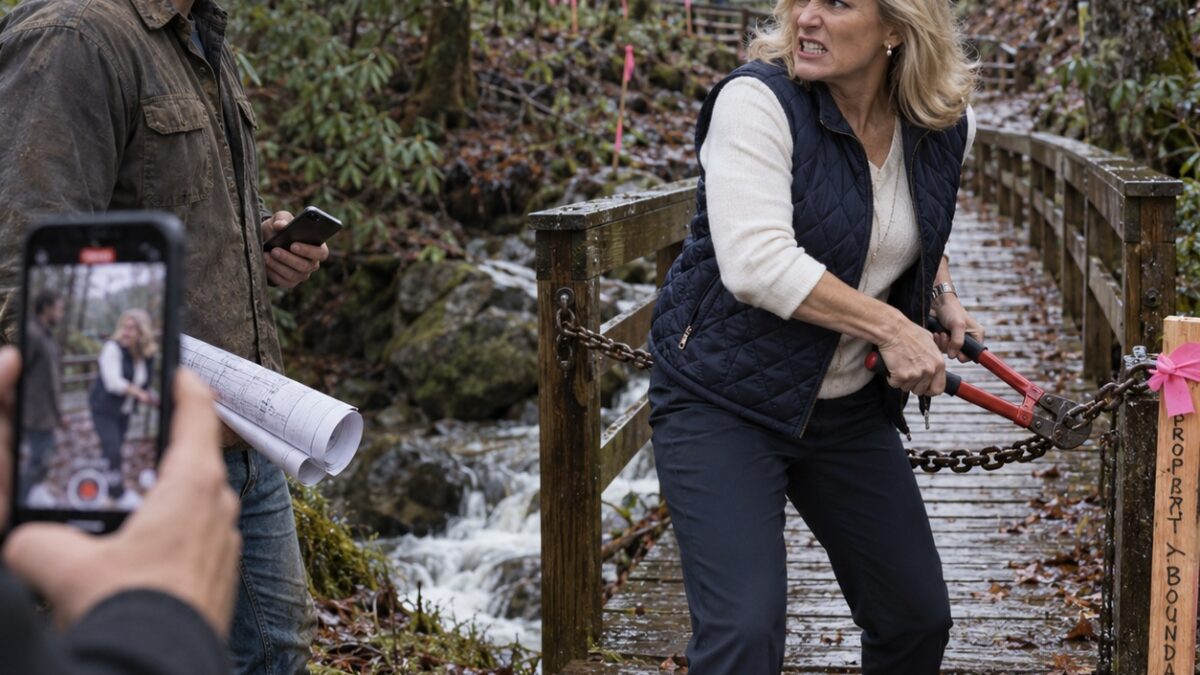
Mara stood beside the chain.
She wasn’t alone.
Greg Nolan was with her.
So were two contractors wearing fluorescent vests.
A compact utility vehicle sat behind them loaded with tools, gravel rakes, and orange cones.
One contractor pointed at the chain.
“Ma’am, if the owner installed that, we need authorization.”
“I am authorizing it.”
“You own this?”
“The association does.”
Greg shifted.
“Mara.”
She ignored him.
The contractor looked toward my sign.
“It says private property.”
“It’s an unauthorized sign.”
He looked at her.
“I’m not cutting somebody’s lock.”
“It’s obstructing contracted work.”
“Then call whoever owns it.”
“I’m the association president.”
“That isn’t the same thing.”
I almost laughed inside my kitchen.
The contractor stepped away.
Smart man.
Mara pulled out her phone.
For a moment I thought she was calling the attorney.
Instead, she walked back toward her Lexus.
She opened the rear hatch.
And took out a pair of bolt cutters.
I whispered aloud.
“No way.”
She walked back.
Greg stepped in front of her.
“Mara, wait.”
“We’ve waited enough.”
“Maybe call Samuel.”
“Our attorney already explained our rights.”
“That isn’t what he said.”
My heart started pounding.
That sentence mattered.
Mara snapped toward him.
“You were in the meeting.”
“Yes.”
“Then you know we have established access.”
“He said there could be an argument.”
“There is an argument.”
“He didn’t say cut the man’s lock.”
Mara stepped around him.
The first squeeze slipped.
She repositioned the jaws.
The second bit into the shackle.
The third snapped it.
Metal hit dirt.
Mara pulled the chain aside.
“Proceed.”
Everything was recorded.
Clear face.
Clear audio.
Clear lock.
Clear instructions.
I didn’t run outside.
That decision took more control than anything I had done so far.
My instinct was to sprint down the hill.
To stand in front of the utility vehicle.
To demand they leave.
Maybe yell.
Maybe make the whole thing worse.
Instead I called the sheriff’s non-emergency line.
“My name is Ethan Walker. I own property off Miller Gap Road. Several people entered after cutting a locked chain. Contractors are attempting work on my land.”
“Are they threatening you?”
“No.”
“Any weapons?”
“Bolt cutters.”
A pause.
“Are you confronting them?”
“No. I’m inside my house watching security footage.”
“Stay there.”
Deputy Aaron Fletcher arrived twenty-three minutes later.
By then the utility vehicle had crossed the bridge.
The contractors had unloaded tools but had not started major work.
I walked down only when I saw the patrol SUV.
Fletcher was mid-forties, broad-shouldered, calm, and unimpressed by everybody.
“What’s going on?”
I handed him my phone.
“Watch from seven sixteen.”
He watched Mara tell the contractor the HOA owned the land.
He watched Greg warn her.
He watched her retrieve bolt cutters.
He watched the lock snap.
His eyebrows rose.
“That her?”
“HOA president.”
“And you’re not in the HOA?”
“No.”
“Bridge ownership?”
“My deed.”
“Survey?”
“In the cabin.”
“Show me.”
Five minutes later, I had the stamped survey, deed, title report, Thomas Briggs permission letter, and email correspondence spread across my kitchen table.
Fletcher read enough to understand that whatever Cedar Ridge might claim legally, it was not simple.
We walked back down.
Mara saw us coming.
Her face brightened.
“Deputy. Thank goodness.”
That nearly made me laugh.
She approached him as if she had called him.
“This gentleman has been illegally obstructing a community trail.”
Fletcher looked at me.
Then her.
“Ma’am, did you cut that chain?”
“It was an unauthorized obstruction.”
“That wasn’t my question.”
She hesitated.
“The chain was preventing contracted association maintenance.”
“Did you cut it?”
“Yes.”
Fletcher nodded toward the broken lock.
“Who bought that lock?”
She looked at me.
“He did.”
“Who installed the posts?”
“He did.”
“Who owns the parcel according to the documents I just reviewed?”
Her expression tightened.
“Our legal position is more complicated than his documents suggest.”
“That may be.”
He pointed toward the utility vehicle.
“Can you show me a recorded easement or deed giving Cedar Ridge ownership or access?”
“Our attorney handles those records.”
“Do you have anything with you?”
“No.”
“Then the contractors need to come back out.”
Mara stared at him.
“Excuse me?”
“You have a landowner showing me a recorded deed and a survey.”
“We have decades of community use.”
“That might matter in civil court.”
“It matters now.”
“Not enough for me to allow physical alteration of property when ownership and access are disputed.”
She folded her arms.
“Deputy, Cedar Ridge pays substantial county taxes.”
Fletcher blinked.
“So does Mr. Walker.”
I looked away before she saw me smile.
“This is absurd.”
“Maybe.”
He gestured toward the contractors.
“But today the work stops.”
She turned toward me.
“This is what you wanted.”
“No.”
“What?”
“What I wanted was the easement document.”
“You know exactly what you’re doing.”
“I know exactly where my property line is.”
Fletcher stepped slightly between us.
“Everybody needs to keep this civil.”
Mara pointed toward me.
“He is harassing an entire community.”
Fletcher looked at the four-foot pedestrian gap beside the chain.
“You were still letting people walk through?”
“Yes.”
Mara’s face tightened.
“He’s trying to establish control.”
I answered before Fletcher could.
“It’s my property.”
The sentence sounded arrogant even though it was simply true.
Mara stepped closer.
“You think owning a piece of paper makes you part of this place?”
“No.”
I looked at her.
“I think owning the land makes me responsible for what happens on it.”
She stopped.
That was the first time I saw uncertainty.
I continued.
“If somebody gets hurt on that bridge tomorrow, who gets sued?”
She said nothing.
“The HOA?”
Silence.
“Or the person whose deed contains the bridge?”
Fletcher glanced at Mara.
“That’s a fair question.”
Mara recovered quickly.
“We maintain the bridge.”
“When was it last structurally inspected?”
She looked at me.
“What?”
“I asked your office.”
“Our maintenance committee reviews community infrastructure.”
“That wasn’t my question.”
“The bridge is safe.”
“According to whom?”
She hesitated.
I nodded.
“So I hired someone.”
Her expression changed.
“What?”
“A structural inspector is coming Monday.”
“You had no authority to—”
I laughed before I could stop myself.
The absurdity of it escaped me.
“No authority to inspect a bridge sitting entirely on my deed?”
She froze.
Fletcher rubbed his jaw.
“Okay. Contractors pack up.”
The utility vehicle was driven back across.
Mara stood beside her Lexus with her arms folded while the crew loaded tools.
Greg avoided her eyes.
When they were gone, Fletcher handed me a card with the incident number.
“Keep everything.”
“I will.”
“Especially that video.”
“Already backed up in two places.”
He looked at me.
“You do disputes for a living?”
“Construction.”
“That explains it.”
Before leaving, he pointed at the bridge.
“Don’t physically confront anyone if they come back.”
“I won’t.”
He started toward his cruiser.
“Deputy?”
He turned.
“Is cutting the lock criminal?”
“Potentially.”
“What happens?”
“Depends on intent, ownership, damages, prosecutor, whole picture.”
He paused.
“You want to pursue charges?”
I looked toward Mara’s Lexus as it disappeared.
“Not yet.”
His eyebrows rose.
“You sure?”
“Yes.”
Because by then I understood something.
Mara wanted the fight to be about a forty-dollar lock.
I wanted the fight to be about documents.
The lock was replaceable.
Her statements were not.
Monday morning, Malcolm Reed arrived to inspect the bridge.
He was a licensed structural inspector who had spent twenty-five years looking at small public bridges, decks, pedestrian crossings, retaining structures, and exactly the sort of thing nobody worries about until something breaks.
He spent almost two hours on site.
He checked deck boards.
Handrails.
Stringers.
Fasteners.
Footings.
Drainage.
The east abutment.
Then he crawled underneath with a flashlight.
When he emerged, mud covered one sleeve.
His expression bothered me immediately.
“How bad?”
“How many people use this?”
“Fifteen to fifty a day. Maybe more on weekends.”
“Any bicycles?”
“Sometimes.”
“Utility vehicles?”
“They tried.”
He looked back at the bridge.
“You need to restrict use.”
My stomach tightened.
“Collapse risk?”
“I’m not saying it’s going to fail today.”
“That’s not very comforting.”
“There’s significant rot in two load-bearing members. The east abutment has shifted. Several fasteners have heavy corrosion. I also don’t like how drainage is washing soil away near the footing.”
“Safe for pedestrians?”
“I would not certify unrestricted public use.”
That changed everything.
Until then, ownership had been the danger in my mind.
Now I pictured the three children I had seen my first morning.
Fishing poles.
Laughing.
Running across boards that flexed underneath them.
“What do you recommend?”
“Close it until an engineer evaluates it.”
I stared at the bridge.
A couple from Cedar Ridge approached from the far side.
They waved.
I felt sick.
I thanked Malcolm, then closed the bridge completely.
No pedestrian opening.
Chain.
Warning signs.
UNSAFE STRUCTURE
CLOSED PENDING ENGINEERING REVIEW
NO CROSSING
I emailed Malcolm’s report to Cedar Ridge immediately.
Mara called eight minutes later.
“You cannot close that bridge.”
“I can when a licensed inspector says it’s unsafe.”
“Our maintenance committee has never identified a structural problem.”
“That doesn’t reassure me.”
“You hired someone predisposed to find defects.”
“I hired someone qualified to find defects.”
“Send his credentials.”
“They’re attached.”
Silence.
Then:
“We are sending our own engineer.”
“Good.”
“Tomorrow morning.”
“Have him call me for access.”
“We do not need your permission to access community property.”
I closed my eyes.
“Mara.”
“What?”
“You cut my lock four days ago, the sheriff stopped your contractors, and you still don’t have an easement.”
“That incident remains disputed.”
“The video isn’t disputed.”
She hung up.
The next morning, Cedar Ridge’s engineer did call me.
His name was Luis Herrera.
He was professional from the first sentence.
“Mr. Walker, I’ve been retained by Cedar Ridge to conduct an independent structural assessment of the footbridge.”
“Fine.”
“May I access through your parcel?”
“Yes.”
“Thank you.”
Mara arrived with him.
So did Greg.
Malcolm returned at my request.
The two engineers inspected the bridge together.
They disagreed about some details.
Not the important ones.
After ninety minutes, Luis climbed up the bank.
“Mr. Walker?”
“Yes.”
“Your inspector’s concerns are valid.”
Mara stiffened.
Luis continued.
“I recommend closure until the south stringer is replaced, the east abutment is stabilized, and several connections are rebuilt.”
“How long?”
“Depends on design, material, permits.”
Mara interrupted.
“This is excessive.”
Luis looked at her.
“It is my professional recommendation.”
“The bridge has stood for decades.”
“So have many structures that eventually fail.”
“What caused this?”
Luis glanced at Malcolm.
“Age. Water. Deferred maintenance.”
That phrase landed hard.
Deferred maintenance.
I looked at Mara.
“You told me the HOA maintained it.”
“We do.”
Luis looked toward the rotted beam beneath the deck.
Nobody needed to say anything else.
Daniel called that evening.
“You’re going to enjoy this.”
“I’m not sure I enjoy any of this anymore.”
“Fair.”
“What did you find?”
“I pulled old county records.”
“And?”
“The bridge predates Cedar Ridge.”
I sat down at the kitchen table.
“How long?”
“Built around 1993 by Thomas Briggs and the neighboring farm owner.”
“Subdivision came later.”
“Eight years later.”
“So Cedar Ridge didn’t build it.”
“No.”
“Did they buy it?”
“No record.”
“Recorded easement?”
“No.”
I stared at the wall.
“Then what are they claiming?”
“Use.”
“We know that.”
“Yes, but I found something else.”
His voice changed.
“What?”
“Cedar Ridge’s original development approvals.”
I waited.
“The developer was required to provide two pedestrian emergency egress routes from the western section of the subdivision.”
My pulse shifted.
“And?”
“One route is the public trail entrance east of you.”
“And the second?”
“An early planning map shows a proposed connection approximately where your bridge sits.”
“Proposed?”
“Yes.”
“Was it acquired?”
“That’s the problem.”
“What problem?”
“I can find where they intended to have access.”
He paused.
“I cannot find evidence they ever acquired it.”
I leaned back.
“So somebody built Cedar Ridge assuming that bridge connection existed.”
“Possibly.”
“And then Thomas later let them use it.”
“Exactly.”
“Could the county force me to provide it because the development depended on it?”
“Not automatically. The planning record matters, but a proposed route does not magically create an easement.”
“Could Cedar Ridge?”
“Not without proving a legal right.”
I stared through the window toward the dark trees.
“Does Mara know?”
“I don’t know.”
We found out six days later.
The Cedar Ridge board requested a meeting.
Not Mara.
The board.
That distinction mattered.
Daniel advised me to attend.
We met in the HOA clubhouse on a Thursday evening.
The room smelled like coffee, carpet cleaner, and years of neighborhood meetings.
Seven board members sat around a long table.
Mara sat at the head.
Greg sat two seats away from her.
Their attorney, Samuel Price, sat beside three thick folders.
Daniel sat next to me.
Price began.
“Mr. Walker, the association would prefer to resolve this without litigation.”
“That’s always been my preference.”
Mara gave a quiet laugh.
Daniel ignored her.
Price continued.
“The association acknowledges that the bridge structure may be located within your deeded parcel.”
May.
Lawyers loved words like may.
“However,” he continued, “Cedar Ridge maintains potential access rights based upon historical use, maintenance, reliance, and the original development scheme.”
Daniel spoke.
“We’ve provided the Briggs permission letters.”
“We question their legal effect.”
“Why?”
“They are informal.”
“One is signed and dated by the property owner. Another is from your own former president acknowledging permission.”
Price adjusted his glasses.
“Historical correspondence does not automatically dispose of all potential easement theories.”
“Nor does historical walking create ownership.”
Mara leaned forward.
“This conversation is getting needlessly technical.”
I looked at her.
“Property ownership is technical.”
“People bought homes with that trail.”
“Then someone should have made sure the trail belonged to Cedar Ridge.”
Her eyes flashed.
“It has functioned as association property for decades.”
“No.”
I kept my voice calm.
“It functioned as private property that prior owners let your residents cross.”
“That distinction means nothing to the people who rely on it.”
“It means a lot to the person who owns it.”
Price raised a hand.
“Let’s focus on a practical resolution.”
He opened a folder.
“The association is prepared to propose acquisition of a permanent pedestrian easement.”
There it was.
The first rational offer since the dispute began.
He slid a document across.
I looked at the number.
Five thousand dollars.
I looked up.
“That’s for a permanent easement?”
Mara answered.
“It’s generous.”
I nearly laughed.
“You spend more than that maintaining flowers at the entrance sign.”
Her expression tightened.
“The easement crosses undeveloped woods.”
“It creates liability. It limits future use. It affects insurance. It affects resale. It allows hundreds of people across my land.”
“The association would maintain the trail.”
“You already claimed you were maintaining it.”
Silence.
Daniel leaned toward me.
“We don’t need to respond tonight.”
“I can respond.”
He looked at me.
I slid the paper back.
“No.”
Mara exhaled loudly.
“Then what do you want?”
That was the first useful question she had asked.
“I want the bridge safe.”
Nobody spoke.
“I want a written agreement defining exactly who maintains it, who insures it, who is responsible for injuries, what hours access exists, whether bicycles are allowed, whether vehicles are allowed, whether the trail can be widened, whether signs can be installed, how repairs happen, what notice is required, and what happens if Cedar Ridge violates the agreement.”
Mara stared at me.
“And compensation.”
“Yes.”
“How much?”
“I haven’t decided.”
She gave me a bitter smile.
“So this was always about money.”
“No.”
I leaned forward.
“If it were about money, I wouldn’t have spent thousands on a survey, cameras, an inspector, and a lawyer before anyone offered me a dollar.”
She said nothing.
“This became expensive because you refused to produce documents you apparently didn’t have.”
I looked around the table.
“And it became adversarial because she cut my lock.”
Robert Mills, an older board member I had not met before, frowned.
“You cut his lock?”
Mara turned toward him.
“You knew there was an incident.”
“I knew a contractor was stopped.”
“She removed an unauthorized barrier.”
Daniel spoke.
“On Mr. Walker’s deeded parcel.”
Robert looked at Price.
“Was the barrier illegal?”
Price did not answer immediately.
That told everyone enough.
Another board member spoke.
“Is this the sheriff incident?”
Mara’s face reddened.
“Yes.”
“You told us the contractor was stopped because ownership was unclear.”
“It is unclear.”
Daniel slid Rachel’s stamped survey across the table.
“It isn’t.”
Robert picked it up.
He studied the map.
Then he looked at Mara.
“You had this before the trail work?”
Mara didn’t answer.
“Mara?”
“We had a preliminary version.”
“How long before?”
She shifted.
“Approximately two weeks.”
Robert leaned back.
“So the contractor was sent after we received a survey showing the bridge and approach were on Walker’s land?”
“The committee had already approved maintenance.”
“That isn’t what I asked.”
Mara’s voice tightened.
“The association had a responsibility to preserve longstanding access.”
Greg finally spoke.
“I told her we should wait.”
Every head turned.
Mara looked at him as if he had betrayed her.
“Greg.”
He swallowed.
“I told you after we got the survey.”
“You supported the project.”
“Before the survey.”
She stared at him.
He kept going.
“And I told you not to cut the chain.”
Silence.
Mara’s face went white.
“You’re rewriting history.”
“No.”
Greg looked toward me.
“I was there.”
“So were the cameras,” I said.
Price looked sharply at me.
“There’s video?”
Daniel answered.
“With audio.”
Mara turned toward him.
“You recorded a private conversation?”
I almost laughed.
“You were standing on my property beside a visible camera.”
Price closed his eyes for a second.
“Has the board seen the video?”
“No.”
Daniel folded his hands.
“But it has been preserved.”
Robert looked at Mara.
“What exactly did you say?”
She stood.
“This is becoming a character attack.”
“No,” Robert said. “Sit down.”
The room changed.
Just like that.
Until that moment Mara had been Cedar Ridge speaking to me.
Now Mara was one board member being questioned by the others.
She sat slowly.
Price cleared his throat.
“I think the board should continue certain matters in executive session.”
Daniel stood.
“I agree.”
The meeting ended without an agreement.
But the dispute had changed.
It was no longer Ethan Walker versus Cedar Ridge.
It was Mara Wickham versus the consequences of what she had told Cedar Ridge.
Two days later, Robert called me.
“Mr. Walker?”
“Yes.”
“This is Robert Mills.”
“I remember.”
“I’m calling personally, not as formal counsel.”
“All right.”
He paused.
“I owe you an apology.”
I didn’t expect that.
“For what?”
“For assuming Mara had verified title.”
“You weren’t the one cutting locks.”
“No.”
His voice was tired.
“But boards create authority by trusting people. We also own what they do with it.”
That sentence earned my respect immediately.
“What happens now?”
“We held a special meeting.”
“And?”
“Mara has been temporarily removed from authority over property and maintenance matters.”
“Temporarily?”
“There’s a process.”
“Understood.”
“We are also suspending the association’s claim that it owns the bridge while counsel completes title review.”
“Good.”
“We’d like to discuss a legitimate easement.”
“That’s possible.”
“Not for five thousand dollars.”
I laughed.
“I appreciate that.”
A week earlier that call would have felt like victory.
It didn’t.
I felt tired.
The bridge remained closed.
Residents became angry.
Some blamed me.
Some blamed the board.
Some blamed Mara.
A few sent polite emails.
Mr. Walker, we understand there is a legal dispute, but my wife and I have used that bridge every morning for thirteen years. We hope the association can resolve this fairly.
I answered those.
I explained the structural report.
I said I wanted the bridge repaired and reopened under a proper agreement.
Other messages were different.
You knew what you were buying.
Stop holding our neighborhood hostage.
Outsiders shouldn’t be able to destroy community traditions.
One person wrote:
Property rights come with social responsibilities.
I stared at that sentence for a long time.
Then deleted it.
I had no interest in arguing with people who believed social responsibility meant I had responsibilities while the HOA had privileges.
Then somebody threw a rock at one of my cameras.
They missed the lens.
The camera recorded the man winding up, throwing the rock, swearing when it only cracked the housing, and walking back toward Cedar Ridge.
His name was Paul Danner.
The sheriff handled that.
Paul eventually received a citation and paid for the damaged housing.
After that, vandalism stopped.
The board sent an email to all residents warning them not to enter closed property, interfere with cameras, remove signs, or contact me abusively.
That email did more to calm things down than anything Mara had done.
A few days later, Robert and two other directors asked to meet at the bridge.
No attorney.
No Mara.
One of them was Karen Alvarez, a pediatric physical therapist in her forties who had lived in Cedar Ridge for twelve years.
The other was Dennis Cooper, a retired accountant.
We walked the approach.
I showed them the rotted beam.
The eroded footing.
The old permission letters.
Karen crouched and looked underneath.
“We were told this was inspected every year.”
“By who?”
She glanced at Robert.
“That’s something we’re trying to determine.”
Dennis opened a folder.
“We have annual budget entries.”
“For the bridge?”
“Bridge and trail maintenance.”
“How much?”
“Usually twenty-five hundred to four thousand dollars.”
I looked at the rotten stringer.
“For what?”
Exactly.
That question led to another problem.
Cedar Ridge’s maintenance records showed annual charges for “bridge/trail upkeep.”
But most of the money had gone to gravel, mulch, vegetation trimming, pressure washing, and labor on the approaches.
Very little had gone to structural work.
No engineer had inspected the bridge.
No qualified bridge specialist had signed anything.
The association had maintained appearance.
Not integrity.
That detail spread through Cedar Ridge quickly.
People were angry.
Not because I had exposed it.
Because they had paid dues believing common amenities were being properly maintained.
Then Karen called me one evening.
“I need to ask you something.”
“Okay.”
“Did Mara ever tell you the bridge was inspected annually?”
“She implied it.”
“Did she say who did it?”
“No.”
“Did she ever give you records?”
“No.”
Karen sighed.
“We asked.”
“And?”
“There aren’t any.”
I looked toward the dark window.
“What happens to Mara?”
“That depends on the membership meeting.”
“When?”
“Next Thursday.”
“I assume I’m not invited.”
“You’re not a member.”
“That’s fine.”
She hesitated.
“There’s something else.”
“What?”
“Some residents are saying you’re trying to force Cedar Ridge to buy your whole property.”
I laughed.
“That’s new.”
“Did you ever offer to sell?”
“No.”
“Did you ever demand the HOA purchase it?”
“No.”
“Did you ask for a million dollars?”
“No.”
She sighed.
“I didn’t think so.”
“Where is that coming from?”
“I don’t know.”
I did.
The rumor had Mara’s fingerprints all over it.
The special membership meeting lasted almost four hours.
I didn’t attend.
I stayed home, ate reheated chili, and tried not to check my phone every five minutes.
At 10:42 p.m., Robert called.
“Mara resigned.”
I stood up.
“As president?”
“From the board.”
“What happened?”
“A lot of questions.”
“Was she removed?”
“She resigned before the removal vote.”
I sat back down.
I had imagined that moment more than once.
I thought I would feel vindicated.
Maybe triumphant.
Instead, I felt strangely empty.
“What now?”
“That’s why I’m calling.”
The new board wanted a permanent solution.
Not a temporary handshake.
Not vague tradition.
A documented easement.
Over the next three weeks, Daniel and Cedar Ridge’s attorney exchanged drafts.
The difference between the first offer and the new proposal was almost embarrassing.
This time Cedar Ridge agreed that the land and bridge location were privately owned.
The HOA would purchase a defined ten-foot-wide pedestrian easement.
No trail widening without written approval.
No motorized vehicles except emergency and maintenance equipment.
No routine construction access without notice.
No lighting.
No events.
No commercial activities.
No fishing from my property.
No leaving the marked corridor.
No signs beyond approved trail markers.
The association would rebuild the entire bridge using a design approved by a licensed engineer.
It would pay all permitting and construction costs.
It would maintain liability insurance naming me as an additional insured.
It would indemnify me from claims connected to association trail use.
The bridge would be inspected annually and undergo a full engineering review every five years.
And the agreement would contain enforcement rights if Cedar Ridge violated the terms.
Then I saw the compensation.
Seventy-five thousand dollars.
I called Daniel.
“Is this fair?”
“Yes.”
“Would you take it?”
“I’m your lawyer.”
“I’m asking as someone who owns land.”
He paused.
“Yes.”
I still negotiated one more condition.
At the Cedar Ridge entrance to the bridge, the association had to install a small permanent plaque.
PRIVATE EASEMENT
ACCESS PROVIDED BY AGREEMENT WITH ADJOINING LANDOWNER
Robert called me.
“You really want the plaque?”
“Yes.”
“Why?”
“Because twenty years from now I don’t want another president telling another owner this is community property.”
Silence.
Then he said,
“That’s fair.”
We signed the agreement in September.
The old bridge came down in October.
I stood near the creek while contractors removed the rotten deck.
When they lifted one of the main stringers, it split under its own weight.
Luis Herrera looked at me.
“That’s worse than it looked.”
“What happens if nobody had inspected it?”
He studied the broken timber.
“Maybe nothing for years.”
“And maybe?”
“Wrong weather. Large group. Enough dynamic load.”
He didn’t finish.
He didn’t need to.
I pictured those kids again.
Fishing poles bouncing.
Running.
I felt cold.
Everyone had focused on the property fight.
The deed.
The chain.
Mara.
The HOA.
The money.
But beneath all of it had been an actual danger.
Had Mara gotten her way that morning, the contractors would have widened the trail, spread new gravel, trimmed vegetation, and cleaned up the approaches.
Residents would have seen fresh work and assumed the bridge itself had been improved.
Usage might have increased.
And nobody would have touched the rotten structure underneath.
Sometimes the most dangerous problems are the ones hidden beneath cosmetic improvements.
The new bridge opened in December.
Engineered footings.
Proper drainage.
New stringers.
New deck boards.
Sturdy rails.
Documented load rating.
Inspection schedule.
Paperwork.
Lots of paperwork.
I had never appreciated paperwork more.
That first Saturday, I stood near the cabin drinking coffee.
Thump.
Thump.
Thump.
Footsteps crossed the new boards.
A family came through.
The father waved.
I waved back.
A woman in her late sixties stopped near the sign.
“You’re Ethan?”
“That depends who’s asking.”
She laughed.
“I’m Linda.”
Something clicked.
“Linda Carver?”
Her eyes widened.
“You know me?”
“You were Cedar Ridge president.”
“Oh God.”
She covered her face.
“Please don’t hold that against me.”
I laughed.
“You wrote Thomas Briggs a Christmas card.”
She stared at me.
Then her mouth dropped open.
“No.”
“Yes.”
“That thing still exists?”
“Walter kept it.”
She burst out laughing.
“Of course he did.”
“It may have saved me a lot of trouble.”
“Tom kept everything too.”
We stood beside the creek.
Then Linda’s smile faded.
“I told them.”
“Told who?”
“Mara.”
I looked at her.
“Told her what?”
“That the bridge was private.”
The creek seemed louder.
“When?”
“Years ago.”
“How many years?”
“Maybe six.”
I stared at her.
“I handed over old board files when Mara became president. I specifically explained that Tom had allowed Cedar Ridge to use the crossing.”
“You told her there was no permanent easement?”
“Yes.”
“You’re sure?”
“Absolutely.”
I thought about every conversation.
According to our records.
Established community access.
Our bridge.
There’s no need to create a problem.
Mara hadn’t discovered midway through the fight that Cedar Ridge’s ownership claim was weak.
She had known the original use began as permission.
Maybe she didn’t understand every legal consequence.
Maybe she believed twenty years of use had changed things.
But she knew the truth was more complicated than what she told me.
“You okay?” Linda asked.
“Yeah.”
I looked across the bridge.
“I just learned something I probably already knew.”
“What?”
“That some people don’t confuse authority with ownership.”
I looked toward Cedar Ridge.
“They just hope everybody else will.”
Winter passed quietly.
Then spring.
I built my workshop.
Metal roof.
Large roll-up door.
Workbench along the north wall.
Nobody sent me a notice.
Nobody asked what color I planned to paint it.
Nobody told me the roof pitch violated community standards.
That alone almost justified the entire mess.
Walter visited in April.
We walked down to the bridge.
He stood with his hands in his coat pockets.
“Tom would’ve liked this.”
“Your brother?”
“Yeah.”
“He really let everybody cross?”
Walter smiled.
“Tom would’ve let the devil cross if the devil wiped his boots first.”
I laughed.
“Did he ever regret giving Cedar Ridge permission?”
“No.”
Walter looked toward the subdivision.
“But he used to say permission was different from surrender.”
That stayed with me.
Permission was different from surrender.
So was kindness.
So was cooperation.
So was being a good neighbor.
For years, Cedar Ridge residents crossed Thomas Briggs’s land because he allowed it.
Most of them never knew that.
Why would they?
They saw a trail on a map.
A bridge.
A maintained path.
Eventually, nobody remembered the favor.
The favor became tradition.
Tradition became expectation.
Expectation became entitlement.
Then somebody like Mara came along and began calling entitlement ownership.
I never sued her personally.
People asked me why.
I could have pushed the damaged lock.
Trespass.
Maybe other claims.
Daniel said there were options.
But by the time the easement was signed, I didn’t want anything else from Mara.
Cedar Ridge paid for the damaged lock and camera.
The board rewrote its property project procedures.
Any work involving land outside recorded HOA parcels now required title verification.
Two officers had to approve access.
External landowner permission had to be documented.
Structural amenities received actual inspections.
No more “we’ve always done it this way.”
Mara lost the authority she had treated as permanent.
That was enough.
At least I thought it was.
Until I ran into her at a hardware store almost a year later.
I was buying deck screws.
She stood near the paint counter.
For a few seconds we both pretended not to notice each other.
Then she approached.
“Ethan.”
“Mara.”
She looked different.
Still polished.
Still composed.
But without the title attached to her, she seemed ordinary.
“I heard the bridge reopened.”
“It did.”
“You got what you wanted.”
I considered that.
“No.”
She frowned.
“What does that mean?”
“What I wanted was eleven quiet acres outside an HOA.”
For the first time, she almost smiled.
“I suppose that didn’t work out.”
“No.”
We stood beneath fluorescent lights while an employee rattled paint cans behind us.
Then she said,
“You made me look like a criminal.”
“I never published the video.”
“You showed it to the board.”
“After you gave them a different version.”
“You could have handled this privately.”
“I tried.”
“No. You challenged me from the beginning.”
“I asked for an easement document.”
“You knew what that meant.”
“Yes.”
I nodded.
“It meant you either had one or you didn’t.”
Her expression hardened.
“You embarrassed me in front of my board.”
“You cut my lock in front of two contractors, Greg, and a camera.”
“You knew the camera would provoke people.”
“Cameras don’t make people cut locks.”
She looked away.
There was one question I still wanted answered.
“Did you know?”
Her jaw tightened.
“Know what?”
“That Thomas Briggs had only given Cedar Ridge permission.”
Silence.
I waited.
Mara looked toward the paint counter.
Then back at me.
“Yes.”
One word.
Quiet.
Almost irritated.
I let it sit between us.
“How much did you know?”
“I knew there had been an informal arrangement.”
“Revocable permission.”
“That’s your lawyer’s phrasing.”
“It was Thomas’s phrasing.”
She said nothing.
“Then why tell me the bridge belonged to Cedar Ridge?”
“Because for every practical purpose, it did.”
“No.”
“Yes.”
Her voice sharpened.
“Twenty years of residents used it. The HOA maintained it. It appeared on every community map. Homes were sold with that trail system.”
“That doesn’t make my land yours.”
“You were one person disrupting hundreds.”
“I hadn’t disrupted anything.”
“You posted private-property signs.”
“Because it was private property.”
“You installed a chain.”
“After you marked my land for construction.”
“We were maintaining a trail.”
“You were widening it.”
She threw up her hands.
“You see everything as a boundary.”
I almost laughed.
“You were the HOA president.”
That stopped her.
Then I asked the question that mattered most.
“Why did you cut it?”
She looked at me.
“Because if I didn’t, you would learn that saying no worked.”
I actually felt something cold move through me.
There it was.
Not confusion.
Not community need.
Control.
She continued before I could answer.
“You had lived there three weeks. If we let you shut down equipment, every future conversation would happen on your terms.”
“On my property.”
“You knew what I meant.”
“I do now.”
She folded her arms.
“An HOA cannot function if every adjoining owner can veto infrastructure.”
“Then the HOA needs easements.”
“We had twenty years of precedent.”
“You had permission.”
She looked away.
I studied her.
“You know the strange part?”
“What?”
“If you had asked me on day one, I probably would have agreed to an easement.”
She turned sharply.
“For seventy-five thousand dollars?”
“Probably less.”
That surprised her.
“How much?”
“I don’t know. Twenty. Twenty-five. Maybe I would have accepted the HOA rebuilding the bridge and assuming liability.”
She stared at me.
“You’re lying.”
“No.”
“The association ended up paying seventy-five.”
“After survey costs, legal costs, inspection issues, insurance questions, an unsafe bridge, construction access problems, and months of conflict.”
I shrugged.
“You created most of the price.”
Her face changed.
I could tell she had never considered it that way.
“What would you have wanted?”
“At the beginning?”
“Yes.”
“Proof.”
She frowned.
“That’s it?”
“Proof you had a right to be there.”
I picked up my box of screws.
“When you couldn’t produce it, I wanted a written agreement.”
I started toward the register.
“Ethan.”
I turned.
She looked almost tired.
“You enjoyed winning.”
I thought about that.
The sheriff.
The legal bills.
The vandalized camera.
The nights reading deeds.
The residents calling me selfish.
The rotten bridge.
The fear that buying the cabin had been a terrible mistake.
“No.”
I shook my head.
“I enjoyed finally being believed.”
She didn’t answer.
That was the last real conversation I ever had with Mara Wickham.
Three years have passed.
The bridge is still there.
Cedar Ridge still uses it.
Children carry fishing poles across.
Joggers pass early in the morning.
Dogs stop in the middle and stare at the creek.
Every January, the HOA sends proof of its liability insurance.
Every spring, someone inspects the structure.
Every five years, the agreement requires an engineering review.
The trail stays inside the easement.
No widening.
No surprise contractors.
No mysterious orange paint.
No one removes markers.
And every person entering from Cedar Ridge walks past that small plaque.
PRIVATE EASEMENT.
Most probably never read it.
To me, those two words mean almost everything.
They mean generosity does not erase ownership.
They mean tradition does not automatically become entitlement.
They mean cooperation does not require surrender.
And they remind me of the morning Mara stood beside my creek with bolt cutters in her hands.
She looked directly toward a camera.
She cut my lock.
She dropped it into the dirt.
And in that moment, she made the most expensive mistake of the entire dispute.
Not because the lock mattered.
It didn’t.
I replaced it that afternoon.
What mattered was what the camera captured.
The contractor refusing.
Greg warning her.
Mara insisting the HOA owned the property.
Her choice to proceed after being told not to.
That video destroyed the explanation she had relied on from the beginning.
Confusion.
There was no confusion anymore.
It showed intent.
It showed certainty.
It showed that when given the choice between proving authority and acting like she already had it, Mara chose force.
The chain had never been what protected my land.
The deed did.
The survey did.
Thomas Briggs’s letter did.
The photographs did.
The cameras did.
The title records did.
The truth did.
All Mara accomplished by cutting that chain was giving me proof that the problem had never really been a bridge.
It was the belief that saying something belonged to the community often enough could make ownership irrelevant.
I bought the property because I wanted peace.
For a while, it gave me anything but peace.
Yet the strange thing is that I understand peace differently now.
I used to think peace meant avoiding conflict.
Letting little things slide.
Not making neighbors uncomfortable.
Keeping the gate open because closing it might offend somebody.
Now I know better.
Sometimes peace comes only after the boundary is clear.
Sometimes the kindest thing you can do is say yes while still making sure everyone understands that your yes is permission, not surrender.
And sometimes, when someone decides your boundary is merely an obstacle to their authority, peace requires standing exactly where the line is and refusing to move.
That bridge still carries footsteps through my woods.
I hear them from the porch some mornings.
Thump.
Thump.
Thump.
The same sound that made me put down my coffee on my first week there.
Except now, when I hear it, I don’t wonder who owns the ground beneath those footsteps.
I know.
And so does Cedar Ridge.








