The HOA President Changed My Locks and Ordered Me Off My Own Ranch—She Never Asked What Was Inside My Father’s Fireproof Box
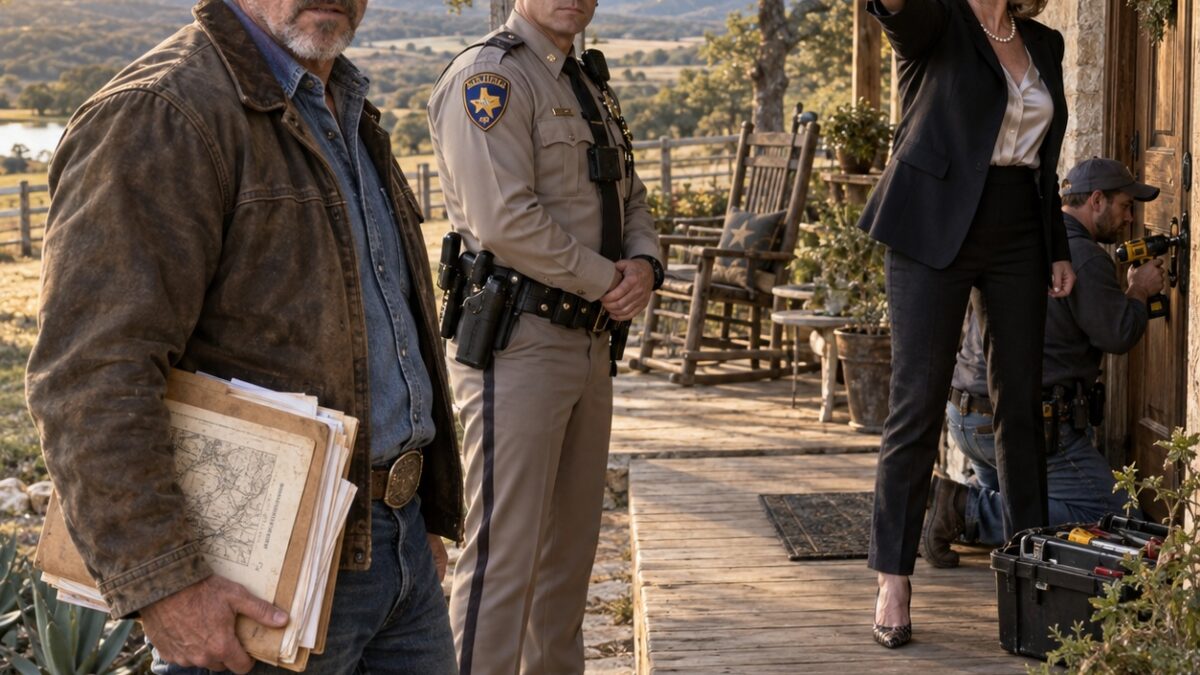
For maybe three seconds, nobody spoke.
The locksmith’s drill spun down with a fading metallic whine.
Darlene’s eyes moved from me to the man behind my shoulder.
Trooper Daniel Reyes was forty-something, broad-shouldered, expressionless, wearing mirrored sunglasses despite the overcast sky.
He had not come because I expected trouble with Darlene.
At least not exactly.
He had come because twenty minutes earlier he had stopped beside my truck on County Road 317 after seeing me standing near a damaged cattle fence.
Somebody had cut two strands of barbed wire overnight.
I had already photographed it and called the sheriff’s office.
Reyes had been passing through, heard part of the radio traffic, and stopped to make sure no livestock had reached the roadway.
When I told him I had a property dispute with the neighboring HOA and suspected the fence damage might be related, he said he would follow me as far as the ranch entrance so he could see the location.
Neither of us expected to find a locksmith dismantling my front door.
Darlene recovered first.
She smiled.
It wasn’t a friendly smile.
It was the tight, professional expression she used whenever reality failed to cooperate with whatever she had planned.
“Officer,” she said.
“Trooper,” Reyes corrected.
“Yes, of course. Trooper.”
She stepped down from the porch.
“I’m glad you’re here.”
Reyes glanced at me.
Then back at her.
“Are you?”
“Absolutely.”
She held up the folder in her hand.
“This gentleman is trespassing.”
She pointed at me.
On my ranch.
With my truck parked beside my barn.
Under the sign that said ALDINE CREEK RANCH.
I almost admired the confidence.
Reyes removed his sunglasses.
“Who owns this property?”
“The association has possession pending resolution of a boundary dispute.”
I said, “That is not true.”
Darlene ignored me.
“We have documentation.”
Reyes held out his hand.
“Let me see it.”
She hesitated.
Not long.
Just enough.
Then she passed him several pages.
I already knew what they were before he finished the first paragraph.
A notice from Creekside Pines HOA.
A resolution passed by its board.
A letter claiming that because the ranch residence was accessed through what they considered association-controlled land, the HOA was entitled to “secure disputed improvements pending judicial determination.”
Susan had already warned me about Darlene’s theory.
Calling it a theory was generous.
The HOA believed that because the subdivision plat incorrectly included a portion of my access lane, it could treat my use of that lane as unauthorized.
From there, Darlene had apparently made the logical leap that she could control access to my entire ranch house.
Reyes read the pages slowly.
Then he looked at Darlene.
“This isn’t a court order.”
“It’s an HOA enforcement resolution.”
“That’s not what I asked.”
“Our attorneys—”
“Is there a court order authorizing you to remove this man from this house?”
Her mouth tightened.
“We are in active litigation.”
“That also isn’t what I asked.”
She glanced at me.
I said nothing.
I had learned a useful lesson over the previous few months.
People like Darlene often defeated themselves if you gave them enough silence.
She pointed at the locksmith.
“We are securing association property.”
The locksmith lowered the drill.
“Ma’am,” he said, “you told me this house was foreclosed.”
My head turned.
So did Reyes’s.
Darlene’s face changed.
Barely.
But enough.
I looked at the locksmith.
“What did she tell you?”
He shifted uncomfortably.
“That the HOA had taken possession after a lien enforcement.”
I laughed once.
The sound came out colder than I intended.
“Did she show you a foreclosure deed?”
He looked at Darlene.
She snapped, “You were hired to change locks, not interpret legal documents.”
He stared at her.
Then at me.
“I asked if she owned it.”
“And?”
“She said the association did.”
Reyes folded the papers.
“Ma’am, do you have a deed showing Creekside Pines HOA owns this residence?”
“This isn’t that simple.”
“It’s becoming pretty simple.”
Her jaw tightened.
I walked toward the porch.
She stepped sideways, blocking me.
“You may not enter.”
I stopped.
Reyes said, “Ms. Witmore.”
She turned.
“If Mr. Aldine represents that this is his residence, and you cannot produce a court order removing him, I strongly suggest you step out of his way.”
“This is disputed property.”
“The land dispute does not authorize you to physically bar someone from a residence.”
She looked at me.
“Garrett, you are making a serious mistake.”
It was the first time she had used my first name.
I said, “You’re standing on land titled to my family trust.”
“According to you.”
“According to the county.”
“According to an outdated survey.”
“Recorded boundary agreement.”
“Our experts disagree.”
“Then tell it to the judge.”
Her eyes sharpened.
“That is exactly what we are doing.”
“Good.”
I gestured toward the locksmith.
“Then why is he drilling my lock?”
She didn’t answer.
I stepped around her.
This time she let me.
The locksmith moved away from the door.
Half the cylinder had been drilled.
Metal shavings glittered across the porch boards.
I looked at them.
My father had installed that deadbolt.
Nothing sentimental about it.
Hardware-store brass.
Probably thirty dollars when he bought it.
But seeing the mangled lock made something settle inside me.
Until that moment, Darlene had mostly been paperwork.
Letters.
Fines.
Emails.
Threats dressed in legal vocabulary.
Now she had crossed onto my porch and put a drill into my door.
I turned.
“Who authorized this?”
Darlene lifted her chin.
“The board.”
“Names.”
“You have the minutes.”
“I’m asking you.”
“All five directors approved enforcement.”
“Enforcement of what?”
“Our property rights.”
Reyes said, “Sir, do you want to make a report?”
Darlene laughed.
“A report for what?”
I looked at him.
“Yes.”
Her smile vanished.
“Garrett.”
I took out my phone.
“I want the damaged lock documented. I want the locksmith’s statement documented. And I want the cut fence documented.”
“You’re implying we cut your fence?”
“I’m not implying anything.”
“You just connected the two.”
“No. I said document both.”
She stepped toward me.
“This vindictive attitude is exactly why this situation has escalated.”
That sentence almost impressed me.
She had come onto my property, hired a stranger to destroy my lock, falsely told him the HOA owned my house, and somehow my reaction was escalation.
I said, “Darlene, you filed fines against land you don’t control.”
“We disagree.”
“You ignored the 1952 boundary instrument.”
“It is ambiguous.”
“It has bearings, monuments, distances and signatures.”
“Our surveyor believes—”
“Your surveyor works off a 2014 plat that ignored the recorded agreement.”
“Your attorney can argue that.”
“She is.”
Darlene folded her arms.
“Then why are you speaking to me?”
“Because you’re on my porch.”
The locksmith coughed.
“I’m going to pack up.”
Darlene spun toward him.
“No. Finish the job.”
He looked at Reyes.
Then at me.
“No, ma’am.”
“I hired you.”
“You told me this was an HOA foreclosure.”
“It is an enforcement possession.”
“That is not what you told me.”
He bent down and started collecting his tools.
Darlene pulled out her phone.
“I’ll find someone else.”
Reyes said, “I would strongly recommend against that until a judge tells you that you have the authority.”
She glared at him.
“Are you giving legal advice?”
“No.”
“What are you giving?”
“A warning that damaging property during an active civil dispute can create problems you may not want.”
For the first time, Darlene seemed to understand that being right in her own mind was not the same as being protected.
She shoved her papers back into the folder.
“You’ll hear from our counsel.”
I nodded.
“I look forward to it.”
She walked toward a silver Mercedes parked near my oak trees.
Then stopped.
She turned.
“You should understand something, Garrett.”
I waited.
“Creekside Pines has forty-two families.”
I said nothing.
“You have one ranch.”
Still nothing.
“We have resources.”
That almost made me smile.
“My grandfather had a pencil.”
She frowned.
“What?”
“He used one to mark the 1952 survey.”
She stared.
“And somehow it’s still causing you problems.”
She got into her car and slammed the door.
Trooper Reyes watched her leave.
Then he looked at me.
“She always like that?”
“I’ve never seen her lose an argument before.”
“Did she lose?”
“Not in her mind.”
He put his sunglasses back on.
“Those are the dangerous ones.”
The sheriff’s deputy arrived fifteen minutes later.
We photographed everything.
The drilled lock.
The locksmith’s work order.
The fence cut.
Tire marks near the western cedar corridor.
The locksmith, whose name was Nathan Doyle, gave a written statement.
Darlene had contacted him that morning.
She told him the HOA had obtained possession of the property after a lien action.
She sent him a picture of the house.
She gave him a gate code.
That last part bothered me.
“What gate code?”
Nathan showed me his phone.
The message from Darlene read:
Use west service gate. Code 1947.
My skin went cold.
I had an old electronic livestock gate on the northwest access track.
The code was 1947.
Only family, two ranch hands, Calvin Puit, and my veterinarian knew it.
“How did she get that?”
Nathan shook his head.
“She sent it to me.”
Reyes leaned closer.
“Save that message.”
Nathan nodded quickly.
I looked west.
The cedar corridor ran behind a low rise.
Someone had not only been studying old maps.
Someone had been on my property.
When I called Susan, she went silent after I described everything.
Then she said, “Do not touch anything else.”
“I’m standing on my porch.”
“Fine. Stand there.”
“Susan.”
“I’m serious.”
“So am I.”
“Photograph every tire track. Save the locksmith’s information. Get the incident number.”
“I already did.”
“And Garrett?”
“Yes?”
“The gate code matters.”
“I know.”
“I’m amending the pleadings Monday.”
“With what?”
“Trespass. Property damage. Declaratory relief. Injunctive relief.”
I looked at the ruined lock.
“And Darlene?”
“She just made herself personally relevant.”
I liked the sound of that less than I expected.
Not because I wanted to protect her.
Because until then, I had hoped the HOA board would eventually recognize that she was dragging them into something stupid.
Now the whole board had apparently voted for her “enforcement.”
“What about the directors?”
“If they approved this with knowledge they lacked legal authority, we’ll find out.”
I rubbed my forehead.
“What happens next?”
“First, I’m requesting an emergency temporary restraining order.”
“Against my HOA?”
“It is not your HOA.”
I smiled despite myself.
“That may be the nicest thing you’ve said all week.”
She ignored that.
“The order will prohibit Creekside Pines, its officers, agents and contractors from entering the disputed corridor or interfering with your access until the court rules.”
“Can we get it?”
“After today?”
She paused.
“I like our chances.”
We got it Tuesday morning.
District Judge Rebecca Hale issued the temporary restraining order shortly after nine.
By noon, a process server had delivered copies to the HOA’s registered agent, its attorney, Harlon Voss Development, and Darlene personally.
At 12:17, Susan received an email from Darlene.
THIS IS JUDICIAL OVERREACH.
Susan forwarded it to me with one line.
Frame this.
I printed it.
Not because I found it funny.
Because by then I had begun keeping everything.
Grandpa Walter would have approved.
For the next ten days, nothing happened.
That made me nervous.
Darlene was many things.
Quiet was not one of them.
Creekside Pines residents still drove past my fence.
Some waved.
Some stared.
One afternoon, a woman named Melissa Greene stopped beside the gate while I was clearing brush.
She lived in one of the houses closest to my land.
“Mr. Aldine?”
“Garrett’s fine.”
She stepped out of her SUV.
“I wanted to apologize.”
“For what?”
“I’m on the landscaping committee.”
I waited.
She looked embarrassed.
“I voted to send the first vegetation notice.”
I leaned on the shovel.
“Why?”
“Darlene told us your western strip was part of the HOA.”
“Did you look at a map?”
“She showed us one.”
“The 2014 subdivision plat?”
“I guess.”
“Did anyone check the deed?”
She gave me a look that answered the question.
“No.”
I nodded.
She shoved her hands into her jacket pockets.
“I thought this was about cedar trees.”
“So did I.”
“She told us you were trying to seize common property.”
“That’s interesting.”
“She said you found an old technicality.”
“Instrument 1952-887 isn’t exactly hidden.”
Melissa looked toward the trees.
“People believe her.”
“I noticed.”
“She’s good at making things sound urgent.”
“That’s useful in a fire.”
Melissa smiled weakly.
“Not so much in an HOA.”
I looked at her.
“Why are you telling me this?”
She hesitated.
“Because she called an emergency board meeting last night.”
I straightened.
“What for?”
“I don’t know. Executive session.”
“You’re not on the board?”
“No.”
“Then how do you know?”
“My husband’s brother is.”
That sounded like the Hill Country.
Everybody was related through one marriage, cattle sale, or bad decision.
“What did he say?”
“Not much. Just that the lawsuit is worse than Darlene told everyone.”
I nodded.
Melissa looked at the ranch house.
“Did she really try to change your locks?”
“Yes.”
“She told people the locksmith was securing an abandoned structure.”
I laughed.
“My truck was in the driveway.”
“I know.”
“She knew I lived there.”
“I know.”
Melissa looked genuinely uncomfortable.
“I’m sorry.”
“Thank you.”
She started back toward her SUV.
Then stopped.
“There’s something else.”
“What?”
“The retention pond.”
I waited.
“She said there could be issues if the boundary moves.”
“What kind of issues?”
“I don’t know.”
“Where is the pond?”
She pointed northwest.
I knew where it was.
Their “lake” sat less than two hundred yards from the disputed cedar strip.
“What did she say exactly?”
Melissa thought.
“She said, ‘If Aldine wins, the water problem becomes his problem.’”
I felt something in my chest tighten.
“What water problem?”
“I don’t know.”
“You’re sure those were the words?”
“Yes.”
I called Susan before Melissa reached the highway.
She listened.
Then said, “I want an engineer.”
“For what?”
“Drainage.”
“Susan, it’s a boundary case.”
“It may not be anymore.”
The engineer arrived three days later.
His name was Martin Cho.
He spent six hours walking the western edge of my ranch with survey flags, old plats, drainage maps, and a laser level.
I followed him for the first hour.
Then stopped pretending I understood what he was doing.
Around four in the afternoon, he stood beside a limestone swale near the cedar corridor.
“Mr. Aldine.”
“Garrett.”
He pointed uphill.
“Your property used to receive sheet flow from approximately forty acres west of here.”
“Used to?”
“Before development.”
“What changed?”
“Road grading. Lots. Storm drains.”
He crouched and drew a line in the dirt.
“Runoff now collects in the retention basin.”
“The lake.”
He smiled.
“If somebody wants to call it that.”
“And?”
He pointed toward a concrete structure partly hidden by cedar.
“That outlet discharges east.”
“Onto me?”
“Partly.”
I walked closer.
I had seen the culvert before.
Never thought much about it.
Martin took measurements.
Then pulled the 2014 plans.
“This outfall appears designed to cross what the developer believed was association-owned greenbelt.”
“But if the 1952 line controls…”
He looked at me.
“Then part of their drainage system crosses your land.”
“Do they have an easement?”
“That’s a legal question.”
I called Susan.
She answered.
“No.”
“You knew what I was asking?”
“I had a feeling.”
“No drainage easement?”
“None recorded that I can find.”
I looked at the concrete pipe.
“How long has it been here?”
“Probably since construction.”
Martin nodded.
“2014 or 2015.”
For years, stormwater from Creekside Pines had been directed across my property.
That alone didn’t necessarily mean catastrophe.
Drainage law was complicated.
But the next discovery changed everything.
Martin walked the drainage channel downhill.
About seventy yards from the outlet, he stopped beside several exposed roots.
“See this?”
I saw raw soil beneath a live oak.
“Erosion.”
“Significant erosion.”
He showed me old aerial imagery on his tablet.
In 2013, the channel was shallow.
By 2020, it had widened.
After several heavy storms, it had cut deeper.
The runoff had been carving my property for years.
“How much damage?”
“I need calculations.”
“Guess.”
“I don’t guess professionally.”
“Unprofessionally?”
He smiled.
“Enough that somebody should have been paying attention.”
That evening Susan called.
Her voice had changed.
Property attorneys have a particular tone when a case stops being annoying and starts becoming useful.
“Garrett.”
“Yes?”
“I found the developer’s drainage plan.”
“And?”
“The original plan shows a drainage easement.”
“On my property?”
“Proposed.”
“Recorded?”
“No.”
“So?”
“So somebody understood they needed one.”
That sat with me.
“They knew.”
“Possibly.”
“Why wasn’t it recorded?”
“I don’t know.”
“Did Grandpa refuse?”
“He died long before development.”
“My father?”
“He was dead by 2014.”
“So they would have needed me.”
“Yes.”
“Nobody asked.”
“I know.”
I stared toward the dark line of cedar outside my kitchen window.
“Darlene said if I win, the water problem becomes mine.”
“She may have revealed more than she intended.”
“What does that mean?”
“If the HOA believes it owns the strip, it may also believe it has the right to maintain infrastructure across it.”
“But if I own it…”
“They may have infrastructure without an easement.”
“Can they get one?”
“They can negotiate.”
“And if I say no?”
“Don’t decide anything yet.”
“I’m not.”
“Good.”
She paused.
“Because I found something else.”
Of course she had.
“What?”
“Harlon Voss Development submitted a title commitment before construction.”
“And?”
“It excepted the 1952 boundary agreement.”
I sat down.
“Meaning?”
“Meaning their title company knew it existed.”
Silence.
“Then how did the plat cross it?”
“That is the question.”
“Was it a mistake?”
“Maybe.”
“And if it wasn’t?”
“Then we have a different kind of lawsuit.”
Two weeks later, we took Harlon Voss’s deposition.
He was seventy-one, tan, silver-haired, and carried the kind of expensive calm that comes from having people bill you by the hour.
He sat across from Susan in a conference room in San Antonio while three attorneys arranged documents around him.
I attended.
Not because I needed to.
Because it was my land.
Susan started simple.
“Mr. Voss, did your company acquire the former Peton Ranch in 2013?”
“Yes.”
“Did you commission a boundary survey?”
“Yes.”
“Did you receive a title commitment?”
“I assume so.”
She placed the document in front of him.
“Does this refresh your recollection?”
He read it.
“Yes.”
“Turn to Schedule B.”
He did.
“Item seventeen.”
His mouth tightened.
I could not read the line from where I sat.
Susan could.
“Recorded Boundary Agreement, dated June 14, 1952, Instrument Number 1952-887.”
Voss looked at his attorney.
His attorney said, “Answer if you know.”
Voss looked back at Susan.
“Yes.”
“Did your company investigate that exception?”
“I don’t recall.”
“Did you contact the Aldine family?”
“I don’t recall.”
“Did you contact Garrett Aldine?”
“No.”
“Did you purchase the cedar corridor from Mr. Aldine?”
“No.”
“Did he grant your company a drainage easement?”
“Not that I recall.”
“Did he grant any easement?”
“No.”
Susan placed the 2014 plat beside the title commitment.
“Why does your subdivision plat place part of the Aldine cedar corridor inside Creekside Pines?”
Voss stared at the drawing.
“That was the surveyor’s determination.”
“Did the surveyor have the 1952 agreement?”
“I don’t know.”
Susan slid forward an email.
“Do you recognize this?”
Voss read it.
His expression changed.
His attorney leaned over.
I watched both of them become very still.
Susan said, “This is an email from your project surveyor to your development manager dated August 8, 2013.”
Voss said nothing.
She read one sentence.
“Old boundary agreement creates overlap at east greenbelt. Recommend title resolution before final plat.”
My pulse jumped.
Susan continued.
“Did your company resolve the title issue?”
Voss looked at his attorney again.
“Answer the question,” his attorney said quietly.
“No.”
“Why not?”
“I don’t know.”
“Did you approve the final plat?”
“Yes.”
“Despite the unresolved overlap?”
“I relied on my professionals.”
Susan slid another email forward.
Voss’s face went pale.
“What is that?” his attorney asked.
“An email from Mr. Voss.”
Susan read.
“Thirty-foot strip is unusable cedar. Peton has treated it as ours forever. Do not delay plat over ancient paper.”
Nobody moved.
I stared at Voss.
Ancient paper.
My grandfather’s boundary agreement.
The thing that had protected the ranch for seventy years had been dismissed because somebody wanted to avoid delaying forty-two home lots.
Susan spoke softly.
“Did you write that email?”
Voss rubbed his jaw.
“Yes.”
That was the moment the case changed.
Until then, Creekside Pines had been able to argue mistake.
Confusion.
Competing surveys.
Technical disagreement.
Now we had evidence the developer knew the recorded boundary instrument created a problem and proceeded anyway.
Susan did not smile.
She rarely did during depositions.
But I knew her well enough to see what she was thinking.
Darlene had built her authority on top of a problem the developer already knew existed.
And she had made it worse.
The HOA learned about the email three days later.
I knew because at 7:12 that evening, Calvin called.
“You got entertainment across the fence.”
“What kind?”
“Emergency HOA meeting.”
“How do you know?”
“I can see the parking lot from my north pasture.”
“Calvin, that’s half a mile away.”
“I own binoculars.”
“Of course you do.”
“Lot’s full.”
I laughed.
“You spying on them?”
“I prefer ‘observing civic collapse.’”
The next morning, Creekside Pines residents began calling Susan’s office.
Not one or two.
Eleven.
By Friday, twenty-three homeowners had requested copies of the pleadings.
Darlene sent out an HOA-wide email.
I got a copy from Melissa.
IMPORTANT COMMUNITY NOTICE
Certain parties are spreading incomplete and misleading information regarding Creekside Pines’ eastern boundary. The Board remains confident in the Association’s legal position and will vigorously defend community property from outside claims.
Outside claims.
I had lived there before their streets had names.
Melissa forwarded another message an hour later.
This one came from homeowner Mark Benson.
Darlene,
Can you confirm whether the 2013 developer email published in the court filing is authentic?
Darlene responded to the entire community.
Litigation strategy prevents detailed discussion.
Mark replied.
That was not my question.
Then another resident.
Are legal fees being paid from reserves?
Another.
How much have we spent?
Another.
Did the board authorize changing Garrett Aldine’s locks?
Another.
Was there actually a foreclosure?
Another.
Why were we told the ranch was partly HOA property if title documents say otherwise?
Within two hours, somebody created a private resident group without Darlene.
Susan told me not to participate.
“You are not going to argue with forty-two homeowners on Facebook.”
“I wasn’t planning to.”
“You looked tempted.”
“You can’t see me.”
“I can hear it.”
The HOA board tried a new strategy.
Settlement.
Their attorney, Howard Mills, called Susan.
They offered to withdraw every fine.
They would acknowledge my ownership of the ranch house and access road.
In return, I would agree to the 2014 subdivision line.
Susan read the proposal to me.
I laughed.
She said, “I assume that’s a no.”
“They want me to give them the strip.”
“Yes.”
“For withdrawing fines they had no right to issue.”
“Yes.”
“No.”
“I thought so.”
Two days later, they improved the offer.
They would pay my legal fees to date.
I would grant an easement over the cedar corridor.
They would dismiss enforcement.
I asked, “Drainage easement too?”
Susan paused.
“It is written broadly enough to include utilities and drainage.”
“No.”
Third offer.
Fifty thousand dollars.
I said no.
Fourth offer.
One hundred twenty-five thousand dollars.
I drove out to the cedar strip before answering.
Thirty feet by four hundred feet.
Not pretty.
Dense brush.
Rock.
A few oaks.
If you measured land only by market value, their offer was more than generous.
Grandpa Walter had probably paid less for his first eighty acres than they were offering for that sliver.
I stood beside one of the old survey markers.
Iron pipe.
Half buried.
Rust on the top.
Walter had stood there in 1952.
Maybe my father had been with him.
Dad would have been a boy.
I thought about Voss’s email.
Unusable cedar.
Ancient paper.
Then I called Susan.
“No.”
“You sure?”
“Yes.”
“Because we can negotiate higher.”
“I don’t want higher.”
“What do you want?”
“The correct boundary.”
She was quiet.
“And after that?”
“We talk about drainage.”
“All right.”
The hearing on the preliminary injunction occurred in March.
Darlene sat at the HOA table wearing a navy suit and pearl earrings.
She did not look at me.
Harlon Voss sat with separate counsel.
Susan presented the chain of title.
1947 deed.
1952 boundary agreement.
Later deeds referencing the same legal description.
Tax maps.
Survey monuments.
Then the 2013 title commitment.
Then the surveyor email.
Then Voss’s response.
Ancient paper.
I watched the judge read it.
Her eyebrows rose.
Not much.
But enough.
The HOA’s attorney argued that the subdivision had relied on the 2014 plat for nearly a decade.
Susan responded.
“A recorded plat cannot convey property the developer never owned.”
Simple.
That sentence did more damage than an hour of argument.
Then came Darlene’s lock incident.
Nathan Doyle testified.
He seemed miserable.
Susan asked, “What were you told?”
“That the HOA had possession after a foreclosure.”
“Did you see a foreclosure judgment?”
“No.”
“A trustee’s deed?”
“No.”
“An order of possession?”
“No.”
“Why did you begin drilling?”
“Ms. Witmore represented that she was authorized on behalf of the owner.”
“Who did she say owned the residence?”
“Creekside Pines HOA.”
Darlene stared at him.
Nathan did not look back.
Susan showed the judge the board resolution.
The judge read it.
Then looked over her glasses at the HOA attorney.
“Counsel, where in this document does the board acquire authority to dispossess Mr. Aldine from his home?”
Mills stood.
“Your Honor, the association believed—”
“I asked where.”
He paused.
“It does not explicitly state that authority.”
The judge looked at Darlene.
Then at the drilled-lock photographs.
Then back at Mills.
“Good.”
Nothing about her tone suggested it was good.
The preliminary injunction was granted.
The HOA, its directors, contractors and agents were prohibited from entering Aldine Creek Ranch, interfering with access, changing locks, erecting barriers, disturbing fences, or altering drainage pending final judgment.
Outside the courthouse, reporters were waiting.
Apparently property disputes involving suburban HOAs and old Texas ranches attracted more attention than I expected.
A woman with a microphone asked me how I felt.
I said, “It’s temporary.”
“Do you believe the HOA tried to steal your land?”
Susan touched my elbow.
That meant stop.
I said, “I believe the records should speak for themselves.”
“Do you have anything to say to Creekside Pines residents?”
“Yes.”
Susan looked at me.
I continued.
“I don’t consider the homeowners my enemies.”
That was true.
“Most of them bought homes believing the developer’s plat was accurate. This problem existed before many of them arrived.”
A reporter asked, “What about Ms. Witmore?”
I looked toward Darlene.
She was standing near the courthouse steps with her attorney.
Our eyes met.
I said, “She can answer for herself.”
Darlene answered the next morning.
She sent another HOA-wide email accusing me of exploiting a “historical technicality” to destabilize property values.
That email may have ended her presidency.
Residents petitioned for a special meeting.
Two weeks later, the community center parking lot overflowed.
I did not attend.
Calvin did.
Of course he did.
He called me at 9:40.
“She’s out.”
I was feeding cattle.
“What?”
“They removed her.”
“President?”
“Board.”
“How?”
“Recall vote.”
I leaned against the fence.
“You went inside?”
“Melissa invited me.”
“You don’t live there.”
“She said I could observe.”
“You enjoyed this too much.”
“Son, at my age you take free entertainment where you can find it.”
“What happened?”
“Thirty-eight households voted.”
“And?”
“Thirty-one removed her.”
I whistled.
“Whole board?”
“Two resigned before the vote.”
“Darlene?”
“Wouldn’t resign.”
“That sounds right.”
“She gave a speech.”
“Of course she did.”
“Said history would vindicate her.”
“That sounds even more right.”
Calvin chuckled.
“New interim president’s Mark Benson.”
I knew the name from the emails.
“He wants to talk to you.”
“About what?”
“Probably keeping his neighborhood from going broke.”
That part was less funny.
Creekside Pines faced legal fees.
Potential damages.
A drainage problem.
Possible claims against the developer.
And forty-two homeowners who had never asked to become characters in a title dispute.
Mark Benson called that afternoon.
He sounded exhausted.
“Mr. Aldine.”
“Garrett.”
“Mark.”
“All right.”
He exhaled.
“I owe you an apology.”
“You personally?”
“As a member of the association.”
“You weren’t on the board.”
“I voted for Darlene twice.”
“That was your mistake, not mine.”
He laughed weakly.
“Fair.”
“What do you need?”
“I want to know whether there is a way through this.”
“There probably is.”
“That is the first encouraging thing anybody has said.”
“But the boundary isn’t negotiable.”
“I expected that.”
“The drainage is separate.”
“Understood.”
“And my legal fees are not disappearing.”
“Also understood.”
I looked toward the cedar corridor.
“What are residents being told?”
“The truth, as much as we know it.”
“That will help.”
He was silent.
Then:
“Did Darlene really know about the developer email?”
“I don’t know.”
“We’re trying to find out.”
“Check board records.”
“We did.”
“And?”
“There are missing emails.”
That got my attention.
“Missing how?”
“Her HOA account was wiped the day after the injunction hearing.”
I called Susan.
Within hours, she sent a preservation notice.
The court later ordered Creekside Pines to preserve electronic records and retain a forensic specialist.
Deleting emails during litigation is rarely a sign of confidence.
Most were recovered.
Among them was a message from Darlene to the HOA attorney six months before she ever fined me.
Subject: ALDINE BORDER ISSUE.
Howard,
Harlon says there may be old paperwork affecting the east strip, but he considers it obsolete. Before we approach Aldine, I want to establish association control through routine covenant enforcement. If he complies with landscaping and access requirements, it strengthens our position that the strip has been treated as HOA-controlled property.
I read the email twice.
Then a third time.
She had known.
Before the first cedar-tree violation.
Before the gravel-road fine.
Before the demand for an approved gate.
This had never been about landscaping.
She had tried to manufacture a history of my compliance.
Susan explained why.
“If you repeatedly comply with HOA demands regarding disputed land, they could later argue you recognized their authority.”
“Would that win?”
“Probably not against recorded title.”
“Then why do it?”
“Because litigation is rarely about one perfect argument. People build piles.”
Another recovered email was worse.
After Susan sent Instrument 1952-887, Darlene wrote:
We cannot concede now. Garrett has ignored community standards for years. Pressure may be more effective than litigation.
Pressure.
The word sat there.
Then:
Explore lien options tied to unpaid assessments.
There were no valid assessments.
I had never been an HOA member.
No declaration encumbered my ranch.
Howard Mills responded:
Do not record any lien against Aldine Ranch without further title review.
Darlene replied:
Understood.
She recorded one anyway.
That discovery came from the county clerk.
A “Notice of Association Claim” had been filed against a portion of my property eleven days before the locksmith incident.
Not a valid foreclosure lien.
But enough to create confusion.
Enough to frighten a contractor.
Enough, perhaps, to cloud title temporarily.
Susan stared at the document.
“She did this without counsel.”
“How do you know?”
“Mills told her not to.”
“What happens now?”
“We add slander of title.”
I rubbed my face.
“This keeps getting bigger.”
“No.”
She looked at me.
“It keeps getting clearer.”
The final quiet-title trial was set for August.
By then, almost nobody seriously disputed that the 1952 boundary agreement controlled.
The fight shifted to consequences.
Voss Development claimed the erroneous plat was a surveying mistake.
The HOA blamed Voss.
Voss blamed its surveyor.
The surveyor blamed conflicting occupation lines.
The title company pointed at exceptions.
Everyone blamed someone.
Grandpa Walter remained inconveniently dead and therefore unable to be cross-examined.
But his paperwork remained excellent.
The original surveyor’s field notes from 1952 were found in a county archive.
They referenced limestone markers.
A fence corner.
A live-oak bearing tree.
Two iron pins.
Martin Cho and a licensed boundary surveyor named Erica Sloan located three of the four markers.
The old fence had wandered over time.
The monuments had not.
Erica stood in court beside a large aerial map.
She drew the legal line.
Then the 2014 plat line.
A narrow wedge appeared between them.
“This area,” Susan asked, “belongs to whom?”
“Based on the recorded deeds, boundary agreement and recovered monuments, the Aldine family trust.”
“Any ambiguity?”
“Not one I would consider material.”
Voss’s lawyer tried to undermine her.
“Isn’t it true that fences can establish boundaries through acquiescence?”
“Sometimes.”
“And the Peton Ranch historically maintained fencing west of the recorded line?”
“Yes.”
“So possession differed from title.”
“Portions of occupation differed from title.”
“Could that support adverse possession?”
Erica looked at him.
“Against whom?”
“The Aldine family.”
“Not without meeting statutory elements.”
“Was the strip openly possessed by Peton?”
“Cedar grew on it.”
A few people laughed.
The judge stopped them.
The attorney continued.
“Was it used?”
“By deer, mostly.”
Even the judge almost smiled.
Then Susan called me.
I had testified in business disputes before.
Never about my grandfather.
Susan asked me about the ranch.
The fireproof box.
My father.
Instrument 1952-887.
Then she showed me Darlene’s first violation letter.
“What did you understand this to mean?”
“That Creekside Pines claimed authority over my vegetation.”
“Did you believe it had that authority?”
“No.”
“Did you pay?”
“No.”
“Did you comply?”
“No.”
“Why?”
“Because it wasn’t their land.”
Then the second letter.
Then the gate demand.
Then the locksmith photographs.
Then the cut fence.
We never proved who cut the fence.
I told the truth.
“I don’t know who did it.”
Susan nodded.
No drama.
No exaggeration.
Grandpa Walter would have approved.
Then Voss’s attorney cross-examined me.
“Mr. Aldine, you understand that communities require infrastructure.”
“Yes.”
“Roads.”
“Yes.”
“Drainage.”
“Yes.”
“Utilities.”
“Yes.”
“And sometimes old rural property descriptions conflict with modern development.”
“Sometimes.”
“So you could have solved this years ago by selling a relatively small strip.”
“Maybe.”
“But you refused.”
“Yes.”
“Even when offered $125,000.”
“Yes.”
“Why?”
“Because I didn’t want to sell it.”
He stared.
“That’s it?”
“Yes.”
“You don’t think there is an obligation to compromise?”
“I think compromise requires something to be mine first.”
He frowned.
“Explain.”
“If you ask to buy my truck and I say no, that’s not failure to compromise.”
“That’s different.”
“Why?”
“A subdivision affects dozens of families.”
“Then the developer should have resolved title before building it.”
His face tightened.
That answer ended the line of questioning.
Darlene testified on the third day.
She had hired her own attorney by then.
The HOA no longer paid for her defense on actions the new board claimed exceeded her authority.
She looked smaller without the presidency.
But not less certain.
Susan asked whether she had received the 2013 developer email before issuing my first violation.
Darlene said she had been told there were “historical inconsistencies.”
“Did you know Instrument 1952-887 existed?”
“Eventually.”
“Before the first fine?”
“I don’t recall.”
Susan showed her the recovered email.
Darlene read it.
Her lips tightened.
Susan asked, “Is this your email?”
“Yes.”
“You wrote, ‘Harlon says there may be old paperwork affecting the east strip.’”
“Yes.”
“What old paperwork?”
“I didn’t know specifically.”
“Then why did you want to ‘establish association control through routine covenant enforcement’?”
Darlene sat straighter.
“Because the association had maintained the area.”
“Maintained how?”
“Vegetation management.”
I almost laughed.
Nobody from Creekside Pines had ever cleared that cedar.
Susan knew it.
“Do you have invoices?”
“I don’t manage individual landscaping invoices.”
“The HOA produced none.”
“That doesn’t mean work wasn’t done.”
“Who did the work?”
“I don’t know.”
“When?”
“I don’t know.”
“How often?”
“I don’t know.”
“But you testified the HOA maintained it.”
“That was my understanding.”
Susan changed documents.
“Why did you tell Nathan Doyle the association had obtained possession through foreclosure?”
“I don’t agree with that characterization.”
“He testified to it.”
“He misunderstood me.”
“You gave him a gate code to Mr. Aldine’s property.”
“We had access information.”
“Where did you get it?”
“I don’t recall.”
“You used the code 1947.”
“I don’t recall.”
Susan looked at me.
Then back at Darlene.
“Do you understand the significance of 1947?”
Darlene hesitated.
“The ranch was founded then.”
“How did you know the gate code matched that year?”
“I may have heard it somewhere.”
“Where?”
“I don’t remember.”
“Did you personally enter Aldine Creek Ranch before the locksmith incident?”
“No.”
“Did anyone acting on your instructions enter?”
“No.”
“Did you send anyone to photograph structures?”
“I don’t remember.”
Susan produced another email.
Darlene’s attorney closed his eyes.
The message was to a property-management employee.
Need photos of west access, house, outbuildings and gate configuration. Do not contact Aldine.
Susan asked, “What did you mean by that?”
Darlene looked toward her attorney.
He couldn’t help her.
She said, “I needed documentation.”
“Did the employee enter the ranch?”
“I don’t know.”
“Did they obtain the gate code?”
“I don’t know.”
“Did you later possess the gate code?”
“Yes.”
“How?”
“I don’t remember.”
The pattern became obvious.
She remembered every HOA rule.
Every complaint.
Every board resolution.
But details involving unauthorized entry had dissolved completely.
Then Susan produced the county filing.
“Did you authorize this Notice of Association Claim?”
“Yes.”
“After Mr. Mills advised against filing a lien?”
“It was not technically a lien.”
“Did you intend it to create notice of an HOA ownership claim?”
“Yes.”
“Did the HOA board authorize the filing?”
“They authorized enforcement generally.”
“That was not my question.”
Darlene’s expression hardened.
“No separate vote occurred.”
“Did you tell the board beforehand?”
“I believed I had authority.”
“Yes or no?”
“No.”
That was the moment I saw Mark Benson in the gallery lean back and close his eyes.
Thirty-one households had removed Darlene.
Now they were learning she had filed a property claim in their association’s name without a specific vote.
Susan approached the witness stand.
“Ms. Witmore, when you told Garrett Aldine, ‘Your locks are being changed. You have no right to be here,’ did you possess a court order giving the HOA possession of his home?”
“No.”
“A foreclosure judgment?”
“No.”
“A deed?”
“No.”
“A writ of possession?”
“No.”
“Any recorded instrument conveying the ranch house to Creekside Pines?”
“No.”
“Then why did you tell him he had no right to be there?”
Darlene looked at me.
For the first time in nearly two years, she answered without legal language.
“Because he wouldn’t cooperate.”
The room went still.
Susan did not speak for a moment.
Neither did Darlene’s attorney.
The truth had finally arrived accidentally.
Susan asked one final question.
“Cooperate by doing what?”
Darlene looked away.
“Recognizing the community boundary.”
“The boundary you already knew was disputed.”
“Yes.”
“No further questions.”
Judge Hale issued her ruling three weeks later.
I sat in the courtroom beside Susan.
Across the aisle sat Voss, his lawyers, representatives of the title insurer, Mark Benson for Creekside Pines, and Darlene with separate counsel.
The judge began with history.
The 1947 deed.
The 1952 boundary agreement.
Subsequent conveyances.
The 2014 development plat.
Then she said the sentence I had waited almost two years to hear.
“The court finds that the recorded 1952 boundary agreement controls.”
I exhaled.
Not dramatically.
Just enough to realize I had been holding my breath.
The cedar corridor belonged to the Aldine family trust.
The HOA had no covenant authority over Aldine Creek Ranch.
The recorded claim was declared invalid.
The association was ordered to release it.
The fines were void.
The gate demand was void.
The landscaping demand was void.
The 2014 plat, as between my title and the developer’s claim, did not transfer land the developer never owned.
Then came the drainage issue.
Judge Hale found that Creekside Pines’ drainage infrastructure crossed my property without a recorded easement.
But she also recognized the practical reality.
Forty-two homes existed.
Water had to go somewhere.
She ordered mediation concerning a permanent drainage easement, erosion remediation, maintenance obligations and compensation.
That was exactly what I wanted.
Not revenge.
A lawful agreement.
Then she addressed the HOA conduct.
The lock incident.
The unauthorized claim.
The trespass-related actions.
The court awarded damages and attorney’s fees against the HOA on certain claims, with findings that allowed the association to pursue indemnity from Voss and potentially others.
Darlene faced separate liability for actions outside board authority.
The details took months to settle.
The numbers were substantial.
But the money never mattered as much as one line in the judgment.
Aldine Creek Ranch is not and has never been subject to the Creekside Pines Declaration of Covenants.
I read it three times.
Then I sent it to Calvin.
He responded:
Might want to laminate it.
I did.
The aftermath was quieter than the lawsuit.
That surprised me.
I expected celebration.
Instead, mostly, there was cleanup.
Legal cleanup.
Physical cleanup.
Relationship cleanup.
Voss Development eventually agreed to contribute heavily toward drainage remediation and my legal costs.
The HOA negotiated a narrow permanent drainage easement with strict maintenance requirements.
They paid compensation.
Not $125,000.
Less.
Because by then I wasn’t selling land.
I was granting a controlled right to use part of it for a specific purpose.
The easement was surveyed.
Recorded.
Limited.
Every word reviewed.
Grandpa Walter would have loved it.
Martin Cho designed improvements that stabilized the eroded channel.
The HOA installed rock energy dissipation near the outlet.
Native vegetation was restored.
The drainage no longer tore through the creek bank during hard storms.
Mark Benson came to the ranch the day the work finished.
We stood beside the new outlet.
He looked west toward Creekside Pines.
“You know, I bought my house because I didn’t want property problems.”
I laughed.
“Then you joined an HOA.”
He laughed too.
“Fair.”
He kicked a limestone chip.
“I’m sorry it got this far.”
“You didn’t cause the original problem.”
“We let Darlene keep going.”
“That part belongs to the board.”
He nodded.
“You could have destroyed us financially.”
“I wasn’t trying to.”
“A lot of people thought you were.”
“I know.”
“They don’t anymore.”
That mattered more than I expected.
Not because I needed the neighborhood to like me.
Because for months, Darlene had turned me into a story.
The stubborn rancher.
The outsider.
The rich landowner exploiting an old technicality.
Once people saw the documents, the story changed.
Truth is often slower than rumor.
But it has better records.
Melissa Greene brought me a pie the following Christmas.
Homemade pecan.
She stood on my porch and looked at the new lock.
“Still yours?”
“So far.”
She laughed.
“Darlene moved.”
I had heard.
“Where?”
“A gated community near Austin.”
I raised an eyebrow.
“HOA?”
Melissa smiled.
“Very strict.”
I laughed so hard I had to set the pie down.
Darlene never apologized to me.
Not once.
For a while, that bothered me.
Then it stopped.
People imagine justice as a confession.
The person who wronged you finally understands.
They admit everything.
They cry.
They apologize.
You forgive them.
Music plays.
Real life is usually less cooperative.
Darlene continued insisting she had protected Creekside Pines from an aggressive land claim.
Even after the judgment.
Even after the recovered emails.
Even after her own testimony.
I eventually understood that I did not need her agreement in order for the truth to be true.
Harlon Voss sold his remaining development interests the following year.
During the final mediation session, we ended up alone in a conference room for maybe two minutes while the lawyers stepped out.
He looked at me.
“You cost me a lot of money.”
I said, “You cost yourself a lot of money.”
He smiled without humor.
“You know what developers call strips like that?”
“What?”
“Remnants.”
I looked at him.
“Pieces too small to matter.”
I nodded.
“That was your mistake.”
He stared.
“Thirty feet of cedar.”
“No.”
“What, then?”
“You thought size decided ownership.”
He looked away.
I never saw him again.
A year after the judgment, I took the old fireproof box out of my office.
Dad’s box.
Before that, Grandpa Walter’s.
The paint was blistered.
One hinge squeaked.
Inside were deeds, tax receipts, surveys, boundary descriptions, old photographs, and Instrument 1952-887.
I carried it to the western cedar strip.
Calvin came with me.
So did my niece Hannah, my late brother’s daughter, who had recently started helping with the ranch books.
She was twenty-six.
Smart.
Impatient.
Much better with computers than I was.
We found the old iron survey pin.
I handed her a certified copy of the judgment.
“What’s this for?” she asked.
“You keep it.”
She laughed.
“You’re giving me a court judgment?”
“I’m giving you a warning.”
“About HOAs?”
“About paperwork.”
Calvin nodded solemnly.
“Paperwork is the natural predator of nonsense.”
Hannah looked at both of us.
“You two have been waiting all morning to say that, haven’t you?”
Calvin said, “Mostly him.”
I ignored him.
“My grandfather kept everything because he knew people forget.”
Hannah looked down at the judgment.
“What do they forget?”
“Where promises end.”
She frowned.
I pointed to the land.
“People remember fences. Roads. Trees. Who mowed what. Who used which gate.”
“Okay.”
“But memory changes.”
I tapped the document.
“Records don’t care who gets elected HOA president.”
She smiled.
“You’re turning this into a lecture.”
“I’m fifty-five now. It’s my right.”
“You were fifty-three when this started.”
“And look what two years of lawyers did to me.”
Calvin said, “He looked old before.”
I told him to go home.
He didn’t.
We walked the entire western line that afternoon.
Four hundred feet through cedar and limestone.
Nothing dramatic.
No golden sunset.
No swelling music.
Just land.
At one point, Hannah stopped beside the new survey marker.
“So all of this happened over thirty feet?”
“Partly.”
“That’s insane.”
“No.”
I looked toward Creekside Pines.
“The thirty feet was just where the argument happened.”
“What was it really about?”
I thought for a moment.
“Authority.”
She waited.
“Darlene believed saying something confidently could make it true.”
“And Voss?”
“He believed inconvenience could make an old document irrelevant.”
“And you?”
I smiled.
“I believed my grandfather.”
That evening, I sat on the porch.
The same porch where Darlene once told me to leave.
The same porch where Nathan Doyle drilled halfway through Dad’s old deadbolt.
The damaged lock was gone.
I kept it in the fireproof box.
Probably sentimental nonsense.
Grandpa would have pretended to disapprove.
But I knew better.
The new lock was stronger.
The door had been refinished.
A little scar from the drill remained near the latch.
I could have replaced the entire door.
I chose not to.
That scar reminded me of something.
Rights rarely disappear all at once.
They get tested.
A letter.
A fine.
A demand.
A line on a map.
A claim that everyone else accepts because challenging it is inconvenient.
Then one day someone stands on your porch and says you no longer belong there.
If you are lucky, you have records.
If you are luckier, somebody before you thought far enough ahead to preserve them.
My grandfather had no idea who Darlene Witmore would be.
He never imagined forty-two houses west of the ranch.
He never heard the phrase “homeowners association.”
He probably would have hated the retention pond.
But in 1952, he stood beside another landowner and did something ordinary.
He wrote down the boundary.
They signed it.
They recorded it.
Seventy years later, that ordinary act stopped a modern development map from rewriting history.
People sometimes ask me whether the lawsuit made me hate Creekside Pines.
It didn’t.
Most people there were decent.
They wanted safe streets.
Nice homes.
A quiet place to raise children.
They had been sold a map and trusted it.
I understood.
The problem began when leadership confused community rules with universal authority.
An HOA can regulate property legally subject to its covenants.
That does not turn it into a government.
It does not expand its boundaries because a president dislikes your cedar trees.
It does not gain your road because somebody drew the wrong line.
And it does not acquire your front door because five people hold a meeting and vote that it should.
The strangest part came almost three years after the first certified letter.
I received another envelope from Creekside Pines.
For half a second, my stomach tightened automatically.
Old reflex.
I opened it.
Inside was a Christmas card.
No violation.
No fine.
No threat.
The message read:
Garrett,
On behalf of the current Creekside Pines board, thank you for working with us on the drainage improvements and recorded easement.
We appreciate having you as a neighbor.
—Mark Benson, President
I stared at that word.
Neighbor.
Not member.
Not violator.
Not disputed owner.
Neighbor.
I put the card in the fireproof box.
Calvin later told me that was ridiculous.
“You keep too much paper.”
I looked at him.
“My grandfather did too.”
He had no answer for that.
One afternoon the following spring, I heard a truck stop near the western fence.
A young couple climbed out.
I recognized them vaguely from Creekside Pines.
The man waved.
“Mr. Aldine?”
“Garrett.”
They approached carefully.
The woman held a rolled survey.
My first thought was, Here we go again.
Instead, she said, “We’re buying the house closest to the east boundary.”
“Congratulations.”
“We wanted to make sure we understand where our lot ends.”
That surprised me.
The man smiled.
“Our agent said we should talk to you.”
I laughed.
“What did the agent say?”
“That you’re very particular about property lines.”
I looked at the cedar.
“That’s one way to put it.”
They unrolled the survey on the hood of their truck.
This one showed the corrected boundary.
My line.
Their line.
The recorded drainage easement.
Everything clear.
The woman pointed.
“So this fence isn’t exactly on the legal boundary.”
“No.”
“How far off?”
“Depends where you are.”
“Should we move it?”
“No need unless you want to.”
She looked relieved.
“We just didn’t want trouble.”
I smiled.
“Neither did I.”
That was the irony.
I never wanted the fight.
I wanted to run cattle.
Repair fences.
Keep the creek clear.
Pay taxes.
Drink coffee with Calvin.
Maybe complain about drought every summer like every rancher I knew.
Darlene brought the fight to my gate because she assumed refusing her authority meant challenging the community.
She never understood that I did not want power over Creekside Pines.
I simply refused to give Creekside Pines power over me.
There is a difference.
I thought about that first day often.
The certified letter.
$250.
Cut the cedar.
Simple.
It would have taken me one afternoon.
I could have paid.
Trimmed the brush.
Avoided hassle.
Then came $400.
Pave the road.
Install the gate.
Maybe I could have done that too.
And if I had?
The HOA would have had a record.
Not proof of ownership.
But evidence of submission.
Then another rule.
Another fine.
Another demand.
Maybe eventually they would have claimed I accepted the subdivision boundary by conduct.
Maybe not.
Susan said the title would probably still have protected me.
But I learned something during those two years.
Bad authority feeds on easy compliance.
Not every rule deserves a war.
But before obeying, it helps to know whether the person giving the order has the right to give it.
Grandpa Walter knew that.
Dad knew it.
I had forgotten.
Darlene reminded me.
In the most expensive way possible.
The last time I saw Trooper Reyes was at a gas station outside Fredericksburg.
I was filling my truck.
He pulled in beside me.
He recognized me first.
“Aldine.”
“Trooper.”
He looked at my truck.
“Still trespassing?”
“Every day.”
He laughed.
“How’d that case end?”
“I own my house.”
“Good outcome.”
“I was hoping.”
He shook his head.
“I still tell that story.”
“What story?”
“Woman tells landowner she’ll call police while a trooper is standing behind him.”
I smiled.
“I imagine you leave out the boring legal parts.”
“Every single one.”
“That’s where the important part is.”
“Not for the story.”
He finished fueling.
Before he left, he said, “She ever apologize?”
“No.”
He shrugged.
“They rarely do.”
“Who?”
“People who call the police when what they really want is authority.”
Then he drove away.
I thought about that line for a long time.
Darlene had threatened to call the police because she believed law was an extension of her certainty.
But law, when it works, is slower than certainty.
It asks irritating questions.
Where is the deed?
Where is the order?
Where is the easement?
Where is the vote?
Where is the authority?
Those questions saved me.
Not because the system was perfect.
It wasn’t.
The case cost time.
Money.
Sleep.
Two years of my life.
But the questions mattered.
And the answers were written down.
The ranch is still here.
Two hundred fourteen acres.
Cedar.
Live oak.
Limestone.
Pasture.
Water.
The creek still runs slowly after rain.
Calvin still complains that my west fence is ugly.
I remind him that ugly fences have excellent legal rights.
Hannah now keeps our property records digitized in three separate locations.
She also keeps the fireproof box.
I asked if that was redundant.
She said, “You spent two years teaching me not to rely on one record.”
Fair enough.
The cedar corridor remains mostly untouched.
People ask why I don’t clear it.
Sometimes I tell them wildlife likes it.
Sometimes I say I’m busy.
The truth is simpler.
I like seeing it.
Thirty feet of land that somebody once called useless.
Thirty feet a developer thought wasn’t worth delaying a plat.
Thirty feet an HOA president believed she could control through enough letters, fines and confidence.
That strip taught forty-two homeowners, one developer, five board members, three law firms and me the same lesson.
Ownership does not become less real because somebody else finds it inconvenient.
And history does not disappear because a newer map uses cleaner lines.
A few months ago, I replaced the old ranch sign.
The original wooden one had weathered badly.
Hannah designed the new version.
Dark steel letters.
Simple.
ALDINE CREEK RANCH
EST. 1947
When the installer finished, I stood at the road looking at it.
He asked whether I wanted anything else added.
Maybe the acreage.
Maybe our cattle brand.
Maybe FAMILY OWNED.
I thought about it.
Then shook my head.
“No.”
The date said enough.
Before Creekside Pines.
Before Darlene.
Before Harlon Voss.
Before me.
My grandfather came home from a war, bought eighty rough Texas acres, and recorded what belonged to him.
He could never have known that decades later a woman in pearl earrings would stand on his grandson’s porch and order a locksmith to remove a lock because an HOA had decided history was inconvenient.
But he had prepared for her anyway.
Not with anger.
Not with threats.
With a deed.
A survey.
A boundary agreement.
A courthouse recording number.
Instrument 1952-887.
That was all.
And in the end, it was enough.
So whenever I remember Darlene pointing at the road and telling me to leave my own home, I don’t remember her voice first.
I remember the silence afterward.
The locksmith lowering his drill.
The state trooper removing his sunglasses.
Her eyes finally shifting toward the man standing behind me.
Because for the first time that afternoon, someone had asked the only question that really mattered.
“Who owns this property?”
Darlene had spent months trying to answer that question with fines, board votes, emails, threats and a locksmith.
My grandfather had answered it seventy-four years earlier.
He just had the good sense to put it in writing.








