The HOA President Bulldozed My $92,000 Weather Station—Then I Found What She Had Already Sold on My Runway
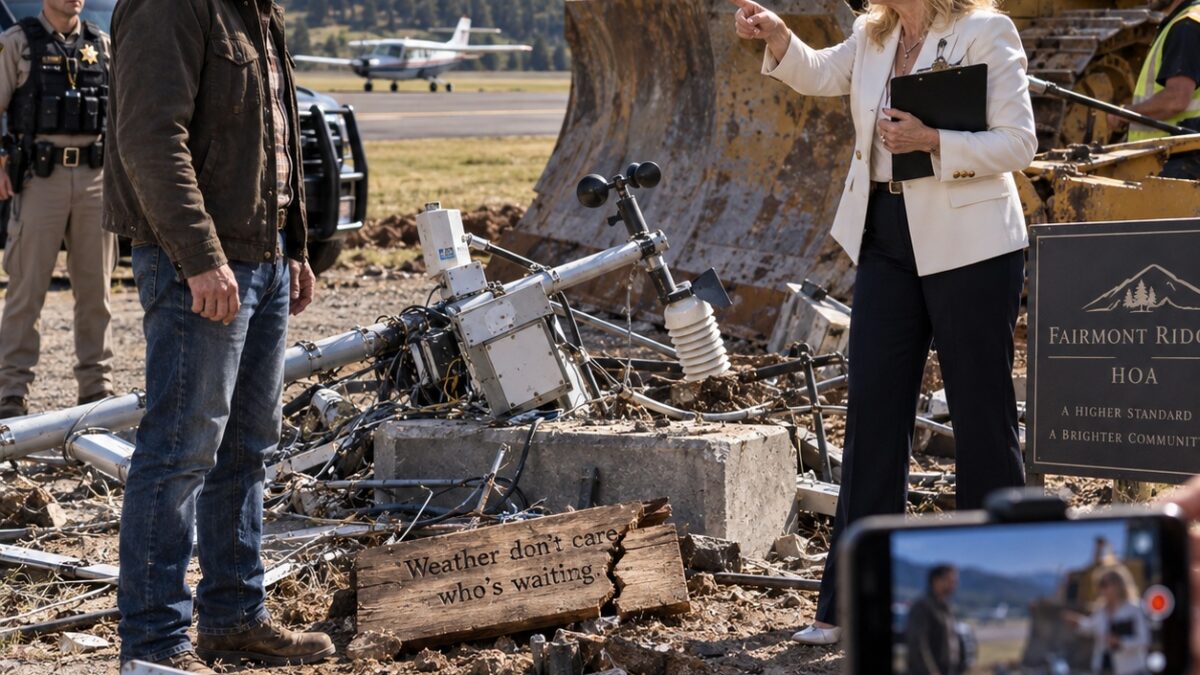
I did not sleep that night.
At 1:13 in the morning, I was still sitting at my kitchen table with the 2004 Fairmont Ridge subdivision plat open on my laptop and three printed deeds spread around it.
My father had always handled the land.
That was the simplest explanation for how I had missed Tract C.
He had lived boundaries in a way I never needed to while he was alive.
Dad knew where an old fence line bent around a sycamore tree.
He knew which drainage ditch belonged to which farmer.
He knew where county right-of-way ended and our gravel shoulder began.
When a neighbor said, “Calvin, can I put a temporary cattle gate there?” Dad knew exactly what “there” meant without looking at paper.
I inherited Walsh Field.
I inherited his hangars.
His tractors.
His debts.
His tools.
I also inherited the dangerous assumption that if something had been where Dad left it for years, he must have handled the paperwork.
The weather station shattered that assumption.
I zoomed in on Tract C again.
1.8 acres.
Long and narrow.
It hugged the north edge of the runway near the midfield taxiway.
The weather station concrete pad sat forty feet inside it.
Not forty feet from Fairmont Ridge.
Forty feet inside land legally titled to the HOA.
The same tract continued west nearly six hundred feet.
I leaned back.
“How did you miss this, Dad?”
The empty kitchen didn’t answer.
At two in the morning, I went outside.
The air had turned cold.
No wind.
No station voice.
For six years, I could step onto my porch, tune a handheld radio, and hear that machine calmly repeat the state of the atmosphere.
Wind.
Ceiling.
Visibility.
Pressure.
Facts.
Now there was nothing.
The silence made the field feel abandoned.
I walked down to the wreckage with a flashlight.
The bulldozer had crushed the mast.
Destroyed the cabinet.
Cracked the concrete pad.
Severed conduit.
The backup battery lay split open in the dirt.
My father’s sign was still where I had left it.
I picked up both halves.
Weather don’t care—
—and then the other half—
—who’s waiting.
Dad had made that sign after a crop duster pilot named Frank Morris tried to push through a thunderstorm in 1987 because a farmer was threatening to hire someone else if his corn wasn’t sprayed that afternoon.
Dad told Frank to sit down.
Frank yelled.
Dad pointed at the sky.
“Weather doesn’t negotiate.”
Years later he carved the shorter version.
Weather don’t care who’s waiting.
Dad wasn’t educated in the formal sense.
He left school at seventeen.
But he understood something Karen did not.
Reality does not become different because you are confident.
I took the sign home.
At 6:30 the next morning, somebody knocked on my front door.
Roy Kesler stood outside holding a folded Fairmont Ridge newsletter.
Roy was sixty-eight, retired from a commercial glazing company, and lived in the only house between my eastern fence and the subdivision’s stone entrance.
Technically, he belonged to Fairmont Ridge.
Spiritually, he belonged to no organization on earth.
He had fought the HOA over his satellite dish, his mailbox, his American flagpole, and once over a wheelbarrow they claimed was visible from the road for too many consecutive days.
He walked into my kitchen without being invited.
“You look terrible.”
“Thank you.”
“Coffee?”
“Pot’s there.”
He poured himself a cup.
Then placed the newsletter in front of me.
“Read the front.”
A glossy architectural rendering filled half the page.
Twelve oversized garage bays.
Stone walls.
Black-framed glass doors.
Copper lighting.
A lounge building.
Landscaping.
A black Porsche parked outside at an angle no sane driver would choose.
Above it:
THE CARRIAGE VAULT AT FAIRMONT RIDGE
PRIVATE MOTOR STORAGE • OWNER LOUNGE • LIMITED MEMBERSHIP
I looked at the date.
March edition.
Four weeks before Karen destroyed my station.
Roy tapped the rendering.
“That didn’t get drawn yesterday.”
“No.”
“Architects don’t work that fast.”
“No.”
“Printer didn’t either.”
I stared at the footprint.
The building sat almost exactly where the weather station had stood.
But something else bothered me.
The rendering showed a paved drive extending south.
Toward my taxiway.
“Where does that go?”
Roy leaned over.
“That?”
“Yes.”
“Looks like your field.”
I looked closer.
The render was stylized, but the southern edge showed pavement continuing out of frame.
“Could be artistic.”
Roy gave me a look.
“Could be Jesus coming back in a Porsche.”
I kept staring.
“What does the newsletter say?”
He flipped the page.
Karen had written the president’s message herself.
Fairmont Ridge was “unlocking the value of an underutilized association asset.”
Tract C would be converted into twelve luxury carriage bays for residents with collector automobiles, motorcycles, recreational equipment, and “select aviation-related storage needs.”
That phrase made my eyes stop.
“Aviation-related.”
Roy nodded.
“I saw that too.”
The project would generate non-dues revenue.
Presales were already underway.
Groundbreaking was “anticipated this spring.”
I read that line twice.
“Presales.”
“Yep.”
“How do you presell garages the HOA hasn’t even approved?”
Roy drank his coffee.
“You’re asking me because you think our board operates like a normal government.”
“Did members vote?”
“Not that I know.”
“Was there a special assessment?”
“No.”
“Where’s the money coming from?”
“Presales, supposedly.”
I sat back.
Karen hadn’t discovered an obstruction and decided to remove it.
The project was already moving.
Plans existed.
Marketing existed.
Presales existed.
Which meant the weather station had become a problem long before I knew there was a problem.
“Can you get me the presale paperwork?”
Roy scratched his chin.
“Maybe.”
“How?”
“A neighbor put down a deposit.”
“Who?”
“Daniel Preston.”
“Will he talk?”
“If he thinks talking annoys Karen.”
“Will he?”
Roy smiled.
“Oh, absolutely.”
Daniel Preston arrived at my hangar that afternoon.
He was fifty-two, owned three classic Ferraris, and dressed like somebody who spent more on shoes than I spent on oil changes.
He carried a blue presentation folder.
“I’m not supposed to show you this.”
“Then why are you?”
“Karen fined me $1,600 last year because my daughter’s Subaru sat in my driveway for eight days.”
Fair.
He handed me the folder.
The cover displayed the same rendering.
Inside was a reservation agreement for Bay Number Seven.
Purchase price:
$185,000.
Deposit:
$18,500.
I whistled.
“For a garage?”
“Climate controlled.”
“That better control the climate on Mars.”
Daniel smiled.
Then I saw the section that mattered.
Amenities.
Private owner lounge.
Detailing station.
Battery maintenance service.
Secured access.
And one line near the bottom:
Proposed controlled vehicular access to adjacent Walsh Field aviation facilities, subject to final operational agreement.
I read it again.
“Daniel.”
“Yeah.”
“What did Karen tell you this meant?”
He hesitated.
“That’s why Roy said I should talk to you.”
“What did she tell you?”
“At the sales meeting, she said buyers would eventually be able to store aircraft support vehicles here.”
“Support vehicles.”
“And maybe small aircraft.”
I stared at him.
“In garages designed for cars?”
“She said later phases might have larger doors.”
“Did she say you’d get runway access?”
Daniel looked uncomfortable.
“Yes.”
My stomach tightened.
“How?”
“She said the HOA was negotiating acquisition of operational rights.”
“From me?”
“She didn’t say.”
“Did she use the word acquisition?”
“Yes.”
“Did she say I had agreed?”
He rubbed the back of his neck.
“She said Walsh Field’s owner was ‘cooperative in principle.’”
I laughed once.
Not because it was funny.
“Had you and I ever met before today?”
“No.”
“Then I guess I’m cooperative telepathically.”
Daniel opened the folder to another page.
“There’s more.”
He showed me a site plan.
This one was more detailed than the newsletter rendering.
Twelve bays.
Parking.
Drainage.
Utility route.
A paved access lane heading south.
The line crossed the property boundary.
Onto Walsh Field.
Then connected directly to my midfield taxiway.
I felt the temperature in the hangar change.
“That is my taxiway.”
“I figured.”
“This plan shows a gate here.”
I pointed.
“Right.”
“On my property.”
“Yes.”
“Who prepared this?”
“Northline Development.”
I recognized the company.
Regional builder.
Not huge.
Not small.
I photographed every page.
“When did you sign?”
“February second.”
Two months before the demolition.
“How many presales?”
“She said seven.”
At $185,000 each, that was nearly $1.3 million in contracted sales.
“And she’s promising runway access.”
“Proposed access.”
“Buyers don’t put down eighteen grand because of the word proposed.”
Daniel looked embarrassed.
“No.”
“Did you think I was involved?”
“I assumed you were.”
“Why?”
“Because who would sell aviation access without talking to the airport owner?”
Exactly.
I called my attorney before Daniel had left the property.
Her name was Rebecca Sloan.
She handled aviation land-use disputes, which was a specialized way of saying she understood three worlds that usually hated one another: property law, municipal planning, and federal aviation rules.
I had used her once when the county wanted to approve a cell tower beneath my approach path.
I emailed her everything.
Deed.
Plat.
Newsletter.
Presale agreement.
Site plan.
My bulldozer video.
The sheriff’s incident number.
She called forty-five minutes later.
“First question.”
“Okay.”
“Did your father ever sign anything with Fairmont Ridge?”
“I don’t know.”
“Find out.”
“He’s dead.”
“I know. Find his records.”
“Second question?”
“Did you authorize anyone to market runway access?”
“No.”
“Ever discuss selling access?”
“No.”
“Ever discuss selling part of Walsh Field?”
“No.”
“Ever tell Karen you were cooperative in principle?”
“I’ve barely been cooperative in person.”
She ignored that.
“Third question. Is W22 public-use or private-use?”
“Private ownership, public-use designation.”
“Good.”
“Why good?”
“Because the operational picture matters. Fourth: is your weather station part of the FAA system?”
“Commissioned and listed.”
“Who owns the physical equipment?”
“I do.”
“Who funded it?”
“Me.”
“Does the FAA have a commissioning agreement?”
“Yes.”
“Get it.”
I rubbed my face.
“Rebecca, she owns the dirt.”
“Maybe.”
“No. I checked. HOA owns Tract C.”
“I heard you.”
“So she had the right to remove my equipment.”
“No.”
I stopped.
“What?”
“Owning dirt and owning the right to destroy someone else’s equipment are not the same thing.”
“It was installed on her land.”
“With permission?”
“I don’t know.”
“Then we find out.”
“And if Dad just screwed up?”
“Then you may have a trespass problem on your side.”
I closed my eyes.
“Great.”
“But she may still have a conversion and property-damage problem on hers.”
“She gave no notice.”
“That matters.”
“She just showed up with a bulldozer.”
“That matters more.”
“And the runway-access promises?”
Rebecca went quiet.
“That may become the most important part.”
“How?”
“Because if Karen destroyed your station not simply to clear HOA property, but to facilitate a commercial project that depends on unauthorized use of your airport, then the demolition becomes part of a much larger pattern.”
“What pattern?”
“Don’t guess yet.”
She paused.
“Find your father’s files.”
Dad’s records filled a storage room behind Hangar Two.
Calling it a filing system would have insulted filing systems.
He kept warranty cards from equipment we no longer owned.
Fuel receipts from 1997.
Old airport directories.
Invoices.
Tax notices.
Handwritten notes.
A stack of aviation magazines tall enough to injure someone.
I spent Thursday night opening boxes.
Friday night too.
On Saturday, Roy showed up carrying sandwiches.
“You look worse.”
“Stop complimenting me.”
“What are we hunting?”
“Anything involving Fairmont Ridge. Around 2003 to 2005.”
He looked at the boxes.
“Calvin saved everything.”
“Yes.”
“That’s good.”
“It would be better if he labeled everything.”
“Your father labeled things.”
I held up a box marked IMPORTANT.
Inside were extension-cord receipts, old medical bills, and a photograph of me at age twelve holding a fish.
Roy nodded.
“Fair.”
We searched for six hours.
Nothing.
At sunset, Roy left.
I stayed.
Around nine, I opened a rusty metal file drawer beneath Dad’s old desk.
The first folder said AIRPORT LIGHTING.
The second said INSURANCE.
The third:
FAIRMONT.
My hands stopped.
Inside were letters.
Meeting notes.
Survey sketches.
A draft subdivision plan.
Dad had written comments in red pen.
NO BUILDINGS NORTH SIDE—APPROACH/WEATHER.
Another sheet showed Tract C.
Across it, Dad had written:
EASEMENT?
I kept digging.
Then I found a recorded document.
Book number.
Page number.
County recorder stamp.
The title read:
DECLARATION OF AVIGATION, SAFETY, ACCESS, AND AIRPORT FACILITY EASEMENT.
My heart started pounding.
The agreement had been executed in 2004 between Calvin Walsh, the Fairmont Development Company, and the original Fairmont Ridge property owners association.
Tract C belonged to the HOA.
That part was true.
But ownership came burdened by something I had never known existed.
A perpetual easement in favor of Walsh Field.
I read the document standing up.
Then again sitting down.
The language granted Walsh Field rights to maintain clear areas associated with airport operations and to enter portions of Tract C for specified safety purposes.
Then I found Section 4.
My hands actually began shaking.
The owner of Tract C grants to Walsh Field, its successors and assigns, a perpetual right to install, operate, inspect, repair, replace, relocate, and maintain meteorological, lighting, navigation, communication, or other equipment reasonably associated with safe aircraft operations.
I whispered,
“Oh, Dad.”
It was there.
The weather station had stood on HOA-owned land.
Legally.
Under an easement Dad had negotiated fifteen years before the station was installed.
Section 6 prohibited the HOA from erecting structures within a defined aviation safety zone without written consent from Walsh Field.
The carriage garages sat almost entirely inside that zone.
I kept reading.
There was more.
Section 8:
No right of vehicular, aircraft, taxiway, runway, or operational access to Walsh Field is granted to the owners of Fairmont Ridge by virtue of this instrument.
I laughed.
Alone in the records room.
A short, disbelieving sound.
Dad had anticipated almost everything.
Tract C could belong to the subdivision.
But Walsh Field retained the right to place aviation safety equipment there.
And Fairmont Ridge explicitly received no runway access.
I called Rebecca at 9:47 on a Saturday night.
She answered.
“This better be interesting.”
“I found the easement.”
Pause.
“What easement?”
I read the title.
She became completely awake.
“Send it.”
I scanned every page.
Five minutes later she called back.
“Do not contact Karen.”
“I wasn’t planning to.”
“Do not contact the board.”
“Okay.”
“Do not post anything.”
“I don’t use social media.”
“Good.”
“What are you seeing?”
“A very large problem for Fairmont Ridge.”
“How large?”
“She bulldozed equipment she was expressly required to allow.”
I sat down.
“And the garages?”
“Likely prohibited without your written consent.”
“She already sold seven.”
“Reserved.”
“Deposits were taken.”
“Even better.”
“For me?”
“No. For the mess.”
I heard papers moving.
“Section Eight is extremely clear.”
“No runway access.”
“Correct.”
“So she sold buyers something the HOA never had.”
“She may argue the contracts only say proposed access.”
“Does that save her?”
“It saves the contract drafter from being completely insane.”
“And Karen telling people I was cooperative?”
“That could become evidence depending on who heard it.”
I looked at Dad’s signature.
“Rebecca.”
“Yeah?”
“My father knew.”
“Knew what?”
“That someday they’d try this.”
She was quiet.
“Maybe.”
“He specifically prohibited runway access.”
“That’s not unusual around airport-adjacent development.”
“It feels pretty unusual tonight.”
The next Monday, Rebecca ordered a title search.
By Tuesday, the easement was confirmed.
Properly recorded.
Properly indexed.
Still valid.
Never released.
Never amended.
Never terminated.
The weather station’s location fell inside the facility easement.
The proposed Carriage Vault fell within the restricted safety area.
Karen had bulldozed a legally protected aviation facility to clear land for a project she could not legally construct without my consent.
I expected to feel relieved.
Instead, I became angrier.
If the station had truly been placed there by mistake, I could accept some blame.
I would still have been furious she destroyed it without notice.
But mistakes happen.
Instead, Dad had secured the exact right we needed.
The HOA’s own title documents contained it.
Which raised a darker question.
Did Karen know?
Rebecca’s first formal letter went to every Fairmont Ridge board member, the association’s management company, its attorney, and Northline Development.
It was eleven pages.
It included the easement.
The weather station commissioning documents.
The bulldozer photographs.
The video preservation notice.
A demand that all project work stop.
A demand that all records relating to the Carriage Vault be preserved.
A warning that no one associated with Fairmont Ridge had authority to represent that Walsh Field access existed.
And a demand for reimbursement of the destroyed station.
Karen called me personally at 7:05 the next morning.
I let it ring.
She called again.
Then texted.
CALL ME.
Rebecca had told me not to.
So I didn’t.
At 7:13 another message arrived.
Your lawyer is misrepresenting historical documents.
I forwarded it to Rebecca.
Her response:
Perfect. Don’t reply.
At 8:30, a pickup from Northline Development appeared near Tract C.
The driver never unloaded.
He photographed the wrecked weather station pad and left.
At noon, Daniel Preston called.
“What did you do?”
“Why?”
“Karen just emailed everyone saying the Carriage Vault is temporarily delayed due to ‘unexpected legal interference from an adjacent operator.’”
“Adjacent operator?”
“You.”
“Interesting.”
“She says runway access remains part of the long-term vision.”
“That’s more interesting.”
“You didn’t agree?”
“No.”
“I want my deposit back.”
“You should ask her.”
“Already did.”
“And?”
“She says deposits are nonrefundable.”
I opened his contract on my computer.
“What did Rebecca say?”
“She’s not your lawyer.”
“I know.”
“She’d probably tell you to hire one.”
Daniel groaned.
“I knew you’d say that.”
He did.
So did three other presale buyers.
By the end of the week, Karen had a new problem.
Her customers were asking questions.
Then Northline Development’s attorney sent Fairmont Ridge a letter terminating the construction agreement pending resolution of title and access issues.
Roy obtained a copy because somebody on the board printed the email and left it in the clubhouse conference room.
He brought it to me inside a grocery bag like we were exchanging classified intelligence.
“I should probably stop accepting stolen documents.”
“It wasn’t stolen.”
“How did you get it?”
“I found it.”
“Where?”
“On a printer.”
“Inside the clubhouse?”
“Yes.”
“That is not helping.”
He sat down.
“Read page two.”
Northline said its pricing and design assumptions had been based on representations from Fairmont Ridge that Tract C was “free of incompatible recorded encumbrances.”
That statement was false.
The recorded easement was not obscure.
A basic title report should have shown it.
More importantly, Northline’s letter referenced an email sent by Karen four months earlier.
The email said:
Association counsel has confirmed the legacy Walsh instrument is non-operative for current use and will not impede development.
I read the sentence twice.
“Association counsel confirmed?”
Roy nodded.
“That’s what she told the developer.”
I called Rebecca.
“Can we find out if their attorney actually said that?”
“Eventually.”
“How?”
“Discovery if they force us to litigate.”
I hated the word eventually.
Walsh Field was operating without a commissioned weather station.
That was my immediate problem.
The FAA didn’t close the runway.
The station wasn’t required for basic operations.
But without it, medevac and wildfire crews had to rely on more distant weather observations and pilot reports.
I installed a temporary noncommissioned station on my own land within four days.
It cost $14,000.
It was better than nothing.
It was not the same.
The published frequency still returned silence.
On the sixth night after the demolition, my phone rang at 11:38.
County dispatch.
“Mr. Walsh?”
“Yes.”
“This is Mountain County Emergency Communications. We have an air ambulance considering Walsh Field for an intercept.”
My whole body tightened.
“What do you need?”
“Field conditions and weather.”
I looked out the window.
Rain had started.
I switched on my temporary display.
Wind variable.
Visibility uncertain.
Cloud base estimated.
Not certified.
Not published.
The same helplessness from the night Dad had his stroke crawled up my spine.
“I have unofficial readings.”
The dispatcher paused.
“Can you give us the nearest official observation?”
“Regional airport is thirty-eight miles south.”
“We have that.”
Of course they did.
“Can you visually estimate ceiling?”
I stepped outside with a flashlight.
Rain struck the porch roof.
Dark clouds swallowed the ridge.
I gave the best report I could.
The helicopter did not use Walsh Field.
They sent the ground ambulance farther south.
That night I sat in Dad’s old chair until almost three.
I wasn’t thinking about Karen.
I was thinking about a patient I would never meet losing time because somebody wanted luxury garages.
At 8:00 the next morning, I called Rebecca.
“I want emergency relief.”
“You want an injunction.”
“I want my station back.”
“Replacement will take time.”
“I want access to Tract C so crews can begin.”
“The easement already gives you that.”
“Then why aren’t we doing it?”
“Because I’m trying to give the HOA an opportunity to resolve this without escalating.”
“They used that opportunity to bulldoze ninety-two thousand dollars of equipment.”
She was quiet.
“What happened?”
I told her about the air ambulance.
Her tone changed.
“All right.”
By noon, she filed for temporary injunctive relief.
Fairmont Ridge responded aggressively.
Their filing claimed the weather station had been installed without proper HOA approval.
Rebecca’s reply was almost surgical.
The easement did not require HOA approval.
They claimed the equipment was obsolete.
The FAA commissioning records said otherwise.
They claimed it interfered with planned association use.
The easement specifically subordinated Tract C use to aviation safety equipment.
Then they claimed I had known about the Carriage Vault and was using the dispute to extort the HOA for control of Tract C.
That one made me laugh.
Rebecca did not.
“Defamation?”
“Not yet.”
“What do you mean, not yet?”
“Court filings are complicated. Stop trying to collect causes of action like baseball cards.”
The hearing was set for the following Tuesday.
Karen entered the courthouse carrying a leather portfolio.
She wore gray.
No white blazer.
Her attorney, Martin Vale, did most of the talking.
I had never met him.
Rebecca had.
She leaned toward me before the hearing.
“Martin is good.”
“Better than you?”
“That’s an annoying question.”
“Sorry.”
“Yes.”
I looked at her.
She smiled slightly.
“I’m kidding.”
The judge was a woman named Ellen Navarro.
She read the easement before anybody spoke.
That helped.
Martin argued that the weather station’s precise location had never been formally approved under the easement and that technological changes made the 2004 language ambiguous.
Judge Navarro looked at him.
“Counsel, where does the document require association approval for meteorological equipment?”
He turned a page.
“It does not expressly use the term approval.”
“So nowhere.”
“It requires equipment to be reasonably associated with safe operations.”
“Is an FAA-commissioned automated weather station reasonably associated with aviation safety?”
Martin paused.
“We dispute whether this particular installation—”
“Answer my question.”
“Yes.”
I almost exhaled too loudly.
Then Rebecca played seventeen seconds of my bulldozer video.
Karen’s voice filled the courtroom.
“Tract C belongs to us. Land somewhere else.”
Then:
“You don’t stop anything here, Mr. Walsh.”
Then:
“Finish it.”
Judge Navarro looked at Karen.
For the first time since the demolition, Karen appeared uncomfortable.
The temporary order came that afternoon.
Fairmont Ridge was prohibited from interfering with my access to the easement area for restoration of meteorological equipment.
No construction could begin on the Carriage Vault pending further proceedings.
The HOA could not represent that it possessed operational access rights to Walsh Field.
And both sides were ordered into expedited mediation.
It was not a final victory.
But it let me rebuild.
A replacement station cost more than the original.
$117,000.
Inflation.
New electronics.
New certification work.
New concrete because Karen’s bulldozer had cracked the old pad beyond reuse.
The aviation community responded faster than Fairmont Ridge did.
Three crop-dusting companies prepaid fuel accounts.
The county emergency services director wrote a letter explaining why local weather data mattered.
A wildfire contractor loaned me temporary equipment.
One medevac pilot named Lisa Grant visited the field personally.
She stood beside the wreckage.
“My crew used your AWOS last winter.”
“For what?”
“Snowmobile accident near Patterson Ridge.”
I remembered the night.
“Two patients?”
“One critical.”
She nodded toward the ruined mast.
“We shot the approach here because your ceiling report gave us enough confidence to stage.”
I swallowed.
“Did they make it?”
“One did.”
“And the other?”
She looked down.
“No.”
That answer stayed with me.
Weather information doesn’t save everybody.
Nothing does.
But it gives pilots facts.
Sometimes facts buy minutes.
Sometimes minutes are all someone has.
The new concrete pad was poured three weeks after the injunction.
Karen came to watch.
She stood on the subdivision side of the boundary with two board members.
I kept working.
Eventually she called out.
“You know this isn’t over.”
I looked up.
“No.”
“You’re forcing the association to subsidize a private airport.”
“I’m rebuilding equipment your bulldozer destroyed.”
“Our bulldozer.”
“Thank you for clarifying ownership.”
Her jaw tightened.
“You think this easement gives you permanent control.”
“No.”
I wiped concrete dust from my gloves.
“It gives me specific rights written in a recorded document.”
“You’re splitting hairs.”
“Recorded property rights are mostly hair splitting.”
“You’re enjoying this.”
“No.”
I looked at the new conduit trench.
“I’d rather be flying.”
She stood there another minute.
Then left.
Mediation happened in May.
Fairmont Ridge sent Karen, Martin Vale, and two board members.
I brought Rebecca.
The mediator was a retired judge named Philip Gaines.
He spent the first hour separating emotion from law.
Then spent the next six hours discovering that Karen had no interest in separating anything.
“Our homeowners have invested in this community,” she said.
“So has Mr. Walsh,” Gaines replied.
“His airport creates noise.”
Rebecca looked at me.
I stayed quiet.
Karen continued.
“Yet we are expected to preserve land for his benefit indefinitely.”
Gaines tapped the easement.
“You purchased property subject to this restriction.”
“We inherited a bad agreement.”
“That can happen.”
“It is economically irrational.”
“That doesn’t make it disappear.”
Karen’s face hardened.
“The Carriage Vault would generate nearly two million dollars.”
There it was.
Not safety.
Not community tradition.
Money.
Gaines asked,
“How much has been collected?”
Martin answered before Karen.
“Approximately one hundred thirty thousand dollars in deposits.”
“Refundable?”
Martin hesitated.
“Contract terms vary.”
Rebecca looked at me.
That was interesting.
Then Gaines asked the question I had wanted someone to ask since Daniel showed me the contracts.
“Why was Walsh Field access included in the marketing?”
Martin answered carefully.
“It was identified as a proposed future amenity subject to agreement.”
Karen interrupted.
“Because it is logical.”
Martin closed his eyes slightly.
She continued.
“Tract C borders the airport. Several residents own aircraft. An access arrangement benefits everyone.”
“Did Mr. Walsh agree?”
“No, because he refuses to discuss anything rationally.”
I almost spoke.
Rebecca touched my wrist.
Gaines asked,
“Before the presales began, did you ask him?”
Karen said nothing.
“Did anyone from Fairmont Ridge ask him?”
Silence.
“Did you inform him the Carriage Vault plan contemplated a connection to his taxiway?”
“No.”
“Then how could he refuse?”
Her face tightened.
“He had historically tolerated association use.”
“What association use?”
“Maintenance. Landscaping. Trail access.”
“Not runway access.”
Karen looked at me.
“Our residents have crossed portions of Walsh property for years.”
I finally spoke.
“On foot.”
“Access is access.”
Rebecca sat forward.
“No, it absolutely is not.”
The room went quiet.
She placed Section Eight of the easement on the table.
“No vehicular, aircraft, taxiway, runway, or operational access.”
Karen looked at it.
Then at Martin.
Something passed between them.
Tiny.
But I saw it.
Rebecca saw it too.
She leaned back.
“Karen, when did you first see this document?”
Martin immediately said,
“She is not required to answer discovery questions in mediation.”
Gaines raised a hand.
“Fair.”
But the damage was done.
Karen had looked at her lawyer before answering.
The mediation failed.
Not because there was no possible deal.
Because Karen demanded that any settlement include negotiation of permanent runway access.
I refused.
She called me unreasonable.
I told Gaines I would discuss compensation for the destroyed station and legal costs.
I would discuss future maintenance procedures on Tract C.
I would even discuss relocating the station twenty feet if the FAA and engineers approved it.
I would not sell runway access.
Not to the HOA.
Not as part of the garage project.
Not under pressure.
Karen stood.
“Then you are holding eighty-six homeowners hostage to your personal grudge.”
Roy wasn’t there.
I wished he had been.
He would have laughed.
The lawsuit entered discovery.
That was when Karen’s story began to fall apart.
The first important document came from Fairmont Ridge’s former attorney.
Not Martin Vale.
A lawyer named Susan Hale had represented the HOA until the previous December.
Rebecca subpoenaed correspondence about Tract C.
Susan produced it.
One email was dated November 18.
Five months before the demolition.
Karen had asked:
Can the 2004 Walsh easement be terminated based on nonuse or technological obsolescence? We need unrestricted development rights on Tract C.
Susan replied:
No. The easement is expressly perpetual. I see no basis to treat it as abandoned. The weather equipment currently located on the tract appears to constitute use under Section 4.
I read that paragraph three times.
Karen knew.
Not vaguely.
Not maybe.
She had asked.
Her attorney had told her the easement remained valid.
Then came Karen’s next email.
What if the equipment is removed?
Susan’s answer:
Removal by the servient landowner would not extinguish the easement and could expose the association to liability if undertaken without Walsh Field’s consent.
I actually stood up when Rebecca showed me.
“She asked what happens if the equipment is removed.”
“Yes.”
“And then she removed it.”
“Yes.”
“What did Susan do?”
“There’s more.”
On November 23, Susan had written:
I strongly advise the board not to market any airport access component without a separate executed agreement with Mr. Walsh. Section 8 expressly excludes such access.
Karen replied:
Understood.
One word.
Understood.
Five months later, she stood beside a bulldozer and told me the station shouldn’t have been on HOA property.
The next batch of documents was worse.
Northline Development had emailed Karen repeatedly asking whether the easement was resolved.
In January, Karen wrote:
Legacy Walsh restrictions are being handled internally and are not expected to survive site preparation.
Not expected to survive site preparation.
Rebecca looked at me across her conference table.
“That phrase is going to matter.”
“She planned to bulldoze it.”
“We don’t say that yet.”
“She literally wrote—”
“I know what she wrote.”
“What else could it mean?”
“Let her explain it under oath.”
Karen’s deposition happened in June.
I wasn’t allowed to sit in the room.
Rebecca called me afterward.
“How did it go?”
“Have you ever watched someone step on a rake?”
“Once.”
“Imagine doing it for six hours.”
“What did she say?”
“She claims ‘site preparation’ referred to legal preparation, not physical clearing.”
I laughed.
“She also claims she did not personally review Susan Hale’s full email.”
“She responded ‘understood.’”
“Yes.”
“She claims she was acknowledging receipt.”
“Of course.”
“And the runway access?”
“She says ‘cooperative in principle’ was a general characterization based on your historically positive relationship with Fairmont Ridge.”
“What historically positive relationship?”
“Exactly.”
I sat down.
“Did she admit ordering the bulldozer?”
“Yes.”
“That part is on video.”
“She says she believed the board had authorized removal.”
“Did they?”
“That is where it gets interesting.”
The board had approved “site clearing and preliminary grading” for the Carriage Vault in March.
But meeting minutes included a condition.
Subject to legal confirmation of Tract C development rights.
Susan Hale was no longer representing them by then.
Martin Vale had been hired.
His legal opinion had not yet been delivered when Karen scheduled the bulldozer.
In other words, the board authorized work only after legal confirmation.
Karen acted before confirmation.
Worse, the property committee had told her to wait.
Greg Nolan testified to that.
“I told Karen the survey and easement issue needed to be resolved first.”
“Did she agree?”
“She said delays would jeopardize presales.”
“Did you authorize destruction of Mr. Walsh’s weather station?”
“No.”
“Did the board?”
“Not in any meeting I attended.”
“Did you tell Karen not to cut the chain?”
That question confused me when Rebecca told me.
“What chain?”
“Wrong case language from another issue,” she said. “Forget it.”
I laughed.
“Long month?”
“Very.”
But Greg’s testimony mattered.
Karen had turned what might have been an association liability problem into a personal governance disaster.
By July, four Fairmont Ridge board members wanted her removed.
Two supported her.
One refused to take sides.
Karen called an emergency membership meeting before they could vote.
She framed the lawsuit as an attack on Fairmont Ridge.
Roy recorded the meeting from his seat.
Not secretly.
North Carolina law issues aside, he simply placed his phone on the table because the HOA allowed owner recordings.
Karen stood before eighty homeowners in the clubhouse.
“This is not about a weather station,” she said.
For once, I agreed.
“This is about whether one man can use a fifty-year-old private airport to dictate the future of an entire community.”
A resident asked,
“Did our old lawyer tell you the easement was valid?”
Karen’s mouth tightened.
“We received conflicting legal interpretations.”
That wasn’t what Susan’s email said.
Another resident asked,
“Did you authorize the bulldozer?”
“The board authorized site preparation.”
Greg stood from the third row.
“No, Karen.”
The room changed.
She looked at him.
He continued.
“The board authorized site preparation after legal clearance.”
“We had clearance.”
“From who?”
Silence.
Greg held up a folder.
“I’ve read the discovery responses.”
Murmurs spread.
Karen’s face hardened.
“This is privileged board material.”
“No. The court filings are public.”
Another resident stood.
“My deposit is tied up in that garage project.”
Then another.
“Mine too.”
A woman near the front asked,
“Why were we selling runway access we didn’t own?”
Karen raised both hands.
“No one sold runway access.”
Daniel Preston stood.
“You told me my bay would eventually connect to Walsh Field.”
Karen stared at him.
“I said the association intended to negotiate access.”
“You said the airport owner was cooperative.”
“I believed he would be.”
That sentence was almost as damaging as the emails.
Daniel laughed.
“So you took my eighteen-thousand-dollar deposit because you believed a man you hadn’t asked would eventually agree?”
The room erupted.
Roy sent me the video that night.
I watched alone.
It should have felt satisfying.
It didn’t.
I knew what it was like to realize someone you trusted with authority had been making decisions you would never have approved.
The residents weren’t my enemies.
They were discovering what I had discovered in April.
Karen presented assumptions as facts until people built plans around them.
Three days after the meeting, the Fairmont Ridge board voted five to two to suspend Karen from acting as president pending a membership recall vote.
She refused to resign.
Her attorney argued the bylaws didn’t permit suspension.
The HOA split into factions.
And the Carriage Vault collapsed.
Northline Development formally withdrew.
Buyers demanded refunds.
The HOA’s insurer reserved rights on coverage because intentional destruction of known third-party property might fall outside the policy.
That phrase frightened the board more than anything else.
Outside the policy.
If insurance refused coverage, homeowners might ultimately pay.
The same residents Karen claimed I was attacking now had a financial reason to ask exactly what she had done.
Then the FAA became involved.
Not because I called them to punish Karen.
I had to report destruction and replacement of the commissioned station.
An FAA airport safety inspector named Henry Cho visited Walsh Field.
He reviewed the easement.
The station location.
The Carriage Vault plan.
The proposed taxiway connection.
He did not make dramatic threats.
Government people rarely do when they know paperwork can do more damage than shouting.
He simply asked,
“Did anyone submit an airspace or airport modification notice for these structures?”
“No.”
“Did anyone coordinate the proposed connection?”
“No.”
“Was the access lane intended for aircraft?”
“I don’t know. Marketing implied aviation use.”
He photographed everything.
Two weeks later, Fairmont Ridge received a letter stating that structures or operational changes affecting the airport environment might require federal notice and aeronautical review.
It wasn’t a fine.
It wasn’t an enforcement order.
But it ended Karen’s favorite argument that the dispute was simply between two neighboring landowners.
Walsh Field was part of a larger aviation system.
You could not draw a road onto a taxiway and call it an amenity.
The replacement weather station became operational on August 3.
The FAA technician finished calibration shortly after noon.
I stood beside the new cabinet with Lisa Grant, the medevac pilot, and Roy.
The radio crackled.
Then the mechanical voice returned.
“Walsh Field automated weather observation…”
I didn’t hear the rest.
Not really.
My eyes had filled.
Roy looked away because he was kind enough not to make it a moment.
Lisa touched my shoulder.
“You okay?”
“Yeah.”
The voice continued.
“Wind one-eight-zero at six…”
Same emotionless cadence.
Same boring truth.
I had never been so grateful to hear a machine.
That evening, I repaired Dad’s wooden sign.
I didn’t hide the crack.
I joined the two halves from the back with steel straps.
From the front, the break still ran diagonally through the words.
WEATHER DON’T CARE WHO’S WAITING.
I hung it inside Hangar One.
The lawsuit still wasn’t resolved.
But something in me settled.
Karen had managed to destroy the station.
She had not silenced it permanently.
September brought the motion hearings.
Fairmont Ridge’s new board wanted settlement.
Karen did not.
By then she had hired separate personal counsel.
That told me everything.
The association and Karen no longer had perfectly aligned interests.
Rebecca explained it.
“The HOA can argue she exceeded authority.”
“And Karen can argue she acted for the HOA.”
“Yes.”
“So they start blaming each other.”
“Usually.”
“I hate lawsuits.”
“Everyone should.”
The insurer eventually agreed to fund part of the property-damage claim while reserving questions about Karen’s conduct.
The HOA offered to pay for the replacement station, temporary equipment, engineering, certification, and a portion of my legal fees.
In exchange, they wanted me to release the association.
I was willing.
Rebecca wasn’t finished.
“What about the easement?”
“What about it?”
“It needs to be clarified.”
“It already seems clear.”
“It seemed clear before someone bulldozed your equipment.”
Point taken.
We negotiated an amended memorandum—not changing the underlying rights, but clarifying procedures.
Walsh Field could maintain and replace weather, lighting, communication, and safety equipment within the designated area.
The HOA had to give thirty days’ notice before work on Tract C that could interfere.
Walsh Field had reciprocal notice obligations for major new installations.
The no-runway-access clause was reaffirmed.
Any future access had to be established by a separate written instrument signed by both parties.
No marketing could imply access without such an agreement.
I insisted on that language.
The board agreed immediately.
They had learned.
The association also agreed that no structure would be placed within the safety area without required aviation review and my written consent where the original easement required it.
The total settlement payment to me was $214,000.
That number sounds dramatic.
It did not make me rich.
$117,000 went to the replacement station.
$14,000 had gone to temporary equipment.
There were engineering costs.
Survey costs.
FAA contractor costs.
Legal fees.
Lost operational revenue.
Damaged concrete.
Electrical reconstruction.
By the time everything was paid, I was not buying a lake house.
I was close to where I had started.
But Walsh Field was whole again.
The HOA refunded the Carriage Vault buyers.
The project was formally canceled.
Tract C returned to being what it had been before Karen decided underutilized land was wasted land.
Grass.
Drainage.
Safety buffer.
Weather equipment.
Karen’s personal situation remained unresolved.
I wanted no part in destroying someone’s life.
That may sound strange after everything.
I was angry at her.
Deeply.
But revenge and accountability are not the same thing.
I didn’t want Karen bankrupt because I hated her.
I wanted the damage repaired and the rights respected.
Then Rebecca called me one October morning.
“You need to come in.”
“That never sounds good.”
“This might.”
I drove to her office.
A folder waited on the conference table.
“What is it?”
“The presale accounting.”
“I thought we were done with that.”
“The HOA produced final internal records.”
She opened the folder.
“Karen did something you didn’t know.”
My stomach tightened.
“What?”
“Remember the nonrefundable deposits?”
“Yes.”
“Part of the money was transferred.”
“To Northline?”
“Some.”
“Where did the rest go?”
She slid a ledger toward me.
A company called Ashford Community Strategies had received $38,000 in consulting payments.
I stared at the name.
“Ashford.”
“Karen’s husband owns it.”
My jaw tightened.
“For what?”
“Project development consulting.”
“Was that disclosed?”
“Not properly.”
“That’s an HOA issue.”
“Yes.”
“So why are you showing me?”
“Because it gives motive.”
I looked at her.
“Karen wasn’t only trying to create revenue for the association.”
“No.”
“She had money tied to the project.”
“Her family did.”
The land grab suddenly looked different.
I had always assumed Karen’s motivation was control and prestige.
Build something impressive.
Increase HOA revenue.
Prove she could force Walsh Field to cooperate.
Those things were probably still true.
But there was money flowing toward her household.
“How much total?”
“Thirty-eight thousand documented.”
“For a project that never broke ground.”
“Yes.”
“Did the board approve it?”
“That question is now between Fairmont Ridge, Karen, their accountants, and potentially law enforcement.”
I leaned back.
“I don’t want to be involved.”
“You already are, but your role is mostly finished.”
The HOA hired a forensic accountant.
I learned about the results through Roy.
There were other conflicts.
Nothing huge enough to become some Hollywood embezzlement scandal.
But enough undisclosed vendor relationships and questionable reimbursements that Karen lost the last of her board support.
The recall vote passed overwhelmingly.
She was removed.
Not suspended.
Removed.
Roy called me from the clubhouse parking lot.
“Seventy-four to nine.”
I stood beside my fuel pump.
“How does that feel?”
“Honestly?”
“Yes.”
“Like our neighborhood just had a root canal.”
I laughed.
“Painful but necessary?”
“And expensive.”
“What happens to Karen?”
“Not president.”
“I gathered that.”
“She left before the vote total.”
I looked toward Tract C.
The new weather mast turned slowly in the autumn wind.
“I’m sorry.”
Roy went quiet.
“For what?”
“You were friends once.”
“Long time ago.”
“Still.”
He sighed.
“Karen wasn’t always like this.”
That sentence bothered me.
We like villains simple.
It makes everything easier.
Karen had probably volunteered for committees because somebody needed to.
Probably solved real problems.
Probably helped neighbors.
Then somewhere along the way, being the person who got things done turned into believing she had the right to decide what should be done.
Authority became identity.
Resistance became disrespect.
And once disagreement feels like disrespect, it gets easy to justify things that would have shocked an earlier version of yourself.
I didn’t forgive her.
Not then.
But I stopped imagining she woke up one morning evil.
That mattered to me.
Winter returned.
Walsh Field stayed busy.
A medevac helicopter used us twice.
Wildfire season ended quietly.
Crop-dusting traffic slowed.
Fairmont Ridge elected Robert Chen as its new president.
Robert was an accountant.
He wore glasses.
Spoke slowly.
Asked for documents before making statements.
I liked him immediately.
Our first meeting happened beside Tract C.
He held a copy of the easement.
“I want to make sure I understand this correctly.”
“That already puts you ahead.”
He smiled.
“The HOA owns the dirt.”
“Yes.”
“You have specified easement rights.”
“Yes.”
“We maintain the non-aviation portions.”
“Yes.”
“You maintain your equipment.”
“Yes.”
“And we don’t touch your weather station.”
“That would be my preference.”
He laughed.
Then became serious.
“I owe you an apology on behalf of the board.”
“You weren’t on the board when this started.”
“I am now.”
“That doesn’t make you responsible for everything before.”
“No.”
He looked toward the mast.
“But it makes me responsible for what we do with it.”
I respected that.
We developed a simple inspection protocol.
Twice a year, Fairmont Ridge’s grounds contractor would meet me before mowing near the equipment.
No heavy machinery inside the station protection area without coordination.
Any drainage changes came to both sides for review.
Boring.
Predictable.
Documented.
Exactly how land relationships should be.
Months passed.
Then one afternoon in March, almost a year after the demolition, a white Lexus appeared near Hangar One.
For a moment, I thought I was seeing a memory.
Karen stepped out.
No clipboard.
No HOA logo.
No blazer.
Jeans.
Dark sweater.
She stood beside the car for several seconds before walking toward me.
I was changing a tire on the tug.
I straightened.
“Karen.”
“Ethan.”
We hadn’t spoken directly since mediation.
“What can I do for you?”
She glanced toward the hangar.
“I heard the station was fully certified again.”
“Since August.”
“I know.”
Silence.
She looked older.
Not dramatically.
Just tired.
“I wanted to see it.”
I didn’t answer.
“You can say no.”
That was new.
I wiped my hands.
“Stay outside the taxiway markings.”
She nodded.
We walked toward Tract C.
The station spoke as we approached.
“Wind two-four-zero at eleven…”
Karen looked up at the mast.
“I hated that voice.”
I almost laughed.
“Why?”
“It never stopped.”
“No.”
“Day. Night. Every minute.”
“Every ninety seconds.”
She glanced at me.
“Of course you know that.”
“I paid for it twice.”
She looked away.
Fair.
We stopped beside the repaired concrete.
For several seconds, neither of us spoke.
Then Karen said,
“I didn’t think it mattered that much.”
I looked at her.
“The station?”
“Yes.”
“You knew it was aviation equipment.”
“I thought it was weather information.”
“It is.”
“You know what I mean.”
“No.”
She exhaled.
“I thought it was convenience.”
I stared at the mast.
“My father died because a helicopter crew didn’t have local weather information.”
Her face changed.
“You never told me that.”
“You never asked why it was there.”
She looked down.
I didn’t soften the sentence.
Sometimes people deserve to sit with an answer.
Eventually she said,
“I’m sorry about your father.”
“Thank you.”
“I’m sorry about the station too.”
I waited.
She seemed irritated by my silence.
Then almost smiled at herself.
“You’re going to make me say all of it.”
“I’m not making you do anything.”
Her smile disappeared.
“I should not have ordered the bulldozer.”
“No.”
“I knew there was an easement question.”
“Yes.”
“I convinced myself Susan was being overly cautious.”
“She was correct.”
“Yes.”
“The board told you to wait.”
“Greg told me to wait.”
“And?”
“I thought he was afraid.”
“Maybe he was sensible.”
“Maybe.”
Wind spun the cups above us.
Karen folded her arms.
“I thought if the station was gone, the argument would become simpler.”
There it was.
The email.
What if the equipment is removed?
“What did you think would happen?”
“That the easement would become theoretical.”
I stared at her.
“You thought destroying the thing protected by the easement would weaken the easement.”
“When you say it like that—”
“How else would I say it?”
She closed her eyes.
“I was under pressure.”
“From buyers?”
“From everyone.”
“No.”
My voice stayed calm.
“You were under pressure from promises you made before you had permission to make them.”
She looked at me.
That one landed.
“I believed you would eventually agree.”
“Why?”
“Because it made financial sense.”
“For you.”
“For both of us.”
“You never asked me.”
“I thought you’d demand too much.”
“So you sold it first?”
“We sold a concept.”
“You took deposits.”
“Yes.”
“You told people I was cooperative.”
“I thought once the project had momentum, you’d see that fighting it wasn’t practical.”
I felt my stomach tighten even a year later.
“Say that again.”
She looked confused.
“What?”
“You created obligations, took money, hired designers, marketed access, and then planned to come to me after enough people depended on my yes that saying no would make me the villain.”
She didn’t answer.
“That was your strategy?”
Her face hardened slightly.
“It’s how development works.”
“No.”
I shook my head.
“That’s how leverage works.”
She looked toward the runway.
A small Piper was on final.
The pilot crossed the threshold and touched down smoothly.
Karen watched it roll.
“I thought Walsh Field was dying.”
That surprised me.
“What?”
“Your father was gone. You weren’t expanding. Half your hangars looked old. The subdivision kept growing.”
“So?”
“So I thought this place would eventually be absorbed.”
“By Fairmont Ridge?”
“By something.”
I almost laughed.
“My father heard that for fifty years.”
“I’m sure.”
“He bought this place when people said small airfields were disappearing.”
Karen looked at me.
“Small airfields are disappearing.”
“Some are.”
“You could sell this land for millions.”
“I know.”
“Then why don’t you?”
I watched the Piper taxi toward the fuel pump.
Because that was the question at the center of everything.
Not easements.
Not Karen.
Not garages.
Why keep Walsh Field?
“I used to ask Dad the same thing.”
“What did he say?”
“That not everything valuable makes the most money.”
Karen frowned.
I continued.
“This field gets crop dusters closer to farms. Fire aircraft closer to mountains. Medical aircraft closer to people who don’t have forty minutes.”
I pointed toward the runway.
“And sometimes a guy just wants a place where he can take off at sunrise.”
She smiled faintly.
“That sounds sentimental.”
“It is.”
“Business usually punishes sentiment.”
“Maybe.”
I looked at her.
“But Walsh Field is still here.”
She nodded.
The station spoke again.
Karen listened to the whole report.
Then she said,
“My husband’s company returned the consulting payments.”
“I heard.”
“Of course you did.”
“Small town.”
“Small aviation community too, apparently.”
“Very.”
She put her hands into her pockets.
“I lost friends.”
I didn’t know what she wanted me to say.
So I told the truth.
“I’m sorry.”
She looked surprised.
“Are you?”
“Yes.”
“You hated me.”
“I hated what you did.”
“Difference?”
“Yes.”
She considered that.
“I hated you too.”
“I figured.”
“You made me feel powerless.”
I looked at her.
“That wasn’t my goal.”
“I know that now.”
She stared at the concrete pad.
“I think that’s why I kept pushing.”
“Because you felt powerless?”
“Because every time I told you how things were going to be, you asked for paper.”
I laughed.
She did too.
“I hated that,” she said.
“Paper’s annoying.”
“No. You were annoying.”
“Also true.”
Her expression became serious again.
“You never got angry the way I expected.”
“I got angry.”
“You didn’t show it.”
“Usually.”
“That made it worse.”
“Why?”
“Because I could tell myself you were calculating.”
“I was documenting.”
“Same difference when you’re on the other side.”
“No.”
She nodded slowly.
“No. I guess not.”
We stood there another minute.
Then she turned to leave.
“Karen.”
She stopped.
I had not planned to say anything else.
But I thought of Dad.
Of time.
Of the things we don’t say because we assume another opportunity will come.
“Why did you come today?”
She looked back.
“To apologize.”
“You could’ve written a letter.”
“I wrote six.”
“What happened?”
“Threw them away.”
“Why?”
“They sounded like legal settlements.”
I understood.
She looked toward the station.
“And I wanted to hear it.”
“The weather?”
“The thing I destroyed.”
The mechanical voice continued calmly.
Visibility ten.
Temperature twelve.
Dew point three.
Altimeter three-zero-zero-eight.
Karen listened.
Then nodded once.
“Goodbye, Ethan.”
“Goodbye, Karen.”
She walked back to the Lexus.
I never became friends with her.
That isn’t how every story needs to end.
Forgiveness doesn’t require friendship.
Understanding doesn’t require trust.
And an apology doesn’t erase a bulldozer track.
But after that day, when her name came up, I didn’t feel my pulse rise.
That was enough.
Two years after the demolition, Fairmont Ridge did build something on Tract C.
Not garages.
A small landscaped walking area near the far western edge, outside the aviation safety zone.
Robert brought me the plans before the board approved them.
“Benches.”
“I see that.”
“Trees.”
“I see those.”
“None exceed the easement height restrictions.”
“I appreciate that.”
“No Porsche rendering.”
“Disappointing.”
He smiled.
“You okay with it?”
I studied the plan.
“Move this tree eight feet west.”
“Why?”
“Future sensor line.”
He made a note.
“Done.”
That was what cooperation looked like.
Not one side winning.
Not one side surrendering.
Ask.
Document.
Adjust.
Build.
The Carriage Vault buyers either received refunds or credits against dues.
Daniel Preston eventually bought a storage bay at the regional airport instead.
He still fueled at Walsh Field sometimes.
One afternoon, he climbed out of his Ferrari wearing aviation sunglasses even though he had arrived by car.
“I miss my garage.”
“You never had a garage.”
“I miss the garage Karen promised me.”
“You miss the rendering.”
“That Porsche looked fantastic.”
“Yours would’ve leaked oil on my taxiway.”
He looked offended.
“It’s Italian.”
“Exactly.”
He laughed.
Then became serious.
“Did you ever consider giving us access?”
“No.”
“Never?”
“Not under that plan.”
“What about someday?”
I looked toward the runway.
“Maybe.”
His eyebrows rose.
“Really?”
“Maybe is not a presale contract.”
He laughed.
“Point taken.”
I wasn’t against development.
That was another thing people misunderstood.
I wasn’t preserving Walsh Field in amber.
Airports change.
Communities change.
Land changes.
There may come a day when controlled access from Fairmont Ridge makes sense.
If it does, there will be engineers.
Insurance.
Security plans.
Access controls.
Written agreements.
FAA coordination.
Money.
A lot of paper.
And nobody will discover it after someone has already sold seven garages.
I sometimes wonder what Dad would have thought about the whole fight.
Part of me knows exactly what he would say.
“You should’ve read the easement sooner.”
He would be right.
I had inherited land and assumed history would protect it.
History protects nothing unless somebody knows where the documents are.
That lesson cost me months of sleep.
Dad had done the hard part.
He saw Fairmont Ridge coming in 2004.
Not Karen specifically.
Development.
More homes.
More people.
Pressure on the field.
He negotiated an agreement that allowed the subdivision to exist beside the airport without giving away the airport’s future.
Then he filed it.
Recorded it.
Put a copy in a metal drawer.
And never once sat me down to explain it.
That part was very Dad.
After everything ended, I reorganized the records room.
Every easement digitized.
Every deed scanned.
Every aviation agreement indexed.
Cloud backup.
Physical backup.
Off-site backup.
Roy saw the new labeled cabinets and whistled.
“Your father would hate this.”
“Why?”
“He enjoyed making people search.”
“That explains my childhood.”
I also created a property map mounted on the hangar wall.
Tract C.
Safety easement.
Runway protection areas.
Fuel areas.
Utility rights.
Access roads.
Nothing assumed.
If I die tomorrow, the next person won’t spend two nights digging through receipts and fishing photos to discover what they own.
The repaired sign hangs beneath that map.
The crack is still visible.
Visitors sometimes ask why I didn’t replace it.
Because replacing it would miss the point.
It broke.
I repaired it.
The break became part of it.
Just like Walsh Field.
Just like me.
Three years after the bulldozer, I was flying home one evening from a maintenance check.
The sun was dropping behind the Blue Ridge.
Light turned the mountains purple.
I descended through 2,500 feet and tuned the weather frequency.
The station answered immediately.
“Walsh Field automated weather observation…”
I smiled.
“Wind two-one-zero at seven…”
I looked down.
Tract C was green.
No luxury garages.
No construction equipment.
Just grass, the weather mast, and a narrow walking path at the far end.
Fairmont Ridge houses climbed the hill beyond it.
From the air, the property fight that had consumed months of my life was invisible.
No glowing boundary line.
No giant label saying HOA.
No line saying mine.
Just land.
That’s the strange thing about property.
From high enough up, every human boundary disappears.
But when you come back down, those lines matter.
A lot.
I entered left downwind.
“Ceiling five thousand five hundred…”
I reduced power.
The runway stretched beneath my left wing.
My father’s runway.
My runway.
Maybe somebody else’s someday.
“Visibility ten…”
I turned base.
The sun caught the new weather mast.
For a second, it flashed bright silver.
“Altimeter three-zero-one-four.”
I turned final.
Years earlier, Dad had died while I stood under a black sky unable to tell a helicopter crew what the weather was doing.
That helplessness became a $92,000 station.
Karen turned that station into scrap because she believed clearing the equipment would clear the legal problem.
Instead, the wreckage forced me to learn what my father had protected.
The easement.
The safety zone.
The line against runway access.
All the things sitting quietly in county records while people made plans over them.
My wheels touched the asphalt.
I rolled past midfield.
Beside Tract C, the station kept talking.
It didn’t know about Karen.
It didn’t know about lawsuits.
It didn’t know about presale contracts or garage renderings or lawyers or board votes.
It knew wind.
Clouds.
Temperature.
Pressure.
Visibility.
Facts.
That was all.
And maybe that was why its voice mattered so much to me.
People can call a thing obsolete because it stands where they want to build.
They can call a right inconvenient because it interferes with a profitable plan.
They can put confident words in newsletters.
They can draw beautiful renderings.
They can collect deposits.
They can tell buyers a deal is basically done before the person whose agreement they need has ever been asked.
For a while, confidence can look exactly like authority.
Karen understood that.
She counted on it.
She believed momentum would become leverage.
Leverage would become consent.
And consent, once extracted under enough pressure, could be rewritten later as cooperation.
The bulldozer was supposed to accelerate that process.
Destroy the station.
Clear the pad.
Start construction.
Create sunk costs.
Put buyers, contractors, and homeowners behind the project.
Then come to me with a simple argument.
Look how far this has gone.
Don’t be difficult.
That plan might have worked on someone else.
It might even have worked on me if my father had not left one document in a rusty drawer.
Instead, the same bulldozer Karen used to create momentum created evidence.
My phone captured her voice.
The records captured her knowledge.
The presale contracts captured her promises.
Her old attorney’s email captured the warning she ignored.
The easement captured the right she could not bulldoze away.
Karen thought my weather station was the obstacle.
It wasn’t.
The obstacle was reality.
Dad had understood that long before I did.
Weather don’t care who’s waiting.
Neither do recorded lines.
Neither do recorded rights.
Neither does a runway when somebody draws a luxury garage over it on a presentation board.
I shut down in front of Hangar One.
The propeller slowed.
The engine clicked as it cooled.
Then, through the open cockpit window, I heard the weather station begin another cycle.
“Walsh Field automated weather observation…”
Same mechanical voice.
Same truth.
Still speaking.








