The HOA Ordered Me to Tear Down My $300,000 Equipment Shed—Then They Crossed One Line They Couldn’t Take Back
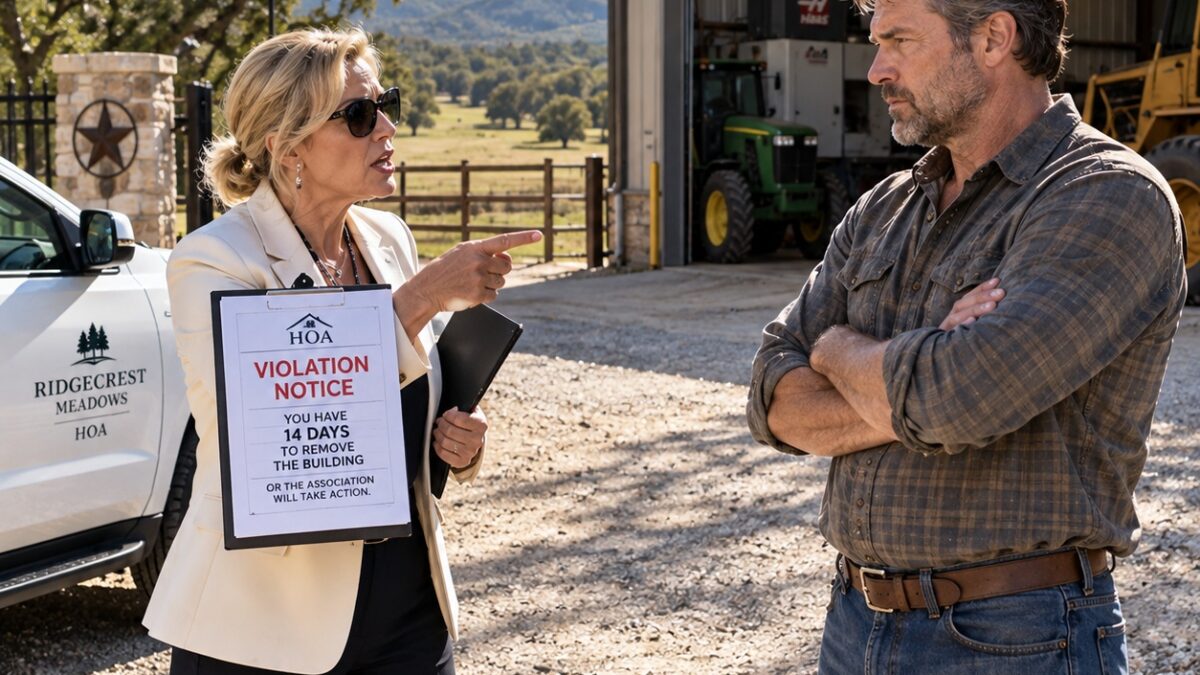
I didn’t.
Not then.
I had never needed them.
My house sat nearly half a mile off the county road.
The gravel drive curved between live oaks, crossed an old cattle guard, then split near the house.
One branch led to the equipment shed.
The other continued toward the back pasture.
For most of my life, security meant a gate, neighbors who recognized unfamiliar trucks, and a blue heeler named Boone who considered squirrels a personal insult.
I had locks.
Motion lights.
A shotgun behind the bedroom door.
But cameras?
No.
That afternoon I bought six.
Not trail cameras.
Not cheap battery units.
Real cellular cameras with cloud backup, timestamps, audio, and enough resolution to read a license plate.
Gerald was very specific.
“Put one at the county road.”
“Done.”
“One at the gate.”
“Done.”
“One on the shed.”
“Two.”
“House?”
“One.”
“And hide one.”
“Why?”
“Because if somebody sees five cameras and disables five cameras, I want the sixth showing them doing it.”
That was Gerald.
He had spent thirty years representing ranchers, developers, widows, oil-service companies, families fighting over inherited land, and occasionally idiots who thought property law was just a louder version of whatever they wanted.
He trusted documents.
He trusted photographs.
He trusted timestamps.
He did not trust people to remember accurately once money entered the room.
The next morning, I walked the boundary nearest Ridgecrest Meadows.
The subdivision had been built on what used to be the Mercer ranch.
When I was a kid, there was nothing there but cedar, limestone, cattle, and a pond where my cousin Travis once sank a four-wheeler up to the handlebars.
The Mercers sold to a developer in 2006.
By 2010, Ridgecrest Meadows had stone entrance columns, forty-two homes, ornamental street lamps, and covenants thicker than my Haas manual.
Over the next decade, it expanded.
New phases.
New streets.
Larger houses.
Pools.
Detached garages.
A community pavilion.
The nearest subdivision lot now sat just beyond my eastern fence.
My land had never been annexed.
Never been deed-restricted by Ridgecrest.
Never been voluntarily added to the association.
Gerald had confirmed all of it.
So the legal question seemed simple.
Why was Renata acting like it wasn’t?
I walked the fence line carrying copies of my survey.
Near the southeast corner, I stopped.
A bright orange ribbon hung from one cedar post.
I hadn’t put it there.
Another ribbon appeared fifty feet north.
Then another.
They formed a rough line angling toward my shed.
I took photographs.
Called Gerald.
“Survey markers?”
“No stakes. Just orange flagging.”
“Any writing?”
“No.”
“Leave them.”
“Why?”
“Because whoever comes back to use them might explain what they’re for.”
I hated that answer.
“Gerald.”
“Yes?”
“How worried should I be?”
“Enough to document.”
“That’s not an answer.”
“It’s the only honest one.”
Two days passed.
Nothing.
Then at 6:41 on Thursday morning, the gate camera sent an alert.
White SUV.
Renata.
Behind her was a gray pickup carrying three men.
I was drinking coffee in the kitchen.
I opened the live feed.
Renata stopped outside the cattle guard.
She got out.
The gray pickup driver stepped down.
Heavyset man.
Work boots.
Orange vest.
He pointed toward my NO TRESPASSING sign.
Renata said something I couldn’t hear.
Then she opened my gate.
The camera microphone caught the contractor.
“Ma’am, you sure about this?”
“Yes.”
“Owner know?”
“He’s been notified.”
I set down my coffee.
My first instinct was to walk outside.
My second instinct—the better one—was to call Gerald.
He answered on the second ring.
“They’re here.”
“Who?”
“Renata and a contractor.”
“What are they doing?”
“Coming through my gate.”
“Call the sheriff.”
“I can handle three men.”
“That is not the point.”
I knew he was right.
I called the county sheriff’s non-emergency number.
“My name is Daniel Garrett. I have people entering posted private property after being told in writing they have no authority here.”
“Are they threatening you?”
“No.”
“Do you know them?”
“One is the president of a neighboring HOA.”
There was a pause.
I could almost hear the dispatcher thinking.
“An HOA?”
“Yes.”
“Are you a member?”
“No.”
Longer pause.
“A deputy is on the way.”
I stayed inside until I saw the patrol SUV on the gate camera.
By then Renata and the contractor had driven as far as the equipment shed.
They were standing beside it.
One man held a tape measure.
Another photographed the corners.
The third was looking at my electrical service.
Deputy Luis Herrera met me near the house.
He was maybe thirty-five.
Calm.
Polite.
The kind of deputy who seemed to listen before deciding who annoyed him.
“What’s going on?”
I handed him the HOA notice.
Then Gerald’s cease-and-desist letter.
Then my deed summary.
Herrera read the notice twice.
“Physical remediation?”
“That’s what they wrote.”
“And you’re not part of this association.”
“No.”
He looked toward the shed.
“Let’s go ask.”
Renata saw the uniform and smiled.
That surprised me.
She walked toward us as though Herrera had arrived to help her.
“Deputy.”
“Ma’am.”
“I’m Renata Voss, president of Ridgecrest Meadows.”
“I gathered.”
She glanced at me.
“We’re documenting a continuing violation.”
Herrera looked at the contractor.
“What company?”
The heavyset man answered.
“Ramsey Site Services.”
“What are you doing?”
“Assessment.”
“For what?”
He looked at Renata.
She answered.
“Removal.”
My jaw tightened.
Herrera’s eyebrows rose.
“Removal of what?”
“The unauthorized structure.”
Herrera looked at me.
Then back at her.
“Who owns the land?”
“Mr. Garrett.”
“Then how is his structure unauthorized by your association?”
Renata lifted the tablet.
“Ridgecrest’s architectural standards extend to adjacent parcels whose structures materially affect community appearance and values.”
Herrera actually stared at her.
“Extend how?”
“Our declaration gives the board authority to protect the community.”
“Does Mr. Garrett pay HOA dues?”
“No.”
“Did he sign covenants?”
“His property predates Ridgecrest.”
“That didn’t answer me.”
Her voice cooled.
“No.”
Herrera nodded.
“So right now I have a landowner telling me he doesn’t want you here.”
“We sent legal notices.”
“He sent one back.”
She glanced toward me.
“His attorney’s interpretation is disputed.”
Herrera looked at the contractors.
“Everybody needs to leave.”
Renata stiffened.
“Deputy, this is a civil enforcement matter.”
“Then enforce it in civil court.”
“We have authority—”
“Ma’am.”
His voice stayed calm.
“You are standing on posted property after the owner told you to leave.”
She stared at him.
“This is unbelievable.”
“Maybe.”
He nodded toward the vehicles.
“But you’re leaving.”
The contractors didn’t argue.
That told me something.
Ramsey Site Services had no interest in becoming part of a property-rights experiment.
They packed the tape measure.
Climbed into the truck.
Renata stood beside her SUV.
“This will be documented.”
Herrera looked at her.
“I hope so.”
I almost laughed.
She heard it.
Her eyes snapped toward me.
“This isn’t over, Mr. Garrett.”
“No.”
I looked at the contractors leaving my drive.
“I’m starting to understand that.”
Herrera stayed after they left.
“Do you want a trespass warning issued?”
“Yes.”
He nodded.
“I’ll document today’s incident.”
“Can she come back?”
“She can come to your door like anyone else unless formally warned. If you want, I can tell her she’s not permitted back without your consent.”
“I want that.”
He made a note.
Then he looked at the shed.
“What’s in there?”
“Machines.”
“How much?”
“Three hundred twelve thousand replacement value.”
His expression changed.
“You might want to tell your insurance company.”
I hadn’t thought of that.
I called them before lunch.
My agent, Paula Merritt, went quiet when I explained the notice.
“They threatened to demolish the structure?”
“They call it remediation.”
“Same question with nicer vocabulary.”
“Apparently.”
“What kind of contractor?”
“Site services. Excavation, demolition, grading.”
“You need an alarm.”
“I have cameras.”
“Alarm too.”
“Paula.”
“Yes?”
“If somebody actually damaged the building, insurance covers it?”
“Probably, but Daniel, I really don’t want to find out the interesting way.”
Neither did I.
I added a monitored alarm.
Installed steel bollards near the overhead doors.
Moved the Mazak’s control backups and CNC program archives to my house.
Then I did something my father would have laughed at.
I photographed every machine.
Every serial number.
Every tooling cabinet.
Every measuring instrument.
Every drawer of carbide inserts.
Every collet.
Every welding unit.
Every compressor.
Thirty years of equipment had always felt permanent.
Now I was making an inventory as if preparing for a fire.
That bothered me more than Renata’s letters.
Two days later, Gerald called.
“Come to my office.”
“What happened?”
“I found something.”
His office sat above a title company in an old limestone building.
When I arrived, he had three maps spread across the conference table.
“What am I looking at?”
“Ridgecrest plats.”
“I’ve seen those.”
“Not this version.”
He pointed to a preliminary development map from 2005.
Phase One.
Phase Two.
Phase Three.
Then a faint dashed outline beyond the recorded subdivision.
Right over part of my eastern acreage.
My stomach tightened.
“What is that?”
“Future development study area.”
I stared.
“That’s my land.”
“Yes.”
“Why is it on their map?”
“It was a developer concept.”
“Did Dad agree to sell?”
“Not that I’ve found.”
Gerald pulled another document forward.
“This is from county planning records.”
A letter from the original Ridgecrest developer.
It discussed “anticipated future acquisition opportunities east of the Mercer tract.”
My property.
I read the date.
“My father would’ve been sixty-eight.”
“Yes.”
“He never sold.”
“No.”
“Then why does this matter now?”
Gerald slid over a newer document.
A current Ridgecrest strategic plan.
Created two years earlier.
Prepared under Renata’s presidency.
One section was titled:
Eastern Buffer Enhancement and Long-Term Community Integration.
I laughed once.
“Sphere of influence.”
“Exactly.”
There it was again.
The phrase Renata had used in my driveway.
I kept reading.
The plan identified nearby non-HOA parcels whose visual condition “directly affects Ridgecrest Meadows property values and expansion potential.”
My equipment shed was pictured.
Photographed from the subdivision side.
Under it:
Large industrial accessory structure visible from future eastern amenity corridor.
I looked at Gerald.
“Future amenity corridor?”
“There’s more.”
He turned the page.
A conceptual walking trail ran along my fence.
Then curved.
Across my land.
Toward a limestone rise overlooking the valley.
A proposed pavilion sat on top.
I stared at it.
“That’s Garrett Hill.”
“I assumed.”
“They drew a pavilion on my hill.”
“Yes.”
“A trail across my land.”
“Yes.”
“They don’t own it.”
“No.”
“Do they have an easement?”
“No.”
“Did anyone ask me?”
Gerald looked at me.
“You tell me.”
“No.”
I walked to the window.
Traffic moved below.
For weeks I had assumed Renata’s obsession was aesthetic.
She hated the shed.
It was visible from the subdivision.
Maybe she wanted nicer views.
Maybe she believed HOAs had some vague power over neighboring parcels.
But now I saw something else.
The shed stood near the route shown on their expansion concept.
If Ridgecrest ever acquired my eastern acreage, the shed would sit where they wanted a landscaped connection.
“How serious is this strategic plan?”
“Legally?”
“Yes.”
“By itself, almost meaningless.”
“And practically?”
“It shows intent.”
I turned.
“Intent to what?”
Gerald tapped the map.
“Treat your land as a future problem to solve.”
That night I walked to Garrett Hill.
The highest point on my property wasn’t dramatic by Hill Country standards.
About two hundred feet above the lower pasture.
Limestone shelf.
Live oaks.
Long western view.
My grandfather had eaten lunch there while building fence.
Dad took me there the evening before I left for trade school.
My daughter Avery learned to shoot a .22 on the lower slope.
Ridgecrest’s concept drawing placed a pavilion almost exactly where Dad’s ashes had been scattered.
I stood there until sunset.
Then I understood why the shed mattered.
It wasn’t only ugly to them.
It established use.
My use.
Industrial.
Agricultural.
Personal.
Permanent.
A forty-by-sixty steel building containing heavy machinery made the eastern edge of my property look exactly like what it was.
Not an unused buffer.
Not a future amenity.
Not scenery.
Mine.
The next morning, I called Gerald.
“What happens if the shed disappears?”
“What do you mean?”
“From a development standpoint.”
He was quiet.
“Your land doesn’t become theirs.”
“I know.”
“But?”
“But removing the structure could make future acquisition or development arguments easier.”
“Especially if I’m pressured to sell.”
“Daniel.”
“Yes?”
“Has anyone offered to buy your property?”
I thought.
Then remembered something.
Eight months earlier, I had received a letter from a company called Silver Creek Land Partners.
Generic.
Polite.
Cash offer.
I had thrown it away.
“I got one of those land letters.”
“When?”
“Last year.”
“Find it.”
“I probably threw it out.”
“Check.”
I checked.
My wife, before she died, used to accuse me of keeping everything.
She was wrong.
I kept almost everything.
The Silver Creek letter was in a drawer beneath old utility bills.
Offer price:
$3.6 million.
For all 212 acres.
I had laughed when I first received it.
Not because the number was small.
Because the land wasn’t for sale.
I sent Gerald a photo.
He called ten minutes later.
“Silver Creek Land Partners was formed three years ago.”
“So?”
“Registered agent is the same law office that represents Ridgecrest Meadows.”
I sat down.
“You’re kidding.”
“No.”
“Does Ridgecrest own Silver Creek?”
“I don’t know.”
“Renata?”
“I don’t know.”
“Can we find out?”
“Probably.”
Two days later, we did.
Silver Creek’s managing member was a developer named Marcus Voss.
Renata’s husband.
I read Gerald’s email twice.
Then a third time.
The $3.6 million offer hadn’t come from a random land investor.
It came from the HOA president’s husband.
Eight months before Renata appeared on my driveway telling me my shed violated standards.
I called Gerald.
“She’s trying to pressure me into selling.”
“Maybe.”
“Maybe?”
“We have facts. Don’t outrun them.”
“What facts?”
“Her husband’s company offered to buy your property.”
“Yes.”
“Later, the HOA strategic plan identified your land for future integration.”
“Yes.”
“Now she is trying to enforce nonexistent covenants against your shed.”
“Yes.”
“That looks bad.”
“It looks obvious.”
“It looks obvious to you because it’s your land.”
I hated lawyers.
“What do you want me to do?”
“Nothing yet.”
“Nothing?”
“Keep documenting.”
The following week, Ridgecrest’s attorney responded to Gerald’s cease-and-desist.
Her name was Melissa Crane.
The letter was far more careful than Renata’s notices.
Ridgecrest denied claiming “direct covenantal jurisdiction” over my parcel.
Instead, it argued the association possessed rights to pursue nuisances or conditions affecting its members.
Gerald read the sentence aloud.
“Interesting retreat.”
“They fined me.”
“Yes.”
“They threatened to remove the shed.”
“Yes.”
“And now they say they never claimed jurisdiction.”
“That is what we call discovering better counsel.”
The letter requested a “cooperative meeting” to discuss screening, landscaping, and eventual redevelopment compatibility.
I almost threw it away.
Gerald told me to attend.
“Why?”
“Because sometimes people say useful things when they think the conflict is calming down.”
We met at the Ridgecrest clubhouse.
I had driven past it a hundred times.
Never been inside.
High ceiling.
Stone fireplace.
Leather chairs.
A kitchen nicer than mine.
Renata sat at the far end of a long table.
Melissa Crane sat beside her.
Two board members joined them.
One was a retired dentist named Tom Keller.
The other was a school administrator named Elaine Porter.
Gerald and I sat opposite.
Melissa began.
“We want to lower the temperature.”
Gerald smiled.
“That seems reasonable.”
Renata said nothing.
Melissa continued.
“The association acknowledges Mr. Garrett is not a member.”
I looked at Renata.
Her expression didn’t move.
“The board’s concern is the visual and economic impact of certain uses adjacent to Ridgecrest.”
“My shed.”
“Among other things.”
“What other things?”
“Outdoor storage.”
“I don’t have outdoor storage.”
“Equipment movement.”
“I drive tractors.”
“Noise.”
“My machines are inside.”
“Industrial character.”
I leaned back.
“I was here first.”
Renata finally spoke.
“That is not the point.”
Gerald looked at her.
“What is the point?”
“The area has changed.”
“My land hasn’t.”
“It should.”
There it was.
Melissa turned toward her.
“Renata.”
But she kept going.
“Ridgecrest is now one of the highest-value communities in the county. We cannot preserve property values if neighboring parcels operate as though this is still 1975.”
I stared at her.
“My father added seventy-two acres in 1978.”
“That isn’t what I mean.”
“No. I know exactly what you mean.”
Gerald touched my arm.
I stopped.
Melissa spoke carefully.
“Would you consider screening the shed?”
“It already has trees on two sides.”
“Additional landscaping.”
“I don’t need landscaping.”
“Perhaps a façade treatment.”
I laughed.
“You want me to put stone on a machine shed?”
Renata folded her arms.
“Many owners would consider it a reasonable compromise.”
“I’m not one of your owners.”
Silence.
Then Gerald asked,
“Is Ridgecrest interested in purchasing any portion of Daniel’s property?”
Melissa looked at Renata.
Just for a second.
Enough.
Gerald saw it too.
Renata answered.
“The association is always open to strategic opportunities.”
Gerald smiled.
“Has the association authorized negotiations?”
“Not formally.”
“What about Silver Creek Land Partners?”
Her face changed.
Tiny.
But there.
“I’m not sure what you’re referring to.”
“Marcus Voss.”
The room went quiet.
Tom Keller turned toward Renata.
“Marcus?”
She looked at him.
“This is unrelated.”
Gerald reached into his folder.
“Silver Creek offered my client $3.6 million for the entire Garrett property eight months ago.”
Elaine Porter frowned.
“I didn’t know that.”
Renata’s voice sharpened.
“It was a private business inquiry.”
“From your husband.”
“Yes.”
“To acquire property identified in an HOA strategic plan.”
“No.”
Gerald slid the map onto the table.
“Then perhaps you can explain why your association planning document identifies Daniel’s land as a future community integration area.”
Tom picked it up.
He looked genuinely confused.
“When was this approved?”
Renata said,
“It was a planning concept.”
“I’m on the board.”
“It was prepared by the land-use committee.”
“I’m on that too.”
Her face tightened.
Melissa intervened.
“I think we’re drifting.”
“No,” Gerald said. “I think we just found the road.”
The meeting ended twenty minutes later.
Nothing was resolved.
But I left knowing something important.
Not every board member knew what Renata was doing.
That changed everything.
Two days later, Tom Keller called me.
Not Gerald.
Me.
“Daniel?”
“Yes.”
“This is Tom Keller.”
“I remember.”
“I need to ask you something.”
“Go ahead.”
“Did Renata tell you the board authorized fines?”
“Yes.”
“How much?”
I told him.
“She posted a notice?”
“Yes.”
“On your shed?”
“Yes.”
“After your attorney told us your property wasn’t in Ridgecrest?”
“Yes.”
Silence.
“Tom?”
“I’m looking at our minutes.”
“And?”
“I can’t find a vote.”
“For what?”
“Enforcement against your property.”
My pulse changed.
“Did she need one?”
“Under our bylaws, for legal action against nonmembers? Yes.”
“Physical remediation?”
He breathed out slowly.
“Definitely.”
I looked toward the shed from my kitchen window.
“Tom, did the board hire Ramsey Site Services?”
“I don’t know.”
“They came with Renata.”
“When?”
I told him.
Another silence.
“I need to call you back.”
He didn’t.
Gerald did.
“Do not talk to board members without me.”
“I didn’t call him.”
“I know.”
“He sounded surprised.”
“That’s useful. It’s also dangerous.”
“To who?”
“Everyone if people start freelancing.”
“What do we do?”
“Wait.”
I was getting tired of waiting.
Then, on Monday morning, the hidden camera captured something that made waiting impossible.
A dark pickup stopped outside my eastern fence at 5:52 a.m.
Not at the gate.
Along the county road.
Two men got out.
They carried surveying equipment.
They did not enter through my drive.
They climbed the fence.
The camera recorded one of them holding the wire while the other stepped over.
I was asleep.
They were on my land for thirty-seven minutes before I saw the alert.
By the time I drove down, they were gone.
But they left stakes.
Red caps.
Survey numbers.
A fresh line ran from my eastern boundary toward Garrett Hill.
I called the surveying company listed on the stake.
“Landmark Geomatics.”
A receptionist answered.
“This is Daniel Garrett. Your crew entered my property this morning.”
“Let me check.”
Pause.
“Project number?”
I read the cap.
Another pause.
“Sir, that project is for Silver Creek Land Partners.”
My hand tightened around the phone.
“Who authorized entry?”
“I don’t have that information.”
“Did anyone tell your crew I owned the property?”
“I’ll have the project manager call.”
He did.
His name was Scott Alvarez.
He sounded horrified when I sent him a still image from the camera.
“Our work order represented access permission had been secured.”
“By who?”
“Client.”
“Silver Creek?”
“Yes.”
“You understand they don’t own my land.”
“I do now.”
“Who ordered the survey?”
“I’d need authorization before sharing client documents.”
“Gerald Fitch will send you something.”
He sighed.
“That’s probably best.”
Gerald was no longer telling me to wait.
Within forty-eight hours, he filed for injunctive relief.
Not because surveying itself damaged much.
Because we now had repeated entry after written notice.
HOA notices.
Contractors.
Surveyors.
A strategic plan.
The land purchase connection.
The judge assigned to the emergency hearing was named Anne Barlow.
She was in her sixties.
Small.
Silver-haired.
She listened more than she spoke.
Gerald laid out the timeline.
My deeds.
The Ridgecrest plat.
The cease-and-desist.
The laminated notice.
The sheriff incident.
The survey crew.
Silver Creek’s connection to Marcus Voss.
Melissa Crane represented Ridgecrest.
A separate attorney represented Silver Creek.
Renata sat behind them.
Marcus sat beside her.
It was the first time I had seen him.
Tall.
Expensive suit.
Tan that looked permanent.
He watched the hearing with the faintly bored expression of a man accustomed to deals solving inconvenience.
Judge Barlow looked at Melissa.
“Does Ridgecrest Meadows contend Mr. Garrett’s property is subject to its declaration?”
“No, Your Honor.”
Renata’s jaw tightened.
“Did Ridgecrest issue fines?”
“Certain notices were sent.”
“That was not my question.”
Melissa paused.
“Yes.”
“On what authority?”
“An interpretation of nuisance and external-impact provisions.”
“Do those provisions authorize fines against nonmembers?”
“No, Your Honor.”
The courtroom became very quiet.
Judge Barlow looked at Silver Creek’s attorney.
“Did your client authorize surveyors to enter Garrett property?”
“Our client understood permission existed.”
“From whom?”
“That is disputed.”
I almost turned toward Marcus.
Gerald did not move.
Judge Barlow read something in the file.
“Mr. Garrett has posted no-trespassing signs.”
“Yes.”
“His attorney sent written notice.”
“Yes.”
“A sheriff removed an HOA contractor.”
“Yes.”
“And after that, a survey crew climbed his fence?”
Silver Creek’s attorney said nothing for a moment.
“That appears to be what occurred.”
The temporary injunction was issued that afternoon.
Ridgecrest Meadows, Silver Creek Land Partners, Renata Voss, Marcus Voss, and their agents were prohibited from entering my property without written permission.
They were prohibited from attaching notices to my structures.
Prohibited from interfering with the shed.
Prohibited from representing to third parties that they controlled my property.
Prohibited from beginning physical remediation.
It felt like relief.
For about six hours.
Then my daughter called.
Avery lived in Austin.
Thirty-one.
Civil engineer.
Smarter than me in ways she enjoyed reminding me about.
“Dad.”
“What?”
“Why is someone sending me an offer for the ranch?”
I sat up.
“What offer?”
“Email from Silver Creek.”
My stomach dropped.
“What does it say?”
“Four point two million.”
“Forward it.”
She did.
The email said Silver Creek understood the Garrett family was “considering succession and estate-planning options.”
We were not.
It offered to purchase the entire property, allow me a twelve-month leaseback, and “resolve ongoing land-use uncertainty.”
I called Gerald.
“They contacted Avery.”
His voice changed.
“When?”
“Today.”
“After the injunction?”
“Signed this morning.”
“Send it.”
I did.
Then I called Avery.
“Don’t respond.”
“I wasn’t planning to.”
“You okay?”
“Dad.”
“What?”
“I design highway bridges. I can handle a developer email.”
“I know.”
“You sound scared.”
That made me stop.
I wasn’t scared of selling.
I wasn’t going to sell.
I was scared because the pressure had moved from my driveway to my family.
“I’m angry.”
“Same thing sometimes.”
She was right.
“Come down this weekend?”
“Why?”
“Because I want to show you everything.”
She arrived Friday night.
We sat at the kitchen table until almost midnight.
Deeds.
Maps.
HOA notices.
Strategic plan.
Silver Creek offer.
Injunction.
Survey photographs.
Avery read quietly.
Then looked up.
“They don’t want the whole ranch.”
“What?”
“Not first.”
She rotated the strategic plan.
“They want this side.”
Eastern acreage.
About forty acres.
Garrett Hill.
The shed.
The area bordering Ridgecrest.
“Why offer for all 212?”
“Because dividing your property might make you refuse. So they make the whole number big enough to sound attractive.”
“Four point two million is attractive.”
“But you don’t want to sell.”
“No.”
She traced the conceptual trail.
“What’s Ridgecrest missing?”
“What do you mean?”
“Why is this valuable to them?”
“Views.”
“Not enough.”
“Expansion.”
“Maybe.”
She looked at the county map.
“Road access?”
I leaned over.
Ridgecrest had one primary entrance.
One secondary emergency gate on the north side.
My eastern acreage touched County Road 219 along nearly fourteen hundred feet.
Avery zoomed out.
“If they acquire this strip, they can build another entrance.”
I stared.
Then she pointed toward Garrett Hill.
“And this ridge gives them access to the parcel behind you.”
“Who owns that?”
“Looks like Wexler Family Trust.”
The Wexler land was nearly three hundred acres.
Mostly undeveloped.
Behind my eastern forty.
If a future subdivision expanded through the Wexler tract, access through my property would become extremely valuable.
My equipment shed sat near the most practical road alignment.
Avery looked at me.
“Dad.”
“What?”
“This isn’t about a shed.”
I knew that.
But hearing my daughter say it made the room feel colder.
Gerald hired a land-use consultant.
Her name was Catherine Holt.
She had worked for the county planning department for fourteen years before opening her own firm.
She studied the Ridgecrest plans.
The road network.
The Wexler parcel.
Utility corridors.
Topography.
Then met us at my kitchen table.
“Your daughter is right.”
Avery smiled.
I ignored her.
Catherine pointed at the map.
“Ridgecrest has limited future expansion west and north. Steep terrain. Existing homes. Drainage.”
“And east?”
“Your land.”
“And behind me?”
“The Wexler tract.”
“Is it for sale?”
“Not publicly.”
“But?”
“Silver Creek has an option.”
I stared at her.
“They already control it?”
“Not own. Option to purchase.”
“How much?”
“Confidential.”
Gerald spoke.
“So acquisition of Daniel’s eastern frontage could unlock access for a much larger development.”
Catherine nodded.
“Potentially several hundred lots depending on density and utilities.”
My mouth went dry.
“What would that be worth?”
She looked at me.
“To you?”
“To them.”
“Access value is difficult to isolate.”
“Roughly.”
She hesitated.
“Millions.”
The $4.2 million offer suddenly looked different.
Not generous.
Strategic.
If forty acres of my land unlocked a development worth tens of millions, the equipment shed wasn’t merely ugly.
It was in the way.
That afternoon I walked through the shed slowly.
Haas.
Mazak.
Bridgeport.
Welding table.
Dad’s old Kennedy toolbox.
Thirty years of gauges.
Micrometers.
Fixtures.
Custom jigs.
The building had never looked like leverage before.
It was just a place to work.
Now I understood why Renata had given me fourteen days.
She had expected obedience.
Fine the shed.
Threaten removal.
Create uncertainty.
Make the property feel difficult to keep.
Then Silver Creek arrives with a check.
Problem solved.
Her problem.
Not mine.
The lawsuit expanded.
Gerald amended the complaint.
Trespass.
Declaratory judgment.
Injunctive relief.
Interference with property rights.
Claims relating to false HOA enforcement.
Silver Creek’s role.
He was careful not to claim conspiracy without evidence.
“We don’t use dramatic words because they feel right,” he told me.
“What do we use?”
“Documents.”
Discovery began.
That was when Ridgecrest Meadows started turning on Renata.
The first surprise came from the HOA manager.
Ridgecrest used a management company called Summit Residential Services.
Their regional manager, Nicole Dane, produced emails.
One from Nicole to Renata:
Daniel Garrett parcel does not appear in Ridgecrest lot schedule. Please confirm legal basis before issuing violation.
Renata replied:
Treat as external-impact enforcement. I’ll handle legal support.
Another email three days later:
Please do not post fines until counsel confirms collection authority.
Renata replied:
The board expects decisive action. Proceed.
Summit refused.
So Renata generated the fine notice herself.
Using Ridgecrest letterhead.
The $1,500 amount did not appear in official HOA accounting.
I read that twice.
“She invented the fine?”
Gerald nodded.
“Apparently.”
“Where did $1,500 come from?”
“Six days at $250.”
“But they never posted it in the system.”
“No.”
“So even the HOA wasn’t actually fining me.”
“Not formally.”
“She was.”
“Yes.”
Then Ramsey Site Services produced its work order.
Client:
Ridgecrest Meadows HOA.
Requested by:
Renata Voss.
Scope:
Assess demolition access and estimated removal cost for 40×60 metal structure, concrete slab optional.
Estimated machinery relocation not included.
I stared at the page.
“They were pricing demolition.”
“Yes.”
“She told the deputy they were just assessing.”
“That part was true.”
“Who approved it?”
“No board authorization attached.”
Ramsey’s owner testified that Renata told him legal clearance had been obtained.
It hadn’t.
Then Landmark Geomatics produced the survey order.
Client:
Silver Creek Land Partners.
Requested by Marcus Voss.
Project description:
Preliminary roadway and access feasibility—Garrett East Acquisition.
Access status:
Permission confirmed by client.
I felt sick.
Marcus had sent men over my fence because he simply told the surveyor permission existed.
The next document was worse.
An email between Marcus and Renata.
Subject:
Garrett timing.
Marcus wrote:
If he loses the shed, eastern section becomes easier to price and easier to pitch. Don’t overplay it before we know whether he’ll fold.
I stared at the screen.
My face felt hot.
Renata replied:
He’s old-school. He’ll complain but won’t litigate. Family land guys hate lawyers more than they hate checks.
Gerald didn’t speak.
I read it again.
Old-school.
He’ll complain but won’t litigate.
Family land guys hate lawyers more than they hate checks.
Something about that sentence hurt more than the demolition order.
Because it told me they had studied me.
Not deeply.
Not correctly.
But enough to create a version of me in their plan.
Fifty-three.
Widower.
Daughter lives away.
Former shop owner.
Large inherited property.
Probably tired.
Probably sentimental.
Probably doesn’t want conflict.
Pressure him.
Make the land burdensome.
Offer cash.
I looked at Gerald.
“How did they know about Avery?”
“Public records.”
“Her address?”
“Possible.”
“My wife dying?”
“Obituary.”
I stood up.
“I want to destroy them.”
Gerald’s expression didn’t change.
“No.”
I turned.
“No?”
“You want to win.”
“What’s the difference?”
“Destroying them becomes about your anger.”
He pointed at the email.
“Winning is making these facts impossible to ignore.”
I hated him for being right.
Ridgecrest held an emergency board meeting after the email surfaced.
Tom Keller called Gerald afterward.
Renata had been suspended as president.
Three board members demanded her resignation.
She refused.
Marcus claimed Silver Creek’s activities were separate from Ridgecrest.
That became harder to maintain when another email surfaced.
Renata to Marcus:
Once shed issue is resolved, board can support east-gate study. We need Garrett acreage controlled before Wexler closes.
There it was.
The shed.
The gate.
The Wexler tract.
All in one sentence.
The thing Avery had inferred from a map was sitting in Renata’s email.
She had not threatened my building because she cared about architectural standards.
She wanted the land corridor.
I called Avery.
“You were right.”
“I know.”
“You don’t even know what I found.”
“I’m still probably right.”
I laughed despite myself.
Then I read the email.
She stopped joking.
“Dad.”
“Yeah.”
“That’s bad.”
“For them.”
“For everyone.”
“What do you mean?”
“If Ridgecrest members didn’t approve this, they’ve been dragged into a private development strategy using HOA authority.”
She was right.
Again.
Homeowners who had nothing to do with my dispute could end up paying legal fees.
Insurance premiums.
Maybe damages.
Renata’s ambition didn’t threaten only me.
It threatened her own community.
That mattered.
I never wanted Ridgecrest residents punished.
Most had done nothing.
Some had lived there fifteen years without knowing my name.
The first resident to knock on my door was a woman named Sharon Bell.
Late sixties.
Gray hair.
Walking shoes.
She stood on the porch holding a pie.
I looked at the pie.
Then her.
“Am I being bribed?”
She laughed nervously.
“No.”
“Good.”
“I’m from Ridgecrest.”
“I guessed.”
Her smile faded.
“May I ask you something?”
“Sure.”
“Are you trying to close our east emergency gate?”
“No.”
She looked relieved.
“Are you suing the HOA for ten million dollars?”
“No.”
“Did you threaten to put a junkyard along our fence?”
I stared at her.
“What?”
She looked embarrassed.
“That’s what some people are saying.”
“Who?”
“I don’t know.”
I did.
I invited her inside.
Showed her the original HOA letter.
The plat.
Gerald’s cease-and-desist.
The injunction.
Not the discovery emails.
Gerald would have killed me.
Sharon read silently.
Then looked at me.
“You’re not in the HOA.”
“No.”
“I knew your ranch was old, but I assumed this side was part of some agreement.”
“There isn’t one.”
“Then why did Renata tell us you refused to comply with community standards?”
“I can’t answer for her.”
She sat back.
“My husband thought you were some developer.”
I laughed.
“I machine irrigation parts and rebuild old tractors.”
She smiled.
Then became serious.
“I’m sorry.”
“You didn’t do anything.”
“I voted for her.”
That sentence carried more weight than she intended.
A week later, Ridgecrest members circulated a petition for a special meeting.
Renata fought it.
Said the board suspension was unauthorized.
Said the lawsuit had become personal.
Said outside interests were trying to weaken the association.
Then Gerald deposed her.
I wasn’t in the room.
He told me about it afterward.
“How was she?”
“Controlled.”
“That sounds disappointing.”
“It got less controlled.”
“Did she admit the fines weren’t authorized?”
“She said emergency board authority allowed her to protect community interests.”
“Does it?”
“No.”
“Did she admit the shed removal was connected to Silver Creek?”
“No.”
“What did she say?”
“That the shed issue and land acquisition were parallel but separate.”
I laughed.
“He’ll complain but won’t litigate?”
“She says that referred to negotiating style.”
“Once shed issue is resolved?”
“She says that meant aesthetic conflict.”
“East-gate study?”
“She says future planning.”
“Garrett acreage controlled?”
Gerald smiled.
“That one she didn’t enjoy.”
“What did she say?”
“She meant contractually controlled after voluntary sale.”
“Before I agreed to sell.”
“Yes.”
I leaned back.
“And Marcus?”
“Next week.”
Marcus was less careful.
Developers often live in a world where leverage is normal.
Options.
Contingencies.
Pressure.
Timing.
Assemblage.
He did not seem to understand why ordinary people heard those words differently when describing their home.
He admitted Silver Creek wanted my eastern acreage.
Admitted the Wexler option existed.
Admitted access through my property would increase the project’s feasibility.
Admitted he and Renata discussed the shed.
Then Gerald asked:
“Did you believe enforcement pressure from Ridgecrest Meadows might make Mr. Garrett more willing to sell?”
Marcus answered:
“I believed unresolved land-use conflict could affect his willingness to retain the property.”
Gerald repeated it slowly.
“So yes.”
Marcus said,
“That’s not how I would characterize it.”
“But you expected the conflict to affect his willingness.”
“Possibly.”
“Did you discuss that possibility with your wife?”
“Yes.”
That answer ended the ambiguity.
The special Ridgecrest membership meeting happened on a Thursday night.
I did not attend.
I was not a member.
Sharon called afterward.
“She’s out.”
“Renata?”
“Yes.”
“As president?”
“Board too.”
“What happened?”
“Recall vote.”
“How close?”
“Not close.”
She sounded exhausted.
“What about the other board members?”
“Tom stayed. Elaine stayed. Two others resigned.”
“And the lawsuit?”
“That’s why I’m calling.”
The new board wanted settlement.
Gerald cautioned me.
“Do not confuse leadership change with resolution.”
“I don’t.”
“What do you want?”
“My land left alone.”
“That’s not a legal demand.”
“It should be.”
He smiled.
“What else?”
“Reimbursement.”
“For?”
“Attorney fees. Survey costs. Security cameras. Alarm. Lost work.”
“Emotional distress?”
“No.”
He looked surprised.
“Why not?”
“Because I’m not interested in inventing pain for money.”
“That isn’t what emotional distress means.”
“You know what I mean.”
He nodded.
“What about damages for trespass?”
“Yes.”
“Punitive?”
“If appropriate.”
“And Silver Creek?”
“I want them away from my property.”
“Anything else?”
I thought about the shed.
The strategic plan.
The false fines.
Then Dad’s ashes on Garrett Hill.
“I want Ridgecrest to record something.”
“What?”
“A formal declaration that my property is not subject to their covenants.”
“That can be done.”
“And no sphere-of-influence language.”
He laughed.
“I’ll see what I can do.”
Settlement negotiations took six weeks.
Ridgecrest’s insurer became involved.
Silver Creek had separate counsel.
Renata and Marcus had their own lawyers.
Four groups that had once acted as though my land was a shared opportunity now spent money explaining why someone else was responsible.
The HOA’s first offer was insulting.
Twenty-five thousand dollars.
No admission.
Mutual release.
I rejected it.
Second:
$60,000.
They would remove my property from all planning maps.
Silver Creek would withdraw the purchase offer.
I rejected it.
Not because I wanted more money.
Because the language still treated everything as a misunderstanding.
There had been no misunderstanding.
Gerald understood.
He drafted terms.
Ridgecrest Meadows would record a memorandum in county records confirming the Garrett property was not subject to Ridgecrest declarations, architectural restrictions, assessment authority, enforcement authority, or common-area rules.
The association would remove all references to my property from community expansion plans.
No Ridgecrest officer, employee, contractor, or agent could enter without written permission except genuine emergency response.
No notices could be posted.
No landscaping or screening standards could be imposed.
No fines.
No remediation.
No future “external-impact” enforcement.
Silver Creek would terminate all pending acquisition activity relating to my property for five years.
That part came from Gerald.
“Why five?”
“Because courts don’t like telling someone they can never make you an offer.”
“Can they offer after five?”
“Yes.”
“I can say no.”
“Yes.”
“Fine.”
The financial settlement eventually reached $186,000 combined.
Again, numbers sound bigger than they feel after lawyers.
Gerald’s fees.
Surveying.
Security.
Consultants.
Lost machine work.
Insurance changes.
Time.
The money did not transform my life.
It did something better.
It ended the intrusion.
Then something unexpected happened.
The new Ridgecrest board asked me to attend a meeting.
I almost said no.
Gerald told me to go.
“Why?”
“Closure.”
“I don’t need closure.”
“Then go because I’m billing hourly.”
I went.
Tom Keller now served as interim president.
Sharon Bell sat on the board.
So did Elaine Porter.
There were two new members I hadn’t met.
No Renata.
No lawyers.
Tom opened a folder.
“Daniel, we owe you an apology.”
I hated formal apologies.
Usually they existed because insurance companies approved the wording.
But Tom sounded different.
“We allowed one person to exercise authority without asking enough questions.”
I said nothing.
Elaine continued.
“Some of us knew about the long-term planning study. We did not know Silver Creek was connected to Marcus.”
“Okay.”
“We did not authorize fines.”
“I know.”
“We did not authorize demolition.”
“I know.”
Sharon looked at me.
“But the association letterhead was used.”
“Yes.”
“Our contractors came onto your land.”
“Yes.”
“Residents repeated things about you that weren’t true.”
I nodded.
Tom folded his hands.
“I’m sorry.”
That was enough.
Not because apologies erase anything.
Because accountability that does not include excuses is rare.
“Thank you.”
Tom looked toward the window.
“We also want to ask about the fence.”
“What fence?”
“Eastern boundary.”
“What about it?”
“Some of our landscaping crews have historically trimmed brush on your side.”
“I know.”
He looked nervous.
I smiled.
“About three feet.”
“Yeah.”
“That’s fine.”
He blinked.
“Really?”
“Yes.”
“As long as they ask.”
Sharon laughed.
“That easy?”
“That’s been the whole point.”
Ask.
That one word could have prevented everything.
Ask before entering.
Ask before surveying.
Ask before attaching notices.
Ask before planning a trail.
Ask before assuming.
Ask before offering my daughter millions for land she didn’t own.
Permission isn’t complicated until somebody decides they shouldn’t need it.
The physical-remediation notice remained pinned above my workbench for months.
I kept it there beside Dad’s old machinist scale.
Further non-compliance may result in physical remediation at the association’s direction.
Every time I read it, I thought about how close Renata came to making a mistake she could never undo.
What if I hadn’t called Gerald?
What if I had assumed HOA letterhead meant authority?
What if I had been away when Ramsey Site Services arrived?
Could they actually have demolished the building?
Probably not without further steps.
Maybe the contractor would have refused.
Maybe the sheriff would have stopped them.
Maybe insurance would have fought.
But “maybe” is not something I like near a $312,000 machine inventory.
I built a steel plaque for the shed instead.
Nothing dramatic.
Just brushed stainless.
Garrett Machine Building
Established 2012
Private Property
Avery visited when I mounted it.
“That’s subtle.”
“I’m a subtle man.”
“You installed three-quarter-inch stainless letters.”
“They’re tasteful.”
“They can be seen from space.”
“Good.”
She laughed.
Then walked inside.
She ran her hand over Grandpa’s Bridgeport.
“You keeping all this forever?”
“No.”
“Really?”
“One day it’s yours.”
Her face changed.
“I’m a civil engineer.”
“Machines don’t care.”
“I live in Austin.”
“Machines also don’t care.”
She smiled.
Then looked around.
“Would you ever sell the land?”
That question had changed over the past year.
Before, I would have answered instantly.
Never.
Now I thought longer.
“Maybe.”
She looked surprised.
“To who?”
“Depends.”
“What happened to four generations?”
“Four generations doesn’t mean the fifth has to be trapped.”
Her eyes softened.
“I don’t feel trapped.”
“I know.”
I leaned against the workbench.
“Grandpa Elias bought land because he wanted choices. Dad added land because he wanted choices. Keeping it just because I’m afraid of change would turn their choices into a prison.”
“So you might sell?”
“Someday.”
“Not to Ridgecrest.”
I smiled.
“Not today.”
She laughed.
The Wexler project eventually went nowhere.
Without access through my property, Silver Creek’s numbers changed.
The option expired.
Another developer bought a smaller section years later, but the density was lower.
Ridgecrest built no east gate.
No pavilion appeared on Garrett Hill.
No amenity trail crossed my pasture.
The orange ribbons disappeared.
The fake fines disappeared.
Renata disappeared from HOA politics.
For almost a year, I didn’t see her.
Then one Saturday morning, she walked into my shed.
Not all the way.
She stopped outside the open overhead door.
I was sharpening a mower blade.
Boone, older and slower now, lifted his head from the floor.
I saw her and switched off the grinder.
“Renata.”
“Daniel.”
She looked different without a tablet.
Jeans.
Boots.
Gray sweater.
No SUV blocking my drive.
She had parked by the house after calling Avery, of all people, to ask whether I might be willing to speak.
Avery had not warned me.
I made a mental note to disinherit her for at least twenty minutes.
“What can I do for you?”
Renata looked at the machines.
“So this is what was inside.”
“Yes.”
She stepped closer.
“That one?”
“Haas.”
“What does it do?”
“Cuts metal.”
“They all cut metal.”
“Different ways.”
She nodded.
The silence stretched.
Then she said,
“I came to apologize.”
I waited.
“I know the settlement already contains language.”
“This isn’t a courtroom.”
“No.”
She looked toward the floor.
“I shouldn’t have come here that first day.”
“You mean physically?”
“I mean with the notice.”
“Okay.”
“I knew your land wasn’t in Ridgecrest.”
That mattered.
I had suspected it.
The emails suggested it.
But hearing her say it was different.
“You knew.”
“Yes.”
“Then why say sphere of influence?”
Her mouth tightened.
“Because the strategic plan used that phrase.”
“The strategic plan had no authority.”
“I know that now.”
“You knew it then.”
She looked at me.
“I knew it wasn’t the same as covenants.”
“That’s a careful answer.”
“I’m trying to give you an honest one.”
I put the mower blade on the bench.
“Go ahead.”
She took a breath.
“I thought Ridgecrest had leverage.”
“Over me.”
“Yes.”
“Because of the shed.”
“Partly.”
“And Marcus wanted the land.”
“Yes.”
I didn’t need to ask if they had coordinated.
The discovery record had answered that.
Still, I wanted to hear how she told herself the story.
“Did you think what you were doing was wrong?”
She looked at the Haas.
“No.”
That surprised me.
“Not at first.”
“Explain.”
“I thought you were sitting on land that would eventually be developed anyway.”
“My land.”
“Yes.”
“You say that differently now.”
“I know.”
She folded her arms, then seemed to realize the defensive posture and dropped them again.
“Marcus believed the Wexler project could add hundreds of homes.”
“I know.”
“Ridgecrest needed another entrance eventually.”
“Maybe.”
“The eastern corridor made sense.”
“To you.”
“To planners.”
“Planners who didn’t own it.”
She nodded.
“Yes.”
“So where did the shed come in?”
She hesitated.
“It complicated everything.”
“How?”
“Road alignment. Appearance. Negotiation.”
“Negotiation?”
“If you had a working facility there, that acreage was psychologically more valuable to you.”
I stared at her.
That sentence was almost clinical.
“Psychologically.”
She winced.
“That’s how Marcus described it.”
“So remove the shed and I become easier to buy.”
“I didn’t think Ramsey would demolish it without another step.”
“You ordered a demolition assessment.”
“Yes.”
“You threatened physical remediation.”
“Yes.”
“You entered after my attorney told you no.”
“Yes.”
“And you still didn’t think it was wrong?”
Her eyes filled slightly.
“By then, I thought if I stopped, everything we had already done would become indefensible.”
There it was.
Not ignorance.
Momentum.
The same thing that traps people in bad decisions everywhere.
Once you’ve gone too far, stopping forces you to admit the earlier steps were wrong.
So instead you take another one.
Then another.
Until eventually a sheriff is standing on a gravel drive asking why an HOA contractor is measuring someone else’s building.
“I was angry at you,” she said.
“Why?”
“Because you didn’t react the way I expected.”
“How did you expect me to react?”
“Negotiate.”
“I called a lawyer.”
“Exactly.”
I almost laughed.
“You thought I hated lawyers.”
Her face changed.
“You saw that email.”
“Yes.”
“I’m sorry.”
“Why did you think that?”
“Your father.”
“What about him?”
“Marcus had heard stories.”
“What stories?”
“That Garrett men settled things with handshakes. That your father hated courts.”
That was true.
Dad once drove eighty miles to avoid paying an attorney $300 to draft a cattle lease.
Renata continued.
“We thought formal pressure would make you want an informal resolution.”
“Meaning sell.”
“Yes.”
I shook my head.
“You studied the wrong lesson.”
“What do you mean?”
“My father hated lawyers because he believed a man should know his own boundaries.”
I looked toward the open door.
“He would’ve hired ten lawyers before giving away land because someone scared him with letterhead.”
She smiled sadly.
“I know that now.”
The machine shed was quiet.
Then Boone stood and walked toward her.
Renata froze.
“He friendly?”
“Usually.”
Boone sniffed her hand.
Then returned to his bed.
“Apparently he’s forgiven you.”
She almost laughed.
“Have you?”
I thought about it.
“No.”
Her face fell slightly.
“But I don’t wake up angry anymore.”
She nodded.
“That’s probably more than I deserve.”
“I’m not deciding what you deserve.”
She looked at me.
“I lost a lot.”
“I know.”
“Friends. Reputation. Marcus and I almost divorced.”
I said nothing.
“He blamed me for the emails.”
“You wrote them.”
“Yes.”
“But he was involved too.”
“Yes.”
“Then why blame you?”
She gave me a tired smile.
“You really need that explained?”
No.
I didn’t.
“Silver Creek is gone,” she said.
“I heard.”
“Marcus dissolved it.”
“Okay.”
“He’s doing commercial work in San Antonio now.”
“Good.”
She looked toward Garrett Hill.
“I drove past the eastern fence before coming in.”
“Why?”
“I wanted to see what we were fighting over.”
“You saw it before.”
“On maps.”
That sentence interested me.
“And now?”
“Now I saw a pasture.”
I waited.
“And your hill.”
“Yes.”
“And the shed.”
“Yes.”
“It all looked smaller than our plans.”
I understood exactly what she meant.
Plans do that.
They turn lived places into shapes.
A house becomes a footprint.
A hill becomes elevation.
A fence becomes a line.
A family becomes an acquisition obstacle.
Paper is necessary.
I had built my whole life around precise drawings.
But drawings can also erase what exists if the person reading them forgets every line represents something real.
Renata looked at me.
“I am sorry.”
This time there was no explanation after it.
No “but.”
No mention of property values.
No community standards.
No strategic opportunity.
Just the sentence.
I nodded.
“Thank you.”
She left.
I didn’t invite her back.
I didn’t need to.
Some endings are not reconciliation.
They are simply the moment two people stop carrying the same fight.
A few months later, I took down the original HOA notice.
Not because I wanted to forget.
Because I no longer needed it to remind me.
I put it in the fireproof lockbox.
With the deeds.
The building permit.
The settlement memorandum.
The recorded declaration that Ridgecrest Meadows had no authority over Garrett land.
Avery made fun of me.
“You’re keeping the fake fine forever?”
“Documents matter.”
“That woman traumatized you into filing.”
“Best thing she ever did.”
Avery laughed.
I reorganized everything.
My grandfather’s 1951 deed.
Dad’s 1978 purchase.
My current survey.
County permits.
Property tax records.
Utility easements.
Fence agreements.
The Ridgecrest settlement.
Digital scans went into two cloud backups and an external drive.
Avery got copies.
“You planning to die?”
“Eventually.”
“Good to know.”
“I don’t want you digging through drawers while an HOA president stands in the driveway.”
She looked at me.
“That actually makes sense.”
“Write that down.”
“No.”
Two years passed.
Then three.
Ridgecrest Meadows is still there.
Homes still line the hill.
Property values did not collapse because my shed remained standing.
No civilization ended.
Children ride bicycles along their streets.
Sharon walks past my eastern fence most mornings.
Sometimes she waves.
Tom Keller retired from the board.
Elaine stayed another term.
The HOA changed its bylaws.
Any enforcement against property not listed in the recorded declaration now requires independent legal review before contact.
Contractors cannot be sent onto non-HOA land without written permission.
Land-use planning documents must identify whether proposed areas are owned, optioned, easement-controlled, or merely conceptual.
That last change made me smile.
No more coloring someone else’s land green and calling it future community space without a big note saying:
NOT OWNED BY ASSOCIATION.
The shed still stands.
The Haas still runs.
The Mazak still throws chips.
Dad’s Bridgeport is older than some Ridgecrest homeowners and still holds tolerance better than machines that cost twenty times more.
I don’t use the shop every day.
I don’t need to.
Sometimes I machine irrigation fittings for local ranchers.
Sometimes I repair parts nobody manufactures anymore.
Sometimes Avery sends me a drawing from one of her projects and asks whether something can actually be fabricated the way an engineer imagined it.
I enjoy those calls.
“Dad, I need you to look at something.”
“That’s what people say before showing me an impossible dimension.”
“It is not impossible.”
“It’s probably impossible.”
Then she sends the print.
Sometimes she’s right.
Sometimes I am.
That is the relationship.
Garrett Hill remains unchanged.
There is no pavilion.
No community trail.
No east entrance.
Dad’s ashes are still in the soil beneath the live oaks.
I go up there occasionally near sunset.
From that ridge, I can see Ridgecrest rooftops.
My equipment shed.
The house.
County Road 219.
The line between my property and the subdivision is invisible from up there.
That’s the strange thing about boundaries.
Most of them are invisible until somebody decides they don’t matter.
Then suddenly they become the most important thing in the world.
My grandfather understood that.
He bought his first 140 acres after Korea.
He had almost no money.
Bad shoulder.
Old truck.
Small house.
But he paid for a survey.
My father once asked him why.
Elias supposedly answered,
“Because the only thing worse than owning little is not knowing which little is yours.”
I used to think that was just Grandpa being Grandpa.
Now I understand.
Renata never needed to be physically stronger than me.
The HOA didn’t need to own my land.
Silver Creek didn’t need a deed.
At first, all they needed was uncertainty.
If they could make me question whether the shed was legal—
whether their standards applied—
whether fines might accumulate—
whether contractors could arrive—
whether holding the property would become expensive—
then ownership started feeling less absolute.
That was the pressure.
Not bulldozers.
Not lawyers.
Doubt.
And that was why Gerald’s first question mattered so much.
“Do you have cameras?”
Not because cameras create rights.
Because rights mean more when you can prove who ignored them.
The first camera recorded Renata opening my gate.
The second recorded the contractor measuring my shed.
The hidden one recorded surveyors climbing my fence.
The documents showed the rest.
The subdivision plat showed where Ridgecrest ended.
The Garrett deeds showed where my land began.
The HOA’s own emails showed that its manager warned Renata.
The work order showed she was pricing demolition.
The Silver Creek records showed her husband wanted the property.
The strategic plan showed why.
The Wexler option showed how much larger the project could become.
And one email said almost everything in a single sentence.
If he loses the shed, eastern section becomes easier to price and easier to pitch.
That sentence changed the way I looked at the entire story.
My equipment shed was never the real violation.
It was evidence that their plan did not control the land.
The machines inside were never the problem.
They were proof I was using the property exactly the way I wanted.
Renata wanted a clean map.
Straight access.
Land that could be priced, bought, and folded into something larger.
I was the inconvenient fact sitting in the middle.
A man.
A building.
A family history.
A deed.
A “no.”
For a while, she thought those were negotiable because enough pressure could make them expensive.
She was wrong.
But I learned something too.
Owning property doesn’t mean you can ignore paperwork because history feels obvious.
I knew that land belonged to the Garrett family.
Everybody around us knew.
That didn’t mean I should have kept the deeds buried in a lockbox and assumed no one would ever challenge them.
Now I know every line.
Every easement.
Every road frontage measurement.
Every county permit.
Every survey monument.
Avery does too.
Not because we’re preparing for another war.
Because knowledge is quieter than fear.
A few years after the settlement, Ridgecrest hired a new landscaping contractor.
The crew foreman called me before trimming near the eastern fence.
“Mr. Garrett?”
“Yes.”
“This is Luis with GreenLine. Ridgecrest gave me your number.”
“That’s already a good start.”
He laughed.
“We have vegetation leaning through the fence in two places. Okay if we trim flush to the wire?”
“Yes.”
“Need you out here?”
“No.”
“Anything we should avoid?”
“Don’t drive through the gate without calling.”
“Got it.”
That was it.
Forty seconds.
No lawyers.
No sheriff.
No certified letters.
No strategic plans.
No $186,000 settlement.
Ask.
Permission.
Respect.
Sometimes I think about how absurd the whole fight was.
Renata could have driven onto my property that first day and said:
“Daniel, I’m Renata from Ridgecrest. Some residents are concerned about the shed’s visibility. I know you aren’t in the HOA. Would you be willing to discuss landscaping?”
I might have said no.
Probably would have.
But maybe I would have planted a few more live oaks.
Maybe Ridgecrest would have offered to pay.
Maybe we would have disagreed and gone home.
Instead, she stood on my gravel and gave me fourteen days.
Fourteen days to remove a legal building from land her association didn’t control.
Then she invented fines.
Then posted them on my door.
Then threatened physical remediation.
Then brought a demolition contractor.
Then her husband sent surveyors over my fence.
Every step created a new fact.
Every fact made the next explanation harder.
By the time she finally wanted to explain, the documents were explaining for her.
That is the part I remember most.
Not the settlement.
Not the recall vote.
Not Marcus’s failed development.
Not even the moment Gerald showed me the email about making my property easier to price.
I remember Renata standing beside Deputy Herrera.
Perfect posture.
Tablet in hand.
Still absolutely convinced that if she spoke confidently enough, authority would appear around her.
Herrera asked one simple question.
“Does Mr. Garrett pay HOA dues?”
“No.”
“Did he sign covenants?”
“No.”
Everything after that was just paperwork catching up with reality.
A few months ago, I replaced the lights in the shed.
LED strips.
Brighter than the old fluorescent fixtures.
Avery came down and helped.
When we finished, we stood outside after dark.
The building glowed through the open doors.
Steel tables.
Machines.
Tool cabinets.
Dad’s Bridgeport.
My Haas.
The Mazak.
Boone was gone by then.
Fourteen years old.
Buried under an oak behind the house.
The ranch felt quieter without him.
Avery looked toward Ridgecrest.
“You know what’s funny?”
“What?”
“From their side, the shed doesn’t even look that bad.”
I laughed.
“Careful.”
“What?”
“You’re questioning community standards.”
She smiled.
Then looked at the stainless plaque.
Garrett Machine Building.
“You ever regret fighting?”
“No.”
“Never?”
I thought about Gerald’s bills.
The sleepless nights.
The anger.
The cameras.
The depositions.
The months when every unfamiliar vehicle made me look toward the gate.
“Maybe I regret that it required a fight.”
“That’s not the same thing.”
“No.”
She leaned against the door frame.
“What would you have done if you’d lost?”
I looked at her.
“The land?”
“The case.”
“I wasn’t going to lose the land.”
“You didn’t know that at the start.”
She was right.
There had been a moment at the beginning when Renata’s certainty affected me.
I knew the property was ours.
I knew the shed was permitted.
Still, when someone arrives with official language, article numbers, fines, and deadlines, a small part of you wonders whether you missed something.
That is the power of bureaucracy.
It can make a lie feel procedural.
“I would have kept going,” I said.
“How far?”
“As far as necessary.”
She nodded.
“Grandpa answer.”
“Which grandpa?”
“All of them.”
I laughed.
The next morning, I opened the shed at sunrise.
Hill Country light came through the eastern door.
Dust floated above the concrete.
I switched on the Haas.
The control screen woke.
Fans spun.
A familiar electrical hum filled the room.
I thought about that first notice.
Fourteen days.
Remove the structure.
Or the association will take action.
They had treated my building like a violation because their future plan worked better without it.
But buildings are not violations simply because someone else wants the ground beneath them.
Land is not “underutilized” because the person who owns it values something other than maximum development.
A hill is not future amenity space because somebody colors it green on a planning map.
And a neighbor is not an obstacle because he says no.
That may be the most important thing I learned.
Renata’s mistake was not that she wanted Ridgecrest to grow.
Communities grow.
Developers develop.
Land changes hands.
Marcus wasn’t wrong for seeing value in my eastern acreage.
He was wrong for believing access to that value justified manipulating the man who owned it.
Renata wasn’t wrong because she cared about Ridgecrest.
She was wrong because somewhere along the way, protecting her community became permission in her mind to override anyone outside it.
That is how authority becomes entitlement.
Slowly.
Then suddenly.
First you enforce rules everyone agreed to.
Then you assume similar rules should apply next door.
Then you call it a sphere of influence.
Then you issue a notice.
Then a fine.
Then you send a contractor.
And if nobody stops you, maybe one day you look at a family’s land and stop seeing a family entirely.
You see expansion.
Access.
Value.
Opportunity.
I never wanted to become the man who fought an HOA.
That sounds ridiculous even saying it.
I wanted to retire partially.
Machine parts when I felt like it.
Drink coffee on the porch.
Watch deer destroy Avery’s landscaping ideas.
Maybe teach a grandson how to use a lathe someday if Avery ever stopped claiming she was too busy to date.
Instead, for almost a year, I learned more about subdivision declarations, injunctions, land assemblage, board authority, insurance coverage, easements, survey access, and civil procedure than any machinist should need.
But when it ended, the ranch was still here.
The shed was still here.
The machines were still here.
And most importantly, the choice remained mine.
That is what ownership really is.
Not just possession.
Choice.
The freedom to keep.
Sell.
Build.
Leave alone.
Give to your daughter.
Plant trees.
Run cattle.
Machine steel.
Or do absolutely nothing.
Other people can make offers.
They can explain why their idea makes more money.
They can point to community growth.
They can show renderings.
They can tell you the future is coming whether you like it or not.
Maybe they are right about the future.
They are still required to ask.
The last time I saw Renata was at the county clerk’s office.
Pure coincidence.
I was recording a small utility easement for Avery’s future house site.
She was leaving as I entered.
We both stopped.
“Daniel.”
“Renata.”
She nodded toward the folder in my hand.
“More paperwork?”
“Always.”
She smiled.
“You really did become paranoid.”
“No.”
I smiled back.
“Organized.”
She laughed.
A real laugh.
Then she stepped aside.
“Take care of the ranch.”
“I will.”
She walked out.
I went inside.
The clerk stamped my document.
Recorded.
Indexed.
Public.
I thought of Grandpa Elias.
The bad shoulder.
The 1951 deed.
His belief that land stayed yours only if you knew where the line was.
For most of my life, I thought he meant fences.
He didn’t.
Not entirely.
The real line is knowledge.
Know what you own.
Know what you signed.
Know what you didn’t sign.
Know who has authority.
Know who only sounds like they do.
And when someone stands on your gravel driveway holding a tablet and gives you fourteen days to destroy something they have no right to touch, don’t waste energy trying to sound more confident than they are.
Open the lockbox.
Pull the deed.
Read the line.
Then let the truth do what good measurements always do.
Hold.








