The HOA Drove 40 Minutes to Fine Me $450—Then I Found What They’d Built 100 Feet Inside My Land
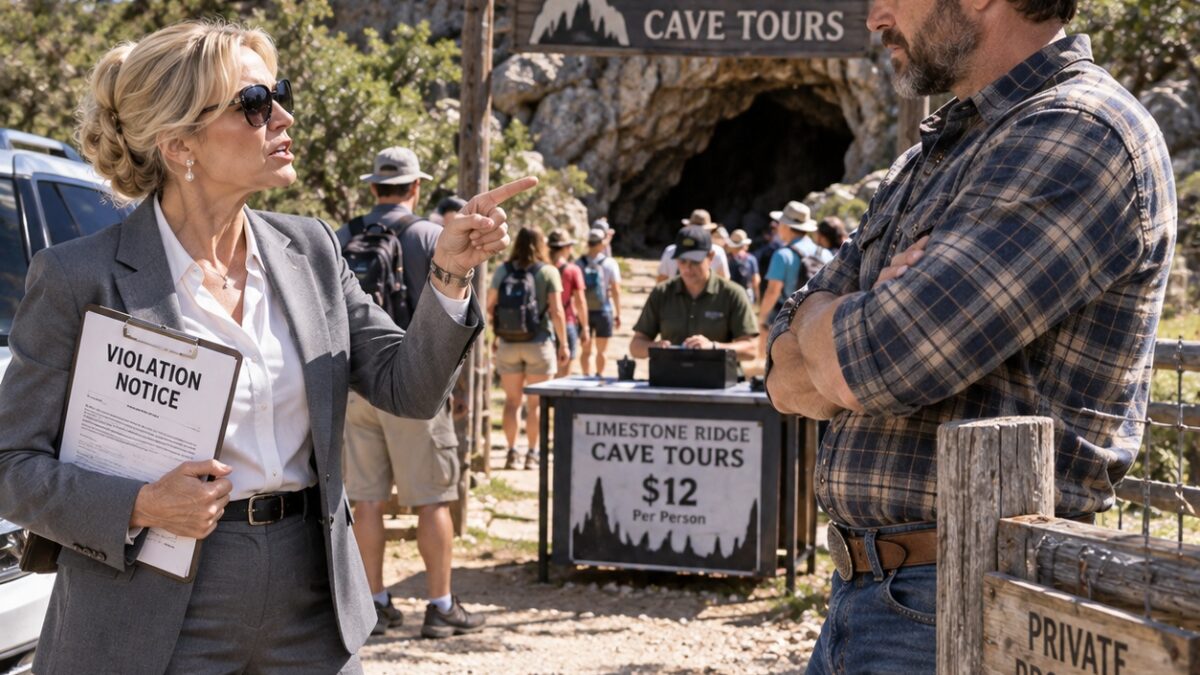
The HOA Drove 40 Minutes to Fine Me $450—Then I Found What They’d Built 100 Feet Inside My Land
A woman from the Limestone Ridge HOA drove forty minutes into the Texas Hill Country to hand me a $450 violation notice and fourteen days to change a fence standing on land my family had owned for generations.
She thought I was the outsider—until I discovered her HOA had been collecting money from strangers for access to something nearly one hundred feet inside my recorded boundary.
I did not argue with her, because inside my grandfather’s cedar chest was a document from 1952 that made me realize the ticket booth was only the first thing I needed to investigate.
“Your property is in violation. You have fourteen days to comply, or we take action.”
Sandra Colton said it like someone who had never once been told no and believed printed letterhead made disagreement illegal.
She stood in my gravel turnaround wearing narrow sunglasses, a pewter blazer, and shoes that probably cost more than the secondhand saddle hanging inside my barn.
A thick manila envelope rested in her outstretched hand.
Behind her, a spotless white SUV idled beneath two live oaks, its tires almost comically clean for a vehicle that had just traveled six miles over a county road powdered with limestone dust.
I took the envelope.
I did not open it.
Instead, I looked beyond Sandra toward the pale ridgeline north of my house.
Morning light was spreading across the limestone bluffs in long amber bands.
Somewhere beneath those rocks was a cave my grandfather had first entered in 1947 carrying a kerosene lantern, a hundred feet of clothesline, and enough confidence to get himself killed.
He called the main chamber the Long Room.
The name was not poetic.
Grandpa Elias Greer was not a poetic man.
If a room was long, he called it the Long Room.
If a spring ran cold, it became Cold Spring.
He once named a bull Red because it was red.
The cave had been on Greer land longer than anyone in Limestone Ridge had been alive.
Sandra followed my gaze and apparently mistook my silence for uncertainty.
“The Limestone Ridge Homeowners Association takes community standards seriously,” she continued. “Your eastern boundary fence does not comply with the aesthetic requirements of our service area.”
“My fence?”
“Yes.”
“The cedar-post fence beside County Road 418?”
“That’s the one.”
“My father built that.”
Her mouth curled into a small smile.
“Then it has apparently been noncompliant for quite a long time.”
She seemed pleased with herself.
I looked at the seal printed on the envelope.
Professional.
Embossed.
Dark blue ink.
Very official-looking.
“And you are?”
She lifted her chin slightly.
“Sandra Colton. Director of Community Standards and Compliance.”
I nodded.
“Understood.”
Her shoulders relaxed.
That told me she thought the conversation was over.
She walked back toward her SUV.
Before opening the door, she turned.
“Please don’t ignore this, Mr. Greer. After fourteen days, the board may assess additional penalties or pursue enforcement remedies.”
“Enforcement against what?”
She smiled again.
“The property.”
Then she left.
I watched her SUV disappear down the ranch road in a cloud of dust.
Only after I could no longer hear the engine did I open the envelope.
The fine was $450.
It cited Section 4, Paragraph 12 of the Limestone Ridge HOA Community Standards:
MAINTENANCE OF VISIBLE STRUCTURES WITHIN THE COMMUNITY AESTHETIC CORRIDOR.
I read it twice.
I had no idea what an aesthetic corridor was.
More importantly, I had no idea why an HOA whose front gate sat nearly seven miles from my house believed it had jurisdiction over my ranch.
My name is Callum Greer.
I was fifty-three years old when this happened, and I had worked as a civil engineer for twenty-six years.
That profession had trained me to separate confidence from accuracy.
A retaining wall could look impressive and still fail if the footing was wrong.
A drainage plan could carry six professional stamps and still flood a road if somebody used the wrong elevation.
And a claim could arrive on expensive stationery, quote paragraphs, use words like enforcement, and still collapse the second someone measured it.
My property had come through my grandfather, Elias.
He acquired the original 640 acres in 1931.
Central Texas land nobody wanted.
Too much limestone.
Too little soil.
Cedar everywhere.
Unreliable water.
Elias saw something other men did not.
Or maybe he was simply too stubborn to quit.
He built a stone house.
Dug wells.
Ran goats before cattle.
Bought neighboring parcels whenever another family gave up.
By the time my father, Raymond, inherited management in 1978, the ranch had grown to 4,100 acres.
By the time the land moved into the Greer Family Trust decades later, we controlled approximately 8,300 contiguous acres.
The cave system sat near the northern edge.
Grandpa first explored it sixteen years after buying the original tract.
In 1952 he hired a surveyor named Harold Pitts to document the entrance, the bluff above it, and enough of the underground formation to establish that the cave lay beneath Greer land.
Grandpa paid extra for that work.
My father used to complain about it.
“Your grandfather spent money proving he owned a hole.”
But that deed and survey still existed.
Inside a cedar chest in my study.
And three days before Sandra Colton drove onto my ranch to fine me for a fence, my ranch manager had called from the north pasture.
“There are people at the cave,” Dub Wakefield said.
“What kind of people?”
“Tourists.”
I leaned back from my desk in Austin.
“Tourists?”
“They put up a sign.”
“What sign?”
There was a pause.
Then:
“Limestone Ridge Cave Tours.”
I said nothing.
Dub continued.
“Twelve dollars a person. Saturdays and Sundays. They graded a parking area too.”
“A parking area where?”
“Your side of the line.”
“How far?”
“Maybe eighty, ninety feet.”
“And the entrance?”
“Still where it’s always been.”
“Are they actually taking people inside?”
“Looks that way.”
I closed my eyes.
Dub added:
“They’ve got a folding table, laminated tickets, QR code, cash box. Whole operation.”
“Whose name is on it?”
“The HOA.”
I wrote LIMESTONE RIDGE CAVE TOURS across the margin of a highway drainage report.
Now, three days later, Sandra had handed me a $450 fine.
I placed the violation notice beside my telephone and called Dub.
“Photograph everything.”
“I already started.”
“From public access or our property only. Don’t confront anyone.”
“What are you going to do?”
I looked again at Sandra Colton’s signature.
“First, I’m going to find out exactly how much of my ranch they think belongs to them.”
By sunset, Dub had sent me fourteen photographs.
The fifteenth changed everything.
FULL STORY CONTINUATION 👇👇
The first fourteen pictures were irritating.
The fifteenth made my hands go cold.
Dub had photographed the cave entrance from the north bluff.
I knew that angle well.
Grandpa had once built a rough cedar gate there to keep goats from wandering into the opening.
The gate had disappeared years earlier after termites hollowed the posts, but two old limestone footing blocks still marked the spot.
In Dub’s photograph, those stones were hidden behind something new.
A waist-high metal railing.
Painted black.
Bolted directly into the limestone.
A sign beside it read:
WELCOME TO LIMESTONE RIDGE HERITAGE CAVERN
A COMMUNITY PRESERVATION PROJECT
GUIDED TOURS — SATURDAY & SUNDAY
ADULTS $12
CHILDREN $8
HOA MEMBERS $5
Underneath was a QR code.
Another photograph showed a gravel parking lot holding seventeen vehicles.
Not beside my property.
On it.
The lot extended approximately ninety feet past the recorded fence line.
Somebody had brought in crushed limestone, graded the ground, compacted it, installed wheel stops, and planted six wooden signs.
Another picture showed solar pathway lights.
Another showed a portable restroom.
Another showed a folding canopy with an HOA logo.
Underneath sat a cash box, a credit-card reader, and two smiling volunteers in yellow shirts.
One held a clipboard.
One held a brochure.
The final photograph was the problem.
Dub had zoomed in on the brochure.
The cover showed the Long Room.
My grandfather’s cave.
A professional photograph.
Warm LED lights illuminated the ceiling.
A railing ran down the side of the passage.
The text beneath it read:
DISCOVER THE HIDDEN WONDER BENEATH LIMESTONE RIDGE
A PRIVATELY PRESERVED COMMUNITY TREASURE
I stared at privately preserved.
Then at community treasure.
Then I called Dub.
“How long have those lights been inside?”
“Don’t know.”
“The railings?”
“Same.”
“You haven’t been in?”
“You told me not to confront anyone.”
“Good.”
“Callum?”
“Yes?”
“You sound mad.”
“I’m trying not to be.”
“That bad?”
“They drilled hardware into the cave.”
Silence.
Dub had known my grandfather too.
Not well.
Enough.
“What do you want me to do?”
“Nothing tonight.”
“That sounds unlike you.”
“I need records before anger.”
He laughed.
“You’ve been an engineer too long.”
“Yes.”
I hung up and walked into my study.
The cedar chest sat beneath the west window.
Grandpa made it himself from aromatic cedar cut somewhere near Fredericksburg.
The lid never closed perfectly.
My father refused to repair it because, according to him, “Your grandfather made one crooked thing in his life, and I intend to preserve the evidence.”
When I opened it, the smell hit immediately.
Cedar.
Paper.
Dust.
Family history.
Inside were deeds.
Old surveys.
Tax receipts.
Water-right correspondence.
Photographs.
Maps folded so many times the creases felt like cloth.
I found the 1952 deed in a brown envelope marked:
NORTH BLUFF / CAVE.
Grandpa’s handwriting.
Block letters.
The deed itself was recorded in Blanco County on March 14, 1952.
Attached was Harold Pitts’s survey.
The property description was unusually detailed for the time.
Grandpa apparently argued with Pitts about it.
A handwritten note said:
ELIAS INSISTS CAVE ENTRY & BELOW-GRADE FORMATION BE NOTED DUE FUTURE CONFUSION.
Pitts had drawn the cave entrance.
The bluff.
Reference pins.
Then a dashed underground projection based on their rough measurement.
The entrance sat ninety-six feet inside the Greer boundary.
Not near.
Not ambiguous.
Ninety-six feet.
I found another document.
A 1967 affidavit from Grandpa stating that all recreational access to the northern cave required express permission from the Greer family.
Why?
Because a group of Boy Scouts had started using it.
Grandpa liked the Scouts.
He simply hated assumptions.
Attached were three letters granting specific access dates.
One in 1968.
One in 1971.
One in 1974.
All temporary.
All revocable.
All signed.
That mattered.
If Limestone Ridge later claimed historical public use, Grandpa had spent decades documenting the opposite.
I kept going.
There was a 1986 utility easement.
Narrow.
Twenty feet wide.
For an electrical line serving an old hunting cabin on neighboring land.
Nothing about cave access.
A 1993 county road dedication.
Again, nothing.
A 2006 mineral title opinion.
A 2011 trust transfer.
Clean chain.
By midnight, my dining table was covered.
At 12:17 a.m., I called the only person I knew who would answer a property question without first telling me to go to bed.
Rebecca Sloan.
Rebecca was a land-use attorney in Fredericksburg.
We had gone to Texas A&M together.
She became a lawyer.
I became an engineer.
We had spent thirty years arguing about which profession caused more unnecessary paperwork.
She answered on the fourth ring.
“Somebody better be dead.”
“Not yet.”
“Callum.”
“I have an HOA problem.”
She became awake immediately.
“Your ranch isn’t in an HOA.”
“That’s what I thought.”
“What happened?”
“They’re fining my fence.”
“Cute.”
“And charging people twelve dollars to tour my cave.”
Silence.
Then:
“Say that again.”
“They graded parking almost a hundred feet inside my boundary and installed a tour operation.”
“How long?”
“Unknown.”
“You have photographs?”
“Yes.”
“Deed?”
“In front of me.”
“Recorded?”
“1952.”
“Survey?”
“Yes.”
“Access history?”
“Documented.”
Rebecca paused.
“Do not call Sandra Colton.”
“I wasn’t going to.”
“Do not remove signs.”
“I know.”
“Do not block public access until we address immediate safety.”
That one bothered me.
“They’re trespassing.”
“Yes, and if they’ve been inviting members of the public into a cave for months, we need to know whether locking a gate while somebody is underground creates a bigger problem.”
Fair.
“Tomorrow?”
“Eight.”
“It’s almost twelve-thirty.”
“Then bring coffee.”
I slept maybe three hours.
By 7:30 I was driving north with the deed, survey, photographs, violation notice, and Grandpa’s access letters in a waterproof document box.
Rebecca’s office occupied the second floor of a limestone building off Main Street.
She wore jeans and a navy blouse.
No makeup.
Hair clipped back.
She looked at my paperwork before she looked at me.
“Coffee?”
I put one on her desk.
“You may live.”
She opened Sandra’s violation notice.
Read.
Then laughed.
“What?”
“Community aesthetic corridor.”
“That’s not a thing?”
“It can be a thing.”
“Of course.”
“Anyone can call a district almost anything inside private covenants.”
“So?”
“The question is whether you agreed to the covenants.”
“I didn’t.”
“Neither did your trust?”
“No.”
“Previous owner?”
“My family is the previous owner.”
She nodded.
“Then first impression: this fine is decorative.”
“Decorative?”
“Looks official. Accomplishes little.”
“What about ‘enforcement remedies’?”
“If they attempt a lien against property not subject to their declaration, we get more interesting.”
She read the cave documents.
Her expression changed.
“This is good.”
“Grandpa was obsessive.”
“God bless obsessive dead men.”
She examined the survey.
“Ninety-six feet.”
“Yes.”
“Any newer survey?”
“2011.”
“Same boundary?”
“Within six inches.”
She looked up.
“Callum, why would they think they own this?”
“That’s what I want to know.”
Rebecca searched county records.
The Limestone Ridge development had been platted in 2009.
The original developer bought roughly 1,140 acres northeast of Mercer—sorry, Greer—Ranch.
Different seller.
Different chain.
The subdivision boundary stopped exactly where my recorded line began.
No annexation.
No declaration covering Greer acreage.
No easement to the cave.
Nothing.
Then Rebecca found something odd.
A document recorded in 2018.
NOTICE OF COMMUNITY RECREATIONAL ACCESS.
Not an easement.
Not signed by me.
Not signed by Dad.
Not even tied to a legal parcel number correctly.
It was filed by Limestone Ridge HOA.
The notice stated that the association “maintained and administered historic community recreational access” to a limestone cavern “adjacent to or within the Limestone Ridge preservation corridor.”
Rebecca stared.
“What does adjacent to or within mean?”
“It means they didn’t know.”
“It means someone wanted ambiguity.”
The document cited an “original developer access exhibit.”
We pulled the 2009 development exhibits.
There it was.
A conceptual amenities map.
Not a deed.
Not a survey.
A marketing exhibit.
A little cave icon appeared west of the actual subdivision boundary.
Label:
FUTURE NATURE ACCESS / CAVERN.
Rebecca tapped it.
“They sold houses advertising your cave.”
I felt my jaw tighten.
“It was never theirs.”
“I know.”
“Did the developer know?”
“Maybe.”
The marketing map had fine print:
CONCEPTUAL ONLY. AMENITIES SUBJECT TO FUTURE AGREEMENTS AND APPROVALS.
There had never been a future agreement.
But somewhere between 2009 and Sandra Colton standing in my driveway, subject to future agreements had apparently evolved into community property.
Rebecca leaned back.
“We need three things.”
“Tell me.”
“Current survey verification.”
“I can have that tomorrow.”
“Good. Second, evidence of exactly what they’re doing.”
“Dub has photographs.”
“I want website archives, payment methods, advertised dates, waivers, insurance statements if public, anything that shows duration.”
“Third?”
She looked at me.
“How much money?”
I understood.
“If they’re charging strangers to enter my cave, I need to know how many strangers.”
“And where revenue goes.”
I called Dub.
“Can you do me a favor this weekend?”
“That sentence always costs me Saturday.”
“I want you to take a cave tour.”
He went quiet.
“As a tourist?”
“Yes.”
“You know they know me.”
“Good point.”
“I can send my nephew.”
“No.”
“Why?”
“Because if anything is unsafe, I’m not sending somebody else’s kid.”
Dub snorted.
“Eli is thirty-one.”
“He’s still somebody’s kid.”
We hired an investigator instead.
Not a trench coat.
Not binoculars.
Rebecca recommended a former insurance investigator named Nolan Price.
Nolan was sixty, bland enough to disappear in a grocery store, and delighted by the assignment.
“You want me to pay twelve dollars to go into a hole you own.”
“Yes.”
“Expense reimbursed?”
“Yes.”
“Best case I’ve had all month.”
He booked online.
That was our first discovery.
There was a website.
LimestoneRidgeCavern.org.
Professionally built.
Tour calendar.
Photos.
History page.
Online tickets.
Private group bookings.
Scout tours.
Birthday packages.
A “Cavern & Chardonnay” evening once a month for adults.
I stared at that.
Rebecca said:
“Please tell me they are not serving alcohol in an unpermitted cave.”
“They are serving alcohol in an unpermitted cave.”
“Wonderful.”
The history page was worse.
It claimed:
The cavern was discovered in 1947 by early Hill Country ranch families and later incorporated into the Limestone Ridge preservation lands.
No.
One rancher discovered it.
My grandfather.
And it had never been incorporated into anything.
Another line:
For decades, local residents used the cavern informally before Limestone Ridge HOA undertook preservation and safety improvements.
What residents?
Which decades?
Grandpa’s letters said otherwise.
Then a photograph.
My grandfather.
Elias.
Standing beside the entrance in 1953.
I knew the photograph.
It was from our family album.
“Where did they get that?”
Rebecca zoomed.
“Could’ve been local-history archive.”
“That’s my grandmother beside him.”
Partially cropped.
The HOA was using my family photograph to market tickets into my family cave.
I stopped being amused.
Nolan toured Saturday at eleven.
He wore a body camera where lawful and took notes.
We did not ask him to record private conversations illegally.
We didn’t need to.
He returned with enough public material.
Fifty-three people were on his tour block.
One guide.
One volunteer.
No professional cave specialist.
No helmets.
Children as young as six.
Basic railing.
Battery-powered LED strips.
Wooden stairs bolted into rock.
A section of walkway crossed what Grandpa’s map identified as a seasonal runoff channel.
In heavy rain, water could rise quickly.
My engineering brain stopped caring about property law for five minutes.
“How much rainfall would it take?”
Nolan shrugged.
I pulled old hydrology records.
The cave drained part of the northern bluff.
A severe thunderstorm could send water through the lower passage.
Not necessarily catastrophic.
Enough to make public tours irresponsible without monitoring.
Nolan showed us the waiver.
LIMESTONE RIDGE HOA CAVERN ACTIVITY RELEASE.
It claimed the HOA was “owner/operator of the premises.”
There it was.
Owner.
Not adjacent.
Not historic access.
Owner.
Rebecca circled the word.
“That is a representation.”
“To whom?”
“Every ticket buyer.”
Nolan added:
“They also sell memberships.”
“What memberships?”
“Twenty-five dollars annual. Gets you free tours.”
I stared.
“They created a membership program for my cave?”
“Yes.”
He seemed almost apologetic.
Rebecca asked:
“How many people?”
Nolan had photographed the reservation board.
Tour numbers ran into five digits.
Ticket number 014382 had been issued that morning.
Maybe numbering started at one.
Maybe not.
Still.
This was not a weekend experiment.
I called Dub.
“How long has that parking lot been there?”
“Maybe a year.”
“You didn’t notice?”
“I noticed gravel.”
“And didn’t ask?”
“You own eighty-three hundred acres, Callum. People put gravel places.”
Fair.
“Tour signs?”
“Those are newer.”
We started asking neighboring landowners carefully.
One remembered seeing buses the previous fall.
Another said his granddaughter had toured the cave on a school outing nine months earlier.
A local Facebook page had photographs going back fourteen months.
Then twenty months.
The first post we found:
GRAND OPENING — LIMESTONE RIDGE HERITAGE CAVERN.
Twenty-two months earlier.
I had been in Houston for work that weekend.
Dub was handling drought cattle.
The north tract was rarely used.
The HOA had chosen the perfect place.
Near enough to their development to feel like theirs.
Far enough from my ranch headquarters that I might not notice.
Rebecca requested records from the HOA through counsel.
Ownership basis.
Insurance.
Revenue.
Permits.
Construction approvals.
Tour attendance.
They responded with a letter from attorney Preston Hale.
Not cooperative.
The HOA, he wrote, possessed “longstanding access and recreational rights supported by historical use, developer instruments, and equitable principles.”
Rebecca laughed.
“Equitable principles.”
“What does that mean?”
“It means he doesn’t have a deed he likes.”
Hale also claimed my attempt to challenge access constituted “interference with established community rights.”
Then the letter referenced something new.
THE 1984 GREER RECREATIONAL EASEMENT.
I looked at Rebecca.
“There is no 1984 cave easement.”
“You sure?”
“I have every document.”
“Dead relatives hide paperwork.”
“Grandpa hid cash. Not deeds.”
We searched county records.
Nothing under Greer.
Nothing under the parcel.
Hale sent a copy after Rebecca demanded it.
The document was three pages.
RECREATIONAL ACCESS AGREEMENT.
Dated September 14, 1984.
Grantor:
Raymond C. Greer.
My father.
Grantee:
Hill Crest Recreational Association.
It purported to grant perpetual public access across a 30-foot corridor to “the known cavern entrance located west of the ridge.”
My heartbeat changed.
Dad’s signature was there.
It looked plausible.
There was a notary seal.
Rebecca watched me.
“Did your father ever mention Hill Crest?”
“No.”
“Could this be real?”
“I don’t know.”
That was hard to say.
I wanted certainty.
Engineering had taught me the world doesn’t care what you want.
I called my older sister, Ellen.
She remembered something.
“Hill Crest was a horseback club.”
“What?”
“Dad complained about them.”
“When?”
“Eighties.”
“Did he give them cave access?”
“Not that I remember.”
Then:
“Wait.”
“What?”
“They wanted a trail across the north side.”
“Did Dad agree?”
“No. Grandpa nearly shot their sign.”
That sounded more plausible.
I went back to the cedar chest.
Found 1984.
Property-tax correspondence.
Veterinary bills.
Horseback-club letter.
There.
HILL CREST RECREATIONAL ASSOCIATION.
June 1984.
Dear Mr. Greer,
We again request permission for members to cross the northern ridge for equestrian recreation and limited cavern visitation.
Dad’s handwritten response was stapled behind it.
NO PERMANENT EASEMENT.
MAY PERMIT ORGANIZED GROUP BY ADVANCE REQUEST.
RAY.
I called Rebecca.
“I have something.”
She came to the ranch.
We spread both documents side by side.
Same year.
Same organization.
Opposite meaning.
Then I noticed something only because my father had spent forty years signing my report cards, tax forms, and birthday checks.
His middle initial.
Dad was Raymond Edwin Greer.
He signed R.E. Greer.
Always.
The alleged easement said Raymond C. Greer.
Rebecca looked at me.
“Could C stand for something?”
“No.”
“Typo?”
“Maybe in typed text.”
“But signature?”
Exactly.
The signature read Raymond C. Greer in cursive.
Not how Dad signed anything.
Then Rebecca pointed at the notary block.
Linda J. Markham.
We searched the Texas notary archive.
Linda Markham had become a notary.
In 1991.
Seven years after supposedly notarizing Dad’s signature.
Rebecca leaned back.
“Well.”
“Forgery.”
“Likely.”
“Likely?”
“You know my favorite word.”
“I hate lawyers.”
“You called me.”
We sent the document to a forensic examiner.
Then notified Hale that the claimed easement appeared fraudulent and demanded preservation of the original.
His response changed tone immediately.
He had apparently received only a scan from the HOA.
He did not know where the original was.
That was revealing.
Sandra called me directly the next morning.
First time since the fine.
I did not answer.
She left a voicemail.
“Mr. Greer, I think there has been a misunderstanding. We should meet before attorneys turn a simple historical issue into something unnecessarily adversarial.”
A simple historical issue.
Twenty-two months of ticket sales.
Altered cave.
Fake easement.
I forwarded the voicemail to Rebecca.
She wrote:
DO NOT CALL.
I replied:
I KNOW.
She wrote:
YOU ARE A MAN WHO ONCE ARGUED WITH A COUNTY INSPECTOR FOR THREE HOURS ABOUT A CULVERT.
Fair.
We did not call Sandra.
We sent formal notice.
Effective immediately, no new tours after seventy-two hours.
The delay allowed the HOA to safely account for already-booked groups and avoid anybody showing up unexpectedly at a locked cave.
After seventy-two hours, access closed pending ownership and safety review.
We hired a licensed cave specialist and structural engineer to inspect.
I attended.
It was my first time inside the Long Room in almost fifteen years.
The entrance narrowed into cool darkness.
The smell came back immediately.
Wet limestone.
Earth.
Something mineral and ancient.
Grandpa used to take me there when I was a kid.
He insisted we never touch formations.
“Rock grows slower than children,” he’d say. “And children grow slow enough.”
Now LED strips had been glued along one wall.
Anchor bolts drilled into limestone.
A wooden platform covered a section where Grandpa once showed me cave crickets.
Someone had painted small directional arrows.
Painted.
On limestone.
I stopped.
Dub muttered:
“Oh, Callum.”
I touched nothing.
The cave specialist, Dr. Melissa Kane, photographed.
“Some of this is reversible.”
“Some?”
“The bolt holes aren’t.”
We continued.
In the Long Room, they’d installed a small platform.
The brochure called it the Cathedral Stage.
Apparently Cavern & Chardonnay evenings included acoustic music.
My grandfather would’ve risen from his grave purely to complain about the name.
Then Melissa showed me something worse.
A crack near the eastern wall.
Fresh scuffing.
Not structural failure.
Damage.
Someone had broken off several small calcite formations.
Souvenirs, maybe.
The HOA had mounted signs saying DO NOT TOUCH.
Signs don’t replace supervision.
The cave specialist also found bat roost disturbance.
Seasonal.
Not catastrophic.
Still.
Public access needed controls they did not have.
I was angry.
Not because the cave was pristine before.
Family had been inside.
Scouts.
Researchers.
But use had been limited.
Known.
Permission mattered.
Stewardship mattered.
The HOA had converted it into a product.
That distinction hurt.
We locked the entrance with a temporary gate after the last scheduled group exited.
Rebecca placed legal notice.
NO PUBLIC ACCESS PENDING TITLE AND SAFETY REVIEW.
The reaction was immediate.
Sandra sent an HOA email.
I know because three residents forwarded it.
GREER RANCH OWNER SHUTS DOWN BELOVED COMMUNITY CAVERN.
It described me as an “absentee landholder.”
I lived on the ranch part time and worked in Austin.
Technically.
It said the cave had “served Limestone Ridge families for years.”
Twenty-two months became years.
It said the HOA possessed “documented historical rights.”
Forgery.
It said I had “unilaterally endangered tourism commitments and community programming.”
My cave had tourism commitments.
I almost admired the nerve.
Then social media started.
Some residents called me greedy.
Others asked why they were paying an HOA that couldn’t produce a deed.
One woman posted:
I paid $96 for my daughter’s birthday cave package last month. Who got that money?
Excellent question.
Rebecca asked it officially.
The HOA refused to disclose financial records to us.
Residents had better rights.
A group led by a retired accountant named Wesley Boone demanded records under the HOA governing documents.
Sandra delayed.
Then provided partial statements.
That was the second turning point.
Tour revenue did not appear under cave tours.
It appeared as:
COMMUNITY PROGRAM CONTRIBUTIONS.
The first year showed $74,118.
The following partial year:
$109,442.
That was already over $180,000.
But reservation data suggested more.
Wesley asked where cash tickets went.
No answer.
He contacted me.
We met at a diner.
Wesley was sixty-seven, white beard, suspenders, and the energy of a man who enjoyed spreadsheets recreationally.
“I’m not asking you to trust the HOA.”
“Good.”
“I’m not asking you to trust me.”
“Better.”
“I want to know if the cave is yours.”
I slid a certified survey copy across.
He read.
“Ninety-six feet.”
“Yes.”
“And HOA owns zero beyond this line?”
“Correct.”
He nodded.
“Then Sandra lied to us.”
“About what?”
“The board told residents the HOA purchased cave rights in 2018.”
“From whom?”
“She never said.”
I showed him the alleged 1984 easement.
“This is what their attorney sent.”
He read.
Then I showed the notary record.
His eyebrows rose.
“Oh.”
“Exactly.”
Wesley leaned back.
“There’s more.”
“What?”
“The parking lot wasn’t paid from tour revenue.”
“Where?”
“Capital reserve.”
“How much?”
“Two hundred eighty-six thousand dollars.”
I nearly choked on coffee.
“For gravel and rails?”
“Official description was ‘North Recreation Preservation Access Improvement.’”
“Two hundred eighty-six thousand?”
“That includes lighting, engineering, retaining work, website, parking, portable facilities, liability program.”
“What liability program?”
“Exactly.”
The HOA had charged residents a special assessment for “recreation preservation improvements.”
Most residents assumed work occurred inside Limestone Ridge.
It had.
Just not entirely.
They had spent HOA funds improving my land without telling residents they didn’t own it.
Wesley continued.
“And the contractor?”
I already knew.
“Who?”
“Colton Community Services LLC.”
I stared.
“Sandra?”
“Her brother, officially.”
There it was.
Related-party contract.
Maybe legitimate.
Maybe not.
We researched.
Sandra’s brother, Martin Colton, owned the company.
It had received $418,000 from Limestone Ridge over three years.
Cave work.
Landscaping.
Event staffing.
Parking maintenance.
Community programming.
Wesley said:
“Could all be legal if disclosed and properly approved.”
“Was it disclosed?”
He smiled without humor.
“Not to me.”
The HOA board had five members.
Sandra was president.
Her close friend Caroline Voss was treasurer.
Two directors rarely attended.
One newer director, Daniel Hooper, started asking questions.
Daniel contacted Rebecca through his own attorney.
He had board minutes.
The cave decision had not been approved the way Sandra claimed.
Two years earlier, Sandra presented “a renewal of existing cave access programming.”
Renewal.
There had been no existing HOA program.
The board approved a $90,000 preliminary budget based on her statement that rights were already secured.
Later spending increased through “emergency safety improvements” under presidential authority.
$90,000 became $286,000.
Then more.
Daniel had asked for the ownership document.
Sandra sent the 1984 easement.
That document first appeared in HOA records nineteen months earlier.
Not 2018.
Not 2009.
Nineteen months.
Rebecca said:
“Someone created it recently or found it recently.”
“Forensic examiner?”
“Working.”
The examiner called two days later.
The scan had problems.
Font in one typed paragraph did not exist commercially in 1984 in that form.
The paper couldn’t be tested because no original.
The notary problem remained definitive enough to raise serious questions.
Dad’s signature appeared digitally composited.
The analyst could identify edge artifacts consistent with a signature pasted into the scanned image.
Not absolute proof without original.
Strong.
Then came the source.
Daniel found a folder on the HOA’s shared server.
ACCESS HISTORY.
Inside:
Scans of old local newspaper clippings.
The 2009 amenities map.
Photographs.
And a file named:
GREER_SIGNATURE_SAMPLE.jpg.
My stomach went cold.
It was Dad’s signature.
Taken from a 1997 fence-crossing permission letter.
Rebecca stared.
“They kept the source image.”
Another file:
1984_Easement_Final2.pdf.
Created twenty months earlier.
Metadata author:
SColton.
Sandra Colton.
That was no longer a historical misunderstanding.
Rebecca called the county sheriff.
Then the district attorney.
I called my sister.
Ellen listened.
Then said:
“Dad would have a stroke.”
“He’s been dead nine years.”
“He’d manage.”
Probably.
The criminal investigation remained quiet initially.
That was good.
Meanwhile, Sandra escalated civilly.
She filed a lawsuit on behalf of the HOA seeking declaratory judgment confirming recreational easement rights.
Her complaint claimed decades of open and continuous community use.
Rebecca read it.
“Decades?”
“Apparently.”
“Limestone Ridge didn’t exist before 2009.”
“They’re claiming predecessor access.”
“Hill Crest?”
“Yes.”
Grandpa’s cedar chest became our answer.
The temporary permission letters.
Dad’s refusal.
Photographs of locked gates.
Correspondence.
A 1987 letter from Hill Crest thanking Raymond Greer for allowing a single annual visit.
Single.
Annual.
Permission.
Prescriptive rights generally depend on use being adverse, not permissive.
Rebecca explained that carefully.
I told her she was enjoying herself too much.
She said:
“Your grandfather accidentally built a litigation file for fifty years.”
“He distrusted everybody.”
“Useful trait in moderation.”
We commissioned a modern survey.
Three independent crews.
One selected jointly after court conference.
All put cave entrance between ninety-five and ninety-seven feet inside Greer Ranch.
Parking lot mostly on my property.
A small corner lay on HOA land.
Their ticket booth straddled the line.
That became my favorite absurd detail.
They could legally sell water from one side of the table.
Not cave tickets from the other.
The judge issued temporary order keeping public tours closed pending case.
Sandra blamed me publicly.
HOA residents became divided.
Then cave finances leaked.
Not from me.
From members.
Tour revenue over twenty-two months totaled approximately $267,000 when cash deposits, card records, memberships, and private events were combined.
Expenses attributed directly to operation were roughly $142,000.
Where was the difference?
Partly HOA general fund.
Partly vendor payments.
Partly unaccounted.
Then Wesley found “management stipends.”
Sandra received $2,500 a month for “recreation oversight.”
She had been paying herself.
Board minutes did not clearly authorize it.
Caroline, the treasurer, received $1,000 monthly.
Martin Colton’s company received event fees.
Cavern & Chardonnay revenue sometimes went through a separate nonprofit called Limestone Ridge Preservation Fund.
Guess who chaired it.
Sandra.
The nonprofit had raised another $186,000 in “cave preservation donations.”
The cave it was preserving did not belong to it.
I sat in Rebecca’s office while she added numbers.
“So they made almost half a million dollars around this cave?”
“Gross across entities, roughly.”
“On twelve-dollar tickets.”
“Plus events, memberships, donations, grants.”
“Grants?”
She turned a page.
The nonprofit had received a $75,000 regional heritage grant for cave-access improvements.
The application stated the organization had “long-term legal control of the preservation site.”
Another false representation.
Sandra had used the fake easement to support it.
The grant agency became interested.
Very interested.
The story changed from trespass to fraud.
I wish I could say I enjoyed that.
I didn’t.
Every new document made the whole thing uglier.
Residents had paid assessments.
Tourists had paid tickets.
Donors gave money believing they were protecting a legitimate community resource.
A regional foundation had awarded grant funds.
And beneath it all was my grandfather’s cave.
Something Sandra could have approached me about honestly.
Would I have agreed to public tours?
Probably not at that scale.
Maybe limited educational visits.
Research.
Scout groups.
Grandpa had allowed those.
But no one asked.
That was the theme.
No one asked because asking risked hearing no.
The $450 fence notice suddenly made more sense.
Rebecca saw it first.
She placed the violation letter beside the HOA lawsuit.
“Callum.”
“What?”
“Look at their service-area argument.”
The HOA claimed my eastern fence sat within a “community aesthetic corridor.”
How did they justify that?
A board resolution passed six months earlier.
RESOLUTION EXPANDING COMMUNITY STANDARDS SERVICE AREA TO ADJACENT HERITAGE INTERFACE ZONES.
Beautiful language.
Meaningless to me.
But it identified three outside parcels.
Mine among them.
Why?
If the HOA could create a record of regulating my property—and if I paid fines or complied—it could later argue some form of voluntary participation, consent, or management relationship.
Would paying $450 magically place 8,300 acres into an HOA?
No.
Rebecca was clear.
But Sandra wasn’t building one magic document.
She was building a story.
HOA manages fence.
HOA maintains cave.
HOA improves access.
HOA sells tickets.
HOA regulates aesthetic corridor.
Greer owner receives notices and complies.
Eventually outsiders see a pattern.
The HOA looks like the operator.
Then future investors or insurers stop asking hard questions.
The fine was not mainly about my fence.
It was another brick in a paper wall.
I felt almost embarrassed I hadn’t seen it.
Rebecca didn’t.
“Fraud works because each piece looks boring.”
“That’s comforting.”
“It should be.”
“It isn’t.”
The deeper question remained:
Why did Sandra need the cave so badly?
Half a million dollars was significant.
But not enough to justify this level of risk.
Then Daniel Hooper found the answer.
A confidential presentation prepared for a development company called Red Crest Hospitality.
LIMESTONE RIDGE NORTH EXPANSION & ECO-TOURISM CONCEPT.
The HOA was not authorized to develop outside its subdivision.
But Sandra had apparently been negotiating a partnership involving adjacent landowners.
The presentation showed a future boutique lodge.
Trail network.
Cavern visitor center.
Wedding pavilion.
Restaurant.
And an “underground event experience.”
I stared.
“They want to turn Grandpa’s cave into a wedding venue.”
Rebecca pointed.
“Not exactly.”
The site plan used approximately 420 acres north and west of Limestone Ridge.
Some belonged to a retiring rancher named Phelps.
He had agreed to sell.
About 160 acres were mine.
Including the cave.
Red Crest’s preliminary term sheet valued the full project at more than $38 million after development.
Sandra’s “preservation nonprofit” was positioned to receive a management contract.
Colton Community Services would perform site work.
The HOA would receive amenities access.
Sandra and her associates stood to make far more than twelve-dollar tickets.
The cave tours were proof of concept.
They had spent nearly two years demonstrating public demand for an attraction they did not own.
My $450 fine was part of building the illusion that my northern tract already sat under HOA influence.
I leaned back.
“That’s why she came herself.”
Rebecca nodded.
“She wanted your reaction.”
“If I paid?”
“Useful.”
“If I replaced the fence?”
“Even better.”
“If I ignored it?”
“They’d escalate.”
“Lien?”
“Maybe attempt one.”
“Could they?”
“Not validly.”
“But they’d create another record.”
“Yes.”
I thought about Sandra standing in my driveway.
Confident.
She wasn’t checking a fence.
She was testing whether I would resist.
I had disappointed her by doing less than expected.
I hadn’t yelled.
Hadn’t threatened.
Hadn’t ripped the envelope.
I had simply taken it.
That turned out to be useful.
Because she assumed silence meant weakness.
People often do.
The first court hearing on the cave access happened six weeks after the fine.
Sandra attended.
So did forty Limestone Ridge residents.
The courtroom was too small.
Some stood in the hall.
HOA attorney Preston Hale looked unhappy.
By then, he’d withdrawn the 1984 easement as an evidentiary basis.
Smart.
He said his client could not authenticate it.
Sandra fired him three days later.
Her new attorney, Kevin Moss, tried a different argument.
Historical recreational use.
Implied dedication.
Equitable estoppel.
Reliance.
Rebecca answered with fifty years of permission letters and surveys.
The judge, Patricia Lang, asked one question that changed the room.
“Counsel, can you identify any recorded instrument conveying any ownership interest in the cavern to the homeowners association?”
Moss talked for almost three minutes.
Judge Lang interrupted.
“That was not my question.”
Silence.
“No, Your Honor.”
“Any recorded easement?”
“No authenticated easement currently in evidence.”
“Any lease?”
“No.”
“License?”
“No.”
“Purchase agreement?”
“No.”
“Then why did the association represent itself as owner/operator on public liability waivers?”
Moss looked toward Sandra.
Sandra looked straight ahead.
“That is under review.”
Judge Lang nodded.
“So is everything else.”
The temporary closure remained.
The HOA could not enter except for mutually agreed inspection.
My ownership claim looked strong.
But Rebecca warned me not to celebrate.
“Temporary hearing.”
“I know.”
“Criminal case separate.”
“I know.”
“Residents angry.”
“I know.”
“You sound disappointed I keep saying things.”
“I am.”
The district attorney executed search warrants two weeks later.
HOA office.
Sandra’s home office.
Colton Community Services.
The preservation nonprofit.
That made news.
Suddenly I became “Texas ranch owner whose private cave sparked HOA fraud investigation.”
Reporters drove to my gate.
One climbed over.
Dub escorted him back out.
Politely.
Mostly.
I issued one written statement:
Greer Ranch welcomes lawful investigation. The cave is private property and is currently closed for safety and title review. We ask the public not to trespass.
No interviews.
Sandra gave three.
She called the situation “a hostile land grab by an absentee heir.”
That was creative.
I had inherited land already owned by my family.
Apparently reclaiming your own cave from unauthorized ticket sales is land grabbing if the other person is confident enough.
She said the HOA had “invested hundreds of thousands preserving an abandoned hazard.”
Abandoned.
That word bothered me more than absentee.
Grandpa’s cave wasn’t abandoned.
We chose not to commercialize it.
There is a difference between unused and available.
People confuse those constantly.
A vacant lot.
An empty room.
A quiet trail.
Someone sees no activity and assumes no owner is using it correctly.
Then use becomes entitlement.
I drove to the cave that evening.
Alone.
The temporary gate was locked.
I opened it.
Walked inside with helmet, light, and gas monitor because Melissa had trained us properly.
The cave felt different without LED strips.
We had removed temporary lighting after documentation.
Darkness returned.
Real darkness.
I reached the Long Room.
Turned off my lamp.
Nothing.
No exit glow.
No sound except slow water.
I imagined Grandpa in 1947 with a lantern.
He had crawled farther than I was willing to.
Not because brave.
Probably because nobody told him not to.
I turned the light back on.
On one wall, faintly, were initials.
E.G.
Grandpa.
I had known they existed.
Never liked them.
Even Grandpa had damaged the cave.
That thought humbled me.
Stewardship changes.
What seemed harmless in 1947 becomes unacceptable later.
Maybe total closure wasn’t automatically the right answer either.
I asked Melissa:
“Could this ever be toured safely?”
She considered.
“Yes.”
“Publicly?”
“With significant controls.”
“Would it harm the cave?”
“Any access has impact.”
“So no?”
“I didn’t say that.”
“What would you do?”
“Limited groups. Education. Seasonal closures for bats. No alcohol. No fifty-person tours. Professional guides. Water monitoring. Remove unnecessary hardware. Maybe twelve visitors at a time.”
Twelve.
Grandpa would approve the number.
Maybe.
I started thinking.
Not about reopening for Limestone Ridge.
About what legitimate stewardship could look like.
Rebecca warned:
“Do not announce that while litigation is active.”
“I wasn’t going to.”
“Your face says ideas.”
“My face doesn’t do that.”
“It does.”
The HOA recall petition began around the same time.
Wesley organized it.
Sandra accused me of funding it.
I hadn’t given a dollar.
Residents gathered enough signatures for a special meeting.
The clubhouse overflowed.
I did not plan to attend.
Then Wesley called.
“You should come.”
“Why?”
“Because half these people still think you stole their cave.”
“That’s their problem.”
“It becomes your problem when neighbors believe fiction.”
Rebecca surprised me.
“Go.”
“You told me not to get involved.”
“I told you not to run the recall.”
“So I can speak?”
“Facts only.”
I attended.
No cowboy hat.
No dramatic deed in a glass case.
Jeans.
Blue shirt.
Survey tube.
The room went quiet when I entered.
Sandra sat at the front beside her lawyer.
Wesley gave me five minutes.
I walked to the projector.
Put up one image.
The 1952 survey.
“This is the cave entrance.”
I pointed.
“This is the Greer boundary.”
Then modern survey.
Same line.
Then 2009 subdivision plat.
Same line.
Then the HOA marketing map with FUTURE NATURE ACCESS.
I read the fine print.
SUBJECT TO FUTURE AGREEMENTS AND APPROVALS.
Then asked:
“Does anyone in this room have a future agreement signed by a Greer?”
Silence.
Sandra stood.
“This is misleading.”
Wesley said:
“You’ll have your time.”
She sat.
I showed Grandpa’s permission letters.
Temporary access.
Specific dates.
Then Dad’s 1984 refusal.
Then the alleged easement.
I did not call it forged.
Criminal case pending.
I said:
“This document has been withdrawn as unauthenticated by the HOA’s former counsel. Its notary did not become commissioned until seven years after its stated date.”
Murmurs.
Then I showed the $450 fine.
A few people laughed.
I didn’t.
“This arrived after the cave dispute began.”
Sandra interrupted.
“It is unrelated.”
I looked at her.
“Maybe.”
That bothered her more than accusation.
I continued.
“I do not want anyone here paying for mistakes you didn’t know about.”
The room quieted.
“The residents of Limestone Ridge did not drill bolts into my cave personally. You did not forge my father’s name. You did not tell a grant foundation you controlled property you did not control.”
Sandra shouted:
“Allegedly.”
I nodded.
“Correct. Allegedly.”
Rebecca smiled in the back.
“I also understand many of you paid for tours in good faith.”
A woman raised her hand.
“My grandchildren loved that cave.”
“I believe you.”
“Are you going to keep it closed forever?”
“I don’t know.”
Honest.
“What I do know is that access to private property needs permission. If the cave reopens someday, it will be because ownership, safety, and conservation are clear.”
Another man asked:
“Are you suing us?”
“No.”
Rebecca coughed.
I corrected:
“I am not seeking to financially destroy six hundred homeowners.”
Laughter.
Rebecca later said I had nearly shortened her life.
But residents heard what mattered.
I wasn’t coming for their houses.
I wanted my boundary.
My cave.
Accounting.
After I finished, Sandra took the microphone.
She gave a forty-minute defense.
Called every expense necessary.
Called the 1984 document something staff provided.
Called tour operations a community service.
Called the Red Crest proposal “conceptual brainstorming.”
Then Wesley asked:
“Did you receive monthly compensation connected to the cave?”
Sandra said:
“For administrative work.”
“Was it approved?”
“Yes.”
Daniel Hooper stood.
“No.”
Silence.
He had board minutes.
Sandra’s compensation had never received a formal recorded vote.
Her face changed.
Then a resident asked:
“Did your brother’s company get the cave contract?”
“Yes, through procurement.”
Wesley:
“There was no competing bid in the records.”
Sandra:
“Emergency safety work.”
Another:
“Why was it an emergency before you opened the cave?”
That did it.
The meeting became impossible to control.
The recall vote occurred two weeks later.
Sandra lost.
Seventy-six percent.
Caroline resigned before the count.
Daniel became interim president reluctantly.
Wesley refused.
“I enjoy sleeping.”
Smart man.
The new board immediately suspended cave-related spending.
Hired independent forensic accountants.
Waived confidentiality over certain records for investigators.
Then Daniel called me.
“I owe you an apology.”
“You?”
“The association.”
“You don’t have to apologize for Sandra.”
“I do for the institution.”
That was a distinction I respected.
We met at the boundary.
No lawyers initially.
Daniel stood where the parking lot crossed into my land.
He looked at survey stakes.
“I can’t believe they built this.”
“They believed it was theirs.”
“No. Sandra knew.”
Maybe.
“What do you want us to do?”
“Remove what doesn’t belong.”
“All of it?”
I looked.
Gravel.
Lights.
Railings.
Portable restroom already gone.
Parking lot could be reclaimed slowly.
“Not blindly.”
He looked surprised.
“If ripping things out creates more damage, we plan.”
That became the start of cooperation.
Melissa, our cave specialist, evaluated.
Some railings could be removed.
Some bolts best left cut flush rather than enlarge holes.
Gravel parking area could be reduced and revegetated.
Runoff controls needed restoration.
The HOA paid.
Not residents through a special assessment immediately.
Insurance covered some because board misconduct riders and vendor claims applied.
Recovered funds from Sandra-related entities later reimbursed more.
The criminal case took almost a year.
That was the least dramatic part and the most consequential.
Document analysis.
Bank records.
Email warrants.
Vendor interviews.
Grant applications.
Metadata.
Cash deposits.
Sandra had not personally pocketed every tour dollar.
Important.
A large portion paid actual expenses.
But prosecutors alleged she falsified the easement, caused false ownership statements to be made, directed related-party contracts without proper disclosure, received unauthorized compensation, and used the fake property rights to obtain grant money and advance the Red Crest development proposal.
Her brother Martin said he believed the HOA owned access.
Maybe he did.
He eventually repaid disputed overcharges and cooperated.
Caroline admitted she knew compensation approvals were incomplete.
She took a plea on lesser financial-record charges.
Then Sandra’s assistant, Lacey Monroe, became key.
Lacey was twenty-nine.
Had worked for Sandra four years.
She admitted creating the fake 1984 document.
That sentence hit hard.
Under Sandra’s direction, according to her statement.
Sandra gave her Dad’s signature sample.
A template.
A notary name pulled from an unrelated document.
Lacey said:
“Sandra told me it was reconstructing a lost agreement.”
Reconstructing.
People use clean words for dirty acts.
Did Lacey know it was fake?
Eventually, yes.
At first, maybe she believed an original existed.
Then Sandra told her to change the date.
That ended ambiguity.
Lacey cooperated.
The federal grant issue brought in another agency because grant money crossed certain lines.
I won’t pretend I followed every jurisdiction.
Rebecca did.
She enjoyed explaining it until I threatened to bill her for listening.
Ultimately, Sandra accepted a plea agreement.
Fraud-related charges.
Forgery-related charges.
Misapplication of HOA funds.
Restitution.
Prison time, but not some life-destroying fifty-year sentence.
She lost the house she had mortgaged partly to cover legal fees.
That felt grim, not satisfying.
People expect revenge stories to end with champagne.
I felt mostly tired.
Before sentencing, prosecutors asked if I wanted to speak.
I did.
Sandra sat at the defense table.
She looked smaller.
Not literally.
Context had changed.
I stood.
“My grandfather did not build the cave.”
I paused.
“He discovered it.”
The judge looked at me.
“I think that distinction matters. None of us created the land. None of us created the limestone. We only decide how we treat what falls under our care.”
Sandra looked down.
“The problem was never twelve-dollar tickets by themselves. It was the assumption behind them.”
I held a copy of the 1952 survey.
“Mrs. Colton decided that because a resource was useful to her community, permission became optional.”
I looked toward the residents sitting behind her.
“That harmed them too. They paid assessments and donated money based on representations they had every reason to believe.”
Then:
“I do not want revenge. I want the record clear.”
I pointed lightly toward the survey.
“The cave belongs to Greer Ranch. The HOA never possessed ownership or a permanent recreational easement. Public access was sold without our permission.”
I paused.
“And a $450 fence fine does not change an 8,300-acre deed.”
The judge almost smiled.
Almost.
I finished:
“Boundaries are not insults. They are information. Most conflict begins when someone decides another person’s boundary is inconvenient.”
Then I sat.
Sandra received her sentence.
Restitution was ordered among several victims.
HOA.
Grant foundation.
My ranch for physical restoration and certain fees.
I did not recover imaginary millions.
I recovered documented costs.
Good.
The civil cave case ended soon after.
The HOA’s new board withdrew its access claim.
A court order confirmed title and boundary.
The alleged easement was declared invalid and unenforceable.
The HOA removed my $450 fine.
Daniel mailed me a copy marked:
VOID.
I framed it.
Not because I am mature.
Rebecca saw it in my office.
“You’re pathetic.”
“Yes.”
Underneath I wrote:
PAID IN FULL: $0.00.
Dub loved it.
For a while, I thought that was the ending.
Then a schoolteacher named Hannah Lyle called.
She taught seventh-grade earth science in a nearby district.
Her class had toured the cave during the HOA operation.
She sounded nervous.
“Mr. Greer, I understand if you say no.”
Good beginning.
“What do you want?”
“We’re studying karst geology.”
I knew.
“My students still talk about the cave.”
I said nothing.
She continued.
“I know what happened. I know the old tours weren’t authorized. I’m not asking for the HOA.”
“What are you asking?”
“A single educational visit.”
My first instinct was no.
Immediate.
Protective.
Then Grandpa’s access letters came back to me.
Boy Scouts.
Schools.
Researchers.
He had not treated the cave as untouchable.
He had treated access as deliberate.
I called Melissa Kane.
“Would twelve seventh-graders destroy the cave?”
“Depends on the seventh-graders.”
“Helpful.”
“With proper supervision? No.”
Rebecca said:
“Insurance.”
Of course.
Dub said:
“Kids ask too many questions.”
Also true.
We planned one visit.
Twelve students.
Two teachers.
Melissa.
Me.
Helmets.
Lights.
No touching.
No food.
No fees.
Hannah’s students arrived terrified of me because apparently she’d told them the landowner was “very serious.”
I hated that.
One boy raised his hand before we entered.
“Did cows live in the cave?”
“No.”
“Were there dinosaurs?”
“No.”
“Could there be gold?”
“No.”
He looked disappointed.
Inside the Long Room, everything changed.
Kids stopped talking.
They looked up.
One whispered:
“Whoa.”
Exactly.
Grandpa probably said the same thing in 1947.
Melissa explained calcite.
Water.
Time.
Bats.
One girl asked how long a formation took to grow.
Melissa gave a range.
The girl stared.
“So if somebody breaks it, we can’t fix it?”
“Not in our lifetime.”
She nodded.
That was preservation education better than a hundred signs saying DO NOT TOUCH.
Afterward, Hannah asked:
“Would you ever do this again?”
I looked at Dub.
He sighed.
“We’re doomed.”
We did it again.
Slowly.
Not public daily tours.
An educational access program.
Four school groups a year.
University geology teams by agreement.
Scout groups occasionally.
No commercial ticket booth.
No chardonnay.
The cave was not abandoned.
It was managed.
The irony didn’t bother me.
Sandra had argued the cave should be shared.
In a broad philosophical sense, maybe.
Her method made it theft.
A good goal does not clean a dishonest path.
That is something people miss.
You can support education and still oppose trespass.
You can want community access and still require consent.
You can preserve land without pretending ownership doesn’t matter.
Years later, Limestone Ridge asked whether HOA families could participate in an annual cave education day.
Daniel was still on the board.
He phrased the request carefully.
“We are asking.”
I smiled.
“I noticed.”
“Progress.”
“Yes.”
We agreed.
Twenty residents chosen by lottery.
No tickets.
Donation optional to a regional cave-conservation organization, not me.
The first group included Wesley Boone.
He stood inside the Long Room.
Looked around.
“This cost me a special assessment.”
I laughed so hard the echo scared a bat.
Wesley pointed at a railing stub.
“Is that from Sandra?”
“Yes.”
“Leave one.”
“Why?”
“History.”
I had planned to remove all traces.
Melissa had already recommended leaving two cut anchor points rather than damaging surrounding rock further.
So technically one remained.
Wesley said:
“People need reminders that improvements can be vandalism if nobody asked.”
Accountants occasionally say poetic things.
I kept quiet.
The northern parking lot took three years to heal.
We removed most gravel.
Recontoured runoff.
Seeded native grass.
The compacted soil resisted.
Nature doesn’t instantly forgive engineering.
I should know.
A small portion remained as a controlled access pad for school vans and emergency vehicles.
Again:
Not everything Sandra built had to be destroyed merely because Sandra built it.
That was a lesson too.
Reaction can become another form of control.
If I ripped out useful infrastructure purely to erase her, she would still be influencing decisions.
We kept what served legitimate purposes.
Removed what didn’t.
The eastern fence stayed.
Same cedar posts where possible.
I never changed it to match Limestone Ridge’s aesthetic corridor.
Two years later, the HOA formally abolished that external service-area resolution.
Daniel sent me a copy.
I put it behind the framed $450 fine.
My office wall became increasingly petty.
Rebecca threatened intervention.
Then she gave me a brass plaque for Christmas:
COMMUNITY AESTHETIC CORRIDOR.
I mounted it over my ugliest filing cabinet.
Friendship.
The bigger development proposal died.
Red Crest Hospitality pulled out once title issues surfaced.
Then they returned years later.
Not with Sandra.
With attorneys.
Surveyors.
An actual offer.
They wanted to buy part of Phelps Ranch and asked whether I would sell sixty acres near the county road for a lodge access corridor.
I said no.
They thanked me.
Two months later they redesigned.
That was it.
No forged maps.
No fines.
No secret ticket sales.
Civilization.
A year after that, I approached them.
“Would you lease five acres for a trailhead if there is no cave access?”
They considered.
We negotiated.
A public trail now begins outside my sensitive northern tract.
People get Hill Country views without entering the cave.
I receive lease income.
The neighboring development gains an amenity.
No one steals anything.
Sandra could have built relationships like that.
She chose paper tricks because they were faster.
Shortcuts are attractive until the full cost arrives.
The ranch itself changed too.
I retired from full-time engineering at fifty-eight.
Not because cave money made me rich.
There was no cave money.
I was already financially comfortable, and the ranch required more attention.
Dub pretended he was pleased.
“You’ll be in my way.”
“Yes.”
“Engineers are terrible ranch managers.”
“You work for me.”
“Temporarily.”
He retired two years later.
His daughter Mae took over livestock operations.
Better than both of us.
Dub built a house near Llano and still arrived every Tuesday without invitation.
Apparently property boundaries are only important when convenient to retired ranch managers.
I remind him.
He ignores me.
The cedar chest remains in my study.
I reorganized it.
Grandpa would object.
Each section now has archival sleeves.
Survey maps scanned.
Cloud backups.
Fireproof storage for originals.
Rebecca says I finally became the obsessive dead man while still alive.
Probably.
The fake easement taught me something uncomfortable.
Family knowledge is not protection if documents disappear.
I knew the cave was ours.
Dad knew.
Grandpa knew.
But if Grandpa hadn’t preserved records, Sandra’s fiction would have been harder and more expensive to defeat.
Truth matters.
Proof matters too.
Not because courts are corrupt.
Because memory dies.
Paper outlives confidence.
I started reviewing all Greer property lines.
Every easement.
Every handshake agreement.
Every neighbor using a ranch road because “we’ve always done it.”
Not to shut people down.
To document.
One neighbor, Calvin Ross, had driven across our southwest corner for thirty years to reach a back pasture.
Dad allowed it.
No writing.
I called him.
He thought I was ending access.
Instead, we signed a simple revocable license protecting both sides.
Calvin laughed.
“Your grandfather would call this lawyer nonsense.”
“Yes.”
“Your dad too.”
“Yes.”
“Why do it?”
“Because someday our kids may not remember why your truck is on my road.”
He signed.
Good.
Boundaries preserved friendship.
Again.
The cave acquired a new name eventually.
Not officially.
The Long Room remained the Long Room.
But the whole system had never had a formal name in our family.
Local people started calling it Greer Cavern.
I hated that.
Sounded commercial.
Melissa suggested Elias Cave.
Worse.
Then one of Hannah’s students wrote a report titled:
THE QUIET CAVE.
I liked that.
Not because it was always quiet.
Because we decided it didn’t need to constantly earn money to justify existing.
That idea confused people.
A resource can have value without monetization.
Engineers are not usually accused of romanticism.
Age does things.
We created a small conservation fund.
Not from admissions.
From voluntary donations, ranch income, and later a modest endowment I set aside.
The fund paid for monitoring.
Bat surveys.
Gate maintenance.
School equipment.
No staff salaries beyond professionals needed for specific work.
Annual report posted publicly.
Every dollar.
Why?
Because after Limestone Ridge, transparency felt like fresh air.
The HOA contributed one year.
I accepted.
Some friends questioned it.
“After what they did?”
“The current residents didn’t forge anything.”
Institutions can change leadership.
If we insist guilt is hereditary, reform becomes pointless.
The check came with a note from Daniel:
FOR ACTUAL PRESERVATION THIS TIME.
I laughed.
He eventually sold his Limestone Ridge home and moved to Arizona.
Wesley became HOA president.
Worst possible outcome for anyone who disliked audits.
He called me his first week.
“I found another contract.”
“Is it mine?”
“No.”
“Then why are you calling?”
“I enjoy sharing misery.”
He found no major fraud.
Just sloppy landscaping billing.
Progress can be boring.
Good.
Sandra finished her sentence.
I knew the date because a reporter called asking for comment.
“No.”
“Do you believe she deserves a second chance?”
I hate questions that try to turn private emotion into headline.
“I believe her sentence belongs to the court record.”
“Do you forgive her?”
“I don’t have a relationship with her.”
“Would you meet her?”
“No reason to.”
That became the quote:
RANCHER REFUSES TO MEET FORMER HOA PRESIDENT.
Not exactly what I said.
Another lesson.
I did receive a letter from Sandra about a year after her release.
No lawyer.
No demands.
Handwritten.
I left it unopened for two weeks.
Then Rebecca asked:
“Curious?”
“Yes.”
“Read it.”
“I thought you’d say throw it away.”
“You hate uncertainty.”
True.
I opened it.
Mr. Greer,
I do not expect a response.
For a long time I believed the cave operation was justified because I thought Limestone Ridge had been promised access by the original developer.
When questions arose, I chose to protect what I had built instead of admitting I could not prove the right existed.
After that, each decision required another.
The false agreement was inexcusable.
So were the representations made with it.
I told myself the community benefited.
Some did.
That did not make the property ours.
I also told myself you were an absentee owner who would eventually accept the reality on the ground.
I understand now how arrogant that was.
I am sorry for what I did to your family records, your property, and to the residents who trusted me.
Sandra Colton
No explanation of compensation.
No request.
No “but.”
I read it twice.
Rebecca asked:
“Respond?”
I thought.
Then wrote:
I received your letter. Thank you for acknowledging what happened.
Callum Greer.
Nothing else.
Forgiveness does not require correspondence.
Hatred does not need maintenance either.
I let it go as much as people actually let things go.
Not erased.
No longer active.
The most surprising reconciliation came with Martin Colton.
Sandra’s brother.
The contractor.
Years after the case, his company bid on a county drainage project where I served as technical consultant.
Conflict disclosed.
I could have objected.
His bid was competitive.
His work record after the scandal was solid.
The county attorney asked whether I could be impartial.
I said:
“Not comfortably.”
So I recused from scoring his section.
Another engineer handled it.
Martin won part of the contract.
Completed it well.
That’s systems working.
Personal history acknowledged.
Not weaponized.
My father used to say character means treating enemies fairly.
He was better at saying it than doing it.
So am I.
The cave helped me practice.
At sixty-two, I finally climbed into one passage Grandpa marked but never fully mapped.
Melissa came.
So did Mae Wakefield.
We crawled through a narrow section beyond the Long Room.
Not far.
Maybe three hundred feet.
Found another chamber.
Smaller.
Beautiful.
Thin soda-straw formations hanging from the ceiling.
Nobody had installed lights.
Nobody had drilled railings.
No brochures.
Melissa whispered:
“Do you want to map it?”
“Yes.”
“Publicly?”
“No.”
She nodded.
Some things can remain quiet.
We documented for conservation and emergency purposes.
Exact coordinates restricted.
Not because ownership is secrecy.
Because popularity can destroy fragile places.
The old me might have treated discovery as family treasure.
The HOA experience taught me another dimension:
Owning something includes deciding what not to expose.
Not every valuable place benefits from audience.
We named the chamber Raymond Room after Dad.
Then I laughed because he would hate that.
Changed it to Back Room.
Family tradition.
Simple names.
Grandpa approved from wherever stubborn ranchers go.
One Saturday, nearly fifteen years after Sandra handed me the $450 envelope, a white SUV pulled into my gravel turnaround.
My body reacted before my brain.
Ridiculous.
Sandra no longer lived nearby.
I walked outside.
A young woman got out.
Late twenties.
Business clothes.
Clipboard.
“Mr. Greer?”
“Yes.”
“I’m with Blanco County environmental services.”
I laughed.
She looked nervous.
“Did I say something?”
“No.”
“I’m here about your well inspection.”
“I know.”
She held out a folder.
I stared at it.
Then took it.
“Everything okay?”
“Yes.”
“Good.”
She looked toward the eastern fence.
“That’s a nice old fence.”
I started laughing again.
She probably thought I was insane.
Maybe.
After the inspection, I went into my office.
The framed $450 violation still hung above the ugly filing cabinet.
I considered taking it down.
Didn’t.
It no longer made me angry.
Now it reminded me how small the first clue had been.
A fine.
Four hundred fifty dollars.
Easy to dismiss.
Easy to pay.
Easy to laugh about.
But it carried a claim:
We have authority here.
That was what mattered.
Not the amount.
If I had mailed a check to avoid aggravation, nothing catastrophic would have happened immediately.
Paying one fine would not legally surrender 8,300 acres.
But it might have encouraged Sandra.
Another notice.
Another compliance demand.
Another line in a future affidavit.
The cave tours would continue.
The parking lot would expand.
The Red Crest proposal might advance.
Maybe eventually someone would put a development contract in front of me and say:
Look, the community already operates this area. Why keep fighting reality?
Reality.
That word is often used by people who created the circumstance they’re asking you to surrender to.
I learned that.
The answer isn’t always litigation.
Sometimes the answer is simply:
Show me the document.
Sandra had confidence.
Grandpa had the document.
Document won.
Not instantly.
Not magically.
Because people still had to verify it.
Survey.
Court.
Investigation.
But truth had something solid beneath it.
That matters.
When young ranch owners ask me about easements now, I become unbearable.
“Record them.”
“When?”
“Now.”
“My neighbor’s my cousin.”
“Especially now.”
“We trust each other.”
“Great. Write down what you trust each other to do.”
Nobody likes me at barbecues.
Acceptable.
I also tell them:
“Walk your boundaries.”
That embarrasses me.
Because I didn’t.
If I’d inspected the north tract monthly, the HOA never runs tours for twenty-two months.
I had 8,300 acres.
Still my responsibility.
Property rights are not self-enforcing.
Neither is stewardship.
I had inherited land and assumed family history would watch it for me.
It doesn’t.
Old deeds protect title.
They don’t pick up trash.
They don’t notice gravel trucks.
They don’t monitor caves.
I changed ranch management after that.
Quarterly boundary inspections.
Drone surveys where appropriate.
Trail cameras near vulnerable access points.
Not fortress behavior.
Basic care.
The public cave gate gets checked.
School access logged.
Permits written.
Boring.
Good.
Mae once said:
“You turned the ranch into an engineering project.”
“It always was.”
“No, Callum. Cows don’t read spreadsheets.”
“They should.”
She walked away.
Leadership.
Limestone Ridge changed visually over the years.
More homes.
New clubhouse.
Different landscaping.
The old cave-tour logo disappeared.
The HOA website now has a page called:
LOCAL LAND STEWARDSHIP & NEIGHBOR RELATIONS.
Wesley sent me the draft before publishing.
I returned fifteen edits.
He regretted asking.
One sentence says:
Nearby ranches and natural resources are privately owned unless expressly designated otherwise. Residents should not assume access based on historical use, informal trails, or prior programming.
That’s a very polite way to say:
Don’t walk into Callum’s cave.
Good enough.
Once a year, Limestone Ridge hosts a Hill Country stewardship day.
We bring maps.
Wildlife experts.
Fire safety.
Water conservation.
I speak sometimes.
The first time, somebody asked:
“Are you the cave guy?”
“I own a ranch.”
“But the cave—”
“Yes.”
“The HOA stole it?”
“No.”
He looked disappointed.
“They trespassed and falsely claimed access.”
“That’s less exciting.”
“Usually.”
Accuracy is boring.
Still important.
Another resident asked why I didn’t turn the cave into a commercial attraction after proving ownership.
“Money,” I said.
They laughed.
“No, seriously. Why not?”
I thought.
“Because not every asset needs maximum yield.”
That is not what my younger engineering self would’ve said.
He would calculate visitor capacity.
Revenue.
Maintenance.
Return.
Age can improve your relationship with value.
The ranch earns through cattle leases, water rights, hunting leases in certain sections, conservation agreements, and some energy infrastructure.
The cave can simply be a cave.
Useful for education.
Important ecologically.
Meaningful personally.
Enough.
Grandpa would understand.
Maybe.
He also would have charged Scouts fifty cents.
Hard to know.
I still have his lantern.
Rusty.
No longer safe.
It sits on a shelf above the cedar chest.
Beside it is a modern helmet lamp.
Two eras.
Same darkness.
My granddaughter—yes, eventually—asked me once:
“Great-Grandpa found the cave?”
“Yes.”
“Did he own it because he found it?”
“No.”
“Why did he own it?”
“Because it was under his land.”
She thought.
“Can you own underground?”
“Sometimes.”
“Can you own all the way to the middle of Earth?”
I called Rebecca.
She retired by then.
Still answered.
“Why are you calling?”
“Vertical property rights.”
“Hang up.”
My granddaughter laughed.
I told her the simplified truth.
Property law is complicated.
Boundaries aren’t infinite magic.
Ownership has rules.
She said:
“Did the HOA lady know the rules?”
I thought.
“She knew enough to know she needed a document.”
“And she made one?”
“Yes.”
“That’s cheating.”
Children are efficient.
“Yes.”
“Did she say sorry?”
“Eventually.”
“Did you forgive her?”
Children ask better questions than reporters because they actually want the answer.
“I stopped being angry all the time.”
“That’s not what I asked.”
I looked at her.
“Then I don’t know.”
She accepted that.
Maybe forgiveness doesn’t need a verdict.
The land outlasts most of our emotional paperwork anyway.
At sixty-eight, I began transferring management responsibilities to my niece and nephew.
Not ownership immediately.
Responsibility.
Slow.
Transparent.
No surprise cedar chest after funeral.
Every easement reviewed together.
Cave rules.
Water agreements.
Conservation plans.
I told them the full Limestone Ridge story.
My nephew said:
“If anyone fines our fence, I’m calling you.”
“I’ll be dead eventually.”
“Then Rebecca.”
“She’ll kill you herself if she’s still alive.”
Fair.
I made one rule.
“If you ever commercialize the cave, do it because you believe it can be done responsibly, not because you think Grandpa or I would approve.”
My niece asked:
“So you’re okay if we do?”
“Maybe.”
“That’s annoying.”
“Good.”
Ownership should carry thought, not commandments from ghosts.
Grandpa documented the cave to protect choice.
I had almost turned his protection into prohibition.
I caught myself.
That matters.
Someday they may create a research center.
Maybe limited tours.
Maybe no access.
Their decision within conservation law and family governance.
I don’t know.
That uncertainty feels healthy.
The one thing that will never return is casual access.
Not because I hate Limestone Ridge.
Because clarity protects everyone.
Visitor.
Owner.
Insurer.
Wildlife.
Land.
Even HOA.
If someone gets hurt, nobody should ask whose cave they were in.
They should know before entering.
The original metal ticket booth sat in county evidence storage for years.
Eventually released.
The HOA asked whether I wanted it.
Absolutely not.
Wesley did.
He installed it in the HOA records room.
Not clubhouse lobby.
Records room.
A small label:
FORMER CAVERN TICKET STATION — RETAINED FOR GOVERNANCE HISTORY.
That is the most accountant thing ever done.
I approved.
Sandra’s old $12 ticket?
I kept one.
Nolan had given it to Rebecca as an expense receipt.
She gave it to me when she retired.
Yellow paper.
Serial number 014382.
LIMESTONE RIDGE HERITAGE CAVERN.
ADMIT ONE.
I put it in the cedar chest.
Not framed.
History.
Beside Grandpa’s 1968 Scout permission letter.
The contrast says everything.
One says:
Permission granted Saturday, May 11, 1968, for Troop 44, accompanied by adult leaders. No fires. Gate to remain closed.
Signed,
Elias Greer.
The other says:
ADMIT ONE.
No owner.
No permission.
Just commerce.
That’s the difference the whole story taught me.
Access is not ownership.
Use is not permission.
Popularity is not entitlement.
And a thing becoming profitable does not make the person monetizing it rightful.
Sandra believed the cave’s popularity created momentum.
Eventually, she thought, I would have to accept what already existed.
But you do not cure trespass by making it successful.
You do not create authority by printing rules.
You do not create an easement by copying a dead man’s signature.
And you do not turn an 8,300-acre ranch into an HOA service area because a fence offends your aesthetic corridor.
Sometimes, when I drive along the eastern boundary at sunrise, I look at that fence.
Cedar posts.
Wire.
Nothing special.
Same type my father built.
The HOA once called it a violation.
Now Limestone Ridge’s official map labels it:
PRIVATE RANCH BOUNDARY — NO HOA JURISDICTION.
I asked Wesley who added that.
He said:
“Risk management.”
I laughed.
The cave entrance lies farther north.
The public gate stays locked most days.
Behind it, cool air rises from the limestone.
The Long Room remains dark until someone enters with permission.
No ticket booth.
No wine nights.
No community-preservation banner.
Just rock.
Water.
Bats.
Time.
Exactly what was there before any of us decided to argue about ownership.
The last time I went inside with Dub, he was seventy-two and pretending his knees still worked.
We sat near the entrance.
Not deep.
He looked at the ceiling.
“You know, twelve bucks wasn’t a bad price.”
I stared at him.
He grinned.
“I’d charge fifteen.”
“Get out of my cave.”
“See? Arrogant landowner.”
I laughed.
Then we sat quietly.
After a while, Dub said:
“You ever think Sandra did one good thing?”
“No.”
“She made you pay attention.”
I looked at him.
“That wasn’t her goal.”
“No.”
He shrugged.
“Still.”
I thought about it.
The north boundary is better documented now.
The cave better protected.
Schoolchildren learn geology there.
Limestone Ridge has better governance.
My family understands the land records.
Neighbors have clear access agreements.
All true.
But I have never liked thanking harm for lessons.
You can learn after a car crash without praising the driver who hit you.
So I said:
“We did the good things afterward.”
Dub nodded.
“Fair.”
That’s how I remember it.
Not as the HOA saving the cave through incompetence.
Not as destiny.
People made bad decisions.
Other people corrected them.
Simple.
The story started with a woman in a pewter blazer holding a manila envelope.
Four hundred fifty dollars.
Fourteen days.
Take action.
She thought those words carried authority.
I thought they were merely ridiculous.
We were both wrong about how important that envelope would become.
Sandra wasn’t really asking me to fix a fence.
She was asking me, without saying it, whether I would accept her version of where her authority ended.
For most of my life, the answer to property disputes had been buried in filing cabinets and cedar chests.
Coordinates.
Bearings.
Signatures.
Book and page numbers.
Boring things.
That morning, boring things protected 8,300 acres.
They protected a cave.
They protected my father’s name from a forgery.
And eventually they protected hundreds of HOA residents from a board that had learned confidence could hide missing proof.
I never paid the $450.
I never changed the fence.
The HOA removed its signs.
The fake easement disappeared from every legitimate title file.
The cave reopened only under rules I agreed to.
And the last check Limestone Ridge ever sent Greer Ranch wasn’t a fine.
It was reimbursement for restoration work on the parking lot they had built without asking.
I deposited it.
Then I drove north.
Past the cedar fence.
Past the old survey marker.
To the bluff where Grandpa once stood with his lantern.
I unlocked the gate.
Walked ninety-six feet into my own land.
And stopped at the cave entrance.
There was no crowd.
No cash box.
No sign telling me the cave belonged to a community that had never owned it.
Just a small metal plaque we installed beside the gate.
It reads:
PRIVATE CONSERVATION SITE
ACCESS BY PERMISSION ONLY
I considered adding more.
History.
Dates.
Grandpa’s name.
Maybe even a warning about HOAs.
I didn’t.
The sentence was enough.
Access by permission only.
Four words Sandra Colton could have respected from the beginning.
Four words that would have saved everyone years of litigation, hundreds of thousands in losses, a criminal case, a recall election, and a great deal of limestone dust.
Four words that mean something much larger than caves.
Ask first.
And if the answer is no, the boundary is still there.








