The HOA Called Me a Trespasser at Their New Marina—Then I Asked Who Signed the Shoreline Consent
The HOA Called Me a Trespasser at Their New Marina—Then I Asked Who Signed the Shoreline Consent
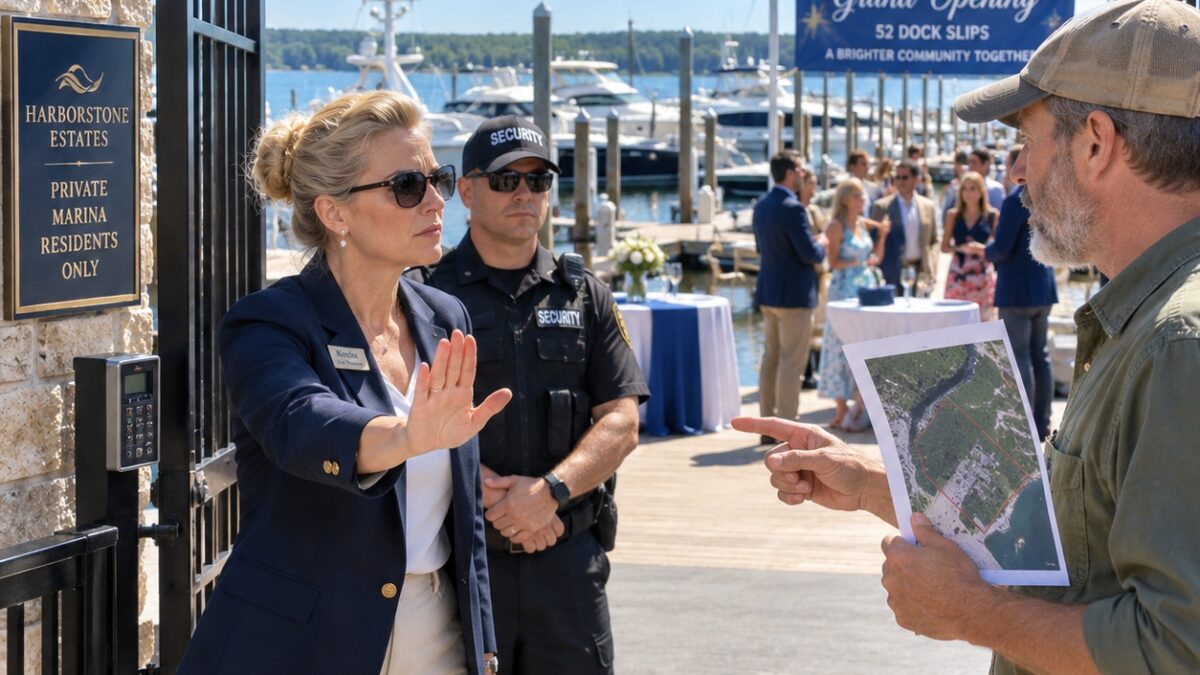
The morning Harborstone Estates opened its brand-new marina, the HOA president ordered me away from the shoreline my family had owned since the 1970s while fifty-two residents celebrated leases they believed were completely legal.
I could have argued at the gate, but instead I photographed every piling, every sign, every boundary marker, and one piece of paperwork the board clearly hoped I would never request.
By the time I discovered whose signature had been used to authorize the project, I stopped wondering whether the HOA had made a mistake and started asking who had known the truth before they collected the first dollar.
The woman standing behind the new marina gate looked me straight in the eye and said, “Lease holders only. You need to leave.”
For a second, I almost laughed.
Behind Kindra Pomeroy, fifty-two fresh dock slips stretched across Cypress Bend in two perfect rows.
New cedar decking gleamed beneath the morning sun.
Powder-coated railings.
Numbered posts.
Electrical pedestals.
Water hookups.
A wide gangway descended toward the floating docks while a blue HARBORSTONE ESTATES banner snapped above a ribbon-cutting table.
Someone had brought champagne.
Someone else had hired a string quartet.
Children ran along the grass wearing little paper captain hats.
Residents stood beside framed maps showing their assigned slips.
Several were still handing checks to a property-management employee beneath a white canopy marked:
HARBORSTONE MARINA MEMBERSHIP OFFICE
I looked at the keypad beside Kindra.
Then at the walkway.
Then beyond it toward the pilings driven into shoreline my family had owned for more than fifty years.
“Before you call security,” I said, holding up the county parcel map on my phone, “you should probably check who owns the ground under those docks.”
Kindra smiled like I had told her a joke she was too polite to enjoy.
“The board approved this project.”
“I didn’t ask who approved it.”
“The permits are valid.”
“Who signed the owner consent?”
Her smile tightened.
“The leases have already been executed, Mr. Nesbitt.”
“That still doesn’t answer my question.”
“You are interfering with a community amenity.”
I nodded toward the water.
“Built on whose shoreline?”
Kindra’s expression changed by maybe half an inch.
For most people, they would have missed it.
I spent thirty-two years around marine contractors, surveyors, engineers, lenders, and local permitting offices.
You learn to notice the moment confidence becomes calculation.
I took out my phone.
Not to call anyone.
To document.
The gate.
The Harborstone banner.
The numbered slips.
The construction staking.
The shoreline transition.
The location of the gangway.
The new gravel parking pad.
The concrete utility vault.
The county survey monument still visible twenty-one feet south of the gate.
Kindra crossed her arms.
“You cannot photograph our private marina.”
“I’m standing on a public road.”
She glanced toward the security guard approaching from the clubhouse.
“He refuses to leave HOA property,” she told him.
I handed the guard my driver’s license.
“I’m leaving the gated section,” I said. “Please record that I dispute Harborstone Estates’ ownership of this shoreline. I have a recorded deed and survey.”
The guard looked from me to Kindra.
Then at the crowd holding champagne glasses.
He wisely decided not to practice property law at a ribbon cutting.
“You should contact the sheriff or county.”
“That’s exactly what I’m doing.”
I walked back to my truck.
From sixty feet away, still on the public shoulder, I called the county mapping office.
Then the lake authority.
Then the marina contractor.
Then Harborstone’s management company.
I sent one short preservation email to all of them.
No accusations.
No threats.
No speeches.
Just a request that every permit, survey, owner authorization, invoice, lease, photograph, email, construction drawing, and project communication relating to the Cypress Bend marina be preserved.
Timestamped at 10:14 a.m.
As I drove away, Kindra was smiling for photographs beneath the Harborstone banner.
She probably thought I had backed down.
She had no idea I had already found the first crack in the entire project.
And it wasn’t in the wood, concrete, or steel.
It was buried in the paperwork.
FULL STORY CONTINUATION 👇👇
My name is Graeme Oliver Nesbitt.
Most people call me Graeme.
My father called me Oliver when he was angry and Graeme when he wanted help carrying something.
I was fifty-seven when Harborstone built the marina.
By then, I had spent most of my working life around marine construction, shoreline permitting, dredging estimates, retaining systems, and survey crews.
I wasn’t an attorney.
That becomes important later.
But I knew enough about real-estate documents to recognize when one deserved a closer look.
And I knew enough about docks to understand one basic rule:
Water does not erase land ownership.
People assume waterfront projects are simple because the finished product looks simple.
Drive some pilings.
Build decking.
Run power.
Collect checks.
But every shoreline project sits on a stack of permissions.
Land ownership.
Riparian rights.
Lake or waterbody authority.
Environmental review.
Building permits.
Electrical permits.
Access rights.
Insurance.
Construction easements.
Sometimes Army Corps involvement.
Sometimes state environmental agencies.
Sometimes county-level zoning.
Sometimes all of the above.
The prettier the marina, the uglier the paperwork can become.
Cypress Bend had belonged to my family before Harborstone Estates existed.
My grandfather, Oliver Nesbitt Sr., bought forty-three acres there in 1972.
Back then, nobody called it Cypress Bend.
The locals called it the south finger because the lake narrowed around a cypress-heavy shoreline before widening again toward the county dam.
My grandfather didn’t buy the land because it was glamorous.
He bought it because he liked fishing before sunrise.
He owned a small welding shop.
Raised three sons.
Didn’t golf.
Didn’t travel.
Didn’t care about investments.
He said land was the only thing he understood because nobody could move it without leaving tracks.
That turned out to be more true than he knew.
The deed he received in 1972 covered upland pasture, the narrow gravel access lane, approximately eleven hundred feet of shoreline, and an old timber dock that had already been half rotten when he bought the place.
My father, Robert Nesbitt, inherited the property with his brothers.
Over the years, they divided some acreage.
Sold some.
Kept the shoreline.
By 1998, my father owned the twelve-acre waterfront tract that later became the issue.
When he died, it came to me.
Simple chain of title.
No mortgage.
No HOA.
No conservation easement.
No recorded access agreement benefiting Harborstone.
That last one mattered more than anything.
Harborstone Estates came later.
Much later.
In 2006, a regional developer bought 160 acres north and east of our property.
Phase One opened in 2008.
Phase Two followed after the recession.
By 2017, Harborstone had more than three hundred homes, a clubhouse, pool, tennis courts, private roads, and one of those entrance monuments that looks like it cost more than my first house.
I never disliked the development.
That surprises people when they hear the story.
They expect me to say I hated subdivisions.
I didn’t.
Most residents were fine.
Retired teachers.
Doctors.
Small-business owners.
Families.
People who wanted a quiet lake community.
I repaired two residents’ private docks over the years.
Helped another with an erosion problem.
Even attended a Harborstone Fourth of July barbecue once because a friend lived there.
The HOA and I coexisted for more than a decade without drama.
Then the board changed.
Kindra Pomeroy became president.
I first met her in 2019.
She drove onto my gravel lane in a black Range Rover and asked whether I would consider selling “the unused shoreline area.”
I knew exactly what she meant.
Cypress Bend.
Harborstone had lake access through a narrow community dock farther east, but it was tiny.
Twelve slips.
Waiting list years long.
Residents complained.
Kindra wanted expansion.
“How much land?” I asked.
“Possibly two acres.”
“No.”
She smiled.
“You haven’t heard the offer.”
“I don’t need to.”
“We would pay fair value.”
“I use it.”
She looked toward the old dock.
“For what?”
That irritated me.
“Fishing.”
“That’s all?”
“That’s enough.”
She smiled again.
The same smile she gave me at the marina gate years later.
Polite.
Dismissive.
“Think about it.”
“I have.”
I thought that was the end.
It wasn’t.
Over the next two years, Harborstone made three informal offers.
Then one formal.
The highest was $410,000 for approximately 2.3 acres plus shoreline access.
Not bad money.
I said no.
Not because I believed the land was worth millions.
Because I didn’t want to sell.
That is something people sometimes struggle to understand.
Value and price are not the same.
There are things worth more to you than the market would ever pay.
My father taught me to fish there.
My grandfather’s old metal chair still sat near a cypress stump.
I kept a small shed where Dad stored tackle.
His initials were carved into the inside of the door.
I could sell someday.
Maybe.
But not because an HOA wanted a marina.
Kindra stopped making offers.
Then Harborstone became very quiet.
Too quiet.
I should have noticed.
The first sign came in 2022 when I saw survey flags near my northern boundary.
Not on my land exactly.
Close.
I called the survey company listed on the stakes.
They said Harborstone was conducting “conceptual planning.”
I asked whether they had been authorized to enter my parcel.
The project manager said no.
I asked for their survey limits.
He emailed a PDF.
Everything appeared north of my line.
Fine.
Six months later, I received a letter from Harborstone’s attorney.
Not an offer.
A “request for clarification” regarding an alleged historical access area along Cypress Bend.
The letter cited old subdivision-planning documents and mentioned “community expectations regarding lake access.”
Expectations.
Not ownership.
Not easement.
Expectations.
I sent it to my attorney, Leah Monroe.
Leah handled real estate and land disputes.
She was forty-four, sharp, almost aggressively organized, and allergic to vague nouns.
She read the letter.
“What exactly are they asking?”
“I don’t know.”
“They don’t either.”
She circled one sentence.
Harborstone Estates has historically understood the Cypress Bend access corridor to be associated with subdivision lake amenities.
Leah looked up.
“Historically understood by whom?”
“Good question.”
“Did your father ever sign anything?”
“No.”
“Grandfather?”
“No.”
“Recorded easement?”
“None.”
“Any licenses?”
“Not that I know.”
“Did residents use the shoreline?”
“Sometimes walkers wandered through.”
“You stop them?”
“Usually not.”
“Any dock?”
“No.”
“Maintenance?”
“No.”
“HOA signs?”
“No.”
She nodded.
“Then this looks like fishing.”
“Legal fishing?”
“Paper fishing.”
She wrote back asking them to identify any recorded instrument creating the claimed right.
They didn’t.
Instead, Harborstone’s attorney responded that no formal claim was being asserted “at this time.”
I filed the correspondence.
That phrase bothered me.
At this time.
Then everything accelerated.
In early 2024, Harborstone announced plans for a major marina.
The newsletter called it:
THE HARBORSTONE WATERFRONT EXPANSION
Fifty-two private slips.
Kayak racks.
Fishing platform.
Utility stations.
Security gate.
Reserved parking.
Annual lease fees between $7,800 and $11,500 depending on slip size.
Initial three-year commitment.
The rendering was gorgeous.
I received it from a resident I knew named Jack Moreno.
He called me.
“Graeme, you sell?”
“No.”
Silence.
“You sure?”
“I think I’d remember.”
“They’re showing the marina at Cypress Bend.”
I opened the PDF.
There it was.
My shoreline.
Or close enough that my pulse changed.
The rendering showed the marina extending from a point that appeared to cross my northern boundary.
But renderings aren’t surveys.
I didn’t panic.
I requested project documents from the lake authority.
The preliminary concept plan showed a legal description referencing something called:
Harborstone Waterfront Tract C
I had never heard of Tract C.
I checked the Harborstone plat.
There was a Tract A.
Common open space.
Tract B.
Stormwater parcel.
No waterfront Tract C on the recorded plat I had.
I emailed the authority.
“Please provide deed reference for Tract C.”
They responded two days later.
The project applicant had submitted an owner authorization identifying Harborstone Estates HOA as owner or authorized controller.
I asked for a copy.
No response initially.
I followed up.
Then they sent a packet.
That packet changed everything.
The owner authorization contained a signature.
Robert O. Nesbitt
My father.
He had been dead seven years.
I stared at it for a long time.
Not because I thought ghosts had started signing permit applications.
Because the signature looked almost convincing.
Almost.
Dad signed his middle initial with a long downward loop.
This one had it.
But the O was too round.
The N too clean.
More importantly, the date beside the signature was February 12, 2023.
My father died October 18, 2016.
I called Leah.
She answered:
“Please tell me you are not calling about another letter that says ‘historically understood.’”
“I found Dad’s signature.”
Silence.
“On what?”
“The marina owner authorization.”
Longer silence.
“Alive or dead?”
“Dead.”
“I’m coming over.”
She arrived forty minutes later.
I had printed everything.
The authorization was a one-page form.
Project:
Harborstone Marina Expansion.
Property owner:
Harborstone Estates Association / Robert O. Nesbitt, adjacent shoreline grantor.
It was poorly drafted.
The slash alone made no legal sense.
Signature:
Robert O. Nesbitt.
Date:
2/12/23.
Below it, handwritten:
Owner consents to construction and access as depicted on attached Exhibit B.
Leah picked up the paper carefully.
“This is a copy?”
“Yes.”
“Did they provide original?”
“No.”
“Exhibit B?”
“Missing.”
Her eyes lifted.
“What?”
“Packet has Exhibit A. Construction plan. No Exhibit B.”
She flipped pages.
“You asked?”
“Not yet.”
She smiled without humor.
“Now we ask very politely.”
We sent a preservation letter immediately.
To Harborstone.
Lake authority.
Engineer.
Surveyor.
General contractor.
Management company.
Insurance carrier if known.
We requested original owner authorization, all exhibits, all communications regarding shoreline ownership, title review, surveys, and signature sourcing.
Then Leah told me something important.
“Do not accuse anyone of forging this yet.”
“My father didn’t sign it.”
“I know.”
“So someone did.”
“Maybe.”
“What other possibility exists?”
“Copied old consent. Administrative mix-up. Reused signature image. Misdated document. Unauthorized signing. Actual forgery. We don’t know.”
“I know what it looks like.”
“Looking is not proving.”
She tapped the authorization.
“And if this becomes litigation, discipline now matters.”
So we stayed disciplined.
Harborstone responded ten days later.
Kindra herself copied on the email.
Their attorney claimed the document had been “provided by a former project consultant” and that the HOA was “investigating an apparent clerical discrepancy.”
Clerical discrepancy.
Dead man signing a permit.
Very clerical.
Meanwhile, construction started.
That was the part I still struggle to understand.
They knew I disputed ownership.
They knew the signature issue existed.
They built anyway.
I drove out one morning and found barges.
Pile driver.
Crews.
Survey stakes.
The gangway foundation poured near my line.
I called the contractor’s superintendent.
“Bill, I’m giving you notice there is an active ownership dispute.”
He was calm.
“We were told it was resolved.”
“By whom?”
“Owner.”
“Which owner?”
Silence.
Then:
“You need to talk to Harborstone.”
“I am.”
I emailed him my deed and survey.
He forwarded to their office.
Construction paused for four days.
Then resumed.
Leah filed for injunctive relief.
Not dramatic.
No judge pounding a gavel.
Emergency motions are paperwork, affidavits, exhibits, schedules.
Harborstone argued construction was substantially within HOA-controlled waterside access and any encroachment was “de minimis.”
That phrase made me laugh.
Fifty-two slips.
De minimis.
The court declined to halt the entire project immediately without a fuller evidentiary record but ordered no permanent rights to be created affecting disputed shoreline and required both parties to preserve evidence.
That should have made Harborstone careful.
Instead, Kindra accelerated presales.
That became one of the worst decisions they made.
Residents received an email:
MARINA LEASE DEADLINE APPROACHING
Deposits due.
Preference based on payment timing.
Three-year leases.
Transfer fees.
Initiation fee.
Capital contribution.
Some residents paid more than $20,000 upfront.
Jack Moreno called.
“They’re telling people the lawsuit is nuisance litigation.”
“What exactly?”
“That you’re claiming a survey error over twenty feet.”
I laughed.
“Twenty feet?”
“Yeah.”
“They show you documents?”
“No.”
“Do not sign anything you haven’t read.”
“I already signed.”
My stomach dropped.
“How much?”
“Twelve-five deposit.”
“Jack.”
“I know.”
“Did the lease mention ownership dispute?”
“No.”
“Any litigation disclosure?”
“Not that I remember.”
I asked him to send it.
The lease was twenty-three pages.
Beautifully formatted.
Lots of rules.
Slip maintenance.
Insurance.
Boats.
Transfer restrictions.
Termination.
One representation stood out:
Association represents that it possesses all ownership, easement, license, and access rights necessary to provide the Marina Facilities during the Lease Term.
I sent it to Leah.
She stared.
“They signed this after receiving our ownership notice?”
“Yes.”
“What date?”
I pointed.
Two weeks after the preservation letter.
She leaned back.
“That’s a problem.”
“For them?”
“For everyone.”
Because now it was no longer only a land dispute.
Harborstone was making contractual representations to residents while knowing ownership was contested.
Maybe they believed they would win.
That matters legally.
But did they disclose uncertainty?
No.
Did they tell leaseholders a dead man’s signature appeared in the permit file?
No.
Did they tell them an exhibit was missing?
No.
Did they tell them the adjacent landowner had sent a formal dispute?
No.
They kept selling.
Then we received the original surveyor’s internal file.
That was the second crack.
Harborstone’s survey contractor was Northline Geomatics.
Professional firm.
Good reputation.
The project file included an email from a senior surveyor named Alicia Grant to Kindra and Harborstone’s manager.
Date:
November 3, 2022.
Subject:
Cypress Bend Boundary Issue
The email said:
Our field recovery does not support the HOA’s proposed southern shoreline limit. Existing monumentation and the Nesbitt deed place the apparent parcel line north of the proposed gangway landing. We recommend title counsel confirm ownership or obtain a recorded easement/license before final design.
I read it twice.
Then again.
They knew.
Before permit filing.
Before leases.
Before construction.
They knew the survey didn’t support them.
A second email from Alicia:
Please note we cannot certify Harborstone ownership of the southern access strip based on documents currently provided.
Then a reply from Kindra:
Proceed using planning line previously provided. Legal will clean up access.
Legal will clean up access.
Leah printed that one.
Put it in a red folder.
“That sentence is staying with us.”
The survey company had later issued a limited topographic plan.
Not a boundary certification.
Somewhere during permitting, that topo plan became attached to an owner authorization as though it supported ownership.
It didn’t.
Then came the missing Exhibit B.
We finally obtained it through discovery.
It was a sketch.
Not recorded.
Not signed by a surveyor.
It showed a shaded strip labeled:
Future Marina Access Easement
Across my land.
Future.
Not existing.
No deed reference.
No grantor.
No legal description.
It looked like a planning concept from 2007.
Leah traced the title block.
“Developer master plan.”
Exactly.
Harborstone had apparently taken a future concept easement that was never finalized and treated it, years later, like an existing right.
That was the heart of the dispute.
The original developer may have intended to acquire the strip.
But intention is not conveyance.
Plans are not deeds.
A dashed line is not ownership.
Then we learned why no legal description existed.
The acquisition had fallen apart in 2008.
My father had negotiated with the developer.
I found the letters in an old steel file cabinet in my workshop.
Dad saved everything.
Offer:
$85,000 for a permanent pedestrian and marina access easement.
Dad’s response:
No.
Developer increased:
$125,000.
Dad’s response:
No.
Then one final letter.
We understand Mr. Nesbitt does not wish to encumber the family shoreline. Future subdivision plans will be revised accordingly.
Signed by developer counsel.
I sat in my workshop holding that letter and laughed.
Not because it was funny.
Because my father had already fought this battle sixteen years earlier.
He had said no.
And somebody had simply resurrected the dead plan after he was gone.
I called Leah.
“I found the 2008 file.”
“What’s in it?”
“The murder weapon.”
“Graeme.”
“Metaphorically.”
“Please stop talking like television.”
I read the letter.
She went quiet.
Then:
“Scan everything.”
I did.
Meanwhile, the marina neared completion.
Harborstone’s board minutes became important.
Getting them took time.
Not because they were secret exactly.
Because discovery is slow.
When we finally received them, the timeline became ugly.
October 2022:
Marina committee discusses “southern access complications.”
November:
Northline warns boundary not supported.
December:
Board authorizes counsel to “evaluate acquisition options.”
January 2023:
Executive session references “Nesbitt access.”
February:
Owner authorization signed with my dead father’s name.
March:
Permit application submitted.
April:
Board approves presale marketing.
June:
Outside counsel memo recommends “resolving shoreline control prior to long-term lease commitments.”
That memo had not been shared with residents.
July:
Kindra responds to management:
If we pause sales now, we lose construction financing. Continue deposits while legal resolves access.
There it was.
The calculation.
Continue deposits.
Not because they believed there was no issue.
Because stopping sales threatened financing.
That distinction became central.
The marina had a budget approaching $3.8 million.
Harborstone financed it through a combination of reserve funds, special assessment, bank line, and presale lease revenue.
Deposits mattered.
Without them, the project could stall.
So the board faced a choice.
Disclose the dispute and risk financing.
Or keep collecting while hoping lawyers fixed the ownership later.
They chose the second.
Kindra later insisted they believed an easement could be negotiated or established.
Maybe.
But the residents were never told.
That was the moral failure long before any final legal ruling.
Then the permit problem worsened.
The lake authority’s permit required certification that the applicant had adequate upland access and owner consent.
The missing legal description meant the approval rested on incomplete information.
When the authority learned my father had been dead at the signature date, they opened an administrative review.
Construction temporarily paused again.
Harborstone reacted publicly.
Newsletter:
MARINA PROJECT TARGETED BY OUTSIDE LANDOWNER
Outside landowner.
My land touched the marina.
But apparently I was outside.
The newsletter said:
The board remains confident that decades-old development rights and established subdivision plans support Harborstone’s access.
No mention of dead signature.
No mention of missing easement.
No mention of survey warnings.
Residents divided.
Some sent me respectful emails.
Others didn’t.
One:
Stop holding 300 families hostage because your father refused progress.
Another:
You have more shoreline than you use. This is selfish.
Another:
We’ll remember what you did to our property values.
I printed them.
Not because I planned revenge.
Because litigation teaches you everything can matter later.
Then one morning, somebody cut the chain on my gravel access road.
I had installed it years earlier to discourage nighttime fishing.
Nothing sophisticated.
Metal gate.
Chain.
Lock.
I found it hanging open.
Bolt cutter marks.
No camera there at the time.
I replaced it.
Added a trail camera.
Three nights later, the camera captured a golf cart from Harborstone.
Two men.
Residents.
They stopped.
Read my sign.
Turned around.
No issue.
A week later, a contractor pickup approached.
Stopped.
Driver got out.
Photographed the gate.
Left.
I sent the image to Leah.
She wrote:
Document. Do not engage.
That became the motto of my life.
Document.
Do not engage.
Then Harborstone began installing utilities.
Electrical conduit needed to cross the disputed strip.
I found orange paint near my boundary.
Called contractor.
They said layout came from engineer.
I emailed stop notice regarding my property.
They paused that section.
Kindra called me directly for the first time in months.
“Graeme.”
“Kindra.”
“This has gone far enough.”
I almost laughed.
“You built fifty-two slips.”
“We need a practical solution.”
“Good.”
“What do you want?”
Interesting.
Not:
You’re wrong.
Not:
We own it.
What do you want.
I said,
“Recognition of title and removal of encroachments.”
She exhaled.
“That is not practical.”
“It’s extremely practical.”
“You know the marina cannot function without that landing.”
“I know.”
“You’re trying to extort the association.”
“No.”
“You rejected every purchase offer.”
“Yes.”
“So this is about leverage.”
“No.”
“What is it about?”
I looked toward Cypress Bend from my porch.
“My father said no.”
Silence.
“You’re holding us to a negotiation from sixteen years ago?”
“I’m holding you to a deed from 1972.”
She became cold.
“You may win a strip of dirt and lose every neighbor around you.”
I smiled.
“I don’t live in Harborstone.”
Then hung up.
Leah was furious when I told her I had taken the call.
“Stop talking to represented parties.”
“She called me.”
“Don’t answer.”
“She called from her personal number.”
“Graeme.”
“I know.”
“Do you?”
“Yes.”
“You’re terrible at litigation.”
“I’m excellent at being right.”
“That is not the same thing.”
She was correct.
The preliminary injunction hearing came first.
Harborstone argued historical planning intent.
Possible implied rights.
Equitable estoppel.
Reliance.
Community expectations.
A stack of legal theories.
Leah focused on documents.
Recorded deed.
No easement.
2008 rejection.
Survey warning.
Dead signature.
Missing Exhibit B.
The judge, Harold Benton, was in his early sixties.
Quiet.
Almost expressionless.
The kind of judge lawyers fear because they cannot read him.
After nearly four hours, he issued a temporary order.
No additional construction on disputed upland area.
No new lease execution affecting contested access.
Existing marina could remain physically in place pending final adjudication.
No boat occupancy until access and permitting issues clarified.
That last part exploded Harborstone.
Residents had paid.
Summer was approaching.
Fifty-two slips.
Empty.
The board blamed me.
Kindra held a town-hall meeting.
Jack Moreno attended and recorded notes, not audio.
According to Jack, Kindra told residents:
“Mr. Nesbitt has exploited a technicality.”
Technicality.
Dead signature.
Missing easement.
Survey warning.
Just technicalities.
A resident asked why leases were sold before litigation resolved.
Kindra answered:
“We had no reason to believe the access claim lacked merit.”
That statement later became important because internal emails showed quite a lot of reason to believe uncertainty existed.
Another resident asked:
“Did the HOA know he disputed ownership before we paid?”
Kindra allegedly said:
“Not in any meaningful way.”
Meaningful.
That word has buried more people in litigation than outright lies.
Because it invites documents.
We had the timestamp.
Preservation letter before many payments.
Attorney correspondence.
Survey email.
Outside counsel memo.
They knew.
The real turning point came from someone inside Harborstone.
His name was Dennis Cole.
Treasurer.
Retired CPA.
Board member for three years.
He contacted Leah.
Not me.
Smart.
He had resigned two days earlier.
Leah called me.
“Someone wants to talk.”
“Who?”
“Former treasurer.”
“About?”
“Everything.”
Dennis met us at Leah’s office.
He looked exhausted.
Brought a banker’s box.
Not stolen records.
Copies he had lawfully retained from board service, according to his lawyer.
He had counsel.
That told me he was serious.
Dennis said:
“I kept thinking legal would fix it.”
No one interrupted.
“We were told the access problem was temporary.”
“By whom?” Leah asked.
“Kindra. Management. Our project attorney.”
“Which attorney?”
He named him.
“Did you see title work?”
“No.”
“Any recorded easement?”
“No.”
“When did you learn none had been found?”
“November 2022.”
I stared.
Before permit.
Before presales.
“Why keep going?”
Dennis rubbed both hands together.
“Because we had already spent eight hundred thousand on design, engineering, deposits, and mobilization.”
Sunk cost.
The most dangerous phrase in a bad project.
“And the signature?” Leah asked.
Dennis went pale.
“I didn’t see that form until discovery started.”
“Do you know who prepared it?”
He hesitated.
“I know who circulated it.”
“Who?”
“Kindra.”
My stomach tightened.
Dennis opened a folder.
Email.
Kindra to management, February 10, 2023:
Attached is legacy owner consent from Nesbitt file. Please adapt for current lake authority submission.
Legacy consent.
Adapt.
The attachment was an old 2007 document.
Signed by my father.
Not for a marina easement.
For temporary permission allowing the original developer to perform soil testing near the northern edge of his property.
Limited.
Expired.
Specific purpose.
Someone had extracted the signature.
The current authorization showed the same signature image.
Same pixel artifacts.
Same slight ink gap.
It had been copied.
I stared at the pages side by side.
My hands went cold.
Leah looked at Dennis.
“Who adapted it?”
“I don’t know.”
“Did Kindra?”
“I don’t know.”
“Management?”
“I don’t know.”
“Project consultant?”
“I don’t know.”
That uncertainty mattered.
We could prove the signature image came from an old document.
Not necessarily who placed it on the new form.
Later forensic review confirmed it.
The current “signature” was digitally reproduced from the 2007 permission.
Not physically signed.
My father’s signature had been lifted.
Now the case changed.
Harborstone’s attorney withdrew from representing the association on certain issues due to potential witness concerns.
New counsel came in.
Insurance carriers got involved.
The lake authority suspended the marina permit pending reapplication.
The contractor filed for payment.
Leaseholders demanded refunds.
Bank lender froze undisbursed funds.
The $3.8 million marina sat empty under summer sun.
It looked beautiful.
That made everything worse.
People could see what they paid for.
Couldn’t use it.
Anger grew.
At me first.
Then toward the board.
Dennis’s documents included a financial forecast.
If all fifty-two leases remained active, Harborstone expected enough revenue to service debt and replenish reserves.
If more than fifteen leases were canceled, projected cash flow went negative.
If the permit failed entirely, the HOA could face assessments approaching five figures per household depending on insurance and recovery.
That scared residents.
Now they wanted facts.
A group formed:
Harborstone Marina Members Committee.
Not anti-HOA.
Not pro-me.
Pro-money.
Nothing motivates document review like twelve thousand dollars disappearing into a locked gate.
They hired separate counsel.
That changed dynamics again.
The leaseholders sued Harborstone.
Class-related claims were considered but not immediately certified.
Individual and collective contract claims.
Misrepresentation allegations.
Refund demands.
Now Harborstone was fighting two directions.
Me over land.
Its own residents over leases.
The board fractured.
Two members resigned.
Kindra stayed.
That still amazes me.
She claimed resigning would be “abandoning the community during crisis.”
Maybe she believed it.
People can turn stubbornness into duty if they use the right vocabulary.
Mediation happened.
All sides.
Long conference room.
Bad coffee.
Harborstone offered me money.
A lot.
$900,000 for a permanent easement.
I said no.
Then $1.2 million.
No.
Residents’ counsel stared at me like I was insane.
Maybe I was.
Leah asked privately:
“What is your number?”
“I don’t have one.”
“Everyone has one.”
“I don’t.”
“You need to think economically.”
“I have.”
“Then?”
“I don’t want a fifty-two-slip marina there.”
“Would you allow smaller?”
That question stopped me.
Maybe.
I hadn’t considered compromise because every prior interaction had felt like theft.
“What smaller?”
“Ten slips? Twelve? Limited hours? No commercial leases? Insurance? Maintenance?”
I thought.
“My father had an old dock.”
“Yes.”
“Twelve might work.”
Leah nodded.
“Now we have a negotiation.”
But Harborstone didn’t want twelve.
They had built fifty-two.
Their debt required fifty-two.
Their political promise required fifty-two.
So mediation failed.
The case headed toward trial.
Before that, discovery produced one more devastating email.
Kindra to project manager, four days before opening ceremony:
Graeme may appear. Security should treat him as non-member trespasser and avoid discussion of boundary issue. Do not allow him inside marina area.
I read it.
Then looked at Leah.
“That morning wasn’t spontaneous.”
“No.”
“She knew I might come.”
“Yes.”
“And told security to call me a trespasser.”
“Yes.”
The ribbon cutting had been staged with the ownership dispute already known.
That angered me more than the copied signature.
The signature may have been someone else’s act.
The gate confrontation was Kindra’s.
She knew enough to anticipate me.
Still smiled.
Still sold leases.
Trial began fourteen months after I stood at the marina gate.
By then, the marina wood had weathered gray.
No boats.
Bird droppings on rails.
Weeds near the parking area.
Fifty-two numbers facing empty water.
Judge Benton presided without jury over the core title and equitable claims.
Separate claims from leaseholders were coordinated but not identical.
The courtroom was full.
Residents.
Reporters.
Contractors.
Former board members.
My father would have hated the attention.
Day one was title.
Boring to almost everyone.
Beautiful to me.
Chain of title.
Recorded deeds.
Parcel descriptions.
Surveys.
Monuments.
No recorded easement.
No conveyance.
Harborstone argued historical intent.
Developer plan.
Subdivision scheme.
Reliance on conceptual documents.
Leah asked their title expert:
“Can you identify the recording book and page containing a marina access easement across Mr. Nesbitt’s parcel?”
“No.”
“Any deed?”
“No.”
“License?”
“No.”
“Recorded memorandum?”
“No.”
“Then what instrument created Harborstone’s right?”
The expert said:
“It is our position rights may arise through the development history and equitable doctrines.”
Leah:
“That was not my question.”
Judge Benton looked over his glasses.
“Answer if you can.”
He couldn’t.
Day two was the 2008 negotiation.
Developer attorney letter.
Dad’s rejection.
Final acknowledgment.
Future plans revised.
That hurt Harborstone.
Because historical intent cut both ways.
Yes, the developer wanted access.
Then failed to obtain it.
That is not evidence Harborstone later owned it.
It is evidence someone knew they needed to acquire it.
Day three was Northline.
Alicia Grant testified.
Calm.
Professional.
She explained field monument recovery.
Deed calls.
Boundary analysis.
She refused to exaggerate.
That made her credible.
Leah asked:
“Did Northline ever certify that Harborstone Estates owned the southern marina access strip?”
“No.”
“Did you warn Harborstone?”
“Yes.”
“When?”
“November 2022.”
“Before construction?”
“Yes.”
“Before leases?”
“Yes.”
“Before permit submission?”
“Yes.”
“What did you recommend?”
“Title review or acquisition of a recorded right.”
Harborstone counsel asked:
“Was your email a final boundary opinion?”
“No.”
Good point.
“Could title counsel disagree?”
“Yes.”
“Could equitable rights exist outside record title?”
“Possibly. I’m not a lawyer.”
Also good.
Then Leah redirected:
“Did anyone ever give you a recorded document establishing the easement?”
“No.”
Simple.
Day four was the signature.
Forensic document expert.
Old 2007 permission.
Current 2023 authorization.
Digital comparison.
Same signature image.
Same artifacts.
My father dead.
The courtroom became silent.
Harborstone’s new counsel did something smart.
They did not defend the signature.
They argued unauthorized project misconduct should not determine underlying property rights.
Legally, that was reasonable.
A bad signature does not automatically prove no easement.
So Leah separated issues.
Title first.
Misconduct second.
Kindra testified on day five.
I had waited for that.
She wore navy.
No jewelry except wedding ring.
Hair perfect.
Voice steady.
Harborstone counsel began gently.
“Did you personally forge Robert Nesbitt’s signature?”
“No.”
“Did you instruct anyone to forge it?”
“No.”
“Did you believe Harborstone possessed marina access rights?”
“Yes.”
“Based on what?”
“Original development plans, long-standing representations, consultant advice, and counsel.”
“Did you intend to steal Mr. Nesbitt’s land?”
“No.”
“Did you intend to deceive residents?”
“No.”
Reasonable questions.
Reasonable answers.
Then Leah stood.
“Ms. Pomeroy, when did you first receive Northline’s November 3, 2022 email?”
Kindra paused.
“I don’t recall exact date.”
“It was sent to you?”
“Yes.”
“It stated field recovery did not support Harborstone’s proposed southern shoreline limit?”
“That was preliminary.”
“That is not my question.”
“Yes.”
“It recommended obtaining title confirmation or a recorded right?”
“Yes.”
“Did Harborstone obtain a recorded easement before construction?”
“No.”
“Did it obtain a deed?”
“No.”
“License?”
“We believed existing rights—”
“Did it obtain a written license from Mr. Nesbitt?”
“No.”
“Did you know Mr. Nesbitt had rejected prior acquisition attempts in 2008?”
“I learned later.”
“When?”
She hesitated.
“During the project.”
“Before marina opening?”
“Yes.”
“Before all fifty-two leases were sold?”
Another hesitation.
“Yes.”
Leah walked to the exhibit monitor.
Displayed Kindra’s email:
If we pause sales now, we lose construction financing. Continue deposits while legal resolves access.
“Did you write this?”
“Yes.”
“What did ‘resolves access’ mean?”
“That attorneys were evaluating rights.”
“So access was unresolved.”
“We believed it would be resolved favorably.”
“That wasn’t my question.”
Kindra’s jaw tightened.
Leah:
“Was access resolved when you told management to continue taking deposits?”
“No final determination had been made.”
“Thank you.”
Then the owner consent.
“Did you circulate a legacy owner consent?”
“I forwarded documents from our project file.”
“Did you write ‘adapt for current lake authority submission’?”
“Yes.”
“What did you mean by adapt?”
“Use the appropriate information.”
“Did you authorize copying Robert Nesbitt’s signature?”
“No.”
“Did you review the final owner authorization before submission?”
“I don’t remember.”
Leah showed an email:
Looks fine. Submit.
Attachment: authorization.
Kindra stared.
“I may have reviewed the packet generally.”
“Did you know Robert Nesbitt was dead?”
“Yes.”
“How?”
“Everyone knew.”
Silence.
Even Harborstone’s counsel shifted.
Leah waited.
Then:
“When you wrote ‘looks fine,’ did you notice the dead landowner’s signature dated 2023?”
Kindra’s face changed.
“I did not focus on that field.”
“Did you focus on collecting lease deposits?”
Objection.
Sustained.
Leah moved on.
Then my gate.
She showed the email instructing security to treat me as non-member trespasser.
“Why?”
“Because the marina area was designated for members.”
“Did you know I claimed ownership?”
“Yes.”
“Did you know my deed included the disputed shoreline?”
“I knew you asserted that.”
“Did you tell security there was an active title dispute?”
“No.”
“Did you tell leaseholders?”
“Our counsel—”
“Yes or no.”
“No.”
“Did you tell residents before accepting deposits that Northline would not certify ownership?”
“No.”
“Did you tell them the 2008 developer had failed to obtain the easement?”
“No.”
“Did you tell them the owner consent carried the signature of a deceased man?”
“I did not know the issue until later.”
Leah displayed timeline.
The preservation letter.
Before ribbon cutting.
Kindra had been copied.
“By the morning you ordered Mr. Nesbitt removed from the marina, did you know the signature was disputed because Robert Nesbitt had died in 2016?”
“Yes.”
“Yet you told residents permits were valid?”
“Our counsel believed—”
“Did you tell them why the permit was under review?”
“No.”
That was enough.
My testimony came last among major witnesses.
Leah asked about history.
Land.
Dad.
Offers.
My refusal.
I tried not to become sentimental.
Courts care about facts.
Still, when she showed Dad’s 2008 letter, my voice changed.
“Is that your father’s signature?”
“Yes.”
“How do you know?”
“Thirty years of birthday cards.”
A few people laughed softly.
Judge Benton did too.
Then Harborstone counsel cross-examined.
He was good.
“Mr. Nesbitt, you rejected $1.2 million in mediation?”
“Yes.”
“More than the disputed strip’s likely market value?”
“Probably.”
“So this isn’t about compensation.”
“No.”
“You simply don’t want Harborstone residents using the shoreline.”
“I don’t want a fifty-two-slip marina there.”
“You’ve allowed people to fish there.”
“Sometimes.”
“Walk there.”
“Sometimes.”
“So residents have historically accessed the area.”
“Some individuals crossed with permission or tolerance.”
“Without written permission?”
“Correct.”
“Without payment?”
“Correct.”
“You never posted no-trespassing signs until recently?”
“Correct.”
“You never fenced the entire shoreline?”
“No.”
“You allowed community use for years.”
“Informal occasional use.”
He leaned in.
“Isn’t it true you only objected when Harborstone improved the property?”
“No.”
“When did you object?”
“When you asked to buy it.”
“That’s not objection.”
“I said no.”
The courtroom smiled.
He did not.
“You are aware equity sometimes protects long-standing reliance?”
“I’m aware lawyers say many things.”
Leah closed her eyes.
Judge Benton said:
“Mr. Nesbitt, answer the questions.”
“Sorry.”
Harborstone counsel continued.
“You benefited from Harborstone’s maintenance of nearby trails.”
“No.”
“Property values increased because Harborstone developed.”
“Probably.”
“Yet you now seek removal of a $3.8 million improvement.”
“Yes.”
“Regardless of cost to hundreds of neighbors.”
“I seek recognition that they cannot build on my land because the project is expensive.”
He paused.
That answer mattered.
Then:
“You don’t live on the disputed shoreline full time.”
“No.”
“So you’re denying fifty-two families a marina you rarely use.”
I looked at him.
“Ownership isn’t a usage contest.”
Silence.
Leah didn’t need redirect.
Closing arguments lasted hours.
Harborstone’s strongest case wasn’t that they had a deed.
They didn’t.
It was that equitable principles, historical development expectations, and long-standing access should support some form of right or remedy short of dismantling the marina.
Leah argued equity should not create what the developer failed to purchase, particularly after explicit rejection.
She emphasized Harborstone had notice.
Survey warning.
2008 file.
Current dispute.
Still built.
Still sold leases.
Still represented rights as existing.
Judge Benton took the matter under advisement.
We waited six weeks.
Longest six weeks of my life.
The written order was seventy-four pages.
Leah called at 6:52 a.m.
“You awake?”
“I am now.”
“Court ruled.”
I sat up.
“And?”
“Read it yourself.”
“Leah.”
“Title confirmed in your favor.”
I closed my eyes.
The room went silent.
She continued.
“No recorded easement. No enforceable marina access right established. Equitable theories rejected based heavily on the 2008 failed acquisition and later notice.”
I sat on the bed.
“What about the docks?”
“Complicated.”
“Meaning?”
“The court separates water structures from upland access and lease validity.”
“Leases?”
Pause.
Then:
“Voided.”
I didn’t speak.
“All fifty-two?”
“Yes.”
“Why?”
“The association represented rights it did not possess and leases depend on access the court found it could not lawfully provide.”
I stood.
Walked toward the window.
Morning light.
“Refunds?”
“Likely restitution process, offsets subject to separate claims.”
“What about marina removal?”
“Court ordered parties to submit remedial plans. Not immediate demolition.”
That was smart.
Courts rarely enjoy destroying expensive structures if another lawful solution exists.
“What about signature?”
“Order calls it unauthorized reproduction and refers related concerns back to appropriate agencies. Court does not determine criminal intent.”
Good.
“What about Kindra?”
“Not personally ordered to prison, if that’s what you’re asking.”
“I wasn’t.”
“You were thinking it.”
Maybe.
The order said more.
Harborstone had no valid basis to exclude me from the disputed shoreline.
The HOA could not enforce marina lease rights across my parcel.
Permits relying on false or incomplete owner authorization required correction.
Leaseholders were entitled to treat their agreements as void due to failure of essential access rights.
Harborstone had to account for collected funds.
The board had breached certain fiduciary and disclosure duties in how it continued marina commitments after material ownership concerns emerged.
Some individual liability questions remained separate.
The copied signature issue was referred to authorities and professional regulators for review.
The marina itself sat in legal limbo.
Built.
Empty.
Expensive.
Useless without access.
Residents exploded.
Not at me this time.
At Harborstone.
Special meeting called.
Standing room only.
Kindra resigned twenty minutes before it began.
Her resignation letter blamed “a campaign of personal vilification.”
She acknowledged no wrongdoing.
Dennis later told me that was classic Kindra.
She could lose a war and still write the press release.
Three other board members resigned.
An interim board formed.
The management company’s contract was terminated.
Marina project counsel faced a malpractice claim.
The consultant who prepared the owner authorization was investigated.
The lake authority revoked and reopened parts of the permit process.
The contractor sued for unpaid retainage.
Insurance carriers fought coverage.
Residents demanded refunds.
The $3.8 million number became almost meaningless because secondary costs climbed.
Attorney fees.
Interest.
Consultants.
Refunds.
Assessments.
Repairs to unused infrastructure.
The true damage was larger.
Then the new board called me.
Not Kindra.
Robert Chen.
Interim president.
Retired cardiologist.
I had met him once.
He said:
“Mr. Nesbitt, I’d like to start over.”
I respected that.
“How?”
“No assumptions.”
“Good.”
“No lawyers at first meeting.”
I hesitated.
“Leah will kill me.”
“You can tell her afterward.”
“She’ll still kill me.”
He laughed.
We met at a diner.
Robert brought Dennis.
I brought nobody.
That was technically unwise.
I told Leah later.
She did, in fact, nearly kill me.
Robert began:
“We have fifty-two dock slips we cannot lawfully use.”
“Yes.”
“You have shoreline access we need.”
“Yes.”
“You don’t want fifty-two slips.”
“No.”
“What would you accept?”
There it was.
Not what price.
What configuration.
I took out a notebook.
“Twelve.”
Dennis blinked.
“Slips?”
“Yes.”
“Existing old community dock has twelve.”
“I know.”
“So twenty-four total?”
“Yes.”
“Could you tolerate sixteen?”
“Maybe.”
Robert smiled.
“Progress.”
I continued.
“No private long-term leases sold as real-estate-like rights.”
“What instead?”
“Annual revocable marina licenses through HOA.”
“Why?”
“Because residents should understand access depends on agreement.”
“Fair.”
“No commercial use.”
“Agreed.”
“No short-term rental boats.”
“Agreed.”
“No fuel.”
“Obviously.”
“No nightlife lighting.”
“Reasonable.”
“Quiet hours.”
“Yes.”
“Security.”
“Yes.”
“Annual insurance certificate.”
“Yes.”
“HOA maintains structures.”
“Yes.”
“Engineering inspection every three years.”
Dennis wrote.
“No dredging without consent.”
“Yes.”
“No expansion without written approval.”
“Yes.”
“No pretending you own my land.”
Robert stopped writing.
Then nodded.
“Absolutely.”
Compensation came later.
I did not donate the easement.
I also did not demand $1.2 million.
We negotiated a twenty-five-year access license with defined boundaries.
Not perpetual.
Renewable.
Compensation:
$420,000 upfront.
Annual indexed fee.
HOA paid survey, legal, redesign, partial dock removal, environmental work, and insurance.
Why lower than the previous offer?
Because circumstances changed.
I no longer felt like they were trying to take something.
They were asking.
That matters.
Also, a smaller marina had less impact.
The board agreed to remove thirty-six slips.
Keep sixteen.
Reconfigure floating system.
Restore part of shoreline.
The removed dock sections were sold.
Some materials reused.
The remaining marina became far less impressive.
That was fine.
Residents finally got legal access the following summer.
Not fifty-two.
Sixteen.
Lottery system.
No long-term paid leases.
Annual permits.
Transparent waiting list.
Jack Moreno got a slip.
He called me.
“You know how long I waited?”
“I don’t care.”
“Seven years.”
“Congratulations.”
“Want to go fishing?”
“No.”
“You’re impossible.”
Maybe.
The leaseholder refunds were messy.
Some recovered deposits quickly.
Others had claims offset by fees.
Harborstone levied a special assessment to cover uncovered costs.
Residents were furious.
Again.
But the anger had direction now.
The board implemented reforms.
Independent title review for any property project.
Two-signature authorization.
Outside counsel written opinion before acquiring or representing property rights.
Mandatory litigation disclosure for amenity contracts.
Resident vote for capital projects above threshold.
No project marketing before final rights were verified.
No executive-session approval of revenue contracts tied to unresolved land rights.
That one was basically named after me without using my name.
Kindra sold her house two years later.
Moved to Florida, according to Jack.
I never spoke to her again.
Almost.
There was one final encounter.
Hardware store.
Of all places.
I was buying stainless carriage bolts.
She stood near paint.
I recognized her before she saw me.
For a moment, I considered leaving.
Then she turned.
“Graeme.”
“Kindra.”
She looked different without the HOA role.
Smaller somehow.
Not physically.
Context gives people size.
“You got what you wanted.”
I looked at the bolts in my hand.
“Mostly.”
“Thirty-six slips destroyed.”
“Removed.”
“Residents lost money.”
“They got refunds or claims.”
“Assessments went up.”
“Yes.”
She stared.
“Does that feel good?”
“No.”
That answer surprised her.
“You ruined a project hundreds of people wanted.”
“No.”
“You did.”
I shook my head.
“The project was ruined before the first piling went in.”
Her jaw tightened.
“You could’ve negotiated.”
“I did. In 2019.”
“You refused.”
“Yes.”
“That left us no option.”
I laughed.
There it was.
No option.
The phrase entitled people use when they mean:
You didn’t choose the option I wanted.
“You had an option.”
“What?”
“Don’t build on my shoreline.”
She looked away.
Then said,
“The marina would have benefited everyone.”
“Not me.”
“You barely used the land.”
“Still mine.”
She laughed bitterly.
“That word again.”
“Yes.”
She studied me.
“You think ownership is absolute.”
“No.”
That stopped her.
“I think ownership is limited by law.”
“Exactly.”
“And law did not give you my land.”
Silence.
She looked toward the parking lot.
Then said something I did not expect.
“The signature wasn’t mine.”
I said nothing.
“I didn’t put it there.”
“I never said you did.”
“You think I did.”
“I think you approved a packet containing it after being warned ownership was unresolved.”
Her face hardened.
“That’s different.”
“Yes.”
“It matters.”
“Yes.”
She looked at me.
For a second, she seemed relieved.
Then I continued.
“It doesn’t help as much as you think.”
Her relief disappeared.
“You knew enough to stop.”
She looked away.
I paid for my bolts.
Before leaving, I turned.
“Why didn’t you?”
She didn’t answer immediately.
Then:
“Because if we stopped, the whole project collapsed.”
There.
No spin.
No historical rights.
No community amenity.
No technicality.
Money.
Sunk cost.
Reputation.
Momentum.
“If we stopped,” she repeated, “everything people had been promised disappeared.”
I nodded.
“So you kept going.”
“Yes.”
“Even though you didn’t know you had the land.”
She looked at me.
“We thought we could solve it.”
That was the real story.
Not cartoon corruption.
Not a woman waking up and deciding to steal a shoreline.
Something more common.
A project gets momentum.
Money gets committed.
Promises get public.
Warnings arrive.
Stopping becomes embarrassing.
So leadership reframes uncertainty as temporary.
Then temporary becomes manageable.
Then manageable becomes somebody else’s problem.
Then one day there’s a $3.8 million marina sitting on disputed land and fifty-two contracts built around rights nobody actually secured.
I left.
Never saw Kindra again.
Years passed.
The smaller marina weathered well.
Sixteen slips.
Quiet.
No giant banner.
No gala.
Just boats.
The plaque at the gate says:
CYPRESS BEND COMMUNITY MARINA
ACCESS PROVIDED UNDER PRIVATE SHORELINE AGREEMENT
That language was mine.
The HOA initially wanted:
HARBORSTONE MARINA
I said no.
Not because I needed my name.
Because memory matters.
Access provided under agreement.
Not ownership.
Not entitlement.
Agreement.
Every resident who walks down that gangway sees it.
The first year after reopening, Robert invited me to the annual meeting.
I declined.
Second year, again.
Declined.
Third year, I went.
Mostly because Jack threatened to show up at my house if I didn’t.
The meeting was boring.
Perfect.
Budget.
Landscaping.
Pool repairs.
Reserve study.
Marina inspection.
No screaming.
No title disputes.
Robert introduced me.
I hated that.
People applauded.
I hated that more.
Afterward, an older woman approached.
Her name was Carol.
“I was one of the fifty-two.”
“Leaseholder?”
“Yes.”
“How much did you lose?”
“Temporarily? Almost eighteen thousand.”
“I’m sorry.”
She looked surprised.
“You are?”
“Of course.”
“I hated you.”
“I know.”
“I wrote one of those emails.”
“Which?”
She winced.
“The selfish one.”
I remembered.
“Okay.”
“I’m sorry.”
“Thank you.”
She looked toward the marina.
“My husband died before it reopened.”
I didn’t know what to say.
“He wanted a slip.”
“I’m sorry.”
She nodded.
Then:
“I blamed you because that was easier than believing people I elected lied to me.”
That sentence stayed.
Systems survive because anger often travels toward the nearest visible obstacle.
I was visible.
The board’s decisions were paperwork.
Emails.
Closed sessions.
Consultant memos.
Harder to hate.
Carol said,
“You didn’t owe us your land.”
“No.”
“I know that now.”
We stood quietly.
Then she laughed.
“I still think sixteen slips is too few.”
“Goodnight, Carol.”
She smiled.
That was Harborstone afterward.
Normal disagreement.
Healthy.
I became almost friends with some residents.
Never joined the HOA.
Obviously.
I helped Dennis inspect the marina after a storm.
Offered advice on pile corrosion.
Charged them.
At full rate.
Jack complained.
I ignored him.
My family shoreline changed too.
I rebuilt Dad’s old dock.
Not big.
Twenty-four feet.
One boat lift.
Fishing bench.
Same location.
I salvaged his initials from the old door and mounted them inside the new tackle shed.
R.N.
He would have laughed at the marina fight.
Then asked why I spent so much on lawyers instead of buying a used bass boat.
Dad believed disputes should be solved with coffee until the other person proved undeserving.
I sometimes wonder what he would have done with Kindra.
Probably less patient than me.
Grandfather would have simply parked a tractor across the access road.
Different generation.
The disputed signature became part of a professional-disciplinary investigation.
The consultant responsible for preparing the permit packet admitted using an old document as a template and electronically reproducing the signature without verifying authority.
He claimed he believed Harborstone had underlying consent and that the signature represented historical authorization.
That explanation did not save him professionally.
His license faced sanctions.
No dramatic prison sentence.
No federal raid.
Just consequences.
Professional reputation.
Fines.
Restrictions.
Harborstone’s former project counsel settled malpractice claims through insurance without admitting intentional wrongdoing.
The management company settled separately.
Again.
Paper consequences.
Real money.
Kindra was never criminally convicted of forging anything.
Important.
I never claimed she was.
She made plenty of terrible decisions without inventing a crime for her.
Truth was enough.
That became another lesson.
When people are angry, they want the villain to be guilty of everything.
You don’t need that.
Hold people to what evidence supports.
Northline’s Alicia became a friend.
We met for coffee once after the case.
I thanked her for the emails.
She frowned.
“For doing my job?”
“Yes.”
“That’s depressing.”
“Still.”
She told me something.
“When clients don’t like boundary warnings, they call them preliminary.”
I laughed.
“Kindra did.”
“Everyone does.”
“Why?”
“Because preliminary sounds optional.”
She stirred her coffee.
“But uncertainty is information.”
That sentence should be printed on every boardroom wall.
Uncertainty is information.
Not inconvenience.
Not negativity.
Not disloyalty.
Information.
Had Harborstone treated uncertainty honestly, they might have spent fifty thousand dollars negotiating a small easement before design.
Maybe one hundred thousand.
Maybe I would have said no.
Then they could have redesigned somewhere else.
Instead they spent millions betting uncertainty would disappear.
It didn’t.
The judge’s order remained famous locally for a while.
News headlines loved the number:
JUDGE VOIDS 52 MARINA LEASES
That made it sound like one gavel stroke destroyed a neighborhood.
Reality was slower.
Months of documents.
Warnings.
Choices.
Construction.
Sales.
Litigation.
Then the order.
The court did not create the problem.
It named it.
Years later, a young attorney interviewing me for a continuing-education presentation asked:
“What was the single biggest mistake the HOA made?”
I expected her to say the signature.
I shook my head.
“Continuing after the first serious warning.”
She frowned.
“Not the forged signature?”
“Unauthorized copied signature.”
“Right.”
“Bad. Very bad.”
“But?”
“But projects can survive one bad document if leadership stops, corrects it, discloses, and fixes rights.”
She took notes.
“The fatal mistake was treating every warning as something to manage instead of something to answer.”
Northline warning?
Manage it.
Missing easement?
Legal will clean it up.
Dead signature?
Clerical discrepancy.
My objection?
Trespasser.
Resident questions?
Nuisance litigation.
Permit review?
Temporary delay.
Every fact received a label designed to make it smaller.
That is how bad projects become disasters.
Shrink the warning.
Grow the commitment.
Eventually reality is the only thing left big enough to stop you.
I also learned something about community organizations.
HOAs aren’t automatically villains.
After Kindra, Harborstone functioned well.
Same covenants.
Same residents.
Same clubhouse.
Different governance.
The problem wasn’t three letters.
H-O-A.
It was concentration of confidence without enough challenge.
Kindra was smart.
Energetic.
Persuasive.
People liked that until it cost them.
Dennis told me later that board meetings under her moved fast.
Too fast.
Questions were treated like obstruction.
Dissent meant disloyalty.
Votes were often unanimous because nobody wanted to be the person delaying “progress.”
The new board deliberately made meetings slower.
Legal review.
Recorded dissent.
Committee reports.
Resident comment.
Boring.
Boring governance is underrated.
If your board meetings feel like a startup launch event, be careful.
Years after the case, I finally reviewed the box of documents Dad left.
Every letter.
Every survey.
The 2008 offer.
His handwritten notes.
On the final developer letter, Dad had written:
They’ll ask again someday.
That hit me.
Underneath:
Don’t sell because they’re in a hurry.
I sat in my workshop holding the page.
Dad had been dead almost thirteen years by then.
Still advising me.
I framed that note.
It hangs above my desk.
Not because I will never sell.
Maybe I will.
I’m sixty-four now.
No children.
My niece likes the property.
Could transfer someday.
Could sell.
Could donate conservation rights.
Could do anything lawful.
That is the point.
Choice.
People sometimes misunderstand property disputes as greed.
Sometimes they are.
Sometimes both sides want money.
Sometimes the owner is unreasonable.
Sometimes community needs matter more under law.
Eminent domain exists.
Regulations exist.
Public rights exist.
But none of those principles say a private association can convert desire into title through confidence.
Harborstone wanted access.
Reasonable.
Residents wanted slips.
Reasonable.
Developer once planned an easement.
Reasonable.
My father refused.
Also reasonable.
The law exists to tell us what happens when reasonable desires conflict.
Not whoever builds fastest wins.
That is what Kindra tried.
Maybe not consciously at first.
But once the marina existed, she believed its existence created legitimacy.
Look at the investment.
Look at the residents.
Look at the money.
Look how unfair removal would be.
That logic is dangerous.
If spending money on someone else’s land created rights, every bulldozer would become a deed recorder.
It doesn’t work that way.
At least it shouldn’t.
The final remedial agreement with Harborstone is forty-one pages.
Leah wrote most.
Defined corridor.
Survey exhibit.
Insurance.
Maintenance.
Indemnity.
No assignment without consent.
No expansion.
No automatic renewal beyond terms.
Annual fee.
Emergency access.
Environmental compliance.
Quiet hours.
Dispute resolution.
Boring.
Beautiful.
Every page answers something the original project ignored.
When Robert signed for Harborstone, he asked:
“Want a ceremony?”
I laughed.
“No.”
“Ribbon?”
“No.”
“Champagne?”
“No.”
“Plaque?”
“Yes.”
He smiled.
The plaque.
Access provided under private shoreline agreement.
That was enough.
The first boat entered the reduced marina at 7:03 on a June morning.
Jack’s.
Of course.
He called from the water.
“You watching?”
“No.”
“You are.”
I was.
From my dock.
Coffee.
Jack waved.
I lifted one hand.
Then he shouted across the bend:
“THANKS FOR THE SLIP!”
I yelled:
“YOU’RE PAYING FOR IT!”
He laughed.
Normal.
That sound meant more than I expected.
For years, Cypress Bend had sounded like pile drivers.
Arguments.
Phone calls.
Legal words.
Now water.
Boat motor.
Birds.
Dad would have preferred that.
So do I.
The old Harborstone gate is gone.
The giant keypad too.
New access gate sits thirty feet north.
Exactly on surveyed line.
That detail makes me smile every time.
No ambiguity.
No pretty planning line.
Recorded survey.
Iron pins.
Coordinates.
Ownership is often invisible until someone tries to ignore it.
Then lines matter.
I still photograph boundary markers every year.
Habit.
Maybe obsession.
Leah says I need hobbies.
Fishing is a hobby.
She says photographing survey monuments does not count.
We disagree.
The most satisfying part of the whole story was not the judge voiding fifty-two leases.
Not Kindra resigning.
Not the copied signature exposure.
Not the reduced marina.
It was a much smaller moment.
About three years after reopening, I was walking the shoreline when a Harborstone resident I didn’t know approached with his grandson.
The boy was maybe eight.
Fishing rod.
Life jacket.
The grandfather pointed toward my side.
“Can we cross over there?”
Years earlier, people just crossed.
Or Kindra told them it was community property.
Now he asked.
I said,
“Sure. Stay off the soft bank.”
“Thank you.”
The boy caught a tiny bluegill.
Too small.
He held it carefully.
Released it.
They left twenty minutes later.
No contract.
No fee.
No lawyer.
Permission.
That word became precious to me.
Permission does not weaken ownership.
It expresses it.
I can say yes because I am allowed to say no.
That is the difference between generosity and surrender.
My grandfather let neighbors fish.
Dad let kids cross.
I sometimes let Harborstone residents walk the edge when they ask.
None of that gives away the land.
Kindra never understood that.
She believed repeated kindness eventually becomes entitlement.
The law did not agree.
Neither do I.
People also ask whether I would have handled anything differently.
Yes.
I would have installed cameras earlier.
Not because of sabotage.
Because documentation saved time.
I would have retained Leah after the first “historically understood” letter instead of treating it as noise.
I did call her, but I should have asked for a full title review then.
I would have met residents sooner.
Not to negotiate ownership.
To explain facts before the board framed me as the enemy.
The HOA had a communication advantage.
They controlled newsletters.
Meetings.
Email lists.
For months, residents heard:
Greedy adjacent owner.
Technical dispute.
Minor boundary.
Then when documents emerged, trust collapsed.
Transparency earlier might have reduced anger.
But I do not regret refusing the fifty-two slips.
The final sixteen prove compromise was always possible.
It just wasn’t attractive enough before consequences forced honesty.
And I do not regret walking away from the ribbon cutting without yelling.
That morning, Kindra expected confrontation.
I think she wanted it.
An angry landowner shouting during a ceremony would have fit her story.
Difficult neighbor.
Hostile outsider.
Instead I photographed.
Requested records.
Sent preservation notices.
Paperwork has no temper.
That is why it scares people who rely on narrative.
The security guard from that morning contacted me years later.
His name was Eric.
He had moved companies.
Saw an article about the final settlement.
He emailed:
I always wondered what happened. For what it’s worth, I wrote in my incident report that you were calm and claimed to be the owner. Management asked me later whether I could change it to “aggressive trespasser.” I refused.
I stared at that email.
Another quiet witness.
“Did you preserve the report?” I asked.
“Yes.”
He had.
It never became central.
We already had enough.
Still, I thanked him.
Small integrity matters.
A surveyor writes a warning.
A security guard keeps accurate notes.
A treasurer saves board records.
A resident sends a lease.
A contractor pauses when ownership is disputed.
None looks heroic.
Together, they prevent confident people from rewriting reality completely.
That is the story beneath the story.
Not me versus an HOA.
Documentation versus momentum.
Consent versus assumption.
Evidence versus confidence.
If you remember anything from Cypress Bend, remember this:
Big projects rarely fail because of one giant hidden flaw.
They fail because small warnings are ignored in sequence.
A survey email.
A missing exhibit.
An old letter.
A dead signature.
A resident question.
An attorney memo.
Each one gave Harborstone a chance to stop.
Each time, someone decided stopping would cost too much.
So the cost grew.
Eight hundred thousand.
Two million.
Three point eight.
Lease refunds.
Lawyers.
Assessments.
Trust.
Reputation.
By the end, the cheapest moment to solve the problem was the first day somebody wrote:
We cannot certify ownership.
Everything afterward was interest.
Kindra once told me I had won a strip of dirt.
She was wrong.
I never won it.
I already had it.
That distinction is the entire story.
The judge did not give me my shoreline.
He confirmed it had never left.
The fifty-two leaseholders did not lose rights they once possessed.
Their contracts promised rights Harborstone could not deliver.
The marina was not taken from the community by an outsider.
It was built before the legal foundation existed.
Words matter.
So do dates.
So do signatures.
Especially signatures.
Every now and then, I look at Dad’s real signature on the 2008 letter.
Messy.
Long loop.
Crooked R.
Then I look at the copied one from 2023.
Same shape.
Same man.
Different truth.
A signature is only meaningful when it represents consent.
Copied without authority, it becomes decoration pretending to be permission.
That might be the best metaphor for the entire marina.
Beautiful structure.
No valid foundation beneath the access.
Harborstone had engineering.
Money.
Residents.
Political support.
Contracts.
Renderings.
A ribbon.
What it did not have was the one boring thing that mattered most.
A lawful yes.
My father had said no.
I said no.
Eventually, after years of litigation, a different Harborstone board finally asked a different question.
Not:
How do we get around him?
Not:
How do we prove we already have rights?
Not:
How much pressure will make him surrender?
They asked:
What could you agree to?
That changed everything.
Sixteen slips.
Written license.
Insurance.
Money.
Limits.
Peace.
I wish they had asked in 2019.
Would have saved everyone millions.
Then again, maybe Kindra needed fifty-two slips because sixteen didn’t look impressive enough on a rendering.
I’ll never know.
These days, I sit on my rebuilt dock before sunrise.
Same cypress trees.
Different chairs.
Dad’s old chair finally rusted through.
I kept one armrest.
Ridiculous.
Sentimental.
My right.
Sometimes Harborstone boats drift out quietly.
Residents wave.
I wave back.
One morning, Carol passed with her grandson.
The boy from the fishing day.
Older now.
He shouted,
“Morning, Mr. Nesbitt!”
“Morning.”
“Water’s glass!”
He was right.
Perfect calm.
The kind my father loved.
The boy asked,
“Did you build that marina?”
I laughed.
“No.”
His grandfather looked embarrassed.
“Long story.”
The boy shrugged.
“Looks nice.”
“It does.”
That surprised me.
After everything, I could admit it.
The smaller marina looked good.
Because now every board beneath it rested on agreement.
Maybe that is why I finally stopped seeing the original fight every time I looked across the bend.
The structure had been changed.
But more importantly, the relationship to the land had changed.
No trespasser signs.
No false ownership.
No gatekeeper telling me to leave.
Just a plaque:
ACCESS PROVIDED UNDER PRIVATE SHORELINE AGREEMENT
Sometimes the most important word in a legal document is not owner.
Not fee.
Not term.
Agreement.
Because agreement means both sides remained people long enough to say yes.
The morning Kindra ordered me off my own shoreline, she thought the marina’s existence had already settled the argument.
Fifty-two slips.
Millions spent.
Residents cheering.
Contracts signed.
What could one landowner do against all that?
Quite a lot, it turned out.
Not because I had more power.
Because I had a deed.
A survey.
A dead father’s real letters.
A copied signature.
A missing legal description.
A surveyor who warned them.
A treasurer who kept records.
A contractor who preserved files.
And eventually a judge willing to read all of it.
The first time Kindra told me, “Lease holders only. You need to leave,” I thought about telling her exactly what I knew.
I’m glad I didn’t.
If I had argued, she would have argued back.
If I had threatened, she would have called me hostile.
If I had tried to physically cross the gate, the story might have become about my behavior.
Instead, I stepped backward.
Took photographs.
And asked one question:
“Who signed the owner consent?”
Everything followed from there.
Years later, people still remember the number fifty-two.
I remember the silence after that question.
Because for the first time that morning, Kindra stopped smiling.
And I think some part of her already knew why.








