The HOA Built a Marina on My Shoreline While I Was Away—Then Their President Made One Mistake on Camera
The HOA Built a Marina on My Shoreline While I Was Away—Then Their President Made One Mistake on Camera
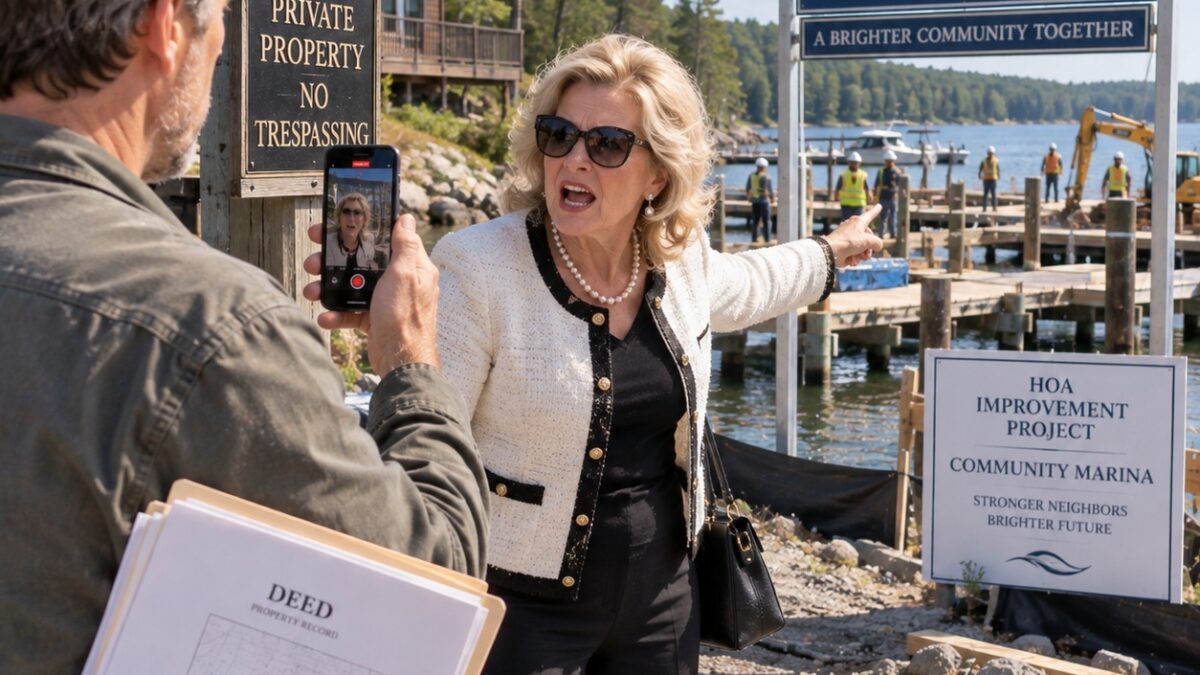
I came back to my family’s lake property and found an HOA marina sitting across my shoreline, complete with private slips, patio furniture, and a sign warning me not to enter without permission.
When the HOA president told me the community had already “taken control” of the waterfront, she expected me to lose my temper, but instead I raised my phone and calmly asked her to explain exactly who had ordered the construction.
She kept talking—and by the time she realized what she had admitted on camera, the county, her own neighbors, and one very patient judge were already asking questions she could no longer answer.
I could have shouted.
I could have ripped down the sign.
I could have dragged their folding chairs into the lake or grabbed the bright blue HARBOR GLEN COMMUNITY MARINA banner and torn it in half.
That was probably what Margaret expected.
Instead, I took out my phone.
I pressed record.
“Would you repeat that?” I asked.
Margaret Voss lifted her chin.
She was standing at the top of a newly built cedar walkway in white linen pants, wedge sandals, and a navy polo embroidered with the Harbor Glen HOA logo.
Behind her, twelve floating slips stretched into the water.
Four had boats tied to them already.
Two families sat under striped umbrellas drinking something from plastic wineglasses.
A stainless-steel grill stood beside a row of Adirondack chairs on the shoreline.
Someone had planted ornamental grasses where my father’s old fishing bench used to be.
And mounted on two fresh posts beside the path was a sign.
HARBOR GLEN RESIDENTS ONLY
PRIVATE MARINA
NO TRESPASSING
I pointed my camera toward Margaret.
“Go ahead.”
Her smile sharpened.
“This shoreline had been abandoned for years.”
I kept recording.
“It was never abandoned.”
“The board considers it common-access land.”
“Based on what?”
“The original community plan.”
“My deed says otherwise.”
She waved one hand dismissively.
“Your interpretation of old paperwork does not outweigh the needs of seventy-eight homeowners.”
“What about the fact that I objected before construction started?”
Margaret stared directly into my camera.
“Yes, Noah. You objected.”
That was useful.
Very useful.
“And the board proceeded anyway?”
“Of course we did.”
Behind her, one of the residents lowered his drink.
Margaret continued.
“This project was approved by the board, paid for through association funds, and built for the benefit of the community.”
I kept my voice calm.
“Did the county approve it?”
Her expression shifted almost imperceptibly.
“The HOA handled all required approvals.”
“That wasn’t my question.”
“You’re not entitled to interrogate me.”
“I’m standing on my property.”
“No.”
She stepped closer.
“You are standing beside a community improvement.”
I looked toward my cabin fifty yards uphill.
Same gray cedar siding.
Same green metal roof.
Same porch my father rebuilt in 1996.
The place had belonged to my family since 1974.
I had the deed inside my truck.
Survey too.
County tax maps.
Photographs of original boundary monuments.
Copies of three letters I had already sent Harbor Glen before construction began.
All of them objecting.
All of them ignored.
Margaret pointed toward the cabin.
“You are one homeowner.”
“I’m not in your HOA.”
“You own one parcel.”
“That is correct.”
“You are not going to hold an entire community hostage because you’re emotionally attached to a strip of weeds.”
I closed the deed folder beneath my arm.
She believed the argument was over.
What Margaret did not know was that the marina was not merely built on disputed land.
The county had no shoreline-development permit for it.
The state environmental database had no protected-zone authorization.
The HOA’s engineer had warned them in writing that the site fell inside a regulated riparian buffer.
And less than twenty-four hours earlier, I had discovered that the “existing dock rehabilitation” Margaret kept referring to had been based on a structure that disappeared before half the current neighborhood had even been built.
I slipped my phone back into my pocket.
Still recording.
Then I said,
“Thank you.”
Margaret frowned.
“For what?”
“For answering.”
I turned toward my truck.
Behind me she laughed.
That confident, practiced laugh people use when they are absolutely certain someone else has lost.
“Run to your lawyer if you want,” she called. “The marina is already here.”
I stopped beside my driver’s door.
Looked back at the new docks glittering on my family’s water.
Then at the residents celebrating on a shoreline they had been told belonged to them.
Margaret was right about one thing.
The marina was already there.
What she hadn’t considered was whether it would still be there when everyone finally saw how it had been built.
FULL STORY CONTINUATION 👇👇
My name is Noah Bennett.
I was fifty-one years old when Harbor Glen Estates built a marina across my shoreline.
I’m a civil site supervisor by trade.
Not a lawyer.
Not a surveyor.
Not an environmental consultant.
But I have spent almost thirty years around grading plans, drainage permits, erosion-control inspections, concrete schedules, right-of-way disputes, retaining walls, and enough municipal paperwork to know that the words we handled the approvals are not the same thing as an approval.
That distinction eventually became very expensive for Harbor Glen.
My grandfather, Edward Bennett, bought the land in 1974.
Fourteen acres wrapping around the southern edge of Briar Lake.
Back then, the lake was smaller.
Quieter.
No gated subdivisions.
No decorative entrance monuments.
No golf carts.
Just forest, pasture, water, and an old two-bedroom cabin that had already been leaning slightly toward the lake when Grandpa bought it.
He fixed the foundation himself.
My father rebuilt the porch.
I rebuilt almost everything else over the years.
Our parcel included roughly nine hundred feet of shoreline.
Most of it stayed natural.
Cypress.
Sweetgum.
River birch.
A narrow gravel path.
One old timber dock near the center.
The dock was never much.
Twenty-two feet.
No electricity.
No roof.
Just pressure-treated boards and four pilings.
Grandpa tied a fourteen-foot fishing boat there.
Dad used it until the transom rotted out.
After Dad died, I removed the final sections of the dock because the decking had become dangerous.
That was in 2013.
The pilings remained for a few years.
Then a storm took two.
I pulled the others in 2016.
That detail mattered later.
Harbor Glen appeared on the north side of our land in stages.
A developer bought former pasture and timber acreage around 2005.
Phase One.
Then Phase Two.
Eventually seventy-eight houses.
Large lots.
Stone mailboxes.
Clubhouse.
Pool.
Mandatory HOA.
The neighborhood boundary came within roughly three hundred feet of my northern property line.
Harbor Glen had no direct deep-water access of its own.
That was inconvenient because the development brochures heavily emphasized “lake living.”
Residents could see Briar Lake.
Many could walk near it.
But the subdivision’s recorded common areas did not actually touch the section of shoreline suitable for boat access.
For years, nobody cared much.
A public boat ramp was four miles away.
Several residents kept boats at a commercial marina across the lake.
Then property values rose.
New families moved in.
A few residents bought expensive wake boats.
Suddenly, Harbor Glen wanted its own marina.
Margaret Voss became HOA president around that same time.
I first met her five years before the docks appeared.
She came to my cabin on a Saturday afternoon.
I was replacing deck boards.
She walked up the gravel path wearing white sneakers that immediately turned brown.
“Mr. Bennett?”
“Yes.”
“Margaret Voss. Harbor Glen board.”
She handed me a business card.
“I know.”
She smiled.
“We’ve been discussing opportunities.”
That phrase always worries me.
“What opportunities?”
“Lake access.”
I set down my drill.
“What about it?”
She looked toward the water.
“Your southern shoreline is underutilized.”
That was the first thing she ever said about my property.
Underutilized.
Not beautiful.
Not private.
Not yours.
Underutilized.
“We would like to discuss purchasing a small access tract.”
“No.”
Her smile remained.
“I haven’t told you the number.”
“I’m not selling.”
“Everyone has a number.”
“I don’t.”
“Mr. Bennett.”
“No.”
She looked toward the old path.
“What if it were only an easement?”
“No.”
“Pedestrian access.”
“No.”
“Docking.”
“No.”
She studied me.
“You understand the neighborhood already uses the walking path near the north edge.”
“Occasionally.”
“So there is precedent.”
“No.”
Her head tilted.
“No?”
“Someone walking across the corner without me chasing them off does not create permission to build a marina.”
Margaret laughed.
“We’re not building anything tomorrow.”
I should have paid more attention to the word tomorrow.
Over the following three years, the HOA contacted me six times.
Two letters.
Three emails.
One certified offer.
The highest proposal was $280,000 for a forty-foot access corridor plus approximately 130 feet of shoreline.
I declined every one.
My reasons were simple.
The shoreline was narrow.
A marina would increase traffic.
Noise.
Lighting.
Fuel spills.
Erosion.
Parking pressure.
And once I granted permanent access, I would never get that section of land back.
I didn’t need the money.
So I said no.
Margaret stopped asking.
That should have bothered me.
Instead, I felt relieved.
Then I started seeing orange flags.
Not on my land at first.
Near the northern boundary.
Survey ribbon.
Paint.
Wood stakes.
One had handwriting:
PROPOSED ACCESS
I photographed them.
Called the number printed on the survey cap.
A technician from Mason-Hart Surveying returned my call.
“Harbor Glen preliminary site work.”
“Did they authorize you to enter my parcel?”
“No, sir.”
“Did you?”
“Not according to our crew notes.”
I asked for the job contact.
Margaret.
Of course.
I emailed her.
Margaret, survey activity has appeared near my north line. For clarity, I have not granted access rights, construction rights, easements, licenses, or permission to perform work on Bennett property. Please confirm the HOA understands this.
She replied:
Noted. Survey is for internal planning only.
I saved it.
Six months later, a Harbor Glen newsletter leaked to me through a friend.
The front page showed a rendering.
BRIAR LAKE COMMUNITY MARINA – COMING SOON
Twelve slips.
Kayak storage.
Fishing deck.
Picnic area.
The rendering showed the dock starting somewhere suspiciously close to my shoreline.
I called Margaret.
No answer.
Emailed.
No answer.
I drove to the county planning office.
Asked for permit records.
Nothing under Harbor Glen marina.
Nothing under Briar Lake community dock.
Nothing under Margaret Voss.
I searched state environmental records.
Nothing.
That did not automatically mean illegal.
Maybe filings used another project name.
Maybe applications were pending.
Maybe the work was conceptual.
So I waited.
Bad choice.
Two months later, a resident named Caleb Morris called me.
Caleb was a retired firefighter who lived in Harbor Glen and occasionally fished with me.
“Noah.”
“Yeah?”
“You know they’re collecting marina assessments?”
I stopped.
“What?”
“Four thousand per house.”
“For what?”
“Construction.”
“When?”
“Starting next month.”
I drove to his house.
He gave me a copy of the assessment notice.
HARBOR GLEN WATERFRONT IMPROVEMENT ASSESSMENT
$4,000 PER LOT
The letter described:
New community dock.
Twelve boat slips.
Picnic pavilion.
Safety lighting.
Shoreline stabilization.
Kayak racks.
No mention that the HOA did not own the shoreline.
No mention of negotiations with me.
No mention that I had refused access.
Instead:
The board has completed its due diligence regarding site control and anticipates construction beginning this summer.
Due diligence.
I called my attorney the next morning.
Her name was Rebecca Sloan.
No relation to anyone in the story.
Real-estate litigator.
Late forties.
Dry sense of humor.
The kind of woman who could make silence feel like cross-examination.
She reviewed my deed.
Survey.
HOA plat.
Letters.
Emails.
Assessment notice.
Then said,
“They don’t own your shoreline.”
“I know.”
“They don’t have an easement.”
“I know.”
“They don’t have a license.”
“I know.”
“They asked you repeatedly and you refused.”
“Yes.”
She looked at me.
“Then either they changed the project location or someone is doing something profoundly stupid.”
That turned out to be optimistic.
Rebecca sent a formal notice to Harbor Glen.
Five pages.
Recorded deed reference.
Survey attached.
No consent.
No access rights.
Demand that they refrain from entering, grading, building, or representing ownership over my parcel.
The HOA’s lawyer responded.
Not Margaret.
Attorney named Stuart King.
He wrote:
Harbor Glen Estates disputes Mr. Bennett’s characterization of the historical shoreline access area. Association records indicate a longstanding common-use corridor and prior dock footprint serving lands now incorporated into the subdivision.
Historical shoreline access area.
Prior dock footprint.
My old family dock.
They were trying to connect Harbor Glen to the dock Grandpa built.
Rebecca laughed when she read it.
“Do they have a document?”
“No.”
“Ask.”
We did.
They sent an old aerial photograph.
My dock visible.
A dirt path nearby.
No Harbor Glen.
Because Harbor Glen didn’t exist.
Then a 2006 development concept plan.
A dashed line labeled:
Potential Future Lake Connection
Potential.
Future.
Not deeded.
Not acquired.
Not recorded.
Rebecca wrote back:
A conceptual planning line is not a conveyance. Please identify the recorded instrument creating the HOA’s claimed right.
No answer.
Three weeks later, heavy equipment arrived.
Mr. Bell—not the same Bell from any other story; different man, same common surname—called me from down the road.
“You expecting excavators?”
“No.”
“They’re near your lake.”
I drove out.
A mini-excavator sat on my property.
Not near.
On.
Bucket down.
Three workers had cleared brush along the access path.
A skid steer had removed a section of old fence.
I parked across the trail.
Got out.
The foreman walked toward me.
“You Noah?”
“Yes.”
“Harbor Glen said you might come by.”
That was interesting.
“What did they tell you?”
“To direct questions to project management.”
“Whose land are you on?”
He looked uncomfortable.
“Harbor Glen access.”
“No.”
I handed him a copy of the survey.
“This parcel belongs to me.”
The foreman stopped smiling.
“Do you have a stop-work order?”
“I’m the owner telling you you’re trespassing.”
That was enough for him to pause.
Contractors hate ownership disputes.
He called his supervisor.
Then Margaret arrived.
Golf cart.
Not even a car.
She stepped out as if responding to a landscaping complaint.
“What are you doing?”
I almost laughed.
“What am I doing?”
“You cannot obstruct contracted work.”
“This is my property.”
“We’ve been through this.”
“No, you’ve avoided it.”
She crossed her arms.
“The board has legal advice.”
“Then show me the legal right.”
“You’ve seen the historical plan.”
“Potential future connection.”
“The neighborhood was developed around lake access.”
“That is not my problem.”
Her jaw tightened.
“This project has already cost the association hundreds of thousands.”
“Then you should have resolved ownership first.”
She looked at the foreman.
“Continue.”
He did not.
Good man.
He said,
“I need written direction from corporate.”
Margaret’s face hardened.
I photographed everything.
Equipment.
Clearing.
Stumps.
Fence.
Workers.
Property monument.
Then I called the sheriff’s non-emergency line.
Deputy arrived.
Looked at deed.
Looked at survey.
Looked at Margaret’s documents.
Then delivered the answer everyone hates.
“Civil property dispute.”
Yes.
Mostly.
He would not physically remove contractors absent clearer authority unless they refused owner instructions under circumstances meeting trespass rules.
But he documented.
Case number.
Time.
Names.
That mattered later.
The contractor withdrew equipment that afternoon.
I thought we had stopped them.
Two weeks later, they returned from a different direction.
This time while I was working three counties away.
They entered through Harbor Glen’s common area.
Crossed the disputed northern edge.
Cleared down to the water.
By the time I arrived, trees were down.
My old path widened.
Grading underway.
I called Rebecca.
Her response:
“File.”
That afternoon, she filed for temporary injunctive relief.
But courts are not vending machines.
Insert deed.
Receive judge.
Scheduling took time.
Harbor Glen exploited time.
They worked fast.
Every day mattered.
Pilings arrived.
Floating sections.
Concrete.
Utility trench.
I began visiting twice daily.
Photographs.
Dates.
Crew counts.
Weather.
Coordinates.
One morning, I noticed silt fencing.
Wrong location.
It stopped uphill but not along the disturbed shoreline.
That bothered me.
My experience is construction.
I knew shoreline disturbance usually required erosion controls beyond what I saw.
I checked county permit lookup again.
Still nothing.
Then I called environmental services directly.
Inspector named Alicia Grant.
I said,
“I’m trying to verify permits for a marina under construction at Briar Lake.”
Address.
Parcel.
Project name.
She searched.
“I see a residential shoreline maintenance exemption.”
“What?”
“Minor maintenance.”
“For Harbor Glen?”
“Yes.”
“What scope?”
“Repair of existing dock, replacement of up to forty percent decking, no footprint expansion.”
I stared at the twelve new slips being assembled in front of me.
“Could you repeat that?”
She did.
“Do you have a new-marina permit?”
“No.”
“Shoreline stabilization?”
“No.”
“Vegetation clearing?”
“Not beyond exemption conditions.”
“Protected buffer authorization?”
Pause.
“What clearing?”
I sent photographs.
Alicia called me back twenty minutes later.
“Do not touch anything.”
“I wasn’t planning to.”
“We’re sending an inspector.”
That was the first moment the story became larger than ownership.
County inspector came that afternoon.
State environmental officer the next morning.
Both photographed.
Measured.
Marked.
The disturbed area sat partly within a protected fifty-foot shoreline buffer.
Several mature trees had been removed.
Grading entered the setback.
The so-called “existing dock” did not exist at time of permit application.
Harbor Glen’s paperwork referenced an old timber structure using aerial imagery more than a decade out of date.
How?
The exemption form listed:
Existing community dock – rehabilitation
Community.
It had never been community property.
Even when it existed.
The application attached one photograph.
Blurry.
Undated.
My father’s old dock.
Someone had apparently pulled it from an online county archive.
Rebecca looked at the permit packet.
Then at me.
“They represented your dock as theirs.”
“Yes.”
“Do you have removal records?”
“I did the work myself.”
“Photos?”
“Yes.”
I had pictures from 2016.
Date metadata.
No dock.
The county aerial from 2018 also showed no dock.
No dock.
No dock.
Yet the HOA filed in 2024 to “repair existing community dock.”
That was problem number two.
Problem three was the signature.
The shoreline maintenance exemption included owner certification.
Not my signature.
Not Margaret’s.
A management employee named Thomas Reed—not related to me—had signed as “authorized agent of property owner.”
Property owner listed:
Harbor Glen Estates HOA.
Wrong.
County parcel number?
Mine.
Correct.
Rebecca stared.
“They used your parcel number and their owner name.”
“Yes.”
“That’s not a typo.”
“No.”
The county issued a stop-work notice.
Finally.
Red paper.
Bright.
Beautiful.
Posted at the site.
STOP WORK – PERMIT VIOLATION
I photographed it.
Margaret tore it down.
I know because my trail camera recorded her doing it.
She did not know about the trail camera.
That clip later played at the public HOA meeting.
But I’m getting ahead of myself.
County reposted the notice.
Hand-delivered order to Harbor Glen management.
State environmental agency issued its own compliance notice.
Construction stopped.
For six days.
Then workers returned.
Not to build docks, Margaret later claimed.
“To secure unfinished structures.”
Some security work is reasonable after a stop order.
But my camera captured decking being installed.
Railings.
Electrical conduit.
Furniture.
Not safety stabilization.
Rebecca forwarded clips to county.
Additional violation notices.
Possible daily penalties.
Margaret responded by calling a special HOA meeting.
I was not invited.
Caleb attended.
He called afterward.
“She told everyone the county issue is paperwork.”
“What exactly?”
“She said an anti-development neighbor filed nuisance complaints.”
“That’s me.”
“Obviously.”
“What else?”
“That the marina is grandfathered because an old dock existed.”
“It didn’t.”
“I know.”
“She said their attorney is confident.”
“Is Stuart still attorney?”
“No.”
Interesting.
“New firm?”
“Yes.”
“Why?”
“Didn’t say.”
Stuart King had apparently withdrawn from the marina matter.
Later, discovery showed why.
He had warned them.
That became a major problem.
His letter to the board, dated six weeks before construction:
We have not identified a recorded easement or fee interest supporting HOA control of the Bennett shoreline. Proceeding with construction prior to obtaining written rights creates material litigation and permitting exposure.
Clear.
Not ambiguous.
Then:
The existing-dock maintenance exemption does not appear appropriate for a materially expanded marina facility. Independent permitting counsel should be consulted.
Even clearer.
Margaret had that letter.
So did the board.
They voted to proceed anyway.
Why?
Money already spent.
Resident promises.
Assessment collected.
Same old story.
Momentum.
By then, nearly $312,000 in assessments had been collected.
Design fees.
Dock deposit.
Contractor mobilization.
Materials.
Margaret argued stopping would “waste community money.”
So they spent more.
The injunction hearing happened three weeks after county stop work.
Judge Ellen Ramirez.
Small courtroom.
Wood paneling.
Too cold.
Harbor Glen’s new attorney argued historical use.
Implied access.
Association reliance.
Old developer representations.
Potential equitable rights.
Rebecca kept it simple.
Recorded deed.
No easement.
No written permission.
Repeated objections.
Permit application misidentifying ownership.
County stop-work order.
Protected-buffer violation.
Judge Ramirez did not decide final title that day.
But she issued temporary relief.
No construction.
No resident use.
No entry onto disputed Bennett parcel except for emergency safety measures approved by the county.
Harbor Glen could not represent itself as possessing final access rights while litigation remained pending.
That last part mattered.
Margaret hated it.
Three days later, she put up the sign.
HARBOR GLEN RESIDENTS ONLY
PRIVATE MARINA
NO TRESPASSING
That was the day I recorded her.
The opening scene.
The furniture.
Boats.
Residents.
They were violating not only the county stop-work restrictions but arguably the court’s use restrictions.
When Margaret said on camera:
“The board ordered the work despite your objections.”
I kept recording.
When she said:
“The association paid for it.”
Recorded.
When she called the shoreline abandoned common land.
Recorded.
When she said I was one homeowner who could not hold the community hostage.
Recorded.
What she did not know was that Rebecca had already told me not to argue.
“Get admissions if you can,” she said.
I did.
Then left.
That evening, I uploaded the file in three places.
Sent Rebecca one.
County investigator another.
Saved original.
The next morning, county enforcement officer Alicia Grant called.
“You have video of people using the marina?”
“Yes.”
“After the stop order?”
“Yes.”
“Boats tied?”
“Yes.”
“Electrical service active?”
“I didn’t test it.”
“Good.”
She sounded tired.
“We’ll inspect.”
They did.
The county found electrical pedestals energized.
No final inspection.
No electrical permit for marina service.
That was new.
The utility contractor had tied into a Harbor Glen common-area panel.
Conduit crossed disturbed buffer.
County electrical inspector immediately disconnected service.
Now the project had:
Ownership dispute.
Invalid maintenance exemption.
Unpermitted new construction.
Protected-buffer disturbance.
Stop-work violations.
Unapproved electrical installation.
Unauthorized use after court order.
And a board president on camera admitting knowledge of my objections.
That week, Rebecca filed an amended complaint.
Trespass.
Property damage.
Declaratory title relief.
Injunctive relief.
Restoration costs.
Other related claims.
We did not sue every resident.
Important.
They had been told the marina was legal.
Most were victims of bad governance.
Margaret tried turning the neighborhood against me anyway.
Harbor Glen Facebook group exploded.
I saw screenshots.
Why is one man destroying our community?
The dock was already there for decades!
He’s demanding millions!
False.
I had never demanded a purchase price.
Another:
Bennett doesn’t even live there full time.
True.
Irrelevant.
Another:
HOA should use adverse possession.
That one made Rebecca laugh.
“People learn three property terms online and become dangerous.”
One resident posted:
If he hates community access so much, why live next to a community?
I lived there first.
Still, I didn’t respond.
Rebecca forbade it.
“Court.”
“Not Facebook.”
Correct.
Then Caleb called.
“You need to know something.”
“What?”
“Residents didn’t approve the marina the way Margaret says.”
I stopped.
“Explain.”
“The assessment vote was for waterfront improvements.”
“Marina.”
“That’s what we thought.”
“What does the ballot say?”
He emailed it.
Special Assessment – Waterfront Recreation and Erosion Improvement Project
No slip count.
No exact location.
No property map.
No disclosure of my ownership dispute.
No mention of new marina versus repair.
The board presentation had shown a dock rendering.
Residents assumed legal access had been resolved.
The assessment passed 49–19.
Ten did not vote.
Then Caleb sent budget sheets.
One line:
Shoreline Easement Acquisition – $0
Interesting.
They budgeted nothing to obtain rights.
Another:
Permit/Environmental Review – $7,500
Actual spending?
Less than $2,000 before construction.
Most legal costs began afterward.
Margaret had sold the project as ready.
Not speculative.
Residents deserved to know that.
Then we found the consultant report.
The HOA hired Lakeshore Environmental Group before construction.
Their biologist, Dr. Melissa Warren, visited the site.
Her report identified the southern access corridor as:
Mixed hardwood riparian buffer with mature cypress and erosion-sensitive bank.
Recommended:
Avoid clearing within fifty feet.
Use elevated boardwalk if access obtained.
Perform delineation before disturbance.
Obtain state and county authorization.
Verify legal shoreline rights.
Verify.
Legal.
Rights.
Margaret received the report.
So did the board.
Then an email from Margaret:
We cannot redesign around a fifty-foot buffer without losing usable shoreline width. Please determine whether existing-dock exemption avoids this requirement.
There it was.
Not accidental.
They were looking for a permit category that avoided the rule.
The consultant replied:
Existing-dock exemption would not apply if there is no current lawful structure at the site.
Four days later, Harbor Glen terminated the consultant.
Hired a cheaper permitting service.
The cheaper service filed the maintenance exemption using old dock imagery.
Rebecca printed that email too.
Our evidence folders became enormous.
Red:
Ownership.
Blue:
Permits.
Green:
HOA finances.
Yellow:
Communications.
I started dreaming in binders.
One afternoon, Rebecca called.
“Do you want good news or annoying news?”
“Good.”
“County opened formal enforcement investigation.”
“Annoying?”
“You may be interviewed for four hours.”
“Fine.”
“You say that now.”
The county investigation expanded beyond permit compliance because association funds had financed work on disputed private property after documented warnings.
County did not regulate HOA fiduciary duties.
But its records would matter in civil court.
The state environmental agency began calculating restoration requirements.
Trees removed:
Eleven mature.
Seventeen smaller.
Approximately 0.38 acres disturbed.
Shoreline grading.
Bank compaction.
Unauthorized gravel placement.
Restoration could require:
Native plantings.
Bank stabilization.
Removal of impervious materials.
Monitoring.
Potential fines.
Margaret called it bureaucratic overreach.
At the next HOA meeting, residents started asking questions.
Caleb told me.
“What did she say?”
“That the trees were invasive.”
“They were cypress and sweetgum.”
“I know.”
“Anything else?”
“She said county maps were inaccurate.”
“They use the same parcel line as my survey.”
“I know.”
“She said your family abandoned the dock.”
“There was no dock.”
“I know.”
Caleb sighed.
“You see the problem.”
Yes.
He knew.
More residents were beginning to know.
Then Harbor Glen’s insurance carrier sent a reservation-of-rights letter.
We learned through discovery later.
Coverage might be disputed for intentional acts or known violations.
That terrified the board.
Now potential costs could fall directly on HOA reserves and residents.
Board treasurer, David Larkin, resigned.
He sent a letter to homeowners.
That letter broke the community open.
He wrote:
I can no longer represent that the marina project proceeded with adequate legal and regulatory certainty. Prior to construction, the board received written notice that ownership, permitting, and shoreline-buffer issues remained unresolved. I voted to pause the project and was overruled.
I read it twice.
Rebecca smiled.
“Here comes the paper.”
David attached no confidential documents.
But his resignation confirmed internal disagreement.
Residents demanded records.
Minutes.
Votes.
Contracts.
Legal invoices.
Margaret refused some requests, citing privilege.
Reasonable in part.
But she also refused non-privileged financial records.
Bad idea.
A group of twenty-three homeowners hired their own attorney.
Now it was not Noah Bennett versus Harbor Glen.
It was Harbor Glen versus itself.
The homeowners’ lawyer sent the board a demand for accounting of marina funds.
They discovered something else.
The project had gone over budget.
Original:
$312,000.
Then $410,000.
Then $486,000.
Not $3.8 million like the previous story; this was a smaller twelve-slip marina.
Still serious.
Change orders.
Shoreline work.
Electrical.
Furniture.
Legal.
Residents had approved $312,000.
The board used reserve funds to cover overruns without a second vote, relying on emergency-maintenance authority.
Emergency.
For a marina.
That angered residents almost as much as the land issue.
One woman named Susan Park contacted me.
I didn’t know her.
She said:
“My husband and I voted yes.”
“Okay.”
“We were told this was a repair.”
“That’s what the permit says too.”
“We thought Harbor Glen already had rights.”
“It doesn’t.”
“Did Margaret ever negotiate with you?”
“Yes.”
“For years?”
“Yes.”
“Did you say no?”
“Yes.”
She went silent.
Then:
“Why didn’t we know?”
Good question.
“I don’t know.”
I did know.
But I wanted her to hear it from documents, not from my anger.
Susan later became one of the loudest reform voices inside Harbor Glen.
Funny how quickly people change when humiliation becomes clarity.
The civil discovery process began.
Depositions.
Emails.
Minutes.
Contracts.
Board messages.
Margaret resisted.
Her attorney did not.
By then the attorney’s job was damage control.
We obtained board minutes from nine months before construction.
Margaret:
Mr. Bennett remains unwilling to cooperate.
Treasurer David:
Without access, project is not viable.
Margaret:
Counsel is reviewing alternative legal pathways.
Board member Cheryl Lane:
Can we use old dock footprint?
Margaret:
Potentially.
Another meeting:
Engineer:
Existing dock no longer present in field.
Margaret:
Can reconstruction be classified as repair?
Engineer:
Not under our interpretation.
Margaret:
We may need another consultant.
That sentence appeared almost exactly before they fired Lakeshore Environmental.
Then:
Board member Tom Price:
Should residents be informed ownership is unresolved before assessment vote?
Margaret:
No. The board should not create unnecessary alarm around routine legal housekeeping.
Routine legal housekeeping.
That phrase became famous inside Harbor Glen.
At a later public meeting, residents repeated it back to her.
But before that, Margaret had to testify.
Her deposition lasted seven hours.
I attended only part.
Rebecca asked:
“Did Mr. Bennett ever consent to construction?”
“No.”
“Did he ever grant easement?”
“No.”
“Did you know that before the assessment vote?”
“Yes.”
“Did residents?”
“I don’t know what individual residents knew.”
“Did the board disclose it in the ballot materials?”
“No.”
“Why?”
“We believed rights could be established.”
“Based on what recorded instrument?”
“Historical use and development documents.”
“Any recorded instrument?”
“No.”
Rebecca:
“Did county environmental consultant advise the existing-dock exemption likely did not apply?”
Margaret:
“One consultant expressed that view.”
“Did you terminate that consultant?”
“We changed providers.”
“Four days later?”
“Yes.”
“Did the replacement provider receive the consultant’s warning?”
Margaret paused.
“I don’t know.”
That meant no or bad.
“Did you tell them the dock had been removed in 2016?”
“I was not aware of the exact date.”
“Did you tell them there was currently no dock?”
“They visited the site.”
“Did they?”
Pause.
“I believe so.”
Records later showed their permit preparer never visited before filing.
Used photos provided by the HOA.
One old photograph.
Then the stop-work notice.
“Did you remove the county notice?”
“I moved it.”
“Where?”
“I don’t recall.”
Trail camera footage.
Rebecca played it.
Margaret peeled the notice from the post.
Folded it.
Carried it away.
“Is that you?”
“Yes.”
“Why?”
“It was getting wet.”
Rebecca stared.
“Did you deliver it to management?”
“I intended to.”
“Did you?”
“I don’t remember.”
The county later posted another because the first vanished.
Then my phone video.
“Did you tell Mr. Bennett the board ordered construction despite his objections?”
“I don’t remember exact wording.”
Video played.
Her voice filled the conference room:
Yes, Noah. You objected. The board proceeded anyway.
Margaret’s attorney rubbed his forehead.
Rebecca paused.
“Do you remember now?”
Margaret did not answer immediately.
“Yes.”
She never recovered from that deposition.
Not because one sentence proved everything.
Because the video made her broader narrative impossible.
She could no longer claim the board believed I had informally consented.
She acknowledged objection.
Then construction.
Sequence.
Important.
The county issued preliminary fines.
State required restoration plan.
The court scheduled trial on title, trespass, injunctive relief, and damages.
But residents forced another event first.
A special membership meeting.
Under Harbor Glen bylaws, enough members signed a petition.
Purpose:
Board accountability.
Marina project.
Potential removal of directors.
Margaret fought the meeting.
Claimed petition signatures invalid.
Management verified enough.
Meeting scheduled at a middle-school auditorium because clubhouse was too small.
Rebecca told me not to go.
I asked why.
“You’re a litigant.”
“So?”
“So don’t turn yourself into entertainment.”
“I won’t speak.”
“You’ll sit there.”
“Yes.”
She sighed.
“Fine.”
I went.
Three hundred chairs.
Maybe 150 people including spouses.
Noah Bennett—the supposed enemy—sat in the back.
Margaret sat on stage with four remaining directors and HOA counsel.
Projector.
Microphones.
Tension.
First hour was financial.
Assessment.
Overruns.
Reserve transfers.
Legal costs.
Environmental penalties.
Then Susan Park stood.
“Were homeowners told the HOA did not own the shoreline before we voted?”
Margaret:
“The association believed it possessed rights.”
Susan:
“That was not my question.”
The room murmured.
Interesting how people learn cross-examination quickly when angry.
“Were we told?”
Margaret:
“No.”
Another homeowner:
“Were we told Noah Bennett had refused an easement?”
“No.”
Another:
“Were we told the environmental consultant said the permit exemption didn’t apply?”
Margaret:
“The consultant’s view was not final.”
“Were we told?”
“No.”
David Larkin, former treasurer, sat front row.
Someone asked him:
“Did you vote to stop?”
“Yes.”
“How many times?”
“Three.”
The room changed.
Margaret accused David of violating board confidentiality.
He calmly said,
“I’m answering about my votes.”
Then someone played my phone video.
I didn’t know they had it.
It had become part of public county record after filing.
On the auditorium screen:
Margaret at marina.
White pants.
Blue polo.
My voice:
“Did the board proceed despite my objections?”
Her voice:
“Of course we did.”
The room went completely silent.
Then:
“This project was approved by the board, paid through association funds, and built for the benefit of the community.”
Another clip.
“You are one homeowner. You are not going to hold an entire community hostage.”
Someone shouted:
“He owns the land!”
Applause.
Not for me.
Against her.
Margaret stood.
“This is being taken out of context.”
A man near the aisle shouted:
“What context makes that better?”
HOA counsel asked for order.
Then county records appeared.
Permit exemption.
Existing dock repair.
A resident named Paul Kim had done his homework.
He displayed aerials.
2018:
No dock.
2020:
No dock.
2022:
No dock.
2024 application:
“Existing community dock.”
Paul asked:
“Who told the county a dock existed?”
Margaret replied:
“The permitting consultant prepared the form.”
“Who gave them the photograph?”
“I don’t recall.”
“Did you review it?”
“Yes.”
“Did you know that dock belonged to Noah’s family?”
Silence.
“I knew there had historically been a dock.”
“That isn’t what I asked.”
The room was no longer hers.
Then Cheryl Lane, still a board member, did something unexpected.
She resigned.
On stage.
She took the microphone.
“I voted for construction.”
No one spoke.
“I believed legal rights would be resolved before work crossed the boundary.”
Margaret stared.
Cheryl continued.
“They were not.”
Then:
“I also approved reserve transfers because I was told stopping construction would cost more than finishing.”
Murmurs.
“I regret that.”
She looked at residents.
“I should have insisted we stop.”
Then she placed her board packet on the table.
“I resign.”
Margaret whispered something to her.
Cheryl walked off stage.
That was the collapse.
A recall vote followed under the bylaws.
Not legally instant for every seat due notice requirements, but members adopted formal motions demanding resignations and beginning removal procedures.
Margaret refused.
At first.
Two days later, she resigned.
Her letter blamed misinformation.
Personal attacks.
Legal complexity.
No apology.
No surprise.
Harbor Glen appointed an interim board.
First act:
Suspend marina use.
Second:
Hire independent counsel.
Third:
Commission title review and environmental audit.
Fourth:
Send residents an apology.
Not to me.
To residents.
Then they called Rebecca.
Settlement.
We were still heading toward trial.
The new board wanted out.
I did not want money first.
I wanted restoration.
Remove marina from my shoreline.
Restore buffer.
Replant.
Repair fence.
Rebuild gravel path.
Pay damages.
No access.
Simple.
The new board asked whether some dock could remain if relocated north.
Possibly.
Not on my land.
Engineers studied.
Problem:
Harbor Glen’s actual common area touched a shallower, muddier section of water.
A small kayak/fishing pier could fit.
Not twelve boat slips.
That was their problem.
We mediated.
Nine hours.
Harbor Glen offered purchase again.
$350,000.
No.
$500,000.
No.
Rebecca asked privately:
“Are you sure?”
“Yes.”
“Half million for a narrow strip.”
“I know.”
“Why?”
“Because I still don’t want a marina.”
She nodded.
“Good answer.”
Settlement eventually:
Harbor Glen acknowledged my title.
Removed all marina structures crossing or dependent on my parcel.
Restored disturbed shoreline under county/state plan.
Replanted native trees.
Paid for three years monitoring.
Paid my documented property restoration costs.
Paid significant portion of attorney fees.
Additional damages confidential.
Association barred from representing any lake-access rights over my land absent new written agreement.
No access.
No easement.
No “historical use” claim.
The county still pursued regulatory penalties separately.
Settlement did not erase them.
The state required mitigation.
The marina came out.
That surprised residents.
Floating sections lifted.
Pilings removed.
Concrete pad demolished.
Electrical pulled.
Gravel scraped.
Picnic furniture relocated.
The huge HARBOR GLEN RESIDENTS ONLY sign came down.
I was there.
Not celebrating.
Just watching.
The foreman who removed it asked:
“You want the sign?”
“No.”
He laughed.
“Thought you might hang it in your garage.”
“Absolutely not.”
He tossed it into the scrap pile.
Good.
I kept one thing.
A six-inch section of cedar from the walkway.
Not as trophy.
Evidence had been released.
I used it later to repair a shelf in Dad’s tackle shed.
That felt better.
The county’s final investigation found the HOA had performed work outside its permit scope, disturbed regulated shoreline buffer without authorization, proceeded after warnings, and violated stop-work conditions.
Administrative penalties.
Restoration.
Monitoring.
The permit preparer faced professional review.
No dramatic criminal conspiracy.
Important.
Margaret was not led away in handcuffs.
No federal agents.
Reality is often more boring.
But boring consequences can cost hundreds of thousands.
The civil case closed under settlement.
HOA legal fees plus penalties, restoration, removal, and wasted construction pushed total marina-related losses well beyond the original project budget.
Residents paid through reserves and later assessment.
I hated that.
They were not innocent in every sense—they voted for an improvement without asking enough—but they were also misled.
Susan once said:
“We paid twice. Once for the marina, once to remove it.”
“Yes.”
“Do you feel bad?”
“Yes.”
She stared.
“Then why not let us keep it?”
“Because feeling bad doesn’t change ownership.”
She nodded.
“I know.”
That was the hard truth.
Compassion does not require surrendering the thing someone wrongfully took just because returning it costs them.
Harbor Glen changed after Margaret.
The interim board became permanent after election.
David Larkin returned as treasurer only after residents begged him.
Susan Park joined the board.
Paul Kim chaired architectural review.
They implemented policies requiring:
Independent title verification before land projects.
Permit matrix.
Written legal review.
Resident disclosure of unresolved claims.
Capital-project contingencies.
No reserve transfers above threshold without member notice.
Board minutes more detailed.
Contractor due diligence.
They became annoyingly responsible.
Good.
One year later, Susan invited me to a public HOA meeting.
I declined.
Then she said:
“We’re discussing lake access.”
I laughed.
“No.”
“Not your land.”
“Good.”
“Can you come?”
“Why?”
“We want someone who’ll tell us when the plan is stupid.”
That almost persuaded me.
I went.
Their new plan:
Small fishing pier on actual HOA property.
No motor boats.
Kayak launch.
Raised boardwalk.
Permits.
Environmental consultant.
Title opinion.
All before construction.
I reviewed informally.
“Looks legal.”
Susan smiled.
“High praise.”
They built it.
Permitted.
Within budget.
No lawsuit.
Boring.
Beautiful.
Margaret sold her house the next year.
Moved to Florida, I heard.
Never contacted me.
Almost.
Three years later, I was at a building-supply store buying galvanized bolts.
I heard:
“Noah.”
Turned.
Margaret.
Hair shorter.
No HOA polo.
Casual clothes.
She looked older.
So did I.
“Margaret.”
She glanced at the box in my hand.
“Still building things?”
“Always.”
Awkward silence.
Then:
“You got your shoreline back.”
“I never lost title.”
She almost smiled.
“Still precise.”
“Yes.”
She looked away.
“I should have stopped.”
That surprised me.
“When?”
“The first legal letter.”
I waited.
“We had already spent forty thousand.”
“That was all?”
“At that point.”
I stared.
Forty thousand.
The final cost had multiplied many times.
“We thought finishing would make the dispute easier to solve.”
“Why?”
She shrugged.
“Leverage.”
Honest.
Ugly.
“If the marina existed, we thought you’d sell.”
There it was.
Not historical common land.
Not community rights.
Leverage.
“You wanted to create the condition you needed me to accept.”
“Yes.”
“Did the whole board know?”
“No.”
“Who did?”
She hesitated.
“Enough of us.”
I did not ask names.
Litigation was over.
I didn’t need new ghosts.
Margaret continued:
“I believed community benefit gave us moral authority.”
“Moral authority doesn’t transfer title.”
“I know.”
“Now.”
“Yes.”
We stood between shelves of screws and paint trays.
Then she said:
“I hated that you wouldn’t negotiate.”
“I did negotiate.”
“You only said no.”
“That was my position.”
She laughed.
“You see? That.”
“What?”
“You thought no was negotiation.”
“No.”
I looked at her.
“I thought no was the answer.”
She became quiet.
That may have been the first time she truly understood the difference.
“You recorded me that day.”
“Yes.”
“I knew you were recording.”
“I told you.”
“I thought it made me look strong.”
I almost smiled.
“It made you look informed.”
Her face tightened.
Exactly.
The recording mattered because she admitted knowledge.
Not because she sounded mean.
Intent and notice.
Facts.
She nodded.
“I lost friends.”
“I’m sorry.”
She looked surprised.
“You are?”
“Yes.”
“After everything?”
“I don’t need you miserable.”
She stared at me for a moment.
Then said:
“I’m sorry about the cabin.”
“What about it?”
“I called it irrelevant.”
“You did.”
“It wasn’t.”
“No.”
She looked toward the front windows.
“I spent years thinking people who resisted community plans were selfish.”
“Sometimes they are.”
“That would’ve been easier.”
“Yes.”
She laughed once.
Then:
“Goodbye, Noah.”
“Goodbye, Margaret.”
That was it.
No reconciliation.
No handshake.
Enough.
The shoreline recovered slowly.
Trees take time.
The county required two years survival rate on plantings.
Some died.
Replaced.
Native grasses came back.
Bank stabilized.
The disturbed scar softened.
Dad’s old fishing bench was gone.
Margaret’s crew had removed it early.
I built another.
Same shape.
Different wood.
For a while, sitting there made me angry.
Then one morning a heron landed near the old piling location.
Stayed twenty minutes.
Water flat.
Cabin behind me.
No boats.
No music.
No HOA sign.
I realized the shoreline felt like itself again.
Not original.
Nothing returns exactly.
Restored enough.
I also rebuilt the old dock.
Not because I wanted to prove ownership.
Because I wanted a dock.
Small.
Twenty-four feet.
Permitted.
Proper buffer review.
County inspection.
I enjoyed every form.
Rebecca thought that was insane.
“You voluntarily enjoyed permitting?”
“Yes.”
“You need therapy.”
“Probably.”
County inspector Alicia Grant came for final.
She recognized me.
“Full circle.”
“Mine’s legal.”
She smiled.
“Don’t get emotional.”
Passed inspection.
I mounted a tiny brass plate under the bench:
BENNETT DOCK – 1974 / 2027
Not historically exact.
Original dock rebuilt multiple times.
Symbolic.
Dad would forgive me.
Caleb still lives in Harbor Glen.
He sometimes texts:
Can I fish from your dock?
I answer:
Yes.
That matters.
He asks.
I choose.
Occasionally another resident asks through him.
Sometimes I say yes.
Sometimes no.
No one acts offended anymore.
That is healthier than the fake “community access” Margaret tried creating.
Permission is not weakness.
Generosity requires the ability to refuse.
Otherwise it isn’t generosity.
It is extraction.
I learned that more clearly through the lawsuit than anything else.
People kept telling me:
“It’s just shoreline.”
“You weren’t using all of it.”
“The community benefits.”
“You could share.”
Maybe.
But sharing begins after asking.
Not after construction.
Harbor Glen could have approached me honestly.
Offered to buy.
They did.
I said no.
They could have redesigned.
They didn’t.
They could have built elsewhere.
Harder.
They could have improved the public launch.
They could have created kayak access on their own parcel.
Instead, some board members decided my refusal was an obstacle rather than a decision.
That mental shift created everything that followed.
Illegal clearing.
Bad permit category.
Misrepresented ownership.
Assessment secrecy.
Stop-work violations.
Lawsuit.
Penalties.
Removal.
Resignations.
All because they refused to accept one ordinary answer.
No.
People often ask whether Margaret’s “family” stole the shoreline.
No.
That isn’t accurate.
This wasn’t a theft in the criminal sense.
It was institutional overreach.
A board convinced itself that a desired outcome was inevitable enough to justify acting before rights were secured.
That is almost more dangerous.
Criminals know they are crossing lines.
Institutions can cross lines while writing minutes about responsibility.
They create committees.
Budgets.
Consultants.
Votes.
Each step gives the next person confidence that someone earlier must have checked legality.
Then nobody does.
The contractor assumes owner.
Engineer assumes access.
Permit preparer assumes parcel control.
Residents assume board did due diligence.
Board assumes lawyer will fix.
Lawyer assumes board will stop.
Margaret assumes completion creates leverage.
And suddenly twelve dock slips are sitting on someone else’s shoreline.
The biggest lesson from Harbor Glen was not “HOAs are evil.”
They aren’t.
The new board proved that.
The lesson was more boring.
Governance needs friction.
Someone asking:
Do we own this?
Where is the deed?
Where is the permit?
What did counsel say?
What happens if we stop?
What happens if we don’t?
Margaret hated friction.
Called it negativity.
Once a board starts treating questions as disloyalty, mistakes become policy.
David Larkin had asked.
Cheryl Lane had hesitated.
The first consultant warned.
Attorney Stuart warned.
I objected.
County records showed no proper permit.
None of that stopped them because every warning was individually reframed.
One skeptical treasurer.
One cautious lawyer.
One difficult landowner.
One overly conservative biologist.
One bureaucratic county employee.
Separately, each could be dismissed.
Together, they were reality.
Bad leadership isolates warnings.
Good leadership connects them.
I later spoke at a county workshop for volunteer association boards.
Rebecca arranged it as punishment.
I hate public speaking.
Topic:
Property and permitting risk for community projects.
I told them:
“If your project requires another person’s land, the cheapest time to hear no is before you spend money.”
People laughed.
I wasn’t joking.
Then:
“If your survey says verify title, verify title.”
“If counsel says stop, stop.”
“If your permit category says existing dock, make sure a dock exists.”
More laughter.
Still not joking.
One board member asked:
“What if the owner is unreasonable?”
“Negotiate.”
“What if they still refuse?”
“Redesign.”
“What if redesign kills the project?”
“Then the project depended on rights you didn’t have.”
Silence.
Simple.
Unpopular.
True.
Another asked:
“Would you ever sell access now?”
I thought.
“Maybe someday.”
That surprised people.
“After all that?”
“Yes.”
“Why?”
“Because the problem was never an easement.”
“What was it?”
“Building first and expecting consent later.”
The room got quiet.
That is the whole story.
Control of sequence.
Ask.
Agree.
Document.
Permit.
Build.
Harbor Glen tried:
Plan.
Assess.
Spend.
Build.
Pressure.
Legalize.
Reverse order.
Expensive.
My father used to say construction exposes impatience.
Anybody can draw a perfect line on paper.
Field conditions humble everyone.
He was talking about grading.
Could have been talking about law.
The cabin changed too.
I spent more time there after the lawsuit.
At first from protectiveness.
Then because I remembered why I liked it.
Morning coffee.
Lake fog.
Wind through cypress.
Old screen door slamming.
Dad’s tackle box.
I replaced the faded curtains.
Kept one panel folded in a trunk.
Sentimental.
I’m allowed.
One winter, a storm dropped a tree through the porch roof.
Insurance adjuster came.
Looked at repaired shoreline.
Asked:
“Was this the marina place?”
I sighed.
“Yes.”
“My wife read about it.”
“Great.”
“She says you’re stubborn.”
“Also great.”
He laughed.
Then:
“Probably saved your land.”
Maybe.
I rebuilt porch.
County permit.
Again.
No joy this time.
Eventually, attention faded.
News article disappeared beneath newer scandals.
Harbor Glen became just another neighborhood.
Residents stopped introducing themselves with:
“I’m from Harbor Glen, but I voted against Margaret.”
Thank God.
Caleb jokes that the marina fight became local folklore.
New residents hear distorted versions.
One thinks Margaret built twenty docks.
Another thinks I owned the whole lake.
One heard I was a retired judge.
I’m a site supervisor.
Folklore improves résumés.
Susan once asked whether I minded.
“No.”
“Really?”
“As long as nobody builds anything.”
Fair.
The association’s small legal fishing pier opened two years later.
On their land.
I attended ribbon cutting.
Yes.
They invited me.
Susan joked:
“We checked the deed.”
I said:
“Show me.”
She pulled a copy from behind the podium.
Everyone laughed.
That is healing.
Not forgetting.
Being able to joke because the system changed enough that the joke no longer hides danger.
Their pier had two benches.
Kayak rack.
No power.
No slips.
Kids fish.
Perfect.
One afternoon, I walked over by invitation.
A boy caught a tiny crappie.
His grandfather asked whether I was “the shoreline guy.”
I said,
“Unfortunately.”
He laughed.
“Thanks for keeping everybody honest.”
I disliked that.
Not because it was wrong.
Because honesty should not require an enemy.
Communities function better when internal people insist on it.
Susan does now.
David.
Paul.
New manager.
Maybe Harbor Glen learned.
I hope.
The original marina photographs remain in my legal archive.
Sometimes I open the folder.
Brand-new cedar.
Blue banner.
Chairs.
Boats.
Margaret smiling.
The thing looked legitimate.
That is important.
Illegal or unauthorized projects do not always look shady.
They can look professional.
Stamped drawings.
Uniformed workers.
Invoices.
Signs.
Keys.
Residents celebrating.
Appearance of authority is powerful.
That’s why paper matters.
A deed looks boring.
A permit looks boring.
A legal description is almost aggressively boring.
But boring documents can stop expensive lies.
I think about Margaret’s line often.
“You are one homeowner. You are not going to hold an entire community hostage.”
She believed numbers changed rights.
Seventy-eight households versus one man.
Democracy.
Community benefit.
But HOA governance is not government eminent domain.
A majority vote inside one association does not automatically transfer a neighbor’s property.
Imagine if it did.
Five people vote for your garage.
Congratulations.
Community amenity.
Absurd.
Still, scale seduces people.
If enough residents want something, opposition feels selfish.
Sometimes it is.
Sometimes majority needs deserve political solutions.
But private rights have procedures for a reason.
Purchase.
Easement.
Condemnation where legally authorized by government.
Regulation.
Due process.
Not twelve board votes and an excavator.
The county investigation report became public after closure.
I read it once.
Dry.
Clinical.
No drama.
Timeline.
Notices.
Violations.
Emails.
Photographs.
Conclusion.
The report described Margaret’s recorded statements as demonstrating “actual awareness of ownership objection prior to continued use.”
Actual awareness.
Three words.
That was what my phone captured.
Not arrogance.
Awareness.
When I asked her to repeat herself, I didn’t know exactly how valuable that would become.
I only knew people often become careless when they think they are winning.
Margaret wanted me to understand I was powerless.
So she explained.
In detail.
On camera.
The best evidence sometimes arrives because someone cannot resist giving a speech.
Rebecca has a framed sticky note in her office:
LET THEM TALK.
I gave it to her after settlement.
She claims it’s unethical décor.
Still hangs it.
My relationship with Rebecca became friendship after years of invoices.
She once told me:
“You were a terrible client.”
“Why?”
“You answered Margaret’s phone call.”
“She called me.”
“You visited site alone.”
“My land.”
“You argued with contractors.”
“I was polite.”
“You attended HOA meeting.”
“I sat in back.”
“You kept wanting to explain property law despite not being a lawyer.”
“I was usually right.”
She stared.
“Exactly why you’re terrible.”
Fair.
She retired recently.
At retirement dinner, I gave her one gift.
The old marina cedar piece I had used in Dad’s shed?
No.
That stayed.
I gave her a photo of the restored shoreline.
No docks.
Sunrise.
On the back:
Documentation beats intimidation.
That was something I said at the very beginning.
Still true.
But I would add another line now.
Documentation works best when paired with patience.
I wanted immediate justice.
Sheriff removes workers.
County arrests Margaret.
Judge orders marina gone that afternoon.
Reality took months.
Years.
Evidence accumulated.
People changed sides.
Insurance letters.
Depositions.
Restoration plans.
Governance reform.
Slower.
More frustrating.
More durable.
If I had ripped down the sign that first day, Harbor Glen could have called me destructive.
If I had thrown furniture into the lake, property damage.
If I had screamed at residents, I would become the story.
Instead, I recorded Margaret.
Let her remain the story.
That discipline saved me.
My father never had much patience either.
Maybe I learned late.
The rebuilt fishing bench on my shoreline has a small drawer underneath.
Inside:
Needle-nose pliers.
Hooks.
Line.
Old photo of Dad.
Copy of the original 1974 parcel sketch laminated against weather.
Overkill.
Maybe.
One morning Caleb opened the drawer.
“Do you carry your deed fishing now?”
“Basically.”
“You need help.”
“Everyone says that.”
He looked across the water toward Harbor Glen’s little pier.
“Worth it?”
“What?”
“All of this?”
I thought.
The legal fees.
Stress.
Angry emails.
Lost weekends.
Trees gone.
Then restored.
“Ask me another way.”
“If you could go back and avoid the whole fight by selling when Margaret first asked?”
“No.”
Immediate.
“Even for half a million?”
“No.”
“Million?”
I smiled.
“Now you sound like her.”
He laughed.
Then:
“What if they asked today?”
“For twelve slips?”
“Yes.”
“No.”
“Four?”
“Maybe.”
He looked shocked.
“Really?”
“Maybe.”
“What changed?”
“People.”
That was true.
If Harbor Glen’s current board approached respectfully with a narrow, well-designed, environmentally sound proposal, I would listen.
Listening is not agreeing.
But I would listen.
Why?
Because trust is not permanent in either direction.
Bad conduct does not require permanent hostility if people, systems, and incentives change.
Margaret’s board could not be trusted.
Susan’s board had earned some.
That is how communities recover.
Not pretending the past didn’t happen.
Building processes that make repetition harder.
The shoreline remains legally mine.
But I do not need to treat every person in Harbor Glen as invader.
That would let Margaret’s choices define everyone.
No.
Some residents were misled.
Some were careless.
Some cheered too early.
Some sent nasty emails.
Some apologized.
People are messy.
Property lines can be exact.
Human lines rarely are.
I keep my boundaries clear anyway.
Especially because I want kindness to remain possible.
One summer evening, Susan called.
“Emergency.”
“What?”
“Our pier ladder broke.”
“That is not an emergency.”
“There are children.”
“Still not emergency.”
“Can you weld aluminum?”
“Yes.”
“I know.”
“You’re manipulating me.”
“Community spirit.”
I drove over.
Fixed it.
Charged nothing.
She tried paying.
I refused.
Then said:
“See? This is what voluntary community cooperation looks like.”
She rolled her eyes.
Still.
Point made.
The next month, Harbor Glen volunteers helped me clear storm debris from my gravel lane.
No invoice.
Normal neighbors.
Good.
Sometimes I wonder whether Grandpa would recognize the lake now.
More houses.
More boats.
Noise.
Lights.
He would complain.
Then probably make friends with Caleb.
Dad would like Susan.
He would despise HOA meetings.
He also would have loved seeing his old shoreline restored.
I keep imagining him sitting beside me the day Margaret put up that sign.
NO TRESPASSING.
On his land.
Dad would have ripped it out.
I know he would.
Then I’d have had to explain evidence preservation.
He’d call me soft.
Then later admit the phone video was smart.
Maybe.
My family stories improve dead people too.
Truth is probably Dad would have yelled for ten minutes.
Then gone fishing.
I had to do something different.
Because Margaret wasn’t one trespasser.
She represented an institution.
Institutions generate records.
That became their weakness.
Every bad decision produced paper.
Assessment vote.
Board minutes.
Consultant warning.
Legal letter.
Permit.
Invoice.
Stop-work notice.
Email.
Budget transfer.
Each individual record looked manageable.
Together they told one story.
They knew enough to stop.
They chose not to.
That is why Margaret’s claim at the hardware store mattered.
“We thought finishing would give us leverage.”
Exactly.
Build first.
Negotiate from sunk cost.
It works sometimes.
People surrender because undoing is expensive.
I didn’t.
Not because I wanted Harbor Glen punished.
Because accepting that tactic would teach every future board the same lesson.
Trespass enough.
Spend enough.
Then owner must compromise.
No.
The removal cost was painful.
Necessary.
The smaller fishing pier proved legal alternatives existed.
The restoration proved damage could be repaired.
The special assessment proved residents eventually pay for shortcuts.
That may be the most useful public lesson.
Board members often gamble with other people’s dues.
If the gamble fails, consequences spread.
Homeowners should ask difficult questions before cheering renderings.
Do we own the site?
Permit status?
Legal review?
Contingency?
What if challenged?
Who bears overrun?
Boring questions.
Ask them.
I wish Harbor Glen residents had.
Maybe they wish too.
Susan told me once:
“We thought board approval meant due diligence had happened.”
I said:
“That’s reasonable.”
“Is it?”
“Until you have reason to doubt.”
“Then?”
“Ask.”
She nodded.
Simple.
The last remaining artifact from Margaret’s marina is underwater.
One piling.
Not structurally.
A short cut section below mud where removal risked more bank damage.
County approved leaving it.
Surveyed.
Documented.
Sometimes at low water, I can see the top.
Dark circle.
I could probably pull it.
Don’t.
It reminds me that restoration is not erasure.
There will always be traces.
In land.
In people.
In records.
That is okay.
The goal is not to pretend nothing happened.
The goal is to make sure the damage no longer controls what happens next.
My cabin still stands.
I repainted it dark gray.
Same color, slightly less faded.
New roof.
Old porch rebuilt.
Dad’s fishing rods inside.
I still work, though less.
Some Fridays I drive out at noon.
Phone off.
Coffee.
Lake.
No HOA banners.
No construction meetings.
No lawyers.
Silence.
One evening, I found a note tucked beneath the bench.
From a Harbor Glen kid.
Maybe twelve.
MR. BENNETT, THANK YOU FOR LETTING US FISH HERE LAST WEEK. CAUGHT MY FIRST BASS. – ETHAN
Caleb later admitted bringing him.
He had asked by text.
I remembered.
I kept the note.
Why?
Because it represented the version of community Margaret could not imagine.
Ask.
Receive permission.
Say thank you.
Nobody loses ownership.
Nobody loses dignity.
That is all cooperation requires.
The morning the marina confrontation happened, Margaret looked at me and saw one stubborn homeowner standing against seventy-eight families.
I looked at her and saw a woman who had mistaken institutional confidence for legal authority.
We were both certain.
Only one of us had a deed.
Years later, the deed is still in my lockbox.
Same legal description.
Same shoreline.
Paper unchanged.
Everything around it changed.
Board members.
Docks.
Trees.
Residents.
Relationships.
That is why recorded ownership matters.
Human memory shifts.
Maps get redesigned.
Renderings become promises.
Promised things begin feeling real.
Then someone points to a line and says:
“This has always been ours.”
Maybe not.
Check.
I still hear Margaret’s voice from that phone video.
“This shoreline had been abandoned.”
It wasn’t.
“The board considers it common land.”
It wasn’t.
“The project was approved.”
By them.
“The association paid for it.”
True.
“You are one homeowner.”
Also true.
“You are not going to hold an entire community hostage.”
That was the sentence meant to make me feel small.
Instead, it exposed the flaw in her logic.
One owner can stop seventy-eight homeowners from using his land without consent.
Not because his needs are more important.
Because their vote does not include his property.
Simple.
A community does not become stronger by pretending boundaries disappear when enough people want something.
It becomes stronger by learning how to cooperate across them.
Harbor Glen eventually did.
Margaret didn’t, at least not while she had power.
The video preserved that moment.
Her certainty.
My silence.
The docks behind her.
Sometimes I wonder what she expected me to do after she finished talking.
Leave forever?
Sell?
Give up because construction was complete?
Maybe.
Instead, I thanked her.
Turned.
Got into my truck.
She thought I was retreating.
I was preserving evidence.
That may be the final lesson.
Quiet is not surrender.
Walking away is not always losing.
Sometimes the most dangerous person in an argument is the one who stops trying to win it in the driveway and starts building a file.
Margaret had the marina.
The banner.
The board.
The assessment.
The contractors.
The residents.
The microphones.
I had a phone recording.
A deed.
A survey.
County records.
And time.
She thought the argument was over because the docks were already in the water.
She was wrong.
It had barely started.








