“So You Finally Learned Your Place,” My Husband Smirked—Then He Looked Across the Breakfast Table and Went Pale
At 5:12 the next morning, I was already in the kitchen.
Not because Nathan had ordered me there.
Because timing mattered.
I had slept perhaps forty minutes.
The bruise beneath my cheekbone had darkened into purple and blue.
My lip had swollen slightly.
I could have covered both with makeup.
I didn’t.
That decision was deliberate.
For years, I had become skilled at hiding damage.
Not only bruises.
Humiliation.
Fear.
The slow erosion that happens when someone teaches you that every argument is evidence of your defect and every kindness they offer afterward is proof that you should forgive the cruelty preceding it.
Nathan’s violence had not started with four slaps over coffee.
It started with correction.
The first year we were married, he criticized the way I spoke at dinner parties.
“You explain too much.”
Then my clothes.
“You dress like you’re trying to disappear.”
Then my work.
“You could stop pretending that consulting thing is a career.”
Then my friends.
“They don’t understand our life.”
Then my money.
“You should let me handle household finances.”
Then my family history.
“Your people never taught you how upper-level circles work.”
The first time he shoved me, he apologized for three days.
Flowers.
Dinner.
Tears.
He blamed stress.
He had lost a major client.
He had been drinking.
He hated himself.
It would never happen again.
I believed enough of it to stay.
The second time, he didn’t cry as much.
The third time, he told me I had “pushed him.”
By then I understood where we were going.
That was when I installed the recorder.
I also began documenting.
Photographs.
Dates.
Emails.
Medical visits explained as accidents.
Threatening texts.
Bank statements.
Conversations.
Not because I was waiting for revenge.
Because women in dangerous marriages learn something quickly if they are fortunate enough to have good counsel:
You do not announce your exit before the exit is ready.
My attorney, Lydia Grant, had told me that six months earlier.
We were sitting in the back corner of a hotel restaurant where nobody in Nathan’s circle would recognize me.
“Vanessa,” she said, “you are not dealing with a man who will respond to rejection rationally.”
“I know.”
“He thinks your life belongs to him.”
“I know.”
“He also thinks the assets belong to him.”
“They don’t.”
“That may make him more dangerous when he understands.”
I stared at her.
“What do I do?”
“We build the landing before you jump.”
So we did.
Quietly.
I changed passwords.
Copied records.
Separated access.
Updated security protocols.
Moved critical documents.
Created a safety plan.
Opened an account Nathan didn’t know about—not because I needed the money but because financial independence during a legal separation matters even when you have significant assets.
I spoke to a security consultant.
I documented every episode.
I told one person at the bank.
Margaret Sloan.
Chair of the risk committee.
Nathan knew Margaret as an elderly board member who rarely spoke during public events.
That was another mistake.
Margaret had spent thirty-eight years in banking.
She could dismantle an executive’s career using twelve calm questions and a yellow legal pad.
When I told her Nathan had begun using bank resources to pressure one of my privately held companies into refinancing through his division, she became concerned professionally.
When I told her he was violent at home, she became concerned personally.
But the third call I made that night was not to Margaret.
It was to my mother.
Catherine Hale.
Nathan had met my mother once.
Technically.
He just didn’t know it.
That sounds impossible until you understand my family.
My mother spent twenty-seven years as a federal prosecutor before leaving government work and becoming general counsel for the Hale Family Trust.
She hated society events.
Hated photographs.
Hated being introduced by title.
At my wedding, she had attended a private ceremony three days before the large reception because she was in Washington during the public event.
Nathan met her for twelve minutes at a quiet lunch afterward.
He remembered her as “your intense aunt.”
I had corrected him once.
“That was my mother.”
He had laughed.
“No, your mother is the woman from Asheville.”
He was referring to my stepmother, Laura, who helped raise me after Catherine and my father separated.
I said nothing.
Nathan knew I had complicated family relationships.
He never cared enough to understand them.
Catherine had never liked him.
She saw something in him before I did.
Not because she had magical intuition.
Because she had prosecuted controlling men for decades.
At our private wedding dinner, Nathan interrupted me three times.
Corrected the amount of a wine bottle.
Told the waiter what I “actually wanted.”
Then joked about how much easier marriage would be once I learned to delegate decisions.
Catherine asked me later:
“Does he always talk to you like you’re an employee?”
I defended him.
She did not argue.
She simply said:
“If you ever need me, do not wait until you think you have enough evidence to deserve help.”
That sentence came back to me every time I almost called.
And every time I didn’t.
Until coffee.
Until four slaps.
Until Nathan told me I was lucky to be in the house I owned.
At 5:45 a.m., Lydia entered through the service door.
She was wearing a navy pantsuit and carrying two folders.
“You look worse.”
“Thank you.”
“You know what I mean.”
“I do.”
She set the folders on the counter.
“Emergency protective order paperwork is ready. Filing begins at eight.”
“Security?”
“Outside.”
“Bank?”
“Margaret confirmed.”
I nodded.
Lydia studied my face.
“You can still change the breakfast plan.”
“No.”
“This is theatrics.”
“Partly.”
“I dislike theatrics.”
“I know.”
“They create variables.”
“I know.”
“Why do you need him to see Catherine?”
I placed strips of bacon on a tray.
“Because Nathan has spent three years believing the reason I stayed quiet was weakness.”
Lydia watched me.
“I need him to understand silence ended before he has time to invent another version.”
“That is emotionally satisfying.”
“Yes.”
“Not legally necessary.”
“No.”
She sighed.
“Your mother is influencing you.”
“Probably.”
Right on cue, the side door opened.
Catherine Hale walked in.
Sixty-four years old.
Five foot eight.
Silver-streaked dark hair.
Charcoal suit.
No jewelry except a watch.
She carried no visible emotion.
That scared more people than anger ever had.
She looked at my face.
Stopped.
Her jaw tightened.
“Four?”
“Four.”
“Recording?”
“Yes.”
“Threat afterward?”
“Yes.”
“Any strangulation?”
“No.”
“Weapon?”
“No.”
“Threat to kill?”
“No.”
“Blocking exits?”
“Previously.”
“When?”
“March.”
Lydia handed her a page.
“Documented.”
Catherine read.
Then looked at me.
“Hospital?”
“Not necessary.”
“That isn’t what I asked.”
“I’m going after breakfast.”
“Good.”
This was my mother.
No dramatic embrace.
No speeches.
The love was in the questions.
In making sure the evidence existed because evidence protects.
Then she stepped forward and touched my uninjured cheek.
Her voice softened.
“I’m sorry I was right.”
That almost broke me.
I closed my eyes.
“I’m sorry I didn’t call sooner.”
“No.”
Her hand dropped.
“We are not doing that.”
I looked at her.
“No backward blame. Understand?”
I nodded.
“Good.”
She looked toward the breakfast preparation.
“This is excessive.”
Nathan loved breakfast.
Eggs Benedict.
Bacon.
Sausage.
Buttermilk biscuits.
Fresh berries.
Hash browns.
Croissants from a bakery near Knox Street.
Coffee.
The correct coffee.
Asheville.
I had ordered it overnight from a specialty roaster Nathan liked and paid a driver an absurd amount to deliver it from an airport freight service.
Catherine looked at the bag.
“You bought his coffee?”
“Yes.”
“Why?”
“Symbolism.”
She stared at Lydia.
“You let her do this?”
“I objected.”
“Good.”
I smiled despite myself.
At 6:30, Evelyn came downstairs.
Silk robe.
Perfectly arranged hair.
She entered the kitchen and stopped when she saw Lydia and Catherine.
Her expression sharpened.
“Who are these people?”
Lydia began:
“Good morning, Mrs. Mercer.”
Evelyn looked at me.
“Vanessa.”
I continued stirring hollandaise.
“You have guests at breakfast.”
“In my house?”
Catherine looked at her.
That made me pause.
Evelyn had said it automatically.
My house.
Not even Nathan’s.
Hers.
Three years of assumption.
I turned off the burner.
“Actually, Evelyn, we should probably clarify that before Nathan comes down.”
She laughed.
“Clarify what?”
“The house.”
“What about it?”
“This property is mine.”
Her face stayed amused.
“Don’t be childish.”
“I’m not.”
“You and Nathan purchased this together.”
“No.”
“Nathan told me—”
“Nathan was wrong.”
She looked at Lydia.
“Who are you?”
“My name is Lydia Grant. I represent Vanessa.”
“Represent her in what?”
“Several matters.”
Evelyn looked at my bruised face.
For the first time, uncertainty appeared.
Not concern.
Calculation.
“What are you doing?”
“Breakfast.”
“Stop being ridiculous.”
Catherine pulled out a dining chair.
Evelyn looked at her.
“And you?”
Catherine said:
“Catherine Hale.”
No recognition.
“Vanessa’s mother.”
Evelyn blinked.
Then laughed softly.
“I thought Laura was your mother.”
“Stepmother.”
“You never mentioned—”
“I did.”
“No.”
“Yes.”
Catherine didn’t smile.
“We met after the wedding.”
Evelyn stared harder.
Then recognition appeared.
Not enough.
“You were some government attorney.”
“Federal prosecutor.”
Evelyn’s face shifted slightly.
Catherine sat.
“Retired.”
“Why are you here?”
“To have breakfast with my daughter.”
Evelyn turned to me.
“This is inappropriate.”
I almost laughed.
“Inappropriate?”
“Bringing outsiders into family disagreements.”
My split lip hurt when I smiled.
“You watched your son hit me four times.”
Evelyn’s face hardened.
“You provoked him.”
Catherine’s eyes changed.
Not dramatically.
A prosecutor’s focus.
“Would you repeat that?”
Evelyn looked at her.
“I said marital disagreements should remain private.”
“That isn’t what you said.”
“I don’t owe you an explanation.”
“No.”
Catherine reached for the coffee.
“But you may owe one elsewhere.”
Evelyn stood rigid.
“You’re threatening me?”
“Not at all.”
She poured coffee.
“Threats are about future possibilities. I’m talking about existing evidence.”
Evelyn looked at me.
The confidence began leaving her face.
“Vanessa, what did you do?”
Exactly the question.
Not:
Are you okay?
What happened?
Did he hurt you?
What did you do?
I carried the breakfast dishes into the dining room.
The table looked spectacular.
Sunlight entered through tall east-facing windows.
Silverware gleamed.
White linen.
Flowers.
Crystal.
A breakfast worthy of the Mercer mythology.
Lydia sat near the middle.
Catherine sat at the far end.
Evelyn did not sit.
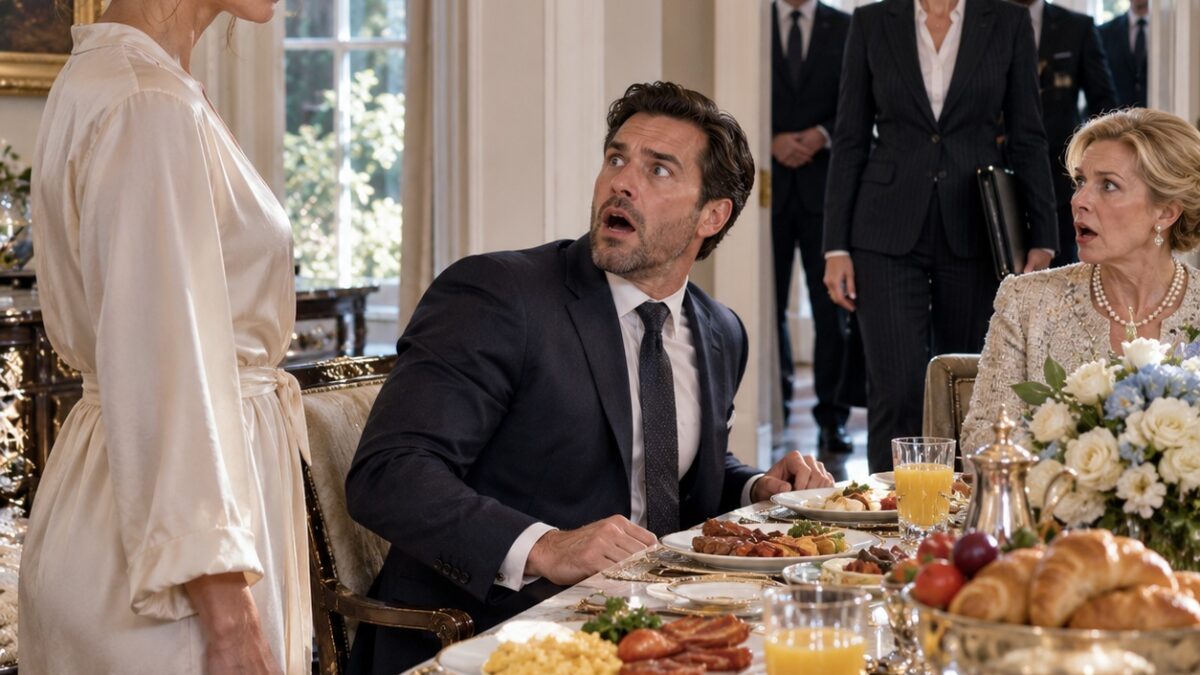
At 7:13, footsteps came down the staircase.
Nathan whistled.
Actually whistled.
He entered wearing gray slacks and a white shirt open at the collar.
His hair was still damp from the shower.
He saw me standing beside his chair.
Saw the food.
Saw the Asheville coffee.
His mouth curled into satisfaction.
“There we go.”
I said nothing.
He walked toward me.
His eyes touched my bruise.
No apology.
Nothing.
He glanced at the table.
“This is more like it.”
Then he leaned close.
“So you finally learned your place.”
My mother’s coffee cup touched the saucer.
A tiny sound.
Nathan looked down the table.
His body stopped.
I watched recognition arrive slowly.
First confusion.
Then memory.
Then fear.
“Catherine?”
My mother smiled without warmth.
“Good morning, Nathan.”
His face lost color.
Not because she was my mother.
Because he knew more about Catherine Hale than Evelyn did.
Years earlier, before retirement from federal service, Catherine had led the prosecution of executives in a major Texas bank fraud case.
One defendant had been Nathan’s first mentor.
That man went to federal prison.
Nathan had once described Catherine over drinks as:
“The woman who can make a guilty man confess just by letting silence sit too long.”
He had no idea she was my mother.
Until that morning.
Nathan looked at me.
Then Lydia.
Then Evelyn.
“What is this?”
Catherine answered:
“Breakfast.”
He didn’t move.
“You—”
I pulled out his chair.
“You asked for a proper breakfast.”
His eyes locked on my face.
“What did you tell them?”
“Everything.”
Nathan’s expression hardened.
That familiar transformation.
Fear seeking a path back to control.
He stepped toward me.
Catherine stood.
Only slightly.
“Don’t.”
One word.
Nathan stopped.
Not because Catherine could physically stop him.
Because he suddenly understood there were witnesses.
And because he noticed something else.
Two men stood beyond the glass doors near the garden entrance.
Private security.
Nathan’s eyes narrowed.
“You brought guards into my house?”
I said:
“My house.”
His head turned.
“What?”
“My house.”
He laughed.
But it sounded wrong.
“Nessa, don’t start this.”
“You don’t own this property.”
“Of course I do.”
“No.”
“We’ve lived here three years.”
“Yes.”
“I pay—”
“You pay utilities from our joint household account.”
“I paid for renovations.”
“My trust reimbursed most of them.”
His face changed.
“My name is on—”
“The deed?”
I reached for the first folder.
Lydia opened it.
“No,” she said.
Nathan looked at her.
“Who the hell are you?”
“Lydia Grant.”
His eyes sharpened.
He knew that name too.
Corporate litigation.
High-net-worth divorces.
Board disputes.
Not cheap.
Not accidental.
Lydia slid a certified deed copy across the table.
“Property acquired by Vanessa Hale eighteen months before your marriage.”
Nathan didn’t touch it.
Evelyn did.
She scanned.
Her face went pale.
Grantee:
Vanessa Catherine Hale.
Sole and separate property.
Evelyn looked at me.
“You lied.”
“No.”
“You let us believe—”
I almost admired the sentence.
“You never asked.”
“Nathan said—”
“Nathan assumed.”
Nathan shoved the paper away.
“This is insane.”
He looked at Catherine.
“You came here for what? To intimidate me?”
Catherine sat again.
“No.”
“Then why?”
“My daughter asked me to be present.”
“This is private.”
“Domestic assault is rarely improved by privacy.”
His jaw tightened.
“There was no assault.”
I looked at him.
He looked at my face.
Then away.
Evelyn spoke:
“It was a marital correction.”
Lydia’s eyebrows rose.
Catherine turned slowly toward her.
“Thank you.”
“For what?”
“For saying that in front of witnesses.”
Evelyn’s mouth opened.
Closed.
Nathan snapped:
“Mom, stop talking.”
The room became silent.
I poured myself coffee.
Nathan stared.
“Vanessa, come upstairs.”
“No.”
“I said—”
“No.”
The word did something to him.
For years, I had disagreed.
Explained.
Negotiated.
But rarely said no without decoration.
He stepped forward.
Security moved closer outside.
Nathan noticed.
Stopped again.
“I don’t know what game you think you’re playing.”
“No game.”
I sat.
Nathan remained standing.
I said:
“Last night was the last time you will ever touch me.”
He scoffed.
“Oh, please.”
“No.”
“You’re blowing this out of proportion because—”
I put the recorder on the table.
Small.
Black.
His voice stopped.
Evelyn stared.
Nathan looked at the device.
“What is that?”
“You know.”
“You recorded me?”
“For six months.”
His face changed completely.
That was the moment.
Not Catherine.
Not the deed.
The recorder.
Because Nathan lived on deniability.
He could charm.
Reframe.
Explain.
Say I bruised easily.
Say I was emotional.
Say his mother misunderstood.
Say I exaggerated.
But audio made his version smaller.
“Without my consent?”
Lydia answered:
“Texas is a one-party consent state for many in-person recordings where one participant consents, subject to the circumstances. Vanessa was a participant.”
Nathan looked at her.
“I didn’t ask you.”
“You should start listening to your attorneys before speaking.”
“I have attorneys.”
“Call them.”
He looked at me.
“You’ve been planning this.”
“Yes.”
“How long?”
“Since you shoved me into the study door in March.”
Evelyn inhaled.
She hadn’t known about that one.
Nathan glanced at her.
Then back.
“You said that was over.”
“You said it would never happen again.”
“So you’ve been setting me up?”
“I’ve been protecting myself.”
“Same thing.”
“No.”
His voice rose.
“You stayed!”
There it was.
The accusation used against survivors constantly.
You stayed.
Therefore it wasn’t bad.
Therefore you accepted it.
Therefore you consented.
Therefore you owe silence.
I looked at him.
“Yes.”
He blinked.
I continued.
“I stayed because leaving a controlling man safely takes planning.”
His face twisted.
“I’m not controlling.”
My mother almost laughed.
I said:
“You monitored my location.”
“We’re married.”
“You read my private messages.”
“You hid things.”
“You pressured me to leave work.”
“You told bank colleagues my companies would eventually be absorbed into your financial planning.”
“That was a joke.”
“You blocked the bedroom door when I tried to leave arguments.”
“You were hysterical.”
“You shoved me.”
“You came at me.”
“You broke my phone.”
“It slipped.”
“You threatened my friend Anna when she told me I should stay with her.”
“I told her to mind her business.”
“You told me no one would believe me.”
Nathan’s mouth closed.
I touched the recorder.
“You were wrong.”
Silence.
Evelyn finally sat.
For the first time, she looked old.
Not elegant.
Not commanding.
Old.
“Nathan,” she whispered, “what exactly is on that?”
He stared at her.
“Mom.”
“What?”
“You need to leave.”
Catherine said:
“She should probably stay.”
Nathan turned.
“You don’t control my mother.”
“No.”
Catherine gestured toward Evelyn.
“But she witnessed last night.”
Evelyn’s eyes widened.
“You are not dragging me into court.”
Catherine’s tone remained calm.
“You are already involved in whatever proceedings follow because you were present and spoke.”
“I won’t testify.”
“That is a conversation for your attorney.”
Evelyn looked at me with genuine hatred.
“You calculated this.”
I almost admired how desperately she needed me to be the villain.
“I bought the wrong coffee.”
Her lips tightened.
I added:
“Everything after that was Nathan’s choice.”
Nathan slammed his palm against the table.
Plates jumped.
Security entered immediately.
Two men.
No weapons displayed.
No aggression.
Presence.
Nathan backed away.
“This is my home!”
“No,” I said.
Again.
“My home.”
He looked toward the staircase.
“I’m not leaving.”
Lydia opened the second folder.
“Then we should discuss occupancy.”
Nathan laughed.
“You think a wife can throw her husband out overnight?”
“I think a court will decide the temporary arrangement.”
“What court?”
“Family court initially.”
I watched his face.
“Protective order petition is being filed this morning.”
He stared at me.
“You’re filing for divorce.”
“Yes.”
There it was.
The word I had rehearsed alone.
Divorce.
Once spoken, it did not shatter the room.
It simply clarified it.
Nathan’s fear turned into rage.
“You ungrateful bitch.”
Catherine stood.
Security moved.
I didn’t.
“That recording too,” I said.
Nathan stared at me like he had never seen me.
Maybe he hadn’t.
He knew the woman who softened sentences.
The wife who absorbed embarrassment.
The person he could intimidate into silence.
He did not know me without fear.
He pointed at me.
“You think this house and some recordings make you powerful?”
“No.”
I looked straight at him.
“I think not needing your permission makes me free.”
That hit harder than anything I could have shouted.
For several seconds, nobody moved.
Then Nathan’s phone rang.
He ignored it.
Rang again.
He looked at the screen.
His face tightened.
“Who?”
I asked.
“None of your business.”
The phone stopped.
Immediately rang again.
He answered.
“Yeah?”
His expression changed.
“What?”
Silence.
“No, I’m at home.”
Another pause.
“Why?”
He looked at me.
Then at Lydia.
“What meeting?”
His voice rose.
“I was not notified.”
He walked away from the table.
“No. Absolutely not. Margaret doesn’t have authority to—”
He stopped.
Listened.
His face became gray.
“What suspension?”
Evelyn stood.
“Nathan?”
He ignored her.
“This is ridiculous.”
He listened.
“No, I have not misused bank resources.”
My pulse remained steady.
That was my second call from the night before.
Margaret Sloan had moved quickly.
Not to punish Nathan because he hit me.
That was not the bank’s jurisdiction by itself.
But during preparation for leaving, I had uncovered something separate.
Nathan had been using his position to access financial information relating to entities connected to my trust.
He had no legitimate business purpose.
He also attempted to steer credit decisions affecting one of my portfolio companies, apparently hoping financial pressure would push me to consolidate assets under his preferred bank management team.
He believed that once we “simplified” our finances, he would have visibility and leverage.
He was careless.
Entitled people often are.
He searched internal systems.
Requested documents.
Directed junior staff.
Created emails.
When Margaret saw those records, she did not need a domestic argument to act.
She had governance obligations.
Nathan lowered the phone.
“How long?”
His eyes found mine.
“How long have you been talking to Margaret?”
“Long enough.”
“You went behind my back at my bank?”
“Your bank?”
That morning had become a festival of assumptions.
Nathan’s nostrils flared.
“You know what I mean.”
I did.
He thought every institution granting him status belonged to him emotionally.
His house.
His bank.
His wife.
His mother’s social circle.
Ownership through entitlement.
His phone buzzed again.
This time, an email.
He read.
“No.”
Then another.
“No.”
Evelyn stepped toward him.
“What is happening?”
He looked at her.
“I’ve been suspended pending internal review.”
Her face collapsed.
“What?”
“It’s temporary.”
Catherine sat again.
“Maybe.”
Nathan looked like he wanted to throw something.
Instead, he pointed at me.
“You did this.”
“No.”
“You contacted them!”
“Yes.”
“You destroyed my career.”
“No.”
I had waited years to understand this distinction.
Reporting conduct is not creating conduct.
“I gave them information.”
“You went through my work!”
“The information concerned my entities and communications sent to me.”
“That isn’t—”
“Your compliance team will decide.”
He laughed without humor.
“Compliance?”
“You think those idiots can touch me?”
Lydia said quietly:
“Please keep talking.”
Nathan looked at her.
Then the recorder.
For once, he shut up.
The breakfast sat untouched.
Steam had disappeared from the eggs.
Hollandaise cooled.
Bacon hardened.
The absurdity almost made me laugh.
Nathan had demanded a feast.
He had one.
He simply lost his appetite.
At 7:48, the front gate intercom rang.
Security checked.
Dallas County process server.
Nathan received formal notice related to the emergency filing and dissolution petition.
Not the final protective order—that required the court process—but enough to make the next stage undeniable.
He read the first page.
Then looked at me.
“You filed before breakfast?”
“Lydia prepared it.”
“You’re asking for exclusive occupancy?”
“Yes.”
“You’re asking the court to freeze joint transfers?”
“Yes.”
“You’re trying to steal my money.”
“Our joint accounts will be handled legally.”
“What about the Hale accounts?”
“Not yours.”
“We’re married.”
“Marriage does not automatically transform every separate asset into community property.”
He stared at Lydia.
“This is Texas.”
“Yes,” she said. “Which is why classifications and tracing matter.”
He looked toward Catherine.
“You planned this from day one.”
My mother laughed once.
“No.”
Everyone looked at her.
“If Vanessa had planned from day one, she would never have married you.”
The insult landed.
Nathan stepped toward her.
Security moved.
He stopped.
Again.
My mother didn’t flinch.
“This is unbelievable.”
Evelyn’s voice cracked.
“This family welcomed you.”
I looked at her.
“Did you?”
“We gave you a name.”
There it was.
The Mercer name.
The thing Evelyn thought had elevated me.
“I already had one.”
Her expression sharpened.
“Hale.”
“Yes.”
Catherine said:
“Perhaps you should have researched it.”
Evelyn turned.
“What is that supposed to mean?”
I almost stopped my mother.
Then didn’t.
Catherine folded her hands.
“The Hale Trust owns a controlling interest in Northbridge Capital.”
Evelyn blinked.
Meaningless to her.
Nathan understood immediately.
His head snapped toward me.
“No.”
Northbridge controlled several regional investment vehicles.
One of them was a major institutional shareholder in the holding company above Nathan’s bank.
Not majority ownership.
Not magical unilateral control.
But enough influence, relationships, and board representation that Nathan suddenly understood the scale of what he had never bothered asking.
His eyes widened.
“You’re a Hale.”
I smiled.
“I’ve been Vanessa Hale the entire time.”
“No. I mean that Hale.”
Catherine said:
“Yes.”
Evelyn looked between us.
“What Hale?”
Nathan whispered:
“Hale Industrial.”
My grandfather had built manufacturing companies after World War II.
My father expanded into logistics.
The family sold major operating assets long ago, diversified, and did something Evelyn could never understand:
Stopped advertising.
Our money became quieter as it grew.
Nathan sank into a chair.
“You told me your father owned a distribution company.”
“He did.”
“You said it was sold.”
“It was.”
“You said you worked in consulting.”
“I do.”
“You never said—”
“You never asked questions that weren’t about how useful the answer was to you.”
That silenced him.
For three years, Nathan had introduced me as “Vanessa from Asheville.”
He liked the contrast.
Sophisticated banker rescues ordinary Southern girl.
He built part of his identity around being the more impressive spouse.
The irony was that I never cared.
I loved him once.
Or believed I did.
His status meant nothing to me.
That may have been why he had initially found me attractive.
I wasn’t impressed.
Later, he needed to reinterpret that as ignorance.
If I wasn’t impressed, I must not understand his importance.
That was easier than considering he wasn’t the center of every room.
Evelyn lowered herself into a chair.
“How much are you worth?”
Catherine’s eyebrows rose.
I laughed.
After violence.
After evidence.
After divorce papers.
Evelyn had finally reached the question she cared about.
“It doesn’t matter.”
“It certainly matters if you’re married to my son.”
“No.”
I stood.
“It matters to lawyers handling marital property. It does not matter to you.”
Her mouth tightened.
“You manipulated us.”
“You mistook privacy for poverty.”
Nathan looked up.
“Nessa.”
I hated that nickname in his mouth now.
“Don’t.”
His tone changed.
Soft.
This was another version of him.
The reasonable Nathan.
The one who emerged when rage failed.
“Can we talk alone?”
“No.”
“Please.”
“No.”
“You are my wife.”
“For the moment.”
He winced.
Good.
I wasn’t proud of enjoying that.
But I did.
He looked at my bruise.
His eyes softened artificially.
“I’m sorry.”
Catherine looked away.
She had seen enough apologies from men facing consequences to recognize the timing.
Nathan continued.
“I lost control.”
“Yes.”
“I shouldn’t have touched you.”
“No.”
“Last night was unacceptable.”
“Yes.”
“Things have been stressful.”
I said nothing.
“The bank.”
Nothing.
“My mother.”
Evelyn looked offended.
“Our marriage.”
Nothing.
“I was drinking.”
There.
The list of defendants.
Stress.
Mother.
Marriage.
Alcohol.
Everything except choice.
“I need help.”
Maybe he did.
That didn’t mean I needed to stay.
I said:
“Get it.”
Hope flashed.
“Then we can—”
“No.”
He stared.
“I hope you get help because you should stop hurting people.”
I kept my voice steady.
“But I am not volunteering to remain close enough for you to prove treatment worked.”
His expression hardened again.
That happened quickly.
Apology has conditions when it is manipulation.
“You think you’re better than me.”
“No.”
“Yes.”
“I think I deserve not to be hit.”
He laughed bitterly.
“Listen to yourself.”
My mother’s chair moved.
I raised my hand slightly.
She stayed seated.
Nathan saw.
Hated it.
I had stopped needing rescue in that moment.
I had support.
Different thing.
Evelyn said:
“Marriage requires forgiveness.”
Catherine answered:
“Forgiveness and access are not synonyms.”
I looked at my mother.
That sentence stayed with me.
Nathan walked toward the windows.
Outside, security waited.
Inside, the life he thought belonged to him was changing faster than he could control.
“Where am I supposed to go?”
I nearly said:
Not my problem.
Instead:
“Your attorney can coordinate property retrieval and temporary arrangements.”
“This is my address.”
“You have your condo downtown.”
His head turned.
“You know about that?”
I smiled sadly.
There was no affair there.
At least not one I could prove or cared to investigate.
Nathan had purchased a condo through an LLC eighteen months earlier.
He claimed it was an investment.
Yet he kept clothes there.
A furnished bedroom.
Whiskey.
Gym gear.
A separate life space.
He had no housing emergency.
Evelyn said:
“He cannot live in some little condo.”
It was 2,300 square feet.
I almost admired her consistency.
Nathan left the house at 9:06.
Not because I physically expelled him.
Because his attorney, reached by phone, advised him to cooperate until emergency court proceedings clarified occupancy.
Two security guards accompanied him upstairs while he collected clothes and essentials.
He tried to take files from the locked study.
I stopped him.
“Those aren’t yours.”
“They concern the bank.”
“Then your counsel can request whatever is appropriate.”
“You can’t keep business records.”
“They belong to my entities.”
He stared at the locked door.
“You’ve been hiding things.”
“Protecting things.”
“From your husband.”
“Yes.”
That truth hurt him more than I expected.
Good marriages should not need locked studies.
Mine did.
When Nathan came downstairs carrying two bags, he stopped in the foyer.
The chandelier glowed above him.
Portraits hung along walls.
Most belonged to my family.
He had never asked.
He looked around differently.
As if the house had transformed.
It hadn’t.
Only his understanding had.
He looked at me.
“You’ll regret humiliating me.”
There it was.
Not:
I’m sorry.
Not:
I love you.
Not:
How do I repair this?
Humiliation.
That remained the injury he cared about.
I said:
“That sounded like a threat.”
His attorney was still on speakerphone.
“Mr. Mercer,” the attorney said sharply, “leave.”
Nathan’s face tightened.
He left.
Evelyn followed fifteen minutes later.
Before walking out, she turned.
“You destroyed my son.”
I looked at her.
“No.”
“Don’t you dare.”
“You watched him hit me and told him he was right.”
Her face stiffened.
“You raised a man who believes love means obedience.”
I opened the door.
“But what happens next is his responsibility.”
She stared.
Then stepped outside.
I closed the door.
And locked it.
The click echoed through the foyer.
My knees gave out.
Not dramatically.
My body simply stopped cooperating.
I sat on the bottom stair.
Lydia rushed forward.
“I’m fine.”
“You’re shaking.”
“I’m fine.”
“You can be both.”
My mother sat beside me.
For a while, nobody spoke.
Then I started crying.
Not relief exactly.
Grief.
Anger.
Embarrassment.
Exhaustion.
The strange heartbreak of ending something you know must end.
People imagine leaving abuse feels triumphant.
Sometimes it does.
Sometimes it feels like vomiting after surviving a car crash.
You are alive.
You are safe.
And your body still cannot understand why the world is moving.
Catherine held my hand.
No advice.
No prosecution questions.
Just my hand.
Eventually, I whispered:
“I loved him.”
“I know.”
“I feel stupid.”
“You aren’t.”
“I knew better.”
“Knowing patterns professionally or intellectually does not make you immune emotionally.”
“I kept thinking the version of him from the beginning would come back.”
My mother nodded.
“Of course.”
“What if I had left after the first shove?”
“Then you would have left after the first shove.”
I looked at her.
“That’s all?”
“That’s all.”
“No lecture?”
“Would it change yesterday?”
“No.”
“Then no.”
She squeezed my hand.
“Today matters.”
The hospital documented my injuries later that morning.
Photographs.
Split lip.
Facial bruising.
Tenderness.
No fracture.
I spoke to police.
I did not embellish.
Four strikes.
Threats.
Prior incidents documented.
Recording provided through counsel.
Evelyn’s presence noted.
The process did not become cinematic.
Nobody instantly handcuffed Nathan at a breakfast table.
Real systems move through reports, probable cause, attorneys, hearings, evidence, and decisions.
That mattered to me.
I wanted truth, not fantasy.
The emergency protective-order hearing took place quickly.
Nathan appeared with counsel.
Clean suit.
No expression.
He did not look at me much.
His attorney argued context.
No continuing threat.
Voluntary separation.
Nathan had moved out.
My attorney presented the recording, prior documentation, photographs, and messages.
The judge issued temporary protections and exclusive use of the residence while the case proceeded.
Nathan was ordered not to contact me directly except through counsel where permitted.
The house became quiet.
At first, too quiet.
I had always loved silence.
Now every sound startled me.
A car outside.
Gate buzzer.
Footstep from staff.
I installed more security.
Changed access codes.
Changed locks.
Removed Nathan’s remaining belongings through arranged collection.
His suits disappeared.
Golf clubs.
Liquor.
Photographs of us.
I kept one wedding picture.
Not because I wanted him back.
Because memory doesn’t become false when a relationship becomes dangerous.
The woman smiling in that photograph was real.
Her hope was real.
I refused to hate her for not knowing the ending.
The bank investigation moved faster than the divorce.
Nathan’s system access had left trails.
He had pulled reports outside ordinary business need.
Requested sensitive information relating to entities tied to my trust.
Communicated with junior analysts about “consolidation opportunities” without disclosures he should have made.
He argued he was developing business.
Compliance disagreed.
He argued our marriage made the relationships informal.
Governance disagreed.
He argued everyone knew Vanessa was his wife.
That made disclosure obligations worse, not better.
Margaret Sloan called me two weeks later.
“You doing all right?”
“Yes.”
“Lie.”
“Functioning.”
“Better.”
She paused.
“Board accepted his resignation.”
I sat down.
“Resignation?”
“Presented as voluntary.”
“Was it?”
“You know I won’t discuss internal deliberations.”
“I know.”
“His employment ends Friday.”
I closed my eyes.
I felt no joy.
That surprised me.
Maybe I expected satisfaction.
Instead, sadness.
Nathan had built his identity around that career.
He had damaged it himself.
I understood that logically.
Emotionally, I still remembered celebrating his promotion.
Opening champagne.
Buying him a watch.
The same man existed in my memories.
Good and bad can belong to one person.
That does not make the bad acceptable.
Margaret said:
“One more thing.”
“Yes?”
“You should know he told several people you engineered this because you wanted his position destroyed before divorce.”
I laughed quietly.
“Of course.”
“Don’t respond.”
“I won’t.”
“Good.”
“Margaret?”
“Yes?”
“Thank you.”
She paused.
“I didn’t do you a favor.”
“I know.”
“That distinction matters.”
“Yes.”
“If the conduct wasn’t there, your report would have gone nowhere.”
Exactly.
Reporting did not create wrongdoing.
That became one of the truths I repeated to myself.
Nathan’s public story evolved.
First, I was unstable.
Then vindictive.
Then secretly wealthy and manipulative.
Then embarrassed by my “working-class husband,” which was hilarious given his entire identity.
Then my family had conspired to remove him from the bank.
Then I had deliberately provoked the coffee fight while recording.
That one reached me through mutual acquaintances.
Anna called.
“I know you said not to send gossip.”
“Then why are you calling?”
“You need to hear this one.”
“No, I don’t.”
“He’s telling people you bought the wrong coffee intentionally.”
I was silent.
Then laughed.
Actually laughed.
“Are you serious?”
“He says you knew it would upset him.”
“So his defense is that I selected a coffee brand strategically enough to cause four involuntary hand movements?”
Anna snorted.
“I know.”
I laughed until my bruised cheek hurt.
That was the first moment Nathan’s narrative lost power over me.
It became absurd.
He needed the coffee to matter because if the coffee didn’t matter, only his choice did.
I stopped listening to gossip.
The criminal side resolved months later.
I won’t pretend it became dramatic justice.
Nathan’s attorney negotiated.
The evidence was strong.
He entered a plea related to assault.
There were conditions.
Counseling.
Probationary requirements.
No-contact provisions continued for a period.
The details mattered legally but became less important emotionally as my life moved forward.
Evelyn never apologized.
She gave a statement minimizing what happened.
She claimed she had been “shocked” and “frozen.”
The recording contradicted that.
Her voice was clear.
“You did exactly what was necessary.”
That sentence followed her.
Mutual friends heard about it.
Some stopped inviting her.
Others didn’t.
Highland Park society did not collapse because one wealthy woman behaved terribly.
Real life is less morally organized than stories.
People rationalize.
Some said:
“We shouldn’t judge a mother.”
Others said:
“She was protecting her son.”
One woman told me:
“Evelyn comes from a different generation.”
My mother responded when I told her:
“So does electricity. We still expect it not to kill people.”
I loved Catherine more every week.
The divorce took almost a year.
That process taught me another truth:
Having money does not make divorce painless.
It makes different arguments possible.
Tracing.
Separate property.
Joint property.
Reimbursements.
Tax treatment.
Business valuations.
Disclosure.
Nathan initially demanded an interest in the Highland Park house.
The deed said otherwise.
He argued marital funds had improved it.
Some expenditures were legitimate reimbursement questions.
We handled them.
He demanded access to trust assets.
The trust structure said otherwise.
He argued my secrecy constituted financial deception.
Lydia answered:
“Privacy about separate inherited or pre-marital wealth is not fraud merely because your client failed to perform basic diligence before marriage.”
Nathan’s attorneys became more realistic than Nathan.
Eventually, settlement discussions progressed.
I did not try to leave him penniless.
That surprised people.
Even my mother.
Nathan had marital rights to certain jointly accumulated assets.
He got them.
Fair share of joint investments.
His personal property.
The condo, which had been funded largely through his earnings and a loan.
Certain retirement assets handled according to agreement.
I kept the house.
My separate property.
My trust interests.
My businesses.
My life.
One mediation session lasted eleven hours.
Near the end, Nathan requested to speak to me privately.
I said no.
Then his attorney proposed supervised direct conversation with lawyers present.
I almost refused.
Lydia asked:
“Do you want closure?”
“I don’t believe in closure.”
“Good answer.”
“Then why would I talk?”
“Because you may want to say something.”
I thought.
Agreed.
We sat across a conference table.
Nathan looked thinner.
Older.
No expensive bank suit.
Simple blue shirt.
For the first time in years, he looked like a man rather than a role he performed.
He said:
“I’m sober.”
I nodded.
“Five months.”
“Good.”
“I’m in therapy.”
“Good.”
“You don’t believe me.”
“I believe you said it.”
He looked hurt.
Fair.
He continued:
“I didn’t understand what I was becoming.”
I said nothing.
“I hated losing control.”
“I know.”
“My father…”
He stopped.
I waited.
“My father hit my mother.”
That did not surprise me.
Evelyn had never mentioned it.
Nathan looked at his hands.
“I swore I wouldn’t be him.”
I felt sadness.
Not absolution.
“You became him anyway.”
“Yes.”
He looked up.
“I’m sorry.”
I believed he meant it in that moment.
That was difficult.
Because people want apologies to sort the world.
False apology?
Reject.
True apology?
Forgive and reunite.
But an apology can be sincere and still arrive too late to restore access.
“I believe you’re sorry.”
His eyes filled slightly.
“Then is there any chance—”
“No.”
Pain crossed his face.
“Not ever?”
“No.”
He looked away.
I continued.
“I hope you become a man who never hits another person.”
He nodded.
“I hope you have healthy relationships.”
His eyes returned.
“But you will not practice becoming safe on me.”
Silence.
He swallowed.
“I understand.”
Maybe he did.
Maybe not fully.
But he didn’t argue.
Then he said:
“Mom hates you.”
I almost smiled.
“I’ll survive.”
“She thinks you destroyed everything.”
“That story protects her.”
He frowned.
“From what?”
“Admitting she watched.”
Nathan went silent.
That was probably the hardest truth anyone had given him.
We finished mediation.
Signed months later.
The marriage ended legally on a Tuesday afternoon.
No thunder.
No dramatic speech.
A judge confirmed terms.
Paperwork.
Done.
I walked outside with Lydia.
Sunlight bright.
Dallas traffic loud.
“How do you feel?” she asked.
“Hungry.”
“That’s healthy.”
We ate tacos.
Not champagne.
Not expensive lunch.
Tacos from a place near the courthouse.
I spilled salsa on my blouse.
Lydia laughed.
I laughed too.
Freedom sometimes looks very ordinary.
The mansion changed afterward.
For months, I had considered selling it.
Too many memories.
The kitchen especially.
I avoided the spot where Nathan hit me.
Ridiculous, because marble doesn’t remember.
Bodies do.
Eventually, my mother asked:
“Do you want to leave because you dislike the house or because he contaminated it?”
“I don’t know.”
“Find out before selling.”
So I renovated.
Not the entire mansion.
Just enough.
The marble kitchen remained mostly intact.
But I replaced the island.
Changed the lighting.
Removed the stools where Evelyn had sat.
Repainted.
The breakfast room became a reading room.
The formal dining room—the place Nathan saw my mother and turned white—I transformed completely.
Round table.
Bookshelves.
No throne at either end.
That mattered.
One morning, almost exactly a year after the coffee incident, I invited three women to breakfast.
Catherine.
Lydia.
Margaret.
No Nathan.
No Evelyn.
I made pancakes.
Bacon.
Fruit.
Coffee.
Supermarket coffee.
Margaret took one sip.
“This is terrible.”
I laughed.
“My ex-husband would agree.”
Catherine raised her cup.
“To bad coffee.”
Lydia said:
“And excellent evidence.”
We laughed.
I looked around the table.
The room no longer felt like the site of a confrontation.
It felt like mine.
I had spent years thinking power meant money.
Then status.
Then documents.
Then lawyers.
Those helped.
Absolutely.
Money made certain exits safer.
Legal advice mattered.
Security mattered.
Evidence mattered.
But the most important power I recovered was simpler.
The right to interpret my own experience.
Nathan had spent years telling me what everything meant.
My success meant luck.
My privacy meant insecurity.
My disagreement meant disrespect.
His control meant leadership.
His jealousy meant love.
His anger meant stress.
His violence meant provocation.
My staying meant consent.
My leaving meant betrayal.
Once I stopped accepting his definitions, the structure collapsed quickly.
Coffee was coffee.
A slap was assault.
A threat was a threat.
A locked study was a boundary.
A deed was ownership.
A career consequence was not revenge if conduct caused it.
A divorce was not destruction.
It was exit.
The Bishop Arts office still exists.
I expanded it eventually.
Not because I needed to prove anything.
Because I liked the work.
I hired two analysts.
One of them, Mariah, asked during her interview:
“Why is your company so private?”
I smiled.
“Privacy is underrated.”
She laughed.
She had no idea.
Eventually, my personal story became public enough that I was asked to speak at a fundraiser for a domestic violence organization.
My first instinct was no.
I did not want to turn pain into branding.
Catherine understood.
Then the director said something that changed my mind.
“Women with resources are often told they should have left sooner because they had options. Women without resources are told leaving is impossible. Shame changes shape to fit whoever is suffering.”
I agreed to speak once.
I stood in a ballroom.
No names.
No details about bank.
No revenge narrative.
I said:
“I had money.”
The room became quiet.
“I had lawyers.”
“I owned the house.”
“I had a mother who understood the legal system.”
“And I still stayed after the first shove.”
I let that sit.
“Resources can create options. They do not automatically erase fear, attachment, hope, manipulation, or danger.”
People listened.
“I am telling you this because survivors are often asked the wrong question.”
Why didn’t you leave?
I shook my head.
“A better question is: What made leaving unsafe, difficult, or emotionally complicated, and what support would make it possible?”
Afterward, a woman approached me.
Elegant.
Probably sixty.
She whispered:
“My husband hasn’t hit me.”
I waited.
“But he controls everything.”
Her eyes filled.
“Everything.”
I gave her the organization’s confidential resource card.
I did not say:
Leave him.
I did not say:
That’s abuse.
I said:
“You deserve to talk to someone who will help you understand your options.”
Choice matters.
Agency matters.
Nobody should replace an abuser’s control with another person ordering them what to do.
That became important to me.
Nathan remarried three years later.
I learned accidentally.
Anna mentioned it, then apologized.
I felt surprisingly little.
I hoped he had changed.
Truly.
Not because he deserved peace more than anyone else.
Because whoever married him deserved safety.
I never contacted her.
Never sent warnings.
Never inserted myself.
Part of me wondered whether that was wrong.
My mother said:
“You are not required to monitor him forever.”
She was right.
His future choices belonged to him.
My life belonged to me.
Evelyn moved to a smaller home near Preston Hollow.
Her social world shrank somewhat.
Not ruined.
She remained Evelyn.
Pearls.
Notes.
Judgments.
Years after the divorce, we crossed paths at a charity luncheon.
I almost didn’t recognize her.
She looked frailer.
She saw me.
We both stopped.
“Vanessa.”
“Evelyn.”
Long silence.
Then she looked at my face.
No bruise, obviously.
Still, her eyes went there.
“I think about that morning.”
I didn’t answer.
She continued.
“I was wrong.”
Three words.
I never expected them.
My chest tightened.
“About what?”
She looked startled.
Maybe she hoped three words would be enough.
I needed specificity.
“About telling him…”
Her voice lowered.
“About saying he was right to hit you.”
I nodded.
“Yes.”
“I shouldn’t have.”
“No.”
She swallowed.
“My husband hit me.”
There it was.
Nathan’s father.
I felt no triumph.
Only sadness.
“I’m sorry.”
“I thought…”
She looked toward the ballroom.
Women talking.
Glasses clinking.
“I thought wives survived by making men feel respected.”
I understood more than I wanted to.
“Maybe that helped you survive.”
Her eyes returned.
“But it taught Nathan something dangerous.”
“Yes.”
She looked down.
“I know.”
There are moments when anger expects satisfaction and receives grief instead.
That was one.
I could have told her I forgave her.
I wasn’t sure I did.
Forgiveness had stopped being a goal.
So I said:
“I hope you find peace with it.”
She nodded.
“You too.”
“I have.”
That surprised her.
Maybe me too.
We walked in opposite directions.
That evening, I called Catherine.
“You’ll never guess who apologized.”
“Evelyn?”
“How did you know?”
“Age makes people either more rigid or more honest.”
“She told me Nathan’s father hit her.”
My mother was silent.
“That explains something.”
“Doesn’t excuse it.”
“No.”
“Still.”
“Yes.”
Understanding is not excusing.
Another distinction I had learned.
Nathan was shaped by violence.
Then he chose violence.
Evelyn was shaped by violence.
Then she normalized it.
I was shaped by their control.
Then I chose to leave.
History influences.
It does not remove responsibility.
Years passed.
The locked study eventually stayed unlocked.
That sounds small.
It wasn’t.
For years, turning that key had been a ritual.
Protection.
Evidence.
Secrets.
After Nathan left, I kept locking it out of habit.
One morning, I walked toward the door with coffee.
Reached for the key.
Stopped.
Who was I protecting it from?
I left it open.
Days later, I realized I had forgotten to close it.
I smiled.
Recovery often arrives unnoticed.
A door stays open.
A phone rings and you don’t panic.
Someone raises their voice in a restaurant and your body doesn’t freeze.
You buy the wrong coffee and laugh.
That last one happened with my mother.
She came to stay for Christmas.
I bought decaf by mistake.
Catherine took one sip.
“This is an act of aggression.”
I froze for half a second.
Then she saw my face.
Her expression softened.
“I’m sorry.”
“No.”
I started laughing.
Hard.
She stared.
“What?”
“Coffee.”
“What about it?”
“I survived another coffee mistake.”
Understanding crossed her face.
Then she laughed too.
We laughed until tears came.
That was the day I knew the memory no longer owned the object.
Coffee became coffee again.
Not a trigger.
Not evidence.
Not a symbol.
A drink somebody could buy wrong.
I still have the original recorder.
Lydia told me I could destroy it after all proceedings ended.
I didn’t.
It sits in a locked safe.
Not because I listen.
I never have since the legal process ended.
I keep it because it represents a moment when I began believing my own reality enough to preserve it.
Sometimes survivors document because they expect nobody to believe them.
Sometimes documentation helps them believe themselves.
That was me.
Nathan had argued so effectively for years that I questioned my interpretation.
Was he controlling or just protective?
Was that shove really a shove?
Did I provoke?
Was I being dramatic?
The recorder did not tell me how to feel.
It simply preserved facts.
His voice.
His hand.
Evelyn’s approval.
Facts became an anchor.
Eventually, I no longer needed the anchor.
But I remember what it did.
People who hear the story often love the breakfast scene.
Of course they do.
Bruised wife.
Magnificent table.
Arrogant husband.
Powerful mother waiting.
Deed.
Lawyer.
Bank consequences.
It has the shape of revenge.
That is not how I remember it.
I remember the night before.
Bathroom mirror.
My face.
Red light blinking.
Phone in my hand.
The long hesitation before calling my mother.
That was the brave part.
Not the table.
Not the deed.
Not Nathan’s face draining of color.
The brave part was admitting:
This will happen again if I stay.
The brave part was giving up hope in the marriage without giving up hope in myself.
The breakfast was theater.
Leaving was work.
Months of legal process.
Safety plans.
Grief.
Therapy.
Paperwork.
Friends.
Boundaries.
Learning how to sleep.
Learning not to apologize when I said no.
Learning that peace sometimes feels boring after chaos.
Especially that.
Nathan had trained my nervous system to expect intensity.
Afterward, calm felt strange.
I once told my therapist:
“Nothing is happening.”
She smiled.
“Do you want something to happen?”
“No.”
“Then maybe nothing is good.”
It was.
Nothing became beautiful.
No footsteps upstairs making me assess mood.
No whiskey breath.
No text asking where I was.
No mother-in-law walking into my kitchen without notice.
No one correcting the way I spoke.
Nothing.
Morning sunlight.
Coffee.
Work.
Books.
Friends.
My own keys.
My own house.
That was enough.
On the fifth anniversary of my divorce, I hosted breakfast again.
Not intentionally symbolic at first.
Anna was in town.
Lydia could come.
My mother flew in.
Margaret had retired from the bank.
We sat around the round table.
I made eggs.
Burned bacon.
Bought pastries instead.
Anna opened a bag of coffee.
“Asheville roast.”
Everyone looked at me.
She froze.
“Oh my God. I didn’t think.”
I stared at the bag.
Then laughed.
“Make it.”
“You sure?”
“Yes.”
She brewed it.
The smell filled the kitchen.
For one second, I was back in the marble room.
Nathan.
Evelyn.
Blood.
Rain.
Then the memory passed.
Catherine watched me.
I lifted my cup.
“To learning my place.”
Lydia nearly choked.
Margaret laughed.
Anna said:
“Vanessa.”
I smiled.
“I did learn it.”
They went quiet.
I looked around my home.
“My place is wherever I can sit without being afraid.”
No one joked after that.
We drank coffee.
And for the first time, Asheville roast tasted like nothing but coffee.
Sometimes I think about the exact moment Nathan saw my mother.
His face.
The fear.
For years, that was the part of the story other people wanted.
Who was she?
Why did he fear her?
What did she do?
The truth is less dramatic than people imagine.
Catherine did not threaten him.
She did not destroy him.
She did not call federal agents into my dining room.
She did something more important.
She sat at the table.
She witnessed.
She believed me.
She refused to let him redefine what happened.
That was what he feared.
Nathan was comfortable when violence existed privately.
In private, he could edit.
I was sensitive.
He was stressed.
It wasn’t that hard.
I made him angry.
Evelyn agreed.
The moment another person entered the room who understood power, evidence, and accountability, his private universe stopped being closed.
He lost narrative control.
That terrified him.
Maybe that is why abusive behavior so often depends on isolation.
Not because outsiders are magical.
Because witnesses complicate lies.
I did not need my mother to be a former prosecutor.
That made Nathan more nervous, yes.
But what I truly needed was a person who would say:
I believe what happened.
You have choices.
You do not have to negotiate your safety.
That can be a friend.
A counselor.
An advocate.
A doctor.
A lawyer.
A hotline worker.
A family member.
Someone.
The power wasn’t Catherine’s résumé.
The power was that I was no longer alone.
Today, when I walk through the dining room, there is no enormous formal table.
The round one remains.
Seats six comfortably.
Nobody sits at “the head.”
I like that.
The house still has marble.
Still expensive.
Still large.
But it stopped feeling like a stage.
It became a home.
The Bishop Arts office moved upstairs into a larger suite.
I kept the original tiny room.
People asked why.
Because I liked remembering the version of me Nathan mocked.
She was not weak.
She was building quietly.
There is a photograph on my desk now.
Not wedding.
Not family trust.
Just me and Catherine sitting at a diner after one of my speeches.
No makeup.
Laughing.
Normal.
Beside it is a small card from Lydia.
She sent it after the divorce finalized.
One sentence:
You never needed permission to belong to your own life.
I keep that one visible.
Nathan’s last direct words to me came during mediation:
“I’m sorry.”
I have never heard from him personally since.
That is as it should be.
I don’t need him to know whether I forgave him.
I don’t need him to see me happy.
I don’t need him punished forever.
I don’t need Evelyn’s regret.
I don’t need strangers to believe every detail.
That freedom took longer than leaving.
At first, I wanted everyone to know.
Look what he did.
Look what I survived.
Look who actually owned the house.
Look who controlled the assets.
Look who won.
Over time, “winning” changed definition.
Winning was sleeping.
Winning was silence.
Winning was bad supermarket coffee.
Winning was a study door left open.
Winning was no longer checking the driveway when a black SUV slowed outside.
Winning was making decisions without rehearsing how someone else would react.
Winning was being boring again.
I understand why people love dramatic endings.
So do I.
There was something unforgettable about Nathan standing beside that breakfast table, looking at the woman he once called “your intense aunt” and finally realizing he had no idea who I was.
But if I tell the story honestly, that wasn’t the ending.
It was the beginning.
The ending came years later on an ordinary Tuesday.
I was alone in the kitchen.
Rain moved across the garden.
Almost exactly the weather from that night.
I opened a cabinet.
Reached for coffee.
Two bags.
Asheville roast.
Cheap supermarket blend.
I looked at both.
For a second, I remembered Nathan saying:
“I told you what to buy.”
Then I chose the supermarket coffee.
Not because it tasted better.
It didn’t.
Because I wanted it.
I brewed one cup.
Carried it into the dining room.
Sat anywhere I pleased.
No bruises.
No witnesses.
No lawyers.
No mother waiting at the far end.
No one to terrify.
No one to impress.
Just me.
I took a sip.
It was awful.
I laughed.
And in the quiet house that had always been mine, I finally understood what Nathan never did.
My place had never been beneath him.
My place had never been behind him.
My place had never been wherever he decided to put me.
My place was in my own life.
And for the first time in years, nobody else got a vote.








