She Ordered Security to Throw Me Out of the Pool—She Had No Idea Whose Property She Was Standing On
I looked at Grant.
“Where did you get this?”
“My neighbor.”
“Resident?”
“Yes.”
“Why would a resident pay the association four hundred fifty dollars to reserve an amenity they already have access to?”
Grant gave me a tired smile.
“Because Cynthia told everyone the HOA had negotiated exclusive control of the pool deck for private resident events.”
“It didn’t.”
“I know that now.”
“You didn’t before?”
He shook his head.
“Most of us didn’t.”
That answer bothered me almost as much as the receipt.
“How long have you been on the board?”
“Seven years.”
“And she never brought this agreement to the board?”
“There was never an agreement.”
“So how did she explain it?”
“She said she handled it directly with hotel management.”
“She named anyone?”
“Usually she said legal counsel had reviewed everything.”
“Whose legal counsel?”
“That changed depending on the meeting.”
I leaned back.
Grant rubbed both hands around his coffee cup.
He looked like a man who had been carrying something unpleasant for a long time.
“I should’ve pushed harder,” he said.
“That depends. What happened when you did?”
His eyes lifted.
“The first time, Cynthia told me the amenity issue had been resolved years ago.”
“And the second?”
“She said questioning it publicly could expose the association to liability.”
“Interesting.”
“The third time, she reminded me that board elections were coming up.”
There it was.
“What does that mean?”
Grant laughed without humor.
“It means Cynthia knows exactly which residents care about landscaping, which ones care about parking, which ones are behind on assessments, which ones want architectural approvals, and which ones just want to be left alone.”
“She trades favors.”
“I didn’t say that.”
“You didn’t have to.”
Grant looked toward the window.
“Cynthia has been HOA president for eight years.”
“Eight?”
“Before that, vice president for three.”
“So she knows the system.”
“She is the system.”
That was the kind of sentence I had learned never to ignore.
Whenever a person became indistinguishable from the institution they managed, accountability usually disappeared shortly afterward.
I picked up the receipt again.
“Who authorized the payment account?”
“Association treasury.”
“Was it reported as amenity income?”
“I don’t know.”
“You’re on the board.”
“I know.”
His embarrassment was obvious.
“That’s part of why I contacted you.”
“Why me?”
“Because I looked up the property records.”
I said nothing.
Grant continued.
“I realized the pool parcel wasn’t association property.”
“How long ago?”
“Three days.”
“After what?”
“After Cynthia announced the association was going to replace the hotel’s pool-entry system.”
That surprised me.
“Replace it with what?”
“Resident access gates.”
I stared at him.
“She plans to put gates on my property?”
“Electronic ones.”
“Using association money?”
“That’s what the proposal says.”
“Approved?”
“Not yet.”
“When is the vote?”
He looked at his watch.
“Tonight.”
I almost smiled.
“You have a copy of the proposal?”
Grant reached into his messenger bag.
“Of course I do.”
He placed six stapled pages on the table.
The title read:
HARBOR CREST AMENITY ACCESS ENHANCEMENT PROJECT.
The language was beautifully polished.
Enhanced security.
Improved resident experience.
Controlled access.
Preservation of community resources.
Not one sentence clearly stated that the association did not own those resources.
Then I saw the projected budget.
$68,400.
I looked at Grant.
“They’re about to spend almost seventy thousand dollars installing gates on property they don’t own.”
“Yes.”
“Using resident assessments.”
“Yes.”
“And she believes the hotel agreed.”
“She claims it.”
“Did she produce a contract?”
“No.”
“Email?”
“No.”
“License?”
“No.”
“Written consent?”
“No.”
I tapped the proposal.
“Then what exactly is she relying on?”
Grant hesitated.
“Usage.”
I stopped.
“Say that again.”
“She keeps saying the residents have controlled the pool for so long that the hotel can’t suddenly take that control away.”
“Controlled?”
“That’s her word.”
Not used.
Not accessed.
Controlled.
I suddenly understood why Cynthia had been so methodical.
The signs.
The wristbands.
The private security.
The exclusive hours.
The events.
The direct instructions to employees.
The payments.
This was not only about privilege.
She had been manufacturing a history.
A narrative.
Something she could point to later and say, See? We’ve always managed this.
I had seen similar strategies in commercial property disputes.
Create a practice.
Repeat it.
Document it selectively.
Let everyone become accustomed to it.
Then treat the practice as if it were a legal right.
Silence becomes consent.
Habit becomes authority.
Eventually someone new arrives and assumes the arrangement was legitimate because it already existed.
Except I was the new owner.
And I read documents for a living.
“Who handled the acquisition before me?” I asked.
Grant thought.
“The previous hotel company?”
“Yes.”
“Three ownership groups in twelve years.”
That helped explain it.
Transient ownership.
Rotating management.
An HOA president who never moved.
Every time hotel leadership changed, Cynthia stayed.
She knew where the gaps were.
She had probably expanded into every one of them.
I folded the proposal.
“Grant, I need you to do something.”
“What?”
“Go to the meeting tonight.”
“You’re not coming?”
“No.”
“Why?”
“Because I don’t want Cynthia changing her behavior because she knows the property owner is in the room.”
Grant looked uncomfortable.
“You want me to spy on her?”
“No.”
“You want me to record the meeting?”
“Only if your association rules and state law allow you to do so.”
He nodded.
“They do.”
“Then record it as a board member preserving association business.”
“What am I looking for?”
“Don’t look.”
He frowned.
“Listen.”
“For what?”
“The truth people tell when they’re certain nobody powerful is listening.”
That evening, I ate dinner alone in the hotel restaurant.
At 8:43 p.m., Grant sent me an audio file.
I took it upstairs, plugged in headphones, and listened.
For the first fourteen minutes, it was exactly what I expected.
Landscaping.
Insurance renewal.
Parking complaints.
Balcony repairs.
Then Cynthia’s voice became sharper.
“Item eight. Amenity access enhancement.”
Papers shuffled.
A man asked, “Do we have written confirmation from the hotel?”
Cynthia answered instantly.
“The hotel has had years to object.”
I stopped the recording.
Played it again.
Not: Yes.
Not: Here is the agreement.
The hotel has had years to object.
I continued.
Another board member asked, “But do we own the pool?”
A pause.
Then Cynthia laughed.
“We are not reopening that discussion.”
The man said, “I’m only asking—”
“The residents have enjoyed uninterrupted control of those amenities for more than a decade.”
Control again.
Grant’s voice entered.
“Usage isn’t ownership.”
Cynthia replied, “Nobody said it was.”
Grant said, “Then why are we installing gates?”
“To protect the residents’ established rights.”
“What rights exactly?”
Her voice cooled.
“Grant, I’m beginning to think you’re creating confusion where none exists.”
“I’m asking for the document.”
“What document?”
“The one giving us control.”
A longer silence.
Then Cynthia said something I replayed four times.
“We don’t need a piece of paper to confirm what everyone already understands.”
That sentence was going to cost her.
The vote was postponed.
Grant and two other board members refused to approve the expenditure without documentation.
Cynthia was angry.
Not loud.
Worse.
Controlled.
At the end of the meeting, after most people had left, the recording continued because Grant had forgotten to stop it.
I heard chairs moving.
Then Cynthia’s voice.
“You’re making a mistake.”
Grant answered, “By asking questions?”
“By creating unnecessary conflict with me.”
“With you?”
“With the association.”
Again.
She had become the association in her own mind.
Grant said, “Those aren’t the same thing.”
Cynthia replied, very quietly, “Around here, they usually are.”
I removed the headphones.
Sat back.
And stared at the wall.
By nine the next morning, my attorney, Melissa Kane, was in the hotel conference room with two binders, three title maps, and the expression she wore whenever someone else’s bad decision was about to become expensive.
Melissa had represented my company for eight years.
She was five foot four, never raised her voice, and could make grown executives sweat by asking them to define a single word.
I showed her the receipt.
Then the proposal.
Then the photograph of the sign.
She listened to the board recording.
When it ended, she looked at me.
“How angry are you?”
“Professionally or personally?”
“Legally.”
“Professionally annoyed.”
“And personally?”
“Ask me tomorrow.”
“That bad?”
“She told me I wasn’t allowed at my own pool.”
Melissa blinked.
“You spoke with her?”
“She thought I was a guest.”
A slow smile appeared.
“You didn’t tell her who you were.”
“No.”
“Of course you didn’t.”
“I wanted documentation before confrontation.”
“You wanted theater.”
“I wanted accuracy.”
“You also enjoy theater.”
“That is unrelated.”
She opened the title binder.
“All right. The good news is boring.”
“My favorite kind.”
“Title is clean. Hotel parcel owns the pool deck, pavilion, bar structure, cabanas, pump house, access corridor, and surrounding landscaping.”
“And residents?”
“Have a nonexclusive easement for recreational access subject to reasonable operational rules.”
“Who sets those operational rules?”
“The hotel parcel owner.”
I nodded.
“Can the HOA independently reserve the deck?”
“No.”
“Charge reservation fees?”
“No.”
“Hire security to restrict hotel guests?”
“No.”
“Install permanent signage?”
“No.”
“Install gates?”
“Absolutely not.”
“Claim control based on historical use?”
She closed the binder.
“Using something you were already granted permission to use does not magically transform permission into ownership.”
“Could their attorneys make an argument?”
“Attorneys can make arguments about weather being emotionally unfair.”
“Melissa.”
“They can make an argument.”
“Could they win?”
“On the facts I’ve seen? I would enjoy watching them try.”
I handed her another file.
“What about collecting fees?”
She read the receipt.
“That becomes more interesting.”
“How?”
“If they represented that they were legally entitled to rent or reserve property they do not own, there may be issues involving misrepresentation, accounting obligations, unauthorized commercial use, tax treatment, insurance exposure…”
She looked up.
“And possibly more depending on where the money went.”
“That’s what I thought.”
“What do you want to do?”
“Nothing yet.”
She stared at me.
“Nothing.”
“Until tomorrow.”
“What happens tomorrow?”
“Private resident event.”
Melissa’s expression changed.
“No.”
“What?”
“I know that face.”
“What face?”
“The one you had before you bought a marina during a boundary dispute.”
“That worked out.”
“You bought half a peninsula out of spite.”
“Investment.”
“You hated the seller.”
“Coincidence.”
She sighed.
“What are you planning?”
“I’m going swimming.”
The following morning, Harbor Crest looked like a postcard.
Bright blue sky.
Sea breeze.
Palmetto fronds moving gently above the courtyard.
At nine, catering trucks began arriving.
By eleven, the deck had transformed.
White tablecloths.
Flower arrangements.
Champagne station.
Seafood buffet.
A jazz trio beneath my pavilion.
Dozens of residents entered wearing green wristbands.
Hotel guests approached twice.
Both groups were turned away.
I watched from the lobby.
A family from Ohio stood near the glass doors.
Father.
Mother.
Two kids.
The younger boy wore inflatable arm bands.
A security guard shook his head.
The mother pointed toward the pool.
I couldn’t hear her words.
The guard pointed toward a printed sign.
PRIVATE RESIDENT EVENT — POOL CLOSED TO HOTEL GUESTS UNTIL 6:00 PM.
The boy’s shoulders dropped.
His father looked furious.
They walked away.
I took a photograph of the sign.
Then another.
Then I went upstairs and changed.
Navy swim trunks.
White T-shirt.
Same worn canvas shoes.
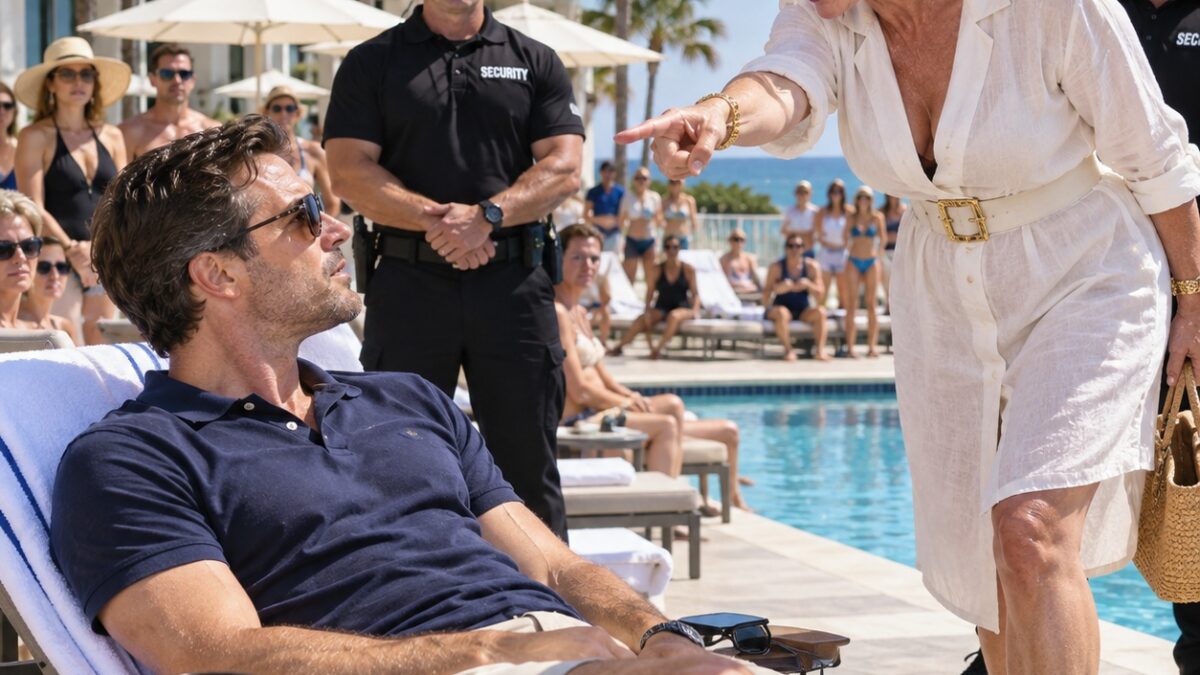
At 12:17, I walked onto the deck.
Nobody stopped me at first.
The temporary security station had become busy checking catering staff.
I picked a lounger twenty feet from the pool.
Removed my shoes.
Opened a paperback.
And waited.
I didn’t have to wait long.
“Excuse me.”
I looked up.
Cynthia.
White linen again.
Different dress.
Same gold sandals.
This time she had a green wristband on her right wrist.
She stared at mine.
Bare.
“I spoke to you yesterday.”
“Yes.”
“I specifically told you this was a private resident event.”
“I remember.”
“Then why are you here?”
“I wanted to use the pool.”
Her lips parted slightly.
“I’m sorry?”
“The pool.”
I pointed.
“Water. Chairs. Sun. Pretty standard concept.”
She looked around.
People were starting to notice.
“Sir, this is not amusing.”
“I wasn’t joking.”
“You are a hotel guest.”
“Yes.”
“Today the amenities are reserved for residents.”
“Who reserved them?”
“The association.”
“From whom?”
Her face tightened.
“We control the pool.”
“That wasn’t my question.”
She removed her sunglasses.
I could finally see her eyes.
Cold.
Evaluating.
“Are you intentionally trying to create a problem?”
“No.”
“Because this is the second day you’ve questioned policies that are none of your concern.”
“I’m staying at the hotel.”
“Which gives you access when the pool is available to hotel guests.”
“And who decides when that is?”
“I already explained this.”
“The association?”
“Yes.”
She said it loudly.
Confidently.
Exactly what I needed.
“What if the hotel disagrees?”
Cynthia smiled.
“The hotel doesn’t disagree.”
“How do you know?”
“Because we’ve operated this way for years.”
“That sounds like an assumption.”
Her face hardened.
By then, perhaps twenty people were watching.
A server slowed while carrying a tray.
The jazz trio kept playing but more quietly.
Cynthia crossed her arms.
“You need to leave.”
“I’m comfortable here.”
“This pool is for residents only today.”
“I understand that’s what your sign says.”
“It’s also what I’m telling you.”
“What authority do you have to tell me that?”
She looked almost offended by the question.
“I am the president of the Harbor Crest Residence Association.”
“Congratulations.”
Someone nearby choked on a laugh.
That was the wrong thing to do.
Cynthia heard it.
Her cheeks flushed.
She turned toward the security station.
“Mark!”
A broad-shouldered guard approached.
“Yes, ma’am?”
“This gentleman has been informed repeatedly that today’s event is private. Escort him back inside.”
The guard looked at me.
I almost felt sorry for him.
He was doing what his client instructed.
“Sir,” he said carefully, “I’m going to have to ask you to leave the pool area.”
“Who hired you?”
“Harbor Crest Residence Association.”
“Do you know who owns this deck?”
He hesitated.
Cynthia cut in.
“We are not doing this.”
I looked at the guard.
“Do you?”
“No, sir.”
“Fair answer.”
Cynthia stepped closer.
“You need to leave right now.”
Her voice carried across the deck.
More people turned.
Maybe forty now.
Some had phones in their hands.
Fine.
Documentation.
I stood.
Cynthia seemed satisfied.
She thought standing meant surrender.
Instead, I reached beneath my lounger and picked up the brown leather case I had brought with me.
She frowned.
“What is that?”
“Something boring.”
I set it on a table.
Opened the clasps.
Inside were copies of the recorded deed.
Parcel map.
Title policy.
Original development declaration.
Current tax map.
And Melissa’s written ownership summary.
I removed the first document.
“Cynthia, could you come here?”
“I don’t need to see your paperwork.”
“I think you do.”
“I said—”
“This is the recorded deed for Parcel H-1 of Harbor Crest.”
Her face changed.
Just slightly.
I opened the survey map.
“This line here runs behind the residential tower.”
I traced it with my finger.
“This line runs along the landscaped corridor.”
I moved my finger south.
“And everything shaded in blue belongs to the hotel parcel.”
People moved closer.
Cynthia didn’t.
I continued.
“The pavilion.”
I pointed.
“The cabanas.”
Another point.
“The bar.”
Another.
“The pool.”
Silence.
“The deck.”
I looked down.
“And the concrete underneath your sandals.”
Her mouth opened.
No sound came out.
The security guard looked at Cynthia.
Then at me.
I reached into the case and removed my business card.
“My name is Nathan Vance.”
That finally did it.
A few residents murmured.
Someone whispered, “Vance Harbor?”
I nodded.
“Vance Harbor Properties purchased the hotel parcel six months ago.”
Cynthia stared at me.
I placed the card beside the deed.
“My company owns this deck.”
The jazz trio had stopped playing.
For several seconds, there was no sound except the pool pump and gulls somewhere above the roofline.
Then Cynthia laughed.
It was too quick.
Too sharp.
“That’s absurd.”
“Which part?”
“The idea that you can walk in here with photocopies and suddenly overturn ten years of established association rights.”
I had expected denial.
What interested me was the wording.
Not surprise.
Rights.
She had prepared for this argument long before she knew I existed.
I said, “I’m not overturning anything.”
“You clearly don’t understand the arrangement.”
“That’s possible.”
I closed one binder.
“Which is why my attorney reviewed it.”
Her confidence flickered.
“Attorney?”
“Several times.”
She crossed her arms.
“The association has legal counsel too.”
“Good.”
I smiled.
“They’re going to have an interesting afternoon.”
Several residents exchanged looks.
Cynthia lowered her voice.
“We should discuss this privately.”
“No.”
Her eyebrows rose.
“No?”
“You chose to challenge my right to be here publicly.”
I looked around the deck.
“You had security approach me publicly.”
Then back at her.
“So we’re going to resolve the basic ownership question publicly.”
Her expression hardened.
“You’re trying to embarrass me.”
“No.”
“You came here under false pretenses.”
“I checked into a hotel I own under my legal name.”
“You concealed your identity.”
“I didn’t realize hotel guests were required to submit résumés to use the pool.”
A man near the bar laughed.
Cynthia shot him a look.
He stopped.
That told me more about Harbor Crest than almost anything else.
People were afraid of her.
Not physically.
Socially.
Administratively.
They were afraid she could make their lives difficult.
That mattered.
Cynthia pointed at the documents.
“Residents have used this pool since Harbor Crest opened.”
“Correct.”
“We have established rights.”
“Correct.”
“You admit it.”
“Of course.”
Her confidence returned.
“Then this performance is pointless.”
“No.”
I pulled out the original easement language.
“The residents have a right to use the recreational amenities.”
“Exactly.”
“Nonexclusive use.”
She went still.
I continued.
“Subject to operational control by the hotel parcel owner.”
No one moved.
Cynthia glanced at the paper but didn’t step closer.
I read the relevant section aloud.
Not dramatically.
I didn’t need to.
Plain language is devastating when someone has built power out of confusion.
When I finished, a resident asked, “So she can’t close the pool to hotel guests?”
I looked toward him.
“Not without our agreement.”
Another resident said, “What about resident events?”
“Those can happen.”
I nodded.
“We support them.”
Cynthia seized on that.
“You see?”
I looked at her.
“When properly scheduled with hotel management.”
I paused.
“And when nobody charges residents money to rent property the association doesn’t own.”
That changed the atmosphere instantly.
Cynthia’s face emptied.
Several heads turned toward her.
Grant was standing near the rear of the group.
He had arrived ten minutes earlier.
He held up one of the receipts.
“You mean these?”
Cynthia turned.
“Grant.”
His voice was calm.
“Are these authorized?”
“This is not the place.”
“It seems like exactly the place.”
A woman beside him asked, “What receipts?”
Grant held the paper higher.
“Cabana reservation fees.”
Another woman said, “I paid one of those.”
“So did I,” someone else said.
Then another.
“I paid six hundred for my daughter’s graduation brunch.”
“My book club paid three fifty.”
“What happened to that money?”
Cynthia raised both hands.
“Everyone needs to calm down.”
Nobody was shouting.
That phrase always interested me.
People who said everyone needs to calm down were often the least calm person present.
Cynthia looked at me.
“You have no idea what those payments represent.”
“That’s true.”
I nodded.
“I would love to know.”
“They cover event coordination.”
“By whom?”
“The association.”
“Using whose deck?”
She didn’t answer.
“Whose tables?”
Silence.
“Whose electricity?”
Her jaw tightened.
“Whose water?”
Nothing.
“Whose staff cleaned afterward?”
Avery stepped out from behind the bar.
“Ours.”
Every face turned toward her.
Cynthia looked stunned.
“Avery.”
The manager folded her arms.
“Our housekeeping staff cleaned every private resident event held here over the last fourteen months.”
“That is part of hotel operations.”
“Correct.”
“Then I don’t understand your point.”
“My point is that the hotel never received a dollar from those reservation fees.”
Silence again.
Avery continued.
“And we never approved them.”
Cynthia looked toward me.
“You’re orchestrating this.”
“No.”
“You set me up.”
“No.”
“You let this happen.”
That one was almost funny.
“I arrived four days ago because complaints had been reaching my office for five months.”
She stopped.
“You knew?”
“I knew enough to come.”
Her eyes narrowed.
“You could have called me.”
“I could have.”
“Instead you pretended to be some ordinary guest.”
There it was.
I tilted my head.
“Some ordinary guest?”
Cynthia realized her mistake.
Too late.
I looked around.
Several actual hotel guests had stopped near the doors.
Employees stood at a distance.
Residents watched.
I turned back to her.
“That’s exactly why I didn’t call you.”
Her voice dropped.
“What?”
“If I had arrived in a suit and introduced myself as the owner, you would’ve been charming.”
“That is insulting.”
“I watched you order employees around.”
“I watched you question guests based on whether you recognized them.”
“I watched your security turn children away from a pool their parents had paid to use.”
Her cheeks reddened.
“And I watched you threaten to remove me because my shoes weren’t expensive enough to make you curious about who I was.”
“That’s ridiculous.”
“Is it?”
I pointed toward the security guard.
“Did you check every resident’s access today?”
Cynthia said nothing.
The guard looked uncomfortable.
“Mark?”
He swallowed.
“No, sir.”
“Who were you told to check?”
He looked at Cynthia.
She snapped, “You do not have to answer him.”
The guard’s face changed.
I said calmly, “He absolutely does not have to answer me.”
Then I looked at him.
“But if your company wants to continue operating on property owned by Vance Harbor, someone will eventually answer our legal department.”
Mark exhaled.
“We were told to stop hotel guests.”
“Anything else?”
He hesitated.
“People without green bands.”
“Residents?”
“No.”
“Hotel guests?”
“Yes.”
“Thank you.”
Cynthia stepped toward him.
“You’re fired.”
Mark stared at her.
I almost laughed.
“No, he isn’t.”
She spun toward me.
“Excuse me?”
“This is my property.”
I pointed toward the gate.
“Your association hired his company to operate here without my authorization.”
I looked at Mark.
“You and your team can leave the deck until we straighten this out with your employer.”
He nodded immediately.
“Yes, sir.”
Cynthia looked furious.
“You cannot interfere with an association contract.”
“I’m not.”
I closed the leather case.
“I’m removing unauthorized private security from my property.”
That sentence ended the party.
Not immediately.
But emotionally.
The illusion was gone.
Cynthia Whitmore’s authority had depended on everyone assuming somebody else had confirmed it.
Residents assumed the board had documents.
The board assumed Cynthia had hotel approval.
Security assumed the HOA controlled the deck.
Employees assumed management couldn’t fight the association.
Hotel guests assumed the signs were legitimate.
Everyone had trusted the layer above them.
And Cynthia had lived inside the gaps.
She looked around at the residents.
“This event is over.”
A woman near the buffet said, “We paid for this event.”
Cynthia ignored her.
Another resident asked, “Where did our reservation money go?”
“Not now.”
“Why not now?”
“I said not now.”
Grant stepped forward.
“Cynthia, we need an emergency board meeting.”
“You don’t have authority to call one.”
“I have two additional directors who agree.”
Her expression shifted.
“How do you know that?”
“Because we spoke this morning.”
That frightened her.
Not the owner.
Not the deed.
The board.
Because for the first time, the institution she believed she controlled had started moving without her permission.
Cynthia collected her purse.
Before leaving, she stopped beside me.
Close enough that nobody else could hear.
“You think buying a hotel makes you powerful?”
“No.”
“You have no idea what kind of problems you’re creating.”
I looked at her.
“I think the problems were already here.”
She stared at me.
Then walked away.
I watched her cross the deck.
White linen.
Gold sandals.
Straight back.
People moved aside for her automatically.
Habits die slowly.
Melissa arrived forty minutes later.
She found me sitting beneath the pavilion eating shrimp from what remained of Cynthia’s catered buffet.
“You look pleased with yourself.”
“The shrimp is good.”
“I got four calls while driving here.”
“From?”
“Association counsel.”
“That was quick.”
“Private security.”
“Expected.”
“And a lawyer representing Cynthia personally.”
I stopped chewing.
“Personally?”
“Yes.”
“That’s interesting.”
“Very.”
Melissa set her briefcase beside me.
“What happened?”
“Cynthia tried to have me removed.”
“Of course she did.”
“She publicly stated that the HOA controls the amenities.”
“Excellent.”
“She also fired the security guard.”
“Less relevant.”
“Then Grant showed residents the receipts.”
Melissa paused.
“In public?”
“Yes.”
“How many residents?”
“Probably fifty by then.”
She closed her eyes briefly.
“You do enjoy theater.”
“I sat in a chair.”
“You strategically sat in a chair.”
“That’s still sitting.”
She pulled out her phone.
“I want the pool signs photographed before anyone touches them.”
“Already done.”
“Wristband instructions?”
“Avery kept copies.”
“Event schedule?”
“Printed.”
“Security contract?”
“Requested.”
“Payment records?”
“Not yet.”
Melissa smiled.
“Good.”
“What?”
“You’re learning.”
“I’m older than you.”
“Not emotionally.”
By late afternoon, the hotel issued a short written notice.
No accusations.
No threats.
Just facts.
The pool remained open to both hotel guests and residents under the existing property documents.
Unauthorized exclusivity signs were removed.
Any future resident event would require hotel coordination.
Private security hired by the HOA would not operate on hotel property without written authorization.
And the hotel would begin reviewing all past charges collected for private use of the amenity area.
That last sentence created chaos.
My phone started ringing before the notice was printed.
At 4:12, Cynthia called.
I let it ring.
At 4:16, she called again.
At 4:27, her attorney called Melissa.
At 4:35, three residents forwarded copies of reservation receipts.
By six, there were twenty-two.
By nine, thirty-eight.
Not all were for $450.
Some were $250.
Some $600.
One was $1,250 for what Cynthia had called an “exclusive sunset wedding reception.”
On my deck.
Using hotel electricity.
Hotel restrooms.
Hotel service corridors.
And hotel cleanup.
The association had collected the money.
The hotel had paid the costs.
The next morning, Avery came into the temporary conference room we had taken over.
“You need to see this.”
She placed a stack of internal work orders on the table.
Housekeeping.
Maintenance.
Pool setup.
Event cleanup.
Furniture movement.
Additional trash removal.
I read dates.
They matched the receipts.
“How far back?”
“Records are clean for thirty months.”
“How many events?”
“Seventy-three that look private or semi-private.”
I stared at her.
“You’re telling me the hotel provided labor for seventy-three events?”
“At least.”
“Did the previous ownership bill the association?”
“No.”
“Why?”
“Because Cynthia told staff the events were part of the amenity agreement.”
I looked up.
“And nobody verified?”
Avery looked ashamed.
“I did.”
“When?”
“After I became general manager.”
“How long ago?”
“Eighteen months.”
“What happened?”
“I asked the ownership group’s regional office for guidance.”
“And?”
“They were selling the property.”
Of course.
“So they ignored it.”
“They told me not to create unnecessary conflict during due diligence.”
I leaned back.
That was the missing piece.
Cynthia hadn’t needed everyone to believe her forever.
She only needed each person to avoid confrontation long enough for the next person to inherit the situation.
Previous ownership knew there was friction.
They simply chose not to spend money solving it before selling.
Their convenience became my problem.
And Cynthia’s confidence.
Avery looked at me.
“Are you angry with me?”
“No.”
“You should be.”
“Did you create the arrangement?”
“No.”
“Did you profit from it?”
“No.”
“Did you document your objections?”
“Yes.”
“Then I’m angry at the right people.”
She looked relieved.
I tapped the work orders.
“Can we estimate the labor cost?”
“Yes.”
“Utilities?”
“Probably.”
“Event damage?”
“Some.”
“Do it.”
“How far back?”
“As far as records allow.”
Then I stopped.
“One more thing.”
“What?”
“I want personnel complaints involving Cynthia.”
Avery hesitated.
“All of them?”
“All.”
“That’s going to be a thick folder.”
“Good.”
By the end of the day, it was.
Towel attendants.
Housekeepers.
Front-desk staff.
Bartenders.
Maintenance workers.
Two assistant managers.
Even a lifeguard who quit after Cynthia publicly accused him of “favoring transient guests over community members.”
One complaint made me stop.
It came from a twenty-year-old college student named Maya, who worked summers at the towel station.
The incident had happened six months earlier.
Cynthia had ordered Maya to remove a Hispanic family from a resident cabana.
The family were hotel guests.
They had been told by front-desk staff that the cabana was available.
Maya explained that.
Cynthia responded, according to the written complaint:
“People who belong here know how things work.”
I read the sentence twice.
Then asked Avery, “Did she really say this?”
“Maya says she did.”
“Where is Maya?”
“Back at college.”
“Can you contact her?”
“Yes.”
“Ask whether she’s willing to speak with counsel.”
Avery nodded.
The situation had grown beyond a property dispute.
It had become a culture problem.
Ownership documents could fix the legal confusion.
They couldn’t undo years of employees being told that a private resident board mattered more than the hotel that employed them.
That part required something else.
Three days later, the Harbor Crest Residence Association held an emergency meeting in the ballroom.
Cynthia arrived with two attorneys.
Not one.
Two.
The room was packed.
Nearly 180 residents.
Grant sat at the board table with six directors.
Cynthia took the center chair.
Of course she did.
I sat in the rear with Melissa.
We had no intention of speaking unless asked.
For the first twenty minutes, Cynthia controlled the room.
She described the dispute as a misunderstanding created by “new ownership unfamiliar with Harbor Crest’s traditions.”
She emphasized community.
History.
Longstanding expectations.
She used the word partnership twelve times.
Then Grant asked one question.
“Cynthia, can you produce the document giving this association operational control of the hotel amenity parcel?”
She stared at him.
“We’ve already discussed this.”
“I’m asking again.”
“Our rights are based on the governing documents and historical use.”
Grant slid a copy of the governing documents across the table.
“Which section?”
One of Cynthia’s attorneys leaned toward her.
Whispered.
Cynthia’s mouth tightened.
Another board member, Elaine Parker, spoke.
“I’d also like an answer.”
Cynthia looked at her.
“You reviewed these issues with me last year.”
“No.”
Elaine shook her head.
“You told me they had been reviewed.”
A murmur moved through the room.
That distinction mattered.
Cynthia said, “This is becoming theatrical.”
Grant almost smiled.
“Then make it boring.”
He tapped the documents.
“Show us the authority.”
Nothing.
Another director asked, “Did the hotel ever authorize us to charge reservation fees?”
Cynthia replied, “Those were administrative contributions.”
“Contributions?”
“They offset association coordination costs.”
A resident shouted from the audience.
“I was told it was a mandatory reservation fee.”
Someone else said, “Me too.”
The meeting chair called for order.
Grant asked, “How much money did the association collect?”
Cynthia looked toward the treasurer.
The treasurer looked terrified.
That was interesting.
His name was Paul Mercer.
He had barely spoken.
Grant turned.
“Paul?”
Paul cleared his throat.
“We are reviewing that.”
“How much?”
“I don’t have a final number.”
“Approximate.”
“Grant—”
“Ten thousand?”
Silence.
“Twenty?”
Paul looked at Cynthia.
That was the mistake.
Everyone saw it.
Grant leaned forward.
“Fifty?”
Paul finally said, “More.”
The room erupted.
“How much more?”
“Paul!”
“Where’s the money?”
The chair banged a gavel.
I looked at Melissa.
She whispered, “Now it’s interesting.”
Grant waited until the room settled.
“How much?”
Paul swallowed.
“Based on the records I reviewed this morning, approximately one hundred eighty-four thousand dollars over forty-one months.”
The room exploded again.
Even I hadn’t expected that number.
Melissa stopped smiling.
I wrote it down.
$184,000.
Grant asked, “Where is it?”
Paul said, “Association operating accounts.”
“Used for what?”
“Various expenses.”
“What expenses?”
“Events. Security. Community programming.”
“Anything else?”
Paul hesitated.
Cynthia interrupted.
“This is irresponsible. Financial summaries should not be discussed without proper reconciliation.”
Grant looked at her.
“Did you know we collected one hundred eighty-four thousand dollars from people for use of property we do not own?”
Cynthia answered immediately.
“We have a legal right to use the amenities.”
“That was not the question.”
“We also incurred costs.”
“For hotel staff?”
No answer.
“For hotel utilities?”
No answer.
“For hotel maintenance?”
Nothing.
Then an older resident near the front stood.
Her name was Margaret Dean.
I had met her once in the elevator.
She looked at Cynthia.
“My husband’s memorial was at that pool last year.”
The room quieted.
Margaret continued.
“You charged me nine hundred dollars.”
Cynthia’s expression softened instantly.
“Margaret, that was a special event requiring—”
“You told me the money went to the hotel.”
Silence.
Even Melissa shifted beside me.
Margaret’s voice shook.
“You looked me in the eye and told me the hotel required the fee.”
Cynthia said nothing.
“Was that true?”
Her attorney whispered something.
Cynthia looked down.
Margaret waited.
“Was it true?”
“No,” Grant said softly.
Cynthia looked at him sharply.
Grant held up an email.
“I asked the hotel this afternoon.”
He looked at Margaret.
“They never charged your association for the event.”
Margaret sat down slowly.
That changed the meeting.
Before, residents were angry about money.
Now they felt lied to.
Those are not the same thing.
Money can be refunded.
Trust is harder.
The board voted to suspend Cynthia’s authority pending a financial review.
Five to two.
She refused to leave the center chair at first.
I watched her.
The same woman who had walked across my deck as though she owned the sunlight itself now sat under fluorescent ballroom lights while board members collected her access card.
She looked smaller.
Not weak.
But limited.
For the first time, everyone could see the edge of her authority.
It had always existed.
She had simply convinced them not to look for it.
As the meeting ended, she came toward me.
Her attorneys followed.
Melissa stood.
Cynthia stopped six feet away.
“Are you happy?”
I looked at her.
“No.”
“You destroyed this community in less than a week.”
“No.”
“You turned neighbors against each other.”
“No.”
“You humiliated me.”
I shook my head.
“You humiliated a hotel guest you thought couldn’t matter.”
Her jaw tightened.
“You humiliated employees because you thought they couldn’t challenge you.”
I stepped closer.
“You charged residents to use my property and told some of them I required the money.”
Her face remained rigid.
“And when anyone questioned you, you treated the question as disloyalty.”
“That’s your version.”
“No.”
I nodded toward the ballroom.
“That’s theirs.”
For the first time, Cynthia had nothing to say.
Her attorney touched her arm.
She walked away.
I thought that would be the end.
I was wrong.
The financial review took six weeks.
It uncovered a mess.
Not a dramatic suitcase of stolen cash.
Reality was uglier and more ordinary.
The HOA had indeed collected roughly $184,000 in private reservation charges over a little more than three years.
Some funded legitimate association events.
Some paid the private security company.
Some paid for signs, wristbands, and printed materials.
Some subsidized resident social functions.
Some covered “presidential hospitality expenses.”
That category interested Melissa.
Receipts included floral arrangements.
Wine.
Restaurant bills.
Transportation.
A hotel suite in Savannah during a property-law conference Cynthia never attended.
Cynthia argued those expenses were related to association business.
The forensic accountant disagreed on several.
The total questionable amount was far smaller than residents initially feared.
But that almost didn’t matter.
The central problem was simpler.
The association had been collecting money based on authority it never possessed.
Worse, records showed Cynthia had repeatedly described the pool as an “association-controlled amenity” in vendor contracts.
She had signed security agreements as though the HOA had operational authority.
She had submitted insurance forms using similar language.
She had even sent one letter to a previous hotel owner claiming the association’s “exclusive management history” should be formally recognized.
That owner never answered.
Cynthia later cited the lack of response as evidence there was no dispute.
Silence had become her favorite tool.
The more we reviewed, the clearer her strategy became.
She had not woken up one morning and decided to steal a swimming pool.
She had done something more believable.
She pushed.
Nobody pushed back.
So she pushed again.
Twelve loungers.
No objection.
A sign.
No objection.
Private brunch.
No objection.
Security.
No objection.
Resident-only hours.
Complaints, but no legal action.
Reservation fees.
Still no lawsuit.
Each unanswered act became proof in her mind that she was entitled to the next one.
Entitlement had grown incrementally until she could stand on property someone else owned and genuinely believe she had the right to remove them from it.
That lesson stayed with me.
People imagine power grabs as dramatic events.
Sometimes they are.
More often, they happen in six-inch steps.
One small boundary crossed.
One uncomfortable conversation avoided.
One false statement left uncorrected because correcting it feels inconvenient.
Then another.
Then another.
Eventually everybody wakes up inside a reality created by the one person who never stopped pushing.
Our hotel submitted a claim to the association for labor, utilities, cleanup, unauthorized commercial use, damaged equipment, and legal costs.
We could have demanded every dollar immediately.
Melissa wanted leverage.
I wanted something else.
A clean future.
So we proposed a settlement.
The association would acknowledge in writing that the hotel owned the amenity parcel.
Resident access rights would remain protected.
No resident would lose normal pool privileges.
That part mattered to me.
The residents weren’t the enemy.
Most had simply believed their president.
The HOA would stop charging unapproved reservation fees.
Any future event would be coordinated through hotel management.
Residents who had paid improper amenity charges could apply for reimbursement from association funds.
The association would reimburse the hotel for documented event-related expenses over the period for which records existed.
All unauthorized signage would be removed.
Any access system would require hotel approval.
And hotel employees would take direction only from hotel management.
Simple.
Clear.
Boring.
Exactly what property agreements should be.
The new board accepted.
Six directors voted yes.
Cynthia was no longer one of them.
She resigned before a formal removal vote could occur.
Her resignation letter was four pages long.
She blamed me.
She blamed the board.
She blamed “changing cultural expectations.”
She blamed previous hotel owners for failing to formalize what she called a cooperative arrangement.
She never once wrote:
I was wrong.
That didn’t surprise me.
People who build their identity around being right often experience accountability as persecution.
Three months later, I returned to Harbor Crest.
This time everyone knew who I was.
I hated that.
The bellman straightened when I entered.
The front-desk agent called me Mr. Vance three times in ninety seconds.
A bartender offered to move another guest so I could sit closer to the view.
I declined.
That kind of treatment was exactly why I had come anonymously the first time.
Titles distort reality.
People show you what they think power wants to see.
Without the title, you see what exists when they believe there are no consequences.
I walked outside.
The pool looked different.
Not physically.
Most of the same furniture remained.
But the navy HOA signs were gone.
The green wristbands were gone.
A new sign stood beside the entrance.
WELCOME TO HARBOR CREST.
HOTEL GUESTS AND RESIDENTS SHARE ACCESS TO THIS AMENITY.
Please see hotel staff for scheduled private events.
That was it.
No ownership battle.
No hierarchy.
No one group presented as more deserving than another.
Near the towel station, I noticed Maya.
The college student.
She was back for winter break.
I had spoken to her by video during the investigation, but we had never met in person.
She recognized me.
“Mr. Vance?”
“Nathan.”
She smiled nervously.
“Okay.”
I looked around.
“How is it?”
“What?”
“Working here.”
She thought carefully.
“Quieter.”
“Good quiet or bad quiet?”
“Good.”
She folded towels.
“People don’t yell at us as much.”
That sentence hit me harder than any financial report.
I leaned against the counter.
“Did they yell a lot?”
“Not everyone.”
“Cynthia?”
She hesitated.
Then nodded.
“Sometimes.”
“Why didn’t more people report it?”
“We did.”
I winced.
Fair.
She continued.
“I think everyone thought somebody higher up already knew.”
Again.
There it was.
Everybody thought somebody else knew.
Everybody thought somebody else had checked.
Everybody thought somebody else would handle it.
That was how Cynthia’s little empire had grown.
Not because she was uniquely powerful.
Because everyone else kept passing responsibility upward.
I nodded.
“Fair criticism.”
Maya looked embarrassed.
“I didn’t mean—”
“No.”
I smiled.
“You were right.”
She relaxed.
“Can I ask you something?”
“Sure.”
“Is it true she tried to kick you out?”
“Very true.”
Maya laughed.
“I wish I had seen that.”
“Half the property did.”
“One of the bartenders has a video.”
I stared at her.
“There’s video?”
Her eyes widened.
“You didn’t know?”
“No.”
“Oh.”
She looked guilty.
“It may have circulated.”
“How widely?”
She winced.
“Do you know what TikTok is?”
I closed my eyes.
“Oh, no.”
She laughed.
That video followed me for months.
Someone had recorded the entire confrontation from near the bar.
The clip where Cynthia said, “The association manages the amenities,” was viewed millions of times.
The moment I opened the survey became a reaction meme.
My communications director found this hilarious.
I did not.
The internet named Cynthia “Pool Karen.”
I hated that too.
Not because I felt sorry for what she had done.
Because reducing a complicated abuse of authority to a nickname made it too easy to miss the lesson.
Cynthia wasn’t dangerous because she wore gold sandals or spoke rudely to strangers.
She was dangerous because she understood something most people don’t.
Authority does not always need to be real.
Sometimes it only needs to go unchallenged.
If you speak confidently enough, put up a sign, hire a guard, print a wristband, send an email with enough legal-sounding language, and repeat your claim long enough, a surprising number of people will assume someone somewhere must have approved it.
And once that assumption becomes routine, questioning it starts to feel disruptive.
Cynthia depended on that.
What ended her control wasn’t my money.
It wasn’t my title.
It wasn’t even the deed.
It was people finally asking one simple question.
Where is that written?
Grant later became association president.
I warned him not to enjoy the title too much.
He laughed.
“After Cynthia, I’m terrified of the title.”
“Good.”
“That’s your leadership advice?”
“Yes.”
“Be afraid of power?”
“Be suspicious of how comfortable it feels.”
He remembered that.
The new board did something I respected.
They posted major contracts in a resident portal.
Meeting minutes became detailed.
Financial reports were distributed quarterly.
Amenity rules linked directly to the governing documents.
Any resident could see what authority the board had.
And, just as importantly, what authority it did not have.
Transparency is boring.
That is one of its greatest strengths.
Drama thrives in uncertainty.
Power thrives in ambiguity.
Cynthia had built her system in both.
A year later, I received an envelope at my Charleston office.
No return address.
Inside was a handwritten note.
Nathan,
You probably believe you improved Harbor Crest.
You did not.
You stripped the community of traditions developed over a decade and replaced neighborly understanding with corporate legalism.
I hope someday you understand that ownership on paper is not the same as belonging.
Cynthia Whitmore.
I read it twice.
Then handed it to Melissa.
She read it.
“Want me to respond?”
“No.”
“Sure?”
“Yes.”
“What are you going to do with it?”
I opened the bottom drawer of my desk.
Placed the letter inside.
Closed it.
“Nothing.”
Melissa smiled.
“Growth.”
I looked at her.
“Don’t ruin the moment.”
The funny part was that Cynthia’s last sentence wasn’t entirely wrong.
Ownership on paper was not the same as belonging.
But she had learned the wrong lesson from that truth.
Belonging does not require ownership.
And ownership does not entitle you to treat people as inferior.
The residents belonged at Harbor Crest.
So did the hotel guests.
So did the employees who cleaned the deck before sunrise.
So did the bartenders.
The towel attendants.
The maintenance crews.
The children who wanted to swim during vacation.
Cynthia’s failure was that she turned belonging into hierarchy.
Residents belonged more.
Hotel guests belonged temporarily.
Employees existed to serve.
Anyone she didn’t recognize had to prove themselves.
And because nobody stopped her early, that hierarchy hardened into policy.
Three summers after the confrontation, I returned with my sister and her two grandchildren.
They knew nothing about the story.
At least I thought they didn’t.
My grandniece was eleven.
Her brother was eight.
We checked in Friday afternoon.
The next morning, I took them to the pool.
My grandniece stopped near the entrance.
“Uncle Nathan?”
“Yes?”
“Is this the pool?”
“What pool?”
“The famous one.”
I looked at my sister.
She started laughing.
“You told them?”
“I did not.”
My grandniece held up her phone.
“You’re literally on the internet.”
I groaned.
Her brother pointed toward the deck.
“Where did the mean lady stand?”
“She wasn’t a mean lady.”
My sister raised an eyebrow.
I sighed.
“She was a complicated lady who made several very bad decisions.”
“Where did she stand?”
I pointed.
“There.”
He ran over.
“Right here?”
“Approximately.”
He looked down at the stone.
“This is your concrete?”
I laughed.
“Technically.”
He planted both feet dramatically.
“I own this concrete!”
“No.”
My sister laughed harder.
“Absolutely not.”
I looked at him.
“Actually, that was kind of the entire lesson.”
He frowned.
“What lesson?”
I sat on the edge of a lounger.
“That you don’t get to claim something just because nobody stopped you yet.”
He thought about that.
Then pointed at his sister.
“She took my charger yesterday.”
His sister groaned.
“That is not the same thing.”
“It is exactly the same thing.”
“It is not.”
Within thirty seconds, they were arguing.
I leaned back.
The pool glittered beneath the morning sun.
Residents were already there.
So were hotel guests.
Nobody wore different wristbands.
Nobody was checking which tower they came from.
A resident couple sat beside a family from Tennessee.
Two children played in the shallow end.
A bartender carried drinks between tables.
Maya, now an assistant guest-services manager, walked across the deck holding a clipboard.
She waved when she saw me.
I waved back.
Nothing dramatic happened.
That was the victory.
The pool had become boring again.
And I had learned to appreciate boring.
People sometimes asked why I hadn’t simply identified myself the first time Cynthia approached me.
The answer was simple.
If I had said, “I own the hotel,” Cynthia would have smiled.
She would have apologized.
She would have blamed an employee.
She would have offered me a drink.
She might even have removed the sign herself.
Then I would have learned nothing.
Instead, she saw an ordinary middle-aged man in worn shoes.
Someone she believed had no authority.
Someone whose embarrassment carried no consequence for her.
And that was the person she chose to show me.
That person mattered more than the version she would have shown an owner.
Because character is not how someone behaves when the powerful person enters the room.
Character is how they behave before they know who the powerful person is.
Cynthia showed me exactly who she was.
So did Avery.
Avery had tried to protect her employees even when previous ownership preferred silence.
Grant had finally questioned a system he had tolerated too long.
Mark, the security guard, told the truth even when Cynthia threatened his job.
Margaret stood in a crowded ballroom and demanded to know why she had been lied to.
Maya had written a complaint even though she believed nobody would read it.
Those actions mattered.
Maybe none of them looked dramatic alone.
Neither had Cynthia’s first twelve loungers.
That works both ways.
Bad systems are built through small surrendered boundaries.
Good ones are rebuilt through small acts of resistance.
A question.
A complaint.
A receipt saved in a drawer.
A board member asking to see the document.
A young employee writing down exactly what someone said.
A security guard refusing to lie.
A manager keeping copies of emails everyone else wanted forgotten.
And sometimes a tired hotel owner sitting quietly beside a pool long enough to watch the truth walk straight toward him in gold sandals.
I still own Harbor Crest.
We renovated the hotel two years after the dispute.
New lobby.
Updated rooms.
Rebuilt bar.
Expanded landscaping.
The pool stayed almost exactly the same.
I insisted on it.
Melissa thought I was being sentimental.
Maybe I was.
The only major change was a small bronze plaque near the entrance.
Nothing about Cynthia.
Nothing about me.
It simply read:
HARBOR CREST AMENITIES
For the shared enjoyment of residents and registered hotel guests.
Please treat our property, our staff, and one another with respect.
That was enough.
Every now and then, I still sit in the same lounger where Cynthia tried to remove me.
Usually nobody recognizes me anymore.
The video faded.
Internet attention moved somewhere else.
That’s another thing I appreciate.
I wear the same kind of navy polo.
My SUV has finally been replaced, although not voluntarily. The transmission made the decision for me.
And I still prefer sitting quietly.
One afternoon, several years after everything happened, I watched a new hotel guest approach the pool.
He was older.
Maybe seventy.
Wearing discount-store sandals and a faded fishing shirt.
He stopped beside the entrance, clearly unsure whether he was allowed inside.
A young towel attendant noticed.
She walked over.
“Hotel guest?”
He nodded.
She smiled.
“Welcome. Towels are right here. Sit anywhere that isn’t reserved.”
He looked toward a group of residents.
“Is it okay?”
“Of course.”
“I’m not a condo owner.”
“Doesn’t matter.”
She handed him two towels.
“You’re welcome here.”
The man smiled.
Nothing else happened.
Nobody applauded.
Nobody recorded it.
Nobody knew I was watching.
And for some reason, that tiny exchange meant more to me than the day I opened the leather case.
Because winning a dispute is easy compared with changing what happens after everyone stops paying attention.
That was what I cared about.
Not whether Cynthia lost.
Whether Harbor Crest became better.
Years earlier, Cynthia had looked down at my worn shoes and decided what kind of person I was.
Hotel guest.
Temporary.
Unimportant.
Someone who could be moved.
She pointed to security.
Raised her voice.
And tried to show forty people exactly where I belonged.
Eleven minutes later, I showed her a recorded deed.
But the paper wasn’t the most important thing I revealed that afternoon.
I revealed the weakness underneath the system she had built.
It depended on nobody asking questions.
Once people started asking, it collapsed almost by itself.
And that is why, whenever someone tells me a rule exists simply because “that’s how we’ve always done it,” I ask the same question.
Show me.
Show me the agreement.
Show me the vote.
Show me the authority.
Show me where it is written.
Because sometimes the person guarding the gate doesn’t own the gate.
Sometimes the person collecting the money has no right to charge it.
Sometimes the sign bolted into the ground is nothing more than a sign.
And sometimes the quiet stranger being ordered to leave is the one person in the crowd who already knows the truth.
Cynthia thought the most powerful thing on that pool deck was her title.
She was wrong.
It wasn’t my title either.
It was the document sitting inside my old brown leather case.
A document she had apparently never bothered to read.
A few sheets of paper.
A property line.
A signature.
And a simple fact no amount of confidence could change.
The pool had never belonged to her.
The deck had never belonged to her association.
The concrete beneath those gold sandals had never been hers to control.
And once everyone finally understood that, neither was the authority she had spent years pretending to own.








