My Neighbor’s MMA-Champion Son Challenged Me in Front of the Entire Street—He Had No Idea Why the Army Kept My Past Classified
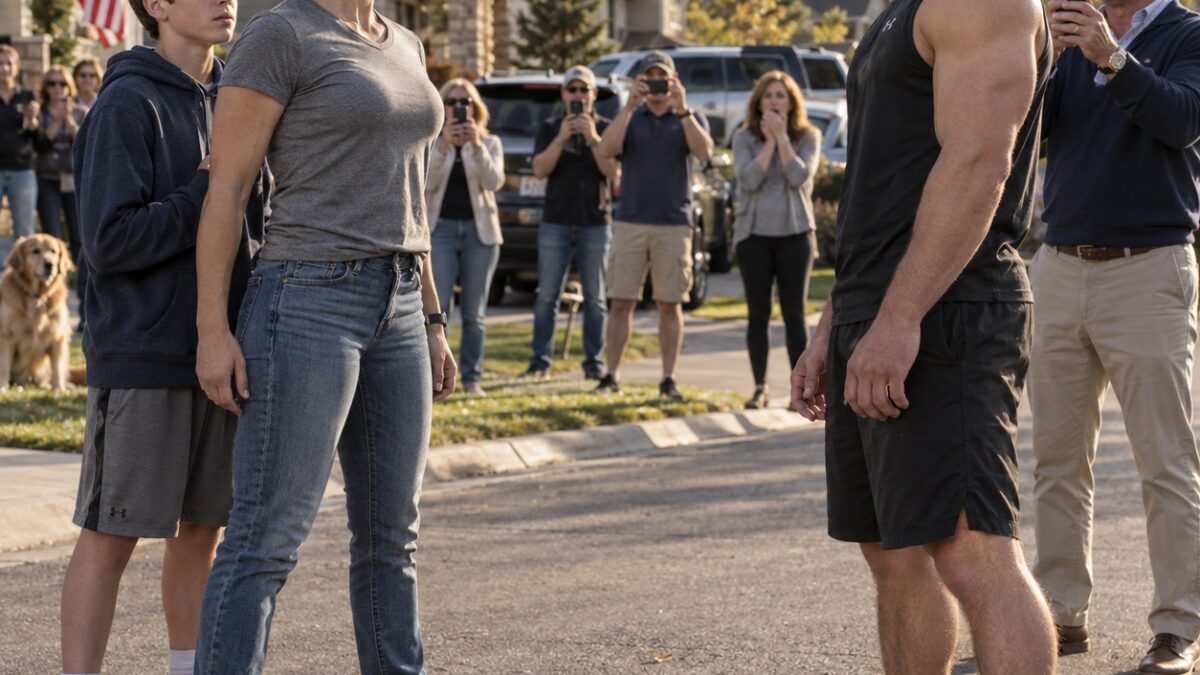
I tossed the gloves onto the edge of the mat.
“I don’t need these,” I said.
A few people laughed, but the sound was brittle.
Grant lowered his phone just enough to look over it. He wore a white linen shirt, expensive sunglasses, and the self-satisfied expression of a man who had spent his life confusing wealth with immunity.
“If you’re afraid of getting hurt, Claire, nobody will blame you,” he said. “Logan was only having some fun.”
I turned toward him.
“Is that what happened to Noah’s face?”
The music continued pounding from the garage, but conversation around us stopped.
Noah looked down.
Grant glanced at Logan. It lasted less than a second, but I saw the silent exchange between them.
They had already prepared a story.
Logan spread his hands. “Your kid fell.”
“Where?”
“Near the trail behind the retention pond.”
“What were you doing there?”
“Training.”
“With a fifteen-year-old?”
“He was spying on me.”
Noah lifted his head. “I wasn’t spying.”
Logan’s expression hardened.
I watched the change carefully. The smile stayed on his mouth, but his eyes became flat.
“What did you see?” I asked Noah.
He looked at Logan before answering.
That frightened me more than the blood.
“Nothing.”
“Noah.”
“I said nothing.”
Grant raised his phone again. “This is becoming unnecessarily dramatic. Teenagers get into trouble. Boys fall down. You don’t have to turn everything into an interrogation.”
I ignored him and stepped closer to my son.
Noah was tall for his age but still carried pieces of childhood in his face. His father’s dark eyes. My stubborn jaw. A tiny scar near his eyebrow from falling off his bicycle when he was seven.
I touched the cracked frame of his glasses.
He flinched.
Not from me.
From the memory of whatever had happened.
“Go home,” I told him softly. “Lock the doors.”
“Mom—”
“Now.”
His eyes moved toward the driveway behind Logan. A black SUV was parked near the open garage, partly hidden by Grant’s Range Rover. It had tinted windows and no front license plate.
Noah swallowed.
“Please don’t fight him.”
“I’m not going to fight anyone.”
Logan laughed.
Noah did not look reassured.
He walked toward our house, and every step seemed to increase the pressure behind my ribs. I waited until he crossed our lawn and entered through the front door.
Only then did I face Logan again.
“You wanted an audience,” I said. “You have one. Tell them why my son is bleeding.”
“He tripped.”
“Then why did you challenge me?”
He opened his mouth but did not answer immediately.
Grant stepped forward. “Because you came over here making accusations.”
“I walked over after I saw you throw those gloves into the street.”
“That isn’t how I remember it.”
“You’re recording,” I said. “Play the beginning.”
Grant’s smile disappeared.
Around us, neighbors shifted uneasily.
Mrs. Delgado, who lived across from me, lowered her paper cup. A father pulled his young daughter closer. Two teenagers stopped whispering.
Logan cracked his neck.
“Maybe the kid needs to learn not to trespass,” he said.
There it was.
Not a fall.
Not an accident.
Trespassing.
“Where did he trespass?”
“He went onto our property.”
“You said he was near the retention pond.”
“The trail crosses our property.”
“No, it doesn’t.”
Grant sighed. “Claire, I developed this neighborhood. I think I know where my property ends.”
“I reviewed the county survey before I bought my house. The trail belongs to the Silver Creek Open Space District.”
His jaw tightened.
Logan stepped onto the mat. “Are we doing this or not?”
“No,” I said.
The satisfaction on his face returned.
Then I continued.
“You’re going to tell me what happened to Noah.”
“And if I don’t?”
“I call the sheriff.”
Grant laughed.
It was too quick and too confident.
“Go ahead.”
A cold sensation moved through me.
Most people feared police involvement when a minor had been injured on their property. Grant welcomed it.
That meant he believed he controlled the response.
I looked again at the black SUV.
The engine was running.
A shape shifted behind the windshield.
“You planned this,” I said.
Logan’s expression flickered.
Grant’s did not.
“Planned what?”
“The party. The cameras. The challenge. Noah’s presence at the trail.”
“You think the world revolves around you, Colonel.”
It was the second time Logan had used my rank.
I had never told him.
Only three people in Silver Creek knew I was still serving: Noah’s school principal, my physician, and the county veterans’ liaison who had helped me navigate the purchase of the house.
My neighbors believed I had worked in Army administration years ago. Even the Whitmores should not have known my current rank.
I stepped closer to Logan.
“Who told you to call me that?”
His smile became uncertain.
Grant answered for him. “Your son talks.”
“No, he doesn’t.”
“Then perhaps you aren’t as mysterious as you imagine.”
The rear door of the black SUV opened.
A man wearing a dark baseball cap got out. He was broad through the chest, somewhere in his late forties, and he moved with the compact balance of someone who had received real training.
He did not approach us.
He stood beside the vehicle and watched.
I recognized him.
Not his face.
His posture.
His right arm remained slightly away from his body, making room for something beneath his jacket. His eyes did not wander like those of a curious guest. They moved between the exits, the crowd, my hands, and the windows of my house.
Security—or surveillance.
A whisper from twenty years of experience moved through my mind.
This is not about Logan.
I picked up the gloves again and threw them directly at his chest.
He caught them instinctively.
“If you come near my son again,” I said, “the consequences won’t take place on a mat.”
The crowd reacted with a low murmur.
Logan’s cheeks reddened.
He had invited everyone because he needed a public victory. Walking away denied him that victory, and humiliation was the one injury men like him could not tolerate.
“You think that uniform makes you special?” he asked.
“I’m not wearing a uniform.”
“You know what I mean.”
“No,” I said. “Explain it.”
His father made a small cutting motion with one hand.
Logan saw it too late.
“You people always act like—”
“Like what?”
He stopped.
I waited.
The man by the SUV shifted his weight.
Grant lowered his phone. “This event is over.”
“It was over before you threw the gloves.”
I walked away.
Nobody laughed this time.
I crossed the street without hurrying, although every instinct in me wanted to run to Noah. Behind me, Grant told his guests there had been a misunderstanding. The music grew louder, forced cheerfulness returning in fragments.
I entered my house and locked the door.
Noah was standing in the living room.
He had not removed his backpack.
“Tell me what happened.”
He looked past me toward the window.
I closed the blinds.
“Who was in the SUV?” I asked.
“I don’t know.”
“Did he touch you?”
“No.”
“Did Logan?”
Noah’s silence answered.
I guided him to the kitchen and sat him beneath the pendant light. When I examined his injuries, I found swelling along his left cheek, abrasions on both palms, and bruising beginning beneath his ribs.
The split lip had come from a direct strike.
The scraped palms suggested he had fallen.
The rib bruises did not.
“How many times?”
Noah’s eyes filled, but he blinked the tears away.
“I’m fine.”
“I didn’t ask if you were fine.”
“Mom, please.”
“How many times did he hit you?”
“Twice.”
“With a closed fist?”
“The first time.”
“And the second?”
“He kicked me after I fell.”
A stillness settled over me.
There were different kinds of anger.
There was the hot anger that made people shout and throw things. It burned brightly, consumed judgment, and usually left regret behind.
Then there was the cold kind—the kind I had carried into rooms where maps covered concrete walls and exhausted soldiers waited for orders.
Cold anger did not shout.
It counted.
It remembered.
It made decisions.
“Why?” I asked.
Noah pulled a small object from his pocket and placed it on the table.
It was a black memory card.
“I was taking pictures near the pond,” he said. “For my environmental science project. We’re supposed to document changes in local wildlife habitats.”
“What did you photograph?”
“Logan and two men unloading barrels from that SUV.”
“What kind of barrels?”
“Blue plastic. They rolled them behind the old pump station.”
“Did you see labels?”
“One had a red diamond. I zoomed in, but Logan saw me.”
My eyes moved toward the memory card.
“He took your camera?”
Noah nodded. “He smashed it. But I pulled the card out before he got to me.”
“Did he know?”
“I don’t think so.”
“Why didn’t you tell me outside?”
“Because the man in the cap said they knew who you were.”
The kitchen seemed to become quieter.
“What exactly did he say?”
Noah’s voice dropped.
“He told Logan not to hit me again. Then he leaned down and said, ‘Ask your mother whether Kandahar still keeps her awake.’”
For a moment, I could not breathe.
Noah watched my face.
“What is Kandahar?”
“A city in Afghanistan.”
“Were you there?”
“Yes.”
“What happened?”
I looked toward the darkened window.
There were memories I had worked hard to keep outside this house.
A compound wall beneath moonlight.
A radio operator whispering coordinates.
A young Ranger named Daniel Ruiz pressing one bloody hand against his neck while I called for evacuation.
A convoy route that changed six minutes too late.
A source with the code name Shepherd who disappeared before we could identify the leak.
Some memories faded with time.
Others simply learned to wait.
“Something I thought was finished,” I said.
I carried the memory card into my home office. The room contained an inexpensive desk, filing cabinets, and a shelf of family photographs. Nothing suggested military work except a locked steel case hidden behind the bottom drawer.
I removed the case, entered the combination, and took out an isolated laptop that had never been connected to my home network.
Noah stood in the doorway.
“Stay back.”
I inserted the card.
There were forty-three photographs.
Most showed ducks, reeds, animal tracks, and the surface of the pond beneath morning light.
Then the images changed.
The first photograph showed Logan beside the black SUV.
The second showed Grant speaking to the man in the cap.
The third captured two blue barrels being rolled toward the abandoned pump station.
I magnified the red label.
Industrial solvent.
The fourth photograph showed something else.
A dark sedan parked beyond the trees.
Part of the driver’s face was visible through the windshield.
Older. Gray beard. A thin scar running from the temple toward the right ear.
I knew him.
His name was Marcus Vale.
Fifteen years earlier, Vale had been a civilian logistics contractor supporting American operations in Afghanistan. Officially, his company supplied generators, fuel bladders, water-purification equipment, and construction materials.
Unofficially, someone inside his organization had sold convoy schedules.
Three attacks had followed.
Eleven Americans died.
Vale denied involvement. Evidence vanished. Witnesses changed their accounts. Before investigators could build a case, he disappeared.
Two years later, he was reported dead in a vehicle explosion near the Pakistani border.
I had never believed it.
My phone rang.
The display showed an unknown number.
I did not answer.
A voicemail appeared moments later.
I played it on speaker.
At first, there was only static.
Then a man’s voice said, “You should have accepted the fight, Colonel. Public humiliation is much kinder than what comes next.”
The message ended.
Noah stared at me.
“Who was that?”
I removed the memory card and closed the laptop.
“Pack a bag.”
His face went pale. “Are we leaving?”
“For tonight.”
“What about school?”
“You’re not going tomorrow.”
“Mom, you’re scaring me.”
“Good,” I said, then softened my voice. “Fear is information, Noah. It doesn’t get to control us, but we listen when it speaks.”
I called one of the few people I trusted without reservation.
Lieutenant Colonel Aaron Pierce answered on the second ring.
“Claire?”
“I need you to verify a name.”
His tone changed instantly. “Go.”
“Marcus Vale.”
There was a pause.
“That isn’t funny.”
“I’m not joking.”
“Where are you?”
“Home.”
“Is Noah with you?”
“Yes.”
“Leave. Now.”
“I need confirmation.”
“Vale is dead.”
“I saw him in a photograph taken behind my neighborhood retention pond three hours ago.”
Silence.
Then I heard movement on his end.
“Send it through the secure channel.”
“I’m not on the network.”
“I’ll get you access.”
“Aaron, he knows about Kandahar.”
The breathing on the other end stopped for half a beat.
“That phrase specifically?”
“Yes.”
“Then you’re compromised. Do not call local law enforcement. Do not trust anyone you haven’t personally cleared.”
“Why?”
“Because someone accessed the sealed after-action files nine days ago.”
“Who?”
“We don’t know.”
A car door slammed outside.
I pulled back the edge of the blind.
A Silver Creek sheriff’s cruiser had stopped in front of my house.
Two deputies got out.
One was Deputy Harold Simms, a broad man with a sandy mustache who had attended Grant Whitmore’s Fourth of July party. The other was younger and unfamiliar.
Grant stood across the street, watching from his driveway.
“Local deputies are here,” I told Aaron.
“Did you call them?”
“No.”
“Do not open the door.”
A fist struck it three times.
“Mrs. Bennett,” Simms called. “Silver Creek Sheriff’s Office.”
Noah appeared behind me with a duffel bag.
I motioned for him to stay quiet.
“What do they want?” Aaron asked.
“I’m about to find out.”
“Claire—”
I ended the call before he could object.
Then I activated the security camera and spoke through the door.
“How can I help you, Deputy?”
“We received a report that you threatened a neighbor with physical violence.”
“Who made the report?”
“You know we can’t discuss that through a closed door.”
“Then slide the complaint beneath it.”
Simms tried the handle.
I watched it move.
“Open the door, Mrs. Bennett.”
“Do you have a warrant?”
“We’re trying to have a conversation.”
“You don’t need to test my lock for a conversation.”
The younger deputy looked at Simms.
Simms stepped back.
“Grant Whitmore says you trespassed on his property and threatened his son.”
“I did neither.”
“He has witnesses.”
“So do I.”
“We’d like you to come to the station.”
“Am I under arrest?”
“No.”
“Then I decline.”
His voice hardened. “This will go easier if you cooperate.”
“That sentence usually means someone has run out of lawful reasons.”
Grant crossed his lawn toward them.
I opened the recording application on my phone.
Simms noticed the camera above the door and lowered his voice.
“We also need to speak to your boy.”
“No.”
“He may have been involved in property damage.”
“He came home with a split lip, cracked glasses, bruised ribs, and injuries consistent with an assault by an adult.”
The younger deputy looked sharply at Simms.
“That wasn’t in the call,” he said.
Simms ignored him.
Grant reached the walkway. “Logan defended himself after the boy tried to steal from us.”
“Stay off my property,” I said through the speaker.
“This is exactly the behavior I reported,” Grant told the deputies. “She’s unstable. Military trauma, probably. Everyone saw her threaten my son.”
I opened the door.
Not fully.
Only enough to stand behind the frame.
Simms placed his palm against it.
I looked down at his hand.
He removed it.
I wore jeans, running shoes, and a faded green sweater. Nothing about me was aggressive.
That disappointed Grant.
He had expected a confrontation he could record.
Instead, I handed the younger deputy my military identification.
“Colonel Claire Bennett,” he read.
Simms’s eyes narrowed.
“I am reporting an aggravated assault against a minor,” I said. “My son needs medical examination, and I want both deputies’ body cameras activated.”
“They’re already active,” the younger deputy said.
Simms gave him a warning look.
“Good. I also want you to document that Deputy Simms attempted to enter my home after I asked whether he had a warrant.”
“I tested the door,” Simms said.
“Why?”
“To determine whether the residence was secure.”
“Is that normal procedure when interviewing a cooperative homeowner?”
Grant raised his phone.
I turned toward him.
“Record everything.”
He hesitated.
“You’ve been recording all afternoon. Don’t stop now.”
For the first time, uncertainty entered his face.
The younger deputy introduced himself as Ethan Cole. He asked whether Noah required an ambulance.
“No,” I said. “I’ll take him to the hospital.”
“We can arrange to meet you there and take his statement.”
“That would be appropriate.”
Simms stepped between us. “We need to search the residence first.”
“On what basis?”
“A report of stolen property.”
“What property?”
“A camera belonging to Mr. Whitmore’s son.”
From behind me, Noah whispered, “It was mine.”
Simms heard him.
“There he is. Noah, come outside.”
I moved into the opening.
“You will not question a minor without his parent present.”
“I’m just talking to him.”
“You’re demanding access to my home based on a camera Logan destroyed and now claims he owns.”
Grant’s phone dipped.
That was confirmation enough.
Simms’s hand moved toward his belt—not his weapon, but the radio beside it.
“I’m going to ask one more time.”
“So am I. Where is your warrant?”
A vehicle turned onto Juniper Hollow Drive.
Then another.
Three dark government SUVs entered the cul-de-sac and stopped in front of my house.
Doors opened simultaneously.
Aaron Pierce emerged from the first vehicle in civilian clothing, followed by six agents wearing jackets marked CID and FBI.
Grant stopped recording.
Simms stepped away from my door.
Aaron walked directly toward us.
“Colonel.”
“Lieutenant Colonel.”
He glanced at the deputies, then at Grant.
“Everyone stays where they are.”
Grant recovered quickly. “This is a private neighborhood. Who authorized—”
An FBI agent held up his credentials.
“Special Agent Maya Torres. We need access to the abandoned pump station and the Whitmore residence.”
Grant’s face lost color.
“You can’t enter my home.”
“We’re not asking yet,” Torres said.
The word yet hung between them.
I took Noah to the hospital while agents secured the trail and pump station.
Dr. Patel documented a fractured rib, facial bruising, and a mild concussion. He recommended overnight observation, but Noah resisted until I told him that arguing with a colonel was rarely a successful strategy.
“Are you going back?” he asked as a nurse adjusted his blanket.
“Yes.”
“Don’t.”
“I need to help Aaron understand what we found.”
“That’s not what I mean.”
I sat beside him.
He looked younger in the hospital bed.
“You got that look,” he said.
“What look?”
“The one you had when Dad died.”
My husband, Michael, had been killed by a drunk driver six years earlier. Noah had been nine. At the funeral, I stood straight for seven hours, thanked strangers, folded the flag from Michael’s prior service against my chest, and did not cry until I was alone in the shower two days later.
“What did I look like?” I asked.
“Like you went somewhere nobody could follow.”
His words struck more deeply than I expected.
I took his hand.
“I’m right here.”
“For now.”
“Noah—”
“You always tell me violence isn’t strength. But when that guy challenged you, part of you wanted to hurt him.”
I did not insult him by denying it.
“Yes.”
“Could you have beaten him?”
“Yes.”
His eyes widened slightly.
“Then why didn’t you?”
“Because I knew what it would cost.”
“You could’ve embarrassed him.”
“And taught him what?”
“That he shouldn’t mess with us.”
“No. It would have taught him that intimidation is acceptable as long as the strongest person wins.”
Noah looked at the blanket.
“I still wish you’d punched him.”
“So did I.”
That earned the beginning of a smile.
I stayed until Aaron arrived with an FBI protective detail. He stood outside Noah’s room and showed me preliminary photographs from the pump station.
The barrels contained trichloroethylene and other industrial chemicals. Someone had been disposing of them in an underground drainage channel connected to the pond.
But chemical dumping was not why Marcus Vale had resurfaced.
Hidden behind the barrels, agents found a steel case containing military-grade encrypted radios, false identification documents, maps of Fort Carson, and photographs of three current Army officers.
One photograph showed me standing on my porch.
Another showed Noah leaving school.
The third had been taken through our kitchen window.
“How long?” I asked.
“Based on the vegetation in the images, at least four months,” Aaron said.
“Why?”
“We don’t know.”
“You know more than you’re saying.”
“We found a list of names.”
“Mine?”
“Yours was circled.”
“What were the other names?”
His jaw tightened.
“Aaron.”
“Survivors from the Kandahar convoy investigation.”
My mind returned to the compound, the burning vehicles, and Daniel Ruiz choking on blood while I tried to keep him conscious.
“How many are still alive?”
“Seven.”
“And how many have died recently?”
He did not answer.
That was answer enough.
“Tell me.”
“Two in the last six weeks. Both deaths appeared accidental.”
“What kind of accidents?”
“One vehicle fire. One fall from a hotel balcony.”
“Vale is cleaning up witnesses.”
“That’s one theory.”
“It’s the correct one.”
“We need evidence.”
“You have surveillance photographs and a hidden communications cache.”
“We need to connect Vale directly.”
“Noah’s photograph does that.”
“Not enough for what we suspect.”
I looked through the glass panel at my son.
“Grant knows him.”
“Grant claims the man is a hazardous-waste consultant named Martin Voss.”
“Grant is lying.”
“Probably.”
“Where is Logan?”
“Gone.”
“What?”
“His motorcycle was found near the western entrance to the development. He left his phone beneath the seat.”
“Vale took him.”
“Or helped him leave.”
Grant had been detained for questioning but not arrested. The search warrant for his house was still being processed. Simms had been removed from the scene after investigators discovered fourteen calls between him and Grant in the previous twenty-four hours.
“What do you need from me?” I asked.
Aaron studied me.
“Officially? Nothing. Stay with Noah.”
“And unofficially?”
“Help me understand why Vale wants the survivors.”
“He isn’t just killing witnesses.”
“How do you know?”
“If that were his only goal, I would already be dead.”
Aaron’s expression darkened.
I continued.
“He arranged a public confrontation. He had Logan call me Colonel. He mentioned Kandahar to Noah. Vale wanted me frightened, but he also wanted me visible.”
“To whom?”
“That’s the question.”
At two in the morning, Noah fell asleep.
I sat beside the window with the lights off and read the declassified portion of the Kandahar reports Aaron had brought.
Operation Iron Lantern had begun as a joint mission to capture Farid al-Hassan, a weapons broker believed to be moving shoulder-fired missiles across the border.
Our convoy route changed at 0210 hours because intelligence suggested an ambush along the original road.
At 0248, we drove into a larger ambush on the replacement route.
That meant the enemy had received the change in less than thirty-eight minutes.
Only nine people knew.
I had spent fifteen years assuming Marcus Vale sold the information because his company controlled the communications relay.
But Vale was not one of the nine.
He could have transmitted the route.
He could not have selected it.
Someone else had.
I read the names again.
Major General Thomas Harwood.
Colonel Stephen Marr.
Lieutenant Colonel Claire Bennett—then Captain Bennett.
CIA liaison Robert Keene.
Intelligence officers Louise Carter and Paul Renner.
Operations Chief Martin Kessler.
Communications commander Aaron Pierce—then First Lieutenant Pierce.
Contractor liaison Evelyn Shaw.
Seven remained alive.
Harwood had died in the vehicle fire.
Renner had fallen from the hotel balcony.
Vale was targeting everyone who knew the route, but perhaps not to silence them.
Maybe he was looking for the person who had betrayed him.
At 2:37 a.m., the hospital fire alarm sounded.
The corridor lights began flashing.
A voice instructed patients and staff to evacuate.
I stood instantly.
Noah woke in confusion.
“What’s happening?”
“Put on your shoes.”
Smoke seeped beneath the door.
Too fast.
Too dark.
Not from a distant fire.
Someone had deployed a smoke canister in the corridor.
I pulled the blanket from Noah’s bed, soaked part of it beneath the sink, and pressed the wet fabric into his hands.
“Cover your mouth.”
The handle moved.
I positioned myself beside the door.
A man wearing hospital scrubs entered with a respirator over his face.
He carried a syringe.
I trapped his wrist, drove it into the doorframe, and struck the nerve above his elbow. The syringe fell. He swung with his left hand, but his stance gave away the movement before it began.
I stepped inside the blow, redirected his arm, and drove him face-first against the wall.
He was trained.
He recovered quickly, twisted, and reached beneath his scrubs.
I caught his thumb, broke his grip, and sent the handgun sliding under the bed.
He slammed his forehead into mine.
Light burst behind my eyes.
Noah shouted.
The attacker lunged for the weapon.
I hooked his ankle and dropped my weight through his shoulder. Bone struck tile. I pinned his arm behind his back and pressed my forearm across his neck.
“Who sent you?”
He laughed.
“You’re slower than Kandahar.”
I increased the pressure.
“Who sent you?”
The window shattered.
I pulled Noah down as a suppressed shot tore through the attacker’s chest.
His body jerked beneath me.
A second round struck the wall.
I switched off the lights, grabbed the fallen handgun, and crawled behind the bed.
Across the parking structure, a shadow withdrew from an opening.
I fired twice—not at the figure, but at the fluorescent light above it.
Darkness swallowed the far level.
Footsteps thundered toward our room.
“Federal agents!” Maya Torres shouted. “Claire, identify yourself!”
“Inside with Noah. One attacker down. Shooter in the parking structure, fourth level, northeast corner.”
Agents rushed past.
The smoke had already begun thinning.
The fire alarm stopped.
Noah sat against the wall, shaking.
I placed the gun on the floor and crawled to him.
“Are you hurt?”
He shook his head.
I checked anyway.
He grabbed my sweater.
“Mom.”
“I’m here.”
“You killed him.”
“No.”
Blood spread beneath the attacker.
“The shooter did.”
“But he was trying to hurt us.”
“Yes.”
Noah stared at the body.
I shifted so he could no longer see it.
The dead man carried no identification, but his fingerprints matched a former employee of Vale Global Logistics.
The syringe contained enough fentanyl to kill three adults.
By dawn, the FBI moved us to a secure facility outside Colorado Springs.
Grant Whitmore was arrested after agents searched his home and found financial records connecting his development company to Vale.
He insisted he knew nothing about murders or military intelligence. According to him, Vale paid him to store hazardous materials and equipment at unfinished construction sites.
Grant claimed the public challenge had been Logan’s idea.
I knew that part was false.
The entire event had been staged to draw me outside in front of cameras. Vale wanted footage of my reaction, perhaps to confirm whether age and civilian life had softened me.
If so, my refusal had denied him what he wanted.
The hospital attack had been the next test.
Two days passed without any sign of Logan or Vale.
Then a video appeared online.
Logan sat in a dim room with his hands bound. The confidence had vanished from his face.
A cut crossed his forehead.
Behind him, a man stood in shadow.
Marcus Vale.
“Colonel Bennett,” Vale said, “fifteen years ago, someone sent your convoy into an ambush and blamed me when the bodies came home. You have spent years believing I was the traitor. I have spent those same years proving I was not.”
Logan pulled against the restraints.
Vale placed one hand on his shoulder.
“His father helped me draw you out. His son helped more enthusiastically than he understood. Now they both want mercy.”
Vale leaned closer to the camera.
“I want the original Iron Lantern communications archive. Not the altered record in Washington—the copy your radio operator gave you before he died.”
My skin went cold.
Daniel Ruiz had pressed more than his bloody hand into mine that night.
He had given me a microdrive.
I reported it to investigators. When they examined it, they found the files corrupted. Eventually, it was returned with my personal effects.
But I had never told anyone that Daniel whispered four words before losing consciousness.
The clock is wrong.
For years, I believed he had been delirious.
Vale continued.
“Bring me the archive by midnight tomorrow, and Logan lives. Refuse, and his father watches his son die knowing his own vanity put him in that chair.”
The video ended with coordinates.
Aaron looked at me across the secure briefing room.
“Do you still have the drive?”
“Yes.”
“You said it was corrupted.”
“That’s what investigators told me.”
“Where is it?”
“Inside Michael’s flag case.”
Aaron stared.
“You kept compromised intelligence in your husband’s memorial?”
“I kept the last thing a dying soldier handed me in the one place no thief would search without understanding me.”
A team retrieved the flag case from my house.
The microdrive was hidden beneath the triangular fold of the flag, sealed inside a plastic sleeve.
Technicians began examining it in an isolated lab.
Grant was brought to the facility under guard.
He no longer looked wealthy or powerful. His linen shirt had been replaced with county-issued clothing. His hair was uncombed, and gray stubble covered his chin.
“Save my son,” he said as soon as he saw me.
I remained standing.
“Did Logan attack Noah because you told him to?”
Grant looked down.
“Vale said the boy had photographed something.”
“So you sent a twenty-two-year-old trained fighter to assault a fifteen-year-old child.”
“I told Logan to get the camera.”
“You knew what he would do.”
“I didn’t think—”
“No. You did think. You decided Noah’s safety mattered less than protecting yourself.”
His eyes filled.
“I’ll give you everything.”
“You should have done that before your son threw the first punch.”
“I didn’t know Vale was a murderer.”
“You knew he was dangerous.”
Grant’s silence confirmed it.
“How did he know my rank?”
“He asked me about everyone who lived near the pump station. I gave him access to the neighborhood association files. He came back with information about you.”
“What information?”
“That you were Army. That your husband was dead. That your son took the trail every afternoon. He said you were connected to people who had ruined his life.”
“And you kept helping him?”
“He had records.”
“What kind?”
“Payments to inspectors. Deputies. County officials. He had evidence against me too.”
“You could have gone to the FBI.”
“And lose everything?”
I looked at him for a long moment.
“Now you understand the price of what you chose to keep.”
He began crying.
I felt no satisfaction.
By evening, technicians recovered the files from Daniel’s drive.
The corruption had been deliberate. Data had been hidden beneath altered timestamps and meaningless packets.
When they reconstructed the traffic, we saw what Daniel had seen.
The convoy route change was transmitted at 0210 according to the official archive.
But the encryption key used to authenticate it had not been issued until 0224.
The record had been backdated by fourteen minutes.
Someone with high-level access had altered the operational log after the ambush.
A second hidden file contained a partial voice recording.
Static filled the briefing room.
Then General Harwood’s voice said, “The alternate route is approved.”
Another man answered.
“It will put Bennett’s team directly in the corridor.”
Harwood hesitated. “Our source guarantees al-Hassan will be there?”
“He guarantees the exchange.”
The second voice was distorted, but I recognized the rhythm.
Robert Keene.
The CIA liaison.
Aaron replayed it.
My stomach tightened.
Keene had briefed us before the mission. He had looked each of us in the eyes and described the intelligence as reliable. After the ambush, he testified that Marcus Vale had compromised the relay.
“Keene traded our convoy,” I said.
“For what?” Torres asked.
“Farid al-Hassan.”
Aaron understood first.
“Keene wasn’t trying to capture him.”
“No. He was protecting him.”
The alternate route had placed us near the weapons exchange, but instead of intercepting it, the ambush trapped us long enough for al-Hassan to escape.
Harwood might have believed the mission remained legitimate. His death suggested he later discovered the truth.
Renner, the intelligence officer who fell from the balcony, may have discovered it too.
“Vale wasn’t killing the survivors,” I said. “Keene was.”
“Then why is Vale kidnapping Logan and threatening you?” Torres asked.
“Because nobody believed him. He wants the archive released publicly.”
“He could have surrendered.”
“He thinks Keene controls the investigation.”
“Does he?”
A silence followed.
Keene had retired from government service eight years earlier and now operated a private intelligence firm in Virginia. His company held contracts with multiple federal agencies.
He had access.
Money.
People trained to make murders look like accidents.
Possibly people inside our current investigation.
Aaron studied the recovered data.
“If Vale releases this without context, it exposes classified operations and the identities of sources who are still active.”
“He knows.”
“So the kidnapping is leverage.”
“No,” I said slowly. “It’s bait.”
I walked to the map and examined the coordinates Vale had provided.
They led to an abandoned steel-processing facility south of Pueblo.
“If he only wanted the drive, he would arrange a private exchange. Instead, he sent a video through a channel Keene could monitor.”
“He wants Keene to come,” Torres said.
“He wants everyone in one place.”
Aaron folded his arms.
“And he wants you at the center.”
I thought of the words from the voicemail.
Public humiliation is much kinder than what comes next.
Vale had been testing whether I would still follow a threat into dangerous ground to protect someone else.
He already knew the answer.
At 10:30 the following night, I drove toward the abandoned steel facility alone.
At least, that was what anyone watching was meant to believe.
A tracker was embedded in my boot. A transmitter thinner than paper was sewn into my jacket. FBI tactical teams approached from the north and east while Army investigators established surveillance beyond the perimeter.
The recovered microdrive hung from a cord around my neck.
It was a copy.
The original remained inside the secure facility.
Clouds covered the moon.
The steel plant rose from the darkness like the skeleton of some enormous dead animal. Rusted conveyors crossed between buildings. Broken windows stared down at the road. Wind moved through empty pipes, producing a low moan.
I parked beside a loading bay and stepped out.
“Vale,” I called.
My voice echoed.
A light came on inside the main building.
I followed it.
Logan sat tied to a chair in the center of the factory floor. His face was bruised, but he was alive.
Marcus Vale stood behind him holding a pistol.
He was older than the man I remembered, but his eyes had not changed. They were the color of winter clouds and just as welcoming.
“You came,” he said.
“You knew I would.”
“I hoped the Army hadn’t trained compassion out of you.”
“You assaulted my son.”
“No. Logan did that.”
“You arranged it.”
“I arranged an opportunity. The Whitmores supplied their own cruelty.”
Logan stared at me.
“Claire, please.”
Vale struck the back of his chair with the pistol.
“Quiet.”
I stopped twenty feet away.
“Let him go.”
“The drive first.”
“Tell me why Daniel had it.”
Vale’s expression shifted.
“You still say his name.”
“I remember everyone I lost.”
“Do you remember the contractors your investigation abandoned?”
“I remember eleven dead Americans.”
“So do I. I warned Keene that our relay had been accessed. He ordered me to keep it open. After the ambush, he blamed me and burned every record showing his instruction.”
“Why didn’t Daniel report the archive through command?”
“He tried. Your general intercepted it.”
“Harwood?”
Vale nodded.
“Harwood was afraid the scandal would destroy the operation and his career. He hid the drive and planned to negotiate with Keene. Daniel stole it back. When he realized he was dying, he gave it to the only officer he trusted.”
“Me.”
“You.”
Wind groaned through the broken rafters.
“You could have contacted me.”
“Would you have believed me?”
“Not then.”
“And now?”
“Now I believe Keene betrayed us. I also believe you poisoned a pond, threatened my son, kidnapped Logan, and arranged an assault at a hospital.”
“The hospital wasn’t mine.”
“I know.”
That surprised him.
I continued.
“Keene’s man killed the attacker before he could talk.”
Vale’s eyes moved toward the upper level.
He had heard something.
So had I.
A scrape of metal.
We were no longer alone.
“He followed you,” Vale said.
“You invited him.”
“I invited the truth.”
“You invited a massacre.”
A shot came from the darkness.
Vale pulled Logan’s chair sideways as the bullet struck the concrete where he had been standing.
I dropped behind a steel column.
Gunfire erupted from the catwalks.
Vale fired upward.
“Move!” I shouted.
He cut Logan’s restraints with a knife, shoved him toward me, and returned fire.
Logan stumbled across the open floor.
A bullet struck his thigh.
He collapsed screaming.
I ran from cover, grabbed the back of his shirt, and dragged him behind a rusted machine.
“Can you move your foot?”
“What?”
“Move it.”
He did.
The bullet had passed through without striking the femur.
I tightened a tourniquet above the wound.
Logan grabbed my sleeve. “Don’t leave me.”
“You challenged me to a fight in front of forty people.”
“I’m sorry.”
“This isn’t the time.”
“I thought you were nobody.”
I looked into his frightened face.
“That was your first mistake.”
A shadow appeared above us.
I fired twice.
The shooter fell behind the railing.
Vale moved toward a side corridor while exchanging shots with another attacker.
“Vale!” I called.
He looked back.
“There are teams outside.”
“Keene has people on your teams.”
“How many?”
“Enough.”
My earpiece crackled.
Aaron’s voice broke through. “Claire, east team is compromised. Repeat, east—”
Static swallowed him.
The lights died.
Total darkness filled the factory.
Logan began breathing too quickly.
“Listen to me,” I whispered. “Keep pressure on the wound. Do not move until I return.”
“You can’t see.”
“Neither can they.”
I removed the earpiece, closed my eyes, and listened.
Footsteps on grated metal.
Fabric brushing concrete.
A magazine sliding into a rifle.
The darkness did not frighten me.
It felt familiar.
I moved away from Logan before the shooters could use his breathing to locate both of us.
A man descended the stairs to my left.
I waited until his boot touched concrete, trapped the rifle barrel, and drove my elbow into his throat. He released the weapon. I struck behind his knee, lowered him silently, and caught his radio before it hit the floor.
A voice whispered through it.
“Bennett is near the western press.”
Robert Keene.
I pressed the transmit button.
“You always were good at sending other people into ambushes, Robert.”
Silence followed.
Then his voice answered.
“You should have died with your Rangers.”
The words erased fifteen years.
I saw Daniel again.
Sergeant Lewis burning inside the lead vehicle.
Corporal Hayes calling for his brother after shrapnel took both legs.
The young medic who kept working with a broken wrist because there was nobody else.
I let the memories come.
Then I let them pass.
“You falsified the route,” I said.
“Harwood approved it.”
“Because you lied to him.”
“History belongs to whoever survives long enough to write the report.”
“Then come down here and write it yourself.”
His laughter came through the radio.
“I don’t need to. You brought the archive, and Marcus brought himself.”
A muzzle flash appeared on the catwalk.
I fired toward it and moved before the return burst shredded the machine beside me.
Vale shouted from the corridor, “Claire!”
Emergency lights flickered on.
Dim red illumination filled the factory.
Vale stood near a control room with blood running from his shoulder. He pointed toward a side door.
“Get Logan out.”
“What about you?”
“I started this.”
“And I’m ending it.”
“You still think command is coming to save you?”
“I didn’t call command.”
The northern wall exploded inward.
An armored FBI vehicle pushed through the loading entrance while Agent Torres’s tactical team flooded the floor.
The unit had been assembled from personnel she had personally cleared after we discovered the possibility of infiltration.
Gunfire erupted across the upper levels.
Keene’s men were trapped between Torres’s team and Aaron’s investigators entering from the west.
I dragged Logan toward the armored vehicle.
Grant appeared behind the tactical line wearing body armor over county clothing. An agent held him back, but when he saw his son, he broke free.
“Logan!”
The wounded young man lifted his head.
“Dad?”
Grant ran through the open space.
I saw the shooter before he did.
Robert Keene stood on the catwalk above the control room, aiming directly at Grant.
I raised my weapon.
Keene fired.
Vale stepped between them.
The bullet struck him high in the chest.
I fired once.
Keene’s pistol flew from his hand, and he collapsed against the railing with a shattered shoulder.
Grant reached Logan and dropped beside him.
Vale sank against the wall.
I ran to him.
Blood darkened his shirt.
He looked toward Keene as agents secured the catwalk.
“Alive?” he asked.
“Yes.”
“Good.”
I pressed both hands over his wound.
“Stay with me.”
“You said that to Daniel.”
My hands stopped for half a second.
“How do you know?”
“I heard the recording.”
“What recording?”
“The radio stayed open during the ambush.”
His breathing became shallow.
“Daniel kept asking whether everyone got out. He knew he was dying, and he was worried about everyone else.”
“That sounds like him.”
“I didn’t sell the route, Claire.”
“I know.”
His eyes closed.
“Say it again.”
“You did not betray us.”
Some tension left his face.
Medics reached us and pushed me aside.
Vale survived.
So did Logan.
Robert Keene was arrested along with eight members of his private security organization, two federal contractors, and Deputy Simms. Evidence recovered from Keene’s devices connected him to the deaths of General Harwood and Paul Renner, as well as the hospital attack.
The Iron Lantern archive proved that Keene had secretly protected Farid al-Hassan in exchange for access to an illegal weapons network. He falsified intelligence, altered operational records, and sacrificed my convoy to protect the arrangement.
Marcus Vale had not been innocent.
He had committed enough crimes during his search for revenge to spend years in prison. But he had not betrayed my Rangers.
That distinction mattered to him.
It mattered to me too.
Grant Whitmore pleaded guilty to conspiracy, unlawful hazardous-waste disposal, obstruction, bribery, and endangering a minor. The money he had spent years displaying could not purchase his way out of federal court.
Logan faced separate charges for assaulting Noah.
He eventually accepted a plea agreement that included probation, community service, mandatory counseling, and restitution. His professional fighting ambitions ended before they began.
Three months after the steel-plant attack, he came to our house.
He had a cane beneath one arm and no cameras following him.
I opened the door but did not invite him inside.
“What do you want?”
“To apologize.”
“To me?”
“To Noah.”
I studied him.
He had lost weight. The expensive clothes were gone. He looked less like the fighter who had stood on the driveway and more like what he actually was—a frightened young man who had spent his life performing strength for a father who rewarded cruelty.
“Noah decides whether he wants to hear you.”
“I understand.”
“No, you’re beginning to.”
Noah joined me at the door.
His rib had healed. His glasses had been replaced. The camera Logan destroyed sat on a shelf behind him, still cracked and muddy.
Logan looked at it.
“I’ll buy you another one.”
Noah shook his head. “You already paid for it through restitution.”
“I know, but I wanted—”
“You think buying things fixes what you did because that’s how your dad thinks.”
Logan lowered his eyes.
“You’re right.”
Noah glanced at me, then stepped onto the porch.
I remained near the door.
“I hit you because I was scared,” Logan said.
Noah frowned. “You were scared of me?”
“You had the pictures. Vale told my dad we’d all go to prison if anyone found them. My dad told me to get the camera. I thought if I frightened you enough, you’d stay quiet.”
“You kicked me when I was already down.”
“I know.”
“You enjoyed it.”
Logan’s face tightened.
For several seconds, he said nothing.
“Yes,” he whispered. “I did.”
The honesty surprised all three of us.
Noah folded his arms.
“Why?”
“Because people were watching. Because I wanted them to think I was powerful.”
“Did it work?”
“For a few minutes.”
“And after?”
Logan looked toward the driveway where he had thrown the gloves.
“Afterward, I felt smaller.”
Noah did not forgive him that day.
I was glad.
Forgiveness offered under pressure was not forgiveness. It was surrender dressed in polite clothing.
But Noah listened.
Sometimes listening was the first mercy a wounded person could give without betraying himself.
When Logan left, Noah and I stood together on the porch.
“Could you really have beaten him?” he asked.
“You’ve already asked me that.”
“You never explained how.”
“Experience.”
“He has a black belt.”
“A belt tells you someone completed training under certain rules.”
“And you?”
“I spent years working in places where rules disappeared quickly.”
Noah leaned against the railing.
“Were you a Ranger?”
“I commanded Rangers.”
His eyebrows rose.
“You never told me.”
“You knew I was in the Army.”
“I thought you organized missions.”
“I did.”
“From an office?”
“Sometimes.”
He stared at me with an expression somewhere between awe and accusation.
“What else don’t I know?”
“A great deal.”
“Why?”
I watched fallen leaves move along the curb.
“Because I wanted you to know me as your mother—not as a rank, a résumé, or a collection of things I survived.”
“But those things are part of you.”
“Yes.”
“So is Dad.”
“Yes.”
“And Kandahar.”
The word still carried weight, but it no longer owned the room.
“Yes,” I said. “Kandahar too.”
That evening, I opened the trunk beneath my bed.
Noah sat on the floor while I removed photographs, medals, folded maps, letters, and patches from units whose names he had only heard in movies.
I showed him a photograph of Daniel Ruiz grinning beside a damaged helicopter.
I told him how Daniel cheated at cards, hated instant coffee, and carried hard candy for village children. I told him about Sergeant Lewis singing old country songs badly enough to make an entire team threaten mutiny.
I did not begin with how they died.
I began with how they lived.
For the first time in years, speaking their names did not feel like reopening a grave.
It felt like bringing them home.
The neighborhood changed after the arrests.
The Whitmore mansion remained empty while courts fought over seized assets. The black SUV disappeared. Contractors removed contaminated soil from the pump station and installed monitoring equipment around the pond.
Mrs. Delgado organized a restoration project. Families planted native grasses along the trail. Noah documented the recovery with a new camera he purchased using the restitution money.
He refused to let me buy it for him.
“It needs to come from what happened,” he said. “I want something good to come from it.”
By spring, ducks returned to the eastern bank.
One Saturday morning, I stood in my driveway washing the old pickup when Noah walked toward me carrying a pair of MMA gloves.
They were not Logan’s.
These were new.
“What are those?”
He tossed them at my feet.
For one terrible instant, the past repeated itself.
Then Noah smiled.
“Are you sure?” I asked.
His smile widened.
Unlike Logan’s, it held no cruelty.
“I want you to teach me.”
“To fight?”
“To not be afraid.”
I picked up the gloves.
“Those are different lessons.”
“Can you teach me both?”
“Yes.”
We began in the backyard.
I did not teach him how to throw a punch first.
I taught him how to stand.
How to breathe when adrenaline made his hands shake.
How to recognize exits.
How to use his voice before his fists.
How to protect someone smaller without needing an audience.
“Real strength gives you choices,” I told him. “If violence is your only answer, you aren’t strong. You’re trapped.”
He practiced until sunset.
Months later, the Army completed its review of Operation Iron Lantern. Daniel Ruiz received a posthumous commendation for preserving evidence that exposed the betrayal. The records of the eleven soldiers killed in the ambush were corrected.
Their families finally learned the truth.
Marcus Vale pleaded guilty from a hospital bed. Before his transfer to federal prison, he asked to see me.
We met in a guarded medical room.
His hair had gone almost entirely gray. A brace held his wounded shoulder in place, and two agents stood beyond the door.
“I heard they corrected the report,” he said.
“They did.”
“And Daniel?”
“Commendation.”
Vale nodded.
For a while, neither of us spoke.
“Do you hate me?” he asked.
“Yes.”
He seemed surprised by the answer.
I continued.
“I hate what you did to my son. I hate that you used Logan, endangered an entire neighborhood, and convinced yourself the truth gave you permission to become cruel.”
“I expected something more diplomatic from a colonel.”
“I’m off duty.”
A faint smile crossed his face.
“Do you believe I deserve prison?”
“Yes.”
“But you came.”
“You asked.”
“Why?”
“Because you also deserve to know that your name was cleared from the convoy investigation.”
His eyes glistened.
“That doesn’t give me back fifteen years.”
“No.”
“Does the truth ever feel like enough?”
“Rarely.”
“Then what is it good for?”
I thought of Noah photographing ducks at the restored pond. I thought of Daniel’s mother receiving the corrected report. I thought of Grant sitting in a prison cell, Keene awaiting trial, and Logan learning too late that applause could vanish faster than character was built.
“It gives the next person a chance to choose differently,” I said.
Vale looked toward the barred window.
“I wish I had.”
“So do I.”
I left without forgiving him.
But I left the hatred in that room.
There was a difference.
The following summer, Juniper Hollow Drive held another neighborhood gathering.
This one took place beside the restored pond. There were no fighting mats, no staged confrontations, and no wealthy man recording someone else’s humiliation.
Noah’s wildlife photographs hung from temporary display boards along the trail. One showed a mother duck leading six ducklings through clean water. Another captured a fox standing among the reeds at sunrise.
The final photograph showed the blue house at the end of the cul-de-sac.
I stood on the porch holding a coffee mug while morning light touched the roof. From a distance, I looked exactly as I had when we first moved there.
Ordinary.
Quiet.
Unremarkable.
Noah had titled the photograph My Mother Before Everyone Knew.
I stood beside him while neighbors studied it.
“Do you miss that?” he asked.
“What?”
“When nobody knew?”
I considered the question.
Some days I missed the privacy. There had been safety in being underestimated, or at least the illusion of safety.
But secrecy had a price too.
It had taught Noah that pieces of me were too frightening to share. It had allowed men like Grant and Logan to interpret restraint as helplessness. It had kept the dead locked inside a trunk instead of alive in the stories they deserved.
“No,” I said. “Not anymore.”
Across the pond, children laughed as they searched for frogs. Mrs. Delgado argued cheerfully with a volunteer over where to place the lemonade. The trail that had once hidden poison and surveillance now held families, cameras, and wildflowers.
Noah bumped his shoulder against mine.
“You know what the weirdest part is?”
“What?”
“Logan thought you were weak because you were quiet.”
“A lot of people make that mistake.”
“He challenged you in front of everyone, and you never actually fought him.”
“No.”
“But you still won.”
I looked at my son.
“This was never about winning.”
“It was a little about winning.”
I laughed.
“Maybe a little.”
The truth was that defeating Logan on that driveway would have been easy.
I could have stepped onto the mat, used his aggression against him, and dropped him before his father finished framing the video. The neighborhood would have cheered. Logan would have been humiliated. For a few satisfying minutes, I would have looked powerful.
But I would not have discovered what Noah had photographed.
I would not have noticed the man beside the SUV.
I might never have reopened Daniel’s archive or exposed the traitor who sent eleven soldiers into an ambush.
Restraint had not made me weak.
It had allowed me to see the larger battlefield.
As the sun lowered behind the mountains, Noah walked ahead to adjust one of his photographs. I stayed near the water and watched the reflections shift across its surface.
For years, I had believed peace meant escaping the past.
I understood now that peace was not an empty street, a quiet house, or a life in which nobody knew what I had done.
Peace was being able to remember without surrendering to the memory.
It was hearing Daniel’s name and thinking first of his terrible singing instead of the blood on his hand.
It was teaching my son to stand without teaching him to hate.
It was knowing I could destroy the man who challenged me and choosing instead to protect the boy watching from across the street.
Logan Whitmore had thrown his gloves at my feet because he wanted the neighborhood to witness my humiliation.
His father had lifted a phone because he believed money, influence, and an obedient sheriff’s deputy had already decided the ending.
Neither of them understood that the strongest person in a confrontation is rarely the one making the most noise.
Sometimes strength is the woman who walks away while everyone calls her afraid.
Sometimes it is the mother who listens closely enough to recognize that her son’s silence is a warning.
And sometimes it is the soldier who carries a battlefield inside her for fifteen years, then finally opens the door and lets the truth come home.
I had moved to Silver Creek hoping no one would ever discover who I had been.
In the end, my past did find me.
But it did not drag me back into the darkness.
It showed my son why I had spent my whole life searching for the light.








