My Neighbor Tore Down My Retaining Wall for 3 Extra Feet—Then the Surveyor Planted One Pink Flag
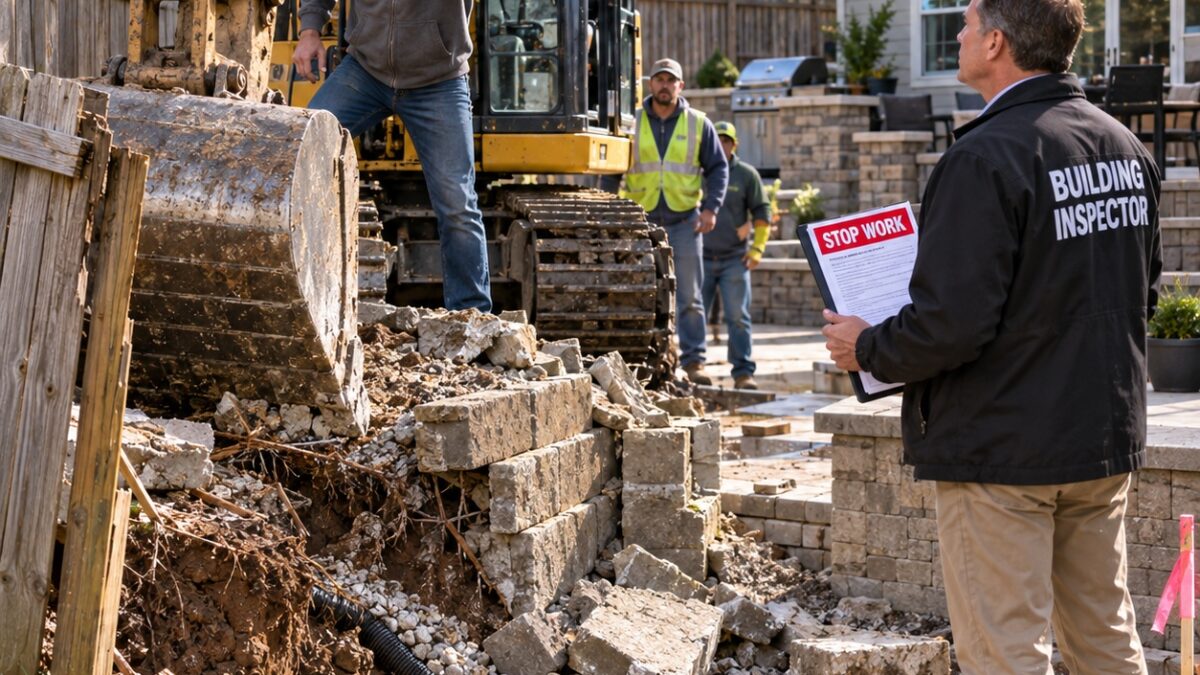
My Neighbor Tore Down My Retaining Wall for 3 Extra Feet—Then the Surveyor Planted One Pink Flag
The excavator was already crushing my retaining wall when Brent looked up at me and said, “You should have moved it when I gave you the chance.”
He thought an old fence gave him three feet of my land, a city permit made his patio untouchable, and once the wall was gone there would be nothing left to argue about.
What he didn’t know was that I had photographed every moved stake, saved every email, recorded every warning, and already had a survey line that was about to turn his dream patio into the most expensive mistake he had ever made.
My name is Aaron Keller, and until Brent Harlow moved in next door, I thought property-line disputes were something that happened to people who enjoyed arguing at HOA meetings.
I didn’t.
I worked from home as a civil estimator, liked my yard quiet, and had spent most of the previous eight years improving a modest hillside property outside Seattle one project at a time.
The house sat on the upper side of a sloping block.
Brent’s property sat below mine.
Between us was a retaining wall about thirty-six feet long and a little over four feet high at its tallest point.
It wasn’t decorative.
That mattered.
The wall held back the lower edge of my backyard.
Behind it was drainage stone, perforated pipe, compacted fill, and a narrow strip of planting bed where my late father and I had planted three Japanese maples shortly after I bought the house.
The wood fence behind the wall was older.
Much older.
It wandered slightly.
Not enough for anyone to care.
At least not until Brent did.
When I purchased my house, the title company had recommended a boundary survey because of the slope.
I paid for one.
The pins were located.
The wall sat entirely on my property.
In fact, at its closest point, the face of the blocks remained about fourteen inches inside my legal line.
The old fence wandered.
In some places it was almost on the boundary.
In others, it sat nearly two feet inside my yard.
Nobody had cared because the previous owners next door understood something Brent apparently didn’t.
A fence can be a fence without being a survey.
Brent moved in on a Saturday in March.
At first, he was friendly.
Forty-one.
Commercial insurance salesman.
Recently divorced.
Two teenage sons who stayed with him every other weekend.
He liked outdoor entertaining.
Within three months, he had replaced his deck railing, installed landscape lighting, bought a stainless-steel grill large enough to roast a deer, and started talking about “opening up the backyard.”
The first time he showed me the patio plan, I didn’t see a problem.
He knocked on my door with a rolled site drawing tucked beneath one arm.
“Got a minute?”
“Sure.”
He spread the drawing on my kitchen island.
Stamped city plan.
Pavers.
Outdoor kitchen.
Fire table.
Seat wall.
The rear edge stopped several feet short of my retaining wall.
“Looks good,” I said.
“Yeah.”
Then he pointed toward the wall.
“Only thing is, I need this shifted.”
I looked at him.
“Shifted where?”
“Back.”
“How far?”
“Maybe three feet.”
I thought he was joking.
Then I realized he wasn’t.
“Back into my yard?”
He smiled like the phrasing was unnecessarily hostile.
“You don’t use that strip.”
“That isn’t the point.”
“I’d rebuild the wall.”
“On my property.”
“It’s basically dead space.”
I looked at the drawing again.
“Your approved patio fits without touching it.”
“Technically.”
There was the first warning.
Technically.
People say technically when reality is inconvenient.
He rolled the drawing halfway closed.
“I want enough room behind the chairs.”
“Then make the patio smaller.”
His smile vanished.
“That fence is the property line.”
“No.”
“Come on, Aaron.”
“I had the property surveyed when I bought.”
“The wall is on my side of the fence.”
“Parts of the fence sit inside my property.”
He stared.
“That doesn’t make sense.”
“It makes perfect sense. The fence wasn’t built on the legal line.”
“Who says?”
“A licensed surveyor.”
Brent laughed.
“You’re really going to fight me over three feet?”
I looked at him.
“You’re asking me to give you three feet.”
“That’s dramatic.”
“No. It’s measurement.”
I rolled his plan completely closed and handed it back.
“The wall stays.”
He took the drawing.
“You’ll change your mind when you see the finished project.”
That evening, I sent him an email.
Not because I wanted a fight.
Because I work in construction.
Written records matter.
I stated clearly that I did not authorize removal or relocation of the retaining wall, fence, drainage pipe, retained soil, or any part of my property.
I also stated that no contractor working for him had permission to enter my yard.
Brent replied nine minutes later.
One sentence.
You’ll change your mind when you see the finished project.
I saved it.
Two weeks later, I heard concrete crack.
And by the time I reached my back door, Brent’s excavator had already destroyed the first section of my wall.
FULL STORY CONTINUATION 👇👇
For half a second, I didn’t understand what I was seeing.
Machines distort scale.
An excavator in a normal suburban backyard looks enormous.
The boom stretched above the fence line.
Its steel bucket had already ripped through several retaining blocks and dragged them downhill.
Drainage stone spilled from behind the wall.
One section of perforated pipe hung exposed.
My fence leaned toward Brent’s property where a support post had lost soil.
Workers stood scattered across his yard.
Nobody looked comfortable.
Brent stood near the machine wearing work boots, jeans, and a bright orange safety vest that had no business making him look official.
I raised my phone and started recording before I said anything.
“Stop the excavator.”
The operator stopped immediately.
That told me something.
He had been waiting for a reason.
Brent looked uphill.
Saw me.
And actually smiled.
“You should’ve moved it when I gave you the chance.”
I stared at him.
“You are on my property.”
“No, I’m not.”
“The wall is mine.”
“No, it isn’t.”
“You have my refusal in writing.”
He waved toward the operator.
“Keep going.”
The operator didn’t move.
A man near the patio excavation, older than the rest of the crew, walked over.
I recognized him from the trucks.
Site supervisor.
His name, I later learned, was Miguel Ortega.
“Shut it down,” Miguel said.
The operator killed the machine.
Brent spun.
“What are you doing?”
Miguel pointed at me.
“He says it’s his wall.”
“I already told you it’s not.”
“You showed us the fence.”
“That is the line.”
Miguel looked toward the broken wall.
“Your permitted plan does not show removing that retaining wall.”
“It’s field adjustment.”
“No.”
Brent laughed.
“I’m paying you seventy thousand dollars.”
Miguel didn’t blink.
“You’re paying us to build the approved project.”
“I told your office about expanding.”
“You told us the neighbor agreed.”
That landed.
I looked at Brent.
He looked at Miguel.
Then at me.
“I said he would.”
“No,” Miguel replied. “You said he had.”
I kept recording.
Brent pointed toward the drainage pipe.
“Fine. Leave the wall. Pull that pipe while you make your call.”
One laborer looked at Miguel.
Nobody moved.
I said:
“Do not touch that.”
Brent walked toward the loose end himself.
“That line drains into my property.”
“It drains through an outlet that has been there for years.”
“Not anymore.”
He grabbed it.
Pulled.
The pipe shifted maybe eight inches.
Then caught beneath the drainage stone.
“Brent,” Miguel warned.
He pulled harder.
The pipe tore.
A section came free.
Brent stumbled backward.
He held the damaged piece like he had proven something.
“There.”
I felt my jaw tighten.
“That drains the wall.”
“There is no wall.”
He smiled.
That smile did more damage to his future than he understood.
Miguel stepped between him and the machine.
“We’re done until this gets resolved.”
“No, you aren’t.”
“Yes.”
“You leave now, I’m withholding payment.”
“You can talk to the office.”
Brent pointed at the excavator.
“I rented that machine.”
“The operator is ours.”
“I’ll run it.”
Miguel’s face changed.
“Do not.”
Brent walked past him.
I honestly thought someone would physically stop him.
Nobody did.
And I understand why.
You don’t wrestle a furious homeowner beside heavy equipment.
Brent climbed into the excavator.
The operator shouted:
“You’re not authorized!”
Brent slammed the cab door.
Miguel turned toward me.
“Keep recording.”
“I am.”
The excavator started.
Brent’s first movement was jerky.
He knew enough to operate basic controls but not enough to look competent.
The boom swung.
Bucket lowered.
Miguel yelled:
“Get out of the machine!”
Brent ignored him.
The bucket scraped across the remaining wall.
Two blocks cracked.
A third rolled downhill.
Then the bucket caught the base of a fence support.
I saw the post move.
“Stop!”
He kept going.
Wood snapped.
The fence section dropped several inches.
Workers backed away.
One pulled out his phone.
Good.
More witnesses.
Brent dug behind the old wall line.
Not carefully.
He scraped away retained material.
Compacted soil that had been stable for years suddenly became an exposed face.
Anyone with basic site experience could see the problem.
Miguel definitely could.
He yelled:
“You’re undermining the slope!”
Brent shouted back:
“Then fix it!”
“You’re making it worse!”
“Do the job I hired you to do!”
He pushed broken blocks toward the prepared patio base.
Some disappeared beneath loose gravel.
That detail became expensive later.
When he finally shut off the excavator and climbed down, he looked up at me.
“Now there’s nothing left to argue about.”
I remember that sentence perfectly.
At the time, it made me angry.
Later, it became one of my favorite pieces of evidence.
I said:
“You just operated your contractor’s excavator after they told you to stop.”
“It’s my rental.”
“And destroyed a structure after receiving written notice it was mine.”
“No. I removed my wall.”
“You sure?”
He spread his arms.
“Prove it.”
I almost answered.
Instead, I smiled.
Not because I was confident everything would work out.
Because the one thing Brent had underestimated was how much I enjoy organized documentation.
I filmed everything.
The machine tracks.
Broken blocks.
Severed pipe.
Exposed gravel.
Fence post.
Excavation edge.
Stakes.
Especially the stakes.
Then I called the city.
Building department first.
The woman on the phone heard “retaining wall removed beside elevated grade” and transferred me immediately.
An inspector named Paul Nystrom arrived less than an hour later.
By then, Brent’s crew had stopped all work.
The excavator sat silent.
Miguel was on the phone with his company.
Brent paced.
Paul stepped into the backyard wearing a city jacket and carrying a tablet, tape, and folder.
Brent intercepted him.
“This is a permitted project.”
Paul said:
“Okay.”
“My neighbor’s trying to stop it.”
“Okay.”
“He’s making ownership claims.”
“Okay.”
Brent clearly hated that word.
Paul asked for the permit card.
Then the approved site plan.
Miguel handed both over.
Paul looked at the drawing.
Then the excavation.
Then the drawing again.
He measured from the house.
Then the side reference.
Then toward the rear.
He frowned.
Measured again.
Brent followed him.
“The fence is the property line.”
Paul said:
“I’m not here to determine your property boundary.”
“Then why are we wasting time?”
“I am here to determine whether construction matches your permit.”
“It does.”
Paul looked at the approved drawing.
“No.”
Brent pointed.
“We widened a little.”
“How much?”
“Minor adjustment.”
“How much?”
“Maybe three feet.”
Paul entered something on his tablet.
Then walked toward the exposed slope.
He stared at the broken wall.
“Who removed this?”
Brent gestured vaguely.
“Construction.”
Miguel immediately said:
“Our company stopped when ownership was disputed.”
Paul looked at him.
Miguel continued.
“Mr. Harlow operated the excavator after shutdown.”
Brent turned.
“Seriously?”
Miguel said nothing.
Paul looked at Brent.
“You operated the equipment?”
“I know how.”
“That’s not what I asked.”
“Yes.”
Paul measured the exposed height.
Then examined the torn drain pipe.
“Was this wall shown for removal on the permit set?”
“No.”
“Replacement wall?”
“Not originally.”
“Engineered detail?”
“No.”
Paul reached into his folder.
Pulled out a bright red-orange notice.
He fastened it to a temporary post beside the patio excavation.
STOP WORK.
Brent stared.
“You’re shutting down my entire patio because he complained?”
Paul looked at him.
“No.”
He pointed toward the drawing.
“I’m stopping work because your construction does not match the approved plan.”
Then the exposed slope.
“And because a retaining structure beside elevated ground has been removed without an approved replacement.”
Brent pointed toward my fence.
“That wall was mine.”
Paul’s tone stayed calm.
“Then show me the recorded survey.”
Six words.
Brent blinked.
“What?”
“Recorded or stamped boundary survey. Show me.”
“The fence is the line.”
“That is not a survey.”
I almost laughed.
Brent looked at me.
I said nothing.
Paul told him no work could resume until the city received a corrected site plan, boundary verification, and a plan addressing the removed retaining structure.
If the exposed condition became unstable, emergency stabilization could be required.
Brent’s face turned red.
“This is ridiculous.”
Paul asked:
“Who moved these layout stakes?”
Silence.
I watched Brent.
His eyes shifted.
I said:
“I have photographs.”
He looked at me.
Paul looked too.
“Of what?”
“The original layout and the moved layout.”
“When?”
“Different days. Timestamped.”
Brent laughed nervously.
“Aaron takes pictures of everything.”
“Yes.”
I lifted my phone.
“I do.”
Paul asked me to email them to the inspection file.
I did before he left.
That evening, Brent sent me his first message since the excavation.
You embarrassed me in front of my contractor.
I stared at it.
Then saved it.
I did not answer.
Ten minutes later:
This could have been avoided if you’d been reasonable.
Saved.
Then:
You’re going to be responsible for my delay costs.
Saved.
My wife, Lena, came home from work around six.
She walked into the backyard.
Stopped.
And said:
“What the hell?”
I had texted her earlier, but photographs didn’t capture it.
The yard looked wounded.
Our retaining wall had once created a clean edge.
Now the lower boundary was a ragged exposed slope.
Broken blocks lay below.
The fence sagged.
Drainage stone had spilled.
One maple leaned slightly because roots near the edge had been disturbed.
Lena stood with both hands on her hips.
“He did this?”
“Yes.”
“After the contractor stopped?”
“Yes.”
“And you recorded?”
“Yes.”
She looked at me.
“Of course you did.”
Lena knows me.
We had been married eleven years.
She works as a physical therapist and approaches conflict differently.
I document.
She wants to ask people whether they’ve lost their minds.
Both methods have value.
“What happens if it rains?”
That was the right question.
The forecast showed rain in two days.
Heavy enough to matter.
Without the wall and functioning drainage, water could saturate the exposed soil.
Our yard wasn’t going to collapse into Brent’s pool—he didn’t have a pool—but localized sloughing was possible.
More importantly, the damaged drain line could redirect water unpredictably.
I called the engineer who had inspected the wall during a previous landscaping project.
His name was Samir Patel.
He came the next morning.
Samir stood at the top of the slope and made a sound I did not enjoy hearing from engineers.
“Huh.”
“What?”
He looked down.
“Did he excavate behind the original wall line?”
“Yes.”
“How far?”
“Maybe eighteen inches in places.”
He climbed carefully down.
Examined the soil.
Pipe.
Base.
Broken blocks.
Then he looked toward Brent’s prepared patio area.
“Was he planning to pour concrete here?”
“Patio slab and paver sections.”
“Where’s the drainage going?”
“Apparently nowhere now.”
Samir did not smile.
He took measurements.
Photographs.
Then said:
“You need temporary stabilization before rain.”
“Can I do it?”
“Yes, but document.”
Always document.
He proposed heavy plastic sheeting over the exposed face, temporary diversion, and protection around the remaining drain outlet until a permanent solution was designed.
I asked:
“Can I enter Brent’s side?”
“Not without permission unless emergency authority exists. Talk to the city.”
So I did.
Paul returned.
Miguel returned.
Brent arrived twenty minutes later and immediately objected.
“You’re not coming onto my property.”
Paul said:
“Then you need to stabilize the exposed cut from your side.”
“It’s his slope.”
“You removed the structure.”
“Because it was on my land.”
Paul held up a hand.
“That argument is unresolved.”
Then he pointed to the stop-work notice.
“But current site safety is not.”
After another twenty minutes, Brent agreed to let Miguel’s company install temporary protection—but only after Paul made it clear the city could issue additional orders if the unsafe condition remained.
Miguel pulled me aside.
“I’m sorry.”
“You stopped.”
“We shouldn’t have touched the wall at all.”
“You were told I agreed?”
“Yes.”
“Did you ever see my approval?”
“No.”
“Then why start?”
He grimaced.
“Brent told our project manager he had resolved it.”
“That’s not approval.”
“I know.”
He looked toward his crew.
“The operator only took the first section because Brent told him the property issue was settled.”
I believed him.
Mostly.
Contractors live in messy spaces between homeowners, plans, verbal changes, and field conditions.
But Miguel’s company had acknowledged my email.
That was going to matter.
I asked:
“Your office received my refusal.”
“Yes.”
His jaw tightened.
“That’s part of why we’re having an internal problem.”
I didn’t press.
Yet.
The temporary stabilization went in.
Rain came.
The plastic held.
Our yard stayed intact.
Brent spent the next two days calling surveyors.
I knew because I heard him arguing on his patio.
“Two weeks?”
Then:
“No, I need someone tomorrow.”
Then:
“I already know where the line is.”
That sentence captured Brent perfectly.
He wanted a professional survey to confirm a conclusion he had already chosen.
Professionals can be inconvenient that way.
They measure instead.
I called the firm that had surveyed my property when I purchased it.
Westland Surveying.
My original surveyor had retired, but the company still had records.
They sent a crew three days later.
Brent watched from his deck.
I watched from mine.
Lena stood beside me with coffee.
One surveyor located the front monuments.
Another found the rear pin beneath years of soil and landscaping.
They set temporary markers along the line.
Bright pink flagging.
The result wasn’t dramatic.
No trumpet.
No lightning.
Just a line.
But that line changed everything.
At the upper corner, the old fence sat nineteen inches inside my property.
Near the retaining wall, it wandered as much as twenty-seven inches inside.
The retaining wall itself sat between fourteen and seventeen inches inside my property.
Brent hadn’t merely crossed the line.
He had crossed my wall, crossed the strip between the wall and legal boundary, and moved his planned patio almost three feet beyond that.
In the worst area, his new layout reached approximately forty-three inches into my parcel.
Three feet seven inches.
I stared at the flags.
Lena said:
“Oh.”
That was all.
Brent came outside.
“Those aren’t right.”
The surveyor looked at him.
“Excuse me?”
“The fence is the line.”
The surveyor pointed toward a recovered monument.
“That is the line.”
“I’ve got a deed.”
“So does he.”
“My title map shows the fence.”
“No. It may show an approximate fence symbol. That is not the same thing.”
Brent walked downhill.
“I want you off my property.”
The surveyor said:
“We’re on Mr. Keller’s property.”
Brent stopped.
I almost felt sorry for him.
Almost.
He looked around.
At the flags.
At the fence.
At the broken wall.
At the patio base.
Then at me.
“You knew.”
“Yes.”
“You knew the fence was inside your land.”
“Yes.”
“Why didn’t you tell me?”
I stared.
“I did.”
“No. You said it wasn’t the boundary.”
“That is telling you.”
“You could have shown me the survey.”
“I offered to.”
That part mattered.
During our first conversation, after he laughed at me, I had said:
“I can send you the survey.”
He replied:
“I don’t need your paperwork.”
I still had the email confirming it.
I reminded him.
His face tightened.
“That survey is old.”
The surveyor said:
“Boundary monuments do not become invalid because you don’t like their age.”
Lena coughed to hide a laugh.
Brent walked away.
The stamped survey update arrived two days later.
I emailed it to Paul.
To Brent.
To Miguel’s company.
To my attorney.
Yes.
By then, we had an attorney.
Her name was Rachel Monroe.
Property and construction disputes.
We found her through Samir.
Rachel’s first question was:
“Do you want money or do you want restoration?”
“Restoration.”
“Good.”
“Why good?”
“Because people often come in saying they want justice when they actually want revenge. Those are expensive clients.”
Lena liked her immediately.
Rachel reviewed the emails.
Videos.
Survey.
City notices.
Photos.
Contractor acknowledgment.
She leaned back.
“This is unusually well documented.”
I smiled.
Lena said:
“Don’t encourage him.”
Rachel continued.
“You have trespass issues, property damage, potential drainage damage, survey costs, engineering costs, restoration costs, and possibly tree impacts.”
“What about the patio?”
“What patio?”
“He hasn’t poured it yet.”
“Then hopefully he doesn’t.”
That hope did not survive the week.
Brent hired another contractor.
I woke Saturday morning at 6:10 to the sound of a concrete truck.
I stood at our bedroom window.
Lena rolled over.
“No.”
“Yes.”
“You’re kidding.”
“No.”
A different crew was in Brent’s yard.
The stop-work notice was still posted.
And they were preparing to pour.
I got dressed.
Went outside.
Started recording.
“Work is stopped.”
The new foreman looked confused.
Brent appeared from behind his house.
“I have permission for stabilization.”
“That isn’t stabilization.”
Forms had been set.
Rebar.
Prepared slab.
And the forms crossed the survey flags.
Bright pink ribbons were literally trapped inside the construction area.
I pointed.
“That crosses my line.”
Brent smiled.
“No, it doesn’t.”
“The survey flags are inside your forms.”
“Those aren’t official.”
“They’re from a licensed survey.”
“I’m appealing.”
“You don’t appeal geometry.”
The foreman looked at Brent.
“You told us the dispute was resolved.”
Of course he did.
Brent said:
“It is.”
I called Paul.
Saturday.
City offices mostly closed.
But the permit enforcement number had an after-hours line for active stop-work violations.
I reported it.
Then called police non-emergency because people were entering my property after written notice.
I did not ask police to determine the boundary.
They generally don’t.
I wanted the situation documented before wet concrete made things worse.
An officer arrived first.
He looked at the survey pins.
Looked at the stop-work notice.
Looked at Brent.
Then said:
“I’m not deciding property ownership.”
“I understand.”
“But if there is an active municipal stop-work order, continuing may be a separate issue.”
Brent said:
“I have permission.”
“Show me.”
Brent produced an email.
It authorized temporary stabilization and restoration of drainage protection.
Nothing about slab placement.
The officer called the city contact.
Ten minutes later, the concrete crew stopped.
The truck sat idling.
And Brent lost his mind.
“I’m paying standby!”
The foreman shrugged.
“Then talk to the city.”
“This is because of him!”
He pointed at me.
The officer said:
“Sir.”
Brent turned.
“You need to lower your voice.”
“This man is harassing me.”
I held up my phone.
“I’m standing on my property.”
“You’re filming my house.”
“I’m filming construction crossing my boundary.”
The officer stepped between us.
“Enough.”
Brent finally backed away.
I thought that stopped the pour.
It did.
For three hours.
At 11:30, Paul arrived personally.
He photographed the forms.
Survey flags.
Rebar.
Then asked Brent:
“Who authorized this?”
“My engineer.”
“Your engineer does not lift a city stop-work order.”
“It’s temporary.”
Paul looked at the slab forms.
“This is a structural concrete patio base.”
“It can be removed.”
Paul stared.
“Then don’t pour it.”
Simple.
He issued another notice.
Brent said:
“What do I have to do to get back to work?”
Paul answered:
“Submit a corrected plan based on the verified property line and an engineered retaining solution.”
“I already have a wall design.”
“Submit it.”
“Then can I pour?”
“If approved.”
Brent looked at me.
“What if Aaron refuses access?”
Paul said:
“Design your project inside your property.”
That should have ended it.
Instead, Brent waited until Monday.
Then poured.
I still don’t understand the logic.
Maybe anger had become more important than the project.
Maybe he believed once concrete hardened, nobody would force removal.
That belief is common.
Build first.
Ask forgiveness.
People assume demolition is too expensive, so everyone will compromise.
At 7:05 Monday morning, while I was on a video call, Lena shouted from downstairs:
“Aaron.”
I muted.
“What?”
“The truck.”
I ran to the window.
Concrete.
Again.
This time pouring.
Wet gray concrete already filled part of the forms.
The city’s bright stop-work notice had been removed from its post.
I grabbed my phone.
Rachel was my first call.
“They’re pouring.”
“Photograph.”
“I am.”
“Do not interfere physically.”
“I know.”
“Call enforcement.”
“Doing it.”
I emailed Paul while on the phone.
Photos attached.
He responded in six minutes.
STOP WORK REMAINS ACTIVE. I AM EN ROUTE.
By the time Paul arrived, roughly half the slab was poured.
Workers were screeding.
Brent stood nearby.
Paul walked straight to him.
“Stop.”
Brent said:
“We’re already poured.”
“I said stop.”
The crew stopped.
Brent pointed at the wet concrete.
“You want me to waste this?”
Paul looked at him.
“You were ordered not to place it.”
“I submitted revisions.”
“They are not approved.”
“They’re pending.”
“Pending is not approved.”
Brent looked at the slab.
Then at the crew.
“Finish it.”
No one moved.
He shouted:
“Finish it!”
The foreman shook his head.
“We’re done.”
Brent’s face went red.
“You people are unbelievable.”
Paul asked:
“Who removed the stop-work notice?”
Nobody answered.
Paul photographed where it had been.
That became another violation.
Brent eventually hired day laborers to finish smoothing what had already been placed.
No additional concrete arrived.
So the slab became a strange half-project.
But the story did not end there.
Because two days later, another truck came.
This time at 5:40 a.m.
I was ready.
Security camera.
Window photos.
Phone.
By 6:00, they were pouring the rest.
I called enforcement again.
But concrete works quickly.
By the time anyone arrived, the slab was complete.
Twenty-two feet by thirty feet.
Approximately six inches thick in areas.
Thickened edge near the downhill side.
And forty-three inches of one corner crossed my property.
Worse, part of the slab now sat where the retaining wall and drainage zone had been.
Brent walked along the finished surface like he had conquered Europe.
He looked up at me.
“It’s done.”
I said nothing.
He smiled.
“What are they going to do, make me tear out concrete?”
I recorded that too.
Three weeks later, the city answered him.
Yes.
Not immediately.
First came process.
Engineering review.
Survey confirmation.
Revised permit denial.
Drainage evaluation.
Then an inspection meeting.
Paul.
A city engineer named Teresa Wong.
Samir, my engineer.
Brent’s engineer, a man named Kevin Walters who looked like he regretted every life choice that had led him there.
Miguel attended as a witness regarding the original excavation.
Rachel came for me.
Brent brought an attorney.
We all stood around the patio.
It was beautiful.
I’ll give him that.
Smooth concrete.
Clean control joints.
A curved area for his fire table.
Connections prepared for the outdoor kitchen.
It also violated the surveyed boundary, city-approved setbacks, and the required retaining/drainage design.
Teresa looked at the slab.
Then the survey.
Then asked Kevin:
“Was this poured to your stamped revision?”
Kevin hesitated.
“No.”
Brent’s attorney looked at him sharply.
Teresa continued.
“Was your revision approved before placement?”
“No.”
“Does the slab encroach onto the Keller parcel?”
Kevin looked at the survey.
“Yes.”
Brent interrupted.
“We dispute the survey.”
His attorney whispered something.
Teresa ignored the comment.
“Does the slab occupy the area previously supporting the retained slope?”
Kevin said:
“Partially.”
“Is there an approved retaining system currently in place?”
“No.”
“What happens to drainage?”
“We proposed a channel.”
“Installed?”
“No.”
Samir spoke.
“The original subsurface drain was severed.”
Teresa nodded.
“We have photographs.”
Brent looked at me.
I smiled.
Rachel elbowed me lightly.
Professional face.
Right.
Teresa walked to the downhill edge.
The new slab had been built partly on base material that included broken retaining blocks Brent had pushed around during his excavator episode.
That was another problem.
Samir had suspected it.
Ground-penetrating review and test pits later confirmed poor material beneath portions of the slab.
The base wasn’t uniformly prepared.
Some areas were fine.
Others contained debris.
Teresa asked:
“Can this be corrected by saw-cutting the encroaching corner?”
Kevin looked uncomfortable.
“Not cleanly.”
Brent said:
“Of course it can.”
Everyone ignored him.
Kevin continued.
“The thickened edge and reinforcement layout run through that section.”
Teresa asked:
“Can the drainage and retaining system be reconstructed without removing adjacent slab?”
Another pause.
“Not as currently built.”
Samir nodded.
The wall needed footing space.
Drain rock.
Pipe.
Compaction.
The slab occupied the work zone.
Brent said:
“Then put the wall somewhere else.”
Samir looked at him.
“Where?”
“On Aaron’s side.”
I laughed.
Couldn’t help it.
Rachel said:
“No.”
Brent glared.
Teresa remained focused.
“Can you produce a compliant design that preserves the slab entirely within Harlow’s parcel and restores the slope?”
Kevin stared at the drawings.
“Not without significant modification.”
“How significant?”
He exhaled.
“At minimum, removal of the rear section.”
“How much?”
“Probably eight to ten feet.”
Samir shook his head.
“That still leaves compromised base and no room for proper wall excavation at the original line.”
The two engineers began talking engineer language.
Bearing.
Subgrade.
Footing width.
Drainage.
Surcharge.
Slope.
Rebar continuity.
Brent looked from one to the other like he hated all science.
Finally Teresa asked:
“If we require full compliance with the property line, setback, engineered wall, and drainage, what is the most reliable correction?”
Kevin closed his folder.
“Remove the slab and rebuild.”
Silence.
Brent laughed.
Not amused.
Just disbelief.
“No.”
Kevin looked at him.
“I’m sorry.”
“No.”
His attorney said:
“Brent.”
“No. That’s insane.”
Teresa said:
“The city will issue its written determination.”
“You can’t force me to destroy a seventy-thousand-dollar patio.”
Rachel finally spoke.
“The city is not the only party requesting removal.”
Brent looked at her.
She continued.
“My client is demanding removal of every improvement trespassing onto his parcel and full restoration of the retaining structure and drainage.”
Brent’s attorney said:
“We’ve discussed compensation.”
Rachel replied:
“My client has declined.”
Brent turned to me.
“You’d rather destroy the whole thing than take money for three feet?”
I looked at him.
“This was never about three feet.”
“Then what is it about?”
“You decided no meant yes.”
That shut him up for maybe three seconds.
Then:
“You don’t even use that strip.”
I shook my head.
“You still don’t understand.”
He didn’t.
For Brent, unused land was available land.
A wall he disliked was movable.
A fence became a legal boundary because it helped him.
A permit covered work not shown on the permit because he wanted it to.
My refusal became negotiation.
The contractor’s refusal became incompetence.
The stop-work order became a suggestion.
Survey flags became opinions.
Wet concrete became leverage.
Every stage had offered him an exit.
He chose forward.
The city’s written order arrived eight days later.
Corrective action required.
The slab had to be removed sufficiently to eliminate encroachment and enable an approved retaining and drainage reconstruction.
Then Brent’s engineer withdrew.
That changed everything.
Kevin sent a letter stating his office would not stamp a partial-removal strategy because the slab had not been installed according to the design sequence, base conditions were uncertain, and retained slope reconstruction required broader access.
The replacement engineer Brent hired reached the same conclusion.
Full removal was simpler.
Safer.
Cheaper than trying to engineer around the mistakes.
So yes.
The whole slab had to go.
Brent still fought.
He appealed the city order.
The appeal hearing happened six weeks later.
I attended with Rachel.
Brent brought photographs showing the old fence.
He argued historic acceptance.
He argued estoppel.
He argued visual boundary.
He argued that the encroachment was minimal.
Then Rachel presented:
My purchase survey.
Updated survey.
Emails offering to share the survey.
Brent’s reply refusing.
My written denial.
His reply predicting I would change my mind.
Contractor acknowledgment.
Photographs of original stakes.
Photographs of moved stakes.
Video of Brent pulling the drain pipe.
Video of him operating the excavator after contractor shutdown.
Video of him saying:
“Now there’s nothing left to argue about.”
Photographs of stop-work notices.
Concrete placement dates.
Emails from the city.
The recording of him saying:
“What are they going to do, make me tear out concrete?”
Nobody laughed.
But I wanted to.
The hearing officer upheld the correction order.
Brent had thirty days to submit a demolition and restoration plan.
He appealed again through his attorney on the civil side.
Not the city order exactly.
The property issue.
He claimed adverse possession.
That scared me for about twelve minutes until Rachel explained the obvious problem.
“Adverse possession is not a magic phrase people use because a fence exists.”
“Could he win?”
“Based on what you’ve shown me? Very unlikely.”
“Why?”
“Among other things, the disputed strip has been used and maintained by you. Your wall is on it. You installed landscaping. You have survey records. He owned his property less than a year when this began. Any predecessor claim would need evidence supporting the required elements over the required period.”
I breathed.
“So the fence doesn’t automatically give it to him.”
“No.”
She stared at me.
“Please stop reading internet forums.”
“Fine.”
“Seriously.”
“Fine.”
She was right.
Never self-diagnose property law at two in the morning.
It makes everything worse.
Brent’s adverse-possession threat disappeared after discovery requests started.
Apparently, his attorney became less enthusiastic once asked to identify the factual basis.
Then came insurance.
Brent submitted a claim under his homeowner policy for the retaining-wall damage and patio loss.
The adjuster contacted me.
I provided documentation.
The claim position became complicated quickly because intentional acts and unapproved construction are not treated the same as accidental property damage.
I won’t pretend I understood every coverage argument.
What mattered was this:
Brent expected insurance to pay for everything.
It did not.
His contractor’s insurer became involved in the initial wall damage because their operator had removed the first section.
Their company argued the operator acted based on Brent’s representation that permission existed.
My email to their office complicated that defense.
Eventually, the contractor’s insurer agreed to contribute toward part of the wall restoration associated with their crew’s initial work.
Brent became responsible for the additional destruction he personally caused, survey/engineering expenses, drainage restoration, and other damages through settlement negotiations.
The patio demolition remained largely his problem.
Then the contractor sued Brent for unpaid invoices.
I learned that through public filings and neighborhood gossip.
Apparently, Brent withheld nearly thirty thousand dollars from Miguel’s company because they “abandoned the job.”
Miguel’s company filed a lien and sued.
Brent counterclaimed.
That dispute exposed more documentation.
Including Brent’s written change request to the contractor.
I saw it during our own case discovery.
One sentence jumped off the page.
Neighbor says he won’t agree, but proceed to fence line. I’ll handle him.
I read it three times.
Rachel smiled.
“Helpful.”
Brent’s attorney looked miserable during the next settlement conference.
That email destroyed his claim that he had genuinely believed he owned the wall.
He knew I refused.
He ordered work anyway.
Then he moved the stakes.
Then he operated the excavator.
Then he poured concrete under stop-work.
At a certain point, a misunderstanding becomes something else.
Settlement talks became serious.
My damages included:
Survey costs.
Engineering.
Temporary stabilization.
Fence repair.
Drainage replacement.
Retaining wall reconstruction.
Landscaping.
Tree evaluation.
Attorney fees where recoverable or negotiated.
Loss-of-use issues.
And the trespass claim.
I didn’t ask for emotional damages.
I didn’t want to become rich from Brent.
I wanted my yard restored and my expenses paid.
Rachel recommended a settlement structure.
Brent funds reconstruction directly through an approved contractor.
Separate payment for professional costs.
No-contact terms regarding construction except through counsel during work.
Recorded acknowledgment of the surveyed boundary.
Permanent agreement regarding fence placement.
No future structures crossing the line.
That last part mattered.
Brent resisted the recorded boundary acknowledgment.
Of course.
Because signing it meant surrendering the fantasy.
Eventually he did.
Not because he suddenly became reasonable.
Because his legal bills were climbing and the city was preparing enforcement penalties.
The demolition began in October.
I stood at my kitchen window with coffee.
Lena came beside me.
“You enjoying this too much?”
“Maybe.”
A breaker rolled onto Brent’s patio.
Concrete saw cut sections.
Then an excavator—operated by an actual professional this time—lifted broken slabs into a dumpster.
The patio that had supposedly become untouchable once poured disappeared piece by piece.
Brent did not come outside.
I almost wished he would.
Then I realized I didn’t.
The moment wasn’t about humiliating him.
It was relief.
The slab had represented months of being told reality didn’t matter if Brent acted fast enough.
Now reality was being loaded into a truck.
The crew removed debris.
Excavated the proper wall zone.
And that was when they found one more surprise.
Broken retaining blocks.
Buried beneath the patio base.
Exactly where my video showed Brent pushing them.
Several had created voids.
The base had settled unevenly already.
A hairline crack ran through one portion of the slab.
Barely visible from the surface.
But there.
The new engineer told Brent:
“You’re lucky this came out now.”
I heard that from Miguel, who had been rehired to complete the final permitted restoration.
Brent apparently asked:
“Why?”
“Because that corner would have moved.”
Maybe not catastrophically.
But enough to crack.
Possibly enough to affect the outdoor kitchen.
So Brent had spent months fighting to preserve a slab that was already beginning to fail because of the shortcuts he created himself.
There is a metaphor there.
I won’t insult you by explaining it.
The new retaining wall went in entirely on my property.
My wall.
Paid for through the settlement.
Engineered.
Proper footing.
New drain.
Clean gravel.
Geotextile.
Outlet repaired.
The fence was rebuilt on a line we agreed would remain inside my parcel but closer to the true boundary, with written acknowledgment that the fence did not alter ownership.
I made sure that sentence appeared clearly.
Rachel said:
“You’re becoming difficult.”
“I learned.”
“Good.”
Brent’s new patio was redesigned.
Smaller.
Much smaller.
The rear edge stopped several feet inside his property.
Exactly where the original approved plan had placed it.
I enjoyed that.
His outdoor kitchen lost one cabinet run.
The fire table moved.
Lounge chairs fit.
Barely.
You know what?
It looked good.
That may be the funniest part.
All of this could have been avoided.
His original patio was fine.
He could have built it.
Enjoyed it.
Invited friends.
Never spoken to a lawyer.
Never paid two engineers.
Never demolished concrete.
Never replaced my wall.
Never fought the city.
Never sued his first contractor.
Never had his insurance carrier arguing with him.
Never become a cautionary tale for every neighbor within three blocks.
All because he wanted about three more feet.
The final cost?
I never saw every invoice.
I can only estimate from disclosed numbers and what became public.
Original project around seventy thousand.
Demolition and disposal roughly eighteen thousand.
Engineering revisions and surveys several thousand more.
City penalties.
Attorney fees.
Contractor dispute.
My restoration settlement.
Rebuilt patio.
Insurance deductible and uncovered portions.
By conservative estimate, Brent’s “extra three feet” cost him well over one hundred and fifty thousand dollars beyond what he originally planned.
Possibly much more.
All for land he never owned.
Neighbors noticed.
Of course they did.
Construction disputes are suburban theater.
People walk dogs more slowly.
Trash cans go out with excellent timing.
One neighbor, Mrs. Alvarez, stopped me while I was getting mail.
“I heard he tried to steal your yard.”
“That’s dramatic.”
“He took a wall.”
“Technically true.”
“And the city made him tear up everything?”
“The patio had to come out.”
She smiled.
“Good.”
I laughed.
“I’m trying not to enjoy it.”
“Why?”
Fair question.
But I didn’t want the story to become revenge.
Brent and I still lived beside each other.
That mattered.
Unless one of us moved, victory would not change geography.
For months, we didn’t speak.
If he was outside, I stayed on my side.
If I was working in the yard, he ignored me.
Lena preferred that.
Then winter came.
Heavy rain.
The new wall performed perfectly.
Drain outlet worked.
No movement.
No erosion.
One December afternoon, I was cleaning leaves from the upper drain when I heard Brent.
“Aaron.”
I turned.
He stood near the fence.
No anger.
That was new.
“What?”
“Is the drainage working?”
I stared.
“Yes.”
He nodded.
“Good.”
Then walked away.
That was our first conversation in three months.
A week later, he spoke again.
“The maple okay?”
The maple he nearly undermined.
“Arborist says yes.”
“Good.”
Another week.
He stopped me by the driveway.
“Can I ask you something?”
“Depends.”
He almost smiled.
“Fair.”
He looked uncomfortable.
“Why didn’t you sell me the strip?”
I had wondered whether he still thought about that.
“Because I didn’t want to.”
“Even for market value?”
“Yes.”
“Why?”
I considered.
The easy answer:
Because it was mine.
True.
But there was more.
“My dad helped build that wall.”
Brent looked surprised.
“He did?”
“Yeah.”
“When?”
“Year after we bought.”
I told him.
My father was not a contractor.
He was an accountant who believed every home project could be solved by watching six online videos and buying three times too many tools.
We hired professionals for the structural work, but Dad helped with drainage stone, planting, cleanup.
He chose the maples.
Two years later, he died of a stroke.
Sudden.
No warning.
The wall wasn’t sacred.
I am not sentimental about concrete blocks.
But that strip of yard was part of my home.
I had memories there.
And even if I didn’t, I still didn’t owe it.
Brent looked toward the wall.
“I didn’t know.”
“You didn’t ask.”
He flinched.
That was the whole conflict in two sentences.
I didn’t know.
You didn’t ask.
He shoved his hands into his coat pockets.
“I thought you were just being difficult.”
“I know.”
“I thought…”
He stopped.
“What?”
He looked embarrassed.
“That because the fence had been there forever, nobody cared.”
“Previous owners probably didn’t.”
“And you did.”
“Yes.”
He nodded.
“Okay.”
Then walked home.
No apology.
Not yet.
I didn’t expect one.
Two months later, I got it.
Sort of.
Spring.
I was replacing mulch near the fence.
Brent approached.
Stayed on his side.
“I owe you an apology.”
I stood.
He looked like saying those words physically hurt.
“For what part?”
Lena says I can be difficult too.
Brent actually laughed.
“Pick one.”
I waited.
“For tearing down the wall.”
Good start.
“For ignoring the emails.”
Better.
“For moving the stakes.”
I had wondered whether he would admit that.
“You moved them?”
“Yes.”
“How much?”
“About thirty inches.”
“Why?”
“Because the patio designer said we needed more clearance.”
“That isn’t why you moved them.”
He looked at me.
“No.”
“Why?”
“Because I thought once the forms were in, you’d give up.”
There it was.
Honesty.
Ugly.
Useful.
“And the concrete?”
“Same reason.”
“You thought once it was poured nobody would remove it.”
“Yes.”
I nodded.
“I did.”
He looked down.
“My attorney asked me at one point why I kept making it worse.”
“What did you say?”
“That I was tired of you winning.”
I laughed.
Brent did too.
Then became serious.
“That sounds stupid now.”
“It sounded stupid then.”
“Yeah.”
He looked toward the rebuilt wall.
“I’m sorry.”
I believed him.
That does not mean we became friends.
Some stories force friendship because audiences like redemption tied with a bow.
Real life is less needy.
Brent became a better neighbor.
That was enough.
He asked before contractors needed side access.
He stopped treating the fence as a legal document.
When he replaced a tree, he sent me the landscape plan first.
Not for permission.
Courtesy.
Once, a delivery driver accidentally backed over part of my grass.
Brent came over before I noticed.
“I got the plate.”
I stared.
“Who are you?”
He laughed.
Progress.
A year after the dispute, his sons were throwing a football.
One came over the fence accidentally.
The younger boy stood near the gate, nervous.
“Can I get it?”
I smiled.
“Yeah.”
He came through.
Picked it up.
Then looked at the wall.
“Dad says this wall cost more than my car.”
I nearly choked.
“What car?”
“I’m getting one next year.”
“Then maybe.”
He grinned.
“Dad says you were right.”
That stunned me.
“Did he?”
“Yeah.”
Then the kid ran home.
I stood there smiling like an idiot.
Later I told Lena.
She said:
“Don’t get emotional.”
“I’m not.”
“You are.”
“I’m satisfied.”
“You’re emotional about being right.”
“Completely different.”
She kissed me.
Life moved on.
That should be the end.
But there was one more thing I didn’t expect.
The original contractor, Miguel’s company, asked whether they could use the dispute internally for training.
Not my name.
Not Brent’s.
A case study.
How field crews should respond to property conflicts.
How written neighbor objections should be escalated.
How scope changes require documentation.
How operators should stop when ownership becomes disputed.
I agreed.
Brent did too.
Apparently, his own case became useful.
Paul from the city later told me permit staff had also discussed it.
“People think stop-work means stop until the inspector leaves.”
“That happened.”
“I know.”
“How often does someone pour anyway?”
He gave me a look.
“You’d be amazed.”
“I don’t want to be.”
He laughed.
Paul retired not long after.
Before he did, I sent him a thank-you note.
Not for “taking my side.”
He didn’t.
That’s what I respected.
He stayed inside his role.
Permit.
Safety.
Plans.
Documentation.
Boundary question?
Surveyor.
Engineering question?
Engineer.
Legal dispute?
Lawyers.
People sometimes imagine justice as one powerful authority arriving and declaring who is right.
Usually, good systems work because different people stay in their lanes.
The surveyor measured.
The engineer evaluated.
The inspector enforced.
The contractor documented.
The lawyer negotiated.
I recorded.
No single person saved my yard.
A chain of evidence did.
That changed the way I handle disputes generally.
Before Brent, I thought being reasonable meant keeping things informal as long as possible.
Neighbor conversation.
Handshake.
Common sense.
After Brent, I still believe in conversation.
I also believe in email.
Friendly conversation followed by:
Just confirming what we discussed…
That sentence has probably prevented more lawsuits than people realize.
Three years later, we sold the house.
Not because of Brent.
Lena got a job opportunity south of the city.
Commute made no sense.
When the real-estate agent walked the yard, she admired the retaining wall.
“Beautiful work.”
I laughed.
“You have no idea.”
Brent saw the sign go up.
He came over.
“You’re leaving?”
“Yes.”
“You didn’t tell me.”
“We decided last week.”
He looked genuinely disappointed.
That surprised me.
“Whoever buys it…”
He pointed toward the fence.
“I’ll tell them where the line is.”
I smiled.
“I’m giving them the survey.”
“Of course you are.”
He laughed.
Then said:
“I mean it.”
“I know.”
On moving day, Brent came over with a bottle of bourbon.
Not expensive.
Good.
“Peace offering three years late.”
I took it.
“Accepted.”
He looked toward the wall.
“Can I ask something?”
“Sure.”
“If I had just offered enough money, would you ever have sold the strip?”
“No.”
He laughed.
“I knew you’d say that.”
“Why ask?”
“I spent a long time believing there had to be a number.”
“There usually isn’t.”
“For land?”
“For no.”
He nodded.
That was what he had finally learned.
No is not always opening bid.
He shook my hand.
“Good luck, Aaron.”
“You too.”
Lena came outside.
Brent hugged her.
She whispered something.
Later I asked what.
She smiled.
“I told him not to touch the wall.”
Perfect.
We moved.
New house.
Flat lot.
First thing I did?
Survey.
Lena almost left me.
“I swear to God, Aaron.”
“It’s prudent.”
“You’ve become a stereotype.”
“An accurate stereotype.”
The survey cost $1,200.
Worth every penny.
Our new neighbor laughed when I mentioned it.
“You worried I’m stealing your yard?”
“No.”
Then I thought.
“Not yet.”
He laughed.
Good neighbor.
So far.
The old property sold to a young couple named Chris and Dana.
I left them a binder.
Yes.
A binder.
Survey.
Wall engineering.
Drainage plan.
Permits.
Fence agreement.
Settlement boundary acknowledgment.
Maintenance notes.
Lena wrote on the cover:
AARON’S PROPERTY-LINE BIBLE.
They loved it.
Six months later, Chris texted.
You’ll appreciate this.
Photograph.
Brent had installed a new row of shrubs.
Every shrub two feet inside his side.
I laughed for a full minute.
Then showed Lena.
She said:
“Character development.”
Exactly.
The entire episode taught me something I did not understand at the beginning.
Most property disputes aren’t really about land.
They’re about assumptions.
Brent assumed visual use created ownership.
He assumed a fence meant boundary.
He assumed a permit meant blanket authority.
He assumed my unused space had less value because I wasn’t actively doing something with it.
He assumed saying no was negotiation.
He assumed contractors would keep working because he was paying them.
He assumed wet concrete would become permanent through inconvenience.
He assumed the city would prefer compromise over enforcement.
He assumed I would eventually calculate that fighting cost more than surrendering.
Some of those assumptions were understandable.
Others weren’t.
But the most expensive assumption was simple.
He assumed acting first gave him leverage.
It didn’t.
It gave me evidence.
That is the part I tell people when they ask what they should do in a similar dispute.
Not legal advice.
I’m not a lawyer.
But from experience:
Stay calm.
Know where your line actually is.
Put objections in writing.
Photograph conditions before they change.
Do not move somebody else’s stakes.
Do not physically interfere with equipment unless immediate safety requires emergency action.
Call the proper authority.
Use qualified surveyors and engineers.
And never assume a fence is the boundary because somebody says it is.
Most of all, don’t let anger push you into doing the exact thing the other side will later prove with your own words.
Brent gave me some of my best evidence himself.
“You should have moved it when I gave you the chance.”
“Now there’s nothing left to argue about.”
“What are they going to do, make me tear out concrete?”
Every sentence revealed intent.
He did not accidentally cross a line.
He believed the line should stop mattering once enough work was done.
That distinction shaped everything after.
I sometimes wonder what would have happened if I had confronted him differently that first day.
What if I yelled?
What if I went downhill?
What if I stood in front of the excavator?
Maybe he stopped.
Maybe not.
Maybe someone got hurt.
Heavy equipment and angry homeowners are a bad combination.
Recording felt passive in the moment.
It wasn’t.
Documentation is action.
Calling the city was action.
Calling the engineer was action.
Sometimes restraint feels weaker than confrontation because it lacks spectacle.
But spectacle is not the same as control.
I learned that.
Brent learned it too.
The final photograph I have from the old house is not the demolition.
Not the broken wall.
Not the slab.
It’s after restoration.
Late afternoon.
New wall.
Mulch.
Three maples.
Fence straight.
Grass repaired.
Brent’s smaller patio visible below.
Nothing dramatic.
If you didn’t know the story, you’d never guess.
I like that.
Damage does not need to remain visible forever to prove it happened.
Restoration is allowed to look ordinary.
Actually, ordinary is the goal.
The maples survived.
All three.
The one nearest the excavation looked rough for a season.
Arborist pruned stress damage.
By the next spring, new leaves.
When we sold, that tree was taller than the fence.
Dad would have liked that.
He would also have mocked me relentlessly for turning a retaining wall into a legal archive.
I can hear him.
“You paid a lawyer how much over concrete blocks?”
Then, after I explained Brent took three feet:
“He did what?”
My father was reasonable until property lines were involved.
Maybe I inherited something.
On the anniversary of his death, a few months before we moved, I sat near the maples with bourbon Brent had given me.
I thought about Dad hauling drainage stone in a wheelbarrow.
Complaining about his back.
Insisting the maples were “an investment.”
They probably added zero measurable value.
Didn’t matter.
I understood then why Brent’s question about selling the strip never landed.
He saw square footage.
I saw continuity.
Even if I had no emotional connection, ownership would still matter.
But the memory gave the boundary weight.
Not legal weight.
Personal.
People dismiss that too easily.
“You don’t use it.”
“You won’t notice.”
“It’s only three feet.”
It’s only a wall.
Only a tree.
Only a corner.
Only an easement.
Property becomes home through accumulated small meanings.
You don’t owe someone a reason for keeping it.
That may be the simplest lesson.
You can say no because no is your answer.
You don’t need tragedy.
Memory.
Plans.
Future use.
Market value.
Nothing.
Brent could have asked.
He did.
I answered.
Everything after that was his choice.
When I tell this story now, people love the slab.
Of course.
There is something deeply satisfying about a man saying:
“What are they going to do, make me tear out concrete?”
Then watching exactly that happen.
I understand the appeal.
I enjoyed it too.
But the slab was not the real consequence.
The real consequence was that Brent lost control of the story.
At first:
Aaron is difficult.
Then:
Aaron doesn’t use the land.
Then:
The fence proves ownership.
Then:
The contractor misunderstood.
Then:
The wall was dangerous anyway.
Then:
The survey is wrong.
Then:
The city is overreaching.
Then:
The slab is too expensive to remove.
Every time reality contradicted him, he changed the explanation.
Documentation prevented that from working.
Pictures don’t care about confidence.
Surveys don’t care about volume.
Emails don’t care what someone remembers later.
That’s why I kept everything.
Not because I expected court.
Because memory becomes political the moment money is involved.
People remember what protects them.
Records remember what happened.
One of the funniest details came out long after settlement.
Miguel told me Brent’s first patio designer had warned him before construction.
The designer said the planned patio was already large enough.
Brent insisted on moving it back.
The designer said:
“Then buy land from your neighbor.”
Brent answered:
“He doesn’t need it.”
That was before he ever knocked on my door.
He had decided my need was the relevant test.
Not my consent.
That attitude explains every step afterward.
Imagine if he had approached differently.
“Aaron, I’d like to enlarge the patio. Would you ever consider selling a three-foot strip? I’ll pay survey, legal, wall reconstruction, and fair value. Totally fine if not.”
I still would have said no.
But we would have stayed neighbors.
No lawyers.
No excavator drama.
No slab demolition.
Asking respectfully doesn’t guarantee yes.
It guarantees that no can remain ordinary.
Brent could not tolerate ordinary no.
So he turned it into war.
Then complained about the cost of war.
That pattern appears everywhere.
Not only land.
Relationships.
Business.
Families.
Someone hears no and thinks:
Maybe if I create enough pressure, they’ll change it.
Sometimes they do.
Sometimes pressure only creates consequence.
That is what happened here.
Three feet became an obsession.
The obsession became trespass.
Trespass became damage.
Damage became stop-work.
Stop-work became defiance.
Defiance became concrete.
Concrete became demolition.
Every step was avoidable.
That chain is why the story sounds unbelievable when summarized.
“My neighbor wanted a bigger patio and ended up tearing out the whole slab.”
People think there must have been some hidden legal trap.
There wasn’t.
Just one survey line and a man unwilling to stop crossing it.
I still have the original email.
The one I sent after our first conversation.
Short.
Professional.
Brent,
Just confirming that I do not authorize removal, relocation, or disturbance of the retaining wall, fence, drainage system, retained soil, or any portion of my property in connection with your patio project. Please ensure your contractors remain within your surveyed parcel. I’m happy to provide a copy of my existing boundary survey if helpful.
Aaron
And Brent’s response:
You’ll change your mind when you see the finished project.
He was partly right.
I did change my mind when I saw the finished project.
I went from wanting only my wall left alone to wanting the entire illegal slab removed.
So perhaps we both learned something.
There’s one more thing I should admit.
For a while, I enjoyed being right too much.
Lena called me on it.
After the appeal hearing, we were driving home.
I had just replayed one of Brent’s contradictions for the third time.
She said:
“You know you won, right?”
“The order is upheld.”
“Yes.”
“But settlement—”
“Aaron.”
“What?”
“You’re still arguing with him in your head.”
I went quiet.
She continued.
“You documented because you needed protection.”
“Yes.”
“Now you’re using the evidence to stay angry.”
That bothered me because it was true.
I had become attached to the injustice.
Every email became a trophy.
Every photo.
Every stupid sentence.
I could summon outrage instantly.
That isn’t healing.
Winning a dispute can become another way of letting the dispute occupy your property.
Not the yard.
Your mind.
So after restoration, I archived everything.
One folder.
Cloud backup.
Attorney file.
Then I stopped opening it.
Until we prepared to sell.
That helped.
I didn’t need to keep prosecuting Brent after the case ended.
He paid.
He apologized.
The wall stood.
The land remained mine.
Enough.
Letting go did not excuse him.
It stopped charging me interest.
That’s something I wish more people understood.
Justice and obsession are not the same thing.
One asks:
Has the harm been addressed?
The other asks:
Can I keep the person who harmed me permanently inside the courtroom of my imagination?
I chose the first eventually.
Brent did too, in his own way.
He stopped defending every decision.
That made neighbor life possible.
By the time we moved, we could talk.
Not like friends.
Like adults who had been through something expensive and learned not to repeat it.
That was enough.
A month after we moved, Chris sent another photograph.
Rainstorm.
Water flowing cleanly through the drain outlet.
Wall dry.
Caption:
Your famous wall survives again.
I sent:
Of course it does.
He replied:
Brent says hi.
I stared at that for a second.
Then typed:
Tell him to stay off the excavator.
Chris sent six laughing emojis.
Apparently, the story survived the property transfer.
Good.
Maybe that is Brent’s real punishment.
Not money.
Not the slab.
Becoming the guy future neighbors warn about with heavy equipment.
I can live with that.
Our new house has no retaining wall.
Flat backyard.
Lena insisted.
“Nonnegotiable.”
I agreed.
We planted two maples.
Not three.
One afternoon, while placing edging, I looked toward the side fence.
Our neighbor, Sam, was trimming shrubs.
“Hey, Aaron.”
“Yeah?”
“You know where the line is over here?”
I froze.
Lena was sitting on the patio.
She slowly lowered her book.
Sam pointed.
“I’m thinking about putting a shed near the back.”
I walked over.
“Yes.”
“I’ve got a survey, but I wanted to compare.”
I stared at him.
“What?”
He looked nervous.
“Did I say something wrong?”
Lena started laughing.
Hard.
Sam looked at her.
Then me.
“What?”
I said:
“Nothing.”
I went inside.
Came back with the survey.
Sam unfolded his.
The lines matched.
He planned the shed two feet farther inside just to be safe.
No conflict.
No drama.
No excavator.
It took ten minutes.
That is what normal looks like.
It almost disappointed me.
Almost.
Sometimes, when people hear the whole story, they ask the same question Brent asked:
Was it worth it?
Meaning:
Was keeping three feet worth lawyers, surveys, months of conflict?
That question reverses responsibility.
I didn’t create the cost by refusing to surrender land.
Brent created cost by ignoring refusal.
Still, I’ll answer.
Yes.
Not because three feet is priceless.
Because boundaries become meaningless if they exist only until crossing them becomes expensive to challenge.
I did not need to punish him.
I needed the line to remain a line.
Once that happened, everything else could settle.
And it did.
The wall was rebuilt.
The drainage worked.
The patio became smaller.
The slab was replaced.
The maples survived.
The fence stood straight.
Brent stayed on his side.
I stayed on mine.
Eventually, we even laughed.
That is about as happy an ending as a property dispute deserves.
No one went to prison.
No one lost a home.
No secret millionaire bought the neighborhood.
No judge awarded me ten million dollars.
Reality was simpler.
A neighbor wanted land.
I said no.
He took it anyway.
A survey showed exactly where he crossed.
And because he kept building after every warning, the correction became far more expensive than the compromise he thought he could force.
The day the demolition crew removed the last piece of his slab, I stood by the same back door where I had first heard concrete crack.
The excavator bucket lifted one final section.
Steel against concrete.
A familiar sound.
But this time, it wasn’t destroying my wall.
It was removing the thing Brent had built after telling me there was nothing left to argue about.
Lena stood beside me.
“Feel better?”
I watched the slab disappear into the dumpster.
“Yeah.”
“Because he lost?”
I thought.
Then shook my head.
“No.”
“Because the line still means something.”
She smiled.
“That is the most Aaron answer possible.”
Maybe.
But it was true.
Brent thought destroying the wall would settle ownership.
It didn’t.
He thought pouring concrete would make the encroachment permanent.
It didn’t.
He thought the old fence mattered more than a licensed survey.
It didn’t.
He thought enough money already spent would force everyone else to surrender.
It didn’t.
In the end, the cheapest moment of the entire project had been the first one.
The moment he stood in my kitchen with a rolled drawing and asked me for three feet.
I said no.
All he had to do was believe me.








