My Neighbor Demanded My RV for Labor Day—Two Days Later, My Tracker Started Moving West
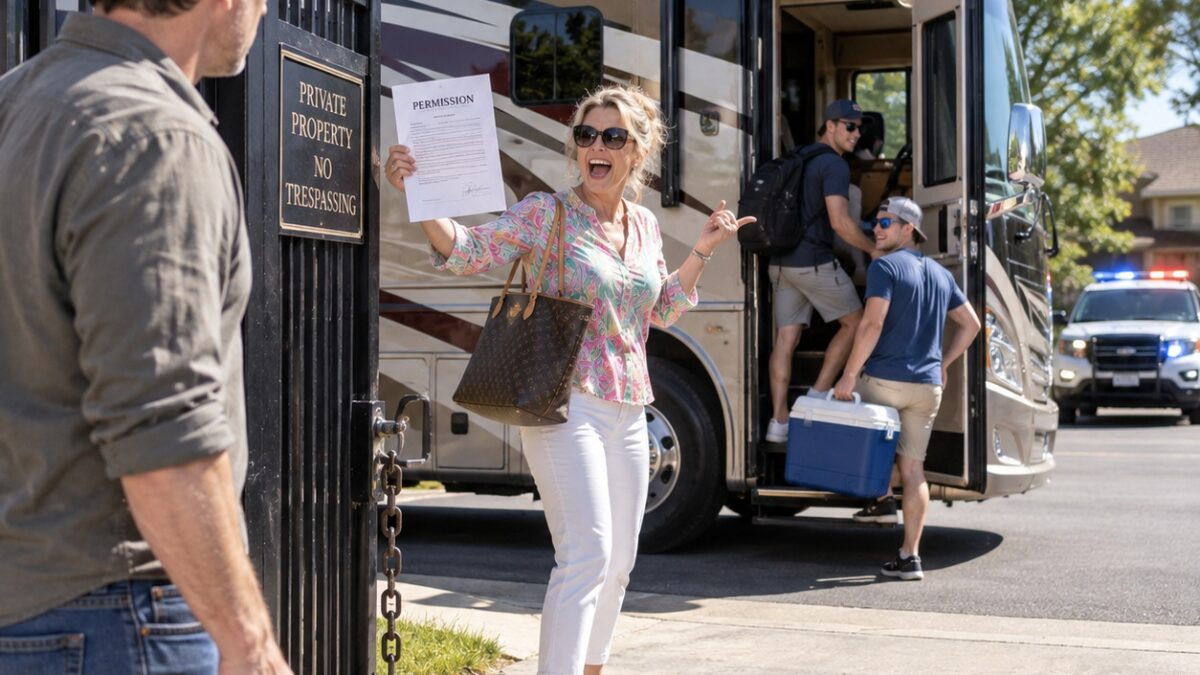
My Neighbor Demanded My RV for Labor Day—Two Days Later, My Tracker Started Moving West
My neighbor laughed when I refused to hand over the forty-foot RV I had spent fifteen years working for, then told her sons that “people like me” only bought luxury things because we were desperate to look important.
Two mornings later, my phone alerted me that the coach was racing west on the interstate while my gate hung open behind a cut chain and Beverly Pike stood on a neighbor’s camera waving a document with my name printed beneath a signature I had never written.
I thought recovering the RV would be the end of it, but when police opened one cabinet at a lakeside campground, they found the reason Beverly had been so certain nobody would believe me over her family.
I bought the RV after fifteen years of running Reed Mobile Electrical.
Fifteen years.
That mattered to me.
Not because I expected anyone else to care how long I had worked.
Because for most of those years, every extra dollar had gone somewhere practical before it ever had the chance to become mine.
New service truck.
Payroll.
Liability insurance.
Wire inventory.
Emergency generator.
Replacement meters.
Health insurance for two technicians after I finally became big enough to offer it.
Then the pandemic.
Then supply shortages.
Then a warehouse lease.
Then the kind of unexpected transformer failure that turns a normal Tuesday into a twenty-hour shift.
I wasn’t poor.
I wasn’t rich.
I was a forty-six-year-old electrician who had spent most of his adult life saying “maybe next year” whenever I wanted something that could not be justified on a spreadsheet.
The RV was the first exception.
A forty-foot diesel coach.
Used.
Three years old.
Dark graphite exterior with bronze striping.
Two slide-outs.
A bedroom big enough for me to stand upright without hitting anything.
A kitchen nicer than the one in my house.
Washer-dryer.
Generator.
Solar assist.
And a driver’s seat that made every work van I had ever owned feel like punishment.
I paid for it outright.
That point became important later too.
No loan.
No lien.
No partner.
No family contribution.
Mine.
The day it arrived, I parked it beside my house behind a six-foot steel gate I had installed years earlier because I kept work trailers there.
Across the street, Beverly Pike watched from her mailbox.
White sunglasses.
Cream blouse.
Perfect hair.
She had lived there eight years with her husband, Grant, and their adult sons, Preston and Cole.
Beverly had opinions about everything.
My work trucks.
The oak tree near my driveway.
The color of my garage door.
The fact that my employees occasionally stopped by before seven in the morning.
When the RV pulled in, she waited until the delivery driver left before crossing the street.
“Well.”
She circled it with her eyes.
“That’s certainly… noticeable.”
I smiled.
“I hope so.”
“Vehicles like this cost a fortune to maintain.”
“I know.”
She tilted her head.
“Seems excessive for one person.”
“I wasn’t aware there was a minimum family-size requirement.”
Her smile tightened.
“I’m only saying some things make more sense for families.”
I should have remembered that sentence.
Three weeks later, Beverly came across my driveway carrying a glossy travel brochure.
Labor Day weekend was approaching.
I had just finished washing road grime from the front cap.
“Our rental was canceled.”
She said it without hello.
I turned off the hose.
“That’s unfortunate.”
“Completely unprofessional company.”
I waited.
She glanced at my coach.
“So we’ll use yours.”
Not could we.
Not would you consider.
We’ll use yours.
I actually thought I had misunderstood.
“No.”
She blinked.
“Excuse me?”
“No.”
Preston had followed her across the street.
Thirty-two years old.
Sunglasses.
Golf shirt.
The confidence of a man who had never learned the difference between access and entitlement.
He leaned against my gate.
“You barely use it.”
“That does not matter.”
Beverly laughed.
“Oh, Marcus.”
My name is Marcus Reed.
The way she said it made it sound like I was being adorable.
“We’re talking seven days.”
“No.”
“We’ll pay for fuel.”
“No.”
“Cleaning too.”
“No.”
Preston looked through the bars.
“A luxury coach should belong to people who actually know how to enjoy one.”
I looked at Beverly.
Then toward the camera mounted above my garage.
Motion light active.
Audio enabled.
Good.
I spoke clearly.
“You do not have permission to enter, take, drive, borrow, use, or move my RV.”
Her smile disappeared.
I continued.
“You also do not have permission to enter the gated side yard.”
For a second, nobody said anything.
Then Beverly adjusted her sunglasses.
“You’re being ridiculous.”
“Maybe.”
“We’re neighbors.”
“Yes.”
“Family should come before toys.”
“We are not family.”
That one landed.
Preston laughed.
Not because it was funny.
Because he wanted me to know I had failed some social test.
Beverly turned toward the street.
As she walked away, she said loudly enough for me to hear,
“Some people buy expensive things because they need everyone to think they’ve arrived.”
I locked the gate.
Two mornings later, while I was standing beside an open transformer cabinet thirty-eight miles away, my phone vibrated.
RV MOVEMENT DETECTED.
For half a second, I thought the tracker had glitched.
Then the map refreshed.
The coach was moving west.
Sixty-two miles per hour.
And gaining distance.
FULL STORY CONTINUATION 👇👇
The first thing I did was stare at the screen.
That sounds stupid.
Maybe it was.
But your brain does strange things when something impossible appears as a moving blue dot.
My RV had been parked behind a locked gate when I left at 4:50 that morning.
I had checked it.
Not because I was paranoid.
Because I always checked.
Gate locked.
Coach plugged into shore power.
Slides in.
Battery tender active.
No reason it should have been moving.
The tracker refreshed.
Sixty-six miles per hour.
Westbound on State Route 14.
My stomach turned cold.
I called my house.
No answer.
Of course.
I lived alone.
Habit.
Then I opened the security app.
Front camera.
Working.
Driveway.
Working.
Gate camera.
Offline.
My pulse jumped.
I switched to the recorder archive.
The feed ended at 6:12 a.m.
Static.
Then nothing.
I was still looking when another message came through.
Elias Moreno.
He lived two houses down.
Retired high-school science teacher.
Sixty-eight.
The kind of neighbor who noticed when your trash can stayed at the curb too long and brought it in without mentioning it.
His text said:
You need to see this.
Then a doorbell-camera clip.
I opened it.
Timestamp:
6:08 a.m.
Grant Pike stood beside my gate holding long-handled bolt cutters.
My mouth went dry.
Beverly stood in the street wearing white pants and a pale-blue jacket.
Preston stood beside the RV gate.
Cole was loading luggage into Grant’s black SUV.
Elias’s camera audio picked up Beverly talking to Mrs. Conklin across the street.
“He gave us permission.”
Mrs. Conklin said something I couldn’t hear.
Beverly unfolded a sheet of paper.
“This is a family arrangement.”
Grant placed the cutters around my chain.
The video angle was distant but clear.
He leaned.
The chain snapped.
My entire body went rigid.
Second clip.
Preston opened the gate.
Walked toward the coach carrying a black backpack.
Beverly looked directly toward Elias’s house.
Elias himself appeared at the edge of the frame.
He said:
“Does Marcus know you’re taking that?”
Beverly held up the paper.
“Obviously.”
Elias:
“He told you no two days ago.”
That was useful.
Very useful.
Beverly’s face changed.
“People cool down.”
Then Preston climbed into my RV.
Grant and Cole got into the SUV.
Beverly laughed.
I could hear it clearly.
Then she said the sentence that stayed with me through every court hearing afterward.
“People like him buy luxury things to impress others. Families like ours are the ones who actually belong in them.”
The dispatcher answered while I was still replaying the clip.
“County emergency services.”
“My motorhome has been stolen.”
“Are you currently in danger?”
“No. I’m thirty-eight miles from home.”
“Address?”
I gave it.
“Vehicle description?”
I gave that too.
Forty-foot diesel coach.
Make.
Model.
Plate.
VIN from memory except the final six digits, which I pulled from my insurance app.
“Do you know who took it?”
“Yes.”
The dispatcher paused.
“You know them?”
“My neighbors.”
That sounded ridiculous even as I said it.
“Do they have permission to use the vehicle?”
“No.”
“Any chance this is a misunderstanding or borrowing dispute?”
“No.”
I kept my voice level.
“I denied permission on camera two days ago. This morning they cut a locked chain to access the property, disabled a security camera, and removed the vehicle. I have video.”
That changed her tone.
“Do you have live tracking?”
“Yes.”
“Do not follow them yourself.”
“I’m not.”
I looked at the transformer cabinet beside me.
My employee, Jamal, was watching from twenty feet away.
He knew something was wrong.
The dispatcher asked for the tracking location.
I gave it.
She transferred information to state police because the coach was already outside the city.
Then Elias called.
“Marcus.”
“I saw it.”
“Jesus.”
“What exactly happened?”
“I went outside because I heard metal.”
“Did you confront them?”
“Not really.”
“Tell me everything.”
Elias said he saw Grant cutting the chain.
He stepped onto his porch and asked what they were doing.
Beverly immediately produced a printed authorization letter.
My name at the top.
My address.
RV details.
A paragraph claiming I had loaned the coach to Grant and Beverly Pike for Labor Day week.
Signature at bottom.
Supposedly mine.
Elias knew it wasn’t real because he had been in his front yard two days earlier when I refused.
“Did you get a picture?”
“Doorbell got most of it.”
“Paper?”
“No.”
“I’m calling police.”
“They’re already coming.”
I looked at the tracker.
Seventy miles away now.
West.
“Did they damage anything else?”
“Camera wire.”
“What?”
“Grant climbed a ladder before they opened the gate. I think he cut your camera cable.”
That meant planning.
Nobody spontaneously steals a forty-foot coach and remembers to disable one specific camera first.
I felt my anger shift.
Not hotter.
Colder.
“Elias, don’t touch the gate or chain.”
“Why?”
“Evidence.”
He went quiet.
Then:
“Right.”
I had spent fifteen years documenting electrical work.
When something fails and six people start touching it, truth disappears.
Same principle.
“Take photos from where you are.”
“I will.”
“And if Beverly comes back?”
“You think she might?”
“I have no idea.”
“Call police. Don’t confront anyone.”
“You sound like the dispatcher.”
“Good.”
I hung up.
Jamal walked over.
“What happened?”
“Someone stole the coach.”
He stared.
“The RV?”
“Yes.”
“Who?”
“My neighbor.”
He waited for me to smile.
I didn’t.
“No way.”
“Finish isolating the primary. I need to go.”
“You want me to drive?”
“No.”
“You’re shaking.”
I looked down.
He was right.
My hands were shaking.
“I’ll sit five minutes.”
He shook his head.
“I’m driving.”
Normally I would have argued.
I didn’t.
We secured the job enough for the utility crew to continue safely.
My second technician, Carlos, took over.
Jamal drove my service truck home while I sat passenger-side tracking the RV.
Every few minutes, the map refreshed.
The coach moved farther west.
At 7:43, state police called.
Trooper Mendez.
“Mr. Reed?”
“Yes.”
“We have the vehicle flagged.”
“Good.”
“Do not attempt recovery yourself.”
“I’m not.”
“Any weapons inside?”
“No firearms.”
“Anything dangerous?”
“Electrical tools in one storage bay. Basic hand tools. Propane system. Diesel fuel. Nothing unusual.”
“Keys?”
“Primary key was inside my house.”
He paused.
“How did they start it?”
That question hit me.
My spare key.
I kept one in a locked drawer in the garage workshop.
Not visible.
Not somewhere Beverly should have known about.
“Spare key may be missing.”
“Could they have duplicated one?”
“Maybe.”
“When was the last time they had lawful access to your garage?”
“Never.”
“Anyone in their family?”
“Grant borrowed my ladder once. Outside only.”
“Any service provider shared?”
“Not that I know.”
Trooper Mendez wrote something.
“Registration documents in the RV?”
“Yes.”
“Insurance card?”
“Copy in glove compartment.”
“Any personal identifying information?”
I thought.
The RV binder.
I kept a binder inside a cabinet behind the driver’s seat.
Registration copy.
Insurance.
Roadside assistance.
Maintenance invoices.
Campground memberships.
Emergency contact page.
Photocopy of my driver’s license?
No.
I didn’t think so.
Then I remembered.
Six months earlier, the manufacturer’s extended-service company required identification for a warranty transfer.
I had printed a copy.
Did I leave it in the binder afterward?
I couldn’t remember.
“I may have an old license copy in a service file.”
“Okay.”
Why was he asking?
Then I understood.
Forged permission letter.
They had my VIN.
Plate.
Possibly signature.
This wasn’t a joyride.
“How did they get my information?”
“We don’t know.”
Neither did I.
Yet.
By 8:15, local police met me at home.
Officer Leah Porter.
Young.
Calm.
Body camera.
She photographed the gate before entering.
Cut chain on pavement.
Fresh scrape marks.
Camera wire clipped behind the junction box.
Small ladder imprint in mulch.
Gate latch bent.
She asked me to pull up my own refusal footage.
I did.
Beverly requesting the coach.
My repeated no.
The exact sentence denying entry and use.
Officer Porter watched twice.
“That helps.”
“I assumed.”
“Do you know whether she saw the camera?”
“Yes.”
I pointed upward.
“Not hidden.”
“Did anyone tell her recording was occurring?”
“Sign by driveway says audio/video surveillance.”
She nodded.
Then Elias came over.
With his phone.
And something else.
A printed sheet in a plastic grocery bag.
“I found this.”
Officer Porter stopped him before he handed it to me.
“Where?”
“Street gutter.”
Beverly’s forged authorization.
My name typed.
RV VIN.
Dates.
Seven-day permission.
Grant and Beverly authorized to operate.
At the bottom:
Marcus J. Reed
Signature.
Not mine.
It resembled mine.
That bothered me more.
My signature had a distinctive long J in the middle initial.
The forged one had it.
Not perfect.
But close.
Officer Porter photographed the document inside the bag.
“Did you pick it up bare-handed?”
Elias looked guilty.
“Yes.”
“That’s okay. Just tell me.”
She took custody.
I stared.
The header included my business logo.
Reed Mobile Electrical.
Not the version from my website.
An older version.
Three years old.
I knew where that logo appeared.
Invoices.
Service proposals.
Employee handbooks.
Old business forms.
“How did she get that?”
Officer Porter asked.
“I don’t know.”
But I had an idea.
Two years earlier, I replaced Beverly and Grant’s electrical panel.
At cost.
Neighbor discount.
I had given them a printed estimate and final invoice.
Both had my signature.
Both had the old logo.
I looked at Officer Porter.
“She has a real sample of my signature.”
“From?”
“Invoice.”
Her expression changed.
“Document that.”
I did.
By 9:00, the RV tracker stopped moving.
Lake Arrowhead.
A private campground roughly 130 miles away.
Trooper Mendez called again.
“Vehicle is stationary.”
“I see it.”
“Campground property.”
“Are officers there?”
“Local unit en route.”
My stomach twisted.
I wanted to drive.
Immediately.
I didn’t.
“Do you need me?”
“Not yet.”
“Please tell them not to let anyone leave with the RV.”
“It’s already entered as stolen.”
“What about the people?”
“That depends on what officers find.”
Depends.
I hated that word.
But I understood.
Police show up at a campground.
Family says they have permission.
Paper says they have permission.
Owner says theft.
Video says no.
Chain says forced entry.
Truth may be clear to me.
Officers still document.
At 9:32, my phone rang from an unknown number.
I answered.
“Mr. Reed?”
Female voice.
“Yes.”
“This is Officer Dana Wu with Lake County Sheriff’s Office. I’m standing at Lake Arrowhead Campground with your motor coach.”
Relief hit so hard I sat down.
“Is it okay?”
Pause.
“That’s part of why I’m calling.”
My stomach dropped again.
“What happened?”
“The vehicle appears to have sustained some damage.”
“How much?”
“We can’t assess mechanically.”
“What kind?”
“Right-side exterior scrape. Rear storage-door damage. Interior mess. One awning arm appears bent.”
I closed my eyes.
“Anyone hurt?”
“No.”
That mattered.
Even angry, I didn’t want anyone injured.
“Who is there?”
“Grant Pike. Beverly Pike. Preston Pike. Cole Pike. Two additional adults and three children.”
Children.
I hadn’t known.
Extended family.
“Are they detained?”
“We are separating parties and reviewing documentation.”
“They stole it.”
“I understand your report.”
“They cut my lock.”
“We have that information.”
“They have forged documents.”
“We’re reviewing those too.”
Then she asked,
“Did you authorize Mrs. Pike to use your insurance policy information?”
“No.”
My skin went cold.
“What did she do?”
“She presented an insurance card listing Grant as an authorized operator.”
“That doesn’t exist.”
“Okay.”
“Is it my policy number?”
“Yes.”
I stood.
“What else do they have?”
Officer Wu’s voice stayed calm.
“There’s a campground registration form signed using your name.”
“What?”
“The site reservation is under Marcus Reed.”
I gripped the table.
“I did not make a reservation.”
“Did you authorize anyone to make one for you?”
“No.”
“Did you provide a copy of your driver’s license?”
“No.”
Another pause.
“Mr. Reed, we found a photocopy of what appears to be your license in the RV.”
My mouth went dry.
“Where?”
“Inside a plastic folder Mrs. Pike provided when officers asked for proof of permission.”
Not my binder.
Her folder.
She had prepared it.
I sat again.
“She made an identity packet.”
Officer Wu did not repeat my wording.
“We’re documenting what was presented.”
Of course.
Facts.
“Can I come?”
“Yes. But do not confront the Pikes. Meet officers at the campground office.”
“I’m leaving now.”
Officer Porter insisted on coming in a separate unit because the local theft case originated at my house.
Jamal tried to come.
I told him no.
He told me that was stupid.
He came anyway, following in my pickup.
Lake Arrowhead Campground looked painfully cheerful when we arrived.
Blue water.
Pine trees.
Families grilling.
Kids on bicycles.
Flags outside trailers.
And near the back loop, my RV.
My beautiful coach.
Crooked in site 47.
Right side too close to a pine tree.
Awning half deployed.
One support arm bent downward.
A long scrape ran across two storage doors.
Mud along the lower panels.
The rear corner had a fresh crack in the fiberglass.
I stopped walking.
Jamal muttered,
“Oh, man.”
Officer Porter said,
“Don’t touch anything yet.”
I knew.
Still wanted to.
Beverly stood twenty yards away beside a picnic table.
Arms crossed.
No handcuffs at that moment.
Grant sat separately near another deputy.
Preston leaned against the SUV.
Cole paced.
Beverly saw me.
Her face did something astonishing.
She looked annoyed.
Not ashamed.
Not afraid.
Annoyed.
“Finally.”
I almost laughed.
Officer Wu stepped between us.
“No direct contact.”
Beverly called past her.
“This is ridiculous, Marcus.”
I ignored her.
That bothered her.
“We were going to bring it back.”
Still ignored.
“You know that.”
Officer Wu turned.
“Mrs. Pike.”
Beverly stopped.
Campground manager, Tom Feldman, invited me into the office.
He looked miserable.
“I am so sorry.”
“You didn’t steal it.”
“We checked paperwork.”
“I know.”
“She had everything.”
He showed me copies.
Reservation confirmation under my name.
My home address.
Phone number.
Except one digit changed.
Email address almost mine.
marcus.reedservice instead of marcus.reedelectric.
A fake Gmail.
My RV details.
Emergency contact listed as Beverly Pike.
Then a scanned driver’s license copy.
Mine.
Old address from before I moved seven years earlier.
That told me where it came from.
Warranty file.
The old license copy had been in the RV binder after all.
But how had Beverly gotten it before taking the RV?
Unless she hadn’t.
Maybe Preston found it after they stole the coach and then built the packet while traveling.
But the campground reservation had been made four days before the theft.
Four days.
Before Beverly asked me.
I looked at the reservation date.
Sunday.
She asked me Tuesday.
They had booked my RV trip before requesting permission.
My refusal had not caused the theft.
It only interrupted the story they were already telling themselves.
“Can I photograph this?”
Officer Wu answered.
“We’ll provide copies through the report. Don’t alter originals.”
I nodded.
Then Tom produced another page.
A copy of the fake authorization.
Not the one found in the gutter.
Another print.
Same wording.
Same signature.
Prepared in advance.
Tom said,
“She emailed it when she booked.”
I stared.
“Before she asked me.”
“Yes.”
That fact changed the whole case.
Beverly had not forged permission after I said no.
She had forged it before asking.
The request had been theater.
She wanted to be able to say she asked.
Maybe she assumed I would agree.
Maybe she thought if I said no, she would simply proceed anyway.
Either way, the plan existed before the conversation.
Officer Wu escorted me to inspect the RV.
Not enter fully yet.
Photographs first.
Exterior damage.
The scrape began near the passenger mirror.
Continued almost thirteen feet.
Likely from campground entry or a tree.
Rear corner cracked.
One basement door wouldn’t close.
Awning arm bent.
One leveling jack looked twisted.
Inside, I smelled alcohol.
Not strong.
Enough.
Shoes everywhere.
Food on countertops.
One cabinet door hanging crooked.
My cream sofa had a dark red stain.
Wine.
Probably.
Bedroom drawers open.
Bedding changed.
Bathroom towels on floor.
And a dent in the refrigerator door.
It looked lived in.
Used.
Violated.
That word felt dramatic.
Still accurate.
Then we reached the driver-side cabinet where I kept documents.
Open.
Binder gone.
I told Officer Wu.
“There was a black binder here.”
She nodded.
“We found one in the Pikes’ SUV.”
“Inside?”
“Yes.”
My pulse jumped.
“That belongs to me.”
“It contains your registration and service records?”
“Yes.”
“Also several invoices?”
“Probably.”
“Signature samples?”
“Yes.”
There it was.
Maybe they had used my old electrical invoice from their own house to create the first fake letter.
Then after stealing the RV, they obtained more documents.
Identity theft expanding in real time.
A deputy found a small portable scanner in Preston’s backpack.
Ordinary device.
Not illegal.
But combined with copies of my documents, it mattered.
So did the laptop.
Police did not search everything immediately without proper authority.
I understood that.
Later warrants would matter.
At the campground, officers focused on possession, evidence in plain view, statements, and immediate theft circumstances.
Grant kept insisting he believed Beverly had permission.
That became one of the strangest parts.
He claimed Beverly showed him an authorization before they cut the gate chain.
Officer Wu asked:
“If you had permission, why cut a locked chain?”
Grant answered:
“Marcus forgot to leave the gate open.”
That sentence almost impressed me.
The human mind will build astonishing bridges over obvious holes.
“Why disable the camera?” the deputy asked.
Grant said:
“I didn’t know it was disabled.”
Elias’s video showed him climbing the ladder.
Hard problem.
Preston’s story was different.
He claimed I had verbally agreed the week before, then “changed my mind emotionally” Tuesday, but Beverly said the written authorization controlled.
Legal nonsense.
Interesting nonsense.
Cole barely talked.
He asked for a lawyer early.
Smartest Pike there.
Beverly talked the most.
Naturally.
She said the disagreement was “a class issue.”
That caught my attention.
I stood far enough away that I heard only pieces.
“He resents us.”
“Blue-collar chip.”
“Trying to humiliate my family.”
Then:
“He told me people like us didn’t belong.”
The exact reverse of what she had said on video.
Officer Porter later told me not to worry about it.
“We have the recording.”
That sentence became comforting.
We have the recording.
By afternoon, the situation hardened.
Beverly and Preston were arrested.
Grant too, based on forced entry and his role.
Cole was initially detained, questioned, then later charged after further investigation tied him to parts of the plan.
The additional adults were Beverly’s sister Denise and Denise’s husband.
They appeared genuinely stunned.
They had been told I owned the RV but loaned it to the family.
Denise had even sent Beverly $1,200 toward “Marcus’s usage fee.”
There was no usage fee.
Beverly had collected money from her own sister.
That told me something important.
This wasn’t only about entitlement.
She had monetized the lie.
The children knew nothing.
Thankfully.
Family members came to retrieve them.
Watching those kids leave turned some of my anger into something uglier.
Adults had built this.
Children would remember police at the campground.
None of that was their fault.
Police released the RV back to me after evidence processing.
I did not drive it.
No chance.
A commercial recovery service towed it to a certified motor-coach shop.
That alone cost nearly $2,000.
Insurance covered much eventually.
The initial repair estimate was $31,700.
Then mechanics found more.
Bent awning assembly.
Damaged leveling jack.
Scraped compartment doors.
Rear fiberglass.
Interior cabinet.
Sofa upholstery.
Generator-hours discrepancy.
And transmission warning logs consistent with harsh low-speed maneuvering.
Final repairs passed $46,000.
Then the body shop discovered the right-side slide seal had been pinched after someone tried extending it while the coach was not properly leveled.
Another bill.
By the time everything was complete, total direct repair and recovery costs exceeded $52,000.
That number mattered in restitution later.
But money was not what bothered me most.
The RV had only 8,400 miles when they took it.
Perfect maintenance history.
Now every time I looked at the repaired side panel, I knew where damage had been.
You can fix fiberglass.
You can’t unknow.
For three days, I considered selling it.
Jamal talked me out of it.
“You waited fifteen years.”
“I know.”
“So don’t let Beverly sell it for you.”
That irritated me because he was right.
“I didn’t ask for therapy.”
“You pay me hourly.”
“You’re off the clock.”
“Then this is free.”
I kept the RV.
Before I could use it again, the identity issue exploded.
Detective Aaron Lewis from the financial-crimes unit called four days after recovery.
“Mr. Reed, we obtained records from the campground and started reviewing digital evidence.”
“Okay.”
“Have you checked your credit?”
My stomach tightened.
“No.”
“Do that today.”
“Why?”
“There was an application for a fuel card using your business identity.”
I stood.
“What?”
“Submitted Thursday.”
The day after my refusal.
“Which company?”
He told me.
Commercial fleet card.
Application used Reed Mobile Electrical.
My federal tax ID.
Business address.
My name.
Requested two cards.
One additional card in Grant Pike’s name listed as “operations manager.”
Grant had never worked for me.
“How did they get my tax ID?”
“Do you give W-9s to customers?”
“Yes. Commercial clients.”
“Pikes?”
“No.”
“Any community work?”
Then I remembered.
Three years earlier, the neighborhood civic association hired my company to upgrade parking-lot lighting at the community pavilion.
Beverly had been treasurer.
She processed payment.
W-9.
Tax ID.
Signature.
Bank information.
Everything.
My stomach turned.
“Beverly had a W-9.”
Detective Lewis went quiet.
“Send me details.”
I did.
The fuel-card application was denied because the business address verification failed.
But that wasn’t all.
There had also been an attempt to add Grant as an authorized user on one of my roadside-assistance accounts.
An online campground membership profile opened under my name.
A temporary email created.
Insurance documents digitally modified.
And a request for duplicate registration information through a third-party vehicle-record service.
Not DMV replacement title.
Nothing that far.
But enough.
They had built a fake version of me.
One that said yes.
That thought bothered me deeply.
Identity theft is usually described financially.
Accounts.
Credit.
Money.
But what they stole first was consent.
They created documents where I agreed.
A signature where I permitted.
A business role where Grant worked for me.
A reservation where I invited them.
A fake email where “I” confirmed.
They manufactured a Marcus Reed who behaved the way Beverly wanted me to behave.
That was what made it feel personal.
Detective Lewis asked me to create a list of every location where Beverly might have obtained business information.
I spent a full day reviewing old files.
Her panel replacement.
Neighborhood pavilion contract.
A charity raffle where my company donated labor.
An HOA-free neighborhood association directory.
Yes, we had a civic association.
No mandatory dues.
No covenants.
Mostly block parties and street cleanup.
Beverly had served as treasurer, then vice president.
She had access to vendor files.
My company was in those files.
That opened a second investigation into whether she had misused association records.
The current association president, Nora Kim, cooperated immediately.
She was horrified.
Beverly had downloaded archived vendor folders before leaving office.
Why?
No legitimate reason.
The audit log showed it.
Two months before the RV theft.
Planning.
Again.
Every new fact pushed the incident farther away from “neighbor goes too far.”
This had structure.
The supposedly canceled rental became the next lie.
Detective Lewis asked Beverly’s attorney for details because her initial statement repeatedly referenced the rental company.
No reservation existed.
None.
Not canceled.
Not pending.
Nothing.
The glossy brochure she carried to my driveway came from a luxury RV rental firm.
They confirmed Beverly requested pricing online.
She never booked.
Instead, five days before asking me, she reserved Lake Arrowhead under my name.
Four days before asking, she emailed the forged permission.
Three days before asking, she bought replacement bolt cutters.
Credit-card receipt.
Then she asked.
The question had never been a question.
It was a courtesy performance.
Maybe she expected yes and wanted easier access.
Maybe she planned to take it regardless.
Prosecutors would later argue the timeline demonstrated premeditation.
Her attorney argued she honestly believed “family-neighbor consent” would be granted and prepared logistics in anticipation.
That explanation didn’t survive the cut chain very well.
Or my recorded no.
Or the disabled camera.
Or the forged documents.
But defense lawyers have jobs.
I respected that.
I also stopped reading comments online after the local news picked up the story.
Someone at the campground leaked photos.
Headline:
FAMILY ARRESTED AFTER ALLEGEDLY TAKING NEIGHBOR’S $400K MOTORHOME
The coach had not cost $400,000.
Its original MSRP was near that.
I paid far less used.
Facts become decorative in headlines.
Then someone found Beverly’s social media.
Photos of her vacations.
Country club.
Charity galas.
Suddenly strangers turned her into a caricature.
“Karen steals RV.”
“Rich family entitlement.”
“Boomer criminal vacation.”
I hated that more than I expected.
Not because Beverly deserved sympathy from me.
Because mockery can make serious facts feel less serious.
They did not “borrow the wrong RV.”
They entered locked property after explicit denial.
Forged permission.
Disabled surveillance.
Used my identity.
Damaged the vehicle.
Collected money under false pretenses.
That was enough.
No meme needed.
And I did not want her family judged by appearances.
Grant had a boat.
Beverly wore expensive sunglasses.
So what?
The case was about conduct.
Not clothes.
Class contempt mattered because of what Beverly said.
But I wasn’t going to reverse it.
Her worst line remained:
“People like him buy luxury things to impress others. Families like ours are the ones who actually belong in them.”
When Detective Lewis asked what I thought she meant, I answered carefully.
“I think she believes people who work with their hands are socially beneath her family.”
“Race?”
“No.”
“Religion?”
“No.”
“National origin?”
“No.”
“Economic class?”
“Mostly.”
I was a contractor.
She described me once at a neighborhood dinner as “the electrician,” despite knowing I owned a company with eleven employees.
Not because electrician embarrassed me.
It didn’t.
I am an electrician.
Proudly.
But the way she said it turned a trade into a category.
Useful person.
Service person.
Not someone who should own what she wanted.
Her worldview seemed to place people into those who provided things and those who were entitled to receive them.
I had apparently violated the arrangement by owning the nicest recreational vehicle on the block.
The preliminary hearing took place six weeks after the theft.
I had never testified in court before.
I hated it.
Not because I was scared of telling the truth.
Because court turns ordinary memories into answerable units.
What exactly did she say?
What time?
Where were you standing?
Was the gate visible?
Was the camera recording continuously?
How do you know the signature is not yours?
Did you ever lend them property before?
Had Grant borrowed tools?
Had Beverly ever driven any vehicle belonging to you?
Did you ever say, “Maybe another time”?
I understood why.
Defense tests ambiguity.
My job was not to perform anger.
Just answer.
“Yes, Grant borrowed a pressure washer once.”
“Yes, Beverly borrowed folding tables.”
“No, they had never borrowed a vehicle.”
“No, they had never entered the gated side yard without me.”
“Yes, Beverly asked to use the RV.”
“No, I did not agree.”
“How many times did you say no?”
“Five, depending on whether you count the sentence denying all access.”
Her attorney looked at me.
“You were angry.”
“No.”
“You disliked Mrs. Pike.”
“Not before this.”
“You had neighborhood disagreements.”
“She disliked my work trucks.”
“That wasn’t my question.”
The prosecutor almost smiled.
I had spent fifteen years negotiating with general contractors.
Questions matter.
Defense counsel continued.
“Did Mrs. Pike offer to pay?”
“For fuel and cleaning.”
“So there was negotiation.”
“No.”
“You discussed terms.”
“She proposed terms after I said no.”
“Isn’t that negotiation?”
“No.”
“Why not?”
“Because my answer didn’t change.”
He paused.
Then:
“Did you ever tell her you might reconsider?”
“No.”
“Did you say ‘not this time’?”
“No.”
“Did you say ‘maybe’?”
“No.”
“What did you say?”
“No.”
Simple.
The video did the rest.
Beverly’s recorded request.
My refusal.
Then Elias’s doorbell footage.
Cut chain.
Paper.
Statements.
The judge found enough probable cause for charges to proceed.
No surprise.
Still, hearing the judge summarize the case felt surreal.
The financial-crimes charges developed separately.
Forgery-related counts.
Identity misuse.
Theft.
Burglary or unlawful entry issues depending on exact legal classification.
Criminal damage.
Insurance-related falsification.
Prosecutors ultimately structured charges based on state statutes I am not going to pretend I could recite.
What I knew was this:
They treated it seriously.
Grant’s role became complicated.
Digital evidence suggested Beverly created most documents.
Preston helped with campground reservation and email setup.
Grant cut the chain and drove the follow vehicle.
Cole knew the RV was unauthorized by the time they left but still participated in travel and used the coach.
Different conduct.
Different exposure.
Their lawyers started separating interests.
Family unity lasted until plea negotiations.
That part was ugly.
Beverly initially insisted Grant knew everything.
Grant’s lawyer argued he relied on his wife’s documents.
Preston said his mother told him I had verbally agreed after my recorded refusal.
Cole claimed he discovered the truth only after they were already thirty miles away.
Then investigators recovered a family group-chat export from cloud backups.
That chat ended most of those stories.
Five days before the theft:
Beverly: Marcus will probably be difficult. Don’t argue with him.
Preston: If he says no?
Beverly: Leave that to me.
Grant: We are not taking someone’s RV without permission.
That surprised me.
For one moment, Grant looked better.
Then later:
Beverly: Permission will be handled.
Grant: Meaning?
Beverly: Paper. Stop worrying.
The morning after my refusal:
Preston: He was pretty clear.
Beverly: He likes saying no because it makes him feel important.
Cole: So trip canceled?
Beverly: Absolutely not.
Then Grant:
What about the gate?
Beverly:
Cut the chain. I’ll replace it.
Grant:
That looks bad.
Beverly:
Only if someone makes a scene.
And Preston:
Camera?
Beverly:
Dad can disconnect it.
There.
No misunderstanding.
No spontaneous decision.
No belief I consented.
Planning.
The message that hurt in a different way came later.
Preston:
Why do you care so much about using Marcus’s?
Beverly:
Because he needs to learn he isn’t better than everyone because business is good.
Preston:
He never said he was.
Beverly:
You don’t have to say it when you park that thing where everyone can see it.
I stared at that message.
The RV was behind a steel gate.
Beside my house.
On my property.
Its visibility was an offense because she experienced ownership as display.
Maybe that was the entire psychological engine.
She believed my purchase was a statement about her.
So taking it became a correction.
When Nora, the civic association president, saw the messages, she shook her head.
“She’s been like this for years.”
“What do you mean?”
“If someone remodeled, Beverly remodeled bigger.”
I had noticed.
“If someone traveled, she posted a better trip.”
“Yes.”
“If someone bought something—”
“She called it tacky unless she had one.”
Nora looked embarrassed.
“I should’ve removed her from financial access sooner.”
“Why?”
“Because of the old vendor downloads.”
“You didn’t know.”
“I knew she took files home.”
“For association work?”
“She said so.”
We were both learning the same painful lesson.
Trust is not stupidity.
But once evidence changes, trust has to change too.
The civic association completed an audit.
No major missing money.
Thank God.
Some questionable reimbursement documentation.
Nothing like embezzlement.
Mostly sloppy governance and Beverly keeping files she should have deleted.
They changed policies.
Vendor records now restricted.
Tax IDs masked.
Download logs reviewed.
Not because of the RV exactly.
Because the RV revealed a vulnerability.
My business did the same.
I had always been obsessive about job documentation and embarrassingly casual about stored identity documents.
After this:
Encrypted digital vault.
No license copies in vehicles.
W-9 distribution tracked.
Bank information separate.
Vehicle registration copies redacted where possible.
Employees trained on social-engineering attempts.
I paid for identity monitoring for myself and key staff.
Then offered it to everyone for a year because my old vendor documents contained employee contact information.
Nothing suggested the Pikes used that.
Still.
Once your information has been in unauthorized hands, imagination becomes expensive.
The RV remained in repair for nine weeks.
Nine.
Labor Day passed.
September.
October.
I went to the shop every Friday.
Not necessary.
The service manager, Luis, tolerated me.
“You know we’ll call.”
“I know.”
“You don’t need to inspect the fiberglass every week.”
“I know.”
“Then why are you here?”
“To annoy you.”
“Working.”
They replaced compartment doors.
Matched paint.
Rebuilt awning mount.
Fixed leveling jack.
Repaired rear cap.
Deep-cleaned interior.
Replaced sofa upholstery.
Aligned slide.
Serviced generator.
Tested transmission.
When they finished, the coach looked nearly new.
Luis handed me the keys.
“You selling?”
“I don’t know.”
He nodded toward the road.
“Drive it first.”
So I did.
Twenty miles.
No destination.
Just interstate.
The engine settled into that low diesel hum I loved.
Cab quiet.
Seat comfortable.
Sunset ahead.
For the first ten minutes, all I could imagine was Preston sitting there.
His hands on my wheel.
Then something shifted.
I knew the controls better.
I knew every sound.
The coach responded to me.
Not him.
By mile fifteen, it felt mine again.
I pulled into a rest area.
Made coffee.
Sat at the dinette alone.
That was when I decided not to sell.
Jamal had been right.
Beverly had already taken it for one week.
I wasn’t giving her the rest.
My first trip after repairs was two nights at a state park ninety miles north.
No luxury campground.
No crowd.
Just trees.
Lake.
Rain one night.
I cooked steak outside.
Read.
Slept nine hours.
At sunrise, I stood beside the coach with coffee.
For fifteen years, I had treated rest like a reward I had not quite earned.
That was why Beverly’s comment bothered me in another way.
“People like him.”
What kind?
Tradesman?
Single?
Working-class background?
Business owner without the right clothes?
I had spent half my life entering expensive houses through service doors because someone’s power had failed.
People called me sir when the lights were out and “the electrician” after they came back on.
I didn’t resent that.
Work is work.
But somewhere along the way, I had internalized the idea that luxury was for customers.
I fixed it.
Installed it.
Powered it.
Wasn’t supposed to own it.
The RV had been my first loud disagreement with that idea.
Maybe that was why I bought it.
Not to impress Beverly.
To impress the younger version of me who once ate gas-station sandwiches in a work van and promised himself life would eventually contain something beyond invoices.
I kept the RV.
The criminal case did not resolve quickly.
Almost a year.
Plea negotiations.
Motions.
Document experts.
Insurance records.
Digital forensics.
Restitution calculations.
I was interviewed repeatedly.
Each time, I tried to stay factual.
Beverly’s attorney proposed a civil settlement before trial.
Full RV repair cost.
Insurance deductible.
Gate and camera.
Identity-protection expenses.
Additional money.
In exchange, I would support a more lenient resolution and dismiss certain civil claims.
I asked my attorney, Dana Price:
“Can I make criminal charges disappear?”
“No. That’s the state.”
“Then what are they asking?”
“For a victim position favorable to settlement.”
“What do you think?”
Dana was fifty-one and had represented my business for years.
She never told me what she thought until I asked twice.
“I think getting paid is not the same as getting justice.”
“Agreed.”
“I also think refusing money because you want suffering can become its own bad decision.”
I looked at the offer.
“What would you do?”
“Not my RV.”
“Dana.”
She sighed.
“I’d separate restitution from anger.”
Good advice.
Insurance had covered much of repair.
The insurer pursued subrogation.
My direct losses were smaller than total damage but still substantial.
I did not want a giant windfall.
I wanted actual losses paid.
My identity repaired.
And acknowledgment.
Beverly refused acknowledgment.
That killed early settlement.
Her proposed language:
The parties disagree regarding authorization and circumstances surrounding use of the vehicle.
No.
There was no authorization dispute in my mind.
Video.
Messages.
Forgery.
Not “use.”
Theft.
Dana wrote back:
Mr. Reed will not execute any statement characterizing consent as disputed.
That was enough.
Months later, Grant changed plea.
He accepted responsibility for cutting the chain, entering the property, assisting in removal, and participating despite knowing I had refused.
He agreed to restitution.
Community supervision.
Other conditions.
His exact sentence in court stayed with me.
“I knew it was wrong, and I let my wife convince me that because she had paperwork, wrong had become complicated.”
That was more honest than I expected.
Preston eventually admitted helping create the fake email and reservation profile.
He claimed Beverly produced the forged signature itself.
Digital evidence supported that most file creation occurred on her laptop, though he had participated in preparing documents.
Cole took a lesser resolution based on his narrower role but admitted he knew before arrival at the campground that I had not authorized the trip.
Beverly held out longest.
Naturally.
Her case approached trial.
Then prosecutors disclosed additional evidence from her laptop.
A folder.
Name:
MARCUS RV
Created twelve days before Labor Day.
Inside:
Photos of my coach copied from my public business social-media account where one employee had congratulated me.
A PDF of my old signed electrical invoice.
A cropped signature image.
My company logo.
Campground reservation screenshots.
RV specifications.
Insurance template.
A draft permission letter.
And a document titled:
If questioned
I did not get to see every line immediately.
Later, through court exhibits, I learned enough.
Talking points:
Marcus agreed verbally.
Marcus is private about lending property.
Family friendship.
Document signed earlier.
Gate lock mistakenly left unchanged.
Camera disconnected to prevent “false theft alerts.”
That last line was almost creative.
She had rehearsed explanations for evidence before committing the act.
Then one note:
Do not argue class issue. Makes him defensive.
I laughed when I saw that.
Even she knew.
Another file contained a rough trip budget.
Fuel.
Campground.
Food.
Activities.
Rental line:
$0.
Marcus coach.
The RV had become theirs on a spreadsheet before I knew I was being asked.
That did something strange to me.
It made me less angry.
Not more.
Because the mystery disappeared.
Beverly did not snap.
She did not misunderstand.
She made a decision.
Then built paperwork around it.
Once motive becomes mundane, obsession loses oxygen.
She wanted a vacation she didn’t want to pay rental rates for.
She resented my ownership.
She believed social confidence would protect her.
That was it.
No deeper conspiracy.
No secret vendetta.
Entitlement plus planning.
The morning Beverly finally entered her plea, I sat behind the prosecutor.
She wore navy.
Hair shorter.
No white sunglasses.
She looked older.
People always say defendants look smaller in court.
Maybe rooms designed around authority do that to everyone.
The judge asked questions.
Did she understand rights?
Consequences?
Was anyone forcing her?
Then asked whether she admitted creating or using false documents to represent my consent and participating in unauthorized removal of the RV.
Long pause.
“Yes.”
I expected triumph.
Nothing.
Just relief.
The sentencing hearing came later.
I was allowed to speak.
I almost declined.
Dana convinced me.
“Not for her.”
“For whom?”
“You.”
I wrote three pages.
Then threw them away.
When I stood at the podium, I used no paper.
“My name is Marcus Reed.”
Obvious.
Still how I started.
“I’ve spent fifteen years building an electrical business. I document things for a living because when power fails, guessing can hurt people.”
The judge listened.
“So I want to be precise.”
I looked at Beverly.
“This case is not about me owning an expensive RV and someone else wanting to use it.”
She stared ahead.
“It is not about neighbors disliking each other. It is not about class jealousy by itself.”
I continued.
“I said no.”
Silence.
“That should have ended it.”
The prosecutor’s pen stopped.
“Everything after that came from treating my no as a problem to overcome instead of an answer.”
I described the gate.
Camera.
Forgery.
Fake insurance.
My business information.
Campground.
Damage.
Then:
“The financial cost mattered. Insurance repaired most of the RV. The identity issue took months to clean up. But the worst part was seeing documents where someone created a version of me who had supposedly agreed.”
My throat tightened unexpectedly.
I slowed.
“She didn’t only take my vehicle. She manufactured my consent.”
That was the sentence.
The judge wrote something.
I finished:
“I am not asking the court to punish Mrs. Pike because she insulted me. I do not care whether she thinks I am fit for luxury.”
A few people shifted.
“I am asking the court to recognize that property rights mean very little if someone can replace an owner’s no with a forged yes and then call the difference a misunderstanding.”
I sat.
Beverly’s attorney spoke.
Mental stress.
Financial pressure.
No prior record.
Community involvement.
Family responsibilities.
Restitution efforts.
All relevant.
Then Beverly spoke.
She cried.
Not dramatically.
She apologized first to her family.
That irritated me.
Then to me.
“I told myself Marcus was being petty.”
She looked at me.
“I thought if we brought it back, nothing permanent had happened.”
I said nothing.
She continued.
“I believed the RV was sitting there unused and that taking it for a week was less serious than paying thousands to rent one.”
There.
Honest.
Ugly.
“I used his information because I knew the campground would ask questions.”
The judge interrupted.
“So you understood you lacked authorization.”
“Yes.”
That mattered.
Then Beverly said:
“I was angry that he could afford it.”
I had not expected that.
Her attorney shifted.
Beverly kept going.
“I thought he looked down on us.”
I almost laughed.
She saw.
Maybe.
“I know now that most of that was me.”
That was the closest we got to truth.
The sentence imposed was serious but not theatrical.
Custodial consequences partly suspended under conditions, probation, restitution, community-service obligations, restrictions tied to identity misuse, and other requirements shaped by the final plea.
I’m not going to pretend I remember every statutory label.
I remember the judge’s words.
“You treated another person’s property as available because you believed your need was more legitimate than his refusal.”
Then:
“The forged documents aggravate this because they demonstrate planning rather than confusion.”
Exactly.
Restitution took time.
Insurance recovered much from the Pikes.
I recovered my deductible.
Security repairs.
Certain uncovered losses.
Identity-protection costs.
Some business expenses tied to responding.
Not every hour I lost.
Not every headache.
Courts cannot invoice stress precisely.
Grant sold his boat.
People in the neighborhood loved that detail.
I didn’t.
It was just property.
Beverly and Grant sold their house fourteen months later.
Not because the court ordered it directly.
Finances.
Legal fees.
Restitution.
Family strain.
Maybe embarrassment.
They moved twenty miles away.
Preston moved too.
Cole had already been living part-time elsewhere.
The Pike house went to a young couple with a toddler and a golden retriever.
First week they moved in, the husband crossed the street.
“Hi. I’m Adam.”
“Marcus.”
He pointed toward my RV.
“Nice coach.”
“Thanks.”
“Just wanted to say if our dog ever gets out, sorry in advance.”
I laughed.
That was our entire first conversation.
Normal.
I had forgotten how valuable normal could feel.
The neighborhood civic association held an election.
Nora stayed president.
They amended records policy.
Beverly’s name disappeared from committees.
No dramatic denunciation.
Just administration.
Elias remained Elias.
He became almost a celebrity locally because his doorbell camera captured the chain cutting.
He hated that.
A news station wanted an interview.
He declined.
“Why?”
“I was wearing pajama pants.”
Fair.
I bought him a new doorbell camera anyway.
He objected.
“Mine works.”
“This one is better.”
“Are you bribing a witness?”
“The case is over.”
“Then yes.”
He accepted.
Jamal never stopped reminding me that he drove me home that first day.
Every time we traveled for a job:
“You want me to drive? You get shaky when neighbors steal buses.”
“It is not a bus.”
“It has a bathroom.”
“So does your house.”
“House doesn’t move.”
“Usually.”
The business grew.
Eleven employees became fourteen.
Then sixteen.
I promoted Jamal to operations manager.
A real one.
When the paperwork arrived, I joked:
“You’re officially an operations manager now. Unlike Grant.”
He stared.
“That took you a year?”
“Yes.”
“Terrible joke.”
“Sign here.”
We both laughed.
I also changed how I displayed success.
Not because of Beverly.
Because of myself.
I used to hide good things.
If business was good, I said “busy.”
If I bought something nice, I explained the discount.
If I took a vacation, I mentioned points.
Somewhere in my upbringing, enjoying what you earned too openly felt arrogant.
Beverly attacked the opposite version.
She thought buying something visible was bragging.
I finally decided both ideas were wrong.
You can own something without apologizing.
You can enjoy it without believing it makes you better.
Those are separate skills.
The RV helped teach me.
I traveled more.
Blue Ridge Parkway.
Maine.
Michigan’s Upper Peninsula.
Ozarks.
A month through Colorado and Utah.
I worked remotely some mornings from campgrounds.
Satellite internet.
Invoices by a lake.
Not retirement.
Better.
One autumn, I parked at a campground in Tennessee.
A family in the next site had a small travel trailer.
Dad, mom, two kids.
Their oldest boy kept looking at my coach.
Eventually he walked over.
“Is that yours?”
“Yes.”
“How much did it cost?”
His mother yelled,
“Evan!”
I laughed.
“A lot.”
He stared at the windshield.
“Do you have a TV?”
“Two.”
His eyes widened.
“Bathroom?”
“Yes.”
“Shower?”
“Yes.”
“Washer?”
“Yes.”
He looked like I had described a spaceship.
His dad apologized.
I said,
“No problem.”
Then the boy asked:
“What do you do?”
“I’m an electrician.”
He thought.
“Like wires?”
“Exactly.”
His face lit up.
“My uncle’s an electrician.”
“Smart man.”
That evening, I thought about Beverly.
“People like him.”
I smiled.
Maybe I did want the RV to impress someone after all.
A ten-year-old who knew electricians could own one too.
That felt fine.
Two years after the theft, I saw Beverly again.
Hardware store.
These stories always end in hardware stores for some reason.
Maybe because adults eventually run out of courtrooms and still need screws.
I was buying a new lockset for a work trailer.
She stood near paint rollers.
I almost didn’t recognize her.
Shorter hair.
Casual clothes.
No makeup.
She saw me first.
“Marcus.”
“Beverly.”
We stood there.
Neither dramatic.
She looked toward the lock in my hand.
“That feels appropriate.”
I surprised myself by laughing.
She did too.
Then awkward silence.
“How are you?”
“Good.”
“Business?”
“Good.”
“The RV?”
“Still have it.”
Her face changed.
“I thought you’d sell.”
“So did I.”
“I’m glad you didn’t.”
I didn’t know what to do with that.
“Thank you.”
She looked down.
“Grant and I separated.”
I had heard.
Neighborhood news travels.
“I’m sorry.”
She looked surprised.
“Are you?”
“Divorce is hard.”
“We’re not divorced yet.”
“Still.”
She nodded.
“Preston barely speaks to me.”
I said nothing.
“He blames me.”
“Does he blame himself?”
She looked up.
“Yes.”
Good.
Not because guilt is healthy forever.
Because responsibility shared honestly is better than blame concentrated for convenience.
Beverly picked at the edge of a paint sample.
“I really did think you looked down on us.”
“I didn’t.”
“I know.”
“How?”
She laughed weakly.
“Therapy.”
Fair.
“I thought you bought the RV because you wanted everyone to see you’d made money.”
“I bought it because I wanted to sleep next to lakes.”
She nodded.
“I know that now too.”
“How?”
“You use it.”
That sentence landed strangely.
Before the theft, she had told me I barely used it.
Afterward, I traveled.
Maybe keeping it changed more than I realized.
She said,
“I’m sorry.”
“I know.”
“No.”
She looked at me.
“I’m sorry for saying your kind didn’t belong in it.”
I waited.
“That was ugly.”
“Yes.”
“I grew up hearing my mother talk that way about tradespeople.”
Interesting.
“She used to say there were people who worked in houses and people who owned houses.”
I almost smiled.
“My grandfather wired houses.”
“Mine owned a car dealership.”
“Okay.”
She looked embarrassed.
“I never realized how much of that I kept.”
“Most people don’t.”
“You did?”
“Different stuff.”
I thought about apologizing for success.
Hiding money.
Judging wealthy customers quietly.
We all inherit something.
The work is deciding what survives us.
Beverly asked:
“Do you forgive me?”
I hate that question.
Not because forgiveness is bad.
Because it turns a complicated process into a yes-no request.
I answered honestly.
“I don’t think about you enough anymore for the anger to run my life.”
She absorbed that.
“Is that yes?”
“I don’t know.”
She nodded.
“Fair.”
Then she walked away.
I bought the lock.
Life continued.
Three years after the theft, Elias died.
Heart attack.
Sudden.
His daughter asked me to speak at the memorial because apparently I had become “the RV guy” in his final years.
I refused that title.
Then spoke anyway.
I told the story of Elias spotting a broken chain before sunrise and deciding to turn on his porch light.
Not confront.
Not play hero.
Observe.
Record.
Call.
Small choices.
At the end, I said:
“Elias was the kind of neighbor who knew where your property line was and still cared what happened on the other side.”
That was him.
I miss him.
His daughter gave me a flash drive afterward.
“Dad kept this.”
Doorbell clips.
Original files.
The theft.
I already had copies.
Still took it.
Why?
I don’t know.
History maybe.
Evidence outliving need.
I keep it in the same safe as the repaired gate’s old cut padlock.
Yes.
I kept the lock.
Jamal called that “serial-killer behavior.”
He may be right.
The old chain too.
Not because I want to stay angry.
Because objects can become punctuation.
That broken chain marks a sentence:
This happened.
Then the new lock marks another:
It ended.
The RV itself accumulated normal damage eventually.
That helped.
A stone chip in Montana.
A cabinet scratch I caused.
One awning fabric tear during wind because I forgot to retract it.
The first time I damaged it myself, I laughed.
Luis at the service center didn’t understand.
“You’re happy?”
“No.”
“You’re smiling.”
“It’s finally my scratch.”
He stared.
“You need hobbies.”
Apparently everyone thinks I need hobbies.
RV travel is a hobby.
So is photographing electrical panels.
People are judgmental.
By year five, the coach no longer felt like the vehicle Beverly stole.
It had become the vehicle I drove thirty thousand miles after she returned it unwillingly through law enforcement.
Different story.
That matters.
Trauma can freeze an object at the moment of violation.
Use can thaw it.
Not always.
Sometimes people need to sell the house.
Replace the car.
Throw away the coat.
No shame.
For me, keeping the RV became reclamation.
Not at first.
Eventually.
One summer, I invited my employees and their families to a lake campground.
Company paid sites.
No work.
Jamal brought his wife and daughters.
Carlos rented a cabin.
Apprentices brought tents.
I parked the coach near the center.
Kids ran in and out all day.
Someone spilled orange soda.
Normally I would have panicked.
I handed them paper towels.
Jamal noticed.
“Growth.”
“Shut up.”
At night, everyone sat around a fire.
One apprentice named Tyler asked:
“Is this the RV?”
I knew what he meant.
“The one.”
“My mom sent me that news article when I got hired.”
“Why?”
“She thought Reed Mobile was exciting.”
“Your mother has strange standards.”
He laughed.
Then:
“Did you really say no on camera?”
“Yes.”
“Five times?”
“Basically.”
“Why did they think they could take it?”
I stared into the fire.
“Because some people think your answer only counts if they respect your reasons.”
Tyler frowned.
“What does that mean?”
“They thought I didn’t need it enough.”
He nodded slowly.
“So?”
“So they decided their vacation mattered more.”
“That’s insane.”
“Yes.”
“But kind of common.”
That surprised me.
“How?”
“My roommate eats my food because I make more money.”
Everyone laughed.
Tiny version.
Same principle.
Need doesn’t create ownership.
Tyler’s food problem was not grand theft auto.
Obviously.
Scale matters.
But the mental shortcut was familiar.
You have more.
I want some.
Therefore your no is selfish.
Generosity is good.
I lend tools.
Give employees bonuses.
Let friends use trailers.
Paid my sister’s mortgage one month after her surgery.
I am not against sharing.
I am against forced generosity.
A gift taken is not a gift.
Consent is what separates kindness from extraction.
That became the deeper lesson.
Beverly repeatedly called me selfish for refusing.
For a while, that word bothered me.
Then I realized selfishness and self-ownership overlap in ways manipulative people exploit.
Yes.
Sometimes I keep my things.
Sometimes I choose myself.
Sometimes I do not justify it.
That is not automatically cruelty.
The RV was not medicine.
Not shelter for a stranded family.
Not emergency evacuation equipment during a disaster.
It was a Labor Day vacation.
They could have rented something smaller.
Booked cabins.
Changed plans.
Stayed home.
Instead, Beverly treated my no as a moral defect.
That allowed theft to feel corrective.
The police file eventually closed completely after probation periods and restitution.
Identity flags cleared.
Credit remained intact.
Business accounts secured.
Insurance rates annoyingly rose for a while despite me not causing the loss.
That made me angrier than court.
Insurance has its own philosophy.
Years later, I received a call from a graduate student studying occupational stereotypes and wealth.
No idea how she found me.
She had read the case.
Wanted interview.
I almost declined.
Then agreed.
She asked:
“Why do you think Mrs. Pike’s comments about your occupation mattered?”
I corrected her.
“She never insulted electricians directly that morning.”
“But you interpreted ‘your kind’ through class.”
“Yes.”
“Why?”
“History.”
I told her about customers who asked whether I “really owned” Reed Mobile.
People assuming the nicest truck belonged to a general contractor.
One banker talking to my office manager instead of me because she wore a blazer and I came from a job site.
Nothing traumatic.
Nothing close to what many people experience due to protected traits.
Still a pattern.
Class signals.
Clothes.
Work.
Accent.
Hands.
Then Beverly.
Luxury belongs to people like us.
The researcher asked:
“Did the theft change your relationship to your trade identity?”
Interesting question.
“Yes.”
“How?”
“I stopped presenting success as an exception to being an electrician.”
She waited.
I explained.
“I used to say, ‘I’m an electrician, but I own a company.’”
“But.”
Exactly.
As though owner corrected electrician.
Now:
“I’m an electrician. I own a company.”
Same sentence.
Different structure.
My trade built the company.
The company bought the RV.
No contradiction.
Dad would have appreciated that.
He was a lineman for twenty-nine years.
Came home smelling like sweat and creosote.
Never owned an RV.
Wanted a fishing boat.
Never bought one.
He died at sixty-two.
Heart attack.
That was part of why I purchased the coach.
I had watched him postpone enjoyment until retirement.
Retirement never happened.
The first time I told Mom what I planned to buy, she said:
“Your father would call it stupid.”
“I know.”
“Then he’d ask to drive.”
“I know.”
She laughed.
Beverly never knew that.
Why would she?
People see objects.
Not the dead people behind them.
Not the years.
Not the promises.
That’s okay.
They don’t need your full story to respect ownership.
That is crucial.
My RV did not deserve protection because I worked fifteen years.
It would still be mine if I inherited money yesterday.
If I bought it impulsively.
If I never used it.
If it sat behind the gate for ten years.
You do not need a morally impressive biography to justify saying no.
For a long time, I told the story emphasizing sacrifice.
Fifteen years.
Skipped vacations.
Payroll first.
All true.
Then Dana once asked me:
“If you won the lottery and bought it, would Beverly have been allowed to steal it?”
“No.”
“So stop acting like you had to earn the right to own your own property twice.”
That lawyer earned her bill that day.
She was right.
Property law didn’t care whether I deserved the coach emotionally.
Title.
Possession.
Consent.
That was enough.
I still tell the fifteen-year part because it explains why the RV mattered.
Not because it made theft more illegal.
Important distinction.
Grant contacted me six years after the case.
Email.
Short.
He had completed every required payment.
Moved to another state.
Separated from Beverly.
He wrote:
I should have stopped it at the gate.
I believed that.
Then:
I knew cutting the chain made the whole thing wrong. I did it anyway because I was embarrassed to tell my family the trip was off.
That may have been the most ordinary motive in the entire case.
Embarrassment.
Imagine.
A man damages his future because telling relatives “we can’t go” feels humiliating.
Social pressure is powerful.
Not an excuse.
An explanation.
He ended:
I’m sorry.
I replied:
I received this. I hope you’re doing well.
Nothing else.
Enough.
Preston never contacted me.
Cole did once through LinkedIn.
Asked whether I would consider removing an old news article from my business website.
I had never posted one.
He had found a third-party result.
I told him I did not control it.
He replied:
Understood. Sorry to bother you.
That was all.
Beverly remained the central figure in everyone’s memory because she was the loudest.
But every adult made choices.
Grant cut.
Preston prepared.
Cole participated.
Beverly planned.
Responsibility can be distributed without being equal.
That is another thing social media misses.
Villains are cleaner when singular.
Real events have committees.
The strangest ending came from Denise.
Beverly’s sister.
The one who paid $1,200 toward the fake usage fee.
She came to my house seven years after.
Called first.
Important.
“Marcus, can I stop by?”
“Why?”
“I found something.”
“What?”
“Better in person.”
I almost said no.
Then agreed.
She arrived carrying an envelope.
Inside:
A cashier’s check for $1,200.
I stared.
“What is this?”
“What Beverly took from me.”
“That wasn’t my money.”
“She collected it pretending it was for you.”
“Then you’re the victim.”
“I got reimbursed through family settlement later.”
“Okay.”
She pushed the check toward me.
“I want you to have it.”
“No.”
“Marcus.”
“No.”
“Why?”
“Because then Beverly successfully collected a usage fee.”
Denise stared.
Then laughed.
Really laughed.
“Oh my God.”
“No.”
“You’re right.”
She tore the check in half.
“Good.”
Then produced a photograph.
Labor Day morning at Lake Arrowhead.
Before police.
Everyone standing in front of my RV.
Beverly center.
Grant.
Preston.
Cole.
Denise.
Children.
A banner someone hung from the awning:
PIKE FAMILY LAKE WEEK
I felt sick at first.
Then noticed something.
Beverly was holding a champagne glass.
Behind her, the awning was already slightly crooked.
“Why show me?”
Denise looked ashamed.
“Because I spent years believing I should’ve known.”
I understood.
“You didn’t.”
“She said you loaned it.”
“Yes.”
“She had papers.”
“Yes.”
“I paid.”
“Yes.”
“I brought my grandchildren into stolen property.”
“You didn’t know.”
She looked at me.
“I need someone to say that who isn’t my therapist.”
So I did.
“You didn’t know.”
She cried.
Then I said:
“But when Elias questioned it, did you wonder?”
She nodded.
“Yes.”
“What did Beverly say?”
“That you were difficult.”
“And you accepted that?”
“Yes.”
That was her piece.
Small.
Not criminal.
Still worth examining.
We sat on my porch.
Talked.
Before leaving, Denise asked:
“Do you hate her?”
“No.”
“You really don’t?”
“No.”
“Why?”
“Takes energy.”
She smiled.
“Fair.”
Then looked toward the RV.
Still parked behind the gate.
New gate by then.
Stronger.
Camera system upgraded.
“Can I ask something?”
“Sure.”
“Does it still feel contaminated?”
Interesting word.
“No.”
“When did that stop?”
I thought.
“Somewhere around Wyoming.”
She laughed.
Good answer.
My RV is ten years old now.
High mileage.
Not worth what it once was.
Still runs beautifully.
I’ve replaced tires twice.
Upgraded batteries.
New mattress.
New inverter.
Reupholstered driver’s seat.
The right-side paint mismatch is invisible unless you know where to look.
I know.
Sometimes I still look.
Not with anger.
History.
One day I’ll sell it.
Maybe soon.
Maybe not.
When I do, the buyer will receive service records thick enough to stun a mechanic.
I’ll disclose every repaired accident area.
Every maintenance item.
No hidden story.
Maybe I’ll tell them about Beverly.
Maybe not.
Ownership means I get to decide which stories transfer too.
The steel gate remains beside my house.
Original cut chain hangs inside my workshop.
Above it, I mounted a small brass plaque Jamal gave me as a joke.
It says:
NO MEANS NO.
YES REQUIRES MARCUS.
Terrible.
I kept it.
Employees love it.
Customers ask.
I say:
“Long story.”
The business has outgrown the property now.
Most trucks park at our warehouse.
Home is quieter.
No 6:00 a.m. vans.
No wire reels.
Just me.
RV.
Garden I’m bad at maintaining.
New neighbors.
Adam and his family still across the street.
Their golden retriever has escaped four times.
Each time, he comes to my yard.
Apparently I’m the destination.
Adam calls first before entering the gate.
Every time.
Even when he can see his dog sitting beside my garage.
“I can grab him?”
“Yes.”
Tiny thing.
But I notice.
Permission.
That word again.
The summer after Elias died, Adam asked to borrow my pressure washer.
“Sure.”
He returned it clean.
Fuel full.
Left a six-pack on my porch.
I laughed.
Generosity feels good when it stays voluntary.
Maybe that is the cleanest way to explain everything.
I wasn’t angry because Beverly wanted to borrow the RV.
I was angry because after I said no, she decided my consent was a formality she could replace.
The rest—the class comments, the forged forms, the campground lie, the identity theft—grew from that original decision.
His answer doesn’t count because I don’t respect his reason.
Dangerous idea.
Every controlling relationship has some version of it.
Every bad property dispute.
Every entitlement problem.
Your no is invalid because I need more.
Because I know better.
Because family.
Because community.
Because tradition.
Because you can afford it.
Because you’re not using it.
Because I already made plans.
None of those automatically creates consent.
Beverly taught me that in the most expensive way possible.
Years ago, when Officer Porter first walked through my cut gate, she asked:
“Why did you tell them so explicitly they couldn’t enter?”
I said:
“Business habit.”
True.
But there was another reason.
Some part of me had already noticed Beverly hearing boundaries as opening bids.
So I made mine impossible to misunderstand.
You do not have permission to take it, enter it, or use it.
Clear.
Calm.
On camera.
She stole it anyway.
That is why the criminal case never needed a dramatic argument about tone.
She knew.
Sometimes people ask whether the cameras “saved” me.
Not exactly.
The tracker recovered the RV.
Elias’s camera captured the gate.
My camera captured refusal.
Digital logs revealed planning.
Documents exposed identity misuse.
Each piece mattered.
But evidence did something more important than win a case.
It protected memory.
When Beverly said I had verbally agreed, I did not need to wonder whether I had accidentally said something ambiguous.
Video.
When Grant said he thought permission existed, messages clarified.
When Preston claimed my refusal was temporary, recording clarified.
When Beverly said the gate was only cut because I “forgot” access, planning messages clarified.
Truth without evidence is still truth.
But evidence makes gaslighting expensive.
I learned that from electrical work too.
Voltage reading.
Photograph.
Timestamp.
Do not argue with the burned panel.
Measure it.
People are harder than panels.
Still, documentation helps.
I never became paranoid.
That was important.
Cameras do not cover every room.
No microphones everywhere.
I don’t record friends secretly.
The upgraded security protects exterior access and vehicles.
Reasonable.
I refused to let one family turn my life into a surveillance project.
That would have given them another kind of ownership.
Beverly’s last direct communication came almost eight years after the theft.
A Christmas card.
No return address.
Inside:
Marcus,
I saw an RV on the interstate that looked like yours and realized the first thing I thought was that I hoped you were somewhere enjoying it.
Then:
I’m sorry it took destroying so much for me to understand that wanting what someone else has does not create a debt they owe you.
No request.
No defense.
Signed:
Beverly
I kept that too.
Maybe I keep too many things.
Cut chain.
Memory card.
Card.
Documents.
Electricians label wires so the next person understands the circuit.
Maybe I do the same with my life.
This happened.
This caused that.
Do not connect these.
Ground here.
I never wrote back.
Not out of cruelty.
There was nothing left to say.
Her apology could exist without becoming a relationship.
That is another boundary people struggle with.
Forgiveness does not automatically restore access.
An apology is not a new key.
Sometimes acknowledgment is the ending.
The Labor Day theft happened on a Thursday morning.
I remember because my transformer job was at a packaging plant that could not afford downtime before holiday production.
For years afterward, every Thursday before Labor Day, Jamal texted:
Check your RV.
Annoying.
Now funny.
Last year I answered:
Already in Maine. Good luck stealing it.
He sent:
Beverly could.
I blocked him for nine minutes.
Then unblocked.
Some scars become jokes only when they no longer need protection.
That takes time.
I’m sixty now.
Reed Mobile Electrical mostly runs without me.
Jamal handles operations.
Carlos supervises field crews.
I take selective jobs because apparently retirement terrifies me.
The RV has carried me through twenty-three states.
One morning in Oregon, I parked beside the Pacific.
Not Atlantic.
Not a lake.
Ocean.
Fog.
Coffee.
I sat outside alone and thought about Dad.
He would have loved the coach.
Would have complained about fuel mileage every ten minutes.
Would have driven too fast downhill.
Would have pretended the washer-dryer was unnecessary, then used it constantly.
I wished he had lived long enough to ride in it.
That grief had always been inside the purchase.
Beverly never stole that.
Couldn’t.
She took a vehicle for seven days.
Not what it meant.
That realization may be why I finally felt completely done.
Things have meaning because we give it.
Thieves can move objects.
Damage them.
Use them.
They cannot automatically take the story unless we hand it over too.
The RV story could have become:
The thing my neighbors stole.
Instead it became:
The thing I kept.
The thing I repaired.
The thing I drove west myself.
The thing that took me to Maine.
Utah.
Oregon.
Montana.
The thing an electrician bought because he wanted one.
That is a better story.
The old gate camera clip still exists.
I watched it once recently while transferring archived files.
There was Beverly.
Brochure.
White sunglasses.
Confident smile.
“We’ll borrow yours for seven days.”
Then me.
“No.”
She pushes.
No.
Preston comments.
No.
Finally I say:
“You do not have permission to take it, enter it, or use it.”
The man on screen looks tired.
Work shirt.
Dirty boots.
Water hose in hand.
Not dramatic.
Not powerful.
Just clear.
I paused the video there.
For years, I thought the important part came two days later.
Tracker moving.
Cut chain.
Police.
Campground.
Forged papers.
Court.
Now I think the most important part happened in my driveway before any crime occurred.
I said no without giving a reason she could negotiate.
That was new for me.
Business owners explain everything.
Customers want discounts.
Employees want exceptions.
Vendors want terms.
You learn to justify decisions.
Beverly taught me that personal boundaries do not need proposals attached.
No can be a complete sentence.
Sometimes it even needs to be.
The Pikes believed luxury was wasted on “my kind.”
Maybe that phrase should have humiliated me.
It didn’t.
Not anymore.
My kind wakes up at 2:00 a.m. when a hospital loses power.
My kind crawls through attics in August.
My kind knows what burned insulation smells like before smoke appears.
My kind apprentices teenagers who have never held a meter and watches them become professionals.
My kind signs the front of payroll checks.
My kind buys an RV if he damn well wants one.
And my kind understands exactly what a locked gate means.
The next person who asks to borrow the coach will get an answer based on trust, timing, insurance, and whether I feel like saying yes.
Maybe yes.
Maybe no.
But the answer will be mine.
That was all I ever wanted.
Not to prove I deserved luxury.
Not to humiliate Beverly.
Not to become a local news story.
Just the ordinary right to decide what happens to something I own.
Two mornings after Beverly Pike told me my RV belonged with a family like hers, my tracker showed it moving west without me.
For one week, she got the vacation she thought she was entitled to.
Then the documents, cameras, messages, police reports, repair invoices, and court records caught up.
What finally defeated her was not that I had more money.
Or better lawyers.
Or a more expensive vehicle.
It was something much simpler.
She had built her entire plan around replacing one word.
No.
She tried to replace it with a forged yes.
And eventually, every piece of evidence put the original answer back where it belonged.








