My Mother Slapped Me and Ordered Me Out on My 21st Birthday—Then I Heard Her Whisper, “We’ll Fix the Papers Later”
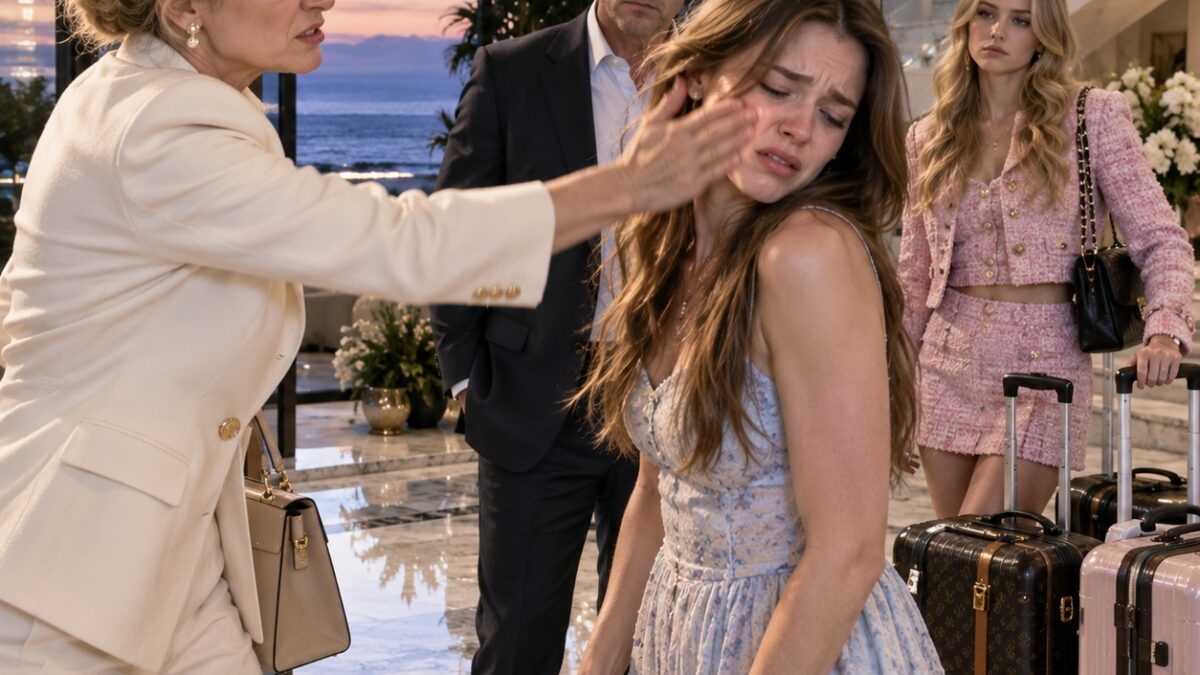
My Mother Slapped Me and Ordered Me Out on My 21st Birthday—Then I Heard Her Whisper, “We’ll Fix the Papers Later”
On my twenty-first birthday, my grandmother handed me the deed to her Malibu mansion and told me, very clearly, that nobody in our family could ever take it from me.
Six hours later, my mother slapped me across the face in that same marble foyer and ordered me to pack because my younger sister “needed the house more.”
Then Mom told Dad not to worry because they could “fix the paperwork later”—and my grandmother quietly stepped out of the hallway, pointed at one painting on the wall, and asked a question that made every person in the room stop breathing.
The first time my mother tried to throw me out of my own house, I was still holding the birthday card from the grandmother who had just given it to me.
I remember the sound before I remember the words.
The pounding came first.
Three violent strikes against the carved walnut front door, sharp enough to echo through the marble foyer and climb the glass walls of the Malibu mansion like an alarm.
Outside, the ocean wind hissed up from the cliffs, bending the cypress trees and dragging mist against the windows.
The Pacific was black beneath the last violet ribbon of evening, restless and enormous, throwing itself against the rocks below as if it already knew something ugly was about to enter.
Only six hours earlier, I had stood in that same foyer while my grandmother, Vivien Brooks, pressed a leather folder into my hands.
“Madison,” she had said, her voice steady in the way only truly powerful people can manage, “this is yours now. Legally. Completely. No one gets to take it from you.”
I laughed because I thought she was being dramatic.
I was twenty-one, still young enough to believe legal documents were stronger than family cruelty, still young enough to believe that if something was written clearly enough in black ink, people who claimed to love you would respect it.
Inside the folder was the deed to the Malibu house.
Not a future inheritance.
Not a promise.
Not a verbal gift.
A completed transfer.
My name.
Madison Brooks.
Sole owner.
Not Amelia Brooks, my mother.
Not Jonathan Brooks, my father.
Not Aubrey Brooks, my nineteen-year-old sister, whose name had somehow been written on nearly every softer thing my parents possessed—patience, forgiveness, excuses, second chances.
Mine.
For the rest of the afternoon, I wandered through the house feeling like an intruder.
The mansion stood on a bluff above the Pacific, all glass, stone, and impossible light.
Floor-to-ceiling windows faced west.
The marble floors were white with fine gray veins.
A floating staircase curved beneath a chandelier that looked like frozen rain.
There was a library with built-in walnut shelves, a kitchen larger than my student apartment, a terrace scented with salt and sage, and bedrooms with ocean views wide enough to make ownership feel absurd.
Grandma watched me from the living-room sofa.
“You keep walking like a museum guard is about to ask for your ticket.”
“I feel like one might.”
“This is your house.”
“That is a ridiculous sentence.”
“It becomes less ridiculous if you practice.”
So I stood in the middle of the room.
“This is my house.”
“Again.”
I laughed.
“This is my house.”
“Louder.”
“This is my house.”
Grandma smiled.
“There.”
I wish I could say I believed it.
But old fear is not persuaded by new paperwork.
I had grown up knowing anything that belonged to me could become Aubrey’s if my mother wanted it badly enough.
A jacket.
A birthday trip.
My bedroom.
My car.
Money.
Attention.
A future.
So when the pounding came that evening, my body understood before my mind did.
Not them.
Please not tonight.
Grandma had supposedly left after dinner, kissing my cheek and saying she had one more errand in town before driving back to Brentwood.
I believed I was alone.
The birthday card she had written was still open on the dining table.
For Madison, who has spent too long believing love means making room for everyone else. This house is not a reward. It is a boundary with walls. Live inside it boldly.
Then my mother shouted through the door.
“Madison! Open this door.”
My stomach folded in on itself.
Through the glass, I saw Amelia Brooks beneath the porch light, blond hair swept back, cream coat belted at her waist.
My father stood behind her with his hands in his pockets.
A black SUV idled in the driveway.
And beside it, my sister Aubrey dragged three designer suitcases toward the house.
I opened the door because I was still learning not to.
The ocean wind rushed in first.
Then my mother.
She stepped past me without invitation.
Dad followed more slowly.
Aubrey came last, suitcase wheels clicking across my marble floor.
Mom looked around the foyer.
Then at me.
“Good. You’re here.”
I held Grandma’s card tighter.
“What are you doing?”
She smiled.
“Solving a family problem.”
FULL STORY CONTINUATION 👇👇
Aubrey rolled the largest suitcase toward the staircase.
I stepped in front of her.
“Stop.”
She looked at me as if I had interrupted a waiter.
“What?”
“Where are you going?”
“Upstairs.”
“No.”
Mom removed her gloves finger by finger.
“Madison, don’t start.”
My pulse hammered.
“I’m not starting anything. Why does Aubrey have luggage?”
My father looked toward the ocean windows.
That was Dad’s specialty.
When conflict entered a room, he suddenly became fascinated by architecture, weather, lamps, carpets—anything that couldn’t demand courage from him.
Mom said, “Your sister is going to stay here.”
I actually laughed.
Not because it was funny.
Because the sentence was too ridiculous to process normally.
“For how long?”
Aubrey shrugged.
“Probably a while.”
“No.”
Mom’s mouth tightened.
“You haven’t heard the circumstances.”
“I don’t need circumstances.”
“You always need circumstances.”
“I own the house.”
Silence.
Not because they were shocked.
Because none of them liked hearing it spoken aloud.
Mom recovered first.
“Your grandmother gave you paperwork today.”
“A deed.”
“Exactly.”
“A recorded deed.”
She waved one hand.
“We know what it is.”
Apparently not.
Dad finally spoke.
“Madison, let’s all sit down.”
“No.”
His eyebrows lifted.
I almost never told my father no directly.
That was another family habit.
Mom pushed.
Dad softened.
Aubrey wanted.
I adjusted.
That had been the ecosystem.
But something about Grandma’s card in my hand changed the chemistry.
“No one is going upstairs,” I said.
Aubrey stared.
“Are you serious?”
“Yes.”
“I drove two hours.”
“That isn’t ownership.”
Mom’s face sharpened.
“She needs somewhere to live.”
“Then she can live at home.”
“She cannot.”
“Why?”
Aubrey sighed dramatically.
“Because Mom and Dad’s house is being renovated.”
I looked at Dad.
“Renovated?”
He nodded once.
That was news.
Their house in Calabasas had seven bedrooms.
“Which part?”
Mom answered.
“Most of it.”
“All seven bedrooms?”
“Don’t be sarcastic.”
“I’m genuinely trying to understand why a nineteen-year-old with parents who own a seven-bedroom house needs to move into mine.”
Aubrey threw up her hands.
“Because I need space.”
I stared at her.
She meant it.
That was the most exhausting thing about my sister.
Aubrey wasn’t usually calculating.
She had simply been accommodated so completely that preference and necessity had fused in her mind.
When she wanted something, it felt like need.
And because Mom had spent nineteen years rearranging reality around that feeling, Aubrey expected walls to move.
Literally, apparently.
“I have school,” Aubrey continued.
“So do I.”
“You’re barely ever here.”
“I got the house today.”
“Exactly. You don’t even use it.”
I almost smiled.
Six hours of ownership and already negligent.
Mom stepped closer.
“This is what I mean.”
“What?”
“You are being selfish for sport.”
“For sport?”
“Aubrey’s apartment lease fell through.”
There it was.
Actual circumstance.
I looked at Aubrey.
“What happened?”
She looked away.
Mom answered for her.
“The landlord changed the terms.”
Aubrey muttered, “He wanted another deposit.”
“How much?”
“That’s irrelevant.”
“How much?”
“Six thousand.”
I blinked.
“You can pay that.”
Mom looked offended.
“Why should we encourage predatory landlords?”
“But invading my house is financially principled?”
Dad rubbed his forehead.
“Madison.”
“No, Dad. Seriously.”
Aubrey dropped onto the bottom stair.
“I cannot believe we’re arguing about this.”
“We aren’t.”
I pointed toward the door.
“You aren’t moving in.”
Mom stared at me.
There was always a point in our arguments when her expression changed from persuasion to command.
I knew it well.
My body knew it better.
Shoulders tightened.
Breathing shortened.
The child in me started searching for surrender terms.
Mom took one step closer.
“You have an eight-bedroom mansion.”
“Five bedrooms.”
“Whatever.”
“Aubrey needs one.”
“She has one at your house.”
“It is full of construction dust.”
“Hotel.”
“For months?”
“Rental.”
“She doesn’t want a rental.”
I looked at my sister.
“What do you want?”
Aubrey’s answer came immediately.
“This.”
The word landed strangely.
Not “a room.”
Not “somewhere to stay.”
This.
The house.
The ocean.
The marble.
The terrace.
I understood then that this was not emergency housing.
This was acquisition disguised as family cooperation.
“How long have you been discussing this?” I asked.
Dad’s eyes moved toward Mom.
Mom said, “That’s irrelevant.”
“How long?”
Aubrey answered before she could be stopped.
“Grandma mentioned she was transferring the place weeks ago.”
My skin went cold.
Grandma had told them?
Or they had learned some other way.
Mom snapped, “Aubrey.”
“What? She already knows.”
I looked at Dad.
“You knew Grandma was giving me the house.”
He said nothing.
That was yes.
“And you planned Aubrey moving in before I even owned it?”
Mom stepped between us.
“We planned for a family asset to remain useful.”
“A family asset.”
“Yes.”
“It is not a family asset.”
“It has always been treated as one.”
“Grandma owned it.”
“And before that your grandfather.”
“And now me.”
Mom’s nostrils flared.
“This attitude is exactly why Vivien should never have done this.”
The words hit harder than I expected.
Because beneath them was something older.
A lifelong implication.
Good things given to me were administrative errors.
Good things given to Aubrey were natural order.
I looked at the card.
A boundary with walls.
I tried again.
“Aubrey is not moving in.”
Mom laughed without humor.
“Oh, she absolutely is.”
“No.”
“What are you going to do?”
The question frightened me because for a second I had no answer.
Call police on my family?
Lock them out?
Physically drag luggage outside?
At twenty-one, ownership existed conceptually.
Authority was still new muscle.
Mom saw the hesitation.
She stepped into it.
“Your father and I have managed property for longer than you have been alive.”
Dad stared at the floor.
Mom continued.
“This house has maintenance costs you don’t understand.”
“I can learn.”
“Insurance.”
“I can learn.”
“Taxes.”
“I can learn.”
“Staff.”
“I can learn.”
“Utilities.”
“I can learn.”
Her voice rose.
“You are a college student.”
“Yes.”
“With no meaningful income.”
“I have a trust distribution.”
“From Vivien.”
“Yes.”
“Which proves my point.”
“What point?”
“That you have never earned any of this.”
There it was.
The accusation every favored sibling arrangement eventually creates in the less-favored child.
You must earn basic space because someone else receives it as entitlement.
I swallowed.
“Grandma owned it. She gave it to me.”
Mom shook her head.
“Because she is using you to punish me.”
That was new.
“What?”
“This has nothing to do with you.”
It always fascinated me how my mother could simultaneously say I was selfish and irrelevant.
“She has been angry with me for years.”
“So?”
“So she is weaponizing property.”
I looked at Dad.
“Do you believe that?”
He sighed.
“Your grandmother has complicated relationships.”
“That isn’t an answer.”
“She and your mother disagree about certain things.”
“Dad.”
He looked at me finally.
“I think Vivien knew giving you the house would create tension.”
My throat tightened.
“So I should give it away?”
“No one said that.”
Mom said, “We said Aubrey will stay here.”
“And if I say no?”
My mother’s voice dropped.
“Then you prove Vivien right about what kind of person she has encouraged you to become.”
That almost worked.
It was designed to.
Selfish.
Difficult.
Ungrateful.
Cold.
Those had always been the emergency words used to pull me back into position.
I remembered my sixteenth birthday.
Grandma gave me a vintage leather jacket.
Aubrey cried because she wanted it.
Mom said I should share.
Two weeks later, the jacket was in Aubrey’s closet.
Seventeenth birthday.
Dad promised me a weekend in New York.
Aubrey’s cheer competition fell on the same dates.
Trip canceled.
She got four nights in Las Vegas for the competition.
Eighteen.
I saved for a used car.
Mom convinced me to let Aubrey “borrow” it for school because her car was in the shop.
She scraped the passenger side.
I paid half the repair because Mom said I shouldn’t have parked so close to the garage pillar.
Every surrender had been small enough to rationalize.
Until surrender became personality.
Grandma saw it.
I hadn’t realized how clearly.
Aubrey stood.
“Can I at least take my stuff upstairs while you two do this?”
“No.”
She groaned.
“Madison!”
“I said no.”
Mom moved so fast I barely registered it.
Her hand struck the left side of my face.
The sound cracked through the foyer.
Sharp.
Flat.
Echoing.
Nobody moved.
My head snapped sideways.
For a second I saw only marble.
Then heat spread across my cheek.
I turned back slowly.
Mom’s hand remained half raised.
Even she looked surprised.
Not ashamed.
Surprised that she had made visible something usually accomplished with words.
Dad whispered, “Amelia.”
Aubrey said nothing.
My eyes filled automatically.
I refused to blink.
Mom recovered.
“Do not speak to your sister like that.”
My voice sounded far away.
“Get out.”
“Madison—”
“Get out.”
Dad stepped toward me.
“Sweetheart—”
“You too.”
His face fell.
“Madison.”
“You watched her hit me.”
“I didn’t know—”
“You watched.”
“That happened in one second.”
“And now another second is happening.”
I pointed toward the door.
“Choose.”
Mom stared.
“You are not throwing your father out.”
“This is my house.”
She laughed.
Then turned to Dad.
“Do you hear how she speaks now?”
Dad looked exhausted.
“Amelia, maybe we should leave.”
Aubrey’s eyes widened.
“What?”
Mom rounded on him.
“No.”
“Let everyone calm down.”
“No.”
“Amelia.”
She lowered her voice.
“This is exactly why we came tonight.”
I looked between them.
“What does that mean?”
Silence.
Then Aubrey, once again unable to tolerate secrets that excluded her, said:
“Because Grandma might change her mind if we wait too long.”
Mom’s face went white.
Dad said, “Aubrey.”
My heart started pounding for an entirely different reason.
“What are you talking about?”
Aubrey looked confused.
“You said—”
Mom cut in.
“She doesn’t know what she is saying.”
“Yes, I do.”
“No, you don’t.”
Aubrey looked at me.
“Mom said once I moved in, it would be easier.”
“Easier to do what?”
No answer.
I turned to Mom.
“What were you planning?”
Mom crossed her arms.
“We were going to discuss practical ownership arrangements.”
“What does that mean?”
Dad closed his eyes.
Mom said, “You’re twenty-one. The property should be managed through a family structure.”
“It is managed.”
“By Vivien’s attorneys.”
“Good.”
“She intends to make you dependent on her.”
“So you want me dependent on you?”
“That is not what I said.”
“What paperwork?”
Mom hesitated.
That was enough.
“What paperwork, Mom?”
Dad said softly, “Amelia.”
She ignored him.
“You could place the house into a family LLC.”
“No.”
“You don’t even know what that means.”
“I know it means not solely mine anymore.”
“It means protection.”
“From whom?”
“Taxes. Liability. Your own inexperience.”
I laughed bitterly.
“And Aubrey living here helps with taxes?”
“No. It establishes family use.”
That phrase.
Establishes family use.
I might have been twenty-one, but I wasn’t stupid.
My major was business economics.
Grandma had spent the afternoon walking me through insurance, title, property tax, trusts, and occupancy.
Not enough to be an expert.
Enough to recognize someone building a future argument.
“You wanted her moved in before I understood what I owned.”
Mom’s face hardened.
“You’re being paranoid.”
Dad looked at her.
For the first time, I saw discomfort deepen into recognition.
“Amelia, what exactly did the lawyer say?”
My attention snapped to him.
“What lawyer?”
Mom glared.
“Jonathan.”
“What lawyer?”
Dad looked trapped.
Mom said, “Nobody.”
Aubrey muttered, “Mr. Pierce.”
Mom turned.
“Stop talking.”
I knew that name.
Darren Pierce.
He had handled one of Dad’s business acquisitions years earlier.
Not Grandma’s attorney.
Their attorney.
My parents had sought legal advice before showing up.
“Why did you talk to a lawyer about my house?”
Mom exhaled.
“Because someone in this family has to think ahead.”
“Before Grandma transferred it?”
“Yes.”
“About what?”
“She had been threatening to do something irresponsible.”
“Giving me property.”
“Giving a twenty-one-year-old an asset worth more than twenty million dollars.”
The number hit me.
Grandma hadn’t told me the exact current valuation.
I knew it was significant.
Twenty million?
Aubrey said, “Twenty-three.”
Mom closed her eyes.
“Seriously?”
I stared at my sister.
“Twenty-three million?”
She shrugged.
“Mom said maybe twenty-five after renovations.”
There it was.
Not emergency housing.
Not family concern.
An asset.
Aubrey had probably already imagined the pool.
Mom had imagined leverage.
Dad had imagined avoiding conflict until paperwork made the decision for him.
I touched my burning cheek.
“Get out.”
Mom stepped toward me again.
I held up my phone.
“Touch me again and I call the police.”
Her face changed.
I had never threatened consequence before.
Dad whispered, “Amelia. Enough.”
She turned on him.
“You’re taking her side?”
“I’m saying we leave.”
“You always do this.”
“Do what?”
“Collapse.”
Dad’s face tightened.
She was not wrong.
He hated confrontation enough that he often surrendered to the person willing to sustain it longest.
Usually Mom.
Tonight, maybe something had shifted.
He looked at me.
“We’ll go.”
Aubrey shouted, “What about my stuff?”
Dad said, “Take it.”
She stared at him as though he’d betrayed the Constitution.
Mom looked around the foyer.
Then something in her expression changed again.
Calculation.
She lowered her voice.
“Fine.”
Too easy.
I knew immediately.
“Fine?”
“Yes.”
She smiled at me.
“We’ll leave.”
Then she turned to Dad and said quietly—but not quietly enough—
“We’ll fix the paperwork later.”
My stomach dropped.
Dad whispered, “Not now.”
Mom continued toward Aubrey.
“Get your bag.”
Aubrey grabbed one suitcase.
Then a voice came from the hallway.
“Which paperwork?”
Nobody moved.
I turned.
Grandma Vivien stepped out from the corridor beside the library.
Gray silk blouse.
Black trousers.
Pearls.
One hand resting on her cane even though she rarely needed it.
Mom went pale.
“Mother.”
Grandma ignored her.
She looked at Dad.
“Jonathan?”
Dad opened his mouth.
Closed it.
Then Grandma looked at Aubrey.
“Sweetheart, leave the luggage.”
Finally, she looked at me.
My cheek was still red.
Her eyes hardened.
“Madison.”
“I thought you left.”
“I did.”
She tilted her head.
“Then I came back through the service entrance.”
My mother laughed nervously.
“Why?”
Grandma’s gaze never left my face.
“Because I know my daughter.”
Silence.
Then Grandma turned toward the large oil painting hanging opposite the staircase.
A moody coastal landscape.
Dark cliffs.
A stormy Pacific.
It had hung there for as long as I could remember.
She raised one finger.
“Amelia, before you discuss fixing paperwork, would you like to tell Madison what is behind that painting?”
My mother stopped breathing.
Dad looked at the painting.
Aubrey looked confused.
I whispered, “What?”
Grandma finally smiled.
Not warmly.
“Take it down.”
I stared at her.
“Grandma—”
“Take it down.”
Dad moved first.
Maybe because he wanted something physical to do.
He walked toward the painting.
It was large—almost five feet across.
He lifted one side.
I took the other.
Together we removed it from its hooks.
Behind it was a recessed steel panel.
Not a safe exactly.
A flush-mounted security cabinet.
I had never known it existed.
Grandma tapped a code.
The door clicked open.
Inside were three things.
A sealed envelope.
A small black recording device.
And a red folder.
Mom said:
“This is insane.”
Grandma looked at her.
“Is it?”
“You recorded us?”
“Parts of my own home.”
Mom’s eyes flashed.
“This is California.”
Grandma laughed.
“You should really stop pretending you understand law better than attorneys you haven’t met.”
I looked at the recorder.
“What is this?”
Grandma took it out.
“Insurance.”
“Against what?”
She looked directly at Mom.
“Exactly what happened tonight.”
My father sat down.
Aubrey said, “Grandma, this is creepy.”
Vivien smiled at her.
“No, darling. Sneaking into someone’s house with suitcases because you intend to manufacture residency is creepy.”
Aubrey’s face changed.
“I didn’t—”
“I know.”
Grandma’s tone softened slightly.
“You mostly came because your mother told you this would be yours eventually.”
That landed.
Aubrey looked at Mom.
Mom snapped:
“Don’t listen to her.”
Grandma opened the red folder.
Inside were copies of emails.
Printed.
Highlighted.
I moved closer.
The first email was from Amelia Brooks to Darren Pierce.
Subject:
MALIBU OCCUPANCY / TRANSFER OPTIONS.
My hands went cold.
Grandma handed it to me.
I read.
If Vivien proceeds with a direct gift to Madison, what options exist to establish broader family control afterward? Madison is young and easily influenced. If Aubrey occupies the property as a primary residence, does that create any leverage in challenging management or transferring the asset into a family entity?
I looked up.
Mom’s face had changed from anger to something I had never seen before.
Fear.
Dad took the page.
“What is this?”
Mom stared at Grandma.
“How did you get that?”
Grandma said:
“You emailed it to an attorney who shares a litigation consultant with mine. Nobody violated privilege, if that’s your next fantasy. Darren disclosed only after you authorized him to circulate a proposed ownership structure involving my property and contacted my trustee without permission.”
Dad was reading faster now.
Another email.
Dad’s name appeared.
Not as sender.
As proposed manager.
JONATHAN BROOKS — MANAGING MEMBER.
AMELIA BROOKS — CO-MANAGER.
MADISON BROOKS — 20% BENEFICIAL INTEREST.
AUBREY BROOKS — 20%.
Parents’ family trust — 60%.
I stared.
They had designed a structure that would reduce me from one hundred percent owner to twenty.
Before Grandma even handed me the deed.
Dad whispered:
“I never approved this.”
Mom snapped:
“We discussed it.”
“No.”
“You said you would consider—”
“I said we needed to understand what your mother was doing.”
Grandma corrected:
“My mother is dead, Jonathan.”
Dad looked at her.
“Vivien.”
She smiled thinly.
“Try to keep the women straight.”
Even then.
Classic Grandma.
I kept reading.
There were notes about valuation discounts.
Management fees.
Possible refinance.
Possible redevelopment.
Redevelopment?
I flipped pages.
One proposal suggested dividing part of the bluff parcel and building two additional residences.
My stomach turned.
“They wanted to split the land?”
Grandma answered:
“Your mother explored it.”
Mom finally exploded.
“I was planning.”
“For property you did not own.”
“For family wealth.”
“It was not yours.”
“Everything has to be some moral crusade with you.”
“No, Amelia.”
Grandma’s voice became quiet.
“Only boundaries.”
The word matched my card.
Mom saw me look at it.
Her face twisted.
“You planned this.”
Grandma nodded.
“I planned for you.”
“You set me up.”
“No.”
“I walked into a trap.”
“No.”
Grandma pointed toward the open front door.
“You could have walked into this house, congratulated your daughter, and left.”
Silence.
“You could have asked whether Aubrey might stay temporarily.”
Silence.
“You could have respected the answer no.”
Grandma’s eyes moved to my cheek.
“And you could have kept your hand to yourself.”
Mom looked away.
Grandma continued.
“I did not force you to do any of the things you did tonight.”
Dad still held the email.
“Amelia, did you plan to refinance the property?”
Mom shook her head.
“Not like this.”
“What does that mean?”
“We needed liquidity.”
“Why?”
Silence.
Dad stood.
“Why?”
My mother looked at him.
And for the first time that night, I realized there was another story happening inside theirs.
Something Dad didn’t know.
Grandma knew.
Mom knew.
Maybe Aubrey knew pieces.
I didn’t.
Grandma returned the recorder to the cabinet.
Then took out the sealed envelope.
“Madison, this is yours.”
“What is it?”
“Instructions.”
“For what?”
“In case tonight became uglier.”
Mom laughed bitterly.
“Could it be uglier?”
Grandma looked at my cheek.
“Yes.”
That shut everyone up.
I opened the envelope.
Inside was a letter from Grandma and a card for a private security company.
There was also a copy of a restraining notice prepared but unsigned.
Grandma said:
“You decide what happens next.”
I stared.
“I don’t know.”
“That’s acceptable.”
She pointed toward the living room.
“Sit.”
No one argued.
We sat.
Five adults arranged around furniture like strangers after an accident.
Mom remained standing.
Grandma looked at her.
“Sit down, Amelia.”
“I am leaving.”
“No.”
Mom stared.
Grandma continued.
“You spent weeks planning how to reduce your daughter’s ownership in a property I gave her. You struck her in my house—her house. You discussed falsifying future paperwork after being told no. You will stay long enough for everyone to understand what happened.”
Mom whispered:
“You do not command me.”
Grandma raised one eyebrow.
“I have spent seventy-six years learning exactly who I can command. Sit.”
My mother sat.
I wish I could explain Vivien Brooks.
She wasn’t simply rich.
People often reduce wealthy older women into glamour and money.
Grandma’s real power was attention.
She listened.
Remembered.
Waited.
Then acted when everyone else believed silence meant absence.
She had inherited a modest real-estate portfolio from her father in her thirties.
Then tripled it.
Then nearly lost half during her second marriage.
Then rebuilt.
She had lived through men who assumed charm could substitute for contracts.
Partners who assumed age would make her careless.
Family who mistook generosity for surrender.
By seventy-six, she treated documentation the way other people treated locks.
Necessary.
Not hostile.
Mom hated that.
Probably because Grandma could see through her.
Vivien looked at Dad first.
“Jonathan, did you authorize the proposed LLC?”
“No.”
“Did you know Amelia contacted Darren Pierce?”
“I knew she had asked general questions.”
“Did you know she planned to move Aubrey into this house immediately after transfer?”
He hesitated.
“Yes.”
My throat tightened.
Grandma nodded.
“Thank you.”
Dad looked at me.
“Madison—”
“Not yet.”
The words surprised us both.
I had never told Dad when he could speak.
He stopped.
Grandma looked at Aubrey.
“Did your mother tell you this house would become partly yours?”
Aubrey stared at her hands.
“Yes.”
“How?”
“She said Madison couldn’t manage something this big.”
“Did she say Madison had agreed?”
Aubrey swallowed.
“She said she would.”
My chest hurt.
Not because Aubrey had schemed.
Because she had arrived genuinely believing my consent was a procedural detail someone else could supply later.
Grandma asked:
“Did you know Madison received the deed today?”
“Yes.”
“And you still came with luggage?”
Aubrey looked at me.
Her eyes finally showed embarrassment.
“Yes.”
Grandma nodded.
Then Mom.
“Why did you need liquidity?”
Mom crossed her arms.
“I don’t.”
Grandma slid another document from the folder.
My father took it before Mom could stop him.
His face changed.
“What is this?”
Grandma answered:
“A notice of default.”
Dad stared.
Mom said:
“It has been handled.”
“On what?”
“The Laguna property.”
“What Laguna property?”
Silence.
Dad stood.
“What Laguna property?”
Grandma closed her eyes briefly.
There it was.
The bigger secret.
Mom had purchased a property in Laguna Beach two years earlier through an LLC.
$6.8 million.
Heavy financing.
Dad had not known.
She had used funds from a family investment account for the down payment.
Not all unauthorized.
Some technically hers under their arrangement.
But the debt was enormous.
Variable-rate loan.
Renovation budget overrun.
The property had been intended as a speculative flip.
Market softened.
Contractor dispute.
Now default notice.
Nearly two million needed to cure and complete.
My head spun.
Dad whispered:
“You bought a house?”
“An investment.”
“With what money?”
“Our money.”
“My money?”
“Our money.”
“Why didn’t you tell me?”
“You would’ve said no.”
Silence.
Sometimes one sentence contains the whole crime against trust.
You would’ve said no.
So I removed your ability to choose.
Grandma looked at me.
“Now you understand Malibu.”
Mom wanted the mansion controlled because it could be borrowed against.
A twenty-plus-million-dollar property.
Equity.
Collateral.
Liquidity.
Aubrey’s residency was one piece of building a narrative that the home was family-controlled, not truly mine in practice.
The LLC plan was another.
My age and dependency another.
Not necessarily enough to steal title outright.
Enough to pressure.
Confuse.
Possibly challenge.
Or simply convince me to sign.
That last one was probably the real plan.
I had signed things for Mom before.
College forms.
Insurance documents.
Family trust acknowledgments.
I rarely read every page because Dad said, “Your mother handled it.”
Old habit.
Grandma knew.
My birthday gift wasn’t only wealth.
It was a test of whether I would finally read my own life.
Dad sat heavily.
“How much?”
Mom said nothing.
“How much do we owe?”
“Jonathan—”
“How much?”
“About nine.”
“Nine what?”
“Million.”
Aubrey gasped.
So she hadn’t known.
Dad’s face went gray.
“Nine million dollars?”
“Not all due.”
He stared.
Grandma said quietly:
“The current cure amount is approximately one-point-eight. Total outstanding debt, construction exposure, and guarantees are near nine.”
Dad stood and walked toward the windows.
The Pacific crashed below.
For once, he couldn’t escape conflict by looking elsewhere because conflict had followed him into every view.
I looked at Mom.
“Were you going to mortgage my house?”
She snapped:
“No.”
Grandma answered:
“Yes.”
Mom turned.
“Stop.”
Vivien opened another document.
“Draft financing inquiry to Westbourne Private Bank.”
Dad took it.
Collateral possibilities:
Malibu residential asset.
Family transfer pending.
Estimated value: $24.5M.
Potential line: $6M–$8M.
My hands started shaking.
“Pending?”
Grandma nodded.
“She began discussions before transfer because she assumed she could persuade you afterward.”
Mom stood.
“Persuade is not steal.”
“No.”
Grandma’s tone was calm.
“That is why I am not calling police for attempted mortgage fraud.”
Dad looked sharply at her.
“Yet.”
Grandma continued.
“But you planned to pressure a twenty-one-year-old into encumbering property she received hours earlier to rescue an investment you hid from your husband.”
Mom’s face crumpled for the first time.
Not tears.
Rage.
“You have always hated me.”
Vivien sighed.
“No, Amelia.”
“Yes.”
“I have been disappointed in you.”
“Same thing.”
“No. Hate is easier.”
Mom looked suddenly younger.
Not younger in face.
In posture.
A daughter again.
I had rarely seen her around Grandma this raw.
“You gave everything to Madison.”
Grandma stared.
“Everything?”
“The house.”
“One house.”
“A twenty-four-million-dollar house.”
“You have received more than that over thirty years.”
Mom laughed.
“Here we go.”
“Tuition. Wedding. Two down payments. Business capital. Trust distributions. Debt repayment after Jonathan’s restaurant investment failed. I can continue.”
Dad looked uncomfortable.
Mom said:
“You keep score.”
“I keep records.”
“Same thing.”
“No.”
Grandma leaned forward.
“Records remember what resentment edits.”
That line silenced the room.
Mom looked away.
Grandma continued.
“I gave Madison this house because she needed one thing in her life that your preferences could not reassign.”
Mom’s eyes flashed.
“You turned her against me.”
“No.”
Grandma looked at me.
“She is only beginning to turn toward herself.”
My throat closed.
I looked down.
Aubrey started crying quietly.
That surprised me more than Mom’s slap.
She wiped her face.
“I didn’t know about the mortgage.”
Mom softened instantly.
“Aubrey—”
“No.”
My sister stood.
“You said Madison didn’t want the house.”
I stared.
“What?”
Aubrey looked at me.
“Mom said Grandma forced it on you.”
I almost laughed.
“She gave it to me this afternoon.”
“I know, but Mom said you were overwhelmed and probably would rather keep your apartment.”
“I said it was overwhelming.”
Mom said:
“Which is true.”
Aubrey ignored her.
“She said I could live here and maybe eventually take over because I wanted to stay in California.”
“I live in California.”
“I know.”
Her voice cracked.
“I know now how stupid that sounds.”
For the first time, I saw the mechanism from the other side.
Mom didn’t only take from me.
She curated reality for Aubrey too.
She told her what was available.
What she deserved.
What I supposedly didn’t care about.
Aubrey had been spoiled.
Yes.
But spoiling is a form of distortion.
If you grow up being told doors open because they should, you may never learn someone else is standing behind them being pushed aside.
That didn’t erase her responsibility.
It changed its shape.
Grandma looked at Dad.
“You have choices to make.”
He nodded without turning from the window.
Then she looked at Mom.
“You too.”
Mom laughed bitterly.
“What choice? Everyone has already decided I’m a monster.”
“No.”
Grandma shook her head.
“You are a woman who made a series of frightened, dishonest choices because you could not tolerate losing money, control, or status.”
Mom looked wounded.
Grandma continued.
“That can be corrected more easily than being a monster.”
I will never forget that.
Not because it saved Mom.
Because it gave everyone a path that didn’t require pretending nothing happened.
Grandma looked at me.
“What do you want tonight?”
I stared.
The question felt enormous.
My cheek still burned.
My heart raced.
I wanted them gone.
I wanted Mom to apologize.
I wanted Dad to defend me retroactively.
I wanted Aubrey to drag her bags back across the marble.
I wanted to rewind my childhood and say no earlier.
Instead I said:
“I want them out of my house.”
Grandma nodded.
“Then that’s what happens.”
Mom stood.
“Vivien—”
Grandma raised her hand.
“No.”
Aubrey collected her suitcases silently.
Dad picked up one.
Mom did not move.
I walked to the door.
Opened it.
The ocean wind rushed in again.
Aubrey stopped beside me.
“Madison.”
I looked at her.
“I’m sorry.”
It was too soon to mean much.
But I heard it.
“Go.”
She nodded.
Dad paused next.
“Can I call you tomorrow?”
“No.”
His face fell.
“When?”
“I don’t know.”
“Okay.”
That answer mattered.
He didn’t push.
Then Mom.
She walked toward me without her coat buttoned, hair moving in the wind.
For one second, I was afraid she might hit me again.
Grandma appeared beside me.
Mom noticed.
Stopped.
She looked at my cheek.
Something passed across her face.
Maybe shame.
Maybe anger at the evidence.
“I shouldn’t have slapped you.”
Not I’m sorry.
Still.
A start.
I said nothing.
She continued:
“But you were being—”
Grandma said:
“Amelia.”
Mom closed her mouth.
Then walked out.
I shut the door.
Locked it.
My hands began shaking so badly I dropped the key.
Grandma picked it up.
Then she did something she almost never did.
She hugged me.
Hard.
I cried into her shoulder.
Not elegantly.
Not quietly.
The kind of crying that makes breathing difficult.
I had spent the evening standing because if I sat emotionally, I thought I might never stand again.
Grandma held me.
“You did well.”
“I opened the door.”
“You’re allowed to learn.”
“I almost let them.”
“But you didn’t.”
“I didn’t know how to stop them.”
“You said no.”
“They didn’t care.”
“Then you said it again.”
I pulled back.
“You recorded us.”
“Yes.”
“That is terrifying.”
“I know.”
“Why were you here?”
Her expression changed.
This was the part she had not explained.
“I never intended to leave you alone tonight.”
“What?”
“I knew Amelia had learned about the deed.”
“How?”
“Darren Pierce called my attorney yesterday after realizing your mother’s proposed LLC relied on assumptions about a transfer he had no authority to influence.”
“You knew she might come.”
“I knew enough.”
“Why didn’t you tell me?”
Grandma hesitated.
I stared.
“Grandma.”
“I wanted to see what you would do before I stepped in.”
Anger flashed.
“So this was a test.”
“No.”
“It sounds like one.”
“It was observation.”
“Same thing if you already know I might fail.”
Her face softened.
“Fair.”
I stepped away.
“I was hit.”
That landed.
Grandma looked genuinely stricken.
“I didn’t expect that.”
“But you expected pressure.”
“Yes.”
“And you hid.”
“Yes.”
“Why?”
“Because if I stood beside you from the start, Amelia would’ve fought me.”
“She did anyway.”
“She would have made the night about us.”
I understood.
But I didn’t like it.
Grandma said:
“You have every right to be angry with me.”
“I am.”
“Good.”
I almost laughed.
“Of course you’d say that.”
“Anger properly directed is useful.”
“You sound like a lawsuit.”
“Occupational hazard.”
Grandma sat on the bottom stair.
Suddenly she looked seventy-six.
Tired.
“I have spent years interfering when your mother mistreated you.”
“No, you haven’t.”
Her eyes lifted.
Exactly.
She sighed.
“I interfered indirectly.”
“Which means what?”
“Trust accounts. Separate gifts. Paying tuition directly. Making sure you had access to me.”
“But you never told Mom to stop.”
“I did.”
“When?”
“Privately.”
“That worked great.”
She accepted it.
“I was afraid direct war with Amelia would cost me both granddaughters.”
That surprised me.
“You thought she’d keep us from you?”
“She threatened to when you were little.”
I sat beside her.
“What?”
Grandma nodded.
“After your tenth birthday.”
I remembered.
Barely.
Grandma had given me piano lessons.
Mom complained because Aubrey felt excluded.
I stopped lessons after six months.
Apparently there had been a bigger fight.
Grandma said:
“Your mother told me if I kept ‘favoring’ you, I would see neither of you.”
My chest hurt.
“So you backed off.”
“I became strategic.”
“Same thing.”
“No.”
She considered.
“Sometimes.”
The honesty helped.
“I thought money placed outside your mother’s reach would compensate for things I wasn’t brave enough to confront publicly.”
I stared.
“You weren’t brave?”
Grandma smiled sadly.
“Everyone is cowardly somewhere.”
That was the most human thing she had ever said.
I leaned against the stair rail.
“So why now?”
“Because you are twenty-one.”
“And?”
“You can open your own door.”
The phrase cut.
Because tonight I had.
Maybe badly.
But mine.
Grandma touched my hand.
“I gave you the house because I wanted you to practice ownership before I die.”
“Please don’t say that.”
“I am seventy-six, not immortal.”
“You act like it.”
“I charge accordingly.”
I laughed through tears.
Then she became serious.
“There are documents you need to understand tomorrow.”
“More?”
“Yes.”
“Please tell me no one else is hidden behind another painting.”
“Not currently.”
“Grandma.”
She smiled.
The next morning, her attorney arrived at nine.
His name was Samuel Levin.
He had represented Vivien for twenty-two years.
Short.
Bald.
Glasses.
The expression of a man permanently disappointed by punctuation.
He brought three binders.
I hated him immediately.
He looked at my cheek.
“Do we need police documentation?”
I froze.
Grandma had asked me the night before.
I said no.
Now Samuel asked again.
“You don’t have to decide about charges,” he explained. “But contemporaneous documentation matters if future restraining orders become necessary.”
I looked at Grandma.
She said nothing.
My choice.
“Photograph it.”
Samuel nodded.
No celebration.
No pressure.
He took timestamped images with my phone and had me email copies to myself and his office.
Then we reviewed the deed.
Recorded earlier that week.
Effective.
Clean title.
No mortgage.
Property tax reserve funded for five years through a separate maintenance trust Grandma had created.
I stared.
“You funded taxes?”
“Partially.”
“Why?”
Grandma said:
“So the gift isn’t a financial grenade.”
There was a household account.
Insurance prepaid.
A property manager available if I wanted.
No requirement to keep staff.
No requirement to live there full time.
I could rent portions only under certain conditions because coastal zoning and HOA restrictions applied.
I could sell.
That surprised me.
“You’d let me sell it?”
Grandma glared.
“I did not give you a prison.”
“What if I sold tomorrow?”
“I’d question your judgment.”
“But legally?”
“Yours.”
I looked at Samuel.
He nodded.
“Completely.”
Grandma had meant it.
The house was a boundary with walls.
Not an obligation.
Then Samuel opened the family file.
The documents behind the painting included more than Mom’s emails.
There were records showing Darren Pierce had warned her that I would need independent counsel before any LLC transfer.
He had refused to prepare documents that misrepresented my consent.
Mom had pushed.
Repeatedly.
One email:
Madison trusts me. She will sign once everyone explains this is standard.
Another:
We can deal with her grandmother after the transfer.
I read that twice.
Madison trusts me.
She will sign.
I felt sick.
Grandma touched my shoulder.
“Trust is not consent.”
I nodded.
That sentence became important later.
Samuel explained:
“What your mother discussed was not automatically illegal. Families transfer assets into LLCs every day. Parents advise adult children. Siblings share homes. The problem would begin if anyone misrepresented facts, forged consent, coerced signatures, or obtained financing through false ownership claims.”
“So nothing criminal happened besides her hitting me?”
“Correct.”
I appreciated the precision.
I didn’t want a fantasy where every cruel plan became felony.
Reality was complicated enough.
“What do I do?”
“With the house?”
“With them.”
Samuel almost smiled.
“I bill by the hour because I am not qualified for that question.”
Grandma said:
“You decide access.”
“Can Mom come here?”
“If you invite her.”
“Dad?”
“Same.”
“Aubrey?”
“Same.”
“And if they show up?”
“You may refuse entry.”
I looked at the front door.
Simple.
Terrifying.
My phone had forty-three messages.
Dad.
Aubrey.
Mom.
Family group chats.
Aunt.
Two cousins.
How did they already know?
Because family conflict travels faster than smoke.
Mom had begun her version.
MADISON HAS BEEN MANIPULATED BY VIVIEN.
VIVIEN IS USING PROPERTY TO DIVIDE THE FAMILY.
MADISON THREW HER SISTER OUT DURING A HOUSING CRISIS.
No mention of slap.
No mention of secret LLC.
No mention of Laguna debt.
I wanted to respond publicly.
Grandma stopped me.
“Why?”
“Because if you begin arguing facts with people who prefer a story, you’ll spend your life feeding them.”
“That sounds convenient.”
“It is.”
“I want them to know.”
“Then tell the people whose opinion matters to you.”
“What about everyone else?”
She shrugged.
“Let them be wrong.”
I hated that advice.
It turned out to be excellent.
Dad called again at eleven.
I answered.
“Madison.”
He sounded awful.
“Are you okay?”
“Yes.”
“I need to apologize.”
I said nothing.
“I knew your mother was planning to ask about an LLC.”
“Ask?”
He sighed.
“I knew she wanted Aubrey living there.”
“You knew before my birthday.”
“Yes.”
“Why didn’t you tell me?”
“I thought Vivien would change her mind.”
I laughed bitterly.
“So you were waiting to see who won.”
“No.”
“That is exactly what you did.”
He paused.
“I didn’t want to get between your mother and grandmother.”
“You let me stand between them instead.”
Silence.
That landed.
“I am sorry.”
I closed my eyes.
“Did you know about Laguna?”
“No.”
“Do you believe me?”
“I saw the papers.”
“That isn’t what I asked.”
He understood.
“Yes.”
“Do you believe Mom was planning to use my house?”
He took longer.
“Yes.”
I cried silently.
Not because answer surprised me.
Because Dad finally chose clarity over softening.
“What are you going to do?”
“I don’t know.”
“That sounds familiar.”
“I deserve that.”
Good.
Then:
“I left.”
“What?”
“Your mother and I argued all night. I stayed at a hotel.”
My chest tightened.
“Dad—”
“No. This isn’t your responsibility.”
First good sentence.
“Don’t take care of me.”
I laughed through tears.
“I wasn’t going to.”
“Good.”
He almost laughed too.
Then:
“I love you.”
“I love you too.”
The words were still true.
People want betrayal stories where love disappears cleanly.
It doesn’t.
Dad had failed me.
I loved him.
Mom had hurt me.
Part of me still wanted her to walk through the door and become someone else.
That contradiction doesn’t mean boundaries are false.
It means attachment is stubborn.
Aubrey called that afternoon.
I answered after letting it ring twice.
“Hi.”
Her voice was small.
“Can we talk?”
“We are.”
“Not like Mom.”
“Okay.”
She took a breath.
“I didn’t know.”
“About the debt?”
“Any of it.”
“You knew she wanted my house in an LLC.”
“I didn’t know what an LLC was.”
Fair.
“I thought it meant we all had shares.”
“That is basically what it meant.”
“I thought you agreed.”
“Why?”
“Because Mom said you would.”
I sat on the terrace.
The Pacific was bright blue now.
Almost offensively beautiful.
“Aubrey, when have you ever asked me directly whether I agreed to something Mom said I’d share?”
Silence.
That was not kind.
It was true.
She started crying.
“I know.”
“Do you?”
“Yes.”
“Because this is bigger than a house.”
“I know.”
“I don’t think you do.”
“I took your stuff.”
Her voice cracked.
“Growing up.”
I said nothing.
“She’d say you didn’t care.”
I looked at the ocean.
“What stuff?”
“The jacket.”
I laughed once.
“You remember?”
“Yes.”
“The New York trip?”
“She told me you canceled because school.”
I closed my eyes.
Of course.
“The car?”
“She told me Dad bought it for both of us.”
He hadn’t.
I had bought most of it from savings and graduation money.
“Your bedroom?”
Aubrey whispered:
“I know.”
At fifteen, Aubrey had decided my bedroom got better morning light.
I was away at college orientation.
Mom moved my belongings to the smaller guest room before I returned.
She called it practical because I would be leaving soon.
I slept in the guest room for the rest of that summer.
Aubrey never asked.
“You believed everything she told you.”
“Yes.”
“Because it benefited you.”
Silence.
“Yes.”
That answer mattered more than excuses.
“What do you want now?” I asked.
“I don’t know.”
“Good.”
She laughed through tears.
“You sound like Grandma.”
“Terrifying.”
“She called me this morning.”
“Did she?”
“She made me return the designer luggage.”
I blinked.
“What?”
Apparently Grandma had purchased the luggage for Aubrey’s graduation.
Vivien told her to return it to the store and use her older bags until she could explain the difference between a gift and entitlement.
I laughed so hard I had to cover my face.
“That is insane.”
Aubrey laughed too.
“I hate her.”
“No, you don’t.”
“No.”
Then:
“Can I come over?”
My body tensed.
Not ready.
“No.”
She was quiet.
“Okay.”
No argument.
Progress.
“When?”
“I don’t know.”
“Okay.”
That became the first new pattern.
I didn’t know.
They accepted it.
Mostly.
Mom did not.
Her messages shifted from anger to guilt.
I HAVE SACRIFICED MY ENTIRE LIFE FOR YOU.
YOU ARE LETTING YOUR GRANDMOTHER DESTROY THIS FAMILY.
AUBREY IS CRYING BECAUSE OF YOU.
YOUR FATHER LEFT HOME.
ARE YOU HAPPY NOW?
Then:
I’M YOUR MOTHER.
That one almost broke me.
Three words.
The oldest leverage.
I showed Grandma.
She read.
Then handed phone back.
“What do you want to say?”
“I don’t know.”
“Try.”
I typed:
I love you. You hit me, entered my home intending to establish control over property I own, and planned to pressure me into a financial structure I had not agreed to. I will not discuss family reconciliation until you acknowledge those facts without blaming Grandma.
I stared.
Then sent.
Grandma smiled.
“What?”
“Nothing.”
“You look smug.”
“I enjoy complete sentences.”
Mom didn’t respond for two days.
Meanwhile, Dad discovered the Laguna problem was worse.
The LLC owning the property was partly funded from a joint investment account, but Mom had personally signed guarantees.
Dad had not.
That protected him somewhat.
Their marriage did not.
He hired separate counsel.
Not divorce initially.
Financial review.
Mom called that betrayal.
Dad said:
“I learned recently that checking facts is not betrayal.”
Grandma nearly applauded when I told her.
Three weeks after my birthday, Dad filed for legal separation.
Not because of the mansion alone.
Because the mansion exposed the Laguna debt.
The hidden accounts.
Several smaller investments.
Credit cards.
A private loan to one of Mom’s friends.
Years of financial decisions he had chosen not to inspect because inspection caused arguments.
Again: Dad wasn’t robbed in his sleep.
He had participated in his own ignorance.
He later admitted that.
At the time, he was furious.
Mom became more furious.
And I became her easiest explanation.
“You did this,” she said when she finally called.
“No.”
“Your father would never leave me if you hadn’t humiliated him.”
“You hid nine million dollars in debt.”
“That was temporary.”
“You slapped me.”
“You provoked me.”
There.
I went silent.
Mom heard it.
Then tried to reverse.
“I shouldn’t have—”
“No.”
My voice was calm.
“You just said I provoked you.”
“You know what I mean.”
“I do.”
“Madison.”
“I told you what I need before we talk.”
“An apology on your terms?”
“Accountability.”
“You have become unbearable.”
“Then don’t call.”
I hung up.
My hands shook afterward.
Boundaries feel terrible at first if you’ve been trained to equate them with cruelty.
That is something nobody tells you.
Saying no did not make me instantly powerful.
Sometimes I cried after.
Sometimes I wanted to call back and apologize for being firm.
Sometimes I reread my messages to make sure I had not become mean.
Grandma watched.
Didn’t rescue.
That was new too.
“Am I doing this wrong?”
“Yes.”
“What?”
She smiled.
“Everyone does boundaries wrong at first.”
“That is not reassuring.”
“You’re overexplaining.”
“Because I don’t want people to misunderstand.”
“They may understand and still dislike it.”
“That seems unfair.”
“Welcome to adulthood.”
I hated her.
Loved her.
She moved into the guest suite for two weeks.
Not because I needed guarding.
Because she said the house felt “too large for one nervous child.”
I reminded her I was twenty-one.
She said:
“Then stop checking the locks six times.”
Fair.
We established routines.
Morning coffee on terrace.
Property manager meetings.
Insurance review.
Utilities.
Security.
Taxes.
I learned what ownership actually cost.
The annual property tax number nearly killed me.
“Grandma.”
“Yes?”
“This is obscene.”
“Yes.”
“You gave me a bill.”
“I gave you an asset.”
“A bill with windows.”
She laughed.
The maintenance trust covered substantial costs temporarily, but not forever.
Grandma made me create a five-year operating plan.
I was in college.
My friends were worried about rent and finals.
I was learning coastal erosion insurance.
Privilege can be stressful without becoming oppression.
I understood that.
I also understood Grandma had given me enough resources to manage the burden if I was responsible.
I could sell.
Rent under limitations.
Live there.
Use the trust income.
Nothing was impossible.
Just adult.
One afternoon, I asked:
“Why me?”
Grandma looked up from her newspaper.
“We covered this.”
“No. Why this house?”
She folded the paper.
“Because Amelia wanted it.”
That shocked me.
“What?”
“She has wanted it since your grandfather died.”
“Why didn’t you give it to her?”
“Because she didn’t love it.”
“She obviously loves it.”
“No.”
Grandma looked toward the ocean.
“She loves what it proves.”
“What does it prove?”
“That she won.”
I sat.
Grandma continued.
“Your mother grew up believing wealth was safety. I contributed to that.”
“How?”
“I was poor longer than she remembers.”
I knew pieces.
Grandma’s father had property, but cash flow was unstable.
There were years when appearances hid debt.
“My first marriage was worse,” she said.
“Grandpa?”
“No. Before him.”
I blinked.
Grandma had been married before Grandpa?
Apparently there were chapters no one shared with children.
“His name was Robert.”
She looked amused by my shock.
“I was twenty.”
“What happened?”
“He liked my father’s money more than he liked me.”
“Oh.”
“He also taught me that the person asking to combine finances most urgently is sometimes the person you should combine with least.”
Dark.
Useful.
“Your mother watched me become obsessed with control afterward.”
Grandma continued.
“I gave her everything I had once lacked. Private school. Clothes. Travel. Security.”
“And?”
“She learned security was something objects produced.”
“Didn’t you?”
“Partly.”
At least honest.
“The Malibu house became the symbol.”
Grandpa had bought it during their happiest years.
After his death, Mom expected it eventually.
Grandma never promised.
But family mythology did the work.
Aubrey heard it too.
Someday this is ours.
Grandma changed the ending.
“Why didn’t you leave it to Mom after you die?”
“Because I watched her treat you and Aubrey differently.”
I looked down.
“She loves Aubrey more.”
Grandma corrected quickly.
“No.”
I looked at her.
“No?”
“She identifies with Aubrey more.”
“What’s the difference?”
“Love can be unequal in behavior without being unequal in feeling.”
That was complicated.
Grandma explained:
“Your mother understands Aubrey. Aubrey wants what Amelia understands how to give—attention, presentation, approval, rescue.”
“And me?”
“You want autonomy.”
I laughed.
“Apparently not very successfully.”
“You wanted it before you could name it.”
Grandma touched my hand.
“To Amelia, independence feels like rejection.”
That made too much sense.
I had always been the difficult one because I pulled away.
Aubrey leaned in.
Mom rewarded closeness.
Then interpreted my distance as proof I needed less.
Families build loops.
“What do I do with that?”
“Nothing.”
Grandma reopened her paper.
“You don’t need to solve your mother to own your house.”
That became another important sentence.
I had spent years analyzing Mom in hopes understanding would unlock better treatment.
Maybe if I found the correct explanation, I could become acceptable.
No.
Understanding can create compassion.
It doesn’t create obligation.
A month after the birthday, Mom sent a handwritten letter.
Not text.
Letter.
I almost threw it away.
Grandma said:
“Read when ready.”
It sat unopened for four days.
Then I did.
Madison,
I have rewritten this six times because every version became an explanation, and you asked me not to explain before acknowledging.
I hit you.
There is no excuse.
I entered your house expecting you to accept a decision I made about your sister living there.
I had already sought legal advice about moving the property into a family structure without telling you.
I intended to persuade you after putting enough pieces in place that saying no would feel destructive.
That was manipulative.
I told myself it was because I was protecting family assets.
The truth is I was terrified.
The Laguna investment was collapsing.
I had hidden how bad it was from your father.
When Vivien gave you Malibu, I saw a solution before I saw you.
I am ashamed of that sentence, but it is true.
I have spent much of your life assuming you would be okay because you usually were.
Then I used your competence as permission to give more to Aubrey.
That was unfair to both of you.
I do not expect forgiveness now.
I am sorry.
Mom
I cried.
Hard.
Then called Grandma.
She answered:
“What happened?”
“Her letter.”
“Good?”
“I don’t know.”
“Honest?”
“Yes.”
“Then don’t decide the rest today.”
That was the hardest part.
Not immediately forgiving.
Not immediately rejecting.
Letting truth sit without turning it into resolution.
I wrote back:
Thank you for acknowledging it. I am not ready to see you yet.
Mom replied:
I understand.
No guilt.
That was new.
Aubrey came to the house first.
Two weeks later.
One suitcase.
Not to move in.
She brought my leather jacket.
The vintage one.
I stared.
“You kept it?”
She looked embarrassed.
“In a closet.”
It was worn.
Soft.
Still beautiful.
“I don’t want it.”
I touched the sleeve.
“Why?”
“Because it was yours.”
“It doesn’t fit me.”
“So?”
I laughed.
“You’ve become dramatic.”
“Grandma.”
“Of course.”
We sat outside.
For a long time, awkward.
Then Aubrey said:
“I was awful.”
“You were spoiled.”
“That’s nicer.”
“Not really.”
She laughed.
Then serious.
“I thought you didn’t care about things.”
“What?”
“Mom always said you weren’t sentimental.”
I looked around at the mansion.
“I care.”
“I know.”
“She’d say I needed things more because I cared more.”
That sentence explained years.
The person who protests louder gets the resource.
The quiet child becomes evidence she doesn’t need.
“Why didn’t you ask me?”
“I didn’t think I had to.”
There it was.
Privilege in six words.
I didn’t think I had to.
Aubrey cried.
“I’m trying.”
“I know.”
“Can we be sisters?”
“We are sisters.”
“You know what I mean.”
I did.
“Maybe.”
She nodded.
Maybe was enough.
We began slowly.
Coffee.
Texts.
No borrowing without asking.
No family messages through Mom.
If she wanted something, direct.
If I said no, no argument.
It felt absurd to formalize basic behavior.
Necessary.
One day she asked to use the Malibu house for a small birthday dinner.
My body tensed.
Then I said:
“How many people?”
“Eight.”
“Rules?”
She listed them before I could.
“No overnight guests. No rooms except downstairs. No moving furniture. Cleaners afterward. I pay.”
I stared.
“Grandma coached you.”
“Extensively.”
I said yes.
The dinner went well.
She sent me photos.
No damage.
No entitlement.
Trust rebuilt through boring success.
Mom took longer.
Three months.
Her separation from Dad became a formal divorce filing.
Laguna sold at a significant loss.
She liquidated jewelry, investments, and one rental property.
Not destitute.
Far from it.
But the illusion of endless wealth cracked.
That mattered to her more than money.
She moved into a smaller condo in Santa Monica.
Still beautiful.
Still expensive.
She called it “temporary” for two years.
Eventually she stopped.
Our first meeting happened at a therapist’s office.
Mom suggested therapy.
That surprised me.
Family therapist named Dr. Nina Hale.
Calm enough to survive us.
Mom sat across from me.
First ten minutes awkward.
Then Dr. Hale asked:
“Madison, what do you need your mother to understand?”
I had prepared paragraphs.
Instead:
“That being easy to ignore is not the same as needing less.”
Mom broke.
Immediately.
Not performative.
She covered her face.
I cried too.
Years condensed.
Birthday trips.
Rooms.
Jackets.
Car.
Attention.
The house was only the biggest example.
Mom said:
“I thought you were strong.”
“I was a child.”
“I know.”
“You always said Aubrey needed more.”
“She did sometimes.”
“So did I.”
“I know.”
The phrase had changed.
Not defensive.
I know.
We spent months there.
Not weekly forever.
Enough.
I learned Mom’s perspective without surrendering mine.
Aubrey had severe anxiety as a child.
Not something I fully understood then.
She cried.
Clung.
Panicked.
Mom responded by rescuing.
I responded by becoming self-sufficient because there wasn’t much room left.
Then Mom interpreted my adaptation as personality.
Madison is independent.
Madison doesn’t need help.
Madison can handle it.
Eventually I performed competence because competence was how I stayed visible.
That followed me into college.
Work later.
Relationships.
Grandma saw.
The house gift was extreme.
Maybe too extreme.
But it broke the pattern because suddenly my “no” had legal walls.
Mom couldn’t redistribute it casually.
We had to confront ownership.
That confrontation changed smaller things too.
Dad and I repaired differently.
He was harder for me.
Mom had actively harmed.
Dad had watched.
Passive betrayal is slippery.
It gives fewer obvious things to forgive.
He asked me to lunch six weeks after the birthday.
I almost declined.
Grandma said:
“Go if curious, not if guilty.”
Useful rule.
I was curious.
Dad looked tired.
Divorce proceedings had begun.
“I’m sorry.”
He said it before menus.
“For what specifically?”
His face tightened.
Therapy had made me annoying.
“For not stopping your mother.”
“When?”
“Many times.”
“Tonight?”
“Your whole life.”
I looked at him.
He continued.
“I convinced myself I was moderating her.”
“You were avoiding her.”
“Yes.”
“That made me easier to sacrifice.”
“Yes.”
I cried.
He did too.
Then:
“I knew about the LLC discussion.”
“I know.”
“I didn’t know the percentages.”
“Okay.”
“I thought if Aubrey moved in, everyone would calm down.”
I laughed through tears.
“You really thought putting her in my house without asking would calm me down?”
He almost smiled.
“When you say it like that.”
“There is no other way to say it.”
“I know.”
Dad admitted something else.
He had depended on Mom to manage family emotional life.
Birthdays.
Vacations.
Rooms.
Disputes.
He worked.
Provided money.
Avoided details.
Then told himself the family ran smoothly.
Classic.
“You weren’t neutral,” I said.
“No.”
“You were absent while standing there.”
He nodded.
That sentence hurt him.
It was meant to tell truth, not wound.
Sometimes both happen.
He started therapy separately.
After the divorce, he moved into a townhouse closer to his office.
Downsized voluntarily.
He became more present.
Not magically.
He called.
Asked direct questions.
Stopped using Mom as information channel.
On my twenty-second birthday, Dad asked:
“What do you want?”
I said:
“Dinner.”
“Where?”
“You choose.”
He panicked.
I laughed.
“See? Choice is hard.”
He chose a small Italian place.
Just us.
No Aubrey.
No Mom.
Not because exclusion.
Because one-on-one relationships should exist.
That became a tradition.
The mansion also changed.
At first, I treated every room like evidence of ownership.
Didn’t touch anything.
Grandma noticed.
“You hate that sofa.”
“No.”
“You have hated it since you were sixteen.”
“It is your sofa.”
“No.”
She pointed.
“Yours.”
I replaced it.
Terrifying.
With something comfortable.
Then I painted a guest room pale green.
Grandma called it hospital soup.
I kept it.
Ownership became practice.
I learned the property.
The staff.
Rafael, who managed landscaping and had been there fourteen years.
Marisol, who came three days a week for housekeeping.
I felt awkward employing people.
Especially after growing up around Mom’s sometimes patronizing tone.
I overcompensated.
Apologized constantly.
Marisol finally said:
“Miss Madison, if you say sorry every time I clean something, I will charge extra.”
I laughed.
“Deal.”
I learned names.
Schedules.
Boundaries.
Not because I’m morally exceptional.
Because ownership includes responsibility to people working inside your comfort.
Grandma liked that.
She never praised directly.
She said:
“Marisol hasn’t complained.”
Highest honor.
I finished college.
Did not move into some immediate CEO role.
Grandma offered opportunities.
I refused at first because I wanted something not attached to family.
I joined a commercial real-estate analytics firm in Los Angeles.
Entry level.
My coworkers eventually learned about the house through an article on a charity event.
Reactions varied.
“Why are you working here?”
Because owning an asset doesn’t give you competence.
I wanted to learn.
Grandma approved.
Mom called it performative.
Then apologized for saying that.
Progress can be clumsy.
Aubrey changed too.
She finished school.
Started working in fashion merchandising.
For the first time, she had a boss who did not care if she cried.
She called me after one brutal review.
“I think I’m terrible at everything.”
“No.”
“How do you know?”
“You’re terrible at receiving criticism.”
“Same thing.”
“No.”
I talked her down.
Not rescued.
Difference.
Mom wanted to call her boss.
We stopped her.
Family growth is often preventing old reflexes.
Grandma remained center.
Until she got sick.
Not dramatically at first.
Fatigue.
Weight loss.
Then pancreatic cancer.
I was twenty-four.
The diagnosis split time.
Before.
After.
Grandma looked at the oncologist and asked for numbers.
Of course.
Treatment bought eleven months.
We spent many at Malibu.
Her house.
My house.
Both in memory.
One evening, she sat beneath the painting that had hidden the documents.
Same stormy coastal landscape.
“Take it down.”
I laughed nervously.
“Again?”
“No secrets.”
“Are you sure?”
“Yes.”
We removed it.
The recessed cabinet was empty now.
Grandma had moved records to secure storage.
She said:
“I don’t want this wall to become mythology.”
“What does that mean?”
“You’re already too sentimental.”
“You hid a recorder behind a painting.”
“And now I’m correcting my mistake.”
We replaced the painting.
But before hanging it again, Grandma took a marker and wrote on the back:
A boundary is not where love ends. It is where clarity begins.
I cried when I saw it.
“That’s unbearably dramatic.”
“I am dying. I have earned drama.”
Fair.
She died seven months later.
At Malibu.
Her choice.
Hospice bed in the library because she wanted books around.
Mom came.
Dad.
Aubrey.
Everyone.
By then, the family had changed enough that her final days weren’t a battlefield.
Mom sat beside her.
They had a private conversation no one heard.
Afterward Mom cried in the bathroom for an hour.
Grandma never told me what they said.
Mom never did either.
Some relationships deserve privacy even after damage.
Grandma’s last conversation with me happened at three in the morning.
She woke.
Asked for water.
I sat beside her.
“Do you regret giving me the house?”
Her eyes opened.
“Why?”
“Look what happened.”
She breathed slowly.
“What happened?”
“Mom. Dad. Divorce. Everything.”
“Madison.”
“Yes?”
“The house did not cause any of that.”
I knew.
Still.
She continued.
“Pressure reveals structure.”
Even dying, real estate metaphors.
I laughed.
“The house was pressure?”
“The truth was.”
She looked at me.
“Your mother had debt. Your father had avoidance. Aubrey had entitlement. You had no boundaries. I had control issues.”
“That is quite a list.”
“Families are inefficient organizations.”
I laughed and cried.
Grandma squeezed my fingers weakly.
“Do not make me a saint after I die.”
“I wasn’t planning to.”
“Good.”
“You are terrifying.”
“I know.”
Then:
“Sell the house someday if you want.”
“I know.”
“Do you?”
“Yes.”
“Live somewhere ugly if it makes you happy.”
I cried harder.
“Grandma.”
“Promise.”
“I promise.”
She slept.
She never fully woke again.
After her death, I walked through every room.
The mansion felt enormous.
Not mine again.
Empty.
I almost sold within six months.
Samuel advised waiting a year after major grief before irreversible decisions if possible.
I waited.
Good advice.
Mom surprised me.
“Don’t sell because you’re hurting.”
I stared.
“You want me to keep it?”
“I want you to choose for you.”
That was perhaps the greatest evidence she had changed.
Not what choice she preferred.
That she stopped supplying one.
I kept it.
For another eight years.
During those years, Malibu became less family symbol.
More home.
Friends stayed.
Aubrey visited.
Mom came only by invitation.
She always asked.
That mattered every single time.
Dad remarried eventually.
A kind woman named Joanne who managed a bookstore and had zero interest in luxury property.
Mom dated but didn’t remarry.
She rebuilt finances.
The Laguna disaster became expensive education.
She started speaking honestly about it.
Not publicly.
Family.
She apologized to Dad for hidden debt.
He apologized for using absence as marriage strategy.
They did not reconcile.
Healing doesn’t always mean reunion.
Aubrey and I became close in a way we never could as children.
Not inseparable.
Better.
Real.
We fought directly.
Once she borrowed a dress without asking.
I nearly lost my mind.
She brought it back dry-cleaned and said:
“I regressed.”
I laughed.
Boundaries can become humor after enough trust.
On my twenty-ninth birthday, she gave me a framed copy of Grandma’s first birthday card.
A boundary with walls.
I cried.
Then Aubrey said:
“For the record, the Malibu house still has too many rooms.”
“Get out.”
“I already packed.”
We laughed.
Mom watched us.
She cried.
Not because everything was fixed.
Because she finally saw what favoritism had prevented.
Sisters being sisters rather than competitors assigned by scarcity.
That is another thing parents forget.
When you constantly redistribute toward one child, siblings don’t only lose objects.
They lose the chance to build uncomplicated affection.
Everything becomes accounting.
Who got more.
Who deserved.
Who sacrificed.
We had to unlearn that.
Years later, I asked Mom:
“Why did you slap me?”
We were sitting in her Santa Monica condo.
Not therapy.
Just coffee.
She went still.
“I’ve asked myself.”
“And?”
“You sounded like my mother.”
That surprised me.
“When?”
“When you said no.”
I waited.
Mom stared into her cup.
“I heard Vivien.”
Not me.
That was the tragedy.
She had hit her daughter during an argument she thought she was having with her mother.
Family patterns travel through bodies faster than logic.
“I am sorry.”
“I know.”
“I will always be sorry.”
I believed her.
Forgiveness did not make the slap acceptable.
It made it no longer active between us.
Those are different.
Dad died when I was thirty-two.
Heart attack.
Sudden.
We had repaired enough.
Not everything.
Enough.
That matters.
His final years included weekly calls.
Annual birthday dinner.
Direct conflict.
Once I told him I hated a woman he was dating.
He laughed.
“Good. At least you’re saying it to me.”
He married Joanne anyway.
I attended.
She was good for him.
After Dad died, Mom came to funeral.
She and Joanne hugged.
Humans can become more mature than their old stories if they work at it.
Not always.
But possible.
Dad left me a letter.
One paragraph stayed with me.
I spent most of my life believing peace was the absence of open conflict. You taught me late that sometimes peace is what comes after the conflict you were brave enough to have.
I kept it.
Next to Grandma’s card.
Two lessons.
Boundary.
Conflict.
Family curriculum.
At thirty-three, I finally sold the Malibu mansion.
People were shocked.
Aubrey most.
“You’re what?”
“Selling.”
“Why?”
“Because I don’t want to live there forever.”
“But Grandma—”
I raised an eyebrow.
She stopped.
Then laughed.
“Wow. That almost came out.”
“Yes.”
Old pattern.
Even she had turned the house into Grandma’s legacy.
I reminded her.
“She told me to sell.”
“I know.”
The property had appreciated substantially.
Ridiculously.
I sold to a family, not a developer.
Not because morally superior.
Their offer was competitive and they wanted the house largely intact.
The buyers had three kids.
One teenager stared at the ocean the way I had at twenty-one.
Intruder.
I recognized it.
At final walk-through, the mother asked whether I wanted to leave the coastal painting.
I looked at it.
The painting.
The wall.
The hidden cabinet behind it.
Grandma’s marker on the back.
I said:
“No.”
I took it.
The house passed on.
Legally.
Completely.
No family vote.
No guilt.
I bought a smaller home in Santa Monica.
Still beautiful.
Nothing like Malibu.
Fewer rooms.
Easier.
Aubrey helped me unpack.
Mom brought food.
No one tried claiming a bedroom.
Progress.
The painting hangs in my Santa Monica house now.
Behind it?
Nothing.
Just wall.
I like that.
Sometimes I take it down and read Grandma’s note.
A boundary is not where love ends. It is where clarity begins.
I used part of the sale proceeds to create a foundation for young adults aging out of foster care.
Not mansions.
Housing grants.
Legal education.
Emergency rental support.
Why?
Because receiving a house at twenty-one taught me ownership before I deserved any praise for understanding it.
It also taught me how many people reach adulthood without one safe door they can close.
I had extreme privilege.
I knew that.
I wanted some of the asset to produce boundaries for people who didn’t have a grandmother with coastal real estate.
Grandma would’ve pretended not to cry.
Then asked about administrative overhead.
I can hear her.
Mom joined the foundation board years later.
Not immediately.
After proving she could keep personal control separate from institutional mission.
She became unexpectedly good at fundraising.
Of course.
Amelia Brooks could persuade sunlight to reconsider sunset.
Used properly, her talents helped.
Aubrey volunteered at events.
Dad’s widow Joanne helped run a literacy partnership.
The family did not become perfect.
We became less dangerous to each other.
That is enough.
When I was thirty-six, I married.
His name was Ethan Cole.
He was a civil engineer.
Very unimpressed by wealth.
He first saw the coastal painting on our third date.
“Depressing ocean.”
I almost ended things.
Grandma would’ve.
He later learned the story.
On our first anniversary, he asked:
“Do I get a percentage of the painting?”
I told him to leave.
He stayed.
We signed a prenup.
Mom asked if that felt unromantic.
I said:
“No. Confusion is unromantic.”
She laughed.
Then:
“Vivien would approve.”
Yes.
Ethan and I have separate property.
Joint accounts for shared life.
Clear agreements.
Not because I expect betrayal.
Because love shouldn’t depend on ambiguity.
I learned that at twenty-one.
Our daughter is seven now.
Her name is Vivian.
One n.
Not Grandma’s exact name.
Close enough.
Mom cried when we told her.
Aubrey said:
“Grandma would’ve demanded two n’s.”
Probably.
Vivian once asked about the painting.
“Why is ocean angry?”
I laughed.
“Grandma liked dramatic art.”
“Can I have it when you die?”
Ethan nearly choked.
I said:
“Maybe.”
She frowned.
“Who gets it?”
“Whoever I decide.”
“Why?”
“Because it’s mine.”
She accepted immediately.
Children understand ownership beautifully before adults complicate it.
Then she asked:
“Can I have your necklace?”
“No.”
“Why?”
“Because I’m wearing it.”
Also boundary.
We practice.
Different family.
Not perfect.
If Vivian wants something belonging to someone else, we make her ask.
If answer is no, we allow disappointment without changing answer.
That sounds simple.
It is.
It also would have changed my childhood.
Mom sees it.
Sometimes she looks sad.
I don’t reassure her every time.
Parents are allowed to feel consequences without children rushing to erase them.
Another lesson.
Aubrey has two sons.
She is surprisingly strict about sharing.
Not forced sharing.
Consent.
Her oldest once grabbed his brother’s toy.
Aubrey said:
“He said no.”
I almost cried in her kitchen.
She saw.
“Don’t make it weird.”
Too late.
We laughed.
Patterns can reverse.
That may be the most hopeful thing I know.
Not through one dramatic confrontation.
Through repetition.
No.
Ask.
Return it.
Apologize.
Try again.
The mansion story became family mythology.
Of course.
At holidays, someone eventually mentions Mom arriving with suitcases.
Aubrey says:
“I was manipulated.”
I say:
“You were nineteen.”
She says:
“Exactly.”
Mom says:
“You were spoiled.”
Aubrey says:
“By whom?”
Then everyone looks at Mom.
She throws a napkin.
Even the slap can sometimes be referenced now, carefully.
Not joked about.
Never normalized.
But acknowledged without the room collapsing.
That took years.
People online love stories where cruel family members are permanently cut off and the protagonist wins through property law.
Sometimes that is necessary.
I understand.
In my case, distance gave people room to change.
Mom did.
Dad did.
Aubrey did.
I did.
Grandma did too, before death.
She admitted hiding was a failure.
That mattered.
Accountability became contagious.
Not guaranteed.
Chosen.
If Mom had denied everything, we might have stayed apart.
If Dad kept avoiding, same.
If Aubrey insisted the house was hers morally, same.
Repair requires truth from more than one person.
I was not obligated to wait forever.
I got lucky they eventually chose it.
Sometimes people ask if Grandma staged the whole night.
No.
She anticipated conflict.
Prepared evidence.
Returned secretly.
Stayed out of sight to see whether I could speak for myself.
Was that manipulative?
A little.
We argued about it for months.
She admitted that.
I forgave her because she acknowledged the risk she took with me.
If she had said:
“See? I taught you a lesson.”
I would’ve remained angry longer.
Instead she said:
“I overestimated my ability to control the situation.”
That is real accountability.
Powerful people rarely admit miscalculation.
Grandma did.
Eventually.
The recording from that night?
Destroyed after legal counsel confirmed no proceedings required it.
I asked why not keep it.
Grandma said:
“Evidence has a job. Once the job is over, don’t build a shrine.”
I remembered that when selling the mansion.
Objects can do their job.
Then leave.
The deed too.
I have a certified copy.
Not framed.
The original transfer is in records.
I don’t need to stare at my name on paper to know I once owned it.
Ownership did its work.
It taught me no.
Funny.
A twenty-four-million-dollar lesson in a two-letter word.
No.
Aubrey cannot move in.
No.
Mom cannot change paperwork.
No.
Dad cannot ask me to absorb conflict.
No.
Grandma cannot hide behind strategy without being questioned.
No.
Family does not mean automatic access.
Then later:
Yes.
Aubrey can visit.
Yes.
Mom can repair.
Yes.
Dad can apologize.
Yes.
I can sell.
Yes.
I can build something different.
Boundaries are not walls only.
They have gates.
You decide when to open them.
That was Grandma’s real gift.
Not Malibu.
Choice.
The night she gave me the deed, I thought ownership meant nobody could take the house.
Years later, I understood ownership meant nobody could force me to keep it either.
That is freedom.
My mother had never understood the difference between security and control.
Neither had Grandma entirely.
I had to learn between them.
Now when Mom visits my Santa Monica home, she rings the bell.
Always.
Even though she has a code for emergencies.
She waits.
I open.
Every time, a small part of me notices.
She waits.
That is love now.
Not because waiting at a door is profound in itself.
Because history makes ordinary respect visible.
One afternoon, years after everything, Mom arrived carrying a cake.
I opened the door.
She smiled.
“May I come in?”
I almost cried.
Instead:
“Yes.”
She entered.
Put cake on counter.
No luggage.
No plans.
No ownership.
Just Mom.
We drank coffee beneath the stormy painting.
She looked at it.
“I still hate that thing.”
I laughed.
“Grandma did too, secretly.”
“No, she didn’t.”
“She said it was melodramatic.”
“That sounds like her.”
Mom stared.
Then:
“Did she really know I was coming that night?”
“Yes.”
“How much?”
“Enough.”
Mom shook her head.
“She was impossible.”
“Yes.”
Then she said quietly:
“She saved us.”
I thought.
“No.”
Mom looked at me.
“She started something.”
“What?”
“The truth.”
That felt more accurate.
The truth did not save us by itself.
Truth hurt.
Divorce.
Debt.
Distance.
Shame.
But it gave everyone real material to work with.
Before truth, we had roles.
Golden child.
Strong child.
Difficult mother.
Passive father.
Controlling grandmother.
After truth, people became more complicated.
More responsible.
More human.
That is better.
If I could go back to my twenty-first birthday, I wouldn’t warn myself.
I think about that.
Would I tell her not to open the door?
Maybe.
Avoid slap.
Avoid terror.
But the confrontation was coming eventually.
If not that night, another.
Mom needed the house.
Dad needed denial.
Aubrey expected access.
I needed boundaries.
Grandma had lit a fuse by transferring title.
Something would happen.
I would tell young Madison one thing:
“When she calls you selfish, do not start proving you’re kind.”
That was my trap.
Every accusation of selfishness sent me into evidence.
I share.
I help.
I compromise.
Look.
See?
I’m good.
People who benefit from your lack of boundaries learn exactly which accusation opens the gate.
For me:
Selfish.
For others:
Ungrateful.
Cold.
Difficult.
Disloyal.
Dramatic.
Mean.
Family should help family.
Words can become lock picks.
Learn yours.
Mine was selfish.
That night, Mom used it.
For the first time, it didn’t work enough.
Not because I suddenly became fearless.
Because Grandma had put legal weight behind my no.
Later I learned to do it without deeds.
That is maturity.
I still help family.
Generously.
Aubrey once needed money during a job transition.
I gave her a loan.
Written.
She repaid.
Mom needed help after surgery.
She stayed at my house two weeks.
By invitation.
Dad once needed someone to manage medical paperwork.
I did.
Help is not the enemy.
Compulsion is.
Choice changes everything.
When I run the foundation now, we teach young adults basic legal literacy.
Leases.
Credit.
Co-signing.
Property.
Bank accounts.
Power of attorney.
Why?
Because “family will handle it” is not a legal plan.
Neither is love.
Love can motivate good planning.
It cannot replace informed consent.
I was lucky to have Samuel.
Grandma.
Resources.
Many people don’t.
We try to change that a little.
At one workshop, a nineteen-year-old woman asked:
“If my mom helped me with rent, does that mean she can come into my apartment whenever she wants?”
“No.”
She looked shocked.
“But she says it’s her money.”
“Help can have conditions if agreed beforehand.”
“What if she adds them later?”
“Then you can say no.”
The girl laughed nervously.
Like I did in the foyer years earlier.
No sounded ridiculous.
I recognized it.
I said:
“Practice.”
She looked at me.
“What?”
“Say: This is my apartment.”
She laughed.
I froze.
Grandma.
Museum guard.
This is your house.
Again.
Louder.
I smiled.
“Say it.”
The girl did.
Quiet.
“This is my apartment.”
“Again.”
She laughed.
“This is my apartment.”
“Louder.”
“This is my apartment.”
Everyone laughed.
I almost cried.
Patterns can travel forward in good ways too.
That is what legacy should be.
Not only property.
Language.
Tools.
Permission.
Grandma gave me all three.
The Malibu house is owned by someone else now.
I drove past once.
Not intentionally.
Traffic detour.
The gate had been painted black.
New landscaping.
One wing looked remodeled.
For a second, I felt offended.
Then laughed at myself.
Not mine.
I kept driving.
Didn’t check listings.
Didn’t search permits.
Freedom.
The painting remains.
Maybe someday Vivian will own it.
Maybe not.
I could donate it.
Sell it.
Keep until death.
No promises.
That’s healthy.
The birthday card is framed in my office.
Not the deed.
The card.
For Madison, who has spent too long believing love means making room for everyone else. This house is not a reward. It is a boundary with walls. Live inside it boldly.
The words outlived the walls.
Grandma knew they might.
That evening at Malibu, after everyone left, I had asked:
“What if I don’t know how?”
“How what?”
“Live boldly.”
She smiled.
“Then start by locking the door.”
So I did.
The key shook in my hand.
Click.
Simple.
The first lock I ever turned without apologizing.
Years later, that is the sound I remember more than the slap.
Not the crack across my face.
The lock.
Click.
My house.
My choice.
Then quiet.
For the first time, no one came back through the door unless I opened it.
That was the beginning.








