My Mother-in-Law Stormed In at 6 A.M. Demanding My $7 Million Inheritance—Then I Told My Husband, “I Have a Surprise Too”
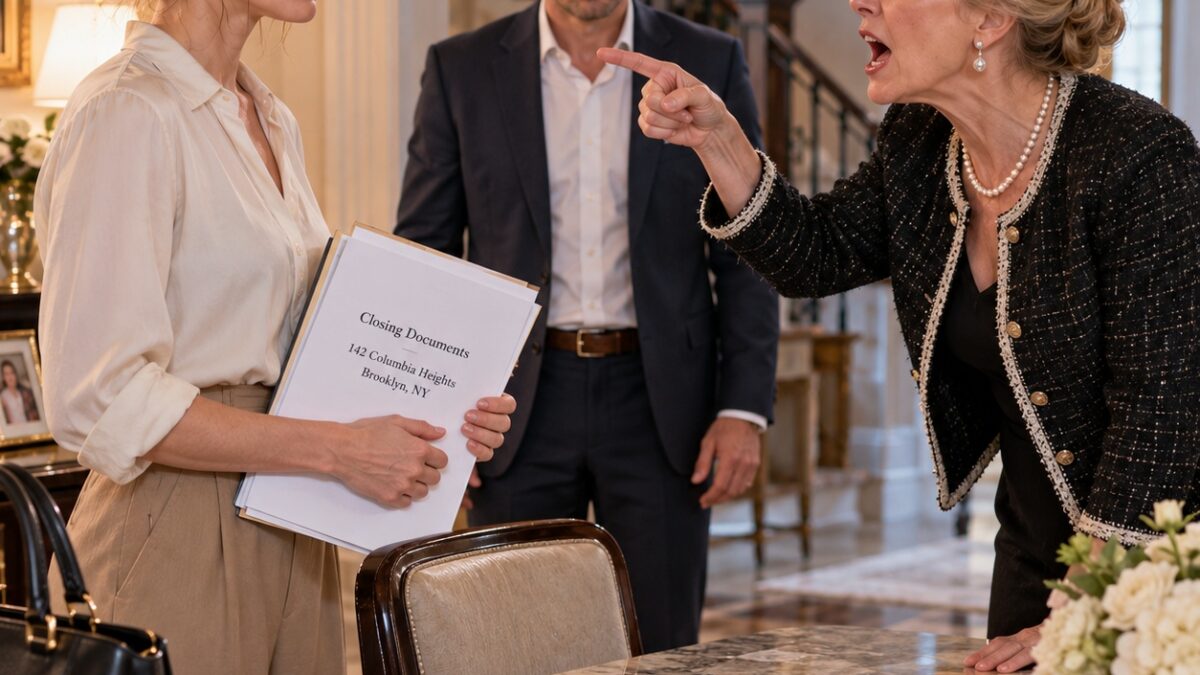
Linda’s smile disappeared first.
Ethan’s lasted perhaps two seconds longer.
“What is that?” he asked.
I placed the paper flat on the dining table.
Not the closing statement.
Not a bank confirmation.
A photocopy.
Six pages.
The top one carried the logo of Hudson Crest Financial.
Ethan recognized it.
Of course he did.
Hudson Crest was where Ryan had obtained one of his business loans.
Ethan’s expression changed so slightly that Linda probably missed it.
I didn’t.
I had been watching him carefully for three months.
“It’s a personal guaranty,” I said.
Linda frowned.
“For Ryan?”
“Yes.”
She looked at Ethan.
“So?”
I tapped the signature block.
“Read the guarantor’s name.”
Ethan’s jaw tightened.
Linda picked up the page.
Her eyes moved.
Then stopped.
“Sophia Bennett Hart.”
She looked at me.
“What is this?”
“That’s what I’ve been trying to figure out.”
Ethan stepped forward.
“Where did you get that?”
Wrong question.
Not:
What?
That can’t be right.
You never signed anything.
His first question was where I got it.
I looked at him.
“You know what it is.”
“No.”
“Yes.”
“Sophia, don’t start making accusations.”
“I haven’t made one.”
I turned another page.
The signature looked like mine.
Close enough for someone glancing quickly.
Not close enough for me.
My S curved differently.
The middle initial was wrong.
And whoever signed it used my married name in a form I never used on financial documents.
The guaranty backed $1.8 million of Ryan’s debt.
The loan had gone into default six weeks earlier.
I had discovered the document by accident.
Hudson Crest sent a certified notice to an old office address associated with me.
The office forwarded it.
The envelope arrived three days before my mother’s apartment closing.
I assumed it was junk.
Then I opened it.
NOTICE TO GUARANTOR.
Ryan Hart.
Default.
Amount immediately due.
My name.
My signature.
My supposed personal guaranty.
I called the bank before I called Ethan.
That was the beginning.
Linda dropped the document.
“This is ridiculous.”
“Yes.”
“Ryan wouldn’t—”
“I didn’t say Ryan signed it.”
She looked at Ethan.
He stared at me.
“Sophia, I can explain.”
That sentence changed everything.
Linda turned sharply.
“Explain what?”
Ethan rubbed one hand over his mouth.
“You need context.”
I almost laughed.
Forgery apparently had context.
“Go ahead.”
He glanced toward his mother.
“Not with Mom here.”
Linda’s face hardened.
“I’m already here.”
“Mom.”
“No. You promised me this was handled.”
There it was.
Handled.
I looked between them.
“You knew?”
Linda froze.
“Knew what?”
“About this guaranty.”
“No.”
Too fast.
I picked up another paper.
“This is an email.”
Ethan’s eyes closed briefly.
One second.
That was enough.
“From you to Ryan,” I said.
Linda stepped backward.
“Where did you get private emails?”
“Ryan forwarded them to the lender during a restructuring request.”
Ethan’s face drained further.
That part he hadn’t expected.
Ryan had become desperate.
Desperate people overshare.
After default, he begged Hudson Crest for an extension.
To prove that the guaranty was legitimate, he forwarded messages he believed supported it.
One of them came from Ethan.
I read aloud.
“Don’t worry about Soph. I’ll get her signature sorted. Once her mother’s place closes, she’ll have more than enough liquidity to backstop this.”
Linda’s mouth opened.
No sound came out.
I continued.
“Ryan answered: Does she know?”
Ethan said:
“You don’t need to read—”
I read anyway.
“You wrote: She’ll know when she needs to.”
Silence.
The house suddenly felt enormous.
All that polished oak.
High ceilings.
Quiet rooms.
A home I had once believed was ours.
I looked at Ethan.
“When exactly was I supposed to need to know?”
He said nothing.
“After my mother died?”
Nothing.
“After the apartment sold?”
Nothing.
“When the bank came after me?”
He finally said:
“It wasn’t supposed to happen like this.”
There it was.
The first truth.
Linda moved toward him.
“You told me Sophia agreed.”
I looked at her.
“He told you that?”
Linda’s eyes darted.
“I—I understood—”
“No.”
I held up a hand.
“Don’t rewrite this yet.”
She glared.
“Watch your tone.”
That almost made me laugh.
“My tone?”
“You’re obviously emotional.”
“My husband forged or arranged for someone to forge my signature on a $1.8 million guaranty tied to his brother’s debt.”
“We don’t know that.”
Ethan snapped:
“I didn’t forge anything.”
I looked at him.
“Who did?”
He stopped.
Interesting.
I leaned back against the table.
“Because the bank has already started investigating.”
Ethan’s face changed completely.
“What?”
“Yes.”
“When?”
“Three days ago.”
“You contacted Hudson Crest?”
“They contacted me.”
“Why didn’t you tell me?”
That question was almost offensive in its entitlement.
“Why didn’t I tell you?”
“We’re married.”
“So you could prepare another lie?”
Linda slapped one palm against the table.
“This family is not going to be destroyed over paperwork.”
I turned toward her.
“Paperwork?”
“You know what I mean.”
“I actually don’t.”
“Ryan was trying to save his company.”
“By using my identity?”
“He made mistakes.”
“Ryan?”
I looked at Ethan.
“Or Ethan?”
Linda’s lips tightened.
“Both boys have been under enormous pressure.”
Boys.
Forty-six and forty-two.
Still boys when responsibility arrived.
I pulled another document from the folder.
“This is the second surprise.”
Ethan stared at it.
He no longer asked where I got things.
That was progress.
“My mother did not leave the Brooklyn apartment directly to me.”
Linda frowned.
“What are you talking about?”
“The apartment belonged to the Bennett Family Trust after Mom updated her estate plan.”
Ethan’s eyes narrowed.
“When?”
“Two years ago.”
“You never told me.”
“Correct.”
His voice rose.
“Why?”
“Because my mother’s estate planning wasn’t yours.”
“We were married!”
“Yes.”
Linda interrupted.
“But you inherited it.”
“No.”
That was not entirely accurate, but close enough for what they understood.
“My mother’s trust sold the apartment.”
I tapped the closing documents.
“The sale proceeds are trust assets.”
Linda stared.
“So?”
“So I am a beneficiary.”
“And trustee.”
“But the seven million is not sitting in our joint checking account waiting for Ryan.”
Ethan’s face hardened.
“You’re hiding assets.”
“No.”
“It’s marital property.”
“Not according to the trust documents.”
He looked suddenly furious.
“That’s convenient.”
“Very.”
“My mother planned carefully.”
“She deliberately excluded me?”
“She didn’t write your name anywhere.”
“That means she excluded me.”
“No, Ethan.”
I shook my head.
“It means she left her property to her daughter.”
Linda stepped forward.
“You’re married. Family shares.”
I looked at her.
“Then perhaps Ryan can share his debts with you.”
Her mouth tightened.
“This isn’t funny.”
“No.”
“It really isn’t.”
The Bennett Trust had existed long before I married Ethan.
My mother placed the apartment and several investment accounts into it after my father’s death.
The structure was not created to defeat Ethan.
It was created because my mother believed in planning.
She had seen too many patients’ families collapse into conflict.
Too many adult children fight over money while someone lay dying.
Too many spouses discover they had no idea where documents were.
“Never leave paperwork for grieving people to solve,” she once told me.
That sentence sounded like her.
Practical.
Unsentimental.
Loving.
Two years before she died, she amended the trust.
I became successor trustee.
After her death, the assets were to remain in trust for me, with broad rights for health, education, support, investments, and eventual distributions.
But separate.
Traceable.
Protected.
I could take distributions.
I could invest.
I could buy property.
But simply being married to Ethan did not convert my mother’s trust into Ryan’s emergency fund.
Ethan knew I was inheriting something.
He didn’t know how it was structured.
Apparently, that hadn’t stopped him from making plans.
“You lied by omission,” he said.
I stared.
“About my mother’s trust?”
“Yes.”
“While you secretly guaranteed your brother’s loan in my name?”
“I told you I didn’t sign that.”
“Then tell me who did.”
He looked away.
I waited.
Linda said:
“This is getting us nowhere.”
“No.”
I looked at her.
“It’s finally getting somewhere.”
I reached into my purse and removed my phone.
“Two people are coming here at seven.”
Ethan looked at the clock.
6:18.
“Who?”
“My attorney.”
His expression shifted.
“And?”
“A forensic document examiner.”
Linda laughed.
“You’ve turned this into some kind of criminal investigation?”
“I didn’t turn it into anything.”
I looked at Ethan.
“The person who submitted my signature did.”
He stepped toward me.
“Sophia, we need to speak privately.”
“No.”
“Stop performing for my mother.”
I stared at him.
“She entered my house screaming for seven million dollars.”
Linda snapped:
“Your house?”
I looked at her.
“Yes.”
“This property belongs to Ethan.”
“No.”
Another silence.
Ethan stared at me.
“What?”
That part I had saved deliberately.
Our house in Scarsdale had been purchased four years into our marriage.
Everyone called it Ethan’s house because Ethan liked telling the story of “moving Sophia out of the city.”
The truth was less flattering.
The down payment came almost entirely from the sale of a condominium I owned before marriage and a documented distribution from my mother’s trust.
The mortgage was in both names initially.
Then, when rates dropped, we refinanced.
Ethan had terrible timing.
He changed jobs during underwriting.
His income became harder to verify.
To secure the best terms, we refinanced the property into my revocable trust, subject to our marital agreement and reimbursement rights.
Ethan signed everything.
He simply never read.
Just like Linda.
“It’s held in the Sophia Bennett Revocable Trust,” I said.
“You signed the transfer.”
Ethan stared.
“That doesn’t mean you can throw me out.”
“I didn’t say I could.”
“Then stop acting like—”
“I’m saying your mother doesn’t get to storm into my home and demand my inheritance.”
Linda’s face turned red.
“You manipulative little—”
“Mom.”
Ethan’s voice finally cut through hers.
“Enough.”
She looked at him, stunned.
That was new.
He turned to me.
“Let’s slow down.”
“Why?”
“Because this can be fixed.”
“Which part?”
“The loan.”
He swallowed.
“Ryan panicked.”
“You just said Ryan.”
He realized his mistake.
“I mean—”
“So Ryan forged it?”
“I didn’t say that.”
“Then who?”
He ran a hand through his hair.
“I need to talk to him.”
“You haven’t?”
“Not about this.”
I nodded.
“Interesting.”
The truth came later.
But that morning, I already knew enough.
Three weeks before my mother died, Ryan had approached Ethan for help.
Ryan’s sports-betting losses were worse than any of us knew.
He owed nearly $600,000 personally.
His construction supply company owed more than $2 million.
Hudson Crest was preparing to foreclose on inventory and pursue guarantees.
Ethan could not cover it.
Linda couldn’t.
Harold, Ethan’s father, had died four years earlier and left the family less liquid than everyone assumed.
Linda’s money was tied up in retirement accounts and a house with a large line of credit.
So they looked at me.
Not at my salary.
At my mother.
They knew she was sick.
They knew the Brooklyn apartment was valuable.
And somewhere in their minds, my future inheritance became family collateral before my mother was even buried.
The thought made me physically ill when I finally understood it.
But there was more.
At 6:27, Linda’s phone rang.
She looked at the screen.
Ryan.
Of course.
She answered immediately.
“Where are you?”
His voice was loud enough that I heard pieces.
Mom?
Did Soph get the money?
Linda turned away.
Too late.
I laughed once.
Ethan looked sick.
I said:
“Put him on speaker.”
Linda covered the phone.
“No.”
“Why?”
“This is private.”
“My name is on his loan.”
I walked toward her.
“Put him on speaker.”
She looked at Ethan.
He said quietly:
“Do it.”
Linda stared at him.
Then pressed the button.
Ryan’s voice filled the room.
“Mom?”
I said:
“Morning, Ryan.”
Silence.
Then:
“Soph?”
“Yes.”
Another silence.
I could almost hear his brain rearranging.
“Did the closing happen?”
I looked at Ethan.
“Interesting first question.”
Ryan said:
“I just mean—I know you’ve had a hard time.”
“Sure.”
“How’s everything?”
“My signature is on your personal guaranty.”
No response.
“Ryan?”
“I don’t know anything about that.”
I almost smiled.
Apparently dishonesty was hereditary by proximity.
“I have the copy.”
“I didn’t sign your name.”
“Who did?”
“I don’t know.”
“Did Ethan tell you I had agreed to guarantee your loan?”
Ryan breathed.
“Look, Soph, I was under pressure.”
“That wasn’t my question.”
Linda interrupted.
“Ryan, don’t say anything until—”
“Mom, shut up!”
Everyone froze.
Ryan never spoke to Linda like that.
He sounded terrified.
“Sophia, I swear I thought Ethan talked to you.”
I looked at Ethan.
His face went gray.
“What did he tell you?”
“That you’d sign.”
“When?”
“Last summer.”
My mother was alive last summer.
Receiving chemotherapy.
I gripped the table.
“And when you asked whether I knew?”
Ryan was silent.
So he remembered the email.
“I was nervous.”
“What did Ethan say?”
“You’ve already read it.”
“I want to hear you say it.”
Ethan snapped:
“Stop.”
I turned.
“No.”
Then to the phone:
“Ryan.”
He said quietly:
“He said you’d know when you needed to.”
My throat tightened.
My mother had spent the last summer of her life nauseated, exhausted, losing weight, still worrying about whether I was sleeping enough.
And my husband was planning to leverage what she would leave me.
“When was the guaranty signed?”
Ryan said:
“September.”
My mother died in October.
I stopped breathing for a moment.
September.
She was alive.
Barely.
But alive.
I whispered:
“You used an inheritance I hadn’t even received yet.”
Ryan said:
“I thought Ethan had authority.”
“That sentence means nothing.”
“We’re family.”
There it was again.
Family.
The universal solvent for other people’s boundaries.
I looked at Ethan.
“You did this while Mom was dying.”
His face changed.
“Sophia—”
“No.”
My voice cracked.
That was the first time.
“Don’t.”
The room became quiet.
Ryan spoke through the phone.
“I’m sorry.”
I closed my eyes.
“No, you’re scared.”
He said nothing.
“Those are different.”
Linda ended the call.
She looked at me like I had committed the offense.
“This is exactly what grief does.”
I opened my eyes.
“What?”
“It makes people cruel.”
I stared at her.
She gestured toward Ethan.
“Your husband made a mistake trying to save his brother.”
“A mistake?”
“Yes.”
“You’re talking about him like he forgot an anniversary.”
“He panicked.”
“He used my identity.”
“To help family.”
“You keep saying that.”
“Because it matters!”
“No.”
I stepped closer.
“It explains why you think you’re entitled to me.”
Linda recoiled slightly.
“What does that mean?”
“It means you don’t see me as family.”
She scoffed.
“Of course I do.”
“No.”
“You see me as a resource.”
Her face hardened.
“You married my son.”
“Yes.”
“And from that day forward, every skill, dollar, connection, room, car, holiday, favor, and inheritance I had became something this family assumed it could allocate.”
“That is not true.”
I began counting.
“Ryan lived in my apartment for four months after his first separation.”
“He needed help.”
“I helped.”
“I paid Vanessa’s tuition shortfall when her financial aid was delayed.”
“We repaid you.”
“Sixteen months later.”
“Your money wasn’t hurting.”
“That is exactly the point.”
I looked at Ethan.
“I paid thirty thousand dollars toward your mother’s roof.”
Linda looked offended.
“The roof protected your room too.”
I almost laughed.
“I have never lived in your house.”
“You stay there at Christmas.”
There was no answer to entitlement that pure.
I shook my head.
“And every time I helped, you turned generosity into precedent.”
Ethan said:
“This isn’t fair.”
“Neither was forging my name.”
He flinched.
At 6:42, the doorbell rang.
My attorney arrived early.
Her name was Nina Desai.
Forty-seven.
Divorce and estate litigator.
I had met her originally through my mother’s estate attorney.
Nina walked into the dining room carrying a leather case and one reusable coffee cup.
She saw Linda.
Saw Ethan.
Saw the papers.
Then looked at me.
“You started without me.”
“They started at six.”
She nodded.
“Of course they did.”
Linda drew herself up.
“And you are?”
“Nina Desai.”
“I mean why are you here?”
Nina placed her bag down.
“Sophia asked me to be.”
Ethan looked at me.
“How long have you had a divorce attorney?”
I said:
“She isn’t only a divorce attorney.”
Nina corrected gently:
“But yes, I am also her divorce attorney.”
Silence.
Ethan’s face changed.
“Sophia.”
I met his eyes.
That was another surprise.
I had not decided to divorce him before the guaranty notice.
Not fully.
Our marriage had problems.
Large ones.
Ethan had become secretive.
Dismissive.
Financially controlling in small ways that I kept rationalizing.
He resented my closeness with my mother.
He complained about the hours I spent helping during her illness.
Once, after I canceled a ski weekend because my mother was hospitalized, he said:
“She’s been dying for months, Soph. Life can’t stop every time she has a bad day.”
I never forgot that sentence.
He apologized.
But something never repaired.
Then came the guaranty.
Then the email.
Then bank statements.
Then Ryan’s debt schedule.
Then I looked more carefully at our own finances.
That was when I found the third surprise.
I took another paper from the folder.
Nina didn’t stop me.
“Do you know what this is?”
Ethan didn’t answer.
Linda stared.
I slid it toward him.
Home equity line statement.
$425,000 drawn.
Our home.
His signature.
My electronic approval.
Except I had never approved it.
This time, Ethan didn’t even pretend not to know.
Linda whispered:
“Ethan.”
I said:
“Where did the money go?”
“Sophia, I can explain.”
“You have used that sentence three times.”
“It was temporary.”
“Where did it go?”
He looked down.
“Ryan.”
Of course.
“How much?”
“Three hundred.”
“And the rest?”
He didn’t answer.
Nina said quietly:
“Ethan.”
He looked at her.
She repeated:
“Where did the remaining funds go?”
He swallowed.
“Mom.”
Linda spun toward him.
“You told me that came from your bonus.”
Everything stopped.
That one surprised even me.
“What did you give Linda?”
Ethan rubbed his forehead.
“One hundred twenty-five.”
“For what?”
Linda looked furious.
“None of your business.”
“It’s debt secured by my house.”
Nina added:
“It is very much Sophia’s business.”
Linda glared at her.
“Medical expenses.”
I paused.
“What medical expenses?”
She looked away.
Ethan said:
“Mom’s credit cards.”
Linda snapped:
“Ethan!”
He ignored her.
“She’s been covering Dad’s old obligations.”
“Harold died four years ago.”
“I know.”
“And?”
“There were debts.”
My head spun.
I had thought Linda was financially comfortable.
Not rich like my mother’s apartment sale suddenly made me appear.
But comfortable.
She had a paid-off house.
Pension.
Investment accounts.
Ethan had always described her as “fine.”
Apparently, the entire Hart family lived on a thin platform of appearances and emergency transfers.
I asked:
“How much debt does Linda have?”
Ethan stared at me.
“About six hundred.”
My mouth fell open.
“Six hundred thousand?”
Linda crossed her arms.
“You don’t know what I’ve had to manage.”
“Apparently not.”
“Harold left obligations.”
“Then why wasn’t the house sold?”
Her face tightened.
“That is my home.”
“Why did you take money from ours?”
“I didn’t.”
“You accepted it.”
“From my son.”
“From a line secured against my property.”
She looked at Ethan.
“You told me Sophia signed.”
Silence.
There it was again.
Ethan had built a little economy of lies.
Tell Ryan Sophia agreed.
Tell Linda Sophia agreed.
Tell me nothing.
Move money.
Wait for inheritance.
Repair later.
Except inheritance arrived with paperwork.
And I had stopped trusting him.
Nina opened her case.
“We need to make something clear.”
Ethan looked at her.
“What?”
“Given what Sophia has discovered, there will be no transfers from the Bennett Trust to Ryan, Linda, you, or any entity associated with you.”
Linda scoffed.
“You don’t decide that.”
“No.”
Nina smiled.
“Sophia does.”
“Then she’ll decide correctly.”
I stared at Linda.
She genuinely believed pressure would still work.
Nina continued.
“Second, Hudson Crest has been notified that Sophia disputes the authenticity and authorization of the guaranty.”
Ethan’s face tightened.
“Third, the lender on this property has been informed of potentially unauthorized borrowing activity.”
He stepped toward her.
“You contacted our mortgage bank?”
“Yes.”
“That could trigger an investigation.”
“Yes.”
“You could freeze the line.”
“That’s the idea.”
“You’re destroying our credit.”
Nina didn’t blink.
“If the credit was obtained through unauthorized approval, preserving access would be inappropriate.”
Ethan turned to me.
“Do you understand what she’s doing?”
“Yes.”
“This could ruin us.”
I looked at him.
“You already borrowed four hundred twenty-five thousand dollars against our home without my informed consent.”
“You think I’m the threat to our finances?”
“I was going to pay it back.”
“With what?”
He looked toward the closing folder.
Everything went silent.
There it was.
The plan.
Not merely Ryan’s debt.
Not merely helping family.
They had already spent my inheritance in their heads.
Seven million.
First repay the home-equity line.
Then Ryan’s bank.
Then Linda’s debts.
Then what?
Maybe Ethan believed he would still call the rest ours.
I whispered:
“You were going to use my mother’s money to cover what you did.”
“Sophia—”
“Yes or no?”
His voice dropped.
“Yes.”
Linda exhaled.
As if the truth finally relieved her.
“See?”
I turned slowly.
“See what?”
“It was temporary.”
My laugh came out broken.
“Linda.”
I looked at her.
“You came into my house at six in the morning screaming at me to hand over seven million dollars because Ethan needed to erase unauthorized debts before I found them.”
“That is not—”
“That is exactly what happened.”
“No one stole from you.”
“The bank may have a different view.”
Her face paled.
“You would call the police on your husband?”
I hadn’t.
Not yet.
But her question told me everything about where her mind had gone.
Ethan said:
“No one is calling police.”
Nina looked at him.
“That will depend on what the lenders discover.”
He stared.
“This is a family matter.”
Nina replied:
“Banks tend not to consider forged guarantees family matters.”
Linda sat down.
For the first time since arriving, she looked frightened.
Ethan looked at me.
“Sophia, please.”
The word hurt.
Not because it softened me.
Because I remembered when his “please” meant something.
Please marry me.
Please move in.
Please stay five more minutes.
Please dance with me.
Please come home.
We had once been happy.
Not fake happy.
Real.
That complicated everything.
He wasn’t a cartoon villain.
He was a man who had slowly taught himself that protecting his family justified lying to his wife.
And then each lie required a larger one.
“I need you to hear me,” he said.
I waited.
“Ryan called me last year.”
“Okay.”
“He was suicidal.”
Linda inhaled.
I looked at Ethan.
“What?”
“He said if the bank took the business, he was done.”
My anger shifted.
Not disappeared.
Shifted.
“Did you get him help?”
“He refused.”
“Therapy?”
“He refused.”
“Doctor?”
“No.”
“So you gave him money.”
“Yes.”
“And forged my name?”
“I did not forge your signature.”
“Then who did?”
He closed his eyes.
“The loan broker sent documents electronically.”
I waited.
“I logged into your email.”
My stomach dropped.
“How?”
“We share the iPad.”
I knew.
I had left my email signed in once.
“You approved the e-signature.”
He rubbed his forehead.
“I clicked it.”
That was it.
No mystery.
No unknown forger.
My husband.
He had opened my email.
Clicked a signature request.
Impersonated me.
Then deleted the message.
I stared at him.
“How could you do that?”
His voice cracked.
“I thought it would be short term.”
“That isn’t an answer.”
“I panicked.”
“You committed fraud because Ryan panicked.”
“I was trying to save my brother.”
“And when did saving me matter?”
He looked at me.
That landed.
I continued.
“When you used my identity?”
Silence.
“When you borrowed against my house?”
Silence.
“When you planned to take the money my mother spent forty years building?”
His eyes filled.
“I was going to make everything whole.”
“Financially?”
“Yes.”
“What about us?”
He had no answer.
I looked at Linda.
“What about you?”
She looked away.
No answer there either.
My mother had died six months earlier.
The night she died, Ethan sat beside me at the hospital for four hours.
He held my hand.
He cried.
He carried my coat.
At 3:00 a.m., when I couldn’t stand, he tied my shoes for me.
That man existed.
So did this one.
That was harder than if he had always been cruel.
People ask why spouses miss financial betrayal.
Because betrayal doesn’t erase tenderness before it happens.
Because the person lying to you may also make soup when you’re sick.
Because love and deception can occupy the same body.
It doesn’t make deception smaller.
It makes discovery more painful.
Nina touched my arm.
“Sophia?”
I realized I was crying.
I wiped my face.
“I’m fine.”
“No one asked you to be.”
My mother used to say something similar.
That almost made me cry harder.
Ethan took one step toward me.
I moved back.
He stopped.
Good.
“I’m sorry.”
I shook my head.
“I don’t know what to do with that yet.”
“Let me fix this.”
“You’ve been fixing things for a year.”
“No.”
“Yes.”
“You mean hiding them.”
“I mean—”
“I know what you mean.”
Linda said:
“You’re going to throw away seven years over money?”
I turned.
“No.”
“Then what?”
“Trust.”
She rolled her eyes.
“People rebuild trust.”
“Sometimes.”
“Marriage is work.”
“So is fraud apparently.”
“Sophia.”
Nina almost smiled.
I didn’t.
I looked at Ethan.
“I’m filing for legal separation today.”
His face collapsed.
“Don’t.”
“I already signed most of the papers.”
“You planned this.”
“After I found the guaranty.”
“You didn’t even confront me.”
“No.”
“Why?”
Because I was afraid.
That answer surprised even me.
Not afraid Ethan would hit me.
He never had.
Afraid he would talk me out of my own reality.
Ethan was persuasive.
Patient.
Emotionally skilled when he wanted to be.
If I had confronted him the first night, he would have cried.
Explained Ryan’s desperation.
Promised repayment.
Shown me suicide texts.
Brought Linda into it.
Turned the fraud into love.
I might have stayed quiet.
So I did what my mother always taught me.
Understand before reacting.
“I needed facts before you gave me explanations.”
He looked hurt.
“You didn’t trust me.”
“No.”
“Apparently, correctly.”
He sat.
Just folded into the chair.
Linda stared at him.
Then me.
“What happens now?”
I answered:
“You go home.”
“This is not finished.”
“For this morning, it is.”
She stood.
“Ethan?”
He didn’t move.
She touched his shoulder.
He shrugged her off.
That shocked her.
Maybe some part of him finally understood how much damage his mother’s certainty had enabled.
Linda looked at me.
“You’re going to regret humiliating this family.”
Nina immediately said:
“Linda, I recommend you stop speaking.”
Linda glared.
“I’m not afraid of you.”
“That wasn’t a threat.”
Nina lifted her coffee.
“It was free legal advice.”
Linda left.
The front door slammed again.
Ethan remained at the table.
I sat across from him.
For the first time that morning, there were only two of us.
He looked ten years older.
“You really called a lawyer before talking to me.”
“Yes.”
“You think I’m a criminal.”
“I think you used my email to sign my name on a financial guaranty.”
He winced.
“You know what I mean.”
“I don’t know what word you want me to use.”
He stared at the table.
“Ryan really was in bad shape.”
“I believe you.”
“He has kids.”
“I know.”
“If he lost the company—”
“He still may.”
“I know.”
“You wanted to protect him.”
“Yes.”
“I understand that.”
Ethan looked up.
Hope appeared.
Then I continued.
“But understanding why you did something doesn’t make it acceptable.”
Hope disappeared.
“You could have asked me.”
“You would’ve said no.”
“Probably.”
“Exactly.”
“No.”
I leaned forward.
“That is where you lost the right to call this help.”
He frowned.
“You knew I would say no, so you removed my ability to say it.”
Silence.
“That isn’t generosity.”
“That’s control.”
He looked away.
I realized then that this was bigger than money.
Ryan had been drowning for years.
Linda rescued him.
Then Ethan.
Then Linda again.
Every bailout came with a story.
Ryan was sensitive.
Ryan had kids.
Ryan was unlucky.
Ryan was embarrassed.
Ryan needed one more chance.
No one allowed consequences to finish reaching him.
And now Ethan had pulled me into the machinery without consent.
I said:
“Do you know what Mom told me when she got sick?”
He shook his head.
“She said, ‘Don’t let grief make you reckless with what took me a lifetime to build.’”
Ethan’s eyes filled.
“She knew you’d inherit a lot.”
“She knew I’d feel guilty.”
“About having it.”
“Yes.”
My mother grew up poor.
Real poor.
Five people in a one-bedroom railroad apartment.
She became a nurse.
Saved.
Invested.
Bought Brooklyn before Brooklyn became an investment story.
She never treated wealth as proof of virtue.
She treated it as responsibility.
“Seven million sounds enormous,” she once told me.
“It is.”
“But money disappears quickly when everyone else has a plan for it.”
She was right.
She had no idea how specifically.
Ethan whispered:
“I’m sorry.”
“I know.”
“Can we not decide the marriage today?”
I looked at him.
“I’m deciding separation today.”
“That’s different.”
“Yes.”
“Not divorce?”
“I don’t know.”
He breathed.
That was the truth.
I wanted distance.
Protection.
Financial clarity.
I did not know whether love was dead.
Trust was.
Love sometimes takes longer to recognize the funeral.
At 7:12, the forensic document examiner arrived.
His role became unnecessary regarding the electronic signature after Ethan admitted what he had done.
But not entirely.
There were paper authorizations tied to the home-equity line.
One signature was mine.
One wasn’t.
Ethan admitted that too.
He had signed a spousal acknowledgment when the bank requested correction because a document was missing.
He claimed he believed I had already agreed “in principle.”
I had not.
By 8:00, Nina had enough.
She told Ethan:
“You need independent counsel.”
He laughed bitterly.
“I need a criminal lawyer.”
“I can’t advise you.”
He looked at me.
“Are you going to report me?”
I didn’t answer immediately.
“I’m going to cooperate with the banks.”
“That’s not what I asked.”
“I don’t know what they’ll do.”
“What do you want?”
That question mattered.
What did I want?
For a moment, rage answered.
I wanted him scared.
I wanted Linda embarrassed.
I wanted Ryan to finally face consequences.
I wanted every dollar back.
I wanted my mother alive.
Only one of those was impossible.
And anger would not help with the others.
“I want my name cleared from Ryan’s debt.”
“Yes.”
“I want the unauthorized home-equity borrowing resolved.”
“Yes.”
“I want every joint account frozen against unusual transfers until we have an agreement.”
He closed his eyes.
“Yes.”
“I want you out of this house for now.”
That hurt him.
“Where?”
“Your apartment in Manhattan.”
“We rent that for work.”
“Then use it.”
He nodded slowly.
“And I want you to stop promising my money to anyone.”
He looked at the floor.
“Yes.”
That was how Ethan left.
No screaming.
No dramatic police escort.
He packed a suitcase.
Kissed nothing.
Took one photograph of us from his dresser.
At the door, he turned.
“Soph.”
I hated the tenderness in his voice.
“What?”
“If I had asked…”
I waited.
“If I came to you and told you everything about Ryan…”
He swallowed.
“Would you have helped?”
I answered honestly.
“Some.”
His face broke.
“How much?”
“I don’t know.”
“Enough to save him?”
“Maybe not.”
“But something.”
“Yes.”
He closed his eyes.
That truth hurt him more than refusal would have.
Because he had destroyed my trust to avoid hearing a limit.
After he left, I walked upstairs.
Sat on the floor beside my bed.
And finally cried like my mother had just died again.
Grief stacks.
It doesn’t replace.
My mother.
My marriage.
My idea of Ethan.
All of it came at once.
Nina found me twenty minutes later.
She sat on the floor too.
No advice.
Just presence.
Eventually she said:
“You need breakfast.”
I laughed through tears.
“Linda interrupted before I ate.”
“You own a seven-million-dollar trust and have no breakfast.”
“Apparently.”
“Tragic.”
We ordered bagels.
That was the first meal of my separation.
Sesame bagel.
Cream cheese.
Coffee.
Nothing symbolic.
Perfect.
The next three weeks were chaos.
Hudson Crest conducted an internal investigation.
Because Ethan had used my email and impersonated me during an e-signature process, the bank froze enforcement against me while reviewing.
Their authentication records showed the signature request had been completed from our home IP address.
That alone didn’t prove who clicked.
Ethan’s written admission through counsel did.
His attorney advised him to cooperate.
The bank removed me as guarantor.
Then pursued Ryan and the remaining valid guarantors.
Ryan called me twelve times.
I answered once.
“Sophia, please.”
I said nothing.
“I’m going to lose everything.”
“You may.”
“You can fix this.”
“I’m not paying $1.8 million.”
“I’m not asking for all of it.”
“How much?”
Silence.
There it was.
He was asking.
“Ryan.”
“I have kids.”
“I know.”
“You love them.”
“I do.”
“Then how can you—”
“No.”
He stopped.
“You don’t get to use your children as collateral in a conversation about money.”
“That’s not what I’m doing.”
“It is exactly what you’re doing.”
He began crying.
Real crying.
That was difficult.
I cared about him despite everything.
Ryan wasn’t evil.
He was addicted.
Gambling had started as entertainment.
Then desperation.
He chased losses.
Borrowed.
Lied.
Built businesses partly to create new credit.
He could be charming.
Generous.
Devoted to his daughters.
And absolutely destructive around money.
“I need help,” he whispered.
“Yes.”
“Then help me.”
“I will pay for treatment.”
Silence.
“Treatment?”
“Yes.”
“Gambling addiction.”
He became angry instantly.
“I’m not an addict.”
“Then I’m not paying anything.”
“Sophia—”
“I’ll cover an assessment and an inpatient or outpatient program recommended by professionals.”
“I need the bank off me.”
“No.”
“I’ll lose the business.”
“Maybe.”
“My house.”
“Maybe.”
“You don’t care.”
“I care enough not to give you money you’ll use to avoid treatment.”
He hung up.
Three days later, he called again.
“What program?”
That was the beginning of Ryan’s recovery.
Not my seven million.
Consequences.
The bank restructured some business debt after he agreed to sell inventory, liquidate personal investments, and enter treatment.
His house was sold.
That devastated Linda.
She blamed me.
Of course.
Ryan moved into a rental.
His wife separated from him temporarily.
He entered a gambling program.
Relapsed once.
Returned.
Recovery was ugly.
Nothing inspirational about it at first.
He hated me for months.
Then one year later, he sent a message.
I thought losing the house would kill me.
It didn’t.
Thank you for not giving me the money.
I stared at that message for a long time.
Then cried.
Linda never saw the lesson so clearly.
She had her own crisis.
The $125,000 Ethan gave her came from the unauthorized line.
His lawyer negotiated repayment into our marital accounting.
Linda insisted she couldn’t return it.
Nina requested financial disclosure because reimbursement became part of the marital dispute.
That was when Linda’s actual finances emerged.
$611,000 in revolving and personal debt.
A home-equity loan against her house.
Luxury spending.
Club dues.
Travel.
Designer purchases.
And years of quietly subsidizing Ryan.
After Harold died, she maintained the lifestyle they had when he was alive.
But Harold’s pension and investments did not support it.
She refused to downsize.
So she borrowed.
Then borrowed more.
Ethan had been covering holes.
I never knew.
One afternoon, Linda called.
Her voice sounded different.
No shouting.
“Can I come over?”
“No.”
Silence.
“Please.”
That word from her felt almost unnatural.
“What do you need?”
“To talk.”
“We can talk by phone.”
She breathed.
“I may lose the house.”
I said nothing.
“The bank says I need to reduce the line.”
“I’m sorry.”
“You could fix it.”
There it was.
Even now.
“How?”
“A loan.”
“No.”
“You have seven million dollars.”
“No.”
“More, probably.”
“That isn’t relevant.”
“I would sign documents.”
“No.”
“I’d pay interest.”
“No.”
Her voice hardened.
“So you’re willing to watch me lose the home where Ethan grew up?”
“If you cannot afford it, you should sell it.”
She gasped.
“You sound cruel.”
“No.”
“You have no idea what that house means.”
“I know exactly what my mother’s apartment meant.”
Silence.
That was the first time she had nothing to say.
I continued.
“I sold it.”
“Because you chose to.”
“Yes.”
“Because keeping a property you can’t responsibly maintain just because memory lives there can become another kind of trap.”
Linda began crying.
I softened.
“Sell before the bank decides for you.”
She whispered:
“I can’t.”
“Yes, you can.”
“I’ll have nowhere.”
“You’ll have money left after debts if the house sells well.”
“I’ll have to move somewhere smaller.”
“Yes.”
She hated that answer.
But six months later, Linda listed the house.
Sold it.
Paid most of her debts.
Bought a two-bedroom condo.
The first time I visited years later, she looked around and said:
“I still hate that you were right.”
I smiled.
“At least the condo doesn’t need a new roof.”
She laughed despite herself.
That was much later.
Before any of that, I still had a marriage to decide.
Ethan and I spent four months apart.
We attended therapy separately.
Then, cautiously, two joint sessions.
Not reconciliation therapy.
Discernment.
Did we attempt repair?
Or end?
The first joint session was brutal.
The therapist, Dr. Elena Morris, asked Ethan:
“Why did you believe Sophia’s consent was optional?”
He answered:
“I didn’t.”
She waited.
He corrected himself.
“I convinced myself she had already agreed.”
“How?”
“Because she always helped my family.”
“That means she agreed to this?”
“No.”
“Then why?”
He stared at his hands.
“My family doesn’t handle no well.”
I almost laughed.
Understatement.
Dr. Morris asked:
“And you?”
Ethan looked at me.
“I don’t handle disappointing them well.”
That was true.
From childhood, Ethan had been the responsible one.
Ryan failed.
Ethan fixed.
Linda panicked.
Ethan soothed.
Harold worked.
Ethan became second adult.
He built identity around rescue.
Then married me.
I was independent.
At first, he loved that.
Then family emergencies kept coming.
I said yes often.
That was the beginning of our pattern.
My yes became expected.
The first no felt like betrayal.
Instead of tolerating disappointment, Ethan went around me.
Dr. Morris asked me:
“Why did you say yes so often?”
I thought.
“Because I had more.”
“More what?”
“Money.”
“Stability.”
“Time sometimes.”
“A mother who taught me to help.”
“And?”
I looked at Ethan.
“Because I wanted his family to love me.”
There it was.
My part.
Not responsibility for fraud.
Never that.
But my contribution to the family pattern.
I had trained people to expect generosity by giving without naming limits.
That didn’t excuse them crossing limits.
It explained why I needed better ones.
“I felt like an outsider,” I said.
“Linda talked about family history constantly.”
“Ryan and Ethan had childhood stories.”
“I didn’t have siblings.”
“My father died.”
“My mother lived in Brooklyn.”
“I wanted to belong.”
“So I became useful.”
Ethan started crying.
“I loved you.”
“I know.”
“You didn’t have to earn it.”
“With you?”
“No.”
“With them?”
He couldn’t answer.
That mattered.
After the fourth joint session, I knew.
I could forgive Ethan eventually.
I could even believe he might change.
But I did not want to stay married while discovering whether he would.
That was difficult to admit because popular stories love reconciliation after remorse.
But remorse does not create obligation.
I told him over coffee.
Public place.
Daylight.
Nina knew where I was.
Not because I feared violence.
Because structure helped me.
“I want a divorce.”
He stared at the cup.
For nearly a minute.
Then nodded.
“I knew.”
“I’m sorry.”
“Don’t be.”
“I am.”
“I know.”
He looked up.
“Do you still love me?”
I hated that question.
“Yes.”
His eyes filled.
“Then why?”
“Because love is not enough to make me comfortable handing you access to my life again.”
“I can earn it.”
“Maybe.”
“Then let me.”
“You can earn being a trustworthy person.”
I swallowed.
“But I don’t have to remain your wife while you do.”
He looked away.
I continued.
“I need my marriage to be the place I’m safest being told no and saying no.”
He closed his eyes.
“I made ours the opposite.”
“Yes.”
That was the end.
Not dramatic.
Two people crying in a coffee shop while strangers worked on laptops around us.
The divorce took almost a year.
Financially, it was complicated.
The Bennett Trust remained separate.
That did not mean every dollar I possessed was protected from marital accounting.
We had joint savings.
Retirement contributions.
Equity issues.
Reimbursement claims related to the house.
Ethan had rights.
So did I.
We settled.
I did not try to take everything.
He did not try to claim the trust after his attorney explained reality.
The unauthorized HELOC became a major issue.
Ethan assumed full responsibility for the portion transferred to Ryan and Linda in the settlement, with assets offset accordingly.
The house stayed with me.
Not because I “won.”
Because tracing and title supported it and I wanted to stay.
For a while.
Eventually, I sold it too.
The house had become too full of that six a.m. morning.
I bought a smaller place near the river.
Warm kitchen.
No enormous formal dining room.
The first thing I did after moving in was install a doorbell camera.
Then laughed at myself.
Linda had cured me permanently of unlocked front doors.
My mother’s trust remained invested.
I did not spend seven million dollars.
That surprised people who heard the story.
The amount itself had become mythic.
Seven million.
As if inheritance creates an obligation to transform your life overnight.
I didn’t.
I paid estate obligations.
Set aside reserves.
Diversified.
Created a charitable account in my mother’s name.
I bought no yacht.
No mansion.
No revenge car.
I kept working.
I used some trust income to reduce my hours for a year while I grieved.
That may have been the best money I spent.
I started a scholarship for nursing students at my mother’s hospital.
The first award was $25,000.
I cried signing the check.
That money felt like her.
Not because she had been wealthy.
Because she had spent decades taking care of people.
I wanted some part of what she built to keep doing that.
Ryan stayed in recovery.
His company failed.
Fully.
He filed bankruptcy.
For years, everyone had treated bankruptcy as the apocalypse.
It wasn’t.
It was painful.
Embarrassing.
Expensive.
But he survived.
He later started working for another company rather than owning one.
Steady salary.
No entrepreneurial fantasies.
He self-excluded from several gambling platforms.
Joined a support group.
His marriage survived after a long separation.
At his daughter Emma’s graduation, he found me outside the auditorium.
“Soph.”
“Hey.”
He looked healthier.
Older.
“I’ve wanted to say something.”
“Okay.”
“I hated you.”
“I know.”
“For not bailing me out.”
“I know.”
“I thought you were sitting on more money than I’d ever see while my life burned.”
I waited.
“And then I realized my life was burning because I kept pouring gasoline.”
That line stayed with me.
“I’m glad you’re okay.”
He smiled.
“I’m not always.”
“Neither am I.”
“Still.”
He looked toward the building.
“My girls respect me again.”
“That matters.”
He nodded.
“Thank you.”
“You did the work.”
“You forced me to start.”
“No.”
I shook my head.
“The bank did.”
He laughed.
Fair.
Linda took longer.
For nearly two years, she referred to me as “the woman who broke the family.”
Then Ethan began challenging her.
That was part of his growth.
He stopped rescuing automatically.
When Linda complained about her condo fees, he didn’t pay them.
When Ryan called during a relapse asking for money, Ethan offered treatment, not cash.
When Vanessa—Ethan’s cousin, not his sister—asked him to co-sign a vehicle, he said no.
Linda interpreted boundaries as cruelty at first.
Then slowly adapted.
She had to.
No one was playing the old roles anymore.
She apologized to me four years after the divorce.
Not because therapy demanded it.
Because she found one of my mother’s letters.
That requires explanation.
When I moved from the Scarsdale house, I found a box of belongings from our wedding.
Inside were notes guests had written.
One was from my mother to Linda.
Margaret had written:
Linda,
I’m grateful Sophia is joining a family with so much history together. She has always been generous, sometimes to a fault. Please remind her that being family does not mean saying yes to everything. I hope we both help them build a marriage where kindness never becomes obligation.
Margaret
My mother had seen it.
Before any of us.
I cried when I read it.
Then made a copy.
I don’t know why.
Months later, Linda and I had to meet over some remaining furniture and photographs.
I gave it to her.
She read.
Her face changed.
“Your mother wrote this?”
“Yes.”
“I don’t remember.”
“It was with the wedding cards.”
She read again.
Then folded it.
“Can I keep the copy?”
“Yes.”
Three months later, she called.
“Can we have coffee?”
I almost said no.
Then agreed.
Public café.
She arrived early.
That alone was strange.
Linda was usually late because she assumed time waited for her.
She had the letter.
“I was angry when you gave me this.”
“Why?”
“Because I thought you were trying to make your mother judge me from the grave.”
That sounded like Linda.
“And then?”
“I kept reading it.”
She looked at me.
“I did exactly what she warned me not to do.”
I said nothing.
“I made your kindness an obligation.”
My throat tightened.
“Yes.”
“I thought that was family.”
“I know.”
“My mother did it.”
“With you?”
“With everyone.”
She looked down.
“If you had money, you helped.”
“If you had a room, somebody stayed.”
“If you had time, somebody used it.”
“Saying no meant you thought you were better.”
I understood.
“It doesn’t make what happened okay.”
“No.”
She looked up.
“I know.”
Then she said:
“I’m sorry I came into your house screaming for Margaret’s money.”
I laughed softly.
“That sentence sounds insane now, doesn’t it?”
“It sounded reasonable to me then.”
“I know.”
“That may be worse.”
We both smiled sadly.
I accepted the apology.
Not because it erased anything.
Because I no longer needed her to remain the villain in order to validate my pain.
People can change.
Some don’t.
Some do partially.
Linda became less entitled.
Not transformed into a saint.
She still complained.
Still gave unsolicited advice.
Still believed expensive handbags had spiritual properties.
But she learned to ask.
Can I come over?
Would you mind?
Are you able to help?
Those phrases mattered.
Ethan remarried six years after our divorce.
Her name was Leah.
He told me himself because he didn’t want me to hear through family.
“I wanted you to know.”
“Thank you.”
“She knows everything.”
I paused.
“Everything?”
“The guaranty.”
“The HELOC.”
“Ryan.”
“Our divorce.”
“My therapy.”
“The whole thing.”
“Good.”
“I didn’t want to build another marriage on editing.”
That moved me.
“I hope you’re happy.”
“I am.”
Then he said:
“I hope that doesn’t hurt you.”
It didn’t.
Not anymore.
“I’m glad.”
And I meant it.
Leah and I met eventually.
Not as rivals.
Not friends.
At Ryan’s daughter’s wedding.
She came over.
“I’ve wanted to thank you.”
That surprised me.
“For what?”
“For making him go to therapy.”
I laughed.
“I didn’t make him.”
“He says you leaving did.”
“That’s different.”
She smiled.
“He also says you’re the reason he reads every contract now.”
“Good.”
“Very annoying.”
“Better annoying than criminal.”
She laughed so hard Ethan looked over from across the room.
That moment gave me closure I didn’t know I needed.
Not because Ethan suffered forever.
Because he didn’t.
Accountability had not destroyed him.
It forced him to become someone else.
That mattered.
I dated eventually.
Slowly.
Terribly.
The first man spent twenty minutes explaining my own profession to me.
No second date.
The second called my inheritance “our retirement plan” after six weeks.
No seventh week.
Then I met Michael.
Widower.
Architect.
Two grown daughters.
He asked what my mother had done for work before asking what the apartment sold for.
That alone put him ahead.
Six months into dating, I told him the full story.
He listened.
Then asked:
“What did your mother like to cook?”
I almost cried.
Not:
How much was left?
What did you invest in?
Did Ethan go to jail?
What happened to Ryan?
What did Margaret cook?
“Lentil soup.”
“Good?”
“Terrible.”
He smiled.
“Perfect.”
We married quietly three years later.
Prenup.
Separate attorneys.
Full disclosure.
I insisted.
Michael smiled when I told him.
“I was going to suggest it.”
“Really?”
“Yes.”
“Why?”
“Because clean agreements protect relationships from imaginary conversations.”
That sounded like my mother.
I married him.
The Bennett Trust eventually grew beyond the amount inherited.
Not because of genius.
Because I did very little dramatically.
Diversified.
Paid taxes.
Avoided foolish risks.
Let time work.
When people hear “seven million,” they imagine unlimited wealth.
It isn’t.
It is enormous privilege.
It is security.
It can also disappear through bad decisions.
I became more intentional about what the money meant.
Not status.
Not rescue fund for adults avoiding consequences.
Choice.
Time.
Care.
Education.
Safety.
I paid for my goddaughter’s nursing school.
Funded legal-aid services for older women dealing with financial exploitation.
Supported a gambling-treatment nonprofit anonymously for years before telling Ryan.
When I finally told him, he said:
“Using Mom’s money to help gamblers?”
“My mom believed nurses should treat the sick.”
He nodded.
“Fair.”
I never gave Ryan cash.
That boundary remained.
The seven-million-dollar demand became a family story eventually.
Dark comedy.
At Thanksgiving one year, Linda said:
“Remember when I came over at six in the morning demanding seven million dollars?”
Everyone stared.
Ryan said:
“Mom, we’re trying to eat.”
She laughed.
“I’m just saying I’ve grown.”
I looked at her.
“You do knock now.”
She raised her wineglass.
“Progress.”
Even Ethan laughed.
That is something I could never have imagined that morning.
The people at the table weren’t the same.
Neither was I.
Family didn’t return to its old shape.
It formed a new one.
Ethan and I were cordial.
Ryan and I became surprisingly close in later years because recovery made him honest in ways he had never been before.
Linda learned boundaries.
Michael joined without trying to fix history.
And my mother remained present in a thousand tiny ways.
Not supernatural.
Practical.
Her handwriting.
Her recipes.
Her trust documents.
The scholarship.
The tiny scar on my thumb from cutting bagels in her Brooklyn kitchen.
One winter, Michael and I walked past her old building.
I hadn’t been there in years.
New owner had renovated.
Different curtains.
Different lights.
I stood across the street.
“You okay?” Michael asked.
“Yes.”
I watched someone move behind the window.
“I thought selling it meant losing her.”
“Did it?”
“No.”
That surprised me.
The apartment had held memory.
It wasn’t memory.
I carried that.
Money can preserve choices.
It cannot preserve people.
That understanding freed me from treating the inheritance like something sacred I could never use.
I also stopped letting others treat it like public property.
Those are different extremes.
I spent thoughtfully.
Gave intentionally.
Said no without speeches.
That last skill took longest.
Early after the divorce, every no came with explanation.
No, because this.
No, because Mom intended.
No, because trust.
No, because legal.
Eventually:
No.
Complete sentence.
Not always.
But often.
The most important conversation about the inheritance happened with my own daughter—though I never had children biologically.
Michael’s daughter, Grace, became close to me.
Years later, after Michael died unexpectedly from a stroke, I updated my estate plan.
Grace sat with me one afternoon.
“You don’t have to leave me anything.”
I smiled.
“That’s not why we’re talking.”
“I don’t want you thinking I expect—”
“Grace.”
She stopped.
“I know.”
“What?”
“I know what expectation can do to generosity.”
Her eyes softened.
So I explained my plan.
Charitable gifts.
Scholarships.
Specific family distributions.
A trust.
Clear language.
No mysteries.
I told her:
“If I leave you something, it is not a contract requiring you to rescue everybody.”
She laughed.
“Very specific.”
“Family history.”
“I know.”
“Use it to build stability.”
“Enjoy some.”
“Give some if you want.”
“But never spend money because someone uses the word family as a weapon.”
Grace became serious.
“I won’t.”
That felt like closing a circle.
My mother had protected me through documents.
I wanted to protect the next generation through clarity.
Not control.
There is a difference.
Control says:
Do exactly what I would do.
Clarity says:
Here is what is yours.
Choose responsibly.
The forged guaranty stayed in my files for years.
Eventually, Nina called.
“Do you still need this?”
“No.”
“Shred?”
I hesitated.
That paper had detonated my marriage.
Exposed Ethan.
Forced Ryan into recovery.
Revealed Linda’s debt.
Saved me from financial entanglement I didn’t even know existed.
I thought I should keep it.
Then I remembered my mother’s apartment.
Objects are not lessons.
They carry lessons for a while.
Then you can let them go.
“Shred it.”
“Done.”
I kept one thing from that morning.
The cream closing folder.
Empty now.
Inside the front cover, I wrote the date.
Then one sentence:
No one gets to spend your life before you choose how to live it.
It sits in my study.
Not locked.
I no longer need locked drawers.
People sometimes ask whether I regret not using the inheritance to save Ryan immediately.
No.
I regret what he suffered.
I regret what his wife and daughters endured.
I regret that addiction nearly destroyed him.
But giving him seven million dollars—or two million, or one—would have postponed truth.
Maybe killed him.
He told me that himself years later.
“If you had paid it all,” he said, “I’d have gambled again.”
“How do you know?”
“Because I still thought the problem was debt.”
“What was the problem?”
“Me.”
Then he corrected himself.
“No.”
He smiled.
“The addiction.”
That distinction mattered.
Ryan was not his disease.
But he had to accept responsibility for managing it.
Just as Ethan was not the worst thing he did.
Linda was not the worst morning she had.
And I was not the grieving woman standing frozen beside the dining table while somebody screamed for my mother’s money.
We were all more than our worst day.
But our worst days revealed where change was required.
That morning revealed everything.
Linda believed family meant entitlement.
Ethan believed rescue justified deception.
Ryan believed money could erase consequences.
And I believed being good meant endlessly giving.
All four beliefs had to die.
Years later, I woke at 5:48 one morning.
Couldn’t sleep.
Michael had been gone almost a year.
The house was quiet.
I made tea.
Walked into the dining room.
Sunrise had barely begun.
For some reason, I remembered Linda’s voice.
Hand over the seven million from your mother’s apartment!
It sounded almost absurd now.
Like dialogue from somebody else’s life.
I pictured myself standing there with a purse on my shoulder.
Closing papers in hand.
Exhausted.
Heartbroken.
Still smelling faintly of the bank lobby and winter air.
I wanted to reach backward and tell that woman:
You are not about to lose your family.
You are about to learn what parts of it are real.
But that would not have comforted me then.
So instead, if I could speak to her, I would say:
Put the folder down.
Breathe.
Ask questions.
Do not let volume become authority.
Do not let marriage become permission.
Do not let guilt become a signature.
And most of all—
Do not confuse someone needing you with someone loving you.
That was the deepest lesson.
Ryan needed my money.
Linda needed my money.
Ethan needed my money to repair his lies.
My mother loved me enough to leave me choices instead.
That difference changed everything.
On the tenth anniversary of her death, I visited the hospital where she had worked.
The scholarship program had funded twenty-three nursing students by then.
One of them, a young woman named Kayla, recognized my name.
“Are you Margaret Bennett’s daughter?”
“Yes.”
“My aunt worked with her.”
That startled me.
“What did she say?”
Kayla smiled.
“She said your mom never let doctors bully new nurses.”
I laughed.
“That sounds like her.”
“She also said Margaret kept granola bars in her locker because somebody was always hungry.”
That almost broke me.
Seven million dollars.
And what someone remembered was granola bars.
Good.
That was right.
Money had grown around my mother accidentally.
What mattered about her was never the apartment.
It was how she used what she had.
Time.
Skill.
Food.
Patience.
Attention.
She helped without letting people exploit her.
I had learned the first half early.
The second half took longer.
Before leaving the hospital, I sat in the lobby.
Pulled out my phone.
Ryan had sent a photograph.
His oldest daughter had gotten engaged.
Ethan had sent a birthday message the week before.
Linda had mailed me a Christmas card with her condo’s ridiculous little balcony covered in lights.
Life continued.
Not cleanly.
Not in straight lines.
But it continued.
I thought about the morning they demanded seven million dollars.
At the time, I believed the surprise was paperwork.
The trust.
The forged guaranty.
The HELOC.
The evidence.
Those were important.
But they were not the real surprise.
The real surprise was me.
They expected the Sophia who would listen to Linda shouting, watch Ethan explain, feel guilty about Ryan, and eventually say:
Fine.
Take what you need.
That woman had existed.
She had given too much.
Explained too little.
Mistaken usefulness for belonging.
Grief changed her.
Betrayal finished the job.
When I put that folder on the table and said I had a surprise, I wasn’t unveiling some brilliant revenge scheme.
I was doing something much more frightening to people who had always relied on my compliance.
I was saying no with information behind it.
There is enormous power in that.
Not money.
Clarity.
Seven million dollars made the story dramatic.
Clarity saved me.
If the apartment had sold for seventy thousand, Ethan’s betrayal would still have mattered.
If my mother had left me nothing, impersonating me would still have been wrong.
If Ryan’s debt were ten thousand instead of millions, coercion would still be coercion.
Money magnified the conflict.
It didn’t create the principle.
Consent did.
That became the word I understood differently afterward.
Consent is not just physical.
It exists in finances.
Contracts.
Family favors.
Shared homes.
Loans.
Guarantees.
Access.
A spouse does not become your signature.
A child does not become your retirement plan.
A generous sister-in-law does not become an emergency fund.
A wealthy daughter does not become a bank.
Love does not erase no.
My mother understood that better than any of us.
Maybe because nurses understand boundaries.
You can care deeply for someone and still say:
I cannot do that.
You can sit beside someone in pain without absorbing the injury yourself.
You can help without taking over.
You can give without surrendering agency.
I wish I had learned earlier.
But I learned.
That has to count.
There is one final thing.
The morning Linda demanded the money, I said:
“You’re right. I do have a surprise for both of you.”
For years, Ethan teased me later that those words terrified him more than any lawyer.
Once, long after we had both remarried, we were at a family graduation.
He came over with two coffees.
“Peace offering?”
“Depends.”
He handed me one.
“What brand?”
He laughed.
“Still suspicious.”
“Healthy boundaries.”
We sat.
Then he said:
“You know what I thought the surprise was?”
“What?”
“That you’d already transferred the money somewhere.”
“I had.”
“I know now.”
“No, I mean the trust sold the apartment.”
“Right.”
He smiled.
“But that wasn’t what scared me.”
“What did?”
“You looked calm.”
I thought about it.
“I wasn’t.”
“I know.”
“You didn’t then.”
“No.”
He took a sip.
“I realized I didn’t know what you knew.”
“That was true.”
He nodded.
“And I had spent years assuming that because you weren’t confronting me, you weren’t seeing me.”
That sentence stayed with me.
Silence is dangerous to misread.
Sometimes silence is ignorance.
Sometimes fear.
Sometimes patience.
Sometimes observation.
Sometimes somebody is simply waiting until they understand enough to walk away.
Ethan mistook mine for permission.
Linda mistook it for weakness.
Ryan mistook generosity for endless supply.
They were all wrong.
My mother never was.
In her final letter to me, written two weeks before she died, Margaret said:
Sophia,
You have spent your whole life trying to make difficult things easier for other people.
That is one of the things I love most about you.
It is also the thing I worry about.
Please remember that helping someone carry a burden is different from letting them put it down on your back and walk away.
What I leave you is not payment for taking care of me.
You owed me nothing.
It is not payment for being my daughter.
Love does not have invoices.
Use it to make your life freer, not more obligated.
And when people tell you that love requires you to give what you do not want to give, look very carefully at what they are calling love.
Mom
I found that letter after the divorce.
It had been sealed inside an envelope marked PRIVATE in her desk.
I read it sitting on the floor of the empty Brooklyn apartment two days before the final closing.
I cried until the light outside turned blue.
Then I stood.
Walked through every room.
Touched the kitchen doorway where she used to mark my height.
Opened the window in my childhood bedroom.
Listened to Brooklyn traffic.
And said goodbye.
Not to her.
To the apartment.
There is a difference.
My mother did not become seven million dollars when she died.
She did not become real estate.
She became memory.
Language.
Habits.
Boundaries I eventually learned.
A scholarship.
A letter.
And the quiet voice in my head reminding me that love does not have invoices.
So when Linda screamed for the money the next morning, she believed she was demanding an inheritance.
She wasn’t.
She was demanding that I betray the final thing my mother had taught me.
That was never going to happen.
Not for Ryan.
Not for Ethan.
Not for Linda.
Not for anyone.
The seven million stayed protected.
The family survived without it.
Ryan learned to live without being rescued.
Linda learned to live within her means.
Ethan learned that helping someone does not grant permission to deceive another person.
And I learned the hardest lesson of all:
Sometimes the most loving thing you can do for a family is refuse to save it from consequences it created.
That morning at six, my mother-in-law burst into my home believing grief had made me weak.
She demanded seven million dollars.
My husband believed marriage entitled him to promise it.
His brother believed desperation entitled him to receive it.
They were all waiting for me to surrender.
Instead, I opened a folder.
And for the first time in years, I stopped asking what everyone else needed from me.
I asked what I was willing to give.
The answer was not seven million dollars.
It was the truth.
And unlike money, once I finally gave them that, none of us could go back to pretending we hadn’t seen it.








