My Family Lured Me to a $4,386 Dinner After 3 Years of Silence—Then the Manager Revealed Why They Really Needed Me There
My Family Lured Me to a $4,386 Dinner After 3 Years of Silence—Then the Manager Revealed Why They Really Needed Me There
My family hadn’t spoken to me in three years, but somehow they managed to spend $4,386 before telling me I was the one expected to pay.
I thought the expensive dinner was their punishment for refusing to surrender my grandmother’s inheritance, until I noticed the restaurant manager staring at my father like he already knew something I didn’t.
And when I quietly asked him one question, his answer made me realize the bill on the table was only the smallest part of the trap.
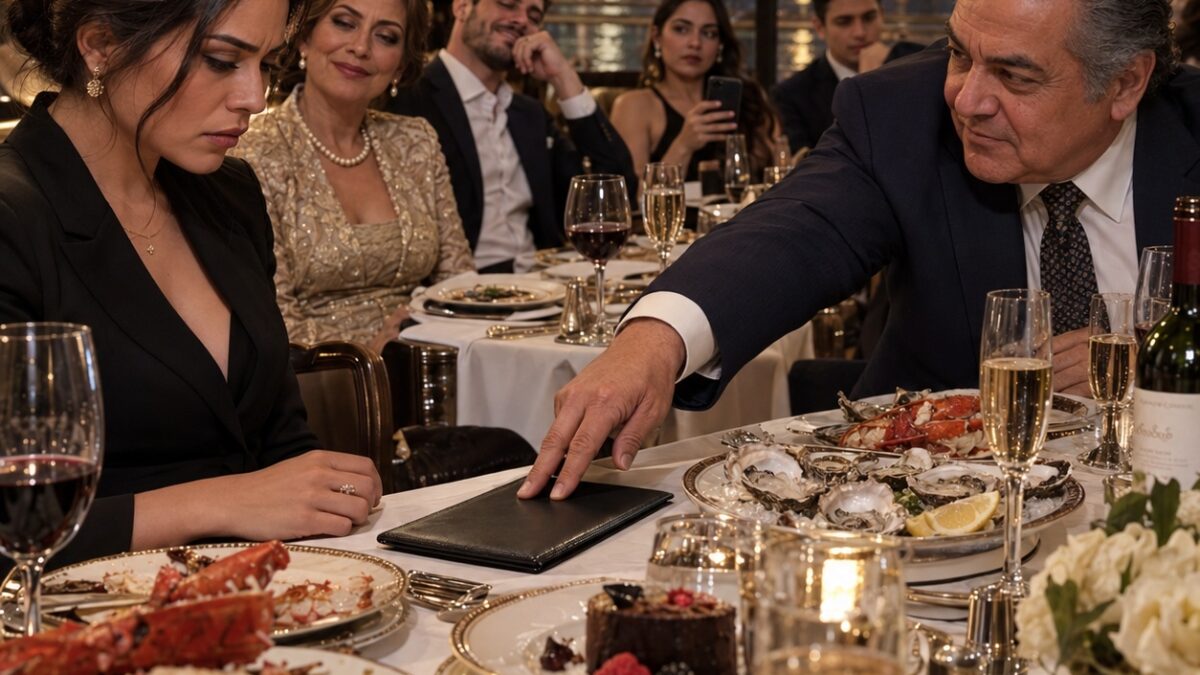
The waiter placed the black leather folder in the center of the table, and my father pushed it toward me with two fingers.
“You’re paying, right, Elena?”
Sixteen faces turned toward me.
Not one looked surprised.
The dining room at Bellmont House glowed gold against the black Chicago River outside. Candlelight reflected in tall windows. Crystal glasses shimmered beneath hanging brass fixtures. Somewhere behind me, a pianist was playing something soft and expensive while people murmured over plates arranged like artwork.
At our table, there was nothing soft about the silence.
My mother folded her hands beneath her chin.
My brother Alejandro leaned back with his wineglass, already wearing the little grin he used whenever he thought somebody else was about to be humiliated.
Aunt Beatriz suddenly became fascinated by the ice melting in her drink.
My cousins stopped taking pictures of their desserts.
I looked down.
$4,386.72.
Cracked lobster shells covered three silver platters. There were empty champagne bottles, oysters, filet mignon, crab legs, imported caviar, and a four-hundred-dollar Cabernet my father had ordered after announcing that “a family reunion deserved something respectable.”
I had eaten a bowl of soup and half a piece of salmon.
They had eaten like a royal family preparing for execution at dawn.
My father chuckled.
“Come on, Elena. Don’t make this awkward.”
“Awkward?”
“You make more money than anybody here.”
Alejandro lifted his glass.
“Think of it as three years of unpaid family dues.”
Several people laughed.
My mother reached across the table and touched my wrist.
“It would be a beautiful gesture, sweetheart. A fresh beginning.”
There was the voice.
The same gentle, wounded voice she had used three years earlier when she placed legal documents on my kitchen counter and asked me to sign away everything my grandmother had left me.
Back then, she had called surrender a gesture too.
A gesture of love.
A gesture of unity.
A gesture for the good of the family.
My grandmother Sofia had left me a lake cottage in Wisconsin and an investment account she had quietly built during forty years as an elementary-school teacher.
It wasn’t a fortune.
But my family had reacted as if she had handed me the crown jewels.
My father insisted the cottage should be sold and the money divided.
Alejandro accused me of manipulating an old woman.
Aunt Beatriz told relatives that I had isolated Grandma Sofia before her death.
None of it was true.
I simply visited her.
I called her.
I listened.
Apparently, in my family, that qualified as manipulation.
When I refused to surrender what she had deliberately left me, my father called me selfish.
My mother cried.
Alejandro punched a hole through my apartment wall.
So I left them behind.
Three years later, my mother texted me.
Your father and I think it’s time to put the past behind us. Dinner? Just us. No pressure.
I wanted to believe her.
That was the humiliating part.
Some stupid little piece of the eight-year-old girl I used to be still remembered sitting at our old kitchen table while Mom braided my hair and told me family was forever.
So I came.
And found sixteen people waiting.
I should have walked out immediately.
Instead, I sat down.
Now the bill was in front of me.
My father smiled.
“Well?”
I looked at the number again.
Then I noticed the manager standing near the bar.
He wasn’t watching me.
He was watching my father.
And the expression on his face wasn’t sympathy.
It was suspicion.
Something inside me went very still.
I closed the bill folder.
Then I raised my hand.
When the waiter leaned toward me, I whispered two sentences.
“Please ask your manager to come here.”
“And whatever my father tells you, don’t run my card.”
His eyes widened.
Then he nodded and walked away.
FULL STORY CONTINUATION 👇👇
My father’s smile vanished almost immediately.
“What did you say to him?”
I picked up my water glass.
“Why?”
“Because he looked confused.”
“He’s a waiter, Dad. I asked him a question.”
“What question?”
Alejandro laughed.
“Jesus, Roberto, relax. Elena’s probably asking if they accept corporate cards.”
More laughter.
I looked at him.
My brother had aged in the three years since I had seen him.
At thirty-eight, Alejandro still had the handsome face that had allowed him to escape consequences most of his life, but it was softer now, heavier around the jaw. His expensive navy jacket couldn’t hide the fact that he had gained weight, and the redness in his cheeks suggested the wine at dinner wasn’t an occasional indulgence.
He stared back at me with the confidence of someone who had never once considered the possibility that the world might stop protecting him.
“You look tired, Alex,” I said.
His smile thinned.
“And you still look judgmental.”
“I said you look tired.”
“We know what you meant.”
That sentence carried my entire childhood inside it.
We know what you meant.
Any word could become an insult if they needed one.
Any boundary could become cruelty.
Any refusal could become betrayal.
My mother sighed.
“Please. Not tonight.”
I almost laughed.
Not tonight.
As if tonight hadn’t been engineered for exactly this.
My father drummed two fingers against the table.
“Elena, if this is about the money, don’t embarrass yourself.”
I looked at him.
“I’m not embarrassed.”
“Then pay it.”
“Why?”
He blinked.
A simple question had always been dangerous in our family.
Why?
Why should I give Alejandro my bedroom because he wanted more space?
Why should I apologize when Aunt Beatriz insulted me?
Why should I skip college orientation because Dad needed somebody to work his booth at the neighborhood festival?
Why should Grandma Sofia’s property belong to people she deliberately chose not to leave it to?
Questions required answers.
My father preferred obedience.
He leaned toward me.
“Because we’re your family.”
My mother nodded.
“And because we invited you back with open hearts.”
I looked around at the wreckage of the meal.
“You invited me?”
“Yes.”
“Interesting.”
“What’s interesting?” Beatriz asked.
“I thought Mom invited me.”
My mother’s fingers tightened around her napkin.
“I did.”
“To dinner with you and Dad.”
“That was the plan originally.”
I glanced at the sixteen chairs.
“So fourteen additional people just appeared?”
My cousin Javier laughed nervously.
“Come on, Elena. Nobody’s attacking you.”
“I didn’t say anyone was.”
Aunt Beatriz rolled her eyes.
“There. That tone. You’ve always had that tone.”
“What tone?”
“The one that makes everybody feel like they’re being interrogated.”
I leaned back.
“Maybe everybody feels that way because nobody wants to answer me.”
That stopped her.
For two seconds.
Then Alejandro laughed.
“This is unbelievable. Three years away and she comes back thinking she’s a prosecutor.”
“No. I work in corporate finance.”
“I know what you do.”
“Then why did you call me an executive when you were deciding who should pay?”
His jaw flexed.
My father slapped his palm lightly against the table.
“Enough.”
The glasses rattled.
Several diners at nearby tables glanced toward us.
And instantly my father changed.
It was almost impressive.
His shoulders relaxed.
His smile returned.
He lowered his voice.
“Look,” he said gently. “Nobody wants a fight. We wanted tonight to be special.”
I remembered those exact tonal shifts.
The private explosion.
The public smile.
My father could call my mother an idiot in the kitchen and greet a neighbor thirty seconds later like a church deacon.
Appearances mattered more than truth.
They always had.
“What exactly are we celebrating?” I asked.
“Reconciliation,” my mother said quickly.
“Whose reconciliation?”
She frowned.
“Ours.”
“For what?”
That did it.
My father stared at me.
“You know what.”
“I know why I stopped speaking to you.”
“Here we go.”
“But if this is reconciliation, I assume at some point someone intends to acknowledge what happened.”
My mother’s face tightened.
“Elena, your grandmother’s estate damaged all of us.”
“No. Your reaction to her estate damaged us.”
Aunt Beatriz whispered, “Unbelievable.”
I ignored her.
My father’s voice dropped.
“Your grandmother was confused at the end.”
“She wasn’t.”
“She was eighty-one.”
“She was eighty-one, not incompetent.”
“You had influence over her.”
“I visited her twice a month.”
“Exactly.”
I stared at him.
For a moment I actually forgot where we were.
The candles, the champagne, the expensive room vanished.
I was standing inside Grandma Sofia’s cottage again.
There were lace curtains over the kitchen sink and wind chimes outside the back door. She was stirring cinnamon into coffee because she insisted it made cheap coffee taste expensive.
She had looked at me six months before she died and said, “Do you know the difference between loneliness and peace, Elena?”
I said I didn’t.
She smiled.
“Loneliness is when no one comes. Peace is when the wrong people stop coming.”
At the time, I hadn’t understood why she looked so sad.
Later, I did.
My father had visited her only when he needed something.
Alejandro borrowed money.
Beatriz complained about every decision she made.
My mother called on holidays and birthdays.
I sat with her on rainy Sundays and watched old movies.
I repaired a broken railing.
I took her to appointments.
I drove two hours during a snowstorm because she was scared of sleeping alone after falling in the kitchen.
When she left me the cottage, I cried because I knew I would rather have had her.
They saw square footage.
I saw the last place where someone in my family had loved me without requiring payment.
The restaurant manager approached our table.
He was probably in his early fifties, tall, silver-haired, wearing a charcoal suit and a burgundy tie. His name tag read MICHAEL DONOVAN.
My father saw him.
Something flashed across his face.
It was gone quickly.
But I saw it.
Fear.
Not worry.
Not annoyance.
Fear.
And that was when I knew the $4,386 was not the entire story.
“Good evening,” Michael said.
My father straightened.
“There seems to be some confusion about the check.”
“No confusion,” my father said immediately. “My daughter is taking care of it.”
Michael didn’t look at him.
He looked at me.
“Ms. Varela?”
“Yes.”
“May I speak with you privately?”
My mother’s head snapped up.
“Why privately?”
Michael remained polite.
“Because Ms. Varela requested to speak with management.”
My father stood halfway from his chair.
“About a dinner bill?”
Michael finally looked at him.
“Among other things.”
Silence.
My skin went cold.
Among other things.
Alejandro stopped smiling.
I placed my napkin beside my plate.
“I’ll be right back.”
Dad stood completely.
“Elena.”
I looked at him.
His face had changed.
The theatrical warmth was gone.
For the first time that night, I was seeing the man who had driven to my apartment three years earlier and told me that if I refused to sign my inheritance over, I should consider myself no daughter of his.
“We’re having a family conversation,” he said.
“I’m going to speak with the manager.”
“Sit down.”
Michael shifted slightly beside me.
He didn’t touch me.
He didn’t need to.
Something about having one person nearby who wasn’t emotionally owned by my father made the command sound smaller.
I stood.
“No.”
The word surprised even me.
Not because it was loud.
Because it wasn’t.
It came out calm.
Final.
Dad stared at me.
My mother whispered my name.
I walked away.
Michael led me past the bar and down a narrow corridor toward a small office near the kitchen.
The moment the door closed behind us, the restaurant sounds became muffled.
He gestured toward a chair.
“You may want to sit.”
My stomach tightened.
“I’d rather stand.”
He nodded.
Then he walked to a desk.
There was a manila folder on it.
On top of the folder was a photocopy of my driver’s license.
My breath stopped.
It was an old license.
The photograph had been taken five years earlier.
The address printed beneath my face belonged to the apartment I had lived in before buying my condo.
“What is that?”
Michael didn’t answer immediately.
He opened the folder.
Inside were several pages.
A banquet reservation.
Credit authorization paperwork.
A photocopy of a corporate business card.
And a signature.
My signature.
Except I had never signed it.
I stepped closer.
“What the hell is this?”
“That,” Michael said quietly, “is why I’ve been watching your table all night.”
For a few seconds I couldn’t speak.
I picked up the top page.
EVENT HOST: ELENA VARELA.
RESPONSIBLE PARTY: ELENA VARELA.
ESTIMATED GUEST COUNT: 18.
MINIMUM FOOD AND BEVERAGE COMMITMENT: $4,000.
There was my company name.
My job title.
My office number.
My email address.
Almost.
The email address contained one additional letter.
So subtle most people would never notice.
My real company address ended in @northcrestholdings.com.
The form said @northcreestholdings.com.
Two e’s.
A fake domain.
My mouth went dry.
“When did you receive this?”
“Eleven days ago.”
“From whom?”
Michael looked toward the closed door.
“Your father.”
My fingers tightened around the paper.
“He gave you this?”
“He came in personally. Said you were organizing a private family dinner but that your schedule was difficult, so he was handling the details.”
I stared at him.
“He told you I authorized this?”
“Yes.”
“And you accepted it?”
Michael’s expression hardened, but not defensively.
“Initially.”
That word mattered.
“Initially?”
“Your father presented the identification copy, the signed form, and your business card. He had enough personal details that nothing seemed obviously fraudulent.”
I held up the signature page.
“This isn’t my signature.”
“I know.”
I looked at him sharply.
“How?”
“Because your company held an investor dinner here last November.”
I remembered.
Northcrest Holdings had hosted forty clients at Bellmont House after closing an acquisition.
“I supervised it personally,” Michael continued. “You signed the final invoice.”
He opened another folder and pulled out a copy.
Two signatures.
Side by side.
Even without being a handwriting expert, the differences were obvious.
The forged signature was careful.
Too careful.
Every letter looked drawn.
My actual signature was fast, slanted, messy.
“You recognized me?”
“Yes.”
“Why didn’t you say something when I arrived?”
“Because I wasn’t certain what was happening.”
He hesitated.
“Then your father asked our server whether the card authorization had already gone through.”
My heart began pounding.
“What card authorization?”
Michael pulled out another page.
I saw only the last four digits.
I didn’t recognize them.
“That isn’t my card.”
“We know.”
“How?”
“It declined.”
Despite everything, I almost laughed.
Of course it had.
But Michael wasn’t smiling.
“After it declined, your father told us you had recently changed accounts and that you would settle everything personally when you arrived.”
“So why let them continue ordering?”
“Because there was technically no violation at that point. Your father provided his own card for incidentals.”
I froze.
“His own card?”
Michael nodded.
My mind began rearranging the evening.
Dad had a card on file.
Dad could pay.
So the public performance had never truly been about whether the restaurant would get its money.
He wanted me to pay for some other reason.
I looked back at the documents.
“What am I missing?”
Michael folded his arms.
“This afternoon, your father brought in one additional document.”
He removed a cream-colored envelope from the folder.
My name was written across it.
Elena Varela.
I felt the first real pulse of fear.
“What is it?”
“He asked me to place it with the final bill.”
My throat tightened.
“He wanted this inside the check presenter?”
“Yes.”
“Why?”
“He said it was a family surprise.”
I reached for the envelope.
Then stopped.
“Did you open it?”
“No.”
“Why do you look like you know what’s inside?”
“Because when he gave it to me, another man was with him.”
“What man?”
“He introduced himself as Mr. Rivas.”
Every muscle in my body tightened.
“Daniel Rivas?”
“I believe so.”
I knew that name.
Daniel Rivas had been my father’s attorney during the fight over Grandma Sofia’s estate.
Not the estate attorney.
My father’s attorney.
Three years earlier, Rivas had sent me two letters implying my family might challenge the will on grounds of undue influence.
They never filed suit because Grandma Sofia’s attorney had documented her mental competence thoroughly.
But the threat had been enough to keep me awake for months.
“What did they say?”
Michael hesitated.
“I don’t want to overstate something I only partially heard.”
“Tell me exactly what you heard.”
“They were standing near the host station. Mr. Rivas asked your father whether you understood what you’d be signing.”
The room seemed to tilt.
“And?”
“Your father said, ‘She won’t read it. Not with everybody staring at her.’”
I stared at Michael.
The muffled clatter of dishes from the kitchen sounded impossibly far away.
He continued.
“Mr. Rivas asked what happened if you refused. Your father said…”
Michael paused.
“What?”
“He said, ‘She always folds when her mother cries.’”
My stomach turned.
For three years I had told myself I was over it.
That I had healed.
That distance had made me stronger.
But hearing those words pulled open something ancient.
Because he was right.
Or at least, he used to be.
When my mother cried, I folded.
When Dad shouted, I apologized.
When Alejandro exploded, I left.
When Beatriz mocked me, I laughed weakly so nobody could accuse me of ruining dinner.
They had constructed tonight using an instruction manual written from my childhood.
I looked at the envelope.
“Give it to me.”
Michael did.
I tore it open.
There were eight pages inside.
The first was titled FAMILY SETTLEMENT AND RELEASE AGREEMENT.
My vision narrowed.
I started reading.
I made it halfway through page two before I understood.
Then I went back to the beginning.
And read it again.
It was dressed in friendly language.
Resolution.
Harmony.
Mutual release.
Final settlement.
But underneath the legal wording was something simple.
If I signed, I would acknowledge that disputes existed regarding the validity of Grandma Sofia’s estate distribution.
I would agree to sell the lake property.
I would release half the net proceeds to a “family trust.”
I would waive certain future claims against anyone involved.
And buried near the bottom of page six was a clause stating that each party had received consideration sufficient to support the agreement.
Consideration.
In contract law, that meant something of value exchanged.
I looked at the check.
The dinner.
A reconciliation dinner.
A “gift.”
A public gesture.
They wanted me to pay.
Then they wanted me to sign.
And later, they could argue I had voluntarily entered a settlement during a family reconciliation.
My hands were shaking now.
“This is why they wanted me here.”
Michael nodded slowly.
“I believe so.”
I looked up.
“And you were supposed to put this in the bill?”
“Yes.”
“So I open the folder…”
“You find the agreement.”
“Everyone pressures me.”
“I assume that was the plan.”
“And they tell me it’s just something to formalize us putting the past behind us.”
Michael’s face said he had reached the same conclusion.
I laughed once.
There was no humor in it.
“My mother texted me ‘No pressure.’”
Michael didn’t say anything.
He didn’t need to.
I sat down finally.
Not because I was weak.
Because suddenly my knees felt unreliable.
For three years I had wondered whether I had been too harsh.
That is the terrible thing about cutting off people you love.
Distance does not erase love immediately.
It leaves ghosts.
You remember birthdays.
Recipes.
Inside jokes.
The way your father used to carry you from the car when you fell asleep as a child.
The way your mother smelled like lavender lotion.
You remember good days and begin questioning bad ones.
Maybe they were angry.
Maybe everyone said things they regretted.
Maybe I should call.
Maybe I was the stubborn one.
Maybe family really was complicated.
I had replayed those questions hundreds of times.
Now an eight-page contract sat in my hands.
They hadn’t missed me.
They had studied me.
Michael pulled the desk phone closer.
“Ms. Varela, would you like us to contact the police?”
I looked at him.
“Not yet.”
He frowned.
“If these documents are fraudulent—”
“I know.”
“Then why not?”
“Because I want them to explain it.”
“That may not be wise.”
“Probably not.”
I stared at the forged signature again.
“But I spent three years wondering if I had misunderstood them.”
I folded the papers carefully.
“I’m done wondering.”
Michael nodded.
“What do you want me to do?”
I thought about it.
Then I asked, “Is my father’s card still on file?”
“Yes.”
“Valid?”
“Yes. We ran a one-dollar authorization.”
“Good.”
I stood.
“Bring the original bill.”
He raised an eyebrow.
“And this envelope?”
“I’ll take it.”
“What about the forged paperwork?”
“You keep the originals.”
He seemed relieved.
“Absolutely.”
“Make copies for me.”
“I already did.”
That almost made me smile.
Michael Donovan was becoming my favorite person in Chicago.
“One more thing,” I said.
“Yes?”
“When you come back to the table, I want you to ask my father the same question he asked me.”
Michael’s expression changed.
“What question?”
I smiled.
“You’re paying, right?”
For the first time, he smiled too.
When I returned to the dining room, the entire table went silent.
My father sat rigidly.
My mother’s champagne glass was untouched.
Alejandro had his phone in his hand.
He lowered it quickly when he saw me.
“You were gone a long time,” Mom said.
“I had a lot to discuss.”
“With a restaurant manager?” Alejandro asked.
“Yes.”
Dad looked past me.
“Where is he?”
“Coming.”
“What’s in your hand?”
I looked down at the folded agreement.
“Oh. This?”
His face changed.
My mother inhaled sharply.
Aunt Beatriz looked at Dad.
Alejandro stopped moving.
That was all the confirmation I needed.
I sat down.
Then I placed the agreement beside my plate.
“You forgot something inside the bill folder.”
My father’s mouth tightened.
“That wasn’t supposed to be handed to you privately.”
“No. I gathered that.”
“Elena,” my mother said softly.
I turned toward her.
“Did you know?”
Her lips parted.
“Know what?”
“Be careful.”
The color drained from her face.
Dad interrupted.
“There’s nothing to be careful about.”
I looked at him.
“So explain it.”
“It’s a family agreement.”
“Why was it hidden in my dinner bill?”
“It wasn’t hidden.”
“It was in a sealed envelope you told the manager to put inside the check presenter.”
Beatriz stared at my father.
“You did what?”
Interesting.
Maybe not everyone knew.
Dad leaned back.
“I was trying to avoid turning this into a legal confrontation.”
“You brought your lawyer to the restaurant this afternoon.”
Alejandro muttered something under his breath.
I looked at him.
“You knew too.”
He scoffed.
“Don’t drag me into your paranoia.”
I slid the agreement toward him.
“Read page six.”
“I don’t need to.”
“Then you already know what it says.”
His eyes flashed.
There it was.
My mother whispered, “Elena, please.”
“No.”
She flinched.
It was such a small word.
But I think that was the moment the entire balance of our family shifted.
“No more ‘please,’ Mom.”
Tears instantly formed in her eyes.
Right on schedule.
“Elena…”
I watched them gather.
For thirty-five years, those tears had been an emergency alarm.
Stop what you’re doing.
Apologize.
Protect Mom.
Make peace.
I felt the old instinct rise.
And then I heard my father’s voice from Michael’s office.
She always folds when her mother cries.
Something inside me hardened.
“Don’t,” I said.
My mother froze.
“What?”
“Don’t cry because I found out what you were doing.”
Her expression collapsed.
“How can you say that to me?”
“Because I finally understand what the tears are for.”
My father shoved his chair backward.
“That’s enough.”
“No, Dad. It isn’t.”
People were looking now.
I didn’t care.
That surprised me most.
For decades, public embarrassment had been the cage they kept me inside.
Tonight the door was open.
He pointed at the contract.
“That agreement solves everything.”
“There was nothing left to solve.”
“Your grandmother’s estate was never fair.”
“Grandma wasn’t required to be fair according to your definition.”
“She was my mother.”
“And it was her property.”
“She would never have intentionally excluded me.”
“She didn’t exclude you.”
His face reddened.
I remembered the will.
Grandma Sofia had left Dad twelve thousand dollars.
Mom ten thousand.
Alejandro five thousand.
Beatriz several pieces of jewelry.
She had left me the cottage and investment account because, according to the letter attached to her will, I had “given her time without keeping score.”
Dad hated that sentence more than anything.
“She left you almost everything of value,” he snapped.
“Because the cottage was valuable to her.”
“It’s worth almost nine hundred thousand dollars now.”
And there it was.
Not Grandma.
Not grief.
Not family.
Nine hundred thousand dollars.
I stared at him.
“When I inherited it, you said it was a worthless shack.”
“The market changed.”
“So did your feelings?”
“This isn’t funny.”
“I’m not laughing.”
Dad leaned closer.
“You have no children. You barely use it. Your brother has two kids.”
Alejandro lifted his chin.
“My boys deserve something from this family too.”
“Then leave them something.”
His face twisted.
“You know my situation.”
“No, Alex. I don’t. You stopped speaking to me three years ago.”
“You stopped speaking to us.”
“After you punched my wall because I wouldn’t give you Grandma’s money.”
“That wasn’t why.”
“What was it?”
He said nothing.
I nodded.
“That’s what I thought.”
Michael approached.
The table fell silent again.
He carried the black folder.
My father turned toward him.
“Finally. We’ll handle payment.”
Michael placed the folder directly in front of Dad.
My father stared at it.
Michael spoke in the same polished tone he had used all evening.
“Mr. Varela, the card you provided for incidentals remains on file.”
Dad glanced at me.
“I told you my daughter is paying.”
Michael didn’t move.
“Ms. Varela has informed us that she did not authorize this event.”
The silence became absolute.
My cousin Javier slowly lowered his glass.
Beatriz whispered, “Roberto?”
Dad stood.
“This is a private family matter.”
“The reservation was made with my establishment, sir.”
“I made the reservation.”
“Using your daughter’s identity.”
My mother covered her mouth.
Alejandro looked toward the exit.
Michael continued.
“You provided a copy of Ms. Varela’s identification, employment information, a business card, an authorization form bearing her name, and a payment card you represented as hers.”
Several people began talking at once.
“What?”
“What is he talking about?”
“You used her ID?”
“Roberto?”
Dad snapped, “Everybody shut up.”
And they did.
Old habits.
He looked at Michael.
“You’re making serious accusations.”
“I am describing documents you personally provided.”
“I never said the card belonged to her.”
Michael’s face remained calm.
“You stated that Ms. Varela was the financially responsible host.”
“That is not fraud.”
“I didn’t call it fraud.”
Michael paused.
“You did.”
Dad’s face went gray.
I almost admired that sentence.
Michael placed the folder closer to him.
“Your total is $4,386.72.”
My father stared.
Michael looked him directly in the eye.
“You’re paying, right?”
Nobody laughed.
Dad looked at me.
The hatred in his face was breathtaking.
“You planned this.”
I actually smiled.
“I found out twenty minutes ago.”
“Bullshit.”
“You forged my signature.”
“I did not.”
“Then who did?”
Silence.
I looked at Alejandro.
His gaze dropped.
Ah.
“There it is.”
He looked up.
“What?”
“You signed it.”
“Go to hell.”
Dad said, “Don’t answer her.”
Alejandro turned toward him.
“I’m not.”
I stared at my brother.
The slant of the forged E.
The strange loop in the V.
Suddenly I remembered.
When we were teenagers, Alejandro used to sign Dad’s name on school permission slips because Dad was rarely home.
He had always drawn signatures carefully.
Too carefully.
“Alex.”
“Shut up.”
“You forged my name.”
“Prove it.”
A cold quiet settled over me.
He regretted the words instantly.
I could see it.
Because unlike the girl he remembered, I no longer heard “prove it” as a threat.
I heard it as instructions.
“All right.”
My mother whispered, “Elena, please don’t.”
I looked at her.
“Don’t what?”
“Destroy this family over money.”
Something almost broke inside me.
Not because the accusation hurt.
Because of how familiar it was.
I shook my head slowly.
“You really believe that, don’t you?”
Her tears spilled over.
“Look around. Everyone came here because we wanted you back.”
“Did they?”
I turned toward my cousins.
“Javier, why are you here?”
He looked horrified.
“What?”
“Why did you come tonight?”
He glanced at Dad.
“I was told it was a family dinner.”
“Were you told I was paying?”
His silence answered.
“Who told you?”
“Elena…” Dad warned.
I kept looking at Javier.
He swallowed.
“Uncle Roberto.”
“Thank you.”
I turned toward Beatriz.
“Did Dad tell you I invited everyone?”
Her face had gone pale.
She looked at her brother.
“Yes.”
Dad cursed.
Beatriz’s eyebrows rose.
“You said Elena wanted a reconciliation dinner.”
“She did.”
“No,” I said. “Mom asked me to have dinner with her and Dad.”
Beatriz looked at Mom.
Mom looked down.
A strange expression came over my aunt.
For the first time that evening, she didn’t seem mocking.
She seemed embarrassed.
My cousin Lucia spoke.
“So Elena didn’t invite us?”
“No.”
“And she didn’t say she was paying?”
“No.”
Lucia looked at my father.
“What the hell?”
Dad slammed his hand on the table.
“Enough!”
Half the restaurant turned.
Michael stepped closer.
“Sir, I need you to lower your voice.”
Dad rounded on him.
“Stay out of this.”
“I will when your bill is settled.”
That nearly made Alejandro laugh.
He caught himself.
Dad saw.
For one second, father and son looked like two men realizing the ship was sinking and there was only one life jacket.
My mother whispered, “Roberto, just pay it.”
He stared at her.
“What?”
“Pay the bill.”
“You said—”
“Pay it.”
Something passed between them.
And suddenly I understood that Mom knew enough to be terrified.
Dad pulled out his wallet.
He handed Michael a black credit card.
“There.”
Michael accepted it.
“I’ll return momentarily.”
As he walked away, Dad sat down.
Nobody spoke.
The beautiful room continued around us.
Forks touched plates.
The pianist played.
A server uncorked wine at another table.
Our family sat in the middle of all that elegance like survivors waiting to learn who had betrayed whom.
I looked at the agreement.
“What happens if I sign this?”
Dad rubbed his forehead.
“Elena, we can discuss this tomorrow.”
“No. You spent eleven days arranging tonight. We can discuss it now.”
“It’s straightforward.”
“Then explain it.”
“It ends the dispute.”
“There is no dispute.”
“There could be.”
I stared at him.
There.
Finally.
The threat.
Not loud.
Not theatrical.
But real.
“You’re planning to challenge Grandma’s will.”
“I’m saying there are questions.”
“Three years later?”
“We recently learned certain things.”
“What things?”
Dad looked at Daniel Rivas’s agreement.
“You were handling her finances near the end.”
“I helped her pay bills online because she hated computers.”
“You transferred money.”
“She reimbursed me for groceries.”
“You drove her to the lawyer.”
“She asked me to.”
“You were present when she changed her estate plan.”
“No.”
Dad’s eyes narrowed.
I knew exactly what was happening now.
They were building a story.
Not because it was true.
Because stories become dangerous when repeated enough.
I leaned back.
“You don’t have evidence.”
“We have concerns.”
“That’s lawyer language for no evidence.”
“You think because you have money now, you’re untouchable.”
“I don’t think that at all.”
“You work for people who make more in a month than I made in ten years.”
“My job has nothing to do with Grandma.”
“It changed you.”
I laughed softly.
“No, Dad. Distance changed me.”
His jaw tightened.
I continued.
“Three years without somebody telling me I was selfish every time I said no changed me.”
My mother cried quietly.
“Three years without Alejandro screaming at me changed me.”
My brother looked away.
“Three years without Aunt Beatriz turning every mistake I made at twelve into a dinner story changed me.”
Beatriz’s face fell.
“Three years without being told family meant surrender changed me.”
I looked around the table.
“You’re right. I’m different.”
Nobody spoke.
“I learned that love doesn’t require a witness.”
Mom looked up.
“What does that mean?”
“It means real love doesn’t invite fourteen spectators before asking for forgiveness.”
Her face crumpled.
I continued.
“It means apologies don’t arrive with legal documents.”
Dad looked away.
“And reconciliation doesn’t need a forged signature.”
Alejandro stood.
“I’m leaving.”
Michael reappeared.
Perfect timing.
“Mr. Varela.”
Dad looked up.
Michael placed the card and receipt beside him.
“Approved.”
Alejandro stepped away from the table.
Michael turned toward him.
“One moment, please.”
My brother froze.
“What?”
Michael’s tone remained courteous.
“Because documentation was submitted under Ms. Varela’s identity, our ownership has asked that all related materials be preserved.”
Alejandro stared.
“So?”
“So no one involved should remove restaurant copies.”
“I’m not removing anything.”
“Good.”
He started walking.
I said his name.
He stopped.
I don’t know why.
Maybe because nobody in our family had ever really left when Dad was still sitting.
“Did you forge my signature?”
He turned slowly.
His eyes were wet.
That surprised me.
I expected anger.
Instead, for the first time all night, my brother looked afraid.
“You already decided I did.”
“I’m asking.”
Dad said sharply, “Alejandro.”
My brother looked at him.
Something cracked.
“You said she would sign.”
Dad’s face went blank.
Alejandro laughed once.
“You said she’d complain, Mom would cry, everybody would tell her to stop being selfish, and she’d sign.”
My mother whispered, “Alex.”
He ignored her.
I could barely breathe.
“You forged it.”
His eyes met mine.
“Dad needed the reservation guarantee.”
My father exploded.
“Don’t you dare put this on me.”
Alejandro turned.
“You asked me!”
“I asked you to prepare paperwork.”
“You gave me her old license.”
“I didn’t tell you to sign her name.”
“You told me to make it work.”
“I meant organize the dinner!”
Alejandro laughed again.
“Oh, now you meant organize dinner?”
Dad stood.
“You’re drunk.”
“And you’re a liar.”
The words hit harder than shouting.
Nobody in our family called Dad a liar.
Not publicly.
Maybe not ever.
Dad stepped toward Alejandro.
Michael moved between them.
“Gentlemen.”
Alejandro pointed around him.
“No, let him talk. He’s great at talking. He told me Elena stole our future. He told me Grandma was senile. He told me once Elena signed the settlement, we could finally sell the cottage.”
I stared at him.
“We?”
He closed his eyes.
Dad said, “Stop talking.”
Alejandro opened them.
“Dad promised me part of the money.”
Of course.
“How much?”
“Elena, don’t.”
“How much?”
He swallowed.
“Two hundred thousand.”
The number hung there.
My stomach turned.
Two hundred thousand dollars.
For forging my signature.
For helping pressure me into surrendering Grandma Sofia’s house.
I looked at my brother.
“Why?”
His face twisted.
“You think I wanted to?”
“Yes.”
“No.”
“You did it.”
“I had no choice.”
“There is always a choice.”
His anger returned.
“That is so easy for you to say.”
“Why?”
“Because you’re rich.”
“I wasn’t rich three years ago.”
“You had a good job.”
“So did you.”
“Not anymore.”
I went still.
“What happened?”
He glanced around the table.
Nobody would meet my eyes.
Apparently there were many family developments I had missed.
Alejandro sat again.
“I lost the dealership.”
“You owned part of a car dealership?”
“Dad and I did.”
I looked at my father.
“You invested Grandma’s money?”
“It wasn’t Grandma’s money.”
“What money?”
Dad said nothing.
Alejandro answered.
“The home equity line.”
Mom closed her eyes.
“What home equity line?”
Dad looked at him with murder in his eyes.
Alejandro had gone too far to stop now.
“Dad borrowed against the house.”
“How much?”
“Four hundred eighty thousand.”
Beatriz gasped.
Mom whispered, “Alex…”
“He deserves this,” Alejandro said bitterly.
I looked at my mother.
“You knew?”
Tears ran down her face.
“We were going to fix it.”
“How?”
Dad snapped.
“None of this concerns you.”
“You forged my identity to get me into a contract involving a nine-hundred-thousand-dollar property. I think we passed ‘none of my business’ a while ago.”
His face reddened.
I turned back to Alejandro.
“What happened to the dealership?”
He rubbed both hands down his face.
“We expanded. Second location. Used inventory jumped during the shortage. We financed too much stock.”
“And?”
“The market turned.”
“How much do you owe?”
Silence.
“Alejandro.”
“About seven hundred thousand.”
My cousins stared at him.
He looked humiliated now.
Not the performative humiliation my family had tried to inflict on me.
The real kind.
The kind that strips arrogance away.
I almost felt sorry for him.
Almost.
“So Dad decided my cottage would solve it.”
“He said Grandma would have wanted to protect the family.”
I laughed.
My father pointed at me.
“Don’t you laugh at that.”
“I’m not laughing at Grandma.”
“You always thought you were her favorite.”
“No. You thought that.”
“You were.”
His voice cracked unexpectedly.
And beneath all the greed, for one second I saw something else.
A son.
An aging son whose mother had died believing he only showed up when he needed money.
Maybe Grandma’s will hadn’t merely cost him a cottage.
Maybe it had told him something about himself he could not bear to hear.
I spoke more quietly.
“Dad, she loved you.”
His face changed.
“Don’t.”
“She did.”
“Don’t tell me what my mother felt.”
“I’m not saying she wasn’t hurt by you.”
“Shut up.”
“She waited for you.”
His eyes flashed.
“You think because you drank coffee with her every Sunday—”
“She waited for you on Christmas Eve.”
My mother whispered my name.
But I had carried this for three years.
Grandma Sofia had made me promise not to use her pain as a weapon.
I wasn’t trying to.
But perhaps silence had become another kind of lie.
“She cooked your favorite pork roast,” I said.
Dad stared at me.
“She kept it warm until almost midnight.”
His mouth opened.
“You told her you were coming.”
“I was working.”
“You went to Alejandro’s house.”
Dad glanced at him.
Alejandro looked down.
Grandma had known because Alejandro posted family photos online.
She had seen them.
So had I.
“She didn’t cry,” I said. “She just cleaned the kitchen.”
Dad sat slowly.
“She never told me.”
“She didn’t want you to come because she guilted you.”
Something in his face collapsed.
For a moment I could see the boy he must have been.
Then it was gone.
He looked at the contract.
“You don’t understand the position we’re in.”
“There it is again.”
“What?”
“The family emergency that somehow becomes my responsibility.”
“It affects your mother.”
I looked at her.
Mom’s hands were trembling.
“What happens to the house?”
She wiped her face.
“If the loan defaults…”
“You lose it.”
She nodded.
“And you knew about the loan?”
“Not at first.”
“But you know now.”
“Yes.”
“When did you find out?”
“Eight months ago.”
“And since then?”
“We’ve been trying to keep up.”
“How?”
She looked embarrassed.
“I sold some jewelry.”
Dad muttered, “Victoria.”
She ignored him.
“We refinanced some other things.”
“What things?”
“My car.”
I stared at my father.
He stared at the table.
Alejandro whispered, “The dealership is finished.”
Dad snapped, “It is not finished.”
“Yes, it is.”
“We have offers.”
“We have liquidation offers.”
“Shut up.”
Alejandro leaned toward him.
“You keep telling everybody one more month. One more loan. One more deal. One more chance.”
Dad’s nostrils flared.
“And who helped lose the money?”
“You signed every expansion document.”
“Because you begged me.”
“You wanted the second store!”
“Enough!” Mom cried.
People looked again.
She covered her face.
I watched her shoulders shake.
For the first time that night, I couldn’t tell whether the tears were manipulation or exhaustion.
Maybe both could exist.
That was another thing distance had taught me.
People did not have to be monsters to hurt you.
Sometimes they were frightened.
Weak.
Greedy.
Ashamed.
Desperate.
And sometimes desperation revealed exactly who they were willing to sacrifice.
Tonight, that person had been me.
Aunt Beatriz pushed her chair back slightly.
“I didn’t know about any of this.”
Dad scoffed.
“You don’t need to explain yourself.”
“I’m not explaining myself to you.”
He stared at her.
She looked at me instead.
“I thought you invited us.”
I nodded.
“I believe you.”
Her eyes filled with something like shame.
“And the stories I told tonight…”
I waited.
She swallowed.
“I was trying to make things feel normal.”
“You did that by calling me dramatic.”
She closed her eyes.
“I’m sorry.”
The words were so unexpected that my throat tightened.
Not because they erased anything.
They didn’t.
But after three years of fake apologies, hearing two simple words made me realize how little an apology actually required.
I’m sorry.
No excuse.
No if.
No but.
I nodded.
“Thank you.”
Dad laughed bitterly.
“Oh, beautiful. Beatriz suddenly joins Elena.”
“This isn’t about sides,” Beatriz said.
“It’s always about sides.”
“No, Roberto. That is you.”
His face hardened.
My aunt continued.
“You told us Elena invited everyone. You told us she wanted to make peace.”
“She did.”
“She did not.”
“You heard her.”
“I heard you lie.”
Dad went pale.
Another forbidden word.
Lie.
For thirty years he had built himself into the sun of our family.
Everyone orbited.
Mom softened his anger.
Beatriz excused his insults.
Alejandro imitated his certainty.
The rest of us adjusted our lives to his weather.
Now, at an expensive restaurant on the Chicago River, the planets were moving.
And he knew it.
He reached for the settlement agreement.
I put my hand on it.
“No.”
“It belongs to me.”
“It has my name on it.”
“It’s a draft.”
“Prepared by your attorney.”
“Give it to me.”
“No.”
He grabbed the edge.
I held it.
For one childish second, we were physically fighting over eight pages of paper.
Michael stepped forward.
“Mr. Varela.”
Dad released it.
I folded the contract and placed it inside my purse.
“You’re making a terrible mistake,” he said.
“What mistake?”
“You think exposing private family problems in a restaurant makes you strong.”
“No.”
“What, then?”
“Not signing makes me strong.”
His face twitched.
“You’re going to let your mother lose her home?”
Mom whispered, “Roberto, stop.”
“No. She needs to understand.”
He turned to me.
“If we lose the house, your mother loses everything.”
“I didn’t take out the loan.”
“You could help.”
“You didn’t ask.”
His eyebrows rose.
“What do you call tonight?”
“A trap.”
“I call it desperation.”
“You forged my identity.”
“I told you I didn’t sign it.”
“You provided the documents.”
“For dinner.”
“You prepared a settlement behind my back.”
“Because you refuse to have a reasonable conversation.”
“You didn’t contact me for three years.”
“You blocked us!”
“You knew my address.”
He stopped.
“You knew where I worked.”
Silence.
“You had Rivas send me letters before. If you wanted an honest conversation, you knew how.”
Nobody spoke.
“But you didn’t want conversation.”
I tapped my purse.
“You wanted a signature.”
Dad sat down.
He suddenly looked older.
Not humbled.
Just tired.
“Fine.”
I waited.
He spread his hands.
“You win.”
I hated those words.
“This isn’t winning.”
“You get the cottage. We lose the house. Your brother goes bankrupt. Congratulations.”
“A consequence isn’t revenge just because you don’t like it.”
His eyes hardened.
“You sound exactly like your grandmother.”
It was meant as an insult.
It landed like a blessing.
“Thank you.”
He looked away.
I stood.
My mother reached toward me.
“Elena.”
I looked down at her.
“What?”
“Are you really leaving?”
I almost said yes.
Then I looked at her face.
At the woman who had braided my hair.
The woman who packed peanut-butter sandwiches in my lunchbox and drew tiny hearts on the napkins.
The woman who had also brought legal papers to my apartment.
The woman who knew enough about tonight to let me walk into it.
There were two truths sitting in that chair.
I loved her.
And I did not trust her.
Both could be true.
“I’m leaving the restaurant.”
Her voice shook.
“Will I ever see you again?”
Dad scoffed.
I ignored him.
“I don’t know.”
She nodded slowly.
Then something changed in her expression.
She opened her purse.
Dad noticed.
“Victoria.”
She reached inside.
“Don’t.”
She pulled out a small silver key.
My heart stopped.
I knew it immediately.
Grandma Sofia’s cottage key.
Not mine.
Her spare.
Grandma had given one to Mom years ago.
After the funeral, Mom told me she had lost it.
She placed it on the table.
“I lied.”
Nobody moved.
I stared at the key.
“About what?”
“I didn’t lose this.”
Dad stood.
“Victoria.”
She turned toward him.
“No more.”
His face darkened.
“Think very carefully.”
“I have.”
She looked at me.
“Your father went to the cottage.”
The restaurant disappeared around me.
“When?”
“Three weeks ago.”
I felt suddenly cold.
“How did he get in?”
Mom looked at the key.
I understood.
“You gave him Grandma’s key.”
“Yes.”
“Why?”
Dad snapped, “It’s a family property.”
I turned on him.
“No. It isn’t.”
He stared back.
Mom continued.
“He was looking for something.”
“What?”
She shook her head.
“I didn’t know at first.”
“Victoria.”
“Roberto, stop.”
He went silent.
Mom’s hands trembled.
“He said Sofia kept records.”
“What records?”
“Financial records. Journals. Letters.”
My mind raced.
Grandma kept everything.
Bank statements.
Old birthday cards.
Receipts from 1998.
She had filing cabinets in the downstairs guest room.
“What did he take?”
Mom looked at Dad.
Then at me.
“A box.”
My pulse thudded.
“What box?”
“A blue metal document box.”
I knew it.
Grandma kept it under her bedroom closet shelf.
I had never opened it.
She once joked that it contained “evidence of a life badly organized.”
After her death, I saw it in the closet and left it alone.
Some grief is too intimate to inventory immediately.
Dad had taken it.
I stepped toward him.
“You broke into my house.”
“I had a key.”
“You entered my property without permission and removed something.”
He looked at Mom.
“You stupid—”
“Finish that sentence,” I said.
He looked at me.
“Go ahead.”
Something in my voice stopped him.
“Where is the box?”
He folded his arms.
“I don’t know what she’s talking about.”
Mom whispered, “It’s in your office.”
He turned toward her.
The hatred on his face made her flinch.
And suddenly I understood something I should have understood years earlier.
My mother’s fear of conflict had not come from nowhere.
She had spent decades smoothing the edges of a man who punished disobedience.
That did not excuse what she had done to me.
But it explained the architecture.
“Michael,” I said.
“Yes?”
“Now I’d like the police.”
My father laughed.
“Oh, come on.”
I took out my phone.
“You stole something from my property.”
“It belonged to my mother.”
“Then you can explain that to them.”
“Elena,” Alejandro said.
I turned toward him.
He looked defeated.
“If cops get involved…”
“What?”
He rubbed his mouth.
“Dad already sold some things.”
My stomach dropped.
“What things?”
Dad shouted, “Shut your mouth!”
Alejandro stood too.
“No!”
Every head turned.
My brother was shaking.
“I am done being the guy you point at when everything fails.”
Dad stared at him.
“You signed her name.”
“Because you told me she owed us!”
“You’re thirty-eight years old!”
“Yes! And you’ve spent thirty-eight years telling me every stupid thing I did was somebody else’s fault!”
That silenced everyone.
Alejandro’s chest rose and fell.
He looked at me.
“When the dealership started collapsing, Dad said there was money Grandma hid.”
“What money?”
“He thought she had bearer bonds. Old certificates. Something in that box.”
Grandma had mentioned old municipal bonds once.
My finance brain activated.
Physical bearer bonds were rare and many were obsolete, but older registered certificates, savings bonds, stock certificates, or ownership documents could exist.
“What did he sell?”
“I don’t know exactly.”
Dad headed toward the exit.
Michael stepped into his path.
“Sir.”
“Move.”
Michael didn’t.
“You’re free to leave, but law enforcement has already been contacted.”
Dad stared at him.
“You called them?”
“I did.”
Dad turned toward me.
“This is your last chance.”
“To do what?”
“Stop this.”
I looked at him.
“No.”
For once, his threat had nowhere to land.
The police arrived twenty minutes later.
By then, several relatives had left.
Michael asked them for contact information first, and most gave it.
Beatriz stayed.
So did Alejandro.
My mother sat at the table staring at Grandma’s silver key.
Dad paced near the windows, furious.
Two officers entered, followed by a plainclothes detective who happened to be nearby because Bellmont House security had described possible identity fraud and theft.
Detective Marissa Kane was maybe forty-five, with sharp eyes and the exhausted patience of someone who had heard every family lie humans were capable of inventing.
She separated us.
That alone changed everything.
Families like mine relied on group pressure.
Truth became easier when people had to tell it alone.
Michael provided the reservation documents.
I showed the settlement agreement.
Mom told them about the cottage.
Alejandro admitted he had copied my signature.
Not immediately.
But eventually.
He tried to soften it.
Said he believed I had agreed verbally.
Said Dad told him it was administrative.
Then Detective Kane asked why the authorization used a fake company email address.
Alejandro stopped talking.
That detail mattered.
A typo could happen.
A deliberately registered look-alike domain was different.
Detective Kane asked who created it.
Alejandro looked toward Dad.
Dad refused to answer questions without his attorney.
The irony was almost funny.
Daniel Rivas, the attorney involved in drafting the settlement, arrived forty minutes later.
He came through the restaurant doors looking irritated.
Then he saw police.
His irritation vanished.
I watched him talk privately with Dad.
Within five minutes, their conversation became heated.
Rivas kept shaking his head.
Dad pointed at me twice.
Eventually Rivas walked away from him.
He approached Detective Kane voluntarily.
That was when I knew Dad had lied to his own attorney too.
Rivas explained that he had been asked to prepare a family settlement agreement because Roberto claimed all parties had already agreed in principle.
He said he never knew my signature had been forged on restaurant documents.
He admitted being present earlier that day but insisted he believed the dinner was a genuine settlement meeting.
Detective Kane asked about Michael overhearing him asking Dad whether I knew what I would sign.
Rivas looked deeply uncomfortable.
“I was concerned about informed consent,” he said.
“You were concerned she hadn’t seen the document?”
“Yes.”
“And you still gave it to him?”
“It was a draft.”
I nearly laughed.
Lawyers loved that word.
Draft.
As though paper stopped being dangerous if somebody hadn’t signed yet.
Rivas looked at me.
“For what it’s worth, Ms. Varela, I advised your father that you should review the document independently.”
“Did you know it would be placed inside my dinner bill?”
“No.”
Dad said, “That’s a lie.”
Rivas turned.
“No, Roberto. The lie was you telling me Elena had agreed to negotiate.”
My father said nothing.
Detective Kane took statements.
She explained that the restaurant identity documents and forged authorization would need investigation.
The cottage theft was separate.
If property had been removed and sold, that would be documented too.
I asked if I could go secure the cottage that night.
She advised me not to enter if I believed someone might be there.
I called the local sheriff’s department in Wisconsin instead.
By midnight, deputies were on the property.
The back door showed no forced entry.
Of course it didn’t.
Dad had Grandma’s key.
Inside, the closet had been disturbed.
The blue box was gone.
Two small filing drawers had been opened.
Nothing else looked obviously missing.
The next morning, I drove north.
I barely slept.
Rain followed me through Wisconsin.
Gray sky.
Wet highway.
Bare trees bending in September wind.
The farther I drove from Chicago, the more the night before felt unreal.
Four thousand three hundred eighty-six dollars.
A fake email account.
A forged signature.
A settlement agreement.
Grandma’s stolen box.
All of it because my father could not accept one word.
No.
When I reached the cottage, a deputy was waiting.
I had changed the locks after Grandma died.
Now I changed them again.
Every one.
Front door.
Back door.
Garage.
Storage shed.
I installed cameras before I even unpacked.
Then I stood in Grandma’s bedroom.
The closet door was open.
The empty space where the blue box used to sit looked like a missing tooth.
And finally, alone, I cried.
Not because of the money.
Not because of the cottage.
Because my family had brought their greed into the last place that still felt safe.
I sat on the edge of Grandma’s bed and pressed both hands over my face.
For three years, this house had been my refuge.
I came when Chicago became too loud.
I came on Grandma’s birthday and cooked her terrible cinnamon coffee.
I came every Christmas morning because I couldn’t bear the thought of strangers owning the rooms where she had loved me.
Now Dad had walked through them searching for money.
I pictured him opening drawers.
Pulling down boxes.
Digging through her papers.
Not looking for memories.
Looking for assets.
I cried until I couldn’t anymore.
Then I noticed something.
A photograph on the nightstand had been moved.
It showed Grandma at twenty-six, standing beside a lake in a one-piece swimsuit, laughing at something outside the frame.
Behind the photograph was a small envelope.
I had never noticed it before.
My name was written on the front.
Elena.
My hands trembled as I opened it.
Inside was one sheet of paper.
Her handwriting.
Blue ink.
Steady.
My sweet Elena,
If you are reading this because you finally started cleaning my impossible bedroom, congratulations. I knew it would take you years.
I laughed through my tears.
That was Grandma.
Then I kept reading.
The house is not valuable because of what someone will pay for it. It is valuable because nobody gets to tell you who you must become while you are inside it.
I stopped breathing.
The page blurred.
I wiped my eyes.
You have spent too much of your life confusing peace with permission. They are not the same. Peace is yours whether anyone approves or not.
My father loves you in the only way he currently knows how. Unfortunately, he sometimes confuses love with ownership. Your mother confuses love with keeping everybody calm. Alejandro confuses love with being rescued.
Do not become angry at them forever. Anger also gives people ownership.
But do not surrender yourself just to prove you can forgive.
There are some things in my blue box that Roberto may someday want. If they are missing, ask him why he needs them before you ask whether you need them back.
I froze.
She knew.
Maybe not the future exactly.
But she knew her son.
I continued.
You will find copies of everything important somewhere much safer.
I love you.
Abuela.
I read the last line three times.
Copies.
Somewhere safer.
I searched the room.
Then stopped.
Grandma had always believed banks were safer than houses.
I called the attorney who handled her estate.
Thomas Grady answered after two rings.
When I said my name, his voice warmed.
“Elena. It’s been a long time.”
“Mr. Grady, did my grandmother have a safe-deposit box?”
Silence.
Then:
“You found the letter.”
I sat down.
“You knew?”
“I helped her prepare it.”
My heart pounded.
“Is there a box?”
“Yes.”
“What’s inside?”
“You’re the authorized successor. I can meet you Monday.”
“What did my father take?”
“I don’t know.”
“Please.”
He sighed.
“Elena, your grandmother kept original records of several loans she made to family members.”
I closed my eyes.
Of course she did.
“How much?”
“Substantial amounts over many years.”
“To Dad?”
“Your father and Alejandro.”
“How much?”
“I would need the ledger.”
My stomach turned.
“Was there anything else?”
“Yes.”
“What?”
“Correspondence.”
“What kind?”
“Letters between Sofia and Roberto.”
Dad.
“What about?”
Another pause.
“The cottage.”
I stood.
“What about it?”
“The property did not originally belong solely to Sofia.”
My pulse jumped.
“What does that mean?”
“Your grandfather purchased it with a business partner in the 1970s.”
I frowned.
“I never heard that.”
“Most people didn’t.”
“Who was the partner?”
“Your father.”
I almost dropped the phone.
“My father was a teenager in the seventies.”
“Not Roberto.”
My confusion deepened.
“Then who?”
“Sofia’s father. Your great-grandfather.”
I exhaled.
“Okay.”
“Years later, the partner’s interest was transferred to Sofia under circumstances that caused a dispute.”
“What kind of dispute?”
“Roberto believed he had some beneficial claim because of money he later invested in renovations.”
“How much?”
“According to Sofia, very little.”
“So Dad has been angry about this house for decades.”
“Longer than you’ve been alive.”
Everything suddenly made more sense.
The cottage wasn’t merely property Dad failed to inherit.
It was a symbol of an old grievance.
A story he had probably repeated until it became truth inside his head.
“Did he ever have legal ownership?”
“No.”
“Any lien?”
“No.”
“Any claim?”
“Not that survived legal review.”
“Then what was in the blue box?”
“Likely old correspondence, receipts and expired certificates. Sofia kept duplicates in the safe-deposit box because she was worried Roberto might someday take the originals.”
I closed my eyes.
My grandmother had seen us all more clearly than we saw ourselves.
“Were there valuable securities?”
“Possibly old certificates, but anything still active was accounted for in probate.”
“So there wasn’t some secret fortune.”
“No.”
I almost laughed.
Dad had broken into my cottage chasing a ghost.
“What would he be looking for?”
Thomas sighed.
“Proof that Sofia owed him.”
“Did she?”
“No.”
“Then why would he think that?”
“Because sometimes people stop looking for truth and start looking for paper that agrees with them.”
I thought of Dad tearing through Grandma’s files.
That sentence fit him perfectly.
The investigation moved faster than I expected.
Alejandro cooperated.
Not because he became noble overnight.
Because he was afraid.
The fake corporate domain had been purchased using one of his credit cards.
He admitted creating the imitation email address.
He admitted signing my name on the restaurant authorization.
He insisted Dad directed the plan.
Dad denied it.
Then police obtained restaurant security video showing Dad delivering my ID copy and paperwork.
They found text messages between him and Alejandro.
Need E to feel responsible.
Make sure everyone knows she’s hosting.
If she resists, V will handle her.
V meant Victoria.
My mother.
Another message:
Once she pays, put agreement in front of her. Make it look like part of closing dinner.
And another:
Do NOT argue legal terms. Tell her Rivas already approved it.
Rivas was furious when he learned his name had been used that way.
He formally withdrew from representing Dad.
Two days later, my mother called me.
I nearly let it ring.
Then I answered.
“Elena?”
“Yes.”
She sounded smaller.
“Your father left.”
I sat at my kitchen counter.
“Left where?”
“I don’t know.”
“What happened?”
“He packed a suitcase.”
“Did police arrest him?”
“No. His lawyer arranged for him to appear with counsel if charges are filed.”
I rubbed my forehead.
“Mom, why are you calling?”
Silence.
Then:
“Because I’m scared.”
I almost told her that I had spent most of my childhood scared.
Instead I asked, “Of what?”
“Everything.”
“The house?”
“Yes.”
“Dad?”
Another pause.
“Yes.”
I stared at the rain against my window.
“Did he hurt you?”
“No.”
I knew instantly that answer was too fast.
“Mom.”
“He never hit me.”
“That wasn’t my question.”
Silence.
“He gets angry.”
“I know.”
“He throws things sometimes.”
I closed my eyes.
“Does he threaten you?”
“He says things.”
“What things?”
“That I’d have nothing without him.”
I remembered Grandma’s letter.
Your mother confuses love with keeping everybody calm.
Maybe Mom had spent forty years believing calm was safety.
“I’m not going to fix the mortgage for you,” I said.
She was quiet.
“I know.”
“If this call is about money—”
“It isn’t.”
I waited.
“I want to leave him.”
I said nothing.
“I should have left years ago.”
Still, I stayed silent.
“I know what you think of me.”
“No, Mom. You know what you’re afraid I think.”
She breathed shakily.
“What do you think?”
I took my time.
“I think you loved me.”
She began crying.
“I think you also failed me.”
A sob escaped her.
“And both are true.”
“I’m sorry.”
There were the words.
Simple.
Bare.
“I am so sorry, Elena.”
I pressed my hand over my eyes.
She continued.
“I knew there was paperwork at dinner.”
My heart tightened.
“I knew your father wanted you to sign something.”
“Did you know he forged the reservation?”
“No.”
“Did you know he stole from the cottage?”
“I knew after.”
“You still came.”
“Yes.”
“Why?”
“Because he told me if you signed, we could save the house and Alejandro could save his business and everything would finally stop falling apart.”
“And you decided I should be the one to hold it up.”
She cried harder.
“Yes.”
The honesty hurt more than an excuse would have.
“I’m sorry.”
I breathed slowly.
“Mom, I love you.”
“I love you too.”
“But I’m not saving the house.”
“I know.”
“I’m not giving Alejandro money.”
“I know.”
“I’m not dropping anything with the police.”
She hesitated.
Then:
“I know.”
“If you leave Dad, it has to be because you want a different life. Not because you expect me to replace him.”
“I understand.”
“Do you?”
“I’m trying to.”
That was the first answer she had given me that felt completely real.
Three weeks later, Mom filed for legal separation.
She rented a small apartment outside Naperville.
Not luxurious.
Not dramatic.
Two bedrooms, beige carpet, a tiny balcony overlooking a parking lot.
She cried the first night because she had never lived alone.
I did not move in.
I did not pay her rent.
I did help her assemble a bookshelf.
Boundaries, I learned, do not have to mean cruelty.
Alejandro filed for bankruptcy four months later.
The dealership liquidated.
His marriage nearly ended.
He sold the house he couldn’t afford and moved into a rental with his wife and sons.
He called me once during that time.
I didn’t answer.
Then he sent a message.
I’m not asking for money. I just want to apologize without Dad sitting beside me.
I stared at it for two days.
Then I agreed to meet him at a coffee shop.
He looked different.
Thinner.
Tired.
No expensive watch.
No performance.
He sat across from me and wrapped both hands around a paper cup.
“I hated you,” he said.
I raised an eyebrow.
“Excellent start.”
He almost smiled.
Then it vanished.
“I hated you because Grandma trusted you.”
“That wasn’t something I did to you.”
“I know.”
“Do you?”
He nodded.
“Dad always told me I was the one who would carry the family name.”
I said nothing.
“He made me feel important.”
“That sounds like Dad.”
“And then every time I screwed something up, he fixed it.”
I thought about Grandma’s letter.
Alejandro confuses love with being rescued.
“Eventually I started believing being rescued meant I was valuable.”
His eyes dropped.
“And you never needed rescuing.”
“That isn’t true.”
“You left.”
“Yes.”
“That’s what I mean.”
He looked at me.
“You did the thing I couldn’t.”
The coffee shop hummed around us.
“I’m sorry I forged your signature.”
I let the words sit.
“I’m sorry I helped Dad trick you.”
Another pause.
“I’m sorry I punched your wall.”
“You scared me that night.”
His eyes closed.
“I know.”
“No, I don’t think you do.”
He opened them.
“I thought you might hit me.”
His face collapsed.
“I would never—”
“You punched the wall six inches from my head.”
He looked down.
“Right.”
“I locked myself in my bedroom after you left.”
His eyes filled.
“I didn’t know that.”
“You weren’t supposed to. You were gone.”
He wiped his face quickly.
“I’m sorry.”
I believed him.
Belief did not equal forgiveness.
And forgiveness did not equal access.
That distinction saved me.
“I accept the apology,” I said.
He looked relieved.
“But?”
“You don’t get to come back into my life like nothing happened.”
He nodded.
“I know.”
“You may never have the relationship with me you want.”
“I know.”
“And if you ever ask me for money—”
He actually laughed.
“I figured.”
For the first time in years, I laughed too.
Not because everything was repaired.
Because maybe repair wasn’t supposed to look like pretending nothing broke.
Sometimes repair was simply refusing to break the same way twice.
My father was eventually charged with offenses related to identity fraud, unauthorized entry, and property taken from the cottage.
The legal process was less dramatic than television.
There were hearings.
Lawyers.
Continuances.
Negotiations.
Most crimes committed by families do not end with flashing cameras and heroic speeches.
They end in fluorescent courtrooms where everyone looks tired.
The blue metal box was recovered from a storage unit rented under one of Dad’s business names.
Several documents were missing.
Investigators traced two old certificates to a collectibles dealer.
They were essentially historical paper.
Worth a few thousand dollars at most.
Dad had imagined hidden wealth.
He found memorabilia.
The cruelest part was that the blue box contained the original letters Grandma had kept from him.
Some dated back thirty years.
One was an apology he had written after borrowing money from her and failing to repay it.
Another promised he would visit more.
Another asked her to refinance the cottage so he could invest in a construction company.
She refused.
He accused her of not believing in him.
History had repeated itself so perfectly that it almost felt supernatural.
Dad eventually accepted a plea agreement.
Probation.
Restitution.
Financial penalties.
Mandatory counseling.
No prison.
Some relatives were outraged.
Others thought it was too much.
I stopped caring what everyone thought.
I did not attend sentencing.
Instead, I went to the cottage.
It was October.
The lake had turned steel gray.
Leaves covered the deck.
I made cinnamon coffee.
It still tasted terrible.
I sat beneath a blanket and read Grandma’s letter again.
Do not become angry at them forever. Anger also gives people ownership.
I struggled with that line.
For months.
Maybe years.
Because anger had kept me safe.
Anger had finally helped me say no.
But Grandma was right about one thing.
I didn’t want my father controlling my life through hatred any more than I wanted him controlling it through guilt.
So I stopped checking what relatives said about me.
I stopped defending myself.
When Aunt Beatriz called to tell me Cousin Marta believed I had “gone too far,” I said, “Marta is allowed to believe that.”
Beatriz went silent.
That became my favorite sentence.
They are allowed.
People are allowed to misunderstand me.
They are allowed to tell stories where I’m the villain.
They are allowed to think boundaries are punishment.
I am not required to enter every courtroom people build inside their own heads and argue my case.
Six months after the dinner, Michael Donovan called me.
For a terrifying second, I thought something else had happened.
Instead, he said Bellmont House had received a letter.
From my father.
“To the restaurant?”
“Yes.”
“What does it say?”
“Mostly complaints about how the situation was handled.”
I laughed.
“That sounds like him.”
“There’s one part I thought you should know.”
“What?”
“He claims you intentionally humiliated him by refusing to pay.”
I looked out my office window.
Chicago spread beneath me.
Cars moved like blood cells through narrow streets.
The river flashed between buildings.
“What did you tell him?”
Michael laughed.
“That the person who reserves the dinner pays unless another responsible party agrees.”
I smiled.
“Thank you.”
“There’s something else.”
“What?”
“We’ve changed our authorization procedures.”
“Oh.”
“Partly because of what happened.”
“That’s probably wise.”
“We now require direct confirmation for third-party payment guarantees.”
“Good.”
He hesitated.
“Ms. Varela?”
“Yes?”
“I’ve worked in hospitality for thirty years.”
“That sounds dangerous.”
He laughed.
“It can be.”
Then his voice softened.
“I’ve watched a lot of families have ugly dinners.”
“I imagine.”
“I want you to know something.”
I waited.
“You didn’t ruin that evening.”
My throat tightened unexpectedly.
“I know.”
“I’m glad.”
After we hung up, I sat quietly.
Six months earlier, those words might have broken me.
Now they simply settled into a place I had already built for them.
I knew.
That mattered.
One year after the Bellmont House dinner, my mother came to the cottage.
I almost said no when she asked.
Then I remembered Grandma’s letter.
Do not become angry forever.
So I gave Mom one weekend.
Not Dad.
Not Alejandro.
Just her.
She arrived carrying a grocery bag and an overnight suitcase.
When she stepped inside, she looked around like someone entering a church after years away.
“I haven’t been here since your grandmother died.”
“I know.”
She touched the kitchen counter.
“She hated this color.”
“Why didn’t she change it?”
“She said ugly countertops made people less likely to stay too long.”
I laughed.
Mom laughed too.
It startled both of us.
That evening we cooked Grandma’s chicken stew.
Mom cut onions.
I peeled potatoes.
For an hour, we didn’t discuss Dad.
Or the inheritance.
Or Bellmont House.
We simply cooked.
After dinner, she washed the dishes.
Then she stood at the sink.
“Elena?”
“Yeah?”
“I need to tell you something.”
My body tightened automatically.
She noticed.
“It isn’t bad.”
I waited.
“Your father asked me to come back.”
I said nothing.
“He says counseling changed him.”
“Has it?”
“I don’t know.”
“That’s your answer.”
She nodded.
“He said we’re too old to start over.”
I dried a plate.
“What do you think?”
“I think I already started.”
I looked at her.
There was something different in her face.
Not happiness exactly.
Ownership.
Of herself.
“I got a job,” she said.
My mouth opened.
“What?”
She smiled.
“At a library.”
“Mom.”
“Part-time.”
“You haven’t worked since I was nine.”
“I know.”
“What do you do?”
“Mostly circulation desk. Shelving. Helping people print things they should know how to print.”
I laughed.
She grinned.
“I like it.”
“I’m glad.”
“I was terrified.”
“I believe that.”
“I thought people would think I was stupid.”
“Why?”
“Because your father always handled everything.”
I thought about how many times dependence had been disguised as protection in our family.
She looked down.
“I didn’t know how much I didn’t know.”
“That happens.”
She nodded.
Then she said, “I also didn’t know how much I could learn.”
That night we sat on the deck under blankets.
The lake disappeared into darkness.
Mom told me stories about Grandma I had never heard.
How Sofia once drove across three states without a license because she wanted to see Elvis.
How she got expelled from Catholic school for smoking behind a chapel.
How she once threw a plate at Grandpa during an argument, missed him completely, then made him clean it because “he was the reason it traveled.”
I laughed until my stomach hurt.
Those were the parts of family I had forgotten.
Not control.
Not obligation.
History.
Ridiculousness.
Memory.
Love without a bill attached.
Before bed, Mom stood outside the guest room.
“I’m proud of you.”
I almost rejected it automatically.
For years, her praise had come tied to obedience.
Good girl for keeping quiet.
Good daughter for helping.
So proud you understand your father.
But this sounded different.
“For what?”
“For leaving.”
I stared at her.
“Three years ago?”
“Yes.”
“You hated me for it.”
“I know.”
“You told everyone I abandoned you.”
“I know.”
“That hurt.”
“I know.”
I waited.
She didn’t defend herself.
She simply stood there and let the truth remain.
Then she said, “You were brave enough to do something I couldn’t do yet.”
My eyes filled.
She hugged me.
I let her.
It was not a magical ending.
Nothing erased Bellmont House.
Nothing erased the forged signature.
Nothing erased the contract hidden inside a dinner bill.
But healing, I discovered, was not the restoration of what existed before.
Sometimes what existed before did not deserve restoration.
Healing was building something new from whatever truth survived.
Two years after that dinner, I made one major decision about the cottage.
I did not sell it.
Despite the market.
Despite offers.
Despite the fact that it had appreciated beyond anything Grandma imagined.
Instead, I renovated the downstairs guest room.
I removed the rusted filing cabinets.
Repainted the walls.
Repaired the old wood floor.
Then I created a small reading room overlooking the lake.
On one shelf, I placed the blue metal box.
Empty.
I did not want the documents anymore.
The important ones were stored securely.
The letters went to Mom where appropriate.
Dad’s financial records went through attorneys.
What remained in the box was one thing.
Grandma’s letter to me.
Sometimes I opened it.
Usually when guilt tried to return.
Guilt is patient.
It waits.
It sounds like:
Maybe you were too hard on him.
He’s still your father.
What if he dies before you speak again?
What if you regret this?
I learned not to argue with those thoughts.
I simply asked another question.
Would reopening the door create peace, or only relieve guilt?
The answers were not always comfortable.
But they were honest.
I saw Dad once after sentencing.
By accident.
A hardware store outside Milwaukee.
I was buying deck stain.
He was standing near the electrical aisle holding a package of extension cords.
For a second, neither of us moved.
He looked older.
Much older.
Gray hair.
Smaller shoulders.
No expensive jacket.
No audience.
Just my father.
“Elena.”
“Dad.”
Silence.
He looked at my cart.
“Working on the cottage?”
“Yes.”
He nodded.
“Your grandmother always hated maintaining that deck.”
“I know.”
Another silence.
Then he said, “Your mother seems happy.”
“She is.”
“I hear you two talk.”
“We do.”
He nodded.
There was something bitter in his face, but not enough energy to sharpen it.
“I suppose everybody got what they wanted.”
I almost walked away.
Instead, I looked at him.
“Is that really what you think?”
He shrugged.
“You got the house.”
There it was.
After everything.
The house.
I felt no anger.
That surprised me.
Only sadness.
“No, Dad.”
He looked at me.
“I already had the house.”
His brow furrowed.
“You lost us because you couldn’t accept that.”
His lips tightened.
“You expect me to apologize in a hardware store?”
“No.”
“Then what do you want?”
“Nothing.”
He stared at me.
And I think that word hurt him more than any accusation could have.
Nothing.
For years, everything in our family had been transactional.
He needed loyalty.
Mom needed calm.
Alejandro needed rescue.
I needed approval.
Now I wanted nothing from him.
Not money.
Not permission.
Not an apology he wasn’t ready to give.
Nothing.
I turned my cart.
“Elena.”
I stopped.
His voice sounded strange.
Small.
“Did my mother really wait for me that Christmas?”
I closed my eyes.
Then turned back.
“Yes.”
“How long?”
“Until almost midnight.”
He looked down.
“She could have called.”
“She did.”
His face tightened.
I remembered seeing Grandma’s phone beside her plate.
Three calls.
No answer.
“I don’t remember.”
“I know.”
He swallowed.
“What did she say?”
“When?”
“After.”
I thought about lying.
Protecting him.
Old reflexes.
Instead, I told the truth.
“She said she hoped you were happy.”
His eyes filled.
He looked away quickly.
For the first time in my life, I saw my father cry without using tears as a weapon.
He turned toward the shelves.
I waited.
After a while, he said, “I was a bad son.”
I did not rescue him from the sentence.
I did not say no.
I did not say you did your best.
I did not do what our family had always done and smother truth before it could breathe.
He nodded to himself.
“I was.”
I said quietly, “Sometimes.”
He looked at me.
“You think I was a bad father too?”
There are moments in life when truth becomes a door.
You can walk through it.
Or you can remain in the familiar room.
“Yes,” I said.
His face tightened.
“But not every day.”
That surprised him.
“You were a good father sometimes.”
He stared.
“You taught me to ride a bicycle.”
His eyes dropped.
“You carried me upstairs when I fell asleep.”
He swallowed.
“You drove three hours to get me when my college car broke down.”
I stepped closer.
“Those things were real.”
His eyes filled again.
“So were the other things.”
He nodded slowly.
Maybe for the first time, he understood what I had learned about Mom.
Two truths could exist.
Someone could love you and hurt you.
Someone could have good memories with you and still lose access to your life.
Love did not erase accountability.
Accountability did not erase every loving thing that had ever happened.
He looked at me.
“Can we have coffee?”
Every part of me went still.
Old Elena would have said yes immediately.
Not because she wanted coffee.
Because saying no felt cruel.
I listened to myself.
“Not today.”
Pain crossed his face.
Then anger almost followed.
I watched him catch it.
He breathed.
“Okay.”
One word.
Okay.
No accusation.
No threat.
No “after everything I’ve done for you.”
Just okay.
I nodded.
“Maybe someday.”
He gave a small, sad smile.
“Maybe.”
I walked away.
We did eventually have coffee.
Eight months later.
Public place.
One hour.
No money.
No inheritance.
No demands.
It was awkward.
Then we did it again six months later.
I will not pretend we became close.
We didn’t.
Maybe we never will.
But Dad began seeing a therapist.
Not because the court required it anymore.
Because he chose to continue.
Mom remained separated.
Alejandro slowly rebuilt his life working for another dealership instead of owning one.
We met occasionally.
He never asked me for money.
The first Christmas we all occupied the same room again happened five years after Bellmont House.
At the cottage.
That part was my idea.
But it came with rules.
No financial discussions.
No alcohol beyond one drink.
No insults disguised as jokes.
Nobody stayed overnight unless invited.
And anyone who violated a boundary left.
Dad laughed when he first read the message.
Then he responded:
Understood.
Alejandro replied:
Fair.
Mom sent a heart.
Aunt Beatriz wrote:
Does “insults disguised as jokes” apply specifically to me?
I answered:
Especially to you.
She sent a laughing emoji.
Christmas dinner was not perfect.
Dad and Alejandro argued about football.
Mom overcooked the vegetables.
Beatriz began telling a humiliating childhood story about me, stopped halfway, and said, “Actually, never mind.”
I nearly applauded.
After dinner, I stepped outside.
Snow had begun falling over the lake.
Tiny flakes disappeared into the black water.
Through the window, I could see my family moving around Grandma’s kitchen.
My father drying dishes.
Mom packing leftovers.
Alejandro wrestling his youngest son away from the cookies.
Beatriz talking with both hands.
For years I had believed there were only two choices.
Stay and surrender.
Or leave and lose everything.
Grandma had understood a third possibility.
Leave.
Learn who you are without them.
Then decide, one door at a time, who gets invited back.
I heard the back door open.
Alejandro stepped onto the deck.
“You okay?”
“Yeah.”
He shoved his hands into his coat pockets.
“It’s weird being here.”
“I know.”
He looked toward the lake.
“You ever think about selling?”
I slowly turned my head.
His eyes widened.
“Not because I want money!”
I burst out laughing.
He groaned.
“Jesus. I walked right into that.”
“You really did.”
“I meant because it’s a lot of maintenance.”
“I know what you meant.”
He laughed too.
Then he became serious.
“I’m glad you kept it.”
“Me too.”
We stood there watching snow.
After a minute he said, “Do you ever think about that restaurant?”
“Yes.”
“I do too.”
“I imagine for different reasons.”
“Probably.”
He looked embarrassed.
“I think about the bill.”
I smiled.
“Four thousand three hundred eighty-six dollars and seventy-two cents.”
“You remember the cents?”
“I will remember those seventy-two cents until I die.”
He laughed.
Then his expression softened.
“You know what’s crazy?”
“What?”
“Dad really thought the bill would make you feel guilty enough to sign.”
“I know.”
“He said if you paid for everyone, you’d feel like you’d already agreed to make peace.”
That was new.
I looked at him.
“He said that?”
“Yeah.”
“And then?”
“Then Mom would say the agreement was only paperwork.”
I nodded.
“Then Beatriz would say not signing meant ruining the night.”
He winced.
“Basically.”
“And you?”
He stared at the snow.
“I was supposed to tell you my kids could lose their home.”
I looked at him.
His eyes were wet.
“I hated myself for agreeing to that.”
A strange calm came over me.
For years, part of me had wondered what would have happened if Michael had never intervened.
Would I have paid?
Probably.
Would Mom have cried?
Definitely.
Would I have signed?
I wanted to believe no.
But the Elena who walked into Bellmont House was not the Elena standing on that deck five years later.
She was stronger than her family knew.
But weaker than she wanted to admit.
Maybe Dad’s plan would have worked.
That possibility used to embarrass me.
Now it didn’t.
Because strength is not something you either have or lack.
Sometimes another person sees the trap before you do.
Sometimes a restaurant manager notices a signature doesn’t match.
Sometimes one person simply asks whether you really agreed.
Sometimes that is enough to give you the second you need to hear your own voice.
“No,” I said.
Alejandro looked at me.
“What?”
“I was just thinking about something.”
He waited.
“I used to feel stupid for going to the dinner.”
“You weren’t stupid.”
“I ignored every warning sign.”
“You wanted your family back.”
“Exactly.”
He nodded.
“That isn’t stupid.”
I looked through the window at Dad.
He was saying something to Mom.
She rolled her eyes.
Not fearfully.
Normally.
“I know that now.”
Alejandro went inside.
I stayed on the deck another minute.
The snow thickened.
I thought about Grandma.
The little kitchen table.
Her cinnamon coffee.
The blue box.
Her letter.
Peace is yours whether anyone approves or not.
For most of my life, I believed family meant the people who had the power to hurt you and still demand access.
I was wrong.
Family can be history.
Blood.
Memory.
Sometimes forgiveness.
But none of those things are a license.
Love is not a debt collector.
Forgiveness is not a signature.
And peace is not paying whatever bill someone pushes across the table simply because they share your last name.
That night at Bellmont House, my father thought $4,386.72 would buy my surrender.
Instead, it bought me something far more valuable.
Clarity.
When that black leather folder slid toward me, I thought the question was whether I would pay the bill.
It wasn’t.
The real question was the one my family had been asking me my entire life.
How much of yourself are you willing to give us so we won’t be angry with you?
For thirty-five years, my answer had changed depending on who was crying, yelling, accusing, or threatening to leave.
That night, for the first time, my answer was simple.
Nothing.
Not because I stopped loving them.
Because I finally understood that love purchased with surrender is not love.
It is rent.
And I was done paying to belong to my own family.
Years later, the receipt from Bellmont House still exists.
Michael mailed me a photocopy after the investigation ended because I jokingly told him I should frame it.
So I did.
It hangs inside the small reading room at Grandma Sofia’s cottage.
Not prominently.
Just beside the bookshelf.
$4,386.72.
Visitors sometimes ask why I framed an old restaurant receipt.
I usually smile.
“It was an expensive dinner.”
That is all I say.
Because the real story is not about lobster.
It is not about a bill.
It is not even about an inheritance.
It is about the night I learned that saying no does not destroy a family.
Sometimes “no” simply reveals what was already broken.
And sometimes, if everyone is willing to face that truth, what grows afterward can finally become something worth calling family.








