My Dog Barked at an Empty Farmhouse for 28 Days—Then a Child Whispered From Behind the Door
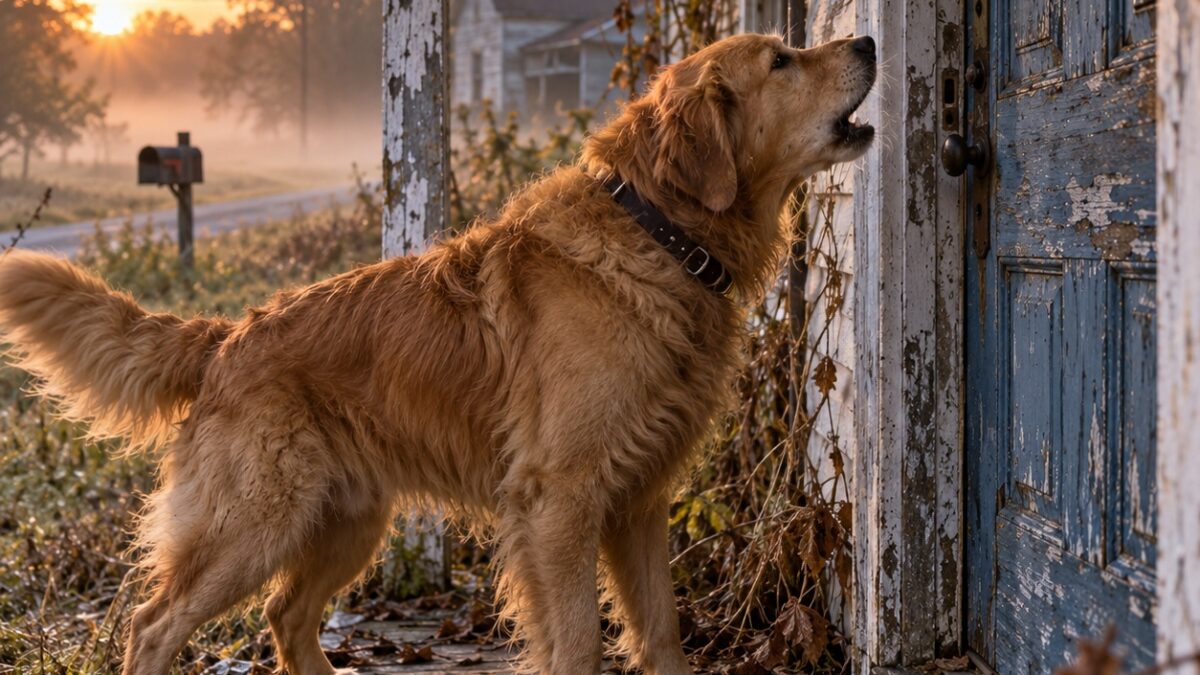
Her name was Emily Carter.
I didn’t learn that until the next afternoon.
That first day, I knew only what the paramedics told Mallerie within my hearing.
She was alive.
Severely dehydrated.
Underweight.
No obvious major injuries.
Shock.
She barely spoke.
When they wrapped her in a blanket and carried her through the hallway, Duke stood.
Emily immediately reached one hand toward him.
One paramedic paused.
“Can the dog come closer?”
Mallerie looked at me.
I nodded.
“Duke.”
He walked carefully.
No pulling.
No jumping.
He placed his head beneath Emily’s hand.
Her fingers closed in his fur.
She whispered something too soft for me to hear.
Then the paramedic carried her outside.
Duke followed until the ambulance doors closed.
He sat in the road watching the lights disappear.
Sheriff Mallerie stood beside me.
“How long?”
“Twenty-eight days.”
He looked at me.
“He’s been bringing you here twenty-eight days?”
“Yes.”
“And you never saw her?”
“No.”
“Anybody?”
“No.”
He stared at the house.
“Damn.”
That word pretty much captured my thoughts.
The Langley place filled with investigators.
Yellow tape crossed the porch.
Deputies searched every room.
I was sent home.
Reporters arrived before sunset.
Braden had fewer than six thousand residents.
A child discovered in an abandoned farmhouse was the kind of event that spread through town faster than weather warnings.
By dinner, everybody knew.
By nine, two television vans had parked near Oakley Road.
I refused every interview.
Duke refused nothing because people kept giving him treats.
“Hero dog!” one reporter called.
Duke wagged.
“Don’t let this go to your head.”
He ate another biscuit.
That night, he slept deeply.
For the first time in almost a month, no pacing.
No barking.
No staring at my door.
I didn’t sleep at all.
Every time I closed my eyes, I saw Emily.
The distance in her stare.
The way she reached for Duke.
Twenty-eight days.
That number became unbearable.
Had she been inside the whole time?
Had someone fed her?
Had someone entered while nobody watched?
Was Duke reacting to scent?
Sound?
Movement?
If I had believed him on day one, would we have found her sooner?
At two in the morning, I got out of bed.
Duke slept in the hallway.
“You tried.”
His tail moved against the floor without his eyes opening.
“I didn’t.”
That was what bothered me.
At 5:12, Duke nudged my hand.
I opened my eyes.
“No.”
He nudged again.
“Absolutely not.”
He walked to the front door.
“Duke.”
He looked at me.
“Emily is gone.”
No movement.
I sighed.
Twenty minutes later, we stood in front of the Langley house.
Police tape fluttered.
The door had been boarded temporarily.
Duke sniffed the porch.
Then sat.
Quiet.
I sat too.
“You done?”
No answer.
A cruiser approached.
Sheriff Mallerie stepped out.
“You planning to make this a career?”
“Ask him.”
Mallerie looked at Duke.
Duke looked back.
Mallerie sighed.
“I got two hours of sleep.”
“Show-off.”
He leaned against the porch rail.
“We found signs somebody had been using the cellar.”
“What kind?”
“Blankets.”
My stomach tightened.
“Food.”
“How much?”
“Enough to suggest she wasn’t completely abandoned.”
That should have relieved me.
It didn’t.
“Somebody put her there.”
“We think so.”
“Who?”
“Working on it.”
He rubbed his face.
“House belonged to Miss Langley. Cousin from Ohio cleared possessions.”
“You think he knew?”
“Interviewing him today.”
“What did Emily say?”
“Almost nothing.”
He looked at Duke.
“But she asked about your dog.”
My throat tightened.
“Can she see him?”
“We’re discussing it.”
Mallerie took out a notebook.
“I need an official statement.”
I gave one.
Twenty-eight mornings.
No people seen.
No vehicles regularly.
Then I remembered.
“Wait.”
“What?”
“A blue sedan.”
“When?”
“Couple nights.”
“Where?”
“Across from Langley.”
“Plate?”
“No.”
“Driver?”
“Couldn’t see.”
Mallerie wrote.
“Anything else?”
“No.”
He closed the notebook.
“I think somebody chose this house because nobody checks it.”
I looked at the boarded door.
“They almost got away with it.”
Mallerie glanced at Duke.
“Almost.”
Five days after Emily’s rescue, a state child-welfare SUV pulled into my driveway.
Duke was asleep beneath my kitchen table.
He stood before the vehicle stopped.
I opened the door.
A woman in a gray suit stepped out.
Then the rear door opened.
Emily sat inside.
Clean hair.
Thick cardigan.
Still pale.
Duke ran.
Not aggressively.
Joyfully.
Emily’s entire face changed.
“Duke!”
That startled me.
Nobody had told me she knew his name.
The social worker smiled.
“She heard it at the hospital.”
Duke placed his head across Emily’s knees.
She buried both hands in his fur.
The woman introduced herself as Caroline Webb.
“This visit is unusual.”
“I figured.”
“Emily hasn’t spoken much.”
She watched the girl.
“But she talks about Duke.”
We sat in my front yard.
I stayed several feet away.
Emily said almost nothing.
She stroked Duke.
Duke stayed still.
After fifteen minutes, Caroline said:
“We need to go.”
Emily hugged his neck.
Then she looked at me.
“You listened to him.”
Four words.
That was all.
I nodded.
“Eventually.”
“Thank you.”
Duke watched the SUV leave.
That evening, Mallerie called.
They had arrested Emily’s uncle.
His name was Curtis Vale.
Temporary guardian after Emily’s mother died.
He had reported her missing.
Claimed she ran away.
Investigators found his fingerprints in the Langley basement.
Receipts connected him to food left there.
Emily eventually told investigators he had said the house was “safe” and that she was supposed to stay hidden.
“Why?”
“Control,” Mallerie said.
“Money may be part of it. Benefits. Custody issues.”
“He left a child alone for weeks.”
“Yes.”
I looked at Duke.
“He would have gotten away with it.”
Mallerie didn’t answer.
We both knew.
After Emily, Duke stopped barking at the Langley house.
He still visited.
Sniffed.
Sat.
Then one morning, he turned away without prompting.
I thought it was over.
Two days later, at 6:14 a.m., he barked at my front window.
Different direction.
“Don’t.”
Another bark.
“Duke.”
He paced.
I pulled back the curtain.
Two houses beyond Langley stood the old Wilcox bungalow.
Empty for four years.
Or supposed to be.
The mailbox flag was raised.
Fresh tire marks cut across the dirt.
Duke stared.
My stomach sank.
“No.”
He barked.
“Absolutely not again.”
Ten minutes later, we were across the road.
The Wilcox place smelled like wet weeds and old paint.
Duke pulled toward the porch.
The blinds were closed.
I knocked.
“Hello?”
Nothing.
Duke barked.
A blind moved.
Barely.
I stepped backward.
Called Mallerie.
He sent a deputy.
The deputy knocked.
Walked around.
Nothing.
“House looks secure.”
“I saw movement.”
“Could be animal.”
Duke barked.
The deputy smiled.
“I know his reputation.”
That irritated me.
“Reputation didn’t rescue Emily.”
The smile disappeared.
He promised they would watch.
Next morning, Duke returned.
I brought coffee and muffins.
Not because I had suddenly become a social worker.
Because if somebody was hiding, I wanted them to know we weren’t a threat.
I placed the bag near the door.
“Whoever’s in there, I’m Eli. I live across the street.”
No answer.
“I’m leaving food.”
Duke sat.
We went home.
Three hours later, coffee untouched.
Muffins gone.
I called Mallerie.
This time he came himself.
By afternoon, they had legal authority for a welfare entry based on the circumstances, evidence of occupancy, and property status.
They opened the house.
A ten-year-old boy sat inside a back bedroom.
His name was Dylan Moore.
He had been missing from Illinois for five months.
His father disappeared around the same time.
Inside Dylan’s backpack was a sketch pad.
One drawing showed my house.
Another showed the Wilcox porch.
A third showed Duke.
Rust-red dog.
Floppy ears.
Sitting outside a door.
He had been watching us from the window.
“Why didn’t he come out?” I asked.
Caroline had joined the case because she already knew Duke.
“Fear.”
“Of us?”
“Of whoever told him not to.”
Dylan barely spoke.
But he smiled when Duke visited.
Once, he whispered something into Duke’s ear.
I didn’t ask.
Children deserve secrets dogs won’t repeat.
Mallerie became uneasy.
Two children.
Two vacant properties within half a mile.
Possibly unrelated.
But coincidence had started feeling lazy.
Then came Hannah.
The old Vance property sat at the north edge of town behind a sagging wooden fence.
Duke found it because I began changing our walks.
That part was my fault.
After Dylan, I started paying attention differently.
Abandoned house?
I watched Duke.
Boarded window?
I watched Duke.
Fresh tire marks?
Porch debris shifted?
I noticed.
For years, I had moved through Braden believing familiarity meant knowledge.
It didn’t.
You can drive the same street a thousand times and never actually look.
The Vance house had been empty at least six years.
Duke stopped at the fence.
Growled.
Then barked.
I did not knock.
I called Mallerie.
He arrived with Deputy Clare Benton.
Clare was thirty-two, sharp-eyed, practical, and apparently incapable of pretending Duke was magical.
“Dog smells something.”
“Probably.”
“Human scent?”
“Probably.”
“Could be raccoon.”
“He doesn’t usually involve sheriff departments in raccoons.”
She almost smiled.
The front door was slightly open.
Law enforcement entered.
We waited.
Then Mallerie shouted:
“Eli!”
Inside, they found twelve-year-old Hannah Pierce.
Missing three months.
Taken from a highway rest stop forty miles away.
Alive.
Terrified.
When Hannah saw Duke, she wrapped her arms around his neck.
He didn’t move.
Not even when she cried into his fur.
After that, state investigators joined.
Not FBI yet.
Not officially.
Three children could still be three separate crimes.
But property records revealed something disturbing.
All three houses had recently been vacant long-term.
All three sat close to old service roads.
All three had been accessed without obvious forced entry.
And all three children described being told variations of the same instruction:
Stay quiet.
Someone will come later.
Who?
Different adults.
Different names.
Emily described her uncle.
Dylan spoke of “a man from the road.”
Hannah couldn’t identify her abductor clearly.
Then Duke found Tessa.
That one changed the scale.
Behind the abandoned paper mill sat a rusted trailer half hidden among trees.
Duke bolted toward it.
I called Mallerie while running.
Law enforcement surrounded the trailer.
Before they could enter, the door burst open.
A man ran.
Deputies caught him three hundred yards into the woods.
Inside was five-year-old Tessa Monroe.
Missing from Wisconsin for four months.
Her family had held a vigil the night before.
The man in custody called himself Randall Pike.
Alias.
No fixed address.
He claimed Tessa was his niece.
She wasn’t.
During interviews, he admitted someone had paid him cash to “watch” the trailer.
He claimed he didn’t know the wider operation.
“What operation?” I asked Mallerie.
We were sitting in the sheriff’s office.
He looked exhausted.
“That’s what we’re trying to figure out.”
“Someone moved these kids.”
“Seems that way.”
“To empty properties.”
“Yes.”
“Why?”
“Because empty buildings don’t complain.”
That sentence stayed with me.
Tessa’s recovery made national news.
Reporters arrived again.
This time more.
Duke became “Braden’s Miracle Dog.”
I hated it.
Miracle suggested mystery.
Magic.
Luck.
It ignored the simplest explanation.
Duke paid attention.
The rest of us hadn’t.
I agreed to one short statement.
No interview.
I stood outside the sheriff’s department.
Duke beside me.
Cameras.
Microphones.
I said:
“My dog isn’t psychic.”
People laughed lightly.
“I’m serious.”
The laughter stopped.
“He smells things I don’t.”
“Hears things I don’t.”
“And unlike people, he doesn’t decide an abandoned building is empty because somebody told him it should be.”
I looked at the cameras.
“If there’s a lesson here, it isn’t that Duke is magic.”
“It’s that somebody should have listened sooner.”
Then I walked away.
That clip went everywhere.
My phone rang for three days.
I turned it off.
The FBI arrived after Tessa.
Agents spread maps across tables in Braden’s small municipal conference room.
Missing children across Indiana.
Illinois.
Ohio.
Wisconsin.
Cold cases.
Recent cases.
Vacant buildings.
Rail corridors.
Abandoned industrial properties.
I sat in the back with Duke.
I had no business being there.
Special Agent Nora Fields disagreed.
“You know the dog.”
“I feed the dog.”
“You recognize his behavior.”
“Yes.”
“That matters.”
“We are not turning him into a police dog.”
“No.”
She meant it.
“We are not using him for forced searches.”
“Good.”
“We may ask whether you’re willing to walk him in areas where we have independent reason to investigate.”
I looked at Duke.
Then maps.
“I’ll help.”
Mallerie said:
“With supervision.”
I looked at him.
“You sound like my mother.”
“Your mother had sense.”
“My mother once drove through a tornado warning to buy cigarettes.”
“More sense than you.”
Clare laughed.
Duke slept.
The next rescue happened outside Braden.
A farmhouse with a burned upper floor.
A local caller had reported hearing crying near the property.
Duke reacted at the cellar entrance.
Eleven-year-old Ben Salazar sat on an old mattress below.
Rope marks at his wrists.
Dehydrated.
Alive.
When paramedics prepared to leave, Ben whispered:
“I heard him.”
“Who?” Clare asked.
“The dog.”
Duke sat beside him.
“Every day.”
That didn’t make sense.
Duke had never been there.
Ben clarified.
“Not here.”
“Before.”
He had been moved.
Multiple locations.
At one earlier place near Braden, he heard a dog barking in the distance.
Then again after transport.
“Kept getting closer.”
That was probably coincidence.
Echo.
Different dogs.
But Ben believed it.
And belief had kept something alive in him.
After Ben, investigators stopped treating the buildings as isolated storage sites.
Someone was moving children through vacant properties.
Old homes.
Trailers.
Sheds.
Places overlooked because nobody had reason to enter.
A trafficking ring?
Kidnapping network?
One offender with helpers?
Nobody knew.
Duke kept noticing.
Some searches found nothing.
That mattered.
He barked at raccoons.
At one empty barn containing three feral cats.
At an abandoned gas station where a homeless veteran had been sleeping.
Duke was not infallible.
The news never reported those.
But investigators did.
They kept perspective.
Then he found Matthew in an old boxcar beside a disused rail spur.
That was the breakthrough.
Matthew was eight.
Missing 104 days.
Inside the boxcar:
Blankets.
Water bottles.
Canned food.
Children’s drawings.
One map.
Old freight routes.
Clare found a drawing beneath a mattress.
A red dog outside a door.
That made three rescued children who had either drawn or mentioned Duke.
Not because Duke had supernatural reach.
Because whoever was moving these children had been monitoring the news.
The rescued children heard about him.
Some had radios.
Some captors talked.
A story spread among frightened children:
There is a dog finding kids.
For adults, it was a headline.
For them, it became hope.
Special Agent Fields explained it later.
“Stories travel inside closed systems.”
“Prisons.”
“Camps.”
“Hostages.”
“Children share scraps.”
I looked at Duke.
“So they knew him before we arrived.”
“Some did.”
That explained the drawings.
Not everything.
But enough.
The boxcar provided another clue.
Rail maps.
I spent that night at my kitchen table.
Old tourist map.
Rail lines.
Rescue sites.
Duke asleep beside my chair.
I marked every location.
Langley.
Wilcox.
Vance.
Mill trailer.
Ben’s farmhouse.
Matthew’s boxcar.
Something appeared.
Not a perfect line.
But a pattern.
Most sat within several miles of abandoned freight routes or former rail service roads.
I called Mallerie at 2:11 a.m.
He answered:
“Someone better be dead.”
“Rail lines.”
Silence.
“What?”
“The houses.”
“Look at old freight routes.”
He woke up properly.
Next morning, federal agents compared my crude map with transportation records.
They already had similar suspicions.
Now evidence supported it.
One name appeared repeatedly.
Jared Colt.
Former freight operator.
Maintenance worker.
Contract laborer.
Route knowledge across Indiana and Illinois.
Fired ten years earlier after erratic behavior.
Arrested once for unlawful imprisonment of an adult acquaintance.
Charges reduced.
Drifter afterward.
His name appeared near two former employment sites close to rescue locations.
Then Randall Pike’s burner phone showed a contact linked to Colt.
The case changed.
From scattered kidnappings to hunt.
Colt knew abandoned rail infrastructure.
Empty structures.
Service roads.
Dead zones.
He knew how to move without being seen.
Investigators believed some children may have been taken by others, then transferred into his control.
Not every case fit.
Emily’s uncle appeared separate initially.
But phone records later suggested Curtis Vale had communicated with an intermediary associated with Colt.
That was the first connection.
He hadn’t invented the Langley house himself.
Someone had told him where he could hide Emily.
Someone who understood Braden’s empty properties.
Colt.
Duke hadn’t uncovered one crime.
He had stumbled into a system.
That realization frightened me more than anything.
Because systems are harder to see than monsters.
One bad man in a van?
People understand.
A chain of neglected properties, informal helpers, drifters, frightened relatives, and one organizer exploiting all of them?
That hides in ordinary gaps.
The places nobody owns emotionally anymore.
The buildings everybody assumes somebody else is watching.
The forgotten roads.
The abandoned tracks.
That was Colt’s world.
And Duke kept walking into it.
Rosie and Caleb were siblings.
Six and seven.
Taken from a campground near Bloomington.
We found them in a cabin along an abandoned spur.
Law enforcement accompanied us.
No improvising anymore.
I walked Duke.
Agents stayed back.
He stopped.
Barked.
Clare heard movement.
Inside were the children and a caretaker.
The man surrendered.
Rosie clung to Duke.
Caleb said:
“We knew you’d come.”
I crouched.
“How?”
“The dog.”
“Who told you?”
“The man said the dog keeps finding houses.”
The captor had been afraid of Duke.
That was almost funny.
Almost.
Duke had become psychological pressure.
Colt’s network began moving children more often.
Moving meant mistakes.
Vehicle sightings.
Dropped receipts.
Footprints.
Burned camps.
Investigators closed in.
Then Lily.
Ten years old.
Missing from across the state line.
An old shack in a field.
Duke barked.
She was unconscious from dehydration but alive.
Then Shawn.
Nine.
Abandoned gravel-pit trailer.
Alive.
Whoever had held him fled minutes or hours before.
Jared Colt’s prints were found.
“He’s running,” Mallerie said.
We sat at my kitchen table.
Map covered in red circles.
“He knows.”
“Yes.”
“About Duke.”
“Absolutely.”
I looked at my dog.
Duke was licking peanut butter from a spoon.
“He doesn’t look intimidating.”
“Tell Colt.”
The strangest part was my own life.
Three months earlier, I had been an unemployed mechanic wondering what to do next.
Now federal agents called my house.
My dog had a county liaison.
Children mailed drawings.
People left treats at my mailbox.
I hated attention.
But something else changed too.
Purpose.
I woke with somewhere to be.
Not because I enjoyed the search.
I didn’t.
Every found child meant somebody had suffered.
Every successful rescue made me wonder who remained hidden.
But I understood something I had forgotten after Davis Auto closed.
Being useful matters.
I had attached too much identity to a building with hydraulic lifts.
Mechanic.
Employee.
Provider for myself.
Then the shop vanished.
I felt pointless.
Duke didn’t care.
He needed breakfast.
Walks.
Attention.
Then children needed somebody to listen when he barked.
Maybe purpose isn’t a title.
Maybe it’s responding to what stands in front of you.
Emily began visiting Duke regularly.
She lived with a foster family outside Braden.
She looked stronger every month.
At first, she said little.
Eventually, she talked constantly.
Mostly about animals.
“I’m going to be a veterinarian.”
“That’s expensive.”
She frowned.
“You’re supposed to encourage me.”
“I’m encouraging financial planning.”
She rolled her eyes.
Duke loved her.
Dylan played soccer again.
Hannah lived with an aunt.
Tessa returned to her parents.
Ben entered long-term counseling.
Families began connecting privately.
Not through media.
Through social workers.
Duke became common ground.
One Saturday, several children met at a park.
No press.
No cameras.
Just families.
Duke walked into the grass.
Every child moved toward him.
I stood back.
Mallerie whispered:
“He remembers them?”
“I think so.”
Emily hugged Duke first.
Tessa grabbed his tail.
He looked at me for help.
“You’re the hero.”
His expression said heroism was overrated.
Then Noah disappeared.
Eleven years old.
Forty-nine days missing.
His case had not been connected strongly to Colt.
He vanished near Millbridge.
Duke led us to an old signal house beside retired track.
This time, the building contained evidence that terrified everyone.
Noah was upstairs.
Alive.
Beneath his mattress was a notebook.
Not his.
Lists.
Names.
Dates.
Town names.
Travel notes.
Some rescued children appeared.
Others were unfamiliar.
Missing cases.
Potential targets.
On the last page, someone had drawn Duke.
Rust-colored.
Standing outside a door.
Underneath:
HE KEEPS COMING.
Mallerie showed me.
My skin prickled.
“Colt wrote this?”
“Handwriting analysis pending.”
“He knows where I live.”
“We assume yes.”
That was when agents placed surveillance near my house.
I objected.
Fields said:
“Not optional.”
“Am I in danger?”
“You’ve interfered with him repeatedly.”
“Duke interfered.”
“Colt may not appreciate the distinction.”
That night, I locked every window.
Duke slept near the front door.
For the first time, I wondered if following him had been selfish.
Not toward myself.
Toward him.
He was a dog.
He didn’t consent to becoming bait.
The next morning, I told Fields:
“We stop.”
She nodded immediately.
No argument.
That surprised me.
“You sure?”
“Yes.”
“Good.”
“You wanted us to?”
“I wanted you alive.”
I looked down at Duke.
“He still walks.”
“Then walk normal routes.”
“No directed searches.”
“Agreed.”
For a week, nothing happened.
Duke walked around Braden.
School.
Creek.
Diner.
Home.
He seemed happier.
I was too.
Then I received a letter.
No return address.
Inside, one sentence:
YOU SHOULD HAVE KEPT FIXING CARS.
I called Mallerie.
Federal agents took it.
No prints useful.
No DNA immediately.
I did not tell Emily.
Or the other families.
Duke sniffed the envelope.
Growled.
That night, I barely slept.
Next morning, Duke pulled east.
Not toward any assigned search.
Toward the woods behind my house.
I stopped at the edge.
“No.”
He looked at me.
“No.”
He whined.
“Duke.”
He moved forward.
I called Clare.
“I think he has something.”
“Stay there.”
“I am.”
“You promise?”
“Yes.”
She arrived with agents.
We followed Duke together.
Not recklessly.
Weapons.
Radios.
Tracking.
The woods thickened.
Then the old bus appeared.
Rusting school bus.
Half sunk into mud.
Recent footprints around it.
Duke growled.
A man’s voice came from inside when I knocked.
“Don’t come in.”
My blood froze.
Clare raised her hand.
Agents positioned.
I called:
“It’s over.”
The man laughed weakly.
“They’re not mine.”
Jared Colt.
No question.
“I kept them safe.”
Clare shouted:
“Come out with your hands visible!”
“No more cages!”
“You kidnapped children.”
“The world kidnaps children every day.”
His voice sounded tired.
Not manic.
That was worse.
Normal language wrapped around madness.
“You don’t decide who belongs with their families!”
Silence.
Then:
“The dog followed me.”
I looked at Duke.
Colt said:
“All this way.”
The bus door opened.
He stepped out.
Gaunt.
Forties.
Torn jacket.
Hands raised.
Agents cuffed him.
Inside the bus was Ava Martin.
Seven years old.
Missing almost two months.
Alive.
Food.
Water.
Blankets.
Colt had not physically injured her severely.
That did not make him merciful.
Imprisonment is injury.
Fear is injury.
Stealing a child’s life is injury.
Ava came outside.
Saw Duke.
Reached for him.
He pressed against her.
She whispered:
“You came.”
I cried then.
First time through all of it.
Not dramatic sobbing.
Just tears I couldn’t stop.
Clare stood beside me.
“You okay?”
“No.”
“Good answer.”
Colt’s arrest broke the network.
Not instantly.
Nothing ends cleanly.
His journals led to other suspects.
Properties.
People who accepted cash.
Some claimed ignorance.
Some knew.
Curtis Vale’s connection became clearer.
Randall Pike cooperated.
Several cases were resolved.
Others remained open.
Duke did not find every missing child.
That mattered too.
The newspapers wanted the myth.
Dog rescues everyone.
Reality was harder.
Some children had died before we ever knew where to look.
Some cases had nothing to do with Colt.
Some families received answers they had spent years praying never to receive.
Fields once told me:
“Rescue stories make people believe finding is always happy.”
I understood.
Finding can mean reunion.
It can also mean truth.
Sometimes truth hurts worse than uncertainty.
But Colt was done.
That morning after his arrest, Duke woke before sunrise.
Walked to the door.
I braced myself.
“Where?”
He looked outside.
Then turned around.
Walked to his bed.
Curled up.
Slept.
I stood there laughing.
“You’re kidding.”
One eye opened.
“You drag me through half of Indiana for months and now you retire without notice?”
Tail thump.
“Union dog.”
He slept.
Sheriff Mallerie brought a framed certificate weeks later.
COUNTY COMMENDATION.
ELI HARPER AND DUKE.
“For extraordinary assistance leading to the recovery of missing children.”
I hung it in the hallway.
Not because I believed Duke understood awards.
Because I wanted visitors to ask about him.
And when they did, I wanted to tell the correct story.
Not miracle.
Not psychic dog.
Not supernatural guardian.
A dog paid attention.
A man finally listened.
Law enforcement responded.
Children survived.
Communities noticed.
That was enough.
The town held a ceremony anyway.
Duke received a gold-colored medal shaped like a bone.
GUARDIAN.
He immediately tried to chew it.
Emily laughed so hard she cried.
Ava slept against his side during speeches.
Dylan brought him a soccer ball.
Hannah brought flowers.
Ben stood quietly near the back.
Tessa wouldn’t let go of his collar.
Parents thanked me.
I kept saying:
“Thank him.”
Eventually one mother said:
“We are.”
She hugged me anyway.
Spring arrived.
Cornfields greened.
Windows opened.
Braden stopped being famous.
News vans disappeared.
That was a relief.
The Langley farmhouse sold.
A young couple renovated it.
Before moving in, they asked Emily whether she wanted anything from the house.
She said no.
Then changed her mind.
“The door.”
They removed the old blue front door before renovations.
It was cracked.
Peeling.
Ordinary.
Emily asked if the county could keep a small piece.
The sheriff’s office cut a six-inch square from it.
At Duke’s ceremony, she gave it to me.
“I don’t want it.”
“You should have it.”
“Why?”
“Because that’s where he barked.”
I looked at the blue paint.
Twenty-eight mornings.
“I didn’t listen soon enough.”
Emily’s expression became serious.
“You listened before everyone else.”
That wasn’t exactly true.
Duke listened first.
Still, I kept the wood.
It sits on a shelf beneath his commendation.
My job situation eventually resolved.
A friend offered me space at his farm equipment shop.
I started repairing tractors three days a week.
Enough.
I didn’t want sixty-hour weeks anymore.
Duke had changed my schedule permanently.
Morning walks mattered.
School visits mattered.
The rescued children’s families began asking whether Duke could participate in counseling support events.
We worked with professionals.
No pretending he was certified.
Eventually, we completed proper therapy-dog training.
Duke passed with embarrassing ease.
I struggled more.
The evaluator told me:
“He reads rooms better than you.”
“I fix transmissions.”
“Exactly.”
Duke started visiting Braden Elementary once a week.
Emily sometimes joined.
Children read to him.
Some were not connected to the case.
That was important.
Duke’s life after the rescues did not become a museum of trauma.
He became a dog again.
A therapy dog.
A bad fetch player.
A committed bacon thief.
A creature who snored loudly during story hour.
Years passed.
The rescued children grew.
Emily kept her veterinarian dream.
At fifteen, she volunteered at an animal clinic.
At eighteen, she graduated near the top of her class.
I attended.
Duke wore a bow tie.
He hated it.
Emily knelt beside him after the ceremony.
“You’re old.”
Duke sneezed.
“Don’t insult him,” I said.
“He is.”
“You’re rude.”
She hugged him.
“You’re still my hero.”
Duke had gone gray around the muzzle.
His hearing softened.
His hips stiffened.
He still checked doors.
Every building.
Every walk.
Not obsessive.
Just habit.
At school, he would pause outside storage rooms.
At the clinic.
At church.
At my house.
Sometimes he looked at a closed door until I opened it.
Usually nothing behind it.
He seemed satisfied anyway.
Just checking.
Mallerie retired.
Clare became sheriff.
At her swearing-in, Duke sat in the front row.
She pointed at him.
“That dog caused half my gray hair.”
Duke wagged.
“And saved my career.”
Mallerie whispered:
“She’s lying. The dog saved children. Her career survived despite her personality.”
Clare heard him.
Retirement did not protect him.
The FBI task force eventually published a report.
Colt received multiple life sentences.
Other participants were convicted.
Some charges related to kidnapping.
Conspiracy.
Unlawful imprisonment.
Child endangerment.
The network had been less organized than the media first claimed.
That mattered.
It wasn’t a giant secret syndicate run with military precision.
It was uglier in a mundane way.
Colt knew desperate, unstable, criminal people.
He provided locations.
Transportation information.
Places to hide.
Sometimes he took children himself.
Sometimes he helped others conceal them.
Sometimes people used his properties for their own crimes.
A loose network of opportunists.
No single motive.
Control.
Money.
Delusion.
Fear.
The common denominator was invisibility.
They believed empty places meant safe hiding places.
Duke destroyed that assumption.
Not alone.
But enough.
One autumn afternoon, years after Colt’s conviction, I sat beside Emily at a park.
She was twenty-one.
College student.
Pre-veterinary track.
Duke lay between us.
“You know what I remember most?” she asked.
“The house?”
“No.”
“What?”
“Hearing him.”
I looked at her.
“Before you heard me.”
She stared at Duke.
“I could hear him bark outside.”
“For twenty-eight days?”
“Not every day.”
“Why didn’t you answer?”
Her face tightened.
“My uncle told me people outside would hurt me.”
I said nothing.
“At first I believed him.”
She stroked Duke.
“Then Duke kept coming back.”
“How did you know it was the same dog?”
“I didn’t.”
She smiled faintly.
“But the bark sounded the same.”
“What changed?”
“I started thinking… if something keeps calling from outside, maybe outside isn’t all bad.”
That nearly broke me.
“So when you said help…”
“I had been trying to decide for days.”
She looked at me.
“You think you took too long.”
“Yes.”
“So did I.”
I turned.
“Emily—”
“We were both scared.”
She smiled.
“Duke wasn’t.”
Duke was asleep.
“I think he was too.”
She considered that.
“Maybe brave just means barking anyway.”
I laughed.
“Put that on a poster.”
She eventually did.
At the animal clinic where she volunteered, a framed photograph of Duke went on the wall.
Underneath:
BE BRAVE ENOUGH TO BARK ANYWAY.
I pretended to hate it.
I loved it.
Duke reached twelve.
Then thirteen.
Large dogs do not negotiate with time.
His walks shortened.
Therapy visits became occasional.
He slept more.
His once-rust-colored face turned gray.
Children who had known him as preschoolers became teenagers.
At fourteen, he developed arthritis.
Medication helped.
A ramp appeared beside my porch.
He refused it for two weeks.
Then discovered ramps required less effort.
Suddenly it became his idea.
Typical Duke.
One winter morning, Clare came by.
She was carrying an envelope.
“What?”
“Open it.”
Inside was a letter from Ava.
She lived in Wisconsin.
Sixteen now.
Dear Mr. Eli,
I don’t remember everything from the bus.
Some memories are clear and some are not.
I remember Duke.
I remember thinking his fur felt warm.
For years I slept with a stuffed dog beside me because of him.
I wanted you to know I’m doing okay.
I’m on the swim team.
I hate chemistry.
I want to study social work.
Please tell Duke thank you.
I read it aloud.
Duke’s hearing was poor, but he watched my mouth.
“See?”
Tail thump.
“You ruined another kid’s chemistry grade.”
Another thump.
Letters came occasionally.
Rosie.
Caleb.
Noah.
Some families wanted distance.
That was healthy too.
Not every survivor wants lifelong contact with symbols of the worst chapter of their life.
I respected that.
Ben never contacted us again.
Then one Christmas, a package arrived.
No return name.
Inside was a handmade leather dog collar.
Stamped:
DUKE
Below:
I HEARD YOU.
I knew.
I put it on Duke.
He wore it until the end.
His last year was quiet.
No missing-child cases.
No abandoned-house mysteries.
No reporters.
Morning sun.
Short walks.
Bacon.
Naps.
Emily visited during college breaks.
Clare stopped by.
Mallerie pretended he came to see me.
Duke knew better.
One evening, thunder rolled.
Duke lifted his head.
For most of his life, thunder hadn’t bothered him.
Now he stared toward the door.
I sat beside him.
“You hear something?”
His ears moved.
Nothing.
I opened the door anyway.
Rain.
Empty porch.
“No one.”
Duke stepped outside.
Stood under the awning.
Listened.
Then returned.
That became our ritual.
If he stared at a door, I opened it.
Always.
Even when I knew.
Because he had earned that.
The end came in spring.
He stopped eating breakfast.
That alone was enough to scare me.
Duke had regarded breakfast as a constitutional right.
I took him to the vet.
Kidney failure.
Advanced.
Medication.
Fluids.
Maybe time.
“How much?”
The veterinarian, Dr. Keller, looked at me.
“Could be weeks.”
I hated him for being gentle.
I brought Duke home.
Emily drove in from college.
Clare came.
Mallerie.
Children’s families sent messages.
I did not turn Duke’s dying into an event.
He didn’t need visitors lined around a bed.
He needed home.
Emily stayed.
For three days, we took turns sleeping near him.
On the second afternoon, she opened the front door.
Duke lifted his head.
“Want to check?”
His tail moved.
We helped him stand.
He walked slowly onto the porch.
Looked across the road.
The Langley house had been renovated years earlier.
White siding.
New windows.
Red flowers.
The blue door was gone.
A family lived there now.
Two children played in the yard.
Duke watched.
One child waved.
“Hi, Duke!”
His tail moved.
Emily cried.
“He remembers?”
“Probably smells their lunch.”
She laughed through tears.
Duke lay down.
We sat beside him.
“You know,” I said, “you caused me a lot of trouble.”
Emily looked offended.
“He saved everyone.”
“And ruined my sleep.”
Duke sighed.
“See? No remorse.”
That evening, he drank water.
Ate two bites of chicken.
Then walked to the hallway.
Sat before my front door.
I opened it.
Night air.
Crickets.
No emergency.
Duke stepped halfway through.
Stopped.
Looked back.
I crouched.
“What?”
He returned.
Lay beside my feet.
Maybe I assigned meaning where none existed.
Humans do that.
We need symbolism.
Dogs need comfort.
Still, I remember that look.
Not a warning.
Not urgency.
Something settled.
The next morning, he couldn’t stand.
Dr. Keller came to the house.
I had already decided.
That decision remains one of the worst kindnesses I have ever done.
Emily sat on one side.
I sat on the other.
Duke wore Ben’s collar.
Dr. Keller explained.
I barely heard.
I held Duke’s head.
“You did good.”
Emily whispered:
“You listened.”
Duke breathed slowly.
I said:
“You can stop checking now.”
His eyes stayed on mine.
“Doors are covered.”
Tail moved once.
I lost whatever strength I had.
“Good boy.”
The medication relaxed him.
His body softened.
No fear.
No pain.
Just Duke.
Then one final breath.
Stillness.
Emily pressed her forehead against his.
I covered my face.
For years, I had associated silence with danger.
Empty houses.
Children too frightened to call out.
Doors nobody opened.
That morning, silence meant something else.
Rest.
Duke had spent his life listening.
Finally, there was nothing left he needed to hear.
Braden buried him beneath a maple tree near my house.
I resisted a public memorial.
Lost.
Clare said:
“This one isn’t for you.”
Families came.
Not all.
Enough.
Emily spoke.
She was twenty-three then.
She stood beneath the tree holding the square of blue wood from the Langley door.
“I spent twenty-eight days learning not to trust the world.”
She looked toward Duke’s grave.
“And a dog spent twenty-eight days refusing to believe I wasn’t worth finding.”
Nobody moved.
“When people tell this story, they talk about what Duke heard.”
Her voice broke.
“But what saved me wasn’t only that he heard me.”
“He came back before I was brave enough to answer.”
I looked down.
“That matters.”
She placed the blue wood near the grave.
“Sometimes people need more than one chance to call for help.”
No dry eyes remained.
Even Mallerie.
He denied it.
Liar.
The county installed a small plaque later.
I wanted simple.
They listened.
DUKE
HE HEARD THEM.
WE LEARNED TO LISTEN.
That was enough.
After Duke died, my mornings collapsed.
No leash.
No nails.
No dog standing at the door.
I slept late accidentally.
Hated it.
The first Monday, I walked alone.
Automatically crossed toward the Langley house.
Stopped.
The new owner was watering flowers.
“Morning, Eli.”
“Morning.”
I stood near the curb.
“You okay?”
“No.”
He nodded.
Good neighbors understand when not to fix things.
I walked home.
At my door, I paused.
For four years, Duke had looked at closed doors differently after Emily.
So did I.
I began volunteering with Braden Search and Support, a community program created after the cases.
Not search operations.
Education.
Vacant-property reporting.
Missing-child awareness.
Safe surrender.
Neighborhood welfare checks.
People mocked us at first.
Then they didn’t.
We created a registry of abandoned properties.
Owners could authorize periodic inspections.
Police had better data.
Neighbors learned warning signs.
Mail accumulation.
Changed locks.
Unfamiliar vehicles.
Curtains moving in buildings assumed empty.
Nothing dramatic.
Boring systems.
Exactly what Braden had lacked.
The truth is, communities often fail through boring gaps.
Everybody assumes somebody else is responsible.
Duke had forced us to close those gaps.
Emily went to veterinary school.
She called the day she was accepted.
“I got in.”
“I told you that was expensive.”
“Eli.”
“I’m proud of you.”
She went silent.
“Really?”
“Obviously.”
“I wish Duke was here.”
“He’d ask whether the school serves bacon.”
She laughed.
Years later, Dr. Emily Carter opened a clinic forty minutes from Braden.
Logo?
A rust-colored dog silhouette beside an open door.
I complained.
“You’re exploiting my deceased dog.”
“You don’t own the trademark.”
“Outrageous.”
She named one exam room the Duke Room.
Used it for frightened animals.
Soft lights.
Floor mats.
No metal table unless needed.
Give them time.
Let them decide when possible.
She told me:
“He taught me scared doesn’t mean difficult.”
That may have been his greatest legacy.
Not the rescues.
The attention.
He taught people to question the label.
Empty house.
Runaway child.
Difficult dog.
Strange neighbor.
Nothing there.
We use labels because labels save time.
Sometimes labels cost lives.
Dylan became a teacher.
Hannah studied horticulture.
Tessa’s parents kept her mostly out of public life.
Rosie and Caleb sent Christmas cards.
Ava went into social work, just like she had written.
Noah joined the military.
Lily became a nurse.
Shawn became an electrician.
Matthew vanished from our lives by choice.
Ben too.
I hope they are well.
Their privacy belongs to them.
The public wanted a reunion special years later.
Money offered.
Documentary.
Everybody back in Braden.
I said no.
Clare said no.
Emily said:
“Absolutely not.”
Their lives were not entertainment owed to anyone.
Duke’s story had already been told too many times inaccurately.
According to one documentary pitch, he “tracked a nationwide child-abduction ring using supernatural instinct.”
No.
He was a dog with a good nose, good ears, persistence, and circumstances that allowed him to notice what people ignored.
Investigators did the rest.
Children survived the rest.
No magic required.
Real courage is impressive enough.
I aged.
That happens whether you solve mysteries or change oil filters.
At sixty, I reduced work.
At sixty-two, stopped completely.
Clare retired later.
Mallerie died at seventy-one after a stroke.
His funeral was packed.
I placed a photograph of Duke beside his casket because he had once joked:
“If that dog gets a bigger funeral than me, I’m coming back.”
Duke’s funeral had been smaller.
Barely.
I whispered:
“You win.”
Years after Duke, I finally adopted another dog.
I resisted.
Emily brought him.
“Absolutely not.”
“He needs a foster.”
“No.”
“Two weeks.”
“No.”
“He’s outside.”
“You brought him here?”
She opened my front door.
A black-and-white mutt entered.
One ear up.
One down.
He walked directly to Duke’s old bed—yes, I still had it—and lay down.
I stared at Emily.
“This is emotional manipulation.”
“Medical recommendation.”
“You are not my doctor.”
“Two weeks.”
His name was Sam.
He stayed eleven years.
Different dog.
Completely.
Sam barked at delivery trucks.
Feared vacuum cleaners.
Couldn’t find a sandwich on the floor unless somebody pointed.
Perfect.
I didn’t need another Duke.
Nobody does.
Replacement is the wrong idea.
Love doesn’t repair itself by copying what was lost.
Sam gave me another life.
His.
That was enough.
He never stared at abandoned houses.
Thank God.
But sometimes, if Sam barked at the door, I opened it.
Habit.
Always.
Once, Emily visited and noticed.
“Nobody there.”
“I know.”
“Then why open it?”
I shrugged.
“Just checking.”
She smiled.
Duke lived inside that phrase.
Just checking.
The city eventually demolished several abandoned properties.
Others were renovated.
The old Wilcox bungalow became affordable housing.
Vance property became a community garden.
Paper mill land was redeveloped.
The boxcar was removed.
The old signal house survived as part of a historical exhibit.
I visited once.
Hated it.
Too clean.
Informational plaques.
Photographs.
One paragraph mentioned the rescue.
Noah’s name omitted for privacy.
Good.
I stood in the hallway where Duke once barked.
Nothing dramatic happened.
That was healing.
Places lose their ghosts when life returns.
The Langley house mattered most.
On the twentieth anniversary of Emily’s rescue, she came back.
No ceremony.
Just her.
Me.
Clare.
We stood across the road.
The owners knew.
They invited us onto the porch.
Emily touched the new red door.
“Feels smaller.”
“You were eight.”
“I know.”
She looked toward the exact place Duke used to sit.
“You remember how many mornings?”
“Twenty-eight.”
“Still count?”
“Always.”
She smiled.
The homeowner’s little boy came outside holding a toy truck.
“Are you the girl?”
His mother looked embarrassed.
“Evan.”
Emily crouched.
“It’s okay.”
He asked:
“The dog saved you?”
“Yes.”
“How?”
“He was loud.”
The boy thought.
“My dog is loud.”
“Maybe listen.”
His mother sighed.
“Please don’t encourage him.”
We laughed.
Before leaving, Emily stood at the curb.
“Eli?”
“Yeah?”
“Do you still blame yourself?”
I knew exactly what she meant.
Twenty-eight days.
“Yes.”
She nodded.
“So do I.”
“You were a child.”
“You were human.”
“That sounds suspiciously forgiving.”
“I’m a veterinarian. We’re wise.”
“Expensive, you mean.”
She elbowed me.
Then became serious.
“Duke didn’t blame either of us.”
No.
He didn’t.
Maybe that was why his story stayed with people.
Dogs don’t waste much time building moral theories about fear.
They respond.
Smell smoke?
Move.
Hear crying?
Bark.
Person returns?
Tail.
Person leaves?
Wait.
We humans complicate survival.
Sometimes necessarily.
Sometimes not.
I finally stopped blaming myself.
Not because twenty-eight days didn’t matter.
They did.
Because guilt was not useful after accountability had done its job.
Accountability said:
Next time, listen sooner.
Guilt said:
Punish yourself forever.
Duke would have hated wasted time.
He liked walks.
I chose the walk.
Today, the plaque beneath Duke’s maple is weathered.
The letters still readable.
HE HEARD THEM.
WE LEARNED TO LISTEN.
Children in Braden know the story.
Mostly exaggerated.
According to one seven-year-old, Duke fought “ten kidnappers by himself.”
He did not.
Another claimed Duke could hear children across state lines.
Definitely not.
One believed he had laser eyes.
I objected least to that version.
My favorite retelling came from a boy at the elementary school.
I overheard him explaining Duke to a new student.
“There was a dog who kept barking at an empty house.”
The new kid asked:
“Why?”
“Because it wasn’t empty.”
That was it.
Whole story.
The dangerous thing wasn’t that the house looked abandoned.
The dangerous thing was that we let appearances become certainty.
Duke didn’t.
Closed door?
He smelled someone.
He barked.
We told him no.
He came back.
Again.
Again.
Again.
Until a frightened child found enough courage to whisper.
Help.
I sometimes wonder what would have happened if Duke got bored.
Dogs do.
What if bacon jerky had persuaded him permanently?
What if I took another route?
What if the auto shop stayed open and I left home before sunrise every morning?
What if I had been too busy?
Those questions lead nowhere.
The things that happened are enough.
My shop closed.
I had time.
Duke noticed.
I eventually listened.
Emily answered.
One chain of ordinary events.
That is how lives change.
Not always through destiny.
Sometimes because a man loses a job.
A dog smells something strange.
A porch board creaks.
Somebody waits twenty extra minutes.
I used to think purpose arrived dramatically.
A calling.
A career.
Marriage.
Children.
Big decisions.
Duke taught me purpose can be embarrassingly small.
Put on boots.
Clip leash.
Cross road.
Knock.
Listen.
Repeat.
Do the next thing.
That was all.
After Sam died, I did not adopt another dog.
Not because I stopped loving them.
Because I was seventy-four and finally capable of admitting large animals and aging knees were a bad combination.
Emily arranged a compromise.
Every Wednesday, I volunteer at her clinic.
My title:
“Retired mechanic who fixes everything except animals.”
I repair cage latches.
Cabinet hinges.
Leaky faucets.
Occasionally hold a nervous dog.
One afternoon, a shepherd mix came in.
Rust-colored.
Black muzzle.
Floppy ears.
My heart stopped.
Not Duke.
Of course.
Young dog.
Different eyes.
His owner apologized.
“He barks at everything.”
The dog stared at the exam-room closet.
Barked.
I laughed.
Emily heard from the hallway.
She walked in.
“What?”
“Nothing.”
Dog barked again.
Emily opened the closet.
Empty.
She looked at me.
“Satisfied?”
“Very.”
She rolled her eyes.
Then gave the dog a treat.
“Good job checking.”
I almost cried.
That is how legacy works.
Not monuments.
Habits.
Open the door.
Check.
Listen.
People have asked whether I believe Duke had some special ability.
I used to answer scientifically.
Nose.
Hearing.
Pattern recognition.
Now I answer differently.
“Yes.”
Then they lean closer.
I say:
“He didn’t assume.”
That was his ability.
Duke never assumed an empty-looking house was empty.
Never assumed a frightened child would call loudly.
Never assumed silence meant nobody needed help.
Never assumed because we had checked yesterday, nothing could change today.
He checked again.
Humans hate checking again.
We want closure.
Done.
Handled.
Empty.
Safe.
Solved.
Duke distrusted final answers.
Just checking.
The world could use more of that.
Not paranoia.
Attention.
There is a difference.
Paranoia sees danger everywhere.
Attention sees what is actually there.
Duke wasn’t afraid of every door.
He passed hundreds.
Thousands.
Most meant nothing.
When something changed, he noticed.
I learned to notice too.
A tire track.
A raised mailbox flag.
A moved blind.
A missing muffin.
A cough.
A sound.
Tiny evidence.
No miracles.
Evidence.
That is why I still correct people when they call the story supernatural.
Making it magic lets us off the hook.
If Duke was magical, ordinary people cannot do what he did.
But if Duke was attentive and persistent?
We can learn something.
We can notice.
Ask.
Report.
Check.
Listen.
That is harder because it gives us responsibility.
Emily once told me:
“People like miracles because miracles don’t require them to change.”
She had become annoyingly insightful.
Veterinary school apparently caused that.
She was right.
Duke required Braden to change.
Vacant homes were tracked.
Police welfare-check protocols improved.
Social services coordinated faster.
Residents learned where to report concern.
Schools trained staff on missing and exploited children.
The town did boring work.
That saved more people than Duke ever could.
One dog opened the first door.
People built better systems after.
That is how it should be.
Colt died in prison.
I learned from a newspaper article.
I felt nothing dramatic.
No triumph.
No hatred.
Just completion.
He had occupied enough space.
I folded the paper.
Threw it away.
That evening, I walked to Duke’s tree.
Sat on the bench.
“Colt’s gone.”
Wind.
Nothing.
“Thought you’d want to know.”
Of course Duke didn’t.
That was another human habit.
We imagine justice matters to animals.
Duke cared about immediate things.
Safety.
People.
Food.
Presence.
Maybe justice is what humans build so fewer immediate harms happen again.
That was enough.
At sunset, Emily joined me.
“You heard?”
“Yes.”
“How do you feel?”
“Old.”
She laughed.
“I meant about Colt.”
“Nothing.”
She nodded.
“Me too.”
We sat.
After a while, she said:
“Sometimes I thought I’d feel free when he died.”
“Were you not free before?”
She looked at Duke’s plaque.
“Yes.”
There.
That was the answer.
Freedom had arrived long before Colt’s death.
The day Emily walked out of the Langley house.
The day she returned to school.
The day she chose veterinary medicine.
The day she stopped being only “the girl Duke found.”
Survival became life.
That was the real ending for every child.
Not rescue.
After.
Too many stories end when the ambulance door closes.
Real life starts there.
Therapy.
Nightmares.
Court.
School.
Trust.
Anger.
Ordinary boredom.
First jobs.
Graduation.
Relationships.
Bad decisions.
Good ones.
Healing doesn’t look cinematic.
It looks like Emily complaining about organic chemistry.
Dylan missing a soccer penalty.
Ava hating chemistry too.
Hannah planting tulips.
Noah arguing with his father.
Ordinary life.
Exactly what was stolen.
Exactly what they reclaimed.
Duke helped find them.
They did the hard part afterward.
Whenever people called him a hero, I wished they would understand that.
Hero dogs are easy to love.
Survivors require patience.
They deserve it.
Twenty-five years after that first bark, Braden held a small anniversary gathering.
I almost skipped.
Emily threatened me.
“Your name is on the invitation.”
“Forgery.”
“You’re coming.”
Clare attended.
Older.
Still terrifying.
Several survivors sent letters.
A few attended.
No press allowed.
We stood beneath Duke’s maple.
Children from the current elementary school had painted little wooden doors.
Each one bright.
Blue.
Red.
Yellow.
Green.
On every door, one word:
LISTEN.
I pretended allergies were responsible for my eyes.
Emily spoke briefly.
Then she handed me the microphone.
“No.”
“You promised.”
“I absolutely did not.”
Everyone laughed.
I took it.
What do you say after twenty-five years?
I looked at the painted doors.
Then the blue piece from Langley’s original door displayed beside the plaque.
“I spent twenty-eight days telling a dog he was wrong.”
Laughter.
“He was gracious about it.”
More laughter.
“I used to think the important moment was when we finally opened that door.”
I looked at Emily.
“It wasn’t.”
She watched me.
“The important moment happened every morning before that.”
“When Duke came back.”
Silence settled.
“Because one knock may not be enough.”
“One question may not be enough.”
“One attempt to help may not be enough.”
“People in fear don’t always answer the first time.”
I swallowed.
“Sometimes they need to hear you come back.”
Emily cried.
So did I.
“Duke came back.”
“That is why she eventually answered.”
I lowered the microphone.
I could have stopped.
Then added:
“If someone or something you trust keeps telling you something is wrong, don’t abandon reason.”
I looked around.
“But don’t use reason as an excuse not to look.”
“Check.”
“Ask.”
“Listen.”
“And when you can, come back tomorrow.”
That became the last public thing I ever said about Duke.
It was enough.
Now, when morning fog hangs low over Braden’s fields, I sometimes see the old version of myself.
Forty-nine.
Unemployed.
Confused.
Boots half tied.
Dog pulling toward a house.
I want to shake him.
Listen sooner.
Then I remember.
He did eventually.
That has to count.
The Langley house still stands.
New blue door now.
Funny enough.
The owners repainted it years later without knowing the history of the original color.
When they told Emily, she laughed.
“Maybe it belongs blue.”
Maybe.
I pass occasionally.
No barking.
No secrets.
Just a family.
Bicycles on the grass.
Christmas lights.
Open curtains.
Life visible inside.
That is my favorite ending.
Not Duke’s medal.
Not Colt in prison.
Not documentaries.
A house that no longer hides a frightened child.
A door that opens normally.
A dog somewhere barking because the mailman exists, not because somebody is trapped.
Ordinary noise.
Ordinary life.
Duke spent his final years surrounded by that.
He earned it.
And every time I look at the square of chipped blue wood on my hallway shelf, I remember what Emily told me at the memorial.
Sometimes people need more than one chance to call for help.
That is why I no longer think the story began when she whispered through the door.
It began twenty-eight mornings earlier.
With a bark.
Then another.
Then another.
And a stubborn dog who refused to let silence convince him nobody was there.








