I Walked Into My Daughter’s House and Saw Her Trembling at the Sink—Five Minutes Later, Her Husband Stopped Smiling
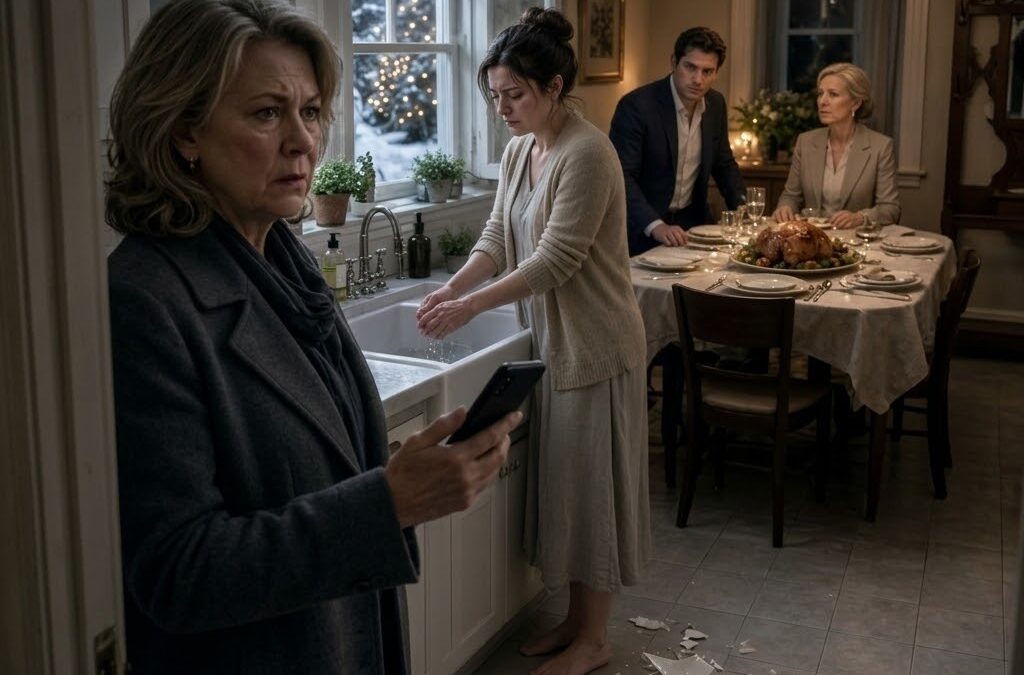
My name is Laura Hayes.
I was fifty-eight years old when I walked into that kitchen, and until that afternoon I had believed I understood the difference between a difficult marriage and a dangerous one.
I had been wrong.
My husband, Robert, had been dead six years.
Cancer.
Fast at the end.
Slow before that.
The kind of illness that teaches a family to measure time in test results and medication schedules instead of months.
Robert’s father had owned several modest rental properties around northern Illinois.
Nothing glamorous.
Duplexes.
Small brick houses.
A six-unit building in Evanston.
The house Emily lived in had been Robert’s childhood home.
A three-bedroom Tudor in a quiet neighborhood outside Chicago.
Stone around the front entry.
Old maple trees.
A kitchen Robert’s mother remodeled in 1998 and still complained about until the day she died.
When Robert’s father passed, the properties went into the Hayes Family Trust.
Robert and his older brother, David, were beneficiaries.
David was a real-estate attorney.
Robert hated paperwork.
You can imagine who became trustee.
Years later, when Robert became sick, he transferred his beneficial interest into a subtrust for me and Emily, but David remained trustee and legal title remained where it had always been.
After Robert died, Emily was twenty-five and trying to rebuild her life after spending almost a year helping me care for him.
Her apartment lease was ending.
David offered the house.
Not ownership.
Not inheritance yet.
An exclusive family occupancy agreement.
Emily could live there rent-free except taxes, insurance contributions, and utilities while building savings.
The trust remained the recorded owner.
The arrangement was intentional.
Robert had wanted Emily protected from selling too quickly, bad relationships, creditors, and her own occasional tendency to make emotional decisions when she loved someone.
Emily knew all of that.
So did I.
Mark did not.
At least, not at first.
To him, the house was simply “Emily’s place.”
I had never corrected him because it had never seemed relevant.
That afternoon it became the most relevant fact in the world.
David answered on the second ring.
“Laura?”
“I need you at Maple Street.”
Silence.
He heard something in my voice.
“What happened?”
“Emily’s husband is hurting her.”
David did not ask me what I meant.
That was one of the reasons I loved my brother-in-law.
“Police?”
“Not yet.”
“Do you need them?”
“Yes.”
“I’m four minutes away.”
“Bring the trust file.”
Another silence.
Then:
“Understood.”
I ended the call.
Mark pushed his chair back.
“What exactly do you think you’re doing?”
“Getting my daughter out of here.”
Emily whispered,
“Mom, please.”
I turned.
She looked terrified.
Not relieved.
Terrified.
“Emily.”
Her eyes moved toward Mark again.
“Please don’t make this worse.”
Those words were the first proof that what I was seeing had history.
Victims do not usually say, “Don’t make it worse,” about something that began five minutes earlier.
Mark stood.
“See?”
He gestured toward her.
“She doesn’t want your drama.”
I stepped between him and Emily.
He laughed.
“You’re serious?”
“Yes.”
“This is my house.”
“No.”
His smile faded.
“What?”
“You heard me.”
Vivian put down her wine.
“Laura, don’t embarrass yourself.”
I looked at her.
“I’m not the one who should be embarrassed.”
“This home belongs to my son and his wife.”
“No.”
Vivian’s expression hardened.
“They are married.”
“That doesn’t put Mark’s name on a deed.”
Mark stared at me.
“What are you talking about?”
Emily shut off the water.
Her hands shook so badly she struggled with the faucet.
I moved toward her.
Mark stepped sideways.
Not enough to block me completely.
Enough to send a message.
I stopped.
“Move.”
“Don’t come into my house giving orders.”
“It isn’t your house.”
“Stop saying that.”
He raised his voice.
Emily flinched again.
I saw it.
This time Mark saw me see it.
His face changed.
Just a flash.
He had been careless.
Vivian stepped in.
“Emily is overwhelmed because she refuses to accept normal expectations.”
I looked at her.
“Normal?”
“Yes.”
“She works all day.”
“So does Mark.”
“Mark was home today.”
“That’s irrelevant.”
“It’s apparently relevant to the dishes.”
Vivian smiled thinly.
“You always raised her to think she was special.”
“She is my daughter.”
“And that is precisely the problem.”
Emily whispered,
“Please stop.”
I looked at her hands.
There were small cracks around her knuckles.
Not from one evening.
Her skin looked raw.
“How long has the window been open?”
Nobody answered.
“Emily?”
Vivian said,
“She gets hot when she works.”
I looked at the December wind pushing the curtain inward.
“She’s barefoot.”
“Her choice.”
Emily’s eyes filled.
That was enough.
I walked toward her.
Mark stepped in front of me.
“Back off.”
I looked up at him.
Mark was thirty-four.
Six feet one.
Athletic.
Worked as a regional sales manager for a medical-equipment distributor.
He had always been polished.
Controlled.
The kind of man who remembered restaurant reservations and sent my birthday flowers exactly three days early.
I had liked him.
Not loved him.
But liked him.
I had believed Emily was safe.
I would spend years forgiving myself for that.
“Move.”
He lowered his voice.
“You don’t come into my marriage and tell me what to do.”
“No.”
I matched his tone.
“I came into the trust’s property and found my daughter shaking while you ordered her around.”
His jaw tightened.
“The trust?”
There it was.
He didn’t know.
Before I could answer, headlights crossed the front window.
A car door slammed.
Then another.
Mark glanced toward the hallway.
“Who did you call?”
“The owner.”
David entered thirty seconds later.
He was sixty-three then.
Tall.
Gray hair.
Dark wool coat.
Leather document folder beneath one arm.
Behind him came Officer Lucas Meyers, an off-duty lieutenant who lived three blocks away and had been with David when my call came.
David apparently called dispatch on the drive.
A marked patrol car was already on the way.
Five minutes.
That was all it took for the atmosphere in the room to change.
Vivian stood.
“Who are you?”
David looked at Emily first.
Then her hands.
The broken plate.
The open window.
Mark.
His face became stone.
“I’m David Hayes.”
Mark frowned.
“Laura’s brother?”
“Brother-in-law.”
David placed the leather folder on the table.
“Also trustee of the Hayes Family Trust.”
Mark stared.
“So?”
“So this property is owned by the trust.”
Silence.
Vivian laughed once.
“That’s absurd.”
David opened the folder.
“No.”
He removed a certified deed.
“It’s recorded.”
Mark looked toward Emily.
“You told me this was your house.”
Emily’s voice was barely audible.
“I said I lived here.”
“You said your father left it to you.”
“He did.”
David spoke.
“Beneficially.”
Mark snapped toward him.
“What the hell does that mean?”
“It means you do not own this house.”
“I’m married to Emily.”
“That also does not make you the owner.”
Vivian stood straighter.
“My son has established residence.”
David nodded.
“Possibly.”
The answer surprised her.
He continued.
“And tenancy rights, if any, will be handled lawfully.”
I watched Mark relax slightly.
Then David added,
“But if police determine domestic violence occurred, possession of the residence may be addressed through protective-order procedures long before anyone discusses ordinary tenancy.”
The patrol car stopped outside.
Mark’s face changed.
“Domestic violence?”
I pointed at Emily.
“Look at her.”
Everyone did.
That was the moment Emily broke.
Not dramatically.
Her knees simply seemed to stop holding her.
I caught her before she hit the floor.
She buried her face against my shoulder.
And whispered,
“I’m sorry.”
Those words destroyed me.
“For what?”
“I’m sorry.”
“No.”
I held her harder.
“No, sweetheart.”
Mark said,
“This is ridiculous.”
Officer Meyers turned.
“Sir, I’d recommend you stop talking for a minute.”
“I haven’t touched her.”
Emily went still against me.
Every person in that room heard the sentence.
Not:
I would never hurt her.
Not:
What are you accusing me of?
He said:
I haven’t touched her.
Officer Meyers caught it too.
“Who said you did?”
Mark opened his mouth.
Closed it.
The uniformed officers arrived.
A woman named Officer Patel and a younger man whose name I don’t remember.
They separated us.
That is how it should happen.
No group argument.
No family debate.
Emily went with Officer Patel into the living room.
Mark remained near the dining table.
Vivian protested.
David gave officers property documentation when asked.
I sat in the hallway.
Waited.
I could hear only pieces of Emily’s statement.
“…three months…”
Then:
“…not allowed…”
Then:
“…my paycheck…”
Then crying.
My stomach turned.
Three months.
They had been married eleven months.
Whatever was happening had not begun that night.
Officer Patel eventually came to me.
“Mrs. Hayes?”
“Yes.”
“Your daughter has injuries we’d like medically evaluated.”
My chest tightened.
“What injuries?”
“She’ll need to decide what she wants to share with you.”
“Is she safe?”
“Right now, yes.”
Right now.
That phrase became my entire world.
Mark was furious by then.
Not loud.
That would have looked bad.
Controlled.
He kept saying this was a “family misunderstanding.”
Vivian kept calling Emily “emotionally unstable.”
Then Officer Patel asked Vivian a simple question.
“Do you live here?”
Vivian said,
“I stay here when my son needs me.”
“How often?”
“That’s none of your business.”
“It becomes my business when I’m determining who is in a residence during a reported domestic incident.”
Vivian looked at Mark.
He said,
“She has a room.”
I stared at Emily’s hallway.
A room.
Vivian had moved in?
Nobody told me.
Officer Patel asked,
“How long?”
Mark hesitated.
“About seven weeks.”
Seven weeks.
Emily had spoken to me almost every day.
Seven weeks.
And never told me.
I felt sick.
That was when I understood how much effort it takes to hide abuse from people who love you.
It isn’t one lie.
It is hundreds.
I’m tired.
Work is crazy.
I can’t come over.
Mark needs the car.
My phone died.
Vivian is visiting.
We’re trying to save money.
Everything’s fine.
Every sentence closes one door.
Eventually the person outside doesn’t realize the house has become a prison.
An ambulance took Emily to the hospital.
I went with her.
David stayed to assist police and secure whatever needed securing.
Mark was not arrested that minute.
That disappointed a part of me.
The larger part understood investigations take facts.
Emily’s injuries included bruising around one wrist.
Older bruises on her upper arm.
A healing cut behind her shoulder.
Signs of dehydration.
Raw hands.
A mild burn on two fingers from hot dishwater earlier that week.
She had also lost fourteen pounds since her last physical.
I sat beside the hospital bed.
Did not ask.
That was difficult.
Every instinct wanted answers.
Who did this?
When?
Why didn’t you call?
Why didn’t you tell me?
Instead I held her coat.
A nurse photographed injuries with Emily’s consent.
When we were alone, she stared at the ceiling.
Then said,
“I knew you’d hate him.”
My heart cracked.
“Emily.”
“I knew.”
“That’s why you didn’t tell me?”
“Partly.”
“I would never hate you.”
“I know.”
“Then what?”
She closed her eyes.
“Because every time something happened, there was an explanation.”
I waited.
“The first time he grabbed my wrist, I was walking away during an argument.”
She swallowed.
“He said I made him panic.”
My hands clenched.
“The first time he took my debit card, he said we needed one person managing money because I was stressed.”
She looked at me.
“When Vivian moved in, it was supposed to be four days.”
“What happened?”
“She said her furnace broke.”
“For seven weeks?”
Emily laughed once.
Broken.
“I kept asking when she was leaving.”
“And?”
“Mark said I was making his mother feel unwanted.”
Of course.
Same pattern.
Control translated into guilt.
Emily continued slowly.
“Then she started correcting things.”
“What things?”
“How I cooked. How I dressed at home. When I slept. How much I ate.”
I felt nauseous.
“She would wake me early because she said married women shouldn’t sleep after their husbands.”
“Mark allowed that?”
“He liked it.”
The words were barely audible.
“He said I had become lazy.”
“You work forty-five hours a week.”
“I know.”
“What was tonight?”
Emily’s eyes filled.
“I came home late.”
“How late?”
“Twenty minutes.”
“From work?”
She nodded.
“Traffic.”
I closed my eyes.
“And the punishment was washing dishes in cold water?”
She didn’t answer.
That was answer enough.
“Why cold?”
“Vivian said hot water was for people who finished their responsibilities on time.”
I stood so fast the chair scraped.
Emily flinched.
Immediately I sat again.
“Sorry.”
“No, Mom.”
“I’m sorry.”
“I know.”
That tiny exchange nearly killed me.
She had learned to fear sudden movement.
My daughter.
I lowered my voice.
“Did Mark hit you?”
Silence.
Then:
“Not like you mean.”
There are sentences mothers remember forever.
That is one.
“What does that mean?”
“He pushed me.”
“When?”
“Sometimes.”
“Emily.”
“He grabbed me.”
“How often?”
“I don’t know.”
“Did he ever punch you?”
“No.”
“Slap you?”
She looked away.
I stopped breathing.
“When?”
“Once.”
“Once?”
“Twice.”
My fingers went cold.
“Why?”
The moment I asked, I hated myself.
Why.
As if there were a reason that could make it coherent.
Emily heard it differently.
She answered.
“The first time because I called him controlling.”
I swallowed.
“The second?”
“I locked the bedroom door.”
I turned away because I could not let her see my face.
For maybe ten seconds, I stared at the wall.
Then I turned back.
“This is not your fault.”
She cried harder.
“I know.”
“No.”
I leaned closer.
“You know the words.”
She looked at me.
“I need you to know the meaning.”
She covered her face.
I held her until she slept.
At 2:14 in the morning, David called.
I stepped into the hallway.
“What happened?”
“Police removed Mark temporarily pending further process.”
“How?”
“Emily’s statement, visible injuries, circumstances, and their procedures.”
“Vivian?”
“She left voluntarily with him.”
“Where?”
“Hotel, I think.”
“Can they come back?”
“Not tonight.”
“Tomorrow?”
“We need an emergency order.”
“I want them gone.”
“I know.”
“That house is yours.”
“The trust’s.”
“You know what I mean.”
“Laura.”
His voice softened.
“We still do this correctly.”
I hated correctly.
Correctly was slow.
Correctly did not satisfy a mother who had just learned her daughter had been slapped.
But David had spent forty years dealing with property and courts.
He knew what panic destroys.
“What did you find?”
He was quiet.
“What?”
“You sound strange.”
“Mark left papers in the office.”
“What papers?”
“Financial.”
I looked back toward Emily’s room.
“What financial?”
“Not over the phone.”
My stomach tightened.
“David.”
“Tomorrow.”
“Tell me.”
He exhaled.
“He has been trying to borrow against the house.”
I went completely still.
“He can’t.”
“No.”
“He knows now.”
“I don’t think he knew before tonight that he had no ownership.”
“What did he think?”
“That Emily owned it outright.”
“And marriage gave him access?”
“Possibly.”
I closed my eyes.
“There’s more?”
“Yes.”
“Tomorrow?”
“Yes.”
I wanted to argue.
Then Emily called my name weakly from the room.
“I have to go.”
“Stay with her.”
I did.
The next morning, Hannah—my younger daughter—drove down from Wisconsin.
She was three years younger than Emily.
Different in every possible way.
Emily was careful.
Hannah was a controlled explosion.
She walked into the hospital carrying coffee, took one look at Emily, and burst into tears.
Then she became furious.
“Where is Mark?”
“Not here.”
“I know. Where?”
“Hannah.”
“I’m just asking.”
“You’re not going near him.”
“I didn’t say I was.”
“You thought it.”
She stared.
“Fine.”
Emily actually smiled.
Small.
First time since I arrived.
Hannah sat beside her.
“I’m not going to ask questions.”
“Thank you.”
“I am going to say one thing.”
Emily waited.
“If you ever go back to him, I will still answer the phone.”
Emily started crying.
Hannah did too.
“I’ll hate it,” Hannah continued. “I’ll complain to Mom privately. I’ll probably break a chair. But I will answer.”
That was wiser than anything I had managed.
Abusers survive isolation.
Victims need doors that remain open even when we hate their choices.
Emily reached for her.
“I’m not going back.”
Hannah nodded.
“Good.”
No celebration.
No “thank God.”
Just good.
Because saying it once and sustaining it are different battles.
The emergency protective-order process began that day.
Emily gave another statement.
Medical evidence was documented.
Mark’s attorney appeared quickly.
Too quickly, in my opinion.
That should have told me something about his preparedness for conflict.
By afternoon, David came to the hospital carrying copies of documents.
“Ready?”
I looked at Emily.
She nodded.
David spread papers across the small visitor table.
The first was a loan application.
Mark Dalton.
Applicant.
The collateral section listed:
Residential property—Maple Street.
Estimated value: $1.14 million.
Estimated equity: $930,000.
Emily stared.
“What?”
David tapped it.
“He represented the property as belonging to the marital household.”
“Did he sign my name?”
“No.”
“Then how?”
“It looks preliminary.”
Another document.
A home-equity proposal from a private lender.
Another.
A draft personal financial statement listing Maple Street under “Family Real Estate Assets.”
Emily’s face drained.
“He told me he wanted to renovate.”
“When?”
“Two months ago.”
“What kind of renovation?”
“Kitchen. Bathrooms. He said we could refinance.”
I looked at David.
“He was trying.”
David nodded.
“Apparently.”
“Why?”
Next document.
A business named Dalton Clinical Solutions LLC.
Mark had formed it fourteen months earlier.
Three months before marrying Emily.
He had invested with a former colleague in a distribution venture for specialty rehabilitation equipment.
The company owed money.
A lot.
Not millions.
Enough.
Roughly $280,000 across private loans, credit lines, and vendor obligations.
Mark had personally guaranteed significant portions.
Emily stared.
“I didn’t know.”
“None?”
“He told me he had a side business.”
“That’s not a side business,” Hannah said.
David continued.
“Payments are behind.”
“How behind?”
“Enough that one lender filed notice of default last month.”
Emily pressed both hands against her face.
I remembered her ignoring calls.
The forced domestic service.
The money control.
Suddenly another shape appeared beneath the abuse.
Not explanation.
Motive for escalation.
“How much of Emily’s paycheck did he control?” I asked.
She lowered her hands.
“He moved my direct deposit.”
“To where?”
“Joint account.”
“When?”
“September.”
“Do you have access?”
“Yes.”
“Full?”
She hesitated.
“Technically.”
“What does technically mean?”
“He changed the password after I bought Hannah’s birthday present.”
Hannah stared.
“What?”
Emily looked ashamed.
“I spent $160.”
“You bought me the boots.”
“Yes.”
“From your salary?”
“Yes.”
“And he changed your bank password?”
“He said we needed to stop impulse spending.”
My vision blurred.
“Did he give you money?”
“Cash.”
“How much?”
“Usually sixty dollars a week.”
She earned almost seventy thousand dollars a year.
My daughter had been receiving an allowance from her own paycheck.
David’s face became hard.
“That’s financial control.”
Emily looked down.
“I know what it sounds like.”
“No,” I said.
“Stop doing that.”
“What?”
“Explaining the sound.”
She looked at me.
“If something happened, we don’t need to protect how it sounds.”
Silence.
Then she nodded.
We spent the next two hours reconstructing finances.
Mark had transferred money from the joint account into Dalton Clinical Solutions.
Emily had not understood several transfers.
One for $8,500.
Another $12,000.
Then smaller amounts.
Total: nearly $39,000.
Emily’s income had contributed.
“How did you not notice?” Hannah asked before catching herself.
Emily flinched.
Hannah immediately said,
“Sorry.”
“No, it’s fair.”
“No.”
Hannah shook her head.
“It isn’t.”
Emily stared at the papers.
“He handled bills.”
I knew that phrase.
It often sounds convenient until control becomes invisible.
David said,
“We’ll get account records properly.”
“Can she recover the money?”
“I don’t know yet.”
“Can Mark touch the house?”
“No.”
David answered that firmly.
“The trust owns it. Emily’s occupancy rights are separate. Mark cannot pledge the property.”
For the first time, I saw relief cross Emily’s face.
Then confusion.
“Why didn’t Dad give it to me directly?”
David looked at her.
“You know why.”
“I thought I did.”
“What did Robert say?”
Emily’s voice softened.
“That he wanted me to have a home nobody could take because I made one bad decision.”
David nodded.
My throat tightened.
Robert.
Dead six years.
Still protecting his daughter.
Not through magic.
Through planning.
Emily started crying.
“He knew I’d marry an idiot?”
Hannah laughed through tears.
“Dad was talented.”
Even David smiled.
I touched Emily’s hand.
“Your father didn’t know Mark.”
“No.”
“He knew life.”
The protective order granted Emily temporary exclusive possession and prohibited Mark from contacting her directly.
The trust’s ownership complicated nothing in the way Mark hoped and clarified almost everything in ours.
Vivian was also instructed not to contact or approach Emily under conditions tied to the order and later separate warnings after repeated attempts.
Mark’s first response was not apology.
It was outrage.
Through his attorney, he argued Emily had “weaponized family ownership” to force him from the marital residence.
David read that sentence aloud in his office.
I stared.
“Family ownership?”
“Yes.”
“He tried to borrow against property he didn’t own.”
“Yes.”
“And now ownership is being weaponized?”
“That appears to be the argument.”
Emily sat beside me.
For the first time, she looked angry instead of frightened.
“That house kept me from being trapped.”
David nodded.
“That was largely the point.”
Mark’s attorney requested financial disclosures.
Emily’s lawyer—David referred her to someone else because he did not want mixed roles—handled divorce proceedings.
Her name was Rachel Kim.
She was patient, unsentimental, and unimpressed by Mark.
I liked her immediately.
Rachel asked Emily one question during our first meeting.
“Do you want reconciliation?”
“No.”
“Do you need time before answering?”
“No.”
“Good.”
She closed one file.
“Then we proceed from there.”
Mark began sending apologies through permitted legal channels.
First:
He had been stressed.
Then:
His mother caused tension.
Then:
Emily misunderstood financial decisions.
Then:
He never intended to control her.
Then:
He had only slapped her because she had shoved him first.
Emily read that sentence.
Put the page down.
“What?”
Rachel asked.
“He says I shoved him.”
“Did you?”
“One time.”
The room went quiet.
“When?”
“The first slap.”
I felt my stomach drop.
Emily continued.
“He blocked the bedroom door.”
“Then?”
“I tried to get past.”
“Did you strike him?”
“No.”
“Push?”
“I put both hands on his chest.”
“To leave?”
“Yes.”
“What happened?”
“He slapped me.”
Rachel wrote.
“Then don’t let his wording become your memory.”
That sentence mattered.
Abusers love chronology without context.
She pushed me.
She yelled.
She disrespected my mother.
She spent money.
She came home late.
Each fact isolated until retaliation looks like a consequence rather than a choice.
Rachel taught Emily to describe sequence precisely.
He blocked the doorway.
I tried to move past.
He slapped me.
Facts.
Not excuses.
The criminal investigation progressed more slowly than I wanted.
Mark was eventually charged in connection with specific assaults supported by evidence.
Not every allegation could be proven.
That frustrated me.
Emily surprised me.
“It doesn’t have to prove every day.”
“What?”
“The case.”
She sat on my couch weeks later, wearing warm socks despite the heat being high.
“People keep acting like if one incident isn’t charged, it didn’t happen.”
She looked at me.
“I know what happened.”
That was growth.
Painful growth.
Vivian became another problem.
She called relatives.
Told them Emily had been “brainwashed by her mother.”
Told people Mark was a victim of an “anti-male legal system.”
Told one cousin I had orchestrated the entire thing because I never liked her son.
Then she posted something vague online about “modern wives destroying families because they refuse traditional values.”
Hannah sent me the screenshot.
I called Rachel.
“Can I respond?”
“No.”
“I have a very good response.”
“I’m sure.”
“Can Hannah?”
“No.”
“She also has excellent material.”
“I have no doubt.”
We stayed quiet.
That was torture.
Then Vivian made a mistake.
She came to the clinic where Emily worked.
Walked into reception carrying flowers.
Emily saw her from the hallway and froze.
Vivian said,
“We need five minutes.”
Emily turned.
Went directly into her manager’s office.
Called police.
Did not argue.
Did not explain.
Did not accept flowers.
That moment meant more to me than any court ruling.
Because the Emily I found at the sink would have worried about embarrassing Vivian.
This Emily protected herself before protecting someone else’s feelings.
Vivian was escorted away.
The incident strengthened enforcement of the no-contact provisions and ended most of her direct attempts.
Emily stayed with me initially.
She refused to return to Maple Street for almost a month.
That surprised everyone.
It was her home.
Safe now.
Locks changed.
Alarm codes changed.
Mark gone.
Vivian gone.
Still she couldn’t sleep there.
“The sink.”
She told me one night.
“What about it?”
“I see myself.”
I understood.
“Then don’t go back yet.”
“But I’m letting them take it from me.”
“No.”
I shook my head.
“You’re deciding when you return.”
She cried.
“There’s a difference.”
She began therapy.
Not because she was broken.
Because she had experienced months of conditioning that changed how she interpreted danger, guilt, and choice.
Her therapist, Dr. Shapiro, gave her homework.
Small autonomy.
Choose dinner without asking anyone.
Spend money on something unnecessary.
Turn the thermostat where she wanted.
Sleep late on Saturday.
These things sounded ridiculous.
They weren’t.
Mark had turned ordinary choice into permission.
Recovering meant rebuilding the muscle.
One Saturday, Emily drove herself to a bookstore and bought six novels.
She came home looking guilty.
“How much?” I asked.
“Hundred and twelve.”
“Okay.”
“That’s irresponsible.”
“No.”
“I already own books.”
“So?”
She looked at me.
Then laughed.
“I bought one because the cover was pretty.”
“Scandalous.”
We put them on the table.
She touched the stack as though it were contraband.
Her phone rang.
Unknown number.
She immediately tensed.
I did not ask who.
She looked at it.
Declined.
Progress.
The first time she returned to Maple Street, David met us there.
He had replaced the cracked-open kitchen window.
Not because it was broken.
Because Emily asked for one that locked differently.
She entered slowly.
Living room.
Dining room.
Kitchen.
The broken plate had been cleaned weeks earlier.
The wedding china remained in the cabinet.
Emily opened it.
Stared.
Then took every plate out.
“What are you doing?” I asked.
“I hate them.”
I almost laughed.
“They’re expensive.”
“I know.”
“I bought them.”
“I know.”
“You loved that pattern.”
“I did.”
Past tense.
She loaded the boxes.
Donated the whole set to a women’s transitional-housing organization.
“That feels wasteful,” I said.
Emily looked at me.
“Mom.”
“Right.”
I shut up.
She bought bright blue everyday dishes from Target.
Cheap.
Cheerful.
No history.
The kitchen changed.
She replaced the dining chandelier.
Closed the window.
Bought slippers.
That last one made me cry when she wasn’t looking.
Red slippers.
Thick.
Soft.
She left them beside the sink.
Mark’s business collapsed during the divorce.
Not because of us.
It was already collapsing.
That mattered.
He later tried to argue that losing access to household resources accelerated the failure.
Rachel’s response was simple.
“Ms. Hayes had no obligation to finance your business.”
The marriage had lasted less than a year.
Mark nevertheless demanded part of various accounts he believed were marital.
Some claims had legal basis.
Others did not.
The divorce became a financial autopsy.
Transfers.
Debts.
Income.
Business contributions.
Household expenses.
Every hidden decision came into light.
Emily recovered a portion of funds improperly transferred from joint accounts as part of the settlement structure.
Not all.
Money rarely returns perfectly once it has been spent.
She accepted that.
The house remained untouched by the marital dispute except for questions around occupancy, because it was trust-owned and had preexisting family documentation.
Mark hated that most.
During one deposition, Rachel asked him:
“When did you first learn Maple Street was owned by the Hayes Family Trust?”
“The night Laura brought police into my house.”
Rachel corrected him.
“Into the trust’s house?”
His attorney objected to the phrasing.
I almost smiled when Emily told me.
Then Rachel asked whether Mark had represented the property as an asset when seeking financing.
He admitted he had.
“On what basis?”
“My wife told me it was her family home.”
“Did she tell you she held title?”
“She said her father left it to her.”
“Did you review a deed?”
“No.”
“Did you ask?”
Silence.
“I assumed.”
That word appeared everywhere.
Assumed.
He assumed marriage gave access to her paycheck.
Assumed family property would become available.
Assumed Vivian could move in.
Assumed Emily would not leave.
Control thrives on assumptions the other person becomes too tired or frightened to challenge.
Then came the email.
The one that changed how Emily saw the financial part of her marriage.
Discovery produced a message Mark had sent Vivian four months before I found Emily.
If she’ll agree to refinance after Christmas, I can clear the private note and keep the business alive. She’s being stubborn because Laura fills her head with independence nonsense.
Vivian replied:
Once she has a baby she’ll settle down. Women stop thinking like single people when they understand family responsibility.
Mark:
We’re not having a kid until the money is fixed.
Vivian:
Then fix the wife first.
I read that sentence twice.
Emily did not.
Once was enough.
“Fix the wife.”
She put the email down.
For several minutes, none of us spoke.
Then Emily said,
“She knew.”
Rachel asked,
“Knew what?”
“That he was controlling money.”
I said nothing.
Emily continued.
“She wasn’t just difficult.”
“No.”
“She was helping.”
“Yes.”
“And Mark wasn’t just letting her.”
“No.”
“He wanted her to pressure me.”
Rachel nodded.
“That appears consistent with these communications.”
Emily stared at the table.
“That’s why she moved in.”
More emails supported it.
Vivian told Mark she could “get Emily organized.”
She suggested limiting discretionary spending.
She complained Emily “ate too much takeout.”
She told him to stop doing household chores because “if you keep rescuing her from responsibilities she’ll never become a wife.”
Mark responded:
She gets defensive if I tell her directly. Better from you.
A system.
Not two difficult people coincidentally treating Emily badly.
A system.
Mark wanted control.
Vivian supplied ideology.
Emily supplied labor and money.
When she resisted, they called resistance laziness.
When she protested, disrespect.
When she cried, manipulation.
When she tried to leave a room, aggression.
Language can build cages as effectively as locks.
The divorce settlement was finalized ten months after I walked into that kitchen.
Ten months.
It felt like ten years.
Mark relinquished any claim connected to occupancy at Maple Street.
Financial accounts were divided according to settlement terms.
Some transfers were repaid.
Some debts remained solely his.
Emily retained her own retirement and separate assets subject to applicable agreements.
Most importantly, there were no children binding them together.
I thanked God for that privately.
The criminal matter concluded later.
Mark accepted responsibility for enough of his conduct that Emily did not have to endure a full contested trial on every allegation.
There were court-ordered conditions.
Counseling.
Probationary consequences.
Restrictions.
I won’t pretend the outcome satisfied the mother in me.
The mother wanted thunder.
The law gave paper.
Dates.
Requirements.
Limits.
Emily gave me perspective.
“I got out.”
We were sitting in her kitchen when she said it.
Blue dishes in the cabinet.
Red slippers by the sink.
Window closed.
“I wanted him punished more.”
“I know.”
She looked at me.
“But I got out.”
I nodded.
“That’s the part I want to build around.”
So we did.
Vivian never truly apologized.
She sent a letter.
Six pages.
Four and a half were explanations.
Her childhood.
Her marriage.
Her sacrifices.
Her beliefs about family.
Somewhere near the end:
I am sorry if my efforts to help contributed to your distress.
Emily laughed.
Then shredded it.
“You want to keep it for evidence?” I asked.
“No.”
“Good.”
“Mom?”
“Yes?”
“I don’t need every bad thing documented forever.”
That was aimed at me.
I had become obsessive.
Screenshots.
Files.
Dates.
Certified copies.
Medical records.
I had watched David and Rachel save us with documentation and learned the wrong secondary lesson.
I began believing safety meant proof.
Emily taught me otherwise.
Proof helps after a boundary is crossed.
Safety also means living somewhere your boundaries are respected before evidence becomes necessary.
A year after the divorce, David asked Emily whether she wanted to change the occupancy arrangement.
“What do you mean?”
“You’re thirty-two.”
“I know.”
“The trust has options.”
He explained that under the plan Robert had created, certain assets could eventually be distributed outright if David determined conditions were appropriate.
Emily looked at me.
I stayed silent.
This was hers.
David continued.
“We could transfer Maple Street to you.”
Emily surprised both of us.
“No.”
David blinked.
“No?”
“Not yet.”
“Why?”
“Because Dad set it up this way for a reason.”
She looked around the room.
“I used to think ownership was the safest thing.”
Then:
“Now I think choice is.”
David smiled.
“Your father would’ve liked that.”
The trust remained owner for several more years.
Emily paid property expenses voluntarily.
Saved aggressively.
Changed jobs.
Her career improved after Mark was gone because she no longer arrived exhausted.
Within eighteen months, she received a promotion.
Her salary increased.
The first thing she bought was not jewelry.
Not a car.
A dishwasher.
A ridiculous one.
High-end.
Nearly silent.
She invited me over the day it was installed.
“You spent how much?”
“None of your business.”
I smiled.
“Correct answer.”
She loaded it.
Pressed start.
Then stood in the kitchen listening to almost nothing.
“You okay?”
“Yes.”
Her eyes filled.
“I just don’t want to wash another plate by hand for a while.”
I hugged her.
“Then don’t.”
Hannah gave her a plaque for Christmas.
It said:
DISHES ARE OPTIONAL. FREEDOM IS NOT.
Emily hung it in the pantry.
Dark humor returned before everything else.
I was grateful.
Therapy continued.
Some weeks good.
Some ugly.
Emily began dating only after two years.
The first man lasted three dates.
He made a joke about women being bad drivers.
She left before dessert.
I applauded.
She rolled her eyes.
“Mom, having standards doesn’t require fireworks.”
“It does in this family.”
The second lasted four months.
Nice man.
Not right.
The third was named Daniel Reed.
Civil engineer.
Divorced.
One daughter.
Quiet.
He met Emily at a volunteer food-bank event.
When she first told me about him, I tried not to interrogate.
Failed.
“What does he do?”
“Engineer.”
“Parents?”
“Mom alive, dad dead.”
“Relationship with mother?”
Emily stared.
“What?”
“Important question.”
“Healthy.”
“How do you know?”
“He doesn’t give her my house key.”
Fair.
Daniel met me six months later.
He was nervous.
Good.
Men should be slightly nervous meeting me by then.
We had dinner.
At one point, Emily got up to refill water.
Daniel stood.
“I’ll get it.”
She said,
“I can.”
He sat back down immediately.
“Okay.”
That tiny thing made me like him.
No insistence.
No performance.
He offered.
She declined.
Done.
Years earlier, Mark would have turned that into a referendum on whether she appreciated him.
Respect is often astonishingly boring.
That is its beauty.
Daniel never moved into Maple Street.
Not immediately.
When they discussed living together years later, Emily called David first.
Not because she needed permission emotionally.
Because she understood the property arrangement.
Daniel joined the meeting.
Asked questions.
Read everything.
At the end, he said,
“So if I live there, I don’t gain ownership rights in the trust property just because we’re together.”
David said,
“Correct, though residential rights can depend on circumstances and law.”
Daniel nodded.
“Seems fair.”
Emily cried in the parking lot afterward.
“Why are you crying?”
“Because he said it was fair.”
“That is a low bar.”
“I know.”
“Still.”
“I know.”
They married eventually.
Small ceremony.
Fifty people.
Blue flowers.
No fine china.
At the reception, Daniel’s mother, Susan, came to me.
“I’ve heard you’re the formidable one.”
I laughed.
“Who told you?”
“Emily.”
“That trait skips generations.”
Susan smiled.
Then said,
“I’m glad she trusts us.”
I looked toward my daughter.
She was dancing.
Not checking the room.
Not watching someone’s expression to decide whether she was allowed to be happy.
“I am too.”
The Maple Street house was finally transferred to Emily outright after she turned thirty-six and after she requested it.
Her choice.
David recorded the deed.
We had lunch afterward.
Emily placed a copy in a safe.
Then handed me a key.
“What’s this?”
“Spare.”
I hesitated.
She smiled.
“You are allowed to have it.”
That nearly broke me.
“Are you sure?”
“Yes.”
“Do I need to call before coming?”
“Yes.”
I laughed.
“Deal.”
That is what access should look like.
Given.
Clear.
Revocable.
Respected.
Not assumed because you are family.
Not taken because you married someone.
Not justified because you are a mother.
I never again used the spare key without permission.
Not once.
Years after Mark disappeared from our daily lives, I saw Vivian at a funeral.
A mutual acquaintance.
She looked older.
So did I.
We stood near the back of a church reception hall.
For a while, neither approached.
Then she did.
“Laura.”
“Vivian.”
She looked toward the floor.
“How is Emily?”
“Good.”
“Married?”
I hesitated.
Then nodded.
“To Daniel.”
“I heard.”
Silence.
Then Vivian said,
“I was wrong.”
Three words.
No explanation yet.
I waited.
“I thought I was protecting Mark.”
I said nothing.
“I thought a wife should… adapt.”
Still nothing.
Vivian looked at me.
“I taught him things I shouldn’t have.”
That was closer to an apology than the letter.
“What do you want me to say?”
“Nothing.”
“Then why tell me?”
Her eyes filled.
“Because I lost him too.”
“What do you mean?”
“Mark doesn’t speak to me.”
I was surprised.
“Why?”
“Therapy.”
She laughed bitterly.
“He decided I controlled him.”
I almost said something cruel.
Didn’t.
Vivian continued.
“He says I taught him love meant obedience.”
My throat tightened.
Maybe Mark had finally learned something.
Maybe not.
People can recognize one form of control while ignoring the harm they caused with it.
Still.
Change is rarely pure.
“I’m sorry,” I said.
Vivian stared.
“You mean that?”
“Yes.”
“I thought you hated me.”
“I did.”
“And now?”
I thought.
“I don’t spend enough time thinking about you to hate you.”
She almost smiled.
“That may be worse.”
“Maybe.”
Then she said,
“I am sorry for what I did to Emily.”
No if.
No but.
No explanation.
I nodded.
“I’ll tell her you said that.”
“Will she forgive me?”
“That’s not mine to answer.”
Vivian looked toward the exit.
“I understand.”
Maybe she finally did.
Emily’s reaction later was simple.
“I’m glad she got there.”
“Do you forgive her?”
“I don’t know.”
Then she laughed.
“I don’t really care if I do.”
That sounded harsh until she explained.
“Forgiveness used to feel like another assignment people gave me so they could be comfortable with what happened.”
I listened.
“I’m not angry every day. I don’t want revenge. I don’t want her in my life.”
She shrugged.
“If that’s forgiveness, fine. If not, fine.”
I understood.
Mark sent one letter years after the divorce.
Only one.
Emily showed me because she wanted to.
He had remarried briefly.
Divorced again.
His business never recovered.
He worked in sales for another company.
The letter said therapy had forced him to see how much of his marriage to Emily had been built around entitlement.
He apologized for violence.
Financial control.
Allowing Vivian into their marriage.
He wrote:
I used to think being respected meant no one resisted me. I understand now that what I wanted was obedience.
That sentence was the only reason Emily finished the letter.
He ended by saying he did not expect contact.
Emily folded it.
Put it back in the envelope.
“You okay?”
“Yes.”
“Do you believe him?”
She thought.
“I believe he believes it right now.”
That was wise.
“Does it matter?”
“A little.”
“Why?”
“Because if he actually changes, maybe nobody else stands at a sink because of him.”
I cried after she left.
Not because of Mark.
Because my daughter had reached a place where another woman’s future mattered more than punishing her past.
That is strength.
Not endurance.
Not taking abuse quietly.
Not keeping a family together.
Strength is building enough safety inside yourself that someone who hurt you no longer determines where your attention goes.
When Emily’s first daughter was born, I became ridiculous.
Completely.
Her name was Grace.
Daniel joked that the hospital should perform a security check before allowing me to leave with visitation privileges.
Emily made rules.
No kissing newborn’s face.
Call before visiting.
No posting photographs without permission.
I followed every one.
Happily.
One afternoon, when Grace was about two, I came over for lunch.
Emily was washing vegetables at the sink.
Warm water.
Red slippers.
Daniel was loading the dishwasher.
Grace sat in a high chair throwing peas.
Sunlight filled the kitchen.
Nothing dramatic.
I stood in the doorway.
Frozen.
Emily noticed.
“What?”
“Nothing.”
“You’re crying.”
“I’m old.”
“That’s not new.”
Daniel looked at me.
“You okay, Laura?”
I nodded.
“I’m fine.”
Emily followed my eyes to the sink.
She understood.
Her expression softened.
“Mom.”
“I know.”
She dried her hands.
Came over.
Hugged me.
Behind us, Daniel said,
“Grace just put a pea in her ear.”
Life.
Normal, ridiculous life.
That was the ending I had wanted without knowing how to name it.
Not Mark ruined.
Not Vivian punished.
Not the house saved.
Emily safe enough that a kitchen could become boring again.
After lunch, Grace dropped a plastic plate.
It bounced.
She laughed.
For one fraction of a second, Emily’s shoulders tightened.
Trauma leaves reflexes long after danger is gone.
Daniel noticed.
He didn’t touch her immediately.
He simply said,
“You good?”
Emily breathed.
Then nodded.
“Yeah.”
That was respect too.
Ask.
Don’t assume.
Years later, David retired as trustee after transferring the final assets.
He brought me the original family trust binder.
Thick.
Old.
Tabs everywhere.
Robert’s signature on several pages.
I ran my fingers across it.
“Funny thing.”
David looked up.
“What?”
“That night I called you, I thought this binder was going to destroy Mark.”
David smiled.
“Paper rarely destroys people.”
“What does?”
“The things they did before the paper was read.”
Natalie had once told someone else something similar.
Documents reveal.
They don’t create truth.
The truth already exists.
The trust did not make Mark controlling.
It exposed how much he had assumed.
The deed did not make Vivian cruel.
The kitchen did.
The protective order did not end Emily’s marriage.
Mark’s behavior did.
The law simply gave consequences shape.
When people hear the story, they usually love the phone call.
“I’m calling the real owner.”
That is the cinematic part.
The satisfying reversal.
Mark thought he ruled the house.
Then David arrived with a deed.
Five minutes.
World collapsed.
But that isn’t the part I think about most.
I think about Emily’s hands.
Red beneath freezing water.
Because that image taught me something no dramatic legal reversal ever could.
Abuse often hides behind ordinary tasks.
Dishes.
Budgets.
Keys.
Thermostats.
Clothes.
Groceries.
Phone passwords.
Who gets to sleep.
Who gets to sit.
Who apologizes.
Who is allowed to be tired.
Who decides whether a window stays open in December.
People imagine danger announces itself with broken doors and screaming.
Sometimes it sounds like:
“You’re overreacting.”
“You’re lazy.”
“My mother is only trying to help.”
“Why do you need your own bank account?”
“You made me angry.”
“Don’t embarrass me.”
“Stop washing dishes and bring more food.”
By the time a plate shatters, the prison may already have been built one small rule at a time.
I also think about my own mistakes.
I missed things.
Mark made jokes at family dinners about Emily spending too much.
I laughed once.
Vivian corrected how Emily served food at Thanksgiving.
I rolled my eyes afterward instead of asking my daughter privately whether this happened often.
Emily stopped wearing bright lipstick because Mark said it looked “desperate.”
I noticed.
Didn’t connect it.
She canceled two lunches.
Said she was busy.
I believed her.
I am her mother.
I loved her.
I still missed it.
For a long time, guilt consumed me.
Dr. Shapiro eventually recommended a therapist for me too.
I resisted.
“I’m not the victim.”
The therapist said,
“You’re still carrying something.”
Fair.
I learned that parents of abused adults often torture themselves with hindsight.
Why didn’t I know?
Why didn’t she tell me?
Why did I like him?
Why didn’t I force the issue sooner?
The answer is uncomfortable.
Adults are allowed privacy.
Healthy parents learn not to inspect every bruise, every silence, every marital conflict.
Abusers exploit that normal respect.
My therapist told me:
“You did not fail because you believed your adult daughter when she said she was okay.”
That took years to accept.
What mattered was what I did when reality became visible.
I believed her.
That sounds basic.
It is not.
Victims are questioned constantly.
Are you sure?
What did you do?
Maybe he was stressed.
Maybe his mother is old-fashioned.
Maybe you both need counseling.
Maybe don’t destroy your marriage over one bad night.
I never said those things.
One thing I got right.
I believed the flinch.
I believed the bruise.
I believed the whisper.
I believed my daughter before Mark had a chance to explain her out of her own story.
If I am proud of anything, it is that.
Emily later volunteered with a financial-abuse education program.
Not publicly at first.
Administrative work.
Then mentoring.
Eventually she spoke to small groups.
At one session, she held up a bank statement.
Not hers.
A sample.
She said,
“People ask why women don’t just leave.”
She paused.
“Sometimes leaving costs money you no longer control.”
The room went silent.
“Sometimes your car is in his name. Your paycheck goes into an account he passwords. Your family thinks you’re happy. Your friend stopped calling because he said she was a bad influence. You don’t know where your documents are. You haven’t made a decision alone in six months.”
She looked toward me in the back row.
“Leaving is not one movement toward a door. Sometimes it’s rebuilding the ability to believe you’re allowed to reach for the handle.”
I cried.
Of course.
Apparently that is what I do now.
Grace grew.
Then Emily had a son, Robert, named after her father.
Daniel never minded that she wanted the name.
Susan, Daniel’s mother, babysat often.
She always called before coming.
Every single time.
Even when Emily eventually said,
“You don’t have to.”
Susan answered,
“I know.”
Then kept calling.
Boundaries respected long enough become trust.
One Christmas, the entire family gathered at Maple Street.
Blue dishes.
A new table.
Kids running.
Daniel cooking.
Emily sitting.
Actually sitting.
I noticed because some part of me always would.
She had a glass of wine.
Her feet were tucked beneath her on a dining chair.
Red slippers.
Susan carried dirty plates toward the kitchen.
Emily called,
“Leave those.”
Susan smiled.
“You cooked yesterday.”
“Dishwasher.”
“Fair.”
Daniel loaded them.
Grace helped badly.
Robert dropped a spoon.
Everyone laughed.
I looked around.
The room where I once watched my daughter stand trembling had become warm for reasons that had nothing to do with the chandelier.
Safety has a temperature.
I know that sounds strange.
But it does.
That night, after everyone left, Emily and I sat at the table.
“Do you remember?”
She asked.
I didn’t pretend.
“Yes.”
“Every time?”
“No.”
That was true now.
“Sometimes.”
She nodded.
“Me too.”
She looked toward the sink.
“I used to think I’d have to sell the house.”
“Why didn’t you?”
“Because I didn’t want the worst thing that happened here to get the last vote.”
I smiled.
“That sounds like Dad.”
“Unfortunately.”
We sat quietly.
Then she said,
“You know what I remember most?”
“The plate?”
“No.”
“The water?”
“No.”
“What?”
“You saying, ‘Come here.’”
I felt my eyes burn.
“You couldn’t.”
“I wanted to.”
“I know.”
“I was scared if I moved, Mark would get worse.”
I reached across the table.
She took my hand.
“But when you said it, I remembered there was somewhere to go.”
That was the phone call before the phone call.
I had always thought David saved the house.
Maybe he did.
But before deeds.
Before police.
Before court.
There was one sentence.
Come here.
A doorway.
An invitation.
That is what people trapped in controlling relationships need most.
Not orders.
Not shame.
Not:
Why are you still there?
They need somewhere to go without proving they deserve the door to open.
Years after the original incident, David died peacefully in his sleep.
Seventy-eight.
I was beside Emily at his memorial.
His daughter handed Emily a small envelope.
“He left this for you.”
Inside was a copy of the original occupancy agreement Robert had created.
Attached was a handwritten note from David.
Your father believed a home should protect the person inside it, never imprison them. You proved him right.
Emily pressed the paper against her chest.
“He knew?”
“He knew everything by the end.”
We went to the cemetery afterward.
Robert and David were buried in the same family section.
Emily stood between the graves.
“Dad protected me.”
“Yes.”
“So did Uncle David.”
“Yes.”
“So did you.”
I shook my head.
“We all helped.”
She smiled.
“Stop being modest.”
“I am never modest.”
“True.”
We laughed in a cemetery.
Robert would have approved.
I’m seventy now.
Older than Vivian was that night.
That perspective is strange.
I understand fear differently.
Parenthood differently.
Even Vivian differently.
I can imagine how losing her husband when Mark was young may have made her cling too tightly.
I can imagine teaching herself that sacrifice entitled her to involvement.
I can even understand how control can disguise itself as devotion when practiced long enough.
Understanding is not excuse.
That distinction matters.
Vivian hurt Emily.
Mark hurt Emily.
Their histories may explain how they became people capable of doing that.
They do not transfer responsibility away.
Adults are responsible for what they do with the wounds they inherit.
Mark inherited control.
He repeated it.
Emily experienced control.
She interrupted it.
That is the difference between explanation and destiny.
Sometimes I sit with Grace now.
Teenager.
Smart mouth.
Emily’s eyes.
She knows a simplified version of the story.
Not everything.
One afternoon she asked,
“Grandma, did you really tell Grandpa Mark he didn’t own the house?”
“He wasn’t your grandpa.”
“You know what I mean.”
“Yes.”
“Was he shocked?”
“Very.”
She grinned.
“That’s kind of iconic.”
I laughed.
“Your generation uses words incorrectly.”
“No, we don’t.”
“You absolutely do.”
Then she became serious.
“Were you scared?”
I thought about it.
“Yes.”
“You didn’t look scared in Mom’s version.”
“People can be scared and quiet at the same time.”
She considered that.
“Why didn’t you punch him?”
I laughed so hard I coughed.
“Because I wanted to help your mother, not get arrested beside her.”
“Fair.”
Then she asked something that mattered.
“Could that happen to me?”
I looked at her.
“Anyone can end up in a relationship that changes gradually.”
She lost the grin.
“How do you know?”
“You pay attention to what happens when you say no.”
That was the simplest answer I had.
“Anybody can be charming when you agree.”
I continued.
“Pay attention when you disagree.”
Grace nodded.
I wished someone had taught all of us that younger.
Maybe we would still have made mistakes.
Most wisdom arrives too late to protect the person who earned it.
So you hand it forward.
That is all you can do.
Mark eventually remarried again.
I know only because Chicago is smaller than it pretends.
I heard he had a child.
I hoped therapy held.
I truly did.
Not for Mark.
For them.
Vivian died years later.
Emily attended no funeral.
Neither did I.
We sent flowers.
No message beyond our names.
Some relationships do not require final scenes.
No dramatic bedside forgiveness.
No reconciliation.
Sometimes closure is simply no longer needing another conversation.
The Maple Street house still stands.
Emily and Daniel eventually renovated the kitchen.
Completely.
When contractors removed the old sink, Emily called me.
“You want it?”
“Why would I want your sink?”
“Historical artifact.”
“Absolutely not.”
She laughed.
They replaced the tile.
Moved the island.
Installed larger windows.
The red slippers were long gone by then.
One thing remained.
A tiny dent near the baseboard where the plate had hit.
The contractor offered to patch it.
Emily said,
“Leave it.”
I asked why.
She shrugged.
“Not because I need the memory.”
Then she looked at me.
“Because I like knowing the room changed more than the dent did.”
I understood.
Healing is not restoring the world to the exact condition before harm.
You cannot.
Emily was not the woman Mark married.
I was not the mother who walked through that doorway.
The house was not the same house.
That did not mean damage won.
It meant life continued building around the mark until the mark became small.
People love the ending where I call David.
I understand why.
It feels good.
A cruel husband says, “My house.”
A mother calls.
The real owner arrives.
Boom.
Power reversed.
But the real collapse did not happen when David opened the deed.
Mark’s world collapsed when Emily stopped asking his permission to believe herself.
Everything after followed from that.
Police.
Lawyers.
Bank records.
Divorce.
Financial exposure.
The house.
Those were structures.
Emily’s real escape began the moment she looked at me in that hospital bed and admitted,
“He slapped me.”
Truth.
One sentence.
Then another.
Then another.
Truth rebuilt the road out.
If you asked me now what I saw that night, I would not say an abusive husband.
I would say a system.
A cracked window.
Cold water.
Bare feet.
A mother-in-law reinforcing humiliation.
A husband enforcing obedience.
Money hidden.
Access controlled.
Fear conditioned.
Isolation disguised as marriage.
Then one interruption.
Me.
Not because I was special.
Because systems built on secrecy are vulnerable to witnesses.
I walked in.
Saw.
Refused to reinterpret what I saw for their comfort.
That mattered.
The last time I stood alone in Emily’s kitchen was after Grace left for college.
Emily and Daniel were out.
I had stopped by to water plants because they were traveling.
With permission.
Always with permission.
I stood at the sink.
Warm water.
Looked through the closed window.
Snow outside.
The room quiet.
I remembered Emily’s red hands.
I turned off the faucet.
For a moment, anger returned.
Old.
Familiar.
Then it passed.
That surprised me.
For years, I thought letting go of anger would somehow excuse Mark.
It didn’t.
Anger had done its job.
It told me something precious was being violated.
Once safety returned, I did not need to carry the alarm forever.
I dried my hands.
Checked the plants.
Locked the door.
Then called Emily from the driveway.
“Everything’s fine.”
She laughed.
“Mom, you watered two plants.”
“One looked suspicious.”
“It’s a fern.”
“Exactly.”
“Love you.”
“Love you too.”
I drove home.
No emergency.
No police.
No deeds.
Just a mother calling her daughter because she wanted to.
That ordinary call meant more than the one everyone remembers.
Still, if you want the moment everything changed, I can give it to you.
Mark standing beneath the chandelier.
Vivian holding her wineglass.
Emily trembling beside broken china.
My phone against my ear.
David’s voice saying,
“I’m four minutes away.”
Mark asking,
“Who did you call?”
And me telling him:
“The actual owner.”
He thought I meant the house.
At the time, I did.
Years later, I understand the sentence differently.
Mark had spent months acting like he owned Emily’s time.
Her paycheck.
Her labor.
Her comfort.
Her body.
Her choices.
Vivian acted as though marriage transferred authority over my daughter to their family.
The deed proved they did not own the building.
But the harder truth was one no lawyer needed to record.
They had never owned Emily either.
And once she remembered that, there was nothing left for them to control.








