I Sacrificed $61,400 for My Family—Then a Secret Document Revealed Why They Needed Me Gone
For five years, I had sent my family an average of $850 every month.
Some months it was less.
Most months it was more.
The money began as a temporary favor after Dad’s construction company lost two major contracts. He told me he needed help covering one mortgage payment until a commercial renovation job started.
I sent $1,200 without hesitation.
The following month, Mom called to say the electric bill was overdue because Dad had used their remaining cash to pay his employees. I transferred another $600.
Then the transmission in Dad’s truck failed.
The water heater broke.
Their property taxes increased.
The roof developed a leak.
Kelsey needed textbooks for college.
Kelsey needed a security deposit.
Kelsey needed emergency dental work.
Kelsey needed money to repair her car after she backed into a concrete barrier.
Every crisis arrived with the same warning: if I didn’t help immediately, something irreversible would happen.
They would lose the house.
The power would be disconnected.
Dad’s business would collapse.
Kelsey would have to leave school.
Mom would go without medication.
At first, they thanked me.
Dad would call me his dependable girl. Mom would say she didn’t know how they would survive without me. Kelsey sent heart emojis and promised to repay every dollar after graduation.
Then gratitude slowly became expectation.
By the second year, Dad no longer asked whether I could send money. He told me the amount and the deadline.
By the third year, Mom cried if I hesitated.
By the fourth, Kelsey accused me of caring more about strangers in uniform than my own family.
I paid anyway.
I was deployed overseas twice during those five years. Other soldiers used their extra pay to replace old cars, eliminate debt, or save for homes. I transferred most of mine to an account my parents had opened when I was a teenager.
I ate in the dining facility instead of going out.
I postponed vacations.
I bought furniture secondhand and kept driving a twelve-year-old sedan with a failing transmission. Whenever it shuddered on the highway, I lowered the radio and silently promised it I would get it repaired after the next payday.
But the next payday always belonged to someone else.
I told myself sacrifice was what family meant.
My parents had fed me, clothed me, and kept a roof over my head for eighteen years. Dad reminded me of that whenever I questioned him.
“You think raising a child is free?” he once asked.
I was twenty-seven at the time.
He said it as if my birth had created an account I could never finish repaying.
The total came to $61,400.
I knew the exact amount because two nights before my family appeared at my door, I had sat at my kitchen table and added every transfer from five years of bank statements.
Sixty-one thousand four hundred dollars.
Enough for a substantial down payment on a house.
Enough to replace my car, build emergency savings, and pay off the small remaining balance on my student loan.
I had sent it home because I believed my parents were struggling to survive.
Then my mother accidentally emailed me the truth.
She had meant to attach a scanned insurance form. Instead, her message contained twelve pages titled:
CALLAHAN FAMILY REVOCABLE LIVING TRUST—SECOND AMENDMENT.
I almost deleted it without reading. My parents’ estate arrangements were none of my business, and I had never expected an inheritance.
Then I saw my name on the fourth page.
The original trust divided their estate equally between Kelsey and me.
The amendment removed me completely.
The house, Dad’s business assets, the investment accounts, and all remaining personal property would pass solely to Kelsey.
A handwritten note appeared beside the paragraph removing me. I recognized Dad’s heavy block letters immediately.
Erin is independent and has already built her own life.
I read the sentence repeatedly.
At first, I didn’t feel angry.
I felt embarrassed.
For years, I had believed my sacrifices made me a good daughter. Now I saw how my parents had interpreted them.
My ability to survive without help had become their excuse to give everything to the child who demanded the most.
Then I reached the financial schedules attached to the amendment.
My parents were not poor.
Dad’s construction company had recovered more than three years earlier. Their retirement and investment accounts contained almost $190,000. Their mortgage balance had fallen dramatically because much of the money I sent for supposed “shortages” had been used to pay down the principal.
They had allowed me to believe foreclosure was always one missed payment away while using my money to protect the house Kelsey would inherit.
There was also a new pickup truck listed as a business asset.
Dad had told me the old truck needed another repair. He had requested $2,700.
He had used part of that money as a down payment on a new vehicle with leather seats, a premium sound system, and a price greater than my annual take-home pay during my first years in the Army.
I called Mom that evening.
She answered cheerfully.
“Did you get the insurance form?”
“You sent me the trust amendment.”
The silence that followed told me more than any confession could have.
She wasn’t confused.
She wasn’t surprised.
She was frightened because I had learned something I was never supposed to know.
“You weren’t meant to see that,” she whispered.
“Is it real?”
“Your father handles those documents.”
“Is it real, Mom?”
She released a slow breath. “Yes.”
I stared at the page removing my name.
“Why?”
“It isn’t what you think.”
“Then tell me what it is.”
“You don’t need an inheritance, Erin. You have a stable career.”
“Kelsey has a job.”
“She works part-time.”
“Because she keeps quitting.”
“She’s still finding herself.”
Kelsey had spent five years finding herself in beach rentals, expensive restaurants, and music festivals she somehow afforded while asking me to cover her car insurance.
I opened my bank records.
“Was the mortgage ever in danger?”
“Your father worries about money.”
“That wasn’t my question.”
“We never forced you to help.”
The lie was so effortless that I laughed.
“You told me you would be homeless.”
“We could have been.”
“You had investments.”
“Those accounts are for retirement.”
“And my money was for what?”
Mom didn’t answer.
I heard Dad’s voice in the background.
A moment later, he took the phone.
“You had no right to read private legal documents.”
“Mom sent them to me.”
“By accident.”
“So if I hadn’t seen them, how long would you have let me keep paying?”
His voice became sharp. “This family supported you for eighteen years.”
“I’ve sent you more than sixty-one thousand dollars.”
“You think that repays us?”
The question reached into the oldest wound I carried.
Dad had always kept score.
When I was twelve, he told me how much my braces cost.
When I was sixteen, he calculated the price of the food I ate each week after I asked for money to attend a school trip.
When I enlisted at nineteen, he said I had wasted everything he invested in raising me.
“You removed me because I joined the Army, didn’t you?” I asked.
“We removed you because you abandoned this family.”
“I was nineteen. I enlisted because you said there was no money for college.”
“You still made your choice.”
“And now I’m making another one.”
While he continued talking, I opened my banking application.
I canceled the automatic transfer.
Then I blocked his number.
Two days later, he stood in my living room demanding my debit card.
“You erased me from your trust while treating me like an ATM,” I said.
Mom grabbed my arm.
“Don’t punish the whole family because of some paperwork.”
I pulled free.
“The paperwork proved you lied to me.”
“We did what was best for everyone.”
“For everyone except me.”
“You have the Army,” she said, as if that institution were a substitute for parents. “Kelsey needs protection.”
Kelsey walked toward my desk.
“I don’t have time for this. Just give us the card and tell Dad the PIN.”
I moved between her and the desk.
“Don’t touch anything.”
She rolled her eyes. “I’m not stealing from you.”
“You broke into my apartment.”
“Dad opened the door.”
“He ripped the chain out of the wall.”
“You’re being dramatic.”
She attempted to step around me.
I blocked her again.
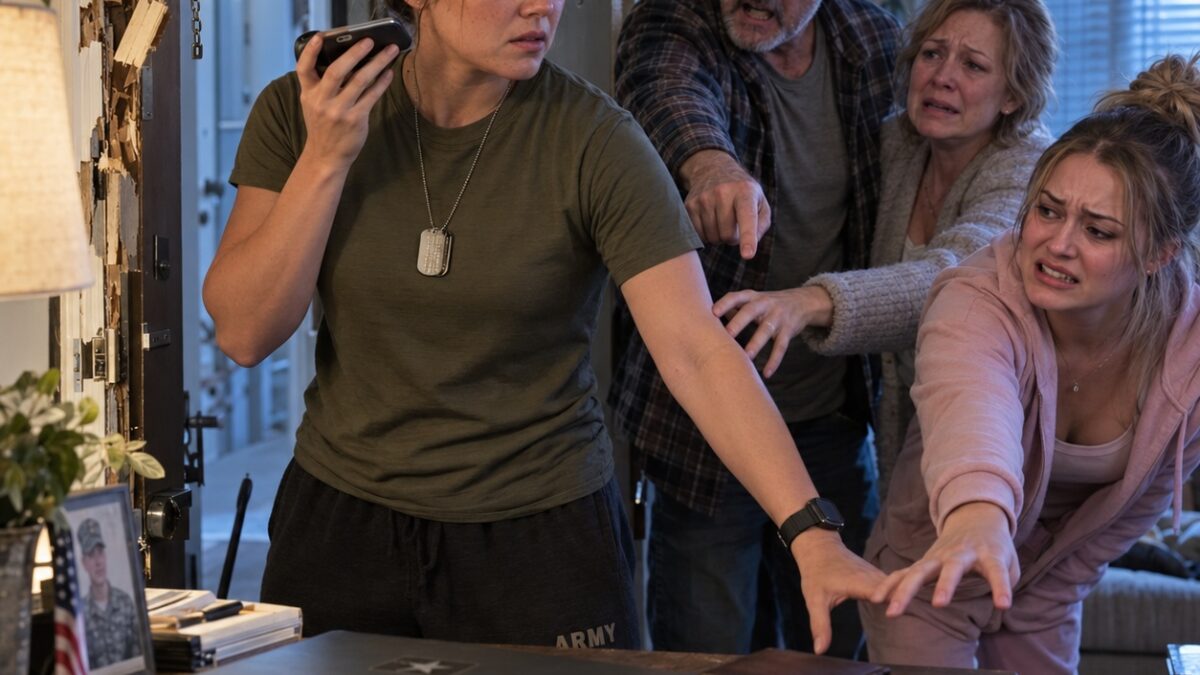
My wallet was beside my government-issued laptop. The computer held no classified information, but it contained controlled Army files, logistics schedules, and personally identifiable information protected by multiple regulations. If Kelsey touched or damaged it, I would have an entirely different problem.
She lunged toward the desk.
I caught her wrist.
“Let go of me!” she screamed.
“That laptop is government property.”
She scratched the back of my hand with her nails.
Dad shoved me with both palms.
I flew backward into the bookshelf. A framed photograph from my promotion ceremony fell and shattered beside my bare feet.
Mom wrapped one arm around my waist while screaming that I was hurting Kelsey.
For one confusing second, all three of them were grabbing at me.
My mind knew they were my family.
My body registered attackers.
I broke Mom’s hold and stepped between Kelsey and the desk again.
Then I removed my phone from my pocket.
“I’m calling 911.”
Dad froze.
The anger on his face did not disappear. It changed shape, becoming colder and more deliberate.
“You would actually call the police on your own family?”
“You forced your way into my apartment and assaulted me.”
“I’m your father.”
“That doesn’t make this legal.”
I dialed and placed the dispatcher on speakerphone.
I gave her my name, address, and the nature of the emergency.
“My family forced entry into my apartment,” I said. “They have been physically aggressive. There are three people.”
“We’re not leaving,” Dad said loudly enough for the dispatcher to hear.
“Ma’am, do you see any weapons?” she asked.
“No visible weapons.”
Mom began pulling Kelsey toward the hallway.
Kelsey resisted for a moment, still glaring at my wallet, before allowing herself to be led away.
Dad remained in the shattered doorway.
“You really think that uniform will protect you?” he asked. “I’ll call your command.”
“Leave.”
“I’ll tell them you have PTSD. I’ll say you’re unstable and dangerous.”
“Everything you’re saying is being recorded.”
He smiled at me.
“Then record this. By Friday, you won’t have a career anymore.”
He stepped into the hallway and disappeared around the corner.
I told the dispatcher they were leaving, but she said officers had already been sent.
I set my phone near the entrance and checked the Army laptop.
The security seal was intact.
My wallet was still there.
The door hung crookedly from one hinge, and a strip of splintered wood lay across the floor.
When I looked down, I noticed blood on my heel where I had stepped on a piece of broken glass.
The first police officers arrived seven minutes later.
I showed them the damaged door, the bruise forming on my cheek, the scratches on my hand, and the red marks across my waist and shoulder.
One officer photographed everything.
The other asked whether I wanted to press charges.
I hesitated.
That hesitation embarrasses me now, but at the time it felt instinctive.
Pressing charges against strangers would have been easy.
Pressing charges against my father, mother, and sister felt like taking a knife to the final threads connecting me to childhood.
“I want the incident documented,” I said. “I need time to decide about charges.”
The older officer studied me.
“Staff Sergeant, people who force their way into your home once often return.”
“I understand.”
“Do you?”
I looked toward the broken frame on the floor.
“I don’t know.”
The apartment manager replaced the lock around noon. Before leaving for work, I photographed every room and emailed the pictures to myself.
I informed my chain of command that a family dispute had resulted in police involvement. I gave Captain Maya Torres the incident number and summarized what had happened.
She listened without interrupting.
Captain Torres was forty years old, with a controlled voice and dark eyes that made careless soldiers confess mistakes before she asked a question. She had commanded our company for eighteen months and knew enough about my family to recognize the names, though not the history.
“Do you believe your father will contact the unit?” she asked.
“He threatened to.”
“What will he say?”
“Anything that might damage me.”
“Is there anything specific we should anticipate?”
“No, ma’am.”
At the time, I believed honesty was enough.
I didn’t know my family had already moved beyond accusations.
Two mornings later, someone knocked on my new door.
The sound was measured and professional.
I looked through the peephole.
A county deputy stood outside. Two Military Police soldiers waited behind him.
Captain Torres stood at the rear of the group.
She would not look directly at me.
I opened the door slowly.
“Staff Sergeant Erin Callahan?” the deputy asked.
“Yes.”
“I’m Deputy Mark Harlan. Your family reported that you pointed a handgun at them during the incident two mornings ago and threatened to kill them.”
For several seconds, I could only stare at him.
“I don’t own a handgun.”
“They provided three sworn statements.”
“That never happened.”
One MP moved to the side, positioning himself behind me. The other held up a search warrant.
My heartbeat slowed in the unnatural way it sometimes did before genuine danger.
“What exactly are you searching for?”
“A black nine-millimeter semiautomatic pistol.”
“There is no firearm in this apartment.”
Deputy Harlan entered.
The MPs separated. One headed toward the bedroom while the other checked the kitchen.
Captain Torres remained near the doorway.
I wanted her to look at me.
She didn’t.
Harlan passed my desk, glanced inside the entryway closet, and moved directly toward the couch.
He didn’t search beneath it.
He didn’t look behind it.
He approached the right side, pulled on a black glove, and reached into the narrow gap between two cushions.
When his hand emerged, he was holding a black handgun.
The room seemed to contract around it.
“That isn’t mine.”
He removed the magazine and checked the chamber.
Loaded.
“Turn around,” he ordered. “Put your hands behind your back.”
“I have never seen that weapon.”
“Turn around.”
“Someone planted it.”
One of the MPs stepped closer.
“Sergeant, follow his instructions.”
I looked at Captain Torres.
“Ma’am, that gun was not in my apartment.”
Her expression remained controlled, but I saw conflict in her eyes.
“Comply with the deputy, Callahan.”
I turned.
The metal cuffs closed around my wrists.
I had spent eleven years earning the Army’s trust. I had been responsible for millions of dollars in equipment, sensitive paperwork, ammunition shipments, and the lives of soldiers under my supervision.
Now I was led from my apartment while neighbors watched through half-open doors.
I remember every sound from that hallway.
The rhythm of boots behind me.
The deputy’s radio crackling near my shoulder.
The whisper of a woman across the hall.
A small boy asking his mother why the Army lady was being arrested.
Outside, morning fog lay across the parking lot. The air smelled like rain and wet pine.
As the deputy guided me toward his vehicle, I noticed a silver Honda parked across the street.
Kelsey owned an identical car.
Its lights came on.
The vehicle pulled away.
“There,” I said. “That may be my sister.”
Harlan barely looked. “Keep moving.”
“She was watching my apartment.”
“Sergeant,” one of the MPs warned.
I said nothing more.
At the county detention center, they took my belt, shoelaces, identification, and fingerprints. They photographed me against a stained wall and placed me in a holding cell that smelled of disinfectant, sweat, and old fear.
The heavy door closed.
For the first time since the police arrived, I was alone.
I sat on a narrow bench and forced myself to reconstruct the break-in.
Dad entered first.
Mom followed.
Kelsey moved toward the desk.
None of them had gone near the couch while I was watching.
Then I remembered Mom wrapping her arm around my waist.
My attention had been on Dad and Kelsey. For several seconds, my mother had been behind me and close to the couch.
Had she hidden the gun then?
No. The police who responded after the break-in had walked through the living room. If a weapon had been poorly concealed, they might have seen it.
The apartment manager had changed my lock later that day.
Had someone returned?
Kelsey knew where I kept the spare key. A small wooden box on the bookshelf contained old identification cards, coins, and keys.
I could not remember whether I had checked it after the break-in.
My assigned military defense counsel arrived that afternoon.
Captain Jonathan Reed looked like a man who had learned never to reveal what he believed too early. He sat across from me in a small interview room and opened a thick folder.
“The civilian charges being considered are aggravated assault, communicating threats, and unlawful possession of a firearm,” he said. “Your command has suspended your access to sensitive systems and relieved you of your duties pending investigation.”
“I didn’t threaten anyone.”
“Tell me everything that happened, starting before your family arrived.”
I told him about the trust amendment, the money, the automatic payment, the threats, and the forced entry.
He interrupted only to confirm times, locations, and exact words.
When I mentioned the 911 call being on speakerphone, his pen stopped.
“The dispatcher heard your father threaten your career?”
“Yes.”
“And responding officers documented forced entry and injuries?”
“Yes.”
“That helps establish your family’s hostility and impeach parts of their account.”
“It should prove they lied.”
“It proves they may have lied about why they entered. It doesn’t explain the weapon.”
“It was planted.”
“By whom?”
“One of them.”
“Can you prove that?”
“Not yet.”
Reed reached into his folder and placed a color photograph on the table.
A black handgun lay on a wood-grain surface. A ceramic bowl and a blue dish towel were visible in the background.
The room looked like my kitchen.
My stomach turned.
“What is this?”
“Your sister says she took it in your apartment three months ago. According to her statement, you left the weapon on your table after cleaning it.”
“I’ve never cleaned a gun in that apartment.”
“Your father claims you purchased it following your second deployment. Your mother says she saw it last Christmas.”
“I spent Christmas on staff duty.”
“All day?”
“From 0600 on December twenty-fourth until 0600 on the twenty-sixth. The duty roster and logbook will confirm it.”
“That contradicts your mother’s statement.”
“It proves she lied.”
“It proves she is wrong about a date. Investigators may call it confusion unless we establish a broader pattern.”
I studied the photograph.
The bowl looked almost identical to mine.
The towel resembled one Kelsey had given me.
Even the pattern on the table seemed correct.
Then I noticed the direction of the light.
“This photograph wasn’t taken in my apartment.”
Reed leaned forward. “Why?”
“The metadata says it was taken at 3:18 in the afternoon, right?”
“Yes.”
“My kitchen window faces east. At that hour, the light wouldn’t fall from that direction.”
“The timestamp could be inaccurate.”
“The bowl is wrong too.”
“How?”
“Mine has a chip along the rim.”
“Could this be an older photograph?”
“I bought that bowl already chipped from a thrift store two years ago.”
I pointed to the right edge of the table.
“And my table doesn’t have that seam.”
Reed took the photograph back and examined it carefully.
“If this was staged, somebody put significant effort into it.”
“That’s what frightens me.”
The gun was not an act of sudden rage.
Someone had obtained it, created a false photograph, coordinated three statements, and placed the weapon inside my apartment.
My family had prepared for the possibility that I would refuse them long before they appeared at my door.
“Who might be helping them?” Reed asked.
“I don’t know.”
“Does anyone in your family have law-enforcement or military experience?”
“My uncle Raymond served in the Army Reserve, but he died six years ago.”
“Anyone connected to private security?”
I thought of Kelsey’s boyfriend.
“Travis Boone.”
“What does he do?”
“Kelsey said he worked security. I never asked where.”
“Does he know where you live?”
“He came to a barbecue at my apartment last month.”
Reed wrote down the name.
“Did he enter every room?”
“I don’t know.”
“Did he ever sit on the couch?”
“Probably.”
“Could he have hidden the gun then?”
“No. Kelsey spilled wine at that barbecue. I removed the cushions the next morning to clean everything.”
Reed stopped writing.
“Then we need to determine who entered after that date.”
He arranged my release pending further investigation.
A soldier from my unit drove me back to my apartment. Specialist David Owens was twenty-two, usually energetic, and completely silent during the trip.
When we reached the parking lot, he turned off the engine.
“Sergeant, can I say something?”
“Yes.”
“I don’t believe you did it.”
Emotion rose unexpectedly in my throat.
“You don’t have to say that.”
“I know. That’s why I’m saying it.”
I nodded and opened the door before he saw how close I was to crying.
Inside my apartment, drawers stood open and couch cushions lay scattered from the search.
I began photographing everything.
Then I noticed something missing.
The broken frame from my promotion ceremony was gone.
I had left it beside the bookshelf after the police photographed it. Now neither the frame nor the picture was there.
The photograph showed Command Sergeant Major Lewis pinning on my staff sergeant rank. My parents and Kelsey stood beside me.
Why would anyone steal that?
I checked the shelf.
The small wooden box containing my spare keys was also missing.
Cold spread through my chest.
Someone had searched the apartment before the warrant was executed.
I called Captain Reed.
“Don’t touch anything else,” he ordered. “Call local law enforcement and report the missing property.”
That evening, I sat in my bedroom with the door locked. Every sound from the hallway tightened the muscles in my neck.
At 1:17 a.m., my phone lit up with a message from an unknown number.
You can still fix this.
A second message appeared.
Admit you were under stress. Say the gun was yours and you didn’t mean to frighten anyone.
Then a third:
We will tell them we forgive you.
I took screenshots.
Another message arrived before I could forward them to Reed.
Family is all you have left.
I stared at those words.
They had been used against me all my life.
Family was why I couldn’t keep my own money.
Family was why I had to tolerate insults.
Family was why Kelsey’s emergencies mattered more than mine.
Now family was the reason I was expected to confess to a crime someone else had manufactured.
I forwarded the messages to Reed and turned off the phone.
I didn’t sleep.
Captain Torres ordered me to report to company headquarters the following morning.
I wore my uniform, though putting it on felt different. For eleven years, it had been a source of identity and pride. That morning it felt like something I stood accused of stealing.
Captain Torres waited in her office with First Sergeant Daniel Price.
“Close the door and sit down,” she said.
I remained at parade rest.
“I’d prefer to stand, ma’am.”
“That wasn’t a suggestion.”
I sat.
She folded her hands on the desk.
“Your father contacted battalion headquarters.”
“I expected that.”
“He claimed you suffer from untreated combat trauma, violent outbursts, paranoia, and alcohol dependency.”
“I rarely drink.”
“He also says you threatened suicide last year.”
“I did not.”
First Sergeant Price watched me.
“Did you ever discuss depression with your family?”
I searched my memory.
“Fourteen months ago, I called Mom after a field exercise. I hadn’t slept properly in days. She said I sounded depressed, and I told her maybe I was.”
“Did you say anything about hurting yourself?”
“No.”
“Are you certain?”
“Yes, First Sergeant.”
Torres opened a folder.
“Your family provided screenshots of text messages.”
She turned one toward me.
The image showed a message from my number:
I don’t know how much longer I can do this.
The messages immediately before and after it were missing.
I remembered the conversation.
Mom had requested $1,600 for a plumbing emergency while I was working fourteen-hour days during an exercise.
My full message had been:
I’m exhausted, Mom. We are living in tents, three vehicles are down, and I don’t know how much longer I can do this without sleeping. I’ll check my account tomorrow.
“They removed the context,” I said.
“We requested the full message history.”
“They won’t provide it.”
“No,” Torres said. “They claim their old phones were damaged.”
“But they saved that screenshot for more than a year.”
Silence filled the office.
My skin prickled.
“They’ve been collecting material against me,” I said.
First Sergeant Price leaned forward.
“Why would they begin doing that fourteen months ago?”
“I don’t know.”
“Think.”
Fourteen months earlier, Dad had asked me to cosign a business loan.
I refused.
He told me it was only a formality, but the documents made me responsible for nearly $90,000 if his company defaulted.
When I said no, he did not speak to me for two weeks.
“Dad wanted me to cosign a loan,” I said. “I refused.”
Torres exchanged a glance with Price.
“So the conflict began before the trust document.”
“Yes.”
“Who knew you wouldn’t sign?”
“My parents. Kelsey. Maybe Travis.”
Torres closed the folder.
“You are being directed to undergo a behavioral health evaluation.”
My stomach dropped, though I had expected it.
“Am I being ordered not to report for duty?”
“You’ll perform administrative duties away from controlled equipment until the investigation is resolved.”
“Ma’am, I have never threatened anyone.”
“I know what you’re saying.”
“That isn’t the same as believing me.”
Her eyes hardened.
“My personal belief cannot replace an investigation. But your record matters, and I intend to make sure the investigators receive all of it.”
That was more support than she was required to offer.
I stood.
“Thank you, ma’am.”
As I turned toward the door, First Sergeant Price stopped me.
“Callahan.”
I faced him.
“I’ve worked with you for three years. I’ve watched you deal with injured soldiers, failed inspections, and enough missing equipment to make a weaker NCO set the building on fire.”
Despite everything, I nearly smiled.
“I have never seen you become violent,” he continued. “That is not proof, but it is evidence.”
My throat tightened.
“Thank you, First Sergeant.”
“It doesn’t mean everything will be fine.”
“I understand.”
“It means you’re not standing completely alone.”
Those words almost broke me.
I had endured the arrest, the handcuffs, and the sight of the gun without crying. Yet the first quiet expression of faith from someone who owed me nothing nearly brought me to my knees.
I left before either of them saw my eyes fill.
Captain Reed’s investigator began examining Travis Boone.
His full name was Travis Michael Boone. He was twenty-eight and had worked for Sentinel Residential Services, a private security contractor responsible for apartment complexes, warehouses, and medical offices.
He had been fired six months earlier.
The reason was buried in an internal report the company initially refused to release.
A handgun had disappeared from a lockbox at one of the properties Travis supervised.
The missing weapon was the same make and model as the gun recovered from my couch.
Its serial number had been partially filed away, but forensic technicians recovered enough digits to establish a probable match.
I assumed that discovery would end the case against me.
It didn’t.
Travis claimed the weapon had been stolen during his shift. He said he reported it immediately and had no idea how it reached my apartment.
Kelsey told investigators she and Travis had broken up two months earlier.
Her social media showed otherwise.
Three days before my arrest, she posted a photograph from a restaurant. Only her food and the arm of the person across from her were visible.
The man had a compass tattoo on his left wrist.
Travis had an identical tattoo.
The post disappeared shortly after investigators questioned him, but Reed’s investigator had already preserved it.
Lieutenant Naomi Bell from the county sheriff’s office took over the case.
She was in her late forties, with silver threaded through her dark hair and a manner so still that nervous people filled silence by confessing things she had not asked.
She interviewed me in a small conference room.
Deputy Harlan sat near the wall.
Bell placed the staged photograph of the handgun on the table.
“We examined the metadata,” she said. “The timestamp was altered.”
“I told Captain Reed it wasn’t taken in my apartment.”
“You did. We also identified the table.”
I waited.
“It belongs to a furnished rental property forty-three minutes from your residence.”
“How did you find it?”
“The grain pattern is distinctive. One of our analysts matched it to photographs in a property listing.”
“Who rented the house?”
“Travis Boone.”
“When?”
“Three months ago. One night.”
The same period when Kelsey claimed to have photographed my gun.
“Then why am I still under investigation?”
“Because a staged image does not prove who placed the weapon in your couch.”
“My family was inside the apartment.”
“So were police officers, a maintenance employee, and several people who attended a gathering there last month.”
“The gun wasn’t there after the gathering.”
“How can you be certain?”
“I removed the cushions the next morning to clean spilled wine.”
“Who spilled it?”
“Kelsey.”
Bell’s expression didn’t change, but her eyes sharpened.
“When was that gathering?”
I gave her the date.
“Was your sister ever alone?”
“I carried trash outside. She may have been alone for two minutes.”
“Did she know where you kept a spare key?”
“She knew about the wooden box on my bookshelf. It disappeared sometime after the break-in.”
“Did the responding officers notice the box?”
“It appears in one of their photographs.”
Bell wrote something down.
“When was your lock replaced?”
“Between noon and one on the day of the break-in.”
“Where were you?”
“At company headquarters.”
“Who had access to the apartment while the maintenance technician worked?”
“I don’t know.”
Bell closed her notebook.
“Your sister’s phone connected to a tower less than half a mile from your apartment at 12:26 that afternoon.”
I felt the pieces moving into place.
“She came back.”
“We’re investigating that possibility.”
“She used the spare key.”
“If she had the key, why wait until maintenance replaced the lock?”
“Maybe she tried to plant the gun during the break-in and failed. The new lock meant the old key wouldn’t work, but the maintenance technician may have left the door open while he worked.”
Bell stared at me for several seconds.
“Your 911 recording contains something important.”
She opened a laptop and played the audio.
I heard my own voice speaking with the dispatcher. Then my father’s threat came through the speaker.
By Friday, you won’t have a career anymore.
After my family left, the dispatcher continued asking questions. My phone had remained on the table near the open doorway.
Bell increased the volume.
A faint male voice sounded from the stairwell.
“Did you get it in?”
Then my mother replied:
“Not there. We’ll need the key.”
The words were muffled, but unmistakable.
Bell stopped the recording.
My hands had begun trembling.
“My mother had it,” I whispered.
“Possibly.”
“She tried to hide the gun while she was holding me.”
“That is one interpretation.”
“What other interpretation is there?”
“The defense will argue we cannot prove what ‘it’ meant.”
“They were talking about the weapon.”
“I believe that is likely. Belief and admissible proof are not always the same.”
The apartment maintenance technician was named Carlos Mendes.
He remembered replacing my lock because the doorframe required additional repairs. While he worked, a young woman in a baseball cap approached and claimed to be my sister.
She said I had forgotten medication and asked him to let her inside.
Carlos refused.
Ten minutes later, the property manager called him to inspect a leaking pipe in another building. He left my apartment door pulled shut, but the replacement latch had not yet been fully adjusted.
When he returned, the door was closed.
He assumed it had locked behind him.
Security footage told a different story.
At 12:24 p.m., Kelsey entered the building carrying a large leather purse.
She stepped into my apartment less than a minute after Carlos left.
She remained inside for three minutes and forty-one seconds.
When she emerged, the purse appeared flatter than when she entered.
At 12:31, she drove away.
The footage should have ended the investigation against me immediately.
Instead, my parents changed their accounts.
Dad told police he had not personally seen me point the weapon. He claimed Kelsey screamed that I had a gun and he reacted to protect the family.
Mom said trauma had confused her memory.
Kelsey refused another interview.
Travis disappeared.
His truck was found near a bus terminal in Richmond, Virginia. The license plates had been removed, and the inside had been wiped clean.
For the first time, law enforcement stopped treating my family solely as victims.
I should have felt relieved.
Instead, I became more frightened.
A desperate person was dangerous.
A desperate person who had already planted a loaded firearm and vanished was worse.
The Army moved me temporarily into on-post lodging after an unfamiliar vehicle followed me from the grocery store. My address was restricted, and I was instructed not to contact my family.
Three nights later, my mother called from an unknown number.
I should have let it ring.
Some wounded part of me still wanted to hear her say the words I had been waiting for since the morning she entered my apartment.
I’m sorry.
We were wrong.
I answered.
“Erin?” she whispered.
“What do you want?”
“You need to stop this.”
“I didn’t start it.”
“Kelsey is terrified.”
“She planted a stolen gun in my home.”
“She made a mistake.”
“A mistake is forgetting to pay a bill. She tried to send me to prison.”
“She was under pressure.”
“From whom?”
Mom began crying.
Her tears had controlled me for most of my life. They meant I was expected to surrender, apologize, send money, or forgive whatever no one wanted to acknowledge.
This time, I remained silent.
“Your father said it was only supposed to frighten you,” she whispered.
My grip tightened around the phone.
“Frighten me into doing what?”
“Restoring the payments.”
“With a loaded weapon?”
“We didn’t know it was loaded.”
“Who is ‘we’?”
She inhaled sharply.
“I have to go.”
“Mom, this call is being recorded.”
It wasn’t, although I had already opened a recording application by then.
She believed me.
Her crying stopped instantly.
“You have always chosen strangers over us,” she said.
“No. I finally chose myself.”
“Your sister could go to prison.”
“So could I.”
“But you have the Army protecting you.”
“The Army arrested me.”
“That wasn’t supposed to happen.”
The sentence slipped out before she could stop it.
I felt cold all the way to my fingertips.
“What was supposed to happen?”
Silence.
“What did Dad tell you would happen, Mom?”
“You’re twisting my words.”
“Did Travis plan this?”
“I don’t know what you’re talking about.”
“Kelsey lied about ending the relationship. We have the photograph.”
“What photograph?”
“The one she deleted.”
Mom began breathing faster.
Then she said, “Whatever happens to your sister is on you.”
The call ended.
I preserved the recording and sent it to Captain Reed and Lieutenant Bell.
Investigators traced the number to a prepaid phone purchased with cash. Store surveillance showed my mother buying it.
A warrant was issued for my parents’ financial records.
That was when the motive grew darker.
The $850 monthly transfer had not merely been household assistance.
The previous year, Dad had obtained a home-equity loan. He listed my transfers as recurring family income when demonstrating their ability to make payments.
He had also used the expected deposits to support a business loan application.
When I canceled the automatic payment, their fragile financial structure began collapsing.
But they still possessed retirement accounts and business assets. Losing $850 a month should not have created enough panic to justify framing me.
Then a forensic accountant found a second account.
For almost four years, Dad had transferred portions of my money into what he believed was a private real-estate investment managed by Travis Boone.
There were no properties.
No legitimate investment company.
No returns.
Travis had taken more than $38,000 from my father.
Some of that money came directly from the payments I sent home.
Dad discovered the truth shortly before the trust amendment was created. Instead of reporting Travis, he demanded repayment.
Travis could not repay him.
So he proposed another solution.
If I were declared psychologically unstable and placed under temporary guardianship, my parents might gain access to my bank accounts, military pay, insurance, and financial authority.
The plan made little legal sense. A criminal accusation would not automatically give them control of anything.
But Travis understood enough about fear to make desperate people believe impossible promises.
He told Dad that once the Army discharged me, I would lose my apartment and return home. Then my parents could “help manage” my finances.
Dad apparently liked the idea of making me dependent.
Mom convinced herself they were saving me from combat trauma.
Kelsey participated because Travis promised to marry her once the family’s financial problems were resolved.
Every person involved told themselves a different version of the lie.
The result was the same.
They intended to destroy my independence and call it love.
The behavioral health evaluation lasted nearly three hours.
A military psychiatrist named Major Susan Patel asked about my deployments, sleep patterns, alcohol use, anger, relationships, childhood, and any thoughts of harming myself or others.
I answered honestly.
When she asked whether I had ever felt depressed, I said yes.
“When?”
“After my second deployment. And during the last few weeks.”
“Did you seek treatment after the deployment?”
“No.”
“Why?”
“I thought I could handle it.”
“Did you?”
“I kept functioning.”
“That wasn’t my question.”
I looked toward the window.
“No. Not completely.”
“Did you ever threaten suicide?”
“No.”
“Did you ever point a weapon at anyone outside your military duties?”
“No.”
“Do you own a private firearm?”
“No.”
She set down her pen.
“Sergeant Callahan, asking for psychological support would not make you weak.”
“I know.”
“But needing support and being dangerous are not the same.”
“I know that too.”
“Do you?”
The quiet question unsettled me.
I folded my hands together.
“I’ve spent most of my life believing that if I remained useful, people wouldn’t leave me.”
Major Patel waited.
“My father praised me when I solved problems. My mother showed affection when I helped her. My sister was kind when she needed something. Every relationship at home depended on what I could provide.”
“And the Army?”
“The Army gave me standards. If I did my job, I knew where I stood.”
“Until now.”
“Yes.”
“What happens if your career is taken away?”
I had asked myself the same question every night.
“I don’t know who I am without it.”
“That fear is understandable. It does not make your family’s claims true.”
I looked at her.
“I should have seen what they were doing.”
“Why?”
“Because I’m trained to recognize patterns.”
“You are trained to analyze logistics and operational risk. You were not trained to expect your mother to help plant a gun in your home.”
The bluntness of the sentence took my breath away.
“I let them use me.”
“You trusted your family.”
“I ignored the lies.”
“Because accepting the truth would have required grieving people who were still alive.”
I looked down at my hands.
For years, I had used softer terms.
Complicated.
Demanding.
Unfair.
Major Patel used a different word.
“Sergeant, what you’re describing is prolonged emotional and financial exploitation.”
Exploitation.
Hearing it spoken aloud made something inside me crack.
Not loudly.
Not completely.
It was like ice beginning to split across a frozen lake.
The evaluation concluded that I showed symptoms of acute stress but no evidence of psychosis, violent instability, suicidal intent, or impaired judgment. Major Patel recommended counseling and temporarily reduced access to weapons until the civilian investigation was complete.
The written finding undermined another part of my family’s story.
It did not erase the shame of being evaluated because they had lied.
I returned to the company on a rainy Monday to perform administrative duties.
Conversation stopped when I entered the operations office.
Specialist Owens rose first.
Sergeant Morales followed.
Then every soldier in the room stood.
It was not a formal military courtesy. My rank did not require them to stand when I entered.
They were telling me I still belonged.
“At ease,” I said.
My voice cracked on the second word.
No one smiled.
No one pretended not to notice.
Sergeant Morales placed a stack of maintenance reports on my desk.
“We saved the ugly ones for you.”
I looked at the pile.
“You shouldn’t have.”
“We knew you’d miss us.”
A few people laughed softly, and the tension in the room loosened.
For six hours, I reviewed vehicle records, corrected supply discrepancies, and answered questions from soldiers who were careful not to mention the investigation.
Routine became a rope.
I held on.
Two weeks after Travis disappeared, federal marshals arrested him at a motel outside Knoxville.
He was using another man’s identification and had dyed his hair.
Inside his room, investigators found ammunition matching the cartridges loaded into the gun recovered from my apartment. They also found counterfeit documents, multiple prepaid phones, and a laptop hidden beneath a loose bathroom tile.
The laptop contained messages between Travis, Dad, Mom, and Kelsey.
Lieutenant Bell allowed Captain Reed and me to review selected portions.
The earliest relevant exchange occurred fourteen months before the break-in, shortly after I refused to cosign Dad’s loan.
Dad had written:
Erin acts like she’s too good for us now.
Travis responded:
She has steady federal income. You shouldn’t be begging her. You should be managing it.
A month later, Travis asked Kelsey whether I had life insurance.
She told him the Army provided it.
He asked who I had named as beneficiary.
Kelsey replied:
Probably us. She doesn’t have anyone else.
I had changed the beneficiary three years earlier to a charitable foundation supporting the children of fallen soldiers. My family did not know.
More messages followed.
Travis encouraged Dad to save any texts in which I sounded exhausted, angry, or depressed.
He told Mom to ask questions about my sleep and emotional state.
He advised Kelsey to photograph medications in my bathroom if she could.
I took nothing except allergy medicine and occasional prescription pain relievers after a knee injury, but Kelsey photographed both bottles during the barbecue.
Travis wrote:
Doesn’t matter what they’re for. A lawyer can make it sound bad.
The staged gun photograph had been created three months before the confrontation.
Kelsey sent Travis a picture of my kitchen.
He found a furnished rental with similar furniture and purchased a matching bowl and towel.
The photograph was never intended as part of the original plan. It was insurance in case I stopped cooperating.
When I canceled the payment, Dad sent a message:
She cut us off. Mortgage transfer bounced this morning.
Travis replied:
Then we move to the second option.
Kelsey wrote:
What if she calls the cops?
Travis answered:
Better. We need a record showing conflict.
Mom’s response came several minutes later.
I don’t want Erin hurt.
Dad replied:
Nobody is hurting her. We’re reminding her what she owes.
The messages from the morning of the break-in were more fragmented.
Kelsey:
She won’t open the door.
Dad:
She will.
Mom:
We should leave.
Travis:
Do not come back without the card or proof she threatened you.
Then, after they fled:
Kelsey:
Mom couldn’t put it in the couch.
Travis:
Use the spare key after the maintenance guy changes the lock.
Dad:
Then what?
Travis:
You all give the same statement. Once police find it, no one will believe her.
Mom:
What if the gun goes off?
Travis:
It won’t unless someone pulls the trigger.
Mom knew it was loaded before it entered my apartment.
The final message was from Kelsey after the weapon had been planted.
Will Erin go to prison?
Travis replied:
Maybe. Once she loses the Army, she’ll need her family again.
I sat in Lieutenant Bell’s office and stared at the screen.
My father’s threats had always carried the heat of anger. I had imagined the plan was his.
But those final words exposed something deeper than rage.
They wanted me dependent.
My independence had always offended them because it limited their authority. Every promotion, saved dollar, and boundary proved I could live without their permission.
If they destroyed my career, I might return home frightened, disgraced, and easier to control.
The gun was not merely a weapon.
It was a chain.
Lieutenant Bell closed the laptop.
“The district attorney is dismissing all charges against you.”
I heard the words, but my mind remained fixed on Kelsey’s message.
Will Erin go to prison?
She had asked the question.
She had received the answer.
Maybe.
Then she had entered my apartment and hidden the weapon anyway.
“Staff Sergeant?”
I looked up.
Bell slid a document across the desk.
“Every charge will be formally dismissed this afternoon. We are also issuing a finding that the firearm was planted.”
I read the first paragraph twice.
My name.
The case number.
All charges dismissed.
Not reduced.
Not delayed.
Dismissed.
“What happens to them?” I asked.
“Travis faces weapons theft, evidence tampering, conspiracy, obstruction, identity fraud, and several financial crimes. Your sister faces burglary, evidence tampering, conspiracy, filing a false report, and possible weapons charges. Your parents face conspiracy and false-report charges. Additional financial charges may follow.”
“My mother says Dad manipulated her.”
“The messages suggest your father and Travis pressured her.”
“Does that matter?”
“In sentencing, perhaps. It does not erase her decisions.”
I folded the dismissal document.
“Am I supposed to feel relieved?”
“You can feel whatever you feel.”
“I thought clearing my name would make everything return to normal.”
Bell studied me with that familiar stillness.
“There is no returning to what existed before, Erin. You know what was underneath it now.”
The Army formally closed its investigation three weeks later.
Captain Torres called me into her office and handed me a memorandum clearing my record.
“No adverse action will be taken,” she said. “Your access will be restored after the administrative systems update.”
“Thank you, ma’am.”
“There’s something else.”
She handed me a second envelope.
Inside was a notification that I had been selected for promotion to Sergeant First Class.
For a moment, I couldn’t speak.
“The board reviewed your file before the allegations,” Torres explained. “The investigation delayed the notification, but it did not change the result.”
I stared at my name beside the new rank.
My family had promised that by Friday I would have no career.
Instead, the institution they tried to turn against me had examined the evidence and returned what I had earned.
Captain Torres stood and extended her hand.
“Congratulations, Sergeant First Class Callahan.”
When I shook it, the relief I expected weeks earlier finally arrived.
It was not joy.
It was the sensation of reaching solid ground after struggling so long that I had forgotten land existed.
My father was arrested at his construction office.
Mom surrendered through an attorney.
Kelsey was found at a friend’s apartment, hiding in a bedroom closet after telling everyone she had gone to another state.
Their arrests became local news because of my military rank and the unusual nature of the accusations.
My photograph appeared beside headlines about a family conspiracy.
Reporters called the unit.
Relatives who had ignored me for years suddenly wanted explanations.
Aunt Linda left a voicemail saying I needed to “remember where I came from.”
My cousin Matthew wrote that Dad had made mistakes but did not deserve to be humiliated publicly.
I responded with one sentence:
He planted a loaded gun in my home.
Matthew replied:
Families should handle things privately.
I stared at the message in disbelief.
There was no private way to handle handcuffs.
No family meeting could remove a false criminal record.
No quiet conversation could return the nights I had spent wondering whether I would lose my rank, freedom, and future.
I blocked him.
Mom’s first letter arrived while she was awaiting trial.
She wrote that Dad’s blood pressure was dangerously high. She said Kelsey cried constantly and could barely eat. She reminded me that no family survived when one person refused to forgive.
She did not apologize.
The second letter came from Dad.
There was no greeting.
Tell the prosecutor this was a misunderstanding. You have already caused enough damage. If you keep pushing this, your mother and sister will lose everything.
He still believed I was the cause.
Not Travis.
Not the gun.
Not the lies.
Me.
Because I had stopped paying.
Kelsey wrote last.
Her handwriting wandered unevenly across several pages.
Erin,
I know you hate me. Travis told me the gun was only supposed to frighten you. He said nobody would believe three civilians over one soldier because the Army always protects its own.
I didn’t understand how serious the charges would be. I didn’t know they could put you in prison for years.
Mom says you can ask the prosecutor to help me. I’m only twenty-three. If I’m convicted, my future will be over.
Please remember when we were children and you slept on the floor beside my bed because I was afraid of thunderstorms.
I still need my sister.
Kelsey
I read the letter four times.
I remembered that night.
Kelsey had been six. I was fourteen.
A storm shook the windows of our old house, and she screamed whenever thunder rolled overhead. Dad shouted from his bedroom that she needed to stop behaving like a baby. Mom closed their door.
I carried my blanket into Kelsey’s room and lay on the floor beside her bed.
She reached down through the darkness.
I held her hand until morning.
I had protected her long before I understood that no one was protecting me.
For two days, I considered asking the prosecutor for leniency.
Then Lieutenant Bell gave Captain Reed another recovered message.
Kelsey had sent it to Travis the evening before my arrest.
If this works, Dad says Erin will have to move home. We can control her checks directly.
She had not misunderstood.
She had not been swept helplessly into someone else’s plan.
She had remembered the sister who held her hand through storms and decided that sister’s life was worth less than access to her paycheck.
I did not request leniency.
The criminal cases moved slowly.
Travis fought extradition on an unrelated warrant before prosecutors consolidated the charges. Dad changed attorneys twice. Mom considered testifying against him, withdrew, then reconsidered. Kelsey dismissed her appointed attorney because he refused to promise she would avoid jail.
During those months, I attended counseling with Major Patel.
At first, I discussed only the investigation.
Gradually, we moved further back.
I told her about being eleven and hearing Dad tell Mom they could have afforded a better house if they had only one child.
I told her about working at sixteen and surrendering half my pay for “household expenses.”
I told her how Mom praised me for being strong whenever she needed me to tolerate something painful.
I told her how Kelsey learned that helplessness earned comfort while responsibility earned additional burdens.
“Why did you keep sending money?” Major Patel asked during one session.
“Because they needed it.”
“That is what they said. Why did you believe you had to provide it?”
“They were my family.”
“That describes the relationship. It doesn’t explain the obligation.”
I struggled for an answer.
“If I didn’t help, Dad stopped speaking to me. Mom cried. Kelsey told relatives I thought I was better than them.”
“So the payments prevented rejection.”
“Yes.”
“What did they cost you?”
“Money.”
“What else?”
I thought of the car I had never replaced, the house I had never purchased, and the trips I had declined.
Then I thought of something harder to measure.
“They cost me the right to have needs.”
Major Patel nodded.
“That may be the largest debt they created.”
I learned that boundaries were not punishments.
I learned that guilt did not automatically mean I had done something wrong.
Sometimes guilt was simply the pain of refusing to perform an old role.
Dad had trained me to treat his anger as evidence.
Mom had trained me to treat her sadness as a command.
Kelsey had trained me to treat her helplessness as my emergency.
Walking away from those roles felt cruel because I had been taught that obedience was kindness.
Healing required me to disappoint people who benefited from my wounds.
The trial date was set eleven months after the break-in.
Travis accepted a plea agreement first.
The evidence against him included the stolen weapon, ammunition, staged photograph, rental records, fraudulent investments, altered documents, messages, and his attempt to flee.
He pleaded guilty to multiple charges and received a lengthy prison sentence.
He never looked at me while the judge spoke.
Dad held out until the morning jury selection was scheduled to begin.
Then prosecutors disclosed that Travis had agreed to testify.
Dad pleaded guilty to conspiracy, filing a false report, attempted financial exploitation, and obstruction.
Before sentencing, he addressed the court.
He did not apologize to me.
He said financial pressure had affected his judgment. He blamed Travis for manipulating the family. He described himself as a hardworking father who had sacrificed everything for his daughters.
Then he looked directly at me.
“My oldest daughter abandoned us the moment we needed her most.”
A murmur moved through the courtroom.
The prosecutor rose, but the judge lifted one hand.
Dad continued.
“We gave her a home. We raised her. We supported her decision to join the military even though it broke her mother’s heart. All we ever asked was that she remember her family.”
The judge’s face remained unreadable.
“Mr. Callahan,” she said, “your daughter gave you more than sixty-one thousand dollars.”
Dad looked away.
“You then participated in a plan to frame her for a felony because she stopped.”
“I never wanted her arrested.”
“You submitted a sworn statement saying she threatened to kill you.”
“I was frightened.”
“You were recorded threatening to destroy her career before any weapon was found.”
Dad’s attorney touched his arm, signaling him to remain silent.
The judge leaned forward.
“Your daughter did remember her family, Mr. Callahan. The evidence before this court suggests you remembered her primarily as a source of income.”
Dad’s face turned red.
He received six months in county jail, followed by home confinement, probation, restitution, and mandatory financial counseling.
Mom cooperated with prosecutors after finally separating from him.
Her attorney presented evidence that Dad had controlled the household finances and subjected her to years of intimidation. The judge considered that history but also emphasized that Mom had entered my apartment carrying a weapon, attempted to hide it, lied to police, and later pressured me to confess.
She received probation, community service, mandatory counseling, and a suspended jail term that could be imposed if she violated the conditions.
Kelsey’s sentencing came last.
She accepted responsibility for burglary, evidence tampering, conspiracy, and filing a false report.
She stood before the judge in a plain blue dress, her hands shaking at her sides.
“I thought my sister would be questioned and released,” she said. “I told myself the Army would protect her. But the truth is, I knew she could be arrested. I did it anyway because I wanted my parents to stop fighting and because Travis promised our problems would disappear.”
The judge asked, “Did you believe your sister owed you money?”
Kelsey looked toward me.
“Yes.”
“Why?”
“Because my parents always said she had more than we did.”
“Did you know she was sending them money?”
“Yes.”
“Did you know how much?”
“Not the full amount.”
“Would knowing the amount have stopped you?”
Kelsey began crying.
“I want to say yes.”
“But?”
“I don’t know.”
It was the most honest answer she had given.
She received eleven months in county custody, followed by probation, counseling, and restitution.
As deputies led her away, she turned toward me.
I expected her to plead.
She only said, “I’m sorry.”
I did not answer.
The house was sold before Dad completed his sentence.
Relatives told people I had caused my parents to lose it by stopping the payments.
The financial records revealed the truth.
Dad had borrowed against the property, invested the proceeds with Travis, and used additional loans to hide previous losses. The mortgage would have failed even if I had continued sending money.
My $850 transfers had not been saving the house.
They had merely delayed the moment when Dad could no longer conceal what he had done.
The trust amendment became meaningless.
There was no house for Kelsey to inherit.
No protected investment account.
No future wealth purchased with my sacrifice.
The document that erased me eventually contained nothing.
I transferred to Fort Carson the following spring.
Before leaving North Carolina, I sold my failing sedan. The transmission had begun slipping so badly that I whispered encouragement whenever I drove uphill.
I bought a dependable used SUV.
Nothing luxurious.
The first time I turned the key and heard the engine start without hesitation, I sat behind the wheel and cried.
Not because of the car.
Because I finally understood how accustomed I had become to living with things that might fail at any moment.
My vehicle.
My finances.
My family.
My sense of safety.
At Fort Carson, I rented a small townhouse and opened a savings account labeled HOME.
Not Mom and Dad’s home.
Mine.
Each month, I transferred $850 into it—the exact amount my family had expected.
Watching the balance grow felt strange at first.
I experienced guilt every time.
I imagined Mom opening an overdue notice. I imagined Kelsey needing groceries. I imagined Dad telling relatives I had become selfish.
Then I reminded myself that adults were responsible for the consequences of their own decisions.
After eighteen months, the account held enough for a modest down payment.
Two years after the arrest, I purchased a small house outside Colorado Springs.
It had three bedrooms, a stone fireplace, and a narrow backyard facing the mountains. The kitchen cabinets were outdated, and the porch needed repair, but the foundation was solid.
The real-estate agent handed me the keys on a clear October afternoon.
“Congratulations,” she said. “You’re officially a homeowner.”
I closed my fingers around the key.
For years, I had sacrificed my chance to own a home so my family would not lose theirs.
Now I stood inside a place no one could take from me through guilt.
The first night, I slept on the living-room floor because my furniture had not arrived.
The empty rooms echoed whenever I moved.
No one knew where I kept my spare key.
No one had access to my account.
No one could force open the door and call it love.
I expected the silence to feel lonely.
It felt sacred.
Mom sent birthday and Christmas cards.
For almost three years, I returned them unopened.
Then one arrived without extra writing on the envelope, without photographs, and without messages from relatives asking me to respond.
Inside was a plain white card.
Erin,
I helped them hurt you because admitting the truth about your father frightened me more than betraying my own daughter.
I carried the gun into your apartment. I tried to hide it while I held you. When I failed, I gave Kelsey the spare key.
There is no excuse for what I did.
I am sorry, and I do not expect forgiveness.
Mom
I read the card at my kitchen table.
There was no request.
No explanation about Dad’s health.
No reminder of what she had sacrificed as a mother.
No sentence beginning with “but.”
For the first time, she accepted responsibility without asking me to carry part of it.
I kept the letter.
Keeping it did not mean forgiving her.
It meant acknowledging that, after years of manipulation, she had finally told the truth.
Several months later, I agreed to one conversation with a family therapist present.
Mom appeared on the screen looking older. Her hair had become almost completely gray, and the anxious tightness around her mouth was gone.
Neither of us spoke for several seconds.
The therapist asked Mom to begin.
“I don’t know how to talk to you without asking you to make me feel better,” she said.
The honesty surprised me.
“Then don’t ask.”
She nodded.
“I was afraid of your father for years.”
“I know.”
“I thought keeping him calm protected both of you.”
“It protected him.”
“Yes.”
“You let him target me because I was the one who could handle it.”
Tears filled her eyes.
“Yes.”
“I shouldn’t have had to handle it.”
“No.”
“You told me being strong was a gift.”
“I used your strength as an excuse to leave you alone.”
For the next ten minutes, we spoke about the morning of the break-in.
She described carrying the handgun inside her purse.
Travis had given it to Dad the night before. Dad ordered Mom to conceal it in my couch while he and Kelsey distracted me.
“Why you?” I asked.
“He said police would punish him more severely if his fingerprints were found.”
“Did you know it was loaded?”
“Travis told us.”
“Did you think about what could happen if it discharged while everyone was struggling?”
“Yes.”
Her answer was barely audible.
“And you brought it anyway.”
“Yes.”
That single word hurt, but I needed it.
The session lasted thirty minutes.
When the therapist asked whether I wanted another one, I said I would decide later.
Mom did not beg.
That was the first boundary she respected.
We eventually began speaking once a month under strict conditions.
She did not know my address.
She did not ask about my income.
She did not relay messages from Dad.
Forgiveness, I learned, was not the same as restored access.
I could release some anger without handing her another key.
Dad never apologized.
He wrote once after completing court-mandated financial counseling.
None of this would have happened if you had helped for a few more months. Travis would have repaid us, and everything could have been fixed. I hope someday you understand what your pride cost this family.
I read the letter once.
Then I placed it in the same shredder I used for unwanted advertisements.
Some people experience consequences and call them betrayal because accountability requires them to acknowledge their own reflection.
Dad remained one of those people.
Kelsey contacted me six months after completing probation.
Her message was short.
I have a job interview in Colorado Springs next month. I am not asking to stay with you or borrow money. If you’re willing, I would like to meet somewhere public. If not, I understand.
I stared at the message for a long time.
Major Patel had warned me that reconciliation driven by guilt could repeat the old pattern.
But refusing every possibility out of fear would also allow my family’s actions to control me.
I agreed to meet at a park near the city center.
Kelsey arrived early.
She looked older than twenty-five. Her face was thinner, and the easy confidence she once carried had disappeared. She wore inexpensive jeans, a dark sweater, and no jewelry.
We sat at opposite ends of a wooden bench beneath a bare cottonwood tree.
“I’m not asking for money,” she said immediately.
“That’s a good beginning.”
She nodded and stared at her hands.
“I got an interview for a patient-transport position at a hospital.”
“What happened to the salon?”
“They fired me after my conviction.”
“I’m sorry.”
“No, you’re not.”
“I’m sorry you’re struggling. That doesn’t mean I think the consequences were unfair.”
She absorbed that.
“Mom says you bought a house.”
“She shouldn’t have told you.”
“She only said you were doing well. She didn’t give me an address.”
“Good.”
A cold wind moved across the park.
Kelsey pulled her sleeves over her hands.
“I used to think you had everything,” she said.
“I worked for what I had.”
“I know that now.”
“Do you?”
She looked at me.
“When you joined the Army, Dad kept saying you thought you were better than us. Every time you got promoted, he said you were showing off. When you sent money, he said it proved you felt guilty for abandoning us.”
“I didn’t abandon you. You were thirteen when I enlisted, and I called every week.”
“I know.”
“Then why did you help them?”
She lowered her eyes.
“Because as long as Dad was angry at you, he wasn’t angry at me.”
The truth settled between us.
It did not excuse what she had done.
But it revealed the structure beneath it.
She had learned the same rules I had.
Stay useful.
Never challenge Dad.
Protect yourself by giving him another target.
“I was willing to let you go to prison,” she said. “I keep trying to find a softer way to describe it, but there isn’t one.”
“No.”
“I knew the gun was loaded.”
“I read the messages.”
“I thought the police would question you, find out you were a soldier, and let you go. Then you would get scared and give Dad money again.”
“And when Travis said I might go to prison?”
“I told myself he was exaggerating.”
“You still planted it.”
“Yes.”
“Why did you take my promotion photograph?”
Her face tightened.
“Dad told me to.”
“Why?”
“He wanted proof that you cared more about the Army than us.”
“A photograph proved that?”
“He said your uniform and rank were the reasons you disobeyed him.”
I almost laughed, but there was nothing funny about it.
The Army had not taught me to disobey my father.
It had shown me that authority came with standards, responsibility, and limits.
Dad wanted the title without any of those things.
“Where is the photograph now?” I asked.
“Mom kept it. She wanted to return it, but she was afraid you’d think she was trying to manipulate you.”
“I probably would.”
Kelsey nodded.
“I’m sorry.”
I studied her face.
“I believe that you feel sorry.”
Hope appeared in her eyes.
“That does not mean I trust you.”
The hope faded, but she nodded again.
“I understand.”
“If we ever have a relationship, it will happen slowly. You will not come to my house. You will never ask me for money. You will not contact my command or anyone I work with. You will not have access to my accounts, documents, keys, or personal information.”
“Okay.”
“If you lie to me once, it ends.”
“Okay.”
“And I may decide I can’t do this.”
Her eyes filled with tears.
“I know.”
We sat there for another twenty minutes.
Mostly in silence.
When we stood, she did not ask for a hug.
I appreciated that more than she knew.
She got the hospital job.
Three weeks later, she sent me a picture of her identification badge with her address and employee number covered.
I noticed the care she had taken not to reveal information I hadn’t requested.
Her message said:
First day Monday. I bought my own shoes.
I replied:
Congratulations.
That became the beginning of something small.
Not the relationship we had before.
That relationship had depended on denial.
The new one consisted of brief messages, occasional phone calls, and public meetings. Trust grew in fractions so small I sometimes wondered whether it was growing at all.
But Kelsey stopped asking me to erase the past.
That mattered.
My promotion ceremony took place the following spring.
First Sergeant Price had retired, but he returned wearing a dark suit that looked uncomfortable on him. Captain Torres had transferred to another assignment and flew back at her own expense.
Command Sergeant Major Lewis attended as well.
The soldiers from my unit filled the small auditorium.
I had no relatives in the audience.
Years earlier, that would have humiliated me. I would have imagined everyone wondering what was wrong with me.
That day, I looked at the people who had chosen to stand beside me when doing so offered them nothing.
I no longer felt alone.
Captain Torres and First Sergeant Price pinned the new rank on my uniform.
“Sergeant First Class Erin Callahan,” Torres announced.
Applause filled the room.
For an instant, I remembered Dad standing in my broken doorway.
By Friday, you won’t have a career anymore.
His promise had followed me through the arrest, the investigation, and every sleepless night.
Now the words finally lost their power.
After the ceremony, Captain Torres handed me an envelope.
Inside was a photograph of the moment she pinned on my rank.
“Put this one in a stronger frame,” she said.
I smiled.
“I will.”
When I returned home, a package waited on my porch.
There was no return address, but I recognized Mom’s handwriting on the label.
I carried it inside and opened it carefully.
The missing promotion photograph lay between two pieces of cardboard.
The original frame was gone.
A note rested beneath the picture.
This belongs to you. I should never have allowed anyone to use your accomplishments as evidence against you.
I placed the old photograph beside the new one.
In the first, my parents and sister stood around me. Dad’s hand rested on my shoulder as if he had helped me earn the rank.
In the second, Torres and Price stood beside me while soldiers applauded in the background.
Blood appeared in one photograph.
Loyalty appeared in the other.
They were not the same thing.
I bought two solid wooden frames and displayed both pictures in my office.
Not because I wanted to honor my parents.
Because I wanted to remember the difference between appearance and truth.
My life gradually became quieter.
I continued counseling.
I built savings.
I repaired the porch myself over three weekends, making mistakes and correcting them without anyone telling me I was incompetent.
I adopted an elderly black Labrador named Ranger from a local shelter. He had stiff hips, one torn ear, and a habit of inspecting every room before settling near the front door.
The first night he slept in my house, I woke at 2:00 a.m. and found him lying across the entryway like a tired sentry.
“You don’t have to guard me,” I whispered.
He lifted his head, thumped his tail once, and returned to sleep.
I sat beside him on the floor.
For years, I had believed safety came from anticipating everyone else’s needs.
Ranger seemed to understand something I was only beginning to learn.
Sometimes safety came from knowing someone would remain even when you had nothing to give.
Mom and I continued our monthly sessions.
During one, she told me she had found a small apartment and started working at a public library.
“I haven’t had my own paycheck in thirty-two years,” she said.
“How does it feel?”
“Terrifying.”
I understood that better than I wanted to admit.
“Dad says I betrayed him,” she continued.
“What do you think?”
“I think I stopped protecting him from the consequences of his choices.”
The sentence sounded familiar.
Major Patel had helped me learn the same lesson.
Mom looked down.
“I should have taught you that when you were a child.”
“Yes.”
“I didn’t.”
“No.”
She took a breath.
“I am sorry.”
I did not tell her it was all right.
It was not all right.
But apologies did not need to erase reality to have value.
“Thank you for saying it,” I replied.
Kelsey completed her probation and began taking community-college courses in respiratory therapy. She paid her own tuition through a hospital assistance program.
On my thirty-fifth birthday, she mailed a card.
There was no request inside.
No story about an emergency.
No suggestion that I celebrate by paying for something.
She had written:
I used to believe love meant somebody fixing my life for me. I’m learning that love may mean respecting the life they built without trying to take it.
I hope you have a peaceful birthday.
I kept that card too.
Dad’s messages continued through relatives.
He blamed Mom for testifying.
He blamed Travis for deceiving him.
He blamed Kelsey for planting the gun incorrectly.
He blamed the judge, the police, my commander, and the military justice system.
Most of all, he blamed me for stopping the payment.
He never blamed himself.
Eventually, relatives stopped carrying his messages because I refused to respond.
Without an audience, his accusations became echoes trapped in an empty room.
Four years after the morning of the break-in, I received orders for another overseas assignment.
Not a combat deployment, but a demanding logistics mission lasting nine months.
Before leaving, I updated my will.
I sat with an attorney in a quiet office and reviewed every provision.
My house would be sold, and the proceeds would fund scholarships for children from military families experiencing financial hardship.
Ranger would live with Sergeant Morales and her husband if I failed to return.
A small amount would go to Mom, enough to acknowledge the progress we had made but not enough to purchase forgiveness.
I left Kelsey a letter rather than money.
The attorney looked at me over her glasses.
“Are you certain you don’t want to divide the estate between your mother and sister?”
“I’m certain.”
“Estrangement can change.”
“So can relationships. The document can be amended if that happens.”
She nodded.
“What would you like the letter to your sister to say?”
I had already written it.
Kelsey,
The most valuable thing I can leave you is not money. It is the truth that you are capable of building a life no one else has to finance.
Do not confuse being rescued with being loved.
Do not let guilt make your decisions.
And never surrender your future to someone who treats your independence as betrayal.
Erin
When I signed the will, I thought of the trust amendment Mom accidentally sent years earlier.
Erin is independent and has already built her own life.
Dad had written those words as an excuse to erase me.
Now they felt like a prophecy he had fulfilled without meaning to.
The overseas mission was difficult but successful.
For nine months, I worked long days coordinating equipment across multiple countries. Problems arrived hourly. Vehicles broke down. Flights changed. Paperwork vanished. People panicked.
I remained steady.
Not because I was afraid my usefulness was the only reason anyone valued me.
Because I was skilled.
There was a difference.
When I returned to Colorado, Ranger met me at the airport with Sergeant Morales. The old dog pulled so hard against the leash that his stiff legs slipped on the polished floor.
I dropped my bag and knelt.
He pressed his gray muzzle against my chest, whining as if he needed to tell me about every day I had missed.
For several minutes, I held him while travelers moved around us.
No one asked me for money.
No one demanded proof of loyalty.
I was simply home.
Mom called that evening.
She asked about the flight, the mission, and Ranger.
She did not ask what I had earned.
Kelsey called next.
“I got accepted into the respiratory therapy program,” she said.
“That’s wonderful.”
“I almost called you when I needed the enrollment deposit.”
My body tensed.
“But I didn’t,” she continued. “I worked two extra weekends.”
I relaxed slowly.
“I’m proud of you.”
She became quiet.
“That’s the first time you’ve said that since everything happened.”
“It’s the first time I was ready.”
“Thank you.”
After the call, I walked onto the porch.
Snow lay across the distant mountains. Ranger settled beside my feet, his body warm against my boots.
The world was quiet enough for me to hear the wind moving through the dry grass.
At 5:03 the following morning, I woke suddenly.
For a second, I didn’t know why.
Then memory returned.
The pounding.
The broken chain.
Dad’s voice.
The handgun rising from between the couch cushions.
Trauma does not disappear simply because the truth wins.
Sometimes it waits inside ordinary sounds.
A knock at the door.
A ringing phone.
A key turning unexpectedly in a lock.
For years, I checked the couch whenever someone visited. I photographed rooms before maintenance workers entered. I woke at the faintest sound in the hallway.
But that morning, the house was silent.
No fists struck the door.
No voice demanded my debit card.
No one stood outside preparing to punish me for choosing myself.
Ranger lifted his head from his bed and looked toward me.
“It’s okay,” I whispered.
He thumped his tail.
I went to the kitchen and made coffee while the mountains slowly emerged from the darkness.
In my office, the trust amendment remained inside a locked file drawer. I had kept it because attorneys advised preserving everything until the appeals period ended.
That period had expired years earlier.
I carried the document into the kitchen.
The pages still smelled faintly of toner and old paper.
My name appeared in the paragraph where it had been removed.
Beside it was Dad’s handwriting.
Erin is independent and has already built her own life.
For a long time, I had read those words as rejection.
They represented every holiday when my sacrifices went unnoticed, every payday I surrendered, and every moment my parents treated Kelsey’s dependence as more deserving than my discipline.
That morning, I saw something else.
The statement was true.
I was independent.
I had built my own life.
Not because my family had given me permission.
Because they had forced me to learn that their approval was too expensive.
I fed the pages into the shredder one by one.
The machine hummed as the house, accounts, inheritance, and handwritten rejection disappeared into narrow strips.
The trust had once seemed like proof that I meant less.
Now it was only paper describing property that no longer existed.
I carried my coffee onto the porch.
The cold air stung my face.
Somewhere beyond those mountains, Mom was learning to live without hiding behind Dad. Kelsey was building a career with her own hands. Dad remained trapped inside a version of the past where everyone owed him something.
Their choices were no longer mine to manage.
Their debts were no longer mine to pay.
Their future was no longer mine to finance.
My phone vibrated.
A message from Kelsey appeared.
First exam today. I’m terrified.
Years earlier, I would have responded by trying to solve everything.
I would have offered money, advice, or a promise to intervene.
Instead, I wrote:
Being afraid doesn’t mean you aren’t ready. You studied. Trust yourself.
Three dots appeared.
Then:
I will. Love you.
I looked at the words for a long time.
I was not ready to write them back.
But I no longer needed to punish either of us by pretending the message meant nothing.
Good luck, I replied.
It was enough for that morning.
The sun rose over the snow-covered peaks, touching them with a line of gold.
My family had tried to erase me from their future.
They had nearly erased my freedom along with it.
For years, I believed the cruelest part was the trust amendment, the false statements, or the gun hidden in my couch.
I eventually understood that the deepest betrayal had begun much earlier.
It began when they taught me love was a debt.
It continued each time they rewarded my sacrifice by asking for more.
And it nearly destroyed me because I mistook being needed for being valued.
The gun exposed the truth in a way I could no longer excuse.
They had not been afraid of losing me.
They had been afraid of losing access to me.
Once I understood that difference, their power ended.
I finished my coffee while Ranger watched the quiet street.
My life had not been restored to what it was before.
That old life rested on lies, guilt, and the belief that I had to make myself smaller so other people could feel secure.
What came afterward was different.
It was quieter.
More cautious.
Sometimes lonely.
But it belonged to me.
I had a home no one could enter without permission.
A career no accusation could erase without evidence.
Friends who stood beside me because of who I was, not what I paid.
A mother learning that apologies did not guarantee access.
A sister slowly discovering that independence was not abandonment.
And a father whose refusal to change was no longer my emergency.
For the first time, I did not need to be useful to deserve the morning.
I did not need to rescue anyone to earn peace.
I did not need my name inside a family trust to prove I had a future.
I had survived the plan designed to bring me home in disgrace.
Instead, I had found a home beyond their control.
And being erased from their inheritance no longer felt like rejection.
It felt like the moment my real life finally began.








