I Pulled a Black Rope From Our Dying Pond—By Morning, Something Beneath Our Farm Had Started to Wake Up
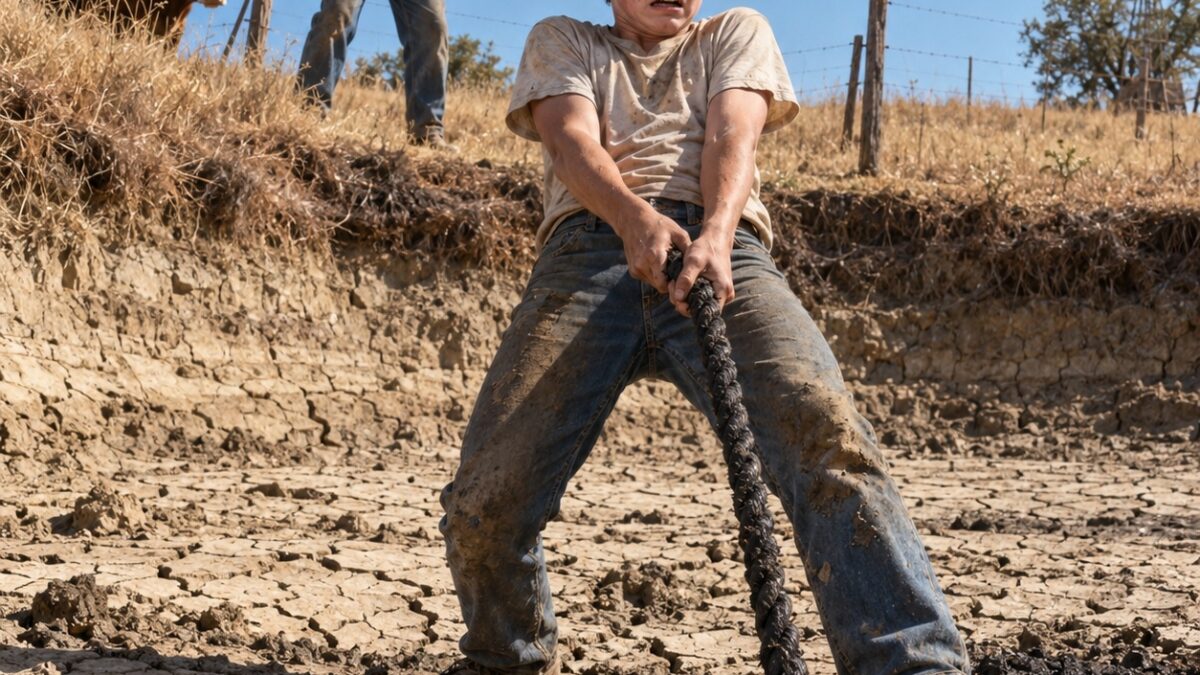
The water had retreated so far that morning that I could walk across ground I’d never seen exposed before.
Usually the pond curved around a stand of willows near the western bank and reached almost to a big cottonwood on the north side.
Now both were high and dry.
The remaining water sat in the center like a muddy puddle.
Cattle had carved deep tracks into the bank.
Each hoofprint had hardened around the edges.
I carried a shovel because Mom had told me to cut a safer slope where the cows were sliding.
I worked maybe twenty minutes before noticing something black in the clay.
At first I thought it was electrical cable.
That made no sense.
There was no electricity anywhere near the pond.
Then I thought maybe it was old fencing.
Our farm was full of forgotten wire.
You could dig almost anywhere and find evidence that some farmer fifty years earlier had decided something needed containing.
But this wasn’t wire.
I scraped mud away with the shovel.
Rope.
Thick rope.
Blackened with age.
Almost as wide as two fingers.
I crouched and touched it.
The fibers felt stiff and swollen.
What struck me as strange wasn’t that there was old rope in the pond.
Farm ponds collected everything.
What struck me was the direction.
The rope didn’t lie across the bottom.
It disappeared straight down.
I scraped more clay away.
Still down.
I wrapped both hands around it.
Pulled.
Nothing.
I pulled harder.
Still nothing.
That should have been enough.
Any sensible person would have walked away.
I was thirteen.
Those were different things.
I planted both boots in the mud, leaned backward, and pulled with everything I had.
For half a second, the rope remained frozen.
Then it gave.
Not gradually.
Suddenly.
I fell backward and landed hard.
Three, maybe four feet of rope came out of the ground.
At the exact same moment, something moved beneath me.
A deep metallic scrape came through the mud.
I felt it through my hands first.
Then my boots.
A long sound.
Slow.
Heavy.
Like somebody dragging an iron gate across stone deep underground.
Then came one solid knock.
Thunk.
The ground trembled beneath my heels.
I dropped the rope.
For several seconds, I sat there.
The cattle didn’t care.
Flies buzzed.
A crow called from the fence.
But I knew what I had felt.
Something was under the pond.
Something big enough to move the earth.
“Grandpa!”
Walter was repairing fence along the eastern side.
He straightened.
“What?”
“Come here!”
He climbed through the wire and walked down toward me.
Walter almost never hurried.
Even emergencies received a fast walk.
“What’d you do?”
That was his first question.
Not what happened.
What did you do?
I pointed at the rope.
“I found it.”
He looked at the disturbed mud.
“Found it doing what?”
“Nothing.”
His eyes moved to me.
“Then why’s four feet of it laying there?”
“I pulled it.”
Walter sighed in a way that carried thirteen years of experience with me.
“Of course you did.”
“Something moved.”
“What?”
“I don’t know.”
“You hear anything?”
“A scraping sound.”
His expression changed slightly.
“What kind?”
“Metal.”
“Sure it wasn’t rock?”
“Metal.”
Walter stepped around the rope.
He used the shovel to scrape away clay without touching it.
The rope disappeared beneath dark mud.
He crouched, pressed his fingertips against the ground, then stood.
“What?”
“Don’t touch it again.”
“Why?”
“Because we don’t know what it is.”
“Could be attached to something.”
“That’s usually how rope works.”
I ignored the sarcasm.
“What kind of something?”
Walter looked toward the pond.
“Old pipe. Pump. Well equipment. Could be anything.”
“Then shouldn’t we find out?”
“No.”
“Why?”
“Because you’re standing on pond bottom that’s drying unevenly. There can be cavities under this stuff.”
I looked down.
“Like sinkholes?”
“Like you disappearing to your waist and me explaining to your mother why I let you dig around old buried equipment.”
“I wouldn’t disappear.”
“You planning to negotiate with the mud?”
I smiled.
Walter did not.
“Leave it.”
“Okay.”
“Ben.”
“I said okay.”
He pointed toward the rope.
“Not one more pull.”
I held up both hands.
“I promise.”
Walter went back to the fence.
I went back to cutting a slope.
But before I left that afternoon, I pushed a short wooden stake into the mud beside the waterline.
With my pocketknife, I scratched a mark across it.
I don’t know exactly why.
Maybe because some part of me was already wondering whether that metallic groan had changed something.
The next morning, my scratch was underwater.
I stood there staring.
The water had covered nearly three inches of the stake.
I crouched.
There were no fresh hoofprints around it.
No sign that cattle had knocked it deeper.
I pulled it out, measured it, then reset it in the same hole.
I walked home fast.
Mom was frying eggs.
“Do we have a tape measure?”
“Tool drawer.”
“Long one.”
“Barn.”
“Where in the barn?”
She turned.
“Why?”
“Nothing.”
That was the wrong answer.
Mom narrowed her eyes.
“What did you do?”
Why did every adult start there?
“I didn’t do anything.”
“Benjamin.”
“The pond came up.”
She stopped.
“What?”
“Like three inches.”
“From yesterday?”
“Yes.”
She shut off the stove.
“Did it rain?”
I looked toward the window.
The sky was painfully blue.
“No.”
Twenty minutes later, she stood beside the pond with Walter.
Walter examined my stake.
Mom looked at the water.
“Could cattle have pushed mud toward it?”
“No,” I said.
Walter didn’t dismiss the idea immediately.
He walked the edge.
“No.”
Mom frowned.
“Groundwater?”
“Could be.”
“What changed?”
Walter looked at me.
I looked innocent.
Mom followed his eyes.
“What?”
“He pulled something.”
“I found a rope.”
“What rope?”
Walter pointed.
Mom walked toward it.
“You pulled that?”
“Once.”
“How many times?”
“Maybe twice.”
“Benjamin.”
“The first time didn’t count.”
Her eyes closed.
Walter hid a smile.
I said, “Something moved underneath.”
Mom looked at him.
“Did he tell you that?”
“Yes.”
“And you left it?”
“I told him not to touch it.”
“You didn’t think you should mention it?”
“Didn’t seem worth worrying you over an old rope.”
Mom stared at him.
Walter changed subjects.
“The water’s the important part.”
She folded her arms.
“What do you think?”
“Could be seepage from underground.”
“During a drought?”
“Groundwater doesn’t always care what’s happening on top.”
Mom looked hopeful for one second.
Then she caught herself.
“We measure again tomorrow.”
That became our routine.
Every morning before breakfast, I walked to the pond.
I carried an old spiral notebook from school.
Date.
Weather.
Wind.
Water level.
August 29.
No rain.
Water up 2⅞ inches.
August 30.
Clear.
Hot.
Another 2¼ inches.
August 31.
No rain.
Another 1¾.
September 1.
Cloudless.
Up 1¼.
By the fourth day, the rise was impossible to ignore.
The cattle had more room to drink.
Mud that had been dry around the center was underwater again.
Mom stopped talking about selling twenty head.
She didn’t say we’d keep them either.
She was afraid to trust the change.
What bothered me most was the mud around the rope.
The rest of the exposed pond bottom had hardened into pale plates of cracked clay.
Around that rope, the ground remained almost black.
I pressed my boot beside it.
Cold water seeped around the leather.
I crouched and pushed my fingertips into the mud.
It felt much colder than the air.
Not cool.
Cold.
I carried some to Walter in a Mason jar.
He was greasing equipment near the barn.
“Feel this.”
“I’ve felt mud before.”
“Just do it.”
He put two fingers in.
His expression changed.
“Where’d you get this?”
“Rope.”
“Right beside it?”
I nodded.
Walter wiped his hand on his pants.
“Show me.”
At the pond, he pushed a steel fence rod into the ground.
On dry clay, it went maybe eight inches.
Near the rope, it went almost two feet.
Then stopped.
Clink.
Walter froze.
He lifted the rod.
Pushed again a foot away.
Clink.
Another spot.
Clink.
“What is that?”
“Stone.”
“Natural?”
“Too even.”
He moved farther left.
This time the rod suddenly dropped.
Almost half of it vanished.
Walter yanked it back.
Cold water bubbled into the narrow hole.
I stared.
“That’s pressure.”
Walter looked at me.
“Science class?”
“Mr. Caldwell.”
“First useful thing I’ve heard that man teach.”
I knelt beside the hole.
Water rose until it reached ground level.
Then stopped.
“Is it a well?”
“No.”
“Spring?”
Walter didn’t answer.
I looked at him.
He was staring toward the hollow with an expression I had never seen.
Not surprise.
Recognition.
“Grandpa?”
He rubbed the back of his neck.
“What?”
“You know something.”
“No.”
“Yes, you do.”
He stared at the pond.
For almost a minute, he said nothing.
Then he whispered, “When I was little, this wasn’t a pond.”
“What was it?”
“A wet hollow.”
“And?”
“There was a spring.”
I stood.
“A spring?”
“A good one.”
“Where?”
He pointed toward the rope.
“Somewhere around there.”
My pulse jumped.
“Then that’s what’s filling the pond.”
“Don’t get ahead of yourself.”
“What happened to the spring?”
Walter looked toward the hill.
“I don’t remember all of it.”
“What do you remember?”
“Stone building.”
“Barn?”
“No.”
“What kind?”
“Springhouse.”
I knew the word.
Older farms used them before refrigeration.
A building over cold running water where milk, butter, meat, and other food stayed cool.
“What happened?”
Walter’s jaw tightened.
“There was a flood.”
“When?”
“1920, maybe.”
“You were alive?”
“I was six or seven.”
“And the springhouse?”
“After the flood, it was gone.”
“Gone where?”
He looked at the ground.
“That’s the thing.”
“What?”
“I don’t remember it being washed away.”
That evening, Walter told Mom.
She listened without interrupting.
When he finished, she looked at me.
“You are not digging.”
“I didn’t ask.”
“You were about to.”
“Maybe.”
“No.”
“But if there’s a spring—”
“Nobody is crawling into a buried building.”
“I wouldn’t crawl.”
“Benjamin.”
“Okay.”
Walter said, “We can inspect from the surface.”
Mom looked at him.
“You’re helping him now?”
“I’m helping us understand where our water’s coming from.”
She sighed.
“I want someone who knows wells.”
“Earl Bishop.”
Mom made a face.
“Is Earl still working?”
“Depends what you call working.”
“What does that mean?”
“He charges people, so yes.”
Earl Bishop arrived two days later.
His truck looked older than he did.
That was impressive, because Earl had worked pumps, wells, cisterns, and farm water systems since before my mother was born.
He was thin, leathery, missing the tip of his left index finger, and wore a sweat-stained hat that had once advertised a seed company.
He looked at the pond.
Then the rope.
Then me.
“This the culprit?”
“I’m Ben.”
“I meant the rope.”
Walter laughed.
Earl crouched.
“How much’d you pull?”
“Three or four feet.”
“Feel weight?”
“At first.”
“Then?”
“It gave.”
“Sound?”
“Scraping.”
“Metal?”
“Yes.”
“You know metal from stone?”
“Yes.”
“How?”
“I’ve heard both.”
He studied me.
“Fair enough.”
He scraped mud away with a hand trowel.
After ten minutes, a wooden crosspiece appeared.
The rope passed through a hole drilled near the center.
Earl stopped.
Walter leaned closer.
“What?”
“You seen this before?”
Walter touched the wood.
“No.”
Then his face shifted.
“Maybe.”
“Maybe isn’t much help.”
“I was a boy.”
Earl pushed his steel rod deeper around the structure.
Stone.
Stone.
Stone.
Then open space.
His eyebrows rose.
He lowered himself and pressed one ear to the wet ground.
We all went quiet.
After maybe thirty seconds, he held up a finger.
I couldn’t hear anything.
He changed position.
Listened again.
Then stood.
“There’s running water.”
Mom’s eyes went to him.
“You’re sure?”
“Yes.”
“How much?”
“No idea.”
“Can it fill the pond?”
“It already is.”
That was the first moment Mom let herself smile.
It lasted maybe two seconds.
“What is the rope?”
Earl looked at the exposed wood.
“Old control system, likely.”
“For what?”
“Gate.”
I thought of the metallic scrape.
“A gate underground?”
“Springhouses sometimes used boards, iron plates, sluices. Depends who built it.”
“If I lifted it—”
“You may have opened something.”
Walter said, “Then we leave it open.”
Earl gave him a look.
“You don’t know what it opens.”
“Water’s coming up.”
“Water always comes up somewhere if you trap enough of it.”
Mom frowned.
“What are you saying?”
“I’m saying we need to understand the system before anybody celebrates.”
Earl walked the pond edge.
“Any old maps?”
Walter shook his head.
“Maybe county.”
“Go look.”
That was how Walter and I ended up in the courthouse basement.
The clerk, Mr. Daugherty, smelled like cigarettes, paper dust, and old wool.
When Walter asked for Mercer property records before 1930, Daugherty stared at him.
“Boundary dispute?”
“No.”
“Mineral rights?”
“No.”
“Tax problem?”
“No.”
He looked disappointed.
“Then this may be boring.”
He returned with plat books and rolled survey maps.
For nearly two hours, we found nothing but parcel lines and names.
Then I saw a small square near the lower hollow on a hand-drawn map dated 1911.
SPRING HOUSE.
“Grandpa.”
Walter leaned over.
His breath stopped.
“There.”
A line ran from the springhouse downhill.
Beside it someone had written:
6″ TILE DRAIN.
Another symbol farther below read:
GATE BOX.
I pointed.
“What’s that?”
Walter rubbed his jaw.
“Control access.”
“For the drain?”
“Probably.”
“Why would the springhouse need a drain?”
“Overflow.”
“If the drain got blocked—”
“Water backs up.”
“And if the building collapsed?”
“Water finds another route.”
Mr. Daugherty wandered over.
“Find your treasure?”
“Do you know about Mercer Spring?” I asked.
Walter looked at me as if I had violated courthouse etiquette.
Daugherty squinted at the map.
“Mercer Spring.”
“You’ve heard of it?”
“Sure.”
Walter straightened.
“From who?”
“My grandfather.”
“What’d he say?”
“Best water on that side of the county.”
My heartbeat quickened.
“Did it ever run dry?”
“Not according to him.”
Walter’s expression became serious.
“Why’d it stop being used?”
Daugherty shrugged.
“Flood.”
“That’s all?”
The clerk looked at Walter strangely.
“Thought you’d know.”
“I was a child.”
Daugherty lowered his voice.
“There was trouble.”
“What kind?”
“Family kind.”
Walter went very still.
“What did you hear?”
Daugherty glanced at me.
“Old stories.”
“Tell me.”
Daugherty leaned against a shelf.
“Your father’s brother wanted to sell water rights.”
Walter whispered, “Samuel.”
I had never heard that name.
“Who was Samuel?”
Walter didn’t answer.
Daugherty continued.
“Some outfit from St. Louis wanted commercial access. Bottling, maybe railroad. Story changed depending who told it.”
“What happened?” I asked.
“Henry Mercer refused.”
“Henry was my father,” Walter said.
“And Samuel?”
“His younger brother.”
Daugherty nodded.
“They fought.”
“Then?”
“Flood came.”
“And Samuel left?”
Daugherty’s expression changed.
“That’s one version.”
Walter rolled the map.
“We’re done.”
I stared at him.
“What does that mean?”
“Ben.”
“But—”
“In the truck.”
We drove home mostly in silence.
Finally, I asked, “What happened to Samuel?”
“I told you. He left.”
“Daugherty didn’t sound like he believed that.”
“Daugherty likes stories.”
“Did Samuel own the farm?”
“Half.”
“So he could sell water rights.”
“Maybe.”
“Did he?”
Walter’s hands tightened on the wheel.
“I don’t know.”
“Did Great-Grandpa bury the springhouse?”
“No idea.”
“You remember more than you’re saying.”
Walter looked at me sharply.
“I remember being seven years old during a flood.”
“And?”
He faced the road again.
“I remember my father hitting Samuel.”
That shocked me into silence.
“Why?”
“I don’t know.”
“At the springhouse?”
“Near it.”
“Before it flooded?”
“During.”
“What happened after?”
Walter’s jaw worked.
“I remember lanterns.”
“What else?”
“Men shouting.”
“What else?”
“My mother carrying me uphill.”
“What else?”
He gripped the steering wheel.
“Enough.”
It wasn’t enough.
Not for me.
But Walter didn’t speak again.
At home, Mom studied the map.
Her finger traced the springhouse.
Then the drain.
Then the gate box.
“If this is accurate, the old spring is directly under the pond.”
“Near enough,” Walter said.
“And the pipe still exists?”
“Maybe.”
I said, “We should find the gate box.”
Mom pointed at me without looking up.
“No shovel.”
“I wasn’t going to—”
“No shovel.”
Walter smiled.
Mom looked at him.
“No encouraging.”
“I’m sitting.”
“You encourage while sitting.”
For two days, we did nothing.
The pond kept rising.
But slower.
One inch.
Then half.
Then barely a quarter.
I became worried.
At breakfast, I said, “It’s stopping.”
Mom poured coffee.
“What’s stopping?”
“The water.”
“It rose almost a foot.”
“But now it’s not.”
Walter looked at me.
“Something may be closing.”
“The gate?”
“Could.”
“Then pull the rope again.”
“No.”
I pushed my chair back.
“Why does everyone keep saying no?”
“Because we like you alive.”
“If the gate closes, the pond could dry.”
“We’ve got more water now than last week.”
“For how long?”
Mom put down the coffeepot.
“Ben.”
“What?”
“You’re thirteen.”
“I know.”
“You are not responsible for saving the farm.”
I looked at her.
“It doesn’t feel that way.”
The room went quiet.
Mom’s expression softened.
She sat across from me.
“What do you mean?”
I looked at my plate.
“I heard you and Grandpa talking.”
“When?”
“The night you said we’d sell cattle.”
Her face changed.
“I wasn’t supposed to hear that.”
“That doesn’t make it not true.”
“No.”
“You said you didn’t want to lose Dad’s farm.”
Mom looked toward the window.
“I was scared.”
“So am I.”
She reached across the table.
“That’s exactly why I don’t want you making dangerous decisions.”
“But if I found water—”
“You did something useful by accident.”
Walter coughed to hide a laugh.
Mom glared at him.
I said, “Thanks.”
She squeezed my hand.
“The farm is my responsibility.”
“It’ll be mine someday.”
“Hopefully when you’re forty and gray.”
“Grandpa isn’t forty.”
“Exactly.”
Walter muttered, “Wonderful breakfast.”
That afternoon, Walter and I searched for the gate box.
Technically, we did not dig.
Not at first.
We used the 1911 map to measure from the old springhouse location.
Thirty feet downhill.
Near a sycamore stump.
Walter pushed the steel rod into the ground.
Clink.
He moved.
Clink.
Again.
Clink.
“Stone.”
We cleared leaves by hand.
Then Walter used a shovel.
When Mom later accused me of digging, I correctly explained that Grandpa held the shovel.
She did not appreciate the distinction.
Beneath eighteen inches of dirt was a rotten wooden lid.
Walter lifted it.
A masonry box opened beneath us.
Inside was a rusted iron lever connected to a horizontal rod disappearing toward the pond.
Around the lever someone had wrapped heavy wire.
Not one loop.
Several.
Twisted tight.
Walter stared.
“This wasn’t abandoned.”
“What?”
“It was locked.”
“On purpose?”
“Nobody ties wire like that by accident.”
“Who?”
He crouched.
Scraped rust.
“Could’ve been my father.”
“Why would he lock the spring closed?”
“No idea.”
“Maybe Samuel did it.”
Walter looked at me.
“Don’t build history from guesses.”
“You do it.”
“I’m older. I get more guesses.”
We called Earl.
He inspected the box, then the map.
“This probably controlled the overflow channel.”
“Could we cut the wire?” I asked.
“Yes.”
“Should we?”
“No.”
I groaned.
Earl smiled.
“You’re learning.”
“What happens if we open it?”
“Depends whether the drain still works.”
“And if it doesn’t?”
“Pressure goes somewhere.”
“Where?”
“Anywhere weaker than whatever’s holding it.”
Mom arrived while Earl was explaining.
She saw the open box.
Then me.
“Benjamin Mercer.”
“I didn’t dig it.”
Walter raised his hand.
“That was me.”
Mom stared at her father.
“Wonderful. You’re both thirteen.”
Earl stood.
“Helen, this isn’t nothing.”
“I know.”
“If the springhouse is pressurized and the outlet is blocked, we need to relieve it safely.”
“Can it hurt the dam?”
“Potentially.”
The word erased her anger.
“What do we do?”
“Uncover enough pipe to inspect.”
“Cost?”
Earl rubbed his jaw.
“Depends.”
Mom’s face fell.
“Everything depends.”
“That’s farming.”
Walter said, “Get Wayne Hollis.”
Wayne owned a backhoe.
More importantly, he owed Walter several favors involving cattle, fence, and one incident nobody would explain involving a truck axle.
Wayne came the next morning.
By noon, the machine had uncovered part of the old stone springhouse.
The discovery looked like archaeology.
Dark stones emerged from clay one row at a time.
Then part of a wall.
Then a collapsed corner.
The building hadn’t washed away.
It had been buried.
“Grandpa,” I said.
Walter didn’t answer.
His face had gone pale.
“You remember it?”
“Some.”
“What?”
“That wall.”
He pointed.
“Used to be whitewashed.”
Earl stopped the backhoe before Wayne reached the center.
“Void underneath.”
The bucket had exposed a dark cavity.
Cold air came through.
So did the sound of moving water.
Earl tied a rope around his waist.
Mom immediately said, “Nobody’s going in.”
“I’m checking air from the opening.”
“Outside.”
“Helen.”
“Outside.”
Earl muttered something about being sixty-nine years old and climbed only as far as the entrance.
He shone a light inside.
Water flashed.
Stone.
Iron.
Broken wood.
He stayed maybe five minutes.
When he came out, his expression was serious.
“Spring’s active.”
Mom’s eyes widened.
“How active?”
“Enough that the whole lower chamber’s full.”
“The rope?”
“Attached to an iron plate.”
My heart jumped.
“I knew it.”
Earl pointed at me.
“Don’t look proud yet.”
“What does it do?”
“Opens direct flow into the pond basin.”
“Then I opened it.”
“Partly.”
“That’s why water rose.”
“Yes.”
Mom breathed out slowly.
For the first time, we had an answer.
Then Earl added, “There’s a problem.”
Of course there was.
“What?” Mom asked.
“That plate should have a counterweight.”
“Should?”
“Doesn’t.”
Walter said, “Meaning?”
“Meaning the rope is holding more tension than it was built for.”
“Can it close?”
“Yes.”
“What happens if it does?”
“The spring water redirects toward the overflow.”
“The blocked pipe.”
Earl nodded.
Mom looked toward the earthen dam.
“And if the overflow can’t handle it?”
“Pressure builds.”
“Could it break the dam?”
“Not directly.”
She waited.
“But?”
“But water under pressure finds cracks. Old masonry fails. Clay shifts. Seepage moves.”
Mom folded her arms.
“So we’re standing on top of something that can change direction by itself.”
“Pretty much.”
“Wonderful.”
Earl found the six-inch tile drain.
The first twenty feet remained intact.
Farther downhill, near an area that had slumped decades earlier, it was crushed flat.
Water stood behind it.
He drilled a small test opening upstream.
At first, nothing happened.
Then black water spit out.
A second later, a clear stream shot six feet across the trench.
Wayne jumped backward.
I shouted.
Walter laughed.
Mom covered her mouth.
Earl stared at the stream.
“There’s your spring.”
He measured the flow using a bucket and watch.
Thirty-five gallons per minute through the small opening.
“Is that a lot?” I asked.
“Over fifty thousand gallons a day.”
My eyes widened.
“Every day?”
“If pressure holds.”
Mom sat on the edge of the truck.
Fifty thousand gallons sounded like salvation.
Our cattle could drink.
We could refill tanks.
We could survive the drought.
Walter looked at Earl.
“How much is still trapped?”
“No idea.”
“Could be more?”
“Definitely.”
“How much more?”
Earl shrugged.
“One hundred gallons a minute. Three hundred. Less. More.”
I said, “Then open it.”
Four adults looked at me.
“What?”
Mom shook her head.
“No.”
“But—”
“No.”
Walter said, “Boy has a point.”
Mom turned on him.
“Of course you think that.”
“If the outlet’s repaired—”
“It’s not.”
“We repair it.”
“With what money?”
That ended the conversation.
Our farm had water.
But repairing the old system properly would cost several thousand dollars.
In 1977, several thousand dollars might as well have been fifty thousand to us.
Feed costs were already crushing us.
Fuel.
Repairs.
Bank payments.
Taxes.
Mom spent that night at the kitchen table with bills spread around her.
I sat across from her.
“How much?”
She didn’t look up.
“Go to bed.”
“How much?”
“Ben.”
“We need the pipe.”
“I know.”
“How much does Earl think?”
“Four thousand if nothing else goes wrong.”
“Does something always go wrong?”
“Usually.”
I watched her write numbers.
“We could sell cattle.”
She stopped.
That was exactly what she’d been trying to avoid.
“Maybe ten.”
“Would that cover it?”
“Part.”
“What about Grandpa?”
“No.”
“What?”
“He offered his savings.”
“Why no?”
“Because he’s sixty-eight.”
“So?”
“So those savings are what he has.”
“He’d give it.”
“Exactly.”
I understood.
Walter would empty his account without hesitation.
Mom wouldn’t let him.
I looked at the bills.
“What if we use spring water somehow?”
“What do you mean?”
“Sell some.”
Mom looked up.
“No.”
“Why?”
“I don’t know enough about it.”
“We have extra.”
“We have water today.”
I didn’t argue.
But somebody else had the same idea.
Three days later, Franklin Vale drove onto our property.
His car was the wrong kind of car for a farm.
Dark blue sedan.
Shiny.
Low.
The tires looked nervous on gravel.
Vale stepped out wearing polished brown boots and a pale suit jacket despite the heat.
He carried a leather folder.
Mom was on the porch.
Walter was by the barn.
I was cleaning troughs.
Vale smiled at my mother.
“Mrs. Mercer?”
“Yes.”
“Franklin Vale.”
“Can I help you?”
“I represent Ozark Pure Water Company.”
Walter stopped walking.
Not obviously.
But I noticed.
Vale continued.
“We’re exploring natural spring sources in this region.”
Mom’s expression closed.
“How’d you hear about ours?”
“Our industry maintains geological and agricultural contacts.”
“Which means someone talked.”
“News travels.”
“Especially when companies pay attention.”
Vale smiled.
“I understand you’ve had an unusual return of flow during the drought.”
Mom crossed her arms.
“What do you want?”
“To discuss opportunity.”
Walter walked closer.
“No.”
Vale looked at him.
“I’m sorry?”
“The answer is no.”
“You don’t know the question.”
“I know your company.”
Vale’s smile tightened.
“Mr. Mercer?”
“Walter.”
“Mr. Mercer, we’re not here to take anything.”
“Then don’t.”
Mom said, “Dad.”
Vale opened his folder.
“Our company could lease access to the spring.”
“No,” Walter repeated.
Mom ignored him.
“What kind of lease?”
Walter turned.
“Helen.”
“Listening isn’t signing.”
Vale immediately addressed her.
“Five-year initial term. Guaranteed annual payment. We install collection equipment, access improvements, metering, and testing.”
“How much?”
“Twelve thousand annually.”
The number sat in the air.
That was real money.
More than enough to repair the outlet.
Enough to buy feed.
Enough to keep cattle.
Enough to make Mom silent.
Vale saw it.
“Potential royalties if yield exceeds baseline.”
Walter stepped between them.
“Leave.”
Vale looked amused.
“I understand sentimental attachment.”
“You understand exactly nothing.”
“Walter,” Mom warned.
Vale glanced toward the pond.
“Water underground has economic value.”
Walter said, “It has value already.”
“Of course. But unused surplus—”
“Unused by who?”
“By your farm.”
“You know how much is under there?”
“Our preliminary information suggests significant flow.”
“Preliminary information from where?”
Vale avoided the question.
Mom noticed.
“So you’ve looked at our spring before coming.”
“We reviewed regional hydrology.”
Walter laughed without humor.
“Vale.”
Franklin’s eyes moved to him.
“What?”
“Your family from St. Louis?”
A tiny pause.
“My grandfather was.”
“What was his name?”
“Charles Vale.”
Walter went completely still.
Mom looked at him.
I did too.
Vale frowned.
“Did you know him?”
Walter said nothing for several seconds.
Then, “Get off our land.”
Vale’s confidence finally cracked.
“Mr. Mercer—”
“Now.”
Mom said, “Dad, what—”
“Not here.”
Vale closed his folder.
He left a business card on the porch rail.
“My offer remains available.”
Walter watched him drive away.
Then he picked up the card and stared at it.
Mom said, “Who was Charles Vale?”
Walter’s voice was low.
“The company.”
“What company?”
“The one Samuel dealt with.”
My skin prickled.
Mom looked toward the road.
“You’re sure?”
“No.”
“You just threw eighteen thousand dollars worth of attitude at him like you are.”
“He offered twelve.”
“He’d go higher.”
“That’s what scares me.”
We went inside.
Walter sat at the kitchen table.
For a long time, he turned Vale’s card between his fingers.
Then he said, “My father used to curse that name.”
“Vale?”
“Yes.”
“Why didn’t you remember at the courthouse?”
“I remembered the company starting with V. That’s all.”
I sat forward.
“Maybe Franklin knows the old spring.”
Mom said, “Or maybe his company looked up the same records we did.”
Walter shook his head.
“No.”
“Why?”
“He came fast.”
She stared at him.
The thought was unsettling.
We had uncovered the spring less than two weeks earlier.
A commercial water company already knew.
Mom picked up the card.
“Twelve thousand.”
Walter closed his eyes.
“Helen.”
“We are one bad month from selling cattle at the worst possible price.”
“I know.”
“Four thousand to fix the system.”
“I know.”
“Feed.”
“I know.”
“Bank.”
“I know.”
“Then stop saying no as if no pays bills.”
Walter’s eyes opened.
“Your husband would’ve said no.”
Mom stood.
“Do not do that.”
“I’m saying—”
“Daniel isn’t here.”
Silence.
Her voice broke.
“I have to make decisions. Not Daniel. Not you. Me.”
Walter looked down.
She continued.
“I do not want to sell anything. I don’t want some company tearing up the lower pasture. I don’t want tank trucks driving through the farm. But I also don’t want to stand at an auction watching somebody else buy our cattle because I was too proud to sign a lease.”
Walter stood.
“Pride isn’t why I’m saying no.”
“Then why?”
He looked toward me.
Then back to her.
“Because I think Samuel learned what happens when you let people price something they don’t understand.”
Mom softened.
“You don’t even remember what happened.”
“No.”
“Then help me find out.”
That became our next goal.
Not the spring.
The history.
Mom called Mr. Daugherty.
Walter contacted two old families who had lived in the county before World War II.
We searched the attic at Walter’s house.
Found photographs.
Receipts.
Letters from cousins.
Nothing about Samuel.
It was almost as if someone had deliberately removed him from the family.
There was one photograph, though.
Two young men stood beside the old springhouse.
One I recognized from pictures of Walter’s father, Henry.
Beside him was a thinner man with dark hair and a grin.
On the back:
Henry & Sam, Mercer Spring, 1918.
I stared at Samuel’s face.
He didn’t look like a family secret.
He looked happy.
I showed Walter.
He sat in an attic chair and studied it.
“That’s him.”
“Do you remember his face?”
“Not until now.”
“Why did everyone stop talking about him?”
Walter swallowed.
“I don’t know.”
A week passed.
Then Earl brought Dr. Marcus Lane to the farm.
Lane was a geologist in his late thirties who occasionally worked with well companies.
He examined the limestone ridge uphill from the pond.
Took measurements.
Tested water temperature.
Studied the old map.
“Your spring isn’t an isolated pocket,” he said.
“What is it?” Mom asked.
“Probably discharge from a fractured limestone aquifer.”
I said, “English?”
He smiled.
“Rain enters rock miles away. Travels through cracks. Comes out here because this is lower.”
“Does drought stop it?”
“Depends how deep and extensive the system is.”
“Can it run forever?”
“Nothing runs forever.”
“What if somebody pumps it?”
“Depends how much.”
Mom looked at him.
“What would Ozark Pure take?”
Lane paused.
“You talked to them?”
“Yes.”
“Who?”
“Franklin Vale.”
Lane’s expression shifted.
“You know him?” Walter asked.
“I’ve done contract work for the company.”
Mom immediately became guarded.
“Are you here for them?”
“No. Earl asked me.”
Earl said, “And I’m paying him in lunch.”
Lane smiled.
Mom did not.
“If they leased the spring, what would they do?”
Lane chose his words carefully.
“Drill monitoring wells. Determine sustainable yield. Install pumps or collection gallery.”
“How much water?”
“Commercial operations prefer enough to justify trucking or piping.”
“How much?”
“Could be one hundred thousand gallons daily. Could be more.”
I thought of our fifty thousand gallons from the test opening.
“What happens to our pond?”
“Could remain unchanged.”
“And could?”
“Drop.”
“Neighbors’ wells?”
“Possibly affected.”
Walter said, “There.”
Mom looked at Lane.
“Would you sign their lease if this were your farm?”
He hesitated.
Vale hadn’t.
Lane did.
“No.”
One word.
Mom stared at him.
“Why?”
“Because you don’t have enough data.”
“That’s all?”
“No.”
He folded the map.
“This spring has functioned with almost no extraction for decades. Commercial pumping changes the system.”
“Could it destroy it?”
“Destroy is strong.”
“Could it reduce flow?”
“Yes.”
“Permanently?”
“Possibly.”
Mom looked toward the pond.
“What would you do?”
“Fix the outlet. Monitor flow for a full year. Don’t promise anybody water you haven’t studied through all seasons.”
That was the advice we needed.
It was also advice we could barely afford.
Walter sold his Farmall tractor without telling Mom.
She found out when Ray Hollis came to pick it up.
Mom stood in the yard, hands on hips.
“Dad.”
Walter pretended confusion.
“What?”
“Where’s the Farmall going?”
“Ray’s.”
“Why?”
“He bought it.”
“You sold your tractor?”
“Didn’t need it.”
“You love that tractor.”
“It leaks oil on my floor.”
“You’ve owned it thirty years.”
“Exactly. Time somebody else suffered.”
Ray stayed very quiet.
Mom looked at him.
“How much?”
Ray looked at Walter.
Walter looked at Ray.
Mom said, “Ray.”
“Two thousand.”
She turned back to Walter.
“No.”
“It’s done.”
“Give him his money.”
“No.”
“I told you not to use your savings.”
“I didn’t.”
“You sold something worth money.”
“That’s usually how selling works.”
“Dad!”
Walter stepped closer.
“Helen.”
She stopped.
“This farm fed me when I was a boy.”
His voice softened.
“It fed Daniel. It feeds Ben.”
Mom’s eyes filled.
“The spring is part of why this farm exists. Let me help fix it.”
She looked away.
Walter added, “And if it makes you feel better, Ray overpaid.”
Ray said, “I did not.”
Walter glared at him.
Ray reconsidered.
“Maybe a little.”
Mom laughed despite herself.
That two thousand dollars started something.
Wayne donated backhoe time.
Earl refused labor charges.
Ray brought gravel.
Three men from our church helped lay replacement pipe.
Mrs. Hollis brought fried chicken.
Mrs. Bishop brought pies.
People arrived without asking.
Nobody called it charity.
Farm people had strange rules about pride.
They called it “getting a job finished.”
The crushed section of tile pipe was replaced with modern PVC.
A new outlet ran around the collapsed area.
Earl planned a control box so we could regulate flow safely.
The black rope would eventually be removed.
That part bothered me more than I admitted.
It felt like cutting the thread connecting us to the mystery.
I asked Earl if I could keep it.
“No.”
“Why?”
“Because you’ll pull it.”
“I won’t.”
“You pulled it when it was attached underground to something you couldn’t see.”
“That was different.”
“Exactly why you’re not keeping it.”
Walter winked at me.
We were almost finished when Dr. Lane returned.
This time he carried a folder.
“Franklin Vale called me.”
Mom stiffened.
“Why?”
“He knows I’m consulting here.”
“What did you tell him?”
“That my work is private.”
“What did he want?”
“Flow estimates.”
Walter snorted.
“Of course.”
Lane looked serious.
“He also mentioned an old contractual claim.”
The yard went silent.
Mom said, “What claim?”
“He said their predecessor company may have purchased rights to Mercer Spring.”
Walter’s face darkened.
“Samuel.”
“Possibly.”
Mom folded her arms.
“From 1920?”
“That’s what he implied.”
“Can a contract that old still matter?”
“Ask an attorney.”
We did.
Our attorney was a man named Charles Benton who mostly handled farm closings, wills, boundary disputes, and divorces involving cattle.
He read the papers we had.
Then requested county records.
Two days later, he called.
“There was a recorded agreement.”
Mom gripped the phone.
“What kind?”
“Water-use option between Samuel Mercer and Vale Water Works.”
Walter sat beside her.
I listened from across the kitchen.
“Is it valid?” Mom asked.
“Probably not.”
Walter exhaled.
“Probably?”
“Samuel only owned an undivided half interest. Henry never signed. The company never exercised the option fully. It appears payments stopped after 1920.”
“Then it’s dead.”
“I’d say so.”
“Could Franklin sue?”
“Anybody can sue.”
Mom closed her eyes.
“Would he win?”
“Unlikely.”
Walter said loudly, “Tell him to try.”
Mom covered the receiver.
“Dad.”
Benton continued.
“There’s another document.”
“What?”
“A termination notice.”
“From who?”
“Vale Water Works.”
“Why?”
“Insufficient dependable flow.”
Everyone looked toward the pond.
The spring had been deliberately closed.
Samuel’s letter hadn’t surfaced yet, but now the outline appeared.
Someone had made the spring look unreliable.
I said, “Great-Grandpa closed it to kill the contract.”
Walter stared at me.
“Maybe.”
Mom said, “If that’s true, Franklin’s grandfather knew about the spring.”
“Or great-grandfather.”
“Either way.”
Benton advised us to send Vale a written notice denying any claim.
We did.
Franklin arrived the next afternoon.
No appointment.
No smile.
He held our attorney’s letter.
“Mrs. Mercer, I think there’s been misunderstanding.”
Mom stayed on the porch.
“What misunderstanding?”
“We have no intention of asserting ownership.”
“Good.”
“But historical rights affect valuation.”
“Not interested.”
“Our offer is now twenty thousand annually.”
Walter whispered, “Told you.”
Mom ignored him.
Vale continued.
“Ten-year term.”
“No.”
“Twenty-five thousand.”
Mom’s face didn’t change.
“Mr. Vale, you should leave.”
His confidence slipped.
“You’re turning down guaranteed income during one of the worst droughts this county has seen.”
“Yes.”
“Why?”
Mom glanced toward the pond.
“Because I don’t know enough about what you’re asking me to sell.”
“We’re not buying the spring.”
“You’re buying what comes out.”
“That’s the point of water.”
“No.”
She looked at him.
“The point of that water is that my cattle are still here.”
Vale tried one more time.
“Mrs. Mercer, you may regret allowing sentiment to dictate business.”
Walter stepped forward.
“Her husband died two years ago. She kept this farm running through debt, drought, and men who thought widow meant stupid.”
Vale’s face tightened.
Walter pointed toward the road.
“I’d choose your next sentence carefully.”
Vale left.
I thought that ended it.
It didn’t.
Three days later, someone cut the temporary measuring line at the outlet.
At first, Earl assumed equipment snagged it.
Then we found tire tracks near the south fence.
Not ours.
Mom called the sheriff.
Deputy Carl Jensen came out.
He looked at the tracks.
“Could be hunters.”
“In August?” Walter asked.
“Could be teenagers.”
“Teenagers measuring water flow?”
Jensen frowned.
“You think Vale did it?”
Mom said, “I think somebody came onto my property.”
The deputy made a report.
We installed a chain at the access lane.
Walter started checking the pond at night.
Mom hated that.
“So now you’re guarding water?”
Walter shrugged.
“Guarding trespassers.”
The pressure made everything feel darker.
The spring wasn’t only saving us.
It had become something people wanted.
At thirteen, I began to understand how quickly value changes the way people look at land.
Before the water rose, our pond was a muddy hole.
Afterward, strangers used words like yield, rights, extraction, asset.
It was still the same water.
Only the price had changed.
The old family mystery bothered Walter more every day.
One evening, I found him sitting alone beside the exposed springhouse wall.
“Grandpa?”
He didn’t look at me.
“Couldn’t sleep.”
“It’s seven.”
“Practicing early.”
I sat beside him.
For a while we listened to water moving through the repaired pipe.
Then he said, “I lied.”
My stomach tightened.
“About what?”
“Samuel.”
I waited.
“I remembered more.”
“What?”
Walter stared at his hands.
“The flood.”
“Tell me.”
He took a long breath.
“I remember Samuel shouting at my father.”
“About what?”
“A contract.”
“What did he say?”
“Can’t remember exact words.”
“Anything.”
Walter closed his eyes.
“Samuel said, ‘I fixed it.'”
“Fixed what?”
“I don’t know.”
“He locked the gate?”
“Maybe.”
“What happened next?”
“My father hit him.”
“Why?”
“Samuel tried to open something during the flood.”
“The spring gate?”
“Could be.”
“And then?”
Walter’s voice lowered.
“There were men from Vale.”
My skin prickled.
“At night?”
“Yes.”
“Why?”
“They wanted water flowing.”
“During a flood?”
“To prove output, maybe.”
He rubbed his forehead.
“Samuel was yelling that they lied.”
“About what?”
“I don’t know.”
“What happened to him?”
Walter’s face collapsed inward.
For one frightening moment, he looked seven years old.
“I remember him running toward the creek.”
“And?”
“Then nothing.”
“Did he leave?”
“That’s what my father told everyone.”
“You don’t believe it.”
Walter looked at me.
“I don’t know.”
That answer stayed with me.
The next morning, the weather forecast changed.
After months of drought, storms were forming west of us.
Everyone celebrated.
Farmers talked about rain at the feed store as if discussing a visiting president.
“Two inches, they say.”
“I’ll believe it when I see mud.”
“Radar’s real.”
“Radar doesn’t own cattle.”
Mom smiled for the first time in weeks.
“We might get a soaking.”
Earl was less happy.
He stood beside the unfinished outlet coupling.
“When?”
“Tomorrow night.”
He cursed.
“What’s wrong?”
“Final steel coupling hasn’t arrived.”
“Can we finish without it?”
“No.”
“What if it rains?”
“Depends how much.”
“Two inches.”
“Probably fine.”
There was that word again.
Probably.
I hated probably almost as much as maybe.
The coupling was supposed to arrive from Springfield the next afternoon.
It didn’t.
A truck had broken down.
Storm clouds gathered west.
The temperature dropped ten degrees.
Wind moved through dry corn.
Walter looked at the sky.
“That isn’t two inches.”
“What is it?” I asked.
“Trouble.”
By sunset, lightning flickered beyond the ridge.
Mom stood on the porch.
The first drops hit dust and disappeared instantly.
Then more came.
The smell was unforgettable.
Dry earth meeting rain.
For months, we’d waited for that smell.
Mom laughed.
Actually laughed.
She walked off the porch and stood in it.
I joined her.
Within minutes, both of us were soaked.
“Finally,” she said.
Walter watched from his truck.
“Get inside.”
Mom smiled.
“Let us enjoy one thing.”
“Enjoy it from inside.”
Then the sky opened.
The rain went from heavy to violent.
Water poured from gutters.
The driveway became a stream.
Dry ground couldn’t absorb it fast enough.
Runoff raced across the pasture.
At ten-thirty, Walter called.
“Lower field’s under water.”
Mom looked through the kitchen window.
“Already?”
“Ground’s hard as concrete.”
“What about the pond?”
“Rising fast.”
We put on raincoats.
Mom told me to stay home.
I followed her to the truck.
“Ben.”
“I’m going.”
“No.”
“It’s my pond too.”
“That’s not how parenting works.”
“Grandpa might need help.”
“Grandpa needs fewer ideas.”
Walter honked.
Mom cursed under her breath.
“Get in.”
Lightning flashed as we drove.
The pond looked enormous.
Water had reached places that had been dust days earlier.
Runoff entered from three gullies.
The emergency spillway was already flowing.
Earl arrived ten minutes later.
Wayne behind him.
Earl shone his flashlight at the dam.
“How high?”
Walter yelled over the rain.
“Maybe six inches under top.”
Earl swore.
Mom shouted, “Is the spillway enough?”
“Not with spring inflow!”
“Can we open more outlet?”
“New section isn’t connected!”
Wayne said, “Dig the trench open.”
“Too slow.”
The pond rose visibly.
Rain struck the surface so hard it looked like steam.
I thought of the black rope.
“If we close the direct gate, spring water stops entering the pond!”
Earl looked at me.
“What?”
“The plate. The rope lifts it.”
His face changed.
“He’s right.”
Mom grabbed my shoulder.
“What does closing it do?”
“Redirects spring toward overflow.”
“The blocked line?”
“Most is repaired.”
“Except coupling.”
“Temporary trench can take some.”
Walter said, “Better than feeding the pond.”
Earl nodded.
“We need to drop the internal gate.”
“How?”
“Release rope.”
We reached the springhouse area.
Water covered it again.
The black rope floated near the broken timber.
Earl tied a safety line around his waist.
“Nobody else comes in.”
He waded out.
Water reached his thighs.
Then waist.
He grabbed the rope.
Pulled.
Nothing.
“What’s wrong?” Walter yelled.
“Caught!”
I knew instantly.
When I’d pulled the rope weeks earlier, extra slack had fallen across the broken wooden beam.
Now tension trapped it beneath a jagged section.
Earl couldn’t reach the angle.
“I can get it!”
Mom spun.
“No.”
“I know where the ledge is!”
“No!”
The dam made a sound.
A low rumble.
Everyone froze.
Wayne shone his flashlight at the downstream face.
A thin stream of muddy water was emerging halfway down.
Earl shouted, “Seepage!”
Mom’s face drained.
“What does that mean?”
“Water’s moving through the dam!”
“Is it failing?”
“Not yet!”
Not yet.
Maybe.
Probably.
Every word felt useless.
Earl shouted, “We need that gate shut!”
I pointed.
“I can get around the beam from the left.”
Mom seized my coat.
“No.”
“Mom.”
“No.”
“There’s a stone ledge there. I walked it when it was dry.”
“You are thirteen.”
“Exactly. I’m smaller than Earl.”
Her face twisted.
I had never seen fear like that.
Not even after Dad died.
Walter came closer.
“Helen.”
“No.”
“He’s right.”
“No.”
“We tie him.”
“Absolutely not.”
Another rumble came from the dam.
Wayne shouted, “Flow’s increasing!”
Mom stared at me.
Rain ran down her face like tears.
Maybe some of it was.
“Benjamin.”
“I’m not going under anything.”
“You come back if Earl tells you.”
“I will.”
“You feel mud move, you come back.”
“I will.”
“You don’t act brave.”
“I won’t.”
She grabbed my shoulders.
“Do you understand me? I don’t care about the farm if I lose you.”
That stopped everything inside me.
For two years, I had believed the farm represented Dad.
If we lost it, we lost him again.
But in that moment, Mom told me exactly where I stood.
Above land.
Above cattle.
Above everything.
I nodded.
Walter tied a safety rope around my waist.
Mom pulled every knot herself.
Then she held the line.
I waded into the pond.
The water was shockingly cold.
Mud pulled at my boots.
Lightning turned the world white.
Earl pointed.
“There!”
I felt with both hands beneath the broken timber.
The rope was pinned.
I pulled.
Nothing.
“Need slack!” I shouted.
Earl lifted the rope.
Deep below us, metal groaned.
The same sound from the first morning.
Long.
Heavy.
Terrifying.
For one second, every hair on my arms stood up.
“Now!”
The rope loosened.
I yanked sideways.
It slipped free.
“Got it!”
“Back!”
We moved uphill.
Earl held the rope.
“Everybody clear!”
He began releasing it.
One foot.
Two.
Three.
Then it jerked violently through his gloves.
The springhouse boomed.
A metallic crash hit beneath the water.
Earl fell backward.
Walter and Wayne hauled his line.
I felt Mom yank me so hard I nearly lost my feet.
Then the rope disappeared.
For several seconds, nothing happened.
Rain.
Thunder.
Our breathing.
Then a roar came from downhill.
Not pond water.
Pipe.
The old overflow had opened.
Water shot through the repaired section and blasted into the temporary trench.
Wayne ran toward it.
“It’s flowing!”
Earl laughed.
“Gate shifted the whole system!”
Mom shouted, “Is that good?”
“Right now, yes!”
We watched the pond.
For five minutes, I couldn’t tell any difference.
Ten.
Then Walter drove another stake at the edge.
Twenty minutes later, the water had dropped half an inch.
By two in the morning, nearly two inches.
The muddy seepage through the dam slowed.
By four, the storm weakened.
At sunrise, we stood in soaked clothes under a gray sky.
The dam held.
The outlet roared.
The pond was full.
Completely full.
For months, we’d feared watching it disappear.
Now our problem was having too much.
Mom wrapped a blanket around me.
“You ever do that again…”
She stopped.
“What?”
“I don’t know.”
Walter laughed.
Mom pointed at him.
“Don’t encourage him.”
“He saved the dam.”
“You both nearly gave me a heart attack.”
Earl limped toward us.
“Technically, hydraulic pressure saved the dam.”
Mom stared at him.
“Do not take this away from me.”
He nodded.
“Boy saved the dam.”
I smiled.
Mom hugged me.
Hard.
For a long time.
I felt her shaking.
When she finally released me, she touched my face.
“Your father would’ve been proud.”
I swallowed.
“Really?”
“And furious.”
“That sounds right.”
The storm dropped almost five inches of rain.
Fields flooded.
A county bridge washed out.
Two barns lost roofs.
But our dam survived.
The following week, the missing coupling arrived.
Earl held it up.
“Perfect timing.”
Nobody laughed harder than Mom.
We finished the outlet.
The old springhouse walls were stabilized.
The dangerous iron gate system was replaced with a modern control.
The black rope was removed.
Earl threw it in the back of his truck.
I said, “Can I have it?”
“No.”
“Earl.”
“No.”
“Why?”
“Because I’ve watched you around rope.”
Walter later stole a two-foot section from Earl’s truck.
He gave it to me.
“Don’t tell your mother.”
“She’ll find out.”
“Eventually.”
“What if she gets mad?”
“I’m old.”
“That’s not protection.”
“It’s some.”
The spring settled into steady flow.
Dr. Lane measured roughly ninety gallons per minute during normal conditions.
More after rain.
Less during winter.
Enough to keep the pond healthy.
Enough for cattle.
Enough that we didn’t sell a single head that year.
Mom cried when she realized it.
Not dramatically.
She stood at the kitchen sink with the cattle figures and wiped her eyes.
I pretended not to notice.
Walter didn’t pretend.
“Daniel would be happy.”
Mom looked down.
“I know.”
For the first time since Dad died, the farm no longer felt like something slowly slipping away.
But the story of Samuel still wasn’t finished.
That winter, Walter caught pneumonia.
He recovered slowly.
Mom and I helped clean his house while he rested downstairs.
I went into the attic looking for blankets.
Behind an old cedar chest, I found a smaller wooden trunk.
Inside were photographs.
Tax papers.
Letters.
A child’s shoe.
A rusted pocket watch.
And one sealed envelope.
On the front:
HENRY.
The handwriting was faded.
I knew Henry had been Walter’s father.
I almost opened it.
Honestly, I held it for nearly a full minute.
Then I thought about every time curiosity had nearly gotten me killed that year.
I took it downstairs.
Walter was sitting by the stove.
“Found this.”
He looked at the envelope.
His face changed.
“Where?”
“Attic.”
“You open it?”
“No.”
He looked genuinely surprised.
“What?”
“Maybe you’re growing up.”
“Don’t make a big thing out of it.”
He smiled.
Then turned the envelope over.
The seal broke easily.
Inside was a three-page letter.
The date was March 12, 1920.
Walter read silently.
By the second page, his hands shook.
Mom noticed.
“Dad?”
He finished.
Then stared into the fire.
“What does it say?” I asked.
He handed it to Mom.
She began reading aloud.
Henry,
You were right about Vale Water Works.
I have seen the actual pumping numbers.
They plan to take far more than Mr. Vale told us.
The agreement I signed speaks of test flow, but their engineer wrote that they intend continuous removal if the line proves profitable.
I was a fool.
I thought the money would pay debts, improve the barn, and leave enough for both our families.
Instead I may have signed away the one thing that keeps this farm alive in dry years.
I went to St. Louis and demanded release.
Vale refused.
He said my signature binds my half interest and that once equipment is installed, the court will decide the rest.
I told him Henry never agreed.
He said money changes minds.
He does not know you.
I have closed the lower gate and wired it.
The spring now backs into the old channel and the company cannot demonstrate dependable commercial flow.
If they cannot prove capacity, their investors may abandon the project.
I know you think I betrayed you.
You are right.
But I am trying to correct it before the mistake becomes permanent.
Vale’s men are coming Friday with another engineer.
Meet me at the springhouse before dawn.
We will remove their intake.
Then we will settle what I owe you as brothers, not business partners.
Samuel.
Mom stopped reading.
The room was silent.
I looked at Walter.
“Friday.”
He nodded.
“The flood.”
“Three days after this letter.”
Walter closed his eyes.
“I remember.”
Mom sat beside him.
“What?”
“The men.”
“What about them?”
“They came during the storm.”
“Why?”
“To open the spring.”
His voice shook.
“I remember Samuel shouting that Vale lied.”
“What happened?”
Walter stared at the fire.
“My father hit him.”
“Why?”
“Samuel was trying to lift the gate.”
I frowned.
“But the letter says he wanted it closed.”
“During the flood, their intake equipment jammed part of the overflow. Water was rising around the springhouse.”
“So he tried to open it to stop flooding.”
Walter nodded slowly.
“My father thought Samuel was helping Vale.”
“He didn’t know about the letter?”
“No.”
My chest tightened.
“What happened next?”
“Samuel ran toward the intake.”
Walter’s eyes filled.
“The creek was over the bank.”
Mom whispered, “Dad.”
“I saw him fall.”
I felt cold.
“Into the water?”
Walter nodded.
“My mother grabbed me before I saw anything else.”
“Did they find him?”
“Two days later.”
The lie that Samuel “left” had protected a seven-year-old child from a terrible truth.
He hadn’t disappeared voluntarily.
He had died trying to undo the mistake he made.
“Why did Henry tell people he left?”
Walter shook his head.
“Shame.”
“Whose?”
“Everybody’s.”
He looked at the letter.
“My father blamed Samuel for the contract. Then Samuel died trying to save the spring. Father blamed himself for not listening.”
“What did Henry do?”
“He destroyed the intake equipment. Buried part of the springhouse. Closed everything.”
“To stop Vale.”
“And because he couldn’t stand looking at it.”
Walter wiped his eyes.
“He told me Samuel went away because I kept asking when he was coming back.”
Mom squeezed his hand.
“And eventually you believed it.”
“I think I chose to.”
We contacted Charles Benton.
The letter wasn’t legally important anymore.
The Vale contract had long expired.
But historically it explained everything.
The locked control.
The buried spring.
The false “insufficient flow” notice.
Henry Mercer had deliberately made the spring unusable commercially.
Samuel had sacrificed himself trying to fix the danger.
And more than fifty years later, I had pulled the rope attached to the very gate they fought over.
The realization kept me awake.
I pictured Samuel standing beside the same stone walls.
Henry shouting.
Rain.
Floodwater.
The same metal groan.
Families think secrets disappear when nobody talks about them.
They don’t.
They become shapes in behavior.
Walter’s hatred of selling water.
Henry’s buried springhouse.
The missing name in photographs.
The silence around Samuel.
Everything had survived.
Franklin Vale returned once more the following spring.
This time, Mom met him at the gate.
I stood beside her.
Walter stayed farther back.
Vale held a folder.
“I understand you’ve stabilized the spring.”
“Yes.”
“Our offer remains.”
“No.”
“We can increase.”
“No.”
“Mrs. Mercer, you haven’t heard—”
“It doesn’t matter.”
“Everything has a price.”
Mom smiled.
“That’s what your grandfather thought.”
Vale went still.
She handed him a photocopy of Samuel’s letter.
He read the first paragraph.
His expression changed.
“Where did you get this?”
“My family kept better records than we realized.”
“Mrs. Mercer—”
“Your company tried to take this spring once.”
“That company no longer exists.”
“Your business carries the same name.”
“We’re not responsible for events fifty-seven years ago.”
“I’m not asking you to be.”
“Then what are you saying?”
“I’m saying no.”
She pointed toward the pond.
“That water stays here.”
Vale folded the letter.
“You’re walking away from substantial income.”
Mom looked toward the cattle.
“No.”
She smiled.
“I’m standing exactly where I want to be.”
Vale never returned.
Years passed.
The drought of 1977 became one of those stories families tell until every person remembers it differently.
Walter’s version made him sound like the only sensible man surrounded by reckless people.
Mom’s version emphasized every instruction I ignored.
Earl’s version claimed I “almost opened Missouri like a bathtub drain.”
Wayne’s version grew more dramatic each year.
By 1985, according to Wayne, the dam had been thirty seconds from exploding.
By 1995, he said five seconds.
By the time he died, apparently I had ridden a tidal wave while holding the rope.
I went to college.
Agricultural engineering.
Nobody was surprised.
Water fascinated me after that summer.
Not because it was mysterious.
Because it wasn’t simple.
People turn on a faucet and think water is an object.
A farmer learns water is a relationship.
Rainfall.
Soil.
Rock.
Elevation.
Pressure.
Recharge.
Use.
Time.
One decision upstream can affect someone miles away.
One blocked pipe can change an entire landscape.
One buried gate can hide a spring for fifty years.
I came home after college.
For a few years, I worked elsewhere.
Then Mom asked if I wanted the farm.
I said yes before she finished the sentence.
She stayed involved.
Of course she did.
Helen Mercer did not retire.
She merely became a person who “wasn’t working today” while somehow working eight hours.
Walter lived until 1988.
His knees got worse.
His stories got better.
One autumn afternoon, I drove him down to the pond.
He leaned on a cane.
The springhouse ruins sat behind a small fence.
We had preserved part of the original stone wall.
“What are you thinking?” I asked.
Walter looked at it.
“My father buried this because he wanted it gone.”
“And?”
“You dug it up.”
“Technically, Wayne did.”
“You started it.”
“With a rope.”
He laughed.
Then became quiet.
“I spent most of my life thinking Samuel was the brother who ruined things.”
“You were a kid.”
“My father never corrected it.”
“He was hurting too.”
“Doesn’t make it right.”
“No.”
Walter looked at the water.
“Samuel made a bad decision.”
“He tried to fix it.”
“That’s what matters.”
He tapped his cane against the ground.
“Remember that.”
“What?”
“People are usually more than their worst mistake.”
I remembered.
Walter died that winter.
After his funeral, I walked alone to the pond.
The spring outlet ran beneath thin ice.
I could hear water even when I couldn’t see it.
For the first time, I understood why Walter had been afraid of the story.
It wasn’t because Samuel betrayed the family.
It was because Samuel died trying to come back.
Mom lived much longer.
She ran the farm books into her seventies.
Still argued over feed prices.
Still distrusted bankers who wore shiny shoes.
Whenever a bottled water company sent a letter, she mailed it back with NO written across the first page.
One salesman called when she was seventy-six.
She listened politely.
Then said, “Young man, I have been saying no longer than you’ve been alive.”
He never called again.
We never commercialized the spring.
That didn’t mean we hoarded it.
During dry summers, neighbors filled tanks.
When Ray Hollis’s well failed, we ran temporary line across the property.
Volunteer firefighters used our water.
One drought year in the 1990s, three farms watered livestock from our pond.
Mom always had one rule.
“We share water.”
Then she’d add,
“We don’t sell the spring.”
Someone once asked why sharing for free made more sense than charging.
Mom answered, “Because the minute I start thinking of thirsty neighbors as customers, I become somebody I don’t want to be.”
That was Helen.
Practical enough to fight over twenty dollars on a feed bill.
Stubborn enough to refuse thousands for water.
In 2014, Mom was ninety.
Her body had slowed.
Her mind hadn’t.
One October afternoon, she asked me to drive her around the farm.
The leaves were turning.
I helped her into my truck.
We passed the barn.
Upper pasture.
Old house.
Then she pointed.
“Pond.”
I parked.
She leaned on my arm as we walked down.
The pond was full.
Sunlight lay across it.
Cattle stood on the far bank.
The spring outlet made its familiar low rush.
Mom stared at the water for a long time.
“Your father would’ve liked this.”
“I wish he’d seen it.”
She smiled.
“He knew.”
“What?”
“He knew there was water under this hollow.”
I looked at her.
“What are you talking about?”
“Daniel used to say the lower pasture stayed too green in dry years.”
“You never told me that.”
“You were already curious enough.”
I laughed.
She squeezed my arm.
“He wanted to dig a test well once.”
“What stopped him?”
“Money.”
“Probably saved his life.”
“Probably.”
We stood quietly.
Then Mom said, “That summer after he died, I thought I was going to lose everything.”
“The farm.”
“Yes.”
She shook her head.
“No. More than the farm.”
“What?”
“My confidence.”
I waited.
“When Daniel died, everybody asked if I was selling.”
“I remember.”
“Men I’d known twenty years.”
She looked toward the barn.
“They’d say, ‘Helen, that’s a lot of place for a woman alone.'”
Her mouth tightened.
“Some meant well. Some were waiting.”
“Waiting for what?”
“For me to fail.”
I had never heard her say that.
“I was afraid they were right.”
“Nobody thought that.”
“Of course they did.”
She smiled.
“I did.”
I squeezed her hand.
“You kept it.”
“We kept it.”
Her eyes moved toward the old springhouse stones.
“Then you pulled that ridiculous rope.”
I laughed.
“You told me Dad would’ve been proud.”
“He would’ve.”
“And furious.”
“Very.”
She became quiet again.
“You know what I thought when I saw that pond rising?”
“What?”
“At first?”
“Yeah.”
“I thought you’d broken something.”
I laughed so hard she started laughing too.
When we settled, she said, “Then I realized maybe what looked broken had just been closed too long.”
I looked at her.
“The spring?”
“Maybe.”
“What else?”
She smiled.
“You’ll figure it out.”
Mom died six months later.
Peacefully.
At home.
After her funeral, I found her old copy of my 1977 notebook in a kitchen drawer.
I hadn’t known she kept it.
Inside the front cover, she had written:
Ben thought he found water.
Really, he found us a way forward.
I sat at that kitchen table and cried like I hadn’t cried since my father died.
Today, I’m older than Walter was when we found the rope.
That feels impossible.
The farm is still here.
The barn is newer.
The cattle herd is smaller.
The county road is paved now.
There are houses on ridges where we once hunted rabbits.
Kids carry phones that can tell them exactly when rain will arrive.
Well companies use cameras to inspect pipes.
Engineers map groundwater with technology Earl Bishop would’ve called witchcraft.
But the spring still runs.
We monitor it properly now.
Temperature.
Flow.
Water quality.
Aquifer levels.
No mysteries left.
At least none involving plumbing.
Part of the old springhouse wall remains exposed.
Years ago, I built a small shelter nearby.
Inside are a few things.
The 1911 map.
A photograph of Henry and Samuel beside the springhouse.
Samuel’s letter.
Walter’s picture.
Mom’s handwritten note.
And one page from my school notebook.
August 29, 1977.
No rain.
Water up 2¼ inches.
People sometimes ask why that page matters.
Because that’s where the mystery became evidence.
Before that, I was just a boy who pulled something he shouldn’t have.
After that, I was measuring.
Observing.
Asking why.
That’s probably why I became an engineer.
There’s one other object.
A two-foot piece of black rope.
The fibers are brittle.
Parts have turned brown.
A small brass plate reads:
THE ROPE BEN WAS TOLD NOT TO PULL.
My grandchildren think it’s hilarious.
They ask whether the story is true.
“Every word?”
“Mostly.”
“Did you really go into the pond during the storm?”
“Yes.”
“Did Grandma Helen really yell at Grandpa Walter?”
“Constantly.”
“Did the dam almost break?”
“Close enough.”
“Did you save the farm?”
That question is harder.
I usually tell them no.
Water saved the farm.
Mom saved the farm.
Walter saved the farm.
Neighbors who showed up with pipe and gravel saved the farm.
Samuel, in a way, helped save it fifty-seven years before I was born when he realized the contract was dangerous and tried to undo his mistake.
Even Henry, who buried the spring, preserved it from extraction.
All I did was pull the wrong rope at the right time.
But privately, I know that isn’t the whole answer.
The farm survived because enough people decided some things mattered more than money.
Samuel learned too late.
Henry learned through grief.
Walter carried that lesson without understanding where it came from.
Mom learned it while choosing between debt and selling water.
I learned it from all of them.
There were years when selling commercial rights would have made us wealthy.
Truly wealthy.
Companies eventually offered figures that would’ve stunned my thirteen-year-old self.
We always refused.
Not because water should never be sold.
Farmers buy water.
Cities sell water.
Infrastructure costs money.
The world isn’t simple.
But this particular spring had already taught our family what happened when we treated an unknown underground system like a bottomless bank account.
We weren’t interested in repeating the lesson.
During severe drought, we share.
During normal years, the overflow feeds the creek.
The pond supports cattle, deer, birds, frogs, and every grandchild who has ever been told not to get muddy and immediately gotten muddy.
The water kept doing what water had done before Henry, Samuel, Walter, Mom, Dad, or me.
Moving.
That may be the most humbling thing.
Families spend generations arguing over ownership.
This is my land.
My spring.
My pond.
My water rights.
But water doesn’t understand deeds.
It travels through rock beneath fences.
Falls as rain on land owned by someone else.
Emerges where geology allows.
Returns to creeks.
Rivers.
Clouds.
We don’t really own it.
We manage our turn.
Sometimes in August, I wake before sunrise and walk down to the pond.
The air is still cool.
Mist sits above the surface.
Cattle haven’t reached the bank yet.
If I stand near the springhouse ruins, I can hear water moving under the stone.
That sound takes me back immediately.
Not to the storm.
Not to Vale.
Not to the courtroom records or Samuel’s letter.
To the first morning.
I can still see myself.
Skinny thirteen-year-old boy.
Mud on my jeans.
Shovel beside me.
Hands wrapped around a rope.
I remember leaning backward.
Remember the sudden give.
Remember falling.
And then that groan.
Deep beneath my boots.
At the time, I thought I had disturbed some piece of junk.
I had no idea I had moved a gate my great-grandfather had deliberately closed.
No idea that gate was attached to a spring my family had hidden after a death.
No idea a corporation had tried to buy that water before my grandfather was old enough to understand the fight.
No idea the pond above it existed partly because nobody wanted to reopen what had happened below.
And certainly no idea the water would keep us from selling cattle during the worst summer of our lives.
People like to imagine turning points arrive clearly.
A phone call.
A diagnosis.
A wedding.
A death.
Something obvious.
Mine came as four feet of rotten rope sliding through mud.
That’s how life works sometimes.
The biggest things arrive disguised as small ones.
An old map.
A letter nobody opened.
A pipe under clay.
A mother saying no.
A grandfather finally remembering.
A neighbor showing up with gravel.
A thirteen-year-old refusing to leave something alone.
For years, I wondered whether I should regret pulling that rope.
It was dangerous.
Earl was right.
Walter was right.
Mom was definitely right.
I could have opened a cavity beneath me.
I could have been injured.
Later, during the storm, I could have drowned.
Curiosity isn’t automatically courage.
Sometimes it’s stupidity that gets lucky.
I tell my grandchildren that too.
They roll their eyes.
Then ask to hear the story again.
So I tell them.
I tell them about the drought.
How the grass snapped under my boots.
How sixty cattle crowded a shrinking pool.
How my mother sat at a kitchen table afraid she’d lose the farm my father died believing would someday be mine.
I tell them about Walter pretending he couldn’t remember Samuel.
About Earl putting his ear to the earth.
About cold water pushing through a drilled hole.
About Franklin Vale standing on our porch with polished boots and a price for something he didn’t understand.
I tell them about the storm.
The dam leaking.
Mom tying a rope around my waist with shaking hands.
The iron gate crashing below us.
The outlet roaring.
And sunrise over a pond that was finally full.
Then I show them Samuel’s letter.
That’s where they stop laughing.
Because the letter changes the story.
Without it, Samuel sounds greedy.
A man who almost sold the family spring.
With it, he becomes human.
Ambitious.
Wrong.
Ashamed.
Then brave enough to try fixing what he’d done.
That matters.
I think Walter wanted me to understand that when he told me people are more than their worst mistake.
I made plenty of mistakes too.
So did Mom.
So did Dad.
So did Henry.
Families aren’t built from perfect people.
They’re built from people deciding whether mistakes become endings.
Samuel’s mistake nearly cost the spring.
His final choice helped preserve it.
Henry’s grief buried the truth.
Decades later, Walter uncovered it.
Mom’s fear nearly pushed her toward Vale’s money.
She listened, learned, then walked away.
And me?
I pulled.
Sometimes I still imagine another version.
A version where I don’t see the rope.
Maybe grass grows over it after the drought.
Maybe rain returns before the pond drops that low again.
Maybe nobody discovers the springhouse for another fifty years.
Maybe the cattle are sold.
Maybe Mom loses enough money that she sells acreage.
Maybe Franklin Vale eventually obtains access from a different owner.
Maybe the spring is pumped hard.
Maybe nothing bad happens.
Maybe everything changes.
We’ll never know.
That’s the strange thing about history.
Once one thing happens, every path that didn’t happen becomes invisible.
We only get the road beneath our feet.
Mine began with a black rope.
Mom used to say I gave too much meaning to coincidences.
Maybe.
But she also kept my notebook for thirty-seven years.
So I think part of her believed it too.
A few years ago, my oldest granddaughter asked me one final question after hearing the story.
“If Great-Great-Grandpa Henry wanted the spring hidden, were you wrong to uncover it?”
I had never thought about it that way.
I looked across the pond.
“No.”
“Why?”
“Because he wasn’t hiding the water from us.”
“Who was he hiding it from?”
“People who wanted to use more than they understood.”
She thought about that.
“So you didn’t undo what he did?”
“I don’t think so.”
“What did you do?”
I smiled.
“We finally understood why he did it.”
That may be the real ending.
Not that we found water.
Not that the farm survived.
Not even that the family secret came out.
The real ending is that after fifty-seven years, fear became understanding.
Henry buried the spring because he couldn’t bear another fight.
Walter buried the memory because he couldn’t bear what he’d seen.
Mom nearly buried her fear because she thought she had to be strong.
Every generation had hidden something.
Then the drought exposed the pond bottom.
One summer stripped everything down.
Grass.
Water.
Money.
Pride.
Secrets.
Until finally, there was nowhere left for the truth to stay buried.
The water came back first.
The rest followed.
I don’t believe land literally remembers.
I’m an engineer.
I understand limestone, pressure, hydrology.
But sometimes I stand beside that spring and the scientific explanation feels too small.
Not wrong.
Just incomplete.
Because the spring was always there whether we remembered it or not.
The stone walls were there.
The iron gate was there.
Samuel’s letter was there.
The history was there.
We were the ones who forgot.
Maybe that’s what people mean when they say land remembers.
Not that dirt has memory.
That evidence survives us.
Foundations.
Trees.
Fence lines.
Old roads.
Water channels.
Things remain after the people who built them stop explaining why.
Then another generation comes along.
If they’re curious enough, they ask.
Why is this wall here?
Why does this field stay wet?
Why is that name missing?
Why does Grandpa get angry when somebody talks about selling water?
Why is a black rope disappearing into the earth?
Questions are dangerous sometimes.
They can also save you.
My mother would hate hearing me say that.
She’d probably point out that safe questions asked from dry ground are preferable.
She’d be right.
She usually was.
I miss her.
I miss Walter.
I miss Earl.
I even miss Wayne’s increasingly ridiculous version of the storm.
Most of all, I miss a world where I could walk into the kitchen and find all of them arguing about what something meant.
But the farm still carries pieces of them.
Walter planted the walnut trees near the lane.
Dad built the north fence.
Mom’s roses still grow beside the house.
Earl’s initials are scratched into the modern control box because he insisted every good mechanic signed his work.
And under the pond, protected now instead of forgotten, part of the old springhouse foundation remains.
Every gallon that enters our pond passes through a system connecting their time to mine.
One summer, not long ago, we had another severe drought.
Not as frightening as 1977.
Technology is better.
We had backup wells.
Storage tanks.
Better pasture management.
Still, by August the county turned brown again.
One morning, I walked to the pond.
The water was lower.
Not dangerously.
But low enough that the old wooden stake location from 1977 would’ve been visible.
My granddaughter came with me.
“Are you worried?” she asked.
“A little.”
“About the spring?”
“No.”
“Why not?”
I pointed toward the outlet.
Water flowed steadily.
“Because now we know what we have.”
That was the difference.
In 1977, our greatest resource was hidden.
Today, it was understood.
Not exploited.
Not ignored.
Managed.
Knowledge changed fear.
We checked the gauges.
Flow was down about fifteen percent.
Still healthy.
I explained recharge.
Aquifer storage.
Long-term drought effects.
She listened patiently for perhaps thirty seconds.
Then asked, “Can I see the rope again?”
I laughed.
Some things don’t change.
We went to the shelter.
She stood in front of the black rope behind glass.
“Was it really this thick?”
“Yes.”
“It looks gross.”
“It was worse.”
“You grabbed that with your bare hands?”
“I was thirteen.”
“That’s not an explanation.”
“It’s the only one I have.”
She read the plaque.
THE ROPE BEN WAS TOLD NOT TO PULL.
Then she looked at me.
“Would you pull it again?”
I thought about that question.
For years I would have said yes immediately.
Because it saved the farm.
But age complicates certainty.
I thought about Mom’s face in the storm.
About Earl’s warnings.
About the dam seepage.
About how easily the same curiosity could have ended differently.
Finally, I said, “I’d tell Walter first.”
She laughed.
“No, really.”
“Really.”
“So you wouldn’t?”
“I’d still want to know what it was.”
“That’s not the same.”
“No.”
“What would you do?”
“I’d ask better questions before I pulled.”
She seemed disappointed by the adult answer.
I understood.
When you’re young, stories should end with bold choices rewarded.
When you’re older, you recognize the luck hidden inside them.
I was lucky.
We all were.
Lucky the old gate opened only partly.
Lucky the springhouse didn’t collapse beneath me.
Lucky Earl knew enough to slow us down.
Lucky the dam held.
Lucky the storm came after most repairs were completed.
Lucky Samuel’s letter survived.
Lucky Mom didn’t sign Vale’s lease.
But luck doesn’t make a story meaningless.
It makes humility part of it.
I once thought the lesson was persistence.
Then I thought it was family.
Then stewardship.
Then courage.
Now I think it’s all of those, plus something simpler.
Pay attention.
Pay attention when the pond drops.
Pay attention when the mud stays cold.
Pay attention when someone older goes quiet at a familiar name.
Pay attention when a salesman knows more about your property than he should.
Pay attention when money solves today’s problem by creating one you can’t see yet.
Pay attention when fear makes people hide things.
Pay attention when water moves.
Most disasters announce themselves softly first.
So do most opportunities.
The black rope didn’t shout.
It just sat there.
Half buried.
Waiting.
There is one thing I never told my mother.
A few days before she died, I went to the pond alone.
I carried a small jar.
I filled it from the spring outlet.
Clear water.
Cold enough to hurt my fingers.
At home, I put it on her bedside table.
She woke and looked at it.
“What’s that?”
“Spring water.”
She smiled.
“You know there’s a faucet ten feet away.”
“I know.”
“What am I supposed to do with it?”
“Drink it.”
She took one sip.
Then another.
“Still tastes like water.”
“That’s usually what water tastes like.”
“Then why’d you bring it?”
I didn’t know how to explain.
Because it had saved us.
Because Samuel died over it.
Because Henry buried it.
Because Walter remembered beside it.
Because Dad suspected it was there.
Because Mom fought to keep it.
Because every time I heard it running, I felt like our family had somehow continued speaking.
Instead, I said, “Thought you might want some.”
She looked at me for a long time.
Then she understood anyway.
Mothers sometimes do.
She lifted the jar.
“To the boy who pulled the rope.”
I laughed.
“You’re finally admitting I was right?”
“No.”
She drank.
“I’m admitting we survived you.”
Those were among the last jokes she ever made.
After she died, I poured the remaining water beneath her rose bush.
Not because I’m superstitious.
Not because I thought it mattered scientifically.
Because sometimes people need gestures larger than explanation.
The rose bloomed heavily that year.
I know.
Coincidence.
Still.
I noticed.
So if you ask me what happened in the summer of 1977, I could give you the short version.
There was a drought.
I found a rope.
The rope opened an old spring gate.
The pond refilled.
We repaired the system.
The farm survived.
That’s all true.
But it’s not the story.
The story is a widow trying not to lose the land she and her husband built a life around.
It’s a thirteen-year-old boy confusing usefulness with responsibility because he wants to protect his mother.
It’s an old man carrying a childhood memory he never learned how to name.
It’s two brothers in 1920 fighting over money, loyalty, and a spring neither truly owned.
It’s one brother making a bad deal.
Then dying while trying to undo it.
It’s a company returning generations later with the same promise dressed in newer clothes.
It’s neighbors showing up with shovels because they know someday they may need you to show up with yours.
It’s a storm arriving at the exact moment our half-repaired system could barely handle it.
It’s my mother’s hands shaking while she tied a safety line around her only child.
It’s the sunrise after, with all of us exhausted and covered in mud, watching more water than we’d seen in months flow exactly where it needed to go.
And it’s the knowledge that what saved us wasn’t hidden treasure.
It was understanding something valuable before somebody else convinced us value meant selling it.
I am an old man now.
I know how strange that sounds because some part of me is still thirteen beside that pond.
But age has given me one advantage.
I can see the whole line.
Samuel to Henry.
Henry to Walter.
Walter to Mom.
Mom to me.
Me to my children.
Now grandchildren.
Five generations connected by a spring.
Not because the water belongs to us.
Because responsibility passed through us.
That’s different.
Ownership says this is mine.
Responsibility asks what will remain after me.
Henry failed at explaining.
But he preserved the spring.
Walter failed at remembering.
But he helped uncover the truth.
Mom nearly failed under pressure.
But she said no when it mattered.
I acted before understanding.
Then spent a lifetime trying to understand.
Maybe that’s all stewardship is.
Doing a little better with what reaches your hands.
The pond still reflects the sky.
Some mornings blue.
Some mornings gray.
Sometimes almost black before storms.
In drought, it drops.
In wet years, it rises.
Nothing magical.
No endless water.
No miracle.
Just geology, infrastructure, restraint, and luck.
Yet every time the level falls, I still walk to the place where I put that first wooden stake.
I can almost see it.
Thin stick.
Knife scratch.
Three inches of impossible water above it.
That was the moment everything changed.
Not when I pulled.
When I measured.
Pulling created the mystery.
Measuring forced us to take it seriously.
That’s another lesson I wish thirteen-year-old me had understood.
Wonder starts things.
Evidence tells you what they’re becoming.
I kept that notebook.
Of course I did.
The first few pages are messy.
My handwriting terrible.
Words misspelled.
Numbers crossed out.
By the end, I had columns.
Water level.
Rainfall.
Outlet flow.
Temperature.
I was becoming an engineer without knowing it.
Mom saw it before I did.
Years later, when I told her I had decided to study engineering, she said, “Good.”
“That’s all?”
“What did you expect?”
“I don’t know. Surprise.”
“Ben, you measured a pond every morning at thirteen.”
“Lots of kids measure ponds.”
“No.”
She was right.
Again.
The spring changed my career.
But more importantly, it changed how I looked at problems.
Whenever something seems impossible, I still ask the same questions.
What changed?
When?
What evidence do we have?
What are we assuming?
What happens if we interfere?
Who benefits from rushing?
Who benefits from waiting?
What did people before us know that we’ve forgotten?
Those questions have saved me from more than one bad decision.
None involved black rope.
A few involved people like Franklin Vale.
They are everywhere.
Not villains.
Usually.
Just people trained to see resources where others see relationships.
They aren’t always wrong.
But they aren’t automatically right because they can put numbers on things.
Our spring had a market value.
It also had agricultural value.
Ecological value.
Historical value.
Community value.
Emotional value.
Numbers capture some.
Never all.
Mom understood that instinctively.
I had to grow into it.
Franklin Vale died years ago.
I read his obituary.
Successful businessman.
Community donor.
Three children.
Seven grandchildren.
Nothing about Mercer Spring.
Of course not.
To him, maybe we were one failed deal.
I sometimes wonder whether he knew the whole history.
Whether his grandfather told him.
Whether our spring had been mentioned at family dinners the way Samuel was not mentioned at ours.
Maybe there was another version of the story.
There usually is.
I don’t need to know anymore.
That’s another gift age gives you.
Not every unanswered question requires digging.
Mom would be pleased to hear me admit that.
There are limits.
When I was thirteen, I thought every secret existed to be uncovered.
Now I know some belong to people, not history.
What mattered about Samuel was enough.
He made a mistake.
He recognized it.
He tried to fix it.
He died.
His brother carried guilt.
His nephew carried silence.
Generations later, we finally gave him back his place in the family.
His photograph now hangs beside Henry’s.
Not hidden in a trunk.
Every Mercer child knows his name.
That may be the most important thing the drought uncovered.
Not water.
Samuel.
Water saved the farm.
Truth repaired the family.
I know that sounds dramatic.
Maybe it is.
But imagine growing up with a missing branch in your family tree.
A name nobody says.
A photograph nobody displays.
A grandfather who becomes angry at a company name without explaining why.
Then imagine discovering the missing person wasn’t a shameful deserter.
He was a man who failed.
Then tried.
That’s worth knowing.
Walter’s final years changed after we found the letter.
He talked about Samuel.
At first only to me.
Then Mom.
Eventually anyone who asked about the spring.
The story softened him.
He stopped saying “my father’s brother.”
Started saying “Uncle Samuel.”
Once I heard him say, “Samuel would’ve liked Ben.”
I asked, “Why?”
“Both of you pulled things before thinking.”
That was probably true.
When Walter died, we placed a copy of Samuel’s photograph in his coffin.
Mom’s idea.
No one else knew.
It felt right.
Two boys in memory again.
No flood between them.
No lies.
Just family.
There are people who hear this story and want a supernatural ending.
They ask whether I ever heard voices near the springhouse.
Whether strange things happened.
Whether Samuel somehow guided me to the rope.
No.
I never saw a ghost.
Never heard whispers.
The metallic groan had a mechanical cause.
The cold mud had a hydrological cause.
The rising pond had pressure and flow behind it.
The hidden springhouse existed because people buried it.
The letter survived because someone stored it in a trunk.
Everything had an explanation.
For me, that makes it more powerful.
Reality didn’t need ghosts.
Human choices were mysterious enough.
A boy in 1977 touched something built by men in 1911 and changed by a decision in 1920.
The effects crossed fifty-seven years.
That’s extraordinary without anything supernatural.
Maybe that’s why I still call the story mysterious.
Mystery isn’t the absence of explanation.
It’s the distance between what you see and what you understand.
That summer, the distance narrowed day by day.
First rope.
Then water.
Then stone.
Then pipe.
Then map.
Then name.
Then contract.
Then letter.
Each answer exposed another question.
Until eventually, the pond stopped being just a pond.
It became history made visible.
I once asked Dr. Lane whether the spring had always fed the pond even before I pulled the rope.
He said probably.
Slow seepage likely escaped through cracks and sediment.
The drought lowered the pond enough to reduce pressure on the buried system.
My pull opened the bypass plate farther.
That increased direct flow.
In other words, I hadn’t awakened a dead spring.
I had simply changed the route of water that had been moving all along.
That explanation stayed with me.
Moving all along.
Hidden doesn’t mean gone.
Walter’s memory had been moving all along too.
So had grief.
So had the consequences of Samuel’s choice.
So had Mom’s fear after Dad died.
None of it disappeared because we didn’t see it.
Pressure built.
Then something opened.
Maybe that’s why Mom’s comment about things being closed too long meant so much.
She wasn’t only talking about water.
At least I don’t think so.
I never asked.
Some questions are better left with the people who spoke them.
The morning after her funeral, I walked to the pond.
Sunrise touched the water.
Everything was quiet.
I sat near the stone wall.
For the first time since childhood, I wished that black rope were still attached.
Not because I wanted to pull it.
Because I wanted one physical connection to the day before everything changed.
Then I remembered the piece Walter saved.
It was inside the shelter.
I held it.
Dry.
Brittle.
Light.
I couldn’t understand how something so ordinary had carried so much weight.
Maybe objects don’t.
We put the weight there afterward.
That rope was just rope.
The story is ours.
Still, I put it back carefully.
My grandchildren will inherit it.
Not as treasure.
As reminder.
If they sell the farm someday, I won’t haunt them.
Probably.
Land changes hands.
Families move.
Circumstances change.
Stewardship isn’t the same as freezing time.
But I’ve asked them to protect the spring.
Monitor it.
Share in need.
Understand before changing.
If a company comes offering large money, read every page.
Then read what isn’t on the page.
Ask what happens downstream.
Ask what happens twenty years later.
Ask who carries the risk if estimates are wrong.
They laugh and say I sound like an engineer.
They’re right.
I also sound like my mother.
That’s not accidental.
Toward the end of her life, she once told me, “You know, Ben, I spent years afraid you’d become too much like your father.”
That surprised me.
“I thought you loved Dad.”
“I did.”
“So what do you mean?”
“He believed wanting something badly enough made risk reasonable.”
“Sounds familiar.”
“Exactly.”
I laughed.
She looked at me.
“Then I spent years afraid you’d become too much like Walter.”
“What’s wrong with Grandpa?”
“Stubborn.”
“You are also stubborn.”
“I know.”
“So what’s left?”
She thought.
“Maybe be a little like all of us.”
“That’s your advice?”
“Take your father’s courage.”
She counted on her fingers.
“Your grandfather’s loyalty. My suspicion.”
“Suspicion?”
“Absolutely.”
“And what do I leave out?”
“Your father’s impatience. Your grandfather’s silence. My fear.”
I smiled.
“And my own flaws?”
“You’re on your own.”
That’s family too.
We inherit traits like land.
Some useful.
Some dangerous.
Some we spend a lifetime trying to understand.
The farm taught me that before I had words for it.
So did the spring.
If you visit today, I can show you the exact spot where I found the rope.
The pond covers it most of the year.
During maintenance, when the level is lowered, part of the original crossbeam can still be seen under protective structure.
We no longer allow anyone near it without safety equipment.
Especially thirteen-year-olds.
There’s a sign.
AUTHORIZED ACCESS ONLY.
My grandson once asked whether that sign would have stopped me.
“No.”
“Then why have it?”
“So when some kid ignores it, I can yell with moral authority.”
He laughed.
I didn’t tell him that every time I see children near the pond, some part of me becomes my mother during the storm.
Age turns you into the adults you once thought were overreacting.
I understand now why Walter’s first words were, “What did you do?”
He wasn’t being unfair.
He knew land contained old dangers.
Wells.
Foundations.
Machinery.
Wire.
Pits.
He’d seen enough to know curiosity and farms could be a bad combination.
I wish I had understood his caution better.
I’m also glad I didn’t understand it completely.
Contradictions are allowed.
Life is full of them.
Samuel’s greed helped expose Vale’s plans.
Henry’s anger protected the spring.
Walter’s silence preserved pain but also protected a child.
My recklessness saved the farm and nearly endangered it.
Mom’s fear almost led her to sign a lease, then helped her ask better questions.
Nothing clean.
Nothing simple.
That’s why I don’t tell the story as hero versus villain.
Even Franklin Vale was mostly doing his job.
The dangerous part was believing price answered every question.
It doesn’t.
Sometimes the most important question is what happens if you’re wrong.
In 1920, Vale Water Works would not have borne the long-term cost of a depleted spring.
The farm would.
In 1977, Ozark Pure offered guarantees.
But if aquifer levels dropped twenty years later, what then?
Contracts can promise many things.
They cannot order geology to cooperate.
Mom understood that eventually.
She once said, “A guarantee is only as good as the thing it promises to replace.”
Water isn’t always replaceable.
Neither is trust.
Neither is family.
Neither is time.
That’s another reason I kept Samuel’s letter.
The sentence that matters most isn’t about water.
It’s this:
I believed money would make our lives easier.
Most bad decisions don’t begin with evil.
They begin with a reasonable desire pushed too far.
Samuel wanted money to improve the farm.
Mom wanted money to save it.
Same temptation.
Different generation.
Knowing Samuel’s story helped her choose differently.
That’s why history matters.
Not because old events are interesting.
Because forgotten mistakes look like new opportunities.
When Franklin Vale offered twenty-five thousand dollars a year, that sounded like a fresh solution.
It wasn’t.
It was an old question wearing a new suit.
What is enough money to make you risk something you don’t fully understand?
Samuel answered one way.
Mom answered another.
Our family needed both stories to get there.
Sometimes people ask whether we could’ve negotiated a smaller extraction rate.
Probably.
Whether commercial use might have been sustainable.
Possibly.
Dr. Lane later said careful pumping could likely have provided some marketable volume without major damage.
So was Mom economically irrational?
Maybe.
That’s not the point.
She decided uncertainty itself had value.
Leaving the spring alone gave us options.
Pumping removed them.
Restraint is hard to price because the benefit often looks like nothing happening.
No dry wells.
No weakened flow.
No lawsuits.
No regret.
Nothing happening can be worth a lot.
That idea became central to my work.
I spent years designing agricultural water systems.
Some of my best projects were the ones where we told clients not to build as much as they planned.
Engineers aren’t supposed to be exciting.
Good infrastructure is boring.
It works.
Quietly.
For decades.
The old Mercer system failed partly because nobody maintained it.
But it also lasted astonishingly long.
Stone.
Iron.
Gravity.
Simple.
Henry’s attempt to bury the past accidentally preserved much of the structure.
When Earl exposed the stone walls, they were still solid in places.
He ran his hand across them.
“People built to last.”
Then he added,
“Shame they also built where nobody could reach the valve.”
Earl died in 1993.
At his funeral, I told his son about the day he put his ear to the pond bottom.
His son laughed.
“That sounds like Dad.”
“He heard running water.”
“He probably heard his knees.”
Maybe.
But he was right.
I miss old men who trusted ears, hands, and experience before instruments.
I also like instruments.
Again, contradictions.
The modern spring outlet has sensors now.
Walter would hate them.
Earl would secretly love them.
Mom would ask how much they cost.
Dad would take one apart.
Samuel would probably try to sell the data.
Henry would bury the whole thing.
I sometimes imagine them standing together beside the pond.
Ridiculous, I know.
But memory does that.
You collect generations into places they never shared.
The pond becomes a table everyone can sit around.
Dad died before the rope.
Samuel died before Dad was born.
Henry died before Mom’s childhood.
Yet in my mind, they all belong to the same story.
Maybe that’s what inheritance really is.
Not property.
Continuity.
The awareness that your choices become somebody else’s starting conditions.
Samuel signed a contract.
Fifty-seven years later, we were still responding.
Henry wired a gate closed.
My hands touched the rope connected to that choice.
Mom refused a lease.
My grandchildren still have the spring.
What will their choices create?
I won’t know.
That’s uncomfortable.
But that’s life.
Stewardship means acting without seeing the final chapter.
Henry never knew we’d reopen the spring.
Mom never knew whether future droughts would worsen.
I won’t know what agriculture looks like fifty years from now.
We do the best we can with partial information.
Maybe that’s why I forgive Samuel.
He had less information.
Then he got more.
When he learned better, he tried to do better.
That’s all any generation can ask of another.
The story of the rope became local legend eventually.
A newspaper wrote about it in the 1990s.
The reporter exaggerated almost everything.
Headline:
BOY’S DISCOVERY SAVES FAMILY FARM.
By then I was middle-aged.
Mom clipped six copies.
I said, “You complained when Grandma bought magazines with my picture.”
“What?”
“Nothing.”
She mailed copies to relatives.
The article described me as “brave.”
I hated that.
I had been curious.
Then scared.
Then stubborn.
During the storm, I acted because adults I trusted told me what needed doing.
Courage sounds cleaner.
Real life rarely is.
Still, the article brought historians.
One found a newspaper notice from 1920.
MERCER SPRING PROJECT SUSPENDED AFTER FLOOD DAMAGE.
Another found Charles Vale’s original company prospectus.
It advertised “virtually inexhaustible limestone water.”
Virtually inexhaustible.
Those words made Dr. Lane laugh.
“No hydrogeologist should ever say inexhaustible.”
The document claimed planned extraction up to 300,000 gallons per day.
Mom stared at that number.
“Three hundred thousand?”
“Potentially.”
“Every day?”
“That’s what they wanted.”
Our normal spring flow couldn’t sustainably provide that year-round without affecting storage.
Samuel had been right to panic.
Vale hadn’t simply wanted surplus.
They wanted nearly everything the spring could produce and perhaps more.
Suddenly Henry’s drastic response made more sense.
He wasn’t only angry.
He was protecting the farm’s hydrology before anyone used that word.
History complicated again.
The newspaper notice also revealed something else.
Samuel had not been blamed publicly.
Henry told reporters the flood destroyed equipment.
No accusation.
No family scandal.
Even in grief, he protected his brother’s name.
That mattered to Walter.
When I showed him, he stared at the clipping.
“Father never said bad things about Samuel.”
“Just stopped saying anything.”
“Yes.”
“Maybe silence was all he could manage.”
Walter nodded.
For the first time, he seemed to forgive Henry too.
One old article.
Another pressure released.
That’s the pattern.
Water.
Memory.
Guilt.
Everything seeks an outlet.
Block it long enough and pressure builds.
Find a safe route and it can move again.
Yes, I know that’s an engineer turning family psychology into plumbing.
My children make fun of me for it.
They’re probably right.
Still, metaphors become metaphors because patterns repeat.
The biggest difference between 1920 and 1977 wasn’t technology.
It was that we eventually talked.
Henry and Samuel fought while misunderstanding each other.
Samuel wrote a letter too late.
Henry buried the site.
Walter carried fragments.
By 1977, when Mom wanted to consider Vale’s offer, Walter finally told us why it frightened him.
Not perfectly.
Not all at once.
But enough to slow us down.
Then we investigated.
That changed the outcome.
Information arrived before commitment.
Sometimes that’s all you need.
A pause.
One more question.
One old map.
One geologist willing to say, “I wouldn’t sign.”
I think about that often.
Dr. Lane could have given a neutral answer.
Could’ve said more testing was required.
Instead, when a thirteen-year-old cornered him beside a motel truck and asked if he’d sign, he said no.
Simple.
That answer influenced Mom more than any technical report.
Experts sometimes underestimate the power of plain language.
He later apologized for speaking privately with me.
Mom said, “I’m glad you did.”
Then she grounded me for biking six miles on the highway.
Both things could be true.
I spent a week cleaning stalls.
Worth it.
At thirteen, every punishment feels eternal.
At my age, a week barely exists.
Perspective is cruel that way.
I wish I could return to some of those evenings.
Not change them.
Just observe.
Mom at thirty-nine, younger than my oldest child is now, pretending she knew how to save a farm.
Walter at sixty-eight, which once seemed ancient.
Me believing adults had answers.
We were all improvising.
That’s another secret nobody tells children.
Adults are usually making the best guess available.
Some just hide it better.
Mom was excellent at hiding it.
Except late at night.
That’s why overhearing her say she couldn’t lose Dad’s farm mattered.
It cracked the image.
I saw fear.
Then I tried to fix it.
Children do that.
Sometimes badly.
If I could speak to thirteen-year-old me, I’d tell him:
You are not responsible for your mother’s fear.
You don’t have to save the farm to prove you loved your father.
And please stop pulling unknown objects from mud.
He wouldn’t listen.
I know because I was him.
Maybe he needed to learn through action.
Maybe all of us do.
Dad’s death had left me angry in ways I didn’t understand.
Nobody talked much about grief then.
Men were expected to work.
Boys too.
I returned to school after the funeral.
People said sorry.
Then life continued.
The farm became the place where Dad still existed.
His hammer.
His boots.
His handwriting on feed records.
Fence posts he drove.
So when drought threatened the farm, I wasn’t only afraid of losing cattle.
I was afraid of losing him.
That explains why I obsessed over water.
Why every inch mattered.
Why Mom telling me the farm wasn’t my responsibility didn’t feel true.
I wish we’d talked about that.
We did years later.
When I was twenty-two.
Mom said, “I knew.”
“Knew what?”
“That you thought keeping the farm meant keeping him.”
“Why didn’t you say something?”
She smiled sadly.
“Because I thought the same thing.”
There it was.
Both of us risking ourselves to preserve something Dad never asked us to sacrifice for.
The spring saved us materially.
But survival gave us time to learn that the farm wasn’t Daniel.
It was a place he loved.
That is different.
Places can be sold.
Changed.
Flooded.
Burned.
People remain in you anyway.
I know that now.
If the Mercer farm disappeared tomorrow, I wouldn’t lose my father again.
Thirteen-year-old me didn’t know.
Mom didn’t either.
Maybe that’s why the summer had to become larger than water.
It forced us to separate memory from possession.
Ironically, that made us better stewards.
We stopped clinging from fear.
Started caring from choice.
When Mom eventually transferred ownership to me, she said, “If this place ever ruins your life, sell it.”
I was shocked.
“You’d be okay with that?”
“It’s land.”
“You fought your whole life to keep it.”
“I fought because I wanted it.”
She looked at me.
“Don’t turn my choice into your obligation.”
That may have been the wisest thing she ever said.
I have passed it on.
My children know they may keep the farm.
Change it.
Lease fields.
Sell parts.
Even sell all of it if life requires.
One condition.
The spring must be protected by conservation easement.
They agreed.
Mom would’ve liked that.
Walter would’ve complained about paperwork, then agreed.
Samuel might’ve asked what easement meant.
Henry would’ve wanted to know whether it could survive a flood.
Dad would’ve asked if there was a tax benefit.
Family.
Always practical eventually.
The conservation agreement was signed in 2008.
It protects the springhead, pond, recharge-sensitive area, and downstream channel.
No high-volume commercial extraction.
Scientific monitoring allowed.
Agricultural use maintained.
Emergency community access preserved.
When I signed it, I brought Samuel’s letter.
Not legally necessary.
Personally necessary.
The attorney asked why.
“Long story.”
He smiled.
“I bill hourly.”
I did not tell it.
Some lessons become policy.
That’s enough.
If you’re wondering what happened to the piece of rope after all these years, it survived better than expected.
We treated it to prevent further decay.
Not because it has monetary value.
It doesn’t.
An appraiser once called it “historically interesting farm material.”
Walter would’ve loved that phrase.
Historically interesting farm material.
Translation:
Old rope.
But to us, it marks the moment hidden systems became visible.
Every family probably has one.
Not necessarily rope.
A letter.
A photograph.
A medical diagnosis.
A confession.
A financial statement.
Some object or event that pulls hard enough to move something buried.
Then comes the groan.
Then the question.
What did we just open?
Sometimes answers save you.
Sometimes they hurt first.
Ours did both.
The final time I saw Franklin Vale was not at the farm.
It was in 1982 at a regional agricultural conference.
I had just finished college.
He recognized me.
“Mercer.”
“Mr. Vale.”
He smiled.
“You grew.”
“That’s generally what thirteen-year-olds do.”
He laughed.
“Still have the spring?”
“Yes.”
“Flow?”
I smiled.
“Enough.”
He understood I wasn’t answering.
“Your mother still refusing money?”
“Yes.”
He shook his head.
“Remarkable woman.”
“She is.”
Then he said something unexpected.
“Maybe she was right.”
I stared.
“About what?”
“My company drilled two other sources that year.”
“And?”
“One underperformed badly after pumping.”
I said nothing.
“The other affected nearby wells. Cost us a fortune.”
“So you would’ve hurt ours.”
“Maybe.”
“That’s not reassuring.”
“No.”
He looked uncomfortable.
“I was younger too.”
That surprised me.
He had seemed old in 1977.
He was probably forty.
Perspective again.
“Did you know about your grandfather’s contract?”
“Not until your attorney sent the notice.”
“You weren’t lying?”
“No.”
“Then why did you come so fast?”
He smiled.
“Feed store.”
“What?”
“Your neighbor talked to our supplier. Supplier talked to a driver. Driver’s brother worked for us.”
I laughed.
No conspiracy.
Just a small town.
“Did your grandfather ever mention Samuel?”
“Never.”
There it was.
Two families.
Same silence.
Different sides of the contract.
Vale extended his hand.
I shook it.
No dramatic reconciliation.
No feud.
Just two descendants realizing we had inherited stories larger than ourselves.
That meeting helped me let go of suspicion.
Franklin wasn’t Charles.
I wasn’t Henry.
History informs.
It doesn’t have to imprison.
Walter would’ve needed convincing.
Mom probably would’ve said, “Fine, but don’t sell him anything.”
I didn’t.
Years later, after Franklin died, one of his daughters contacted me.
She had found old company files.
Among them was an engineering report from March 1920.
The report warned that projected extraction could lower local groundwater.
Charles Vale had received it.
He proceeded anyway.
That detail angered me.
For a while.
Then I placed the document beside Samuel’s letter.
Complete record.
No need for revenge.
The spring survived.
We learned.
Sometimes that’s enough.
My granddaughter once asked why I keep documents showing people at their worst.
“Shouldn’t you throw those away?”
“No.”
“Why?”
“Because forgetting makes repeating easier.”
“That’s depressing.”
“A little.”
“What about good things?”
I pointed at Mom’s note.
“We keep those too.”
History should not be a museum of blame.
It should be instructions.
What worked.
What failed.
What people feared.
What they chose.
The shelter by the pond isn’t fancy.
Wood roof.
Stone floor.
Bench.
Display cases.
Visitors mostly come during family gatherings.
Some local school groups occasionally visit because teachers like the groundwater story.
I stand there explaining artesian pressure to kids who are more interested in whether I fell in the mud.
I show them the old map.
Explain springhouses.
Then I show Samuel’s letter.
I never tell them Samuel was bad.
I ask:
“What mistake did he make?”
They say, “Signed without understanding.”
“Then what did he do?”
“Changed his mind.”
“Tried to fix it.”
Exactly.
Then I ask:
“What would you do before signing?”
Read.
Ask questions.
Get expert advice.
Think about long-term effects.
Children understand quickly when nobody has taught them to hide uncertainty.
Maybe that’s why I enjoy them.
Adults hate saying, “I don’t know.”
That phrase saved us in 1977.
Mom finally admitted she didn’t know whether selling water was safe.
Walter admitted he didn’t remember the whole history.
Earl admitted he didn’t know what the rope operated.
Dr. Lane admitted he couldn’t guarantee pumping wouldn’t cause damage.
Each “I don’t know” created room to investigate.
Franklin Vale’s certainty made him less trustworthy.
That’s a lesson I took into engineering too.
Beware anybody who is never uncertain around water.
Or money.
Or land.
Or people.
Complex systems punish confidence.
The pond taught me young.
Maybe that’s why I became cautious later.
My children would laugh hearing me call myself cautious.
They know the storm story.
But caution isn’t never acting.
It’s knowing what you’re risking.
During the storm, we acted because the alternative was clearer.
Dam seepage.
Rising water.
Potential failure.
We had safety lines.
Earl directing.
A known ledge.
It was still dangerous.
But not blind.
The first rope pull was blind.
That’s the difference.
I spent years trying to teach that.
Curiosity without information is impulse.
Curiosity with evidence becomes investigation.
Courage without understanding can be recklessness.
Courage with informed necessity is different.
I don’t always know where the line sits.
Nobody does.
We do our best.
Another generation will judge.
Maybe kindly.
Maybe not.
Henry buried the spring thinking he was protecting us.
For decades, that decision looked irrational.
Then we understood the contract.
Samuel’s choice looked selfish.
Then we found his letter.
Walter’s silence looked stubborn.
Then we understood childhood trauma.
Mom’s refusal of a lucrative lease looked sentimental.
Decades of stable flow made it look wise.
Context changes judgment.
Remember that before deciding who the villain is.
Except maybe the person who designed a six-inch tile drain without an easy cleanout.
I reserve judgment there.
Earl would’ve agreed.
He complained about that pipe until he died.
“Whole mess could’ve been avoided if those fools had left access.”
Maybe.
Then there’d be no story.
I suppose infrastructure failures have narrative value.
Not enough to recommend them.
The old pipe is no longer active.
We preserved a section.
Cracked ceramic tile.
Simple.
Handmade-looking.
When you hold it, you realize how fragile systems can be.
One collapse changed water flow for decades.
Modern systems are stronger.
But complexity adds new failure modes.
Every generation thinks its infrastructure solved the old problems.
Then invents new ones.
Another lesson.
I could keep going.
Old men do.
But eventually every story reaches the point where nothing more needs explaining.
The drought ended.
The farm survived.
The spring remained.
The family truth came out.
Samuel’s name returned.
Mom found confidence.
I found a life’s work.
Walter found peace with a memory.
That’s enough.
Still, there’s one final scene I think about more than the others.
Not the rope.
Not the storm.
Not the letter.
It happened the spring after the drought.
April 1978.
Pastures had turned green.
Really green.
The kind that almost hurts after months of brown.
Calves ran beside their mothers.
The pond was full.
Mom and I stood at the bank repairing a short fence section.
She rested on the post.
“Listen.”
I stopped.
“What?”
“Nothing.”
I frowned.
She smiled.
“Exactly.”
No trucks hauling water.
No cattle bawling around mud.
No adults whispering about sales.
No storm.
Just birds.
Wind.
Water moving through the outlet.
Peace can be so quiet you miss it.
Mom looked across the pond.
“This is what we were fighting for.”
At thirteen, I thought she meant the farm.
At sixty, I thought she meant security.
Now I think she meant the silence.
The absence of crisis.
Enough.
Enough water.
Enough money.
Enough knowledge.
Enough trust.
People spend entire lives chasing more because enough doesn’t announce itself.
That spring, we had enough.
That’s the real treasure beneath the pond.
Not unlimited water.
Enough.
Samuel didn’t understand that until too late.
Vale’s company certainly didn’t.
Mom learned it through fear.
I learned it slowly.
Enough cattle.
Enough income.
Enough land.
Enough water.
Enough ambition.
Knowing where enough sits may be one of the hardest things humans do.
Maybe that’s why the spring remains.
We never asked it for everything.
Today, the flow meter shows seasonal changes exactly as Dr. Lane predicted.
Some years strong.
Some weak.
The aquifer breathes with weather.
We allow it to.
No high-volume pumps forcing output.
No tankers.
No bottling plant.
Just the spring, pond, farm, creek, and whatever comes after us.
I like that.
The thirteen-year-old version of me would’ve found it boring.
He wanted mysteries.
Buried structures.
Old contracts.
Storms.
Adult me understands boring is underrated.
A full pond on a quiet morning is excellent.
No metallic groans.
No lawyers.
No emergency repairs.
Perfect.
But if you stand beside me and ask about the black rope, I will tell the story.
Every time.
Because ordinary peace becomes meaningful when you remember how close you came to losing it.
I still have Dad’s boots.
The ones Mom wore during the drought.
Cracked now.
Too dry to use.
They sit in my workshop.
His initials remain scratched near the ankle.
DM.
Daniel Mercer.
Sometimes I wonder what he would’ve done if he’d been alive.
Probably discovered the spring sooner.
Probably injured himself repairing the gate.
Probably argued with Vale.
Definitely ignored Mom.
She would’ve yelled.
Then they’d have laughed.
I used to wish desperately he had been there.
Now I can accept that he wasn’t.
Grief doesn’t disappear.
It changes tense.
At first, everything is should be here.
Eventually, it becomes would have liked this.
That’s gentler.
Dad would’ve liked the spring.
Would’ve liked my career.
Would’ve teased me about the rope.
Would’ve been proud.
And furious.
Mom was right.
She usually was.
So when people ask what saved our farm during the drought of 1977, I never give them the dramatic answer first.
I don’t say a hidden spring.
I don’t say a mysterious rope.
I say people paying attention.
Then, if they want the long version, I begin where all good farm trouble begins.
With a thirteen-year-old boy doing exactly what he’d been told not to do.
I tell them about the morning the clay had cracked pale beneath the August sun.
The cattle crowding a shrinking pool.
My father’s absence hanging over the farm.
My mother’s fear behind closed doors.
The black line in the mud.
My hands around it.
The pull.
The sudden release.
The deep metallic scrape traveling through the earth.
And Walter’s face when I called him over.
“What did you do?”
At the time, I thought he was accusing me.
Now I hear something else.
Experience.
He knew one action could uncover fifty years of consequences.
I didn’t.
That’s why the memory still makes me smile.
Because after everything that happened, if Walter were standing beside me today and asking the same question, I finally know how I would answer.
“I opened something.”
Not just the gate.
The past.
The spring.
The conversation.
A future we nearly lost.
The water had been there all along.
So had the truth.
Both only needed a way out.
And all these years later, when August heat turns the fields brown and I hear cold water moving through limestone beneath my feet, I still think about that first careless pull.
I thought I had found junk.
Instead, I found the reason our farm survived.
I found the story my grandfather had spent a lifetime trying not to remember.
I found a mistake one man made, another man buried, and a family finally learned from.
Most of all, I found out that the things capable of saving us do not always arrive from somewhere new.
Sometimes they are old.
Forgotten.
Covered in mud.
Waiting beneath the place we have been standing all along.








