I Found a Silent Dog Chained to a Post With One Blue Toy—Then Someone Started Leaving Notes at My House
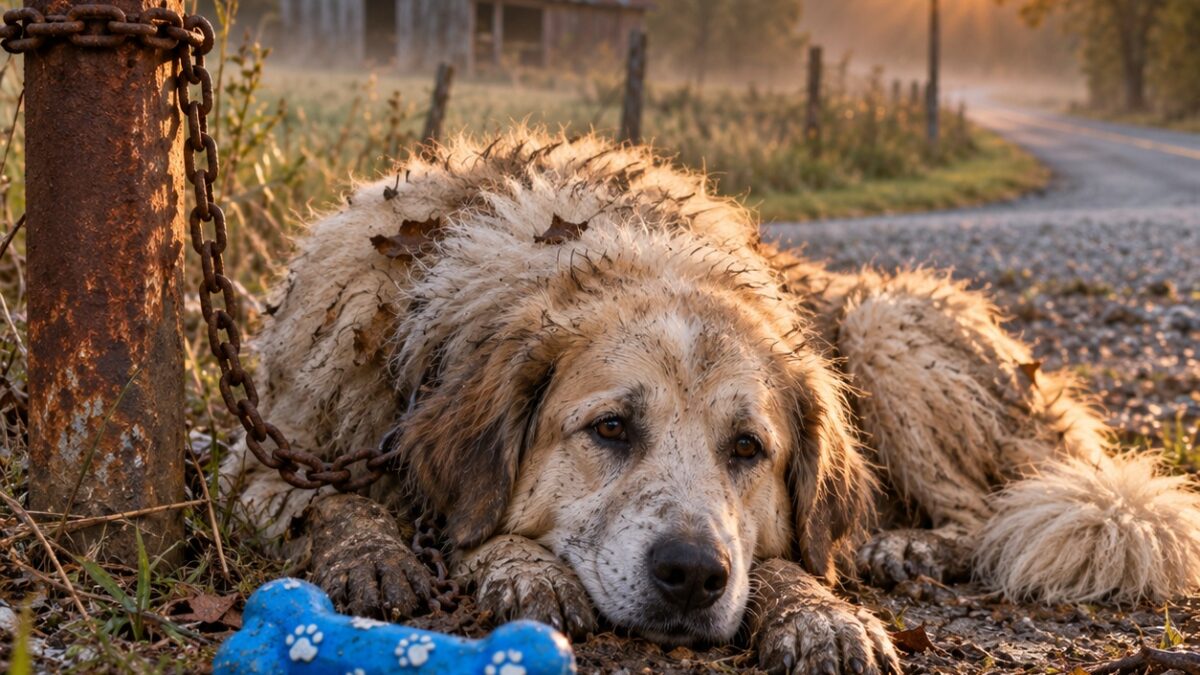
The shelter was fifteen minutes away.
Toy sat in the back of Lacy’s Subaru without making a sound.
I rode beside him.
Technically, I didn’t need to.
Lacy had everything under control.
She had worked animal rescue long enough that a thin abandoned dog beside a rural road was tragic but not unfamiliar.
For me, it was different.
I kept looking at Toy as if he might vanish if I turned away.
The blue rubber bone rested in my lap.
He stared at it once.
Then looked out the window.
“You recognize this?”
Nothing.
“Apparently I’m talking to a dog now.”
Lacy glanced at us in the mirror.
“You’ll get used to it.”
Toy lowered his head onto the seat.
At the shelter, Lacy led us through the side entrance so he wouldn’t have to walk past the main kennel room.
Even before we reached it, the building came alive with barking.
Toy stopped.
His body went rigid.
Lacy crouched.
“It’s okay.”
He did not pull away.
He simply stood there, listening.
That became one of the first things I learned about him.
Toy rarely reacted loudly.
He absorbed.
Fear went inward.
So did curiosity.
Even happiness seemed to arrive quietly.
We put him in an exam room.
The shelter veterinarian checked him.
Severe dehydration.
Malnutrition.
Old abrasions around the neck where the chain had rubbed.
Muscle loss in his left side.
No broken bones.
No major infection.
No microchip.
He was older than I had expected.
Maybe seven.
Possibly eight.
“Has he been tied there long?” I asked.
The vet shook his head.
“Can’t know.”
“But the muscle loss?”
“Could be from inactivity over a much longer period. Could be old neglect.”
I looked at Toy.
He stood beside the wall.
Silent.
“Can he stay?”
Lacy gave me a look.
“Addie.”
“What?”
“You met him forty-five minutes ago.”
“I asked if he could stay here.”
“Yes.”
“Oh.”
She smiled.
“He can stay.”
I removed the blue toy from my pocket.
“Can this stay too?”
Lacy picked it up.
“Wash it first.”
I nodded.
The toy looked absurdly cheerful beneath fluorescent shelter lights.
“What kind of person chains a dog to a post and leaves a new toy?”
Lacy shrugged.
“People do strange things when they’re ashamed.”
“That’s not an answer.”
“No.”
She looked at Toy.
“But whoever did it may have wanted him found.”
“They could have brought him here.”
“Maybe.”
“Then why didn’t they?”
“That’s the question.”
I went to work that day.
Or I tried.
Mrs. Calloway’s third-graders were learning fractions.
By 10:15, two twins named Oliver and Owen had switched desks and were waiting to see how long it would take me to notice.
Normally I would have appreciated the effort.
Instead, I looked at Oliver and called him Owen.
They exchanged triumphant grins.
I sighed.
“You two are exhausting.”
“Did we fool you?”
“For twenty-eight minutes.”
They fist-bumped.
At lunch, I checked my phone.
Lacy had sent a photo.
Toy lay on a blanket in the quiet kennel.
The blue toy sat beside his paws.
He wasn’t touching it.
But his head was turned toward it.
I stared at the picture longer than necessary.
Then Lacy texted:
He ate.
I felt ridiculous relief.
I went back that afternoon.
Toy did not lift his head when I entered.
I sat on the floor outside his kennel.
“Hi.”
His eyes moved toward me.
“Long day.”
Nothing.
“The Emerson twins switched places again.”
His ears twitched.
“That’s more reaction than their math worksheet got.”
I brought a blanket.
A peanut butter biscuit.
And apparently my entire day’s worth of conversation.
I told him about the lunch lady slipping me extra cornbread.
About the broken copier.
About the weather.
About nothing.
Toy listened.
The next day, I returned.
Then the day after.
By the fourth day, he lifted his head when I entered.
On day five, he licked my hand.
It was one slow swipe across my knuckles.
I looked at Lacy.
“Did you see that?”
“I saw.”
“He likes me.”
“Don’t become unbearable.”
“He likes me.”
“Yes, Addie.”
I laughed.
Toy lowered his head again.
On the sixth day, I arrived carrying roasted chicken because Lacy had discovered it was the only food that made Toy’s eyes noticeably brighten.
There was a folded note outside his room.
No envelope.
Just a piece of paper tucked beneath a can of wet food.
I picked it up.
Please make sure he gets love.
I couldn’t anymore.
I left the toy so he’d know I tried.
My hands went cold.
“Lacy.”
She came over.
I handed her the note.
She read it twice.
“At least they have some heart.”
I stared at her.
“They chained him to a fence.”
“I know.”
“You can’t leave a dog tied to a post and make it okay because you bought him a toy.”
“I didn’t say it was okay.”
“Then what are you saying?”
“That whoever left him may not have stopped loving him.”
“That makes it worse.”
“Sometimes it does.”
I looked through the kennel bars.
Toy watched us.
The blue toy rested near his chest.
I crouched.
“Do you know who wrote this?”
Toy’s eyes lowered.
Of course he couldn’t answer.
But from that day forward, the blue toy felt different.
Not like random guilt.
Like a piece of a relationship.
I kept visiting.
Toy gained weight slowly.
His neck healed.
We cut mats from his fur, and beneath the dirt emerged a surprisingly handsome dog.
Cream and brown.
Thick coat.
Large paws.
A white stripe on his chest.
He liked acoustic guitar playing quietly from my phone.
He liked chicken.
He liked hearing people read.
He hated loud kennel doors.
He disliked being approached from behind.
And he almost never barked.
One rainy afternoon, after three weeks of visits, I sat beside him and said the thing I had been avoiding.
“What if you came home with me?”
Toy blinked.
“Just temporarily.”
One tail movement.
“Don’t get excited.”
Another.
I laughed.
“You are manipulating me.”
Lacy helped with foster paperwork.
“You understand foster means foster.”
“I know.”
“You are saying that like somebody who is going to adopt this dog.”
“I am evaluating.”
“You bought him an orthopedic bed yesterday.”
“Temporary dogs can have comfortable joints.”
“And six bags of biscuits?”
“Bulk discount.”
She looked at me.
I looked away.
Toy came home Sunday.
He climbed into my car quietly.
The blue toy sat beside him.
When we reached my house, he stood in the living room as if he had entered a museum after closing.
He sniffed the couch.
The rug.
Kitchen doorway.
Stairs.
Every room carefully.
He did not run.
Did not explore with excitement.
He inspected.
When he finished, he returned to the living room, circled twice beside the couch, and lay down.
The blue toy settled between his paws.
Then he sighed.
A long, deep breath.
It sounded like someone putting down a suitcase after carrying it for years.
“Okay,” I whispered.
“You can stay.”
Technically, I still meant temporarily.
Technically.
Two weeks later, I was buying his specific food because the cheaper brand upset his stomach.
I had placed an extra blanket near my bed.
My kitchen cabinet contained dog supplements.
His leash hung beside my coat.
I stopped using the word temporary.
I simply didn’t use permanent yet.
Toy found a routine.
Morning walk.
Breakfast.
Nap beside the bay window.
Me at school.
My arrival at three-thirty.
Evening walk.
Dinner at exactly seven-thirty.
He somehow knew the time.
At seven twenty-eight, he would sit beside his bowl.
At seven thirty-one, I received a look of deep personal disappointment.
“You survived being abandoned and this is what makes you angry?”
Silence.
“Food two minutes late?”
Stare.
“You are spoiled.”
Tail movement.
That silence stopped feeling sad.
Sometimes quiet is trauma.
Sometimes quiet is simply personality.
Toy was both.
He noticed everything.
If I laughed from another room, he came to the doorway.
If I sang while washing dishes, he lay beside my feet.
If I read on the couch, he rested his head near my leg.
I started reading aloud to him.
At first because I thought he liked my voice.
Eventually because I liked having someone listen without correcting my opinions.
One Wednesday, I brought him to Pine Hollow Elementary after classes.
Mr. Hardy, our principal, technically had rules against animals in classrooms.
He also knew Toy’s story.
“You have twenty minutes,” he said.
“Thirty.”
“Twenty-five.”
“Deal.”
Mrs. Feldman’s second-graders nearly exploded.
“MISS ADDIE HAS A DOG!”
“Is he yours?”
“Can he do tricks?”
“Is he magic?”
One boy genuinely asked whether Toy was real.
I knelt beside him.
“This is Toy. He’s gentle, but we’re going to take turns.”
A quiet girl named Emily came first.
She held out her hand.
Toy sniffed.
Then closed his eyes while she rubbed his head.
The rest followed.
Twenty-two small hands.
Twenty-two voices.
Questions without end.
“Does he like pizza?”
“Probably too much.”
“What’s his favorite color?”
“No idea.”
“Blue,” Emily whispered, pointing to the toy beside my bag.
A boy named Jacob said, “That’s his safety thing.”
I looked at him.
“What?”
“My little brother has a blanket. He takes it everywhere because it means home.”
I stared at the blue toy.
Maybe.
Afterward, Toy slept in my car all the way home.
That evening, I found the second note.
Inside my mailbox.
No stamp.
No envelope.
Same handwriting.
I saw you with him.
Thank you.
I didn’t know anyone would care.
I stood at the curb reading it twice.
Then looked up and down the street.
Nobody.
An old man walked a pug three houses away.
A cat stretched on a porch railing.
Cars sat in driveways.
Nothing unusual.
But suddenly my neighborhood did not feel completely private.
I went inside and locked the door.
Toy approached.
“It’s okay.”
He leaned against my leg.
I placed the note beside the first one.
I did not tell Lacy immediately.
I told myself I wasn’t frightened.
Curious.
Uncomfortable.
Maybe angry.
But not frightened.
Then I saw the woman.
It happened at the farmers market the following Saturday.
Toy had become well enough for short public outings.
He stayed close beside me as we moved among booths selling bread, honey, pumpkins, soap, and pet treats.
A woman at the honey stand scratched his ears.
“Beautiful dog.”
“He’s new.”
“Rescue?”
“Yes.”
Toy accepted a biscuit with great dignity.
Then I saw someone across the plaza.
Young woman.
Maybe mid-twenties.
Standing behind tall sunflowers near a pottery booth.
Light jacket.
Large sunglasses.
Dark hair pulled into a tight braid.
Watching Toy.
Not me.
Him.
I straightened.
Toy didn’t react.
I looked directly at her.
She stepped backward.
Then disappeared.
I pushed through the crowd.
By the time I reached the pottery booth, she was gone.
That evening, I called Lacy.
“You should have told me about the second note.”
“I knew you’d worry.”
“I am professionally employed to worry about strange people near abandoned animals.”
“That is not your job title.”
“It should be.”
“Do you think the woman left him?”
“Maybe.”
“Why watch instead of approaching?”
“Shame.”
“You keep saying that.”
“Because shame makes people weird.”
That night, I checked every lock twice.
Toy slept by my bedroom door.
At dawn, he barked.
One bark.
Deep.
I sat upright.
Toy stood beside the living room window.
“Toy?”
He stared outside.
Street empty.
Then I noticed the blue rubber bone.
I had left it beside his bed.
It was near the front door.
“Did you move that?”
Toy kept watching outside.
I told myself he had carried it.
Obviously.
He was a dog.
Dogs moved toys.
There was no mystery.
Then the third note appeared taped to my backyard fence.
It was raining.
The paper had begun curling at the edges.
I just wanted him to be happy.
You’re doing that.
I won’t come again.
I stood beneath the rain staring at the handwriting.
Whoever wrote it had entered my backyard.
That changed things.
I called Lacy.
Then the sheriff’s non-emergency number.
There was little they could do.
No threat.
No damage.
No identification.
They advised cameras.
I installed two that afternoon.
Toy watched me drill the mounting brackets.
“This is your fault.”
He yawned.
“I had a peaceful life.”
Tail wag.
“Very expensive peaceful life.”
He went inside.
I found myself smiling.
That was the strange thing about Toy.
Even when something unsettling surrounded his past, his presence made my house calmer.
Weeks passed.
No notes.
No woman.
Toy continued healing.
His coat thickened.
Muscles returned.
He started barking occasionally.
Not often.
One bark at the mail truck.
One at a squirrel.
One when I forgot dinner.
Each bark felt like a small piece of him coming back.
Dr. Halpern, his veterinarian, noticed it too.
“He’s recovering beautifully.”
“He’s still stiff in cold weather.”
“Probably always will be somewhat.”
She checked his left hip.
“Muscle loss from prolonged inactivity. Movement helps.”
I hesitated.
“Can dogs remember people who abandoned them?”
Her hands paused.
“Yes.”
“Do they forgive?”
“That’s a human word.”
“What’s the dog word?”
She smiled.
“Dogs respond to what’s happening now.”
That stayed with me.
Maybe Toy did not need to solve his past.
Maybe I did.
Then the woman appeared again.
Snow had begun falling lightly.
Toy and I were walking after dinner.
At the far end of our street, just beyond a lamp, a figure stood near the hedge.
Same height.
Same posture.
Toy stopped.
His ears rose.
The woman looked at him.
I raised my hand.
“Hey!”
She flinched.
Turned.
Ran.
Toy made a sound I had never heard from him.
A soft whine.
One.
That was enough.
We went home quickly.
Under my doormat was another note.
I miss him every day.
But he doesn’t need me anymore.
My anger changed.
Not disappeared.
Changed.
I sat on the couch.
Toy leaned against me.
“You know her.”
He rested his head on my knee.
“I need to know who she is.”
The next morning, I called Lacy.
She sighed.
“I figured.”
“Can we check the intake paperwork again?”
“There wasn’t much.”
“Anything.”
At the shelter, she opened Toy’s original file.
There was an anonymous online surrender inquiry submitted two days before I found him.
Never completed.
No last name.
No phone number.
Just a first initial.
E.
I went home and did something I usually mocked other people for doing.
I became an internet detective.
Pine Hollow.
Local Facebook pages.
Old dog photographs.
Lost-pet posts.
Nothing.
Then I found an account belonging to Emory Jacobs.
Inactive for nearly a year.
Old profile photos.
Community posts.
Then a photograph from four years earlier.
A younger woman sitting beside a creek.
Beside her stood a large shaggy dog.
Toy.
Same white chest.
Same eyes.
The caption:
Toy says hi from the creek.
My heart hammered.
I typed:
Hi. I think I have your dog.
Then I stared at the message.
Sent.
Nothing happened for a day and a half.
I checked constantly.
Then, the next morning:
Where did you find him?
No greeting.
No denial.
Just that.
I typed:
Tied to a fence post near County Road 6, close to the old Lambert fruit stand. He had a blue toy.
An hour passed.
Then:
That was mine.
He was mine.
I stared at the words.
Toy lay beneath the kitchen table.
“Emory?”
His ear moved.
I wrote:
Do you want to talk?
A response came quickly.
Yes.
Not online, please.
We agreed to meet behind the Pine Hollow Library.
I almost left Toy home.
Then Emory asked if I would bring him.
The afternoon was cold.
Toy walked beside me toward the gazebo.
Twenty yards away, he stopped.
Emory stood beside the railing.
No sunglasses.
No braid.
No hiding.
She looked younger than I imagined.
And more tired.
Too-thin jeans.
Threadbare sweater.
Hands wrapped around herself.
Toy stared.
She stared back.
Neither moved.
Then she whispered:
“Hey, boy.”
Toy took one step.
Another.
He stopped in front of her.
Sat.
Emory dropped to her knees.
“I missed you.”
Her hands shook as she touched his face.
Toy didn’t jump.
Didn’t lick her.
Didn’t hide.
He simply let her hold him.
I looked away for a second because it felt private.
Then she said:
“I’m sorry.”
Not to me.
To him.
Her forehead touched his.
“I’m so sorry.”
Toy stayed still.
When she stood, her eyes were red.
“You saw us at the market.”
She nodded.
“And near my house.”
“Yes.”
“You left the notes.”
“Yes.”
“Why didn’t you just come talk to me?”
Her face folded slightly.
“Because I thought you’d hate me.”
“I did, a little.”
She nodded.
“I understand.”
I hated the honesty of that answer.
There was no defense.
No outrage.
I sat on the bench.
“Tell me what happened.”
Emory looked at Toy.
“My dad gave him to me when I was seventeen.”
“How old is Toy?”
“Eight.”
Close to our estimate.
“My dad loved him as much as I did.”
Her voice trembled.
“Dad died three years ago.”
“I’m sorry.”
“Everything went downhill after that. Mom stopped functioning. Bills stacked up. We lost the house.”
She swallowed.
“I moved in with a friend. They wouldn’t allow Toy.”
“So you abandoned him?”
“I tried not to.”
Her voice cracked.
“I called people. Friends. Relatives. Nobody wanted a big older dog.”
“The shelter existed.”
“I was scared.”
“Of what?”
“That they would euthanize him.”
“Our shelter doesn’t—”
“I didn’t know.”
She looked at me.
“I was not thinking clearly, Addie.”
That was the first time she used my name.
“I had lost my dad. My home. Mom was somewhere else emotionally. I had twenty dollars in my bank account and was sleeping on a couch.”
She wiped her face.
“I convinced myself that if I left Toy somewhere visible, somebody good would find him.”
“You chained him.”
Her eyes closed.
“I know.”
“He could have died.”
“I know.”
“He waited.”
That broke her.
She cried silently.
“I know.”
I wanted to stay angry.
Anger would have been easier.
Then Toy moved.
He approached Emory.
Placed his head against her knee.
She covered her mouth.
“I left the blue toy because Dad bought it for him.”
That detail landed differently.
“He had it since he was a puppy?”
“Yes.”
“I thought it was new.”
“I washed it.”
She almost laughed through the tears.
“It was the last thing I could do.”
“You could have stayed.”
“I know.”
I said nothing.
She crouched and rubbed Toy’s ears.
“I know it wasn’t enough.”
No excuses.
Only grief.
After a long silence, she said:
“I can’t take him back.”
I looked at her.
She continued before I could respond.
“I’m still on my friend’s couch. I work part-time at a bakery. I don’t have money for vet bills. You gave him everything I couldn’t.”
Toy sat between us.
“He’s happy,” I said.
“I can see that.”
“He remembers you.”
“I hope so.”
The words were almost too fragile to hear.
I thought about Dr. Halpern.
Dogs respond to what is happening now.
I made a decision.
“If you want to see him sometimes, you can.”
Emory looked up.
“What?”
“Visits.”
“I don’t want to confuse him.”
“I think he’s smarter than both of us.”
A laugh escaped her.
Toy’s tail moved.
“I’d like that.”
“Okay.”
“You’re sure?”
“No.”
She almost smiled.
“But I think it’s okay.”
That was the beginning of something I never expected.
Toy did not return to Emory.
Emory did not disappear.
Instead, the three of us built something that did not have an easy name.
I was Toy’s home.
Emory was his history.
And Toy somehow made room for both.
At first, Emory texted once or twice a week.
How is he?
Did he eat?
Does he still hate thunder?
Does he still steal socks?
Apparently, yes.
He had simply waited until becoming comfortable in my house before revealing his criminal tendencies.
I sent pictures.
Toy asleep in a sunbeam.
Toy with snow on his nose.
Toy staring judgmentally at broccoli.
The first time Emory visited, she brought a green rope toy.
Toy sniffed it.
Then carried it to his bed and placed it beside the blue bone.
Emory cried.
I pretended not to notice.
Christmas arrived.
I bought Toy a ridiculous memory-foam bed.
Emory knitted him a gray scarf.
He tolerated the scarf for approximately thirty seconds.
Then removed it with one paw.
“He hates my gift.”
“He has taste.”
She threw a cushion at me.
Toy watched.
And something happened that evening.
We laughed.
All three of us—well, two humans and one dog who looked offended by our noise.
For months, Toy’s story had felt heavy.
Abandonment.
Grief.
Shame.
Now joy began taking space too.
In January, Lacy asked if I could foster a young dog for five days while the shelter repaired a heater.
His name was Dodger.
Six months old.
Wild.
Toy looked at him as if I had brought home a tornado.
Dodger stole socks.
Ran into furniture.
Barked at his reflection.
Brought toys to Toy constantly.
Toy responded with dignified silence.
On the third morning, I found both dogs asleep in Toy’s bed.
The blue toy between them.
I photographed it.
Sent it to Emory.
She replied:
He never shared that toy.
That mattered.
When Dodger returned to the shelter, Toy stood by the window and watched the van disappear.
That night he slept near the door.
I realized Toy had changed.
The dog who once expected people to disappear was beginning to believe relationships could end without abandonment.
People could leave.
And sometimes they came back.
The same was happening to Emory.
She started working more hours.
Then she told me she was considering school.
“For what?”
“Animal sciences.”
I stared at her.
She laughed nervously.
“Too obvious?”
“No.”
“I keep thinking maybe if I understood more back then…”
“Don’t do that.”
“What?”
“Build your future entirely as punishment for your past.”
She was quiet.
“You made a bad decision.”
“A terrible decision.”
“Yes.”
She winced.
“But Toy survived.”
“Because of you.”
“Because he was found.”
I looked at her.
“If you want to work with animals because you care about them, do it.”
She nodded.
“If you’re trying to spend the rest of your life apologizing, Toy doesn’t need that.”
Toy lay between us.
Head on his paws.
Emory whispered:
“Maybe I need it.”
I understood.
Spring came.
Toy got stronger.
His first full bark happened because of a squirrel.
I was gardening.
Toy lay in the shade.
The squirrel jumped onto the fence.
Toy stood.
Then a huge bark burst from him.
BOOM.
He startled himself.
I dropped my trowel and laughed.
“Well!”
He looked at me.
Another bark.
“You found your voice.”
After that, Toy barked selectively.
One bark for squirrels.
One for raccoons.
One for the garbage truck if it came too close.
Never endlessly.
Never without reason.
The neighborhood children started calling him the Quiet King.
Later, Mayor Toy.
He visited the school occasionally.
Then the library.
Children read to him.
He lay beside the shelves, blue toy near his paws, listening exactly the way he had listened to me at the shelter.
Emily—the shy girl from Mrs. Feldman’s class—started reading aloud more confidently when Toy visited.
“He doesn’t care if I mess up,” she told me.
“No.”
“People do.”
“Sometimes.”
Toy put his head on her shoe.
Emily smiled.
“Maybe people should be more like him.”
I agreed.
Emory entered community college.
She worked mornings at the bakery and shadowed at Dr. Halpern’s clinic twice a week.
Some evenings, she studied on my porch.
Toy slept beside her.
Once she looked at him and said:
“Do you ever think he knows what he did?”
“What?”
“To us.”
I looked at Toy.
“Probably not.”
“He brought us together.”
“You mean he brought you back.”
“No.”
She shook her head.
“He brought both of us somewhere.”
I understood what she meant.
Before Toy, my life had been tidy.
School.
House.
Running.
Occasional dinner with friends.
Nothing wrong.
Nothing broken.
Just emotionally flat.
Toy gave my days weight.
Then Emory arrived with all her guilt and sadness, and somehow we became friends.
Not because either of us planned to.
Because loving the same dog required honesty.
Emory showed me old photographs.
Toy as a puppy.
Toy beside her father.
Toy sleeping under a porch while a man with a guitar played above him.
One photograph showed Emory at seventeen holding the blue rubber bone.
“That’s it.”
She nodded.
“Dad bought it his first Christmas.”
Toy sniffed the photograph.
Then the toy.
I smiled.
“Very sentimental.”
Emory laughed.
“He used to destroy everything except that.”
“Of course.”
She gave me Toy’s original blue collar.
His name stitched in faded white letters.
I hesitated.
“You sure?”
“Yes.”
I put it on him.
Toy licked my hand.
Emory looked away.
“I used to think I ruined him.”
“You hurt him.”
She nodded.
“I know.”
“But ruined?”
Toy walked toward the porch.
Strong.
Calm.
Home.
“No.”
She watched him.
“No.”
We took him to the lake that summer.
Toy hated the idea at first.
He stared at the water as if we had both betrayed him.
Emory walked in barefoot.
“Come on, old man.”
Toy grumbled.
Then followed.
Water reached his belly.
He stood beside her.
Tail moving slowly beneath the surface.
He did not swim.
Did not need to.
Later he rolled in wet sand like a puppy.
Emory laughed so hard she cried.
When we ate sandwiches under a tree, she said:
“I didn’t think I’d ever get days like this again.”
“You will.”
“Are you sure?”
“No.”
I looked at Toy.
“But apparently none of us knows what’s coming.”
Toy rested his head on her leg.
Emory whispered:
“He makes me feel like I’m allowed to be happy.”
I never forgot that.
Healing is strange.
People talk about forgiveness as though it happens once.
A conversation.
An apology.
A decision.
It didn’t work that way for Emory.
Some days she forgave herself.
Other days she didn’t.
Toy never seemed to demand either.
He just responded to the present.
She arrived.
He wagged.
She left.
He slept.
She returned.
He greeted her.
Simple.
Maybe that simplicity taught us both.
By fall, Toy had three toys.
Blue bone from Emory’s father.
Green rope from Emory.
And a red rubber bone I found buried in the far corner of my yard.
I still do not know how it got there.
Maybe Toy had buried it after moving in.
Maybe it came from somewhere else.
He watched me wash it.
Then left it beside the others.
The three toys became almost ceremonial.
Sometimes Toy placed them in the hallway.
Sometimes by his bed.
One evening, I found all three facing the front door.
Emory laughed.
“He’s making an altar.”
“Or trying to kill us by tripping.”
Toy watched.
We never solved it.
That was fine.
Not every mystery needs an answer.
The strange notes stopped permanently after I met Emory.
The mysterious woman became the person who brought muffins on Sunday.
The abandoned dog became Mayor Toy.
The substitute teacher became a full-time elementary-school teacher.
And the young woman sleeping on a friend’s couch slowly built a life.
Emory completed her first semester.
Then another.
She started assisting at Dr. Halpern’s clinic.
Eventually, she moved into a tiny studio apartment.
No pets allowed.
When she told me, she laughed.
“The universe has jokes.”
“Terrible ones.”
“But someday.”
I knew what she meant.
Someday another dog.
Not Toy.
Toy’s home was with me.
That truth stopped hurting her.
Or at least stopped feeling like punishment.
One autumn afternoon, Emory asked if we could take Toy to a trail she used to walk with her father.
It was farther than our usual route.
Toy was older now.
His joints stiffened faster.
But the trail was flat.
We went.
Halfway through, we reached a stone bench.
Emory stopped.
“Oh.”
She took an old photograph from her pocket.
Her father sat on that exact bench.
Younger Emory beside him.
Toy as a puppy sprawled between them.
Toy sniffed the photograph.
Then lay at Emory’s feet.
We stayed until the light changed.
On the walk back, Toy stopped beside wildflowers.
Raised his head.
Barked once.
Emory smiled through tears.
“He’s telling Dad we came back.”
I didn’t tell her that was impossible.
Some moments deserve tenderness more than correction.
Toy began slowing that winter.
Not dramatically.
Later mornings.
Shorter walks.
Longer naps.
Dr. Halpern examined him.
“Age.”
I hated that word.
“How old?”
“Maybe ten now.”
“That isn’t ancient.”
“For a dog his size with his history, his body has worked hard.”
He was healthy enough.
Just older.
Emory spent Thanksgiving with us.
Then Christmas.
By then, neither of us thought it strange.
We decorated a stocking for Toy.
The children at school sent cards.
One drawing showed Toy surrounded by three toys and wearing a gold crown.
MAYOR TOY.
I taped it to the refrigerator.
Christmas morning, Toy moved slowly around the block.
He stopped to watch a cardinal.
Then we went home.
That evening he rested his head on Emory’s leg.
She stroked his ears.
“He feels slower.”
“I know.”
“Not sick.”
“No.”
“Just…”
“Settled.”
She nodded.
I handed her the blue toy.
“He chose this the day I found him.”
She rubbed her thumb over the worn paw prints.
“It was always his anchor.”
That night, Toy slept deeply.
The next morning, he didn’t come to meet me.
I knew something had changed before I reached his bed.
“Toy?”
His eyes opened.
Tail moved once.
I knelt.
“Hey, buddy.”
He pushed his nose against my palm.
He tried to stand.
Couldn’t.
I called Emory.
Then Dr. Halpern.
Dr. Halpern came to the house.
She listened to Toy’s heart.
Checked his gums.
His abdomen.
His joints.
“He’s tired.”
Emory’s voice shook.
“Is he hurting?”
“Not significantly.”
“Can you make him better?”
Dr. Halpern looked at us.
“There isn’t one specific illness to fix.”
I knew what she meant.
I hated her for saying it.
Not rationally.
But grief is rarely polite.
“So what do we do?”
“Keep him comfortable.”
“For how long?”
She looked at Toy.
“He’ll tell you.”
I had spent years learning his quiet language.
Suddenly I didn’t want to understand it.
Toy ate almost nothing that day.
A little chicken.
Two bites of biscuit.
Water from my hand.
Emory sat on one side of him.
I sat on the other.
We read aloud.
The same way I had in the shelter.
Children’s books.
A novel.
Anything.
Emory played acoustic guitar recordings her father used to love.
Toy’s eyes stayed half open.
Calm.
That evening, Lacy came with a soft blue blanket.
“For the most important foster I ever had.”
Toy smelled it.
Then rested his head.
Lacy cried.
“I knew you’d keep him.”
“I didn’t.”
“Yes, you did.”
Toy’s tail moved.
We placed the three toys around him.
Blue near his front paw.
Green rope near his back.
Red beside the blanket.
Emory stayed overnight.
Neither of us said that we were staying because we were afraid.
We simply stayed.
Near midnight, Toy opened his eyes.
I touched his face.
“You’re home.”
His breathing was slow.
Emory whispered:
“We’re both here.”
Toy looked at her.
Then me.
His eyes closed.
In the morning, light entered the room before either of us moved.
I woke on the floor beside him.
Something felt different.
No movement.
No breath.
I placed my hand against his chest.
Nothing.
Emory woke when she heard me say his name.
She sat up.
Looked.
Understood.
For a long time, neither of us cried.
I think grief was too large for tears initially.
We simply sat with him.
Emory rested one hand against his side.
I stroked his head.
“You were loved.”
My voice sounded strange.
“Every day.”
Emory leaned forward.
“You gave us back to ourselves.”
That did it.
I cried.
She cried.
Not loudly.
Not dramatically.
Toy’s face remained peaceful.
We buried him beneath the old pear tree in my backyard.
Lacy came.
Dr. Halpern came.
A few neighbors.
The librarian.
Mr. Hardy.
Emily, older now, brought a folded drawing.
Mayor Toy under a blue sky.
Nobody gave a big speech.
Toy would have hated the attention.
We buried him with the blue rubber bone.
I hesitated before placing it beside him.
That toy had survived his first home.
His abandonment.
The shelter.
My house.
Emory’s return.
Every season afterward.
But it belonged to him.
So I let it go.
The green rope and red bone remained inside.
On Toy’s empty bed.
That first night without him, the house sounded wrong.
No nails against hardwood.
No sigh beside the couch.
No collar.
No seven-thirty dinner stare.
I woke at six-thirty out of habit.
Made coffee.
Then walked onto the porch.
Sunrise spread gold over the yard.
Emory arrived ten minutes later.
She had stayed with a friend nearby.
She sat beside me.
“He would’ve liked this morning.”
I looked toward the pear tree.
“He did.”
We sat quietly.
Later, I noticed the red toy near the window.
I was certain I had left it on Toy’s bed.
Maybe Emory moved it.
Maybe I did and forgot.
The next morning, the green rope was in the hallway.
I laughed despite myself.
“Very funny.”
Emory denied touching it.
I didn’t investigate.
Some mysteries are better left kind.
Toy’s death did not end what he had changed.
Emory finished her animal-science program.
Two years later, she began working full-time as a veterinary technician.
Her first paycheck from the clinic bought a donation of twenty blue rubber toys for the Pine Hollow shelter.
She did not tell me beforehand.
Lacy called.
“Come down here.”
“Why?”
“Just come.”
A box sat on the front desk.
Twenty toys.
Each with a small tag.
For dogs waiting for someone to stop.
I cried.
Emory shrugged.
“It seemed right.”
We began a small fund through the shelter.
Not huge.
Nothing grand.
Emergency boarding for owners facing housing crises.
Temporary foster support.
Pet-food assistance.
The kinds of things Emory hadn’t known existed when she panicked years earlier.
We called it the Toy Fund.
Emory initially refused.
“That sounds like a fund for toys.”
“Exactly.”
“That is terrible branding.”
“Too late.”
The first person it helped was a woman escaping an abusive relationship who needed temporary care for her senior beagle.
The second was an elderly man hospitalized after a stroke.
Then a family whose apartment building burned.
Each time, I thought about County Road 6.
How differently Toy’s story might have begun if Emory had known how to ask for help.
You cannot rewrite a past mistake.
But you can build something that makes the same mistake less likely for someone else.
That became Emory’s way of living with what she had done.
Not pretending it was okay.
Not punishing herself forever.
Turning guilt into usefulness.
Years passed.
I remained at Pine Hollow Elementary.
The children changed.
The stories about Mayor Toy became school folklore.
New students saw his framed photograph in the library.
A large shaggy dog with serious brown eyes.
Underneath, the librarian eventually placed a small plaque.
TOY
THE QUIETEST LISTENER IN PINE HOLLOW
One afternoon, a little boy asked:
“Was he famous?”
I smiled.
“To us.”
“What did he do?”
That question stopped me.
What did Toy do?
He did not pull anyone from a burning building.
Didn’t detect disease.
Never became a police dog.
He wasn’t trained for therapy work officially.
No dramatic heroics.
“He stayed,” I said.
The boy frowned.
“That’s it?”
I looked at Toy’s photograph.
“No.”
I smiled.
“That was enough.”
Toy stayed beside children while they read.
Stayed beside Emory while she learned to forgive herself.
Stayed beside me through seasons when I hadn’t realized I needed company.
Stayed quiet until he found his voice.
Stayed connected to his past without being trapped by it.
And when his body could no longer stay, everything he changed remained.
Years after Toy died, Emory and I returned to the old Lambert fruit stand site.
The structure had finally been removed.
Only the metal fence post remained.
Rustier.
Bent slightly.
We stood beside it.
Emory touched the metal.
“I hate this place.”
“I know.”
“I used to dream about it.”
“Me too.”
She looked toward the road.
“I don’t anymore.”
We stood silently.
Then Emory reached into her bag.
She pulled out a blue rubber bone.
New.
Same style.
“You brought that?”
“Yes.”
“What are you doing?”
She placed it at the base of the post.
I looked at her.
“For what?”
She shrugged.
“For whoever needs to see it.”
We walked away.
A year later, the county removed the post.
The toy disappeared with it.
Maybe somebody took it.
Maybe it was thrown away.
I didn’t care.
Symbols only need to survive long enough to do their work.
I still live in the same house.
The pear tree is bigger.
Every spring, white blossoms fall over the place where Toy is buried.
There is no elaborate marker.
Just a flat stone.
TOY
Below it:
HE FOUND HIS WAY HOME.
Sometimes people assume that means my house.
It doesn’t.
Not entirely.
Home was me.
Home was Emory.
Home was Lacy.
The school.
The library.
Children’s hands.
Chicken treats.
Three toys.
Morning sunlight.
The trail.
The lake.
His old collar.
The sound of guitar.
All of it.
Home was finally having enough safety that he no longer needed to wonder whether everyone would leave.
And maybe that was what Toy gave Emory and me too.
Neither of us ended where we began.
The woman who abandoned him became someone who spent her life helping people keep animals through hard times.
The substitute teacher who went running because she liked quiet learned that quiet and loneliness were not the same thing.
And the dog I first mistook for dead became one of the most alive presences I had ever known.
I used to imagine rescue as one person saving another.
Toy changed that definition.
I freed him from a chain.
Lacy got him medical care.
I gave him a home.
All true.
But Toy rescued parts of us too.
He gave Emory proof that the worst thing she had ever done did not have to become the only thing she ever did.
He taught me that love does not always arrive loudly.
Sometimes it sits beside your couch.
Listens while you read.
Waits by the door.
Carries an old blue toy from one life into another.
And sometimes forgiveness isn’t pretending the chain never happened.
It is acknowledging it.
Learning from it.
Then choosing not to let it be the final image.
My final image of Toy isn’t County Road 6.
It isn’t the rusty fence.
It isn’t his thin body curled against dirt.
It isn’t even that blue toy beside him.
It is Christmas morning years later.
Fire dying low.
Emory sitting on the floor.
Me beside her.
Toy stretched between us with his head on her leg.
Safe.
Warm.
Old.
Loved by the person who once failed him and the person who later found him.
He belonged to neither of us completely.
Maybe Emory had been right all along.
Toy was never meant to be only one person’s dog.
He belonged to every version of himself.
The puppy beside Emory’s father.
The abandoned dog by the roadside.
The shelter dog learning to trust.
My foster.
My family.
The children’s Quiet King.
Mayor Toy.
Emory’s second chance.
My companion.
And eventually, a memory that kept doing good even after he was gone.
The blue toy went into the ground with him.
But what it meant never did.
Somewhere in Pine Hollow, there are dogs sleeping safely tonight because the Toy Fund paid for temporary boarding.
Somewhere there is a frightened owner being told:
You do not have to abandon them just because your life is falling apart.
Let us help.
Whenever I hear those words, I think of the note left outside Toy’s shelter room.
Please make sure he gets love.
I couldn’t anymore.
I left the toy so he’d know I tried.
For years, I thought that note was about failure.
Now I see something else inside it too.
A request.
Not a good plan.
Not enough.
But a request for someone else to continue where one person had collapsed.
I happened to be there.
Lacy was there.
The shelter was there.
Then, eventually, Emory came back.
And together, imperfectly, we finished the promise.
Toy got love.
More than the frightened young woman who tied him to that post probably imagined possible.
More than I knew I had to give.
He got mornings.
Winters.
Children.
Friends.
A home.
A voice.
He got old.
That last part matters most to me.
Abandoned dogs do not always get the privilege of growing old.
Toy did.
His muzzle grayed.
His steps slowed.
He slept longer.
He became tired because he had lived enough years to become tired.
There is extraordinary beauty in something that ordinary.
I once thought the saddest thing I had ever seen was Toy tied beside that road.
I was wrong.
The saddest thing was losing him after we knew exactly how much he mattered.
But I would choose that grief every time.
Because grief was the price of the years before it.
And those years were worth everything.
Sometimes, early in the morning, I still walk the neighborhood before school.
No dog beside me now.
At least not always.
I foster occasionally.
Never permanently, I tell Lacy.
She no longer believes me.
On quiet mornings, I pass the oak tree Toy used to stare at.
The fire hydrant he sniffed every day.
The corner where he barked at a squirrel for the first time.
I sometimes hear a dog bark somewhere behind a fence.
One deep bark.
Then silence.
And without meaning to, I smile.
“Good morning, Toy.”
Then I keep walking.
Not because he never left.
He did.
That is part of loving someone too.
Eventually, they leave.
But Toy taught me that leaving and abandonment are not the same thing.
Abandonment says:
You are alone now.
Love says:
I cannot stay forever, but what happened between us will stay inside you.
Toy died in a warm house with two people touching him.
He had his toys beside him.
Music he recognized.
A blanket from Lacy.
No chain.
No fear.
No waiting beside an empty road for somebody to notice.
The first time I saw him, his silence looked like surrender.
The last morning, his silence felt like peace.
That difference was his whole life.
And ours.








