I Found a Dying Puppy on the Side of the Road—Then Months Later, a Stranger Told Me Who He Really Was
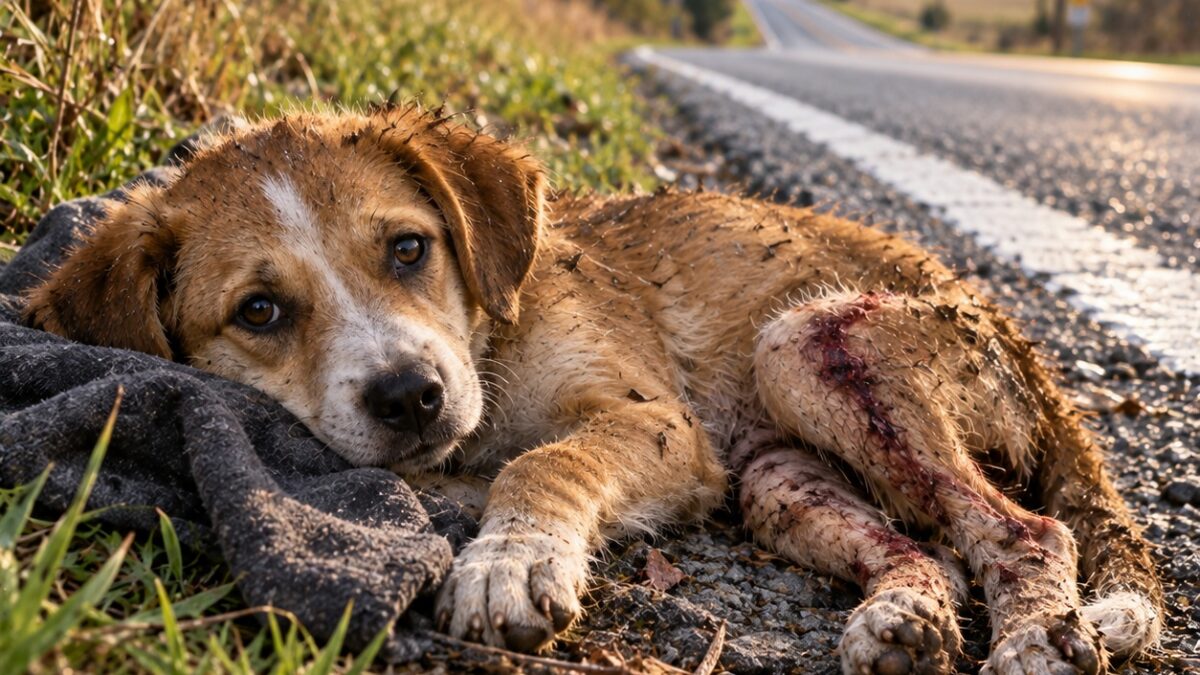
I visited Chance every day.
At first, Dr. Blakeley tried to tell me I didn’t need to.
“He’s heavily medicated.”
“I know.”
“He sleeps most of the time.”
“That’s fine.”
“He may not even know you’re here.”
“That’s fine too.”
So I sat beside his kennel.
The first few days, he barely opened his eyes.
Pins had been placed in his damaged hip.
One rear leg was wrapped.
His belly had been shaved where they had checked for internal injuries.
Bruises covered more of him than fur.
I brought nothing except myself.
I talked.
Mostly because silence felt worse.
I told him about the weather.
About the cabinets I was building for the Johnson family.
About how Mr. Palmer at the hardware store had somehow managed to buy the wrong size screws three times in one week.
About Maple Ridge.
About my parents.
I even told him about the first dog I ever had when I was a kid, an old beagle named Rusty who once stole an entire ham from our kitchen table.
Chance listened.
Or slept.
Same difference.
On the fourth day, Dr. Blakeley told me I could bring food.
“Chicken?”
“Plain.”
“No seasoning.”
“I know.”
“You’d be surprised.”
I boiled chicken at home.
Cut it into tiny pieces.
Chance ate three bites.
I nearly cheered.
By day six, he could hold his head up longer.
By day eight, his eyes followed me when I walked past the kennel.
Then on the tenth day, I walked into the treatment area carrying another container of chicken.
His tail moved.
Once.
Slow.
Weak.
But unmistakable.
I stopped.
Dr. Blakeley saw it too.
“Well.”
“What?”
“Looks like someone knows you.”
I crouched beside him.
“Hey, buddy.”
His tail moved again.
That was the moment.
Not the road.
Not the emergency clinic.
Not the first payment at the front desk.
That wag.
That was when I knew I couldn’t hand him to a shelter once he recovered.
I didn’t know if I was ready for a dog.
I didn’t know if Chance would ever run.
I didn’t know if he’d need lifelong medication.
I knew exactly none of the practical things a sensible person should know before adopting an injured animal.
I only knew I could not walk away.
Dr. Blakeley must have known before I did.
“When can I bring him home?”
She smiled.
“I wondered when you’d ask.”
He came home two days later.
The clinic staff carried him to my truck on a padded sling.
He couldn’t walk yet.
His hips were too unstable.
One leg needed support.
I had been given written instructions covering medication, feeding, physical therapy, bowel movements, wound care, warning signs, and enough medical vocabulary to convince me I had made a terrible mistake.
“What if I mess something up?”
“You call.”
“What if he falls?”
“Call.”
“What if he won’t eat?”
“Call.”
“What if—”
“Tom.”
I looked at Dr. Blakeley.
“You brought him in alive when most people would have driven past.”
“That doesn’t mean I know what I’m doing.”
“No.”
She smiled.
“But it means you’ll ask when you don’t.”
That was good enough.
My house changed before Chance even entered it.
I moved the coffee table.
Rolled up rugs so they wouldn’t slip beneath him.
Put a thick dog bed near the heater.
Placed blankets around it like walls.
Moved a water bowl close.
Then closer.
Then decided it was too close and moved it back.
By the time I carried Chance inside, the living room looked like I was expecting a very small, very furry king.
He lay quietly on the bed.
Looked around.
Then looked at me.
“Well.”
I sat on the floor.
“This is home.”
His eyes stayed on me.
“Not much.”
Tail twitch.
“But it’s quiet.”
Another twitch.
“I think you’ll like it.”
The first week nearly killed both of us.
I slept on the couch.
Every time Chance whimpered, I woke.
Medication at midnight.
Outside at two.
Water at three.
Pain medicine again at six.
Physical therapy exercises before breakfast.
Clean bandages.
Check incision.
Call clinic because incision looked swollen.
Discover incision was normal.
Call clinic again because Chance refused dinner.
Discover he was tired of chicken.
Buy six kinds of dog food.
Learn that the dog who nearly died would apparently only accept one specific canned lamb formula that smelled like something found beneath a fishing dock.
I learned how to slide a towel beneath his belly and support his hips while he tried to stand.
At first, his rear legs barely helped.
He would shift forward.
Front paws strong.
Back half confused.
Then he’d collapse.
I hated those moments.
Chance didn’t.
He would lie there.
Catch his breath.
Try again.
“Slow.”
Another attempt.
“That’s enough.”
Another.
“Chance.”
Another.
“Buddy, stop.”
He never listened.
Two weeks after coming home, he managed to stay upright for three seconds.
I counted.
“One.”
His rear leg shook.
“Two.”
He shifted.
“Three.”
Then down.
I yelled so loudly that my neighbor Hank came outside.
“You okay over there?”
“He stood!”
Hank looked across the fence.
Chance was lying on the grass.
“Looks like he’s down.”
“He was standing.”
“Right.”
I ignored him.
Hank was sixty-four and believed affection for animals should be limited to feeding them and occasionally saying “good dog.”
When he first saw me carrying Chance into the truck for therapy, he shook his head.
“You’re spending all that on a crippled mut?”
I didn’t answer.
He continued.
“Would’ve been kinder to put him down.”
That sentence stayed with me.
Not because I thought Hank was right.
Because I knew plenty of people probably agreed.
Chance had cost more than I had intended.
Much more.
Surgeries.
Imaging.
Medication.
Follow-ups.
Physical therapy.
Special harness.
I stopped adding the numbers after ten thousand dollars.
But every morning, Chance tried to stand.
Every day he watched me work.
Every evening he rested his head against my ankle.
You can call that sentimentality.
Fine.
Maybe it was.
But life had felt empty before him in ways I had gotten very skilled at pretending not to notice.
The house had been quiet.
Not peaceful.
Quiet.
There’s a difference.
My parents were gone.
My work was good.
I had friends.
People liked me.
Yet most evenings ended with television playing to no one while I ate dinner standing over the sink.
Chance changed that.
He needed me to come home.
That sounds small until nobody has needed you for a long time.
Two months after the accident, Chance stood without support.
Not three seconds.
Thirty.
Dr. Blakeley watched.
“So far, so good.”
Then Chance took one step.
His rear leg dragged slightly.
Second step.
Wobbled.
Third.
Collapsed.
I started crying.
No warning.
No dignity.
Just tears.
Dr. Blakeley pretended to study her clipboard.
“I’m fine.”
“Of course.”
“He walked.”
“I noticed.”
“I’m not crying.”
“No.”
“You’re terrible.”
“I’ve been told.”
That night, I sat on the porch with Chance lying beside me.
Spring had turned into early summer.
Fireflies floated above the yard.
I scratched behind his ears.
“You’re walking, buddy.”
His tail moved.
“You know what that means?”
He looked at me.
“It means now you’re going to destroy my house.”
I was right.
Once Chance understood his legs worked again, caution disappeared.
He developed a strange, lopsided running style.
Front legs fast.
Rear legs following with a hop.
The limp never left completely.
Probably never would.
Chance didn’t care.
He chased tennis balls.
Attempted stairs before being allowed.
Dug one hole beside my garden.
Then another.
Then looked deeply offended when I filled them.
The mailman, Pete, began leaving biscuits.
Miss Lorna from the diner started sending home scraps.
Ellie Blakeley, Dr. Blakeley’s teenage daughter, came over after school to help with walks.
One afternoon she tied a blue bandana around Chance’s neck.
White stars.
Uneven stitching.
“I made it.”
Chance looked ridiculous.
I loved it.
“He looks like a superhero.”
Ellie laughed.
Chance strutted across the yard.
“He knows.”
People around town began recognizing him.
“How’s Chance?”
“Walking?”
“Still improving?”
“Bring him by sometime.”
Then someone at the animal clinic posted a photograph online.
Chance standing beside me in front of the hospital.
Blue bandana.
Crooked stance.
Huge grin on my face.
Caption:
Two months ago, Chance arrived after a devastating hit-and-run accident. Today he walked into his appointment on his own.
That photograph spread.
Not globally.
Not millions of people.
But enough.
Local Facebook pages.
Rescue groups.
A Charleston reporter called.
Then a local news station.
I hated cameras.
Chance did not.
He sat beside me during the interview.
The reporter asked,
“Why spend so much money on a dog that wasn’t yours?”
I didn’t know how to answer without sounding dramatic.
So I told the truth.
“He was alive.”
The reporter waited.
“That’s it?”
“That seemed like enough.”
Chance became “Chance the Miracle Dog.”
I thought the name was ridiculous.
Everyone else loved it.
Someone painted a mural beside Maple Ridge Animal Hospital.
Chance sitting upright.
Small painted crown.
Words beneath him:
STILL HERE.
The first time I saw it, I stood there longer than I expected.
Still here.
Two words.
For him.
For me.
Maybe for everybody who had ever been told something was too broken to bother fixing.
Attention brought visitors.
People drove through town to meet him.
Most were kind.
A few were strange.
One woman traveled nearly three hours just for a photograph.
A father brought his six-year-old son who wore braces on both legs.
The boy sat beside Chance on my porch.
He didn’t talk.
Chance leaned against him.
The boy whispered,
“He walks like me.”
I had to go inside.
I stood in the kitchen pretending to wash a clean coffee mug because I didn’t want strangers watching me cry.
Chance did that to people.
Not intentionally.
Dogs never intend symbolism.
That’s what makes it powerful.
He didn’t know he represented resilience.
He wanted chicken and a tennis ball.
Humans made the rest.
By midsummer, our routine felt permanent.
Wake up.
Coffee.
Chance outside.
Breakfast.
Workshop.
Walk.
Dinner.
Porch.
Chance started bringing me an old tennis ball every morning while I worked in the garage.
At first, I threw it once.
Then twice.
Soon an hour disappeared every day.
I stopped fighting it.
“Fine.”
Throw.
Chance bounded after it with that strange hop-step.
Back.
Drop.
Again.
My cabinet orders took slightly longer.
Customers survived.
I started turning down jobs requiring overnight travel.
People joked Chance was my foreman.
He was.
If I worked too long, he nudged my hand.
If I ignored him, head on knee.
If I kept ignoring him, tennis ball dropped directly onto whatever I was sanding.
“You’re a terrible employee.”
Tail wag.
“No respect.”
Ball.
“Unionized already?”
Ball.
I threw it.
Fall brought the animal hospital fundraiser.
They were raising money for a new emergency wing.
Dr. Blakeley asked Chance to be honorary guest.
Not me.
Chance.
“I’m his driver?”
“Basically.”
Town hall filled with people.
Chance wore a red bandana Ellie had made.
He sat on a low platform beneath a banner:
MAPLE RIDGE HEROES.
People clapped when he entered.
He stopped.
Looked around.
Then walked forward like a politician who had been promised snacks.
He received a small plaque.
I received nothing, which felt fair.
Afterward, a man named Brent told me he had forwarded Chance’s first news clip to a cousin in media.
“That’s how it spread.”
“Why?”
“People needed something good.”
I looked toward Chance.
A little girl was petting him.
“He’s just a dog.”
Brent smiled.
“That’s probably why it works.”
That night, after the fundraiser, Chance and I sat outside.
Full moon.
Cold air beginning to move through the valley.
Then a tan sedan slowed in front of my house.
Stopped.
A woman got out.
Fifties.
Scarf.
Small purse.
She walked toward the porch.
“Sorry to bother you.”
I stood.
“Can I help you?”
“Are you the man from the news?”
Chance stayed beside me.
“Yes.”
Her eyes filled immediately.
“I think he might be our dog.”
Everything inside me tightened.
“What?”
She pulled out a photograph.
A boy hugging a young puppy.
Tan fur.
White forehead.
Similar ears.
Very similar eyes.
“My grandson called him Bandit.”
She looked at Chance.
“He ran away during a thunderstorm last year.”
I studied the photograph.
Chance was approximately the right age.
Maybe.
The markings looked close.
Maybe.
No chip.
No collar when I found him.
Possible.
The woman crouched.
“Bandit?”
Chance looked at her.
Nothing.
“Bandit?”
He sniffed her hand.
Accepted a gentle touch.
Then stood and leaned against me.
The woman began crying.
I felt terrible.
“Maybe he doesn’t remember.”
“Maybe.”
She smiled through tears.
“Or maybe it isn’t him.”
She showed me more photographs.
None were conclusive.
We compared markings.
There were differences.
White patch slightly larger in one.
Ear shape uncertain.
I gave her Dr. Blakeley’s number and promised we could compare records.
She stayed nearly an hour.
Before leaving, she hugged me.
“Even if he isn’t Bandit, I needed to see a dog like him alive.”
Later, records showed her missing puppy had been a little older and had a distinctive scar Chance did not have.
Not the same dog.
I expected that to be disappointing.
Instead, she said,
“I think I knew.”
“Why come?”
“Hope makes people do strange things.”
I understood.
Winter arrived early.
Chance loved snow.
The first time he stepped into it, he froze.
Sniffed.
Then launched himself face-first into a drift.
He came up covered in white.
Sneezed.
Did it again.
I bought him a navy coat because his damaged hip stiffened in cold weather.
He hated it.
Walked sideways.
Refused to move.
Ellie laughed until she nearly fell down.
After several weeks, he accepted the coat because he finally connected coat with longer walks.
That winter we began using an old trail behind my house.
It climbed the ridge.
Not steep.
Quiet.
Deer tracks.
Pine.
Bare oak.
Chance loved it.
One afternoon, halfway home, he stopped.
Ears up.
Then bolted toward a hollow log.
“Chance!”
I followed.
He stood beside the log.
Something inside whimpered.
Another puppy.
Tiny.
Shivering.
Matted fur.
Eyes exhausted.
I looked at Chance.
“No.”
Tail wag.
“No.”
Whimper.
I crouched.
The puppy was freezing.
“Damn it.”
Chance’s tail wagged harder.
That was how Millie entered my life.
Dr. Blakeley examined her.
No chip.
No serious injury.
Malnourished.
Parasites.
Maybe ten weeks old.
“Shelter can take her tomorrow,” she said.
I looked at Chance.
He was lying beside Millie’s carrier.
“No.”
Dr. Blakeley smiled.
“I was hoping you’d say that.”
Chance became a big brother instantly.
Millie climbed over him.
Chewed his ears.
Stole toys.
Slept on his back.
Chance tolerated everything.
If she wandered too far outside, he followed.
If she barked at something, he checked.
If she became scared, he sat beside her.
My quiet house became chaos.
I loved it.
A month later, Chance helped find another dog.
A golden retriever named Sunny disappeared near Hollow Road.
Missing posters covered town.
Chance found her beneath an abandoned pickup.
Thin.
Weak.
Alive.
When Sunny’s owners arrived at the clinic, the man cried so hard he couldn’t speak.
His wife fell to her knees.
Sunny’s tail moved.
I pointed toward Chance.
“He found her.”
They hugged him too.
Millie received three biscuits and behaved as though she had personally led a federal rescue operation.
Chance’s story kept spreading.
Not because I pushed it.
People did.
The mural.
News articles.
Animal rescue pages.
School projects.
A charity calendar.
One woman asked whether Chance could visit a rehabilitation center.
I declined.
I didn’t want him turned into a mascot.
But we did visit schools occasionally.
Kids loved him.
Chance loved kids.
Especially quiet ones.
One afternoon, a little girl asked,
“Did you know he was special when you found him?”
I looked down.
Chance rested against my shoe.
“No.”
“Then why save him?”
“He needed somebody.”
I thought for a second.
“Turns out so did I.”
The teacher cried.
I pretended not to notice.
Years passed faster than I expected.
That is the cruelest thing about good years.
You assume there will be more because today feels permanent.
Chance’s limp remained.
But he ran.
Played.
Walked the ridge.
Raised Millie.
Became known around town.
And aged.
At first, gray around the muzzle.
Then longer naps.
Then hesitation before standing.
Dr. Blakeley assured me much of it was normal.
His old injuries would make aging harder.
“Arthritis.”
“I know.”
“Supplements.”
“Already.”
“Weight.”
“He’s good.”
“Shorter walks.”
“He hates that.”
“He’ll survive the insult.”
Chance glared at her from the exam table.
“He understands.”
“Good.”
One summer afternoon, a young man knocked on my door.
Late twenties.
Tall.
Nervous.
Duffel bag over one shoulder.
“Mr. Ferris?”
“Yes.”
“My name’s Kyle.”
I waited.
“I think Chance used to be my dog.”
That sentence no longer shocked me the way it once might have.
Chance’s picture had been everywhere.
People saw resemblance.
People hoped.
“Why?”
Kyle opened his bag.
Pulled out a photograph.
My chest tightened.
This was different.
A younger Chance.
No question.
Same white forehead marking.
Same uneven patch near the chest.
Same small dark spot above the left paw.
Puppy sitting in an old Jeep.
“What was his name?”
“Tucker.”
I looked at Chance through the screen door.
He was lying beside Millie.
“What happened?”
Kyle swallowed.
“I adopted him from a shelter in Ohio.”
“When?”
He gave me the date.
Age lined up.
“I had him almost a year.”
“How did he end up here?”
Kyle looked ashamed.
“I joined the Army.”
I stayed quiet.
“I left him with my roommate when I went to basic.”
“And?”
“When I came home, Tucker was gone.”
“Roommate said?”
“Ran away.”
“Did you believe him?”
“At first.”
“And now?”
Kyle looked toward Chance.
“No.”
We sat on the porch.
Kyle told me the rest.
His roommate had struggled with drugs.
Money.
Unreliable.
Kyle had trusted him anyway.
When Tucker disappeared, he searched.
Shelters.
Social media.
Missing posters.
Nothing.
Then his mother saw the Chance mural in a regional news story.
“She called me crying.”
Kyle laughed weakly.
“She said, ‘That’s Tucker.’”
“Records?”
He had them.
Shelter paperwork.
Vaccinations.
Photographs.
Enough to convince me.
Enough to convince Dr. Blakeley too.
Chance had once been Tucker.
Kyle’s dog.
I felt something I didn’t want to feel.
Fear.
Not because Kyle seemed cruel.
He didn’t.
Because if he was the legal owner, what did that make me?
Chance was my dog.
The thought came fast and selfish.
My dog.
Then guilt followed.
If someone had found my dog after years and loved him, wouldn’t I want him back?
Kyle asked quietly,
“Can I see him?”
I opened the door.
Chance lifted his head.
Kyle knelt.
“Hey, Tucker.”
Chance stared.
Tail moved once.
Kyle’s face crumpled.
“You remember me?”
Chance stood slowly.
Walked over.
Sniffed him.
Kyle touched his cheek.
Chance allowed it.
Then turned.
Walked back to me.
Leaned against my leg.
Kyle laughed through tears.
“I guess that answers that.”
“It doesn’t have to.”
He shook his head.
“No.”
“Kyle—”
“No.”
He sat back.
“He’s yours.”
“You had him first.”
“And I lost him.”
“That wasn’t your fault.”
“I left him with someone who failed him.”
“That’s not the same thing.”
He looked at Chance.
“You rebuilt him.”
“So did he.”
Kyle stayed for dinner.
He returned again.
And again.
Never asked to take Chance.
Chance came to recognize him.
Tail wag.
Occasional lean.
But their old bond had changed.
Kyle understood.
“Different life.”
“Yeah.”
He started volunteering at a rescue shelter.
Said Chance made him realize guilt wasn’t useful unless it changed what you did next.
I respected that.
Not everyone gets a second chance with the same thing they lost.
Sometimes your second chance is becoming better for someone else.
Around the same time, I saw Hank slow his truck beside my driveway.
He rolled down the window.
“Heard about that soldier kid.”
“Kyle.”
“Yeah.”
“He okay?”
“Seems.”
Hank cleared his throat.
“I adopted a dog.”
I almost laughed.
“You?”
“Don’t make a thing of it.”
“What kind?”
“Shelter mutt.”
“Name?”
“Roscoe.”
I smiled.
Hank pointed at me.
“Don’t.”
“I didn’t say anything.”
“You’re thinking loudly.”
Chance sat beside me.
Hank looked at him.
“I was wrong.”
“About?”
He sighed.
“Dog.”
Chance’s ears moved.
“He wasn’t a waste.”
“No.”
Hank drove away.
I scratched Chance’s neck.
“You converted Hank.”
Chance sneezed.
“Biggest miracle yet.”
By then, Chance’s body had started telling us time was moving.
Longer naps.
Stiff mornings.
Cold bothered him.
He still wanted the ridge trail.
But sometimes we stopped halfway.
Eventually I began driving closer to the trailhead so he didn’t have to walk the road.
Millie adjusted instinctively.
The young dog who once raced everywhere began circling back.
Waiting.
Walking beside Chance.
If he stopped, she stopped.
Dogs understand decline without language.
Humans require conversations and denial.
One morning I woke and found Chance lying near the back door.
Breathing differently.
Not panicked.
Just tired.
I knelt.
“Buddy?”
Tail thump.
Weak.
I called Dr. Blakeley.
She came to the house.
Examined him.
Heart.
Lungs.
Joints.
Blood work later.
“He’s slowing.”
“What does that mean?”
“What it sounds like.”
“He’s not that old.”
“He’s older than you think.”
I frowned.
“We know approximately.”
“And his body has lived hard.”
I looked at him.
“He’s not dying.”
Dr. Blakeley didn’t answer fast enough.
My chest tightened.
“He’s not dying.”
“Not today.”
I hated those words.
She gave supplements.
Pain control.
Diet changes.
Shorter walks.
More rest.
We moved his bed near the strongest morning sunlight.
Raised the food bowl.
Added rugs for traction.
I became a student of Chance’s comfort.
Was he panting?
Was he stiff?
Was that pain?
Was he drinking enough?
Was he sleeping too much?
One night, he stood at the back door.
I opened it.
Moonlight silvered the yard.
Chance walked out.
Stopped.
Looked upward.
He just stood there smelling the cold.
I stepped beside him.
He leaned against my leg.
For some reason, I felt grief.
Not because anything happened.
Because nothing did.
That moment was so ordinary I could suddenly see how temporary ordinary things are.
Spring returned.
Ellie made a scrapbook.
She was older now.
College applications.
Still talking about veterinary school.
She brought the book to my house.
Photos.
Chance after surgery.
Chance walking.
Chance in blue bandana.
Fundraiser.
Mural.
Millie climbing over him.
Sunny rescue.
Snow.
Kyle.
Kids.
One page said:
CHANCE’S FAVORITE THINGS
- Walks with Dad
- Blue ball
- Naps in the sun
- Millie
- Chicken treats
I stared at “Dad.”
“You wrote that?”
Ellie looked embarrassed.
“That’s what you are.”
I swallowed.
Then added:
- Being loved.
Ellie leaned against my shoulder.
“Good one.”
Summer was harder.
Chance still walked.
But slowly.
Sometimes I carried him home.
I reduced work.
Clients understood.
Those who didn’t could find another cabinetmaker.
One July morning, I found him wheezing beside the kitchen door.
Millie sat beside him.
Mags had joined us by then.
She was an older shepherd mix from a rescue one county over.
I hadn’t intended to take a third dog.
Chance chose her.
Karen Hill, the shelter director, brought Mags for a possible foster placement.
Chance walked over.
Sat beside her.
Mags laid down.
Done.
“You realize I’m becoming a shelter.”
Karen smiled.
“Your fault.”
Mags was gray.
Stiff.
Quiet.
Chance seemed calmer with another older dog in the house.
Millie had someone else to annoy when Chance tired.
That morning in July, though, everyone was quiet.
Dr. Blakeley examined Chance again.
“He’s not in acute pain.”
“Then what?”
“Age. Chronic damage. His body has been compensating for years.”
“How long?”
She looked at me.
“No.”
“What?”
“Don’t ask me that.”
“Why?”
“Because I don’t know, and if I guess, you’ll spend whatever time you have left measuring it against my answer.”
I looked away.
“What do I do?”
“Make good days.”
So I did.
Short ridge walks.
Porch mornings.
Chicken.
Sun.
Visitors.
Kyle.
Ellie.
Dr. Blakeley.
Sunny’s owners.
School children.
The old tennis ball.
Chance stopped fetching, but Millie used it.
He watched.
Sometimes barked once.
As if giving instructions.
The regional veterinary board asked to photograph Chance for an adoption campaign.
I almost refused.
Then I realized people had already turned him into a symbol.
Maybe we could use that.
The photo session was small.
Quiet park.
Chance wore his red bandana.
Millie came too.
One photograph showed Chance sitting beneath an oak tree.
Older now.
White around the face.
Scarred leg slightly angled.
Eyes steady.
The campaign slogan said:
BROKEN ISN’T THE SAME AS FINISHED.
I normally hate slogans.
That one stayed.
At a school visit, a fifth-grade girl asked,
“Did Chance know you saved him?”
I smiled.
“I don’t know.”
“Do dogs know stuff like that?”
“I think they know who stays.”
That was the best answer I had.
Fall came.
Then frost.
Chance’s mornings changed.
Millie waited at the door.
Mags stretched.
Chance stayed in bed.
I brought breakfast.
Warm rice.
Turkey.
Chicken.
He ate slowly.
Some days not much.
He still looked up when I entered a room.
That became important to me.
Ellie noticed too.
“He used to meet me at the door.”
“He still knows you’re here.”
“I know.”
She sat on the floor.
“He just waits now.”
Chance lifted his head.
Tail tap.
Ellie cried silently.
Thanksgiving at Dr. Blakeley’s house was loud.
Twenty people.
Children.
Food.
Dogs.
Chance lay near the fireplace.
Everyone stopped to touch him.
A woman told me her husband started fostering rescue dogs because of Chance.
A man showed me a photo of a hound named Lucky.
“Named him because of Chance.”
That sentence made no logical sense.
I understood perfectly.
Chance’s life had become a small current running through other lives.
Not because he performed heroic acts.
Because he survived.
People see survival and begin believing survival might be available to them too.
December snow fell after midnight.
Millie exploded into the yard.
Mags stepped carefully.
Chance walked halfway across the snow.
Stopped.
Lifted his face.
Snowflakes landed on his nose.
He did not shake them away.
I photographed him.
Ellie printed it.
The school library displayed it.
I still have a copy.
Chance looking upward.
Not sad.
Not old.
Just present.
Christmas Eve, all three dogs lay near the fire.
Millie chewing a bone.
Mags asleep.
Chance watching flames.
“Merry Christmas, buddy.”
Ear twitch.
I read from my journal.
Chance listened.
Or slept.
Same difference.
January changed everything.
Not dramatically.
No collapse.
No emergency.
Just less.
Chance ate less.
Walked less.
Stood less.
I carried him more.
One night, freezing rain struck the windows.
I woke hearing scraping.
Chance was pulling himself toward the back door.
His rear legs were weak.
I rushed to him.
“Hey.”
He looked up.
I opened the door.
Supported him outside.
Snow covered the yard.
Chance stood only long enough to sit.
He looked at the moon.
I knelt beside him in the snow.
No coat.
No boots.
Hand on his side.
We stayed until I couldn’t feel my knees.
Then I carried him inside.
After that, he stopped walking independently.
I became his legs.
Outside.
Inside.
Car.
Window.
Porch.
Dr. Blakeley examined him.
“You’ll know.”
“I hate when people say that.”
“I know.”
“What if I don’t?”
“You will.”
“What if I do it too early?”
“Tom.”
“What if I wait too long?”
She sat beside me.
“You are asking for a moment where you won’t hurt.”
I looked at her.
“There isn’t one.”
That was cruel.
And kind.
I took Chance to the ridge one final time.
Truck as far as possible.
Then carried him.
Millie and Mags walked ahead.
Snow dusted the trail.
Chance rested against my chest.
At the overlook, I wrapped him in a blanket.
We sat.
Maple Ridge below.
Water tower.
Church steeple.
Diner sign.
The same town he had somehow changed simply by refusing to die beside a road.
I talked to him.
Sunny.
Kyle.
Ellie’s college applications.
Hank’s rescue dog.
The fundraiser.
Millie.
Mags.
The old blue tennis ball.
Chance looked over the valley.
His breathing slow.
I wished dogs understood gratitude.
Maybe they do.
Maybe they understand it better because they don’t turn it into speeches.
February brought another storm.
Snow.
Wind.
Cold.
Chance’s bed stayed near the heater.
Ellie left a new bandana on the porch.
Navy blue.
Tiny gold stars.
Note:
FOR THE BRAVEST SOUL I’VE EVER KNOWN.
I tied it around his neck.
He licked my hand.
Once.
That weekend, I pulled out photographs.
Spread them across the rug.
Mags lay on one.
Millie sniffed others.
Chance slept.
Monday.
Tuesday.
Wednesday.
Thursday morning I woke before sunrise.
Made coffee.
Millie appeared.
Mags followed.
Chance didn’t.
I walked to the hallway.
He lay exactly where he had been the night before.
Still.
For one terrible second, I thought he was gone.
I touched his side.
Warm.
Breathing.
Barely.
His eyes opened halfway.
“Hey.”
Tail moved.
Tiny.
I lifted him.
Carried him to the living room.
Fire.
Blanket.
Millie curled against his belly.
Mags lay near his feet.
I sat behind him with his head in my lap.
Sunrise slowly filled the windows.
At nine, I called Dr. Blakeley.
She didn’t ask me to bring him in.
“I’m coming.”
I texted Ellie.
She arrived crying.
Dropped to her knees.
“I love you.”
She said it again.
Again.
Chance opened his eyes.
Looked at her.
Tail tap.
Dr. Blakeley listened to his heart.
Then sat beside me.
“He’s peaceful.”
“Is he hurting?”
“Not badly.”
“Can he recover?”
Her eyes filled.
“No.”
That answer hurt less than uncertainty.
Chance lifted his head slightly.
Looked at me.
The same eyes I saw beside the road.
Brown.
Quiet.
Waiting.
I remembered carrying him.
Blood through the hoodie.
“He won’t make it.”
I had been wrong.
Chance made it.
Not forever.
But long enough.
Long enough to walk.
Run.
Play.
Save Sunny.
Raise Millie.
Meet Kyle again.
Change Hank.
Inspire Ellie.
Fill my house.
Fill a town.
Fill the empty part of me I had convinced myself was fine.
I nodded to Dr. Blakeley.
She prepared the medication.
Ellie held Chance’s paw.
Millie pressed closer.
Mags did not move.
I held his head.
“You’re okay.”
This time it wasn’t a lie.
“You’re okay.”
Chance breathed out.
Slow.
Dr. Blakeley administered the first medication.
His body relaxed.
I scratched his ear.
“Good boy.”
Second medication.
His breathing slowed.
Then stopped.
The fire cracked.
Wind moved outside.
Millie lifted her head.
Chance did not.
The world didn’t collapse.
That was the strangest part.
No thunder.
No sudden darkness.
My heart broke and the clock kept moving.
Dr. Blakeley cried.
Ellie sobbed.
I sat with my hand on Chance’s head.
Warm.
Then slowly not.
We buried him on the ridge.
Same overlook.
I wrapped him in the hoodie I had used the morning I found him.
The bloodstains had faded but never disappeared.
Ellie placed the snow photograph beside him.
Millie carried the blue tennis ball.
Dropped it next to Chance.
Then looked at me.
I almost couldn’t breathe.
Mags sat near the grave.
Wind moved through bare trees.
Nobody spoke.
Kyle came.
Sunny’s owners came.
Hank came carrying flowers and looking furious at the sky.
Dr. Blakeley stood beside Ellie.
I lowered Chance into the ground.
Every shovel of dirt felt wrong.
Then necessary.
When it was done, we sat.
Maple Ridge below.
Smoke from chimneys.
Small town.
Ordinary day.
Chance beneath the soil.
That night, his bed remained beside the heater.
I couldn’t move it.
Millie pawed at it.
Whined.
Then curled where Chance used to sleep.
I lay beside her.
Mags pressed against my back.
I cried until I fell asleep.
Grief doesn’t arrive as one thing.
It comes as habits looking for someone.
I opened the back door and waited.
No Chance.
Dropped food into three bowls.
Stopped.
Two.
Heard nails on the floor.
Turned.
Millie.
Saw the old blue bandana.
Couldn’t breathe.
People sent cards.
Hundreds.
Local people.
Strangers.
Children.
One envelope had no return address.
Inside was one sentence.
HE WAS YOUR MIRACLE, BUT HE BECAME OURS TOO.
I framed it.
Ellie asked for a small memorial.
We gathered on the ridge.
Maybe twenty people.
Dr. Blakeley.
Kyle.
Sunny’s owners.
Hank.
Pete the mailman.
Miss Lorna.
Families who had met Chance at school.
The boy who once said Chance walked like him.
Older now.
Standing with braces replaced by crutches.
Ellie read something she wrote.
Kyle placed a wooden plaque near the stone.
STILL HERE.
The same words from the mural.
I said nothing.
Couldn’t.
Didn’t need to.
Spring returned.
Snow melted.
Grass.
Birds.
Mud.
Millie slowly became herself again.
Mags slept in the sun.
I built a bench on the ridge.
Faced it toward town.
Sometimes I found footprints near Chance’s grave.
I never asked who visited.
Ellie graduated high school.
In her graduation speech, she mentioned Chance.
Not by accident.
“He taught me that gentleness is not weakness, and that caring deeply for something vulnerable is one of the bravest things we can do.”
I sat in the bleachers holding Millie’s leash.
Cried openly.
Didn’t care.
Ellie eventually entered veterinary school.
Kyle kept volunteering at the shelter.
Hank adopted another dog after Roscoe.
Then pretended both dogs were inconveniences.
Sunny grew old with her family.
Mags lived with us another two years.
When she died, Millie and I buried her under a maple closer to the house.
I fostered again.
A half-blind terrier named Jasper.
Then a nervous shepherd.
Then two puppies who destroyed my kitchen.
People joked Chance had turned my house into a rescue.
Maybe he had.
I never became someone who believed every animal could be saved.
That would have been dishonest.
Some couldn’t.
Some were too sick.
Some were too injured.
Some arrived too late.
But Chance taught me that “unlikely” and “impossible” are not synonyms.
He also taught me that saving is not always dramatic.
Sometimes it is three surgeries.
Sometimes it is carrying a dog outside at two in the morning.
Sometimes it is sitting quietly beside an animal too frightened to eat.
Sometimes it is throwing the same disgusting tennis ball sixty times when you have work to do.
Sometimes it is knowing when to keep fighting.
Sometimes it is knowing when fighting has become asking someone you love to stay for you instead of for themselves.
That last lesson was the hardest.
Years later, I found the hoodie in a storage box.
Not the one Chance was buried in.
A second one.
Same color.
For one ridiculous second, my body thought it was the original.
Memory does that.
I sat on the floor.
Millie, older now, walked over.
Rested her head on my knee.
“You remember him?”
Tail wag.
Maybe.
Dogs remember differently.
Or maybe memory isn’t what matters.
Impact is.
Chance lived inside everything that came after him.
Ellie becoming a veterinarian.
Kyle working with shelter dogs.
Hank adopting.
My home filling.
Sunny surviving.
Children who saw a limping dog and learned broken bodies still contain joy.
Me learning that quiet and peace are not the same.
I returned to the road where I found him every April.
Not as a ritual at first.
I just happened to drive past.
Then I started stopping.
The ditch changed.
Grass grew.
County repaired the shoulder.
No stain.
No marker.
Nothing to show a life had nearly ended there.
One spring, I stood beside the road while traffic passed.
A truck slowed.
Older man inside.
Gray beard.
Flannel shirt.
I recognized him.
The man from the bridge.
The one who said:
I think I hit him.
He pulled over.
Got out.
“You’re the Chance guy.”
“Yes.”
He looked older.
“Dog still around?”
I didn’t answer immediately.
“No.”
His face changed.
“Oh.”
“He had a good life.”
The man looked toward the ditch.
“I think about that day.”
“Why did you leave?”
His jaw tightened.
“I panicked.”
“You didn’t stop.”
“No.”
“You thought he was dead.”
“Yes.”
“Why tell me later?”
He looked toward the mountains.
“Because I saw him online.”
“And?”
“I couldn’t stand everybody calling him a miracle while I knew I was the reason he needed one.”
I studied him.
Part of me wanted anger.
I had imagined this conversation.
Thought I’d accuse.
Shout.
But too much time had passed.
“Were you drunk?”
“No.”
“Speeding?”
“Yes.”
He swallowed.
“Late for work.”
I laughed once.
Bitter.
“All that.”
“I know.”
“You could’ve killed him.”
“I know.”
“You could’ve killed a person.”
“I know.”
He looked at me.
“I’m sorry.”
I nodded.
Not forgiveness.
Not exactly.
But acceptance that the moment had already happened.
“I’m glad you told me.”
He looked surprised.
“Why?”
“Because I spent years wondering whether someone knew.”
“What?”
“That he was lying there.”
The man looked down.
“I knew.”
“That was worse.”
“I know.”
We stood beside the road.
Then he said,
“He really survived all that?”
“Yes.”
“Walked?”
“Yes.”
“Ran?”
“Badly.”
The man smiled.
“Had a family?”
“Big one.”
He nodded.
“I’m glad.”
Then he drove away.
I never saw him again.
That conversation changed nothing.
And something.
Chance’s life was not meaningful because a driver made a mistake.
I refuse to give that man ownership of the story.
Chance’s life mattered because of everything after.
Dr. Blakeley refusing to give up.
The technicians working through the night.
Chance eating chicken.
Standing.
Walking.
Running crooked.
Millie following him.
Children hugging him.
Kyle finding him.
Me learning to live differently.
One bad moment started the story.
It did not define it.
Years after Chance died, Maple Ridge Animal Hospital expanded again.
The emergency wing became too small.
They built a rehabilitation center.
Dr. Blakeley was nearing retirement.
Ellie—Dr. Ellie Blakeley by then—came home to join the practice.
At the opening ceremony, Ellie led me behind the building.
A landscaped yard.
Low ramp.
Water station.
Small rehabilitation track.
At the entrance was a plaque.
THE CHANCE RECOVERY GARDEN
I stared.
“No.”
Ellie laughed.
“What?”
“You people need to stop doing things without asking me.”
“Too late.”
Beneath the name:
For every animal who needs one more chance—and every person willing to stop.
That line got me.
Not because Chance was famous.
He wasn’t really.
Not anymore.
The internet had moved on.
New miracle dogs.
New stories.
New tragedies.
But Maple Ridge remembered.
I looked across the garden.
A dog with one rear leg walked beside an older woman.
A puppy in a mobility cart chased a ball.
A shepherd recovering from surgery moved slowly through exercises.
Still here.
All of them.
Still trying.
Ellie stood beside me.
“You know why I became a vet?”
“Your mother?”
“She helped.”
“Chance?”
She nodded.
“I watched Mom fix his body.”
“And?”
“I watched you give him a reason to use it.”
I shook my head.
“He gave me more than I gave him.”
“That’s what you always say.”
“Because it’s true.”
Millie died at fourteen.
Peacefully.
Old.
Gray.
Still stubborn.
I buried her near Chance.
Not beside.
A little below the ridge.
Her blue ball went with her.
Not Chance’s original.
That one stayed in my workshop.
Mags.
Millie.
Chance.
Three graves.
Three lives that entered mine accidentally.
People ask whether it becomes harder to adopt again after losing them.
Yes.
And no.
Loss teaches you exactly how much it will hurt.
But love teaches you why you do it anyway.
I eventually adopted another dog.
Then another.
Never replacements.
That word bothers me.
You don’t replace a life.
You make room beside the absence.
The final years of my cabinet business were lighter.
I worked less.
Taught Caleb, a younger carpenter.
Eventually sold him most of the company.
Kept the garage.
Kept building little things.
Benches.
Dog ramps.
Shelter beds.
Ellie joked I had finally found my market.
One evening, long after Chance had been gone, I walked the ridge alone.
Sunset.
Orange across the valley.
Maple Ridge below.
The bench I built sat near the graves.
I lowered myself onto it.
My knees hurt now.
I understood Chance’s later years better.
Wind moved through the grass.
For a second, I could almost hear the uneven rhythm of his walk.
Front paws.
Hop-step.
Front paws.
Hop-step.
Memory.
Nothing more.
Enough.
I thought back to the road.
The blood.
Those eyes.
“He wasn’t supposed to survive.”
Maybe that sentence had always been wrong.
There is no “supposed to” in survival.
No one is promised strength.
No one is promised recovery.
No one is promised another morning.
Chance did not survive because destiny had a plan.
He survived because his body held on.
Because people helped.
Because medicine worked.
Because chance—actual chance—went his way.
What happened after was what gave survival meaning.
He used his second life completely.
Every stupid tennis ball.
Every snow drift.
Every child.
Every nap.
Every chicken treat.
Every slow walk.
Every person he changed without knowing their name.
Chance never understood he was inspirational.
Thank God.
He was a dog.
He smelled terrible after rain.
Stole food.
Ignored commands when convenient.
Snored.
Hated his winter coat.
Loved attention.
He was imperfect.
Ordinary.
And that made the lesson stronger.
You do not have to be extraordinary to matter.
You do not have to perform miracles.
Sometimes you just stay.
You heal.
You keep going.
You let someone love you.
You love them back.
Years ago, on that spring morning, I believed I was carrying a dying dog toward my truck.
I thought the important thing was getting him to the hospital before his breathing stopped.
I had no idea I was carrying the next chapter of my own life.
That sounds sentimental.
I’m old enough not to care.
Chance gave me mornings again.
Responsibility.
Community.
Friendship.
Purpose.
He turned my quiet house into a home.
Then filled that home with Millie.
Mags.
Fosters.
Kids.
Veterinarians.
Neighbors.
People who needed hope.
He brought Kyle back to rescue work.
Brought Hank into a shelter.
Helped Ellie discover a career.
Helped find Sunny.
Made strangers stop and look at broken things differently.
And in the end, he taught me that loving something temporary is not foolish just because you know how the story finishes.
Everything finishes.
That does not make the middle less worth having.
I stayed on the ridge until the sky darkened.
Then stood.
Touched Chance’s weathered marker.
Still here.
The wood had been replaced once.
The words remained.
I looked toward Maple Ridge.
House lights coming on.
Diner sign glowing.
Animal hospital beyond the church.
Somewhere in town, Ellie was probably working late.
Somewhere a family was bringing home a rescue dog for the first time.
Somewhere a scared animal was learning that a hand could mean food instead of pain.
Somewhere a lonely person was about to discover that being needed could pull them back into their own life.
Maybe none of that had anything to do with Chance.
Maybe all of it did.
I walked home slowly.
When I opened the door, my current foster—a scruffy terrier named Rosie—stood in the hallway holding one of my work gloves.
“Give me that.”
Tail wag.
“Rosie.”
She ran.
I laughed.
Then chased her through the house.
And for one brief, ridiculous second, when she cut around the couch and disappeared into the kitchen, I heard something behind her.
Not really.
But memory is generous sometimes.
The uneven rhythm of another dog running.
A blue tennis ball bouncing across the floor.
A tail striking furniture.
A life that nearly ended beside an empty West Virginia road but somehow reached far beyond it.
Chance was gone.
That part would always hurt.
But the life he gave me was still moving.
Still opening doors.
Still finding dogs.
Still building homes.
Still teaching people to stop.
Still asking for one more throw.
Still here.








