I Found a Dog Who Had Given Up on Life—Then I Sat Beside Him—Then One Old Photo Changed Everything
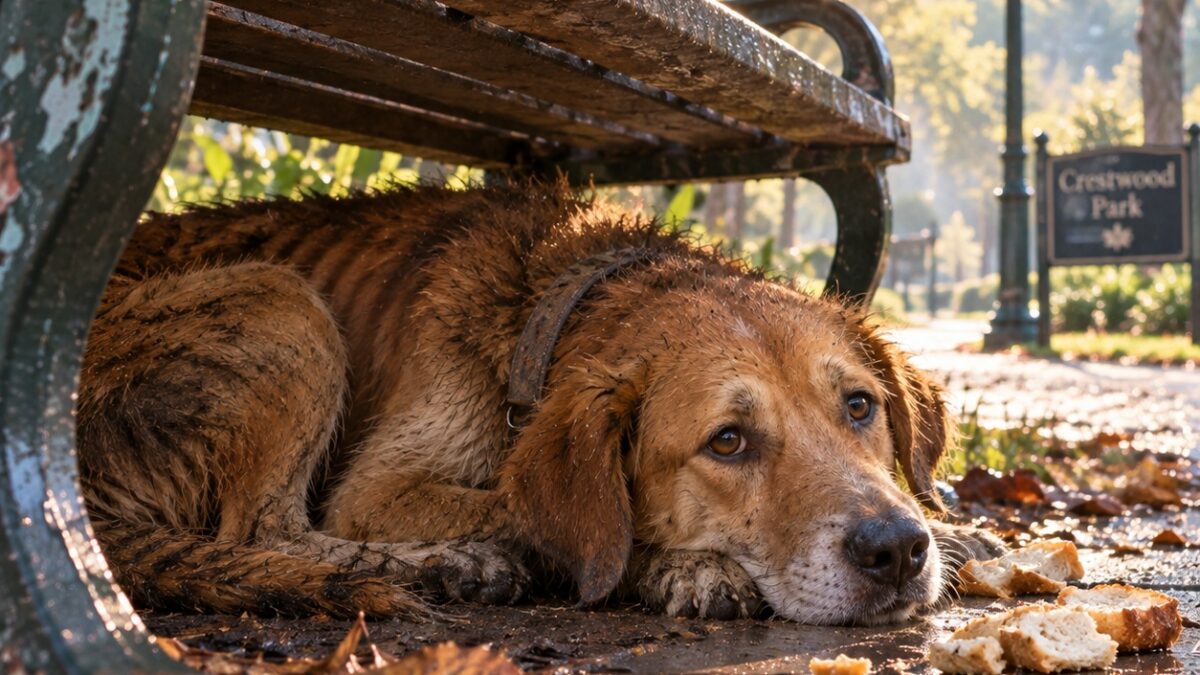
The rain came down steadily that Wednesday morning.
Not a storm.
Just that gray spring rain that seems determined to soak everything one layer at a time.
I almost didn’t go to the park.
My alarm rang at six thirty.
I lay there beneath the blankets listening to water ticking against the window and thought, He won’t be there.
Then another thought followed.
What if he is?
That got me out of bed.
I wrapped leftover turkey in foil, filled a small plastic bowl with water, found an old umbrella, and left my apartment twenty minutes earlier than usual.
Crestwood Park was nearly empty.
The paths shone black beneath the rain.
Water dripped from bare branches.
When I saw the bench, something inside my chest loosened.
He was there.
Not beneath it this time.
Beside it.
Standing.
Barely.
“Hey.”
His ears lifted.
He looked directly at me.
I slowed.
“Good morning.”
His tail didn’t move.
But he remained standing.
That alone felt enormous.
I sat at the far end of the bench.
He watched the foil packet.
“You know why I’m here now, don’t you?”
His nose twitched.
I unwrapped the turkey.
Instead of tossing a piece, I held one between my fingers.
He stared.
“I’m not moving.”
Rain drummed against the umbrella.
He took one step.
Stopped.
Another.
His body stayed low.
Every muscle looked ready to retreat.
I held my breath.
“Take your time.”
Another step.
His nose touched my fingertips.
Warm.
Wet.
Then his lips closed gently around the turkey.
I released it.
He backed away and swallowed.
My eyes filled so suddenly I laughed at myself.
“Oh, come on, Grace.”
He stared at me.
“Don’t judge me.”
I held another piece.
This time, he approached faster.
Not fast.
Faster.
He took it.
Then another.
By the fifth piece, his body had risen slightly.
Something inside him had decided I was not dangerous.
Not safe.
Not yet.
Just not dangerous.
There is a difference.
After he finished, he stood near the bench instead of crawling underneath.
I poured water.
He drank.
Then slowly, cautiously, he lowered himself to the ground less than three feet from my shoes.
I didn’t touch him.
Every part of me wanted to.
Instead, I sat in the rain until I was late for work.
When I finally stood, he lifted his head.
“I’ll come back.”
Those words left my mouth before I realized their weight.
I’ll come back.
Maybe that was exactly what somebody else had once promised.
The thought followed me all the way to the clinic.
I worked scheduling at a small physical rehabilitation practice.
Most days involved insurance calls, appointment changes, doctors running behind, patients running early, and people becoming angry at me because the human body refused to respect a calendar.
My coworker Jasmine took one look at my wet hair.
“You look terrible.”
“Thank you.”
“You walked?”
“Yes.”
“In that?”
I sat at my desk.
“There’s a dog.”
She stared.
“A dog.”
“In the park.”
“Your dog?”
“No.”
“Then why are you soaked?”
I opened my computer.
“Complicated.”
Jasmine leaned over the partition.
“You’re feeding a stray.”
“I have fed a stray.”
“How many times?”
I didn’t answer.
“Grace.”
“A few.”
“How many is a few?”
“Seven.”
Her eyes widened.
“You have a dog.”
“I do not have a dog.”
“You have an outdoor dog.”
“I have a park dog.”
“That is worse.”
I laughed despite myself.
Jasmine became serious.
“You should call animal control.”
“I know.”
“Could be sick.”
“I know.”
“Could bite.”
“He won’t.”
“You don’t know that.”
She was right.
I hated that.
“I’m trying to get him comfortable enough to help.”
“Just don’t get attached.”
I looked at her.
Too late.
That evening, I searched lost pet sites.
For nearly two hours.
Brown dog.
Reddish dog.
Large stray.
Male dog.
Crestwood.
Missing.
No photograph looked like him.
The next morning I brought grilled chicken.
The morning after that, cooked egg.
I stopped bringing bread after reading that protein would be better.
I started carrying a second bottle of water.
Soon I had a ridiculous dog-rescue kit living permanently in my tote.
Food.
Water.
Paper towels.
A collapsible bowl.
Old blanket.
Latex gloves.
And one day, without admitting why, a cheap red leash.
The dog continued improving.
At first he ate only after I moved away.
Then beside me.
Then from my hand.
He remained cautious around strangers.
If joggers passed too close, he retreated under the bench.
If children ran toward him, he flattened himself.
Loud voices made his ears drop.
But every morning when I appeared, he looked.
By the second week, his tail moved when he saw me.
Not much.
A single sweep.
Then two.
I started calling him Leo in my head.
I don’t know why.
The name came one morning while I watched him struggle to stand.
He looked weak.
But there was stubbornness in him.
Leo sounded like strength.
Like something larger than the thin body in front of me.
I didn’t say it aloud.
Not yet.
Names felt like claims.
I wasn’t ready to claim him.
One Saturday morning, an older woman walked past with two Pomeranians dressed in matching pink sweaters.
She stopped.
“You keep feeding that dog?”
“Yes.”
“You shouldn’t.”
I looked up.
“Why?”
“Strays get attached.”
I almost laughed.
“To food?”
“To people.”
One of her Pomeranians barked hysterically at a squirrel.
The woman tugged the leash.
“You don’t know his history.”
“No.”
“He could be aggressive.”
“He isn’t.”
“You don’t know.”
She was the second person to tell me that.
Again, technically true.
She lowered her voice as if the dog could understand.
“These situations never end well.”
I looked at Leo.
He was watching her dogs with mild confusion.
“I guess we’ll find out.”
She shook her head and walked away.
I stayed.
Sunday morning, I brought a bowl of clean water.
Leo drank.
Then sat beside the bench.
His tail brushed the grass once.
I smiled.
“Good morning, Leo.”
His ears lifted.
There.
I had said it.
He looked at me.
“Leo.”
Another ear movement.
“Okay.”
I laughed softly.
“That’s you until somebody tells me otherwise.”
The following Wednesday was the rain day.
The day he took food from my hand.
The day the distance between us became something measurable in inches instead of fear.
The morning after that, I brought a towel.
I dried the bench.
Then sat.
Leo stood.
Not immediately.
But when I said his name.
“Leo.”
He rose.
One slow stretch.
Then he walked toward me.
I extended my hand.
Palm down.
He sniffed.
My heart hammered.
His nose moved across my knuckles.
Then, without warning, he pressed his muzzle into my fingers.
I froze.
He stayed.
I touched the side of his face.
His eyes closed.
That was it.
No dramatic music.
No miracle.
Just a dog leaning into a human hand.
But something inside me cracked wide open.
“Hi.”
My voice shook.
“There you are.”
I stroked behind his ear.
He allowed it.
Then his neck.
Then his shoulder.
His fur was rough.
Dirty.
Warm.
Under my palm, I could feel every bone.
I had to swallow hard.
“You’re okay.”
I knew he wasn’t.
Not yet.
But I needed both of us to hear it.
That evening, I called Pinebrook Veterinary Clinic.
Dr. Samuels had treated our childhood dog years ago.
His receptionist asked the obvious question.
“Can you get the dog into a car?”
“I don’t know.”
“Leash?”
“Maybe.”
“Aggressive?”
“No.”
“Scared?”
“Yes.”
“Then don’t force him.”
She gave me an appointment for Friday afternoon.
I spent Thursday practicing with the leash.
First, I placed it near Leo.
He sniffed.
No reaction.
Then I clipped it to the old collar.
His entire body stiffened.
I immediately let go.
He walked backward.
The leash dragged.
He spun, startled.
“Okay.”
I crouched.
“Bad idea.”
He stared at me.
I picked up the leash slowly.
Removed it.
No more that day.
Friday morning, I brought it again.
This time, I clipped it.
Held the handle loose.
Leo took one step.
Stopped.
Looked back.
“Good.”
Another step.
“Good boy.”
There.
I had called him that before thinking.
His tail moved.
We walked ten feet.
Then twenty.
He became nervous near the path and tried to turn back toward the bench.
I followed him.
No pulling.
“No problem.”
He returned to his spot.
I removed the leash.
That afternoon, after work, I came back with my old Toyota Corolla.
I parked beside the park.
Opened the rear door.
Spread a towel across the seat.
Leo watched from twenty feet away.
“You’re going to hate this.”
I put chicken on the ground.
He approached.
More chicken near the car.
Then on the floorboard.
He stretched his neck.
Ate.
Backed away.
It took nearly forty minutes.
At one point I sat on the curb and wondered whether I should cancel.
Then Leo stepped into the rear floorboard.
One paw.
Two.
I did not move.
He sniffed the towel.
Climbed onto the seat.
Turned around.
I slowly closed the door.
His eyes widened.
“Okay.”
I opened it again.
He jumped out.
Not running.
Just out.
We repeated.
Second time, door halfway.
Open.
Third time, closed for three seconds.
Open.
Fourth time, he stayed.
I drove with the windows cracked.
Leo stood in the back seat, legs spread for balance, nose working furiously.
At every stoplight, I looked in the mirror.
“You okay?”
He did not look okay.
But he did not panic.
At Pinebrook, the veterinary technician came outside to help.
Her name was Cara.
She crouched.
“Hey, handsome.”
Leo pressed closer to the car.
Cara looked at me.
“He bonded to you?”
“I think.”
“Use that.”
That sentence stayed with me.
Inside, Dr. Samuels examined Leo on the floor.
He was older than I remembered, gray around the temples and gentler somehow.
He moved slowly.
“Let’s see what we have.”
No microchip.
That was the first thing.
He scanned twice.
Nothing.
No tag.
No tattoo.
No obvious identification.
Leo weighed forty-one pounds.
Dr. Samuels estimated he should weigh closer to fifty-five.
“Malnourished?”
“Yes.”
“How badly?”
“Significant, but he’s improving if you’ve been feeding him regularly.”
I nodded.
He checked Leo’s mouth.
“Probably two or three years old.”
“Really?”
“You thought older?”
“His eyes.”
Dr. Samuels smiled sadly.
“Hard lives can age expressions.”
He felt Leo’s abdomen.
Listened to heart and lungs.
Examined the cracked paws.
Then lifted the left hind leg.
A pale scar crossed the outer thigh.
“What is that?”
“Old injury.”
“From what?”
“Could be a vehicle.”
My chest tightened.
“Is he okay?”
“Healed. Maybe some stiffness later.”
“Anything else?”
“Exposure. Fleas. Mild skin irritation. Underweight.”
He looked at me.
“Nothing we can’t work with.”
I almost cried from relief.
Then came the harder part.
“You reported him found?”
“Not yet.”
“You need to.”
“I know.”
“If someone is looking—”
“I know.”
I looked at Leo.
He had pressed his shoulder against my shin.
The thought of somebody arriving and taking him made my stomach turn.
Then I hated myself for feeling that.
If someone loved him, shouldn’t I want them to find him?
Dr. Samuels seemed to read my face.
“Grace.”
“Yes?”
“Finding the past and protecting the present are not the same thing.”
I looked at him.
“What does that mean?”
“It means do the right steps.”
He touched Leo’s head.
“If someone lost him and has been searching, they deserve the chance to know.”
I nodded.
“And if no one comes?”
“Then you decide what comes next.”
The shelter allowed me to hold Leo temporarily while the found-dog report circulated.
That evening, for the first time, I did not leave him at Crestwood Park.
I could not.
The thought of taking him back beneath the bench after a vet appointment felt wrong.
My apartment did not allow permanent pets without approval, but my unit had a tiny covered back porch.
I built a temporary setup.
Cheap crate.
Blanket.
Water.
Food.
Two toys from the dollar store.
Leo investigated cautiously.
When darkness came, he curled into the crate with his nose buried beneath the blanket.
I stood behind the kitchen window watching him.
It reminded me painfully of my mother.
That connection made no logical sense.
Still, it was there.
Mom’s memory had begun slipping two years earlier.
At first, little things.
Forgotten appointments.
Repeated questions.
Then names.
Dates.
Stories told out of order.
The woman who once knew every birthday, every recipe, every neighbor’s business started leaving herself notes.
Meredith handled most of her care because she lived closer.
I handled guilt.
Watching Leo sleeping outside the glass, I realized how much of my life had become watching things I loved from a distance because I did not know how to fix them.
My mother.
My own grief.
Now him.
I opened the door.
Leo’s head lifted.
I sat on the porch floor.
“You don’t know anything about this, do you?”
He blinked.
“Lucky.”
I leaned against the wall.
“My mom is forgetting me.”
His ears shifted.
“I know that isn’t fair.”
I laughed softly.
“She isn’t choosing it.”
Leo crawled forward and rested his chin near my ankle.
Not touching.
Close.
“That’s kind of where I am too.”
I reached down.
He let me scratch behind one ear.
The days blurred after that.
Morning food.
Walk.
Work.
Rushing home.
Evening walk.
Training.
Calls to the shelter.
No one claimed him.
He gained weight.
The dull coat began to shine.
He learned that his bowl would be filled again.
That might have been the hardest lesson.
At first, he ate as if every meal were the last.
Fast.
Protective.
Eyes constantly checking me.
By the third week, he slowed.
By the fourth, he sometimes left food.
The first time that happened, I stared at the bowl.
“You know there’ll be more.”
Leo drank water.
Didn’t care.
I cried anyway.
One afternoon, I opened my apartment door.
Not the porch door.
The actual apartment.
“Come on.”
Leo stood outside.
He stared inside.
Warm living room.
Rug.
Couch.
Bookshelf.
No cage.
No pressure.
I sat on the floor several feet inside.
“It’s warmer here.”
He sniffed the threshold.
One paw.
Back.
Another attempt.
Two paws.
Back.
I waited.
Five minutes.
Ten.
Then Leo stepped inside.
All four paws.
He looked around.
“Welcome.”
His tail moved.
I rearranged my apartment around him over the next week.
Bed beside the bookshelf.
Water near the kitchen.
Crate door left open.
Old rug sacrificed to muddy paws.
My building manager approved him after I paid a deposit I could barely afford.
“You sure about this?” Jasmine asked when I told her.
“Yes.”
“You didn’t even want a dog.”
“I never said that.”
“You said you didn’t have a dog.”
“That was technically true.”
She smiled.
“Now?”
I looked down at the photograph on my phone.
Leo sleeping upside down on my rug.
“Now I do.”
Meredith met him first through FaceTime.
“Oh my God.”
Leo sniffed my phone.
“He’s huge.”
“He is not huge.”
“Compared to a cat.”
“You don’t have a cat.”
“My point stands.”
Her kids appeared behind her.
“Aunt Grace has a dog!”
“Can he come over?”
“What’s his name?”
“Leo.”
Meredith looked at me.
“You named him?”
“Apparently.”
Her expression softened.
“He looks good.”
“He does.”
Then:
“You look good.”
I almost dismissed it.
Instead, I said:
“I feel better.”
Meredith was quiet.
“Mom would be glad.”
That brought the heaviness back.
I reached down and touched Leo’s head.
“Maybe.”
Spring arrived.
Leo and I continued going to Crestwood Park.
But everything was different now.
He walked beside me.
No hiding beneath the bench.
Children asked to pet him.
At first, I said no.
Then carefully.
One child.
Quiet hands.
Leo tolerated it.
Later, enjoyed it.
The woman with the Pomeranians saw us one morning.
She stopped.
“Oh.”
I smiled.
“Good morning.”
She stared at Leo.
“Well, look at that.”
Leo’s coat shone in the sun.
His ribs had disappeared.
His tail moved lazily.
“He’s yours?”
“Yes.”
She nodded.
“Guess this one ended well.”
I wanted to say, We’re not at the end.
Instead I smiled.
“We’re working on it.”
Then came the tennis ball.
It was a Tuesday evening.
I was washing dishes when Leo barked.
One sharp bark.
He almost never barked.
I turned.
“What?”
He stood near the back door.
Ears forward.
I opened it.
Nothing.
Wind.
Alley.
Trash cans.
Leo stepped onto the porch.
Sniffed.
Then walked to the crate I had never removed.
Beside the blanket was a faded red tennis ball.
Dirty.
Half chewed.
I stared.
“That wasn’t there.”
Leo sniffed it.
His whole body changed.
Tail.
Ears.
Energy.
He grabbed the ball.
I laughed.
“Where did you get that?”
He brought it toward me.
Dropped it.
I picked it up.
The rubber was worn.
One side had tooth marks.
“Yours?”
Leo stared at it.
I threw it across the small yard.
He exploded after it.
Not trotted.
Ran.
Full speed.
For the first time since I found him, I saw him move like an animal who had never been hungry.
Never abandoned.
Never afraid.
He caught the ball.
Turned.
Ran back.
I laughed so hard my chest hurt.
Again.
Again.
Again.
He never tired of it.
That night, the red ball lay beside his bed.
I stared at it.
The question I had tried not to ask returned.
Who were you before me?
The next evening, I called Meredith.
“Do you remember Pinebrook shelter?”
“The one near the old red barn?”
“Yes.”
“We volunteered there in high school.”
“You lasted three weeks.”
“Because you made me clean kennels.”
“That was volunteering.”
“I was emotionally volunteering.”
She laughed.
“What about it?”
“Do you think they keep old lost-dog reports?”
Silence.
“You found something.”
“A ball.”
“A ball?”
I explained.
Meredith listened.
When I finished, she said:
“You think someone loved him.”
“Yes.”
“You think they’re still looking?”
“I don’t know.”
“Grace.”
“What?”
“If you find his family…”
My stomach twisted.
“I know.”
“You may have to make a hard choice.”
“I know.”
She softened.
“But not knowing won’t make it easier.”
That was the annoying thing about sisters.
Sometimes they know where the pain is before you are ready to name it.
The following morning, I drove Leo to Pinebrook.
The shelter looked smaller than I remembered.
The red barn out front had faded almost pink.
Inside, a receptionist named Jill looked at the photograph I brought.
Leo sitting upright beside my apartment steps.
Green grass.
Bright eyes.
Red ball beneath one paw.
“He looks healthy.”
“He wasn’t when I found him.”
“Where?”
“Crestwood.”
“When?”
I gave her the approximate date.
She searched the digital system first.
Nothing obvious.
Then she pulled an old binder.
“We still get people who fill these out by hand.”
She flipped pages.
I watched.
Leo sat beside my knee.
Three pages in, Jill stopped.
“Huh.”
My heart jumped.
“What?”
She turned the binder.
MISSING DOG.
Late October.
Large male.
Reddish-brown coat.
Dark leather collar.
Missing near Crestwood area.
Name:
COPPER.
I stared.
“No photo?”
“No.”
“Age?”
“About two.”
That fit.
“Owner?”
“Kathy Bloom.”
“Phone number?”
Jill looked at me.
“You want me to call?”
I looked down.
Leo had placed one paw across my boot.
My mouth went dry.
“Yes.”
Jill dialed.
“Hi, is this Kathy Bloom?”
Pause.
“This is Jill from Pinebrook Animal Shelter.”
Pause.
“I’m calling about a missing dog report you filed for Copper.”
The voice on the other end changed enough that even I heard it.
Jill looked at me.
“We have a woman here who may have found a dog matching the description.”
Leo leaned against my leg.
I put my hand on his head.
Jill listened.
Then nodded.
“Yes. I understand.”
She hung up.
I couldn’t breathe.
“Well?”
“She wants to see him.”
Of course.
I drove home in silence.
Leo rested in the back seat.
His nose tilted toward the cracked window.
Happy.
Unaware.
That night, I barely slept.
I imagined every outcome.
Kathy arrives.
Leo recognizes her.
Runs to her.
Leaves with her.
My apartment becomes empty.
Then I hated myself.
He wasn’t furniture.
If Kathy was his person, my grief did not outweigh his history.
Then I imagined something worse.
He doesn’t recognize her.
What if she neglected him?
What if she had abandoned him and filed the report to look innocent?
What if the truth was ugly?
I went to the living room.
Leo slept beside the couch.
I sat on the floor.
He woke.
Raised his head.
“Who are you?”
His tail moved.
“Copper?”
Nothing obvious.
“Leo?”
Tail.
But he responded to my voice more than the name.
I rubbed his chest.
“I don’t know what tomorrow does to us.”
He rested his head on my thigh.
“Great timing.”
The next afternoon, Kathy Bloom knocked at 3:15.
She was in her early sixties.
Soft gray hair.
Brown coat.
Kind face.
And hands that trembled before I even opened the door completely.
“Grace?”
“Yes.”
“I’m Kathy.”
“Come in.”
She stepped inside.
Leo stood beside the couch.
He looked at her.
Kathy stopped breathing.
“Oh.”
Her hand covered her mouth.
“Oh, my heart.”
She pulled a folded photograph from her purse.
A younger version of Leo stood in a sunny yard with a red tennis ball in his mouth.
Same eyes.
Same white patch on the chest.
Same slight bend in the left ear.
“Copper.”
Her voice broke.
Leo’s ears moved.
Kathy crouched.
“Copper?”
He took one step.
Then another.
My heart cracked with each one.
Kathy opened her arms.
Leo stopped several feet away.
Sniffed.
His tail moved.
Slowly.
Then he walked to her.
Pressed his head against her shoulder.
Kathy started crying.
Not politely.
Not quietly.
Years of grief came out of her in one sound.
“My boy.”
She wrapped her arms around him.
Leo stood still.
Then leaned.
I looked away because I felt like I was watching something private.
When I looked back, Kathy had both hands buried in his fur.
“I thought you were dead.”
Leo licked her cheek.
I had to sit.
Later, we drank tea.
Leo lay between us.
One paw against my foot.
His back touching Kathy’s shoe.
“He was my husband’s dog,” Kathy said.
“Your husband?”
“Allan.”
Her eyes moved toward Leo.
“We got him as a puppy.”
“Copper.”
She nodded.
“Allan picked the name.”
“What happened?”
Kathy stared into her tea.
“Allan died.”
“I’m sorry.”
“Cancer.”
Her mouth tightened.
“Fast.”
Leo raised his head at her voice.
“After Allan died, Copper became everything.”
She smiled faintly.
“Morning walk at six thirty. Breakfast at seven. Garden after lunch. Tennis ball until my shoulder hurt.”
I looked at the faded ball.
“How did he disappear?”
“One night the gate was open.”
“Accident?”
“I think so.”
Her eyes filled.
“I had family staying. People coming and going. I still don’t know.”
“October?”
“Yes.”
“You searched?”
“Everywhere.”
She laughed through tears.
“Posters. Shelters. Facebook. I drove until two in the morning some nights.”
My guilt changed direction.
This wasn’t someone who abandoned him.
This was another person who had been waiting.
“Why didn’t he go home?”
“I don’t know.”
“How far?”
“About three miles.”
Not far.
And somehow impossible.
Dogs are not GPS devices.
Fear changes direction.
Weather changes scent.
One wrong turn becomes ten.
Kathy looked at me.
“I don’t want to take him.”
I stared.
“What?”
She smiled sadly.
“I saw him when I came in.”
“He recognized you.”
“Yes.”
“He’s your dog.”
“He was.”
“Kathy—”
“Grace.”
She reached across the table.
“I have seen what a dog looks like when he is home.”
I looked at Leo.
“He looked at you before he came to me.”
I couldn’t speak.
Kathy continued.
“I live alone now.”
“So do I.”
“I’m sixty-four.”
“That isn’t old.”
“My knees disagree.”
A small laugh.
“I love him.”
“I know.”
“And because I love him…”
She swallowed.
“I can see he belongs here.”
Tears filled my eyes.
“You don’t have to do this.”
“I’m not giving him away like he means nothing.”
“I know.”
“I’m acknowledging what happened.”
She looked down at Leo.
“He survived without me.”
Her voice broke.
“And somebody else taught him the world was safe again.”
I shook my head.
“He taught me too.”
Kathy wiped her face.
“Then maybe we don’t have to make this into losing.”
I did not understand yet.
Over the following weeks, I did.
Kathy became part of Leo’s life again.
Sometimes she visited.
Sometimes we drove to her house.
The first time Leo entered her backyard, he froze.
Then ran directly toward the garden shed.
Kathy laughed and cried at the same time.
“He remembers.”
Behind the shed, she opened an old plastic storage box.
Inside were toys.
Leashes.
A bowl with COPPER printed across the side.
Leo dug his nose in.
Then found another red ball.
He grabbed it.
Kathy sat on the ground.
“He used to have six.”
I laughed.
“So that’s where the obsession comes from.”
Old photographs filled an album.
Leo asleep across Allan’s feet.
Leo in snow.
Leo as a puppy chewing a shoe.
Leo beside Kathy’s garden.
It was strange seeing a life that existed before mine.
I felt jealous once.
I’m not proud of that.
Kathy was showing me a photo of Allan lying on the couch with Leo stretched across his chest.
Leo looked completely safe.
Completely loved.
And some childish part of me thought, He had this before me.
Then shame followed.
Of course he had.
That was good.
I didn’t need to be his first love.
Only one that lasted.
Kathy never asked me to change his name back.
“Copper was Allan’s name for him,” she said.
“And Leo?”
“Leo is who he became with you.”
So he carried both.
To Kathy, sometimes Copper.
To me, Leo.
He answered to love either way.
Spring warmed.
Crestwood Park turned green.
We walked there almost every morning.
One day, a little boy on a scooter stopped.
“Is that your dog?”
“Yes.”
“He looks like he has superpowers.”
I laughed.
“What kind?”
The boy considered.
“Knowing when people are sad.”
Leo stared at him.
“That might actually be true.”
The boy zipped away.
I looked down.
“You hear that?”
Tail wag.
“Superhero.”
Leo sneezed.
That summer, his appetite changed.
At first, barely noticeable.
He left part of dinner.
Then he slowed on the stairs.
I told myself heat.
Too much activity.
Maybe his old leg.
By the third day, fear took over.
Dr. Samuels examined him.
Bloodwork.
X-rays.
Ultrasound.
I sat in the waiting room with my hands locked together.
He returned carrying the serious expression doctors wear when they are deciding which words hurt least.
“There’s a mass near the spleen.”
My hearing narrowed.
“Cancer?”
“We don’t know.”
“How big?”
“Large enough that I want a biopsy and surgical consult.”
I stared at Leo.
He sat beside me.
Tail moved when I looked at him.
“How did I miss it?”
“You didn’t.”
“But—”
“He was eating normally last week.”
“I should’ve—”
“Grace.”
Dr. Samuels waited.
“You brought him in after three days.”
I nodded.
“That is not missing something.”
The biopsy wait was brutal.
Kathy came over.
She brought Leo a soft blue blanket.
“He always loved soft things.”
I spread it beside his bed.
“He loves you.”
Kathy looked at me.
“He loves us.”
The results came two days later.
Benign.
I nearly collapsed.
But surgery was still recommended.
The mass was large.
Risk of bleeding.
Risk of rupture.
“Will he be okay?”
“He’s young,” Dr. Samuels said. “Healthy otherwise.”
“How young?”
“Maybe four now.”
I had forgotten how much life might still be ahead.
The night before surgery, I slept on the floor beside him.
“You came back from worse.”
Leo rested his nose against my forehead.
“This is another chapter.”
The next morning, I drove him to Pinebrook.
Kathy offered to come.
I said no.
Later I regretted how I said it.
“I need to do this.”
She understood.
Still, I could hear the hurt.
The truth was uglier.
I was scared.
And when I was scared, I became possessive.
Leo had become the place where too many losses met.
Dad.
Mom’s disappearing memory.
Years of loneliness I hadn’t named.
I wanted to carry the surgery alone because some irrational part of me believed that if something went wrong, grief belonged to me first.
Waiting changed that.
Two hours.
Then two and a half.
Coffee went cold in my hands.
Every door opening made my heart jump.
Finally, Dr. Samuels appeared.
Mask lowered.
“He’s in recovery.”
I stood.
“We got it.”
“All?”
“Yes.”
“Bleeding?”
“Controlled.”
“He’s okay?”
“He did very well.”
My legs nearly failed.
When I saw Leo afterward, he looked small beneath the blanket.
Bandage across his abdomen.
Cone.
Eyes barely open.
I crouched.
“You did it.”
His ear twitched.
I called Kathy from the parking lot.
“He’s okay.”
She started crying.
So did I.
“I’m sorry.”
“For what?”
“Yesterday.”
“Grace.”
“I should’ve let you come.”
There was silence.
Then:
“You’re allowed to be afraid.”
“I made it about ownership.”
“No.”
“Yes.”
I looked toward the clinic.
“He is part of your life too.”
“And part of yours.”
“I know.”
Kathy’s voice softened.
“That’s the strange gift, isn’t it?”
“What?”
“Love doesn’t divide the way property does.”
I wrote that sentence down later.
Leo stayed overnight.
Driving home without him was unbearable.
His leash lay on the passenger seat.
My apartment smelled like him.
The living room looked wrong.
I dreamed about Crestwood Park.
In the dream, the bench was empty.
The next afternoon, he came home.
Groggy.
Offended by the cone.
Barely interested in food.
I took the week off work.
Jasmine covered my schedule and sent a message:
YOUR CHILD IS FINE. STOP EMAIL CHECKING.
I ignored the second instruction.
Every two hours I checked Leo.
Medication.
Water.
Incision.
Breathing.
I read aloud from a mystery novel because silence felt too heavy.
By day four, he stood without help.
Day seven, appetite returned.
Day ten, he walked to the door and gave one low bark.
I laughed.
“You want outside?”
Tail flick.
I opened the door.
Leo stepped into the sunlight.
Lifted his face.
Sat.
I stood behind him and cried.
Recovery was slow.
Short walks.
No jumping.
No running.
Kathy visited.
She brought another tennis ball.
“You are enabling him.”
“He has suffered.”
“He has eighteen balls.”
“Not enough.”
Eventually, we returned to Crestwood Park.
When we reached the old bench, Leo stopped.
Sniffed.
Circled once.
Then lay in the grass.
I sat.
“Remember?”
His eyes lifted.
“Of course you do.”
We stayed for nearly an hour.
Three days later, an envelope arrived.
No return address.
Inside was a cheap thank-you card.
The handwriting shook slightly.
Thank you for taking care of him when I couldn’t.
I was going through something terrible and didn’t know how to ask for help.
I never stopped thinking about him.
I never stopped hoping.
He looks happy.
That’s all I could ever want.
You gave him what I couldn’t.
Thank you.
No name.
I read it three times.
My first thought was Kathy.
But the handwriting didn’t match.
And Kathy had never hidden anything from me.
Someone else?
A temporary caretaker?
Family member?
Person who had him between Kathy and the park?
I called the number from the shelter report.
Kathy answered.
“Did you send me something?”
“No.”
I told her.
Silence.
“That’s strange.”
“You know who it could be?”
“No.”
Then:
“After Allan died, I had a bad period.”
“What kind?”
“Depression.”
She sighed.
“My niece stayed with me for a while. Neighbors helped with Copper sometimes.”
“Could one of them—”
“Maybe.”
“Did anyone have him long-term?”
“No.”
“Then who—”
“I don’t know.”
I wanted to investigate.
Find fingerprints.
Check handwriting.
Ask neighbors.
Kathy stopped me gently.
“Grace.”
“What?”
“Maybe not every door needs opening.”
I looked at the card.
“But somebody knows him.”
“Yes.”
“Somebody saw him.”
“Yes.”
“And they’re watching.”
“Maybe.”
“That doesn’t bother you?”
“A little.”
She paused.
“But the note doesn’t ask for anything.”
No.
It only thanked me.
I placed it in a kitchen drawer.
The mystery stayed.
Spring became summer.
Leo settled into a comfortable routine.
Morning walks.
My workday.
Kathy visiting.
Evenings on the porch.
His coat thickened.
His weight stabilized.
He discovered ice cubes and treated them like edible toys.
He stole one carrot from my grocery bag and decided vegetables were occasionally acceptable.
I began singing again.
That surprised me.
Not well.
But often.
I hadn’t realized how quiet I had become.
Then the building manager called.
“There have been some barking complaints.”
“Leo?”
“I assume.”
“He barely barks.”
“I know. He seems sweet.”
“When?”
“During the day.”
That worried me.
The next morning, I set up my phone to record.
When I came home, the first few hours were boring.
Leo slept.
Drank water.
Moved to the window.
At noon, he stood abruptly.
Walked to the door.
Barked.
Three low bursts.
Paced.
Waited.
Barked again.
Then lay down facing the door.
My chest hurt.
He wasn’t barking at noises.
He was waiting.
For me.
I bought puzzle toys.
Chews.
A small radio.
Nothing fully fixed it.
Kathy did.
“I can come by.”
“You don’t have to.”
“I want to.”
“Every day?”
“Not every.”
She smiled.
“Most.”
She began arriving around eleven.
Walk.
Water.
Treats.
Talking.
One afternoon I came home early and found Kathy asleep on my couch.
Leo lay curled at her feet.
I took a photograph.
I never showed either of them.
That became one of my favorite pictures.
Later that summer, I rented a dog-friendly cottage near the coast.
Two hours away.
Leo’s first ocean.
He stood at the edge of the water.
A wave came in.
He jumped backward.
I laughed.
He barked at the Atlantic Ocean.
“Good luck winning that argument.”
Another wave.
Another retreat.
By the second morning, he chased foam.
We sat on the cottage porch watching fog move across the dunes.
I drank cider.
Leo rested his head on my knee.
For the first time in months, my brain went quiet.
When we returned home, an envelope waited from my mother’s care facility.
Inside was a painting.
Sloppy brushstrokes.
A brown dog beneath a tree.
A note from a caregiver.
She keeps asking about the dog.
We told her his name is Leo.
She wanted to paint him for you.
I sat on the kitchen floor.
Leo came over.
I held the painting against my chest.
I did not cry at first.
Then he nudged my hand.
That did it.
Mom was losing names.
Faces.
Time.
But somewhere in the chaos of her memory, a dog she had never met had taken root.
September came.
Another anonymous package appeared.
Dog biscuit shaped like a heart.
A note:
Thank you for loving him.
I looked up and down the street.
Nothing.
No unfamiliar cars.
No person waiting.
I put the note beside the first.
My mother’s care facility sent another message in October.
Would you consider visiting?
I had not seen her in almost a year.
That was my shame.
Meredith visited.
Her kids visited.
I called.
But I stayed away.
Because I was afraid.
Not of Mom.
Of the moment she looked at me like a stranger.
Leo watched while I read the letter.
“What do you think?”
He tilted his head.
“Helpful.”
I drove alone.
Kathy kept Leo.
The facility smelled like disinfectant, coffee, and floral air freshener.
My mother sat near a window.
Thinner.
White hair.
Blanket across her knees.
Still somehow regal.
“Mom.”
She turned.
“Yes?”
“It’s me.”
She studied my face.
“I had a daughter named Grace.”
My chest tightened.
“That sounds promising.”
“She liked books.”
“I still do.”
“Freckles.”
I smiled.
“Less visible now.”
Mom reached toward my hand.
“Are you her?”
“Yes.”
Her fingers closed around mine.
For a while, we simply sat.
Then:
“Do you have a dog?”
I froze.
“Yes.”
“Leo?”
My eyes filled.
“You remember him?”
She frowned.
“In dreams maybe.”
Then smiled.
“But I remember.”
On the drive home, I cried so hard I had to pull over.
When Kathy returned Leo, he lunged toward me with such joy that I dropped to my knees.
“I missed you too.”
That night, we walked late.
Leaves crunched beneath our feet.
Outside a bookstore, a sign caught my attention.
PET-FRIENDLY READING NIGHT.
Friday, 6 PM.
I went.
Leo lay beside my chair while people read.
A teenager read poetry.
An old man read from a gardening memoir.
A woman read a children’s story about a bear who couldn’t sleep.
Afterward, the owner approached.
“He’s incredibly calm.”
“He has his moments.”
“We host a therapy-dog gathering once a month.”
“Leo?”
“Why not?”
I looked at him.
He was leaning against the leg of an older woman who had been sitting alone.
I thought about the boy who said he had superpowers.
Maybe.
We started informally.
Library visits.
Older patrons.
Children reading.
Leo seemed to know who needed him.
He did not perform.
He stayed.
That was his gift.
One rainy afternoon, a man in his sixties approached us.
“Rescue?”
“Sort of.”
“I had one like him.”
Leo leaned against the man.
The man stopped speaking.
His eyes filled.
“Best dog I ever had.”
I nodded.
He rubbed Leo’s ears.
“Thank you.”
That became common.
People thanked me for bringing Leo into rooms where he simply existed.
Then Mom met him.
The facility approved a visit.
I was nervous.
Leo wasn’t.
He walked beside me into the common room.
Mom sat by the window.
When she saw him, she sat straighter.
“Oh.”
Leo approached.
Placed his head on her knee.
She stroked his ears.
“I told them you were real.”
My throat closed.
Mom hummed while rubbing his coat.
We stayed an hour.
When we left, she kissed his head.
“Thank you for coming home.”
In the car, I held the steering wheel with both hands until my knuckles whitened.
Home.
Leo kept teaching me that word.
Winter arrived.
Snow covered Crestwood Park.
We walked to the old bench.
Leo rolled in the snow like a puppy.
I laughed.
At home, he slept beside the heater.
The bookstore asked us to attend a holiday open house.
Children came specifically to see him.
A mother named Elaine told me:
“My daughter had a panic attack during poetry night. Leo sat beside her.”
I looked at him.
“He does that.”
“Have you considered certification?”
I had.
After that, I did more than consider.
Training.
Evaluations.
Temperament tests.
Distractions.
Crowds.
Handling.
Leo passed everything.
The evaluator, Bill, pulled me aside.
“He’s exceptional.”
I smiled.
“He found me.”
By January, Leo had an official therapy-dog vest.
Our first hospital visit terrified me.
Bright lights.
Sterile smells.
Machines.
Leo walked calmly.
A little girl cried into his fur.
He didn’t move.
A boy undergoing speech therapy read halting sentences while stroking his back.
A child who could not speak turned picture-book pages while Leo rested his chin on her knee.
Driving home, I kept the radio off.
My hand rested on his shoulder at red lights.
I thought about the dog beneath the bench.
Everyone had walked past.
Now rooms brightened when he entered.
Kathy saw him in the vest and cried.
“Allan would’ve loved this.”
She showed me another old photo.
Allan asleep in a recliner.
Copper across his feet.
“He always knew when Allan was sick.”
I looked at her.
“You think that’s why?”
“Why what?”
“He understands people.”
Kathy stroked Leo’s head.
“Maybe hurt teaches some creatures to recognize hurt.”
I wished that were less true.
Mom had a lucid day in January.
Meredith called.
“Come now.”
I did.
Leo came too.
Mom looked directly at me.
“There you are.”
No hesitation.
Leo walked to her.
“He looks strong.”
“He is.”
She touched my face.
“So are you.”
I started crying.
“Mom.”
“What?”
“You remember me.”
She smiled.
“Today.”
The honesty almost broke me more.
We talked for an hour.
As we left, Mom whispered:
“He waited for you.”
I turned.
“What?”
“I always knew someone would.”
I never understood exactly what she meant.
Leo?
Life?
Love?
Maybe herself?
Memory rarely offers footnotes.
I carried the sentence anyway.
Winter wore on.
Leo became famous in our small town.
Not truly famous.
But enough.
Library dog.
Hospital dog.
The listener.
Children recognized him.
Older people requested him.
A hand-knitted sweater appeared on my porch with a note:
He helped my son stop being afraid of the hospital.
Thank you for showing up.
I wrote in my notebook that night:
He doesn’t just listen. He reminds people they matter.
Spring returned.
Library festival.
Story Time with Leo.
Children sat around him reading.
One little boy whispered:
“My mom says I talk too much, but you don’t mind, right?”
Leo nudged his hand.
Another boy, Owen, used a wheelchair.
He couldn’t speak.
For twenty minutes, he ran his fingers over Leo’s ears, forehead, and paws.
His brother whispered:
“He hasn’t been this calm all week.”
I said nothing.
Some moments do not improve with explanation.
At a charity walk for the shelter, Leo wore a paper bib.
ADOPTED AND PROUD.
Halfway through, he slowed.
I knelt.
“You okay?”
He stood after a moment.
Finished.
That evening, he favored the old injured leg.
I reduced walks.
Dr. Samuels examined him.
“Age.”
“How old?”
“Hard to know exactly.”
“I thought he was young.”
“He is. But trauma, old injury, genetics…”
He shrugged.
“Bodies keep records.”
That line scared me.
Leo recovered.
Then slowed again months later.
Nothing dramatic.
Longer stretches before standing.
Less interest in chasing squirrels.
More time watching.
I learned not to treat every slower step like an emergency.
Life changed shape.
Therapy visits became shorter.
Walks became gentler.
Mom’s memory deteriorated faster.
Then summer arrived.
And Mom died.
Peacefully.
Meredith was there.
I arrived an hour later.
I sat beside the bed.
Held Mom’s cool hand.
There was grief.
But also exhaustion.
I had been losing her for years.
One nurse pulled me aside.
“She always asked about Leo.”
“Even lately?”
“Especially lately.”
I closed my eyes.
“When she forgot other names, she sometimes remembered his.”
I drove home in silence.
Leo met me at the door.
Slow.
Steady.
I dropped to my knees.
“She’s gone.”
He approached.
Pressed his forehead to mine.
That night, he stayed within three feet of me.
Always.
If I moved to the kitchen, he followed.
Bathroom, he waited outside.
Couch, he lay beneath my hand.
I don’t know what dogs understand about death.
I know what he understood about me.
I needed him.
Kathy came over with lemon bars and mint.
We sat on the porch.
Leo at our feet.
“He’s tired,” she said.
“So am I.”
“Grace.”
“What?”
“You’ve been carrying two goodbyes for a long time.”
I looked down at Leo.
“Not yet.”
“No.”
She touched my arm.
“Not yet.”
August was hot.
Leo lay near the fan.
We walked early morning and late evening.
Short loops.
One night, we sat beneath the maple tree beside an old bench I had placed there.
Leo leaned against my leg.
The stars came out.
“I think you saved me.”
His ear moved.
“Not just once.”
I stroked his back.
“Over and over.”
He slept deeply that night.
The next morning, he did not get up.
Not immediately.
I sat beside him.
“Leo?”
His eyes opened.
Tail barely moved.
He tried to lift his head.
Couldn’t.
My body knew before my mind allowed it.
I called Dr. Samuels.
He came to the apartment.
No clinic.
No bright room.
No strangers.
Just home.
He examined Leo gently.
Heart.
Breathing.
Eyes.
Gums.
Joints.
Then sat beside me.
“He isn’t suffering sharply.”
I nodded.
“But?”
“He’s tired.”
Tears filled my eyes.
“How tired?”
Dr. Samuels looked at Leo.
Then me.
“I think he’s ready.”
I had imagined this moment.
Feared it.
Practiced speeches.
There were no speeches.
Only:
“Today?”
“If you choose.”
Leo’s eyes were open.
Watching me.
I lay on the rug.
Pressed my forehead against his.
“You remember the bench?”
Tail movement.
Tiny.
“I lied to you.”
Dr. Samuels looked away.
“The first thing I said.”
I stroked Leo’s face.
“I said he was coming back.”
My voice broke.
“I didn’t know who I meant.”
Leo breathed slowly.
“Maybe Kathy.”
I smiled through tears.
“Maybe Allan.”
Another breath.
“Maybe me.”
I kissed his head.
“But I kept coming back.”
His eyes softened.
“And so did you.”
Kathy arrived before we did anything.
I had called.
“I’m coming.”
She sat beside Leo.
“Copper.”
His ear moved.
“My beautiful boy.”
Her hand rested near mine.
Neither of us fought over names anymore.
Grace’s Leo.
Kathy’s Copper.
Allan’s dog.
The library’s listener.
The hospital children’s friend.
The dog beneath the bench.
All true.
Dr. Samuels prepared the first injection.
I wrapped Leo in the soft blue blanket Kathy had given him before surgery years earlier.
The faded red tennis ball sat nearby.
“You’re okay.”
I realized I had said those words to him the first month too.
Back then, they had been hope.
Now they were permission.
“You don’t have to keep trying for me.”
My voice collapsed.
“You did enough.”
Dr. Samuels administered the sedative.
Leo’s body relaxed.
He breathed out.
His head grew heavier against my arm.
Kathy cried silently.
I whispered:
“You were the best thing that ever happened to me.”
His eyes closed.
“I love you.”
The second injection came.
No struggle.
No fear.
Breath.
Pause.
Another.
Then stillness.
Silence filled the apartment.
I waited for pain to feel like something enormous.
Instead, it was quiet.
Terribly quiet.
Dr. Samuels listened.
Then lowered the stethoscope.
“He’s gone.”
Gone.
The word I had feared since the moment he first began to matter.
But he had not disappeared.
Not like before.
Not beneath a bench.
Not through an open gate.
Not leaving me wondering whether he was hungry or afraid.
He died at home.
Warm.
Loved.
His people touching him.
There are worse endings.
Kathy helped me bury him beneath the maple tree.
Near the bench.
I wrapped him in his favorite blanket.
Placed the red tennis ball beside him.
For a moment, I almost kept it.
Then I understood.
It belonged with every version of him.
Copper.
Leo.
Past.
Present.
Kathy said:
“Allan loved you first.”
I looked at her.
She touched the blanket.
“Grace loved you last.”
I shook my head.
“Not last.”
She looked at me.
“Forever.”
Kathy nodded.
We covered him.
That night, my apartment was silent.
No nails clicking.
No breathing.
No sigh.
No collar tag tapping against a bowl.
I sat on the kitchen floor.
Opened the drawer.
The anonymous notes.
Thank you for taking care of him when I couldn’t.
Thank you for loving him.
The photograph of the broken dog beneath the park bench.
The painting Mom had made.
I spread everything around me.
One life.
So many people.
So much evidence that a dog can pass through the world leaving marks nobody sees until he is gone.
Cards arrived.
Hospital staff.
Library.
School.
Care facility.
Children drew pictures.
One showed Leo with wings beside a giant book.
One showed him wearing his therapy vest.
One child wrote:
LEO WAS GOOD AT LISTENING EVEN WHEN I WAS BAD AT TALKING.
That one destroyed me.
A week later, another envelope arrived.
No return address.
Inside, one sentence.
Thank you for giving him back to the world.
I added it to the drawer.
I never learned who sent those notes.
Maybe I could have tried harder.
Maybe the person who wrote them had known Leo during some chapter Kathy never saw.
Maybe someone cared for him briefly.
Maybe someone had been too ill, too poor, too broken, too ashamed.
Maybe one day they saw me walking him and understood he had survived.
I used to believe every mystery demanded an answer.
Leo taught me otherwise.
Sometimes the answer is what happened afterward.
He was loved.
That was enough.
For a long time after he died, I could not walk through Crestwood Park.
Then one morning, almost three months later, I did.
The bench was still there.
Rusted.
Ordinary.
Someone had scratched initials into one side.
I sat.
For several minutes, I stared at the grass beneath it.
That was where he had been.
Head down.
Body thin.
Hope almost gone.
A jogger passed.
Mother with stroller.
Teenager on bicycle.
Life continued exactly as it had the day I found him.
I closed my eyes.
I could almost hear his breathing.
I thought about the sentence I had spoken without knowing why.
Sometimes hope just means sitting still until someone notices.
At the time, I thought I was talking about Leo.
I wasn’t.
I had been sitting still too.
After Dad died.
After Mom began disappearing.
After years of living alone in an apartment where nothing truly needed me.
I had gone to work.
Come home.
Answered Meredith’s calls.
Avoided visiting Mom because grief frightened me.
Told myself I was fine.
Then I found a dog who had stopped moving because the world had disappointed him too many times.
And I sat down.
That was all.
I sat.
He noticed me.
I noticed him.
Neither of us understood what would come next.
Food.
Trust.
Home.
Kathy.
Surgery.
Hospitals.
Children.
Mom.
Snow.
Ocean.
Books.
Anonymous notes.
Years.
Goodbyes.
A whole life can hide inside one small decision.
I returned to therapy-dog events eventually.
Not immediately.
At first, walking into the library without Leo felt wrong.
The owner hugged me.
“We miss him.”
“I know.”
“We’re putting up a photo.”
“You don’t have to.”
“We want to.”
They hung one near the reading corner.
Leo lying beneath a child’s hand.
Calm.
Eyes half closed.
A small brass plate read:
LEO — OUR BEST LISTENER.
I cried in the bathroom for ten minutes.
Then I came back out.
Months later, Pinebrook shelter asked whether I would speak at an adoption fundraiser.
I nearly said no.
Public speaking terrified me.
Jill, the woman who found Kathy’s old lost-dog report, called personally.
“You don’t have to make it a speech.”
“What do I say?”
“Tell them about the bench.”
So I did.
I stood before maybe eighty people.
I told them I was not a rescuer.
Not an expert.
Not unusually brave.
I had simply been late for work because I sat beside a dog.
I told them how long trust took.
How adoption wasn’t the end of healing.
How Leo carried an old name and a new one.
How a former owner’s love did not cancel mine.
How he survived surgery.
How he became a therapy dog.
How he died at home.
At the end, I said:
“I used to think I saved him because I gave him food, a home, and a name. That’s not what happened. I gave him a place to stay. He gave me a reason to stop hiding from my own life.”
Afterward, a woman approached.
She had tears in her eyes.
“I’ve been thinking about adopting an older dog.”
“Do it when you’re ready.”
“I’m afraid of losing them sooner.”
I understood.
I looked toward the shelter kennels.
“Sooner than what?”
She stared.
I continued.
“No amount of time is enough when you love somebody.”
“That isn’t very reassuring.”
“No.”
I smiled.
“But loving less doesn’t protect you.”
Three weeks later, Jill sent me a photograph.
The woman had adopted an eight-year-old hound.
I put the picture on my refrigerator.
Next to Mom’s painting of Leo.
Kathy and I stayed close.
Grief changed us.
At first, we spoke daily.
Then weekly.
Then whenever one of us found a photograph.
She gave me Allan’s old dog bowl.
COPPER.
I kept it.
Not because I wanted to rename Leo in memory.
Because I finally understood that the past did not threaten what came after.
One afternoon, Kathy and I sat beneath the maple tree.
The grass above Leo’s grave had grown thick.
She said:
“I used to feel guilty.”
“For what?”
“Being glad he found you.”
“That’s nothing to feel guilty about.”
“I know.”
She looked toward the grave.
“When Jill called, part of me wanted my dog back exactly as he had been.”
I nodded.
“But he wasn’t that dog anymore.”
“No.”
“Neither was I.”
“No.”
She smiled faintly.
“That was hard.”
“What changed?”
“You didn’t shut me out.”
My chest tightened.
“I almost did.”
“I know.”
“I was jealous.”
Kathy laughed.
“Of an old widow?”
“Of Allan.”
Her laughter stopped.
“Because Leo loved him first.”
She looked surprised.
I continued.
“Then I realized love isn’t a ranking.”
“No.”
“Leo didn’t love me because he forgot you.”
Kathy’s eyes filled.
“And he didn’t remember me because he loved you less.”
Exactly.
We sat quietly.
A breeze moved through the maple leaves.
Kathy eventually said:
“He had a lot of homes.”
I shook my head.
“He had a lot of people.”
She considered.
“Better.”
Years continued.
My mother was buried beside Dad.
Leo beneath the maple.
Different kinds of grief.
Same lesson.
You carry people forward differently than you carried them while they were alive.
I started visiting the care facility where Mom had lived.
At first, I told myself it was to donate books.
Then I stayed.
Talked with residents.
Some remembered me.
Some did not.
One woman called me Susan for six months.
I stopped correcting her.
The therapy dog program continued.
I volunteered without a dog.
Sometimes I handled dogs for owners who needed a break.
Sometimes I simply sat.
That turned out to be something I was good at.
Sitting.
Listening.
Not solving.
Leo had taught me.
On the anniversary of his death, I went to Crestwood Park before work.
Cold morning.
Wet grass.
Same bench.
I brought a red tennis ball.
Ridiculous.
I knew.
I placed it beneath the bench.
Then sat.
A young man passed walking a nervous-looking mixed breed.
The dog pulled toward the ball.
The man apologized.
“Sorry.”
I smiled.
“He can have it.”
“You sure?”
“Yes.”
The dog grabbed the ball.
Tail exploded into motion.
The young man laughed.
“He loves these.”
“So did someone I knew.”
They walked away.
I watched until they disappeared around the path.
I thought I would cry.
I didn’t.
I smiled.
That felt like healing.
Not forgetting.
Not moving on.
Moving with.
There is a difference.
Sometimes people ask why I called him Leo when his real name was Copper.
I don’t correct them.
Copper was real.
Leo was real.
Names belong to chapters.
My mother had called me Gracie when I was little.
My coworkers called me Grace.
Meredith called me several things depending on how annoyed she was.
All were me.
The same was true for him.
Copper belonged to Allan and Kathy’s garden.
Leo belonged to the park bench, my apartment, the library, the hospital, and the years after.
Neither erased the other.
Eventually, the anonymous letters stopped.
The last one remained the simplest.
Thank you for giving him back to the world.
For years, that sentence bothered me.
Back?
Had Leo belonged to the world before?
Whoever wrote it clearly knew something.
Then I realized it didn’t matter.
The world had given him pain.
It had also given him Allan.
Kathy.
Me.
Dr. Samuels.
Children.
Books.
Snow.
Ocean waves.
Soft blankets.
Chicken.
Red tennis balls.
Hands that reached carefully.
A place to rest.
His story was never only about what hurt him.
That would have been unfair.
The dog I found beneath the bench looked broken because that was one moment.
A terrible moment.
But it was not his identity.
Leo was stubborn.
Patient.
Funny.
He hated his winter jacket.
He loved carrots more than any sensible dog should.
He snored.
He knew exactly when Kathy had treats.
He pretended not to hear me when I called him away from interesting smells.
He could sit beside a frightened child for half an hour without moving.
He barked at the Atlantic Ocean.
He stole half a grilled cheese sandwich from my plate once and acted deeply offended when I took the other half away.
He slept on my feet during thunderstorms even though I was the one afraid of thunder.
He remembered Kathy.
He accepted Mom.
He forgave the world.
That was Leo.
Not the dog who gave up.
The dog who came back.
If I had walked through Crestwood Park ten minutes later that first morning, maybe somebody else would have found him.
Maybe animal control.
Maybe a family.
Maybe no one.
I don’t let myself live inside those alternate stories.
I was there.
He was there.
I sat down.
That happened.
And because it happened, my life divided into two parts.
Before the bench.
After the bench.
Before Leo, I believed independence meant needing as little as possible.
I had my apartment.
My job.
My routines.
My sister from a safe distance.
My mother through phone calls.
I thought needing people made loss more dangerous.
Then Leo arrived needing almost everything.
Food.
Water.
Patience.
Medicine.
Home.
Time.
Eventually, I needed him too.
And yes, I lost him.
The fear came true.
He died.
My mother died.
Dad stayed dead.
Loss won every argument eventually.
But the conclusion I had built around that fact was wrong.
I thought because love ended in loss, avoiding love reduced suffering.
It doesn’t.
It only reduces life before suffering arrives.
Leo gave me years I would have missed protecting myself.
Mom gave me moments of recognition I would have missed if I had stayed away because I feared being forgotten.
Kathy gave me friendship I would have rejected if I treated love like ownership.
So when people ask whether I would do it again knowing how it ended, I don’t hesitate.
Yes.
Every morning.
Every vet bill.
Every surgery.
Every frightened night.
Every final breath.
Yes.
Because endings are not evidence that something failed.
Sometimes they are evidence that something was allowed to become complete.
Leo’s life with me was complete.
Not perfect.
Not long enough.
Complete.
The park bench is still there.
Crestwood never replaced it.
The rust has spread.
One board was repaired.
Trees around it grew larger.
Children who once read to Leo became teenagers.
The bookstore still has his photograph.
The hospital keeps an old copy of the therapy-dog flyer.
Pinebrook shelter has his story framed in the lobby.
Kathy eventually moved closer to her daughter.
Before leaving, she came to the maple tree one last time.
She placed a fresh red tennis ball near the grave.
“For Allan.”
I smiled.
“For Copper.”
She nodded.
“For Leo.”
“Same dog.”
“The best dog.”
We hugged.
Then she left.
I still receive Christmas cards from her.
Usually a note.
Always a little paw drawn somewhere in the corner.
My apartment changed too.
I moved eventually.
Not because of Leo.
Because life did.
I bought a small house with a porch.
That detail was deliberate.
The maple tree came with me only in memory.
Leo stayed buried there with the permission of the new property owner, who promised not to disturb the spot.
I visit sometimes.
Not often.
I do not need the grave to remember him.
But every porch matters to me now.
Every bench.
Every dog curled somewhere people are too busy to notice.
I cannot save all of them.
That was another lesson.
Trying to carry every suffering animal would destroy a person.
But I can notice.
I can call.
I can stop.
I can help the one in front of me.
One winter morning, years after Leo died, I saw a small black dog wandering near the grocery store.
No collar.
Traffic nearby.
My heart reacted before my brain.
I pulled over.
The dog ran.
I called animal control.
Waited.
Directed cars around him.
Within twenty minutes, an officer arrived.
They scanned him.
Chip.
Owner located.
A family had been searching since the night before.
The dog went home.
I did not adopt him.
I did not need to.
Driving away, I laughed.
Leo would have approved.
Or demanded chicken.
Probably both.
At home, I opened the kitchen drawer where I still kept the old notes.
The first card.
The second.
The last.
My mother’s painting was framed on the wall.
Leo beneath a tree.
The proportions wrong.
The colors muddy.
The most valuable thing I owned.
I sat at the table.
Read the first anonymous card again.
Thank you for taking care of him when I couldn’t.
I finally understood why I never needed the sender’s name.
Because those words could have belonged to so many people.
Kathy.
Allan, if there were somewhere words came from after death.
My mother.
The frightened version of Leo who could no longer care for himself.
Maybe even me.
Thank you for taking care of him when I couldn’t.
That is what we do for one another when life works the way it should.
We carry something for somebody until they can carry it again.
And sometimes, when they can’t, we carry it to the end.
The last morning of Leo’s life, after Dr. Samuels told me he was ready, I remember one thing more clearly than anything else.
Leo looked at me.
Not frightened.
Not asking.
Just looking.
The same brown eyes from under the bench.
But different.
Years earlier, they had seemed empty because he expected nothing.
That morning, they were tired.
But full.
Full of recognition.
Trust.
History.
Home.
I had spent years trying to give that to him.
What I didn’t understand was that he had given it to me too.
So no, the first thing I told Leo was not completely a lie.
I said someone was coming back.
Someone did.
Every morning.
Me.
I came back with food.
Then water.
Then a leash.
Then a car.
Then a home.
Kathy came back into his life.
My mother came back in fragments.
Leo himself came back from hunger, fear, surgery, and all the quiet places where hope had nearly disappeared.
Eventually, none of us could come back forever.
That was never the promise.
The promise was simpler.
While you are here, I will see you.
While you are frightened, I will sit.
While you are hurting, I will stay.
And when it is time to let you go, you will not leave this world wondering whether you mattered.
Leo never had to wonder again.
Neither did I.
That is why, whenever I pass a park bench now, I look underneath it.
Not because I expect him to be there.
Because once, years ago, a broken dog was.
And nearly everyone kept walking.
I didn’t.
That small decision gave him a second life.
And somehow, without either of us understanding it at the time, it gave me one too.








