I Forgot About the Hidden Camera at My Grandmother’s House—The Next Morning, My Husband’s Phone Rang at 8:00 A.M.
I Forgot About the Hidden Camera at My Grandmother’s House—The Next Morning, My Husband’s Phone Rang at 8:00 A.M.
I only checked the hidden camera because our neighbor had mentioned strange movement around my grandmother’s country house, but instead of a trespasser, I watched my mother-in-law calmly destroy something my grandmother had spent forty years building and slip a jewelry box beneath her coat.
I didn’t confront her, didn’t call my husband in tears, and didn’t give Margaret even one hint that I knew what she had done; I simply saved the footage, called the police, and prepared one thing she would never be able to explain away.
At exactly 8:00 the next morning, Daniel’s phone rang beside our breakfast plates, and when he heard the voice on the other end, every excuse he had ever made for his mother disappeared from his face.
I heard Margaret before I saw her.
“Oh, don’t worry. She won’t notice if a few eggs go missing. She’s too busy pretending this place matters.”
Her voice drifted through the half-open kitchen window like smoke, curling around the teapot in my hands, the old wooden cabinets, the faded yellow curtains that still carried the faint lavender scent of my grandmother’s detergent.
At first, my brain refused to accept the words.
I actually stood there thinking maybe Margaret was talking about someone else.
Some other woman.
Some other property.
Some other family.
Then she laughed.
That bright, polished little laugh that never reached her eyes.
“That farm shack,” she continued. “Perfect place for dumping trash.”
A pause.
Then, softer:
“Meaning her, apparently.”
My fingers tightened around the mug.
The ceramic rattled against its saucer.
Trash.
It shouldn’t have surprised me.
My mother-in-law had always possessed a special talent for cruelty disguised as sophistication.
She wore pearls while insulting people.
Sent handwritten thank-you cards after humiliating them.
Could tell a woman she had gained weight and make it sound like concern for her health.
But hearing her say it there, standing outside the country house my grandmother Ana had left me, felt like watching someone deliberately wipe mud across a grave.
Ana had raised me almost as much as my parents did.
She taught me how to knead bread.
How to prune roses.
How to tell when rain was coming by watching the swallows.
How to collect eggs without frightening the hens.
How to peel peaches without wasting half the fruit.
When I was sick, she pressed cool hands against my forehead.
When I was heartbroken at sixteen, she made tea and never once told me the boy “wasn’t worth crying over.”
She understood that pain didn’t become smaller just because somebody else considered it foolish.
When she died at eighty-seven, she left me the house, six acres, the orchard, the chicken coop, and everything inside.
To anyone else, it was an aging farmhouse an hour and a half from the city.
To me, it was proof that one person had once known exactly who I was and loved me without requiring improvement.
Margaret hated that.
Or perhaps she hated that the house existed outside her influence.
I heard gravel crunch outside.
“Honestly, Marion, you should see it,” Margaret said into her phone. “Peeling paint, chickens, jars of God knows what in the pantry. Elena acts like she inherited Versailles.”
Her sister’s voice came faintly through the speaker.
“Margaret, be nice.”
“Oh, please.”
Margaret lowered her voice theatrically.
“If Daniel had any sense, he would have sold this place the minute the old woman died.”
The old woman.
My grandmother.
The woman whose hands had planted the apricot trees Margaret was standing beneath.
I almost walked outside.
My body wanted to.
Every instinct told me to fling open the screen door and order her off my property.
Instead, I set my mug down.
Carefully.
Then I stood in Ana’s kitchen and listened.
Because somewhere beneath the anger, another feeling had appeared.
Suspicion.
Margaret had volunteered to come out alone that weekend to feed the chickens and “check on things” because our neighbor had seen unfamiliar headlights near the property.
Daniel had suggested it.
“She’ll feel useful,” he’d said.
I had reluctantly agreed.
What Margaret did not know was that Daniel and I had installed two motion-activated cameras the week before.
One covered the living room.
The other faced the back entry and pantry.
They weren’t there because of her.
At least, not originally.
But by Monday morning, when I finally opened the camera app and started reviewing the weekend footage, I understood something chilling.
The stranger our neighbor had seen near the house was the least of my problems.
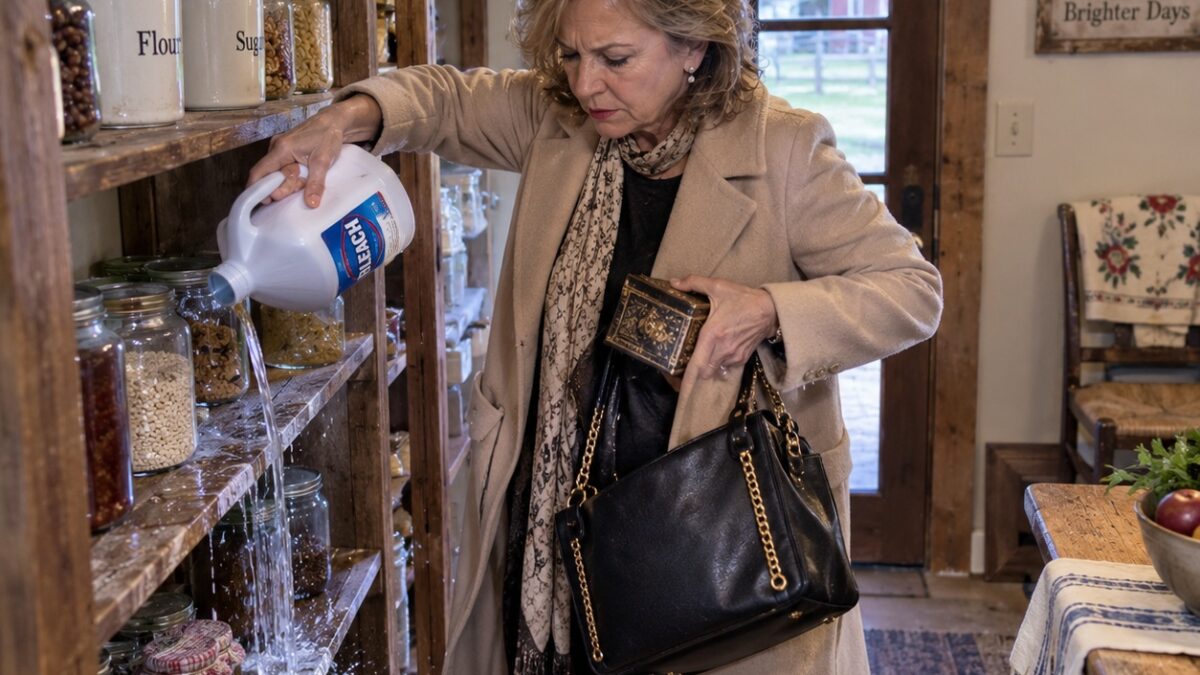
Because at 3:14 Saturday afternoon, Margaret walked into my grandmother’s pantry carrying a bottle of bleach.
And six minutes later, she walked out with Ana’s jewelry box hidden under her coat.
FULL STORY CONTINUATION 👇👇
My name is Elena Mercer.
I was thirty-five when this happened, and I had been married to Daniel Mercer for four years.
I loved him.
That matters.
Not because love excuses what came next.
Because it explains why I had tolerated Margaret as long as I had.
Daniel was one of those men people trusted immediately.
Soft-spoken.
Patient.
Glasses that constantly slid down his nose.
A civil engineer who could spend twenty minutes explaining drainage grades and somehow make you feel like the subject mattered.
He remembered birthdays.
Called his father every Sunday.
Stopped for injured animals.
Returned grocery carts even in thunderstorms.
And he loved his mother.
Deeply.
Uncritically.
That second part became our problem.
Margaret Mercer had raised Daniel after his father spent most of Daniel’s childhood traveling for work.
She had built her identity around sacrifice.
Every story about Daniel eventually became a story about what she had done for him.
His college degree?
“I worked two jobs.”
His first apartment?
“I found it.”
His first car?
“I helped him negotiate.”
His marriage?
Well.
That was the one accomplishment she could never make about herself, and I think she resented me for it from the beginning.
At our wedding, she kissed my cheek and whispered,
“You’d better keep him interested, dear. Men get bored.”
Photographs show her smiling warmly.
If you zoom in, you can see her fingers digging into my shoulder.
Daniel laughed when I told him.
“Mom thinks she’s funny.”
“She isn’t.”
“I know.”
“Then tell her.”
He kissed my forehead.
“She likes you.”
That became the first of many phrases.
She likes you.
She means well.
She’s just direct.
She’s from a different generation.
She’s protective.
She doesn’t know when she’s crossed a line.
By year three of our marriage, I had heard every variation.
Margaret did not scream.
She did not threaten.
She specialized in erosion.
Little remarks.
Small intrusions.
Tiny humiliations.
She once entered our apartment while we were out because Daniel had given her an emergency key.
Nothing was missing.
Instead, every cabinet had been reorganized.
When I asked why, she said,
“You looked overwhelmed.”
I told Daniel the emergency key needed to come back.
He hesitated.
“Why?”
“Because she used it when there was no emergency.”
“She was trying to help.”
“I don’t want that help.”
He eventually got the key.
Margaret cried.
Daniel spent two days miserable.
I ended up feeling guilty.
That was the pattern.
Margaret crossed a line.
Daniel defended her intent.
I defended my boundary.
Daniel became emotionally exhausted.
I softened the boundary so the marriage could feel peaceful again.
Peace.
That word deserves suspicion sometimes.
Silence can look a lot like peace from the outside.
The country house made everything sharper.
Ana died the previous September.
She had lived alone there for twenty-three years after my grandfather passed.
By the end, her knees were bad, but her mind remained frighteningly sharp.
The month before she died, she called me into the pantry.
Shelves covered three walls.
Peaches.
Green beans.
Tomato sauce.
Pickled cucumbers.
Jam.
Honey.
Dried herbs.
Old labeled tins.
Most people saw clutter.
Ana saw memory.
She touched a row of peach preserves.
“Your mother made the labels.”
I smiled.
“They’re crooked.”
“So is your mother.”
Ana had no patience for sentimentality unless it involved teasing someone.
Then she pointed toward a narrow cabinet built beneath the lowest shelf.
“That stays locked.”
“I know.”
Inside was her jewelry box.
Not crown jewels.
Family things.
My grandfather’s watch.
Ana’s wedding pearls.
A small emerald ring that belonged to her mother.
Two gold bracelets.
A silver locket containing a photograph of my mother as a child.
A brooch shaped like a swallow.
And several envelopes containing old letters.
The total monetary value was perhaps twenty-five thousand dollars.
The emotional value was impossible.
Ana made me promise something.
“Don’t sell anything for a year.”
“I wouldn’t.”
“You don’t know what grief makes you do.”
That was Ana.
Practical even at the edge of death.
“Wait one year. Then if you hate this place, sell it.”
“I won’t hate it.”
“You might.”
“I won’t.”
She squeezed my hand.
“Then waiting won’t hurt.”
She died nine days later.
I inherited the house outright.
No mortgage.
Taxes manageable.
Daniel and I lived in the city because of work, but we began spending weekends there.
The first night after the funeral, I woke around two and found Daniel standing in the kitchen.
Barefoot.
Drinking water.
“What are you doing?”
He looked around.
“I get it.”
“Get what?”
“Why you love this place.”
That moment mattered to me.
I thought maybe the house could become ours without ceasing to be mine.
Then Margaret visited.
Her first reaction:
“You’re keeping it?”
Her second:
“The upkeep alone will become ridiculous.”
Her third:
“Daniel won’t want to drive this far every weekend.”
Daniel corrected her.
“I like it.”
Margaret smiled.
“Now.”
That one word was aimed directly at me.
When we began fixing small things, her criticism increased.
Paint the kitchen white.
Remove the old pantry shelves.
Sell the chickens.
Cut down the apricot trees because they “make the yard look rural.”
It was rural.
When I pointed that out, she said,
“You don’t have to advertise it.”
The neighbor who mentioned strange activity was Mr. Bell, seventy-two, retired mechanic, lived half a mile down the road.
He called Thursday.
“Elena?”
“Hi, Mr. Bell.”
“You expecting anybody at Ana’s place?”
“No.”
“Saw headlights around midnight Tuesday.”
My stomach tightened.
“Driveway?”
“Couldn’t tell.”
“Truck?”
“Maybe.”
He apologized for bothering me.
I thanked him.
Daniel immediately suggested cameras.
We drove out Friday.
Installed one in the living room facing the front entry.
The second went above the back hall, wide enough to capture the pantry door and rear entrance.
Daniel balanced on a step stool.
“It’s probably teenagers.”
“Or raccoons.”
“Very organized raccoons.”
“Criminal network.”
“Egg theft.”
We laughed.
That memory would later hurt.
Because those cameras were something we installed together.
To protect the house.
Then his mother became the first person they caught.
The weekend Margaret volunteered, Daniel and I had to attend a conference in Milwaukee.
We would be gone from Friday morning through Sunday night.
Mr. Bell offered to feed the chickens.
Margaret heard.
“No.”
She said it over dinner.
“I’ll do it.”
I stared.
“You?”
“Why not?”
“You hate the chickens.”
“I do not hate them.”
“You called them feathered bacteria.”
“That was a joke.”
Daniel looked at me.
“It could be good.”
I knew what he meant.
Another opportunity.
Another peace offering.
Margaret smiled.
“I promise not to redecorate.”
I should have listened to the feeling in my stomach.
Instead I gave her instructions.
The back-door code.
Chicken feed.
Water.
Do not let them free-range if she couldn’t stay until dusk.
The pantry cabinet remained locked.
The key stayed in our apartment.
Or so I believed.
We returned late Sunday.
Monday morning, I drove to the country house before work because I had left a laptop charger there.
That was when I heard Margaret outside on speakerphone with Marion.
She did not know I was inside.
I had arrived through the front.
She must have come back one more time.
I heard everything.
Farm shack.
Trash.
Old woman.
I stood there.
Silent.
When she eventually drove away, I walked outside.
She had collected eggs.
Feed bucket returned.
Nothing obvious.
I almost dismissed the whole thing as another ugly Margaret moment.
Then I remembered the cameras.
My charger could wait.
I sat at Ana’s kitchen table.
Opened the app.
The first two days were boring.
Friday afternoon.
Margaret entering.
Feeding chickens.
Opening windows.
Leaving.
Saturday morning.
Same.
Then at 3:08 p.m., the back-door camera triggered.
Margaret entered carrying two grocery bags.
She placed them on the floor.
One bag contained cleaning supplies.
At first, I thought maybe she had decided to clean.
Then she walked directly into the pantry.
No hesitation.
The camera angle captured almost everything.
She opened the top shelf.
Took down three jars of peaches.
Looked at the labels.
Rolled her eyes.
Set them on the floor.
Then another.
Then another.
She removed almost twenty jars.
My chest tightened.
At 3:14, she pulled a bottle of bleach from the bag.
Unscrewed it.
For several seconds, I didn’t understand.
Then she poured bleach across the bottom pantry shelf.
Slowly.
Deliberately.
Back and forth.
Liquid ran down the old wood.
Across labels.
Into two storage baskets filled with handwritten recipe cards and linen towels.
I stopped breathing.
She poured more.
Then stepped backward.
Watched.
No accident.
No spill.
No confusion.
She capped the bottle.
Placed it back in the bag.
My hands started shaking.
“What are you doing?”
I whispered to the screen.
Of course she couldn’t hear me.
Margaret then took a dish towel from the counter.
Wiped the bottle.
That detail changed everything.
Wiped it.
Then she opened a drawer beside the pantry.
She tried three keys from a ring.
The third worked on Ana’s locked cabinet.
I froze.
She had a key.
How?
The cabinet opened.
Margaret crouched.
Removed the jewelry box.
Dark walnut.
Brass latch.
My grandfather had made it for Ana on their tenth anniversary.
Margaret lifted the lid.
Even from the camera, I saw the jewelry.
She touched the pearls.
Held up the emerald ring.
Then looked toward the hallway.
Closed the box.
Slid it into a large tote.
Not under her coat yet.
The coat came later.
At 3:22, she left the pantry.
Returned several minutes after with the tote folded smaller.
She had apparently transferred the box beneath her coat.
The camera captured the shape.
Then she walked out.
I watched the entire clip again.
Second time hurt worse.
First time, shock.
Second time, details.
Bleach.
The key.
The wiping.
The jewelry.
The glance toward the hall.
Intent lives in details.
I immediately called Daniel.
Then stopped before the call connected.
My thumb hovered over his name.
What would he say?
No.
I knew exactly what he would say.
There has to be an explanation.
Maybe she thought the pantry was moldy.
Maybe Grandma told her about the jewelry.
Maybe she was protecting it.
Maybe—
I canceled the call.
That was not betrayal.
It felt like betrayal at first.
A wife should tell her husband when his mother commits a crime.
But another thought stopped me.
If I told Daniel immediately, he would call Margaret.
Not maliciously.
He would ask.
And Margaret would know about the cameras.
She could return the box.
Destroy evidence.
Invent a story.
Maybe Daniel would even unknowingly help her build that story.
I loved my husband.
I did not trust his instincts where Margaret was concerned.
That difference mattered.
I downloaded every clip.
Original file.
Cloud backup.
External drive.
Sent a copy to myself.
Then I called the county sheriff’s department.
Deputy Ryan Cole arrived forty-five minutes later.
Late thirties.
Broad shoulders.
Quiet.
He watched the footage on my laptop without interrupting.
When the bleach appeared, his jaw tightened.
When Margaret opened the cabinet, he paused.
“Does she have permission to access that?”
“No.”
“The key?”
“I don’t know how she got one.”
“What’s inside the box?”
I listed the items.
“Approximate value?”
“Maybe twenty-five thousand.”
“Do you have photographs?”
“Yes.”
Ana had insured several pieces.
I had estate inventory records.
Receipts for the emerald ring from an appraisal two years earlier.
Deputy Cole watched the rest.
Then asked,
“Have you confronted her?”
“No.”
“Does she know about the camera?”
“No.”
“Good.”
I looked at him.
“What happens now?”
“First we document damage and confirm the property is missing.”
We did.
The cabinet was empty.
The jewelry box gone.
Bleach had soaked through two shelves.
Several old labels were destroyed.
Three linen bundles ruined.
Recipe cards stained.
One jar had cracked.
The pantry smelled harsh enough to make my eyes water.
I started crying when I found Ana’s handwritten recipe for peach preserves stuck to the bottom shelf, ink bleeding blue into the paper.
Deputy Cole waited.
No hurry.
That mattered.
When I regained control, he photographed everything.
“Do you know why she would pour bleach?”
“No.”
“Any dispute over the property?”
“She hates the house.”
“Specific financial interest?”
“Not that I know.”
“Insurance?”
I stared.
“The house is insured.”
“Contents?”
“Yes.”
“Jewelry?”
“Separately scheduled.”
He nodded.
“Did she know?”
“Maybe.”
That question stayed with me.
Why destroy the pantry?
The jewelry theft made sense in the ugly, simple way theft makes sense.
Value.
Money.
But bleach?
That felt personal.
Deputy Cole asked about the unknown headlights.
“Could Margaret have been here Tuesday?”
“I don’t know.”
“Any older footage?”
“No. Cameras went up Friday.”
“Keys?”
“She had the back-door code only.”
He looked toward the cabinet.
“Someone duplicated that key.”
I suddenly remembered.
Six months earlier, during Ana’s estate cleanup, Margaret had come with us one weekend.
I had opened the jewelry cabinet in front of her.
The key lived on a brass ring with three old pantry keys.
I kept it in my purse during the day.
Later that evening, Margaret had asked to borrow lip balm.
I gave her my purse.
A minute.
Maybe two.
My stomach turned.
Deputy Cole must have read my face.
“What?”
I told him.
“Speculation for now.”
He was right.
Facts.
That became my rule too.
“What should I tell Daniel?”
Deputy Cole considered.
“Your husband isn’t under investigation.”
“I know.”
“If you believe he’ll notify her immediately, I’d prefer you hold off until we decide next step.”
That permission helped.
“What next step?”
He looked at the video again.
“Does she believe there are other valuables here?”
My pulse changed.
“Yes.”
“What?”
“Ana had an antique silver tea service.”
“Here?”
“No.”
“In storage?”
“Bank deposit vault.”
“Does Margaret know?”
“She thinks it’s here.”
“How?”
“She asked once.”
Deputy Cole leaned back.
“How valuable?”
“Maybe twelve thousand.”
“And jewelry?”
“She might think there’s more.”
An idea entered the room.
Not mine initially.
His.
“We may not need a trap.”
“I know.”
“The video is strong.”
“But?”
“But if she tries returning or removing additional property, it can clarify behavior.”
I understood.
“You want me to bait her.”
“No.”
He answered quickly.
“I’m saying do not manufacture a crime.”
Important distinction.
“We can document property, secure the house, and allow normal circumstances to continue.”
Then he asked,
“Was she supposed to return?”
I remembered her phone call outside.
She had said:
“I’m just here to do them a favor. Feed the chickens, check on things.”
Maybe she planned to continue.
“She still thinks she’s feeding chickens today.”
“What time?”
“Usually afternoon.”
Deputy Cole nodded.
“Then don’t change routine yet.”
I looked at the empty cabinet.
“She already stole something.”
“Yes.”
“So why wait?”
“We don’t have to.”
He explained options.
Immediate interview.
Search warrant depending prosecutor review.
Request voluntary surrender.
Further evidence collection.
My mind raced.
Then I asked the question I couldn’t avoid.
“Could the jewelry be gone already?”
“Yes.”
Pawned?
“Yes.”
Sold?
“Yes.”
“Destroyed?”
“Possible.”
My grandmother’s ring.
The swallow brooch.
The letters.
The locket.
Something inside me hardened.
“I want it back.”
“We’ll do what we can.”
Before leaving, Deputy Cole asked me to send original files directly through a secure evidence link.
He also told me not to post anything.
Not to send clips to family.
Not to contact Margaret.
I agreed.
Then I cleaned nothing.
That was difficult.
Ana’s pantry sat wounded.
Bleach stains.
Wet wood.
Ruined labels.
I wanted to fix it.
Deputy Cole told me to wait until the scene documentation was complete.
At noon, Daniel texted.
How’s Grandma’s place? Find the charger?
I stared.
Then answered:
Still here. Taking care of something.
He replied with a heart.
Guilt hit me.
Then I watched the footage one more time.
Guilt disappeared.
At 1:38, Margaret arrived.
My driveway camera alerted.
I was no longer at the house.
Deputy Cole had asked me to leave.
Mr. Bell had agreed to call if anything happened.
The sheriff’s department had units nearby.
I sat in my car ten minutes away, watching the live feed.
Margaret entered through the back code.
She carried chicken feed.
Nothing else.
She went outside.
Fed the hens.
Collected eggs.
Came back.
Then entered the pantry.
I stopped breathing.
She looked at the bleached shelves.
Smiled.
Not a huge smile.
Barely.
But there.
Then she opened another cupboard.
Moved jars.
Checked behind flour tins.
Looked under the sink.
Searching.
For the silver tea service?
More jewelry?
I don’t know.
She then took three eggs.
Put them in her bag.
That part would have been almost funny if not for everything else.
Then she stood in the kitchen and called Marion.
Speakerphone.
“You should see the place.”
I could hear it through the camera.
Again.
Margaret apparently could not insult me without an audience.
Marion said,
“Are you still there?”
“Yes.”
“I thought you were only feeding chickens.”
“I am.”
Cabinet opening.
“There’s so much junk.”
“What are you looking for?”
Margaret laughed.
“Nothing.”
She was absolutely looking for something.
Then Marion said something that froze me.
“Did you find the silver?”
Margaret stopped moving.
My pulse exploded.
“How do you know about the silver?” she asked.
“You told me yesterday.”
Long pause.
“Oh.”
Margaret lowered her voice.
“Not yet.”
I grabbed my phone.
Called Deputy Cole.
“She’s talking about silver.”
“We have audio.”
“You’re listening?”
“Yes.”
Relief.
“What do I do?”
“Nothing.”
Margaret remained another twenty minutes.
Then left.
No arrest.
I was furious.
Deputy Cole called.
“Why didn’t you stop her?”
“Because she didn’t take additional felony-level property that we observed, and we’re coordinating with the investigator assigned.”
“She already took jewelry.”
“Yes.”
“Then arrest her.”
“Elena.”
I hated calm voices that day.
“We’re moving carefully because recovery of your property matters too.”
That stopped me.
“What do you mean?”
“If we arrest before knowing where the jewelry went, recovery may become more difficult.”
I understood.
Hated it.
Still understood.
That afternoon, Detective Sarah Bennett took over.
Early forties.
Direct.
She watched everything.
Then asked about Marion.
“Last name?”
“Mercer too. Widowed. Margaret’s older sister.”
“Address?”
I provided what I knew.
She called Marion.
Not to accuse.
To ask.
Later she told me enough.
Marion had assumed the silver discussion was legitimate.
Margaret had told her I was planning to sell “the old junk” and had asked Margaret to help identify valuables.
A lie.
Margaret told Marion she might take a few pieces to an appraiser.
Another lie.
Then something useful.
Margaret had mentioned meeting a dealer named Raymond Pierce.
Detective Bennett knew the name.
Antiques.
Estate jewelry.
Bought gold.
Private appointments.
Licensed business.
Not necessarily criminal.
She made calls.
I waited.
At 4:16, Daniel called.
I answered.
“You okay?”
“Yes.”
“You sound weird.”
“Tired.”
“Still at the farm?”
“No. Driving.”
“Mom said she was there earlier.”
My hand tightened around the steering wheel.
“She told you?”
“Yeah.”
“What did she say?”
“That the pantry had a mildew problem.”
I almost laughed.
“What?”
“She said she had to bleach some shelves.”
There it was.
The explanation had already begun.
“She told you that?”
“Yes.”
“She mention my grandmother’s jewelry?”
Silence.
“What?”
Wrong question.
Too direct.
Daniel heard it.
“What happened?”
I closed my eyes briefly at a red light.
“Nothing I want to discuss on the phone.”
“Elena.”
“We’ll talk tonight.”
“What happened?”
“Daniel.”
He knew my tone.
“Okay.”
Then:
“Is Mom involved?”
I did not answer.
That silence told him more than words.
“I’ll see you at home.”
When I arrived, Daniel was standing in our kitchen.
No glasses.
He removed them when anxious.
He looked pale.
“What happened?”
I placed my purse down.
“Sit.”
His face tightened.
“Elena.”
“Please.”
He sat.
I took the chair opposite.
Then said,
“I need you to listen to everything before you call anyone.”
His eyes changed.
“Mom?”
“Yes.”
He inhaled.
“What did she do?”
I took out my laptop.
Opened the video.
Pressed play.
I watched Daniel instead of the screen.
At first, confusion.
Margaret entering pantry.
Removing jars.
Then bleach.
His eyebrows pulled together.
“What is she doing?”
I said nothing.
Margaret poured.
Daniel leaned forward.
“No.”
The word came quietly.
Then she opened the cabinet.
His face went blank.
She removed the jewelry box.
“No.”
Again.
This time weaker.
He watched his mother place it in the tote.
Walk away.
The video ended.
Daniel sat completely still.
I gave him no explanation.
He replayed it.
All of it.
Second time, he covered his mouth.
At the end, he whispered,
“There has to be—”
I stood so quickly the chair moved backward.
His eyes lifted.
He stopped.
That phrase.
There has to be.
Of course.
I stared.
He closed his eyes.
Then said,
“No.”
I waited.
He looked at me.
“No. There doesn’t.”
Something in me unclenched.
Not fully.
Enough.
“What did she tell you?”
“That there was mildew.”
“She poured bleach over Ana’s pantry.”
“I saw.”
“She took the jewelry.”
“I saw.”
“She had a key.”
He looked sick.
“How?”
“I don’t know.”
Daniel stood.
Started pacing.
“Call her.”
“No.”
He turned.
“What?”
“The police are involved.”
His face went white.
“Police?”
“Yes.”
“You called the police before me?”
There it was.
Not angry exactly.
Hurt.
I kept my voice steady.
“Yes.”
“Why?”
“Because if I called you first, you would have called her.”
“I would have asked her what happened.”
“Exactly.”
He stared.
“I’m your husband.”
“And she is your mother.”
“What does that mean?”
“It means for four years, you have explained her before believing me.”
That hit.
He sat again.
“Elena.”
“No.”
My voice shook now.
“I love you. But I knew what you would do.”
“You don’t know.”
“I do.”
“That’s not fair.”
“She poured bleach on my grandmother’s things and stole a jewelry box on video.”
“I’m not defending her.”
“Now.”
His face changed.
I continued.
“Because you saw it.”
Silence.
“If I had called and said I found bleach damage and jewelry missing, what would you have said?”
He looked down.
I answered for him.
“Maybe she was cleaning.”
His jaw tightened.
“Maybe Ana told her to take it.”
“Elena.”
“Maybe I misunderstood.”
“Stop.”
“Maybe—”
“Stop.”
His voice cracked.
He put both hands over his face.
“I get it.”
I sat.
Neither of us spoke.
Finally Daniel asked,
“What happens now?”
I told him.
Deputy.
Detective Bennett.
Marion.
Silver.
Raymond Pierce.
He listened.
Then:
“Do they have the jewelry?”
“Not yet.”
“I’ll call Mom.”
“No.”
“She might tell me.”
“And she might destroy evidence.”
He looked offended.
Then caught himself.
Because the video existed.
There was no version of Margaret left that deserved automatic benefit of the doubt.
He whispered,
“I don’t know who she is.”
I softened.
“That hurts.”
He looked at me.
“You sound like you understand.”
“I do.”
“She’s my mother.”
“I know.”
He laughed bitterly.
“I spent four years telling you she meant well.”
“Yes.”
“I was wrong.”
The words mattered.
Not enough.
But they mattered.
He sat at the kitchen table for an hour.
Then said something I didn’t expect.
“Don’t tell me what police plan.”
“What?”
“If they’re setting something up.”
“You don’t want to know?”
He shook his head.
“I don’t trust myself not to give something away.”
That was the first truly protective decision Daniel made that night.
I reached for his hand.
He held mine.
At 9:30, Detective Bennett called.
“We found Raymond.”
My heart jumped.
“And?”
“Margaret contacted him yesterday.”
“What did she sell?”
“Nothing yet.”
I nearly collapsed with relief.
“He says she sent photographs.”
“Of the jewelry?”
“Some pieces.”
“Can we get it back?”
“We don’t know where it is because he hasn’t seen it physically.”
“What did she ask?”
“Cash value. Off-book if possible.”
My stomach dropped.
“Off-book?”
“He says that made him uncomfortable.”
“Why didn’t he call police?”
“People say odd things to antique dealers constantly.”
Fair.
“She scheduled a meeting.”
“When?”
“Tomorrow morning.”
My pulse spiked.
“Where?”
“His shop.”
“What happens?”
“Leave that to us.”
I glanced at Daniel.
He watched my face but could not hear.
“Does she still have the box?”
“Likely.”
“What do you need from me?”
“Confirmation of identifying features.”
I described everything.
Emerald ring inscription.
Swallow brooch chipped wing.
Ana’s pearls restrung with a modern clasp.
Grandfather’s watch engraved inside:
A + M, 1959.
Then Detective Bennett asked,
“Do you have anything else of similar appearance she believes valuable?”
“The silver.”
“Would you be willing to help with a controlled documentation plan?”
That was the trap.
Not fake evidence.
Not planting stolen property.
Something simpler.
We would let Margaret believe I was suddenly clearing valuables from the country house.
Detective Bennett did not want me sending provocative messages.
No entrapment nonsense.
Instead, we arranged something entirely natural.
I called Marion.
That part terrified me.
Detective Bennett approved the wording.
“Hi, Marion.”
“Elena.”
She sounded nervous.
“I heard there’s some problem at Ana’s house.”
“There is.”
I kept my tone normal.
“I’m having the remaining valuables inventoried tomorrow.”
Pause.
“Okay.”
“The silver tea service, coins, old watches.”
I knew Margaret would hear.
Maybe not directly.
But sisters talk.
“I’m moving them to secure storage.”
“That sounds wise.”
“Can you tell Margaret she doesn’t need to feed chickens anymore? Mr. Bell is taking over.”
Another pause.
“I can.”
“Thank you.”
That was all.
No bait.
No claim they were unattended.
Just information.
But the key phrase was remaining valuables.
If Margaret believed the silver might disappear from her reach, we expected reaction.
Then Detective Bennett said,
“Now we wait.”
I hated waiting.
At 11:40, our country-house camera alerted.
Margaret.
Again.
Daniel was asleep in our bedroom.
Or pretending.
I sat on the couch with the live feed muted.
Margaret entered.
No chicken feed.
Gloves.
Not winter gloves.
Thin leather.
She went directly to the pantry.
Opened cabinets.
Searched.
Then walked into the living room.
The other camera captured her examining Ana’s old secretary desk.
Drawers.
Bookshelf.
Sideboard.
She found nothing.
Because the silver wasn’t there.
She became visibly angry.
Then pulled out her phone.
The camera audio captured one side.
“Marion said Elena is moving things tomorrow.”
Pause.
“No, I can’t wait.”
Pause.
“She probably knows something.”
My blood turned cold.
Who was she talking to?
Not Marion.
Then:
“I still have the jewelry.”
Relief and horror at once.
Still has it.
“Eight-thirty.”
Pause.
“Fine.”
She hung up.
Detective Bennett got the clip immediately.
Minutes later, she texted:
Do nothing.
Margaret left.
Daniel woke around midnight.
Found me sitting in darkness.
“What happened?”
“I can’t tell you.”
He nodded.
No argument.
“Okay.”
He sat beside me.
For almost twenty minutes, we said nothing.
Then Daniel whispered,
“I’m sorry.”
“For what?”
“Every time.”
I looked at him.
“Every time you told me she hurt you and I explained her.”
My eyes filled.
“I thought I was keeping peace.”
“I know.”
“I was just making you absorb the cost.”
That was exactly it.
I started crying.
Quietly.
Daniel did too.
“I don’t know what happens to us after this.”
He said it.
Not me.
I took a breath.
“Neither do I.”
He nodded.
“But I know what happens tomorrow.”
“What?”
“You don’t warn her.”
His face twisted.
“I won’t.”
At 6:30 the next morning, we woke.
Neither had slept much.
I made coffee.
Daniel sat at the kitchen island.
He kept checking his phone.
Not calling.
Just looking.
At 7:12, Detective Bennett texted:
We’re in position.
I said nothing to Daniel.
At 7:46, another:
Meeting underway.
My heart pounded.
At 7:58:
Property visually confirmed. Stand by.
Then—
8:00 a.m.
Daniel’s phone rang.
His mother’s name did not appear.
UNKNOWN NUMBER.
He looked at me.
I already knew.
“Answer.”
He did.
“Hello?”
A man’s voice.
Calm.
Professional.
“Mr. Mercer? This is Detective Paul Hawkins with the county sheriff’s office.”
Daniel’s face changed.
“Yes.”
“I’m calling from your mother’s phone. She asked that we contact you.”
He sat down.
Slowly.
“What happened?”
Detective Hawkins paused.
Then:
“Your mother has been detained in connection with suspected theft and property damage involving your wife’s residence.”
Daniel closed his eyes.
I gripped the counter.
The voice continued faintly.
“She was found in possession of property identified as belonging to Elena Mercer’s grandmother’s estate.”
Daniel whispered,
“Oh God.”
Then the detective said something neither of us expected.
“There’s another issue.”
Daniel’s eyes opened.
“What?”
“The vehicle she arrived in contains additional property we believe may have been stolen from other family members.”
Silence.
I stared.
Daniel looked at me.
“What property?”
“We’ll need formal identification. But we found jewelry, documents, and several items bearing names other than Mrs. Mercer.”
Daniel’s face drained.
“Whose names?”
“I don’t want to speculate over the phone.”
Then:
“Your aunt Marion is on her way here.”
Marion.
The call ended four minutes later.
Daniel kept holding the phone after the screen went dark.
I asked,
“What else?”
His voice barely worked.
“They found more things.”
“What?”
“He doesn’t know yet.”
He looked at me.
Or maybe he knew enough not to say.
I sat beside him.
For once, there was no explanation.
No defense.
No “maybe.”
At 9:15, Detective Bennett called me.
Margaret had gone to Raymond Pierce’s shop carrying Ana’s jewelry box inside a canvas tote.
Raymond, cooperating with investigators, examined pieces.
Asked routine provenance questions.
Margaret told him the jewelry came from “family property being cleared.”
He asked whether she had authority to sell.
She said yes.
Then she offered to sell for cash below appraisal value if he “kept it simple.”
Investigators entered.
Margaret initially claimed everything belonged to Daniel.
Then claimed I had asked her to sell it.
Then claimed Ana had given it to her before death.
Then, when confronted with the video, stopped talking.
My jewelry was recovered.
All of it.
The box.
The pearls.
The ring.
The brooch.
The locket.
The watch.
The letters.
I cried so hard I had to sit down.
Daniel held me.
I let him.
Then Detective Bennett explained the second discovery.
Margaret’s car contained three jewelry pouches.
A set of gold earrings engraved with Marion’s initials.
A men’s watch belonging to Daniel’s father.
Several old savings bonds.
Two envelopes of cash.
A signed blank check from an elderly cousin.
And copies of financial documents for Marion’s house.
My stomach turned.
“Did she steal all that?”
“We’re investigating.”
Marion arrived.
Identified the earrings.
She had thought they were lost two years earlier.
Daniel’s father, Howard, was called.
The watch had vanished from his dresser the previous Christmas.
He believed he misplaced it.
The savings bonds belonged to him too.
Margaret had apparently been taking small things for years.
Not enough to create immediate suspicion.
One piece.
One envelope.
One document.
People blamed themselves.
Misplaced.
Forgot.
Lost.
Exactly like she expected.
“She’s been stealing from everyone.”
Daniel whispered.
I didn’t answer.
Because the truth was still forming.
Police executed additional legal process later that day.
I will not pretend I knew all procedural details.
I didn’t.
What I know is that investigators searched Margaret’s townhouse after obtaining authorization through the proper process.
They found more.
My grandmother’s missing silver serving spoon.
I had not even known it was gone.
A diamond pendant belonging to Marion.
Two antique coins Howard reported missing.
Gift cards.
Cash.
Photocopies of signatures.
A folder containing estate documents for three family members.
And something that changed the case from ugly to frightening.
Insurance paperwork.
For Ana’s country house.
My insurance paperwork.
Copies.
Margaret had no legitimate reason to possess them.
Detective Bennett asked whether I had ever given Daniel’s mother access to our files.
“No.”
“Daniel?”
“No.”
He looked sick.
Then we remembered.
Six months earlier, Margaret had stayed in our apartment while a pipe repair happened.
She was there alone for four hours.
Our home office filing cabinet had not been locked.
My stomach dropped.
“What does this mean?”
I asked.
Detective Bennett remained cautious.
“It means we need to understand why she copied them.”
“Bleach?”
I thought of the pantry.
“What if she was trying to make damage look bigger?”
“We’re not jumping there yet.”
Good detective.
Facts.
Always facts.
But something was wrong beyond theft.
Margaret hated the farmhouse.
Wanted it sold.
Had insurance information.
Destroyed part of the pantry.
Searched for valuables.
Copied documents.
Why?
Three days later, we learned about her debt.
Margaret had always looked wealthy.
Designer clothes.
Country-club lunches.
A renovated townhouse.
Annual trips.
She wasn’t.
Not anymore.
Credit cards.
Personal loans.
Home-equity borrowing.
Investment losses.
A failed private real-estate fund.
Nearly $190,000 in unsecured debt.
No one knew.
Not Daniel.
Not Howard, though they had been divorced for twelve years.
Not Marion.
Margaret had maintained appearance through borrowing.
The thefts were partly money.
Jewelry sold quietly.
Cash.
Gift cards.
Small assets.
But why my pantry?
The answer came from messages on her phone.
Not deleted well enough.
A conversation with an acquaintance named Lyle Benton.
Lyle ran a cleanup and restoration company.
He had asked Margaret months earlier whether the country house might come onto the market.
She said:
If Elena sells, yes.
Lyle:
Good land. House probably teardown.
Margaret:
She’s sentimental.
Lyle:
Sentiment changes when old places become expensive.
Then:
Water damage? Mold? Structural?
Margaret:
Nothing serious. Unfortunately.
Unfortunately.
Another conversation weeks later:
If pantry contamination becomes a recurring issue, she may finally understand the place is unsanitary.
Lyle:
Don’t create problems.
Margaret:
Relax.
That was enough to show mindset, though not every thought became a charge.
She wasn’t pouring bleach to commit insurance fraud.
Not based on evidence.
She was trying to make the property unpleasant.
Damaged.
Unmanageable.
She believed if I tired of the farmhouse, I would sell.
Lyle had casually discussed buying opportunities.
Margaret apparently imagined she might receive a finder’s fee or some financial help if the sale happened.
There was no signed agreement.
No proven conspiracy with Lyle.
He cooperated immediately and seemed horrified.
Margaret had turned casual conversation into permission in her own mind.
That was her pattern.
A suggestion became entitlement.
A key became access.
Family became ownership.
Daniel read the messages at our dining table.
He stopped halfway.
“She was trying to push you out of Ana’s house.”
“Yes.”
“Why?”
“Money.”
“And because she hated it.”
He rubbed his face.
“I let her feed the chickens.”
“Yes.”
The guilt on his face worried me.
“Daniel.”
“I gave her the code.”
“Yes.”
“If I hadn’t—”
“No.”
He looked at me.
“No.”
I reached across.
“You didn’t pour bleach.”
“But I opened the door.”
“Literally.”
“That isn’t funny.”
“No.”
I squeezed his hand.
“You trusted your mother.”
He laughed bitterly.
“Too much.”
“Yes.”
“But trusting someone doesn’t make you responsible for the crime they commit with access you gave them.”
He stared.
“That sounds like therapy.”
“We need therapy.”
He looked at me.
Then nodded.
“Yes.”
That mattered more than any apology.
Because remorse without changed behavior becomes another performance.
Daniel needed to understand why he had repeatedly prioritized Margaret’s explanations over my experience.
Not only because of this crime.
Because our marriage had been paying that cost for years.
We began couples counseling two weeks later.
Our therapist was Dr. Rachel Foster.
She asked Daniel something in the first session.
“What did keeping your mother happy mean when you were a child?”
He looked confused.
“What?”
“Was the home calmer when she was happy?”
“Yes.”
“And when she was unhappy?”
He hesitated.
“She would withdraw.”
“For how long?”
“Days.”
“What did you do?”
“Try to fix it.”
There.
Daniel had been trained.
Not by villainy exactly.
By repetition.
Margaret’s emotional state became everyone’s responsibility.
If she felt excluded, include her.
If she felt criticized, apologize.
If she crossed a boundary and became upset when corrected, comfort her.
Daniel had spent his entire life managing her.
Marriage did not erase training that old.
It simply transferred the cost to me.
Dr. Foster said,
“You weren’t choosing your mother over Elena every time consciously.”
Daniel looked relieved.
Then she added,
“But Elena experienced the effect as a choice.”
Relief disappeared.
Good.
Truth can be compassionate without becoming soft.
I learned things too.
I had accepted too much because I wanted Daniel to be “different” from his mother.
Whenever he apologized, I considered the issue resolved.
I rarely required changed structure.
The spare key.
Holiday plans.
Unannounced visits.
Financial questions.
Every incident ended with emotion instead of policy.
That changed.
Margaret’s case moved forward.
There were charges related to theft, property damage, and possession of stolen property, along with other counts arising from items belonging to other family members.
Some allegations were stronger than others.
Several pieces had unclear origins.
Not every missing object could be proven stolen.
That frustrated Marion.
“I know that bracelet was mine.”
“I believe you,” I said.
“But knowing isn’t enough?”
“Not always.”
She hated that.
So did I.
Margaret hired an attorney.
Then did what I expected.
She blamed me.
Through Daniel’s aunt network, cousins, family friends, anyone who would listen.
Elena set her up.
Elena secretly recorded her.
Elena manipulated Daniel.
Elena turned a misunderstanding into a criminal case.
The bleach was cleaning.
The jewelry was “being appraised.”
The other items were “family property” Margaret had stored for safekeeping.
Then Raymond Pierce’s statement became known to the attorneys.
Cash.
Below market.
Keep it simple.
Harder to explain.
Margaret called Daniel from the county jail shortly after her initial detention.
He did not answer.
Second call.
Did not answer.
Third.
He looked at me.
“What should I do?”
“Your choice.”
“I don’t want to.”
“Then don’t.”
He didn’t.
Later, after she made bond, she called from another number.
Daniel answered.
I was not in the room.
He told me afterward.
“She said I abandoned her.”
“What did you say?”
“That I’m not discussing the case.”
“And?”
“She cried.”
I waited.
“I didn’t apologize.”
That was a victory.
Small.
Enormous.
“She asked if I believed you over her.”
My stomach tightened.
“What did you say?”
He looked at me.
“I said the camera wasn’t an opinion.”
I laughed despite myself.
He smiled weakly.
Then grew serious.
“She told me you installed it to trap her.”
“What did you say?”
“That I installed it.”
That mattered too.
Daniel refused to let her rewrite even the origin.
We had installed the cameras together because of Mr. Bell’s report.
Margaret didn’t know.
That was not entrapment.
That was evidence.
The farmhouse remained closed for several weeks while I repaired the pantry.
At first, I wanted everything restored exactly.
Same wood.
Same paint.
Same labels.
Then the carpenter told me something.
“The bleach went deep.”
“How deep?”
“Some boards need replacement.”
I started crying in front of a man named Travis holding a pry bar.
Embarrassing.
He put the tool down.
“Was this your grandma’s?”
“Yes.”
He waited.
Then said,
“We can save the face trim.”
“What?”
“The old trim. Maybe two shelves. Build new around them.”
That became the plan.
Not restoration to before.
Integration.
Old wood.
New wood.
Ana’s original trim.
Fresh shelves.
The damaged recipe cards were dried and professionally conserved.
Some writing remained blurred.
I hated that.
Then my mother visited.
She looked at one card.
Blue ink spreading through the word peaches.
“That’s still her handwriting.”
I nodded.
“Damage doesn’t make it less hers.”
I carried that sentence into therapy.
Daniel’s father, Howard, became another unexpected part of the story.
He invited us to dinner.
Divorced from Margaret for twelve years.
He had always been polite but distant.
After police recovered his watch, he seemed embarrassed.
“I thought I lost it.”
“Anyone would.”
“No.”
He looked at Daniel.
“I knew your mother took things sometimes.”
Daniel stared.
“What?”
“Small.”
Howard looked ashamed.
“Cash from my wallet when we were married. A ring from my mother. She always had explanations.”
“Why didn’t you tell me?”
“You were twenty-two when we divorced.”
“So?”
“I didn’t want to make you hate her.”
Daniel laughed bitterly.
“Everyone was protecting me from the same person.”
Howard flinched.
“Yes.”
The ring from Howard’s mother had never been recovered.
Maybe sold long ago.
Maybe somewhere else.
Margaret’s theft wasn’t new.
The scale was.
Or perhaps the scale had simply become visible.
Howard said something that night that I never forgot.
“Your mother doesn’t steal because she thinks things don’t belong to other people.”
Daniel waited.
“She steals because she thinks needing something gives her a stronger claim than their ownership.”
Exactly.
Eggs.
Jewelry.
Documents.
Access.
Our marriage.
Margaret never saw herself as someone taking.
She saw herself as someone correcting distribution.
If she needed it more, wanted it more, understood its value better, then ownership became selfishness.
That worldview explained everything.
Even her attitude toward my grandmother’s house.
Why should Elena have six acres she only uses weekends?
Why keep jewelry in a box?
Why preserve old jars?
Why let sentiment block economic use?
Margaret believed efficiency excused consent.
It doesn’t.
The trial never became the grand courtroom spectacle relatives imagined.
Most cases don’t.
There were hearings.
Motions.
Negotiation.
Evidence review.
Margaret eventually accepted a plea resolving several of the strongest charges.
Restitution.
Probationary restrictions.
Community service.
Mandatory counseling.
A suspended custodial component conditioned on compliance.
Additional civil reimbursement for property damage.
Some charges tied to disputed family property were dismissed or consolidated.
Marion was furious.
“She should go to prison.”
Maybe.
I didn’t know.
By then, my goal had shifted.
I wanted the jewelry back.
Got it.
Wanted the pantry repaired.
Mostly.
Wanted Margaret out of my property.
Done.
Wanted Daniel to stop sacrificing me to protect her feelings.
Still in progress.
Justice is rarely one dramatic door slamming shut.
Sometimes it’s dozens of smaller doors finally getting locks.
The first time I saw Margaret after everything was at a courthouse hallway.
She looked smaller.
No pearls.
Gray suit.
Her attorney beside her.
Daniel and I stood with Detective Bennett.
Margaret saw me.
Her expression changed.
Not remorse.
At first, anger.
Then she looked at Daniel.
He did not move toward her.
That hurt her more than seeing me.
She whispered,
“Daniel.”
His shoulders tightened.
I touched his arm.
Not to stop him.
To remind him he had choice.
He said,
“Hi, Mom.”
She looked at me.
“You’re pleased with yourself.”
I stared.
“No.”
That was true.
I wasn’t.
“I lost my home.”
She hadn’t.
Not literally.
Her townhouse remained hers.
“I lost my son.”
Also not exactly.
Daniel had created distance.
“You did this over some old jewelry.”
There.
The entire problem.
Some old jewelry.
A pantry.
A camera.
Eggs.
Small things.
People who violate boundaries love shrinking the objects involved.
It’s just a key.
Just a room.
Just money.
Just jewelry.
Just words.
The object may be small.
The entitlement isn’t.
I replied,
“You poured bleach on my grandmother’s belongings and took things that weren’t yours.”
“I was having them valued.”
“The dealer says otherwise.”
Her mouth tightened.
“You turned Daniel against me.”
I looked at him.
Daniel answered before I could.
“No.”
Margaret stared.
“Sweetheart.”
“No.”
His voice shook.
But he kept going.
“Elena showed me a video.”
“You don’t understand—”
“I watched you.”
“It was more complicated.”
“I watched you.”
She looked like someone had slapped her.
Daniel’s eyes filled.
“You taught me my whole life to trust what I saw.”
Margaret whispered,
“I’m your mother.”
“I know.”
“That should mean something.”
“It does.”
He swallowed.
“It doesn’t mean you get to make Elena the liar every time you hurt her.”
Margaret looked at me with hatred.
I said nothing.
This was not my conversation.
She turned back.
“So you choose her.”
Daniel closed his eyes.
For years, that question controlled him.
Mom or wife.
Mother or marriage.
Choose.
Dr. Foster had taught him a better answer.
“I’m choosing the truth.”
Margaret walked away.
I stood beside him.
He shook for five minutes afterward.
Courage does not always look steady.
Sometimes courage looks physically terrified and still says the sentence.
Our marriage changed after that.
Not instantly.
Some wounds opened.
I admitted how lonely I had felt at holidays.
How every disagreement with Margaret became something Daniel and I fought about privately while she went home untouched.
Daniel admitted he had resented me for “making him choose.”
Then understood I had mostly asked him to enforce ordinary limits.
Call before visiting.
Don’t insult my clothes.
Don’t rearrange our home.
Don’t share private medical information.
Don’t use emergency keys casually.
Don’t call my grandmother trash.
Not extreme.
He began individual therapy.
I did too.
Six months after the crime, we changed our apartment locks.
Margaret never had a key again.
No emergency copy.
No building code.
Nothing.
Daniel informed her in writing that all contact needed to be scheduled.
She called it cruel.
He did not change it.
For our fifth wedding anniversary, we went to the country house.
Just us.
The pantry restoration was finished.
New oak shelves.
Ana’s original trim.
Recipe cards framed behind glass.
The jewelry box returned to the locked cabinet.
But I changed one thing.
I moved the most valuable pieces to a bank safe-deposit box.
Not because the house felt unsafe.
Because Ana had told me grief makes people do surprising things.
So does denial.
The swallow brooch stayed with me.
I wore it to dinner.
Daniel noticed.
“Grandma’s?”
“Yes.”
“It’s beautiful.”
I touched the chipped wing.
“She hated it.”
“What?”
“Thought it looked too fancy.”
He laughed.
“Then why keep it?”
“My grandfather bought it in Paris.”
“Your grandmother went to Paris?”
“No.”
“That seems unfair.”
“He went during the Army.”
“And brought home a bird.”
“She called it an ugly pigeon.”
We laughed.
That was the first time the jewelry felt like family again instead of evidence.
After dinner, we sat on the porch.
Chickens settling.
Crickets.
Dark fields.
Daniel said,
“I almost ruined this for you.”
“No.”
“I convinced you to let Mom come.”
“Yes.”
“I gave her access.”
“Yes.”
He looked at me.
“You’re making forgiveness difficult.”
“I’m not forgiving something you didn’t do.”
“I helped create the opening.”
“That’s different.”
He considered.
“What would you have done if there hadn’t been cameras?”
That question haunted me.
“I don’t know.”
“She would’ve said she cleaned.”
“Yes.”
“Jewelry?”
“Maybe I would’ve thought I misplaced it.”
He closed his eyes.
“Like Dad.”
“Yes.”
“And Marion.”
“Yes.”
He looked toward the pantry window.
“That’s terrifying.”
It was.
The camera didn’t create truth.
It made denial harder.
I thought about the title everyone later gave the story.
“The hidden camera.”
As if the camera were the hero.
It wasn’t.
It was a witness.
Witnesses matter.
But the camera did not save me from Margaret.
It saved me from debating reality.
There is a difference.
Without footage, I might have spent weeks explaining why I knew.
Margaret would have asked where my proof was.
Daniel might have wanted “both sides.”
Marion might have defended her sister.
Howard might have shrugged about another missing watch.
The video compressed all that.
There.
Watch.
No interpretation needed.
Margaret herself eventually wrote us a letter.
Eighteen months after sentencing.
I did not open it for two weeks.
Daniel opened his separately.
Mine began:
Elena,
I have spent most of my life believing that being useful gave me permission to involve myself.
I stopped reading.
Then continued.
When Ana’s house passed to you, I told myself you were wasting an asset. I believed Daniel would eventually resent the travel and maintenance. I believed if the house became inconvenient enough, you would sell it and everyone would be better off.
There it was.
No excuse.
Just ugly truth.
The bleach was meant to make the pantry feel contaminated and impossible to preserve. I did not think of the recipes or the labels as things. I thought of them as clutter. That was cruel.
My hands shook.
I took the jewelry because I needed money and because I convinced myself family objects belonged to family, not one person. That belief was convenient and dishonest.
She addressed the other thefts too.
Not every detail.
Enough.
Then:
I know saying I am sorry does not repair what I did.
Good.
I also know Daniel has every right to decide how much of me he wants in his life.
Better.
At the end:
Your grandmother’s house mattered because she made it matter to you. I did not have the right to decide that was foolish.
I cried.
Not because everything was healed.
Because Margaret finally named the correct injury.
Not theft.
Not bleach.
Contempt.
She had believed my love for the house was silly.
Therefore damaging it felt acceptable.
That happens more than people admit.
We respect boundaries more easily when we value the thing inside them.
Mature respect requires something harder.
Honoring boundaries around things we personally don’t understand.
I did not reply immediately.
Months later, I sent one sentence.
I received your letter. Thank you for taking responsibility.
Nothing else.
Daniel rebuilt limited contact with her over time.
Phone calls.
Occasional lunch.
Never at our apartment.
Never at the country house.
I did not attend at first.
He never pressured me.
That was part of his change.
A year later, Margaret had surgery.
I sent flowers.
No visit.
Two years later, we attended Howard’s retirement dinner.
Margaret was there.
She approached cautiously.
“Elena.”
“Margaret.”
She did not hug.
Good.
“You look well.”
“Thank you.”
Then:
“May I ask about the chickens?”
I almost laughed.
“Six now.”
“The red one still alive?”
“Henrietta?”
“Yes.”
“She’s immortal.”
Margaret smiled.
“Of course she is.”
That was the entire conversation.
Enough.
Marion forgave her sister faster than I did.
Then regretted it twice.
Margaret had changed in some ways.
Not all.
People do not become saints after consequences.
She still criticized.
Still liked control.
Still believed expensive clothes improved morality.
But now, when Marion said,
“Stop,”
Margaret sometimes stopped.
Progress can be unglamorous.
Pausing before repeating the same damage.
Howard never reconciled deeply with her.
He remained polite.
Distant.
Daniel accepted that.
We no longer tried to engineer family closeness.
Another lesson.
Togetherness is not automatically health.
Sometimes distance is what allows civility.
Three years after the incident, we renovated Ana’s living room.
Very carefully.
The wallpaper peeled.
Electrical outdated.
Floor sagged near the fireplace.
I panicked at every change.
The contractor, Mason, finally said,
“Elena, houses are allowed to age.”
“I know.”
“You’re trying to preserve 1978.”
“My grandmother liked 1978.”
He laughed.
We stripped the wallpaper.
Behind it, pencil marks.
Heights.
My mother at nine.
Then twelve.
My aunt.
Me.
Ana had recorded everyone against the door trim over decades.
I cried.
Mason suggested removing the whole board intact.
We did.
Reinstalled it after painting.
Old marks.
New wall.
Like the pantry.
That became the philosophy of the whole house.
Not museum.
Continuity.
Daniel built a chicken run.
Badly.
It leaned.
I made fun of him.
He rebuilt it.
Mr. Bell died that autumn.
His son sold the neighboring property.
Before he passed, I visited.
He was in hospice.
“Camera catch your burglar?”
I smiled.
“Something like that.”
He laughed.
“Knew those headlights were trouble.”
“You were right.”
“Usually.”
I held his hand.
He looked toward the window.
“Ana would be glad you kept the place.”
That mattered.
After Mr. Bell’s death, I started staying at the farmhouse more often.
Remote work had become easier.
Daniel commuted some days.
Other times stayed in the city.
We learned how to have two homes without making one a threat to the other.
That was important too.
Margaret once predicted Daniel would hate the country.
He didn’t.
But he also loved the city.
Marriage did not require us to turn every preference into sameness.
We could differ.
Before therapy, Daniel thought disagreement meant someone was losing.
Now we understood adults can choose different things without turning choice into rejection.
Four years after the theft, Ana’s orchard produced the biggest apricot crop I had ever seen.
Too many.
Branches bending.
I invited family to pick.
My mother.
Marion.
Howard.
Daniel.
Cousins.
Not Margaret.
I hesitated about that.
Then Daniel asked,
“Do you want her there?”
“I don’t know.”
“Then don’t invite her.”
Simple.
No guilt.
I didn’t.
The day was beautiful.
Children ran between trees.
Jars lined the kitchen.
We made jam.
Someone used too much sugar.
Howard told stories about Ana.
Marion cried.
At sunset, Daniel and I sat on the porch.
“Good day.”
“Very.”
He smiled.
“No bleach.”
“Low standard.”
“Still.”
The next year, I invited Margaret.
My choice.
She arrived carrying nothing.
That was intentional.
No gifts.
No food.
No “help.”
She stood at the porch.
Waited.
I opened the door.
“Hi.”
“Hi.”
“Come in.”
Her eyes filled.
She didn’t mention it.
Inside, she paused near the pantry.
I watched.
She did not enter.
Not until I said,
“You can look.”
She stepped inside.
New shelves.
Old trim.
Framed recipes.
The locked cabinet.
Her face collapsed slightly.
“I’m sorry.”
“I know.”
She touched nothing.
After maybe thirty seconds, she left the pantry.
That mattered more than another speech.
At dinner, she complimented the jam.
I said,
“Ana’s recipe.”
She nodded.
No comment.
Growth.
Daniel and I never had children.
Not by tragedy.
Choice.
We liked our life.
People asked constantly.
Margaret stopped after the case.
Maybe fear.
Maybe respect.
Either way, I appreciated it.
We filled the country house with nieces, nephews, friends, rescue animals, neighbors.
The pantry became active again.
Jars.
Labels.
Linen.
Recipe cards.
No bleach except a small bottle under the utility sink, which I moved there intentionally after realizing I had avoided buying bleach for almost two years.
Trauma does odd things.
The first time I smelled it in a hotel hallway, my hands shook.
Therapy helped.
Time helped.
Reclaiming it helped.
I used diluted bleach to disinfect chicken equipment one summer.
Standing outside.
Sunlight.
Daniel nearby.
The smell hit.
Memory.
Then passed.
That felt like victory.
Not never remembering.
Remembering without returning.
My relationship with the jewelry changed too.
The emerald ring became mine legally under Ana’s will.
For years, I kept it in the bank.
Then on my fortieth birthday, I wore it.
Margaret happened to be at lunch.
Her eyes dropped to my hand.
I saw recognition.
She said nothing.
Good.
I lifted my glass.
Conversation continued.
That ring no longer belonged to the crime scene.
It belonged to Ana.
That was the reclamation.
The police eventually returned the original jewelry box after the case fully closed.
I repaired one scratched corner.
Inside, I found something I had forgotten.
A folded note beneath the velvet tray.
Ana’s handwriting.
Elena, if you’re reading this, you were snooping.
I laughed so loudly Daniel came running.
“What?”
I handed him the note.
Below the first line:
Good. Curiosity keeps women from being fooled.
Daniel stared.
“Your grandmother was terrifying.”
“Yes.”
Then the final line:
Things are only things. Keep the stories.
I stopped laughing.
Things are only things.
From the woman who saved recipe cards.
Jewelry.
Photographs.
Land.
At first, it seemed contradictory.
Then I understood.
Ana preserved things because they carried stories.
She did not confuse the object with the love itself.
Margaret had attacked objects.
The love survived.
That was why rebuilding the pantry could work.
Why wearing the ring again could work.
Why changing wallpaper did not erase Ana.
I framed the note.
It hangs inside the pantry today.
Years after everything, Detective Bennett visited once.
Her daughter was looking at colleges nearby.
She called.
“Is it weird if I stop by?”
“No.”
She stood in the kitchen.
Looked around.
“You fixed it.”
“Mostly.”
“Jewelry?”
“Safe.”
“Margaret?”
“Complicated.”
She laughed.
“Best-case outcome.”
“Really?”
“Simple outcomes usually require simple families.”
Fair.
I thanked her.
“For what?”
“Believing the video.”
She looked confused.
“It was evidence.”
“I know.”
“Then?”
“I guess I was used to explaining things.”
Detective Bennett nodded slowly.
“That’s common.”
“What is?”
“People come in with video and still spend ten minutes apologizing for what it shows.”
That sentence stayed.
Evidence doesn’t erase conditioning.
Even when truth is visible, people sometimes feel guilty for seeing it.
Before leaving, she looked toward the camera still mounted near the pantry.
“You kept it.”
“Yes.”
“Same one?”
“Newer.”
“Still hidden?”
I smiled.
“Not anymore.”
The cameras were visible now.
Everyone knew.
Not because I expected crime.
Because the house sat empty sometimes.
Normal security.
Nothing secret.
That felt healthy.
The hidden-camera story became family lore eventually.
Cousins exaggerated.
One told someone Margaret “burned the farmhouse down.”
No.
Another said police arrested her in a dramatic sting with ten officers.
Also no.
Reality was quieter.
One cooperating antique dealer.
Two detectives.
A parking lot.
A phone call at eight.
Daniel sitting at our kitchen table hearing a stranger’s voice from his mother’s phone.
That moment remained sharp.
Years later, I asked him what he remembered.
“The coffee.”
“What?”
“It was cold.”
“That’s what you remember?”
“And your face.”
“What about it?”
“You knew.”
“Yes.”
“I realized before the detective finished that you already knew.”
He looked away.
“I also realized you hadn’t trusted me with the plan.”
I felt guilty.
“Does that still hurt?”
“Yes.”
Honest.
“Do you understand?”
“Yes.”
Both things true.
That is marriage after betrayal—not betrayal by spouse exactly, but betrayal around the marriage.
We didn’t rewrite.
We integrated.
Daniel earned back trust around his mother by actions.
Not demanding advance information.
Not leaking boundaries.
Not pressuring reconciliation.
Not translating Margaret’s feelings into my responsibility.
It took years.
Worth doing.
At our tenth anniversary, Daniel gave me a small wooden box.
Handmade.
Not as beautiful as Ana’s.
Crooked lid.
I stared.
“You made this?”
“Technically.”
“Who helped?”
“Mason.”
“I knew it.”
Inside was no jewelry.
Just index cards.
On each one, a memory.
First date.
Wedding.
Ana’s porch.
The night we installed cameras.
I looked up.
“Interesting choice.”
He winced.
“I almost left that one out.”
“No.”
I read.
You held the flashlight while I nearly fell off a stool. We thought we were protecting the house from strangers. I’m sorry I spent so long failing to protect our marriage from familiar harm.
I cried.
Of course.
The next card:
The first night after Ana’s funeral, I told you I understood why you loved the house. I understand more now.
Another:
I used to think defending my mother meant loving her. Sometimes loving someone means refusing to help them hurt others.
That one I kept separately.
Daniel’s relationship with Margaret eventually stabilized into something adult.
Not child and controlling mother.
Two adults.
Lunch monthly.
Calls.
Clear limits.
When Margaret complained, Daniel said,
“I understand you’re upset.”
Then did not fix it automatically.
That sentence became his superpower.
I understand you’re upset.
Not:
You’re right.
Not:
I’ll change.
Not:
Let me call Elena.
Just recognition.
Margaret hated it at first.
Then adapted.
People often do when manipulation stops producing the old reward.
Marion once laughed.
“You broke him.”
Margaret glared.
Daniel answered,
“Therapy fixed me.”
I nearly choked on wine.
Even Margaret eventually smiled.
A strange family.
Still family.
My grandmother’s country house remains mine.
The orchard is older.
Roof replaced.
Chickens are different generations.
Henrietta did eventually die despite rumors of immortality.
We buried her beneath the apricot tree.
Daniel delivered a speech so dramatic I threatened divorce.
The pantry remains.
Some original wood.
Some new.
Ana’s recipes.
The framed note.
The jewelry cabinet mostly empty because valuables live elsewhere.
I keep one thing inside.
The walnut jewelry box.
Nothing valuable in it.
Only copies of letters.
Photographs.
Ana’s note.
My grandfather’s old watch strap.
Stories.
Exactly what she told me to keep.
Sometimes guests ask why the pantry has a camera.
I say,
“Long story.”
If they know me well, they eventually hear it.
Most react the same way.
“You stayed calm?”
No.
I didn’t.
Not inside.
My hands shook.
I cried.
I wanted to confront Margaret.
I wanted Daniel to immediately choose me.
I wanted police to arrest her in five minutes.
I wanted the pantry magically restored.
Calm was simply what I did while feeling everything else.
That distinction matters.
Strength is often misdescribed as absence of emotion.
No.
Strength is behavior while emotion is loud.
I did not confront Margaret because evidence mattered more than relief.
I didn’t tell Daniel immediately because preserving the investigation mattered more than proving I trusted him.
I called police because theft is theft even when the person stealing shares your last name.
And I set a trap—not a theatrical one, not some revenge game—but a simple boundary around truth.
I let Margaret believe she still had the secrecy she depended on.
That was enough.
People who operate through secrecy often create their own evidence when they think no one is watching.
Margaret returned.
Searched.
Called.
Admitted she still had jewelry.
Scheduled the sale.
No one forced her.
That was the part her attorney hated.
The hidden camera did not entrap her.
It simply allowed us to see what she chose when she believed she was alone.
That may be the most unsettling thing about surveillance footage.
It removes performance.
Margaret was polite when watched.
Helpful.
Generous.
Concerned.
When she believed no family member was present, she poured bleach.
The difference taught me something broader.
Character is not how someone behaves when their role is being evaluated.
It is what they permit themselves when they think consequences are absent.
Ana knew that without cameras.
She judged people by how they treated waiters, animals, borrowed tools, and secrets.
“Anybody can behave at church,” she used to say.
I wish she had seen the camera.
She would have hated it.
Then asked how much it cost.
Then told me I overpaid.
Then insisted we install one at the chicken coop.
I miss her.
That never ended.
Grief simply became less sharp.
Sometimes I stand in the pantry holding one of her jars.
Not original food anymore.
Those are long gone.
But same labels.
My handwriting now.
Peaches.
Beans.
Tomato sauce.
I hear her voice correcting my spacing.
I see Margaret pouring bleach.
Both memories occupy the same room.
One does not erase the other.
That is healing too.
Bad memories do not have to be evicted.
They just stop becoming the only tenants.
The last meaningful conversation I ever had with Margaret about the case happened nearly eight years later.
She was older.
Thinner.
We sat at Marion’s house after Thanksgiving dinner.
Everyone else had gone into the living room.
Margaret remained at the table.
“Elena.”
“Yes?”
“Can I ask something?”
“Sure.”
“Why didn’t you confront me?”
I knew exactly what she meant.
“The video.”
She nodded.
“You saw it Monday?”
“Yes.”
“And said nothing.”
“Yes.”
“You went to police.”
“Yes.”
Her expression tightened, but not in anger.
More curiosity.
“Were you trying to punish me?”
“No.”
“Then why?”
I considered.
“Because I knew you would explain it.”
She looked away.
“You thought I’d lie.”
“Yes.”
“That’s harsh.”
“You did lie.”
A sad smile.
“Fair.”
I continued.
“And I knew Daniel would want to hear you.”
“He’s my son.”
“I know.”
“You thought he’d believe me.”
“Not exactly.”
“What then?”
“I thought he would delay believing himself.”
That landed.
Margaret looked toward the living room where Daniel was laughing with Howard.
“I did that to him.”
“Yes.”
She nodded.
“I used to think doubt meant intelligence.”
“What?”
“If someone accused me of something, I taught him there were always two sides.”
“That can be healthy.”
“I used it too much.”
“Yes.”
She looked at me.
“So the camera gave him one side.”
“No.”
I shook my head.
“It gave him reality.”
She exhaled.
Then said,
“I hated that house.”
“I know.”
“I thought it represented you keeping Daniel half outside the marriage.”
I frowned.
“How?”
“You had something that came before him. Something he couldn’t change.”
I stared.
“That is a terrifying definition of marriage.”
“I know that now.”
She rubbed her hands.
“I think I believed if he loved you fully, he would stop needing me.”
There.
Not the whole truth.
But a deep one.
“And you made me competition.”
“Yes.”
“I never agreed to compete.”
“I know.”
Silence.
Then Margaret surprised me.
“Thank you for not selling it.”
I laughed.
“What?”
“The house.”
“Why?”
She smiled sadly.
“Because if you had, I could tell myself I was right.”
That may have been the most honest thing she ever said.
We never discussed it again.
Margaret died at seventy-eight.
Heart complications.
Daniel was with her.
So was Marion.
I went to the hospital on the final day.
My choice.
Margaret was barely awake.
She opened her eyes when I touched her hand.
“Elena?”
“Yes.”
“The chickens?”
I laughed through tears.
“Still ridiculous.”
She smiled.
“Good.”
That was all.
No deathbed confession.
No dramatic forgiveness.
Life had already done the work.
At her funeral, Daniel spoke.
He did not turn her into a saint.
He talked about her energy.
Her determination.
Her flaws without naming crimes.
Her love.
Complicated.
True.
Afterward, Marion handed me a small envelope Margaret had left.
Inside was a check.
Not huge.
Five thousand dollars.
Memo:
Pantry Fund.
I laughed until I cried.
Daniel looked over my shoulder.
“She really did that?”
“Yes.”
“What are you going to do?”
I thought about it.
Then donated half to a rural food pantry.
Used the other half to restore Ana’s old root cellar.
It felt right.
Not erasure.
Redirection.
The hidden camera that started everything is long gone now.
Technology replaced twice.
But I kept the original memory card.
Not the footage.
The actual little card.
It sits in the same box as Ana’s note.
Why?
I’m not completely sure.
Maybe because it reminds me that truth can be very small physically.
A few grams of plastic.
Hours of recorded reality.
Enough to change a family.
Enough to return jewelry.
Enough to stop years of denial.
Enough to force a husband to see what his wife had been saying all along.
At 8:00 that morning, Daniel’s phone rang.
People love that part.
The suspense.
The detective on the other end.
His mother detained.
Jewelry recovered.
But the most important call came before that.
Mine.
The call to police.
Quiet.
No audience.
No dramatic speech.
Just:
“My mother-in-law is on camera taking property from my grandmother’s house.”
The dispatcher asked,
“Are you safe?”
“Yes.”
“Is she there now?”
“No.”
“Do you know where she is?”
“Yes.”
“Do not confront her.”
That single instruction changed the entire outcome.
Do not confront.
At first, I thought restraint meant weakness.
It didn’t.
Restraint gave truth time to collect itself.
Margaret created the evidence.
I simply stopped warning her that anyone was watching.
Years afterward, a friend asked whether I regretted installing cameras.
“No.”
“Even though it changed Daniel’s relationship with his mother?”
“The camera didn’t change it.”
“What did?”
“The truth.”
She thought about that.
Then:
“Same thing, maybe.”
“No.”
I knew the difference now.
“A camera can show truth. People still choose what to do with it.”
Daniel could have watched the footage and defended Margaret anyway.
Some people do.
He didn’t.
Not ultimately.
That mattered.
He chose reality over training.
Our marriage survived because of that choice.
Not the first night.
Not perfectly.
But repeatedly.
Every family has a story about the moment something became impossible to ignore.
Ours happened in a kitchen.
Laptop open.
My husband watching his mother unscrew a bleach bottle.
The woman who raised him.
The woman he had defended to me for four years.
Pouring poison over the shelves of a dead woman she had mocked.
Then stealing a box she had no right to touch.
Daniel watched.
And for once, there was no room left for:
She means well.
She didn’t mean it.
You misunderstood.
There has to be another explanation.
He started to say it.
“There has to be…”
Then stopped.
That stopped sentence may have saved our marriage.
Because finally, before the explanation arrived, he chose to look again.
Sometimes healing starts there.
Not with knowing everything.
With refusing to look away from the thing you already know.
Ana’s house still smells faintly of lavender detergent some mornings.
Impossible, probably.
The curtains have been replaced.
Wood refinished.
Different soap.
Still.
Memory has its own scent.
When I make tea, I stand where I stood the morning I heard Margaret outside.
Farm shack.
Trash.
Old woman.
Those words no longer hurt the same.
Because the house outlived her contempt.
So did Ana’s memory.
So did I.
The pantry survived bleach.
The jewelry came home.
Daniel learned boundaries.
Margaret eventually learned that needing, wanting, or judging something did not give her ownership of it.
And I learned one lesson my grandmother would have appreciated most:
You do not always have to announce that you know the truth.
Sometimes you document it.
Protect it.
Let the liar keep talking.
Then, when the right moment comes, you place the evidence where it belongs and allow reality to introduce itself.
Margaret thought nobody was watching.
She was wrong.
But the camera was never the thing she truly forgot about.
She forgot that the house belonged to someone who loved it enough to pay attention.








