I Collapsed Into a Stranger’s Car After a 31-Hour Shift—Then He Found the Secret Someone Had Hidden in My Bag
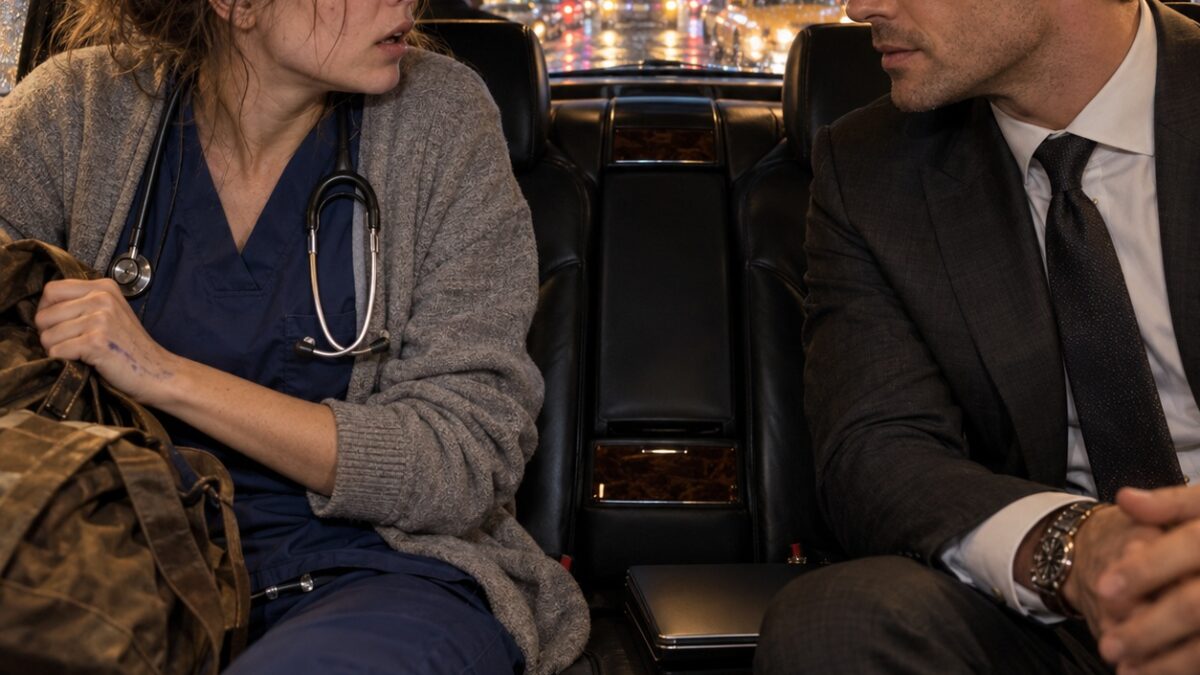
I reached for the evidence pouch.
Alexander caught my wrist before my fingers touched it.
His grip wasn’t painful, but it was immediate and absolute.
“Don’t.”
I stared at his hand.
“Let go of me.”
He released me at once.
Marcus was watching through the rearview mirror, his expression no longer mildly curious. Both locks beside me had dropped into place.
“What is happening?” I demanded.
Alexander set my stethoscope on the seat between us.
“That drive belongs to one of my companies.”
“Then someone put it in the wrong bag.”
“It is sealed inside an internal evidence pouch.”
“I can see that.”
“The red stripe means the contents came from a restricted forensic review.”
“That means nothing to me.”
“It means fewer than twelve people are authorized to possess it.”
“And I’m not one of them.”
“No.”
“Then unlock the door.”
The ghost of warmth I had seen in his face when I first awoke had disappeared. He looked controlled now, every emotion drawn behind something cold and impenetrable.
“Not until I understand why you have it.”
“I just told you I don’t know.”
“And I don’t know you.”
“My hospital badge is attached to my pocket.”
His gaze lowered.
I was still wearing the badge, though it had twisted backward. I turned it so he could see the photograph and printed name.
OLIVIA BENNETT, RN.
He studied it.
“St. Catherine’s intensive care?”
“Yes.”
“How long have you worked there?”
“Six years.”
“Were you on the seventh floor tonight?”
The question unsettled me.
“I work in the medical ICU on seven.”
He leaned back slightly.
“Did you enter room 714?”
A pulse of cold moved through me.
Room 714 had been the reason my twelve-hour shift became thirty-one.
A man named Nathan Cole had arrived around midnight with sudden respiratory failure, neurological confusion, and a dangerously unstable heart rhythm. He was forty-two, healthy according to his chart, and employed by a medical research company I had never heard of.
His condition deteriorated faster than anything I had seen in years.
“Why are you asking about him?” I said.
Alexander’s eyes sharpened.
“You know the patient.”
“I didn’t say that.”
“You didn’t have to.”
“You need to unlock the door.”
“Mr. Vale,” Marcus said quietly, “we’ve been followed since the hospital.”
I turned toward the rear window.
A dark SUV remained two cars behind us. Rain distorted its headlights into long white streaks.
“Who is following us?” I asked.
“We don’t know yet,” Alexander replied.
My hand moved instinctively toward my phone.
He didn’t stop me.
I checked the screen.
Seven missed calls.
Three from the hospital.
One from my charge nurse, Leah.
Three from an unknown number.
A text message waited beneath them.
Olivia, call me immediately. There has been an incident in 714.
It had been sent by Leah six minutes after I left.
Another message appeared from the unknown number.
You took something that doesn’t belong to you.
My stomach tightened.
I looked at the open bag.
“I didn’t take that drive.”
Alexander extended his hand. “Show me the message.”
“No.”
“If whoever sent it is in the vehicle behind us, secrecy is not helping you.”
I hated that he was right.
I held up the phone without giving it to him.
He read the words.
A muscle tightened along his jaw.
“Marcus, don’t go to the park. Take the West Side route.”
“Yes, sir.”
“Where are you taking me?” I demanded.
“Somewhere public and secure.”
“I’m going home.”
“That would be unwise.”
“You don’t get to decide where I go.”
“You are carrying stolen corporate evidence, and someone appears to know it.”
“I’m calling the police.”
“You should.”
His agreement caught me off guard.
He removed his own phone and made a call.
“Gabriel, meet me at the Fifty-Ninth Street office. Bring Elena Park and building security. Do not notify anyone connected to Halcyon.”
He ended the call.
I dialed Leah.
She answered immediately.
“Olivia? Where are you?”
“In a car. What happened?”
“What car?”
“It’s complicated. What happened in 714?”
Silence.
Then I heard a door close on her end.
“Nathan Cole is dead.”
The words cut through me.
“What?”
“He went into cardiac arrest nine minutes after you left. They worked him for nearly half an hour.”
“That doesn’t make sense. He was stable.”
“He wasn’t stable.”
“His pressure was holding. His rhythm had normalized.”
“I know.”
I pressed my fingers against my forehead, trying to reconstruct the final hour of his care.
Nathan had been conscious when I left. Frightened, but conscious.
He had gripped my wrist while I adjusted his oxygen mask.
“Don’t let Dr. Mercer give me anything else,” he whispered.
I assumed he was confused. Dr. Adrian Mercer was a respected research physician and one of the hospital’s largest private donors. He had entered the room twice, identified himself as Nathan’s consulting specialist, and ordered medication through the electronic system.
The orders appeared legitimate.
I notified the resident of Nathan’s concern, documented his statement, and placed a note in the chart requesting that all medications be confirmed with the attending physician.
Then an electrical failure disrupted the floor.
By the time the systems returned, I had been ordered to go home before fatigue caused me to make a mistake.
“Who was with Nathan when he arrested?” I asked.
“Dr. Mercer.”
The cold sensation deepened.
“Leah, did anyone touch my bag?”
“What?”
“My canvas bag. It was at the nurses’ station.”
“I don’t know. Why?”
“Someone put something inside it.”
I glanced at Alexander.
He was listening without pretending otherwise.
“Olivia,” Leah whispered, “hospital security is looking for you.”
“Why?”
“They say medication is missing from the narcotics cabinet.”
My mouth went dry.
“What medication?”
“Two vials of carfentanil.”
“That’s impossible.”
“I know you completed the count before you left.”
“I completed it with Monica. Everything matched.”
“The electronic log says your badge accessed the cabinet again at 3:42 a.m.”
“At 3:42, I was in the east stairwell moving Mr. Delgado’s gurney.”
“I know.”
“Cameras will show it.”
“The cameras went down during the power failure.”
I closed my eyes.
The outage.
The missing medication.
Nathan’s death.
The drive in my bag.
None of it felt random anymore.
“Do not tell security where I am,” I said.
“What are you talking about?”
“Just don’t.”
A male voice sounded near Leah.
“Ms. Chen, are you speaking to Nurse Bennett?”
Leah lowered her voice.
“I have to go.”
The line disconnected.
I immediately tried calling back.
No answer.
Alexander watched me.
“What was taken?”
I wanted to tell him it was none of his business. But the dark SUV still followed us, and a stolen corporate drive sat inside my bag.
“Carfentanil.”
Marcus looked into the mirror.
Even he reacted to the name.
Alexander’s face became still.
“Could it have killed the patient?”
“In a tiny dose. But Nathan was in a monitored ICU. If someone administered it, the record should show who entered and when.”
“Unless the cameras and electronic systems failed.”
“Yes.”
“Was the failure accidental?”
“I don’t know.”
“What did Nathan Cole say to you?”
“How do you know his name?”
Alexander looked through the rain-streaked window.
“Because he worked for Vale Biomedical Analytics.”
I stared at him.
“He worked for you?”
“Indirectly. Nathan was director of clinical verification for a company we intended to acquire.”
“Halcyon?”
His eyes moved back to me.
“You saw that name?”
“On the pouch.”
“Yes. Halcyon Therapeutics developed an artificial-blood product for emergency trauma care. If it works as represented, it could save thousands of lives every year.”
“And if it doesn’t?”
His silence answered before he did.
“We received allegations that certain trial results were manipulated.”
I looked at the silver drive.
“Nathan was investigating?”
“He contacted my office yesterday. He said he had proof of fraudulent trial data and unreported patient deaths. We arranged to meet at St. Catherine’s tonight.”
“That’s why you were at the hospital.”
“Yes.”
“Did you meet him?”
“No. When I arrived, I was told he had become critically ill.”
“And this drive contains his evidence?”
“Possibly.”
A memory surfaced.
Nathan clutching my wrist.
His breathing ragged beneath the oxygen mask.
A woman in blue.
He had said more than I first remembered.
“He asked me if I knew the woman in blue,” I whispered.
Alexander leaned forward. “What woman?”
“I thought it was delirium. He kept saying, ‘The woman in blue has the truth.’”
My scrub top was blue.
But so were the uniforms worn by half the nursing staff.
“He may have chosen you,” Alexander said.
“No. He didn’t know me.”
“He could have placed the drive in your bag.”
“He never left his room.”
“Then someone acting for him did.”
“Or someone trying to frame me.”
The SUV moved closer.
Marcus changed lanes abruptly. It followed.
“We need to lose them,” Alexander said.
Marcus took the next turn, accelerating through a yellow light. The SUV entered the intersection behind us as the signal turned red.
My phone vibrated.
Another message from the unknown number:
Get out of the car at the next light, Olivia.
The use of my name frightened me more than the threat.
I showed Alexander.
He immediately lowered the privacy shade behind Marcus, blocking the rear vehicle’s view into our cabin.
“They can see us,” I said.
“They may also have access to your phone.”
“How?”
“If your hospital account was compromised, they could have your number, address, emergency contacts, and location permissions.”
I opened the rideshare application.
My requested driver had sent four messages.
I’m outside.
Where are you?
Your trip was canceled.
The license plate displayed in the app did not match Alexander’s car.
Someone had watched me enter the wrong sedan.
Maybe they had expected to follow my rideshare home.
Instead, they were now following one of the most heavily protected men in the city.
The thought was strangely comforting.
Then the SUV struck us.
The impact came from behind, hard enough to throw me forward.
Alexander caught my shoulder before my head hit the opposite door.
Marcus fought the wheel as the sedan skidded across the wet street.
“Seat belts!” he shouted.
I pulled mine into place.
The SUV accelerated toward us again.
“This is not about a corporate theft charge,” I said.
“No,” Alexander replied. “It isn’t.”
Marcus turned sharply into the entrance of an underground parking garage. The barrier arm was already rising.
The SUV followed.
A security vehicle emerged from behind a concrete column, blocking its path. Two guards stepped out.
Marcus drove past them and stopped beside a private elevator.
Alexander opened his door.
“Stay close to me.”
“I’m not going anywhere until I know what happened to Leah.”
“You can call her upstairs.”
He extended his hand.
I looked at it.
Less than fifteen minutes earlier, I had awakened embarrassed because I had fallen asleep in a stranger’s car. Now that stranger stood between me and people willing to ram a moving vehicle in Manhattan traffic.
I ignored his hand and climbed out myself.
His mouth shifted slightly, as though he had expected that.
The elevator required Alexander’s fingerprint and a numerical code. Marcus joined us inside, speaking quietly into his phone.
“No plates visible,” he reported. “Windows fully tinted. They reversed out after security blocked them.”
“Preserve the garage footage,” Alexander said.
The doors opened into a private executive floor with glass walls, dark wood, and a view across Central Park.
Three people waited near a conference room.
A broad-shouldered man in a navy suit approached first.
“Gabriel Ross,” he said, showing me credentials. “Director of security for Vale Meridian.”
Beside him stood a Korean American woman in a gray pantsuit.
“Elena Park. General counsel.”
The third person was a uniformed NYPD lieutenant named Samuel Ortiz.
Relief passed through me when I saw the badge.
Then I remembered that I was carrying stolen evidence and had supposedly accessed a narcotics cabinet before a patient’s unexplained death.
Lieutenant Ortiz seemed to read the fear on my face.
“You’re not under arrest, Ms. Bennett.”
“Yet?”
“Let’s establish what happened before we make assumptions.”
Alexander placed the evidence pouch on the conference table without touching the drive inside.
Elena photographed it from several angles.
“Where did you find this?” Ortiz asked.
“In her bag,” Alexander replied.
“I can answer for myself.”
Alexander looked at me but didn’t argue.
“I entered Mr. Vale’s car by mistake after leaving St. Catherine’s,” I said. “My bag fell open. He saw the pouch.”
“Had you seen it before?”
“No.”
“Who had access to your bag?”
“Anyone at the seventh-floor nurses’ station during the last thirty-one hours.”
Ortiz glanced at Alexander. “That’s a large group.”
“Especially during an outage,” I added.
Elena pulled on gloves and examined the seal.
“It has been opened and resealed.”
“How can you tell?” Gabriel asked.
“The adhesive is misaligned.”
She held it beneath a desk lamp.
A faint reddish smear marked one corner.
“That may be blood,” I said.
Everyone looked at me.
“Not mine.”
Elena placed the pouch inside a larger evidence bag.
“We should give it directly to law enforcement.”
Alexander’s gaze remained fixed on the drive.
“If the allegations are true, people connected to Halcyon may have influence inside the hospital and possibly within city agencies.”
Lieutenant Ortiz’s face hardened.
“You asked me here because you trust me.”
“Yes.”
“Then either turn it over or don’t. But don’t imply I’m here to steal it.”
“I’m implying nothing about you.”
“You never imply. You arrange facts until everyone reaches your preferred conclusion.”
Their familiarity suggested this wasn’t their first disagreement.
I moved toward the far end of the table and tried Leah again.
No answer.
I called the intensive-care unit.
A nurse named Denise picked up.
“St. Catherine’s ICU.”
“It’s Olivia. Is Leah there?”
There was a pause.
“Olivia, where are you?”
“Is Leah there?”
“She left with security.”
My chest tightened.
“What do you mean, left?”
“They took her downstairs to answer questions.”
“Did she go voluntarily?”
“I don’t know.”
“Who is caring for her patients?”
“Monica took over.”
“Did anyone say where security was taking her?”
“No.”
I ended the call.
“Something’s wrong,” I said.
Ortiz asked what I meant.
“Leah warned me security was looking for me. Now she has been removed from the floor.”
“She may simply be answering questions.”
“Then why isn’t she answering her phone?”
Alexander looked at Gabriel.
“Find her.”
Ortiz raised a hand. “No private-security operations inside a hospital. I’ll contact the precinct.”
Gabriel’s phone rang before anyone moved.
He listened for less than ten seconds.
“The SUV from the garage was found abandoned six blocks away,” he reported. “The vehicle was stolen this afternoon.”
“Any occupants?” Ortiz asked.
“No.”
“What about cameras?”
“Traffic feeds in that section experienced a nine-minute interruption.”
Ortiz’s expression changed.
“Someone has significant access.”
Elena looked at me.
“Ms. Bennett, we need to know everything that happened around Nathan Cole.”
I sat at the table and reconstructed his admission.
Nathan arrived at 12:14 a.m. by ambulance from a hotel. He was vomiting, disoriented, and struggling to breathe. Paramedics said a hotel employee found him collapsed near an elevator.
Initial tests suggested an allergic reaction or toxic exposure.
Dr. Mercer appeared twenty minutes after admission, identifying himself as Nathan’s private physician. His credentials were valid. The electronic chart showed that he had consulting privileges.
“He ordered a medication called belvarizine,” I said.
Alexander and Elena exchanged a glance.
“What?” I asked.
“Belvarizine is manufactured by Halcyon,” Elena replied.
“What is it?”
“An experimental immune stabilizer.”
“It appeared in our formulary as an approved emergency medication.”
“It isn’t approved.”
The room became silent.
“I administered the first dose,” I whispered.
Alexander’s expression tightened.
“You followed an authorized order.”
“I gave him an experimental drug without consent.”
“You didn’t know.”
“That will not matter to his family.”
I remembered the liquid entering Nathan’s IV line.
His heart rate had spiked minutes later.
Mercer claimed it was part of the underlying reaction and ordered another medication to stabilize him.
“What happened after the dose?” Elena asked.
“He became more confused. He kept asking for someone named Daniel.”
Alexander stood so quickly his chair rolled backward.
“What name?”
“Daniel. Maybe Daniels.”
“Daniel Vale was my brother.”
The resemblance became visible only after he said it.
Not in appearance.
In the grief that passed through his face before control returned.
“What does your brother have to do with Halcyon?” I asked.
“He founded Vale Biomedical with me.”
“Where is he now?”
“He died eighteen months ago.”
“How?”
“A private plane crashed off the coast of Maine.”
Something flickered through my memory.
Nathan’s hand around my wrist.
The woman in blue.
Daniel didn’t crash.
I heard the words again, clearer now.
“He said your brother didn’t die in an accident.”
Alexander became completely still.
“What exactly did he say?”
“I thought it was delirium.”
“What did he say, Olivia?”
It was the first time he used my name.
His voice remained low, but desperation moved beneath it.
“He said, ‘Tell Alexander that Daniel didn’t crash. Halcyon killed him.’”
No one spoke.
Rain tapped against the windows.
Alexander walked toward the glass wall overlooking the city and stood with his back to us.
Elena removed her glasses.
“Daniel had been reviewing Halcyon before his death,” she said quietly. “He recommended terminating negotiations.”
“Why did the acquisition continue?” I asked.
“Because the report he supposedly completed supported it.”
“Supposedly?”
Alexander turned from the window.
“I received the final report three days after Daniel’s funeral. It carried his digital signature.”
“And you believed it?”
“I wanted to.”
The admission sounded like it cost him something.
“He had spent two years championing Halcyon’s technology. The report said his earlier concerns had been resolved.”
“But Nathan found proof otherwise.”
“That appears likely.”
Lieutenant Ortiz gestured toward the bagged drive.
“If this contains evidence of fraud and murder, it goes to the district attorney’s office tonight.”
A message appeared on my phone.
It came from Leah.
I’m okay. Security questioned me. Go home and call hospital legal in the morning.
Relief moved through me, but it stopped before reaching my chest.
Leah never called the hospital’s legal department “hospital legal.” She called it Risk.
She also knew I couldn’t safely go home.
I typed:
What did we order for Mrs. Ellis before I left?
The reply arrived almost immediately.
Insulin.
Mrs. Ellis wasn’t diabetic.
Leah had ordered a warming blanket because the patient’s temperature dropped after dialysis.
“That isn’t Leah,” I said.
Ortiz took my phone.
The sender called.
Everyone looked at the screen.
“Answer it,” Ortiz said. “Put it on speaker.”
I accepted the call.
“Leah?”
For several seconds, I heard only breathing.
Then a man spoke.
“Bring the drive back to St. Catherine’s.”
“Where is Leah?”
“She will be released after you return what you stole.”
“I didn’t steal anything.”
“You have forty minutes.”
“What happens after forty minutes?”
The voice became almost gentle.
“Then Nurse Chen becomes another exhausted hospital employee who made a fatal mistake.”
The line went dead.
My chair scraped backward as I stood.
“We have to go.”
Ortiz blocked my path.
“No.”
“They have her.”
“And they want you and the evidence.”
“I’m not letting Leah die because someone used my bag.”
“You won’t help her by walking into an ambush.”
Alexander returned to the table.
“We will make the exchange.”
Elena stared at him. “Absolutely not.”
“We’ll copy the drive.”
“We don’t know what protections it contains.”
“Then take it to the secure lab.”
“The nearest appropriate facility is in Connecticut.”
“We don’t have time.”
Gabriel leaned over the pouch.
“If they know we have the drive, they may be monitoring this building.”
“They probably are,” Marcus said. “The SUV began following us before Ms. Bennett woke.”
Alexander looked at me.
“Did anyone give you anything before you left the hospital?”
“No.”
“Did anyone speak to you near the exit?”
I forced myself to retrace those final minutes.
I had returned a pager.
Signed the staffing log.
Collected my coat.
A custodian pushed a cart past me.
A young resident asked whether I was finally leaving.
Then, near the side exit, an orderly bumped my shoulder.
My bag fell open.
He apologized and helped gather my belongings.
“What did he look like?” Gabriel asked.
“White, maybe thirty. Surgical mask, hospital cap, dark-framed glasses.”
“Name badge?”
“I didn’t notice.”
“He may have planted the drive,” Ortiz said.
“Or Nathan arranged for him to deliver it,” Alexander replied.
“Why put it in my bag without telling me?”
“Because you were leaving, and the people searching for it expected the drive to remain inside the hospital.”
I remembered the orderly glancing behind him while returning my bag.
“He looked frightened.”
“If he worked with Nathan, he may be in danger too.”
Elena’s phone chimed.
She read a message and looked at Alexander.
“Our forensic team says copying the drive could trigger a deletion protocol. It needs to be opened inside an isolated system.”
“How long?” he asked.
“Two hours to prepare safely.”
“We have thirty-five minutes,” I said.
Ortiz began issuing instructions. Police units would approach St. Catherine’s without lights or sirens. Hospital administrators would be notified only after officers secured the security center. I would call the kidnapper again and agree to the exchange.
Alexander insisted on accompanying me.
“No,” I said.
He looked at me as if the refusal were a foreign language.
“They asked for me,” I continued. “Your presence may put Leah in more danger.”
“They already know you’re with me.”
“That doesn’t mean you should walk into the hospital.”
“You don’t know who inside that building is involved.”
“And you do?”
“No. That is why you shouldn’t go alone.”
Lieutenant Ortiz interrupted.
“Neither of you is controlling the operation. You will follow my instructions or remain here.”
Alexander’s expression suggested that people rarely spoke to him that way.
Marcus almost smiled.
We traveled to St. Catherine’s in an unmarked police van. Alexander sat beside me while Gabriel and two detectives reviewed floor plans.
I could feel him watching me.
“Why do you keep doing that?” I asked.
“Doing what?”
“Looking at me.”
He didn’t deny it.
“I’m trying to understand why Nathan chose you.”
“Maybe he didn’t. Maybe someone saw an exhausted nurse and decided I was easy to use.”
“You noticed the false message from Leah.”
“Because I know her.”
“You remembered Nathan’s exact words after thirty-one hours without sleep.”
“Eventually.”
“You refused to touch evidence that could implicate you once you understood what it was.”
“That is basic common sense.”
“Common sense is less common than people believe.”
I turned toward him.
“Is this how you talk to everyone?”
“How?”
“Like you’re interviewing them for ownership.”
Something almost like amusement passed through his eyes.
“No.”
“What makes me special?”
The question came out sharper than I intended.
He considered it seriously.
“You entered my car without knowing who I was.”
“That wasn’t a compliment to either of us.”
“Everyone I meet knows my name before I know theirs. Most have already decided what they want from me.”
“And I wanted a ride home.”
“You wanted nothing from me.”
“I still don’t.”
“I know.”
The simple answer unsettled me.
The van stopped in an underground loading area one block from the hospital.
Ortiz handed me a small earpiece.
“You will enter through the service corridor,” he said. “The drive in your bag is a decoy. We placed a tracker inside the pouch.”
“What if they check it?”
“Then we adjust.”
“You mean improvise.”
“Yes.”
I looked toward the hospital.
For six years, St. Catherine’s had been the safest place I knew. Its hallways were predictable even at their worst. Every alarm had a meaning. Every crisis came with protocols.
Now rows of dark windows stared down at me like empty eyes.
Alexander stepped beside me.
“You don’t have to do this.”
“They have Leah.”
“The police can proceed without you.”
“The caller demanded me.”
“You are not responsible for what they do to her.”
“I’m responsible for what I choose to do now.”
His jaw tightened.
“That belief will get you killed.”
“Maybe. But it has also kept people alive.”
Before he could answer, Ortiz motioned for us to move.
The service entrance opened with my hospital badge.
That meant my access had not yet been disabled.
The corridor beyond it smelled of detergent and overheated machinery. Half the ceiling lights were off.
I carried the decoy pouch inside my bag.
Alexander walked six feet behind me, dressed now in a dark security jacket Gabriel had brought. The billionaire who appeared on magazine covers had disappeared. In the dim hallway, he looked like a man who had spent years learning how not to be surprised.
“Why are you really here?” I whispered.
“Because Daniel died before he could tell me the truth.”
“That isn’t what I asked.”
He remained silent.
I looked back.
“Leah is my friend. Nathan was my patient. Why are you risking your life?”
His eyes held mine.
“Because when I looked inside your bag, I brought you into this. And because every time I imagine you walking into this building alone, I find that possibility unacceptable.”
The earpiece carried Ortiz’s voice.
“Keep moving.”
We reached the elevator.
A handwritten sign said OUT OF SERVICE.
The same sign had been there during the earlier electrical failure.
We took the east stairwell.
On the fourth-floor landing, my phone rang.
“Where are you?” the distorted voice asked.
“Inside.”
“Go to seven.”
“You said Leah would be there.”
“She will.”
“How do I know she’s alive?”
A muffled sound came through the line.
Then Leah spoke.
“Olivia, don’t—”
The call ended.
She was alive.
We continued upward.
The seventh-floor door opened onto darkness.
Emergency lighting glowed along the baseboards. The unit should have been full of nurses, alarms, ventilators, and ringing telephones.
Instead, it was almost silent.
“Where is everyone?” I whispered.
Ortiz answered through the earpiece.
“A fire alarm was triggered on the west side six minutes ago. Patients are sheltering in secured rooms. Staff were directed to the central station.”
That direction made no sense during a possible fire.
Someone had deliberately cleared the east wing.
Room 714 stood at the end of the corridor.
The door was open.
I entered.
Nathan’s bed was empty. Clean sheets had already been placed over the mattress.
Leah sat in a chair near the window. Her wrists were secured behind her, and silver tape covered her mouth.
Dr. Adrian Mercer stood beside her.
He was sixty, distinguished, and calm, wearing the same navy suit and white coat he had worn while treating Nathan.
A handgun rested against Leah’s shoulder.
Another man stood near the bathroom.
The false orderly.
Without the mask, I recognized him as a research assistant who had visited Nathan earlier. His badge had identified him as Evan Price.
“Put the bag on the bed,” Mercer said.
“Let Leah go first.”
“You are not in a position to negotiate.”
Alexander entered behind me.
Mercer’s expression changed.
“Mr. Vale.”
“Adrian.”
They knew each other.
Alexander closed the door.
“You killed Nathan,” he said.
Mercer smiled faintly.
“Nathan was dying long before he reached this hospital.”
“From belvarizine?”
“From ambition. He wanted to become important by destroying work he lacked the courage to understand.”
“Did Daniel lack courage too?”
For the first time, Mercer’s composure cracked.
“Daniel became sentimental.”
“My brother discovered the trial deaths.”
“He discovered statistical noise.”
“Children died.”
“They were already dying.”
Alexander’s voice lowered.
“So you erased them from the data.”
“We refined the data. That is how medicine advances. If every imperfect outcome ended research, we would still be cutting limbs off with saws.”
Leah made a desperate sound behind the tape.
Mercer pressed the gun harder against her.
“The drive,” he ordered.
I removed the decoy pouch and placed it on the bed.
Evan stepped forward.
“Open the bag,” Mercer said.
I did.
Evan searched it, then took the pouch.
His hands trembled.
“You don’t have to do this,” I told him.
He refused to look at me.
“He helped Nathan give me the drive, didn’t he?”
Mercer’s eyes narrowed.
“Evan made an error in judgment.”
“Nathan asked him to get the evidence out.”
“I thought Mr. Cole would expose them,” Evan whispered.
“Be quiet,” Mercer said.
“He put it in my bag because I was leaving.”
Evan swallowed.
“Nathan told me to find the nurse in blue. He said you documented everything and Mercer hadn’t been able to alter your notes.”
My charting.
I had entered Nathan’s warnings in a temporary bedside record during the electronic outage. A scanned copy should have remained in the clinical file.
Mercer had not known whether I carried it with me.
He assumed the drive and documentation were both in my bag.
“You caused the outage,” I said.
“We needed twenty minutes without cameras.”
“You changed the narcotics log.”
“Your badge was convenient.”
“How did you get it?”
Evan looked at Mercer.
The doctor answered.
“You left it on the counter while treating another patient.”
Only for seconds.
Long enough for someone to clone its access signal.
“You killed Nathan with the missing carfentanil.”
“His condition was already critical.”
“You stood beside his bed and injected it after I left.”
“I ended unnecessary suffering.”
Rage burned through my exhaustion.
“You murdered him.”
“He was going to destroy something capable of saving millions.”
“Then prove your treatment works without falsifying deaths.”
“You’re a nurse,” he said with quiet contempt. “You carry out decisions made by people capable of understanding them.”
I took one step forward.
Alexander caught my arm.
Not to control me.
To keep me out of the line of the gun.
Mercer saw the movement.
A strange smile touched his face.
“Remarkable,” he said. “Alexander Vale protecting a woman he met less than two hours ago.”
“Release the nurses.”
“Where is the original drive?”
Alexander said nothing.
Mercer looked at the pouch in Evan’s hand.
“Check it.”
Evan broke the seal and connected the decoy to a small tablet.
The screen remained blank.
Mercer’s face changed.
“You brought a copy.”
“No,” Alexander said. “We brought a tracker.”
Gunfire cracked in the corridor.
Leah screamed behind the tape.
Mercer pulled her from the chair and dragged her toward the bathroom.
Evan dropped the tablet.
I moved before anyone could stop me.
I seized the steel IV pole beside the bed and swung it into Mercer’s forearm.
The gun fired.
The bullet struck the ceiling.
Alexander tackled Mercer against the bathroom door.
Evan ran toward the hallway just as officers entered. He dropped to his knees with his hands raised.
Mercer drove an elbow into Alexander’s face and reached for the fallen weapon.
I kicked it beneath the bed.
He turned toward me.
For one second, his expression contained nothing human.
Then Alexander struck him.
They crashed into the wall.
Ortiz and another officer pulled Alexander away while Gabriel forced Mercer facedown and handcuffed him.
I went to Leah.
My hands shook so badly I struggled to remove the tape.
“Are you hurt?”
She shook her head.
I freed her mouth.
“You absolute idiot,” she gasped.
Then she threw both arms around me.
I held her while police filled the room.
Across the bed, Alexander stood with blood at the corner of his mouth.
He watched me as if he needed visible proof that I was alive.
Mercer’s arrest uncovered a conspiracy that had operated for nearly three years.
Halcyon’s artificial-blood product produced severe inflammatory reactions in a small but significant percentage of patients. Rather than suspend the trials, Mercer and several executives altered records, removed adverse outcomes, and paid intermediaries to pressure families into silence.
Daniel Vale discovered the discrepancies.
He arranged to meet a federal investigator in Maine.
His plane crashed before he arrived.
The official investigation blamed mechanical failure, but evidence from Nathan’s drive revealed that a Halcyon contractor had paid the maintenance supervisor responsible for Daniel’s aircraft.
The crash had been murder.
Nathan uncovered the payment while verifying the clinical data. When he contacted Alexander, Mercer poisoned him with belvarizine at his hotel, knowing the symptoms would resemble an immune reaction.
Nathan survived long enough to reach St. Catherine’s.
Mercer followed him there and used the power outage to complete the murder.
The carfentanil in Nathan’s blood, the altered access logs, my documentation, Evan’s testimony, and the original drive created a case even Mercer’s attorneys could not bury.
St. Catherine’s suspended three administrators who had helped conceal the unauthorized drug order. One had accepted payments from Halcyon. Another insisted he believed Mercer was conducting legitimate emergency research.
Leah and I were placed on paid administrative leave.
For the first three days, I slept nearly eighteen hours at a time.
When I finally woke without an alarm, sunlight filled my bedroom and someone was knocking on my apartment door.
My entire body tensed.
“Olivia?”
Alexander.
I opened the door but left the chain fastened.
He stood in the hallway wearing a dark sweater instead of a suit. The fading bruise along his jaw made him look less untouchable.
“How did you find my address?”
His expression changed.
“That is a fair question.”
“It wasn’t rhetorical.”
“Gabriel obtained it while arranging police protection.”
“I didn’t ask for police protection.”
“You were followed home from the prosecutor’s office yesterday.”
I stared at him.
“Why didn’t anyone tell me?”
“They didn’t confirm it until this morning.”
“Who?”
“Halcyon employed more than Mercer. Not everyone involved has been identified.”
I opened the door wider but kept the chain in place.
“What do you want?”
“To know whether you’re all right.”
“You could have called.”
“You stopped answering.”
I had ignored six of his messages.
None demanded anything. Each contained some variation of Are you safe?
“I’ve been sleeping.”
“I assumed that.”
“Then why are you here?”
He looked at the chain between us.
“I don’t know.”
For the first time since I met him, Alexander Vale appeared uncertain.
It made him more dangerous in a different way.
“I’m not one of your companies,” I said. “You can’t solve this by monitoring me.”
“I know.”
“Do you?”
His eyes held mine.
“No,” he admitted. “But I’m trying.”
I closed the door, removed the chain, and opened it again.
“One cup of coffee.”
“That sounds dangerously close to an invitation.”
“It’s an interrogation.”
“Then I’ll cooperate.”
He entered my small apartment without commenting on the worn couch, crowded bookshelves, or kitchen table that doubled as a desk.
I poured coffee into two mismatched mugs.
He accepted the chipped one without hesitation.
“You assaulted a suspected murderer,” I said.
“Technically, you struck him first.”
“I used an IV pole.”
“I noticed.”
“You could have been shot.”
“So could you.”
“I was protecting Leah.”
“And I was protecting you.”
“You had known me for two hours.”
“Two hours and fourteen minutes.”
I stared at him.
“You counted?”
“Apparently.”
“That isn’t normal.”
“Very little about that night was normal.”
He sat across from me at the kitchen table.
Without a driver, security team, or conference room surrounding him, he seemed less like the man from financial magazines. Fatigue marked the skin beneath his eyes. Grief lived in the way he turned the mug between his hands.
“Did you know Daniel’s plane was sabotaged before Nathan?” I asked.
“No.”
“You suspected something.”
“I suspected he changed his mind about Halcyon before he died. I never believed the final report reflected his concerns.”
“But you continued with the acquisition.”
He looked toward the window.
“The board said grief was affecting my judgment. Halcyon’s product had the potential to transform emergency medicine. Daniel had spent two years supporting it.”
“So you believed the document because it was easier.”
“Yes.”
His willingness to answer without defending himself surprised me.
“Mercer used your grief.”
“I allowed him to.”
“That isn’t the same thing.”
“No, but it doesn’t make me innocent.”
We were silent for a moment.
Then he said, “When you fell asleep in my car, you looked peaceful.”
I almost laughed.
“I was unconscious from exhaustion.”
“I know.”
“That isn’t peaceful.”
“It was the closest thing I had seen in years.”
The honesty in his voice unsettled me more than flattery would have.
“Alexander, we experienced something traumatic. People sometimes mistake intensity for connection.”
“I’ve considered that.”
“And?”
“I was interested in you before I knew about the drive.”
“You watched me sleep for approximately ten minutes.”
“Seventeen.”
I put down my mug.
“That doesn’t help your argument.”
A real smile appeared then—brief, reluctant, and unexpectedly young.
“I’m aware.”
“You don’t know me.”
“I know you entered a room to save your friend after being awake for thirty-one hours. I know you challenged a man holding a gun because he insulted your profession. I know you drink coffee with too much cream, your left shoe squeaks, and you touch your stethoscope whenever you’re worried.”
I looked down.
My fingers were wrapped around the tubing draped from my work bag.
I released it.
“You observe people for a living.”
“Usually to determine what they want.”
“And what do I want?”
“To return to a life that no longer exists.”
The answer took the air from the room.
Before Nathan, the drive, and Mercer, I had believed exhaustion was my greatest problem. I thought rest would return everything to normal.
But I could not walk back into the ICU without remembering Nathan gripping my wrist.
I could not open my bag without checking for something hidden.
I could not see a black sedan without feeling the shock of waking across from Alexander.
“What do you want?” I asked.
His gaze did not move.
“To see you again when neither of us is being chased.”
“That sounds like a date.”
“It is.”
“I don’t date billionaires.”
“How many have asked?”
“One.”
“And?”
“I haven’t decided.”
He finished his coffee and stood.
At the door, he paused.
“I assigned security to the building.”
“Remove them.”
“I can’t.”
“You can. You don’t want to.”
“Two people connected to Mercer remain unidentified.”
“Then tell the police.”
“I did.”
“I won’t live inside your protection.”
His expression tightened.
“I watched my brother get on a plane and told myself he would call when he landed. For eighteen months, I believed there was nothing I could have done.”
“I’m not Daniel.”
“I know.”
“Then don’t turn me into another chance to save him.”
He looked as though I had struck him.
After several seconds, he nodded.
“The guards will leave. Gabriel will give you a direct emergency number.”
“Thank you.”
He stepped into the hallway.
“Dinner Friday?” he asked.
I should have said no.
Instead, I said, “Somewhere without a private entrance.”
“Public restaurant.”
“And I’m paying for myself.”
“That seems performative.”
“That seems like a condition.”
His mouth curved.
“Then it’s a condition.”
Our first dinner lasted four hours.
Alexander chose a small Italian restaurant in Brooklyn where no one appeared impressed by him. We argued over whether hospital systems should be run as public infrastructure, discovered that we both hated opera despite pretending otherwise for years, and shared a piece of lemon cake after he admitted he didn’t like chocolate.
He asked about my childhood.
I told him my mother had died when I was twelve and my father raised me above the hardware store he managed in Queens. Dad taught me to change a tire, balance a checkbook, and never trust a man who described himself as “self-made.”
“Why not?” Alexander asked.
“Dad said it usually means he forgot everyone who helped him.”
Alexander considered that.
“Your father would dislike me.”
“He died four years ago, but yes.”
“I’m sorry.”
“So am I.”
Daniel’s name came up only once.
Alexander told me his younger brother collected antique maps and refused to use GPS. He smiled while remembering him, then became quiet.
I didn’t try to fill the silence.
After dinner, we walked beneath strings of lights along the waterfront.
He did not bring a driver.
When I asked how we were getting home, he pointed toward the subway entrance.
“You take the subway?”
“Marcus says prolonged exposure to ordinary life may improve my personality.”
“Marcus is wise.”
“He has become insufferable since meeting you.”
At my stop, Alexander walked me to the building entrance.
He did not ask to come upstairs.
“Good night, Olivia.”
“Good night.”
I was almost through the door when he called my name.
I turned.
He stood beneath the streetlight with his hands in his coat pockets.
“The first time you left my car, I didn’t know whether I would ever see you again.”
“You followed me into a murder investigation. That increased the odds.”
“I’m serious.”
“I know.”
“I disliked the feeling.”
“What feeling?”
“Not knowing.”
His honesty made my chest tighten.
“You can’t purchase certainty,” I said.
“I’ve been told.”
“You can’t negotiate for it either.”
“That remains deeply inconvenient.”
I smiled despite myself.
“Good night, Alexander.”
He watched until the door closed.
The investigation continued for months.
Nathan’s family filed a wrongful-death suit. Vale Meridian withdrew from the Halcyon acquisition and created a fund for patients harmed during the concealed trials.
Alexander testified before a federal grand jury regarding Daniel’s final report and the board’s decision to continue negotiations.
The business press accused him of ignoring warning signs.
He refused to hide behind his advisers.
“I wanted my brother’s work to be successful,” he told reporters outside the courthouse. “That desire made me accept evidence I should have questioned. The responsibility is mine.”
Vale Meridian’s stock fell for six weeks.
The board pressured him to resign.
He offered to do so if an independent review found he had knowingly concealed clinical risks.
It did not.
But it revealed a culture in which employees were afraid to challenge profitable decisions.
Alexander replaced three senior executives, strengthened internal reporting protections, and invited independent medical ethicists onto the board.
He asked me to serve as an adviser.
I refused.
“You’re qualified,” he argued.
“I’m an ICU nurse.”
“That is precisely why you’re qualified.”
“You’re also dating me.”
“We have had four dinners.”
“And you know exactly how the headline would read.”
His jaw tightened.
“I don’t care about the headline.”
“I care about being treated as credible.”
He withdrew the offer.
Two weeks later, an independent foundation unaffiliated with Vale Meridian invited me to join its patient-safety panel. Alexander swore he had not arranged it.
I didn’t believe him until Elena showed me the correspondence proving she had referred my name without telling him.
“You were right to refuse his offer,” Elena said.
“Does he know you said that?”
“He pays me to prevent him from becoming unbearable.”
“Is it working?”
“Intermittently.”
Dating Alexander was nothing like the fantasy magazines would have created.
He didn’t send diamonds.
He sent dinner to the ICU when he knew I was working overnight, then learned to send enough for the entire floor after I threatened never to speak to him again.
He didn’t surprise me at work.
The one time he tried, Leah blocked him at the unit doors.
“Family only,” she told him.
“I’m bringing Olivia coffee.”
“So is the vending machine.”
He waited in the lobby for forty minutes.
When I found him there, I laughed so hard I had to sit down.
He stared at me with exaggerated injury.
“I own part of the company that manufactures half the equipment upstairs.”
“And Leah still made you wait.”
“I may hire her.”
“She would organize a union before lunch.”
His phone rang constantly, but he stopped answering it during meals unless the call concerned an emergency.
He learned that listening did not mean waiting for his turn to solve something.
I learned that his control did not always come from arrogance.
Sometimes it came from fear.
Three months after Mercer’s arrest, I woke in Alexander’s apartment and found him sitting on the floor beside the bed.
He was breathing too quickly.
“Alexander?”
“I’m fine.”
“You’re on the floor at three in the morning.”
“I dropped something.”
“What?”
He looked around as if an answer might appear.
I sat beside him.
His hands were shaking.
“What did you dream about?”
“Daniel’s plane.”
I waited.
“I was there this time,” he whispered. “I knew what they had done, but the door wouldn’t open.”
I placed my hand over his.
“You’re here.”
“I should have stopped him.”
“You didn’t know.”
“I should have known.”
“That isn’t the same thing.”
His breathing gradually slowed.
He looked at our hands.
“You said that the morning after Mercer was arrested.”
“Because it was true then too.”
He leaned his head against the bed.
“I hate needing anyone.”
“I noticed.”
“What happens if they leave?”
“It hurts.”
“That’s all?”
“No. Sometimes it destroys you for a while.”
His eyes met mine.
“And then?”
“You keep living.”
He lifted my hand and pressed his mouth against my knuckles.
No one had ever kissed me with such restraint.
It felt more intimate than urgency.
Six months after I entered his car, Mercer’s remaining associates were arrested. One was a hospital administrator. The other was a former Halcyon contractor who had helped sabotage Daniel’s plane.
The immediate threat ended.
Alexander’s security team stopped sending me daily updates.
For the first time since Nathan’s death, I could walk home without checking every black SUV.
I thought that would make our relationship easier.
Instead, the absence of danger exposed problems we had avoided.
Alexander hated uncertainty.
I hated being managed.
He booked an entire restaurant for my birthday after I specifically asked for dinner with Leah, Marcus, and a few friends.
When I arrived and saw the empty dining room, I turned around.
He followed me onto the sidewalk.
“Olivia.”
“I said something small.”
“This is small.”
“You closed a restaurant.”
“So we could have privacy.”
“I didn’t ask for privacy.”
“You said you didn’t want photographers.”
“I wanted a normal dinner. You transformed it into an event designed around avoiding things you can’t control.”
His face closed.
“I was trying to do something kind.”
“You were trying to create a perfect evening without asking what would make it perfect for me.”
“I asked.”
“And then you decided my answer was inconvenient.”
We stood beneath the restaurant awning while rain fell beyond us.
The night felt painfully similar to our first meeting.
“What do you want me to do?” he asked.
“Listen.”
“I do listen.”
“No. You collect information, decide what it means, and act before anyone can disagree.”
“That is unfair.”
“Is it?”
He looked through the restaurant window.
Inside, a table had been arranged with flowers and candles. Marcus, Leah, Elena, and Gabriel were waiting.
Alexander had tried.
That was what made it hurt.
“I don’t know how to do this,” he said.
“Neither do I.”
“You seem very certain about what I’m doing wrong.”
“I’ve had more experience being on the receiving end.”
He flinched.
I regretted the cruelty immediately.
“Alexander—”
“Go inside. Your friends are waiting.”
“Aren’t you coming?”
“I need some air.”
He walked into the rain before I could stop him.
He didn’t call for four days.
I told myself the silence was a relief.
I worked two shifts, cleaned my apartment, met Leah for coffee, and refused to look at financial news.
On the fifth evening, Marcus appeared outside the hospital.
“Mr. Vale asked me not to contact you,” he said.
“Then why are you here?”
“Because Mr. Vale occasionally confuses respecting a boundary with disappearing entirely.”
“That sounds like him.”
“He has resigned from the patient-safety foundation dinner next week.”
“Why?”
“He believes his presence will undermine your credibility.”
The decision should have pleased me.
Instead, it felt like another choice made without me.
“Where is he?”
“Daniel’s house in Maine.”
The cottage stood on a rocky stretch of coast above the Atlantic.
I arrived the next afternoon after a flight Alexander’s assistant arranged only when I insisted on paying the equivalent commercial fare.
He was on the beach below the house, stacking driftwood beside an outdoor firepit.
He saw me and went still.
“What are you doing here?”
“Marcus says you’re terrible at boundaries.”
“I told him not to interfere.”
“He ignored you. I respect him more every day.”
Alexander looked back at the ocean.
Wind pulled at his coat.
“I heard you withdrew from the foundation dinner.”
“You were right. My presence would make the story about me.”
“You didn’t ask what I wanted.”
“I thought that was the problem.”
“The problem was you deciding for me.”
His face tightened with frustration.
“I cannot determine when acting is controlling and when failing to act is abandonment.”
“Ask.”
“It cannot be that simple.”
“It isn’t simple. But it’s a start.”
He stared toward the waves.
“Daniel bought this place six months before he died. I mocked him for spending money on a house with unreliable electricity and no cellular signal.”
“He would probably enjoy knowing you came here to hide.”
“I’m not hiding.”
“You’re stacking wet wood in the wind.”
He looked at the pile.
“I may be hiding.”
I moved beside him.
“The restaurant was beautiful.”
“That sounds like the beginning of a rejection.”
“It wasn’t what I asked for, but I know you tried.”
“I should have listened.”
“Yes.”
“You shouldn’t have compared me to people who treated you badly.”
“No. I was angry, and I chose the sentence that would hurt most. I’m sorry.”
He looked at me then.
“I didn’t call because I thought respecting you meant waiting.”
“I needed time. But after two days, a message would have been reasonable.”
“How many days?”
“That isn’t a universal formula.”
“Very inconvenient.”
“Deeply.”
A faint smile touched his mouth.
“Will you attend the foundation dinner?” I asked.
“If you want me there.”
“I do.”
“In what capacity?”
“As the man I’m dating.”
His smile vanished beneath something more vulnerable.
“Are we still dating?”
“I flew to Maine to argue with you.”
“That seems promising.”
I touched the bruise-colored shadow beneath his eyes.
“Come home.”
The word affected him.
I felt it in the way he leaned into my palm before catching himself.
“Where is home?” he asked.
I understood that he wasn’t asking about New York.
“I don’t know yet,” I said. “But neither of us gets to decide alone.”
One year after Nathan’s death, St. Catherine’s dedicated a patient-safety center in his name.
His widow invited me to speak.
I stood before doctors, nurses, investigators, and families affected by the Halcyon trials.
Alexander sat in the second row.
Not onstage.
Not hidden.
Simply present.
I told them about Nathan’s final hours.
I described how exhausted I had been and how close I came to dismissing his words as confusion.
“I believed my responsibility ended when my shift did,” I said. “But patient safety depends on whether people feel permitted to question authority, even when the authority carries a famous name, a respected title, or billions of dollars.”
Dr. Mercer had treated nursing as obedience.
Vale Meridian’s board had treated profit as evidence.
Hospital administrators had treated reputation as something more valuable than truth.
Nathan died because too many people assumed someone more powerful must know better.
Afterward, Nathan’s widow hugged me.
“He trusted you,” she said.
“He barely knew me.”
“He knew you listened.”
Across the room, Alexander watched us.
Later, as we walked outside, he took my hand.
“The woman in blue,” he said.
“What?”
“That was how Nathan identified you.”
“I happened to be wearing blue scrubs.”
“He had encountered dozens of people that night. He chose the one who listened.”
I leaned against his shoulder.
“And then she entered the wrong car.”
“I’ve never believed in luck.”
“What do you believe?”
“Probability. Preparation. Human decisions.”
“That sounds romantic.”
“I’m learning.”
“Slowly.”
He stopped beneath the hospital awning—the same place where my impossible journey had begun.
“The probability of you entering my car was extremely low,” he said.
“Three black sedans were parked together.”
“Still low.”
“I was exhausted.”
“Lower judgment increases randomness.”
“Is this going somewhere?”
“Yes.”
He turned toward me.
“I have spent a year trying to determine whether what I feel exists because of what happened that night.”
My heart beat harder.
“And?”
“I would have searched for you even if the drive had not been in your bag.”
“You didn’t know my name.”
“I would have found it.”
“That sounds slightly threatening.”
“It sounded better when I practiced it.”
“You practiced?”
“For several hours.”
I laughed.
He waited until I stopped.
“I don’t love you because you needed protection,” he said. “You rarely do. I love you because you refuse to let fear make your decisions, even when I wish you would choose the safer one. I love you because you see every part of me I tried to conceal behind competence and remain unimpressed by most of it.”
“I’m impressed by some parts.”
“Thank you.”
“I’m particularly impressed by Marcus.”
“He is never hearing that.”
“He already knows.”
Alexander reached inside his coat.
I immediately stepped backward.
“If that’s a ring, put it away.”
His eyebrows lifted.
“It isn’t.”
“What is it?”
He showed me a small brass key.
“To Daniel’s cottage.”
“Why are you giving it to me?”
“I transferred half ownership to you.”
I stared at him.
“You did what?”
His confidence collapsed.
“Elena said this was legally cleaner than—”
“You gave me half a house without asking?”
“I appear to have repeated the birthday error on a larger scale.”
“Yes.”
“I can reverse it.”
“Yes.”
“Immediately.”
“Yes.”
I held out my hand.
He placed the key in it.
“What are you doing?” he asked.
“Keeping this until you reverse the transfer.”
“That seems contradictory.”
“The cottage matters to you. Someday, if we decide together, it might belong to both of us.”
Hope moved through his expression.
“But you don’t get to create shared decisions by signing documents alone,” I continued.
“Understood.”
“And if you ever propose, do not do it outside my workplace.”
“Noted.”
“No photographers.”
“Obviously.”
“No rented restaurant.”
His mouth tightened.
“That eliminates several plans.”
I stared at him.
“Hypothetical plans.”
“Alexander.”
“I will ask.”
“Good.”
Two years passed.
I became the clinical director of St. Catherine’s new patient-safety program. The work kept me close to bedside care while giving nurses greater authority to challenge dangerous orders.
Alexander rebuilt Vale Biomedical around independent clinical oversight. He turned down an acquisition that would have doubled the company’s medical portfolio because its trial documentation was incomplete.
The financial press called him cautious.
He considered it a compliment.
We moved into a brownstone in Brooklyn chosen together. He wanted security glass. I wanted windows that opened.
We compromised on both.
Marcus lived close enough to interfere regularly.
Leah came for dinner every Sunday and still refused to treat Alexander as important.
Ranger, the elderly rescue dog we adopted after Alexander claimed the house was too quiet, slept on whichever expensive jacket happened to be closest to the floor.
The Halcyon trials eventually reached court.
Mercer was convicted of murder, conspiracy, evidence tampering, and multiple fraud charges. Several executives received prison sentences. Families of harmed patients received compensation from assets seized during the investigation and the fund Alexander established.
No settlement returned the dead.
But the truth entered the record.
Daniel’s plane crash was officially reclassified as homicide.
On the anniversary of his death, Alexander and I traveled to Maine.
We stood on the cliff above the ocean as waves struck the rocks below.
“I spent so long wanting one more conversation with him,” Alexander said.
“What would you say?”
“That I’m sorry I doubted him.”
The wind carried salt against our faces.
“He kept investigating because he believed you would do the right thing once you knew.”
“How can you know that?”
“Because Nathan risked his life to tell you.”
Alexander looked toward the horizon.
“I almost lost you the same night I learned the truth about Daniel.”
“You didn’t know me well enough to lose me.”
“I knew enough.”
“Seventeen minutes?”
“Two hours and fourteen minutes by the time Mercer took Leah.”
I smiled.
“You still count.”
“I count everything involving you.”
“That sounds exhausting.”
“It is.”
He reached for my hand.
This time, there was no key hidden in his palm.
No ring.
No document transferring property without permission.
Only his hand.
Five months later, he proposed in our kitchen while I was wearing old sweatpants and arguing with him about whether takeout containers belonged in the recycling.
There were no photographers.
No private restaurant.
No audience.
He stopped me in the middle of a sentence and said, “May I ask you something that will change both our lives?”
I looked at the small ring in his hand.
“You may ask.”
He smiled at the wording.
Then he lowered himself onto one knee.
“Olivia Bennett, will you continue entering the wrong parts of my life until they finally become right?”
“That line sounded better when you practiced it, didn’t it?”
“Much.”
“How many hours?”
“Several weeks.”
I knelt in front of him instead of making him wait below me.
“Yes,” I whispered.
For once, Alexander Vale had no prepared answer.
He pressed his forehead against mine and closed his eyes.
We married at Daniel’s cottage the following October.
Twenty-eight people attended.
Marcus stood beside Alexander.
Leah stood beside me.
Nathan’s widow came with her daughter, and we placed an empty chair near the ocean in memory of the men whose courage had brought the truth into daylight.
Alexander didn’t purchase the weather, close the coast, or arrange a magazine feature.
It rained through half the ceremony.
Neither of us cared.
Years later, people still asked how we met.
Alexander liked to say I chose his car out of every vehicle in New York.
I corrected him every time.
“I was unconscious from exhaustion and failed to check the license plate.”
He would smile and say, “She noticed me eventually.”
What neither of us usually mentioned was the evidence drive, the chase, the hostage exchange, or the gunshot that tore through the ceiling of room 714.
Those events brought us together, but danger was not what made us stay.
Staying required quieter things.
Listening after the argument.
Asking instead of deciding.
Allowing uncertainty without trying to control it.
Learning that protection without consent could become another kind of cage.
Understanding that love was not obsession, rescue, ownership, or fear disguised as devotion.
On the fifth anniversary of Nathan’s death, I worked a twelve-hour shift that became fourteen.
When I finally left St. Catherine’s, rain was falling over Manhattan.
Three black cars waited at the curb.
For a moment, the scene looked so much like that first night that I stopped beneath the awning.
Then the rear door of the middle sedan opened.
Alexander stepped out holding an umbrella.
His suit was wrinkled, his hair damp, and our daughter was asleep against his shoulder in a carrier beneath his coat.
“You’re late,” he said.
“My patient decided to frighten everyone.”
“Is he all right?”
“She is. And yes.”
He kissed my forehead.
I checked the license plate before entering the car.
Alexander noticed.
“You still don’t trust me?”
“I trust you. I don’t trust black sedans.”
Marcus looked into the mirror.
“A wise distinction.”
I settled beside Alexander while our daughter slept between us.
The city moved beyond the rain-streaked windows.
Years earlier, I had entered that car believing I needed only a ride home. Instead, I woke beside a stranger and discovered that someone had placed a dead man’s secret inside my bag.
That mistake exposed a medical conspiracy, solved a murder, saved my friend, and forced one of the most powerful men in New York to confront the grief he had spent years trying to control.
But the most important thing it changed was smaller.
It taught both of us that a life could turn on one exhausted decision without being ruled by that moment forever.
Alexander had once watched me sleep because my stillness fascinated him.
Now, with our daughter’s head resting against his chest, he closed his eyes and allowed himself to become still too.
I leaned against him.
Marcus drove us through the October night.
No one followed.
No hidden evidence waited inside my bag.
No voice demanded that I return to the hospital.
The danger that began in the wrong car had ended years ago.
What remained was the home we had learned to build without buying certainty, controlling each other, or mistaking fear for love.
I had entered his car by accident.
Everything that happened afterward had been a choice.








