I Came Home to Find the HOA Selling My House—Then Their $4M Headquarters Became the Real Problem
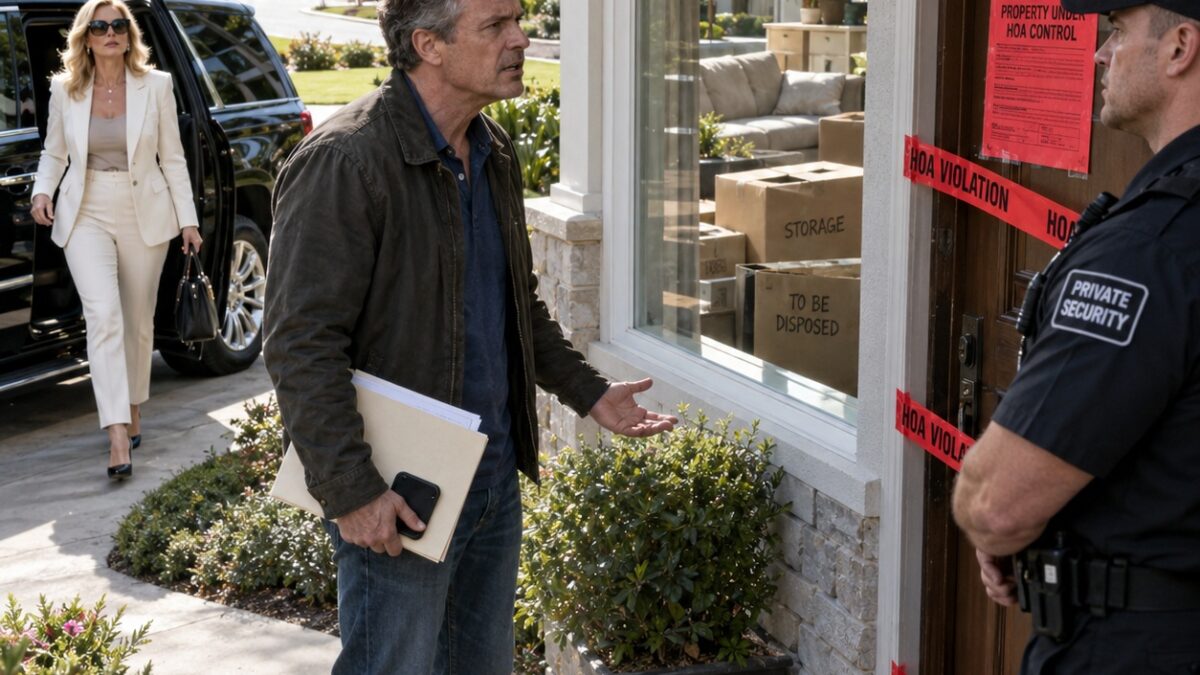
“Grant.”
She said my name as if I had arrived late to a meeting she was gracious enough to continue.
“We tried to reach you.”
“No, you didn’t.”
Her expression did not change.
She opened a leather portfolio and removed a folder.
“We sent certified correspondence.”
“To where?”
“Your address of record.”
I stared at my own locked front door.
“You sent abandonment notices to the house you had already decided was abandoned?”
Valerie’s smile tightened.
“We also emailed.”
“No.”
“You may have missed them.”
“I didn’t.”
She handed me the folder.
Inside were inspection reports.
Photographs of my lawn.
A picture of two newspapers near the driveway that I had never subscribed to.
A close-up of my front step with what looked like a dead potted plant.
I had never owned that plant.
Three notices claimed failed contact attempts.
The dates were strange.
Two fell on days Martin had entered the house to water my indoor plants.
The third was a Sunday when my motion camera showed a package delivery.
Then I saw the numbers.
$2,400 emergency grounds remediation.
$3,150 security assessment.
$6,800 property stabilization.
$5,940 administrative receivership costs.
Total: $18,290.
I looked up.
“You spent eighteen thousand dollars changing my locks and moving my couch?”
“The association incurred costs protecting an unsecured property.”
“It was locked.”
“We found evidence of abandonment.”
“You created the evidence.”
Her eyes cooled.
“If you reimburse the association within seven days, the board may reconsider liquidation.”
I stopped.
“Liquidation.”
“Your property has entered emergency receivership under the community preservation provisions.”
I almost admired the confidence.
“Those provisions don’t exist.”
“They were adopted last year.”
“By whom?”
“The board.”
“You cannot amend state property law with an HOA vote.”
Valerie’s patience thinned.
“An affiliated investment firm has offered to purchase distressed units before they deteriorate and affect surrounding values.”
There it was.
Purchase.
Not preserve.
“Which firm?”
“That information will be disclosed during closing.”
“My closing?”
“If you fail to cure.”
I looked back down.
President: Valerie Sloan.
Vice President: Tessa Langford.
County representative: Aaron Mercer.
A county seal sat beside the third signature.
The seal bothered me immediately.
Surveyors become irritating people because we live inside tiny differences.
A line shifted three inches.
A benchmark rounded to the wrong hundredth.
A parcel call missing one directional notation.
Most people see paper.
We see claims about reality.
The county seal had a starburst around its center that Williamson County stopped using years earlier.
Then I saw the parcel number.
08-114-07-326.00.
My parcel ended in 325.00.
One digit.
That was all.
I looked at Valerie.
“Are you sure you want to use this parcel number?”
She frowned.
“What?”
I tapped the page.
“This one.”
“It came from the county.”
“You’re sure?”
“Grant, this delaying tactic is beneath you.”
“That wasn’t my question.”
Her smile vanished.
“Yes. I’m sure.”
I photographed every page.
Valerie crossed her arms.
“Taking pictures won’t change the status.”
I looked past her.
At the entrance to Silver Crest Ridge, beyond the landscaped median, stood the association’s new headquarters.
Glass.
Stone.
Steel.
Three stories.
Curved façade.
Conference center.
Fitness room nobody asked for.
Executive offices nobody knew an HOA needed.
Opened eight months earlier after what residents were told was a $3.8 million “capital modernization initiative.”
A huge silver sign read:
SILVER CREST RIDGE COMMUNITY ADMINISTRATION & RESIDENT SERVICES CENTER.
I looked back at the parcel number.
Then at Valerie.
“Before you sell my home, you might want to check whose land your headquarters is sitting on.”
For the first time since she arrived, Valerie Sloan stopped smiling.
That night, I rented a motel room twelve miles away, put my laptop on a desk the size of a pizza box, connected through my work VPN, and opened the county GIS archive.
I entered the parcel number from Valerie’s seizure notice.
08-114-07-326.00.
The map loaded.
My stomach went cold.
The highlighted polygon did not touch my house.
It sat beneath the HOA headquarters.
And according to the county’s archived 1987 survey layer, the land had never been conveyed to Silver Crest Ridge at all.
I zoomed in until the new headquarters filled the screen.
Modern GIS systems make property ownership look simple because they hide the history.
Colored polygon.
Owner name.
Acreage.
Tax address.
Click.
But a parcel map is not a deed. It is an index. A convenient visual summary built from records that may have been revised, corrected, split, combined, or entered incorrectly over decades. When something does not fit, you stop trusting the colorful layer and start reading the instruments underneath it.
The current screen showed parcel 08-114-07-326.00 as:
SILVER CREST RIDGE HOMEOWNERS ASSOCIATION, INC.
4.72 ACRES.
COMMUNITY FACILITY.
The update date was only eleven months old.
That immediately interested me.
I opened the previous archived layer.
Same area.
Different shape.
No HOA ownership.
The 2022 version identified the tract as DR-17, a drainage reserve associated with an old subdivision plat.
I went backward.
The same strip of land remained outside the private residential lots.
On the oldest digitized plat, it was crosshatched and labeled:
DRAINAGE RESERVATION — NOT FOR PRIVATE IMPROVEMENT.
COUNTY ACCESS RESERVED.
SEE BOOK 411, PAGE 82.
I leaned closer.
Book 411, Page 82.
That reference led to a scanned instrument recorded in October 1987, when the first phase of development was approved. The original developer had granted the county a perpetual stormwater and flood-control easement over a narrow but strategically placed strip crossing the future neighborhood entrance. Beneath it ran a reinforced concrete culvert carrying runoff from almost three hundred uphill acres.
The developer had retained underlying title temporarily, subject to restrictions, but the later transfer documents were messy.
The company dissolved in 1994.
Several common parcels were conveyed to the HOA.
DR-17 was not listed among them.
I checked again.
Then again.
No conveyance.
The headquarters appeared to have been built partly over land the HOA did not own and fully within a drainage reservation that prohibited permanent structures without county engineering approval.
That was bad.
Then I noticed the current parcel shape had swallowed two adjoining remnants.
Worse.
I downloaded every map layer and scanned instrument.
Metadata too.
Edit dates.
Source references.
The current GIS ownership change cited Instrument 2025-184771.
I searched the recorder index.
Instrument 2025-184771 existed.
But the indexed description didn’t match.
The recorder’s public index described it as:
CORRECTIVE QUITCLAIM / SCR HOA / DEVELOPMENT REMNANT.
Grantor:
Briarstone Land Holdings LLC.
Grantee:
Silver Crest Ridge HOA.
Executed by:
Aaron Mercer, Authorized Agent.
Aaron Mercer.
The same “county representative” who had signed my seizure notice.
Except now he wasn’t claiming to be county.
He was signing for a private LLC.
I downloaded the deed image.
The document claimed Briarstone Land Holdings had succeeded to the interest of the original developer through a chain of mergers and assignments.
The legal description was Exhibit A.
That exhibit made me sit back.
Someone had taken the metes-and-bounds description for the drainage tract and modified two calls.
Not wildly.
Thirty-seven seconds in one bearing.
Forty-two feet in one distance.
Tiny changes to anyone reading casually.
Those changes pushed the polygon around the HOA headquarters.
I had spent twenty-two years checking descriptions exactly like that.
The alteration was not accidental.
Even stranger, the deed referenced a survey by “G. W. Mercer, RLS 4421.”
I searched Tennessee’s licensing database.
No G. W. Mercer.
License 4421 belonged to Gregory Watts, retired and deceased three years earlier.
My pulse began to climb.
I printed nothing.
Instead, I created a read-only cloud folder and uploaded everything.
Then I called the one person I trusted to tell me when I was getting ahead of myself.
Martin Keene answered on the fourth ring.
“Grant?”
“Hey.”
“Where are you? I saw your truck earlier.”
“Motel.”
Pause.
“Why?”
“Because apparently I don’t own my house anymore.”
Silence.
Then:
“What?”
I told him.
Not everything.
Changed locks.
Abandonment notice.
Valerie.
Parcel number.
Martin swore so loudly I moved the phone away.
“I was inside your house two weeks ago.”
“I know.”
“I watered that ugly fern Elise liked.”
“It’s not ugly.”
“It has three leaves.”
“It’s recovering.”
“Grant.”
“Sorry.”
Martin lowered his voice.
“I used your spare key on December fourth. Everything was normal.”
“Did anyone contact you?”
“No.”
“See HOA people around?”
“Actually…”
I waited.
“A white maintenance van was there one afternoon. I thought it was your lawn crew.”
“When?”
“Maybe ten days ago.”
“Did they enter?”
“I don’t know.”
“Any photos?”
“My doorbell camera catches part of your driveway.”
My heart jumped.
“Don’t delete anything.”
“You think they broke in?”
“They changed my locks.”
“Jesus.”
“Martin, I need you to do something else.”
“Name it.”
“Do not confront Valerie.”
“Why would I—”
“You absolutely would.”
He sighed.
“Fine.”
“Also don’t tell anyone I found a parcel problem.”
“What parcel problem?”
“Exactly.”
He understood.
Martin had been my neighbor seventeen years and my friend for twelve. Retired civil engineer. Seventy-one. Built like someone who still believed lifting heavy objects was easier than asking for help.
He said:
“You sound scared.”
I stared at the screen.
“I’m interested.”
“That wasn’t what I said.”
Fair.
“I think this is bigger than my house.”
“How much bigger?”
“I don’t know.”
“Then get a lawyer before you find out.”
That was good advice.
At 10:18 p.m., I emailed Lena Park.
Lena and I had worked together on two right-of-way disputes. She specialized in land-use litigation, title problems, and municipal records—the kind of law where people can argue for six months about whether a comma moved an easement.
She called me nine minutes later.
“Are you drunk?”
“No.”
“It’s after ten.”
“You answered.”
“I assumed somebody died.”
“My house did.”
“Grant.”
I told her.
When I reached the fake-looking county seal, she stopped me.
“Send everything.”
I did.
Twenty minutes passed.
Then thirty.
I watched the motel heater cycle on and off.
At 11:07, Lena called.
“You’re not going home tomorrow.”
“I can’t get in anyway.”
“I mean do not attempt entry.”
“It’s my house.”
“I know.”
“Then why?”
“Because I want an emergency injunction before you create a trespass confrontation their lawyer can muddy.”
“I can’t trespass on my own land.”
“Legally, probably not. Strategically, stop being a surveyor for ten minutes.”
I leaned back.
“What do you see?”
“A ridiculous HOA document pretending to be a court order.”
“Agreed.”
“A parcel number that identifies their headquarters instead of your lot.”
“Agreed.”
“A deed in the recorder system that has enough facial irregularities to make me very interested.”
“Forgery?”
“I didn’t say that.”
“Yet.”
“Grant.”
“Fine.”
She continued.
“The deed was notarized by Tessa Langford.”
I looked at the seizure paperwork.
HOA vice president.
“You saw that?”
“Yes.”
“Conflict?”
“At minimum, relevant.”
“What about Mercer?”
“Aaron Mercer is not a county employee.”
“I figured.”
“He runs something called Mercer Municipal Services.”
I searched while she spoke.
Consulting firm.
Land administration.
Permit coordination.
Public-private development support.
Lena said:
“He has contracts with several small municipalities but none with Williamson County that I can see.”
“So the seizure form calling him a county representative—”
“Potentially fraudulent representation. Preserve it.”
“Already did.”
“And tomorrow morning, I’m filing for a temporary restraining order preventing the HOA from entering, disposing of property, encumbering the parcel, or attempting a transfer.”
“Can we get access?”
“I’ll ask.”
“My clothes are in there.”
“Buy underwear.”
“Legal advice?”
“Premium.”
I laughed despite myself.
Then Lena went quiet.
“Grant, the headquarters issue is separate.”
“Maybe.”
“Do not use it as a threat.”
“I already sort of did.”
“Of course you did.”
“She asked for it.”
“You are not twelve.”
“Debatable.”
“Listen. If the deed is fraudulent, or if the county record was manipulated, we need clean hands and clean documentation. No dramatic confrontation.”
“Fine.”
“Also, county GIS disappearing does not determine ownership.”
“I know.”
“Say it back.”
I sighed.
“GIS is an index, not title.”
“Good surveyor.”
I looked again at the headquarters parcel.
“What would cause the map to change eleven months ago?”
“Recorder instrument feeding assessor data. Assessor correction. Manual GIS edit. Lots of possibilities.”
“Can we see who changed it?”
“If county logs exist.”
“They do.”
“How do you know?”
“I’ve used their internal request process.”
“Then tomorrow we request audit logs.”
That was when a second idea hit me.
I pulled up the HOA’s monthly board packets.
Silver Crest Ridge posted PDFs publicly because Valerie liked transparency as a concept.
I searched “headquarters.”
Hundreds of hits.
2023 feasibility.
2024 land acquisition.
2024 capital assessment.
2025 construction.
Residents had been told the HOA acquired 4.7 acres from Briarstone Land Holdings for $620,000.
The closing summary listed:
Land purchase — $620,000.
Architectural/design — $412,000.
Site work — $691,000.
Construction — $1.73 million.
Furnishings/technology — $286,000.
Contingency/other — $94,000.
Total: $3.833 million.
Paid through a $1.9 million special assessment plus reserves and a bank facility.
I opened the minutes approving the acquisition.
Valerie Sloan.
Tessa Langford.
Treasurer Miriam Cho.
Secretary Dennis Pike.
Vote 3–1.
Miriam Cho had voted no.
Reason recorded:
“Title and drainage concerns not adequately resolved.”
I sat up.
There it was.
A warning.
Buried in minutes nobody read.
I searched Miriam’s name.
She had resigned as treasurer four months later.
Reason:
“Personal.”
I found her number in an old neighborhood directory.
Too late to call.
I texted:
Miriam, this is Grant Mercer from Alder Lane. Sorry for the hour. I came home tonight to find HOA possession notices on my house. I also found the headquarters parcel number on one of their documents. I saw your 2024 vote regarding title/drainage. If you’re willing, I urgently need to understand what you saw. Please call whenever safe.
Then I kept digging.
At 12:34 a.m., I found the flood study.
That changed the scale again.
The buried culvert beneath DR-17 was not a minor neighborhood drain.
It was the principal conveyance for runoff from the ridge west of us.
Forty-eight-inch reinforced concrete for most of its length, expanding near the entrance.
County inspections in 2009 and 2018 warned that permanent access must be maintained because blockage could redirect floodwater toward twenty-seven downstream homes.
The headquarters had been built directly over the maintenance corridor.
I pulled satellite imagery.
During construction, the HOA’s site contractor had filled part of the swale, landscaped above the culvert, and constructed the building’s east parking deck across the access zone.
I whispered:
“You have got to be kidding me.”
The motel room was silent except for the heater.
At 12:51, Miriam called.
Her first words were:
“Do not tell Valerie you contacted me.”
I sat straighter.
“I won’t.”
“You’re serious about your house?”
“Yes.”
“What did she do?”
I explained.
Miriam did not sound shocked.
That frightened me more than shock would have.
When I finished, she said:
“How many days did they claim?”
“Forty-two away.”
“That’s faster.”
“Faster than what?”
Silence.
Then:
“Grant, your house isn’t the first.”
My hand stopped above the keyboard.
“What do you mean?”
“They have a list.”
“What list?”
“Distressed properties.”
“How many?”
“I saw seventeen when I left.”
My stomach went cold.
“What were they doing with them?”
Miriam breathed in.
“Turning violations into acquisition opportunities.”
I looked toward the motel window, where my reflection stared back.
“Start at the beginning.”
So she did.
Miriam had joined the Silver Crest Ridge board three years earlier because she was an accountant and made the mistake of believing accounting would be useful in an organization that collected nearly two million dollars a year from homeowners.
“For the first six months, it was normal,” she told me.
Landscaping contracts.
Pool repairs.
Insurance.
Reserve studies.
Arguments over fences.
Then Valerie proposed what she called the Community Preservation Initiative.
The official justification sounded reasonable.
A handful of homes had become neglected after deaths, foreclosures, long hospitalizations, and absentee owners. Tall grass, broken gutters, frozen pipes, one genuinely abandoned property with squatters.
Valerie argued the HOA needed a faster process for protecting surrounding property values.
The board’s attorney at the time warned that the HOA could secure common areas, enforce covenants, and pursue liens, but it could not simply take possession of private property without legal process.
“So Valerie changed lawyers,” Miriam said.
“To whom?”
“Bexley & Crane.”
I knew the name.
Small real-estate firm in Nashville.
Aggressive.
“Did they tell her she could seize homes?”
“Not exactly. That’s the trick.”
Miriam explained the program.
The HOA would identify properties considered “at risk.”
Then it would accumulate fines and “emergency maintenance expenses.”
Mow a lawn for $900.
Send a security patrol and bill $1,500.
Perform an “occupancy inspection” for another $1,200.
Add attorney fees.
Administrative charges.
Repeat.
For owners who responded, the charges often disappeared or were negotiated down.
For owners who didn’t respond quickly—elderly residents in assisted living, people traveling, heirs dealing with estates—the HOA sent increasingly frightening notices suggesting imminent foreclosure.
Then came an offer.
Crestline Residential Partners LLC would purchase the property, pay the HOA charges, and “relieve the owner of litigation risk.”
“Who owns Crestline?” I asked.
“That’s what I tried to find out.”
“And?”
“On paper? A Delaware holding company called VSM Holdings.”
VSM.
Valerie Sloan.
Maybe.
“Keep going.”
“VSM is owned through a trust.”
“Beneficiary?”
“Not public.”
“But you think Valerie?”
“I know money from Crestline paid invoices to Sloan Strategic Consulting.”
I stopped typing.
“Valerie’s company?”
“Her daughter’s.”
There it was.
Miriam continued.
“Tessa’s husband did renovation work on two of the houses Crestline acquired.”
“How many did it acquire?”
“Four that I confirmed.”
“Through actual foreclosure?”
“No. Owners signed deeds.”
I leaned back.
That mattered.
Not a secret physical seizure.
A pressure machine.
Create inflated debt.
Send official-looking notices.
Offer rescue.
Get signatures.
“Were the owners represented?”
“Some weren’t.”
“Did they know Crestline was connected to the HOA leadership?”
“No disclosure I saw.”
“What happened to the houses?”
“Renovated. Resold.”
“Profit?”
“On the first three? Roughly seven hundred thousand total before costs.”
I let that sit.
“And seventeen were on the target list?”
“When I resigned, yes.”
“Was mine?”
“I don’t remember.”
“Could you check?”
“I don’t have the file anymore.”
“Who did?”
“Valerie. Tessa. Aaron Mercer.”
Aaron again.
“What role did he play?”
“He built the property scoring system.”
I almost laughed.
“Scoring system.”
“Absentee days. Violations. Mortgage status when they could infer it. Owner age. Mail accumulation. Emergency contacts.”
“That sounds less like preservation and more like hunting.”
“That’s why I quit.”
“Why didn’t you report it?”
The question came out harder than I intended.
Miriam went quiet.
I regretted it immediately.
“I’m sorry.”
“No. You’re right to ask.”
She breathed.
“I tried.”
“To whom?”
“The board attorney. Valerie said I was imagining conflicts.”
“County?”
“I contacted the state consumer affairs office anonymously.”
“What happened?”
“I don’t know.”
“Police?”
“I had suspicious accounting. Not proof of a crime.”
“You had four purchases.”
“Owners signed voluntarily on paper.”
She sounded exhausted.
“And I was afraid.”
That stopped me.
“Of Valerie?”
“Of being sued. Of losing my job. My husband’s company had a contract with one of the developers she knew. She made sure I understood that.”
I stared at the spreadsheet on my screen.
Power doesn’t always threaten with fists.
Sometimes it reminds you where your paycheck comes from.
Miriam continued.
“The headquarters pushed me out.”
“Tell me.”
“Valerie said we had an opportunity to buy the entrance tract for six hundred twenty thousand.”
“From Briarstone.”
“Yes.”
“I can’t find a valid chain from the original developer to Briarstone.”
“Neither could I.”
“Did you tell the board?”
“I did.”
“What happened?”
“Aaron produced a title memo.”
“From a title company?”
“No. His firm.”
I swore.
“Miriam.”
“I know.”
“What about the flood easement?”
“I found it during due diligence.”
“And?”
“Valerie said county engineering had approved relocation.”
“Did they?”
“I asked for the approval.”
“Did you get it?”
“She gave me a letter.”
“County letterhead?”
“Yes.”
“Signed?”
“Aaron Mercer.”
I closed my eyes.
“He isn’t county.”
“I learned that later.”
“Where is the letter?”
“I kept a copy.”
“Send it to Lena Park. I’ll text her email.”
“I have more.”
“What?”
“Invoices.”
“How much?”
“Hundreds of thousands.”
My heart sped up.
“From whom?”
“Sloan Strategic. Mercer Municipal. Langford Development Services. Plus a contractor called Ridgeline Civil.”
“Connected?”
“I don’t know about Ridgeline. The others clearly.”
“What were they billing?”
“Permit coordination. Entitlement consulting. Acquisition services. Stakeholder management.”
“For an HOA headquarters.”
“Yes.”
“How much to Sloan?”
“About three hundred ten thousand before I left.”
“Valerie disclosed her daughter?”
“Not in the minutes.”
“Conflict policy?”
“Required disclosure.”
I rubbed my eyes.
It was after one in the morning.
Sleep no longer existed.
“Miriam, why resign instead of forcing a vote?”
“I tried.”
“What happened?”
“Tessa and Dennis backed Valerie. Dennis told me I was creating liability by asking questions in open session.”
“Secretary Dennis Pike?”
“Yes.”
“Still on board?”
“No. He moved to Florida.”
“Would he talk?”
“I doubt it.”
“Try anyway.”
Miriam was quiet.
Then:
“There’s something else.”
Of course there was.
“What?”
“Two months before I resigned, the reserve account was short.”
“How short?”
“Seven hundred eighty-four thousand dollars compared with the adopted reserve schedule.”
My hand froze.
“Spent?”
“Transferred.”
“To?”
“A capital project clearing account.”
“Headquarters?”
“That’s what Valerie said.”
“Board approval?”
“She claimed prior authorization under the capital budget.”
“Did it reconcile?”
“No.”
“How much came back?”
“None while I was treasurer.”
“So residents paid a special assessment while reserves were also being drained.”
“Yes.”
“Did the bank know?”
“I don’t know.”
The headquarters wasn’t just a title problem anymore.
It was the physical center of a financial problem.
I sent Lena three texts in a row:
Miriam Cho confirms concerns re DR-17 title/easement before purchase.
Has county “approval” signed by Aaron Mercer (not county).
Has invoices and reserve-transfer records. Call when awake.
She replied immediately:
I was awake until message 1.
Now I’m angry.
Have her preserve originals.
I told Miriam.
She said she would.
Then I asked:
“Why would Valerie use the headquarters parcel number on my seizure notice?”
Miriam considered.
“Template error?”
“Maybe.”
“Or Aaron copied the wrong line from his property matrix.”
That felt closer.
“If the parcel number came from an internal database…”
“Then maybe your record and headquarters record sit near each other.”
“Or they were using the headquarters parcel as some kind of master account.”
“Grant.”
“Yes?”
“Be careful.”
I looked at the glowing map.
“I am.”
“No. You’re excited.”
She knew surveyors too well.
“This is not a boundary dispute over a fence. These people have already entered your house.”
That sobered me.
We ended the call at 1:47.
I slept maybe ninety minutes.
At 5:30, I was back on the laptop.
I compared the seizure notice to county records.
The wrong parcel number appeared six times.
Not once.
Six.
Header.
Inspection report.
Expense ledger.
Receivership certificate.
Acquisition referral.
County acknowledgment.
That meant the number wasn’t a typo made while drafting one page.
It had propagated through a system.
I searched hidden PDF metadata.
Author:
amsloan-admin.
Created using software licensed to:
Crestline Residential Partners.
I stared.
The HOA’s seizure package had been generated using software registered to the investment company buying the “distressed” homes.
I took screenshots.
Downloaded originals.
Hash values.
Lena would appreciate that.
At 6:18 a.m., Martin sent doorbell footage.
White van.
Silver Crest Ridge Property Services.
Three people.
One used a key.
Not forced entry.
Key.
They entered my house on December 14 at 10:07 a.m.
Left at 12:42.
Returned December 17 with boxes.
My stomach tightened.
“How did they get a key?” Martin asked by text.
I knew.
The HOA maintained emergency gate and amenity access codes.
Not house keys.
But two years earlier, Silver Crest Ridge had offered a voluntary “senior safety lockbox” program.
I never joined.
My spare key existed only with Martin.
Unless someone copied it during previous legitimate maintenance?
No.
Then Martin called.
“I checked my kitchen drawer.”
I already knew before he spoke.
“The spare is gone.”
“When did you last see it?”
“November.”
“Who’s been in your house?”
“Cleaner. My daughter. Grandkids. HOA maintenance guy.”
“Why HOA?”
“Smoke detector inspection.”
Our HOA did not inspect smoke detectors inside private houses.
“What date?”
“December eleventh.”
Three days before entry.
I closed my eyes.
“Martin, don’t touch the drawer.”
“What?”
“Call police non-emergency. Tell them you believe a key was stolen during an unauthorized inspection connected to an unlawful entry next door.”
“Grant, are you saying—”
“I’m saying preserve fingerprints if any exist and camera footage.”
Martin swore.
Then said:
“I’m going to bury Valerie under the clubhouse.”
“No.”
“Metaphorically.”
“Please specify that if police ask.”
At 7:02, Lena called.
“Courthouse opens at eight.”
“Good morning.”
“You have a hearing request drafted.”
“How?”
“Magic. Also I bill by the hour.”
“Did you read Miriam’s documents?”
“She sent them.”
“And?”
“That county approval letter is fake or at minimum falsely presented.”
“How sure?”
“The county engineering director who supposedly received a carbon copy retired five years before the letter date.”
I stood.
“You already checked?”
“I also emailed county counsel.”
“Before seven?”
“Lawyers don’t sleep when surveyors bring forged plats.”
“Can we say forged?”
“No.”
“Suspected fraudulent instrument.”
“Less fun.”
“More survivable.”
She continued.
“We’re requesting emergency relief on your house only. Separate notice to the county regarding the headquarters tract.”
“Why separate?”
“Because I want a judge focused on the immediate unlawful interference with your residence. Clean issue.”
“Can we get inside today?”
“If granted.”
“What about evidence in the house?”
“We ask the court to prohibit alteration pending inspection.”
“Valerie could clear it now.”
“Police have been notified.”
“You called?”
“Your neighbor did. I called their counsel.”
“Valerie?”
“HOA counsel.”
“Bexley & Crane?”
“Interesting development. They say they did not draft the ‘emergency receivership’ packet.”
I stopped.
“What?”
“They represented the HOA on covenant matters but terminated representation three months ago.”
“Why?”
“They wouldn’t say.”
“That’s useful.”
“Yes.”
“So who is legal counsel on the packet?”
“No law firm listed.”
I looked at the PDFs again.
She was right.
Legal-looking.
No lawyer.
“Aaron.”
“Possibly.”
At 8:11, I was sitting in Lena’s office wearing yesterday’s clothes while she filed electronically and drank coffee strong enough to dissolve a spoon.
By 9:40, we had a hearing set for 11:15.
At 10:03, Valerie emailed me.
Grant,
Yesterday’s interaction was unnecessarily adversarial.
The Association remains willing to resolve your delinquency without further escalation. If you provide immediate payment of $18,290 and sign the attached occupancy compliance acknowledgment, I can authorize restoration of limited access pending board review.
If you continue interfering with Association operations or spreading inaccurate claims regarding the Community Administration Center, the board will consider all legal remedies.
Regards,
Valerie Sloan
President
Attached was a two-page acknowledgment.
Paragraph seven made me laugh.
Owner acknowledges Association’s emergency possession was reasonable and waives any claim arising from entry, storage, lock replacement, or property management activities.
“Eighteen thousand dollars and a liability waiver,” I said.
Lena read it.
“Forward.”
I did.
She smiled.
“Thank you, Valerie.”
At 11:56, a judge signed the temporary restraining order.
The order was not dramatic.
No gavel.
No courtroom speech.
No judge telling Valerie she had finally met her match.
Real emergency orders are often much less satisfying than fiction.
Three pages.
Typed findings.
A signature.
But those three pages did more for me than shouting ever could.
Silver Crest Ridge HOA, its officers, agents, contractors, and affiliated entities were temporarily prohibited from entering my property, removing or disposing of personal property, changing locks, recording liens related to the disputed “abandonment” charges, negotiating any sale, or interfering with my access.
The association was ordered to provide all keys and access credentials then in its possession.
The court also directed the parties to preserve records relating to my property.
Lena read the last line twice.
“Preservation duty.”
“I know.”
“Meaning if anyone starts deleting emails now—”
“Problem.”
“Large problem.”
At 12:18, the order was served electronically on the HOA’s registered agent, Valerie, Tessa, and the property-management company.
At 12:31, Valerie called me.
I let it go to voicemail.
She called again.
Voicemail.
Then texted:
You have made a serious mistake.
Screenshot.
Saved.
Lena said:
“Stop enjoying this.”
“I’m not.”
“You’re smiling.”
“Stress response.”
“Grant.”
“Fine.”
At 1:10, we met two sheriff’s deputies at my driveway.
Martin stood on his porch pretending not to watch.
He was terrible at pretending.
Valerie arrived seven minutes later with Tessa Langford and a man I recognized from the company website as Aaron Mercer.
So much for subtlety.
Aaron was in his early forties, expensive field jacket, loafers inappropriate for winter grass, and the expression of a man accustomed to explaining documents until other people became embarrassed enough to stop asking questions.
Valerie approached Lena first.
“This order was obtained through misrepresentation.”
Lena held out a copy.
“You can address that at the return hearing.”
“We were protecting a vacant property.”
“My client was away forty-two days.”
“Occupancy is determined by association criteria.”
“No, ownership is determined by deeds and possession rights are determined by law.”
Aaron stepped in.
“If everyone could remain professional—”
I looked at him.
“You’re the county representative?”
He blinked.
“What?”
I held up the seizure certificate.
“Your signature.”
He glanced at it.
“That is an administrative designation.”
“Are you employed by Williamson County?”
“No.”
“Contracted by Williamson County?”
“Not currently.”
“Then why does it say county representative?”
Valerie said:
“Grant, this is not the time.”
I looked at Aaron.
“Seems perfect.”
One deputy stepped between us slightly.
“Folks, our role is just to keep this orderly.”
Lena touched my sleeve.
I stopped.
Good lawyer.
Valerie produced a ring of keys.
The deputy photographed the handoff.
One fit my new front lock.
I turned it.
The door opened.
My own house smelled wrong.
Cleaning chemicals.
Cardboard.
Cold air.
Someone had turned the heat down to fifty-five.
The pale yellow kitchen Elise had chosen was still there.
For a second, seeing it made me angrier than anything else.
Boxes filled the dining room.
Tags everywhere.
A framed photograph of Elise and me at Glacier National Park had a yellow sticker:
PERSONAL / NO RESALE.
At least some anonymous contractor had decided my dead wife wasn’t marketable.
I stood there.
Lena said quietly:
“You okay?”
“Yes.”
Not really.
A deputy entered first.
We documented every room before touching anything.
Kitchen drawers emptied into bins.
Desk files removed.
Closets inventoried.
My gun safe had not been opened, thank God.
Electronics tagged.
Artwork photographed.
My late wife’s jewelry box had a sticker reading HIGH VALUE — HOLD.
I stared at it.
“Grant.”
Lena again.
“I know.”
On the kitchen counter sat a clipboard.
PROPERTY TRANSITION INVENTORY.
At the top:
Asset ID SCR-DP-17.
I froze.
DP-17.
Miriam had called the target list distressed properties.
I photographed the sheet.
There was a bar code.
A QR code.
And beneath:
Acquisition Channel: CRP
Projected Close: 01/15
Disposition: Renovate / Retail
Target Basis: $412,000
Projected Retail: $638,000
My house.
Market value around six hundred twenty thousand.
They planned to acquire it for four hundred twelve.
I turned toward the door.
Valerie stood outside with Tessa.
She couldn’t enter under the order.
I held up the sheet through the glass.
Her face changed.
Not much.
Enough.
Lena took it from me.
“This is important.”
“No kidding.”
“Don’t wave evidence at opposing parties.”
“Right.”
She photographed it in place.
Then another document surfaced in my desk box.
A printed “Owner Resolution Path.”
Option A:
Pay association costs.
Option B:
Enter hardship installment agreement secured by lien.
Option C:
Voluntary distressed transfer to Crestline Residential Partners.
The document offered a prefilled sale price.
$412,000.
There was even a line:
Owner equity preserved without foreclosure stigma.
I laughed.
“They were going to scare me into signing away two hundred grand.”
Lena shook her head.
“Do not assume what they were going to accomplish. Document what they prepared.”
Surveyors and lawyers should be forced to marry each other just so nobody else has to live with us.
We kept documenting.
In the garage, someone had attached red tags to my woodworking tools.
My table saw:
RETAIN.
Elise’s old gardening bench:
DISPOSE.
I removed nothing until the deputy completed photographs.
Then Martin appeared at the edge of the driveway holding a clear evidence bag.
A police officer from the earlier theft report stood beside him.
Inside the bag was my spare key.
“Found it,” Martin called.
I stared.
“Where?”
The officer answered.
“Maintenance employee turned it over.”
That moved fast.
Apparently the HOA contractor who had performed the fake smoke-detector inspection at Martin’s house had been contacted by police. Faced with camera footage and questions about the key, he admitted a supervisor instructed him to retrieve it because the association “needed emergency access.”
“Supervisor who?” I asked.
Officer shrugged.
“Detectives are following up.”
Valerie’s face from the sidewalk became unreadable.
Aaron spoke quietly to her.
Tessa looked sick.
At 3:20, the deputies left.
Lena’s office arranged a locksmith.
My original locks went back on.
At 4:05, a county attorney named Samuel Ortiz called Lena.
She put him on speaker.
“Mr. Mercer?”
“Grant is fine.”
“I’m county counsel. We received your submission concerning parcel 08-114-07-326 and instrument 2025-184771.”
“Yes.”
“We are initiating an administrative audit.”
“What does that mean?”
“It means the assessor, register’s office, GIS division, engineering, and county attorney are reviewing the source documents and edit history.”
Lena asked:
“Has the county confirmed the easement?”
“Yes. Book 411, Page 82 is authentic.”
“Any release?”
“None located.”
“Relocation?”
“None located.”
“What about the county approval letter signed by Aaron Mercer?”
Long pause.
“The county did not issue that letter.”
Even though I knew, hearing it officially changed the air.
I looked out my front window.
The HOA headquarters gleamed down the boulevard.
Samuel continued.
“We also have no employee or authorized representative named Aaron Mercer in county engineering, land records, or stormwater.”
“What about the deed?”
“Instrument was recorded. Recording does not validate substantive title.”
“Understood.”
“The instrument is being referred for further review.”
“To law enforcement?”
“I can’t discuss referrals.”
That meant yes or maybe.
“Can the county correct the GIS immediately?”
“Not ownership based solely on allegation.”
“Of course.”
“But we can flag the current display as disputed and restore the prior reference geometry while the title question is examined.”
I looked at Lena.
She knew exactly what I was thinking.
Don’t say vanished.
So I didn’t.
Samuel added:
“We’re also concerned about construction over the stormwater access corridor.”
“What happens?”
“Engineering inspection tomorrow.”
I looked at the darkening sky.
Rain was forecast for the weekend.
“How serious?”
“We don’t know until inspection.”
That evening, for the first time in forty-three days, I slept in my own bed.
Not well.
Every sound woke me.
At 2:15 a.m., a car slowed outside.
I checked cameras.
New cameras.
Three of them.
Martin had helped install them before dinner.
The car moved on.
At 6:30, I found six emails from residents.
Word about the court order had spread.
Most asked whether rumors were true.
One said:
Grant, did they try the “abandoned property” thing on you too?
I opened it.
Sender: Olivia Chen, Pine Terrace.
I called.
Olivia was sixty-six.
Widowed.
She had spent two months in Arizona the previous winter helping her daughter after surgery.
When she returned, she found $23,000 in HOA charges and a notice threatening foreclosure.
Crestline Residential offered to buy her home for $355,000.
Market value then: around $520,000.
“What happened?”
“I paid the charges.”
“How?”
“Home-equity line.”
My stomach tightened.
“Do you still have all the paperwork?”
“Yes.”
“Did the parcel numbers match?”
“I don’t know.”
“Can you scan them?”
“Grant, are we in trouble?”
That question repeated all morning.
I did not tell residents we had uncovered a criminal scheme.
We hadn’t proved that.
I said:
“We found irregularities. Preserve documents. Don’t sign anything without independent counsel.”
By noon, nine residents had contacted me.
Three had been targeted.
One had actually sold.
His name was Daniel Ruiz.
He had inherited his mother’s house after she died.
During probate, HOA violations accumulated.
Crestline offered to “simplify” the estate.
He sold for $298,000.
Six months later, Crestline resold for $471,000 after cosmetic renovations.
“Did you know Crestline was connected to HOA leadership?”
“No.”
“Did anyone tell you?”
“No.”
“Who negotiated?”
“Aaron Mercer.”
I closed my eyes.
“Did he say he represented the county?”
“He said he was coordinating with the county and HOA.”
Careful words.
Enough ambiguity to create authority.
I asked Daniel for documents.
He said yes.
Then:
“Can I get the house back?”
I hated that question.
“I don’t know.”
The truth.
By late afternoon, engineering crews had surrounded the HOA headquarters.
County trucks.
Orange vests.
Survey equipment.
Ground-penetrating radar unit.
The irony was almost too perfect.
Valerie had spent years sending inspectors onto everyone else’s lots.
Now government inspectors stood on hers.
At 4:40, Martin called.
“Look at the map.”
“What?”
“County map.”
I opened the public GIS.
For a few seconds, nothing looked different.
Then I zoomed to the entrance.
The large parcel polygon labeled SILVER CREST RIDGE HOA was gone.
Not the building physically.
Not the aerial photo.
The actual glass headquarters remained visible in imagery.
But the ownership layer had reverted.
The bright HOA parcel disappeared.
In its place:
DR-17 — TITLE UNDER REVIEW / DRAINAGE RESERVATION.
The building footprint still sat on top visually, but it no longer appeared as an HOA-owned taxable parcel.
A warning banner read:
RECENT PARCEL GEOMETRY AND OWNERSHIP ATTRIBUTES SUSPENDED PENDING RECORD REVIEW. SEE COUNTY ATTORNEY NOTICE.
I stared.
Forty-eight hours earlier, Valerie had stood in my driveway and told me my house was no longer under my control.
Now the digital property map no longer showed her four-million-dollar headquarters as property controlled by the HOA at all.
Martin came through my back door without knocking.
He had a laptop under his arm.
“Tell me you see it.”
“I see it.”
He put the computer beside mine.
On his screen, the old and new layers blinked back and forth.
Headquarters parcel.
Gone.
Drainage reserve.
Back.
He grinned.
“Her building vanished.”
“From the ownership layer.”
“Do not ruin this for me.”
“Technically—”
“Grant.”
I laughed for the first time since coming home.
Then my phone rang.
Valerie.
I declined.
She called again.
Declined.
A text arrived.
What did you do to the county records?
I stared at it.
Then showed Martin.
He whistled.
“Reply.”
“No.”
“Please.”
“No.”
“What would you say?”
I considered.
Then smiled.
“Nothing as useful as what she just wrote.”
I forwarded the screenshot to Lena.
Her response:
Excellent. Do not answer.
Then another:
County is holding press briefing tomorrow morning.
And another:
Also, brace yourself. HOA bank’s counsel just contacted me.
I called immediately.
“What does the bank want?”
“The headquarters loan is secured partly by the association’s interest in the facility parcel.”
My stomach dropped.
“If the HOA doesn’t own the parcel—”
“Collateral problem.”
“How large?”
“About $1.26 million outstanding.”
“So the bank just discovered its mortgage may attach to an interest that doesn’t exist.”
“Potentially.”
I sat back.
The headquarters had not disappeared physically.
But the legal assumptions holding it up were starting to vanish one by one.
Title.
Easement compliance.
Permit representations.
Loan collateral.
And tomorrow, county engineering would explain what the buried culvert had to say about the rest.
The county press briefing was scheduled for nine the next morning.
By eight thirty, the road beside the headquarters looked like election night.
News vans.
Tripods.
Residents.
County vehicles.
One extremely irritated traffic deputy.
I stayed home.
Lena advised it.
“You are already becoming the face of something we don’t fully understand.”
“I’m just the guy whose locks got changed.”
“You’re the surveyor who found the parcel.”
“Because they printed it on my paperwork.”
“Which reporters will call destiny.”
I made coffee and watched the livestream.
Samuel Ortiz stood at a podium beside the county engineering director, Dr. Priya Nandakumar, and the register of deeds, Melissa Ward.
No Valerie.
No Aaron.
Dr. Nandakumar spoke first.
“The county is investigating discrepancies concerning the parcel commonly identified with the Silver Crest Ridge Community Administration Center.”
She was careful.
No accusations.
“The current headquarters structure appears to overlap a recorded drainage and flood-control easement established in 1987.”
A reporter asked:
“Was the building permitted?”
“The building permit file contains documentation purporting to show county stormwater approval.”
“Purporting?”
Dr. Nandakumar paused.
“We have not authenticated one of those documents.”
Samuel stepped in.
“The county has referred certain records to appropriate authorities. We will not characterize potential criminal conduct at this stage.”
That sentence did more damage than any dramatic accusation.
Another reporter:
“Is the building unsafe?”
Dr. Nandakumar answered.
“We have not found evidence that the building itself is structurally unstable. Our concern is the drainage infrastructure beneath and adjacent to it.”
Then she displayed a diagram.
I sat forward.
The old culvert crossed diagonally beneath the eastern parking area, just outside the main building footprint at one end and partially beneath a landscaped terrace at the other.
During construction, a junction access vault had been covered.
Worse, one branch had been reduced by a newer utility crossing.
“Stormwater modeling indicates that a significant blockage could cause overtopping along the north swale and increase flood exposure downstream.”
“How many homes?”
“Potentially twenty-seven under the modeled event.”
I thought of every resident who had paid for Valerie’s headquarters believing it improved the neighborhood.
The headquarters had been built over infrastructure protecting homes.
A reporter asked:
“Will you close the facility?”
“The county has issued an emergency access order requiring the parking terrace and eastern portion of the site to be cleared so crews can expose inspection points.”
Samuel added:
“The HOA has voluntarily agreed to suspend occupancy during that work.”
Voluntarily.
I laughed.
Martin, watching from my kitchen, nearly spit coffee.
“Voluntarily means the fire marshal was already driving over.”
Probably.
Then Melissa Ward explained the land record.
“The register records instruments presented in proper form. Recording is not a determination that the grantor owns the interest purportedly conveyed.”
A reporter asked:
“Did Briarstone own the property?”
“That is under legal review.”
“Could the deed be fraudulent?”
Samuel:
“No comment.”
“What happened to the online map?”
Melissa answered:
“The county GIS department suspended recent ownership attributes after finding inconsistencies between the displayed parcel and historical source documents.”
There it was.
Not magic.
Not revenge.
Administrative correction.
Still beautiful.
At 9:37, the HOA emailed all residents.
URGENT COMMUNITY NOTICE.
Valerie wrote:
Recent actions by a disgruntled homeowner have created confusion concerning the Administration Center. The Association is cooperating fully with routine county review. Claims that the Association does not own its headquarters are premature and irresponsible.
There is no evidence of financial misconduct.
No resident funds are missing.
The facility remains a lawful community asset.
Please disregard speculation on social media.
The email might have worked if the attachment hadn’t contained the wrong audit.
I saw it immediately.
A PDF labeled “2025 Capital Reconciliation Summary.”
Probably meant to reassure.
Instead, page seven showed a line item:
Reserve Fund Transfer — $784,000.
Destination: SCR Capital Clearing.
Final Allocation: Acquisition / Consultant / Transition.
No breakdown.
No supporting invoices.
Miriam called me laughing.
“She just published the transfer.”
“Maybe she thinks it proves authorization.”
“It proves residents weren’t told the whole funding source.”
“Not necessarily theft.”
“I know.”
She sighed.
“You lawyers have infected you.”
“I’m a surveyor.”
“Worse.”
Within twenty minutes, residents were asking about the $784,000.
By ten fifteen, Valerie’s email had become an accidental disclosure event.
Then something more serious happened.
Tessa Langford hired her own lawyer.
Lena received notice because the preservation order named Tessa.
At noon, Tessa’s attorney contacted ours.
“My client wishes to clarify her role.”
Translation:
The ship had a hole and Tessa wanted a lifeboat.
We met that afternoon by video.
Tessa appeared without makeup, hair tied back, looking ten years older than she had in my driveway.
Her attorney did most of the speaking.
Lena asked:
“Is your client prepared to provide documents responsive to the preservation order?”
“Yes.”
“Complete?”
“Yes.”
“Including communications with Valerie Sloan, Aaron Mercer, Crestline Residential Partners, and VSM Holdings?”
Tessa looked down.
Her lawyer answered:
“Yes.”
My pulse increased.
Then Tessa spoke.
“I didn’t know about Grant’s house.”
I almost laughed.
Lena held up a hand before I could respond.
“What did you know?”
“The preservation program.”
“Meaning distressed acquisitions?”
“Yes.”
“Did you understand Crestline was purchasing homes targeted by the HOA?”
“Yes.”
“Did you understand who controlled Crestline?”
Tessa hesitated.
Her attorney whispered something.
Then:
“I believed Valerie had an indirect interest.”
“Believed?”
“She told me it was her daughter’s investment vehicle.”
There.
“Did residents know?”
“No.”
“Board?”
“Dennis knew.”
“Miriam?”
“No.”
“Why not?”
“Valerie said conflict disclosure wasn’t required because she didn’t personally own it.”
Lena remained expressionless.
“And your husband?”
Tessa looked miserable.
“He renovated two properties.”
“Paid by Crestline?”
“Yes.”
“Did you disclose that?”
“No.”
“Why?”
“I should have.”
Not enough.
But something.
Lena asked:
“What about the headquarters land?”
Tessa swallowed.
“Aaron said the title gap could be fixed.”
“How?”
“He said an old successor entity still held residual rights.”
“Briarstone?”
“Yes.”
“Did he provide proof?”
“A corporate succession memo.”
“Who wrote it?”
“Aaron.”
Of course.
“Did you see the 1987 drainage instrument?”
“Yes.”
“What did Valerie say?”
“That county engineering agreed the easement was obsolete because newer storm drains had been installed.”
“Did you verify?”
“No.”
“Why?”
Tessa looked directly at the camera.
“Because I wanted the building.”
At least honest.
She continued.
“We all did.”
I thought of the resident vote.
There hadn’t been one on the final design.
The board had used delegated capital authority after approving an initial budget.
Tessa said:
“Valerie said the headquarters would make Silver Crest Ridge prestigious. Property values. Events. Professional management.”
“And the altered legal description?”
“I didn’t know it was altered.”
“You notarized the deed.”
“I notarized signatures. I didn’t prepare Exhibit A.”
“That distinction may matter to someone else.”
Tessa looked sick.
Then Lena asked the question I cared about most.
“The list of seventeen properties.”
Tessa’s face changed.
“You know about that?”
“Yes.”
She closed her eyes.
“I have a copy.”
My hands tightened.
“Grant,” Lena warned without looking at me.
I stayed quiet.
Tessa’s attorney said:
“We’ll produce it.”
“Today.”
“Yes.”
“Any documents relating to SCR-DP-17?”
Tessa looked confused.
“That number?”
I held up the inventory sheet.
“My house.”
She stared.
Then shook her head.
“No.”
“What?”
“DP-17 wasn’t a house.”
I felt cold.
“What was it?”
“The headquarters parcel.”
The room went still.
Of course.
Distressed property list.
DR-17 drainage reserve.
DP-17 headquarters in the acquisition database.
Similar internal coding.
Lena leaned forward.
“Explain.”
Tessa rubbed her forehead.
“Aaron’s system used DP numbers for acquisition projects. The headquarters tract was Development Parcel 17.”
“And the homeowners?”
“HP numbers. Home Preservation.”
I looked at my sheet.
SCR-DP-17.
Projected close.
Disposition renovate/retail.
Target basis $412,000.
“How does my house get coded DP-17?”
Tessa stared at it.
“I don’t know.”
Lena said:
“Could someone have copied a headquarters project record into Mr. Mercer’s file?”
“Yes.”
“And the parcel number?”
“Yes.”
“Which would explain why the headquarters parcel propagated through his seizure documents.”
“Yes.”
The wrong digit wasn’t random.
Someone created my acquisition file using a duplicated template from the headquarters project.
They changed the address.
Owner.
Price.
Some fields.
But missed the parcel ID and internal project code.
A clerical shortcut had connected the two schemes on paper.
I almost admired the stupidity.
Lena asked:
“Who managed the acquisition database?”
Tessa whispered:
“Aaron.”
“Who authorized homeowners for the preservation list?”
“Valerie.”
“Who communicated with Crestline?”
“Valerie and Aaron.”
“Did you?”
“Sometimes.”
“Did you ever receive compensation?”
“No.”
“Your husband?”
“Yes, for renovations.”
“Anything else?”
“No.”
Lena sat back.
“Produce everything.”
The call ended.
I looked at Lena.
“How bad?”
“For whom?”
“All of them.”
“Too early.”
“I hate you.”
“That’s billable.”
At 4:18, Tessa’s lawyer delivered 3.6 gigabytes of records.
Emails.
Spreadsheets.
Board drafts.
Invoices.
Texts exported as PDFs.
We were not investigators.
We forwarded relevant production to the parties entitled under the order and, where appropriate, law enforcement through counsel.
But we could review what related to my case.
The target spreadsheet was there.
Seventeen homes.
Mine made eighteen.
My row had been added recently.
Status:
ABSENT OWNER — WORK TRAVEL.
Equity estimate:
$418,000.
Mortgage:
None.
Contact responsiveness:
LOW.
Acquisition feasibility:
HIGH.
Mortgage none.
That column made my skin crawl.
They weren’t just looking for neglected property.
They were scoring equity.
The other targets told stories.
Widow in assisted living.
Military reservist deployed overseas.
Estate after death.
Owner recovering from stroke.
Couple living temporarily with daughter after house fire damage.
Investor property with tenant dispute.
Elderly man hospitalized.
High equity.
Low response.
Vulnerability disguised as neighborhood preservation.
One column read:
Resistance Risk.
My row:
MEDIUM — TECHNICAL BACKGROUND UNKNOWN.
They hadn’t known I was a surveyor.
If they had, maybe Valerie would have chosen another house.
Another row made me stop.
Olivia Chen.
Status:
CURED / FEES PAID.
Acquisition:
FAILED.
She had borrowed against her house to pay inflated charges.
Another:
Daniel Ruiz.
TRANSFER COMPLETE.
Profit estimate:
$121,000 net.
Not seven hundred on his house.
Still enormous.
I stared at the names.
Miriam had seen seventeen.
Now eighteen.
How many before that?
Lena searched archived sheets.
We found thirty-one historical entries over three years.
Six transfers to Crestline or related buyers.
Nine owners paid disputed fees under pressure.
Others were removed after legal counsel intervened.
This was not an experiment.
It was a business process.
Then came the invoices.
Sloan Strategic Consulting had received $327,500 from the headquarters capital account.
Valerie’s daughter, Claire Sloan, was its sole member.
Services:
Community positioning.
Acquisition facilitation.
Capital communications.
Strategic stakeholder engagement.
Crestline had paid the same company another $214,000 in “advisory fees.”
Money flowed from HOA funds to Valerie’s daughter and from property flips to Valerie’s daughter.
Whether Valerie personally benefited would require investigators.
But the conflict alone was staggering.
Mercer Municipal Services received $186,000.
Langford Development—Tessa’s husband—received $143,000.
Ridgeline Civil received $691,000 for site work.
That one initially looked legitimate.
Then an email from Ridgeline’s project manager appeared.
Subject:
DR-17 CONFLICT — NEED WRITTEN DIRECTION.
The message was sent seven months before groundbreaking.
We cannot certify excavation limits until ownership/easement conflict is resolved. County mapping indicates drainage reservation and we have not received recorded release. We recommend no permanent construction within corridor pending county confirmation.
Valerie’s response:
Proceed per Mercer entitlement package. Board assumes risk. Do not delay mobilization.
Miriam had never seen that email.
Neither had residents.
Lena read it twice.
“That may become very expensive.”
“For Valerie?”
“For the HOA.”
That sobered me.
The HOA was us.
Every resident.
If leadership committed misconduct, innocent homeowners could still face insurance gaps, legal costs, loan problems, repairs.
A satisfying scandal could bankrupt neighbors.
I stopped smiling.
“What happens to the building?”
“Depends on engineering, title, lender, insurance, and whether any ownership can be cured.”
“What happens to residents?”
“That is now the important question.”
Exactly.
Winning against Valerie wasn’t enough.
We had to keep her decisions from taking the neighborhood down with her.
The Silver Crest Ridge board called an emergency meeting for Saturday.
Valerie scheduled it for ten in the morning in the headquarters conference hall.
County engineering stopped that plan.
The building remained temporarily closed.
So, in one of those small humiliations history seems to enjoy, the emergency meeting about Valerie’s four-million-dollar headquarters took place in the old community clubhouse she had spent two years calling obsolete.
Every chair was filled forty minutes early.
People stood along walls.
Others watched through an online stream.
I had no intention of speaking.
Lena advised me not to discuss active litigation.
That became difficult when Valerie walked to the front of the room.
She looked immaculate.
Cream suit.
Pearl earrings.
Hair perfect.
If I hadn’t spent the previous three days watching her paperwork unravel, I might have believed nothing touched her.
Tessa sat at the far end of the board table beside her lawyer.
Not beside Valerie.
That told the room plenty.
The remaining directors looked terrified.
Valerie tapped the microphone.
“This meeting has been called to address misinformation.”
The room erupted.
“Misinformation?”
“What about the reserve money?”
“You tried to take Grant’s house!”
“Who owns Crestline?”
Valerie raised her hand.
“Order.”
Nobody cared.
For four years, that hand had silenced committee meetings.
Not anymore.
She waited.
Eventually the room quieted enough.
“There is an organized effort,” she said, “to portray ordinary association enforcement and a correctable title issue as a criminal conspiracy.”
Martin muttered beside me:
“That’s a sentence written by someone billing four hundred an hour.”
I almost smiled.
Valerie continued.
“The Administration Center remains an association asset. The county’s temporary GIS adjustment has no legal effect on title.”
That part was technically true.
I hated that she knew it.
“Furthermore, the Community Preservation Program was created to protect all homeowners from deteriorating and abandoned properties.”
Olivia Chen stood.
“Then why did you charge me twenty-three thousand dollars while I was helping my daughter recover from surgery?”
Applause.
Valerie stiffened.
“Ms. Chen, your account was resolved.”
“Because I borrowed against my house.”
More applause.
Daniel Ruiz spoke from the back.
“You bought my mother’s house through your daughter’s company.”
Valerie’s face changed.
“Crestline is not my daughter’s company.”
Daniel held up printed corporate records.
“Sloan Strategic got paid by Crestline.”
“That does not make—”
“And the HOA.”
The room exploded again.
Valerie tapped the microphone.
“Order!”
Someone shouted:
“You don’t have any.”
That ended it.
People stood.
Voices overlapped.
The board’s outside counsel, a new attorney retained two days earlier, leaned toward the microphone.
“If I may.”
Nobody listened.
He tried again.
“If I may, there are governance actions the membership can take under the bylaws, but this meeting cannot become a trial.”
A woman shouted:
“We want Valerie removed.”
Then ten voices.
Then fifty.
The bylaws allowed a membership recall through a special vote if twenty percent of owners petitioned.
Residents had already collected forty-three percent.
Martin had helped.
Of course.
The attorney reviewed the petition.
A recall vote was set for the following week.
Valerie stared at the crowd.
“This association will regret allowing a mob to replace governance.”
Olivia answered:
“We regret letting governance become a mob.”
Even Lena laughed at that.
Then Tessa asked for the microphone.
Valerie turned.
“What are you doing?”
Tessa didn’t look at her.
She addressed the residents.
“I’m resigning effective immediately.”
Noise moved through the room.
Tessa’s hands trembled.
“I also want to say that I supported decisions I should have questioned.”
Valerie whispered something I couldn’t hear.
Tessa continued.
“I failed to disclose that my husband’s company received work related to properties acquired through the preservation program.”
Someone shouted:
“How much?”
Tessa closed her eyes.
“Approximately one hundred forty-three thousand dollars.”
The room reacted.
“I am cooperating with counsel and investigators.”
Valerie stood.
“You have no authority to discuss privileged board matters.”
Tessa looked at her for the first time.
“Neither do you anymore.”
I watched Valerie’s face.
That was the moment she understood.
Not the map.
Not the county trucks.
Not my court order.
The room.
Her power had never come from the HOA seal.
It came from everyone behaving as though challenging her was more trouble than obeying.
That spell was broken.
She gathered her papers.
Walked out.
No dramatic security escort.
No screaming.
Just dozens of residents moving aside without saying a word.
Sometimes silence is more humiliating than applause.
The recall vote never happened.
Valerie resigned two days before it.
Her letter blamed “a hostile environment driven by misinformation and personal attacks.”
She denied wrongdoing.
Dennis Pike resigned remotely from the secretary position he had technically still held in an advisory capacity.
An interim board was appointed under the bylaws.
Miriam agreed to return as temporary treasurer on one condition:
“Every invoice goes online.”
Residents cheered.
She added:
“And stop cheering accountants. It encourages us.”
The next month was ugly.
That deserves emphasis.
Stories like this often rush from exposure to victory because consequences are less entertaining than revelations.
Real cleanup is boring and expensive.
The HOA’s insurer issued a reservation-of-rights letter.
The bank froze further advances on the headquarters loan.
The county demanded full access to the drainage corridor.
Engineers excavated part of the eastern terrace and found the old access vault buried beneath nearly four feet of compacted fill.
The culvert itself had not failed.
That was the best news we received.
But sediment buildup and construction restrictions had reduced maintenance access enough that the county ordered immediate remedial work.
Cost estimate:
$438,000.
Residents nearly revolted.
Then Ridgeline Civil’s insurer became involved because the contractor had proceeded after documenting the conflict.
Arguments began over allocation.
Who pays?
Contractor.
Design professional.
HOA.
Directors-and-officers insurer.
Consultant.
Title insurer—if coverage existed.
Bank.
Lena told me:
“This is why nobody should celebrate lawsuits.”
“I never celebrated lawsuits.”
“You smiled when the county map changed.”
“That was cartography.”
“Of course.”
The title question took longer.
County researchers went beyond digitized records into microfilm and archived subdivision files.
Two weeks later, Samuel Ortiz called.
“We found the missing conveyance.”
My pulse jumped.
“To who?”
“The county.”
“When?”
“1996.”
“Why wasn’t it indexed under DR-17?”
“Instrument description used the old developer tract number. Legal exhibit references the drainage reserve but indexing never cross-referenced the modern parcel.”
I stood.
“So Briarstone never owned it.”
“Based on the chain we’ve reviewed, we see no evidence it did.”
“Underlying fee belongs to county?”
“Yes, subject to final confirmation.”
I looked toward the headquarters from my window.
Valerie had paid six hundred twenty thousand dollars of community money to an entity for land the county already owned.
“How did a title company miss this?”
“Which title company?”
I stopped.
The board packet listed “title review.”
Not title insurance.
I searched.
There had been no owner’s title policy.
Aaron’s succession memo had substituted for real title work.
“Jesus.”
Samuel said:
“That is close to county counsel’s unofficial reaction.”
“What happens to the building?”
“County commission will decide. Demolition is not automatic.”
“Can the HOA buy the land?”
“Possibly, but flood-control access must remain protected, and parts may be nonconveyable.”
“So residents could pay again for land they thought they already bought.”
“Yes.”
I sat.
Victory tasted worse when invoices arrived.
The interim board hired independent counsel, forensic accountants, and an engineer.
Then they did something Valerie never would have.
They showed residents the choices.
Option one:
Litigate title for years.
Option two:
Negotiate with the county for a limited conveyance of buildable residual land while restoring the drainage corridor.
Option three:
Abandon the headquarters and pursue responsible parties for losses.
Nobody liked any of them.
At the town-hall meeting, a man shouted:
“Why should we pay for Valerie’s fraud?”
Miriam answered:
“We shouldn’t, if we can recover from the people and insurance responsible.”
“If we can’t?”
She did not lie.
“Then the association is still the borrower.”
Silence.
That was adulthood.
An HOA is not some external monster.
It is a legal corporation owned collectively by neighbors.
Bad leadership can hurt innocent members.
Replacing the president does not erase contracts.
For the first time, residents understood why governance matters before a scandal.
The forensic accounting report came three months later.
The headline number made every local news station.
$1.37 million in association funds had been paid over four years to entities with undisclosed personal or family relationships to board leadership or consultants.
That did not mean all $1.37 million was stolen.
Some services were actually performed.
Some invoices were arguably inflated.
Some had insufficient documentation.
Some represented conflicts that should have been disclosed.
The report was careful.
News headlines were not.
HOA MILLIONS FUNNELED TO INSIDERS.
Valerie issued another denial through counsel.
Aaron disappeared from public meetings.
Then investigators executed search warrants at his office and Crestline’s business address.
I learned from the news like everyone else.
Lena made me promise not to speculate.
“You don’t know what was seized.”
“I can see boxes.”
“Boxes can contain staplers.”
“Do federal agents use twenty people for staplers?”
“Grant.”
“Fine.”
The criminal process moved slowly.
Meanwhile, my civil case became simpler.
The HOA’s new board admitted the “emergency receivership” procedure used against me had no lawful basis to take physical possession.
They agreed my fines were void.
They paid for lock restoration, damaged property, cleaning, and temporary lodging.
The directors-and-officers insurer negotiated the rest.
I did not become a millionaire.
I did not want to.
We settled my personal claims for an amount that compensated the intrusion, legal fees, and losses without forcing the homeowners to absorb punitive fantasies.
One condition mattered more than money.
Silver Crest Ridge permanently repealed the Community Preservation Initiative.
Any future lien or foreclosure enforcement required independent counsel, documented notice, a board vote disclosed to membership where legally permissible, and no acquisition by board members, relatives, managers, or affiliated entities.
Another condition:
Every owner targeted under the old program received an independent review.
Olivia received reimbursement for most of the inflated charges she had paid, funded through insurance and recovered program funds.
Daniel Ruiz could not get his mother’s house back because Crestline had resold it to an innocent third-party buyer.
That was painful.
Instead, he joined a civil settlement against Crestline and related entities.
Other owners did too.
Some outcomes were confidential.
Some were not.
The important point was this:
The people on Valerie’s spreadsheet stopped being rows.
They got lawyers.
Names.
Voices.
That changed everything.
As for my house, the first thing I restored was the mailbox.
Martin helped.
He insisted the original cedar post had been “structurally insulting” and built a new one heavy enough to survive a truck.
I put the brass numbers back on the house myself.
Not 326.
Martin watched.
“One digit.”
I tightened the final screw.
“One digit.”
“Would you have found everything without it?”
“Eventually someone might.”
“That wasn’t my question.”
I looked down the boulevard at the glass headquarters.
“No.”
That answer bothered me.
How many schemes survive because every number happens to be typed correctly?
How many people trust a seal?
A letterhead?
A confident woman saying county approved?
My entire career had taught me documents deserve verification.
Somehow I had never expected to need that lesson at my own front door.
The headquarters remained closed for almost four months.
People joked about it.
At first.
Someone taped a cardboard sign to the fence:
WORLD’S MOST EXPENSIVE STORAGE SHED.
The interim board removed it.
Then another appeared.
MAP NOT FOUND.
Martin denied responsibility with such theatrical outrage that I became certain he had printed it.
But eventually the jokes faded because the building represented money people might never recover.
County negotiations moved alongside insurance claims and litigation.
The engineering solution was less dramatic than demolition and far more sensible.
The eastern parking terrace had to be partially removed.
The buried access vault was restored.
Landscaping over the drainage corridor was stripped out.
A permanent twenty-foot maintenance route was reestablished.
The HOA surrendered any claim to the core drainage tract.
After public hearings, the county approved a narrow sale of two adjoining residual pieces that were not required for flood control. That allowed the main headquarters structure to remain legally connected to land the association could actually own, while the county retained the culvert corridor and unrestricted access.
The price was based on independent appraisal.
Residents hated paying for land twice.
So did I.
But the interim board negotiated aggressively.
The county credited certain site improvements that benefited public drainage access, and settlement money from parties involved in the defective acquisition covered much of the new purchase.
The final map looked strange.
The big 4.72-acre HOA parcel Valerie had displayed in glossy brochures never returned.
Instead, the county GIS showed two smaller HOA tracts wrapped around a long drainage reservation owned by the county.
The headquarters building footprint crossed only the legally retained portion after part of the eastern terrace was removed.
Anyone opening the map could see the truth Valerie had tried to bury beneath glass and landscaping.
A public drainage corridor ran through the heart of her monument.
Martin called it poetic infrastructure.
I told him that phrase should never be spoken again.
He put it on a T-shirt.
Six months after my return, the district attorney announced indictments.
Valerie Sloan.
Aaron Mercer.
Claire Sloan, Valerie’s daughter.
Tessa Langford was not charged at that stage. She had cooperated early, produced records, and her husband’s contracting relationship was referred separately for civil review.
The charges against Valerie and Aaron included conspiracy, fraudulent instruments, theft-related counts, and offenses connected to misrepresentations in property transactions.
Claire faced financial charges tied to Crestline and consulting payments.
An indictment is not a conviction.
Lena made me say that every time a reporter called.
Eventually I stopped taking calls entirely.
The prosecutors alleged that Valerie and Aaron used the HOA’s enforcement system to generate inflated claims against selected homeowners, then directed distressed-sale opportunities toward Crestline while concealing conflicts.
They also alleged that the headquarters acquisition relied on false or materially misleading documents concerning title and county approval.
The state did not claim every person who worked on the headquarters knew.
That mattered.
Ridgeline Civil had warned.
Some consultants relied on documents they were given.
Some board members were negligent, not conspirators.
Some transactions were ugly but lawful.
Others were not.
Reality divided responsibility more carefully than neighborhood gossip had.
Valerie’s attorney described the prosecution as “an attempt to criminalize aggressive community management.”
That phrase followed her almost as badly as “routine county review.”
Aaron’s attorney blamed Valerie.
Valerie’s team blamed Aaron.
Crestline blamed outside advisers.
Outside advisers blamed incomplete HOA disclosures.
Everyone discovered individual responsibility once collective confidence disappeared.
The criminal case took more than a year to resolve.
Valerie eventually entered a plea to multiple felony counts involving fraudulent records and financial misconduct.
She did not admit every allegation prosecutors originally made.
Aaron pleaded separately and cooperated in reconstructing the property-acquisition files.
Claire resolved her case through a plea involving financial transactions and restitution obligations.
I attended only one hearing.
The one involving my house.
The prosecutor described how my “abandonment” package had been generated from a duplicated project template, resulting in the headquarters parcel number remaining embedded throughout the file.
Valerie sat at the defense table.
For the first time since I had known her, she wore no expression of ownership over the room.
The judge asked whether she understood the rights she was giving up.
“Yes.”
Her voice was quiet.
I felt no triumph.
That surprised me.
For months, I had imagined what accountability would feel like.
Hot.
Vindicating.
Clean.
It felt administrative.
A judge.
Forms.
Questions.
A clerk entering data.
Maybe that was appropriate.
Valerie had abused paperwork.
Paperwork ended her power.
At restitution proceedings, the court considered losses connected to proven conduct.
Civil settlements handled others.
The numbers were complicated.
Insurance.
Recovered funds.
Property profits.
Consultant payments.
Legal fees.
Remediation.
No single dramatic check fixed everyone.
Daniel received money through the civil resolution with Crestline.
Olivia paid down the home-equity line she had taken to satisfy HOA charges.
Two estates reopened claims.
One military family recovered attorney fees and improperly assessed costs.
A widower named Samuel Price told me the best result was simply that nobody could threaten to take his house while he was in cardiac rehabilitation.
That sentence stayed with me.
Not every victory needs a headline.
Silver Crest Ridge changed too.
At first, residents wanted to abolish the HOA.
I understood.
Legally, it was complicated because the association owned roads, stormwater features, common landscaping, and recreational property.
Instead, we rewrote how it operated.
I say “we” because Martin nominated me for the governance committee without permission.
I threatened to survey his property line one inch inside his rose garden.
He said:
“You already know where it is.”
Unfortunately, true.
I joined.
Not the board.
Never the board.
I had learned enough about people who enjoy board meetings.
But I helped draft property-record procedures.
Every enforcement notice had to use the correct legal parcel and street address verified against an independent source.
No internal form could represent itself as a county document.
No officer could use an affiliated vendor without full conflict disclosure and competitive review above modest thresholds.
Board members had to disclose relatives doing business with the association.
Major capital acquisitions required independent title insurance, independent survey, recorded easement review, and outside legal opinion.
Residents gained online access to monthly bank summaries, reserve balances, contracts above a threshold, and meeting packets before votes.
Miriam became permanently annoying about reconciliations.
People loved her.
She hated that.
The new board sold the executive furniture Valerie had bought for the headquarters.
Her desk alone had cost nearly eight thousand dollars.
Martin wanted it.
“For history.”
“No.”
“For irony.”
“No.”
The auction proceeds went into the legal-recovery fund.
The headquarters reopened eventually.
Smaller.
Less glamorous.
The third-floor “executive board suite” became shared meeting rooms and after-school tutoring space.
The private board dining room became a community classroom.
The fitness studio survived because residents actually liked it.
The enormous presidential office was divided into three workspaces.
The silver exterior sign was replaced.
No more:
COMMUNITY ADMINISTRATION & RESIDENT SERVICES CENTER.
Just:
SILVER CREST RIDGE COMMUNITY CENTER.
That felt healthier.
The first public meeting after reopening happened eighteen months after I came home.
I almost didn’t attend.
Martin dragged me.
Literally took my coffee and walked down the sidewalk with it.
“You can get this back at the meeting.”
“Extortion.”
“Community engagement.”
We entered through the glass lobby.
I looked down.
A bronze strip had been installed across the floor.
COUNTY DRAINAGE ACCESS — KEEP CLEAR.
I laughed.
“What?”
Martin asked.
“Nothing.”
Miriam saw us.
“You’re late.”
“Grant resisted democracy.”
“I resisted folding chairs.”
The meeting was boring.
Budget.
Pool schedule.
Tree replacement.
Insurance.
A dog-waste-station argument that lasted seventeen minutes.
I loved every second.
Boring governance is underrated.
No distressed homes.
No emergency possession.
No secret capital transfers.
A man complained that the landscaping contract increased seven percent.
Miriam displayed three competitive bids.
Someone asked about reserves.
She showed the balance.
Another resident asked who owned the land beneath the building.
The new president, Aisha Benton, answered:
“The HOA owns the two parcels shown on page twelve. Williamson County owns the drainage corridor. Our use is subject to recorded access restrictions.”
Plain.
No mystique.
No embarrassment.
Just truth.
Afterward, Aisha stopped me near the door.
“Grant, can I ask something?”
“Sure.”
“Do you ever wish you’d just paid the eighteen thousand?”
I laughed.
“No.”
“Even knowing what all this became?”
I looked around the building.
The corrected walls.
The residents.
The county access marker.
“No.”
Then I considered.
“I wish none of the people before me had been targeted.”
She nodded.
“But you were the one who found it.”
“No.”
“What do you mean?”
“Miriam found problems.”
I pointed toward her.
“She objected.”
“Daniel knew he had been pressured.”
“Olivia knew the charges felt wrong.”
“Ridgeline documented the easement conflict.”
“County records preserved the old plat.”
I looked back at Aisha.
“Lots of people had pieces.”
“So what changed?”
“One wrong number connected the pieces.”
That was the truth.
I did not uncover a perfect hidden conspiracy because I was a genius surveyor.
I got lucky.
Someone careless duplicated the wrong record.
But luck only mattered because the records still existed and because, eventually, people compared them instead of trusting authority.
That lesson changed the way I looked at my profession.
Surveying is often misunderstood as measuring land.
Distance.
Angle.
Elevation.
It is also memory.
A property line is a legal memory carried forward.
An easement is memory.
A plat is memory.
A deed is memory.
People can lie.
Boards can vote.
Consultants can issue memos.
Maps can be edited.
But old records wait.
Sometimes thirty-eight years.
Until somebody asks why the new line doesn’t match the old one.
My house recovered too.
Most of the furniture went back where it belonged.
Some things never felt the same.
The desk drawers had been emptied by strangers.
Elise’s jewelry box had been handled.
Our photographs had inventory stickers.
For months, I found little circles of adhesive on objects.
Every one made me angry.
Eventually, I stopped removing some.
One remains under the frame from Glacier National Park.
PERSONAL / NO RESALE.
I left it there.
Not because I like the memory.
Because it reminds me how close someone came to reducing a life to an asset list.
Elise died four years before all this.
Cancer.
Fast.
For a long time after, the house felt too large.
People suggested selling.
I never did.
Maybe that was why Valerie’s scheme affected me differently than it might have before.
They did not merely enter property.
They entered the place where my marriage still had a physical shape.
The yellow kitchen.
The back porch.
The dent in the hallway wall from the time Elise tried to move a dresser alone.
A house is legally a parcel.
Financially an asset.
To the people inside it, something else.
That is why procedures around taking homes matter.
Due process sounds boring until someone puts a red notice on your door.
The following Christmas, Martin gave me a gift.
A framed printout of the county GIS from the week the headquarters parcel disappeared.
On one side:
The incorrect HOA polygon.
On the other:
DR-17 restored.
At the bottom he had printed:
CHECK YOUR PARCEL NUMBER.
I stared.
“This is terrible.”
“You love it.”
“I hate it.”
“It’s going in your office.”
It is in my office.
Two years after I came home from Asheville, I took another six-week project.
This one in Kentucky.
Before leaving, I told Martin:
“If anyone declares my house abandoned—”
“I’m setting the headquarters on fire.”
“Do not say that.”
“Metaphorically.”
“Still.”
He laughed.
I installed a better alarm system.
Left no spare key in Martin’s kitchen.
My fern survived.
Barely.
When I came home, the mailbox stood where it belonged.
Brass numbers clean.
No tape.
No notices.
No guard.
I parked in my driveway and sat for a moment.
Then I looked down the boulevard.
The headquarters still stood.
That surprises people when they hear the title of the story.
They expect me to say the building was demolished.
It wasn’t.
What vanished was more important.
The false parcel.
The fake certainty.
The idea that Valerie’s paperwork could turn a lie into ownership simply because nobody challenged it.
For three days, the county map had told residents the association owned 4.72 acres beneath that glass building.
Then old surveys, old deeds, and one buried drainage reservation forced the county to remove that claim.
The building remained.
The ownership story disappeared.
Valerie had told me:
“Your property is no longer under your control.”
She was wrong.
My house never stopped being mine.
Her forms didn’t change that.
Her red tape didn’t change that.
Her security guard didn’t change that.
Her investment company didn’t change that.
And the irony was that the number she used to pretend otherwise pointed straight toward the one property in Silver Crest Ridge whose ownership she most desperately needed nobody to examine.
One digit.
That was all.
One digit led to a drainage easement.
The easement led to a false approval.
The false approval led to Aaron.
Aaron led to Crestline.
Crestline led to Valerie’s daughter.
The acquisition files led to thirty-one targeted households.
The invoices led to reserve transfers.
And the reserve transfers led an entire neighborhood to ask a question it should have asked years earlier:
Who benefits when the people enforcing the rules are also positioned to profit from the punishment?
Now, whenever a homeowner tells me an HOA notice “must be official because it has a seal,” I give them the least exciting advice imaginable.
Read it.
Check the parcel.
Check the authority.
Check the deed.
Check the dates.
Ask who signed.
Ask who gets paid.
And never confuse confident paperwork with lawful power.
Because I once came home from a forty-two-day work trip to find my life boxed for liquidation by people who were certain I would be too frightened to examine the fine print.
They were wrong about one thing.
I was a surveyor.
Fine print was where I lived.
And by the time Valerie Sloan realized she had put the wrong parcel number on the notice declaring my house abandoned, the number had already pointed me toward the buried record that brought her entire system into daylight.








