I Came Home Early and Found 30 Strangers on My Private Dock—Then One Woman Said, “We Paid for This”
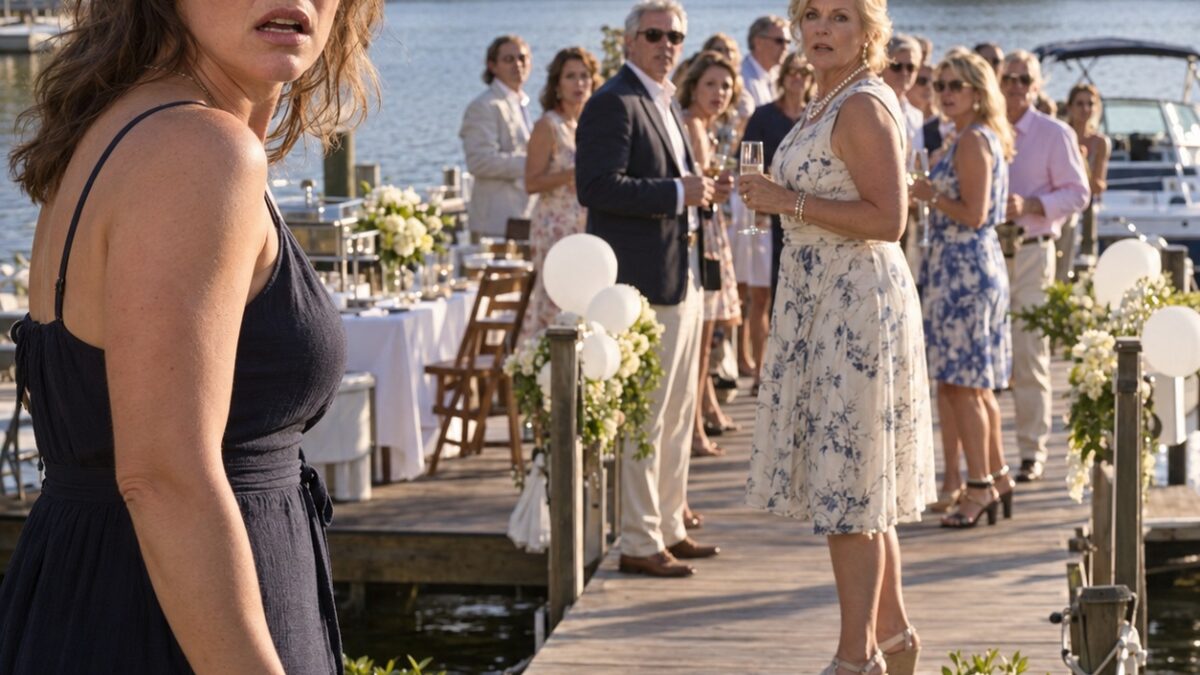
“What are you doing?” Diane asked.
I unlocked my phone.
“Documenting this.”
Her entire posture changed.
The warm, community-president smile vanished.
“Sarah, there are guests here.”
“I noticed.”
“This is somebody’s anniversary.”
“I noticed that too.”
The woman in the floral dress looked from Diane to me.
Her name, I later learned, was Rebecca Collins.
She was celebrating her parents’ fortieth wedding anniversary.
At that moment, she simply looked mortified.
“I’m sorry,” she said. “We were told this was an HOA event space.”
I turned toward her.
“You don’t owe me an apology.”
Diane cut in immediately.
“Sarah, please don’t involve paying guests in a property disagreement.”
Paying guests.
There it was again.
Not neighbors.
Not residents who misunderstood access.
Customers.
I raised my phone and photographed the dock.
The balloons.
The folding tables.
The floral arrangements.
The catering setup.
The boat tied to my railing.
The small sign near the path that read:
COLLINS 40TH ANNIVERSARY
PRIVATE EVENT
Diane stepped in front of me.
“That’s enough.”
I lowered the phone.
“Move.”
“You are making everyone uncomfortable.”
“You rented my property to strangers.”
“That is a gross oversimplification.”
“It’s six hundred dollars worth of simplification.”
Rebecca winced.
Diane looked at her.
“Please return to your guests. I’ll handle this.”
Rebecca didn’t move.
Instead, she looked at me.
“Do you want us to leave?”
That was the first moment I felt truly awful.
Because none of those people had done anything wrong.
They were dressed for a celebration.
An older couple stood near the end of the dock holding champagne glasses, smiling uncertainly while everyone around them pretended not to listen.
A little girl in a pale yellow dress was carrying a cupcake.
A caterer stood beside a tray of food, clearly wondering whether he should continue serving or start packing.
This was supposed to be a happy memory for somebody.
Diane had put me in the position of either letting strangers remain on my property or ruining a fortieth anniversary in front of thirty people.
And I suddenly understood exactly why she had chosen a party instead of quietly sending two families back onto the dock.
Pressure.
Social pressure.
If I objected, I looked unreasonable.
If I allowed it, she could later say I had consented.
I looked at Rebecca.
“How long is the event scheduled?”
“Until eight.”
It was just after four.
I looked at Diane.
“Did you know I was out of town?”
Her expression didn’t change.
But she answered too slowly.
“I knew you had mentioned travel at the last community meeting.”
I had.
The realization made my skin crawl.
She had not accidentally scheduled an event while I happened to be away.
She knew.
“Did you know I wasn’t supposed to return until tomorrow?”
“That has nothing to do with this.”
“Yes, it does.”
Rebecca looked at Diane now.
“Did you know she was gone?”
Diane ignored her.
“Sarah, the association has historically managed waterfront access. Your attorney’s letter did not resolve the underlying issue.”
“My attorney told you to stay off my dock.”
“Your attorney expressed an opinion.”
“He sent you my deed.”
“Documents can be interpreted.”
“The property line is a straight line.”
Her voice sharpened.
“You are not a land-use attorney.”
“No. That’s why I hired one.”
Several guests were openly watching now.
The music kept playing, creating a bizarre soundtrack to the argument.
I took a breath.
Then looked at Rebecca.
“I’m not asking your family to leave this second.”
Diane relaxed visibly.
I continued.
“But I need a copy of whatever you signed or received from the HOA.”
Diane stepped forward.
“No.”
Rebecca frowned.
“No?”
“That agreement is between the association and the renter.”
I looked at her.
“The renter?”
She realized what she had said.
Too late.
Rebecca pulled out her phone.
“I have the confirmation email.”
Diane said, “Rebecca—”
“I paid six hundred dollars.”
“Yes, and we will discuss—”
“I want to know what I paid for.”
She turned toward me.
“What’s your email?”
I gave it to her.
Thirty seconds later, my phone buzzed.
I opened the message.
The subject line read:
HAWTHORNE SHORES WATERFRONT EVENT RESERVATION CONFIRMATION
I clicked the attachment.
A professionally formatted PDF opened.
At the top was the HOA logo.
Below it:
PRIVATE LAKEFRONT EVENT PACKAGE
MITCHELL DOCK – WEST WATERFRONT
Capacity: 35
Resident Rate: $600
Nonresident Sponsored Rate: $850
My hands went cold.
Not “lakefront dock.”
Not “west dock.”
MITCHELL DOCK.
My name.
My property.
Listed like a clubhouse rental.
I scrolled.
Included amenities:
Private dock access.
Boat tie-up.
Waterfront lawn access.
Two electrical outlets.
Temporary decorating privileges.
Trash removal.
Event host assistance upon request.
Waterfront lawn access.
I looked over my shoulder at my backyard.
My lawn.
They weren’t only renting the dock.
They were renting the area behind my house.
The document continued.
Quiet hours after 9:00 p.m.
No open flame.
No amplified music above association limits.
Maximum four-hour reservation window.
I stopped.
Four-hour reservation window.
That implied repetition.
Not one event.
A system.
I looked at Diane.
“How long have you been doing this?”
She crossed her arms.
“This conversation should happen privately.”
“How long?”
“Sarah.”
“How many times have you rented my dock?”
Rebecca whispered, “Oh my God.”
Diane looked toward the guests.
“Please.”
I stepped closer.
“How many?”
Her expression hardened.
“You are creating a scene.”
“No. I came home to one.”
That got a reaction from somebody behind her.
A man coughed to hide a laugh.
Diane’s face flushed.
“I am not discussing association finances in front of nonmembers.”
Rebecca said, “I’m a member.”
Diane turned.
Rebecca continued.
“My parents live on Laurel Point. I’m their daughter. They sponsored the event.”
Diane looked trapped.
I almost felt sorry for her.
Almost.
Then I saw another line near the bottom of the reservation document.
Site coordinator: Diane Parker.
Emergency contact: Hawthorne Shores HOA.
I took screenshots.
Diane watched me.
“What exactly are you planning to do?”
“I don’t know yet.”
“You need to be careful.”
That phrase made me laugh.
Not loudly.
Just once.
“About what?”
“Making accusations.”
“I’m reading your rental agreement.”
“Which reflects longstanding community practice.”
“Then why didn’t you send it when I asked for the records?”
She opened her mouth.
Nothing came out.
I held up the phone.
“This document was created April nineteenth.”
Rebecca looked at me.
“How can you tell?”
“The footer.”
Diane said nothing.
My attorney’s letter had been sent February twenty-sixth.
So the HOA had created—or at least updated—a rental form nearly two months after being formally told my dock was private.
That changed everything.
If the form had been ten years old, she could claim institutional confusion.
But April nineteenth?
They had been warned.
Then they formalized it.
I looked at Rebecca.
“Please finish the event.”
Diane turned sharply.
“What?”
I ignored her.
“I’m serious. Your family didn’t know.”
Rebecca looked relieved and embarrassed at the same time.
“I feel terrible.”
“Don’t.”
“I can pay you directly.”
“No.”
Diane jumped in.
“Exactly. The fee was paid to the association.”
I looked at her.
“That wasn’t agreement.”
Her mouth closed.
I continued.
“Rebecca, enjoy your parents’ anniversary. I’m going inside.”
“You’re sure?”
“Yes.”
“But what about—”
“I’ll deal with the HOA separately.”
Her shoulders relaxed.
“Thank you.”
I nodded.
Then I looked at Diane.
“You need to come inside.”
She stared.
“No.”
“Then leave my property.”
“I am coordinating the event.”
“Not anymore.”
Her eyes narrowed.
“You cannot order the HOA president off association-managed event space.”
Rebecca whispered, “Diane.”
I didn’t raise my voice.
“Leave.”
“Sarah—”
“Now.”
For several seconds, we stared at each other.
Then something changed in her face.
She understood that the audience no longer protected her.
Every person on the dock now knew there was a property dispute.
Rebecca knew she had paid.
The rental agreement was already in my inbox.
If Diane continued arguing, she risked giving me more witnesses.
She lifted her handbag from a chair.
“This is not over.”
I said, “I’m starting to understand that.”
She walked up my lawn and disappeared around the side of the house.
I watched until I heard her car start.
Then I went inside and locked the door.
My hands were shaking.
I stood in the kitchen staring at the dock through the glass.
The party slowly resumed.
Music.
Laughter.
Champagne.
From a distance, it looked beautiful.
That somehow made it worse.
I called Daniel Reeves.
He answered with the distracted tone of someone still at his office on a Friday afternoon.
“Sarah?”
“You’re going to love this.”
“That sentence has never preceded anything I loved.”
“The HOA rented my dock for six hundred dollars.”
Silence.
“Say that again.”
“There are thirty people outside my house celebrating a fortieth anniversary.”
Another silence.
“Are you safe?”
“Yes.”
“Did anyone enter the house?”
“No.”
“Damage?”
“Not that I can see.”
“Do you have proof they paid the HOA?”
“I have the reservation confirmation.”
“Send it.”
I forwarded it.
He opened it while we were still speaking.
I knew exactly when he reached the title.
“Mitchell Dock?”
“Yes.”
“Jesus.”
“Keep reading.”
He did.
“Waterfront lawn access?”
“Yes.”
Another pause.
“This was created in April.”
“I noticed.”
“After my letter.”
“Yes.”
His voice changed.
Daniel was usually calm.
Almost boring.
I trusted boring attorneys.
It meant they thought before speaking.
Now he sounded angry.
“Sarah, do not communicate with Diane tonight.”
“I already did.”
“Further.”
“Okay.”
“Do not post anything online.”
“I won’t.”
“Take photographs after the event ends.”
“Of what?”
“Everything. Grass. Dock. Cleats. Electrical outlets. Trash. Any damage.”
“All right.”
“Save every email. Screenshot the PDF. Forward the original.”
“Done.”
“Did Diane admit anything?”
“She called Rebecca a renter.”
“Witnesses?”
“Thirty.”
He exhaled.
“Good.”
That felt strange.
“Good?”
“Good for evidence. Not good for you.”
“What do we do?”
“First, we find out whether this was the first rental.”
I looked back toward the party.
“I don’t think it was.”
“Why?”
“The form describes a four-hour reservation window and has rates for residents and sponsored nonresidents.”
“Agreed.”
“And Diane knew I was out of town.”
That silence lasted longer.
“Can you prove that?”
“I mentioned my conference at the community meeting.”
“Recorded?”
“I don’t know.”
“Find out.”
My stomach tightened.
“You think she scheduled around my absence?”
“I think we don’t accuse anyone of that until we have evidence.”
Classic Daniel.
“Okay.”
“I’ll send a preservation letter tonight.”
“To the HOA?”
“To the HOA, management company, board members, and whoever handles their website or booking system.”
“There’s a booking system?”
“I’m guessing.”
“Why?”
“The PDF has a reservation number.”
I looked at the top.
He was right.
HS-WF-0624-117.
“One seventeen.”
“Exactly.”
A cold sensation moved through me.
“Daniel.”
“I see it.”
“That doesn’t necessarily mean one hundred seventeen dock rentals.”
“No.”
“But it means there’s a system.”
“Yes.”
I stared through the glass.
At 7:52, Rebecca knocked on my back door.
I stepped outside.
Most guests were leaving.
The caterer was packing.
The older couple—her parents—stood near the path.
Rebecca handed me a small envelope.
“What’s this?”
“My phone number. And a copy of everything.”
“You already emailed it.”
“There’s more.”
She gave me her phone.
A text thread.
Diane.
Two weeks earlier.
The messages read:
Your requested date is available. West Waterfront/Mitchell Dock is ideal for approximately 25–35 guests.
Then:
The homeowner is scheduled to be away that weekend, so parking and noise should not be an issue.
My stomach dropped.
I looked at Rebecca.
“She told you I’d be gone?”
Rebecca nodded slowly.
“I didn’t understand what she meant at the time.”
I took screenshots with permission.
“Can you send this to me?”
“Already did.”
I looked toward the driveway.
“You didn’t know.”
“I swear.”
“I know.”
Her father approached.
He was maybe seventy, silver-haired, wearing a blue blazer.
“Sarah?”
“Yes.”
“I’m Tom Collins.”
He held out his hand.
I shook it.
“My daughter explained.”
“I’m sorry this happened during your anniversary.”
He looked almost offended.
“You have nothing to apologize for.”
His wife joined him.
She held my hand between both of hers.
“If somebody rented my backyard while I was away, I’d be calling the sheriff.”
That hadn’t occurred to me.
Not seriously.
Maybe because HOA disputes are so often framed as paperwork.
Fines.
Covenants.
Meetings.
Letters.
But strip away the logo and the titles.
Thirty strangers were on my private property because someone accepted money for access without my permission.
Tom said, “Did they pay you anything?”
“No.”
“Were you even told?”
“No.”
His expression hardened.
“Then this isn’t a misunderstanding.”
Diane would spend the next several months calling it exactly that.
A misunderstanding.
An administrative discrepancy.
A historical-use conflict.
A good-faith interpretation of community access.
Anything except what it felt like from my kitchen window.
Someone had sold time on my property because they assumed I wouldn’t catch them.
By nine, everyone was gone.
Rebecca and her family left the dock cleaner than they found it.
They even removed the balloons.
I walked the entire area with my phone camera.
No major damage.
One fresh scrape on the outer railing.
A small wine stain on the cedar.
Two divots in the lawn from table legs.
Nothing worth fighting over.
Then I checked the outdoor electrical outlet.
An extension cord ran from it toward the catering area.
My outlet.
My electricity.
They hadn’t only rented my dock and lawn.
They had included my power.
I photographed the meter.
Then I sat at the kitchen table and opened every HOA email I had received since buying the house.
At 10:14, I found something I had ignored months earlier.
A community newsletter from March.
Near the bottom:
SUMMER WATERFRONT RESERVATIONS NOW OPEN
Residents interested in hosting private gatherings should contact the HOA office for available dates and approved waterfront locations.
Approved waterfront locations.
Plural.
I searched older newsletters in the association portal.
April.
May.
The same language.
Then I found photographs.
The HOA had an online gallery.
Summer picnic.
Graduation celebration.
Book club sunset social.
Engagement party.
Most were at the community marina.
But one photograph made my heart stop.
It showed my dock.
I recognized the railing.
The shape of the shoreline.
My neighbor’s red boathouse in the distance.
String lights were wrapped around my posts.
At least twenty people were sitting at tables.
The photograph was dated the previous summer.
Before I owned the house.
I stared at it.
Maybe Diane had been telling the truth about one thing.
The previous owner really had allowed use.
But permission from the previous owner did not automatically transfer with the house.
I downloaded the image.
Then another.
And another.
Three events.
All on my dock before I bought the property.
Then I found one dated after my closing.
September 14.
I had owned the house for eleven days.
I remembered that weekend.
I had gone to Charlotte to help my sister move.
The photo showed nine women on my dock holding wine glasses.
A banner read:
LADIES OF HAWTHORNE BOOK CLUB.
My pulse quickened.
I searched the date in my calendar.
Gone from Friday through Sunday.
Another photo.
October 7.
A retirement party.
I had been visiting my mother in Raleigh.
December 2.
Holiday wine tasting.
I had been at my company Christmas retreat.
January 20.
Birthday brunch.
I had spent that weekend skiing with friends in West Virginia.
I sat back from the computer.
Every event I could identify had happened while I was away.
That was not a misunderstanding.
It was scheduling.
I started a spreadsheet.
Date.
Event.
Source.
Was I home?
Evidence.
By midnight, I had seven possible events on my dock after I purchased the house.
Seven.
The Collins anniversary made eight.
I could prove I had been away for six.
The other two were daytime events during work hours.
I had probably never known.
At 12:37, Daniel emailed.
Preservation notices sent.
Then another message.
Go to sleep.
I replied with the spreadsheet.
He called me immediately.
“You ignored my advice.”
“You told me to preserve evidence.”
“I told you to sleep.”
“There were at least eight events.”
Silence.
“After you bought?”
“Yes.”
“How many after my February letter?”
I looked.
Three.
Including tonight.
Daniel swore quietly.
I had never heard him swear before.
“You found photos?”
“HOA gallery.”
“Download everything.”
“Already did.”
“Do not alert them that you found it.”
“Why?”
“Because tomorrow that gallery may disappear.”
He was right.
By Saturday afternoon, the entire waterfront-events gallery was gone.
I had copies.
So did Daniel.
Monday morning began with an HOA email.
Dear Hawthorne Shores Residents,
The Board is aware of concerns raised regarding historical waterfront reservation practices. Out of respect for all parties, waterfront reservations are temporarily suspended while records are reviewed.
Temporarily suspended.
Not stopped.
Reviewed.
At 9:03, Daniel sent the HOA a second letter.
This one was twelve pages.
He demanded:
All rental records involving my dock or lawn.
All payments.
All reservation confirmations.
All board minutes discussing waterfront access.
All communications mentioning my property.
All insurance records.
All photographs.
All website logs.
All vendor agreements.
All accounting entries.
All correspondence with previous owners.
And confirmation that no one would enter, advertise, rent, reserve, or represent my property as available without my written consent.
The HOA’s attorney responded two days later.
His name was Charles Benton.
He described the matter as “a potentially correctable disagreement regarding historical recreational access.”
Daniel forwarded that sentence to me.
I called.
“What does that mean?”
“It means they are nervous.”
“Why?”
“Because if they thought they had clear legal rights, the letter would say so.”
That made sense.
The HOA scheduled an emergency board meeting for Thursday.
I went.
The clubhouse had never been so full.
News travels quickly in neighborhoods built around water.
Especially when the news involves money.
Diane sat in the center of the board table.
Beside her were vice president Alan Burke, treasurer Nancy Feldman, secretary Kathy Moore, and board member Steven Price.
I recognized Alan and Steven.
I barely knew the others.
Diane opened with a prepared statement.
“The association has recently become aware that a homeowner disputes longstanding community use of a waterfront amenity historically identified as West Waterfront Dock.”
I nearly laughed.
My attorney had attended with me.
Daniel leaned closer.
“Don’t.”
“I didn’t say anything.”
“Your face did.”
Diane continued.
“The board is committed to resolving this matter respectfully while preserving community access rights.”
Daniel wrote something on a legal pad.
I glanced down.
What access rights?
I smiled.
He covered the note.
Diane described the Collins event as “unfortunate timing.”
Not trespass.
Not unauthorized rental.
Timing.
Then she opened homeowner comments.
Mark Ellis stood first.
He lived three streets over.
“I paid four hundred fifty dollars for my daughter’s graduation party last July.”
The room murmured.
Diane said, “Thank you, Mark.”
“No. I’m asking a question.”
She stiffened.
“Go ahead.”
“Was that Sarah’s dock?”
I looked at him.
He looked embarrassed.
Diane said, “It was the West Waterfront location.”
Mark turned toward me.
“Was it your dock?”
“Yes.”
He closed his eyes.
“I’m sorry.”
I nodded.
Then he looked at Diane.
“Where did my money go?”
Treasurer Nancy Feldman shifted in her chair.
Diane said, “Reservation revenue supports community amenities.”
“What does that mean?”
“It goes into the general operating fund.”
Mark frowned.
“So the HOA rented somebody’s private dock and put the money into the general fund?”
Diane’s jaw tightened.
“That ownership issue remains disputed.”
Daniel raised one finger beside me.
Stay quiet.
I did.
Another homeowner stood.
Then another.
A woman named Julie Brennan said she had paid $500 for an engagement party.
A man named Keith Sloan had paid $350 for a fishing-club gathering.
A woman near the door said she paid $700 for a small wedding reception.
My stomach turned.
This was bigger than the photos.
Nancy Feldman, the treasurer, looked increasingly uncomfortable.
Finally she leaned toward the microphone.
“I need to clarify something.”
Diane looked at her.
“Nancy—”
“I need to.”
The room settled.
Nancy opened a binder.
“The association has a revenue category labeled Waterfront Private Events.”
I watched Diane.
Her expression didn’t change.
Nancy continued.
“Last year, it generated $11,850.”
A low murmur spread across the room.
“This year to date, $6,900.”
I felt Daniel sit straighter beside me.
Someone called, “How much of that was Sarah’s dock?”
Nancy looked down.
“I don’t know.”
Diane interrupted.
“Because the funds are not site-specific.”
Daniel whispered, “Convenient.”
Nancy continued.
“I reviewed the reservation calendar this afternoon.”
Diane turned sharply.
“You did what?”
“I reviewed it.”
“How many?” I asked before Daniel could stop me.
Every head turned.
Nancy looked at me.
Diane said, “Sarah, you do not have the floor.”
Nancy answered anyway.
“Twenty-two reservations were assigned to West Waterfront over the previous twenty-four months.”
My mouth went dry.
Twenty-two.
Some before I bought.
Some after.
“How many since September?” I asked.
Nancy looked at the calendar.
“Thirteen.”
The room went silent.
Thirteen events.
I had found eight.
Five more had happened without leaving public photographs I could identify.
“How many after February twenty-sixth?” Daniel asked.
Diane snapped, “Counsel will not conduct discovery during a board meeting.”
Nancy looked at the dates.
“Five.”
Five events after Daniel’s formal letter telling them the dock belonged exclusively to me.
The Collins party wasn’t a rogue mistake.
It was the fifth.
I stared at Diane.
She finally looked back.
No smile.
No maternal patience.
Just anger.
“You knew,” I said.
Daniel touched my arm.
Too late.
Diane leaned into her microphone.
“What I knew was that the association had longstanding use.”
“You had my deed.”
“We had conflicting historical records.”
“Show me one.”
“This is not the forum.”
“It’s been four months. You still haven’t shown me one document.”
She looked toward Charles Benton, the HOA attorney.
He wasn’t there.
I wondered if he had advised her not to speak.
If so, she ignored him.
“The prior owner allowed unrestricted community use.”
I said, “That’s not a property right.”
“Again, you are not an attorney.”
Daniel finally spoke.
“I am.”
The room became very quiet.
Diane looked at him.
Daniel stood.
“My office requested any deed, easement, license, covenant, reservation, lease, or other recorded instrument supporting HOA access to Ms. Mitchell’s dock.”
Diane said nothing.
“As of five o’clock today, none has been provided.”
Nancy looked at Diane.
Alan Burke looked at Diane.
Steven Price looked at Diane.
The board suddenly seemed less united.
Daniel continued.
“What has been provided is evidence that the association received money from third parties for use of Ms. Mitchell’s property after being placed on written notice that the property was privately owned.”
Diane said, “That is your interpretation.”
“Yes.”
He smiled slightly.
“That is why courts exist.”
No one spoke for several seconds.
Then Alan Burke asked a question that changed the entire meeting.
“Diane, when did you first learn Sarah’s closing attorney disputed our use?”
She stared at him.
“You received the correspondence.”
“I’m asking when.”
“February.”
“And we kept renting it?”
“The issue was under review.”
Alan leaned back.
“Did the board vote to continue?”
Diane’s expression tightened.
“We did not need a specific vote to administer existing amenities.”
Nancy spoke.
“I don’t remember a vote.”
Steven said, “Neither do I.”
Diane looked at them like they had betrayed her.
“You were aware reservations continued.”
Steven shook his head.
“I knew waterfront reservations continued. I assumed they were at the marina.”
So did I.
That was the trick.
The association called both locations “waterfront.”
West Waterfront.
Community Marina.
Without an address, most board members apparently never asked what West Waterfront actually meant.
Nancy turned pages.
“I approve deposits, not site assignments.”
Alan looked at Diane.
“Who assigns locations?”
She didn’t answer.
The property manager, a woman named Melinda Hayes, sat near the wall.
Everyone looked at her.
She swallowed.
“Diane normally handles waterfront scheduling.”
There it was.
Not the board.
Diane.
She had built the system.
Maybe she inherited the practice, but she had personally kept it going after being warned.
Alan asked, “Did you schedule around Sarah’s travel?”
The room went so quiet that the air-conditioning sounded loud.
Diane laughed.
“That is absurd.”
I took out my phone.
Daniel looked at me.
This time he didn’t stop me.
I read Rebecca’s message aloud.
“The homeowner is scheduled to be away that weekend, so parking and noise should not be an issue.”
People gasped.
Diane’s face went white.
Nancy whispered, “You wrote that?”
Diane said, “That message has been taken out of context.”
“What context makes it better?” Alan asked.
No answer.
Then something unexpected happened.
Melinda, the property manager, began crying.
Quietly.
She wiped her face and stood.
“I need to say something.”
Diane said, “Melinda, don’t.”
That was the worst possible thing she could have said.
Melinda looked at her.
“You told me Sarah had agreed to honor existing reservations.”
My stomach dropped.
“What?”
Melinda turned toward me.
“After your attorney’s letter came in, I told Diane we should cancel everything at West Waterfront.”
Diane said, “That’s not accurate.”
Melinda ignored her.
“She said you had spoken privately and agreed not to disrupt reservations that were already booked.”
“I never spoke to her.”
“I know that now.”
The room erupted.
Diane hit the gavel.
“Order!”
Nobody listened.
Melinda continued through tears.
“I asked for written confirmation. Diane said you were being difficult and didn’t want to put anything in writing.”
I stared at her.
“How many reservations were already booked?”
“Three.”
“But five happened after the letter.”
She looked confused.
“That can’t be right.”
Nancy checked the calendar.
“It is.”
Melinda walked to the board table.
“Show me.”
They looked together.
Her face changed.
“Two of these were added later.”
“By who?” Alan asked.
Nancy looked at the system log.
Then at Diane.
“D. Parker.”
The meeting exploded.
People shouted.
Somebody demanded Diane resign.
Someone else yelled about refunds.
A woman behind me said, “Call the police.”
Diane stood.
“This meeting is adjourned.”
Alan reached for the gavel.
“No.”
She stared at him.
“I am president.”
“And I am vice president.”
“You do not have authority to override—”
“I move that we enter executive session immediately regarding potential misconduct by an officer.”
Nancy said, “Second.”
Steven said, “Agreed.”
Diane looked around the table.
Kathy Moore, the secretary, slowly raised her hand too.
Four board members.
Diane stood alone.
The homeowners cheered.
Daniel leaned toward me.
“Now we leave.”
“What?”
“You have enough.”
“I want to hear—”
“No.”
“Daniel.”
“Sarah, from this point forward, every extra sentence is risk.”
I hated when he was right.
We left.
At 10:16 that night, an HOA-wide email arrived.
Diane Parker had been temporarily suspended from all reservation and financial authority pending board review.
Alan Burke would serve as acting president.
All waterfront rentals were canceled.
The HOA would refund affected reservations.
The next morning, Diane called me from her personal number.
I didn’t answer.
She left a voicemail.
“Sarah, I know you’re upset, but you do not understand the damage you are causing. This community has operated cooperatively for years. People were happy. The dock was being used responsibly. Nobody was hurting you. You came here eight months ago and decided decades of tradition suddenly meant nothing. I hope you think carefully about what happens next.”
I listened twice.
Then sent it to Daniel.
He responded:
Do not delete this.
I typed:
I wasn’t planning to.
His reply:
I know. I just enjoy saying obvious lawyer things.
For the first time all week, I laughed.
Then the records arrived.
Not voluntarily.
Not completely.
But enough.
The HOA’s insurer got involved.
So did outside counsel.
The reservation calendar showed twenty-two West Waterfront rentals over two years.
Thirteen occurred after I bought the house.
The HOA collected $7,150 from events held on my dock during those eight months.
Five took place after Daniel’s warning letter.
Two were booked after that letter.
Diane had personally approved both.
One was the Collins anniversary.
The other had been a retirement brunch while I attended my cousin’s wedding in Richmond.
The records also showed something I hadn’t expected.
The previous owner, Harold Benton, had not given the HOA unrestricted access.
He had signed a one-year revocable license eleven years earlier allowing the neighborhood social committee to use the dock for four specific community events.
Four.
One year.
The license expired a decade ago.
Harold renewed it twice.
Then stopped.
But the HOA kept using the dock.
At first occasionally.
Then increasingly.
Somewhere along the way, four community gatherings became paid private events.
And a temporary license became “historical community access.”
I asked Daniel how that could happen.
He said, “Slowly.”
“That’s the legal explanation?”
“That’s the human explanation.”
He showed me the old licenses.
They were simple.
Harold allowed the HOA to use the dock for:
Spring fishing derby.
Fourth of July picnic overflow.
Labor Day gathering.
Autumn boat parade viewing.
No fees.
No private events.
No commercial use.
No transfer.
No permanent easement.
Each license explicitly said:
Permission may be revoked at any time and shall not create any property right.
I stared at the sentence.
“How did Diane get from this to six-hundred-dollar anniversaries?”
“Apparently by not reading the last line.”
The records also contained emails.
Hundreds.
Most boring.
Some not.
Three years earlier, Diane wrote to a former treasurer:
West dock remains underutilized. We should monetize private reservations to offset marina maintenance.
Former treasurer:
Do we have written permission from Harold?
Diane:
He has never objected.
Treasurer:
That isn’t what I asked.
Diane:
I’ll handle it.
No follow-up.
Two years later, another message.
Resident asks whether West Waterfront belongs to HOA.
Diane:
Functionally, yes. It has always been managed as common waterfront.
Functionally.
I had learned to hate that word.
Then, after I bought the property:
New owner appears more territorial than Harold. Avoid unnecessary confrontation.
Two weeks later:
Schedule West Waterfront only when Mitchell is unlikely to be home until we resolve ownership discussion.
I had to stop reading.
Daniel saw my face.
“You okay?”
“No.”
“Take a break.”
“She knew.”
“Yes.”
“This entire time.”
“Yes.”
“She wasn’t confused.”
“Not by the time you bought.”
I felt strangely violated.
More than I had at the party.
Because the records meant someone had been watching my routines.
Not stalking me in some criminal-thriller sense.
But noting when my car wasn’t there.
When I traveled.
When I worked.
When my house was empty enough to turn my backyard into an event venue.
I remembered mornings when a chair had seemed slightly moved.
A tiny piece of ribbon near the dock ladder.
A bottle cap in the grass.
Once, I found wax near the railing and assumed it came from the previous owner.
Now those details rearranged themselves.
Evidence doesn’t always arrive dramatically.
Sometimes the truth makes old memories change shape.
I asked Daniel, “Can we sue her personally?”
“Yes.”
“Should we?”
“That is a different question.”
“What would you do?”
“I don’t give clients that answer.”
“Convenient.”
“My job is to tell you options.”
“So tell me.”
We had claims worth discussing.
Trespass.
Conversion or unjust enrichment related to rental income.
Potential nuisance issues.
Property damage, though minimal.
Possible personal liability for Diane if she acted outside board authority.
The HOA’s insurance carrier wanted settlement.
So did the new acting board.
Diane hired her own lawyer.
That told me the HOA had stopped protecting her.
The first settlement offer was almost insulting.
The HOA would pay me $4,000.
They would permanently discontinue private rentals.
Each side would pay its own legal fees.
Daniel slid the letter across his desk.
“What do you think?”
“I think they made over seven thousand dollars on my property.”
“Good.”
“And I already spent more than four thousand on you.”
He smiled.
“Also good.”
“You’re enjoying this.”
“No.”
“Yes, you are.”
“A little.”
We rejected it.
Second offer.
$12,500 plus legal fees.
No admission of wrongdoing.
I said no.
Daniel asked why.
“Because I don’t care enough about the number.”
“That usually makes settlement easier.”
“I want the property issue dead.”
“It can be.”
“I want a recorded document.”
He nodded.
Now we were talking.
I wanted the HOA to formally acknowledge:
My dock was private.
My lawn was private.
No recreational easement existed.
No community access right existed.
No historical-use claim would be asserted.
No reservation could occur without my written permission.
The association would remove all references to West Waterfront as an amenity.
Any old maps or directories would be corrected.
Daniel added reimbursement of all rental revenue collected after I purchased the property.
Attorney’s fees.
Cost to repair the dock railing.
And compensation for unauthorized use.
The HOA countered.
Negotiations lasted six weeks.
During that time, Diane launched her own campaign.
She sent letters to residents.
She claimed I was trying to “privatize historically shared lake access.”
That phrase showed up everywhere.
Historically shared.
The community marina still existed.
The public boat launch still existed.
The swimming platform still existed.
Nobody had lost lake access.
They had lost the ability to rent my backyard.
But facts mattered less than framing.
Some residents turned against me.
Not most.
Enough.
Someone left a note in my mailbox.
HOPE YOU ENJOY YOUR PRIVATE KINGDOM.
Another wrote online:
Why move into a community if you hate community?
That one bothered me.
I almost responded.
Daniel stopped me.
“Never wrestle in mud with people who screenshot.”
So I said nothing.
Then Rebecca Collins posted.
I hadn’t asked her to.
She wrote a long message in the resident group.
She described booking her parents’ anniversary.
She posted the reservation document.
She posted Diane’s text saying I would be away.
Then she wrote:
Sarah Mitchell did not disrupt our anniversary. She allowed thirty strangers to remain on her private dock after discovering the HOA had charged us for access without her permission. If anyone thinks she is anti-community, I was there. She treated my family with more courtesy than the HOA treated her.
The tone online changed almost overnight.
Mark Ellis added his receipt.
Julie Brennan added hers.
Others followed.
Residents began comparing confirmations.
Then someone noticed something.
Different prices.
$350.
$450.
$600.
$700.
$850.
No published schedule explained the differences.
Treasurer Nancy started digging.
That created the next problem.
Some reservation payments had gone directly through the HOA portal.
Those were accounted for.
Others had been paid by check.
Still accounted for.
But six payments had been made through a mobile payment account connected to “Hawthorne Social Events.”
That account was not owned by the HOA.
It belonged to Diane.
When Daniel called me, his voice was careful.
“Before you get excited, we don’t know what this means.”
“She took money?”
“We know payments went to an account in her name.”
“How much?”
“Roughly twenty-eight hundred dollars over eighteen months.”
“Did she put it into the HOA account later?”
“Some appears to have been transferred.”
“Some?”
“About sixteen hundred.”
My stomach turned.
“What about the rest?”
“Unknown.”
“Is that theft?”
“Sarah.”
“I’m asking.”
“And I’m telling you not to use criminal labels until an audit is complete.”
I sighed.
“What happens?”
“The board hired a forensic accountant.”
That investigation had almost nothing to do with me.
And yet it grew directly from someone deciding my dock was theirs to rent.
Three weeks later, Diane resigned from the board.
Her resignation letter blamed “an atmosphere of hostility and personal attacks.”
She did not mention the mobile payment account.
The forensic review eventually found $1,240 in reservation money that could not be documented as transferred to the HOA.
Diane claimed those funds reimbursed her for decorating supplies, cleaning costs, and event expenses.
Receipts supported some.
Not all.
The HOA settled the accounting issue privately after its insurer and counsel became involved.
I never learned every detail.
By then I didn’t want to.
I wasn’t trying to destroy Diane.
I wanted my dock back.
But one fact mattered.
The moment someone treats boundaries as optional because they think they know better, the habit rarely stays confined to one boundary.
Property.
Board authority.
Money.
Truth.
Diane seemed to believe rules were flexible whenever she was the person doing the interpreting.
The final mediation happened in September.
One year after I bought the house.
I sat beside Daniel at a long conference table.
Across from us were Alan Burke, Nancy Feldman, the HOA’s new attorney, and an insurance representative.
Diane did not attend.
Her claims had been separated.
The association wanted peace.
So did I.
Alan began.
“Sarah, before we talk numbers, I want to apologize.”
I didn’t expect that.
He continued.
“The board should have investigated this years ago.”
“You weren’t president then.”
“I was vice president.”
“You didn’t know.”
“That’s not a complete excuse.”
I respected that.
Nancy spoke next.
“The old license was sitting in our archived files.”
“I know.”
“I approved financial reports showing waterfront revenue without asking which waterfront.”
She looked ashamed.
“I should have.”
I said, “You’re not the person who scheduled events.”
“No. But organizations fail collectively too.”
That sentence stayed with me.
Because it was true.
Diane had driven the abuse.
But systems survive because other people assume somebody else checked.
The settlement took six hours.
When we finished, the HOA agreed to pay:
Every dollar collected from rentals on my property after my purchase.
My documented attorney’s fees.
Dock repair and restoration.
Additional compensation for unauthorized use.
The total was enough to matter but nowhere near the absurd six-figure revenge numbers people like to imagine in stories like mine.
That was fine.
The important part was six pages of property language.
The Hawthorne Shores HOA expressly acknowledged that my dock, shoreline access, lawn, and associated improvements were privately owned and not common property.
The association disclaimed any easement, license, prescriptive right, implied right, or historic-use claim.
No HOA officer or agent could enter for recreational, event, or administrative purposes without my permission except for genuine emergencies or legally authorized access.
The “West Waterfront” amenity designation was permanently retired.
Maps would be corrected.
Online references removed.
Rental materials destroyed.
And one more thing.
The HOA agreed to record a memorandum in the county land records confirming it claimed no recreational interest in my waterfront parcel.
I wanted future owners protected.
Not because I planned to sell.
Because someday somebody would.
And I never wanted another person to stand in their kitchen staring at strangers on the dock while an HOA president explained that tradition was more important than title.
Daniel handed me the pen.
“You sure?”
I looked at the agreement.
“Yes.”
I signed.
Alan signed.
Nancy signed as secretary.
The insurer signed.
Then it was done.
At least legally.
Emotionally took longer.
For months, I felt uneasy leaving town.
Before every trip, I checked my cameras.
Yes, I installed cameras.
Three of them.
One facing the backyard.
One toward the dock.
One along the side path.
Not because I expected another party.
Because trust had been damaged.
The first weekend away after settlement, I checked the feed from my hotel room six times.
Empty dock.
Second night.
Empty.
Third morning.
Empty.
I laughed at myself.
Then almost cried.
That is what violations do sometimes.
They make normal privacy feel temporary.
It took months before I stopped checking.
The neighborhood changed too.
Alan Burke became HOA president officially after the next election.
He lasted one term.
His first meeting as elected president began with a thick binder.
“Property map,” he announced.
People laughed.
He didn’t.
Every board member received copies of:
Common-area deeds.
Marina documents.
Utility easements.
Trail easements.
Stormwater agreements.
Licenses.
Boundary maps.
And a bright red sheet titled:
DOES THE HOA ACTUALLY OWN OR CONTROL IT?
The checklist beneath it was simple.
Deed?
Recorded easement?
Written license?
Contract?
Statutory authority?
If no, stop.
Ask counsel.
I loved it.
Nancy became president two years later.
She invited me to serve on the board.
I laughed for nearly a minute.
“I’ll take that as a no,” she said.
“Very strong no.”
“Can’t blame me for asking.”
“You absolutely can.”
We became friendly eventually.
Not close.
But friendly.
Diane stayed in the neighborhood for almost another year.
I saw her sometimes.
At the grocery store.
Driving past.
Once at the community mailbox.
The first few times, she looked through me.
Then one evening, six months after settlement, I walked down to my dock carrying a cup of coffee.
She was standing on the public walking trail near the community marina.
She saw me.
I saw her.
For some reason, she walked over.
She stopped at the edge of my property.
That detail mattered.
She didn’t step onto the grass.
“Sarah.”
“Diane.”
Silence.
She looked toward the dock.
“No parties.”
“No.”
She smiled bitterly.
“Happy?”
I thought about the question.
“Yes.”
That seemed to surprise her.
“You got what you wanted.”
“My property?”
“You know what I mean.”
“I actually don’t.”
She folded her arms.
“The whole neighborhood used to be different.”
“How?”
“More open.”
I waited.
“People shared things.”
“Some people did.”
“Harold never cared.”
“Harold signed licenses.”
Her jaw tightened.
“That proves he was willing.”
“For specific events.”
“He understood community.”
“So do I.”
“You sued the community.”
“I settled with the HOA.”
“Same thing.”
“No.”
She looked at me.
“What’s the difference?”
“The community didn’t rent my dock.”
Her eyes hardened.
“You benefited from living here.”
“I pay dues.”
“Property values come from the neighborhood.”
“I know.”
“The marina. Roads. landscaping. events.”
“I know.”
“So what would it have hurt to let people use the dock?”
I stared at her.
There it was.
After everything.
The question underneath all of it.
What would it have hurt?
That was how she still saw it.
Not ownership.
Not consent.
Not money.
Harm.
If she could not identify dramatic damage, then apparently my no had no value.
I set my coffee on the railing.
“Diane, if you had asked me whether the HOA could rent my dock for one event, I might have said yes.”
She looked skeptical.
“I might have.”
“Then why all of this?”
“Because you didn’t ask.”
She shook her head.
“That’s such a technical distinction.”
“No.”
I looked directly at her.
“That is the whole distinction.”
She said nothing.
“You looked at my travel schedule.”
“We knew when you were away.”
“Exactly.”
“You’re making it sound sinister.”
“I’m making it sound intentional.”
She looked toward the water.
After a while, she said, “The reservation money helped the association.”
“Then rent HOA property.”
“The marina books up.”
“That sounds like an HOA problem.”
She laughed bitterly.
“You always have an answer.”
“No. I just know where my backyard ends.”
She turned to leave.
Then stopped.
“I did what I thought was best.”
I believed her.
That was the disturbing part.
“I know.”
She looked back.
“That doesn’t matter to you?”
“It matters.”
“Then?”
“It doesn’t give you permission.”
Her face changed slightly.
For the first time, I thought she might actually understand.
Not agree.
Understand.
She nodded once.
Then walked away.
Three months later, she sold her house.
The new owners were a young couple with two children.
They moved in during spring.
On their first weekend, I saw them walking along the shoreline trail.
The father waved.
I waved back.
That was all.
Normal.
I had forgotten how much I missed normal.
My dock became exactly what I had imagined when I bought the house.
Coffee before work.
Books at sunset.
Bare feet over water.
Murphy sleeping in the shade.
Friends occasionally.
My sister.
My mother.
A few neighbors I genuinely liked.
And yes, eventually, a party.
That surprised everyone.
Especially me.
It happened two summers after the settlement.
Rebecca Collins called.
We had stayed in occasional contact.
Her parents were celebrating their forty-second anniversary.
She joked:
“Don’t worry. I’m not asking to rent the dock.”
I laughed.
Then thought about it.
“Why not?”
Silence.
“What?”
“Do they want to come back?”
“You’re serious?”
“Small group.”
“Sarah, after what happened—”
“That was not your fault.”
Two weeks later, Rebecca’s parents returned.
Not thirty people.
Twelve.
No rental fee.
No HOA logo.
No secret booking.
Rebecca asked first.
That changed everything.
She brought flowers.
Her father brought a bottle of wine.
Her mother hugged me.
We set one table near the shore.
No caterer.
No amplified music.
Just dinner.
At sunset, Tom Collins lifted his glass.
“To permission.”
Everyone laughed.
I did too.
That night became one of my favorite memories at the house.
Not because it erased what happened.
Because it proved something important.
A boundary is not a wall against generosity.
It is what makes generosity possible.
If I cannot say no, then my yes is meaningless.
I had spent months being described by Diane as selfish because I wanted control over my own property.
But control did not mean I never shared it.
It meant sharing was my decision.
That distinction changed the entire emotional shape of the dock for me.
For a while, the place felt contaminated by the dispute.
I’d look at the railing and remember Diane’s hand resting on it.
I’d see the lawn and picture rented tables.
I’d hear music across the lake and remember walking home early.
Eventually, new memories replaced those.
My mother teaching Murphy to climb the dock ladder.
My sister dropping her phone in the lake.
Rebecca’s parents dancing badly at sunset.
A thunderstorm rolling across the water while I watched from the screened porch.
Ordinary life reclaimed the place.
Daniel Reeves remained my attorney.
Unfortunately for my bank account.
A few years later, I refinanced the house.
He called during the title review.
“Guess what appears in the county records?”
“What?”
“The HOA memorandum.”
I smiled.
“Good.”
“The title examiner highlighted it.”
“Even better.”
“Future Sarah thanks current Sarah.”
“I hope there’s never another Sarah.”
“You know what I mean.”
I did.
Documents outlive arguments.
That was something I hadn’t understood before buying lakefront property.
People think ownership is obvious.
Fence.
House.
Dock.
Lawn.
But ownership lives on paper as much as on land.
Surveys.
Deeds.
Recorded instruments.
Licenses.
Easements.
People also underestimate how quickly repeated permission can start looking like entitlement.
Harold had been generous.
That was all.
He allowed several neighborhood events.
Then a few more.
The HOA became comfortable.
Years passed.
New board members arrived.
Someone stopped asking.
Someone else started charging.
By the time I moved in, the story had changed completely.
The dock had “always” been a community amenity.
That is how myths form.
Not necessarily through one giant lie.
Through small details disappearing.
The one-year license disappears.
The four-event limit disappears.
The no-property-right clause disappears.
Harold’s permission disappears.
Eventually only the use remains.
And repeated use begins to feel like ownership.
Diane did something worse.
Once I challenged the story, she received the records proving it was not that simple.
Instead of stopping, she adapted.
She renamed the dock.
West Waterfront.
She scheduled around my absences.
She told the property manager I had agreed to honor reservations.
She kept the system alive because stopping would have required admitting the system had no foundation.
Pride can make ordinary disputes incredibly expensive.
The settlement cost the HOA.
Legal fees.
Insurance involvement.
Audit expenses.
Refunds.
My compensation.
Recorded corrections.
More than the waterfront rental program had earned in years.
All to protect something they never owned.
Sometimes I wonder what would have happened if my conference had not ended early.
I would have arrived Saturday evening.
The Collins party would have been gone.
Maybe Rebecca would never have contacted me.
The dock would have looked normal.
Perhaps I would have found a wine cork.
A scrape.
A moved chair.
I might have blamed wind.
Or myself.
The next event would happen.
Then another.
Maybe months later I would notice something.
Maybe not.
That is the part that still bothers me.
Not that strangers were there.
That the system depended on me not knowing.
There is something uniquely unsettling about discovering that people behave differently on your property when they believe you are absent.
Diane once called that statement melodramatic.
I don’t.
Privacy is partly the belief that what belongs to you remains yours when you leave.
Your locked house.
Your yard.
Your porch.
Your dock.
You do not expect ownership to switch off when your car leaves the driveway.
That morning—actually, that afternoon—changed my relationship with the word “community.”
Before then, I thought the opposite of community was isolation.
I don’t anymore.
The opposite of healthy community is entitlement.
A good community asks.
A healthy neighborhood respects no.
Neighbors borrow things and return them.
They invite.
They share.
They help.
But they do not decide that because something would benefit everyone, the person who owns it loses the right to choose.
That lesson became important again when Hawthorne Shores discussed expanding the marina.
The HOA needed temporary construction access across two private lots.
Old Diane-era thinking would have treated resistance as obstruction.
Nancy did it differently.
She met with both owners.
Asked.
Negotiated.
Paid for temporary easements.
Recorded them.
Construction finished.
Everyone remained friends.
One afternoon she called me.
“You realize this is partly your fault.”
“What is?”
“We now document everything like we’re buying nuclear material.”
“That sounds healthy.”
“It’s exhausting.”
“Also healthy.”
She laughed.
“Daniel has infected you.”
Maybe.
Or maybe thirty strangers with champagne had.
Five years after the incident, the dock needed rebuilding.
The cedar decking had softened near the ladder.
Two pilings were beginning to shift.
A marine contractor quoted the work.
I almost replaced it with a larger dock.
More seating.
Covered section.
Boat lift.
Then I decided not to.
I rebuilt almost exactly what was there.
Simple cedar.
Two chairs.
Small table.
Open water.
When the contractor removed one old railing board, he found dozens of tiny staple holes underneath.
“What were these from?”
I looked.
Decorations.
Balloons.
Banners.
String lights.
Years of events.
He asked, “You used to throw parties?”
I smiled.
“Not exactly.”
He looked confused.
“Long story.”
We replaced the board.
I kept a small piece of it.
Not because I am sentimental about conflict.
Because the marks told a story.
People had attached decorations there for years.
Some with permission.
Some without.
The wood didn’t know the difference.
I did.
The rebuilt dock was finished in May.
That first evening, I carried a glass of wine to the end.
No music.
No balloons.
No strangers.
Just lake water against the pilings.
A heron near the opposite reeds.
Murphy’s successor—an absurd Labrador named Charlie—sleeping behind my chair.
I thought about the title company.
Daniel.
Rebecca.
Alan.
Nancy.
Even Diane.
All those people connected to one rectangle of wood over water.
I thought about the six hundred dollars that exposed it.
That was the funny part.
The money wasn’t really the problem.
If Diane had knocked on my door and said:
Sarah, Rebecca’s parents are celebrating forty years. Would you consider letting them use the dock? The HOA will pay you six hundred dollars.
I might have said yes.
Maybe I would have asked to meet them.
Maybe I would have set conditions.
Maybe I would have declined.
The point is, there would have been a choice.
Instead, she sold the choice too.
That was what I could never accept.
For years after, people who heard the story focused on the most dramatic details.
Thirty strangers.
Champagne.
HOA president.
$600 rental.
Secret booking.
But the moment I remember most clearly happened before any shouting.
Rebecca asked:
“Do you want us to leave?”
There was fear in her face.
Embarrassment.
She had paid for something she suddenly realized the seller might not own.
I could have destroyed her parents’ anniversary to prove a point.
Maybe legally I had every right.
But she wasn’t the person who wronged me.
That distinction mattered.
People often talk about boundaries as if they require cruelty.
They don’t.
I could let Rebecca stay and still refuse Diane.
I could be generous without surrendering ownership.
I could forgive guests without forgiving the conduct that put them there.
Maturity, I learned, often means refusing to punish the wrong person.
Years later, Rebecca sent me a photograph from that first anniversary party.
I had never seen it.
Taken before I arrived.
Her parents stood at the end of my dock beneath white balloons.
The lake behind them was glowing gold.
They were looking at each other, not the camera.
Happy.
On the back she wrote:
A beautiful memory born from a terrible arrangement. Thank you for protecting the first without excusing the second.
I framed it.
That surprises people when I tell them.
Why keep a photograph of the unauthorized party?
Because not everything connected to a bad experience has to remain bad.
The Collins family did nothing wrong.
Their happiness was real.
My violation was real.
Both things can exist together.
Life is complicated that way.
Diane never apologized.
Not formally.
The conversation near the trail was the closest we ever came.
For a while I thought I needed her to say it.
I was wrong.
I had no right.
I shouldn’t have done it.
Eventually I realized an apology would not change the deed.
It would not change the recorded memorandum.
It would not change the cameras.
It would not change how the HOA operated afterward.
And most importantly, it would not change what I knew.
Some people need the person who harmed them to agree with reality before they can move forward.
I understand that.
But I learned another way.
You can stop arguing.
You can let the records speak.
You can let behavior have consequences.
You can build new memories.
You can sit on your dock at sunset and stop wondering whether the person who violated your boundary finally understands why it mattered.
Her understanding is not required for your peace.
That lesson was worth more than the settlement.
Occasionally a new resident still hears an old version of the story.
Last summer, a couple moved into the house two doors down.
The wife came over while I was gardening.
“Can I ask you something weird?”
“Sure.”
“Did the HOA really used to own your dock?”
I laughed.
“No.”
“Oh.”
“Why?”
“Someone told us there was a lawsuit and you bought it from the HOA.”
“That is impressively wrong.”
She looked embarrassed.
“What actually happened?”
I pointed toward the dock.
“They rented it.”
“From you?”
“No.”
Her eyebrows rose.
“Then how?”
“Exactly.”
She stared at the water.
“How many times?”
“Thirteen while I owned the house.”
Her mouth opened.
“You didn’t know?”
“No.”
“How did you find out?”
I smiled.
“I came home early.”
That was all it took.
One canceled conference day.
One drive home I wasn’t supposed to make.
One glance through the kitchen window.
Sometimes the truth is waiting behind your house with champagne.
People ask whether I was lucky.
Yes.
I was lucky I came home.
Lucky Rebecca kept the emails.
Lucky Daniel told me to preserve evidence immediately.
Lucky the HOA had saved the old licenses.
Lucky several board members cared more about fixing the problem than protecting Diane.
Lucky the Collins family responded with decency.
But I also learned that luck works better when followed by documentation.
Photographs.
Screenshots.
Receipts.
Dates.
Recorded deeds.
The first time two families used my dock, I handled it casually.
I assumed one correction would be enough.
When Diane told me “our records indicate otherwise,” I could have argued endlessly.
Instead, I asked for the records.
She never sent them.
That should have told me something.
People with documents usually show documents.
People with authority can usually identify the source of authority.
When someone responds to a specific question with tone, history, tradition, community expectation, or “this is how things have always been done,” I pay much closer attention now.
Tradition can be meaningful.
It is not a deed.
Confidence can be impressive.
It is not an easement.
Repetition can feel permanent.
It is not ownership.
And an HOA logo at the top of a rental form does not magically give someone the right to sell what belongs to somebody else.
The county memorandum is still recorded against the HOA’s records.
The title examiner will find it someday when this house eventually sells.
I hope that day is far away.
But when it comes, the next owner will know.
PRIVATE DOCK.
NO HOA RECREATIONAL RIGHTS.
It sounds almost ridiculous that those words needed to be formally recorded.
But they did.
Because once a story has been repeated long enough, sometimes the truth needs stronger handwriting.
I keep my closing survey in a drawer near the kitchen.
The original is digitized and stored securely.
But I like the paper copy.
A thick black line surrounds my parcel.
The dock is drawn at the bottom.
Simple.
Unambiguous.
Every time I see it, I remember Diane telling me:
“Our records indicate otherwise.”
She wasn’t completely lying.
Her records did indicate otherwise.
They just weren’t property records.
They were calendars.
Event sheets.
Old newsletters.
Assumptions.
A decade of people calling something “West Waterfront” until the name became more real to them than the deed.
That is why the conflict became so strange.
Diane did not believe she was taking something.
In her mind, she was defending something the neighborhood already possessed.
The problem was that belief does not create title.
It only creates confidence.
Sometimes dangerous confidence.
The last HOA meeting I attended was years later.
Nancy was retiring as president.
At the end, she gave a short speech.
She thanked volunteers.
Board members.
Committee chairs.
Then she looked at me.
“And Sarah Mitchell taught us perhaps the most expensive lesson in Hawthorne Shores history.”
Everyone laughed.
I covered my face.
She continued.
“If something is not ours, we do not rent it.”
More laughter.
Then she added:
“And if we aren’t sure whether it’s ours, we check before charging six hundred dollars.”
I laughed too.
There was a time that joke would have made me angry.
Now it didn’t.
Because the story belonged to me again.
Not to Diane.
Not to the HOA.
Not to the legal dispute.
I could laugh because I no longer felt powerless inside it.
After the meeting, Alan approached.
“You know, I still remember that night.”
“The emergency meeting?”
“Yeah.”
“What about it?”
“When Melinda said Diane told her you approved the reservations.”
I nodded.
“I thought the association might actually implode.”
“It came close.”
He smiled.
“I learned something.”
“What?”
“Never let one person become the only person who knows how a system works.”
That was another good lesson.
Diane controlled the reservation calendar.
She understood the naming system.
She communicated with renters.
She knew when residents traveled.
She knew the history—or the version of it she preferred.
Everyone else trusted her expertise.
Expertise without oversight eventually becomes power.
Power without questions becomes habit.
Habit becomes entitlement.
That is not only an HOA problem.
It happens in companies.
Families.
Clubs.
Governments.
Anywhere people stop asking the boring question.
What gives you the right to do that?
The first time I asked Diane, she never answered.
Not really.
She said history.
Community.
Previous owners.
Records.
Practice.
Tradition.
Never deed.
Never easement.
Never license.
Never permission from me.
Years later, her entire argument still collapses into that missing answer.
I sometimes imagine my younger self standing in the kitchen on that Friday afternoon.
Travel bag on the floor.
Music outside.
Thirty strangers.
White balloons.
Diane holding a wineglass.
That version of me had no idea how long the next year would become.
Attorneys.
Meetings.
Screenshots.
Financial records.
Neighbors choosing sides.
Settlement drafts.
Cameras.
Sleepless nights.
If I could tell her one thing, it wouldn’t be:
Call the police.
Sue everybody.
Throw the guests out.
Fight harder.
It would be simpler.
Do not let someone else’s confidence make you doubt what you already verified.
I had the deed.
The survey.
The title report.
My attorney’s opinion.
I knew the dock was mine.
Yet when Diane stood there saying “the association approved it,” a tiny part of me still wondered whether I had missed something.
That is what confident people can do.
They make your certainty feel rude.
They make basic questions feel confrontational.
They make boundaries sound selfish.
They make “no” sound like aggression.
I don’t fall for that as easily anymore.
Today, if someone tells me they have authority over something I own, I ask one question.
“Show me.”
Not angrily.
Not dramatically.
Show me.
If they have the deed, show me.
If they have the easement, show me.
If they have a contract, show me.
If they have a court order, show me.
If they have nothing except “this is how we’ve always done it,” then we are not discussing law.
We are discussing habit.
Habits can change.
That Friday afternoon, Diane thought she had history on her side.
Nine years as HOA president.
Years of events.
Old permission from Harold.
A neighborhood accustomed to using the waterfront.
A reservation system.
Paying guests.
Even my travel schedule.
She had everything except the one thing she actually needed.
My permission.
That was why her face changed when Rebecca said:
“We rented it through the HOA.”
Until that second, Diane still controlled the story.
She could call the event community access.
Historical use.
A private gathering.
She could tell me we would discuss it later.
But money changed the question.
Someone had paid.
Someone had sold.
And I was the owner standing there wondering why nobody had asked me.
That question eventually opened everything.
The old license.
The expired permission.
The twenty-two reservations.
The thirteen events after I bought the house.
The five after the attorney’s warning.
The travel scheduling.
The personal payment account.
The board’s lack of knowledge.
The false claim that I had agreed.
All of it began with six hundred dollars and one nervous woman telling the truth.
I still have the original Collins reservation PDF.
Daniel told me I could delete it after everything ended.
I didn’t.
It sits in a digital folder with the deed, the settlement, and the county memorandum.
Every once in a while, I open it.
MITCHELL DOCK – WEST WATERFRONT.
Capacity: 35.
Resident Rate: $600.
I no longer get angry.
Mostly I’m amazed.
Not by the audacity.
By how official something can look while having no authority behind it.
Logo.
Reservation number.
Rules.
Fee schedule.
Cancellation policy.
Official email.
Site coordinator.
Every visual signal told Rebecca the HOA had the right to sell access.
Only one thing was missing.
The owner.
That may be the most important thing I learned from the entire experience.
Illegitimate authority rarely introduces itself by saying:
I have no right to do this.
It arrives with forms.
Titles.
Policies.
Confident language.
A clipboard.
Sometimes a wineglass.
And it counts on you being too intimidated, too polite, too confused, or simply too absent to ask the question that makes everything wobble.
Who gave you permission?
On that Friday afternoon, nobody had a good answer.
Not Diane.
Not the HOA.
Not the old reservation system.
Not ten years of tradition.
The answer was supposed to be me.
And for the first time since buying the house, everyone finally understood that.








