HOA Called the Sheriff on Me for “Trespassing”—Then One Old Deed Turned Their Entire Neighborhood Upside Down
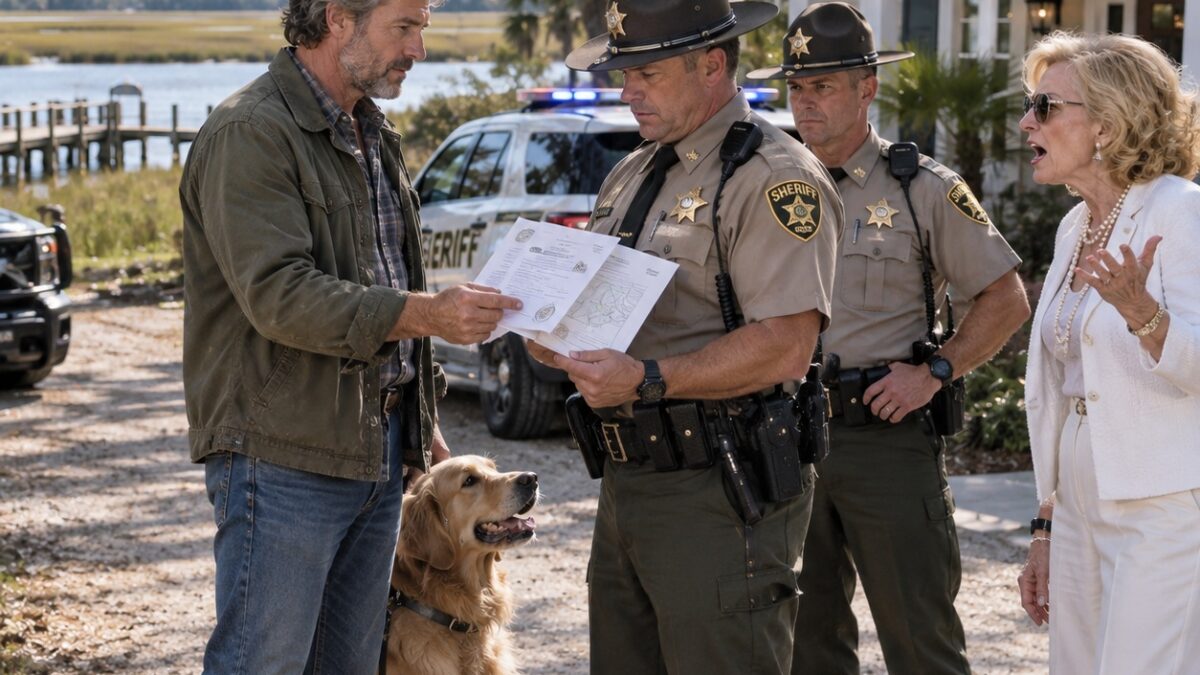
Sixty-eight days earlier, I had no idea there was going to be a fight.
I was trying to survive grief.
That was enough.
My wife, Vivien, had been dead eighteen months.
There are deaths that arrive after long conversations with doctors, whispered decisions in hospital corridors, and enough time for a family to begin saying goodbye before they are ready.
Vivien’s wasn’t like that.
She collapsed in our kitchen on a Sunday morning while pouring tea.
One moment she was complaining that I had bought the wrong brand of marmalade.
The next, the cup shattered.
By the time the ambulance arrived, she was gone.
A ruptured aneurysm.
Fast.
Merciless.
Our daughter, Laya, was fourteen.
I remember almost nothing about the first week after Vivien died except sounds.
The refrigerator humming.
People knocking.
Casserole dishes being placed on counters.
Laya’s bedroom door closing.
The cello not playing.
That last sound—the absence of it—was the worst.
Vivien had taught music at a small Episcopal school near Brunswick.
She could take a room full of twelve-year-olds vibrating with energy and somehow make them sit still for Schubert.
Laya inherited her ear.
And her stubbornness.
Before the funeral, Laya practiced cello almost every evening.
Afterward, she didn’t touch it for three months.
I didn’t pressure her.
I had spent twenty-eight years as a forensic title examiner for a regional title insurer out of Savannah.
The job had taught me patience with paper.
Grief was different.
Paper eventually answered questions.
Grief kept changing them.
Six months after Vivien died, I retired.
People assumed I had made enough money.
That wasn’t really why.
I could no longer sit under fluorescent lights reconstructing the ownership of shopping centers while my daughter ate dinner alone.
I sold our house in Brunswick.
That decision caused arguments.
Laya accused me of erasing Mom.
I accused her of being unfair.
Then apologized because she was sixteen and had lost her mother.
Eventually, we moved twenty-five miles north to a small cottage my grandfather built in 1971.
The cottage sat on one acre of family land near a subdivision called Live Oak Plantation Estates.
It wasn’t fancy.
Two bedrooms downstairs.
A small loft room upstairs that became Laya’s.
Screened porch.
Tin roof.
Tabby driveway.
Marsh behind it.
Palmettos.
Live oaks heavy with Spanish moss.
The property needed work.
One shutter hung crooked.
The porch screens had three tears.
The kitchen cabinets had been painted so many times the doors no longer shut properly.
It was perfect.
My grandfather, J.W. Pickering, had built the place before developing the surrounding land.
When he later laid out Live Oak Plantation Estates, he kept the cottage acre for himself.
He always called it “the quiet piece.”
Granddaddy died when I was twenty-eight.
My father used the cottage occasionally.
After Dad died, ownership passed to me through Pickering Land Holdings LLC, the family company Granddaddy had created back when real-estate developments still involved cigarettes in courthouse hallways and plats drawn by hand.
Laya and I moved in on a Tuesday.
For three days, nobody bothered us.
She unpacked books.
I repaired a window.
Duke discovered squirrels.
On Friday afternoon, I opened the mailbox and found a cream-colored envelope.
The paper was thick.
Embossed oak tree at the top.
LIVE OAK PLANTATION ESTATES HOMEOWNERS ASSOCIATION.
I assumed it was a welcome note.
Technically, it was.
WELCOME TO LIVE OAK PLANTATION ESTATES.
Below that were three “initial compliance observations.”
Exterior paint not approved.
Mailbox noncompliant.
Pet observed off leash on common property.
I read the letter twice.
Duke sat beside me.
“You’re a criminal.”
He yawned.
At the bottom:
Marina Puit, President.
I didn’t know Marina.
I knew of her.
People around coastal Georgia knew the Puit family.
Her husband, Bradford, served on the county council.
They owned a construction company through relatives, invested in waterfront properties, sponsored charity dinners, and appeared in enough local photographs to suggest they enjoyed appearing in local photographs.
I put Duke inside and drove to Live Oak.
The development consisted of forty-eight houses arranged around curving roads under enormous live oaks.
Most homes were built in the late seventies and eighties.
Some had been renovated into expensive coastal properties.
The clubhouse sat near the marsh with a swimming pool on one side and a boat ramp behind it.
I parked.
Marina opened the office door herself.
She looked almost exactly like someone named Marina Puit should look.
Late fifties.
Salon-blonde hair.
White linen.
Pearls.
Perfect makeup at eleven in the morning.
“Mrs. Puit?”
“Yes?”
“Sterling Pickering.”
A brief flicker of recognition.
Then a smile.
“Mr. Pickering. Welcome.”
“I received your letter.”
“Good. We like to get new residents oriented quickly.”
“There seems to be a misunderstanding.”
She kept smiling.
“I’m sure we can solve it.”
“My cottage isn’t part of your HOA.”
The smile remained.
Her eyes changed.
“Sweetheart, every property within Live Oak Plantation Estates is subject to the association.”
“My parcel isn’t within the subdivision plat.”
“All homes within the natural community boundary are governed by Live Oak.”
“Natural community boundary isn’t a title term.”
That irritated her.
People accustomed to controlling conversations often dislike vocabulary that doesn’t cooperate.
“Mr. Pickering, I’ve served on this board for twelve years.”
“I understand.”
“We have forty-eight homes.”
“My cottage makes forty-nine buildings, not forty-nine lots.”
She stared at me.
“My driveway enters from County Road 9.”
“That doesn’t matter.”
“My deed says it does.”
“All owners here follow the same standards.”
“I’m not an owner here.”
“You just said you live here.”
“I own adjacent family property.”
The distinction did not interest her.
She leaned against the doorframe.
“Mr. Pickering, I appreciate that you’re new, but I would hate for this relationship to become unnecessarily adversarial.”
That was an interesting sentence to use on a man correcting a mailing list.
“I agree.”
“Then come to orientation Tuesday.”
“No, thank you.”
Her smile vanished.
“I’m sorry?”
“I’m not joining an association my property isn’t part of.”
“You don’t have a choice.”
I studied her.
For twenty-eight years, I had watched buyers, lenders, lawyers, developers, and government agencies become emotionally attached to inaccurate assumptions.
Sometimes correcting them took one page.
Sometimes one year.
I didn’t yet know which kind Marina would be.
“I’ll send you the recording information.”
She folded her arms.
“We already know our boundaries.”
Apparently the second kind.
I drove home.
Laya was upstairs practicing cello.
Bach.
The same passage repeated again and again.
Each time slightly cleaner.
I opened the fire safe.
Pulled my deed.
Put it on the kitchen table.
Then I created a file folder.
On the tab, I wrote:
LIVE OAK.
The next morning, I drove to the county clerk’s office in Darien.
I knew the staff.
Retired title examiners never truly stop haunting courthouses.
The clerk, Denise Harper, looked over her glasses.
“You’re retired.”
“Apparently not enough.”
“What are we hunting?”
“1973 subdivision plat. Live Oak Plantation Estates.”
She disappeared into records.
Ten minutes later, she returned with a protective sleeve.
The moment I saw the plat, I recognized Granddaddy’s handwriting.
There were forty-eight lots.
Clubhouse parcel.
Pool parcel.
Boat ramp.
Greenbelts.
Road network.
Entry tract.
Marsh access.
And in the southeast corner, one small rectangle.
ONE ACRE.
RESERVED — PICKERING FAMILY — NOT SUBJECT TO PLAT.
I leaned back.
There are few professional pleasures greater than being correct in ink recorded fifty years earlier.
“Find what you wanted?” Denise asked.
“Yes.”
“Good news?”
“Depends how unreasonable the other person is.”
She laughed.
I ordered certified copies.
That afternoon, Marina’s second letter arrived.
No welcome this time.
It stated that all parcels “within the master community boundaries” were subject to association authority regardless of “personal opinion.”
Regardless of personal opinion.
I appreciated the phrase.
Not legally.
Comedically.
I wrote a professional response.
No emotion.
No sarcasm.
Book and page numbers.
Recorded plat reference.
Parcel identification.
Reservation language.
I concluded:
I respectfully request that all further correspondence regarding alleged HOA violations cease, as the Pickering family parcel falls outside the legal authority of Live Oak Plantation Estates Homeowners Association.
Certified mail.
Return receipt.
Three days passed.
Then Laya came into the kitchen holding a paper plate.
“Dad?”
Something in her voice made me put down my coffee.
“What?”
“Someone left these on the porch.”
Three violation notices.
Shrubbery encroachment.
Improper kayak storage.
Unauthorized bird feeder.
All dated that morning.
Placed beneath a brick.
I recognized the brick.
Same pale handmade style as the walkway outside the clubhouse.
I photographed everything.
Then walked the property.
Near the marsh, I found fresh footprints.
Narrow shoe.
Deep heel.
Someone had walked around the cottage.
Laya stood on the porch in pajama pants, arms folded.
“Why is she doing this?”
“She probably doesn’t like being told no.”
“That’s stupid.”
“Power and intelligence aren’t automatically related.”
“Are you going to pay?”
“No.”
“Are you going to take down Mom’s bird feeder?”
The feeder had belonged to Vivien.
She used to fill it every Sunday.
“No.”
Laya relaxed.
“Good.”
The situation became personal at that moment.
Not because of the bird feeder.
Because Marina had walked onto a grieving teenager’s porch to leave intimidation.
I didn’t know for certain it was Marina.
But I knew someone connected to the HOA had trespassed.
That evening, I pulled the corporate file for Pickering Land Holdings LLC.
The company surprised me.
Granddaddy had formed it in 1972.
After he died, my father maintained it.
After Dad died, it passed to me.
I had kept annual registrations current almost automatically because title people dislike dissolving entities attached to old land.
I hadn’t thought about why it existed in years.
The corporate file contained the development agreement for Live Oak.
My grandfather had acquired 164 acres.
He subdivided residential lots.
Recorded restrictive covenants.
Sold houses through the LLC.
Reserved the cottage acre.
Then something caught my attention.
The original declaration described several “common-use areas to be subsequently conveyed to an owners’ association upon completion of development.”
Subsequently conveyed.
I stopped.
The declaration did not itself convey ownership.
It promised a later deed.
Maybe Granddaddy had recorded one.
Probably.
Developers did that all the time.
But “probably” is a dangerous word in title work.
I pulled the county online index.
Searched Pickering Land Holdings.
Lots.
Mortgage releases.
Utility easements.
Drainage easements.
Nothing obvious for the common areas.
I stared at the screen.
No.
Couldn’t be.
The subdivision had existed for more than fifty years.
Surely the clubhouse and roads had been conveyed.
I told myself I was missing an instrument.
Then the sheriff drive-bys started.
One patrol car Monday.
Another Tuesday evening.
Wednesday morning, Deputy Avery Coats stopped.
He was young.
Broad shoulders.
Good manners.
Embarrassed.
“Mr. Pickering?”
“Yes.”
“I wanted to explain why you’ve been seeing us.”
“I assumed tourism.”
He almost smiled.
“Mrs. Puit has called dispatch six times.”
“Six?”
“Loose dog. Loud music. Suspicious activity. Trespassing. Some complaint about a kayak.”
I looked toward Duke.
He was asleep upside down on the porch.
Avery followed my eyes.
“For what it’s worth, I’ve personally been here four times.”
“And?”
“I’ve seen one quiet house, one teenage girl, one father, and a retriever too lazy to pursue organized crime.”
I laughed.
“Thank you.”
He looked serious again.
“I’m documenting everything accurately.”
“I appreciate that.”
“Mrs. Puit is persistent.”
“So am I.”
“I’m beginning to notice.”
I requested copies of every incident report.
Then Marina hired an attorney.
The letter arrived on cream paper from a Savannah firm.
It demanded $1,275 in accumulated HOA fines.
Threatened lien.
Threatened collection costs.
Claimed my assertion of exemption had “no legal basis.”
Then came my favorite sentence.
Mr. Pickering’s position appears to rest primarily upon verbal assertions regarding historical ownership.
Verbal assertions.
I had sent certified documents.
That sentence told me whoever wrote the letter either had not received my response or had been told not to care.
I called Garrett Fairley.
Garrett practiced real-estate law in Brunswick.
We had worked together on title problems for twenty years.
He answered.
“Sterling?”
“Retirement has failed.”
“Knew it would.”
“I need coffee.”
“That’s serious.”
We met the next morning.
I brought the folder.
Garrett read silently.
Marina’s letters.
My deed.
Subdivision plat.
Attorney demand.
Sheriff reports.
Corporate file.
He reached the declaration.
Stopped.
Read again.
“Sterling.”
“Yes.”
“Is Pickering Land Holdings still active?”
“Yes.”
“Good standing?”
“Yes.”
“Please tell me your grandfather conveyed the common areas later.”
“I was hoping you would tell me.”
He looked at me.
“You haven’t checked?”
“Not fully.”
“Go check.”
“I planned to.”
“No. Go now.”
I smiled.
“Why?”
“You know why.”
“I’d like to hear you say it.”
He leaned forward.
“If the declaration promised a later conveyance, and your grandfather never recorded that conveyance, fee title could still be in the development company.”
“Residents may have easement rights.”
“Yes.”
“Association may have maintenance rights.”
“Probably.”
“But ownership…”
“Could be yours.”
I paid for the coffee.
Drove directly to Darien.
For the next three hours, I searched.
Every conveyance.
Forty-eight residential lots transferred cleanly.
Restrictive covenants.
Utility agreements.
Boat access provisions.
Then nothing.
No clubhouse deed.
No pool deed.
No road deed.
No marsh tract deed.
No boat-ramp deed.
No entry parcel deed.
I expanded the search.
Pickering Land Holdings as grantor.
Nothing.
As grantee.
Nothing relevant.
HOA as grantee.
Nothing.
I checked name variations.
Live Oak Property Owners Association.
Live Oak Plantation Association.
Live Oak Estates HOA.
Nothing.
Denise walked over.
“You look like you found a body.”
“Worse.”
“Title defect?”
“Fifty-year-old one.”
“Those are the fun kind.”
“For examiners.”
“You are one.”
“Retired.”
“No one believes you.”
I ordered a current ownership index.
The result printed slowly.
Pickering Land Holdings LLC.
Clubhouse parcel.
Pickering Land Holdings LLC.
Pool parcel.
Pickering Land Holdings LLC.
Boat ramp.
Pickering Land Holdings LLC.
Greenbelts.
Pickering Land Holdings LLC.
Private road network.
I sat there.
Granddaddy had never transferred them.
Maybe he forgot.
Maybe the lawyer forgot.
Maybe everyone assumed another instrument completed it.
For half a century, the HOA had maintained, insured, regulated, landscaped, and controlled property it did not own in fee simple.
They likely had extensive easement and equitable rights.
Residents clearly possessed recorded access rights.
I couldn’t simply close roads.
Nor would I.
But legal title mattered.
Especially because Marina had just threatened a lien against the one parcel Granddaddy explicitly excluded from her authority.
My phone buzzed.
Text.
Bradford Puit.
Marina’s husband.
Local councilman.
Mr. Pickering, let’s settle this like gentlemen. Coffee tomorrow. Clubhouse. 9 sharp.
I looked at the ownership report.
Then at his message.
Clubhouse.
My grandfather’s company still owned the land beneath it.
For the first time since Marina’s letters started, I smiled.
I arrived at nine.
Bradford waited inside.
He was sixty-two.
Tall.
Gray hair.
Navy blazer.
A man who had spent enough years in public meetings to master the handshake that says both friend and witness.
“Sterling.”
“Bradford.”
“Coffee?”
“Please.”
Marina sat at the conference table.
She did not offer a greeting.
Beside her was the HOA attorney, Neil Baston.
That told me coffee was not coffee.
Bradford gestured.
“Sit.”
I did.
He folded his hands.
“Things have gotten unnecessarily heated.”
“I agree.”
“Marina tells me you’ve been confrontational.”
I looked at her.
“Did she?”
Her jaw tightened.
Bradford continued.
“You’re new to the neighborhood.”
“No.”
“Excuse me?”
“My family developed it.”
“I mean newly resident.”
“That’s different.”
He smiled thinly.
“Fair.”
Neil Baston slid a document across the table.
“We’ve prepared a simple resolution.”
I did not touch it immediately.
“What does it resolve?”
“Your disputed association status.”
“How?”
“Recognition of historical membership in exchange for waiver of accumulated penalties.”
I looked at Neil.
“You want me to join the HOA.”
“We’re saying your parcel has always been within the master community.”
“No.”
Marina exhaled sharply.
Bradford held up one hand.
“Sterling, we’re trying to give you an easy path.”
“Toward what?”
“Peace.”
“That document would subject my parcel to restrictions it has never carried.”
Neil said, “It clarifies ambiguity.”
“There is no ambiguity.”
Marina laughed.
“Here we go again.”
I finally picked up the document.
It was worse than expected.
It didn’t merely acknowledge HOA membership.
It ratified the declaration.
Granted the HOA enforcement authority.
Recognized the cottage parcel as part of the “master planned community.”
And included a broad release of all title claims relating to common areas.
I read that sentence twice.
There it was.
They knew.
Maybe not Marina originally.
But someone knew now.
I looked at Neil.
“How long have you known about the common-area title issue?”
His face changed.
Slightly.
Bradford answered too quickly.
“What issue?”
I smiled.
“You shouldn’t do that.”
“Do what?”
“Answer before your lawyer.”
Marina pushed back her chair.
“This is ridiculous.”
I turned the paper around.
“Paragraph eleven.”
Nobody spoke.
“Why would I release title claims relating to common areas if no title issue exists?”
Neil removed his glasses.
“Standard language.”
“No.”
“Mr. Pickering—”
“I wrote title exceptions for twenty-eight years. That isn’t standard language.”
Bradford leaned back.
“Your grandfather intended the common areas for the community.”
“I agree.”
“Then why make trouble?”
“I haven’t.”
Marina laughed.
“You have done nothing but make trouble.”
I looked at her.
“You mailed fines to my daughter’s home.”
“Your home.”
“Outside your plat.”
“You walk through our marsh.”
“Maybe.”
“Our boat ramp.”
“Maybe.”
“Our roads.”
“Maybe.”
Her eyes narrowed.
“What is that supposed to mean?”
I slid the ownership report onto the table.
Neil saw it first.
His face went pale.
Bradford picked it up.
Marina watched both men.
“What?”
No one answered.
She reached for the paper.
Her eyes moved down the list.
“What is Pickering Land Holdings?”
“My family company.”
“This is old.”
“Printed yesterday.”
“It doesn’t mean anything.”
Neil finally spoke.
“Marina.”
She turned.
“What?”
“It means something.”
Silence.
Bradford looked at me.
“What do you want?”
Good question.
“I want your wife to stop claiming authority over my parcel.”
“That can be arranged.”
Marina snapped, “Bradford.”
He ignored her.
“What else?”
“I want all fines withdrawn.”
“Fine.”
“Written acknowledgment that my property isn’t subject to the association.”
“We can discuss wording.”
“No.”
Bradford’s expression hardened.
“You don’t dictate—”
I interrupted.
“You invited me to settle.”
He stopped.
I continued.
“And before we discuss the common areas, I want every title document your board has relied on to claim ownership.”
Neil said, “We’ll produce relevant records.”
“Good.”
Marina stood.
“My board has managed this neighborhood for decades.”
“I know.”
“We maintain those roads.”
“I know.”
“We insure that clubhouse.”
“I know.”
“We built the pool improvements.”
“I know.”
“Then you understand that your technical paperwork doesn’t suddenly make you king.”
I almost smiled.
“Mrs. Puit, I have no interest in being king.”
“Then sign the release.”
“No.”
She stared at me.
“Why?”
“Because I don’t sign away property rights before understanding them.”
Bradford leaned forward.
“What are you planning?”
“Research.”
That frightened them more than a threat would have.
Title people understand why.
Research is what happens before certainty.
I left.
That evening, Laya was playing cello on the porch.
Not practicing.
Playing.
Vivien’s favorite piece.
I sat inside and listened.
When she finished, she found me in the kitchen.
“You look weird.”
“Thank you.”
“Good weird.”
“I may own part of the neighborhood.”
She stared.
“What?”
“Technically the family company may still own the common areas.”
“How much?”
“Roads. Clubhouse. Pool. Ramp. Some marsh.”
Her eyes widened.
“Are we rich?”
“No.”
“That’s disappointing.”
“It may be complicated.”
“Can you ban Marina?”
I laughed for the first time all day.
“No.”
“Even from the clubhouse?”
“Probably not.”
“Terrible legal system.”
“She’s likely entitled to use it through association easements.”
Laya opened the refrigerator.
“Can you at least ban her brick?”
“I’ll investigate.”
The next two weeks became a professional resurrection.
I stopped being retired.
Garrett and I reconstructed the entire chain.
My grandfather’s intention was clear.
Residential owners received rights to roads, recreational areas, and marsh access.
The association had authority to maintain and regulate those facilities for members.
But fee title remained in Pickering Land Holdings.
Why?
We found the answer in a letter from 1976.
Granddaddy had planned to convey the common areas after the final phase of development.
Then the final phase was canceled because of a recession and financing trouble.
The closing attorney drafted the deed.
Nobody recorded it.
Granddaddy died three years later.
The developer’s operating records disappeared into family storage.
The association continued as though the conveyance had occurred.
For decades, nobody questioned it.
No sale triggered a title examination because the HOA never tried to sell the common areas.
Until recently.
Garrett found that part.
Six months before I moved into the cottage, Live Oak HOA had applied for financing to renovate and expand the clubhouse.
The lender ordered title work.
The title commitment showed Pickering Land Holdings as owner.
The loan stalled.
The board knew.
I sat in Garrett’s office holding the commitment.
“When did Marina see this?”
“Board packet says January.”
I moved into the cottage in May.
“So she knew before she sent the first letter.”
Garrett nodded.
“Looks that way.”
“Why target me?”
“Because you control the LLC.”
“She wanted a deed.”
“Or release.”
“Then why not ask?”
Garrett gave me a look.
“You’ve met her.”
Fair.
We found meeting minutes.
January 14.
Title defect discussed.
Board instructed counsel to identify successor interest of Pickering Land Holdings.
February 3.
Sterling Pickering identified as registered manager.
March 9.
Board discussed “potential integration of reserved Pickering tract into master community as part of comprehensive title resolution.”
I read that sentence twice.
Integration of reserved tract.
My cottage.
They didn’t just want the common areas.
Someone had proposed dragging my one-acre family parcel into the HOA as part of the fix.
Why?
Garrett found a conceptual site plan attached to the clubhouse-renovation financing application.
Expansion.
New event room.
Additional parking.
Shuttle turnaround.
A service lane.
The proposed service lane ran directly along the edge of my property.
Part of the parking buffer crossed it.
I stared.
“They need my acre.”
“Part of it.”
“They were going to treat me as a member, then negotiate from there.”
“Possibly.”
“If I signed that ratification yesterday…”
“You would have made their argument much stronger.”
Anger feels different after fifty.
When I was thirty, anger moved my hands.
At fifty-two, it sharpened my paperwork.
I told Garrett, “Send notice.”
He drafted a formal letter.
The HOA was instructed to cease all enforcement against the reserved parcel.
Preserve all records.
Stop entering my land.
Stop representing that it owned property titled to Pickering Land Holdings.
No construction, financing, encumbrance, lease, or alteration of those common parcels without written consent while title was being resolved.
We did not threaten residents’ access.
Important.
I had no intention of harming forty-eight homeowners because their board president behaved badly.
The response arrived forty-eight hours later.
Aggressive.
The HOA claimed adverse possession.
Prescriptive rights.
Implied dedication.
Estoppel.
Unjust enrichment.
Every legal doctrine within reach.
Some mattered.
Some didn’t.
Garrett smiled.
“They’re throwing the pantry.”
“Anything dangerous?”
“Not to your cottage.”
“Common areas?”
“Complicated.”
That was fine.
Complicated was my natural habitat.
Marina responded differently.
She escalated personally.
A security contractor photographed Laya carrying her cello from my car.
A violation notice arrived for “commercial music activity.”
I stared at it.
Laya read over my shoulder.
“I’m sixteen.”
“Yes.”
“What commercial activity?”
“Perhaps Bach is monetized.”
She laughed.
Then didn’t.
“Dad, can she do anything to us?”
“No.”
“You sure?”
“Yes.”
“Actually sure?”
I put down the notice.
“Yes.”
That answer mattered.
A grieving teenager deserves at least one adult who sounds certain when certainty exists.
I installed two security cameras.
Not facing the neighborhood.
Only my property.
Three days later, Marina walked onto the porch at 7:12 a.m.
The camera recorded everything.
She placed an envelope under the doormat.
Then looked through the front window.
Not accidentally.
She cupped one hand around her eyes.
Laya was inside.
The footage changed my mood.
I called Garrett.
“File trespass notice.”
“You want police?”
“Not yet.”
“You sure?”
“Yes.”
I sent Marina a written notice that she was not permitted to enter my parcel.
She replied through counsel that HOA officers retained inspection rights.
Garrett’s response was six words.
No recorded covenant grants such rights.
I framed nothing.
But I considered it.
Meanwhile, homeowners started hearing rumors.
A man named Tom Ellison stopped me at the grocery store.
“You trying to close our boat ramp?”
“No.”
“Marina says you claim it.”
“The company technically owns the underlying parcel.”
“So yes.”
“No. Ownership and access rights are different.”
He looked suspicious.
“We’ve used that ramp thirty years.”
“I know.”
“You gonna charge us?”
“No.”
“Then what’s this about?”
“Ask your board why they sent me HOA fines after receiving a title report showing my cottage is excluded.”
He stared.
“What?”
“Ask them.”
That conversation happened five more times in different forms.
Marina had begun telling residents I was a retired “title speculator” attempting to seize community property.
The phrase almost impressed me.
I wrote a letter to all forty-eight owners.
Garrett hated the idea.
“Anything you say can be used.”
“I know.”
“Then why?”
“Because silence lets her write the story.”
The letter was calm.
I explained that Pickering Land Holdings remained recorded owner of the common parcels due an uncompleted historic conveyance.
I acknowledged residents’ longstanding use rights.
Promised I would not interrupt road, clubhouse, pool, marsh, or boat-ramp access while the matter was being resolved.
Then I stated plainly that my one-acre cottage parcel was never part of the HOA and that the dispute began only after repeated attempts to impose association authority upon it.
No insults.
No accusations of conspiracy.
Facts.
Laya stuffed envelopes.
“You’re terrible at folding.”
“I examine titles.”
“Same shape of paper.”
“Different skill.”
“Mom would’ve made me redo these.”
“Yes.”
We both became quiet.
Then she reached across the table and fixed my stack.
Grief appears in stupid places.
The recall petition against Marina began three days after homeowners received my letter.
I didn’t organize it.
I didn’t sign it.
I learned from Tom Ellison.
“People are pissed.”
“At me?”
“Some.”
“Good to know.”
“At Marina too.”
“Better.”
He leaned closer.
“She never told us about the failed clubhouse loan.”
I said nothing.
“Or title.”
Still nothing.
“She told the board this was some new claim you invented.”
“That isn’t accurate.”
“I figured.”
He looked uncomfortable.
“I’m sorry I came at you in the grocery store.”
“You asked a question.”
“Not nicely.”
“I’ve survived.”
He smiled.
The HOA scheduled a special meeting.
Marina sent a notice stating the board would discuss “an attempted hostile property claim by an adjoining landowner.”
Garrett called.
“Do not go alone.”
“I wasn’t planning to.”
“You were.”
“Probably.”
“I’m coming.”
The meeting drew nearly every homeowner.
Clubhouse packed.
Marina sat at the front with Bradford beside her, though he wasn’t a board member.
Neil Baston represented the HOA.
I sat with Garrett near the back.
Laya wanted to come.
I said no.
She said I was treating her like a child.
I reminded her she was legally one.
She slammed a door.
Normal parenting had finally returned.
Marina opened the meeting.
“For months, our community has been subjected to aggressive claims by Mr. Sterling Pickering…”
Garrett whispered, “Months?”
“Time moves differently in HOA disputes.”
She continued.
She said I had demanded ownership.
Threatened facilities.
Questioned decades of community history.
Then she made a mistake.
“Mr. Pickering’s grandfather conveyed these common areas for our use when Live Oak was founded.”
I raised my hand.
She ignored me.
A homeowner shouted, “Let him talk.”
Another joined.
Marina tightened.
“Mr. Pickering will have an opportunity.”
Bradford leaned toward her.
Whispered something.
Finally she said, “Five minutes.”
I stood.
“My grandfather did intend the common areas to serve Live Oak.”
That surprised people.
I continued.
“Residents have recorded rights to use many of them. I have no intention of blocking those rights.”
Tom called, “Then what are we doing here?”
“Good question.”
A few laughs.
I held up the 1973 plat.
“This is the recorded subdivision.”
Then my deed.
“This is the one-acre parcel my grandfather reserved for his family.”
I pointed to the notation.
“Not subject to plat.”
Marina interrupted.
“That does not exempt you from master restrictions.”
Garrett stood.
“It does when the recorded master declaration doesn’t include his parcel.”
Neil looked irritated.
Marina said, “This isn’t a courtroom.”
Garrett smiled.
“Then stop making legal conclusions.”
More laughter.
Bradford glared.
I continued.
“Six months before I moved into the cottage, the board received a lender’s title commitment identifying Pickering Land Holdings as owner of the common parcels.”
The room changed.
Marina froze.
Someone said, “What?”
I held up the copy.
“This is in your association records.”
A woman near the front turned.
“Marina, did you know?”
Marina looked at Neil.
Neil looked at the table.
That was an answer.
I continued.
“After receiving that report, the board discussed integrating my reserved family parcel into the master community as part of its title resolution.”
Now people were angry.
Tom stood.
“You were going after his house?”
Marina slammed her palm against the table.
“No one was going after anyone.”
I held up the conceptual plan.
“This clubhouse expansion shows parking improvements extending toward my parcel.”
Bradford stood.
“Conceptual planning does not constitute a taking.”
“I agree.”
“Then stop implying it.”
“I’m showing why your board had a reason to want my signature on a ratification document.”
Neil whispered, “Bradford.”
Too late.
A homeowner shouted, “What ratification document?”
I placed a copy on the projector table.
Garrett had brought a portable scanner and projector because he knows me.
Paragraph eleven appeared on the wall.
Broad release of title claims.
Recognition of HOA jurisdiction.
Silence.
Marina said, “That was a settlement draft.”
“Yes.”
“You rejected it.”
“Yes.”
“Then why are we discussing it?”
“Because you told residents I invented the title problem after harassing your association.”
A voice from the back said, “Did he?”
Marina didn’t answer.
I did.
“No.”
The meeting lasted three hours.
By the end, nobody felt victorious.
That’s important.
People sometimes imagine legal revelations as cinematic.
One document appears.
Villain gasps.
Crowd cheers.
Reality is messier.
Homeowners were scared.
Would mortgages be affected?
Could roads be sold?
Was clubhouse insurance valid?
Did HOA assessments improperly pay for property it didn’t own?
Could I demand rent?
Could the lender sue?
Could Pickering Land Holdings revoke access?
Garrett and I answered carefully.
Recorded easements protected many rights.
No one was losing access overnight.
No one was being evicted.
No liens were suddenly invalid.
Title could be corrected through negotiated conveyance and judicial confirmation if necessary.
My goal wasn’t to take the neighborhood.
It was to stop the neighborhood association from pretending it owned my home.
At ten-thirty, a board member named Elaine Foster made a motion.
“I move that all enforcement actions against the Pickering cottage be suspended pending independent legal review.”
Seconded.
Marina objected.
Vote.
Four to one.
Marina was the one.
Then Elaine made another motion.
Independent title counsel.
Passed.
Another.
Suspend clubhouse expansion financing.
Passed.
Bradford left before the meeting ended.
Marina stayed.
As people filed out, she approached me.
Her face had lost the polished calm.
“You’re enjoying this.”
“No.”
“Don’t lie.”
“I’m enjoying being heard.”
“You embarrassed me in front of my neighbors.”
“You invited forty-eight people and called me hostile.”
Her eyes hardened.
“My husband has spent twenty years building relationships in this county.”
“That has nothing to do with a deed.”
“You think paperwork makes you powerful.”
“No.”
I looked at her.
“I think paperwork tells us what people actually did instead of what we wish they did.”
She stepped closer.
“This community will never accept you.”
I glanced toward the door.
Laya wasn’t there.
Good.
“Mrs. Puit, I didn’t move here for your acceptance.”
I went home.
The sheriff calls increased.
Not decreased.
Noise complaint.
Loose dog.
Suspicious vehicle.
One caller claimed I was “surveying community property without authorization.”
That one was technically true.
I was walking the road with a surveyor.
The surveyor had my permission.
Marina did not.
Deputy Avery came twice.
On the second visit, he looked exhausted.
“Mr. Pickering.”
“Avery.”
“You surveying again?”
“Yes.”
“Are you going to stop?”
“No.”
“Good.”
I laughed.
He lowered his voice.
“You should know dispatch is noticing the pattern.”
“Thank you.”
“Just… don’t give anyone a reason.”
“I don’t intend to.”
Duke barked once from the porch.
Avery pointed.
“He’s getting reckless.”
The independent title attorney issued a preliminary opinion two weeks later.
It confirmed exactly what Garrett and I had found.
My cottage was outside the HOA.
Pickering Land Holdings held fee title to the principal common areas.
Residents and the association possessed significant recorded access, use, and maintenance rights.
The attorney recommended negotiated conveyance to correct the historic defect.
Marina refused to accept the report.
At the next board meeting, she called it “one interpretation.”
The title lawyer resigned from the assignment that afternoon.
That should have ended Marina’s presidency.
It didn’t.
Power rarely resigns because facts arrive.
It usually demands a second opinion.
Bradford requested a private meeting.
This time at a restaurant in Brunswick.
I brought Garrett.
Bradford brought no Marina.
Interesting.
He looked older.
“You’ve made your point.”
“I wasn’t making a point.”
“Sterling.”
“What?”
“Enough.”
Garrett said, “What are you proposing?”
Bradford slid a page across the table.
The HOA would recognize my cottage exemption.
Withdraw fines.
Pay a portion of legal fees.
In exchange, Pickering Land Holdings would quitclaim all common areas to the HOA for ten dollars.
I read it.
“Not enough.”
Bradford’s jaw tightened.
“You want money?”
“No.”
“Then what?”
“Recorded protections.”
“For what?”
“Marsh.”
He frowned.
“The marsh is already protected.”
“Not permanently.”
“What else?”
“Publicly recorded acknowledgment that my acre remains outside HOA authority.”
“Fine.”
“Permanent access easement for my parcel over the old rear road.”
“You use County Road 9.”
“I want redundancy.”
Bradford stared.
“Why?”
“Because your wife called the sheriff on me for using that road.”
His mouth tightened.
“What else?”
“Governance changes aren’t mine to demand.”
“Then why mention them?”
“Because your homeowners will.”
Bradford sat back.
“You want Marina gone.”
“I want Marina to stop harassing my daughter.”
“She has never harassed Laya.”
I took out still photographs from the porch camera.
Marina looking through our front window.
Bradford stared.
For the first time, he looked genuinely shocked.
“She didn’t tell you.”
He said nothing.
Garrett leaned forward.
“There are six sheriff reports generated from complaints with no observed violations. There are notices delivered after legal notice of exemption. There is recorded video of entry after a cease-contact request.”
Bradford looked at me.
“What do you intend to do?”
“Nothing if it stops.”
“You won’t file?”
“Not unless necessary.”
He put the photo down.
“I’ll talk to her.”
“That conversation should’ve happened two months ago.”
The next morning, no HOA letter arrived.
For seven days, silence.
It felt wonderful.
Laya practiced on the porch.
Duke slept.
I repaired the north screen.
For the first time since moving, the cottage began feeling like ours.
Then Thursday happened.
At 3:30, Duke and I walked the rear dirt road.
Why?
Because I wanted to.
Also because the surveyor had confirmed the road itself sat within one of the parcels still owned by Pickering Land Holdings.
Residents had easement rights.
I had fee ownership.
There was nothing improper about me walking my dog.
I saw Marina near the clubhouse.
She saw me.
We were maybe forty yards apart.
She walked toward the road.
“You’re not allowed back here.”
I stopped.
“Good afternoon.”
“I’m serious.”
“So am I.”
“This is community property.”
“Marina.”
“Turn around.”
“No.”
Her face flushed.
“You’re deliberately provoking me.”
“I’m walking Duke.”
“You have been warned.”
“I’ve been wrongly warned.”
“You think because your name appears on some old company filing you can wander wherever you want.”
I looked at the road.
Then at her.
“Yes.”
She pulled out her phone.
“Fine.”
She called the sheriff.
Right in front of me.
“He’s trespassing on community property and refusing to leave.”
I waited.
Duke found a crab hole.
Twelve minutes later, two deputies arrived.
The same scene that began this story.
The younger deputy asked me to stand clear.
Marina watched.
I handed them the certified deed.
Plat.
Ownership report.
They checked.
Called a supervisor.
Verified county recording.
Then the senior deputy removed his hat.
“Mrs. Puit,” he said carefully, “this man owns the road.”
Her mouth opened.
He continued.
“Pickering Land Holdings is fee owner.”
She found her voice.
“We have rights to it.”
“Yes, ma’am. Residents appear to have access rights. But that isn’t what you reported.”
“I reported trespassing.”
“He cannot trespass against himself.”
I looked down because if I looked at Marina, I might smile.
The deputy checked the next parcel.
“He also owns the marsh-access tract.”
Marina stared.
“And the boat-ramp parcel.”
“No.”
The deputy looked at the clubhouse.
“According to this title report and county confirmation, Pickering Land Holdings also owns the parcel that building sits on.”
Marina went white.
“This is absurd.”
The deputy replaced his hat.
“Maybe. But it isn’t a criminal trespass by Mr. Pickering.”
She turned toward me.
“You set this up.”
That accusation genuinely surprised me.
“I made you call the sheriff?”
“You knew what would happen.”
“I asked you not to.”
“You walked here deliberately.”
“On property I own.”
Her voice rose.
“You do not own my clubhouse!”
The deputy interrupted.
“Mrs. Puit.”
She spun.
“What?”
“You need to stop.”
Silence.
The sentence was simple.
It broke something.
Maybe because authority had finally come from someone she couldn’t fine.
I clipped Duke’s leash shorter.
“Have a good afternoon.”
I walked home.
By Friday morning, every board member knew.
By Friday afternoon, half the subdivision knew.
By Saturday, all of coastal Georgia appeared to know.
Local social media turned it into entertainment.
HOA PRESIDENT CALLS COPS ON ACTUAL LANDOWNER.
That headline wasn’t accurate enough for my taste.
But Laya enjoyed it.
She came downstairs holding her phone.
“Dad.”
“No.”
“You don’t even know.”
“I know.”
“Someone made a meme.”
“No.”
“It’s Marina pointing at the clubhouse and the caption says, ‘That’s mine.’ Then underneath—”
“Laya.”
She was laughing so hard she couldn’t finish.
It was the first time I had heard her laugh like that since Vivien died.
I let her show me.
I laughed too.
Then the story stopped being funny.
Monday morning, the HOA filed an emergency civil action seeking declaratory judgment and temporary control over the common areas.
Garrett called at seven.
“They sued.”
“Good morning.”
“You sound happy.”
“I prefer formal disputes.”
“You’re insane.”
“Formal disputes have rules.”
The HOA’s filing argued it held equitable title through decades of possession, maintenance, improvement, and the developer’s original intent.
Not frivolous.
Important to admit.
They also claimed my sudden assertion threatened community stability.
That irritated me.
I had repeatedly promised continuity.
We filed an answer.
Counterclaim limited to declaration of title.
No damages against individual homeowners.
No demand for historical rent.
No request to close facilities.
Then Garrett added a claim for wrongful attempted enforcement against my cottage and asked for injunctive relief preventing the HOA from imposing liens or restrictions on it.
The judge scheduled a hearing.
For three weeks, everything became evidence.
Old plat.
Granddaddy’s letters.
Board minutes.
Loan application.
Clubhouse expansion plan.
Marina’s violation notices.
Porch camera.
Sheriff reports.
The proposed ratification.
The lender’s title commitment.
Then discovery produced one email that changed the entire case.
January 19.
From Neil Baston to Marina, Bradford, and the board.
Subject: Title Issue — Pickering Parcels.
Neil wrote that the cottage reservation was clearly excluded from subdivision covenants.
He advised the HOA not to assert enforcement jurisdiction over it.
He also warned that the common-area title defect should be resolved through voluntary conveyance from Pickering Land Holdings.
Do not antagonize the successor owner prior to negotiations.
I read that line three times.
Garrett leaned back.
“She was specifically told.”
“Yes.”
“She did it anyway.”
“Yes.”
“Why?”
We found the answer four emails later.
Marina to Bradford.
If Sterling moves into the cottage and becomes difficult, we need leverage before approaching him about the land. Treating the parcel as inside Live Oak creates a stronger negotiating position.
I stared at the screen.
There it was.
Not misunderstanding.
Strategy.
Garrett said, “Well.”
I didn’t answer.
Anger arrived cold.
They hadn’t sent the first violation because of confusion.
They knew my parcel was exempt.
Marina wanted leverage.
Against a widower and his teenage daughter moving into a family cottage.
Bradford replied:
Be careful. Neil says title language is against us.
Marina:
He’ll comply once he understands how things work here.
I printed the email.
Put it in my folder.
That night, Laya found me at the kitchen table.
“You’re doing the face.”
“What face?”
“Mom called it the Sterling Found Something face.”
I smiled sadly.
“She said that?”
“All the time.”
“What does it look like?”
“Like somebody just lied to you and you’re deciding how expensive that’s going to be.”
Vivien.
Perfect.
I turned the laptop toward her.
Then stopped.
Laya was sixteen.
This involved her home.
She deserved some truth.
But not every ugly sentence.
“Marina knew we weren’t in the HOA before she sent the first letter.”
Laya’s expression changed.
“Then why?”
“She wanted me to sign something later.”
“For the clubhouse?”
“Yes.”
“So she bullied us because she needed your land.”
“That’s a simplified version.”
“Is it wrong?”
“No.”
Laya crossed her arms.
“Destroy her.”
“No.”
“Dad.”
“No.”
“Why not?”
“Because we’re not trying to destroy anybody.”
“She tried to scare us.”
“Yes.”
“She looked through our window.”
“Yes.”
“She called the cops on you.”
“Yes.”
“And you’re going to be nice?”
“No.”
I closed the laptop.
“I’m going to be accurate.”
She stared at me.
“That sounds less satisfying.”
“It usually is.”
The hearing took place on a Tuesday morning.
Small courtroom.
No television cameras.
Thank God.
Live Oak residents filled two rows.
Marina sat beside Neil.
Bradford behind her.
Garrett and I sat opposite.
The judge, Patricia Wynn, was in her early sixties and had the expression of someone who had long ago stopped being impressed by rich people arguing over land.
The HOA requested temporary recognition of its exclusive control pending trial.
Garrett opposed.
Judge Wynn asked Neil the obvious question.
“If residents’ access is not being interrupted, what emergency requires this court to grant exclusive control?”
Neil talked about uncertainty.
Insurance.
Management.
Community expectations.
The judge asked me through Garrett whether Pickering Land Holdings intended to restrict roads or amenities.
“No.”
“Sell them?”
“No.”
“Charge residents?”
“No.”
“Interfere with maintenance?”
“Not routine maintenance.”
“Why not convey them immediately?”
Garrett answered.
“Because the association president knowingly attempted to use enforcement against Mr. Pickering’s excluded parcel to gain leverage over a title negotiation.”
Neil objected.
The judge looked at him.
“Is that allegation supported?”
Garrett handed over the email.
The courtroom became very quiet.
Judge Wynn read.
Then the January 19 counsel email.
Then Marina’s response.
She removed her glasses.
“Mrs. Puit.”
Marina sat straighter.
“Your own counsel advised you that the Pickering cottage was outside the covenants?”
Neil whispered something.
Marina answered.
“There were competing interpretations.”
Judge Wynn looked at Neil.
“Mr. Baston?”
He looked miserable.
“My written preliminary opinion was that the reservation was excluded.”
Judge Wynn turned back.
“And after receiving that advice, enforcement notices were issued?”
Marina hesitated.
“Yes.”
“Why?”
“Because the property functions as part of the community.”
“That was not my question.”
Marina’s face reddened.
“We believed consistent standards were important.”
Judge Wynn glanced at the email mentioning leverage.
“I see.”
Two words.
Terrible words if you’re the person being judged.
The court denied the HOA’s request for exclusive control.
Then granted our limited injunction.
No HOA enforcement against the cottage.
No lien.
No entry for inspection.
No interference with my use of property held by Pickering Land Holdings so long as residents’ established rights were respected.
Then Judge Wynn ordered mediation.
She looked directly at both sides.
“This defect existed before most of you moved into that neighborhood. I strongly suggest you solve it without turning fifty years of paperwork into five years of litigation.”
Outside, reporters waited.
I hadn’t expected that.
One asked, “Mr. Pickering, are you planning to take possession of the clubhouse?”
“I already have possession rights through the company.”
Terrible answer.
Garrett closed his eyes.
I corrected.
“No. I am not evicting anyone, closing anything, or disrupting residents.”
“Do you plan to sell the roads?”
“No.”
“Is Marina Puit trespassing when she goes to the clubhouse?”
“No. She has the same access rights as other residents.”
That mattered.
I could have humiliated her.
The law gave me better options.
A week later, Marina was removed as HOA president.
Not by me.
By the homeowners.
Thirty-six voted for recall.
Eight against.
Four abstained.
Elaine Foster became interim president.
Her first call was to me.
“Mr. Pickering.”
“Sterling.”
“Then call me Elaine.”
“All right.”
“I think everyone has suffered enough.”
“I agree.”
“Can we meet?”
“Yes.”
She came to the cottage.
No lawyer.
No pearl necklace.
Jeans and a folder.
Duke approved immediately.
Traitor.
We sat on the porch.
“I owe you an apology.”
“You personally?”
“As a board member.”
“You voted to suspend enforcement.”
“I should’ve asked questions earlier.”
I looked toward the marsh.
“That’s the theme of this whole thing.”
She smiled.
“We need roads.”
“Yes.”
“Clubhouse.”
“Yes.”
“Pool.”
“Yes.”
“Boat ramp.”
“Yes.”
“And you don’t actually want them.”
“Correct.”
“Then why haven’t we fixed this?”
“Trust.”
She nodded.
“Fair.”
I outlined what I wanted.
Permanent recorded recognition of the cottage exemption.
No future annexation without owner consent.
A conservation restriction over the marsh parcel.
Permanent access easements.
No commercial event expansion that materially increased traffic behind my cottage without separate approval.
Association governance provisions requiring title review before property enforcement.
Reimbursement of documented legal expenses caused by knowing enforcement after counsel’s warning.
Elaine listened.
“Anything else?”
“Yes.”
“What?”
“The association gets the common parcels.”
She blinked.
“All of them?”
“Roads. Clubhouse. Pool. Ramp. Entry. Greenbelts.”
“For how much?”
“Nominal consideration.”
“You’re giving them?”
“I’m completing what my grandfather intended.”
She stared at me.
“After all this?”
“This isn’t about punishing forty-eight families.”
“What about Marina?”
“Marina isn’t forty-eight families.”
Elaine smiled.
“What about Bradford?”
“Not my problem.”
Mediation lasted two sessions.
The final agreement was seventy-three pages because lawyers need hobbies.
Pickering Land Holdings conveyed the principal common areas to a newly confirmed Live Oak community association.
The deeds preserved residential easements.
The marsh received permanent conservation protections preventing commercial fill or development.
The boat ramp remained restricted to community and emergency use.
The cottage parcel was formally acknowledged as separate, outside the HOA, and not subject to existing or future association covenants without my written consent or that of a future owner.
A rear-road easement was recorded for the cottage.
Legal expenses were reimbursed.
All fines disappeared.
The HOA issued a written correction.
No dramatic apology from Marina.
I didn’t demand one.
The clubhouse expansion plan was abandoned.
Not because I required it.
Because homeowners voted against taking on the debt after seeing the financing documents.
Bradford Puit faced questions at the county council over whether he had improperly involved himself in a private association dispute.
Nothing criminal came of it.
He announced the following year that he would not seek reelection.
Marina sold their house eighteen months later.
I saw her once before she moved.
At the grocery store.
Produce section.
Of all places.
She had a cart.
I had tomatoes.
We noticed each other at the same time.
For several seconds, neither spoke.
Then she said, “Sterling.”
“Marina.”
She looked older.
Not dramatically.
Just tired.
“I suppose you’re pleased.”
“With what?”
“You won.”
I thought about that.
Vivien was still dead.
My daughter still carried grief.
I had spent months arguing over paper.
Marina lost a position she valued.
Neighbors had turned against neighbors.
Lawyers had earned enough to purchase something expensive.
“Winning isn’t the word I’d use.”
She gave a bitter smile.
“Of course you wouldn’t.”
I could have left.
Instead, I said, “Why didn’t you ask me?”
Her expression changed.
“About what?”
“The deed.”
“You would’ve refused.”
“You never gave me the chance.”
“You were a Pickering.”
I almost laughed.
“What does that mean?”
“Your family always believed that land was theirs to control.”
“My grandfather developed your neighborhood.”
“Exactly.”
I finally understood something.
Marina hadn’t seen me as one homeowner.
She saw a returning family name.
Old ownership.
Old power.
Maybe she feared I would use it.
So she tried first.
“You assumed what I would do.”
“Yes.”
“And I assumed you simply hadn’t read the plat.”
She looked away.
“We were both wrong.”
“No.”
Her eyes returned.
“You knew my parcel was excluded.”
That ended the symmetry.
She sighed.
“You always have to be exact.”
“Yes.”
“Must be exhausting.”
“It is.”
For a second, almost unbelievably, she smiled.
Then she pushed her cart away.
That was the last conversation we ever had.
Life at the cottage became quiet.
Actual quiet.
No violation letters.
No sheriff drive-bys.
No attorneys.
The bird feeder stayed.
The kayak stayed.
My mailbox stayed.
Nobody approved the paint.
I repainted it anyway.
Same pale green Vivien once said looked “like a hospital trying to be cheerful.”
Laya hated the color.
I kept it because she hated it in exactly the way Vivien had.
Two years after we moved, Laya graduated high school.
She auditioned for conservatories.
On the morning of her final audition, she was terrified.
“I can’t do this.”
“You can.”
“You’re required to say that.”
“Yes.”
“What if I’m awful?”
“You won’t be.”
“What if I am?”
“Then you’ll be awful for twelve minutes and alive afterward.”
She stared at me.
“That is terrible encouragement.”
“I’m a title examiner.”
“You’re retired.”
“People keep saying that.”
She was accepted.
The night before she left for college, she played cello in the clubhouse.
That was her idea.
Elaine had asked months earlier whether Laya would perform at a small community dinner.
I expected her to refuse.
Instead, she said yes.
The room was full.
Tom Ellison.
Deputy Avery off duty.
Garrett.
Elaine.
Neighbors who had once suspected I wanted to steal their roads.
Neighbors who had signed the recall.
Even Neil Baston attended, though he stayed near the back and avoided title discussions.
Laya played the slow movement from Schubert’s String Quintet arranged for cello and piano.
Vivien’s favorite.
Halfway through, I had to look down.
Grief is not linear.
People tell you time heals.
That’s too simple.
Time changes the room around grief.
Some days the room gets bigger.
The grief doesn’t.
When Laya finished, nobody moved for several seconds.
Then applause.
Standing.
She looked at me.
For one impossible second, I saw Vivien in her face.
Afterward, Elaine handed me a drink.
“Your wife taught her?”
“Yes.”
“Beautiful.”
“Vivien was.”
Elaine looked around the clubhouse.
“Funny place for this.”
“What do you mean?”
“A year ago we were arguing about who owned the floor.”
I looked down.
“Technically you own it now.”
“Don’t start.”
I laughed.
The ownership transfer had been recorded six months earlier.
The HOA finally owned its clubhouse.
Roads.
Ramp.
Pool.
No title defect.
My grandfather’s unfinished business completed fifty years late.
I kept one thing from the old common-area ownership.
Not land.
A copy of Granddaddy’s 1976 letter.
It was addressed to his attorney.
Henry,
Once the final section sells, prepare deeds for the roads, recreation tracts, and marsh access to the homeowners association. Those facilities belong with the families who live there. Keep my cottage acre out of it. I want one place where nobody can tell me what color to paint a door.
I laughed the first time I read that last line.
Apparently HOA conflict was hereditary.
His letter made my final decision easy.
The common areas never truly felt like mine.
They were an administrative accident.
What mattered was correcting the accident without creating another one.
A few homeowners told me I should have demanded millions.
The land beneath the clubhouse alone was valuable.
Maybe.
But value isn’t always price.
I had spent a career watching families destroy each other over property because once someone discovered leverage, they felt morally required to use all of it.
I didn’t want leverage.
I wanted peace.
That sounds noble now.
It wasn’t always.
There were nights I imagined chaining the clubhouse.
Sending Marina a trespass notice.
Charging rent.
Posting PRIVATE PROPERTY signs across the boat ramp.
I am not immune to pettiness.
I simply had Garrett.
And Laya.
One night, during the worst of it, I told her I could probably shut down some clubhouse activity temporarily.
She stared at me.
“Would Mom do that?”
Unfair.
Effective.
“No.”
“Then don’t become weird.”
“What does that mean?”
“You’re doing the thing where being right makes you annoying.”
“I am right.”
“Exactly.”
Children are excellent appellate courts.
No respect for precedent.
That conversation probably saved me from several mistakes.
Years later, I asked Laya what she remembered most about the HOA fight.
I expected Marina.
Police.
The meeting.
She said, “The brick.”
“The violation notices?”
“No. The brick.”
“Why?”
“Because it was on the porch.”
I understood.
Until then, the conflict was adult paper.
A letter.
Rules.
Arguments.
The brick meant someone had crossed into our space.
After losing her mother and leaving her childhood home, Laya needed the cottage to feel safe.
Marina had unknowingly attacked the one thing I cared about more than title.
Safety.
That was why I never backed down.
Not because I owned roads.
Because my daughter asked me whether someone could control the last place we had chosen together.
I told her no.
Then I had to make that answer true.
The sheriff incident became local legend.
Deputy Avery hated that.
Every time someone retold it, the number of police vehicles increased.
Within a year, people claimed four cruisers and a helicopter had responded.
Avery once stopped by the cottage.
“Someone told my wife SWAT came.”
“I heard National Guard.”
He laughed.
“Please fix this.”
“Impossible.”
“What actually happened?”
“Two deputies.”
“Correct.”
“No helicopter.”
“Thank you.”
“Senior deputy removed his hat.”
“He did.”
“Dramatic.”
“He was hot.”
I had assumed the gesture meant gravity.
Apparently it meant Georgia humidity.
Reality is rude to storytelling.
Avery drank coffee.
Duke slept on his boot.
Before leaving, he said, “You know, Marina really did think we’d arrest you.”
“I know.”
“How?”
“She stayed.”
He nodded.
“Good point.”
That was something I never forgot.
Marina wasn’t pretending.
She believed authority would confirm her worldview.
When it didn’t, she experienced correction as betrayal.
I saw that often in title work.
People confuse longstanding behavior with legal ownership.
“We’ve always used it.”
Maybe you have an easement.
“We maintain it.”
Maybe.
“Everyone knows it’s ours.”
Courthouses are full of disasters caused by that sentence.
But law isn’t the whole answer either.
The HOA didn’t have fee title.
Yet residents had built expectations over fifty years.
They paid assessments.
Maintained roads.
Repaired pool.
Insured facilities.
Granddaddy intended them to receive those properties.
A person could use strict title law to ignore all that.
That would’ve been wrong too.
Ownership is a legal fact.
Stewardship is broader.
I think my career made me better at the first.
Vivien made me better at the second.
She used to say, “Being technically right is useful. Being only technically right is lonely.”
I hated that sentence.
Mostly because she deployed it when I was being difficult.
During the Live Oak dispute, I heard it constantly in my head.
Technically, the road was mine.
Practically, forty-eight families needed it.
Technically, Marina could be excluded from property owned by my company under some circumstances.
Practically, weaponizing access would’ve made me exactly what she accused me of being.
Technically, I could have pursued damages aggressively.
Practically, the true goal was to establish boundaries.
I chose boundaries.
Not revenge.
That doesn’t mean Marina faced no consequences.
She lost the presidency.
Lost the clubhouse project.
Lost influence.
Her own emails became part of the public court record.
The sheriff stopped treating her complaints as neutral after the pattern became obvious.
Her husband left council politics.
Consequences happened.
I didn’t need to manufacture extra ones.
There is freedom in letting reality punish people.
It saves energy.
Three years after Laya left for college, I finally sold our old Brunswick house completely out of my mind.
Legally it had been gone for years.
Emotionally, no.
I had avoided driving past it.
One afternoon, I did.
Different family.
Children’s bicycles on lawn.
Blue front door.
Vivien had hated blue doors.
I sat in my truck across the street.
Expected devastation.
Didn’t happen.
I felt sad.
Then grateful.
Then hungry.
Grief had become survivable enough to allow lunch.
That was progress.
I drove back to the cottage.
Duke was older.
Gray around muzzle.
He met me slowly.
We walked the rear road.
Same road Marina had called the sheriff over.
Now association signs marked it as a shared private access road.
One sign included a small line:
FEE TITLE: LIVE OAK HOMEOWNERS ASSOCIATION.
I had smiled when they installed it.
Finally accurate.
At the marsh, Duke stopped.
Sniffed mud.
Same fiddler crabs.
The clubhouse was visible through oaks.
Music drifted faintly from inside.
Someone hosting a birthday.
Life.
No title drama.
Exactly what Granddaddy intended.
Duke died the following winter.
Fourteen.
Laya came home.
We buried him beneath a live oak near the cottage.
No HOA approval required.
She cried harder over Duke than she had at Vivien’s funeral.
That worried her.
“Why am I more upset?”
“You’re not.”
“It feels like it.”
“You were fourteen when Mom died. Your brain protected you.”
She looked at the grave.
“Duke was there.”
“Yes.”
“He was the last thing from before.”
I understood.
Again, grief hides in ordinary things.
Dog.
Bird feeder.
Cello.
Cottage.
Maybe even property disputes.
For a while, I had treated the cottage as Granddaddy’s reserved acre.
Then as legal refuge.
Eventually, it simply became home.
Years passed.
Elaine remained HOA president for one term, then refused reelection.
A retired engineer took over.
He loved procedures.
Perfect.
The HOA adopted a rule requiring legal review before sending fines involving disputed boundary parcels.
I suggested a simpler rule.
Read the deed first.
They declined my wording.
Too sarcastic.
The clubhouse never expanded.
Instead, residents renovated the existing interior.
One small room became a music room.
Elaine called me before the vote.
“We want to name it for Vivien.”
I couldn’t speak for several seconds.
“Why?”
“Laya’s concert.”
“That was one night.”
“Sometimes one night sticks.”
I asked Laya.
She cried.
Then said yes.
A brass plate went outside the room.
VIVIEN PICKERING MUSIC ROOM.
No mention of me.
Perfect.
The building that had once stood at the center of our legal fight became a place carrying my wife’s name.
Life has a strange sense of symmetry.
At the dedication, Laya played again.
She was twenty-three then.
Professional posture.
Controlled hands.
Still Vivien’s eyes.
Afterward, I walked outside alone.
The marsh was gold in late light.
I thought about the first cream-colored letter.
Unapproved paint.
Mailbox.
Dog.
How small it seemed.
Then I thought about how quickly small assertions grow when nobody checks them.
That was the deeper lesson.
Marina didn’t begin by calling the sheriff.
She began with a letter.
Then another.
Then a brick.
Then reports.
Then lawyers.
Then leverage.
Escalation usually feels reasonable from inside itself.
One more step.
One more threat.
One more certainty.
Until suddenly two deputies are standing on a dirt road explaining that the man you’re accusing of trespassing owns the ground beneath your shoes.
I sometimes wondered what would’ve happened if I had simply paid the first fine.
Probably nothing dramatic.
I might have attended orientation.
Signed some form.
Allowed a false assumption to become paperwork.
Then months later, when the board approached about clubhouse expansion, they would have pointed to my own signed acknowledgment.
Maybe I’d still win legally.
Maybe.
But harder.
More expensive.
Laya would’ve watched me surrender something I knew was true because resistance was inconvenient.
That mattered.
People often ask whether HOA disputes are worth fighting.
Wrong question.
Some aren’t.
If the issue is whether trash cans must be hidden on Tuesday, maybe move the trash can.
Life is short.
But if an organization knowingly claims authority it doesn’t possess and uses that false authority to pressure ownership rights, the issue isn’t the mailbox.
It’s consent.
Boundaries only exist if occasionally enforced.
That applies to land.
Also people.
Especially people.
I learned that too late in parts of my marriage.
Vivien was better at it.
She could say no without giving a closing argument.
I always produced exhibits.
When Laya was little, she once asked why Dad explained everything.
Vivien answered, “Because your father believes life is a deposition.”
Accurate.
During the HOA dispute, I learned sometimes one sentence is enough.
No.
My parcel is not part of your association.
No.
You may not enter my property.
No.
I will not sign that release.
No.
The rest can come later.
That would’ve made Vivien proud.
Or amused.
Probably both.
The original LIVE OAK folder still sits in my filing cabinet.
It’s thick now.
Violation letters.
Certified receipts.
Sheriff reports.
Survey.
Plat.
Deeds.
Emails.
Court filings.
Settlement.
Final recorded conveyances.
On top is Marina’s first welcome letter.
Sometimes I show it to young title examiners.
I teach occasional continuing-education seminars now.
Retirement continues to fail.
I hold up that letter.
Ask:
“What is the first mistake?”
They usually say harassment.
Wrong.
The first mistake was assumption.
Marina assumed every nearby parcel belonged to the HOA.
Then once evidence challenged the assumption, she defended status instead of investigating fact.
That’s where ordinary mistakes become expensive.
Everyone makes bad assumptions.
Professionals correct them.
Powerful people sometimes double down.
So I teach the examiners:
When a document surprises you, don’t become offended.
Become curious.
Who signed?
What was recorded?
What wasn’t?
What does the legal description actually include?
What rights exist separately from title?
What did parties intend?
What changed?
Who benefits from the ambiguity?
Then I tell them the second lesson.
Never threaten a title examiner with a lien unless you’re absolutely sure.
That gets a laugh.
It is also sincere.
The Live Oak case never went to trial.
People often find that disappointing.
They want courtroom explosions.
A judge pounding a gavel.
Marina confessing.
Bradford arrested.
None happened.
Most real-estate disputes end with signatures.
Ours ended in a conference room with bottled water and too many copies.
I signed the common-area deeds.
Elaine signed for the HOA.
Garrett checked every notary line three times.
Neil Baston attended for final counsel.
Marina did not.
Bradford did not.
When the last page was signed, Elaine exhaled.
“Fifty years late.”
I looked at Granddaddy’s signature reproduced in the old corporate records.
“About that.”
Garrett closed his file.
“You realize, Sterling, a normal person could’ve just charged them money.”
“A normal person wouldn’t enjoy this.”
“True.”
Elaine asked, “Do you feel different?”
I expected yes.
Instead, I felt tired.
“No.”
She laughed.
“Excellent.”
At the recorder’s office, I watched the deeds receive instrument numbers.
That’s when it felt real.
Not victory.
Completion.
The chain had closed.
J.W. Pickering developed the neighborhood.
Promised common areas.
Failed to record conveyance.
Thomas inherited company.
Then me.
Then decades later, my signature completed what Granddaddy intended.
A broken title chain repaired by the same family line that created it.
There is satisfaction in that if you’re strange enough.
I am.
After recording, I drove to Granddaddy’s grave.
Hadn’t planned to.
Just did.
The cemetery sat under pines.
I stood beside his stone.
“You forgot something.”
Wind moved needles.
No answer.
“Fixed it.”
Still nothing.
Then I laughed.
Because if Granddaddy had been alive, he would’ve denied forgetting.
Probably blamed attorney.
Family consistency matters.
I told him about the cottage.
About Laya.
About Vivien.
About Marina.
Not long.
Just enough.
Then went home.
That evening, Laya called from college.
“Did you do it?”
“Yes.”
“So you don’t own the clubhouse anymore?”
“No.”
“Road?”
“No.”
“Boat ramp?”
“No.”
“Pool?”
“No.”
She sighed dramatically.
“We were rich for such a short time.”
“We were never rich from it.”
“You lacked vision.”
“I raised you badly.”
“Clearly.”
Then she asked, “Still have the house?”
“Yes.”
“Then good.”
Exactly.
The one acre Granddaddy kept was enough.
A house.
Porch.
Live oak.
Marsh view.
Memory.
Freedom to paint the door whatever ugly color I wanted.
Enough.
I spent a career watching people believe more land meant more security.
Sometimes it does.
Sometimes one peaceful acre is worth more than forty-eight roads you never wanted.
Years after everything ended, a new couple bought Marina’s old house.
They stopped by to introduce themselves.
Young.
Two children.
Friendly.
The husband said, “We heard this neighborhood has history.”
I looked at his wife.
She laughed.
“We were warned not to mention the HOA around you.”
“Probably wise.”
He smiled nervously.
“We just wanted to make sure there’s no weird property issue with our lot.”
I asked for his address.
He told me.
I knew the lot number immediately.
“Clean.”
He blinked.
“You know from memory?”
“Yes.”
“That’s slightly terrifying.”
“Occupational damage.”
Their children played with shells near my driveway.
I watched them leave.
No resentment toward their house.
Good.
A place should outlive the personalities who temporarily occupy it.
Marina had been one chapter.
Not the neighborhood.
That’s another thing conflict can distort.
You start seeing institutions as the person hurting you.
HOA equals Marina.
Clubhouse equals harassment.
Road equals police.
But institutions are containers.
People change.
Rules change.
Governance changes.
That realization helped me give the common areas back.
If I had believed Live Oak would always be Marina, I might have kept control defensively.
That would’ve been another kind of fear.
Elaine proved the community could correct itself.
Residents proved it too.
They recalled her.
Asked questions.
Demanded documents.
Changed procedures.
That’s what associations are supposed to do.
Self-governance isn’t the absence of conflict.
It’s having a mechanism to correct power when power forgets its limits.
I still don’t like HOAs.
That hasn’t changed.
But I dislike lazy generalizations almost as much.
Live Oak became better after its worst moment.
So did I.
Before the dispute, I had moved to the cottage partly to disappear.
Retirement.
Grief.
Quiet.
I didn’t want neighbors.
Meetings.
Community.
Vivien had been the social one.
Without her, withdrawing felt easier.
Marina’s hostility forced the opposite.
I met Tom.
Elaine.
Avery.
Dozens of residents.
People brought food after Duke died.
Someone checked the cottage during storms when I traveled to see Laya.
At Christmas, neighbors hung lights along the clubhouse road.
I started attending the oyster roast.
Not HOA meetings unless invited.
I have limits.
The place became community despite the association fight.
Maybe partly because of it.
Human beings bond through shared irritation remarkably well.
One year, Tom raised his glass at the oyster roast.
“To Sterling, who once owned every road and had the decency not to install tollbooths.”
People laughed.
I said, “Missed opportunity.”
Someone shouted, “Marina would’ve charged us.”
More laughter.
I didn’t join that part.
There comes a point when a defeated person no longer needs help being defeated.
Marina had moved.
Enough.
That restraint surprised Laya.
“You’re nicer now.”
“No.”
“You are.”
“Age.”
“Mom would be shocked.”
“Your mother thought I was wonderful.”
“She thought you were exhausting.”
“Both can be true.”
Laya married at twenty-eight.
Small ceremony.
At the cottage.
Under the live oak.
She asked me before sending invitations.
“Can we park at the clubhouse?”
I stared.
She smiled.
“I’m kidding.”
We did use the clubhouse lot.
With permission.
Written, naturally.
I walked her down the aisle.
Vivien’s absence stood beside us.
Not visibly.
But present.
After the ceremony, Laya placed her bouquet beneath the plaque in Vivien’s music room.
I cried in a storage closet for five minutes because apparently dignity has limits.
Garrett found me.
“Title problem?”
“Go away.”
“Need a lawyer?”
“Especially go away.”
He did.
Good friend.
At the reception, Deputy Avery—now Sergeant Coats—came up.
“Remember when I almost arrested you?”
“You never almost arrested me.”
“That’s not how I tell it.”
“Of course.”
“My version has handcuffs.”
“I heard a helicopter was involved.”
“Two.”
Stories grow.
That’s fine.
Facts still exist in the file.
Maybe that’s why I don’t mind folklore.
I know where the records are.
That confidence is comforting.
The original certified deed from the sheriff incident now has a coffee stain.
Mine.
I spilled coffee on it during mediation.
Garrett nearly murdered me.
Certified copies are replaceable.
He acted as if I’d damaged Magna Carta.
I keep that copy anyway.
When I look at it, I remember the deputy reading.
Turning the plat.
Looking at Marina.
The moment certainty changed sides.
But the deed isn’t my favorite document.
Granddaddy’s letter is.
Keep my cottage acre out of it. I want one place where nobody can tell me what color to paint a door.
That line became family legend.
When Laya and her husband bought their first house, no HOA.
Her first text:
GRANDDADDY WOULD APPROVE.
I replied:
CHECK TITLE ANYWAY.
She sent an eye-roll emoji.
Parenting success.
I am seventy now.
Still at the cottage.
The shutter is fixed.
Screens replaced multiple times.
Kitchen cabinets finally changed.
I kept the bird feeder.
Different birds now.
Same brass hook.
Vivien’s feeder is weathered but functional.
Every Sunday, I fill it.
Not because routines keep people alive.
They don’t.
Because love can survive as maintenance.
Small acts.
Seed.
Paint.
Recorded deeds.
Phone calls.
Showing up.
Maybe that’s what ownership really means.
Not possession.
Care.
For a long time, Marina and I fought over who had the right to control property.
Eventually, what mattered more was who was willing to care for it without controlling everyone around it.
The residents care for Live Oak now.
The HOA owns the land.
I care for the cottage.
The marsh remains protected.
Laya has a key.
Her daughter, Vivien—yes, she named her after her mother—likes catching fiddler crabs behind the house.
The first time little Vivien wandered toward the rear road, I almost told her not to trespass.
Then I laughed so hard she looked frightened.
I explained later.
Poorly.
She was five.
“Bad lady called police?”
“Something like that.”
“Did police take Grandpa?”
“No.”
“Why?”
“Grandpa had paperwork.”
She nodded as if this made perfect sense.
Maybe it does.
When she’s older, I’ll tell her the real story.
Not the exaggerated one.
Not “Grandpa owned an entire neighborhood.”
I didn’t.
That isn’t legally precise.
Pickering Land Holdings held fee title to common parcels burdened by substantial community rights.
Try putting that on a Facebook meme.
The real story is better anyway.
Her great-great-grandfather built a neighborhood.
Forgot to finish some paperwork.
Decades passed.
A board president found the defect while planning an expansion.
Instead of approaching the successor owner honestly, she tried to establish leverage by asserting authority over land she had been advised was excluded.
The successor owner happened to spend twenty-eight years examining titles.
Poor strategic choice.
Then facts surfaced.
Residents corrected leadership.
Old ownership got cleaned up.
One family parcel stayed free.
Nobody lost their home.
Nobody lost road access.
The marsh stayed marsh.
A grieving daughter found community.
A music room got Vivien’s name.
That’s the story.
Messier than revenge.
Better than revenge.
Sometimes strangers ask whether I wish Marina had been punished more.
No.
Not anymore.
At the time?
Absolutely.
I imagined all kinds of satisfying consequences.
Then life continued.
The best consequence was simpler.
She lost the power to tell me I didn’t belong on my own land.
That was enough.
More importantly, nobody else gained that power after her.
The deed makes sure.
The settlement makes sure.
The plat makes sure.
Good boundaries don’t rely on good people.
They survive bad ones.
That’s why we record things.
Memory fades.
Leadership changes.
Neighbors move.
Families die.
Paper can outlast certainty.
Not always.
Paper gets lost.
Misindexed.
Misspelled.
Misread.
That was my career.
But when properly recorded, it gives future people somewhere to start.
Granddaddy’s one-acre reservation waited fifty years for me.
Not emotionally.
Legally.
A little rectangle.
Looping handwriting.
RESERVED — PICKERING FAMILY — NOT SUBJECT TO PLAT.
Those words protected Laya and me when we needed a place nobody else could redefine.
I think about that often.
Granddaddy couldn’t know Vivien would die.
Couldn’t know I would move there.
Couldn’t know Marina.
He simply wanted one acre outside the subdivision.
A choice made in 1973 became shelter half a century later.
Property decisions travel through time.
So do mistakes.
The missing common-area deed traveled too.
One protected us.
One caused chaos.
Same generation.
That’s history.
Not clean.
A mix of foresight and oversight.
We inherit both.
Our job isn’t to worship ancestors.
It’s to finish what they left unfinished without destroying what they got right.
I kept the acre.
Finished the conveyances.
Protected the marsh.
That feels balanced.
Last Thursday, I walked the rear road at 3:45 in the afternoon.
Didn’t plan the time.
Noticed afterward.
The tide was halfway out.
Dark pluff mud.
Fiddler crabs.
No Duke now.
I walk slower.
At the clubhouse, a group of residents were setting tables for some dinner.
The current HOA president waved.
“Sterling!”
I waved back.
No one called sheriff.
Disappointing for storytelling.
Wonderful for life.
I stopped near the exact spot where the deputy had taken my deed.
Closed my eyes.
I could still hear Marina.
He’s trespassing on community property.
Then the deputy:
This man owns the road.
At the time, those words felt like vindication.
Today, they feel almost funny.
Because I don’t own the road anymore.
I signed it away deliberately.
And somehow that makes the moment better.
I proved ownership not so I could keep everything.
I proved it so nobody could use a lie to take what mattered.
Then I gave the rest where it belonged.
That is the distinction I hope Laya remembers.
Maybe little Vivien someday too.
Strength isn’t keeping every piece of leverage you discover.
Sometimes strength is knowing exactly what is yours, protecting it firmly, then releasing what was never supposed to be held forever.
I walked home.
Past the marsh.
Past the old property line.
Up the tabby driveway.
The cottage door is blue now.
Laya painted it when I turned sixty-five.
Vivien would’ve hated it.
I complained.
Laya pointed at Granddaddy’s letter.
Nobody can tell me what color to paint a door.
I lost that argument.
Fairly.
The bird feeder swung near the porch.
Late sunlight came through the oaks.
Inside, my old LIVE OAK file sat in a cabinet, thick with evidence nobody needed anymore.
That’s my favorite kind of file.
Closed.
Quiet.
Resolved.
People often imagine justice as someone else losing.
Sometimes it is simply being allowed to return to your own porch.
To your own dog.
Your own daughter.
Your own ridiculous door color.
Without somebody insisting that what belongs to you belongs to them.
Marina thought the sheriff would settle the question.
In a way, she was right.
She just asked the wrong question.
She asked whether I had permission to stand on the road.
The deed answered something much larger.
Who had authority?
Who had assumed too much?
Who had read the records?
And who had been standing for decades on land nobody had ever bothered to properly transfer?
That Thursday afternoon, two deputies came expecting an ordinary trespassing complaint.
Instead, one old chain of title opened beneath an entire neighborhood.
For sixty-eight days, Marina Puit had tried to convince me I was a guest beside my own home.
Four minutes with a certified deed changed that.
But the part I remember most isn’t her face.
It isn’t the clubhouse.
It isn’t even the deputy taking off his hat.
It’s walking home afterward with Duke beside me.
Laya was waiting on the porch.
She had heard the sheriff cars.
“What happened?”
I held up the folder.
“They checked.”
“And?”
I looked back toward Live Oak.
Then at my daughter.
“We’re exactly where we’re supposed to be.”
She smiled.
That was all I had wanted from the beginning.
Not the roads.
Not the clubhouse.
Not the marsh.
Not victory.
A place where the two of us could stand after losing Vivien and know, without anyone else’s permission, that we belonged there.
And this time, the paperwork agreed.








