Five Days After My C-Section, My Husband Left Me at a Bus Stop—One Phone Call Ended the Life He Stole From Me
Five Days After My C-Section, My Husband Left Me at a Bus Stop—One Phone Call Ended the Life He Stole From Me
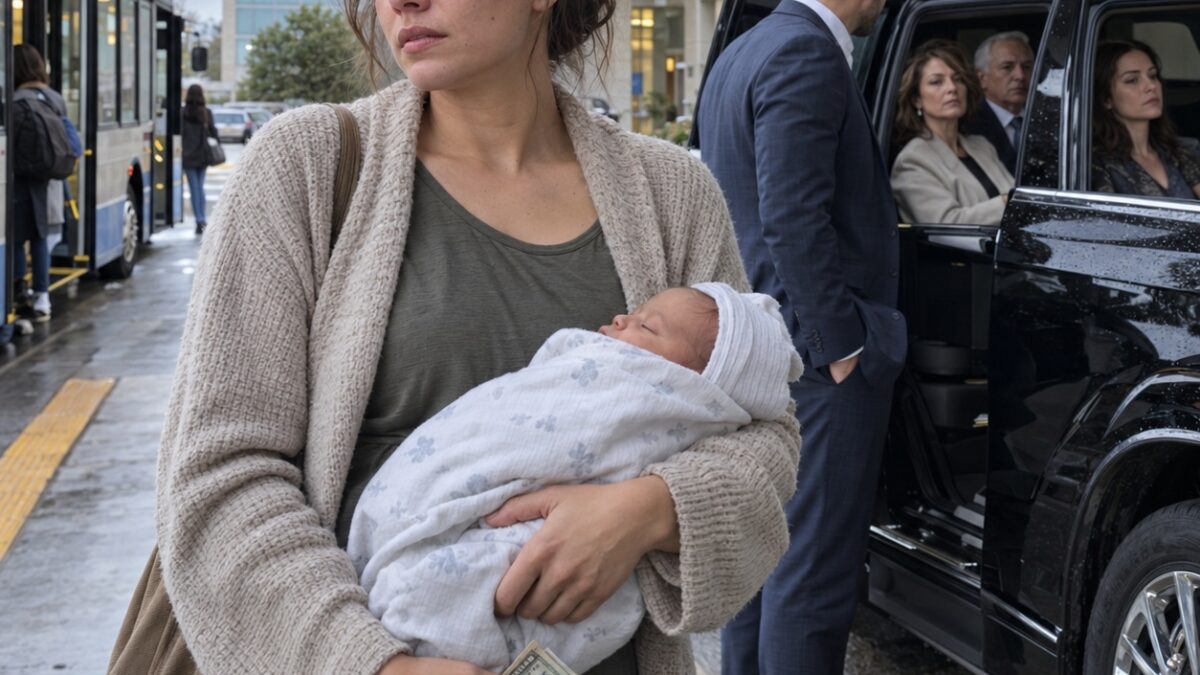
Five days after doctors cut my body open to deliver our son, my husband placed bus fare in my hand and drove away in the luxury SUV my father had bought for us.
Dominic thought the exhausted woman standing outside the hospital was too weak, too dependent, and too frightened to punish him for what he had done.
He did not know that before the city bus reached the next intersection, I would make one quiet phone call that would expose every lie behind his perfect life.
“This should cover your fare,” Dominic said.
He pressed a crumpled fifty-dollar bill and several coins into my palm as if he were tipping a stranger. The metal felt cold against my skin.
For a moment, I simply stared at the money.
My five-day-old son, Leo, slept against my chest beneath a pale blue hospital blanket. I had one arm beneath him and the other wrapped protectively around his back, but even that small amount of pressure sent a burning line of pain through my lower abdomen.
I had undergone an emergency C-section after eighteen hours of labor. The incision was still swollen. My legs trembled whenever I stood for more than a few minutes, and the doctor had warned me not to lift anything heavier than my baby.
Outside the hospital, traffic rolled through the gray afternoon while a September wind tugged at the loose sleeves of my cardigan.
“Dominic,” I said, certain I had misunderstood him. “What do you mean, my fare?”
He checked his watch.
“The bus, Audrey. It stops right there.”
He pointed toward the shelter at the edge of the hospital driveway.
I followed his hand with my eyes, then looked behind him at the polished black SUV parked in the loading zone. My father had given it to us as a wedding present. Dominic drove it almost every day because he said arriving in an expensive vehicle helped investors see him as a serious businessman.
“I just had surgery,” I whispered. “I can barely walk.”
His expression tightened with irritation.
“Please don’t start. My sister was walking around three days after giving birth.”
“Natalie has never given birth.”
“You know what I mean.”
“No, I don’t.”
He exhaled loudly, glancing toward the hospital doors as if he were afraid someone important might witness my embarrassment.
“My parents and Natalie are waiting. I made a lunch reservation weeks ago, and I’m not losing the table because you’ve decided to be dramatic.”
I looked at the SUV again. There was enough room for seven people.
Before I could answer, the hospital doors slid open. Victoria, my mother-in-law, emerged first in a cream-colored coat, followed by Arthur and Natalie.
Victoria’s gaze passed over me and settled on Dominic.
“We’re already late,” she announced. “The restaurant only holds reservations for fifteen minutes.”
Natalie glanced at Leo without coming closer.
“Oh, good. She’s finally discharged.”
No one asked how I felt. No one offered to carry my bag. No one even welcomed Leo home.
Dominic took the diaper bag from the nurse beside me, but instead of handing it back, he tossed it onto the SUV’s rear seat.
“There are leftovers in the refrigerator,” he said. “Heat those up when you get home. And don’t keep calling me. I’ll be busy with my family.”
His family.
The words landed harder than the cold.
I watched him climb into the driver’s seat. Victoria took the front passenger seat. Arthur and Natalie settled comfortably in the back beside my son’s diapers, formula, medication, and spare clothes.
Then Dominic drove away with the diaper bag, leaving his wife and newborn on the sidewalk.
A bus approached with a mechanical growl.
As it lowered toward the curb, I closed my fingers around the money, held Leo closer, and understood that the pain inside me was no longer heartbreak.
It was certainty.
FULL STORY CONTINUATION 👇👇
The nurse beside me made a soft sound of disbelief.
Her name was Claire. She had cared for me through two overnight shifts, bringing me ice chips when I could not stop shaking and sitting beside my bed when Leo was taken for additional monitoring.
“Was that your husband?” she asked.
I could not bring myself to lie.
“Yes.”
“And he took the baby’s bag?”
I looked toward the SUV’s fading taillights.
“Yes.”
Claire’s face changed. The professional calm she had worn for five days gave way to quiet anger.
“You can’t take that bus.”
“I don’t have another way home.”
“Come back inside. We’ll call someone.”
Dominic had spent two years training me to fear scenes. Whenever he humiliated me in public, he would lower his voice and warn me not to embarrass him. If I challenged him, he accused me of being emotional. If I remained quiet, he presented my silence as proof that he was right.
Even then, abandoned outside a hospital, I could hear his voice in my head.
Don’t make this a bigger deal than it is.
The bus doors opened.
I stepped forward.
Pain tore across my incision so sharply that my vision blurred. Claire caught my elbow before I fell.
“Mrs. Vance, stop.”
“I’m okay.”
“No, you’re not.”
The driver had been watching from behind the windshield. He was a broad-shouldered man in his late fifties with silver at his temples. He left his seat and came down the steps.
“Ma’am, do you need an ambulance?”
The question finally broke through the numbness.
“No,” I said quickly. “Please. I just need to sit down.”
Claire looked as though she wanted to argue, but Leo stirred against my chest. His tiny mouth opened, searching in his sleep.
I climbed onto the bus.
The driver refused my money.
“Keep it,” he said. “Sit near the front so I can avoid the roughest turns.”
His kindness almost made me cry when my husband’s cruelty had not.
I lowered myself into a seat beside the window. Claire stood on the sidewalk, one hand pressed to her mouth. Before the doors closed, she slipped a folded piece of paper into my hand.
“My number,” she said. “Call me when you are safe.”
The bus pulled away.
Every crack in the pavement sent a jolt through my body. I held Leo against me with both arms and counted his breaths so I would not think about the blood I could feel beginning to soak through the surgical dressing beneath my clothes.
At the first red light, the black SUV rolled into the lane beside us.
Dominic was laughing.
Victoria said something that made Natalie throw back her head. Arthur remained absorbed in his phone. My diaper bag sat between them like an abandoned package.
Dominic never looked toward the bus.
For two years, I had mistaken endurance for love. I had believed patience could restore the man I married. I had excused every insult because I remembered his tenderness from the beginning.
But as I watched him laugh, I realized something terrifying.
That tenderness had never been love.
It had been an audition.
Dominic Vance met me at a charity exhibition in Boston three years earlier. I had been standing alone beside a series of photographs taken after a hurricane when he approached me carrying two glasses of sparkling water.
“Everyone else is pretending to understand these,” he said. “You look like you actually do.”
I laughed despite myself.
“My father’s company rebuilt three bridges in that region.”
“What company?”
“Brooks Construction.”
It was not technically a lie. Brooks Construction had been the name of my grandfather’s first business before it grew into Brooks Global Corporation, an international infrastructure empire operating across thirty-one countries.
Dominic’s attention had sharpened, but not enough to concern me.
“A family business?”
“Yes.”
“Successful?”
“We’re comfortable.”
Comfortable was the word I had used all my adult life.
I had watched money change people the instant they learned my last name. Friends became flatterers. Dates arrived with business proposals. Strangers treated access to my father as though it were hidden treasure.
So I never told Dominic the full truth.
My apartment was modest because I liked it. I drove an eight-year-old sedan because it still worked. I wore clothes without visible labels and taught design workshops at a community arts center, though the trust my grandmother left me could have supported generations.
Dominic appeared to love that simplicity.
He brought takeout to my apartment and washed the dishes afterward. He listened when I spoke. He remembered my mother’s birthday even though she had died when I was nineteen.
When he proposed after eleven months, he did it in my kitchen with no photographers and no audience.
I thought I had finally found someone who loved Audrey rather than Charles Brooks’s daughter.
My father was cautious.
“There’s hunger in him,” he told me privately.
“Ambition isn’t a crime.”
“No. But some people build because they want to create something. Others build because they want everyone beneath them.”
I accused him of judging Dominic unfairly.
Dad apologized, walked me down the aisle, and gave us the SUV and a renovated apartment as wedding presents. He never told Dominic their actual value or explained that both remained in a trust under my name.
He also quietly introduced Dominic to three investment firms.
That was the beginning of Vance Meridian Technologies.
Dominic believed the meetings happened because of his pitch deck. He never learned that each investor had received a personal call from my father.
At first, I was proud of him.
Then the company raised its first major round of funding, and Dominic began coming home later.
He replaced his old friends with executives who laughed too loudly at his jokes. He criticized my clothes, my work, my posture, and eventually my family.
Victoria encouraged him.
“My son is moving into a different world,” she told me during one dinner. “You’ll have to make an effort if you want to keep up.”
She believed my father operated a small regional construction business. Dominic had apparently told her that my family was “working class with lucky connections.”
I could have corrected her.
Instead, I waited for my husband to defend me.
He never did.
When I became pregnant, the control worsened. Dominic insisted I stop teaching because he did not want investors seeing his pregnant wife “playing with paint in a community center.” He monitored my spending even though he paid the household expenses from an account funded largely by my wedding trust.
By my seventh month, I needed permission to order dinner.
Still, I stayed.
I told myself stress had changed him. I told myself Leo deserved both parents. I told myself Dominic would become gentle again when he held his son.
Then labor began, and he complained because it interrupted a networking dinner.
When doctors decided on an emergency C-section, I reached for his hand.
He was checking emails.
After Leo was born, Dominic posed for photographs beside my bed, sent them to his colleagues, and left for six hours.
Five days later, he gave me bus fare.
The light changed.
The SUV accelerated away.
Something inside me became perfectly still.
I reached into my purse and took out my phone. There was one number I had spent years refusing to use for personal trouble.
My father answered before the second ring.
“Audrey?”
His voice carried the warmth it always did when he saw my name, but also immediate concern. I rarely called him during business hours.
“Dad,” I said, surprised by how calm I sounded. “I need your security team sent to my apartment.”
There was a pause.
“Why?”
“Dominic made me take the city bus home with Leo.”
Silence.
“Say that again.”
“He took the SUV to lunch with his parents and Natalie. He left me outside the hospital with fifty dollars. He also took the diaper bag.”
The silence on the other end became heavier.
My father did not shout when he was truly angry. His voice grew quiet, each word deliberate.
“Where are you?”
I gave him the nearest intersection.
“Are you injured?”
“My incision may be bleeding.”
“Get off at the next stop. I’m sending an ambulance and security.”
“No ambulance. Please, Dad. I don’t want cameras.”
“Audrey, this is not about pride.”
“It isn’t pride. Leo is sleeping, and I’m only twelve minutes from the apartment.”
“You are not going back there.”
“I need my documents and his medical things.”
“My team will retrieve everything.”
I closed my eyes.
“I’ve decided to leave him.”
Dad took a slow breath. I imagined him standing behind the wide desk in his Manhattan office, one hand braced against the polished wood.
“Listen carefully,” he said. “My daughter and grandson will never be treated like this again. Stay on the bus until my people reach you. Do not tell Dominic where you are going.”
“What are you going to do?”
“First, I’m going to make sure you’re safe. Everything after that will depend on how many laws your husband has broken.”
The bus driver glanced at me in the mirror. I realized my hand was trembling.
“Dad, don’t destroy him because he hurt me.”
“I won’t.”
His answer came without hesitation.
“If Dominic is destroyed, it will be because of what he chose to do when he thought no one powerful was watching.”
A convoy of two dark sedans and a private medical vehicle met the bus three stops later.
The driver pulled over and opened the doors. A woman in a navy suit boarded first. I recognized her immediately.
Mara Ellis had led my father’s personal security detail for eleven years. She had taught me how to change a tire, escape a wrist hold, and identify when someone was following me.
Her eyes moved from my white face to Leo, then to the blood staining the lower edge of my blouse.
“Oh, Audrey.”
That quiet expression of concern undid me.
“I’m sorry,” I whispered.
“For what?”
“For calling only when it got this bad.”
She crouched in front of me.
“You never have to apologize for asking to be brought home.”
The paramedic examined me inside the medical vehicle. Two stitches had pulled, but the wound had not opened completely. My blood pressure was low, and I was dehydrated.
While he worked, Mara called the hospital and arranged for a private room under a protected name at a different medical center.
“I need Leo’s diaper bag,” I told her.
“It will be retrieved.”
“Dominic has it.”
“Then he will return it.”
I looked through the rear window as the bus continued down the street.
The driver raised one hand before disappearing into traffic. I lifted mine in return.
I never learned his full name, but I remembered his kindness long after I forgot the pain of that ride.
My father was waiting when we reached Brooks Medical Pavilion.
The building carried our family name because my mother had spent her final months there. Dad had funded an entire maternal recovery wing after learning how many women suffered complications because they could not afford extended postpartum care.
He stood beneath the entrance canopy without a coat, though rain had begun to fall.
At sixty-two, Charles Brooks still possessed the kind of presence that made crowded rooms fall silent. His silver hair was damp, his tie loose, and his expression tightly controlled.
He came to my door before the vehicle stopped completely.
When he saw Leo, his face softened. When he saw the blood, it hardened again.
“Give me the baby,” he said gently.
I hesitated from instinct.
“It’s all right, sweetheart. I have him.”
Dad lifted Leo with extraordinary care, supporting his neck exactly as the nurses had taught us. My son opened his dark eyes and stared up at the grandfather who had visited him every day, unlike the paternal relatives now eating lunch without him.
“You’re safe,” Dad whispered. “Both of you.”
I began to cry.
Not graceful tears. Not silent ones.
I sobbed until my incision hurt, until the paramedic made me breathe slowly, until Dad sat beside me and held my hand while Leo slept against his chest.
“I should have listened to you,” I said.
“No.”
“You warned me.”
“I warned you about an impression. You lived with a reality he worked hard to hide.”
“I kept thinking he would change back.”
Dad looked at me for a long moment.
“Sometimes the man at the beginning isn’t the man who disappeared. Sometimes he’s only the disguise.”
The doctors repaired my stitches, treated the beginning of an infection, and ordered me to remain under observation overnight.
While I slept, Mara’s team entered the apartment using authorization from the property trust. They collected my clothes, personal documents, jewelry inherited from my mother, Leo’s nursery supplies, and the laptop on which I had kept records of Dominic’s financial demands.
They photographed everything before moving it.
What they discovered concerned my father’s attorneys.
Several drawers in Dominic’s office contained credit agreements bearing my forged signature. There were loan applications listing me as a guarantor. One document claimed I had pledged an ownership interest in an apartment Dominic did not legally own.
More disturbing was a folder labeled “BGC Outreach.”
Inside were copies of confidential-looking reports carrying the Brooks Global logo.
They were fake.
Dominic had been using my family name more openly than I knew.
At 3:42 that afternoon, he called me for the first time.
I was awake, nursing Leo while rain traced silver lines down the hospital window.
“Where are you?” he demanded.
No hello. No question about whether we were safe.
“At a hospital.”
“You just left a hospital.”
“My stitches tore.”
He was silent for half a second.
Then he lowered his voice.
“Did you call your father?”
“Yes.”
“Why would you involve him in a private disagreement?”
“You left me outside a hospital.”
“I gave you money.”
“You took the baby’s bag.”
“That was an accident.”
“You put it in the car yourself.”
“I was distracted because you were creating a scene.”
I looked down at Leo’s hand curled against me.
“I didn’t raise my voice once.”
“That’s not the point. You always find a way to make me look cruel.”
“I didn’t make you look like anything, Dominic.”
Behind him, I heard restaurant noise. Plates. Glasses. Natalie laughing.
He was still at lunch.
“Come home,” he said. “We’ll discuss this when my family leaves.”
“I’m not coming home.”
The background sounds seemed to vanish.
“What?”
“I’m leaving you.”
His first reaction was not grief.
It was disbelief.
“You can’t be serious.”
“I have never been more serious.”
“You are exhausted and hormonal. I’m not going to let you make irrational decisions five days after giving birth.”
“You don’t get to let me do anything.”
His breathing changed.
“Where is Leo?”
“With me.”
“He is my son.”
“And I’m his mother.”
“You can’t take him away from me.”
“You left him at a bus stop.”
“I left him with you.”
As though that made it acceptable.
He spoke more softly, adopting the patient tone he used when investors challenged him.
“Audrey, listen to me. You’re upset. Fine. I should have handled the transportation differently. But marriage is bigger than one bad afternoon.”
“You’re right.”
He relaxed too soon.
“It’s bigger than one afternoon. It’s every time you humiliated me and called it honesty. Every time your mother insulted me and you stayed silent. Every bill you made me justify. Every appointment you missed. Every lie you told.”
His voice sharpened.
“What lies?”
“My father’s attorneys found documents in your office.”
This time, the silence was unmistakable.
“You had no right to search my things.”
“The apartment belongs to my trust.”
“It’s our marital home.”
“It was. And your office contains forged signatures.”
“You don’t understand business documents.”
“I understand my own name.”
“Audrey—”
“Do not contact me again except through my attorney.”
I ended the call.
He called seventeen times in the next hour.
Then Victoria began.
Her first message read, Stop punishing my son because you were too lazy to take a short bus ride.
Her second warned me that Dominic would seek full custody if I continued behaving “unstably.”
Her third was almost comical.
Think carefully before you throw away the best thing that ever happened to you.
I forwarded every message to my attorney.
By six that evening, Dominic’s tone changed.
His texts became affectionate.
Audrey, I’m sorry.
I panicked because of the reservation.
Mom pressured me.
I love you and Leo.
Please tell me where you are.
An hour later, he sent a photograph of the empty nursery.
Come home. Our family belongs here.
I stared at the picture until I noticed something in the corner.
The small white ceramic lamb my mother had bought years before I became pregnant was missing.
It had been on the nursery shelf that morning.
I called Mara.
“My mother’s lamb wasn’t with my things.”
“We packed it.”
“It isn’t in the nursery photograph.”
Mara was silent.
“When did he send the picture?”
“Two minutes ago.”
“I’ll check the inventory.”
She called back within five minutes.
The lamb had been wrapped and packed in a box now stored at my father’s house. The photograph Dominic sent was not current.
Metadata later showed it had been taken three weeks earlier.
He had prepared the image in advance.
That discovery frightened me more than his anger.
Dominic had anticipated needing to persuade me to return. He had assembled evidence of a peaceful home before abandoning me.
By morning, my attorney, Evelyn Shaw, was sitting beside my hospital bed.
Evelyn was in her forties, calm, direct, and famous for dismantling wealthy men who believed charm was a legal strategy.
She placed three folders on the table.
“The first contains your petition for divorce and request for temporary sole custody,” she said. “The second addresses the fraudulent financial documents. The third concerns Vance Meridian.”
“What about the company?”
“Your husband has represented Brooks Global as an informal guarantor in at least four investor meetings.”
“My father never approved that.”
“We know. He also implied you would inherit voting control of Brooks Global within twelve months.”
I stared at her.
“My father isn’t retiring.”
“Dominic knew that. He said it anyway.”
“Why?”
“To inflate his company’s value before another funding round.”
She opened the third folder.
“Three early investors joined because Charles personally assured them that Dominic had promise. Your father never guaranteed the company. But Dominic transformed that introduction into a story suggesting permanent financial backing.”
“Can they withdraw?”
“Not immediately. However, Brooks Global can issue a clarification and end every commercial relationship with Vance Meridian.”
“What would happen?”
“The company would face intense scrutiny. If its products and financials are sound, it could survive.”
“And if they aren’t?”
“That would be Dominic’s problem.”
I remembered my father’s words.
If Dominic is destroyed, it will be because of what he chose to do.
“Do it,” I said.
Evelyn studied me.
“Once the clarification is released, there may be no quiet reconciliation.”
“I rode home from surgery on a city bus while my husband ate lunch with the people who taught him to despise me.”
I signed the papers.
“There will be no reconciliation.”
Dominic was served at 9:15 the following morning during a board meeting.
I learned the details later from a video captured by the conference room security system.
He had been standing before a screen displaying projections for Vance Meridian’s expansion when a process server entered.
“Dominic Vance?”
Dominic smiled automatically, assuming the man was a courier.
“Yes.”
“You’ve been served.”
The envelope landed on the conference table.
Two minutes later, every board member received the Brooks Global clarification by email.
Brooks Global Corporation has no financial obligation to, ownership interest in, or future funding commitment to Vance Meridian Technologies. Any representation to the contrary was unauthorized.
The room erupted.
Dominic called my father before he called me.
Dad answered on speakerphone with Evelyn present.
“Charles, we need to stop this misunderstanding before it damages both families.”
“There is no misunderstanding.”
“Audrey is recovering from surgery. She’s emotional.”
“My daughter was lucid enough to identify forged financial documents.”
“You don’t know the context.”
“I know my signature appears on a letter I did not write.”
Dominic changed tactics.
“I have always respected you.”
“No, Dominic. You respected what you believed I could give you.”
“I built Vance Meridian myself.”
“Then you should have no difficulty sustaining it without my name.”
“You introduced me to those investors.”
“I did. That was my mistake.”
“You can’t abandon me now.”
Dad’s reply was cold enough to cross the distance between them.
“You abandoned my daughter and newborn grandson outside a hospital. Do not speak to me about abandonment.”
By noon, the story had begun spreading through financial circles.
It had not reached the news yet, but investors demanded emergency audits. The board froze discretionary spending. Dominic’s access to company accounts was temporarily restricted.
At 1:07, he arrived at Brooks Medical Pavilion.
He brought flowers.
Mara stopped him in the private lobby.
“I’m here to see my wife and son.”
“Mrs. Vance has declined visitors.”
“She doesn’t have the right to keep my child from me.”
“You may address custody matters through counsel.”
“I’m not discussing my family with a security guard.”
Mara looked him directly in the eyes.
“You are discussing access to a protected patient with the director of executive security. You will leave.”
Dominic tried to step around her.
Two officers moved into view.
He left the flowers on the desk and walked out.
The card attached to them said, We both made mistakes.
I asked the nurse to throw them away.
Three days later, I moved into my father’s country house outside Greenwich.
I had grown up there, but returning did not feel like surrender. For the first time in months, I slept without listening for Dominic’s key in the door.
My old room had been converted into a warm recovery suite. A bassinet stood beside the bed. Dad had hired a postpartum nurse named Rebecca, but he asked my permission before finalizing the arrangement.
That small courtesy made me realize how completely Dominic had erased the idea that my permission mattered.
Recovery came slowly.
At night, I woke expecting to hear his criticism.
Sometimes I found myself rehearsing explanations for ordinary choices—why I had turned up the heat, why I had ordered a certain meal, why I needed medication.
Rebecca would notice me staring at the thermostat.
“You’re allowed to be warm,” she said once.
I laughed, then unexpectedly cried.
Leo became my anchor.
He did not care whether I wore makeup. He did not measure my value by the room I entered or the people I impressed. He needed warmth, milk, safety, and the sound of my heart.
During those early weeks, I began understanding that motherhood was not the chain Dominic had assumed it would be.
It was the reason I finally broke free.
He had expected exhaustion to make me obedient. Instead, the sight of my son forced me to ask what kind of life I was teaching him to accept.
I could not raise Leo to believe love looked like humiliation.
The temporary custody hearing was scheduled for the end of the month.
Dominic responded to my petition with accusations.
He claimed I suffered from postpartum instability. He said my father had manipulated me into leaving. He insisted the bus incident was a misunderstanding caused by my refusal to join the family lunch.
His filing stated that he had offered me a seat in the SUV, but I declined because I wanted attention.
I read that sentence three times.
“He’s lying,” I said.
Evelyn remained calm.
“Then we prove it.”
Claire, the nurse, had already provided a statement. The bus driver was located through transit records. Hospital security footage showed Dominic giving me money and driving away. The SUV’s internal camera showed every seat except the driver’s occupied by his relatives and my son’s bag, even though the third row remained folded and could easily have been opened.
The strongest evidence came from Natalie.
Not because she intended to help me.
She had posted a video from inside the SUV.
The caption read: Finally rescued my brother from the maternity ward. Celebratory lunch!
In the recording, Victoria complained that I had “milked the surgery long enough.” Dominic laughed and said, “The bus will teach her she can’t use the baby to control my schedule.”
The video had been online for eleven minutes before Natalie deleted it.
Eleven minutes was enough.
One of her followers had saved it.
Evelyn played the video during the temporary custody hearing.
Dominic sat across the courtroom beside his attorney. He looked thinner than he had a month earlier, but his suit was perfect and his expression carefully wounded.
The judge watched the clip twice.
Then she turned to Dominic.
“Mr. Vance, your newborn child was five days old?”
“Yes, Your Honor, but—”
“And your wife was five days post-major abdominal surgery?”
“Yes.”
“You removed the child’s supplies from her possession?”
“Accidentally.”
“Then recorded yourself saying the bus would teach her a lesson?”
Dominic swallowed.
“It was a private joke taken out of context.”
The judge’s face did not change.
“What context makes that statement appropriate?”
His attorney touched his arm, warning him to stop.
The court granted me temporary primary custody. Dominic received supervised visits twice a week, contingent upon a parenting assessment and psychological evaluation.
Victoria gasped aloud.
“This is outrageous!”
The judge looked toward her.
“One more interruption and you will be removed.”
Outside the courtroom, Victoria rushed toward me.
“You vindictive little liar.”
Mara stepped between us.
Victoria pointed around her.
“You were pretending to be poor this entire time. You tricked my son.”
“I never pretended to be poor.”
“You let us believe your father was a contractor.”
“He is.”
“He owns Brooks Global!”
“Yes.”
“You should have told us.”
“Why? Would you have treated me differently?”
Her mouth opened, then closed.
That was answer enough.
Dominic emerged behind his attorney.
“Mother, go downstairs.”
“I’m defending you.”
“You’ve done enough.”
It was the first time I had ever heard him speak sharply to her.
Victoria’s face crumpled.
I might once have felt sorry for her. Instead, I saw the pattern clearly. Dominic blamed whoever stood closest whenever his choices became expensive.
He looked at me.
“Can we talk alone?”
“No.”
“Five minutes.”
“Anything you need to say can be said through our attorneys.”
“This is about Leo.”
“Then definitely through our attorneys.”
His polished control cracked.
“You’re enjoying this.”
“No, Dominic. I’m recovering from surgery while filing for divorce and discovering that my husband forged my signature. Nothing about this is enjoyable.”
“You’re humiliating me.”
I almost laughed.
Even then, he believed the greatest crime was being seen clearly.
“I didn’t upload Natalie’s video. I didn’t make you say those words. I didn’t put you in that courtroom.”
“You brought your father into our marriage.”
“You brought his name into your company.”
His face went pale.
For the first time, I knew the business problem was worse than he had admitted.
“What else did you find?” I asked.
His attorney stepped forward.
“This conversation is over.”
Dominic stared at me as he was guided away.
The answer arrived two days later.
Vance Meridian’s internal audit uncovered a twelve-million-dollar discrepancy.
The money had not vanished all at once. It had moved through consulting contracts, inflated vendor payments, and a real-estate holding company controlled by Arthur Vance.
Dominic’s father had been receiving company funds for eighteen months.
Natalie had been paid as a branding consultant despite doing no documented work. Victoria’s luxury travel had been categorized as investor relations.
Dominic had transformed the company into a private bank for his family.
He had also opened a seven-million-dollar line of credit by implying that my inheritance would guarantee repayment.
When the lender requested proof, someone submitted a letter carrying my father’s forged signature.
I sat in Dad’s study as Evelyn explained it.
“Will he be arrested?”
“The authorities are investigating. We should not speculate about charges.”
“Did he know Arthur was taking money?”
“Dominic approved every contract.”
I turned toward the window.
Outside, autumn leaves moved across the lawn. Rebecca walked beneath the maples with Leo in his stroller while two security officers followed at a respectful distance.
“Why would he risk everything?”
Dad closed the report.
“Because he stopped believing consequences applied to him.”
I thought about the worn bill in my hand outside the hospital. Dominic had not been worried that anyone would stop him. He believed I had nowhere else to go.
“How much of the company survives?” I asked.
“Possibly none.”
“I don’t want the employees punished.”
Dad nodded.
“Neither do I.”
Brooks Global had no obligation to help, but I asked Dad to create an independent rescue fund for employees whose wages and retirement contributions were at risk. The fund would not benefit Dominic, his relatives, or the executives involved in the misconduct.
Dad studied my proposal.
“You’ve thought this through.”
“They believed in a company because you introduced him. We can’t save their jobs, but we can keep their children from losing homes while they find new ones.”
A faint smile touched his face.
“You sound like your mother.”
That was the highest compliment he could give me.
The supervised visits began the next Tuesday.
Dominic met Leo in a family services center under the observation of a licensed monitor. I was not required to remain in the room, but I watched the first few minutes through one-way glass.
He arrived twelve minutes late.
He carried an expensive stuffed bear still bearing its store tags. When the monitor placed Leo in his arms, Dominic held him awkwardly.
“Why is he crying?” he asked.
“He may need time to adjust,” the monitor replied.
“He knows me.”
Leo was six weeks old. Dominic had spent less than two full days caring for him.
“Support his head,” the monitor instructed.
“I know.”
His hand remained too low.
She corrected him.
Dominic’s irritation surfaced instantly.
“I said I know.”
Leo cried harder.
Watching my son struggle in his father’s arms filled me with conflicting emotions. Part of me wanted to rush through the glass. Another part grieved for the family I had once imagined.
But grief was not permission to return.
Dominic loved the image of fatherhood. He loved photographs, congratulations, and the status of having a son.
Love itself required patience when no one applauded.
During the third visit, he refused to change Leo’s diaper because the monitor was present.
“I’m not performing basic childcare for your report.”
She wrote that statement down.
At the fourth, he spent twenty minutes asking questions about my house instead of interacting with the baby.
“Is Audrey dating anyone?”
“That is not relevant.”
“Has her father been present?”
“I am here to observe your parenting.”
“Does she talk about me?”
The monitor ended the questioning.
Afterward, Dominic sent me a message through the court-approved parenting application.
We can fix this if your father restores the investor relationships.
I read it twice.
Not if I apologized.
Not if we went to counseling.
Not if he learned to become a better father.
If my father restored the investors.
I forwarded it to Evelyn.
At that moment, the last fragile part of me that wondered whether he truly wanted our marriage died.
The criminal investigation became public in November.
Reporters gathered outside the Vance Meridian headquarters as federal agents carried out boxes of records. The board removed Dominic as chief executive. Trading in the company’s private secondary shares was suspended.
Arthur disappeared for forty-eight hours before being located at a hotel near the Canadian border.
Natalie deleted all her social media accounts.
Victoria called me from an unfamiliar number.
I answered because Leo was asleep and because some quiet part of me needed to hear what she would say when flattery became her only remaining weapon.
“Audrey,” she began, her voice trembling. “Thank God. You have to help us.”
There was no apology.
“What happened?”
“They’ve frozen our accounts. Arthur can’t access anything. Reporters are outside the house.”
“You should speak to your attorney.”
“We can’t afford the attorney they say we need.”
“What do you want me to do?”
“Talk to your father. Tell him this has gone too far.”
“My father did not move company money into Arthur’s business.”
“That was all Dominic’s accountants. Arthur signed what he was given.”
“Your husband received more than four million dollars.”
“We’re family.”
“No, Victoria. You made that clear outside the hospital.”
She began to cry.
“I was upset that day. I had been looking forward to lunch.”
I closed my eyes.
“You left a newborn without diapers because you didn’t want to lose a restaurant reservation.”
“We assumed you could buy more.”
“With the bus money?”
Her crying stopped.
“You always thought you were better than us.”
“I spent years allowing you to insult me because I wanted peace.”
“You deceived us about your money.”
“And there it is.”
“What?”
“You aren’t sorry for how you treated me. You’re angry because you would have treated me better if you had known I was wealthy.”
She said nothing.
“I hope you cooperate with the investigation,” I continued. “Do not call me again.”
“You can’t turn Leo against his grandmother.”
“I won’t have to. You chose a restaurant over him before he was a week old.”
I blocked the number.
That evening, I stood beside Leo’s crib and watched him sleep. The nursery at Dad’s house was not as carefully designed as the one in the apartment, but it felt safer.
My father appeared in the doorway.
“You all right?”
“I thought hearing her beg would make me feel powerful.”
“Did it?”
“No. It made me tired.”
“That’s because revenge and freedom are different things.”
I looked at him.
“You could destroy them completely.”
“I could make their problems worse,” he said. “But they’ve already done the destroying.”
He came to stand beside me.
“Your mother once told me power reveals people more often than it changes them. Dominic gained a little power and revealed himself. Then he thought you had none and revealed himself again.”
I touched the edge of Leo’s blanket.
“I should have left sooner.”
“Perhaps.”
The answer surprised me.
Dad rarely allowed himself bluntness when I was hurting.
He continued gently, “But shame will not return those years to you. Learn what they taught you and refuse to pay for the same lesson twice.”
The divorce process lasted nine months.
Dominic fought every detail, even things he did not want.
He demanded half the apartment until documents proved it belonged to a protected premarital trust. He claimed partial ownership of my inheritance, though our prenuptial agreement excluded it. He demanded the SUV, forgetting it was registered to the same trust.
When he realized he could not keep the vehicle, he damaged it.
Mara’s team found the leather slashed, the navigation system smashed, and paint poured across the hood.
Dominic denied involvement.
The apartment garage recorded him entering with a hardware-store bag at 2:13 in the morning.
Evelyn showed me the footage.
“He knew there were cameras,” I said.
“He was angry.”
“That isn’t an explanation.”
“No,” she replied. “But it is often the closest men like him come to one.”
The vandalism violated a court order prohibiting destruction of marital property. It also damaged his custody case.
His psychological assessment revealed severe narcissistic traits, poor impulse control under stress, and a tendency to regard family members as extensions of his public identity.
The evaluator did not call him incapable of change.
She wrote that meaningful change would require sustained accountability.
Dominic rejected the report and accused the evaluator of bias.
That reaction became part of the final report.
Meanwhile, I rebuilt my own life.
When Leo was four months old, I returned to the community arts center for one afternoon a week. The first day, I stood outside with my hand on the door, afraid I no longer belonged there.
My friend Camille opened it from the other side.
“You planning to come in?”
“I’m thinking.”
“You always think too much in doorways.”
She hugged me carefully, mindful of the incision that had healed into a pink scar.
The classroom smelled of clay, paper, and acrylic paint. Nothing there was luxurious. Nothing was arranged to impress investors.
It felt like oxygen.
I began designing a program for mothers recovering from traumatic births and abusive relationships. We offered childcare, legal referrals, art therapy, and small-business training.
I named it The Open Door Project.
Dad offered to fund the entire program.
I refused.
“I want community partners.”
“Why?”
“Because I don’t want it to disappear if the Brooks family loses interest after I’m gone.”
He smiled.
“Then Brooks Global will be one partner among many.”
Within six months, eleven organizations had joined.
Claire, the nurse who had tried to stop me from boarding the bus, became one of our medical advisors.
When she visited the center for the first time, I hugged her.
“I called the number you gave me,” I said.
“I know. Three weeks later.”
“I wasn’t ready before then.”
“You called when you were.”
The bus driver attended our opening ceremony too. His name was Samuel Ortiz. The transit authority had located him after I wrote a letter praising his compassion.
He brought his wife and two grandchildren.
“You didn’t charge me,” I reminded him.
“You looked like you had enough to carry.”
I presented the transit authority with funding for postpartum safety training and emergency transportation vouchers—not as repayment to Samuel, but because his kindness showed me how much one person could change the direction of another person’s worst day.
Reporters wanted to turn the ceremony into a story about a billionaire’s daughter taking the bus.
I corrected them.
“The story isn’t that a wealthy woman was mistreated,” I said. “The story is that no woman should be abandoned after childbirth, regardless of whether she can call a powerful father.”
That sentence became the foundation of our mission.
Dominic saw the interview.
That night, he sent a message through the parenting application.
You’ve built a brand out of destroying me.
I replied only once.
Telling the truth about what happened is not the same as causing it.
His supervised visits became less frequent.
At first, he canceled because of legal meetings. Then because reporters followed him. Then because he claimed the center’s location was inconvenient.
Leo stopped crying when Dominic held him.
That might sound like improvement, but the monitor described it differently.
“The baby no longer expects comfort from him.”
Those words haunted me.
Dominic’s criminal case advanced in the spring.
Arthur accepted a plea agreement and agreed to testify. He admitted that his son created false contracts to move money from Vance Meridian. In return, prosecutors recommended a reduced sentence.
Victoria publicly blamed Arthur.
Natalie blamed both men and insisted her consulting income had been legitimate.
Dominic blamed everyone.
He claimed his father manipulated him, his board failed to supervise him, his accountants misunderstood his instructions, and I had sabotaged him out of postpartum jealousy.
Then investigators recovered audio files from his office.
Dominic had recorded meetings without informing the people present. He apparently believed the recordings would protect him from disloyal employees.
Instead, they captured his own voice approving fraudulent transfers.
In one recording, his finance director warned him that using Brooks Global’s name without authorization could constitute fraud.
Dominic laughed.
“Audrey will sign whatever I put in front of her. She’s desperate to keep the marriage.”
The recording was dated two months before Leo’s birth.
I listened to it in Evelyn’s office.
Dominic’s voice was relaxed, confident, almost amused.
I had been at home that day, assembling the crib by myself because he said he was too busy securing our future.
“Turn it off,” I said.
Evelyn stopped the recording.
For several minutes, I could not speak.
It was one thing to understand that a person had used you. It was another to hear the precise calculation in his voice.
“He knew,” I whispered.
“Yes.”
“He knew I was unhappy.”
“Yes.”
“And he thought that made me easier to control.”
Evelyn closed the laptop.
“I’m sorry.”
I looked down at my hands.
“No. I needed to hear it.”
“Why?”
“Because some part of me still remembered the man in my kitchen.”
“The one who proposed?”
“Yes.”
“What do you understand now?”
“That he didn’t disappear.”
I raised my eyes.
“He was studying me.”
Two weeks before the final divorce hearing, Dominic asked to meet.
His attorney contacted Evelyn and proposed a private settlement conference. Dominic would withdraw his financial claims, consent to the existing custody arrangement, and avoid a public trial if I agreed to provide a written statement saying the hospital incident had been “mischaracterized during a period of mutual stress.”
Evelyn pushed the document toward me.
“He wants your statement for his criminal defense.”
“He wants me to lie.”
“He wants ambiguity. It would allow his attorneys to question your reliability.”
“What does he offer in exchange?”
“Essentially, he offers to stop demanding things he has little chance of receiving.”
I slid the paper back.
“No.”
“I expected that.”
“I’ll meet him, though.”
Evelyn frowned.
“You don’t owe him closure.”
“I’m not offering closure. I want him to hear my answer without a lawyer translating it into language he can dismiss.”
The meeting took place in a private conference room with attorneys on both sides.
Dominic entered wearing a charcoal suit I had once chosen for his birthday. His face was gaunt, and exhaustion had carved shadows beneath his eyes.
For a dangerous second, I felt pity.
Then I remembered the bus.
He sat across from me.
“You look well,” he said.
“I am well.”
“How is Leo?”
“You receive the monitor’s reports.”
“That isn’t the same as hearing it from you.”
“He’s healthy. He has started crawling.”
Pain crossed his face, though I could not tell whether it came from missing Leo or missing the milestone.
“I should have been there.”
“Yes.”
His attorney began discussing the proposed statement.
Dominic lifted one hand.
“Can Audrey and I have a few minutes?”
“No,” Evelyn and I said together.
Dominic almost smiled.
“You two make quite a team.”
Evelyn folded her hands.
“Say what you came to say, Mr. Vance.”
He looked at me.
“I made a terrible decision that day.”
“You made many decisions.”
“My mother pressured me about the reservation.”
“You were thirty-six years old.”
“I was under stress.”
“So was I. My body had just been cut open.”
“I didn’t understand how serious the surgery was.”
“You attended the medical consultations.”
“I thought you would call a car.”
“Then why did you give me bus fare?”
His jaw tightened.
“I don’t remember exactly what I was thinking.”
“I do. You wanted to teach me a lesson.”
He glanced at his attorney.
“Natalie’s video made an ugly moment look worse.”
“The video recorded your words.”
“I was joking.”
“You have called it a misunderstanding, stress, your mother’s fault, my refusal, and now a joke. Which lie would you like me to put in your statement?”
His composure slipped.
“I’m trying to save what is left of my life.”
“So was I.”
“I could go to prison.”
“I could have hemorrhaged on that bus.”
“But you didn’t.”
The moment the words left his mouth, everyone became silent.
Dominic closed his eyes.
“I didn’t mean that.”
“Yes, you did.”
“Audrey—”
“You still measure cruelty by whether the victim survived it.”
His attorney whispered something to him, but he shook his head.
“I loved you.”
“No. You loved my loyalty when you thought it belonged to someone powerless. Then you loved my name when you discovered what it could buy.”
“That isn’t fair.”
“Did you forge my signature?”
He did not answer.
“Did you tell investors I would sign anything because I was desperate to keep our marriage?”
His eyes moved toward Evelyn’s laptop.
“So you heard that.”
“Yes.”
He leaned back.
For the first time, he stopped performing remorse.
Coldness returned to his face—the expression I had seen whenever affection failed to produce obedience.
“You hid who you were,” he said. “You let me struggle while your father could have funded the company with a phone call.”
“My father introduced you to investors.”
“He gave me crumbs.”
“He gave you an opportunity.”
“I built something worth hundreds of millions.”
“On false guarantees and stolen money.”
“My family deserved the life I promised them.”
“What about the life you promised me?”
His mouth tightened.
“You never understood what it takes to succeed.”
I thought about the women entering The Open Door Project carrying children, court papers, hospital bills, and fear. I thought about Samuel opening the bus doors, Claire offering her phone number, Dad standing in the rain, and Leo learning to crawl across a sunlit floor.
“I understand something you never did,” I said. “Success isn’t the number of people you can make feel small.”
I pushed the proposed statement toward him.
“I will not sign this.”
He looked at the paper but did not touch it.
“If I lose everything, Leo will grow up knowing his mother destroyed his father.”
“No. Leo will grow up knowing his father faced the consequences of his own choices.”
“You’ll turn him against me.”
“I will tell him the truth in a way appropriate for his age. What he eventually thinks of you will depend on what you do next.”
He laughed without humor.
“You always sound like Charles now.”
“No. I sound like myself. You just never listened long enough to recognize me.”
I stood.
Dominic’s mask broke completely.
“Please.”
It was the first honest word he had spoken.
I paused but did not sit down.
“Please what?”
“Tell your father to help.”
Even at the end, he was asking for money.
Not forgiveness.
Not another chance to become a father.
Money.
I walked out.
The divorce was finalized on a clear morning in June.
I received sole legal custody, with Dominic permitted supervised visitation subject to compliance with the court’s treatment plan. I retained all premarital property. The court held him responsible for the damage to the SUV and a portion of my legal expenses because of his fraudulent claims.
I did not celebrate.
I took Leo to a park after the hearing and sat beneath an old oak tree while he pulled at blades of grass with intense concentration.
The paper in my purse declared me unmarried.
Freedom felt quieter than I expected.
There were no trumpets. No dramatic sky. Just my son laughing because a leaf landed on his shoe.
Dad sat beside us on the grass, ruining an expensive pair of trousers.
“How does it feel?” he asked.
“Like I’ve been holding my breath for three years.”
“And now?”
I inhaled slowly.
“Now I’m learning how to breathe without asking permission.”
Dominic pleaded guilty four months later to conspiracy, wire fraud, and falsification of financial records. His cooperation came too late to avoid prison, though it reduced his sentence.
Arthur also received prison time. Natalie repaid a portion of her consulting income and avoided prosecution after cooperating. Victoria sold the family home to cover legal fees and civil judgments.
I did not attend the sentencing.
Evelyn called afterward.
“Seven years,” she said.
I sat at my desk in The Open Door Project’s new building. Through the glass wall, I could see a young mother painting with her daughter.
“How did he react?”
“He told the court he regretted allowing ambition to distort his judgment.”
“Did he mention Leo?”
“Yes.”
I waited.
“He said he hoped to rebuild a relationship with him someday.”
I looked at a photograph beside my computer. Leo was fourteen months old, standing unsteadily between Dad and me, his smile wide enough to light the room.
“Someday will depend on what he becomes,” I said.
Before reporting to prison, Dominic was granted one final supervised visit.
I considered keeping Leo home, but the court order remained in place, and I did not want my anger to become another form of control.
I watched through the glass.
Dominic sat on the carpet while Leo pushed a wooden truck across the floor. For once, Dominic wore no suit. There were no cameras, gifts, or speeches.
He watched his son quietly.
After several minutes, Leo rolled the truck toward him.
Dominic picked it up and rolled it back.
They repeated the game.
When the visit ended, Dominic asked the monitor if he could speak to me for one minute.
I entered but remained near the door.
He looked older.
“I’m sorry,” he said.
I waited for the explanation that usually followed.
None came.
“For which part?”
“All of it.”
“That is a large answer.”
“I know.”
He looked through the window at Leo, who was fastening and unfastening the strap on his stroller.
“I kept thinking there would be one thing I could say to reverse everything.”
“There isn’t.”
“I know that too.”
I studied him, searching for manipulation. Perhaps some remained. Dominic had performed sincerity before. I no longer believed I could identify every lie by looking into his eyes.
So I stopped trying.
Whether he meant the apology was his responsibility.
Accepting it was not mine.
“I hope prison changes me,” he said.
“Prison can’t do that for you.”
“No.”
He nodded.
“I suppose that’s the point.”
When he moved toward Leo, the monitor stopped him because the visit had ended.
Dominic lowered his hand.
“Will you tell him I loved him?”
“I will tell him you had opportunities to love him.”
The answer hurt him.
It was also true.
I lifted Leo from the stroller and settled him against my hip.
As I turned away, Dominic spoke again.
“Audrey.”
I stopped.
“I should never have left you at that hospital.”
“No,” I said. “You shouldn’t have.”
That was the last time I saw him before his sentence began.
Three years later, The Open Door Project operated in six cities.
We provided emergency rides for postpartum mothers, temporary housing, childcare, legal services, and employment training. Hospitals placed our transportation cards inside discharge folders so no woman would remain trapped because someone controlling her held the car keys.
Samuel attended every annual fundraiser, though he refused to sit at the head table.
Claire became director of maternal advocacy.
Dad claimed retirement but appeared in my office four days a week with suggestions no one had requested.
Leo grew into a curious, gentle little boy who loved trucks, blueberries, and asking why the moon followed our car.
He knew his father lived far away and could not come home yet. I never told him Dominic was a monster.
Children eventually discover that adults are human. I wanted Leo to learn the truth without inheriting my anger.
Dominic wrote letters from prison.
At first, they were full of explanations.
Later, the explanations grew shorter.
After two years, he stopped asking me to contact investors or speak publicly on his behalf. He began writing about the parenting classes he taught in the prison education program.
I did not mistake effort for transformation.
But I acknowledged effort when it was real.
I saved the letters for Leo to read when he was older.
On the fifth anniversary of the bus ride, I returned to the hospital.
The entrance had changed. The old bus shelter had been replaced with a brighter one bearing a small sign:
SAFE RIDE SUPPORT AVAILABLE INSIDE. NO PARENT LEAVES ALONE.
I stood beneath it while Leo held my hand.
“Mommy, is this where Grandpa found you?”
“Near here.”
“Were you lost?”
The question caught me by surprise.
For years, I had described that day as the moment Dominic abandoned me.
But as I looked through the glass doors at nurses guiding new parents toward waiting cars, I understood it differently.
“No,” I said. “I thought I was lost, but I wasn’t.”
“Then what happened?”
I crouched so we were eye to eye.
“I remembered the way home.”
A city bus approached and lowered toward the curb with the same familiar hiss.
The doors opened.
Samuel sat behind the wheel.
He was supposed to have retired the previous year, but he still drove one route each Tuesday because, according to his wife, he became unbearable when he had too much free time.
He grinned when he saw us.
“Well, look who it is.”
Leo climbed aboard and immediately began asking questions about every button on the dashboard.
Samuel answered each one with grave seriousness.
I stood on the first step, remembering the weak woman who had climbed onto another bus while blood seeped through her bandages. She had believed silence was the last dignity left to her.
I wanted to reach backward through time and tell her that silence was not her ending.
It was the breath before she spoke.
My phone rang.
Dad.
“Where are you?” he asked.
“With Samuel. We’re coming to the center.”
“You’re late.”
“You aren’t my boss.”
“I’m chairman of the primary funding partner.”
“You’re also retired.”
“An administrative technicality.”
I smiled.
“We’ll be there soon.”
Leo tugged my sleeve.
“Can we ride the bus?”
I looked toward the long aisle, the sunlight warming the empty seats, and the city waiting beyond the windows.
Five years earlier, I had boarded carrying pain, shame, and a newborn I was terrified I could not protect.
Now I stepped aboard holding my son’s hand.
Not because someone had taken my choices.
Because this time, the choice was mine.
Samuel closed the doors, and the bus pulled away from the hospital.
Through the window, I watched the black pavement pass beneath us. I no longer saw Dominic’s SUV in the next lane. I no longer heard Victoria’s contempt or felt those coins cutting into my palm.
I saw the life that had grown from one decision.
The life Dominic believed I was too weak to claim.
He had left me outside a hospital with fifty dollars because he thought money was power and I had none.
He never understood that my father’s wealth was not what saved me.
The phone call opened a door, but I was the one who chose to walk through it.
I was the one who signed the papers.
I was the one who faced the courtroom.
I was the one who rebuilt a home where my son would never confuse fear with respect or control with love.
Dominic had expected the bus ride to teach me a lesson.
It did.
It taught me that the moment someone abandons you is not always the moment your life falls apart.
Sometimes it is the moment the road finally opens.
And sometimes the person left standing at the curb is the only one strong enough to decide where the story goes next.








