All 23 of My Cattle Refused Half the Pond—Then I Pulled a Blue Rope My Father Had Buried 30 Years Ago
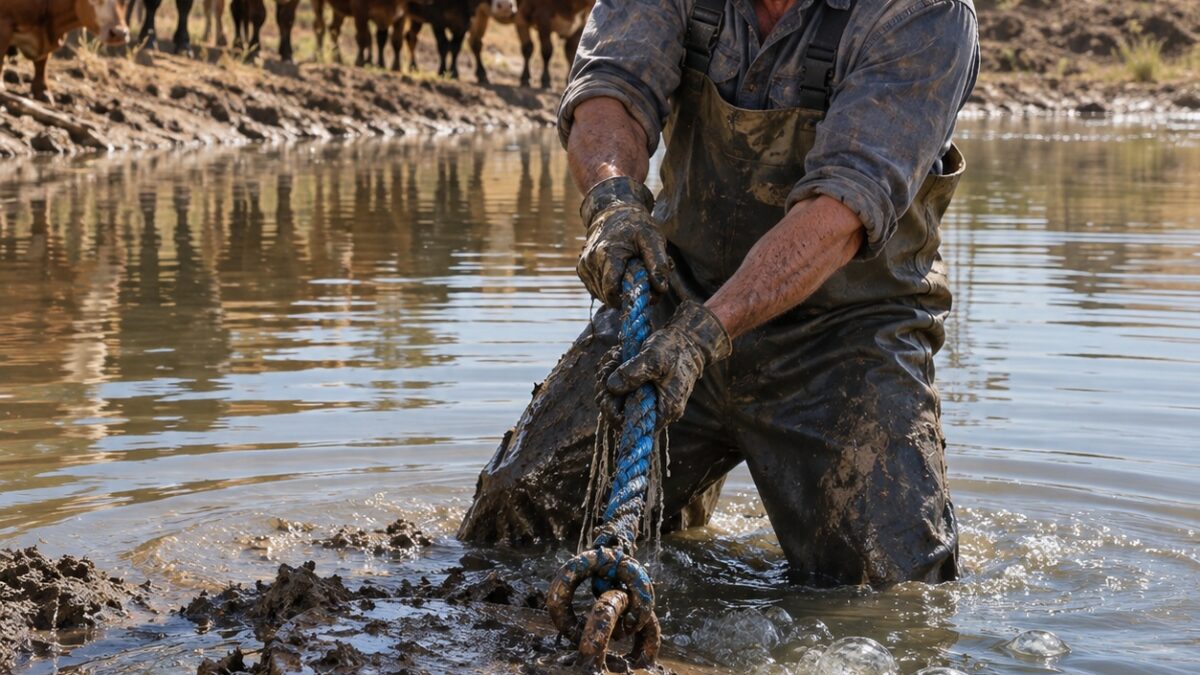
I stood there for almost a full minute without moving.
The bubbles thinned.
One at a time.
Then disappeared.
The water became flat again.
A dragonfly landed on a dead reed.
If I hadn’t felt the rope move in my hands, I might have convinced myself I’d imagined the whole thing.
I looked across the pond.
The cows were still watching me.
Old Number 14, a red baldy cow I had owned for nine years, stood closest to the water.
She lowered her head.
Took one step toward the western side.
Stopped.
Then backed away.
Cattle are not mystical animals.
I know people like to make livestock behavior into something mysterious.
Usually it’s not.
If cattle refuse a gate, there’s often a loose chain banging against metal.
If they avoid a corner of pasture, there may be wasps, mud, bad footing, strange smell, or something else perfectly explainable.
Animals notice small changes because their survival depends on noticing them.
That’s exactly why Number 14 bothered me.
She wasn’t afraid of the water.
She was afraid of that water.
I crouched again.
The blue rope lay across the mud where I’d dropped it.
I shouldn’t have touched it a second time.
I know that now.
I knew it then too.
But curiosity is just intelligence with bad brakes.
I put on the work gloves hanging from my belt and pulled the rope gently.
It tightened almost immediately.
I didn’t lean backward this time.
Just enough to feel resistance.
Something below responded.
A vibration traveled up the rope.
Then bubbles appeared.
Not as many.
A thin stream of clearer water pushed through the brown sediment.
I stared.
The plume coming from beneath the pond was almost colorless.
The rest of the pond was warm, greenish-brown water.
This looked like glass.
I dipped my fingers into it.
Cold.
Not a little cooler.
Cold enough that my skin reacted immediately.
I smelled my hand.
Earth.
Iron.
A mineral scent.
No rotten-egg smell.
No sewage.
No oil.
Nothing that suggested obvious contamination.
Just water that seemed to belong somewhere underground.
I released the rope.
The plume weakened.
Stopped.
“What in God’s name did you leave down there, Dad?”
The pond gave me no answer.
By ten that morning, I had told myself six different possibilities.
An old well casing.
A pump intake.
Drain valve.
Trash.
Part of a submerged livestock watering system.
Something my father had installed before turning the farm over to me.
But every explanation had the same problem.
I should have known about it.
Thomas Mercer was secretive about feelings.
He was not secretive about infrastructure.
The man labeled electrical breakers that already had labels.
If he buried a four-inch pipe, he drew it on the farm map.
If he replaced a culvert, he wrote the date on the concrete with a nail.
When I took ownership, Dad spent three days walking me around the property telling me things I already knew.
“There’s tile under this field.”
“I know.”
“Old well behind the machine shed.”
“I know.”
“That oak drops limbs in ice.”
“I know.”
“Don’t trust the north fence after hard rain.”
“Dad.”
“I’m just saying.”
If there was a steel structure beneath the pond connected to a blue rope, he should have mentioned it.
That afternoon, I returned with a fiberglass probing pole.
The cattle were drinking again.
Same pattern.
East side.
Not one on the west.
I walked down the exposed bank.
The September heat pressed hard against the back of my neck.
I pushed the probe into mud where the rope entered.
Six inches.
A foot.
Then—
Clink.
Metal.
I moved the pole left.
Clink.
Forward.
Clink.
Right.
Clink.
The hard surface extended several feet.
I kept probing.
The rough shape became clearer.
Circular or maybe octagonal.
At least six feet across.
Possibly more.
Whatever was there wasn’t a bucket, pipe end, or small pump.
It was a structure.
I lifted the rope slightly.
Bubbles came again.
A clear thread of cold water spread across the surface.
Number 14 approached within fifteen feet.
She stretched her neck.
Sniffed.
Her ears rotated forward.
Then she turned around and walked away.
I stared after her.
“You’re not helping.”
She kept going.
The next morning, I made a decision I would later regret.
I put on chest waders.
The pond was shallow near the western edge because of the drought.
Five feet offshore, the water came only to my knees.
I took a short-handled shovel and began clearing sediment.
The mud was soft around the rope.
Much softer than the exposed bank.
Every handful I moved released colder water.
Within fifteen minutes, my fingers found metal.
A ring.
The blue rope had been tied through a heavy iron ring approximately four inches across.
Below the ring was a flat steel surface.
I scraped around the edge.
Not a pipe.
Not a tank wall.
A lid.
Or plate.
I couldn’t tell how large because mud covered most of it.
But it was clearly built to close an opening.
I stood.
The rope ran through the ring and doubled somehow beneath the sediment.
I couldn’t see the connection.
I pulled lightly.
The plate lifted.
Not much.
Less than an inch.
But immediately, a sucking sound came from beneath it.
Bubbles raced around my boots.
Cold water pushed upward strongly enough to swirl mud around my legs.
I released the rope.
The steel plate dropped.
Thunk.
The bubbles stopped.
I backed away so fast I nearly fell.
There was pressure under that lid.
Real pressure.
Not trapped air from a bucket.
Not mud settling.
Water.
And suddenly the phrase my father had used all my childhood returned to me.
The pond is our savings account.
At the time, I had always assumed he meant surface water.
Standing there in the western shallows, I wondered whether he had meant something else.
I went straight to the machine shed.
Dad’s workbench was still there.
I had changed tools.
Replaced shelves.
Added a compressor.
But the steel drawers beneath the bench were the same.
Thomas had been the kind of man who never threw away washers because, according to him, washers became valuable exactly five minutes after the hardware store closed.
I opened every drawer.
Bolts.
Old spark plugs.
Grease fittings.
Cotter pins.
A dead mouse nest.
Nothing.
Then I remembered the cabinet above the bench.
Dad called it his “important junk.”
Inside were equipment manuals, property papers, expired warranties, survey flags, receipts, old photographs.
I carried everything to the bench.
Two hours later, I found a photograph.
It was dated 1993.
The western side of the pond was almost dry.
Three men stood beside a trench.
One was my father.
Thomas looked different.
He was sixty-two then.
Lean.
White T-shirt.
Jeans tucked into rubber boots.
Beside him stood a man I recognized.
Hank Bowden.
Hank used to drill wells across three counties before he retired.
The third man had his back to the camera.
On the ground behind them lay a coil of bright blue rope.
I stopped breathing for a second.
Same color.
New then.
There was something else in the picture.
Part of a steel circle.
Only the edge.
But enough.
I flipped the photograph over.
Dad’s handwriting.
WEST POND — SEPT. 1993.
Nothing more.
Thirty years earlier.
Exactly.
I sat down.
September 1993 had been another dry year.
Not as bad as the current drought.
But bad.
I remembered because of Luke.
My younger brother.
For three decades, I had spent enormous energy trying not to connect ordinary things with Luke.
Rain.
Ponds.
September.
Blue pickup trucks.
A certain Willie Nelson song.
Anything connected to the last week of his life.
Luke was twenty-four.
I was twenty-seven.
We both worked the farm with Dad then, though I had already started handling most business.
Luke was everything I wasn’t.
Funny.
Impulsive.
Able to turn strangers into friends in five minutes.
He loved cattle but hated paperwork.
He could repair an engine by instinct, then lose the wrench he used.
On September 18, 1993, Luke drowned.
That was the version I had carried for thirty years.
He had gone down to the pond during a storm.
The bank collapsed.
He fell.
Dad found him.
That was all.
I had been at a livestock auction seventy miles away.
By the time I got home, emergency crews were already leaving.
Dad never discussed details.
Mom couldn’t.
She died four years later.
Luke’s death became a door in our family everyone learned not to touch.
But now I had a photograph.
Three men.
A trench.
A blue rope.
Five days before Luke died.
My hands started shaking.
I looked again.
Dad.
Hank Bowden.
The unknown man.
And behind them, something metallic beneath the pond.
I found Hank’s number in an old address book.
He answered on the fourth ring.
“Hello?”
“Hank?”
“Who’s this?”
“Jake Mercer.”
Silence.
Not normal silence.
The kind where someone recognizes more than your name.
“Jake.”
“How are you?”
“Old.”
“Sounds inconvenient.”
“It is.”
I almost laughed.
Then I said, “I found something in the west pond.”
Silence again.
“What?”
“A blue rope.”
Nothing.
“Hank?”
“Leave it alone.”
My grip tightened around the phone.
“You know what it is.”
“Jake.”
“You know.”
“I said leave it.”
“There’s a steel plate under the mud.”
He exhaled slowly.
“Did you lift it?”
“Less than an inch.”
“Damn it.”
The fear in his voice changed everything.
“What is it?”
“Don’t touch it again.”
“Everybody keeps saying that without telling me why.”
“Everybody?”
“My cattle.”
Hank didn’t laugh.
“What are they doing?”
“Refusing the western half.”
“Since when?”
“Three or four days.”
“Any bubbling without you pulling?”
I hesitated.
“Some.”
“How much?”
“Small patches.”
“Temperature?”
“Cold.”
Another curse.
“Hank.”
“Jake, listen carefully. Stay off that side of the pond.”
“What is under there?”
“I need to see it.”
“You can tell me now.”
“No.”
“Why?”
“Because if it’s what I think, I need to see how much bank is exposed.”
My voice hardened.
“Does this have something to do with Luke?”
Silence.
Longer this time.
“Hank.”
“I’ll be there tomorrow.”
He hung up.
I stood in the machine shed holding the receiver long after the line went dead.
That evening, I didn’t sleep much.
My wife, Ellen, died six years earlier from cancer.
Our two children lived out of state.
The farmhouse was too quiet at night.
Usually I liked it.
That night, every pipe creak sounded louder.
I kept thinking about Luke.
Dad.
The photograph.
Hank’s reaction.
At one in the morning, I went back to the shed and searched until I found three more photographs.
One showed the pond drained lower than I’d ever seen.
Another showed concrete forms.
The third stopped me.
Luke.
He stood beside the steel structure smiling at the camera.
A blue rope hung over one shoulder.
I sat hard on Dad’s old stool.
On the back:
LUKE — PRESSURE TEST.
No date.
Same handwriting.
I whispered, “You lied to me.”
I wasn’t sure whether I meant Dad or the photograph.
At seven the next morning, Hank’s truck came up the lane.
He was eighty-one.
I hadn’t seen him in probably fifteen years.
Time had narrowed him.
His shoulders curved forward.
White beard.
Thick glasses.
But his eyes were sharp.
He climbed out using a cane.
“You still drink bad coffee?”
“Yes.”
“Good.”
He looked toward the pond.
“Let’s go.”
We drove down in my truck.
The cattle were already gathered east.
Hank saw them.
His face tightened.
“They remember things faster than people.”
“What does that mean?”
“They feel the vibration.”
“What vibration?”
“Water moving under that shelf.”
I stopped walking.
“You know exactly what’s under there.”
“Yes.”
“Then tell me.”
He looked at the western shallows.
“Your father called it the lower spring vault.”
I laughed once.
Not because anything was funny.
“There is a vault under my pond.”
“Part of one.”
“Since when?”
“1993.”
I stared at him.
“You built it.”
“I helped.”
“Why?”
“Drought.”
“That simple?”
“No.”
Hank walked slowly down the bank.
I followed.
He stopped where the blue rope disappeared.
“Thomas had known for years there was a spring under this side.”
“How?”
“Old farm records. Your grandfather talked about wet ground here before the pond was built.”
“Our pond was built in the fifties.”
“1956.”
“You remember?”
“I helped rebuild the dam in ’71.”
Of course he remembered.
“What happened in 1993?”
Hank pushed his cane into the mud.
“Your father called me because the pond was dropping.”
“Like now.”
“Not this low.”
“Then why dig?”
“Thomas believed there was enough groundwater under the limestone shelf to feed the pond if we opened it.”
“Did you drill?”
“At first.”
He looked at me.
“We didn’t need to go far.”
“How far?”
“Thirty-eight feet.”
“That’s nothing.”
“For a well, no. For hitting a pressurized fracture, it was enough.”
“Artesian?”
“Yes.”
I looked at the pond.
“How much water?”
“At first? Too much.”
“What does too much mean?”
Hank smiled without humor.
“It means your father started laughing and I started running.”
Despite myself, I almost smiled.
Then Hank’s expression darkened.
“The drill broke into a limestone void. Water came up around the casing. Cold. Hard. Fast.”
“How fast?”
“We couldn’t measure initially.”
“So you capped it.”
“Eventually.”
“What was the steel plate?”
“Not the well cap.”
My stomach tightened.
“What is it?”
“Access lid.”
“To what?”
“A collection chamber.”
He pointed beneath us.
“Your father decided if the fracture was strong enough, we could capture the spring discharge below pond level and feed the pond naturally.”
“Why not just pipe the well?”
“Because Thomas Mercer enjoyed taking a simple problem and making it ambitious.”
That sounded like Dad.
“We built a concrete vault around the spring opening.”
“How big?”
“About eight feet across. Six deep.”
My mind pictured it beneath the water.
“What is the plate for?”
“Top access.”
“Why is it under pressure?”
Hank looked at me.
“Because something else is blocked.”
The same cold sensation I had felt in the water spread across my back.
“What?”
“The relief line.”
“Where?”
“Runs west beneath the bank, then south to the drainage swale.”
“I’ve never seen it.”
“Thomas buried it.”
“Why?”
Hank didn’t answer.
I stared at him.
“Luke.”
His eyes lowered.
“Yes.”
The word was barely audible.
My mouth went dry.
“What happened?”
Hank looked toward the eastern bank where the cattle stood.
“You sure you want this here?”
“I’ve waited thirty years without knowing I was waiting.”
We climbed back to the truck.
Neither of us spoke until we reached the porch.
I made coffee.
Hank sat at the same kitchen table where Dad used to drink his.
For several minutes, he held the mug without drinking.
Finally, he said, “Luke didn’t just fall into the pond.”
I stared at him.
“That was what Dad told me.”
“I know.”
“You let him.”
Hank closed his eyes.
“Yes.”
Anger arrived slowly.
More dangerous that way.
“What happened?”
“We were testing the system.”
“What system?”
“The vault fed water into the pond through one line. Relief line carried excess pressure downhill.”
“Why would there be excess pressure?”
“The spring entered below the pond’s normal level. When pond level was high, pressure balanced. When low, spring discharge could increase into the chamber. Thomas wanted a gate so he could regulate it.”
“The rope.”
“Emergency lift for the access plate at first. Later we used it to operate the internal gate.”
“So when I pull—”
“You change the gate position slightly.”
“And bubbles?”
“Water and trapped gas from the chamber.”
“Gas?”
“Mostly air. Possibly dissolved carbon dioxide.”
“Poison?”
“Not at the levels we saw.”
“Then why are cattle afraid?”
“Soft ground. Bubbling. Metal movement. Cold current. Pick one.”
I leaned forward.
“Luke.”
Hank looked into his coffee.
“The evening before the storm, the relief line clogged.”
“With what?”
“Mud. Stone. We never knew exactly.”
“So?”
“Pressure started building in the vault.”
“Did you know?”
“Yes.”
“Then why didn’t you fix it?”
“We were trying.”
My anger sharpened.
“Who is we?”
“Me. Your dad. Luke.”
I stood.
“You had Luke down there?”
“He was twenty-four.”
“He was my little brother.”
“He was a grown man, Jake.”
I walked to the window.
That was true.
It didn’t help.
Hank continued.
“Luke was the smallest of us. He could get into the service trench easier.”
I closed my eyes.
“Jesus.”
“That afternoon, we cleared part of the relief. Thought it was enough.”
“But it wasn’t.”
“No.”
“The storm?”
“Rain came harder than forecast.”
I turned.
“What happened?”
“The pond rose fast. Runoff increased. Spring pressure increased. The bank around the vault softened.”
“Luke went down there.”
“He and Thomas did.”
“Why?”
“To open the emergency bypass manually.”
“Where were you?”
“Getting equipment.”
“What happened before you got back?”
Hank’s face tightened.
“Part of the western bank collapsed.”
I didn’t breathe.
“Luke was in the water.”
“Yes.”
“Dad?”
“On the bank.”
“Did the vault suck him under?”
“No.”
That answer came firmly.
“What then?”
“The collapsing mud knocked him off the trench edge. Current from the relief opening pulled him farther out.”
“Could Dad reach him?”
“He tried.”
“What about the blue rope?”
Hank looked at me.
“Luke grabbed it.”
My stomach twisted.
“He grabbed the rope?”
“Thomas had tied it around the gate lever.”
“For what?”
“Emergency control.”
“So Luke was holding it when he died?”
“No.”
Hank looked directly at me.
“He used it to pull the gate.”
I stared.
“Why?”
“The relief was jammed. Pond was rising. The vault was close to blowing the plate.”
“What does that mean?”
“Eight-foot steel lid with water pressure beneath it.”
I imagined the dull thud I’d heard.
“If it lifted completely…”
“Could’ve thrown steel. Broken the bank. Maybe breached the pond.”
“And Luke?”
“He pulled the gate open.”
“While in the water.”
“Yes.”
“Then what?”
“Pressure released through the spring outlet.”
“Did it save the dam?”
Hank nodded.
“Probably saved Thomas too.”
My throat closed.
“But Luke drowned.”
Hank looked away.
“The bank gave again.”
For thirty years, I had believed my brother made a stupid decision during a storm.
That’s not a kind thought to admit.
But grief isn’t always noble.
I had been angry with him.
Why did you go near the pond?
Why didn’t you wait?
Why did you make Dad find you?
Why did you make Mom bury a son?
Now Hank was telling me Luke had been there because Dad asked him to help.
He died trying to release pressure from something my father built.
I said, “Dad lied.”
Hank’s voice was quiet.
“He was broken.”
“He told me Luke went down there alone.”
“He couldn’t say what happened.”
“So you all agreed?”
“No.”
“Then why didn’t you tell me?”
“Thomas begged me.”
I laughed bitterly.
“And that was enough?”
“No.”
Hank put the coffee down.
“I was ashamed too.”
“Why?”
“I designed part of the vault.”
That silenced me.
“I told Thomas the relief pipe was enough. I told him the chamber was safe.”
His hand shook.
“I was wrong.”
For a moment, there were three guilty men in that kitchen.
One dead.
One old.
One who had just learned he’d spent thirty years being angry at the wrong person.
I sat.
Hank whispered, “I’m sorry, Jake.”
I didn’t answer.
Not because I wanted to punish him.
Because I didn’t know which emotion deserved to speak first.
Finally, I asked, “What did Dad do afterward?”
“Drained the western side.”
“How?”
“Opened the outlet.”
“Then?”
“We welded the plate.”
I stared.
“The plate is welded shut?”
“Was.”
“Was?”
“Rust doesn’t care about promises.”
“Then why can I lift it?”
“Because the welds were only around part of the access flange. The internal control still moves.”
“What did Dad bury?”
“Everything.”
“The rope too?”
“Yes.”
“Why leave it attached?”
“Couldn’t remove it without reopening the chamber.”
“He could’ve cut it.”
“He meant to.”
“Didn’t?”
Hank shook his head.
“Then he changed his mind.”
“Why?”
“Thomas said if pressure ever returned, somebody might need it.”
I stared at him.
“So he buried the only warning.”
“He put markers.”
“What markers?”
Hank frowned.
“Three limestone posts.”
“I’ve never seen them.”
“Probably removed when you regraded.”
I remembered.
In 1998, I’d hired a dozer to smooth the western bank.
Three odd stones had been pushed into fill.
I had thought they were debris.
My father had watched me do it.
He never said a word.
That hurt almost as much as the lie.
“What else?”
“Thomas wrote everything down.”
“Where?”
“I don’t know.”
“He didn’t give you anything?”
“No.”
“Did he tell Mom?”
“Some.”
“How much?”
“Enough.”
That explained her silence too.
Mom had been unable to discuss Luke at all.
Maybe grief and guilt had become inseparable.
Hank stood slowly.
“We need to inspect the relief line.”
“Now?”
“Today.”
“What if it’s blocked?”
“It is.”
“How do you know?”
“Because your plate’s bubbling.”
Outside, we followed the old bank south.
Hank counted steps from the cottonwood.
Then from the fence corner.
He stopped beside a patch of blackberry canes.
“Here.”
“There’s nothing.”
“Dig.”
I brought a shovel.
Eighteen inches down, we hit concrete.
A narrow rectangular box.
I had walked past it thousands of times.
Hank pried off the broken cover.
Inside was a six-inch steel pipe with a rusted valve.
Or what had once been a valve.
It was now a lump of corrosion.
“Relief?”
“Yes.”
I leaned closer.
There was no water.
“Shouldn’t something be flowing?”
“That’s the problem.”
He tapped the pipe.
Solid sound.
“Blocked.”
“How bad?”
“Could be sediment. Could be roots. Could be collapsed.”
“What do we do?”
“Camera.”
“Do you have one?”
“No.”
“Who does?”
“Bowden Well Service.”
I stared at him.
“Your old company?”
“My son’s.”
“You could’ve started with that.”
“Didn’t want him knowing I was involved until I knew what we had.”
“You are very committed to family secrecy.”
He looked at me.
“Fair.”
His son, Mark, arrived that afternoon.
Mark was fifty-four, built like a refrigerator, and looked annoyed before he even stepped out of his truck.
“Dad says you found his worst memory.”
Hank said, “Good afternoon to you too.”
Mark ignored him.
“You touched the plate?”
I looked at Hank.
“Is this how all Bowdens greet people?”
“Mostly.”
Mark inserted a small inspection camera into the relief pipe.
The first ten feet looked rusty but open.
At seventeen feet, sediment narrowed the pipe.
At twenty-four, roots.
At thirty-one—
Nothing.
Black screen.
Mark pulled back.
“Collapse.”
Hank sighed.
“Where?”
“Under the bank.”
“Can we excavate?”
“Yes.”
“Safely?”
Mark looked toward the pond.
“Not until we reduce pressure.”
I laughed.
“To reduce pressure, we need the relief.”
“Correct.”
“And to fix the relief, we need to reduce pressure.”
“Correct.”
“That’s not helpful.”
“No.”
“What about pumping the pond down?”
“Possible.”
I looked at the drought-shrunken water.
“Into what?”
“The creek.”
“We need the pond.”
“Then pump temporarily and return spring flow after repair.”
“How long?”
“Three days if nothing goes wrong.”
My father used to say those were the five most expensive words in agriculture.
If nothing goes wrong.
“What will it cost?”
Mark named a number.
I thought about the yellow legal pad beside my coffee maker.
Eight cows.
Maybe more.
Hank said, “I’ll pay half.”
Mark turned.
“No.”
I said, “Absolutely not.”
Hank looked offended.
“I helped build the problem.”
“You were doing your job.”
“Badly.”
“Thirty years ago.”
“Time doesn’t fix engineering.”
Mark said, “Dad.”
Hank ignored him.
“I’ll pay half.”
I shook my head.
“No.”
“Then I’ll do the work.”
“You’re eighty-one.”
“So?”
“So if I let you into a trench and you die, your son will bury me beside you.”
Mark nodded.
“Accurate.”
For the first time that day, I laughed.
It felt strange.
Almost disloyal to Luke.
Then I realized Luke would’ve laughed too.
That hurt in a different way.
We decided to leave the plate untouched.
Mark installed a pressure gauge through the old relief box using a temporary fitting.
When the needle moved, his expression changed.
“What’s normal?” I asked.
“Normal would be close to zero if the relief were open.”
“What’s this?”
“Eleven pounds.”
“That doesn’t sound like much.”
“Per square inch.”
He looked toward the plate.
“Multiply that across several square feet.”
I stopped thinking eleven sounded small.
“Can it blow?”
“Not like a bomb.”
“That’s reassuring.”
“But it can lift weak sections.”
“Less reassuring.”
He pointed to the western bank.
“And move water through places you don’t want.”
“Like under the dam?”
“Potentially.”
The pond dam sat on the southern side.
The chamber was west.
Different structures.
But underground water didn’t care about property labels.
We marked the pressure every four hours.
At sunset: eleven.
Midnight: eleven and a half.
At six the next morning: twelve.
I didn’t like the direction.
Neither did Mark.
“What changed?”
“Could be the spring increasing.”
“During a drought?”
“Groundwater reacts slowly. Could be recharge from rain weeks ago somewhere uphill.”
“Or?”
“The internal gate you moved may not have reseated.”
I swore.
Hank gave me a look.
“You had to pull the rope.”
“Yes.”
“I understand.”
That irritated me more than criticism would’ve.
The cattle still refused the western side.
By then, I did too.
I set temporary fencing fifteen feet from the water so none could walk over the soft bank.
That evening, my sister Claire called.
Claire lived in Kansas City.
Older than me by four years.
She had left the farm at twenty and never returned except holidays and funerals.
We loved each other.
From a comfortable distance.
“You sound strange,” she said.
“I found something.”
“That sounds ominous.”
“At the pond.”
Silence.
Interesting.
“Claire?”
“What?”
“Do you know about the blue rope?”
Nothing.
My heart started pounding.
“Claire.”
“Where did you hear that?”
“I found it.”
“Oh.”
Not surprise.
Recognition.
“You knew.”
“I knew there was a rope.”
“What else?”
“Jake.”
“Don’t.”
“What?”
“Do not do what Dad did.”
“What does that mean?”
“Decide I can’t handle the truth.”
She was quiet.
Then, “How much do you know?”
“Hank told me about Luke.”
Her breath caught.
“Everything?”
“Luke was helping Dad. The chamber pressurized. He opened the gate.”
“Yes.”
“Did you know?”
“Mom told me.”
“When?”
“After Dad died.”
I stood in my kitchen staring at the dark window.
“Eleven years ago?”
“Yes.”
“And you didn’t tell me.”
“She made me promise.”
I laughed.
It sounded ugly.
“That’s everybody’s favorite excuse.”
“Jake, she was dying.”
“Mom died fourteen years ago.”
“I know.”
“You had three years after Dad died before Mom—”
“No. Dad died eleven years ago. Mom died before him.”
I closed my eyes.
Grief had tangled years.
Mom died fourteen years earlier.
Dad three years after her.
Claire continued.
“Mom told me before she died.”
“Why you?”
“I asked.”
“What?”
“I asked why Dad filled the western bank after Luke died.”
I thought back.
Claire had been home for the funeral.
She stayed almost two weeks.
I remembered almost none of that time clearly.
“She told you Luke didn’t fall?”
“She told me there had been machinery under the pond. She didn’t know every detail.”
“Why didn’t you tell me?”
“Because you were already destroying yourself.”
That stopped me.
“What does that mean?”
“After Luke died, you worked eighteen hours a day.”
“So?”
“So you blamed yourself.”
“I wasn’t there.”
“Exactly.”
I sat.
Claire’s voice softened.
“You kept saying if you’d skipped the auction, Luke wouldn’t have gone to the pond.”
I remembered.
Barely.
“You don’t remember saying it?”
“No.”
“You said it for months.”
I rubbed my eyes.
Claire continued.
“Dad blamed himself. You blamed yourself. Mom was trying to keep both of you alive.”
“So everyone lied.”
“Yes.”
The bluntness surprised me.
“I’m not defending it.”
I said nothing.
Then Claire asked, “Is the rope exposed because the pond is low?”
“Yes.”
“Are you pulling it?”
“I did.”
“Jake.”
“I’m not now.”
“What happened?”
I explained.
Bubbles.
Cold water.
Pressure.
The blocked relief.
When I finished, Claire whispered, “Cover it.”
“What?”
“Fill it back in.”
“We can’t.”
“Why?”
“The pressure is increasing.”
“Then get somebody.”
“We did.”
“Who?”
“Hank.”
She laughed once in disbelief.
“Of course he’s still alive.”
“Apparently too stubborn to die.”
“That whole generation.”
She paused.
“Jake, don’t turn this into some way to fix what happened to Luke.”
“I’m trying to keep the pond from failing.”
“You know what I mean.”
I did.
I hated that she did too.
“I’m not Dad.”
“No.”
Her voice softened.
“But you are his son.”
The next day, Mark returned with two employees and a portable pump.
His plan was cautious.
Lower the pond eighteen inches.
Excavate the relief line from the downstream side.
Replace the collapsed section without disturbing the pressurized vault.
Then slowly release pressure.
Only after pressure reached near zero would we expose the plate.
“How much water do we lose?” I asked.
“Maybe sixty thousand gallons.”
My stomach tightened.
“That’s weeks for the herd.”
“Not if the spring is as strong as Dad remembers.”
Hank said, “Stronger than you’ll need.”
I looked at him.
“You sure?”
“No.”
At least he was honest.
I walked toward the pasture.
The cows stood in dry grass.
Number 14 lifted her head.
Twenty-three cattle.
One failing pond.
A buried spring chamber.
A drought.
I thought of selling eight animals.
Then six.
Then maybe all of them if the pond failed completely.
“Do it.”
The pump began running that afternoon.
Water moved through a temporary hose into the lower drainage swale.
Watching it leave hurt.
I know how irrational that sounds.
But when you’re in drought, water leaving your property feels like money blowing out a truck window.
By dark, the pond had fallen seven inches.
Cold seepage around the plate became more obvious.
Without deeper pond water covering it, small bubbles rose every few minutes.
The pressure gauge read thirteen pounds.
Higher.
Mark frowned.
“Why is pressure rising while pond level falls?”
Hank answered before him.
“Less head pressure on top.”
Mark nodded.
The pond itself had been helping hold the chamber closed.
By lowering it, we reduced external pressure.
I stared at the steel plate beneath muddy water.
“So we made it worse.”
“Temporarily.”
“How temporarily?”
Mark looked at the gauge.
“Let’s work fast.”
They excavated from the downstream side the following morning.
Twenty feet.
Twenty-five.
Thirty.
At thirty-two feet, the backhoe exposed crushed steel.
Not rusted.
Crushed.
The relief pipe had flattened beneath a mass of rock and compacted clay.
“How does pipe get crushed like that?” I asked.
Hank stared.
“Bank collapse.”
“From 1993?”
“Likely.”
“So Dad never repaired it.”
“No.”
“He just buried everything.”
“Yes.”
Anger returned.
Not as sharp.
More tired.
“Why leave a pressurized chamber under the pond?”
Hank said, “It wasn’t pressurized when we left.”
“What happened to spring flow?”
“We diverted it.”
“Where?”
“Gravel trench north.”
“Still active?”
“Should be.”
Mark looked up from the pipe.
“If that’s blocked now too, pressure has nowhere to go.”
I stared toward the western bank.
Thirty years of roots.
Sediment.
Soil movement.
Time.
Dad had not buried a solved problem.
He had buried a temporarily quiet one.
At noon, Mark cut into the downstream side of the crushed pipe.
Dry.
He moved upstream three feet.
Drilled a tiny hole.
Water shot twenty feet.
Everyone jumped back.
Mark yelled, “Pressure!”
He quickly fitted a valve over the hole.
The stream stopped.
“That answers that,” he said.
My heart hammered.
“Can you open it slowly?”
“Not through a quarter-inch test hole.”
“What now?”
“We replace this section while closed.”
“How?”
“Freeze plug.”
I stared.
“In English.”
“We isolate upstream pressure temporarily using an inflatable pipe plug. Cut out collapse. Install new line.”
“What if plug fails?”
“Then everybody gets wet.”
Hank said, “That’s why we stand downhill.”
Mark gave him a look.
“Helpful.”
The work took most of the day.
At four, the new relief section was connected.
Mark stood beside the valve.
“Ready?”
I looked at Hank.
He nodded.
“Slow.”
Mark cracked the valve.
Nothing.
Then a hiss.
Brown water.
Air.
Mud.
A violent cough from the pipe.
Then clear water came out.
The pressure gauge at the old box dropped.
Thirteen.
Twelve.
Eleven.
Ten.
For the first time in days, I breathed easier.
Water poured into the swale.
Cold.
Clear.
Steady.
“How much?” I asked.
Mark timed it.
“Forty-two gallons a minute.”
I stared.
“That’s coming from under my pond.”
“Yes.”
“Without pumping.”
“Yes.”
Hank smiled faintly.
“Told you.”
The pressure dropped to six pounds.
Then four.
Then three.
At two, it stopped falling.
Mark adjusted the valve.
Flow increased.
The gauge dropped to one.
Bubbles around the steel plate stopped.
The surface became still.
Number 14 stood on the eastern bank watching.
Hank sat on an overturned bucket.
His hands were trembling.
“You okay?”
“Yeah.”
“You don’t look okay.”
“I’m eighty-one. None of me looks okay.”
I sat beside him.
For a while, we watched spring water run.
Then Hank said, “Luke would’ve liked seeing this.”
I swallowed.
“He ever complain about helping you?”
“Constantly.”
That sounded right.
“What did he say?”
“Called the vault Dad’s submarine.”
I laughed.
That hit me in the chest.
Luke would have named it something ridiculous.
Hank continued.
“He was excited about the water.”
“Why?”
“Thought you could expand the herd.”
“He told you that?”
“Yeah.”
Hank looked at me.
“He talked about you all the time.”
I stared at the pipe.
“Mostly complaints?”
“Mostly admiration.”
That was harder to hear.
“He thought you were going to turn this place into the best cattle operation in the county.”
“I didn’t.”
“You did fine.”
“Fine isn’t what he said.”
Hank shrugged.
“Dead younger brothers get to exaggerate.”
I looked at him.
Then laughed through tears I hadn’t expected.
That night, I found Dad’s notebook.
Not because anyone told me where it was.
Because Hank mentioned one detail.
“Thomas always kept pressure numbers on green paper.”
Green paper.
Dad had a green accounting ledger that I remembered seeing in the farmhouse office.
I hadn’t seen it in years.
At ten that night, I climbed into the attic.
Two hours later, I found a metal document box behind Christmas decorations.
Inside:
Tax receipts.
Mom’s life insurance papers.
Luke’s high school diploma.
And a green ledger.
The first relevant entry was September 6, 1993.
WEST POND SPRING TEST.
Depth 38′.
Pressure strong.
Hank concerned about limestone cavity.
Luke says water colder than well.
September 7.
Built collection form.
Jake at sale barn.
Do not tell him until proven.
I stopped.
Do not tell him until proven.
That was how it started.
Not a dark secret.
A surprise.
Dad had planned to show me after they knew it worked.
September 9.
Flow excellent.
Potential 70-100 gpm.
Could change whole operation.
Luke wants to tell Jake.
I said wait.
September 11.
Pressure spikes when pond drops.
Need relief.
Hank designing.
September 14.
Blue rope gate test.
Works but hard pull.
Luke says replace with lever.
He is right.
September 16.
Relief slowing.
Need clear before rain.
September 17.
Jake leaving early for auction tomorrow.
Will finish with Luke.
Then September 18.
Only one line.
My hands began shaking before I read it.
LUKE GONE.
The next page was blank.
So was the next.
Then, September 22:
I killed my son with pride.
I stopped breathing.
Dad’s handwriting became uneven.
Hank told me no.
Luke told me the relief wasn’t ready.
I wanted water before the storm because I wanted to show Jake the pond full when he came home.
Luke went down because I asked.
He opened the gate because I couldn’t reach it.
He saved me.
I told Jake he fell.
I am a coward.
I closed the ledger.
Couldn’t read.
Couldn’t see.
For thirty years, Dad’s silence had made Luke look careless.
The truth was worse and better.
Luke had gone because Dad asked.
He stayed because Dad was in danger.
He opened the gate because the chamber might fail.
He died saving the father who then couldn’t bear to say it.
I cried.
Not neatly.
Not quietly.
I sat on the attic floor with that ledger against my chest and cried like a twenty-seven-year-old man who had just been told his brother was dead.
Eventually, I read more.
September 27.
Filled west trench.
Welded lid.
Buried relief box but left access.
Hank says repair later.
I cannot go back there.
September 30.
Jake wants to know why bank changed.
Told him erosion repair.
He believed me.
October 4.
Blue rope should be cut.
Could not make myself.
Luke’s hands were last on it.
I stared at that sentence for a very long time.
Dad hadn’t left the rope because it was useful.
Not entirely.
He left it because Luke touched it last.
A father had buried a piece of rope because cutting it felt like cutting his son away.
October 10.
Pressure stable.
Diverted north through gravel.
No need reopen.
If someday west starts bubbling, relief has failed.
Do not lift main plate under pressure.
Clear south relief first.
I looked up.
Thirty years later, exactly what he wrote had happened.
Then the final entry.
Not dated.
Jake will inherit all of this place.
I should tell him.
I keep thinking tomorrow.
Tomorrow is a dangerous place to store the truth.
I closed the book.
For the first time, I understood my father as something other than the man who raised me.
He had been a father too.
A frightened one.
A guilty one.
A man who made a bad decision and then woke every morning afterward knowing one of his children had paid for it.
That didn’t excuse the lie.
But it changed its shape.
At five the next morning, I called Claire.
“I found Dad’s ledger.”
She was quiet.
“What did it say?”
I told her.
By the end, she was crying.
“So Luke saved him.”
“Yes.”
“Mom didn’t know that.”
“What did she think?”
“That the bank collapse took him while they were working.”
“Dad never told her?”
“Apparently not.”
The secret had layers.
Dad lied to me.
Partly lied to Mom.
Hank kept the worst of it.
Everyone carried a different version.
Claire whispered, “He must have hated himself.”
“He wrote that he killed Luke.”
“Did he?”
The question surprised me.
I looked toward the pond through the kitchen window.
“No.”
“Are you sure?”
“No.”
Then I corrected myself.
“Yes.”
Dad made the decision that put them there.
That mattered.
But Luke was twenty-four.
Hank had warned them.
The storm shifted conditions.
The bank failed.
Reality was more complicated than Dad’s guilt.
“He made a mistake.”
Claire said, “A big one.”
“Yes.”
“Luke made a choice too.”
“Yes.”
We stayed quiet.
Then she asked, “What are you going to do with the vault?”
“Fix it.”
She exhaled.
“Jake.”
“Safely.”
“You need the water that badly?”
I looked at the yellow legal pad.
“Maybe.”
“That’s not what I asked.”
I knew.
Was I fixing the vault because the herd needed water?
Or because Dad failed?
Or because Luke died?
Or because I wanted to turn tragedy into something useful?
All of them, probably.
“I don’t know.”
“Then wait until you do.”
I hated good advice.
Especially from siblings.
The spring relief continued flowing for two days.
Forty gallons per minute.
Then thirty-eight.
Then forty-one.
Stable.
The pond level stopped falling despite heat and cattle use.
Even with some water diverted downhill, seepage from the spring began entering the pond naturally through the western mud.
The cattle noticed.
So did I.
Number 14 walked closer.
Not to the bubbling spot.
But within ten feet.
The ground had become firmer as pressure dropped.
Mark tested the spring water.
I expected iron.
Maybe bacteria.
The lab results came back surprisingly clean.
Hard water.
High calcium.
Moderate iron.
Safe after standard livestock testing.
“Can people drink it?” I asked.
Mark shrugged.
“Legally, I’d run more tests.”
“Hank?”
Hank scooped some into his hand and drank.
Mark stared at him.
“Dad.”
“What?”
“We are literally waiting for lab confirmation.”
“Tastes like 1993.”
“That is not a laboratory standard.”
Hank offered me some.
I waited for the full results.
Being fifty-eight had improved at least one thing.
Patience.
A little.
Three days later, the expanded panel came back safe.
I filled a glass.
The water was cold.
Clean.
Slight mineral taste.
I wondered whether Luke had drunk from that same source.
Probably.
Hank had said he did.
That evening, I walked to the pond alone.
The blue rope remained tied to the submerged mechanism.
We hadn’t removed it.
Pressure was nearly zero.
The surface no longer bubbled.
I sat on the bank until dark.
“Luke.”
Saying his name aloud felt strange.
Not because I never said it.
Because I usually said it around other people.
This time, it was just me and the pond.
“I was mad at you.”
The water didn’t care.
“I thought you were stupid.”
A frog moved in the reeds.
“I thought you made Dad watch you die.”
My throat tightened.
“I’m sorry.”
There was no answer.
Of course not.
But apology doesn’t always require one.
Sometimes it is simply truth finally reaching the right address.
The next morning, Mark inspected the steel plate with a remote camera inserted through a service fitting Hank remembered.
The vault below was partly filled with sediment.
But intact.
Concrete walls.
Steel frame.
Internal gate.
The old spring opening visible beneath clear water.
“It’s better than I expected,” Mark said.
“Can it be restored?”
“Yes.”
“Should it?”
He looked at me.
“Different question.”
Apparently everyone over fifty becomes irritating in the same way.
“What would you do?”
“Not reopen the original access lid.”
“Why?”
“Because we don’t need to.”
“Then how?”
“Install new side access from dry ground. New pressure control. New relief. Abandon old plate permanently.”
I looked at the blue rope.
“And that?”
“Remove it.”
That word landed harder than it should have.
Hank looked at me.
“You don’t have to throw it away.”
Mark said, “Please don’t suggest he frame it.”
Hank smiled.
“I was going to suggest exactly that.”
We developed a plan.
It wasn’t cheap.
New relief pipe.
Side vault.
Flow control.
Backflow protection.
Monitoring.
Stabilize the western bank.
Fence cattle temporarily.
Run a gravity line to a new trough so the herd wouldn’t need to crowd the pond.
The cost would equal roughly six mature cows.
Maybe seven.
Irony.
I had found water that could save the herd, but fixing it might require selling part of the herd.
I spent that evening with my calculator.
At nine, my neighbor, Sam Carter, knocked on the door.
Sam was sixty-three and farmed the property north of mine.
He walked in carrying beer.
“Thought you looked like a man doing math.”
“That obvious?”
“Your truck hasn’t moved and lights are on in the office.”
I showed him the estimate.
He whistled.
“That’s ugly.”
“Yes.”
“You selling cows?”
“Maybe.”
“Which?”
“Six, eight, seventeen, nineteen, twenty-two, maybe fourteen.”
“Fourteen?”
“She’s old.”
“She’s your favorite.”
“I don’t have favorites.”
Sam stared at me.
“Jake.”
“She’s one of my favorites.”
He looked at the numbers.
“How much water?”
“Forty gallons a minute now. Hank thinks more if controlled.”
“That’s a river compared to cattle use.”
“I know.”
“So fix it.”
“With what?”
“Money.”
“Excellent. Glad you came.”
He ignored me.
“You’ve got equipment.”
“Some.”
“I’ve got excavator.”
“Mark wants insured excavation.”
“I’m insured.”
“You’re also not a well contractor.”
“No. But I can move dirt for one.”
I looked at him.
“You volunteering?”
“I’m offering neighbor rate.”
“What’s neighbor rate?”
“Fuel and lunch.”
“No.”
“Why?”
“Pride.”
“Stupid reason.”
“Yes.”
“Then we’re settled.”
“No.”
Sam opened a beer.
“Jake, when my barn burned in ’08, who brought a tractor at two in the morning?”
“That’s different.”
“How?”
“Fire.”
“When my wife was in the hospital, who fed forty head for four days?”
“That was different.”
“How?”
“You needed help.”
He stared at me.
Then I understood.
I hated understanding.
“Fine.”
“Good.”
“I pay fuel.”
“Yes.”
“And something for the machine.”
“No.”
“Sam.”
“Fine. One steak.”
“Per hour?”
“Per project.”
“You’re a terrible businessman.”
“That’s why I still farm.”
The project became a community effort faster than I expected.
Mark handled water system work.
Sam excavated.
His son helped set pipe.
I bought materials.
Hank supervised from a lawn chair nobody asked him to bring.
Claire drove down from Kansas City.
She arrived with two suitcases.
“How long are you staying?”
“Until you’re done.”
“You hate farms.”
“I hate living on farms.”
“Difference?”
“I like visiting when somebody else owns the manure.”
She stood beside the pond for a long time.
“Where?”
I pointed toward the western water.
“Luke?”
“Yes.”
She closed her eyes.
Then asked, “Where’s the rope?”
I showed her.
For a second, she looked twenty-eight again.
“I remember that color.”
“You saw it?”
“After the funeral.”
My chest tightened.
“Where?”
“Dad’s truck.”
“What?”
“There was blue rope in the bed.”
“Did you ask?”
“He told me it was trash.”
We both laughed sadly.
Dad and his half-truths.
On the third day of work, we uncovered the side of the old concrete vault.
Hank sat watching.
When the wall emerged, he removed his hat.
I noticed.
“So that’s it?”
“Yes.”
“You poured this?”
“Me, Thomas, Luke, and two guys from Springfield.”
“Who took the photograph?”
“Your mother.”
That surprised me.
“Mom was there?”
“Before the accident, yes.”
Of course.
Another piece.
Claire asked, “Did Luke really call it the submarine?”
Hank smiled.
“Mercer submarine.”
She laughed.
That laugh sounded so much like Luke I had to walk away.
Grief is unfair.
It lets you think you’ve mastered it.
Then someone laughs at the right pitch and thirty years disappear.
We found the original control mechanism the next afternoon.
Mark cut an access opening from the dry side.
Inside was a rusted iron lever connected to the spring gate.
The blue rope passed through a pulley and tied to the lever.
Hank stared at the knot.
“Luke tied that.”
“How can you know?”
“He always doubled his bowline wrong.”
Mark leaned in.
“That knot held thirty years.”
“Wrong doesn’t always mean weak.”
I reached toward the rope.
Stopped.
The fibers were faded almost gray underwater.
A small section remained blue where mud protected it.
“Can we cut it without moving the gate?”
Mark nodded.
“Yes.”
I looked at Claire.
She understood.
“Do it.”
I expected Hank to protest.
He didn’t.
Mark cut the rope.
Nothing dramatic happened.
No bubbles.
No metal groan.
Just a soft snap of old fibers.
He handed me the loose end.
Wet.
Heavy.
Cold.
I stood there holding the last thing we knew Luke had touched before the accident.
For a moment, I wanted to keep the entire length.
Mud and all.
Then I thought about Dad.
October 4.
Blue rope should be cut.
Could not make myself.
Luke’s hands were last on it.
My father had spent thirty years frozen at that exact moment.
I didn’t want to inherit that too.
“How much do we need to keep?”
Claire asked.
I looked at her.
“Need?”
She nodded toward the rope.
“Enough to remember. Not enough to worship.”
That was exactly right.
We cut twelve inches.
Hank said, “Make it eighteen.”
Claire rolled her eyes.
“We compromise at fifteen.”
So fifteen inches of rope went into a clean bucket.
The rest went into the disposal pile.
I watched it go.
It hurt.
Then it felt lighter.
The new system took six days.
By the end, the original spring gate was locked in a safe position.
A new stainless control regulated flow from dry ground.
Two relief lines provided redundancy.
Pressure gauges sat where anyone could see them.
The old steel plate was permanently secured and covered with protective rock.
The western bank was rebuilt with compacted material.
A fenced buffer kept cattle away.
We installed a gravity-fed trough fifty yards east.
When Mark opened the new flow line, spring water entered the trough.
Clear.
Cold.
Fresh.
Number 14 was first.
Of course.
She approached cautiously.
Sniffed.
Looked at me.
“Don’t start.”
She drank.
Then another cow came.
Then three.
Within minutes, half the herd crowded around the trough.
Sam laughed.
“There’s your water test.”
Hank said, “Cows are cheaper than laboratories.”
Mark shook his head.
“Please never say that professionally.”
I stood watching those cattle drink.
Twenty-three.
Still twenty-three.
I hadn’t sold one.
Not yet.
The total project cost came in lower because of donated labor.
I could manage it.
Barely.
That should have been the end.
It wasn’t.
Two mornings later, I walked to the pond and heard a sound I will never forget.
Crack.
Not loud.
But deep.
The western bank dropped almost two inches.
I froze.
Another crack.
A section of newly compacted soil sagged.
Then the pressure gauge on the new spring line jumped.
Four pounds.
Seven.
Nine.
I ran.
“Mark!”
He was staying at a motel in town.
I called from the house.
No answer.
Called again.
Then Hank.
He answered.
“Pressure’s climbing.”
“How fast?”
“Three to nine in maybe five minutes.”
“Shut spring control.”
“I don’t know which—”
“Red lever. Quarter turn clockwise. Slowly.”
I ran back.
The cattle were already moving away from the trough.
Not running.
But uneasy.
I reached the control box.
Red lever.
Quarter turn.
The gauge climbed to eleven.
“Hank!”
“Relief line!”
“What about it?”
“Check discharge!”
I ran downhill.
Nothing.
No water.
The new relief had stopped.
Impossible.
It was brand-new.
I found the outlet.
Dry.
Then I saw mud around it.
A raccoon?
Debris?
No.
The entire downstream ditch had collapsed overnight after our excavation softened an old buried section.
The new pipe exited into ground we assumed was stable.
It wasn’t.
The outlet was pinched.
Again.
Thirty years later, same problem.
Different pipe.
I called Mark.
This time he answered.
“Pressure eleven.”
“I’m coming.”
“Bank moved.”
“Stay away from plate.”
“I know.”
“Shut inlet.”
“Hank told me quarter turn.”
“Close another quarter.”
I did.
Gauge: twelve.
“Why is it rising?”
Mark swore.
“Spring isn’t the only source.”
“What?”
“Groundwater is entering vault around casing.”
“Meaning?”
“You can’t shut geology with a valve.”
Excellent.
“Hurry.”
I called Sam.
Within fifteen minutes, he arrived with excavator.
Mark came twenty minutes later.
Pressure hit fourteen.
The western bank sagged another inch.
Hank showed up despite everyone telling him not to.
Mark yelled, “Dad, stay uphill.”
Hank yelled back, “I’ve been getting ignored longer than you’ve been alive.”
Claire came from the house.
“What’s happening?”
“Relief collapsed.”
“Again?”
“Yes.”
“This pond has terrible habits.”
Mark assessed the outlet.
“We need bypass.”
“How?”
“Surface hose.”
“From where?”
“Vault service port.”
“Can it handle pressure?”
“Yes.”
He attached a heavy two-inch hose.
“Open?”
“Slow.”
Cold water blasted through.
Pressure dropped from fourteen to twelve.
Then held.
“Need more flow,” Hank said.
Mark nodded.
“Second line.”
We connected another.
Pressure dropped to ten.
But the bank kept settling.
Sam stood near the rebuilt area.
“Jake.”
“What?”
He pointed.
A crack ran toward the pond.
Long.
Thin.
Growing.
“Move equipment uphill.”
Everyone moved.
The cattle gathered at the far side of pasture.
Number 14 stared.
Animals always seem to know before humans decide to admit danger.
Mark said, “If that section slides, it could expose the old vault.”
“What happens?”
“Depends.”
“Nobody is allowed to say depends anymore.”
He almost smiled.
Then the ground dropped.
Not the whole bank.
A section about fifteen feet wide slumped toward the pond.
Water rushed into the depression.
Mud rolled.
One of the temporary hoses kinked.
Pressure jumped.
Thirteen.
Fifteen.
Mark shouted, “Hose!”
Sam and I ran.
We dragged it free.
Pressure dropped one pound.
Then stopped.
Hank stared toward the old control box.
“Main spring gate.”
Mark shook his head.
“No.”
“What?”
“Open it.”
“You just told him to close.”
“I know what I said.”
Hank pointed toward the pond.
“If vault pressure can’t relief south, send it into pond.”
Mark said, “Pond level—”
“Has capacity.”
I looked.
The drought had left the pond almost two feet below normal full pool.
He was right.
There was room.
Mark hesitated.
Hank shouted, “That’s what Luke did!”
Everything stopped inside me.
The same decision.
Same vault.
Same rising pressure.
Same need to open the gate.
Thirty years collapsed into one moment.
I could almost see Dad.
Luke.
Rain.
Mud.
Blue rope.
“No,” Claire said.
She had heard.
I looked at her.
“Jake, no.”
Mark said, “We can operate from dry box.”
That mattered.
No one needed to enter the water.
No rope.
No trench.
No son standing in a collapsing bank.
We had changed the system.
This was exactly why.
“Do it.”
Mark opened the new control.
A deep sound came from beneath the pond.
Not violent.
A heavy hydraulic groan.
Then fifty feet offshore, water bulged.
Bubbles rose.
A broad plume of clear spring water pushed upward.
The pressure gauge fell.
Fifteen.
Twelve.
Nine.
Six.
The bank stopped moving.
Five.
Three.
One.
Nobody spoke.
Water continued entering the pond.
Cold spring water spreading through warm September shallows.
For the first time, I saw the entire system working as it should have worked thirty years earlier.
Controlled.
Measured.
Nobody in the water.
Nobody holding rope.
Nobody guessing.
Hank sat down hard on the grass.
Mark went to him.
“You okay?”
Hank nodded.
Then started crying.
Quietly.
I had never seen an old man cry like that.
Not dramatic.
Just exhausted.
“It worked,” he whispered.
Mark knelt beside him.
“I know.”
“No.”
Hank looked at me.
“It worked this time.”
I understood.
For thirty years, Hank had carried not just Luke’s death.
He had carried an unfinished engineering problem.
The exact failure had returned.
And this time, because we understood it, nobody died.
I sat beside him.
Claire came too.
The four of us watched the spring refill part of the pond.
Eventually, Hank said, “Thomas should’ve seen this.”
I looked at the bubbles.
“He did.”
Hank stared at me.
“In pieces.”
I touched his shoulder.
“He knew enough to leave the warning.”
The ledger.
Clear relief first.
Do not lift plate under pressure.
Dad’s failure had become instructions.
That matters.
The bank collapse delayed us another week.
This time, Mark refused shortcuts.
We excavated farther downhill.
Found an old clay seam prone to movement.
Moved the outlet completely.
Added a gravel energy basin.
Anchored pipe.
Installed redundant surface overflow.
Dr. Morris, a geotechnical engineer from Springfield, inspected the bank.
Yes, I hired an engineer.
Dad would’ve mocked me.
Then secretly asked a hundred questions.
Dr. Morris confirmed the vault wasn’t under the dam.
Good.
The spring was feeding through limestone fractures beneath the western shelf.
Normal.
The cattle’s avoidance had likely resulted from several things:
Soft unstable mud.
Subtle vibration from water pressure.
Intermittent bubbling.
Sudden temperature change.
Possibly mineral concentration around seepage.
Nothing supernatural.
Still, I trusted Number 14 more afterward.
The following month, rain finally came.
Not violent.
Two days of steady autumn rain.
The kind farmers pray for.
Grass didn’t magically recover.
But dust settled.
The pond rose naturally.
Spring flow remained stable.
The new trough stayed full.
All twenty-three cattle remained on the farm.
I kept waiting for the victory to feel bigger.
It didn’t.
It felt quiet.
One evening, Claire and I sat on the porch.
She was leaving the next morning.
“You going to sell any cows?” she asked.
“No.”
“Good.”
“I thought you hated cows.”
“I hate stepping in what comes out of cows.”
“Different.”
“Very.”
She took a sip of tea.
“What are you going to do with Dad’s ledger?”
“Keep it.”
“Show your kids?”
“Yes.”
“You going to tell them everything?”
I looked toward the pond.
“Everything I know.”
She nodded.
“Good.”
“Think Dad would be angry?”
“Yes.”
That surprised me.
“You do?”
“At first.”
“Then?”
“He’d be relieved.”
We sat quietly.
Claire said, “He wasn’t good at being forgiven.”
“No.”
“Neither are you.”
I looked at her.
“You’re getting very brave now that you’re leaving.”
She smiled.
“I’m four years older. It’s my job.”
After she went home, I called my children.
My daughter, Megan, lived in Colorado.
My son, Daniel, named after our grandfather, lived in Tennessee.
I asked both to come for Thanksgiving.
Not because of the holiday.
Because of the ledger.
We sat around the same kitchen table where Hank had finally told me the truth.
I told them about Luke.
Not the simplified family version.
All of it.
Dad’s spring project.
The pressure.
The storm.
Luke opening the gate.
The bank collapse.
The lie.
The ledger.
Megan cried.
Daniel became angry.
“Grandpa lied to you for thirty years?”
“Yes.”
“And everybody let him?”
“Not everybody knew everything.”
“Still.”
“I know.”
“How can you not be furious?”
“I was.”
“Was?”
I thought about it.
“I still am, sometimes.”
“Then why are you defending him?”
“I’m not.”
“It sounds like it.”
I opened the green ledger.
“Your grandfather made a terrible choice after a terrible accident.”
“That’s an excuse.”
“No.”
I looked at my son.
“Explanation isn’t excuse.”
He went quiet.
I continued.
“If I tell you only that Thomas Mercer lied, you know one true thing.”
I pointed to the ledger.
“If I tell you why, what he believed, what happened to Luke, what he carried afterward, you know a person.”
Megan wiped her eyes.
“Did Uncle Luke save Grandpa?”
“Yes.”
“Did Grandpa ever tell anyone that?”
“Hank knew.”
“Why didn’t Grandpa put it on Luke’s grave?”
That question broke something open.
Luke’s grave marker said:
LUKE THOMAS MERCER
1969–1993
BELOVED SON AND BROTHER
Nothing more.
Why hadn’t Dad honored what Luke did?
Because doing so required admitting why he had been there.
Shame had stolen even that.
“I don’t know.”
Megan said, “You could.”
“What?”
“Put something there now.”
The following spring, Claire, my children, and I met at the cemetery.
We didn’t replace Luke’s headstone.
We added a small bronze plaque at the base.
Not dramatic.
No mention of Dad’s mistake.
It read:
HE STAYED WHEN SOMEONE HE LOVED NEEDED HIM.
Claire cried first.
Then Megan.
Then me.
Daniel stood with his hands in his pockets staring at it.
Finally, he said, “That’s better.”
Yes.
It was.
Hank died the next year.
Eighty-two.
Heart failure in his sleep.
At his funeral, Mark asked me to speak.
I didn’t know what to say.
So I told the truth.
Not every detail.
But enough.
I told people Hank spent much of his life fixing things underground that other people never saw.
Wells.
Pipes.
Pumps.
And one old mistake he carried longer than anyone knew.
I said, “Near the end of his life, Hank helped me fix something twice—once under the ground and once in my family.”
Mark looked down.
After the service, he handed me a box.
“Found this in Dad’s shop.”
Inside was an old pressure gauge.
Rusty.
Face cracked.
A label in Hank’s handwriting:
MERCER 1993.
I stared.
“Was this from the vault?”
“Yes.”
“You want it?”
“No.”
Mark smiled.
“Dad would haunt me if I threw it away.”
“You believe in ghosts?”
“No.”
“Then you’re safe.”
“I’m not taking the chance.”
The gauge now hangs in my machine shed.
Beside Dad’s green ledger.
And fifteen inches of faded blue rope.
I didn’t frame the rope.
Hank would’ve been disappointed.
It sits in a glass-front cabinet.
Below it, I wrote one sentence:
ASK WHY BEFORE YOU PULL.
My grandchildren think that rule exists specifically for them.
It doesn’t.
It’s for me too.
The spring changed the farm.
Not dramatically.
I didn’t triple the herd.
Didn’t bottle water.
Didn’t turn it into a business.
The flow averaged between thirty-five and fifty gallons a minute depending on season.
Far more than twenty-three cattle needed.
We installed a second trough for rotational grazing.
The pond stayed healthier because cattle no longer destroyed the shoreline.
During wet months, excess spring water flowed through the protected relief into the drainage swale.
That swale fed the creek.
During dry months, controlled flow maintained pond level.
A simple system.
Once we finally built it correctly.
People asked why I didn’t expand.
“With that water, you could run twice the cattle.”
Maybe.
But more cattle needed more grass.
More feed.
More fencing.
More everything.
Water solved one constraint.
It didn’t abolish reality.
Dad had made that mistake in 1993.
Water appeared, and he saw possibility faster than risk.
I understood him because I felt it too.
The first time the new flow meter showed forty-eight gallons a minute, I started calculating.
Fifty cattle.
Maybe sixty.
Then I stopped.
Enough.
Twenty-three became twenty-seven over time.
Then thirty.
Slowly.
At the speed the land supported.
I learned to treat the spring not as money under the ground but as part of the farm’s limits.
Dad had called the pond a savings account.
I eventually changed the metaphor.
The pond wasn’t savings.
It was a trust.
Something I could use.
Not empty.
The difference sounds small.
It isn’t.
One summer, five years after the blue rope resurfaced, we had another dry spell.
Not as severe.
But enough that neighboring ponds dropped.
Sam Carter called.
“Jake.”
“Yeah?”
“My south pond’s mud.”
“How many head?”
“Seventeen.”
“Bring a tank.”
“You sure?”
“Yes.”
For three weeks, Sam hauled spring water.
He offered money.
I refused.
He reminded me about the excavator.
I reminded him I bought steak.
We called it even.
Another neighbor needed water later.
Then the volunteer fire department asked whether they could use the pond as an emergency fill point.
I agreed.
The spring became useful beyond our fence.
That mattered more to me than selling water ever could.
I thought of Luke every time.
He had believed the spring could help the farm.
He was right.
He just never got to see the safe version.
I like to think he would’ve approved.
Though knowing Luke, he would’ve suggested installing a waterslide.
Claire says that’s disrespectful.
I say it’s accurate.
The cattle eventually stopped avoiding the western half of the pond.
It took months.
After the bank stabilized and bubbling ceased, one animal finally walked over.
Number 14.
Naturally.
She stood ankle-deep.
Sniffed.
Drank.
Nothing happened.
The next morning, three cows joined her.
Within a week, the invisible fence disappeared.
Watching that felt strangely important.
Animals had recognized danger before I did.
Then recognized safety when it returned.
No speeches.
No grudges.
Just information.
Humans are worse at that.
We can keep avoiding safe places because something bad happened there thirty years earlier.
Or keep entering dangerous ones because admitting fear feels weak.
The western pond bank became my reminder.
Conditions can change.
You have to look again.
Dad never did.
After Luke died, he treated the entire system as permanently dangerous.
Emotionally, I understand.
Practically, it meant the relief line sat buried for decades until it failed.
Fear preserved the problem.
I could have done the opposite.
Opened everything recklessly because I needed water.
That might have repeated the tragedy.
The answer wasn’t bury it.
Or yank it open.
The answer was understand it.
Measure.
Inspect.
Build redundancy.
Tell people.
That last part mattered most.
Every person who works on Mercer Farm now knows where the spring vault is.
There is a map in the office.
Another in the machine shed.
A third digital copy.
Pressure limits are written down.
Valves labeled.
Emergency procedure posted.
If the west pond bubbles:
- KEEP PEOPLE AND LIVESTOCK CLEAR.
- CHECK RELIEF FLOW.
- CHECK PRESSURE.
- DO NOT OPEN OLD ACCESS PLATE.
- CALL WELL CONTRACTOR.
Dad would’ve hated all the signs.
I love them.
Secrets are terrible maintenance plans.
The first time my grandson Owen read the procedure, he asked, “What happens if I pull the rope?”
“There is no rope.”
“What happened to it?”
“I cut it.”
“Why?”
“Because somebody eventually has to.”
He didn’t understand.
Maybe he will.
Maybe not.
That’s okay.
Not every generation needs the full emotional weight of an object.
Sometimes a rope can go back to being rope.
A few years after Hank died, Mark brought me another piece of information.
He had been sorting company records.
His father kept everything.
Apparently all men from that generation believed paper reproduction had ended.
Mark found an invoice from September 1993.
Concrete.
Steel plate.
Six-inch pipe.
Blue marine rope.
At the bottom, Hank had written:
THOMAS — REPLACE ROPE WITH FIXED LEVER BEFORE WINTER.
It never happened.
One unfinished task.
Thirty years later, I put my hands on it.
That’s the part of the story that still unsettles me.
Not ghosts.
Not fate.
Deferred maintenance.
The world is full of consequences attached to words like later.
We’ll fix it later.
We’ll tell him later.
We’ll repair the relief later.
We’ll cut the rope later.
Dad’s ledger said it perfectly.
Tomorrow is a dangerous place to store the truth.
I had that sentence engraved on a small metal plate.
It hangs above my desk.
Megan says it’s depressing.
I think it’s useful.
Whenever I avoid a hard conversation, I see it.
Whenever I think a problem can wait because it’s quiet, I see it.
Pressure is often quiet.
Until it isn’t.
The pond taught me that physically.
Luke taught me personally.
Dad taught me through failure.
I wish the lesson had been cheaper.
Some lessons are not priced fairly.
One afternoon, years later, Claire and I walked down to Luke’s plaque after visiting Mom and Dad’s graves.
She asked, “Do you forgive Dad?”
I thought about it.
“Some days.”
She nodded.
“Same.”
“Do you?”
“Some days.”
That felt more honest than yes.
Forgiveness isn’t a door you walk through once.
At least it wasn’t for me.
I could understand why Dad lied and still be angry.
Love him and resent him.
Feel sorry for him and wish he’d trusted me.
All at once.
People like simple emotional endings.
I don’t believe in them.
I believe in quieter ones.
Dad became more human after I found the ledger.
Less heroic.
Less disappointing.
More complicated.
That was good.
Children turn parents into structures.
Strong.
Weak.
Good.
Bad.
Age reveals people.
Thomas Mercer was not a monument.
He was a man who loved his sons.
Made a reckless choice.
Lost one.
Then made another mistake by letting shame decide what the surviving son deserved to know.
He also kept the farm alive.
Cared for my mother through cancer.
Taught me cattle.
Built fences that still stand.
Helped neighbors.
Made terrible coffee.
Laughed with his whole body when something surprised him.
All true.
Luke was more than the way he died too.
Finding out he saved Dad threatened to turn him into a hero statue.
I resisted that.
Luke stole my truck at sixteen.
He once convinced me a calf had twins just to make me search the pasture for an imaginary second calf.
He forgot Mom’s birthday two years in a row.
He cheated at cards badly.
He was funny.
Annoying.
Generous.
Reckless.
Loyal.
He shouldn’t be reduced to one brave choice any more than Dad should be reduced to one terrible one.
That’s what telling the full story gave us back.
People.
Not roles.
The pond itself changed too.
After we fenced part of the west bank, reeds returned.
Frogs.
Dragonflies.
A pair of wood ducks nested there one spring.
The cold spring inflow created a clearer patch of water during summer.
You could sometimes see fish hovering near it.
The spot that once frightened cattle became one of the healthiest areas.
That made me happy.
Maybe too symbolically.
I’m aware.
Farmers become poets when nobody is listening.
One October evening, Number 14 died.
Natural causes.
She was ancient for a cow.
I found her beneath an oak.
I buried her on the ridge.
Sam laughed when I told him.
“You buried a cow?”
“Yes.”
“You know rendering trucks exist.”
“She earned it.”
He shook his head.
“I knew you had favorites.”
“I never denied favorites.”
“You absolutely did.”
Maybe I did.
Number 14 had been the first animal to tell me something was wrong.
Then the first to trust the west side again.
A good cow deserves a little sentiment.
At least on my farm.
The spring system passed every inspection afterward.
Pressure stable.
Relief clear.
I still checked it obsessively.
For the first year, twice daily.
Then once.
Then weekly.
Mark finally said, “Jake, you’re wearing out the gauge by looking at it.”
“Not how gauges work.”
“I know.”
“Then don’t say stupid things.”
“I need you to relax.”
“I am relaxed.”
“You call me every time pressure changes half a pound.”
“Data.”
“Anxiety.”
“Both can coexist.”
They did.
Eventually, I trusted the system.
Trust, like cattle returning to the west bank, came gradually.
The first winter freeze scared me.
The first heavy rain scared me.
The first time the pond reached full pool, I drove down at two in the morning to inspect overflow.
Everything worked.
I stood in freezing rain, laughing at myself.
Then checked again at sunrise.
Some lessons make you wiser.
Some also make you annoying.
I accept both.
The year I turned sixty-five, my son Daniel asked whether I planned to retire.
“From what?”
“The farm.”
“What would I do?”
“Anything else.”
“Name one.”
“Travel.”
“I traveled to Kansas once.”
“That’s not travel.”
“It was unpleasant enough.”
He laughed.
Then became serious.
“Someday Megan and I need to know what you want.”
There it was.
Succession.
The conversation Dad had delayed about more than water.
I didn’t.
We spent six months planning.
Ownership.
Equipment.
Land.
Conservation.
The spring.
Everything written.
Everything explained.
Daniel asked why I was obsessive about documentation.
I pointed toward the pond.
“Oh.”
Exactly.
I included a family narrative with the property records.
Not just technical information.
Dad’s ledger had shown me why.
A future owner might see an old sealed plate and think it useless.
Without context, they might remove it.
Or pressure-test it wrong.
Or decide the relief line wasn’t necessary.
Technical systems need stories too.
Why is this here?
What failure created this design?
What happened last time?
Engineering without history repeats accidents.
Families do too.
I copied Luke’s story.
Not sensationally.
Facts.
The 1993 installation.
The storm.
His actions.
Dad’s burial of the vault.
The rediscovery thirty years later.
Repairs.
I let Claire read it first.
She changed one sentence.
I had written:
Luke died because the western bank collapsed.
She crossed out because.
Wrote after.
“Why?”
“Because you don’t know one cause.”
She was right.
He died after multiple failures.
Pressure.
Weather.
Design.
Decision.
Bank instability.
Timing.
Words matter.
Especially when they assign blame.
I changed it.
That document now sits with the deed.
If a Mercer owns the farm fifty years from now, they won’t have to discover the past with a shovel.
That feels like progress.
One summer, a local journalist heard about the buried spring system.
He wanted a story.
“Mysterious rope reveals hidden water source.”
I almost refused.
Then I thought about Dad’s silence.
I agreed on one condition.
No monster language.
No ghost nonsense.
No “cursed pond.”
He laughed.
“I wasn’t planning that.”
“Good.”
He interviewed me.
Claire.
Mark.
He found 1993 rainfall records.
Old drought data.
He asked whether the cattle really refused half the pond.
“Yes.”
“How do you know it wasn’t coincidence?”
“I watched them.”
“All twenty-three?”
“Yes.”
“For how many days?”
“Three before I investigated.”
“Why?”
“I was stubborn.”
“Why do you think they avoided it?”
“Probably unstable footing, bubbling, vibration, cold seep.”
“Not some instinct about danger?”
“Those are instincts about danger.”
He smiled.
Fair.
The article was good.
Mostly.
Headline:
CATTLE KNEW FIRST: BURIED SPRING REVEALS MERCER FAMILY SECRET.
I hated “family secret.”
Claire loved it.
“Accurate.”
“Sounds like murder.”
“Luke died.”
“Not murder.”
“Headlines don’t have room for nuance.”
She had become irritating in retirement.
The article brought strangers.
Not many.
A few people asked to see the spring.
I started saying no.
It’s a working farm.
Not a tourist site.
One man asked whether the blue rope was for sale.
I hung up.
Another offered money for a piece.
Absolutely not.
Not because the rope is sacred.
Because commodifying it felt absurd.
Some things should remain evidence, not merchandise.
I know that sounds like Dad talking.
Maybe.
We become our parents in selected areas whether we like it or not.
The reporter asked one question I couldn’t answer immediately.
“If the drought hadn’t lowered the pond enough to expose that rope, do you think you ever would’ve learned the truth?”
I said no.
Then thought more.
“Maybe.”
Dad’s ledger might have surfaced after my death.
Claire might have told me eventually.
Hank might have confessed.
But probably not.
The drought created conditions for discovery.
That’s uncomfortable.
We tend to divide events into good and bad.
Drought bad.
Water good.
But the drought exposed the rope.
The rope exposed the chamber.
The chamber exposed the lie.
The lie exposed Luke’s choice.
The truth let us repair both system and memory.
Does that make the drought good?
No.
It nearly ruined us.
Cause and meaning aren’t the same.
Bad events can uncover useful truths without becoming blessings.
I am careful about that language.
I would never tell a grieving person their loss happened for a reason.
Luke did not need to die so I could learn something.
We learned because he died.
Different.
Important difference.
His life wasn’t tuition for my wisdom.
He deserved to live.
Dad deserved a chance to make things right with him.
Mom deserved both sons.
I deserved my brother.
Nothing that came later makes the loss fair.
What we can do is refuse to waste what truth remains.
That is enough.
When I walk beside the pond now, I don’t feel haunted.
I feel informed.
There is peace in understanding physical things.
The vault is here.
The spring enters there.
Pressure goes here.
Relief exits there.
The bank failed along this seam.
Luke stood approximately there.
Dad here.
Hank came from the road.
Facts create shape around memory.
Before, Luke’s death was a black hole.
“Accident.”
One word swallowing everything.
Now I can picture the actual event.
Painful, yes.
But human.
He wasn’t alone.
He wasn’t careless.
He was helping.
That mattered more than I expected.
For thirty years, I sometimes resented him.
I carried guilt about that after learning the truth.
Claire corrected me.
“You resented the story you were given.”
Not Luke.
Maybe.
I hope so.
I visited his grave often that first year after the discovery.
Talked.
Which I had never done before.
I told him about cattle.
Complained about Daniel.
Told him Claire still thought she was smarter than us.
One day Claire caught me.
“You know he’s dead.”
“Thank you. Helpful.”
“I’m just saying.”
“You talk to Mom.”
“That’s different.”
“How?”
“She’s our mother.”
Apparently grief has hierarchy.
We laughed.
Luke would’ve enjoyed that.
The blue rope in my cabinet faded further over time.
Drying changed the color.
The exposed fibers became almost white.
Only the center retained blue.
Visitors expected something dramatic.
It wasn’t.
Rope is rope.
That’s part of why I keep it.
Consequences don’t always look important before they happen.
An ordinary object can become attached to extraordinary weight.
The real artifact is the knowledge around it.
Without story, it’s trash.
Dad almost turned the truth into that.
Something buried until context vanished.
I try not to judge him too harshly.
I also try not to imitate him.
Those are separate choices.
The farm eventually passed partly to my children through a trust.
Yes, a trust.
My son laughed.
“Thought you hated paperwork.”
“I hate paperwork.”
“You’re creating forty pages.”
“Because I love you.”
“That’s a strange love language.”
“Wait until you see the appendices.”
All maps included.
Spring vault coordinates.
Relief route.
Inspection schedule.
Emergency contractors.
Hydrology reports.
And in bold:
NO UNAUTHORIZED EXCAVATION WITHIN WEST POND BUFFER.
Owen, my grandson, asked whether that meant he couldn’t search for treasure.
“It means especially you.”
“Why me?”
“Genetics.”
He didn’t appreciate that.
He is curious.
Like me.
Like Luke.
Like Dad.
That’s not bad.
It just needs brakes.
One morning, years after discovery, Owen and I checked the spring.
He was thirteen.
Same age I had been in some of the stories I told about my own childhood, though not the rope discovery.
He stared at the pond.
“How did the cows know?”
“Know what?”
“That something was wrong.”
“They didn’t know about a steel vault.”
“But they stayed away.”
“They noticed conditions.”
“What conditions?”
“Soft ground. Sound. Current. Smell.”
He thought.
“So they weren’t predicting danger.”
“No.”
“They were reacting to evidence.”
I smiled.
“Exactly.”
“Like scientists.”
“With worse record keeping.”
He laughed.
Then asked, “Would Uncle Luke have died if they’d watched the cows?”
I wasn’t prepared for that.
“There may not have been cattle there during the work.”
“Oh.”
He skipped a stone.
“Grandpa Thomas should’ve waited.”
“Yes.”
“You don’t mind me saying that?”
“No.”
“Even though he was your dad?”
“Especially because he was my dad.”
He looked confused.
I explained.
“Loving someone doesn’t require pretending every decision was good.”
He nodded slowly.
“Can you love somebody and be mad forever?”
Children ask questions adults spend decades avoiding.
“Maybe.”
“Are you mad forever?”
“Not every day.”
“That’s not what I asked.”
I smiled.
“Ask me when you’re sixty.”
“That’s a long time.”
“It goes faster than you think.”
He hated that answer too.
Later that day, I realized Dad had never been given that conversation with me.
Not really.
We had lived beside each other for nineteen years after Luke died.
Nineteen.
He could have told me.
Any day.
Breakfast.
Fence repair.
Truck ride.
Christmas.
He didn’t.
I used to imagine one dramatic confession.
Maybe he did too.
That’s part of the problem.
People think truth needs the right moment.
Perfect words.
Enough courage.
Then years pass.
There is rarely a perfect moment.
Sometimes you start badly.
“I need to tell you something.”
That’s enough.
I tell my family that now.
If there is something difficult, start.
Don’t wait for elegance.
Truth can survive clumsy delivery better than families survive silence.
The spring system requires annual maintenance.
Every September, Mark’s company inspects it.
First year after Hank died, Mark arrived alone.
He stood by the control box.
“Feels wrong without Dad yelling.”
“He mostly criticized.”
“That’s what I mean.”
We checked the relief.
Clear.
Pressure.
Normal.
Flow.
Forty-three gallons per minute.
Mark looked across the pond.
“Thirty years we could’ve fixed this.”
“What?”
“If Thomas had called Dad back after Luke.”
“He couldn’t.”
“Wouldn’t.”
I looked at him.
“Difference matters.”
“Yeah.”
Mark kicked dirt.
“Dad thought Thomas hated him.”
“For the accident?”
“Yes.”
“Did he?”
“I don’t know.”
“Hank thought he caused it.”
“So did Thomas.”
“So did I, apparently.”
“Everybody wanted the whole blame.”
I smiled sadly.
“Plenty to share.”
Mark nodded.
“Maybe that’s the real problem.”
“What?”
“Everybody thinks guilt is proof they cared.”
That sentence stayed with me.
Dad punished himself with silence.
Hank punished himself by staying away from the farm.
I punished myself by believing I should have been home.
None of that helped Luke.
Guilt can feel like loyalty.
Sometimes it’s just another way to keep pain central.
Letting go can feel like betrayal.
It isn’t.
I started understanding that late.
Better late than never.
Claire eventually donated Dad’s green ledger to me permanently.
I said, “It was already in my attic.”
“Legally, Mom’s papers belonged to both of us.”
“You want half a ledger?”
“No.”
“Then what are you donating?”
“My right to complain.”
“That’s valuable.”
“Exactly.”
She did ask for copies.
We scanned everything.
One digital file went to each child.
No secret can survive cloud storage now.
Dad would be horrified.
Good.
The farm had another major drought when I was seventy-one.
By then, the spring was no longer a mystery.
That changed everything.
We knew baseline flow.
Knew seasonal decline.
Had storage.
Troughs.
Emergency plan.
The drought was still difficult.
Hay prices rose.
Pasture browned.
But fear was different when uncertainty was smaller.
One evening, I stood beside the pond remembering the first drought.
Back then, every inch of dropping water felt like a threat.
Now I knew the spring produced thirty-one gallons a minute even at seasonal low.
Enough.
That word again.
Enough.
The herd drank.
Wildlife drank.
The pond remained below normal but healthy.
No cattle crowded muddy edges.
No invisible fence.
I realized Dad’s dream had finally worked.
Thirty-eight years late.
His spring system did keep the farm alive during drought.
Just not the way he built it.
That realization hurt and comforted me.
I wish I could tell him.
Maybe I would say:
You were right about the water.
Wrong about the rush.
Wrong about the secret.
But the idea was good.
Then I imagine Dad’s answer.
“How much’d the new system cost?”
That would absolutely be his first question.
I would tell him.
He would whistle.
Then say he could have done it cheaper.
I would remind him where that attitude got us.
He would become quiet.
Maybe we’d finally talk.
Imaginary conversations are easy.
Real ones are why we need courage before people become memories.
I tell my children that too.
They accuse me of repeating myself.
I do.
Age turns advice into a loop.
Still, they listen sometimes.
The old western bank is now the safest part of the pond.
Reinforced.
Graded.
Vegetated.
We keep cattle fencing back from the spring structure.
There is a bench near the cottonwood.
Claire requested it.
A small metal plaque reads:
LUKE’S PLACE.
Nothing else.
Not a memorial to death.
A place to sit.
Luke hated solemn things.
He would have hated a large plaque.
On family gatherings, people use the bench.
Kids eat sandwiches.
Grandchildren fish.
Nobody needs to whisper.
That’s important.
We didn’t turn the pond into a shrine.
Life happens there.
Exactly as it should.
One summer afternoon, I watched two of Luke’s grand-nieces arguing over a fishing pole beside that bench.
One shouted.
One cried.
Then both laughed.
I thought, this is better than silence.
Much better.
When I was young, I believed family legacy meant keeping land.
Later, I thought it meant preserving stories.
Now I think it means improving what gets passed.
Dad passed me land and a secret.
I want to pass land and context.
Luke inherited risk.
I want grandchildren to inherit safeguards.
Hank inherited guilt.
Mark inherited knowledge.
That’s progress.
Not perfection.
Progress.
The cattle couldn’t explain why they refused the west side.
They didn’t need to.
Their behavior was enough to make me look.
That’s sometimes how truth works.
First you notice something doesn’t fit.
A person avoids a subject.
A room goes quiet at a name.
A parent gives an answer that is technically possible but emotionally wrong.
A group of cows refuses water that looks perfectly normal.
The clue isn’t always the answer.
It’s permission to investigate.
I wish I had investigated Dad while he was alive.
But I didn’t know there was anything to investigate.
That’s the unfairness of hidden truths.
The people excluded from them are later blamed for not asking.
What question could I have asked?
“Dad, did Luke actually die while operating an underground spring gate you never told me existed?”
No.
Secrets often protect themselves through invisibility.
That’s why documentation matters.
That’s why speaking matters.
That’s why I no longer admire stoicism the way Dad’s generation did.
Endurance is useful.
Silence isn’t always strength.
Sometimes it’s just pressure with nowhere to go.
And I know what that does now.
It lifts steel.
Moves earth.
Changes water.
Avoids cattle.
Eventually, something gives.
Better to build relief.
There I go turning family therapy into hydraulics again.
Claire hates it.
I enjoy annoying her.
She is eighty now.
Still in Kansas City.
Still visits every fall.
Every time, she walks to Luke’s bench.
Sometimes alone.
I never follow.
Everyone deserves private conversation with the dead.
When she returns, she usually says something practical like, “Your fence is sagging.”
That’s her way.
Mercers don’t become completely emotionally evolved.
We make progress.
A few years ago, she brought me a photograph.
I had never seen it.
Luke and me beside the pond, 1992.
One year before he died.
I’m holding a stringer with two bass.
Luke is pointing at me laughing.
On the back, Mom wrote:
JAKE CHEATED. LUKE KNOWS.
“I didn’t cheat.”
Claire said, “Dead men can’t defend themselves.”
“He stole one of my fish.”
“Convenient.”
I framed it.
It now sits beside the blue rope.
That’s the balance I wanted.
If the cabinet held only rope and pressure gauge, Luke would remain trapped in his death.
The photograph gives him back laughter.
Important.
When people die young, the ending can swallow the middle.
Don’t let it.
Remember how they lived.
Luke laughed loudly.
That matters.
Dad whistled badly.
Mom burned biscuits when angry.
Hank swore at equipment like it understood English.
Number 14 hated veterinary trailers.
Specifics rescue people from tragedy.
I keep collecting them.
Maybe that’s another kind of preservation.
The final technical mystery was solved years later.
Why had the spring pressure returned exactly during that drought after remaining quiet for thirty years?
Dr. Morris and Mark studied it.
The diverted gravel trench Dad installed in 1993 had gradually mineralized and clogged.
Normally, spring water followed that path north.
As flow decreased, pressure slowly shifted back toward the sealed vault.
For years, pond depth provided enough opposing pressure.
Then severe drought lowered the pond almost six feet.
External pressure dropped.
Groundwater pressure beneath the chamber remained.
The old system started pushing upward.
Bubbles.
Cold seep.
Soft bank.
Cattle avoidance.
Then I pulled the blue rope and cracked the internal gate.
Everything connected.
No coincidence required.
No ghost.
No hidden monster.
Just hydrology and thirty years of deferred maintenance.
I found that satisfying.
Some people were disappointed.
The journalist asked, “So nothing enormous was moving under the pond?”
“Oh, something enormous moved.”
“What?”
“An eight-foot steel access plate and gate assembly under hydraulic pressure.”
He blinked.
“That’s enormous enough.”
Exactly.
Reality did not need embellishment.
The steel structure weighed hundreds of pounds.
Water moved it.
That first dull thud had been the plate reseating.
The “breathing” shoreline was groundwater pressure escaping around the seal.
The cattle were responding to movement beneath their feet.
Every mysterious element had an explanation.
Knowing didn’t make the memory less intense.
It made it more.
Because now I knew how close I came to lifting that plate farther while standing directly over it.
Mark calculated later that fully opening it under peak pressure could have moved enough water and sediment to knock me down.
Maybe worse.
He said this casually six months later.
I stared.
“You could’ve told me earlier.”
“You were already anxious.”
“Good choice.”
“Thank you.”
I didn’t pull unknown ropes after that.
Mostly because there aren’t many.
But the principle expanded.
I no longer sign documents I haven’t read.
No longer ignore noises from equipment.
No longer accept “we’ve always done it that way” as an answer.
No longer delay important truths because tomorrow seems easier.
At least I try.
We’re all unfinished projects.
The spring needed pressure relief.
So do people.
Sometimes that means confession.
Sometimes forgiveness.
Sometimes saying, “I was wrong.”
Dad wrote it in a ledger.
He never said it to me.
I wish he had.
But I am grateful he wrote it.
Written truth still arrived.
Late.
Not too late.
Without his notes, I might have spent the rest of my life thinking Luke died through recklessness.
Instead, when I speak his name now, I think of a twenty-four-year-old man standing in storm water, pulling a blue rope because his father was in danger.
That is not how he should be defined.
But it is something I am proud to know.
The last line in Dad’s ledger—tomorrow is a dangerous place to store the truth—became the sentence our family remembers most.
My granddaughter Megan’s daughter used it in a college essay.
She called me for permission.
“You don’t need permission.”
“It’s Grandpa Thomas’s line.”
“He’d be happy somebody used it.”
“What was he like?”
Not what did he do.
What was he like?
Best question.
I told her.
Strong hands.
Bad singer.
Quiet.
Funny when surprised.
Loved peach pie.
Hated debt.
Could estimate cattle weight within twenty pounds.
Kept nails in coffee cans.
Could apologize to strangers easier than family.
Loved Luke.
Loved me.
Made mistakes.
She wrote them down.
Memory continued.
That’s all any of us gets.
I sometimes wonder what Dad would think about strangers knowing the story.
He valued privacy.
I value truth.
We would probably argue.
Maybe the story belongs to all of us now.
Not because family pain is public entertainment.
Because lessons grow when shared carefully.
If somebody hears this and decides to inspect an old relief pipe before it fails, good.
If someone tells a child a difficult truth instead of hiding it for thirty years, better.
If someone sees cattle acting strangely and pays attention, also good.
Livestock are useful editors of human arrogance.
They don’t care what we think should be safe.
They respond to what is.
That first morning, I looked at twenty-three cattle crowded on the east bank and thought they were being stubborn.
I had it backward.
I was stubborn.
They were observant.
The land was giving me information through them.
Eventually, I listened.
That’s maybe the simplest version of everything that followed.
I listened late.
But I listened.
Today, Mercer Farm belongs to three generations at once.
I still live here.
Daniel manages most cattle operations.
Megan owns a share but wisely lives where snow is someone else’s problem.
Grandchildren visit.
Spring flow remains steady.
The pond is deeper after some improvements but still shaped much as Dad knew it.
The cottonwood on the western bank is larger.
The old blue rope cabinet sits in the machine shed.
Dad’s green ledger remains in a fireproof box.
Luke’s plaque sits beneath his name at the cemetery.
And twenty-three became thirty-two cattle this year.
Not because water allowed us to chase numbers.
Because pasture allowed gradual growth.
Dad would approve of thirty-two.
Then suggest forty.
Some things don’t change even in imagination.
Every September, around the week Luke died, I walk the western shoreline before sunrise.
Not as ritual.
At least that’s what I tell myself.
Mist sometimes lies over the pond.
The spring line makes a low steady sound inside the control box.
There is no bubbling where it shouldn’t be.
No cracking mud.
Pressure gauge sits where it belongs.
I check anyway.
Then I sit on Luke’s bench.
Some years I talk.
Some years I don’t.
One morning, I brought the fifteen-inch rope with me.
Only once.
I held it across my palms.
It was lighter dry.
The blue almost gone.
I tried to picture Luke’s hands tying the knot.
Couldn’t.
Memory I never had cannot be created honestly.
So I didn’t try.
Instead, I remembered what I did know.
His laugh.
His terrible cards.
His truck.
The way he said my name when he wanted a favor.
“Jake.”
Always drawn out.
Jaaake.
I smiled.
Then I carried the rope back.
It belongs in the cabinet.
Not because it is sacred.
Because putting objects away is healthy.
Dad couldn’t.
He buried the rope attached to the problem because he couldn’t separate Luke from it.
I can.
Luke isn’t in that rope.
He isn’t in the pond.
He isn’t in the accident.
He is part of me.
That sounds sentimental.
At seventy-something, you earn some sentiment.
The drought that exposed the rope eventually became one of the driest seasons our county recorded in years.
We survived.
Not effortlessly.
Hay cost a fortune.
I sold two steers earlier than planned.
But no breeding cows.
No emergency well damage.
No water hauling.
The spring paid for its repair in avoided losses over time.
If you insist on measuring everything financially.
Dad would’ve.
I kept records partly for him.
Year five, total savings exceeded project cost.
I wrote in the ledger margin:
DAD — YOU WERE RIGHT ABOUT THE WATER.
Then beneath it:
WRONG ABOUT EVERYTHING ELSE.
Claire saw it and laughed for five minutes.
“That’s going in your obituary.”
“Please don’t.”
“No promises.”
She probably will outlive me out of spite.
Families need one sibling like that.
The cattle still occasionally cluster east.
When they do, I notice immediately.
Usually wind.
Shade.
Mud.
Once hornets near the west trough.
Nothing dramatic.
But I investigate.
Some habits deserve keeping.
Last summer, Daniel found me watching them.
“What?”
“They’re east.”
“It’s four in the afternoon.”
“So?”
“Shade’s east.”
“Oh.”
He smiled.
“You thought the vault was failing.”
“No.”
“Yes, you did.”
“Check gauge anyway.”
He did.
Normal.
He returned.
“Happy?”
“Yes.”
“You’re impossible.”
“Genetics.”
He rolled his eyes.
Dad would’ve enjoyed that.
Maybe that’s the final stage of a family secret.
Eventually, it becomes family humor.
Not because the tragedy stops mattering.
Because pain no longer controls every mention.
Luke’s name can appear at dinner without silence.
Dad’s mistake can be discussed without somebody leaving the room.
The pond can be enjoyed without fear.
That’s healing.
Not forgetting.
Integration.
I didn’t know that word when I was younger.
I would’ve called it getting on with things.
Different language.
Same need.
There is one part of Dad’s ledger I rarely show people.
Near the back, months after Luke died, he wrote:
Jake thinks I am strong because I do not talk.
Truth is I do not talk because if I start, I don’t know whether I can stop.
That sentence changed how I remembered him.
Dad had always seemed composed.
After Luke’s funeral, he returned to work in four days.
I interpreted that as strength.
Maybe he did too.
Now I see a man afraid emotion would be endless if allowed to begin.
Older generations were taught dams without relief.
Hold.
Hold.
Hold.
Then wonder why things crack.
I wish he knew opening doesn’t always destroy you.
Sometimes pressure drops.
Sometimes water finds a safe route.
Sometimes you survive saying the thing.
I can’t teach him now.
I can teach the living.
So when Daniel’s wife died unexpectedly years later, I did not tell him to stay busy.
I did not say be strong.
I sat with him.
When he cried, I didn’t redirect.
When he didn’t want to talk, I stayed.
When he finally said, “I don’t know what to do,” I answered honestly.
“Neither do I.”
We figured it out.
Would I have done that without the pond?
Without Dad’s ledger?
I don’t know.
Maybe.
But the connection is there.
A buried hydraulic system taught me how badly hidden pressure can damage things.
I am still an engineer even when speaking about grief.
Claire says I need a new metaphor.
Too late.
The final time Mark inspected the system before retiring, he brought his daughter Elise.
She had taken over Bowden Well Service.
Third generation.
Elise was thirty-nine.
Smart.
Efficient.
She opened the control box, looked at our paperwork, and said, “This system is overdocumented.”
I smiled.
“Perfect.”
Mark said, “He has trauma.”
Elise nodded.
“Clearly.”
I liked her immediately.
She ran camera through both relief lines.
Clear.
Inspected pressure fittings.
Good.
Measured spring.
Forty-one gallons per minute.
She said, “Should last longer than you.”
“Rude.”
“Hydrology isn’t polite.”
Hank would’ve loved her.
Before leaving, Mark stood beside Luke’s bench.
“Dad talked about this place his whole last year.”
“What did he say?”
“Mostly that he should’ve come back sooner.”
I nodded.
“Your dad wasn’t the only one storing things in tomorrow.”
Mark looked at me.
“Guess not.”
We shook hands.
Another layer closed.
Not erased.
Closed properly.
There is a difference.
The old steel access plate remains beneath several feet of protected structure.
We could remove it.
No need.
It isn’t dangerous now.
Pressure relieved.
Gate bypassed.
I like knowing part of 1993 still exists where it happened.
Not as shrine.
As evidence.
Human beings build things.
Then later humans inherit them.
Understanding matters.
I sometimes imagine an archaeologist two hundred years from now uncovering it.
“What was this?”
Hopefully the records survive.
If not, maybe someone pulls a faded rope.
No.
There is no rope.
Good.
We broke that cycle.
That thought makes me smile.
The farm will change after me.
I accept that.
Maybe cattle disappear.
Maybe fields become something else.
Maybe pond restoration changes shape.
But the spring will still move through limestone if the aquifer remains healthy.
Long after Mercer means nothing locally.
Water is older than family names.
That humbles ownership.
Dad said “our pond.”
I say it too.
But really, we are temporary managers of a place water has been moving through for thousands of years.
Luke touched the system for hours.
Dad decades.
Me a lifetime.
Still temporary.
Maybe that is why commercial extraction never interested me after discovery.
Could we bottle it?
Probably.
Could make money.
But the spring already does work.
Feeds pond.
Supports cattle.
Keeps downstream vegetation alive.
Provides emergency water.
Not every useful thing needs a new revenue model.
Dad would argue.
Then maybe agree eventually.
He had changed after Luke.
Too far in one direction.
But he understood limits.
I found one last note among his papers years later.
No date.
No context.
Just:
Water is only valuable while it is where you need it.
Simple.
True.
Could apply to almost everything.
Money.
Truth.
Love.
Too little where needed is shortage.
Too much where uncontrolled is damage.
Distribution matters.
Okay.
Claire is right.
I have exhausted the metaphor.
Still.
It’s a good one.
If I had to reduce the entire story to one moment, it wouldn’t be pulling the rope.
It would be releasing it.
That first morning, after the plate shifted and bubbles rose, I opened my hand.
The rope slipped back.
Something heavy dropped beneath the mud.
Thunk.
At the time, I felt fear.
Years later, I see something else.
I was lucky enough to stop before curiosity became catastrophe.
Then I went looking for knowledge.
Not immediately.
I pulled it again once.
I am still me.
But eventually.
That distinction saved us.
Not the fact that I found a mystery.
The fact that after touching it, I asked people who knew more.
Hank.
Mark.
Claire.
Dad’s ledger.
Dr. Morris.
Sam.
No one person had the whole answer.
That’s another lesson farms teach.
Independence is mostly a myth people tell after neighbors go home.
I did not fix that spring alone.
Dad didn’t build it alone.
Luke didn’t save the situation alone.
Our failures and successes were collective.
The older I get, the less interested I am in lone-hero stories.
Real survival looks like somebody showing up with an excavator.
Another person bringing pipe.
Someone remembering where a valve used to be.
A sister driving four hours because she knows silence has lasted too long.
A son reading documents.
A cow refusing water.
A dead father leaving one useful sentence in a green ledger.
That’s the story.
All of it.
One evening recently, Owen sat beside me on Luke’s bench.
He is grown now.
Married.
Baby on the way.
He asked, “You think I’ll ever run this place?”
“Do you want to?”
“Maybe.”
“Bad answer.”
“Why?”
“Farm knows when you’re not committed.”
He laughed.
Then asked, “Would you care if I didn’t?”
There it was.
Legacy.
Obligation.
I thought of Mom.
Dad.
Luke.
The weight land can place on children who confuse inheritance with love.
“No.”
He looked surprised.
“Really?”
“Really.”
“What if nobody in the family wants it?”
“Then sell responsibly.”
“You’d be okay?”
“I’d be dead.”
“Grandpa.”
I smiled.
“The spring easement stays. Beyond that, don’t use land to prove you loved me.”
He became quiet.
“Did you do that?”
“For a while.”
“With your dad?”
“Yes.”
“And Luke?”
“Yes.”
“Was it worth it?”
I looked across the pond.
“Some of it.”
Honest answers are rarely clean.
He nodded.
Then said, “I think I’d like to keep it.”
“Then keep it because you like mornings that smell like cow manure.”
“I don’t like that part.”
“Deal breaker.”
He laughed.
The sun went down.
Spring water entered the pond invisibly below us.
No bubbles.
No groans.
No warning.
Just functioning.
Sometimes I think that’s what Dad wanted all along.
A farm where water quietly handled itself.
He nearly got there.
We finished the job.
Not for him.
Not despite him.
After him.
There’s something peaceful about that word.
After.
Not against.
Not because.
After.
Each generation works after another.
We inherit incomplete systems.
Incomplete stories.
Incomplete people.
We decide what to repair.
What to preserve.
What to remove.
What to forgive.
What not to repeat.
I cut the rope.
Kept a piece.
Rebuilt the relief.
Kept the vault.
Told the truth.
Kept Dad.
Honored Luke.
Kept living.
That is the ending.
Not dramatic enough for some people.
But it’s mine.
On dry September mornings, I still sometimes see all thirty-two cattle lined at the trough.
Cold spring water flows into it steadily.
Steam rises slightly when mornings cool.
The animals drink without hesitation.
The western pond bank sits green behind them.
Cottonwood roots no longer hang exposed.
If drought lowers the pond, the controlled spring maintains a safe level.
The pressure gauge rarely moves.
When it does, somebody checks.
No secrets.
No guessing.
No rope waiting under mud for another generation.
And in the machine shed, behind glass, fifteen inches of faded blue fiber remain.
Visitors usually ask the same question.
“Is that really it?”
“Yes.”
“It looks ordinary.”
“It is.”
“Then why keep it?”
I usually tell them because it reminds me to pay attention.
That’s true.
But not complete.
I keep it because for thirty years, I believed the worst thing that happened at our pond was my brother’s foolish accident.
The rope proved I had inherited the wrong story.
It led me to the real one.
A story about pressure.
Pride.
Fear.
A father who loved too deeply and spoke too little.
A brother who stayed when someone needed him.
A friend who carried guilt for decades.
A sister who kept a promise too long.
A herd of cattle that noticed a change before any of us did.
And an old farmer who almost sold part of his life’s work because he thought his pond was running out.
The pond wasn’t empty.
We just didn’t understand where the water was.
That distinction saved the herd.
Understanding the past saved something else.
For years, Luke existed in my mind mainly as a loss.
Now he has movement again.
A voice.
A laugh.
Hands tying a bad bowline into blue rope.
Dad has movement too.
Not just the stern older man who died with too many things unsaid.
I see him younger.
Standing beside Hank.
Excited because cold water exploded from limestone.
Thinking he had discovered the answer to every drought the farm would ever face.
I can almost understand the temptation.
You’re standing in September heat.
Pasture brown.
Pond falling.
Then water rises from the earth.
Cold.
Clean.
More than your cattle can drink.
You think:
I solved it.
That’s when you’re most dangerous.
When you think the problem has become simple.
Dad didn’t understand pressure.
Not enough.
I didn’t understand his past.
Not enough.
The cattle understood only that the ground felt wrong.
That was enough for them.
Sometimes limited knowledge produces the wisest decision.
Stay away until you know more.
I wish humans respected that instinct.
We love certainty too much.
Dad wanted certainty that the spring would save the farm.
I wanted certainty the steel plate held an answer.
Hank wanted certainty he caused Luke’s death.
Guilt itself can be certainty.
Real truth is messier.
Multiple causes.
Partial control.
Unpredictable weather.
Human judgment.
The bank failed because several things lined up.
Luke died because the world can become dangerous faster than people understand.
Blame had a role.
It wasn’t the whole story.
That took me years to accept.
Accepting it did not cheapen accountability.
Dad should have waited.
Should have listened.
Should have told me afterward.
Hank should have insisted harder.
Maybe.
Luke could have stepped away.
Maybe.
I could have skipped the auction.
Maybe.
You can build an endless machine from maybe.
It never produces anything.
Eventually, you work with what happened.
Repair what remains.
That is what we did.
So when somebody asks whether I regret pulling the faded blue rope from the mud, my answer is complicated.
I regret pulling before understanding.
I do not regret finding it.
I regret that the truth waited thirty years.
I do not regret finally hearing it.
I regret what Dad carried.
I regret what Hank carried.
I regret every year I spent thinking Luke died because he was careless.
But I am grateful the story changed while I was still alive to change with it.
Maybe that’s enough.
One morning last September, exactly thirty-one years after the original accident, I woke before dawn.
Couldn’t sleep.
I walked to the pond.
No flashlight.
Knew the path.
The cattle were still lying in pasture.
Mist covered the water.
At the western bank, I stopped.
For a moment, the world looked almost like the morning I found the rope.
Low light.
Cottonwood silhouette.
Reeds.
Still surface.
I listened.
Nothing.
Then the trough valve opened automatically somewhere behind me.
Water began running.
Steady sound.
I smiled.
“Dad.”
I said it aloud.
Then:
“Luke.”
No speech.
No long apology.
Just names.
Sometimes names are enough.
I stood there until sunrise.
As light reached the pond, one cow got up.
Then another.
Eventually the herd walked toward water.
Some used the trough.
Several went directly to the pond.
Two crossed to the western side.
No hesitation.
No invisible line.
I watched them drink.
For three mornings years earlier, twenty-three cattle had refused that exact water.
I thought they were stubborn.
They were telling me the ground had changed.
That the pond had changed.
That something underneath had begun moving again.
I only understood because eventually I stopped expecting the world to behave according to what I already knew.
That’s the thing I carry most.
The farm I thought I knew completely still held a structure eight feet wide beneath one of its most familiar places.
My father, whom I thought I understood, carried a truth I never suspected.
My brother, whose death I thought I understood, had made a final choice I never knew about.
Familiarity is not the same as knowledge.
You can walk over something for thirty years and not know what’s beneath you.
You can love someone for a lifetime and not know what they are carrying.
You can look at a muddy pond and see only shortage while thousands of gallons of water move quietly through limestone below.
That is why I pay attention now.
To cattle.
To land.
To gauges.
To silence.
Especially silence.
Because if there is one thing the Mercer farm taught me, it’s this:
Pressure never disappears just because nobody talks about it.
It waits.
And if you’re lucky, before something breaks, it gives you a sign.
For me, the sign was twenty-three cattle standing on the wrong side of a dying pond.
Then a faded blue rope in the mud.
I pulled it.
Something enormous moved beneath the water.
And thirty years of buried truth finally started rising with the bubbles.








