A Tiny Puppy Was Dragging Itself Toward the Highway—Then It Looked at Me Once, and I Couldn’t Drive Away
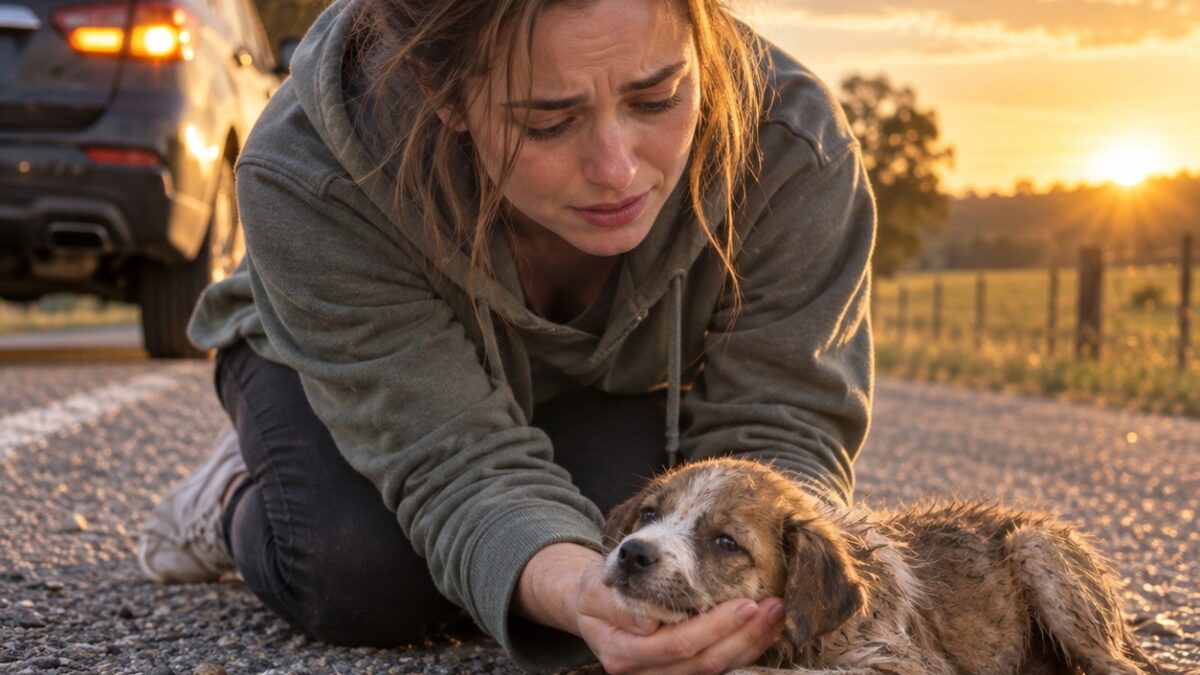
I don’t remember much about that twenty-one-minute drive in any normal sense.
I remember pieces.
A tractor moving slowly in the opposite lane.
A red mailbox.
A church sign.
The sun dipping lower behind the fields.
My own hands gripping the steering wheel too tightly.
And every few seconds, my eyes dropping toward the passenger seat.
The puppy lay bundled in my sweater.
Sometimes I couldn’t tell whether it was breathing.
So I started talking.
Not because I thought it understood every word.
Because silence terrified me.
“You’re not allowed to quit now.”
A tiny breath.
“That’s right.”
I glanced over.
“You went through all that trouble to crawl out to the road. You made me spill coffee all over my car. So now you’re stuck with me until we figure out what’s going on.”
Nothing.
I swallowed.
“My car needed cleaning anyway.”
I reached one hand across the console and rested two fingers against the blanket.
Still warm.
Still breathing.
“Good.”
My voice broke.
“Please stay that way.”
The clinic sat near the edge of a little town I had passed through dozens of times but never really noticed.
A low brick building.
Three parking spaces.
A faded blue sign.
MILLER VETERINARY CLINIC.
I barely shut the car door before running inside with the puppy in my arms.
The bell over the entrance jingled.
A woman in navy scrubs looked up.
Her eyes widened.
“Roadside puppy?”
“Yes.”
She came around the counter immediately.
“Bring him back.”
Him.
Until then, I hadn’t even thought to check.
She pushed through a swinging door.
“Dr. Miller!”
A man in his fifties stepped out of an exam room.
Gray hair.
Glasses.
Calm face.
“What’ve we got?”
“I found him crawling toward the highway.”
He reached for the puppy.
My arms tightened instinctively.
Dr. Miller noticed.
“I’m just going to put him on the table.”
“Right.”
I felt stupid.
“Sorry.”
“Don’t apologize.”
He laid the puppy on a thick towel.
The moment the sweater opened, the full condition of the little body became obvious under the fluorescent light.
The ribs.
The hip bones.
The raw paws.
The dried mud.
One ear had a tiny tear near the tip.
Dr. Miller’s expression changed.
Not dramatically.
But the softness disappeared.
“How long ago did you find him?”
“Twenty-five minutes. Maybe thirty.”
“Was he conscious?”
“Yes.”
“Walking?”
“Dragging himself.”
Dr. Miller pressed gently against the puppy’s gums.
Then pinched the skin near his shoulders.
It stayed tented for several seconds.
“Significantly dehydrated.”
“Is he going to die?”
The question came out too fast.
Dr. Miller looked at me.
“I’m not telling you that.”
“Why?”
“Because I don’t know yet.”
My stomach dropped.
“But he’s alive. His heart rate is weak but steady. Temperature is low. He’s underweight.”
He ran gentle hands along the puppy’s legs.
The puppy whimpered.
I stepped closer automatically.
Dr. Miller glanced up.
“Any idea where he came from?”
“No.”
“Collar?”
“No.”
“Anyone nearby?”
“I didn’t see anybody.”
He nodded to the technician.
“Let’s get glucose, fluids, temperature support, fecal, parvo screen, CBC if he can tolerate the draw.”
The technician moved quickly.
Dr. Miller looked back at me.
“How old do you think he is?”
“I have no idea.”
“Probably six weeks. Maybe seven.”
My heart dropped.
“That young?”
“Very.”
“How could he be out there?”
“That’s a question I’d like answered too.”
They carried him into the back.
I followed two steps before the technician gently stopped me.
“We’ll take care of him.”
“I can stay.”
“You can.”
“I mean back there.”
She gave me a sympathetic smile.
“Let us stabilize him first.”
The door closed.
I stood in the hallway staring at it.
That was when the adrenaline started leaving my body.
My knees felt weak.
My hands shook.
I walked into the waiting room and sat in a plastic chair beneath a poster explaining heartworm prevention.
I had known that puppy for less than an hour.
That fact should have mattered.
It didn’t.
My mind kept replaying the road.
His paws scraping gravel.
The way his head dropped into my palm.
That breath.
Relief.
I thought about all the things that had to happen for me to see him.
My meeting had ended eleven minutes early.
I had taken the county road instead of the highway because traffic near Knoxville was backed up.
I had slowed for a farm truck three miles before that bend.
If any one of those details changed, I might have passed before he reached the shoulder.
Or after.
I stared at my hands.
They were dirty from the puppy.
Dust under my nails.
Mud on my wrist.
I didn’t wash them.
I was afraid of losing the only physical evidence that the last hour had really happened.
The receptionist brought me a paper cup of water.
“You okay?”
“No.”
She smiled gently.
“Fair answer.”
I took the water.
“Does this happen often?”
“Strays?”
“Puppies like that.”
Her expression became sad.
“More than it should.”
“How can someone just leave him?”
“We don’t know that anyone did.”
“He’s six weeks old.”
“I know.”
She sat behind the desk.
“Sometimes a mother dog gets hit. Sometimes litters get separated. Sometimes people dump them.”
That last word stayed in my head.
Dump.
Like trash.
I hated the thought.
Forty minutes passed.
It felt like four hours.
Finally, Dr. Miller came through the door.
I stood so quickly the chair legs scraped the floor.
“He’s alive.”
I didn’t realize how tightly I had been holding my breath until it left me.
“Okay.”
“He’s responding to warmed fluids. Glucose is low but improving. Parvo test is negative.”
“Is that good?”
“Very good.”
I closed my eyes.
“What’s wrong with him?”
“Mostly what you already saw. Severe dehydration. Malnutrition. Exhaustion. The paws are badly abraded but not infected yet.”
“Anything broken?”
“No obvious fractures.”
I opened my eyes.
“Then why was he dragging himself?”
“He may simply have been too weak to stand properly.”
That somehow hurt more.
“How long had he been without food?”
“Hard to say. At his age, even a relatively short period can become dangerous.”
“Could he have been born outside?”
“Possibly.”
“No chip?”
“We scanned. Nothing.”
He rubbed the back of his neck.
“I’m going to be candid.”
“Please.”
“The next twenty-four to forty-eight hours matter.”
My stomach tightened again.
“He can still crash.”
“Yes.”
“What do you need to do?”
“Small frequent nutrition. Temperature support. Fluids. Parasite treatment when stable enough. Monitoring.”
“Can he stay here?”
“We don’t have overnight staffing.”
“Then what happens?”
Dr. Miller studied me.
“Do you have other pets?”
“No.”
“Children?”
“No.”
“Are you able to monitor him tonight?”
I didn’t even think.
“Yes.”
“You don’t know what I’m asking yet.”
“Then tell me.”
A faint smile touched his face.
“All right.”
For the next twenty minutes, he explained everything.
Feedings.
How much.
How often.
How to check gum color.
How to recognize hypoglycemia.
When to call.
What symptoms meant get in the car immediately.
He drew up medications.
The technician brought out formula.
A syringe.
Towels.
A tiny heating pad.
I listened like there would be an exam afterward.
Finally, Dr. Miller said, “You understand fostering this puppy could turn into something more permanent.”
I looked toward the recovery room.
“I know.”
“If an owner appears—”
“I understand.”
“And if nobody does?”
I looked at him.
“Then he has one.”
He watched me for a second.
“Okay.”
The technician let me see him before we left.
He was curled in a blanket inside a kennel.
Cleaner now.
Still painfully thin.
But there was color in his gums.
His eyes opened when I knelt.
“Hey.”
His head lifted about half an inch.
Then his tail moved.
Once.
Barely.
The technician whispered, “He recognizes your voice.”
I almost lost it.
“Can I touch him?”
“Absolutely.”
I slipped my fingers through the kennel opening.
The puppy pressed his nose against them.
I whispered, “I told you I wasn’t leaving.”
His tongue touched my fingertip.
One tiny lick.
I laughed and cried at the same time.
The technician handed me a tissue.
“That happens a lot here.”
“I’m not usually like this.”
“Everybody says that.”
They wrapped him carefully.
I drove home much slower than I had driven to the clinic.
Night had fallen.
The headlights swept across fields and fences.
The puppy slept most of the way.
Every few miles, I touched the blanket.
Still warm.
Still breathing.
At home, I turned my bedroom into a miniature intensive-care unit.
Towels on the floor.
Heating pad under half the bed so he could move away if too warm.
Water.
Syringes.
Formula.
Medication schedule written on a legal pad.
I set alarms.
10:30.
12:30.
2:30.
4:30.
6:30.
The puppy looked impossibly small against the towels.
I sat on the floor beside him.
“What am I going to call you?”
His eyes remained closed.
I considered names.
Scout.
Lucky.
Buddy.
Chance.
Nothing felt right.
“You nearly crawled into traffic, so clearly judgment isn’t your strongest quality.”
One ear twitched.
“How about Milo?”
Nothing.
“Cooper?”
Nothing.
“Finn?”
His eyes opened.
I laughed.
“Finn?”
His tail gave a weak little movement.
“Well, that’s extremely scientific.”
So Finn he became.
The first feeding scared me.
Dr. Miller had warned me not to give too much too quickly.
Finn was hungry enough to swallow fast, but his body wasn’t ready for a full meal.
I measured the amount twice.
“Slow.”
He tried to pull at the syringe.
“Easy.”
A tiny sound came from him.
“I know you’re hungry.”
That sentence nearly broke me.
Because hunger to me was inconvenience.
A missed lunch.
A late dinner.
For him, hunger had carved itself into his body.
I fed him slowly.
Then held him upright against my chest.
His head fit beneath my chin.
I could feel every bone.
“You don’t ever have to be that hungry again.”
I said it like a promise.
Maybe it was.
At midnight, he whimpered.
I woke instantly.
“What?”
He tried to stand.
His legs folded.
I scooped him up.
He pressed his face against my neck.
“Oh.”
Nothing medical.
Nothing urgent.
He simply didn’t want to be alone.
I carried his little bed beside my mattress.
Then I lay on the floor with one hand inside it.
“Better?”
Finn rested his chin across my wrist.
Within a minute, he was asleep.
I stayed there.
At two-thirty, I fed him.
At four-thirty, again.
At six, I realized I had slept maybe forty minutes total.
I didn’t care.
Sunlight filtered through my curtains.
Finn was no longer in the middle of his bed.
Panic jolted through me.
“Finn?”
A tiny warm shape pressed against my ribs.
During the night, he had somehow crawled out of the bed and across the towel until his body touched mine.
He was sleeping against my side.
I stared at him.
For a creature who had spent God knew how long alone, proximity seemed to be medicine.
I stroked his head.
His eyes opened.
“Morning.”
His tail tapped the towel.
Once.
Twice.
Three times.
My first real smile of the day arrived before coffee.
“We’re going to figure this out, aren’t we?”
Finn yawned.
I decided that counted as agreement.
The next week reorganized my entire life.
Work happened around Finn.
Sleep happened around Finn.
Meals happened whenever I remembered that humans also required food.
I moved my laptop to the living room floor.
Finn slept beside me in a laundry basket lined with blankets while I answered emails.
Every couple of hours, he woke.
Sometimes hungry.
Sometimes frightened.
Sometimes simply checking whether I was still there.
He would raise his head.
I would say, “Right here.”
Then he would settle.
That became our phrase.
Right here.
On the third night, he had diarrhea.
I panicked.
Called Dr. Miller.
He asked questions.
Any vomiting?
No.
Still alert?
Mostly.
Gums?
Pink.
Drinking?
Yes.
“Parasites and diet adjustment,” he said. “We expected some GI trouble.”
“Expected?”
“Yes.”
“You could have emphasized that.”
“I did.”
“I was busy being terrified.”
He laughed softly.
“Bring him tomorrow if it gets worse.”
I stayed awake anyway.
At three in the morning, Finn crawled into my lap.
He curled into a ball.
I rubbed the length of his spine.
“You really know how to choose high-maintenance ways to meet people.”
He sighed.
I stared into the dark room.
Before Finn, I had been good at being alone.
At least that was what I told myself.
I had spent the previous two years building a life around independence.
A job I could do partly from home.
A quiet house outside town.
Friends I saw when schedules aligned.
Parents three states away.
No spouse.
No children.
No pets.
Nothing depended on me enough to rearrange my life.
I had called that freedom.
Some nights, it felt more like silence.
Finn changed the silence immediately.
By the end of the first week, my home smelled faintly like puppy formula no matter how often I cleaned.
Tiny towels hung over chair backs.
Medicine bottles lined the kitchen counter.
I had slept on the floor more nights than in my bed.
And somehow the house felt warmer.
At his first follow-up, Finn had gained eleven ounces.
Dr. Miller smiled.
“Excellent.”
“Eleven ounces sounds tiny.”
“For him, it’s significant.”
Finn stood unsteadily on the exam table.
His legs were stronger.
Not strong.
Stronger.
Dr. Miller watched him take three steps.
“He’s improving faster than I expected.”
My chest filled with something that felt embarrassingly close to pride.
“Because he’s stubborn.”
“Most survivors are.”
He listened to Finn’s heart.
“Still a mild murmur.”
My happiness stopped.
“What?”
“Don’t panic.”
“Too late.”
“It may be innocent. Malnutrition can make everything sound worse. I want to recheck once he’s stronger.”
“Could it be serious?”
“It could.”
That word followed me home.
Could.
Finn didn’t care.
He spent the car ride trying to chew the edge of his blanket for the first time.
Normal puppy behavior.
I had never been so delighted to see something destroyed.
At home, I bought him toys.
Too many.
A stuffed fox.
A rope.
Two rubber chew toys.
A squeaking duck.
Finn looked at the collection.
Then attacked one of my socks.
“Really?”
Tail wag.
“I spent forty dollars.”
Sock.
“You are impossible.”
He grabbed the sock and attempted to run.
His legs moved faster than the rest of him.
He rolled sideways.
For half a second, he looked offended by gravity.
Then I started laughing.
Not polite laughter.
Not the automatic kind you give coworkers.
Real laughter.
The kind that fills a room.
Finn stared at me.
Then barked.
The bark was tiny.
Almost a squeak.
That made me laugh harder.
He barked again.
Soon we were both making ridiculous noises on my living room floor.
I realized afterward that it had been months since I laughed like that.
Maybe longer.
By the second week, Finn started exploring.
First the kitchen.
Then the hallway.
Then the porch.
The first time I placed him on grass, he froze.
His paws spread.
His nose lowered.
He smelled everything.
Dirt.
Clover.
Wind.
Then a butterfly crossed in front of him.
Finn attempted pursuit.
He made it three feet.
Tripped.
Rolled.
Stood again.
Chased.
I stayed two steps behind him, terrified he would somehow injure himself on oxygen.
“Easy.”
He ignored me.
“Finn.”
Butterfly.
“You’re supposed to be recovering.”
Butterfly.
I started to understand that recovery did not mean becoming careful.
For Finn, recovery meant becoming a puppy.
And puppies are terrible at caution.
Every day, something new appeared.
Curiosity.
Hunger.
Mischief.
A preference for sleeping with one paw touching me.
A hatred of the vacuum cleaner.
A fascination with ice cubes.
A very specific bark for when his food was thirty seconds late.
I learned all of it.
He learned me too.
The sound of my car keys.
The tone I used before medicine.
Which chair I sat in with coffee.
Which drawer held treats.
He began looking back at me constantly.
In the yard.
At the vet.
Walking from one room to another.
Three steps.
Look back.
Five steps.
Look back.
At first, I thought it was cute.
Then I realized what he was doing.
Checking.
Are you still there?
Every time, I answered.
“Right here.”
At night, he sometimes dreamed badly.
His paws twitched.
His breath quickened.
A tiny cry escaped him.
I would touch him gently.
“Finn.”
He woke suddenly.
Eyes wide.
Then he saw me.
His body relaxed.
“You’re home.”
That became another phrase.
You’re home.
I couldn’t erase whatever had happened before the road.
I couldn’t know whether he remembered hunger.
Cold.
Being left.
Losing his mother.
Maybe all of it lived only as sensations.
But I could teach him what came after.
Food arrived.
Hands were gentle.
Doors opened again.
When I left a room, I came back.
Storms ended.
Night ended.
Fear ended.
That was enough.
At three weeks, Finn went back to Dr. Miller.
He had gained nearly two pounds.
His coat looked completely different.
What had seemed dull brown now held warm reddish tones along his back.
White covered his chest and the tips of his front paws.
His eyes were brighter.
Dr. Miller listened to his heart for a long time.
I watched his face.
“Well?”
He moved the stethoscope.
Then smiled.
“Murmer’s nearly gone.”
I actually sat down.
“Really?”
“Really.”
“So his heart is okay?”
“Everything I’m hearing suggests the earlier sound was likely related to his condition.”
I closed my eyes.
“Thank God.”
Dr. Miller laughed.
“You’ve been worried about that for two weeks, haven’t you?”
“Every twelve minutes.”
Finn tried to bite the stethoscope.
Dr. Miller pulled it away.
“He’s certainly feeling better.”
I scratched Finn behind the ears.
“He thinks medical equipment is a snack.”
“Healthy developmental milestone.”
Then Dr. Miller became more serious.
“We should talk about ownership.”
My stomach tightened.
“What about it?”
“We posted a found notice as required.”
“I know.”
“No response.”
I felt guilty about the relief that hit me.
He continued.
“Shelter intake records don’t show a matching litter. No chip. No lost-pet report.”
“So?”
“If no legitimate owner emerges within the applicable stray hold requirements, you can formally adopt.”
I looked down at Finn.
He was licking my wrist.
“Can I do that today?”
“Almost.”
“How almost?”
“A few more days.”
I nodded.
Finn looked up.
“You hear that?”
Tail wag.
“You might be stuck with me legally soon.”
Dr. Miller said, “Something tells me the paperwork is a formality.”
He was right.
The evening I completed Finn’s adoption paperwork, I cried in the clinic parking lot.
Not dramatically.
Just quiet tears that came without warning.
The form had a blank.
OWNER NAME.
I wrote mine.
Another blank.
ANIMAL NAME.
FINN.
I stared at those words.
Owner.
Name.
Family can begin on paper sometimes.
But ours had started on gravel.
That night, I stopped calling him “the puppy” in my own head.
He was mine.
Not as property.
As responsibility.
As belonging.
I bought him a collar.
Dark green.
Nothing fancy.
The tag read:
FINN
Then my phone number.
I held it in my palm before putting it on.
The first day I found him, there had been nothing around his neck.
No name.
No number.
No evidence that anyone would come looking.
The little metal tag seemed absurdly important.
I fastened the collar.
Finn immediately scratched at it.
“Oh, please appreciate the symbolism.”
Scratch.
“It has your name.”
Scratch.
“It cost eighteen dollars.”
He rolled onto his back.
I laughed.
“Fine. Be emotionally unavailable.”
The first month passed.
Then another.
Finn grew.
Not quickly enough for me.
Too quickly for me.
Both at once.
The raw paws healed.
Hair grew over the thin places.
His ribs disappeared beneath muscle.
His tail became a full-time source of destruction.
Coffee table?
Tail.
Water glass?
Tail.
Newspaper?
Tail.
Anything within eighteen inches of his happiness was in danger.
My quiet house transformed.
There were toys under furniture.
Paw prints near the back door.
A dog bed in the living room that Finn ignored because apparently my sofa existed solely for him.
My schedule changed too.
Morning walks.
Breakfast.
Work.
Midday yard break.
Training.
Evening porch.
I had structure now.
Not the rigid structure of productivity apps and calendars.
Living structure.
Another heartbeat waiting for mine.
I started waking before my alarm.
Finn usually woke first.
At sunrise, his nose would appear beside my bed.
Then one paw.
Then another.
Eventually his entire body climbed onto me.
“Finn.”
Tail.
“It’s six.”
Nose against my chin.
“You don’t have a job.”
Lick.
“That’s easy for you.”
By then, he weighed fifteen pounds and believed he weighed three.
I took him to a small park outside town for his first real outing after vaccines.
I was nervous.
Finn was ecstatic.
The world had apparently been invented that morning specifically for his entertainment.
Children.
Leaves.
Squirrels.
Trash cans.
Grass.
Bicycles.
A man carrying a sandwich.
Especially the sandwich.
Finn pulled toward everything.
“Easy.”
A woman walking an older golden retriever smiled.
“First park?”
“Is it obvious?”
“Only because you look terrified.”
“I’m managing risk.”
“You’re holding the leash with both hands.”
“Risk management.”
She laughed.
Her dog approached slowly.
Finn stopped.
I felt the leash tense.
For a moment, I worried.
What if other dogs frightened him?
What if something happened before I found him?
The golden retriever lowered its head.
Finn sniffed.
The older dog sniffed.
Then Finn’s tail moved.
Fast.
The golden bowed playfully.
Finn exploded.
They ran in a circle around us.
I laughed.
The woman said, “There you go.”
Something about seeing Finn with another dog touched me more deeply than I expected.
He wasn’t surviving.
He was participating.
In life.
In play.
In relationships.
The roadside puppy disappeared a little more every day.
Not erased.
Transformed.
We went to a lake the next weekend.
The source had repeated many lake and park trips; I chose one that mattered.
Finn had never seen open water as far as I knew.
At first, he hated it.
A small wave touched his paws.
He jumped backward like the lake had personally insulted him.
I laughed.
“It’s water.”
He barked.
“Yes, very threatening.”
Another wave.
Finn moved forward.
Then back.
Forward.
He pawed at the surface.
The water moved.
This offended him.
He attacked the ripple.
Ten minutes later, he was splashing in the shallows.
Twenty minutes later, I was wet from the knees down because apparently his discovery required my participation.
I threw a small stick.
Finn chased it.
Grabbed it.
Then ran in the wrong direction.
“Bring it here!”
He looked at me.
Stick in mouth.
“Here!”
He took off along the beach.
“So fetch is theoretical.”
Eventually, he returned.
I sat in the sand with him between my legs.
His wet fur smelled like lake water and dog.
I wrapped a towel around him.
For a long time, we watched sunlight move across the surface.
I thought of the road.
Not with pain exactly.
With disbelief.
How could this be the same animal?
Finn rested his head against my knee.
I said, “You almost missed all this.”
His eyes closed.
Then another thought came.
So did I.
Before Finn, weekends were errands.
Laundry.
Groceries.
Maybe dinner with friends.
Now I was sitting beside a Tennessee lake with mud on my shoes, dog hair on my clothes, and a wet puppy asleep against me.
I was happier.
That realization unsettled me.
Not because happiness was bad.
Because it revealed something.
I had not known how lonely I was.
Loneliness can be loud.
But mine hadn’t been.
Mine was organized.
Clean house.
Full schedule.
Streaming shows.
Work calls.
Occasional dinners.
Nothing obviously missing.
Then Finn arrived and filled something I had never named.
He needed me.
That sounds like burden when you say it clinically.
But being needed can also pull you outward.
His hunger required me to cook.
His fear required me to stay present.
His energy required me to walk.
His curiosity made me notice things again.
Weather.
Grass.
Sunlight.
Neighbors.
Other people’s dogs.
Children waving from porches.
I was no longer moving through my days alone inside my head.
Finn kept dragging me back into the world.
Sometimes literally.
He grew into a surprisingly strong dog.
By six months, walks required training.
Finn loved everything too much.
People.
Dogs.
Birds.
Plastic bags.
The possibility of adventure.
I enrolled us in a basic obedience class.
Our instructor, Megan, looked at Finn bouncing at the end of his leash.
“How old?”
“About six months.”
“Rescue?”
“Yes.”
“Energy level?”
Finn jumped up and tried to lick her elbow.
She nodded.
“Got it.”
Training became another language between us.
Sit.
Stay.
Come.
Leave it.
Wait.
Look at me.
At first, Finn obeyed only when no interesting object existed within the state of Tennessee.
But gradually he learned.
More importantly, I learned.
Megan corrected me constantly.
“You’re repeating commands.”
“He’s ignoring me.”
“Because you repeat commands.”
“What am I supposed to do?”
“Say it once. Help him succeed.”
That line stuck with me.
Help him succeed.
Not punish failure.
Not dominate.
Not scare.
Communicate.
We practiced every evening.
Finn loved it.
Mostly because treats existed.
One afternoon, Megan asked us to demonstrate recall across the training room.
Finn sat at the far end with another assistant.
I crouched.
“Finn. Come!”
He launched toward me.
Not ran.
Launched.
Ears back.
Mouth open.
Tail flying.
He hit me hard enough to nearly knock me over.
The whole class laughed.
I hugged him.
“Good boy.”
Megan said, “Technically excellent. Structurally dangerous.”
I couldn’t stop smiling.
The puppy who once dragged himself toward a road now ran toward me like distance was unacceptable.
That mattered.
Autumn arrived.
Finn experienced falling leaves.
He treated them as enemies.
Every gust became a chase.
He would leap at one leaf, miss it, then discover ten more and lose all strategic focus.
I stood in the yard laughing.
Neighbors started knowing him.
Mr. Howard next door kept treats in his garage.
A girl named Emma two houses down drew Finn pictures.
The mail carrier learned to keep packages above tail height.
Finn became part of the small geography of our street.
People asked about him when I walked alone.
“Where’s Finn?”
At the vet.
Sleeping.
Destroying my couch.
Wherever.
He had a social life larger than mine.
One evening, a thunderstorm rolled across the hills.
The first crack of thunder hit hard enough to shake the windows.
Finn froze.
Everything changed.
His playful body went rigid.
Ears back.
Tail tucked.
He ran beneath the kitchen table.
I crouched.
“Finn.”
Another thunderclap.
He trembled.
Something about that fear felt older than the storm.
I crawled under the table with him.
Not dignified.
Not comfortable.
Necessary.
“Hey.”
He pressed into my chest.
“I’ve got you.”
Lightning flashed.
Thunder.
Finn shook harder.
I wrapped a blanket around him.
“You don’t have to be brave.”
I realized as I said it that nobody had ever said that to me.
Not exactly.
Maybe that was why it mattered.
“You can be scared.”
I stroked his ears.
“I’m right here.”
The storm lasted forty minutes.
We stayed under the table for forty-five.
Eventually, Finn slept with his face tucked under my arm.
I sat there long after the rain softened.
Something about caring for him was teaching me a different definition of strength.
I had always thought strength meant functioning.
Handling things.
Not inconveniencing anyone.
Finn had survived because he kept moving when he had almost nothing left.
But healing began when he stopped moving.
When he let someone carry him.
That distinction reached somewhere inside me.
A few weeks later, I called my mother.
We had a good relationship.
But I had gotten lazy about maintaining it.
Busy.
Work.
Distance.
Life.
She answered.
“Everything okay?”
“Yes.”
“You don’t usually call on Tuesday.”
“I know.”
Pause.
“Is Finn okay?”
I laughed.
“Finn is fine.”
“Then what’s wrong?”
“Nothing.”
Another pause.
“I just wanted to hear your voice.”
She went quiet.
Then:
“Well. I like this dog.”
“What?”
“He’s improving you.”
“Mom.”
“I’ve been saying you need companionship.”
“You meant a husband.”
“I was trying not to say it.”
“I regret calling.”
She laughed.
We talked for an hour.
Finn slept beside me.
Little changes.
That was what he brought.
Not a cinematic transformation.
I didn’t quit my job.
Move across the country.
Discover a hidden calling.
I simply became more connected.
More present.
I started volunteering once a month with a local rescue because Dr. Miller mentioned they always needed transport drivers.
The first transport was difficult.
Three puppies from an overcrowded shelter.
Healthy.
Loud.
Safe.
One cried the entire drive.
I remembered Finn’s silence on our first ride.
Silence had been worse.
At the rescue, a volunteer named June asked how I got involved.
I told her about Finn.
She looked down at him.
“He found the right road.”
I smiled.
“I think I did.”
Finn turned one sometime the following spring.
We did not know his actual birthday.
So I chose the day I found him.
Road Day.
My friends thought that name was depressing.
Finn didn’t care.
Cake existed.
Dog-safe cake.
I invited neighbors.
Dr. Miller came for twenty minutes.
Megan came.
Mr. Howard brought a bag of treats big enough for a kennel.
Emma gave Finn a paper crown.
He ate part of it.
We stood in my yard beneath string lights.
Someone asked me to tell the rescue story again.
I had told it dozens of times by then.
But that night it felt different.
I looked at Finn running across the grass.
Strong legs.
Shiny coat.
Healthy body.
I told them about the road.
The gravel.
The sweater.
The clinic.
The first tiny tail wag.
My voice broke when I reached the part about him crawling across the bedroom floor to sleep beside me.
Dr. Miller said, “You left out the part where you called me at three in the morning because he had hiccups.”
Everyone laughed.
I stared at him.
“I thought it was respiratory distress.”
“It was hiccups.”
“He was fragile.”
“He had eaten too fast.”
“I was under pressure.”
Finn barked as if defending me.
“Thank you.”
The party continued.
Near sunset, I sat on the porch steps.
Finn came over.
He was tired.
He leaned against my leg.
“One year,” I said.
He looked at me.
“Pretty good.”
Tail thump.
“You know, technically, you still owe me a sweater.”
He put his head in my lap.
“Fine.”
I scratched his chest.
“Debt forgiven.”
Another year passed.
Finn matured.
Somewhat.
He stopped eating socks.
Mostly.
He learned to swim.
He loved car rides.
He hated nail trimming.
He developed an obsession with a particular yellow tennis ball that was always missing when we needed it.
He slept on my bed.
No negotiation.
He had moved from fragile roadside puppy to healthy medium-sized dog with deep brown eyes and a white chest.
People who met him for the first time never guessed his beginning.
That felt like victory.
Then something happened that scared me more than I expected.
Finn disappeared.
Only for twenty-three minutes.
But twenty-three minutes can contain an entire lifetime of panic.
A delivery driver left my side gate unlatched.
I didn’t notice.
Finn went into the yard.
Ten minutes later, I called him.
Nothing.
“Finn?”
I stepped outside.
Gate open.
My heart stopped.
“FINN!”
I ran into the street.
No dog.
“Finn!”
Neighbors came outside.
Mr. Howard.
Emma’s father.
Two teenagers.
Everyone started searching.
I ran toward the county road.
The same direction as the road where I had found him years before.
My mind became cruel.
Cars.
Ditches.
Lost collar.
Fear.
I could barely breathe.
“Finn!”
Then I heard a bark behind me.
I turned.
Across the intersection, Finn stood beside an elderly woman.
She held his collar loosely.
“He yours?”
I ran.
Finn exploded toward me the moment she released him.
He hit my knees.
I dropped to the pavement and wrapped both arms around him.
“You idiot.”
He licked my face.
“You absolute idiot.”
More licking.
I was crying so hard the woman looked uncomfortable.
“He came into my yard.”
“Thank you.”
“He was chasing a squirrel.”
“Of course he was.”
I held his face.
“Do not ever do that again.”
Finn wagged.
No remorse.
That night, I replaced the gate latch.
Then added a secondary lock.
Then installed a camera.
Then ordered a GPS collar.
My friends said I overreacted.
I did.
I knew it.
But fear has memory.
For twenty-three minutes, I had been back beside that Tennessee road.
The difference was that this time I knew his name.
That made losing him imaginable in a way I never wanted to experience again.
That night, Finn slept beside me.
I kept one hand on his back.
At two in the morning, I woke.
He was breathing normally.
I whispered, “Right here.”
His tail moved once in sleep.
The years began passing faster.
Finn became the dog I had imagined during those first frightening weeks.
Strong.
Affectionate.
Ridiculous.
Loyal.
He could read my moods better than most humans.
If I cried, he appeared.
If I was sick, he refused to leave the bedroom.
If I worked too long, he placed his chin on my laptop.
Once, during a video meeting, he closed the computer with his nose.
My boss stared at the frozen screen when I reopened it.
“Was that your dog?”
“Yes.”
“Does he disagree with the quarterly plan?”
“Strongly.”
Finn came to my parents’ house for Christmas.
My mother spoiled him.
My father claimed not to like dogs in the house.
Finn slept on his feet during dinner.
By the second day, Dad was feeding him turkey.
“Traitor,” I said.
Dad shrugged.
“He seems underfed.”
Finn was thirty-eight healthy pounds.
“He ate ten minutes ago.”
“Growing dog.”
“He is three.”
“Still.”
Finn learned something else.
Comforting strangers.
It happened naturally.
At first, I noticed it with Mr. Howard after his wife died.
Howard stopped coming outside.
His garage stayed closed.
One afternoon, I brought groceries to his porch.
Finn came with me.
Howard opened the door.
He looked twenty years older.
Finn did not jump.
Did not bark.
He simply stepped forward and leaned against Howard’s leg.
Howard’s hand dropped onto his head.
Neither moved.
Eventually, Howard whispered, “She loved dogs.”
I said nothing.
Finn stayed.
We sat with him for an hour.
After that, Howard started joining us for walks.
Short at first.
Then longer.
Finn would slow down for him.
That surprised me.
This dog who usually believed all movement should occur at maximum speed somehow understood.
That planted an idea.
Therapy work.
Megan encouraged it.
“He has the temperament now.”
“Finn?”
She looked at him lying quietly beside a child during a training class.
“Yes.”
“He once ate drywall.”
“Growth.”
We completed evaluations.
Obedience.
Temperament.
Noise.
Wheelchairs.
Walkers.
Crowds.
Touch.
Finn passed.
The first retirement community visit took place on a bright spring morning.
I was more nervous than he was.
The lobby smelled like coffee and furniture polish.
A coordinator named Louise met us.
“Ready?”
“No.”
She laughed.
“He looks ready.”
Finn’s tail wagged.
We entered the common room.
Heads turned.
Instantly.
Dogs do something to places full of people who have lost pieces of their old lives.
Homes.
Spouses.
Driving.
Privacy.
Routine.
Sometimes memory.
Finn walked to an older gentleman sitting beside a window.
The man held out a shaking hand.
Finn approached slowly.
Sniffed.
Then rested his chin on the man’s knee.
The man smiled.
Not politely.
Not because someone told him a dog was visiting.
A real smile.
“There you are,” he whispered.
As if Finn had been expected.
The man’s daughter later told me he had barely spoken since moving in.
Finn sat with him for fifteen minutes.
No tricks.
No games.
Just presence.
We visited another woman.
She buried both hands in Finn’s fur and told us about the collie she had owned in 1963.
A former farmer laughed when Finn stole his napkin.
Two sisters argued over who got the next turn petting him.
Finn moved from person to person.
Giving exactly what each moment required.
Energy when people wanted laughter.
Stillness when they needed quiet.
I watched him.
This dog who once needed someone to place a hand against his body so he knew he wasn’t alone.
Now he was doing that for other people.
On the drive home, he collapsed asleep in the passenger seat.
I rested my hand against him at a red light.
“You did good.”
One eye opened.
“Very good.”
Tail thump.
“I’m proud of you.”
The light turned green.
We continued home.
That became part of our life.
Not every week.
But often.
Schools.
Senior centers.
A rehabilitation facility.
A library reading program where children practiced reading aloud to dogs.
Finn particularly loved that one because children frequently dropped crackers.
One boy named Caleb refused to read in front of his class because he stuttered.
With Finn, he tried.
Slowly.
Word by word.
Finn didn’t know whether the words came out perfectly.
Finn cared whether Caleb had a hand available for petting.
The boy relaxed.
Week after week.
One afternoon, Caleb finished an entire page without stopping.
His mother cried.
So did I.
Finn sneezed.
He had no respect for dramatic timing.
Driving home, I thought about rescue.
People always said I rescued Finn.
The sentence made me uncomfortable.
It implied a one-way transaction.
I found him.
I fed him.
I paid the vet.
I gave him a home.
All true.
But it ignored everything he gave back.
He pulled me into the world.
Into relationships.
Into service.
Into laughter.
Into responsibility that did not feel like weight.
He taught me that being needed could be beautiful.
That care becomes routine before it becomes identity.
That healing often looks boring from the outside.
Meals.
Medicine.
Walks.
Sleep.
Consistency.
Until one day, the creature who once couldn’t stand is running across a field.
Finn was six when I drove that road again intentionally.
I had passed it many times.
But this time, I stopped.
Same shoulder.
Same bend.
The area looked smaller than I remembered.
Maybe trauma enlarges places.
I parked safely and clipped Finn’s leash.
He jumped out.
Sniffed.
No recognition.
Of course not.
He had been a baby.
I walked him toward the gravel shoulder.
My chest tightened.
There.
I thought.
Somewhere around there.
I could almost see his tiny body again.
Dragging forward.
Finn pulled toward weeds.
“Easy.”
He sniffed.
Then looked at me.
Healthy eyes.
Bright.
Alive.
I crouched.
“This is where I met you.”
Finn licked my nose.
I laughed.
“You have no idea.”
Tail wag.
“No idea what you did.”
Cars passed occasionally.
I kept him close.
We stood there for maybe five minutes.
Nothing supernatural happened.
No grand revelation.
The road remained a road.
Finn remained a dog.
And yet I felt something close.
A circle.
I took a photograph.
Finn sitting beside the wild grass.
Sun behind him.
No one looking at it would understand.
That was fine.
Some landmarks are private.
On the way home, I stopped at Miller Veterinary Clinic.
Dr. Miller was still practicing.
More gray now.
He came into the lobby.
“Well, look who survived.”
Finn rushed him.
Dr. Miller laughed.
“Yes, yes. I remember you.”
I said, “He remembers snacks.”
“Also survival.”
He examined Finn out of professional habit.
“Looks terrible.”
I stared.
He smiled.
“Perfectly terrible. Healthy.”
“Very funny.”
He scratched Finn’s neck.
“You know, I didn’t think he’d make it that first night.”
I went still.
“You never told me that.”
“You had enough fear.”
“How bad?”
He looked at Finn.
“Bad.”
I swallowed.
“Why did he?”
Dr. Miller shrugged.
“Good timing. Treatment. Genetics. Luck.”
Then he looked at me.
“And somebody who didn’t sleep for three weeks.”
I smiled.
“I slept.”
“Not according to your phone calls.”
We laughed.
Then I asked a question I had wondered about for years.
“Do you think he was abandoned?”
Dr. Miller took his time.
“I think we’ll never know.”
“That bothers me.”
“I understand.”
“I want to know where he came from.”
“Why?”
I looked at Finn.
“I don’t know.”
Dr. Miller leaned against the counter.
“Sometimes knowing the beginning doesn’t improve the ending.”
I said nothing.
“He was alone when you found him.”
“Yes.”
“He isn’t now.”
No.
He wasn’t.
That had to be enough.
Years passed.
Finn’s face slowly changed.
White appeared around his muzzle.
He still chased leaves.
Just slower.
He still believed squirrels were a personal insult.
Still slept pressed against me.
Still checked where I was.
But not with fear anymore.
Now it was habit.
Love has habits.
At nine, he developed arthritis.
Nothing dramatic.
Stiff mornings.
Slower stairs.
I bought ramps.
Joint supplements.
A better orthopedic bed.
Finn ignored the bed and continued sleeping on mine.
“Excellent investment.”
Tail thump.
We walked shorter distances.
Visited the retirement center less often.
Finn’s role changed.
He no longer bounced from person to person.
He sat quietly.
Older residents seemed to appreciate that.
They understood slower bodies.
Mr. Howard died that year.
At his memorial, his daughter hugged me.
“Thank you for bringing Finn into Dad’s life.”
I looked down at Finn.
“He brought himself.”
She laughed through tears.
“He did.”
She handed me a photograph.
Howard sitting on his porch.
Finn’s head on his knee.
Both looking toward the road.
I framed it.
There were so many lives inside Finn’s life now.
Not just mine.
That amazed me.
A creature nobody appeared to want had become precious to people who never knew he existed that first day.
Sometimes worth is not discovered.
It is simply given space to become visible.
When Finn turned eleven—approximately—I took him back to the lake.
The same one from his first real outing.
He walked slowly onto the sand.
A wave touched his paws.
He did not jump this time.
He stepped into the water.
Then looked at me.
“Show-off.”
He waded deeper.
I rolled up my jeans and followed.
We stayed near shore.
No fetch.
No running.
Just water around our ankles.
Sunlight.
Wind.
Finn eventually sat beside me under a tree.
I rubbed his gray muzzle.
“You’re old.”
He sighed.
“I’m serious.”
Another sigh.
“Very judgmental.”
I thought about that first trip.
Wet puppy.
Stick running away from me.
Endless energy.
The years between seemed impossibly short.
I felt grief before there was anything to grieve.
That is the price of loving something with a shorter life.
You begin missing them while they are still beside you.
I hated myself for that sometimes.
Finn would be sleeping peacefully, and suddenly I would think:
There will be a day this room is quiet again.
I learned to stop.
Not because the thought was false.
Because it stole the present.
Finn had taught me presence once.
I could return the favor.
So I touched his head.
Right here.
He opened his eyes.
Still here.
Another year.
Then another.
Finn slowed.
But he remained himself.
He still greeted me at the door.
Just without the spinning.
Still stole socks occasionally.
Perhaps out of principle.
Still recognized the word “park” from two rooms away.
Still hated thunderstorms.
During storms, we no longer fit under the kitchen table together comfortably.
So I sat on the floor beside the couch.
Finn pressed against me.
“You don’t have to be brave.”
Same words.
All those years later.
His breathing slowed.
My hand rested on his chest.
Heartbeat.
Steady.
Older.
Beloved.
One winter morning, Finn did not get up for breakfast.
I knew immediately.
Not death.
Not yet.
Something wrong.
“Finn?”
He raised his head.
Tail moved once.
I knelt.
“Come on.”
He tried to stand.
His rear legs slipped.
Fear ripped through me with the same violence as that first roadside moment.
I carried him to the car.
He was much heavier now.
Thirty-nine pounds.
Still felt too light in my arms.
At Miller Veterinary Clinic, the building had been renovated.
New sign.
Same bell.
Dr. Miller had retired the year before.
A younger veterinarian, Dr. Patel, examined Finn.
Bloodwork.
X-rays.
Ultrasound.
I sat beside him on the floor.
“Right here.”
Hours later, Dr. Patel sat with me.
There was a mass.
Spleen.
Likely malignant.
Internal bleeding.
My brain refused the words.
“What do we do?”
“Surgery is possible.”
“Then do it.”
She waited.
“What?”
“Sarah—”
I had told her my name years earlier at appointments.
“What?”
“Finn is nearly thirteen.”
“So?”
“Surgery carries significant risk.”
“Then what are you saying?”
“I’m saying we need to consider what outcome we’re hoping for.”
“I’m hoping he lives.”
My voice broke.
She didn’t flinch.
“I know.”
“Then fix it.”
Silence.
That silence reminded me of Dr. Miller all those years before.
I’m not telling you that because I don’t know yet.
Except now I understood what veterinary medicine could not do.
It could save.
Treat.
Repair.
Support.
But it could not negotiate forever.
Dr. Patel explained everything.
Surgery might give months.
Maybe longer if benign.
Maybe days if complications.
Without surgery, bleeding could worsen unpredictably.
I looked at Finn.
He rested his head on my foot.
Thirteen years disappeared.
Tiny body in a sweater.
Syringe feeding.
First bark.
Lake.
Training class.
Retirement center.
Howard.
Storms.
Road.
Home.
“How do I know what he wants?”
Dr. Patel’s eyes softened.
“You know him.”
That felt cruel.
“I know he wants chicken.”
She smiled.
“Yes.”
“And socks.”
“Probably.”
“How am I supposed to make this decision?”
“You don’t make it because you want less pain.”
I looked at her.
“You make it because he deserves less pain.”
I cried.
Not quietly.
Finn lifted his head.
I immediately wiped my face.
“Sorry.”
He tried to move closer.
Even then.
He was comforting me.
I laughed through tears.
“Stop.”
Tail.
“You don’t have to take care of me.”
But of course that was what we had always done.
We chose surgery.
Not because I couldn’t let go.
Because his bloodwork and heart suggested he was stable enough to have a reasonable chance.
I signed the forms with shaking hands.
Then kissed his head.
“This is the deal.”
Finn looked at me.
“You fight only if you want to.”
His eyes stayed on mine.
“No promises.”
I pressed my forehead against his.
“I already got more years than I had any right to ask for.”
They took him back.
I sat in the waiting room.
Different chairs.
Same fear.
Thirteen years collapsed into one loop.
Door.
Clock.
Footsteps.
Waiting.
I remembered the first time.
Forty minutes.
This time, two hours.
Then three.
Finally, Dr. Patel appeared.
I stood.
She smiled.
“He made it.”
My legs almost failed.
Surgery went well.
The mass had ruptured slightly.
They removed the spleen.
Finn recovered slowly.
The pathology came back a week later.
Benign hematoma.
Not cancer.
I read the message three times.
Then sat on the kitchen floor crying while Finn ate chicken from my hand.
“You ridiculous animal.”
He swallowed.
“You’re going to outlive me out of spite.”
He didn’t.
Of course.
But we got more time.
Eighteen months.
Good months.
Slower.
Gentler.
Precious.
Finn reached fourteen.
He could no longer jump onto my bed, so I built a ramp.
He sometimes forgot why he entered a room.
I understood.
He slept more.
His hearing faded.
I started touching the floor so vibrations woke him instead of calling his name.
But his eyes still found me.
Every time.
Are you there?
Right here.
Near the end, we returned once more to the porch.
Warm afternoon.
Finn lay on a thick bed beside my chair.
The Tennessee air smelled like cut grass.
A truck passed on the distant road.
He lifted his head.
I rested my hand on him.
“Not our road.”
His eyes met mine.
Maybe he understood tone.
Maybe nothing.
I told him the story anyway.
“You were very small.”
Tail barely moved.
“Very ugly.”
His eyes narrowed.
I laughed.
“Fine. Beautiful. Terrible condition, though.”
I described the gravel.
The sweater.
Dr. Miller.
The first tail wag.
The way he crawled to me that first night.
“You know what I thought?”
He breathed slowly.
“I thought I saved you.”
My voice broke.
“For a long time, people kept saying that.”
I stroked the white fur around his muzzle.
“I don’t think that’s what happened.”
Finn rested his head.
“You made me stop.”
I looked toward the fields.
“Not just the car.”
The truth settled into me.
I had been moving through life efficiently.
Quickly.
Safely.
Finn had made me stop.
Kneel in the dirt.
Pay attention.
Care about something that could hurt me simply by becoming important.
He had led me into friendships.
Service.
Family.
Grief.
Joy.
All the dangerous things that make life matter.
“You didn’t save me from anything dramatic.”
I whispered.
“You just made sure I actually lived.”
Finn closed his eyes.
We stayed there until sunset.
A few weeks later, his body told me it was time.
No emergency.
No dramatic collapse.
Just enough small things.
Food lost interest.
Walking became work.
Pain medication helped less.
He slept more than he was awake.
And one morning, he looked at me in a way I knew.
People will tell you dogs cannot ask.
Maybe they are right.
Maybe I only projected meaning because I was terrified.
But after fourteen years of learning every expression that face could make, I knew.
I called Dr. Patel.
She came to the house.
That mattered to me.
Finn hated the clinic now.
I wanted his last place to be home.
His bed was by the porch door.
Sunlight came through the window.
I sat on the floor.
Finn’s head lay in my lap.
Dr. Patel explained the process.
I barely heard.
I kept rubbing his ears.
“You’re okay.”
Finn breathed.
“You’re home.”
His eyes opened.
“Right here.”
The first injection relaxed him.
His body softened.
For the first time in weeks, pain left his face.
I cried into his fur.
“You did so good.”
His breathing slowed.
“So good.”
I remembered the road.
Tiny puppy.
Head in my palm.
Relieved to be held.
The shape was the same now.
Much larger.
Much older.
Same trust.
“I’m not leaving.”
Dr. Patel touched my shoulder.
I nodded.
The final medication went in.
Finn’s chest rose.
Fell.
Rose.
Fell.
Then became still.
I kept my hand on him.
For a long time.
There was no dramatic sound.
No sign.
No miracle.
Just quiet.
Fourteen years earlier, silence had terrified me because I thought it meant a life might be ending before it began.
Now silence meant a life had been fully lived.
That didn’t make it hurt less.
For weeks, I heard Finn everywhere.
Nails on the floor.
Collar tags.
A sigh near the couch.
I turned toward the door at feeding time.
I woke expecting weight beside me.
The house became the quiet house I had once thought I wanted.
I hated it.
People sent flowers.
Dr. Miller called when he heard.
Megan brought photographs from training.
The retirement center mailed a card signed by residents and staff.
Caleb—no longer a little boy—sent me a note.
Finn was the first one who ever listened to me read without waiting for me to get the words right.
I cried over that for an hour.
Mr. Howard’s daughter sent the porch photograph again, this time enlarged.
My mother called every day for a week.
Even my father cried.
“He was a good dog.”
“Yes.”
“The best?”
“Obviously.”
Months passed.
Grief changed.
It stopped being a constant emergency and became weather.
Some days clear.
Some days sudden.
I could say Finn’s name without crying.
Then a green collar in a store would ruin me.
I kept his tag.
FINN.
My phone number.
The number never changed.
Sometimes I held it.
Proof.
Not that he belonged to me.
That for fourteen years, someone knew where home was.
Nearly a year after Finn died, I drove the county road again.
I didn’t plan to stop.
Then I did.
Same shoulder.
Different season.
Tall grass.
Warm afternoon.
I got out.
I stood where I thought I had found him.
For a moment, I felt ridiculous.
Then peaceful.
A car passed.
Wind moved through the grass.
I said aloud:
“Thank you.”
No answer.
Of course.
But I stayed.
People often want rescue stories to end at adoption.
Puppy saved.
Home found.
Happy ending.
I understand why.
Those endings are easier.
But a real happy ending is not an ending without loss.
A happy ending is getting the years in between.
Fourteen of them.
Thousands of mornings.
Walks.
Storms.
Socks.
Vet visits.
Lakes.
Children reading.
Old men remembering.
My mother feeding him food I told her not to give him.
My father pretending not to love him.
A dog sleeping with his head on my arm.
A life.
That is what I received because one late afternoon I happened to look toward the shoulder of a Tennessee road.
I used to wonder what would have happened if I had been one minute later.
I don’t anymore.
That question has no answer.
I was there.
Finn was there.
I stopped.
That is the only version of the story we ever had.
A few months after that roadside visit, I started fostering puppies for the same rescue I had volunteered with years earlier.
The first one arrived terrified.
A nine-week-old hound mix named Poppy.
She hid behind my sofa for three hours.
I sat on the floor nearby.
I didn’t reach for her.
Didn’t pull.
Didn’t rush.
Eventually, one small nose appeared.
Then eyes.
I smiled.
“Hey.”
Poppy froze.
“You’re okay.”
One paw came forward.
Then another.
She stopped.
I remembered a dusty road.
A tiny body.
A voice I hardly recognized as my younger self.
You’re safe now.
I held out my hand.
Poppy smelled it.
Then stepped closer.
“Right here.”
She sat beside me.
I cried.
Not because she was Finn.
She wasn’t.
No dog could be.
I cried because love had not ended with him.
He had taught me what to do with it next.
I fostered Poppy for six weeks.
Then a family adopted her.
I cried again.
That was different grief.
Healthy grief.
A beginning leaving my house to become someone else’s.
Then came Baxter.
Lucy.
Moose.
Daisy.
Some easy.
Some difficult.
One chewed a kitchen cabinet.
One refused to walk through doors.
One screamed in the car like I was committing murder.
Every one left.
Every one took something.
Every one gave something.
People asked why I didn’t adopt another dog permanently.
For a long time, I said I wasn’t ready.
Then, one rainy afternoon, the rescue called.
“Can you take an emergency intake?”
“What?”
“Older puppy. Found near a warehouse. Scared. We have no foster opening.”
I closed my eyes.
“How old?”
“About five months.”
“Medical?”
“Thin. No major injuries.”
“How long?”
“Just tonight if that’s all you can do.”
I laughed.
That was how these things began.
“Bring him.”
His name at intake was Number 214.
I hated that.
He arrived shaking inside a crate.
Black fur.
White chin.
Too-big paws.
He refused to come out.
I sat nearby.
Hours passed.
Finally, he crawled forward.
Not toward the road.
Toward me.
He placed one paw outside.
Then another.
I whispered:
“Take your time.”
He looked at me.
And for the first time in years, something in that look reminded me not of Finn himself, but of the moment everything had started.
Trust asking whether it was safe to exist.
The puppy came out.
Sat beside me.
Then leaned against my leg.
I smiled through tears.
“Oh, no.”
The rescue volunteer laughed.
“What?”
“I know this feeling.”
“What feeling?”
I scratched the puppy’s ear.
“The one right before foster failure.”
She smiled.
Three weeks later, I adopted him.
I named him Walter.
Not because Finn would have wanted it.
Dogs do not leave instructions.
I named him Walter because I wanted the next chapter to have its own name.
Walter grew into himself.
Different from Finn in almost every possible way.
Finn loved water.
Walter acted personally betrayed by rain.
Finn chased squirrels.
Walter watched them as if conducting scientific research.
Finn slept touching me.
Walter preferred the foot of the bed.
Finn liked every stranger.
Walter chose people carefully.
That difference healed something important in me.
Love did not repeat.
It expanded.
I didn’t need another Finn.
I needed to remain capable of loving whoever came next.
Years later, a woman at the rescue asked me why I started fostering.
I told her the short version.
“I found a puppy by the road.”
She smiled.
“That changed your life?”
I looked at Walter sleeping beneath the table.
At photographs of Finn on my phone.
At the rescue dogs moving through rooms around us.
“Yes.”
“How?”
I thought about it.
There were a hundred answers.
Finn made me less lonely.
More patient.
More present.
He connected me with people.
Taught me service.
Taught me grief.
Taught me boundaries of medicine and limits of control.
Taught me that vulnerability was not failure.
But none of those answers felt complete.
Finally, I said:
“He taught me to stop.”
She frowned.
“Stop what?”
“Moving past things just because they weren’t mine.”
I thought of the road.
How easy it would have been to assume someone else would help.
Animal control.
Another driver.
A farmer.
Anybody.
I could have kept going.
Instead, I stopped.
That action had become a philosophy without me noticing.
Stop when something matters.
Stop when someone needs help.
Stop pretending being busy is the same as being alive.
Stop long enough to notice.
I don’t believe every suffering thing can be saved by one person.
That would be dishonest.
Rescue work taught me limits.
Money.
Space.
Time.
Medicine.
Sometimes we lose them.
Sometimes help arrives too late.
Sometimes love cannot reverse damage.
But limitation is not an argument for indifference.
You do what is in front of you.
That was Finn’s legacy.
Not that everyone should pull over for every stray animal regardless of safety.
Not that love cures everything.
Not that rescue is magical.
His story was simpler.
One small life was in danger.
One person stopped.
Professionals helped.
Days became weeks.
Weeks became years.
Years became a lifetime.
And that lifetime touched more people than either of us could have imagined.
I still have the sweater.
The one I wrapped around Finn that first day.
Old gray thing.
Mud stain never fully came out.
There is a tiny tear near one sleeve.
I keep it inside a box with his collar, tag, photographs, adoption certificate, and the first veterinary instructions.
FEED SMALL AMOUNTS EVERY TWO HOURS.
MAINTAIN BODY TEMPERATURE.
MONITOR CLOSELY.
CALL IMMEDIATELY IF—
The paper is faded now.
I sometimes read it.
Not because I enjoy remembering the fear.
Because it proves how small the beginning was.
A syringe.
A heating pad.
A dirty puppy.
One night.
Just survive the night.
Then another.
Then a week.
Then a month.
Nobody handed me fourteen years that first day.
They arrived one ordinary day at a time.
That may be why the ending feels complete instead of cruel.
Finn did not owe me forever.
He gave me his lifetime.
There is a difference.
Sometimes, on late summer afternoons, the light through the fields looks exactly like it did that day.
Low gold.
Long shadows.
Quiet road.
I remember my coffee hitting the floor.
My feet on asphalt.
The first time his eyes met mine.
I remember thinking:
Please don’t die.
Years later, holding him at the end, I thought something different.
Thank you for living.
That is the whole story, really.
Not the road.
Not abandonment.
Not even rescue.
Living.
Finn lived.
He ran through fields.
Learned water.
Chased leaves.
Comforted strangers.
Listened to children read.
Slept through thunderstorms pressed against my chest.
Stole food.
Lost tennis balls.
Aged.
Went gray.
Loved.
Was loved.
And when his body finally stopped, there was nothing unfinished about the life between that first breath in my arms and his last.
Sad?
Yes.
Devastating?
Absolutely.
But unfinished?
No.
I once thought saving a life meant preventing death.
Finn taught me otherwise.
Saving a life means helping make the time before death worth having.
That is what the veterinarian did.
What I tried to do.
What Finn did for me.
The road still exists.
Cars still travel it.
People pass that patch of grass without knowing anything important happened there.
There is no marker.
No sign.
No memorial.
I don’t need one.
Whenever I see a frightened animal begin to trust.
Whenever Walter follows me into the kitchen.
Whenever a foster leaves with a new family.
Whenever somebody from the retirement center sends me a photograph of a dog beside an old person’s chair.
Whenever I choose to stop instead of rushing past something that matters—
Finn is there.
Not as a ghost.
Not as some mystical presence.
As influence.
Love continuing through behavior.
That is enough for me.
And if I could return to that Tennessee afternoon and speak to the version of myself running toward a half-dead puppy beside the road, I wouldn’t tell her how the story ends.
I wouldn’t tell her about the fourteen years.
The lake.
The therapy visits.
The cancer scare.
The final morning.
Walter.
The foster dogs.
I would let her discover all of it exactly as I did.
I would only tell her one thing.
Pick him up.
Everything after that is worth it.








