A Stray Dog Waited Outside My School Every Morning—Years Later, I Finally Understood Who He Was Waiting For
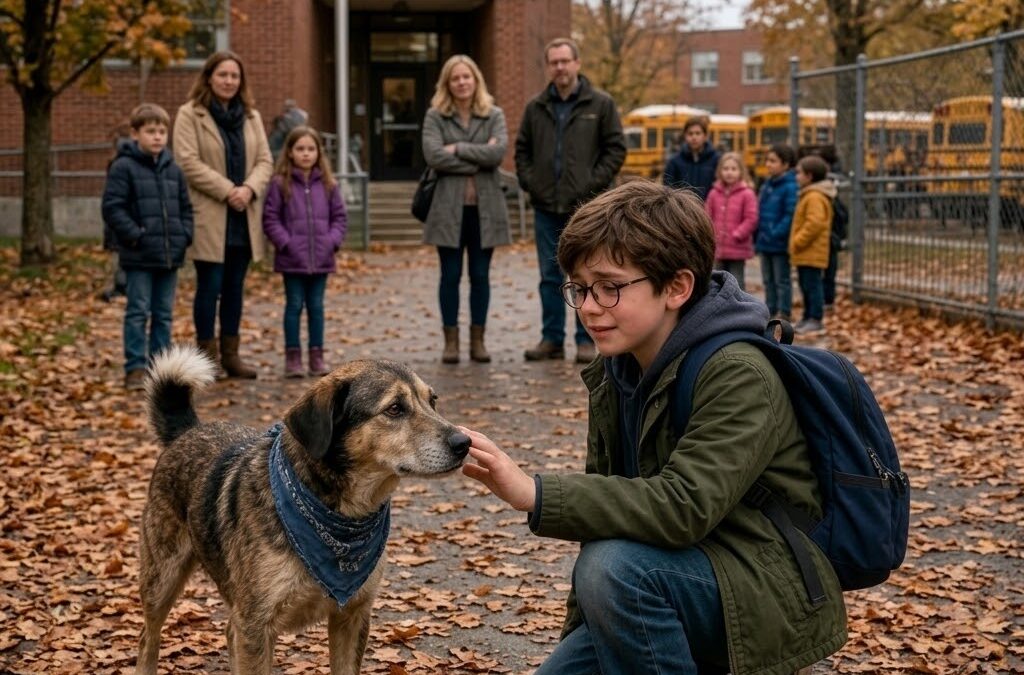
The next day, I looked for him before I looked for my teacher.
That was new.
Usually when Mom dropped me off, I stared at the ground and hurried inside before someone could ask me a question I didn’t know how to answer.
That morning, I stopped at the gate.
Patch was there.
He saw me.
His ears lifted.
His tail moved.
Not wildly.
Patch never did anything wildly.
Even happiness seemed thoughtful with him.
I walked closer.
“Hi.”
He stepped beside me.
For several seconds, I didn’t move.
Neither did he.
Then I started toward the school doors.
Patch walked with me.
At the entrance, he stopped.
He seemed to understand there was a line.
Outside belonged to him.
Inside belonged to us.
I touched the top of his head.
“I’ll come back.”
His eyes followed me through the door.
Mrs. Lutz noticed.
She always noticed more than I wanted.
“Made a friend, Jaime?”
“No.”
She smiled.
“Of course not.”
At recess, Patch was waiting near the tree.
I sat beside him.
That became our routine.
At first, I didn’t say much.
I gave him crusts from sandwiches.
Half an apple.
A piece of cheese when Mrs. Lutz wasn’t watching.
Sometimes I read.
Patch would put his chin on his paws and look at the pages.
Once I asked Mrs. Lutz, “Can dogs read?”
She paused.
“Most can’t.”
“Most?”
“Patch hasn’t filled out the assessment yet.”
I didn’t realize she was joking until the other kids laughed.
But they didn’t laugh at me.
That mattered.
Within weeks, children who had never spoken to me started sitting near Patch.
At first, they came for him.
Then sometimes they stayed for me.
“Does he bite?”
“No.”
“Does he know tricks?”
“I don’t think so.”
“Can I pet him?”
“If he lets you.”
Those were easy questions.
I knew the answers.
That made talking easier.
Patch became the bridge.
I didn’t understand that until years later.
Children think friendship arrives because somebody suddenly decides you’re interesting.
Sometimes friendship arrives because a dog sits beside you and gives another kid an excuse to sit there too.
Lily Hart started joining us in February.
Lily was in third grade and much taller than me.
She had strawberry-blonde hair and a blue backpack covered in stickers.
She talked less than most older kids.
I later learned her parents were separating.
At six, I just knew she looked sad a lot.
One Monday after lunch, I saw her sitting alone near the blacktop.
Patch saw her too.
He got up.
Walked over.
Lay beside her.
Lily tried to ignore him.
Patch nudged her elbow.
She looked down.
Then suddenly buried her face in his neck.
She cried.
Not loudly.
Her shoulders shook.
Patch didn’t move.
I remember standing maybe twenty feet away, unsure whether I should leave.
Mrs. Lutz came beside me.
“Give them a minute.”
“Why is she crying?”
“Sometimes people need to.”
“Why Patch?”
Mrs. Lutz watched them.
“Maybe because he doesn’t ask questions.”
That answer stayed with me.
Adults often think children don’t understand complicated things.
We understand more than we can explain.
I understood that crying near Patch was different.
Patch didn’t say, “What’s wrong?”
Didn’t say, “Don’t cry.”
Didn’t say, “Everything will be okay.”
He just stayed.
After that, kids started saying Patch knew when people were sad.
Maybe he did.
Or maybe sadness has a posture.
A smell.
A silence.
Whatever the explanation, Patch found it.
When a kindergartner scraped his knee, Patch appeared before the nurse.
When two fourth graders argued over a basketball, he walked between them and sat.
When Noah, a quiet new student, transferred midyear and ate alone, Patch lay under his table.
Noah smiled for the first time.
He began saving half his apple for him.
Principal Henderson fought the situation longer than anyone.
He was not cruel.
That’s important.
When I was little, I thought adults who said no were mean.
Now I understand Henderson had responsibilities.
A stray dog on elementary school property meant liability.
Allergies.
Bites.
Disease.
Parents.
Rules.
District policies.
He once stood outside while Patch lay under the tree.
“You know,” he said to Mrs. Lutz, “one complaint and this becomes a disaster.”
Mrs. Lutz answered, “And yet no complaints.”
“Yet.”
“He’s been here six weeks.”
“That’s not reassuring.”
I was close enough to hear.
I stood.
“Don’t take him.”
Henderson looked down.
“I’m not taking him anywhere today, Jaime.”
“Animal control takes dogs.”
“Sometimes.”
“They kill them.”
Mrs. Lutz said my name sharply.
I had heard that from another student.
Henderson crouched.
“Listen to me. Nobody is making that decision right now.”
“You said complaint.”
“I said we have to be careful.”
“He’s careful.”
Henderson looked at Patch.
Patch looked back.
Then yawned.
Principal Henderson sighed.
“That’s the problem.”
“What?”
“He keeps making my arguments look stupid.”
Mrs. Lutz laughed.
I didn’t.
But Patch stayed.
The winter passed.
Then came the morning he saved me.
I don’t remember deciding to get off the bus.
That’s the frightening thing about being six.
A bad decision can begin with one small thought.
I had left my red backpack on the bus.
At least I thought I had.
The bus stopped near the school.
Kids got off.
I stepped onto the sidewalk.
Then realized I didn’t have it.
I panicked.
Inside were my volcano book, my spelling sheet, a drawing Mom had signed, and a plastic astronaut I wasn’t supposed to bring.
I saw the bus turning toward its next route.
I ran.
I thought I could catch it at the next stop.
I couldn’t.
Within minutes, I was farther from school than I had ever walked alone.
The bus disappeared.
I stopped.
Nothing looked familiar.
It was cold.
Snow remained in dirty piles from the previous storm.
I started crying.
Then I became embarrassed even though no one was there to see.
I walked toward what I thought was the school.
Wrong direction.
Eventually I ended up behind a hardware store.
Narrow alley.
Brick wall.
Trash bins.
I sat beside the wall and pulled my knees to my chest.
At school, the teachers noticed immediately.
The bus driver called.
“Jaime Keller didn’t get on.”
Mrs. Lutz called my house.
Mom had already gone to work.
No answer.
Years later, Henderson told me that Patch started pacing before they even knew I was missing.
He walked between the flagpole and the kindergarten doors.
Whined.
Something he almost never did.
When the office phone rang, he took off.
Miss Carver shouted, “Follow him!”
Coach Denny ran.
Mrs. Lutz ran.
Henderson followed because apparently even principals can abandon dignity when necessary.
Patch ran three blocks.
Past the park.
Past the church.
Across the road.
Straight to the hardware store.
I heard claws before voices.
Click-click-click against pavement.
I looked up.
Patch rounded the corner.
“Patch?”
He reached me.
I wrapped both arms around him.
I remember his fur being cold.
I remember his breath.
I remember him licking my cheek while I cried harder than before.
Then Mrs. Lutz appeared.
“Oh, Jaime.”
She hugged me.
Coach Denny called the school.
Miss Carver took off her scarf and wrapped it around me.
Principal Henderson arrived out of breath.
He put both hands on his knees.
Looked at Patch.
Then at me.
Nobody spoke for a few seconds.
Finally Henderson said, “Well.”
Coach Denny laughed nervously.
“That’s all you’ve got?”
Henderson pointed at Patch.
“I’m reconsidering several policies.”
At school, Nurse Palmer checked me.
Cold.
Scared.
No injury.
Mom arrived twenty minutes later and cried harder than I had.
Then yelled at me.
Then hugged me.
Then yelled again while hugging me.
Patch stayed outside the nurse’s office.
When we left, Mom crouched in front of him.
For years, she insisted she didn’t believe animals understood gratitude.
That afternoon, she held his face in both hands.
“Thank you.”
Patch licked her wrist.
The next morning, Patch had a tag.
PROPERTY OF ALDER CREEK ELEMENTARY.
Principal Henderson denied approving it.
The school secretary, Mrs. Vale, denied ordering it.
Coach Denny denied knowing anything.
No one believed them.
The PTA organized veterinary care.
Patch had no microchip.
No known owner.
No matching missing-dog reports.
The vet estimated he was maybe six or seven.
Healthy.
Some old scars.
Nothing serious.
The blue bandana stayed.
I asked why they didn’t replace it.
Mrs. Vale said, “It came with him.”
That made sense to everyone.
The janitor, Mr. Howard, built a small wooden shelter near the tree.
Students painted PATCH’S CORNER across the front.
Principal Henderson made us paint over it because he said dogs could not legally own school property.
So we painted PATCH’S PLACE.
Apparently that was different.
Patch became part of Alder Creek.
Not officially at first.
Emotionally.
He greeted buses.
Watched recess.
Sat beside kids at lunch.
Sometimes he walked along the playground perimeter like a security guard.
Never chased balls.
Never stole lunches.
Except once.
A hot dog fell near him.
Some rules are unreasonable.
What amazed everyone was how he understood routines.
Morning bell.
Lunch bell.
Recess.
Dismissal.
He knew.
During fire drills, he walked outside with the classes.
During assemblies, he sat near the bleachers.
At the spring concert, he lay with his chin on his paws while the band played badly.
Coach Denny claimed Patch’s ears flattened during the trumpet section.
Probably true.
By then, Principal Henderson had stopped pretending he disliked him.
I caught them once behind the office.
Henderson sat on the steps eating lunch.
Patch beside him.
The principal gave him meatloaf.
“You tell anyone,” Henderson said, “I’ll deny it.”
I promised.
Then told Mrs. Lutz immediately.
First graders are terrible with confidentiality.
Spring came.
Patch started watching the woods.
Behind our soccer field was a rusted chain-link fence.
Past it, trees dropped down toward a creek and an old rail line.
Students weren’t allowed there.
Sometimes Patch sat facing those trees.
Still.
Alert.
Miss Carver noticed.
“What’s he looking at?”
“Squirrels,” Coach Denny said.
“He doesn’t chase squirrels.”
“Coyote trail.”
Mrs. Lutz looked toward the woods.
“Maybe he remembers something.”
That idea scared me.
I had stopped thinking of Patch as a dog who came from somewhere.
To me, Patch began at Alder Creek.
The possibility that he had another life felt threatening.
“What if his owner comes?”
I asked Mom.
We were washing dishes.
She stopped.
“Then we’d have to figure out what was right.”
“School owns him.”
“No one owns somebody because they love them.”
I hated that sentence.
“That’s stupid.”
“Probably.”
“If his owner loved him, why didn’t they find him?”
“Maybe they can’t.”
“Why?”
“I don’t know.”
“What if Patch leaves?”
Mom dried a plate.
“Then loving him won’t have been a mistake.”
I didn’t like that either.
Adults become philosophical when they don’t have useful answers.
One rainy Friday, Mom was late picking me up.
Mrs. Lutz let me stay in her classroom.
Patch waited outside under the awning.
Rain blew sideways.
I kept looking at him.
“Can he come in?”
“No.”
“Why?”
“School rules.”
“He’s wet.”
“So are squirrels.”
“We don’t like squirrels.”
Mrs. Lutz laughed.
Patch shivered.
That ended the argument.
She opened the door.
“One time.”
Patch walked in.
Shook water everywhere.
Mrs. Lutz screamed.
I laughed until my stomach hurt.
Patch sat beside me while I drew rockets on the whiteboard.
When Mom finally arrived, she opened the classroom door.
Saw him.
“Who’s this?”
I stared at her.
“You know Patch.”
She had heard about him daily for months.
“I haven’t been formally introduced.”
I stood.
“Mom, this is Patch. Patch, this is Mom.”
She extended her hand like he was a person.
“Nice to meet you.”
Patch sniffed.
Then leaned against her knee.
That was how he worked.
The school year ended.
I became terrified of summer.
Where would Patch go?
Would he stay?
What if he forgot us?
Kids made plans.
“I’ll visit Tuesday.”
“My dad drives past.”
“I’ll bring food.”
Someone made a paper calendar so Patch could supposedly count the days.
Principal Henderson found it.
“You understand dogs don’t read calendars.”
I crossed my arms.
“You don’t know.”
He surrendered.
The final week, Patch moved slower.
Not enough to worry adults.
Enough for children to notice.
He lay down more.
Stopped following us around the entire field.
Coach Denny said he was tired.
I thought he was sad about summer.
On the second-to-last day, a storm arrived.
Black clouds.
Thunder.
Rain.
We had an assembly in the gym because outdoor activities were canceled.
Patch waited near the entrance.
Then the power went out.
Complete darkness.
Children screamed.
Teachers raised voices.
Backup lights flickered.
Then Patch barked.
I had almost never heard him bark.
One sharp sound.
Everyone stopped.
Patch moved toward the far gym doors.
Barked again.
I stood.
“He wants us to go.”
“Jaime, sit down,” Mrs. Lutz said.
Then Coach Denny smelled it.
“Smoke.”
Principal Henderson changed instantly.
No hesitation.
“Everyone out. Now.”
Teachers moved us through the safer exit.
Lines.
Hands on shoulders.
No running.
Outside, smoke became visible near a storage room behind the gym.
Firefighters arrived.
Small electrical fire.
Contained.
No serious damage.
But one firefighter later told Henderson another ten minutes could have changed everything.
The local newspaper ran a photograph of Patch beside a fire truck.
My hand rested on his back.
Headline:
SCHOOL DOG HELPS ALERT CHILDREN TO FIRE.
Patch became famous.
People came to meet him.
Treats appeared.
Cards.
Someone wrote HERO on a poster.
Patch did not care.
Dogs have the good sense to ignore public relations.
The last day arrived.
I sat beside him on the front steps.
Peanut butter sandwich in one hand.
Yearbook in the other.
“You should live with us.”
Patch leaned against me.
“I asked Mom.”
He looked up.
“She said she’ll think.”
Technically true.
Mom had said, “Jaime, he belongs to the whole school now.”
I considered that thinking.
“I’ll be back in August.”
Buses arrived.
I climbed aboard.
Leaning out the window was forbidden.
I did it anyway.
“I’ll be back!”
Patch stayed on the steps.
Watching.
That summer, people took turns caring for him.
Patch never really left school property.
He wandered into town.
Lay near the square.
Once followed a child home from summer camp.
But every evening, he came back.
In July, the school board officially adopted him as Alder Creek’s companion animal.
There were forms.
Vet records.
Insurance discussions.
Principal Henderson hated every minute.
Then voted yes.
When August came, I ran from Mom’s car.
Patch was at the gate.
I threw my arms around him.
“You waited.”
Of course he had.
The next school year was when Patch stopped being only my dog.
Not that he ever was.
But I began noticing what he meant to everyone.
He walked with Charlie, a kindergartner who wore braces on his legs.
Slow.
Matching Charlie’s pace.
Never pulling ahead.
He started visiting the art room.
Mrs. Bloom let students draw him instead of their assigned self-portraits.
The hallway filled with Patch pictures.
Crayon Patch.
Purple Patch.
Patch with wings.
Patch driving a school bus.
One child drew Patch as principal.
Henderson said the tie was inaccurate.
The fall festival came.
I dressed as a forest ranger.
Patch refused costumes.
Henderson said we should respect his dignity.
So Patch simply walked beside me.
People applauded louder for him than anyone.
Mom stood by the pie table watching.
“You two have been through a lot.”
I nodded.
“He always knows.”
“Knows what?”
“When something’s wrong.”
Mom looked at Patch.
“Maybe that’s his gift.”
Then, the Monday after the festival, he disappeared.
At first, I wasn’t afraid.
Not really.
Patch sometimes wandered.
By lunch, fear arrived.
Teachers searched.
Coach Denny checked the field.
Mrs. Lutz checked the woods.
Principal Henderson called shelters.
I barely ate.
That night, Mom drove me around town.
Park.
Church.
Hardware store.
The alley where Patch had found me.
Nothing.
Tuesday passed.
Then Wednesday.
We made signs.
MISSING.
PATCH.
BLUE BANDANA.
FRIENDLY.
PLEASE CALL ALDER CREEK ELEMENTARY.
I put hearts on mine.
By Thursday morning, I had started believing he was gone forever.
Then during the second bell, someone shouted.
Patch walked through the gate.
Mud on his fur.
Burr on his leg.
Exhausted.
I didn’t run.
I don’t know why.
I walked.
Kneeled.
Held him.
“Where did you go?”
Patch pressed his head against my chest.
No answer.
Later, the vet said he was fine.
Just tired.
We eventually learned he’d gotten caught near fallen logs by the creek.
His leg had probably been trapped long enough to strain it.
That explained one disappearance.
But not the others that came later.
Patch began slowing down.
It happened gradually.
Children notice change before adults admit it.
He rested longer.
Stopped patrolling the whole playground.
Some mornings he arrived late.
Some days not at all.
“He’s old,” Lily said once.
I became angry.
“No, he’s not.”
She looked surprised.
“I just mean—”
“He’s not.”
I walked away.
That night, Mom found me sitting on the kitchen floor beside my backpack.
“Bad day?”
“No.”
“Okay.”
I hated when she did that.
She would accept obvious lies and wait.
Eventually I said, “Lily says Patch is old.”
Mom sat beside me.
“Maybe he is.”
“He’s not.”
“Jaime.”
“He runs.”
“Sometimes.”
“He saved me.”
“I know.”
“He saved the school.”
“I know.”
“Old dogs can still do things.”
“Yes.”
“Then stop.”
She touched my hand.
“Stop what?”
“Agreeing.”
Mom looked toward the window.
“You know, when your dad left—”
I stiffened.
Dad had moved out before Patch came.
My parents weren’t divorced yet.
Just separated in the painful way adults say is temporary until everyone realizes it isn’t.
“I thought if I didn’t talk about things changing, maybe they weren’t changing.”
“I don’t care about Dad.”
I did.
“Okay.”
“Patch is different.”
“Yes.”
“Patch stays.”
She didn’t answer.
I stood.
“I hate when you don’t answer.”
“I know.”
Patch stayed.
For a while.
We created Patch’s Place near his favorite tree.
A real bed.
Waterproof cover.
Blanket.
Students came quietly.
No crowding.
By then everyone knew he needed rest.
I started a journal.
PATCH DAYS.
The first entry was about the sandwich crust.
Then the day he found me.
The fire.
The festival.
The time he stole Lily’s mitten and somehow left it in the sandbox.
I wrote everything I could remember.
I was afraid forgetting began before someone was gone.
So I wanted proof.
Patch came.
Patch sat here.
Patch did this.
Patch mattered.
Some evenings the entry was one sentence.
Patch slept all day.
Or:
Patch walked me halfway to class.
Or:
Patch wasn’t here today, but I think he’ll come tomorrow.
He always did.
Until one morning in October.
The buses arrived.
Patch stood by the gate.
I smiled.
Walked toward him.
He didn’t move.
No wag.
No step.
He looked at me for several seconds.
Then turned toward the woods.
“Patch?”
He kept walking.
I followed.
“Patch!”
At the broken fence, he slipped through.
I couldn’t.
Children weren’t allowed beyond it.
I gripped the metal.
“Come back!”
He disappeared between trees.
I waited ten minutes.
Twenty.
Mrs. Lutz eventually came.
“Jaime.”
“He’ll come.”
“Come inside.”
“He’ll come.”
She waited beside me.
The bell rang.
“Inside.”
All day I checked windows.
Nothing.
That night I wrote:
Patch went somewhere today. I don’t know why. I hope he comes back. If he doesn’t tomorrow, I’ll still write something so he knows I’m waiting.
The next morning, no Patch.
The next day.
Nothing.
A week.
Nothing.
School changed.
That’s the only way I can describe it.
Buildings can feel different when someone is missing.
Same walls.
Same bells.
Same children.
But absence occupies space.
The tree looked wrong.
The flagpole looked wrong.
The gate.
Lunch.
Everything.
I kept writing.
Mrs. Hampton, the counselor, asked whether I wanted to talk.
“No.”
“Want to write?”
I nodded.
She gave me peanut butter crackers.
Patch’s favorite.
I wrote while she sat quietly.
Finally, I said, “I think he went to help someone.”
Mrs. Hampton didn’t laugh.
“Maybe.”
“He helped me.”
“Yes.”
“He helped Lily.”
“Yes.”
“Maybe somebody else needs him.”
“Maybe.”
That explanation let me breathe.
Principal Henderson made an announcement.
He didn’t say Patch was gone.
He said missing.
He told students to write letters and draw pictures.
Miss Carver placed a large box outside her classroom.
Within days, the hallway filled.
Dear Patch.
Come home.
Thank you.
We miss you.
I wrote:
I keep your blanket clean. It’s not the same here. If you’re helping someone, that’s okay. But please come back when you’re done.
Late October, police called.
A dog matching Patch had been seen near the old rail station.
Tracks led toward our woods.
My heart exploded with hope.
The next morning, I left home ten minutes early.
Mom allowed me to walk farther as long as I stayed near houses.
I reached the park.
Stopped near the trail.
Waited.
Cold air.
Pine.
Leaves.
Then a sound.
Claws on stone.
Patch stood at the tree line.
Thinner.
Dirty.
Tired.
Blue bandana faded.
His tail moved.
Once.
Again.
I knelt.
No shouting.
No running.
Patch walked to me.
Put his head on my shoulder.
I held him.
“I knew.”
I didn’t.
But children are allowed to rewrite fear after surviving it.
When we reached school, everyone came outside.
Quietly.
No cheering.
Just people sitting around him near the tree.
I opened my journal.
Patch is back.
He came home.
For a while, things felt normal.
But they weren’t.
Patch had changed.
He rested more.
Moved slower.
Didn’t reach buses every morning.
Sometimes I would arrive and find him already lying down.
I stopped asking him to walk me to class.
Instead, I walked him to his blanket.
“You don’t have to do anything.”
That’s what I started telling him.
“You already did enough.”
Funny how children sometimes say the thing adults need years to learn.
Patch had spent his time helping.
Guarding.
Following.
Finding.
Waiting.
We had begun expecting usefulness from him.
Even love can become selfish that way.
You give us comfort.
So continue.
You make us feel safe.
So stay strong.
You saved us.
So don’t age.
One day, Patch couldn’t get up.
Mrs. Lutz brought warm broth.
I poured it into a bowl.
He drank slowly.
The entire school seemed to lower its volume.
Teachers allowed drawing sessions near him.
Mr. Howard built a proper wooden sign.
PATCH’S PLACE.
FRIEND TO ALL.
Students started a guest book.
Thank you for watching us.
You make school feel like home.
You’re better than Cheetos.
That one was from Eli Morrison.
Patch rested beside hundreds of words he couldn’t read.
But maybe dogs understand intention.
November approached.
Patch disappeared again.
This time, I didn’t run all over town.
I waited.
That wasn’t maturity.
It was fear disguised as acceptance.
If I searched and didn’t find him, I would know too much.
So I sat beneath the tree.
Read from my journal.
Remember when you took Lily’s mitten?
Remember the fire?
Remember the first sandwich?
The next day, Patch returned.
Every step looked difficult.
He reached his blanket.
Lay down.
I sat beside him.
Patch nudged my arm.
That was the last time I remember him moving under his own strength.
The following morning, he wasn’t there.
Wednesday.
Thursday.
Friday.
Nothing.
Principal Henderson contacted everyone.
Shelters.
Police.
Veterinary offices.
Animal control.
People searched the woods.
No body.
No injured dog.
No Patch.
Monday morning, Henderson gathered us beside the tree.
Teachers stood behind us.
Some crying.
Mrs. Lutz had red eyes.
Henderson spoke slowly.
“Our friend Patch hasn’t been with us these past several days.”
Nobody moved.
“We have looked. We will keep paying attention.”
He paused.
“But I also want us to remember something. We don’t know everything about Patch’s life before Alder Creek. We don’t know every place he went or every person he knew.”
I looked at the woods.
“What we do know is what he gave us while he was here.”
His voice broke slightly.
“He was a friend.”
Henderson cleared his throat.
“A guardian.”
Another pause.
“And maybe the best staff member this school ever had.”
Coach Denny laughed through tears.
Henderson looked down at me.
“Jaime wanted to read something.”
I hadn’t wanted to.
Mrs. Lutz suggested it.
I held my Patch Days journal.
My hands shook.
“Patch showed up one morning like he belonged here.”
My voice sounded too small.
“After a while, he did.”
I looked at the other kids.
“He sat with people when they were sad. He watched us. He helped me when I was lost.”
I swallowed.
“He didn’t ask for things. He didn’t do tricks. He just stayed.”
I looked down at the page.
“Sometimes staying is the bravest thing someone can do.”
That was all.
Lily brought a drawing of Patch surrounded by stars.
We pinned it to the tree.
Students left small things.
Crackers.
Mittens.
Notes.
Someone left a tennis ball.
I didn’t.
My gift was the journal.
Not leaving it.
Continuing it.
Patch never came back.
I need to say that clearly because for years I told the story in softer language.
We never found him.
No one called.
No shelter reported him.
No body was discovered in the woods.
Nothing.
Adults tried to protect us by saying maybe.
Maybe someone took him in.
Maybe he returned to an old home.
Maybe he found another family.
Maybe he went somewhere quiet.
I still don’t know.
As a child, I chose the version I could survive.
Patch went where he needed to go.
That’s still the version I carry.
Not because I believe it literally.
Because some mysteries do not owe us cruelty.
Winter came.
Snow covered Patch’s Place.
We cleared it.
I brought broth.
Just in case.
I knew.
But knowing and stopping are different.
I continued the journal.
It snowed today.
The playground looks like when you first came.
Lily helped a first grader tie his shoe.
You would’ve liked that.
Noah sat with a new kid.
Maybe we’re learning.
That winter, something changed at Alder Creek.
We became kinder.
Not perfect.
Children remain children.
We fought.
Teased.
Excluded.
Forgot.
But Patch had created a reference.
What would Patch do?
Lily made the first poster.
WHAT WOULD PATCH DO?
Below:
Sit with someone alone.
Notice when someone is sad.
Stay.
Help quietly.
Listen.
Soon posters appeared everywhere.
The cafeteria.
Hallway.
Library.
Kindergarten students traced hands on colored paper and wrote promises.
I WILL HELP.
I WILL SHARE.
I WILL LISTEN.
Patch had become a verb without anyone saying it.
Teachers noticed.
So did parents.
In February, Mrs. Lutz announced a writing contest.
Someone Who Changed My Life.
I wrote three pages.
Title:
MY FRIEND WHO DIDN’T SPEAK.
I won.
I hated that because winning meant reading it aloud.
The gym was full.
Parents came.
Local news came.
I stood behind a microphone.
“I’m not very good at talking in front of people.”
A few children laughed.
“But Patch wouldn’t care if I was nervous.”
I looked at my paper.
“Patch was a dog, but he wasn’t just a dog.”
I paused.
“He knew things.”
I described sitting alone.
How Patch came.
How he listened.
How looking at him felt like not needing to explain.
Then I wrote something I didn’t understand until years later.
I think that’s the kind of friend I want to be. Someone who stays. Someone who helps by being there.
The applause grew slowly.
Warm.
Not huge.
Afterward, a woman I didn’t know kneeled beside me.
“I never met Patch.”
“I’m sorry.”
“I wish I had.”
I smiled.
“He probably would’ve sat next to you.”
She laughed.
“Why?”
“He did that.”
Spring arrived.
The snow melted.
Patch’s blanket faded.
Drawings curled at the edges.
Then one morning, a small white dog appeared beyond the fence.
Nothing like Patch.
Smaller.
Skinny.
Huge ears.
Nervous eyes.
Children noticed.
Adults panicked.
Not another dog.
Principal Henderson stood at the window.
“You’ve got to be kidding me.”
Coach Denny laughed.
“Apparently you’re running a shelter.”
“We are not.”
The dog stayed outside the fence.
I watched.
Did not approach.
Something Patch taught me without words:
Let frightened creatures choose distance.
I left water.
The dog waited until we returned inside.
Then drank.
Next day, closer.
By Friday, near the tree.
Lily whispered, “Is it Patch’s puppy?”
“No.”
“How do you know?”
“I just do.”
The dog wasn’t Patch.
That mattered.
I did not want another Patch.
Not then.
Replacement felt like betrayal.
Miss Carver asked whether we should name him.
“Not yet.”
She looked surprised.
“Why?”
“Names come after.”
That sounded wise.
Really, I was afraid.
If I named him, he mattered.
If he mattered, he could leave.
He disappeared for three days.
Of course.
When he returned, he limped slightly and carried a stick.
He dropped it near Patch’s tree.
I crouched.
“Okay.”
The dog watched.
“Maybe you’re ready.”
I tossed the stick.
He didn’t chase.
Looked at it.
Looked at me.
Then slowly approached.
Two feet.
One.
His nose touched my knee.
I didn’t move.
He sat.
Lily approached.
Then Charlie.
The dog stayed.
That night I wrote:
Something is changing. It doesn’t feel like the end. It feels like something new. Not a replacement. Not a redo. Just something else.
I almost added:
Maybe Patch sent him.
I didn’t.
Too sentimental.
I was eight by then.
Very sophisticated.
The white dog stayed.
I stopped bringing food.
Brought myself.
Sat nearby.
Read aloud.
Patch taught me that trust grows faster when you stop reaching for it.
One morning, I brought a box.
Inside:
An old rubber ball.
A scarf Patch once slept on.
A photograph of Patch and me from the fall festival.
And a new gray collar.
I placed it near the white dog.
He sniffed Patch’s scarf.
Pulled it toward himself.
I waited.
Then lifted the collar.
“You don’t need a name.”
He watched.
“This just means you’re with us.”
I fastened it.
He didn’t flinch.
A week later, the district office called.
Someone had seen his photo.
The white dog matched a puppy from a hoarding rescue across the county.
Most dogs adopted.
Two remained.
One escaped before placement.
The shelter had searched.
Never found him.
Until now.
Principal Henderson called them.
I sat outside his office.
When he finished, I asked, “Do they want him back?”
Henderson crouched.
“They say he is legally unclaimed.”
“What does that mean?”
“It means they are willing to let us become his home.”
I looked through the window.
The white dog lay in sunlight.
“So he chose us.”
Henderson smiled.
“Seems to be a pattern around here.”
The school voted on names.
Paper slips in a jar.
Snowy.
Ghost.
Comet.
Marshmallow.
Sir Barkington.
That one received four votes from the same student.
Then one name appeared again and again.
Hope.
At first, I thought it was too obvious.
Mrs. Lutz said obvious isn’t always wrong.
We made a tag.
HOPE.
I fastened it to the gray collar.
“Hope.”
He nudged my arm.
Different from Patch.
Completely.
Patch had been calm from the start.
Hope was cautious.
Patch watched everyone.
Hope attached slowly.
Patch seemed to know routines instantly.
Hope got distracted.
Patch loved peanut butter.
Hope hated it.
That mattered.
We weren’t recreating anything.
We were beginning again.
Hope started greeting buses.
Not every morning.
Some.
He sat through reading circles.
Followed outdoor art classes.
Let Charlie rest against him.
Then one morning, a new girl named May arrived.
Third grade.
Glasses too big for her face.
Nervous.
Alone at recess.
I saw her.
Before I moved, Hope walked over.
Lay beside her.
May’s shoulders relaxed.
I stood near the swings.
For one impossible second, time folded.
Patch crossing the playground.
Me sitting alone.
A crust of sandwich.
Thump.
Hope beside May.
I didn’t interrupt.
Later, I opened Patch Days—Volume Three.
I wrote:
She looked scared, but Hope went to her first, just like Patch came to me.
Then I stopped.
Crossed out “just like.”
Wrote:
Not exactly like Patch.
Like Hope.
That was important.
Then underneath:
That’s how I know we’re going to be okay.
And we were.
Not because sadness disappeared.
Not because Hope replaced Patch.
Not because every lonely child suddenly found a dog.
We were okay because Patch had taught us something before he left.
That being needed doesn’t always require fixing.
That courage can look quiet.
That attention is a kind of love.
That sometimes the person sitting alone doesn’t need advice.
They need someone to sit.
I carried those lessons longer than I carried any textbook from Alder Creek.
Years passed.
I grew up.
My glasses eventually fit.
I became better at talking.
Not great.
Better.
Mom remarried when I was thirteen.
Dad came back into my life slowly.
We never became the family I had imagined as a first grader.
We became something else.
Different.
Still real.
I went to college.
Studied counseling.
That surprises people when they hear the Patch story.
It shouldn’t.
I became a school counselor.
Of course I did.
The first school I worked at had no dog.
Plenty of lonely kids.
During my first year, a fourth grader named Evan came to my office after his grandmother died.
He refused to speak.
I tried questions.
Nothing.
Worksheets.
Nothing.
Feelings chart.
Nothing.
Then I remembered Patch.
I stopped talking.
Sat on the floor across from him.
Five minutes.
Ten.
Evan finally said, “Aren’t you going to ask something?”
“No.”
“Why?”
“You don’t look like you want questions.”
He stared.
Then started crying.
I stayed.
Afterward, in my office, I opened an old box.
Inside were my Patch journals.
Three volumes.
I hadn’t read them in years.
The handwriting changed across pages.
Six-year-old block letters.
Then cleaner lines.
Spelling improving.
Grief changing.
Patch changing.
Hope arriving.
I read until midnight.
The next morning, I drove to Alder Creek.
Principal Henderson had retired.
Mrs. Lutz too.
Coach Denny moved.
Miss Carver became principal.
That amused everyone.
The building looked smaller.
Childhood places always do.
The flagpole had been replaced.
The playground updated.
The old tree remained.
Under it:
PATCH’S PLACE.
FRIEND TO ALL.
Below, another plaque had been added.
AND HOPE CAME NEXT.
I touched the wood.
Hope had lived another twelve years.
After I left elementary school, he became Alder Creek’s official companion dog.
Not Patch.
Never Patch.
Hope.
He helped children through storms, divorces, bad grades, moves, grief, and ordinary Tuesdays.
When Hope eventually died peacefully at a foster volunteer’s home, the school planted a second tree.
Miss Carver showed it to me.
“You know,” she said, “this all started with you.”
“No.”
“Patch chose you first.”
“Patch came before me.”
She smiled.
“You still argue literally.”
“I’m a counselor now. It’s more expensive.”
She laughed.
We walked through the hallway.
A display case held photographs.
Patch by the fire truck.
Patch and me at the fall festival.
Hope beside May.
Guest-book pages.
My writing contest essay.
I stared at the first photograph.
I barely recognized the boy.
Too-big glasses.
Cardboard ranger hat.
One hand on Patch.
“He looks scared.”
Miss Carver looked at me.
“You?”
“Yeah.”
“You were.”
“I remember being shy.”
“You were carrying a lot.”
Children carry things quietly.
Patch knew that.
Or maybe he simply didn’t care what made someone quiet.
Either way, he sat.
Miss Carver asked, “Did you ever figure out where he came from?”
“No.”
“Me neither.”
“Did anyone ever claim him?”
“Never.”
“Nothing?”
“Nothing.”
I stared at his blue bandana in the photograph.
For years, that mystery bothered me.
Who tied it?
Who loved him first?
Did someone lose him?
Did someone abandon him?
Had he lived near the rail station?
Was the school part of some route he remembered?
Why the woods?
Why did he disappear?
Why return?
There are stories we never receive.
For a long time, I thought closure meant getting all the answers.
It doesn’t.
Closure is learning which unanswered questions you’re willing to carry.
Patch belonged to someone before us.
Almost certainly.
That doesn’t diminish what he became with us.
People can have more than one home.
More than one chapter.
More than one person who matters.
Dogs too.
I went outside.
Sat beneath the tree.
A class came out for recess.
Children ran.
One girl sat alone near the fence.
No dog walked over.
A boy did.
He sat beside her.
They didn’t speak.
I smiled.
There it was.
Patch, without Patch.
That’s legacy.
Not statues.
Not stories.
Behavior.
Someone teaches you how to love, and years later you do it without remembering you were taught.
A year after that visit, the district where I worked began discussing therapy animals.
The superintendent asked me to help.
I agreed.
We created a program carefully.
Certified dogs.
Handlers.
Insurance.
Training.
All the things Principal Henderson would’ve demanded.
I thought of him during every meeting.
Liability nightmare.
He had been right.
And Patch had been right too.
Rules and compassion are not enemies.
Good systems create safe ways for kindness to happen.
Our first therapy dog was a black Labrador named Rosie.
She did not roam freely.
Did not live at school.
Did not predict bells.
She wore a vest and arrived twice weekly.
Kids loved her.
One boy whispered into Rosie’s fur about his father’s addiction.
A girl with severe anxiety read books to her because Rosie never corrected mistakes.
A teacher sat beside her after losing a pregnancy.
I watched.
Thought about Patch.
No magic.
Presence.
Years later, I was invited back to Alder Creek for the school’s anniversary.
They wanted me to speak.
I refused three times.
Miss Carver called.
“Jaime.”
“No.”
“You are thirty-two.”
“Yes.”
“You give presentations professionally.”
“To counselors.”
“There will be children.”
“Worse.”
She laughed.
“Talk about Patch.”
That changed things.
The gym was full.
New students.
Parents.
Teachers.
Former staff.
Mrs. Lutz sat in front.
Older.
Still wearing a charm bracelet.
Coach Denny joined online because he lived in Arizona.
Principal Henderson attended.
White hair now.
Same expression.
I stood at the microphone where I had once read My Friend Who Didn’t Speak.
I brought the journals.
“Most of you never met Patch.”
Children listened.
“He appeared outside this school when I was six.”
I told them about the flagpole.
Sandwich crust.
Getting lost.
The fire.
The tree.
His disappearances.
His aging.
The day he did not return.
Then Hope.
I did not make Patch a saint.
I told them he once stole Lily’s mitten.
Ate a hot dog.
Shook rainwater all over Mrs. Lutz’s classroom.
Henderson laughed louder than anyone.
Then I said:
“When I was little, I thought Patch’s gift was knowing when something was wrong.”
I looked across the room.
“I don’t believe that anymore.”
A student raised his hand.
I smiled.
“We’ll do questions after.”
He lowered it.
“I think Patch’s gift was paying attention.”
I paused.
“He watched.”
“He noticed.”
“He stayed.”
“Those sound like small things.”
“They aren’t.”
I looked toward Henderson.
“One person notices smoke before anyone else.”
“One person notices a child is missing.”
“One person notices someone sitting alone.”
“Sometimes attention changes everything.”
The gym was silent.
Then I opened my first journal.
Found the page.
Read:
Patch sat next to me today. I gave him bread. His tail moved one time.
People laughed softly.
I smiled.
“That was the beginning.”
Afterward, Principal Henderson approached.
He walked with a cane.
“You made me sound nicer than I was.”
“You kept him.”
“He kept himself.”
“True.”
He looked toward the doors.
“I almost called animal control.”
“I remember.”
“I did call once.”
I stared.
“What?”
“They came.”
“When?”
“Early.”
“Why didn’t they take him?”
Henderson smiled.
“He disappeared.”
My mouth opened.
“What?”
“Truck pulled in. Patch walked around the building. Gone. They waited twenty minutes.”
I laughed.
“Next morning?”
“Flagpole.”
“Of course.”
Henderson shook his head.
“After that I gave up.”
“Why didn’t anyone tell me?”
“You were six.”
“That’s not a reason.”
“It’s an excellent reason.”
Some things never change.
Mrs. Lutz hugged me.
Her charm bracelet still clicked.
“I kept your essay.”
“I saw.”
“You were a good writer.”
“I became a counselor.”
“Nobody’s perfect.”
We laughed.
Then she became quiet.
“You know why Patch mattered to you?”
“Because I was lonely.”
“More.”
I waited.
“Your parents were separating.”
“I know.”
“You were afraid people left.”
That landed.
“Patch kept showing up.”
I swallowed.
Every morning.
Same place.
Same dog.
For a child watching family change, Patch had become proof of return.
I had known emotionally.
Never named it.
Mrs. Lutz squeezed my arm.
“That’s why his disappearances hurt so much.”
“Probably.”
“And that’s why Hope mattered.”
I looked toward the display case.
“Because he stayed too?”
“No.”
She smiled.
“Because after Patch left, you learned you could love something new without betraying what came before.”
Teachers.
They wait decades to finish lessons.
That night, I drove to Mom’s house.
She was older.
Still sharp.
We sat at her kitchen table.
I told her what Mrs. Lutz said.
Mom smiled.
“She’s right.”
“You knew?”
“I hoped.”
“Why didn’t you explain it?”
“You were six.”
“Everyone keeps using that.”
“You were extremely six.”
I laughed.
Mom got up.
Returned with an old storage box.
“What is that?”
“Things you left when you moved.”
Inside:
School papers.
Volcano books.
Plastic astronaut.
A blue cloth.
I froze.
Patch’s original bandana.
“What?”
Mom looked surprised.
“You didn’t know I had it?”
I picked it up.
Faded.
Frayed.
“Where did you get this?”
“After he disappeared.”
“How?”
“Mr. Howard found it near the creek.”
I stared.
“What?”
“He gave it to Henderson. Henderson gave it to me.”
“Why didn’t you tell me?”
“You were devastated.”
“So everyone hides things from children?”
“Mostly parents hide sharp objects and emotionally loaded dog accessories.”
I almost laughed.
Almost.
“Was there blood?”
“No.”
“Torn?”
“Just came loose.”
“Where exactly?”
“Near the woods.”
My heart sped up.
Suddenly I was six again.
“Why didn’t anyone search there?”
“They did.”
“How much?”
“Jaime.”
“Did they find tracks?”
“I don’t know.”
“Mom.”
She reached across the table.
“This won’t answer what happened.”
I knew.
That was why it hurt.
I held the bandana.
For decades, I imagined Patch wearing it wherever he went.
Apparently, he lost it.
Did that mean something bad?
Maybe.
Or it snagged.
Or fell.
Or he slipped free.
Maybe is endless.
Mom said, “Do you want it?”
I thought.
Then nodded.
“Yes.”
I brought the bandana home.
Put it beside the journals.
For three nights, I dreamed about Patch.
Not old Patch.
Young Patch.
Flagpole.
Tail.
Brown fur in snow.
The fourth night, I dreamed nothing.
That felt like an answer.
Not about Patch.
About me.
I didn’t need to solve his ending.
I needed to remember his life.
Today, I keep the blue bandana in my office.
Not displayed dramatically.
Inside a drawer.
Sometimes children notice the framed photograph on my shelf.
A little boy in oversized glasses.
Brown dog.
“Is that your dog?”
I always pause.
Then say, “Sort of.”
If they ask, I tell them.
Not twelve thousand words.
Usually.
I say:
He showed up at my school.
Nobody knew where he came from.
He helped people.
He was my friend.
One child once asked, “Did he die?”
I answered honestly.
“I don’t know.”
“That’s sad.”
“Yes.”
“Do you think he’s dead now?”
Patch would be impossibly old.
So I said, “Yes.”
The child thought.
“Then why do you smile when you talk about him?”
There are questions that contain their own lesson.
“Because sad isn’t the only thing he makes me feel.”
She nodded.
Children understand mixed emotions better than adults think.
I still visit Alder Creek.
Patch’s Place remains.
The original tree lost a large limb in a storm but survived.
Hope’s tree is tall now.
The school runs a kindness week every February.
No one remembers exactly why February.
Mrs. Lutz says it began after my essay contest.
Students write notes.
Sit with someone new.
Donate supplies to shelters.
Older children read to younger ones.
They call it Patch Week.
I hate the name.
Love the idea.
The local shelter brings adoptable dogs sometimes.
Safe.
Supervised.
No random strays wandering campus.
Henderson would approve.
One year, a brown mixed-breed dog came.
Black ears.
Patchy tail.
A blue bandana.
I nearly stopped breathing.
Of course it wasn’t Patch.
Not possible.
But for one stupid second, my body forgot time.
The dog came toward me.
Sat.
Tail touched ground.
Thump.
I laughed.
Then cried.
A volunteer panicked.
“Are you okay?”
“Yes.”
“What happened?”
“Old memory.”
The dog was adopted that afternoon by a family with two children.
Good.
I did not need another Patch.
That’s a lesson Hope taught me.
Love does not ask every new thing to become an old thing.
It lets difference live.
I eventually married.
My wife, Rachel, is a pediatric occupational therapist.
We met at a school conference.
Our first argument was about whether emotional-support animals are overused.
Romantic.
We have a son named Eli.
When Eli turned six, I took him to Alder Creek.
We stood beneath Patch’s tree.
“That’s where he sat?”
“Yes.”
“Every day?”
“Mostly.”
“Did he really find you?”
“Yes.”
“Were you scared?”
“Very.”
“Did he fight bad guys?”
“No.”
“Then how was he a hero?”
I smiled.
“He noticed I was missing.”
Eli considered.
“That’s it?”
“Sometimes that’s enough.”
He ran toward the playground.
Then stopped.
A boy sat alone on a bench.
Eli looked at him.
Then at me.
I didn’t say anything.
He walked over.
Sat.
Started talking.
Maybe coincidence.
Probably.
Still.
I noticed.
That’s what Patch taught me.
Notice.
People think important lives are loud.
Famous.
Accomplished.
Patch never spoke.
Never earned money.
Never understood awards.
Never knew an article called him a hero.
Never knew children wrote essays about him.
He simply appeared.
Then kept appearing.
Until he couldn’t.
That was enough to change hundreds of people.
Sometimes when my work becomes complicated—reports, meetings, crisis plans, policies—I think about the first day he sat beside me.
No strategy.
No treatment plan.
No behavioral objective.
A lonely child.
A quiet dog.
Presence.
I don’t romanticize it.
Kids need professionals.
Families need resources.
Schools need systems.
Dogs don’t replace therapy.
Patch didn’t fix my parents.
Didn’t erase social anxiety.
Didn’t make me magically confident.
What he gave me was smaller.
And maybe more foundational.
He made school somewhere I wanted to arrive.
When you’re six and lonely, that’s enormous.
The school became safe because someone waited.
Years later, I asked Mom whether she’d ever seriously considered letting Patch live with us.
“Yes.”
I almost fell over.
“You said no.”
“I said I’d think.”
“You were thinking yes?”
“Sometimes.”
“Then why didn’t you?”
“Because he wouldn’t come.”
“What?”
“I tried.”
“When?”
“Summer after first grade.”
I stared.
“You tried to bring him home?”
“Three times.”
“What happened?”
“He walked halfway.”
“Then?”
“Turned back toward school.”
Of course.
Patch had chosen his place.
Not a house.
A school.
Children.
Doors.
Flagpole.
Routine.
Maybe there had been another school in his past.
Maybe a child.
Maybe he had lost someone.
That’s speculation.
I’ve learned to distinguish beautiful ideas from evidence.
But sometimes I allow myself the thought.
What if Patch came to Alder Creek because something about children waiting for bells felt familiar?
What if he wasn’t searching for one person?
What if he was searching for a role?
Again, I don’t know.
And I’m finally comfortable saying that.
The most meaningful things in our lives often include unanswered questions.
We want explanations because explanations feel like control.
But love doesn’t become less real because origin is uncertain.
Patch’s past remained hidden.
His impact didn’t.
I once received an email from Lily Hart.
We hadn’t spoken in twenty years.
She found me through the counseling program.
Subject:
PATCH.
Her message said:
You probably don’t remember the day by the blacktop when I cried into Patch’s fur.
I did.
She wrote:
My parents were fighting constantly. I had decided that morning it was my job to keep Mom from crying. I was eight. Patch was the first place I cried myself.
I stared at that sentence.
She continued:
I became a social worker. I think some part of that began there.
No grand speeches.
One dog lying beside a girl.
Noah became a teacher.
Charlie became a physical therapist.
May studied veterinary medicine.
Not because of Hope alone.
Lives are not that simple.
But when we reconnect, Patch appears in conversations.
A landmark.
Before Patch.
After Patch.
Patch’s Place.
The fire.
The forest.
The journals.
We are a generation of children shaped partly by an animal whose legal owner no one ever found.
That’s beautiful to me.
And strange.
Principal Henderson died when I was thirty-three.
His daughter asked whether I’d speak.
I did.
I told everyone he pretended not to like Patch.
People laughed.
Then I told the story about animal control.
His daughter didn’t know.
Afterward, she showed me a photograph from Henderson’s home office.
Patch lying beside his desk.
Henderson’s hand on his back.
I asked when.
“Summer.”
Apparently Principal Henderson came to school every Saturday during Patch’s first summer.
He brought lunch.
Sat outside.
Never mentioned it.
Some people love privately because public tenderness feels embarrassing.
Patch collected those people.
Mr. Howard died before Henderson.
Mrs. Lutz is still alive.
Ninety now.
I visit.
Her bracelet is gone because arthritis makes jewelry difficult.
Her memory comes and goes.
Sometimes she forgets my job.
Once she forgot my name.
Then I showed her Patch’s photograph.
“Patch.”
Immediately.
“Yes.”
She touched the image.
“That dog knew the bell.”
I laughed.
“That’s what Henderson said.”
She smiled.
“Jaime?”
“Yeah.”
Memory returned.
“Big glasses.”
“Still have them.”
She touched my hand.
“He found you.”
“Yes.”
Then she said something softly.
“Or maybe you found each other.”
I didn’t correct her.
Accuracy matters.
So does grace.
When I left, I sat in my car and cried.
Loss repeats.
Teachers.
Dogs.
Parents.
Friends.
Places.
Aging is partly becoming fluent in goodbye.
But Patch gave me a framework young.
Goodbye does not cancel presence.
If someone mattered, their absence changes the shape of the world.
Then eventually, you learn the new shape.
Not better.
Different.
Hope taught the second half.
After losing Patch, I believed loving another dog would mean moving on.
Moving on sounded like abandonment.
Hope showed me that love can expand without replacement.
That’s why his name became perfect.
Not optimism.
Not denial.
Hope is willingness to remain open after evidence that things can leave.
That’s harder.
When the little white dog walked toward me, I was afraid.
Then I stayed.
So did he.
Years later, when Rachel asked me to marry her, I thought of Patch and Hope.
Not romantically.
Obviously.
But emotionally.
Love asks the same risk.
This matters.
Therefore losing it could hurt.
Will you choose it anyway?
Yes.
That’s hope.
Our son Eli has heard the Patch story too many times.
He complains.
Then asks new questions.
Recently:
“Dad, what if Patch didn’t come to school because he was special?”
“What do you mean?”
“What if he was just hungry?”
“Possible.”
“What if everybody made him important after?”
I smiled.
“Also possible.”
“Then does that change the story?”
I looked at him.
He’s twelve now.
Old enough to ask dangerous good questions.
“No.”
“Why?”
“Because meaning doesn’t require intention.”
He frowned.
“What?”
“Patch didn’t need to plan to change us.”
“Oh.”
He thought.
“So a thing can matter even if it wasn’t trying to?”
“Yes.”
He nodded.
“Cool.”
Then returned to video games.
Children humble philosophers efficiently.
Maybe Patch came for food.
Maybe warmth.
Maybe safety.
Maybe he waited at school because children dropped sandwiches.
So what?
The effects remain.
He found me when I was lost.
Alerted people to smoke.
Comforted children.
Whether he understood symbolism is irrelevant.
Dogs don’t need mythology.
We create mythology because memory likes shape.
I try to keep both.
The real dog.
And the meaning.
The real Patch had burrs in his fur.
Smelled terrible when wet.
Snored sometimes.
Stole one hot dog.
Once rolled in something so awful the PTA paid for emergency grooming.
He was not an angel.
Good.
Angels are difficult to love honestly.
Dogs are better.
My favorite memory isn’t the rescue.
Not fire.
Not article.
It’s one ordinary lunch.
Spring.
Sun.
I sat beneath the tree reading about volcanoes.
Patch beside me.
Kids shouting far away.
He sighed.
Put one paw on my shoe.
That’s all.
Nothing happened.
Nobody was saved.
No lesson.
No drama.
Just enough safety for a lonely kid to read.
That’s what I miss.
Not heroism.
Ordinary presence.
When people we love are gone, spectacular memories become stories.
Ordinary memories become longing.
The way Vivien must have missed pouring tea after my mom’s stories—sorry, that’s another family’s grief; ours was different. For me, it was Patch’s paw on my shoe.
Mrs. Lutz saying, “Come inside.”
Mom calling dinner.
Things you don’t realize are precious because preciousness would make daily life impossible.
So we live casually.
Then remember intensely.
I keep teaching children not to wait until loss to notice.
Not morbidly.
Simply:
Look at your people.
Listen.
Sit together.
Say thank you.
Take photographs.
Write things down.
Jaime at six knew that before Jaime at thirty.
He started Patch Days because he was afraid of forgetting.
Smart kid.
I still write.
Not daily.
But journals remain.
After Eli was born.
After Mom’s surgery.
After Rachel’s father died.
Important days.
Ordinary days too.
Because Patch taught me memory needs small details.
Tail once.
Bread crust.
Blue bandana.
Frost.
Flagpole.
These are how lives survive.
A few months ago, Alder Creek contacted me.
They were renovating the old playground.
The tree had become unsafe.
Disease.
Storm damage.
It had to come down.
Miss Carver, now superintendent and somehow still working, called personally.
“I thought you’d want to know.”
I went.
So did former students.
Lily.
Noah.
Charlie.
May.
All adults.
Some with children.
Workers had already removed upper branches.
Patch’s Place sign stood nearby.
We gathered awkwardly.
No ceremony planned.
Then ceremonies happen when enough memory stands together.
Lily touched the trunk.
“I cried here a lot.”
Noah said, “I ate apples.”
Charlie said, “Patch used to walk slow with me.”
May laughed.
“Hope scared me the first day.”
I looked up at what remained.
For one second, I hated change.
Wanted the tree preserved.
Even dead.
Dangerous.
Like my childhood needed physical proof.
Then I remembered the lesson.
Keeping everything unchanged is not the same as honoring it.
We took sections of healthy wood.
The school planned benches.
One for the library.
One playground.
One near the new kindness garden.
The stump was removed.
In the hole, students planted a young oak.
Not another copy of the old tree.
A new tree.
Of course.
Hope again.
Before workers finished, I took out Patch’s blue bandana.
I had brought it without knowing why.
Lily saw.
“Oh my God.”
“You remember?”
“Of course.”
Everyone touched it.
Gently.
I considered burying a small piece beneath the tree.
Dramatic.
Symbolic.
Then didn’t.
Patch doesn’t need objects hidden in soil.
The bandana belongs with the story.
I took it home.
The new oak will grow without relics.
That is healthier.
At the library, they installed the bench made from old tree wood.
A small plaque reads:
SIT WITH SOMEONE.
No Patch name.
No explanation.
I suggested that.
Some lessons work better without attribution.
A child may sit there fifty years from now with no idea a brown stray dog once slept under the tree that became the bench.
Doesn’t matter.
If they sit beside someone lonely, the chain continues.
That is enough.
I think Patch would approve.
Not because I know what dogs approve.
Because Patch never seemed interested in credit.
That’s another human invention.
Maybe the greatest gift he gave Alder Creek was reducing kindness to something simple enough for children.
You don’t need perfect words.
You don’t need to understand the whole problem.
You can sit.
You can notice.
You can stay.
You can walk beside someone at their speed.
You can sound the alarm when something smells wrong.
You can lead people toward safety.
You can rest when you’re tired.
You can leave when you need to.
You can love again afterward.
That’s a pretty good curriculum for one stray dog.
Sometimes people ask if Patch was trained.
Probably partly.
The way he responded to bells, children, crowds, and emergencies suggests experience.
Maybe somebody trained him.
Maybe he lived around a school.
Again, mystery.
But his deepest skill wasn’t training.
It was temperament.
He was gentle.
Observant.
Steady.
Hope was different.
More nervous.
More playful later.
Yet Hope learned.
From people.
Maybe from the culture Patch created.
That’s something schools forget.
Culture teaches as much as adults do.
By the time Hope arrived, students already knew how to treat a frightened dog.
Don’t chase.
Give space.
Leave water.
Wait.
Patch had trained us.
Then we trained the environment Hope entered.
Hope changed too.
That’s community.
We shape what arrives.
What arrives shapes us.
Patch showed up when Alder Creek needed him.
Maybe Alder Creek became the kind of place another dog could trust because Patch had been there.
I like that interpretation.
Again, not proof.
Meaning.
I allow myself meaning.
Counselors are allowed.
I tell children there are three versions of most important stories.
What happened.
What we remember.
What it means.
They overlap.
Not perfectly.
What happened:
A stray dog appeared.
He stayed.
He bonded with students.
He found me.
Alerted a fire.
Aged.
Disappeared.
Another dog came.
What I remember:
Frost.
Bread.
His eyes.
Fear.
Warm fur.
The sound of his tail.
The empty tree.
What it means:
I wasn’t invisible.
Someone noticed.
Then I learned to notice others.
All three are true in different ways.
That’s how I tell it now.
Not as a miracle dog story.
Not exactly.
As a story about attention.
Alder Creek didn’t need Patch because we lacked adults who cared.
We had caring adults.
Mrs. Lutz.
Miss Carver.
Henderson.
Mom.
They cared.
Patch offered a different kind of care.
One without language.
That created space children could enter without explanation.
Sometimes a child doesn’t need one more adult saying, “Tell me what’s wrong.”
They need less demand.
Patch had no demand.
He didn’t ask for disclosure.
Didn’t require eye contact.
Didn’t tell us to use our words.
He just existed beside us.
Professional counseling can learn from that.
I did.
In my office today, there is a sign.
YOU DON’T HAVE TO TALK RIGHT AWAY.
A student asked where I got it.
“Dog.”
He laughed.
“Seriously.”
“Seriously.”
Patch still contributes to treatment plans.
Not bad for an animal with no paperwork.
Mom is eighty now.
I asked recently whether she remembers meeting Patch in Mrs. Lutz’s classroom.
“Of course.”
“What did you think?”
“That he smelled horrible.”
I laughed.
“Anything emotional?”
“You talk for a living now. Not everything was emotional.”
“Fair.”
Then she smiled.
“I also thought he was watching you.”
“What do you mean?”
“You were talking to me.”
“Yeah.”
“He watched your face.”
I hadn’t remembered.
Mom continued.
“It made me feel better.”
“Why?”
“Because during that year, I couldn’t always be where you were.”
My parents’ separation.
Work.
Life.
She looked down.
“I thought maybe somebody else was watching when I couldn’t.”
There it was.
Patch gave adults comfort too.
Parents send children into buildings every day.
Trust strangers.
Systems.
Rules.
Maybe Patch became another pair of eyes.
Not security.
Care.
No wonder Henderson eventually loved him.
Principals carry invisible fear.
Hundreds of children.
Anything could happen.
Patch found one missing boy.
Alerted one fire.
After that, maybe Henderson could breathe slightly easier with him near the doors.
A dog cannot manage school safety.
But emotionally?
Symbols matter.
Patch became “someone is watching.”
Maybe that’s why losing him affected adults almost as much as kids.
He carried a role no one had formally assigned.
When he disappeared, the role remained empty until people realized they could share it.
That may be the real ending.
Patch did not leave one successor.
Hope wasn’t the sole continuation.
We all were.
Kids helped each other.
Teachers listened more.
Henderson softened.
I became a counselor.
Lily a social worker.
Hope carried part.
The school culture carried part.
No single replacement.
A distributed legacy.
That’s the adult phrase.
Children said:
What would Patch do?
Better.
Shorter.
I still ask myself sometimes.
Not literally.
When someone calls late and I don’t feel like answering.
When a colleague looks exhausted.
When Eli says “nothing” in a tone that clearly means something.
What would Patch do?
Notice.
Stay.
Maybe bring sandwich.
Usually works.
Rachel says I attribute too much wisdom to a dog.
Then she uses the question too.
So.
A few weeks ago, I found the first Patch Days journal again.
The cover is soft with age.
Pencil faded.
On one page:
Patch didn’t do anything today. He just sat with me.
I stared at that line.
Six-year-old me thought “didn’t do anything.”
Thirty-four-year-old me knows better.
He did the thing.
He sat.
That’s why I chose the title when Alder Creek asked me to contribute a piece to their anniversary book.
MY FRIEND WHO STAYED.
But the publisher suggested something more dramatic.
Dog Saves Boy.
Hero School Dog.
I refused.
Those things happened.
They were not the heart.
The heart was return.
Morning after morning.
The same animal.
Same place.
For a child whose home life felt uncertain, predictability was love.
That’s the piece adults missed.
When Dad moved out, I never knew which weekend would change.
Which plan would fail.
Which argument would happen.
Mom tried.
Dad tried.
But instability becomes weather inside a child.
Patch was weather that didn’t change.
Until he did.
And because he eventually did, I had to learn the harder lesson too.
Nothing stays forever.
Not even what saves you.
But what something gives you can become part of how you live after it’s gone.
That’s why his ending does not make the story tragic to me.
Sad.
Yes.
Not tragic.
Tragedy would be if his kindness ended with him.
It didn’t.
Hope came.
Then May.
Then kindness week.
Then counseling programs.
Then kids sitting on benches.
Then my son noticing another child.
The tail wag became a line moving forward.
One quiet action.
Then another.
That’s how culture grows.
That’s how love survives.
No magic required.
Though if you want to believe there was a little magic in Patch, I won’t argue very hard.
I have become less strict about mystery with age.
Evidence matters.
So does wonder.
The last time I visited Alder Creek, it was a frosty Tuesday morning.
I did not realize the date until I arrived.
Children stepped off buses.
The new oak near Patch’s old place was taller than me.
A therapy dog named Clover waited with her handler near the entrance.
Not stray.
Certified.
Bright yellow vest.
A boy approached nervously.
Clover sat.
He touched her head.
Tail wagged.
Once.
I stopped.
There are coincidences.
I know.
Still.
I stood there long enough that Miss Carver came outside.
“You okay?”
“Yeah.”
“What?”
I pointed.
The boy and Clover walked toward the doors.
“Nothing.”
Miss Carver smiled.
“You always were a terrible liar.”
We sat on the library bench made from Patch’s tree.
SIT WITH SOMEONE.
Children passed.
No one knew who we were.
Good.
Stories should eventually belong to themselves.
Miss Carver said, “I think Henderson was right.”
“About what?”
“Patch knew the bell better than we did.”
I laughed.
The bell rang.
Clover’s ears lifted.
Somewhere in my memory, a brown dog beneath a flagpole did the same.
For a second, I was six.
Glasses slipping down my nose.
Bread crust in my hand.
Lonely enough to think solitude was a personality.
Patch walking toward me.
Sitting.
No introduction.
No promise.
Just presence.
I wish I could tell that boy what comes next.
You will make friends.
Your parents’ separation will hurt, but you will survive.
Mom will be okay.
Dad will become complicated instead of absent.
You will learn to speak in rooms full of people.
You will turn listening into a career.
The dog beside you will not stay forever.
That part will break your heart.
But don’t pull away.
Don’t protect yourself by loving him less.
Stay too.
Write it down.
Pay attention.
One day you will understand that the reason his leaving hurts so much is the same reason his arrival matters.
He taught you that you were worth waiting for.
Then he taught you how to become someone who waits for others.
I can’t tell six-year-old me that.
But I can tell the children who come into my office.
Not with Patch’s story every time.
Usually just by being there.
A chair.
Silence.
Maybe crackers.
And if they don’t want to talk?
That’s okay.
I know somebody who built an entire legacy without saying one word.
His name was Patch.
He showed up beneath a flagpole one winter morning wearing a faded blue bandana.
Nobody knew where he came from.
Nobody ever found out where he finally went.
But in the years between those two mysteries, he made a school feel safer, found a lost little boy, warned hundreds of children about smoke, sat beside kids whose hearts were hurting, softened adults who thought rules were enough, and taught an entire generation how powerful it can be simply to stay.
Then, when he could stay no longer, we discovered something he had been teaching us all along.
Kindness was never supposed to belong to the dog.
It was supposed to pass through him.
Into us.
And when Hope walked through that same gate months later, nervous, white, and unsure whether the world was safe, we finally had the chance to prove we’d learned.
We didn’t chase him.
We didn’t force him.
We gave him water.
We waited.
And eventually, he sat down beside us.
Exactly where a friend had taught us how.








