A Stray Dog Followed Our Car for Two Blocks—When I Learned Who He Had Been Waiting For, I Couldn’t Stop Crying
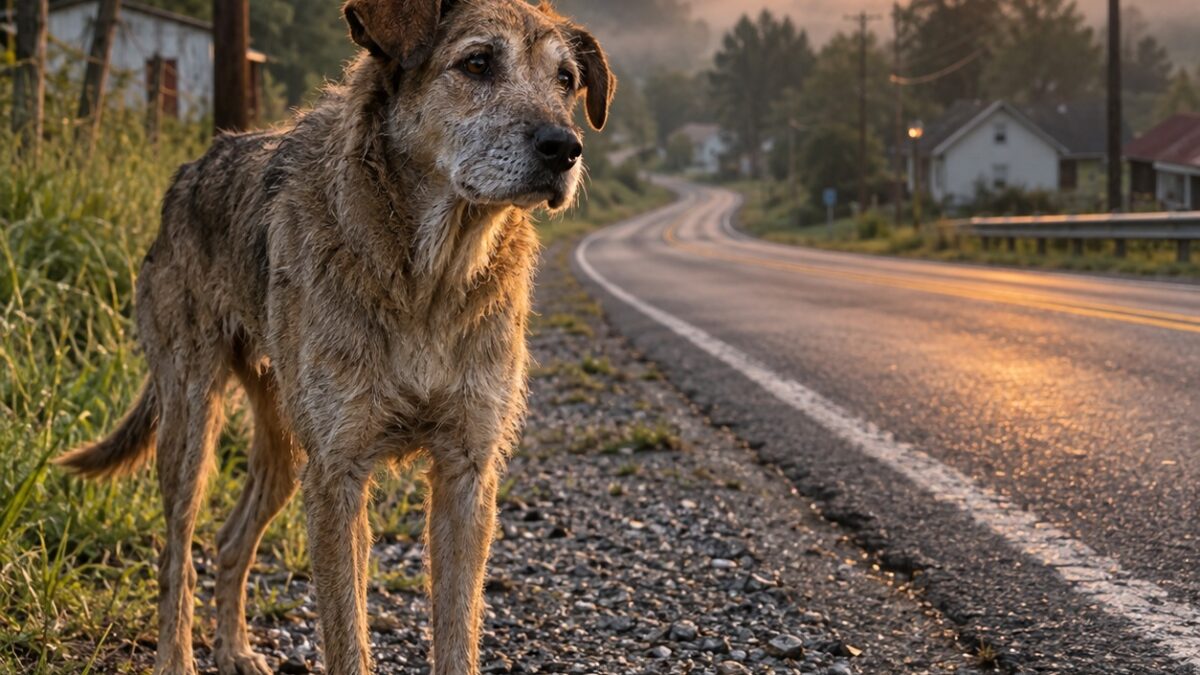
Mom found me in the kitchen at six-fifteen.
I had a granola bar in one hand.
Henry’s leash in the other.
She stopped halfway through pouring coffee.
“No.”
“I didn’t say anything.”
“You’re holding a leash.”
“That’s not technically saying anything.”
“Ellie.”
“We can just drive by.”
“I have work.”
“Please.”
She stared at me.
I knew that look.
It meant she was deciding whether arguing would take longer than surrender.
Mom worked as an office manager for a physical therapy clinic across town, and being late made her anxious.
But she also knew me.
Once something lodged in my heart, reasoning with me became a long-term construction project.
“Five minutes.”
I grabbed my coat.
“Thank you.”
“Five.”
“Yes.”
“We are not bringing a dog home this morning.”
“Okay.”
“You said that suspiciously fast.”
“I said okay.”
We drove to Willow Creek Road.
Same ditch.
Same frost.
Same line of bare trees.
No dog.
I pressed my face to the glass.
“He was right here.”
“I know.”
“Slow down.”
“I am going twenty-five.”
“Slower.”
“Ellie.”
We reached the spot where he’d stopped following us.
Nothing.
I looked behind fences.
Driveways.
The drainage culvert.
No thin brown dog.
My chest tightened.
“We can come back later,” Mom said.
“What if he got hit?”
“Don’t do that to yourself.”
“What if—”
“We don’t know.”
That sentence became one I hated.
We don’t know.
Adults use it when reality offers no useful answer.
Mom dropped me at school.
I carried Henry’s leash in my backpack.
For three days, I searched.
After school, I rode my bike along Willow Creek Road.
I checked behind the bakery.
The gas station.
The church lot.
The alley behind Henderson Hardware.
My friend Casey joined me on Wednesday.
“You realize there are probably fifty brown mutts in this town.”
“I’d know him.”
“You saw him for thirty seconds.”
“I’d know him.”
She looked at me.
Then handed me half her bag of beef jerky.
“For bait.”
That’s friendship at thirteen.
By Thursday, even I started doubting myself.
Maybe he’d belonged to someone.
Maybe someone picked him up.
Maybe he’d crossed into another neighborhood.
Maybe Mom had been right and I had turned one hungry dog into some cosmic emotional assignment because I still missed Henry.
That possibility bothered me more than I wanted to admit.
Henry had been with me since I could walk.
He slept outside my bedroom when I had the flu.
Sat beneath the table during homework.
Followed Dad to the garage before Dad moved to Seattle.
When Henry died, something in the house changed.
Quiet became sharper.
Mom cried privately.
I knew because I found her sitting in the laundry room one night holding his old red collar.
I pretended I hadn’t.
We were both good at giving each other privacy around pain.
Maybe too good.
Dad had left two years earlier.
Not vanished.
Not abandoned me completely.
My parents divorced.
He took a job in Seattle.
Called Sundays.
Sent birthday packages.
Visited twice a year.
Adults called that maintaining a relationship.
At thirteen, it mostly felt like someone I loved had become a voice coming through a phone.
Then Henry died.
So maybe when I saw that dog watching our car, I recognized something in him.
Someone waiting.
Someone not understanding why what used to be there wasn’t there anymore.
On Friday afternoon, I found him.
I was walking home from Patterson Books with a sketchpad under my arm.
The bakery smell drifted down Main Street.
Cars moved slowly through the four-way intersection.
And there he was.
Standing beside a newspaper box.
I stopped.
He saw me.
His ears lifted slightly.
His tail moved once.
“Hey.”
The dog turned.
Walked away.
“No, no, wait.”
He didn’t run.
That was the strange part.
He went slowly enough for me to follow.
Around the bakery.
Past the pharmacy.
Toward the edge of town.
I should have called Mom.
I should have told someone.
Instead, I followed a stray dog onto a road bordering the woods because thirteen-year-old brains are impressively bad at risk management.
He looked back every few seconds.
Making sure I was there.
The houses thinned.
The sidewalk ended.
I stayed near the shoulder.
“Where are you going?”
No response.
Another turn.
Then another.
At the third bend, the dog stopped.
Sat.
I stopped too.
We were maybe twenty feet apart.
His chest rose quickly.
He was even thinner than I remembered.
Gray fur around his muzzle.
Older.
I lowered my sketchpad.
“I’m not going to hurt you.”
He watched.
I crouched.
Held out one hand.
No food.
That was stupid.
But maybe better.
“It’s okay.”
He stood.
One step.
Stopped.
Another.
His ears lowered halfway.
Not fear exactly.
Uncertainty.
I stayed still.
Five feet.
Three.
He sniffed my fingers.
My wrist.
My jacket.
Then suddenly he pressed his entire side against my knees.
Not gently.
He leaned.
Like a tree finally giving up after a storm.
I wrapped my arms around him.
His ribs were hard beneath his coat.
He closed his eyes.
I started crying.
I don’t know why.
Relief.
Grief.
Henry.
Dad.
Everything.
I buried my face against dusty fur.
“There you are.”
His tail moved once against the dirt.
“I found you.”
Later, I would realize that wasn’t quite true.
He had led me there.
I called Mom.
She was furious.
Not about the dog.
About me following him alone.
Her Honda appeared twelve minutes later.
She got out.
“Ellie Morgan, what were you thinking?”
“I found him.”
“I see that.”
“He came to me.”
“I also see that.”
“Can we help him?”
Mom looked at the dog.
He remained pressed against my legs.
She closed her eyes.
“Get in the car.”
I smiled.
“That means yes?”
“It means get in before I remember I’m angry.”
We took him to Dr. Tilly.
His clinic sat behind a feed store in a low brick building that smelled like antiseptic, wet fur, and coffee.
Dr. Tilly was in his sixties.
White hair.
Quiet voice.
Hands that seemed built for calming frightened animals.
He examined the dog.
Teeth.
Eyes.
Heart.
Back legs.
Joints.
“No chip.”
Mom nodded.
“Age?”
“Hard to say exactly.”
Dr. Tilly looked at the teeth.
“Seven? Eight? Maybe older.”
I stared.
I had assumed five.
Something about him felt both old and unfinished.
“He’s skinny.”
“Very.”
“Is he sick?”
“Hungry. Dehydrated. Arthritis in the back legs.”
“Anything bad?”
Dr. Tilly smiled slightly.
“Hunger is bad.”
“I mean—”
“I know.”
He placed the stethoscope down.
“Nothing obvious that makes me think he can’t recover.”
I exhaled.
“Can we take him home?”
Mom crossed her arms.
“We have to report him.”
“I know.”
“Shelter hold.”
“I know.”
“Someone may own him.”
That possibility hit me strangely.
“Would they get him back?”
“If he’s lost and properly claimed, yes.”
I looked at the dog.
He was staring at me.
“What do we call him?”
Mom asked.
I answered immediately.
“Jasper.”
She blinked.
“You already named him?”
“I thought of it Wednesday.”
Dr. Tilly laughed.
“Of course you did.”
That night, Jasper came home temporarily.
Legally, he was a found stray.
Emotionally, I had already failed at temporary.
He entered the living room slowly.
Sniffed the couch.
Fireplace.
Rug.
Table legs.
Henry’s old water bowl.
When he reached that bowl, he stopped.
I wondered whether dogs could smell years.
Probably.
He drank for almost a full minute.
Then curled on the old rug near the fireplace.
No barking.
No whining.
Just one deep sigh.
Like someone putting down luggage after a very long trip.
I slept on the couch.
Mom came downstairs at midnight.
“Why are you here?”
“He shouldn’t be alone.”
“He’s sleeping.”
“So am I.”
“You’re awake.”
“Not anymore.”
She shook her head and went upstairs.
I woke at three with Jasper standing beside me.
His nose inches from my face.
“Hi.”
He sniffed.
Then lay down again.
That was our first night.
The shelter posted his photo.
Mom put notices online.
Dr. Tilly contacted local clinics.
No owner.
Day one.
Day two.
Day five.
A week.
Nobody.
Every day, I worried someone would appear.
A family.
A man in a truck.
A woman with photographs.
Someone who would say Jasper’s real name was Buddy or Duke or Max, and I’d have to hand him over.
But there was another part of me that wanted someone to come.
Because if nobody came, what did that mean about him?
Had he been dumped?
Forgotten?
Did anyone miss him?
The legal holding period felt like waiting for a verdict.
Meanwhile, Jasper changed.
He followed me through the house.
Not anxiously.
Quietly.
If I went upstairs, he stayed at the bottom because stairs bothered his hips.
But when I came down, he was waiting.
When Mom left for work, Jasper watched her car through the front window until it turned the corner.
Then he sighed.
Always that sigh.
I started thinking he had spent a lot of time watching people leave.
Food revealed another piece.
He didn’t eat quickly.
Most hungry dogs inhale meals.
Jasper chewed every bite slowly.
Deliberately.
Sometimes he paused and looked at the bowl.
As if making sure it remained.
I would sit nearby.
“There’s more.”
He didn’t understand.
I said it anyway.
“You don’t have to save it.”
At loud noises, he changed.
Car backfire.
Dropped pan.
Thunder.
He dropped low.
Shook.
Once, Mom knocked over a baking tray and Jasper slammed beneath the kitchen table so fast he hit his shoulder.
I lay down on the floor.
Didn’t pull him out.
Just stayed.
“It’s okay.”
His eyes were wide.
“You’re safe.”
I said that so often during those first months that the words became something I was telling myself too.
You’re safe.
You’re home.
Nobody is leaving right now.
After the holding period, Mom took me to the shelter office.
I signed my name below hers even though legally she was the adopter.
The woman behind the desk smiled.
“Congratulations.”
I looked down at Jasper.
“You’re a Morgan.”
Mom touched my shoulder.
“You realize dogs don’t care about last names.”
“He cares.”
“Of course.”
We bought a dark green collar.
I attached a silver tag.
JASPER MORGAN.
Mom saw it.
“You actually put our last name.”
“Yes.”
“I’m not arguing.”
Good decision.
Spring arrived slowly.
Jasper gained twelve pounds.
His coat became softer.
His ribs disappeared.
His eyes changed.
That was what people noticed most.
At first, they had been permanently alert.
Like every sound could mean danger.
Now he blinked slowly.
Slept deeply.
Stretched on the carpet.
One afternoon, he found Henry’s old tennis ball behind the shed.
He sniffed it.
Picked it up.
Dropped it.
I tossed it three feet.
Jasper looked at me like I had misunderstood something.
Then he trotted after it.
Not fast.
Brought it back.
I screamed.
Mom opened the window.
“What happened?”
“He fetched!”
“Call the newspaper.”
“I might.”
At school, Casey got daily Jasper reports whether she wanted them or not.
“He ate from my hand.”
“He rolled over.”
“He barked once.”
“He hates bananas.”
“Ellie.”
“What?”
“I love you.”
“I know.”
“But I know more about this dog than my own brother.”
“Jasper is more interesting.”
“True.”
The day everything changed again happened at school.
I stayed late for garden club.
Mom let me bring Jasper because we were working outside.
Our school field had a tall chain-link fence.
After everyone left, I unclipped his leash.
Jasper looked at me.
“Go.”
He didn’t.
“You can.”
He sniffed grass.
Walked.
Then something shifted.
His head lifted.
He started trotting.
Faster.
Then running.
Not graceful.
His old back legs were stiff.
But he ran.
Wide circle.
Ears flying.
Tail high.
Another circle.
I laughed.
“Go, Jasper!”
He ran until he was panting.
Then collapsed beside me in the grass.
I sat.
Placed one hand on his side.
Heart hammering.
“You were waiting for us, weren’t you?”
He looked at me.
“That road.”
I scratched behind his ear.
“You were just waiting for somebody to stop.”
His head lowered onto my shoe.
At thirteen, that explanation was enough.
Months later, I learned it wasn’t the whole story.
The first clue was the red mailbox.
Early spring.
Maple Drive.
Jasper and I were walking.
He suddenly stopped beside an old red mailbox with peeling paint.
Behind it stood a small one-story house.
Stone garden gnomes.
Faded wind chimes.
Closed curtains.
FOR SALE sign tilted near the sidewalk.
Jasper sniffed the mailbox.
Then sat.
“Come on.”
He didn’t move.
His eyes stayed on the house.
“What is it?”
Nothing.
After almost a minute, he stood and continued.
Three days later, same thing.
Stop.
Sit.
Watch.
I began noticing the house.
No car.
No lights.
Unmowed edge along flower beds.
Something about it felt abandoned.
At dinner I asked Mom.
“Do you know who lived at 214 Maple?”
“No.”
“Why?”
“Jasper stops there.”
Mom looked up.
“What?”
“Every time.”
“Maybe another dog lived there.”
“Maybe.”
But the way he looked at the house didn’t feel like curiosity.
It felt like recognition.
I started a box in my closet.
Jasper’s box.
First collar.
Shelter flyer.
Photos.
Drawing of him running.
I had no reason.
I just wanted evidence.
More memories to come.
One Saturday, Jasper did more than stop.
He walked up the path.
Straight to the porch.
Sat beside the door.
I followed.
My skin prickled.
“Jasper.”
He leaned toward the wood.
Sniffed the bottom edge.
Then waited.
Five minutes.
Ten.
He didn’t scratch.
Didn’t bark.
Just waited.
“Do you know this place?”
His ears moved when the wind chime rang.
That sound did something to him.
His head lifted sharply.
Then lowered.
I walked him home.
But the next day, I went back alone.
Mom thought I was at Casey’s.
Not my finest decision.
The neighbor was watering shrubs.
Middle-aged man.
Baseball cap.
He noticed me staring at the empty house.
“Can I help you?”
I almost lied.
Then said, “Do you know who used to live there?”
He pointed with the hose.
“Mrs. Parker.”
“Did she have a dog?”
He stopped.
“Big scruffy fellow?”
My heartbeat doubled.
“Yeah.”
“Why?”
“I think we found him.”
The hose dropped slightly.
“You’re kidding.”
“No.”
“What does he look like?”
I described Jasper.
Long legs.
Gray muzzle.
Tan wiry coat.
Quiet.
The man looked toward the house.
“Well, I’ll be damned.”
“What happened?”
His expression changed.
“Mrs. Parker died last summer.”
I stared.
“What?”
“Heart trouble.”
“Here?”
“I think ambulance took her out. She didn’t make it.”
The world seemed too bright.
“What happened to her dog?”
“He stayed.”
“What do you mean?”
“Sat on that porch.”
He pointed.
“Days.”
My throat tightened.
“Animal control tried.”
“He ran?”
“Yeah.”
“Did anyone feed him?”
“I did. Couple neighbors.”
“Why didn’t someone take him?”
The man looked uncomfortable.
“Wouldn’t come close.”
I thought of the road.
Following cars.
Waiting.
“How long?”
“Couple weeks maybe. Then disappeared.”
“He didn’t get abandoned.”
The man frowned.
“No.”
I whispered, “He was waiting.”
I walked home slowly.
My entire understanding of Jasper rearranged itself.
He hadn’t been dumped.
His person had died.
He had stayed on that porch waiting for her return.
Ambulance.
Empty house.
Wind chime.
Days.
Then strangers trying to catch him.
He ran.
Wandered.
Followed cars.
Watching.
Waiting for one to stop.
That night, I sat on the floor beside him.
Jasper slept with his stuffed rabbit near his paws.
I touched his ear.
“I know.”
His eyes opened.
“I know where you lived.”
He stared.
“Mrs. Parker.”
The name meant nothing to him as language.
Maybe tone did.
“You waited for her.”
His head lifted.
“I thought someone threw you away.”
My voice cracked.
“They didn’t.”
I pressed my face into his neck.
“She didn’t leave you on purpose.”
Jasper leaned into me.
I cried harder.
“You waited.”
For the first time, I understood why he watched cars.
Why he stared through windows.
Why departure mattered.
He had learned the worst possible lesson.
Someone can love you and still disappear.
Not because they choose to.
Because life is cruel enough to separate people without permission.
That realization hit something in me too.
Dad.
Henry.
Loss.
Different causes.
Same empty place.
After that, I never said “You’re mine now” to Jasper.
Not because he wasn’t family.
He was.
But I stopped treating love like replacement.
Mrs. Parker mattered.
I didn’t know her.
Jasper did.
One evening, I walked him back to the house.
Fireflies blinked in bushes.
The FOR SALE sign was gone.
Jasper climbed porch steps.
Sat.
I sat beside him.
No words.
The wind chime moved.
Tiny notes.
Jasper’s ears lifted.
Then he sighed.
We stayed maybe twenty minutes.
When he finally stood, he walked down the steps.
Didn’t look back.
That night, he slept through the entire night.
Maybe coincidence.
Maybe not.
I don’t need to decide.
Summer became the best season of my childhood.
That’s a dangerous sentence because I know now what came after.
But it’s true.
Mornings walking Jasper.
Afternoons at park.
Reading on porch.
Farmers market.
Creek.
He became known around town.
Tom the mailman carried treats.
Mrs. Diaz at bakery saved bread ends.
Kids recognized him.
“Jasper!”
He never acted excited.
Just one slow tail wag.
People always said the same thing.
“Kind eyes.”
Never handsome.
Though I thought he was.
Kind.
An older woman at flea market said it.
A little girl in park.
Dr. Tilly.
Kind eyes.
That became Jasper’s reputation.
He wasn’t energetic.
Didn’t perform tricks.
Didn’t jump.
He made people feel calm.
At the park, children sat near him.
He leaned against strangers gently.
One girl with braces said, “He looks like he knows secrets.”
“He does.”
“What kind?”
“Dog secrets.”
She accepted that.
I started a journal.
Nothing formal.
June 12: Jasper watched a butterfly for five minutes.
June 16: Found baseball. Carried it inside like treasure.
June 18: Paper bag scared him. Recovered faster.
June 20: Watched front door. Didn’t seem afraid. Maybe remembering.
Writing forced me to notice.
Jasper changed the speed at which I lived.
Before him, I wanted everything next.
Next class.
Next weekend.
Next birthday.
Next summer.
With Jasper, interesting things were small.
A breeze.
Squirrel.
Smell on a fence post.
Sunlight moving across floor.
He could spend ten minutes investigating one patch of grass.
At thirteen, I thought it was funny.
At forty, I understand he was teaching me attention.
Mom noticed too.
“You’re calmer.”
“No, I’m not.”
“You are.”
“Casey says I’m obsessive.”
“That too.”
I began volunteering at the shelter.
At first, one Saturday a month.
Then weekly during summer.
Kennel dogs overwhelmed me.
Barking.
Jumping.
Fear.
I drew them.
That’s how it started.
I was always sketching.
I made portraits.
Daisy with tennis ball.
Leo with enormous ears.
Rex smiling.
Under each picture, I wrote something.
DAISY LOVES FETCH AND THINKS EVERY BALL BELONGS TO HER.
LEO IS SHY BUT BRAVE.
REX WANTS TO SIT BESIDE YOU WHILE YOU WATCH TV.
Visitors stopped.
Read.
Adoptions increased.
The shelter director called Mom.
“Your daughter’s doing something here.”
Mom handed me the phone.
“What?”
“She gives dogs stories.”
I looked at Jasper.
He was lying near my feet.
“I just want people to see them.”
“Exactly.”
That sentence followed me into adulthood.
I just want people to see them.
Animals.
People.
Anyone overlooked because they weren’t loud enough.
Jasper made me notice.
Our first day trip happened in July.
Mom packed sandwiches.
Blanket.
Water.
We drove an hour to a dog-friendly forest trail.
Jasper sat in back seat with nose lifted into wind.
When we reached the creek, he drank.
Then lay in grass.
“Best day ever,” I said.
Mom laughed.
“Your standards are manageable.”
Jasper ate sandwich crust.
Sunlight came through pines.
I remember looking at Mom.
She looked happy too.
Dad’s absence had changed her.
Divorce made her quieter.
More tired.
For a long time, our relationship felt like two people carefully protecting each other from whatever the other wasn’t saying.
Jasper disrupted that.
He gave us something to talk about.
Laugh about.
Plan around.
One night, she brought Henry’s photo albums downstairs.
We sat on porch.
Jasper between us.
Henry at lake.
Henry destroying Christmas wrapping.
Henry with toddler me sleeping on his back.
“He always knew when to be still,” Mom said.
“Jasper too.”
She nodded.
“Think Jasper remembers the bad stuff?”
“Probably.”
Mom gestured around us.
Porch light.
Crickets.
Warm night.
“But maybe he remembers this too.”
I thought about that for years.
Memory isn’t either/or.
Pain remains.
So does safety.
Maybe healing isn’t forgetting.
Maybe it’s giving memory enough new company.
Late July brought the neighborhood picnic.
Jasper wore a red bandana.
Children tried including him in a sack race until adults intervened.
He spent most of afternoon in shade.
An older woman asked Mom, “That your dog?”
Mom looked at me.
“Ours.”
The woman watched Jasper.
“You can tell he’s been through things.”
“Yes.”
“But there’s kindness in him.”
Mom smiled.
“We think so.”
At sunset, I leaned against him.
“Remember when you followed our car?”
His breathing was slow.
“I think you knew.”
Did he?
Probably not.
Maybe he followed because he smelled food.
Because cars represented possibility.
Because he was tired of waiting.
Meaning doesn’t always require intention.
At thirteen, I preferred destiny.
At forty, I think chance is beautiful enough.
August came.
School loomed.
I hated leaving Jasper.
He followed me more as I packed backpack.
One evening, I held his face.
“You’re not losing me.”
His eyes stayed on mine.
“I come back.”
Those words mattered to me.
Maybe more than him.
I come back.
I began building my identity around being someone who returned.
Maybe because others hadn’t.
Dad returned sometimes.
Not enough.
Henry couldn’t.
Mrs. Parker couldn’t.
I wanted Jasper to know my departures ended.
First day of school, I hugged him.
“Three o’clock.”
Mom said, “He can’t tell time.”
“He’ll know.”
When I returned, Jasper didn’t jump.
No barking.
He walked toward me.
Tail slowly swaying.
Pressed head into my stomach.
Welcome home.
No doubt.
I cried the first day.
Didn’t tell anyone.
That fall, Jasper earned a “Good Citizen” certificate at town fair.
The trainer said it wasn’t tricks.
Temperament.
Walking through crowds.
Calm greeting.
Touch.
Jasper passed everything.
She handed certificate.
“Certified good boy.”
I held it up.
“He already was.”
We framed it.
Yes.
Ridiculous.
No regrets.
Jasper met Scout in September.
Scout was young.
Wiry.
Mismatched ears.
Energy level of a small explosion.
His owner Maggie was a photographer in her thirties.
Scout lunged toward Jasper.
Jasper stood calmly.
Scout stopped.
Something passed between them.
Then Scout settled.
Maggie laughed.
“He’s never done that.”
“Jasper is intimidating.”
We looked at his sleepy expression.
“No.”
We started walking together.
Scout bounced.
Jasper moved steadily.
Maggie talked about work.
I talked about school.
Four souls.
Strange comfort.
One day Maggie said, “Your dog holds the room down.”
I loved that.
Anchored.
That was Jasper.
October brought a Polaroid camera.
I photographed everything.
Jasper sleeping.
Jasper with Scout.
Jasper staring at refrigerator.
Jasper in leaves.
Jasper looking offended by a pumpkin.
My bedroom wall became a museum.
Journal:
October 6: Chased one leaf today. Like he forgot to act old.
Age.
The word had started entering.
Not dramatically.
Stiffer mornings.
Longer naps.
Shorter walks.
Dr. Tilly had warned us.
Arthritis.
Unknown history.
Older than we thought.
I resisted.
“He’s not that old.”
Mom stopped correcting me.
One rainy Tuesday, I stayed home sick.
Jasper remained on couch beside me all day.
When I coughed, he moved closer.
“You’re medicine.”
He sighed.
By October, I rubbed his hips before morning walks.
Warmed his blanket sometimes.
Added softer food.
He still followed.
Still wanted outside.
At creek, his tail tapped twice when I said it was my favorite place.
He remained Jasper.
That’s something people forget when aging enters.
We start watching symptoms instead of person.
I began doing it too.
Did he limp more?
Eat less?
Sleep longer?
Instead of:
Did he enjoy sun?
Was he curious?
Did he want the walk?
I had to relearn how to see him.
For art class, assignment: transformation.
I painted Jasper twice.
First day.
Thin.
Dusty.
Eyes watching from distance.
Then now.
Fuller body.
Soft coat.
Calm face.
Same eyes.
Title: Becoming.
In front of class, I said:
“He didn’t change overnight. It was slow. Mostly nothing happened. We just kept living, and one day I realized he wasn’t scared of everything anymore.”
Mrs. Carter cried.
Casey whispered, “You broke the teacher.”
I came home.
“You’re famous again.”
Jasper yawned.
Halloween.
Jasper wore blue bandana.
No costume.
We tried bumblebee outfit.
His expression contained moral judgment.
I removed it.
“Your dignity is safe.”
He supervised candy.
A little boy called him ghost dog.
I said, “Guardian.”
That felt more accurate.
November.
Rain.
Shorter days.
Jasper still nudged leash.
We walked in mist.
He seemed happiest when world slowed.
I became fascinated with that.
Rain softened sound.
Snow later would too.
Jasper liked quiet.
Maybe because loudness once meant danger.
Maybe because old dogs understand something humans resist.
Not every moment needs stimulation.
Mom left banana bread with note:
Save Jasper some.
I gave him a small piece.
He chewed like everything deserved appreciation.
I started a timeline project.
Sketches.
Not events.
Mom sat beside me.
“You’re capturing something photos can’t.”
“I want to remember everything.”
“You will.”
She said it confidently.
She was wrong.
Memory fades.
Details go.
I have photographs now and sometimes can’t remember the day.
But wanting to remember made me pay attention while it happened.
That mattered.
We visited lake before winter.
Jasper stepped into shallow water.
Fetched stick once.
Sat beside us.
Nothing dramatic.
That moment remains one of my strongest memories.
Why?
Maybe because no disaster happened.
No lesson.
Just us.
Ordinary happiness is often what grief later magnifies most.
In English class, assignment:
Someone Who Changed Your Life.
Jasper.
Obviously.
I wrote about Willow Creek Road.
His eyes.
Following.
Waiting.
I read aloud.
Room silent.
Teacher said, “Honest.”
I went home.
Read it to Jasper.
“I think you knew.”
His breathing slow.
“We needed each other.”
Maybe.
First frost came.
His stiffness became visible.
I shortened route.
Journal:
November 12: Cold. Slower steps. Still smiled when I said his name.
Mom watched me watching him.
“He’s older than we thought.”
“I know.”
“But he’s happy.”
“Yes.”
Those words became our defense.
He’s happy.
As if happiness could guarantee time.
Thanksgiving.
Aunt Karen brought Yorkie named Muffin.
Muffin barked nonstop.
Jasper sniffed once.
Walked away.
Dignity.
I served him turkey.
Sweet potato.
Mashed carrots.
“Thank you for finding us.”
Day after, orchard.
Bare trees.
Jasper walked ahead.
Turned often.
Checking me.
I took photo.
Wind catching ears.
That picture became one of my favorites.
Because he is moving away from camera but looking back.
Always checking.
Always confirming I was there.
Then snow.
First snow transformed town.
Jasper sat at window.
We went outside.
He lifted nose.
Snowflakes on fur.
I said, “Second winter with us.”
He didn’t move.
But I felt time then.
Second.
Counting meant something had limits.
December became soft.
School.
Lights.
Short walks.
Blanket in my bag.
If Jasper tired, I spread it under bench.
He always waited until I sat before lying down.
I still don’t know why.
Politeness?
Habit?
Trust?
One morning, he slept late.
I touched chest.
Rise.
Fall.
Slower.
He opened eyes.
One tail thump.
“We go slow.”
Halfway to park, he stopped.
Looked at me.
I spread blanket.
He rested head on foot.
I drew sidewalk from his perspective.
Long shadows.
Not him.
Us.
Christmas tree.
Blue ribbon.
Paw ornament with JASPER written in gold.
Mom gave me necklace.
Dog tag charm.
Jasper.
I wore it immediately.
Christmas morning, he ate soft turkey.
Slept beside tree.
That night, I whispered:
“You’re the best part of every day.”
I wish I hadn’t made one living thing responsible for that much.
But I was fourteen.
And it was true.
New year.
Snow deep.
Some mornings Jasper stayed home.
I asked.
“Want to go?”
If he stood, we went.
If not, I went alone.
I learned consent from an old dog.
January journal:
Jan 5: Watched snow 20 minutes.
Jan 12: Slower. I waited. He chose to keep going.
Scout visited.
Young energy toned itself down around Jasper.
Maggie said, “He holds the room down.”
Again.
Anchor.
February.
Sunlight began reaching porch.
Jasper moved from heater to warm patches.
One morning, he didn’t stand.
I sat beside him.
“Sleep.”
Eventually he rose.
Window.
Watched.
Over days:
Less food.
More sleep.
Still clear eyes.
Still affection.
Mom said vet.
I said, “Not yet.”
Fear.
Finally Dr. Tilly examined him.
Heart.
Joints.
Eyes.
“He’s not in acute pain.”
I breathed.
“But?”
“He’s slowing.”
“How much?”
“His body’s asking for rest.”
I hated poetic veterinarians that day.
“What do we do?”
Dr. Tilly looked at me.
“Let him lead.”
I started crying.
Jasper leaned against knees.
Dr. Tilly gave practical guidance.
Pain.
Food.
Breathing.
Hydration.
Comfort.
When to call.
I heard half.
On drive home, Jasper slept with head in lap.
I kept one hand on him.
That night:
“You don’t have to do anything for me.”
He opened eyes.
“Just be here.”
He pressed nose into arm.
February passed in short days.
He stopped stairs.
I moved to couch.
Mom argued.
“Ellie, you have school.”
“I sleep fine.”
“You look exhausted.”
“He shouldn’t be alone.”
“He’s asleep.”
“What if he wakes?”
Mom sat beside me.
“Sweetheart.”
“No.”
She stopped.
Then brought me another blanket.
That’s motherhood sometimes.
Knowing which battle isn’t worth winning.
One night, Jasper sat upright staring at front door.
Eyes wide.
I woke.
“What?”
He stayed.
No noise.
No one outside.
After a while, lay down.
I wondered if he heard something.
Smelled something.
Remembered something.
Mrs. Parker?
Impossible to know.
I stayed awake until dawn.
Next day, I skipped school.
Mom allowed it.
We made house soft.
Lavender.
Low radio.
Blankets.
I read Jasper’s journal aloud.
Butterfly.
Baseball.
Paper bag.
Gnome.
Leaf.
Scout snoring.
He listened.
Or slept.
At sunset, I bundled him.
Carried him to porch.
Sky gold.
I held paw.
“You followed every car.”
My voice shook.
“And then ours stopped.”
Jasper rested head on knee.
“You chose us.”
I cried.
“Thank you.”
The light faded.
His breathing slowed.
I sat.
Mom sat several feet behind us.
She knew.
I think she knew before me.
Stars appeared.
Jasper took a breath.
Then another.
Long pause.
I said his name.
His eyes opened slightly.
I leaned closer.
“I’m here.”
He exhaled.
His body relaxed.
I waited.
Another breath did not come.
At first, I refused to understand.
I put my hand on chest.
Nothing.
“Jasper.”
Silence.
“Jasper.”
Mom moved.
I shook my head.
“No.”
She stopped.
I pressed my forehead against his.
“Come on.”
No.
“You’re okay.”
I was saying it to him.
To me.
“It’s okay.”
It wasn’t.
“Jasper.”
I remember the cold.
Porch boards.
His fur.
My own breathing too loud.
The world didn’t change enough.
That offended me.
Cars still passed somewhere.
Wind moved.
A dog barked far away.
How could everything continue?
Mom sat beside me.
I held Jasper’s collar.
I don’t know how long.
Hours maybe.
Eventually Dr. Tilly came to house.
I would not go inside when he arrived.
He sat with us first.
No rush.
He checked Jasper gently.
Then nodded once.
I hated him for the nod.
Not rational.
He said, “He went peacefully.”
I said nothing.
“He was with you.”
Nothing.
“He knew.”
I snapped.
“You don’t know that.”
Dr. Tilly accepted it.
“No.”
He nodded.
“I don’t.”
That kindness made me cry harder.
No false certainty.
No sentimental lie.
Just presence.
We cremated Jasper.
I kept collar.
Green leash.
Stuffed rabbit.
Some fur.
The blue ribbon.
Everything suddenly became an artifact.
Mom sat with tea next morning.
Snow had fallen overnight.
Soft.
I held collar.
“I don’t know how to be without him.”
She looked at me.
“You don’t have to become somebody without him all at once.”
“He’s gone.”
“Yes.”
“That means without.”
“Physically.”
I hated that word too.
Then Mom said something better.
“What he changed in you didn’t die.”
I looked down.
Maybe.
At fourteen, I didn’t care about legacy.
I wanted dog back.
For days, I sorted photographs.
Drawings.
Journals.
Memory book.
The page I’d left blank months earlier.
Still more memories to come.
That sentence destroyed me.
I almost tore page out.
Didn’t.
Instead, I wrote:
There were.
More than I knew.
I walked alone.
Willow Creek Road.
Main Street.
Maple Drive.
Gnome house had new family.
Flowers.
Curtains.
Wind chime rehung.
I stopped.
Jasper had stopped there months before and walked away.
You’re not waiting anymore.
I whispered now:
“Neither am I.”
That was a lie.
Grief is waiting for the impossible.
For footsteps.
Collar jingle.
Body at door.
You know they aren’t coming.
Some part of you waits anyway.
One afternoon, weeks later, I went to park.
A dog sat near water fountain.
Young.
Bony.
Huge ears.
Watching road.
I stopped.
My entire body resisted.
No.
Not again.
The dog looked at me.
Tail moved once.
I almost laughed.
Or cried.
I approached slowly.
“Hey.”
The dog stood.
Uncertain.
“You waiting for someone?”
I knelt.
Memory hit me.
Jasper beside Willow Creek.
Following cars.
Waiting.
My hand shook.
“I know the feeling.”
The young dog took one step.
I did not reach.
Waited.
Another.
Nose to fingers.
That was where the original story ended in my mind for years.
Dog leaves.
Another appears.
Circle.
Hope.
But reality continued.
Of course it did.
I didn’t adopt that young dog.
That’s important.
A woman searching for him arrived twenty minutes later.
His name was Cooper.
He had escaped a yard after a gate broke.
She cried when she saw him.
Cooper ran to her.
For one second, pain stabbed through me.
Someone came back for him.
Good.
That’s what Jasper deserved too.
Mrs. Parker would’ve returned if she could.
Watching Cooper reunion helped me understand.
Not every waiting dog is abandoned.
Not every person who disappears chooses to leave.
That distinction became foundational in my life.
I returned to shelter volunteering.
More seriously.
At first, because being around dogs hurt less than empty house.
Then because work mattered.
Portraits.
Stories.
Walking shy dogs.
I became known as the kid who sat on kennel floors.
One dog took three weeks to let me touch him.
I didn’t rush.
Jasper had taught me.
Casey came sometimes.
“You smell terrible.”
“Thank you.”
“You have dog hair on your face.”
“Fashion.”
By high school, I knew what I wanted.
Animal behavior?
Veterinary medicine?
Social work?
I couldn’t decide.
What interested me wasn’t medicine.
It was connection.
Fear.
Trust.
Grief.
Why beings respond to safety.
I studied psychology.
Then counseling.
Eventually became a grief counselor specializing in adolescents and families, with part of my work involving animal-assisted therapy.
People hear that and say, “Because of Jasper.”
Yes.
And no.
One dog doesn’t decide a career.
But Jasper gave shape to instincts I already had.
Notice the quiet one.
Wait.
Don’t force.
Let trust choose pace.
Those principles work with frightened teenagers too.
My first year as a counselor, a fifteen-year-old boy named Marcus came after his father died.
He sat in my office.
Arms crossed.
Wouldn’t speak.
I asked questions.
Nothing.
Tried worksheets.
Nothing.
Finally, I remembered lying under dining table with Jasper after the baking tray fell.
I stopped asking.
Sat.
Silence.
Ten minutes.
Marcus looked at me.
“Aren’t you going to say something?”
“Not if you don’t want me to.”
“What am I supposed to do?”
“Whatever.”
He stared.
Then cried.
Hard.
For forty minutes.
I stayed.
After he left, I sat alone and thought:
Jasper.
Not magic.
Method.
Presence without demand.
Years passed.
Mom aged.
Dad and I rebuilt something.
Not the relationship I had before Seattle.
Something adult.
Messier.
More honest.
When I was twenty-three, I finally told him how angry I’d been.
“You left.”
“I moved.”
“You left me.”
He looked hurt.
“I called.”
“I know.”
“I came back.”
“Sometimes.”
Silence.
Then he said, “I’m sorry.”
No defense.
That changed everything.
Not fixed.
Changed.
I told him about Jasper.
He knew some.
Not whole meaning.
“He waited after his owner died.”
Dad looked down.
“I didn’t die.”
“I know.”
“That makes mine worse.”
I hadn’t expected that.
“No.”
“Ellie.”
“You were unhappy.”
“I still hurt you.”
Both true.
Maybe adults can hold multiple truths where children need one.
Years later, Dad adopted an old dog from Seattle shelter.
A beagle named Martha.
He sent photo.
Caption:
Learning.
I cried.
Mom kept Jasper’s things until I was ready.
At twenty-five, she gave me the green leash.
“You should have this.”
“I can’t.”
“You can.”
It hung in my apartment closet for years.
Then one day, I used it.
Not on another dog.
During therapy training demonstration about grief objects.
I showed it to a group.
Said:
“This leash once belonged to Henry, then Jasper. For years I thought keeping it meant staying connected. Eventually I realized memory wasn’t in leather.”
A participant asked, “Why keep it then?”
“Because objects can help.”
“Do you still need it?”
I thought.
“No.”
That night, I placed it in a shadow box with Jasper’s collar.
Not because he lived there.
Because I liked seeing it.
Need and choice are different.
At thirty, I returned to Willow Creek for Mom’s retirement.
Town changed.
Bakery still there.
Patterson Books closed.
Gas station became pharmacy.
Willow Creek Road widened.
I drove the exact route.
Pulled over where I first saw Jasper.
Could not identify exact spot.
That upset me.
Memory wants geography to cooperate.
It doesn’t.
Grass.
Guardrail.
Cars.
No marker saying:
HERE A GIRL’S LIFE CHANGED.
Of course not.
Important places often look ordinary to everyone else.
I parked anyway.
Sat.
Thought of eyes in rearview mirror.
Tail moving.
Then I drove to Maple Drive.
Mrs. Parker’s house had blue door.
No gnomes.
Wind chime still there or another similar one.
I stood on sidewalk.
New owner came outside.
“Can I help you?”
I almost said no.
Then told him.
An older woman.
A scruffy dog.
Years ago.
He listened.
Then said, “Previous owner left some boxes in garage when we bought.”
My heart jumped.
“What?”
He disappeared.
Returned with dusty cardboard.
Mostly household junk.
Inside was a photo.
Mrs. Parker on porch.
Jasper beside her.
Younger.
Black around muzzle.
Same eyes.
I sat down on curb.
“That’s him.”
The man handed it to me.
“Take it.”
I couldn’t breathe.
On back:
SAM AND ME — OCTOBER 2008.
Sam.
His name had been Sam.
I stared.
Jasper had had a name before Jasper.
That should have disturbed me.
Instead, I felt relief.
Mrs. Parker named him.
Loved him enough for porch photo.
He wasn’t nameless before me.
I whispered, “Sam.”
No magical reaction.
Dog dead years.
But I suddenly knew one more piece.
I took photo to Mom.
She cried.
“We should’ve known.”
“How?”
“I don’t know.”
“It doesn’t change Jasper.”
“No.”
“Sam was hers.”
“Jasper was ours.”
Both.
Identity can have chapters.
I placed photo beside my own.
Young Sam with Mrs. Parker.
Older Jasper with me.
Two lives.
One dog.
No competition.
That discovery reshaped another belief.
As a teenager, I needed to think our love completed him.
Adult me understood we joined him mid-story.
He had history.
Love before us.
Loss.
Then us.
We weren’t saviors.
We were continuation.
That’s humbling.
Important.
A few years later, I incorporated Jasper’s story into workshops for kids facing grief.
Not the dramatic version.
I told them:
He waited for someone who died.
Then he learned to love us.
Learning new love didn’t erase old love.
That’s grief.
Not replacement.
Expansion.
A girl once asked, “Did Jasper forget Mrs. Parker?”
“No.”
“How do you know?”
“I don’t.”
She frowned.
“Then why say that?”
Fair.
I corrected.
“I hope he didn’t need to.”
She nodded.
“That’s better.”
Children are brutal editors.
They keep adults honest.
I married at thirty-three.
My husband, Daniel, met Jasper only through stories.
Early in dating, he asked, “Am I competing with a dead dog?”
“Yes.”
“Good to know.”
He bought me a framed map of Willow Creek for our first anniversary.
A small gold dot on road.
No words.
I cried.
He learned.
We eventually adopted a dog.
Not immediately.
A shelter mix named Nora.
Young.
Chaotic.
Nothing like Jasper.
I had expected grief.
Instead, I laughed.
Nora chewed shoes.
Barked at leaves.
Hated rain.
Loved everyone.
For two months I kept comparing.
Jasper would never.
Jasper used to.
Then I caught myself.
Nora deserved herself.
I stopped.
Love isn’t a sequel.
Years later, Nora became therapy certified.
Her style opposite.
Jasper had held room down.
Nora lifted it.
Kids laughed.
She rolled.
Requested belly rubs.
Different healing.
Same value.
When Mom developed arthritis, she joked:
“Jasper and I finally have something in common.”
Then later needed walker.
She hated it.
I said, “Jasper would’ve approved.”
She glared.
“Don’t weaponize the dog.”
Fair.
When Dad died at seventy-two, heart attack, I thought of Mrs. Parker.
Not because circumstances identical.
Because I finally understood the shock of absence more deeply.
He called me Tuesday.
Gone Thursday.
I sat holding phone.
Adult.
Counselor.
Professional grief expert.
Useless.
Loss does not care about credentials.
I dreamed of Jasper that week.
He was sitting outside a closed door.
Not moving.
I woke crying.
Maybe my mind gave itself metaphor.
Good enough.
Mom said, “Your dad loved you.”
“I know.”
“He made mistakes.”
“I know.”
“You forgave him?”
“Mostly.”
“That’ll have to do.”
Exactly.
We don’t always finish relationships perfectly.
We finish with what we have.
At Dad’s memorial, I spoke about fishing.
He didn’t like fishing.
I had told Jasper that years earlier by school pond.
Funny how memories travel.
After memorial, I found old photograph in Dad’s wallet.
Me at thirteen.
Jasper beside me.
Dad had received it in Christmas card.
He carried it almost twenty years.
People love imperfectly.
Still love.
At forty, I visited Willow Creek Elementary for a career day.
Teacher introduced me as counselor.
A kid asked what made me choose work.
I almost gave professional answer.
Then said, “A dog.”
Everyone laughed.
I told them.
Not twelve thousand words.
They heard about Jasper.
A boy raised hand.
“So the dog fixed you?”
“No.”
“What did he do?”
“Stayed.”
“That’s it?”
“That’s a lot.”
He considered.
“Yeah.”
Later, school counselor said, “You know, kids understand that better than adults.”
I do know.
That afternoon, I walked to park.
Same pond.
Bench replaced.
Ducks.
A girl sat alone.
No Jasper.
A friend arrived and sat beside her.
They said nothing.
I smiled.
Legacy doesn’t require repetition.
Sometimes we teach each other behaviors by being loved.
I keep Jasper’s journal.
Still.
Pages.
Thirteen-year-old handwriting.
“June 12: butterfly.”
“October 6: chased leaf.”
“November 12: slower steps.”
The last entries are almost unreadable because I cried on them.
For years, I considered rewriting.
Preserving digitally.
I scanned instead.
Never corrected grammar.
Memory deserves original voice.
One page says:
He looked at the door tonight. Maybe he remembers her.
Another:
He followed every car until ours stopped.
That became the sentence people like most when I tell story.
But it’s not quite accurate.
He didn’t follow every car.
I don’t know how many.
He followed ours.
Then later he walked away and waited for me to follow him.
Choice moved both directions.
I was searching for him.
He was testing whether I’d keep coming.
Maybe.
Again.
Meaning.
Not fact.
I have become careful with stories.
We shape memory.
Simplify.
Create arcs.
Lost dog.
Girl rescues him.
Learns past.
Dog heals.
Dog dies.
Girl helps another.
Clean.
Real life wasn’t clean.
I got angry at Jasper once because he chewed my art project.
Yes.
He did.
I yelled.
He cowered.
I immediately hated myself.
Sat on floor two hours.
That isn’t in inspirational version.
It matters.
Trust can be damaged by people who love you.
Then repaired.
I accidentally stepped on his paw.
He stole chicken.
Mom resented vet bills sometimes.
I complained about hair.
Ordinary life made love real.
If we turn loved ones into symbols after death, we lose them again.
Jasper wasn’t only “the dog who waited.”
He snored.
Hated bananas.
Liked bread.
Stared at squirrels.
Ignored Muffin.
Feared paper bags.
Loved warm blankets.
Smelled terrible after rain.
That is who I miss.
Specificity protects memory from becoming mythology.
At forty-one, I was invited to speak at shelter fundraiser.
They asked title:
THE DOG WHO CHOSE ME.
I changed it.
THE DOG WHO TAUGHT ME TO WAIT.
Because choice was too simple.
Waiting mattered.
Jasper waited for Mrs. Parker.
I waited for Jasper to trust.
He waited by door for me.
I waited beside him when he slowed.
At end, he taught me to wait without forcing.
Then grief made me wait for pain to change shape.
That was lesson.
Not moving on.
Not replacing.
Waiting long enough for life to become possible around the hole.
At fundraiser, I said:
“People often think rescue means changing an animal’s life. Sometimes the deeper change is learning to enter their life at the pace they can tolerate.”
I showed photo.
Jasper by red mailbox.
People cried.
I did not show final porch.
That belonged to us.
Some moments shouldn’t become content.
I say that even though I’m telling story now.
There are still things I keep.
The exact look in his eyes before last breath.
The sound Mom made when she realized.
The first night after when I heard imaginary collar.
Those belong privately.
Story doesn’t need everything to be true.
Years later, Mom moved closer to me.
We sorted her garage.
Found Henry’s old water bowl.
Then another item.
Small red bandana.
“Was this Jasper’s?”
“No.”
“Henry’s.”
We laughed.
How many objects can one family preserve?
She said, “Throw it.”
I couldn’t.
She took it.
Put in trash.
I gasped.
“Mom.”
“What?”
“That’s Henry’s.”
“He does not need it.”
True.
“Memory isn’t landfill.”
Savage.
Correct.
We kept photo.
Released cloth.
I thought of Mrs. Parker’s house.
Gnomes gone.
New family.
Places move on.
We can too without betrayal.
When my daughter was born, I named her Grace.
Not after Jasper.
Not after anyone.
At age four, she found his photo.
“Who’s dog?”
“Jasper.”
“Where?”
“He died long before you.”
“Why?”
“He got old.”
“Was he nice?”
“Very.”
“Can I have him?”
“No.”
“Why?”
“Time.”
She accepted that more easily than adults do.
At six, I told her longer story.
She asked, “Did he love the first lady more or you more?”
I nearly laughed.
“Love isn’t ranked.”
“Why?”
“Because it changes.”
She frowned.
“That’s confusing.”
“Yes.”
Then she asked better:
“Did he love both?”
“I think so.”
“Okay.”
Children often only need enough.
Grace later helped at shelter.
One day, she wanted oldest dog.
I panicked.
History repeating.
I asked why.
“He looks lonely.”
Not enough.
We discussed care.
Costs.
Our existing dog.
Capacity.
We didn’t adopt him.
Another family did.
Grace was sad.
Then happy.
Compassion doesn’t require possession.
That’s something thirteen-year-old me hadn’t known.
I wanted Jasper home immediately because seeing suffering activated grabbing.
Adult me learned helping can mean finding right home, not yours.
Jasper shaped that too.
Mom died at seventy-nine after long illness.
Different from Dad.
Time for goodbye.
I sat bedside.
She was mostly sleeping.
One afternoon, she opened eyes.
“Ellie?”
“Yeah.”
“Remember that ridiculous dog?”
I laughed through tears.
“Which one?”
“Jasper.”
“Obviously.”
“You nearly got yourself kidnapped following him.”
“Good memory.”
“You were impossible.”
“I know.”
She smiled weakly.
“He saved us.”
I froze.
“What?”
“After your dad.”
Her eyes closed.
“House was too quiet.”
I took her hand.
“You saved us too.”
She opened eyes again.
“No.”
“Mom.”
“We saved each other.”
Then slept.
She died three days later.
We saved each other.
That became truest sentence in family.
Not dog rescues girl.
Not girl rescues dog.
Mutual.
Messy.
Enough.
After Mom’s funeral, I drove to Willow Creek again.
Red mailbox gone.
House renovated.
Road busier.
I parked near old spot.
Thought about Mom’s Honda.
Rearview mirror.
Dog following.
A thirteen-year-old saying:
He looked into my soul.
I smiled at dramatic child.
Then defended her.
Maybe that’s how it felt.
Feelings deserve accuracy too.
I had recognized him.
Not literally soul.
Something.
Loneliness?
Waiting?
He reflected a part of me I didn’t know language for.
That’s why some connections feel immediate.
Not destiny necessarily.
Pattern recognition of the heart.
We see familiar wounds.
Sometimes that becomes unhealthy.
Sometimes healing.
With Jasper, healing.
I once asked Dr. Tilly before he retired if he remembered us.
He laughed.
“Girl with stray old dog?”
“Yes.”
“You asked fourteen questions in five minutes.”
“Only fourteen?”
“He was in better shape than you thought.”
“I thought he was dying.”
“You always thought he was dying.”
I winced.
True.
Even early, fear of loss shadowed love.
Dr. Tilly said, “You know what I remember?”
“What?”
“How he watched you.”
“Everyone says eyes.”
“No.”
He shook head.
“He checked where you were.”
That hit me.
“He always did.”
“Some dogs monitor exits.”
“Trauma?”
“Maybe.”
“Or attachment?”
“Maybe.”
He smiled.
“Stop asking dead questions.”
“What?”
“You’ll never know which.”
Veterinarians become philosophers when retiring too.
But right.
Not everything needs explanation.
Jasper checked me because he did.
I checked him too.
Enough.
When I turned fifty, Grace gave me a gift.
She had scanned my Jasper journals and paired entries with photos.
A private book.
Cover:
HE FOLLOWED US HOME—OR MAYBE WE FOLLOWED HIM
I laughed.
“Too long.”
“Genetics.”
Inside, first page had photo from Mrs. Parker’s porch.
SAM AND ME.
Next, my photo.
JASPER AND ELLIE.
Underneath:
Both true.
I cried for an hour.
Grace sat.
No fixing.
She had learned.
Maybe from me.
Maybe from Jasper through me.
That’s how love travels.
Not as ghost.
As behavior.
As patience.
As the way someone sits beside pain without demanding it stop.
That is the legacy I trust.
I don’t know whether Jasper ever understood we had learned about Mrs. Parker.
I don’t know whether dogs conceptualize death the way we do.
I don’t know if his porch visit represented closure.
I don’t know if he followed our car because he chose us or because he was hungry.
I don’t know whether his last look meant goodbye.
There are so many things I don’t know.
At thirteen, uncertainty felt unbearable.
At fifty, it feels honest.
What I know:
He existed.
He had been loved before me.
He lost that person.
He survived.
He wandered.
He followed our car.
I searched.
He approached.
He lived with us.
He softened.
He loved.
We loved.
He aged.
He died beside me.
I changed.
That’s enough fact to hold meaning.
Sometimes people want the ending where the girl sees another stray and adopts it because Jasper “sent” the dog.
Real life gave me Cooper, whose person came running.
Better lesson.
Someone did come back.
I watched reunion.
It healed something.
Years later, yes, I adopted other animals.
Not replacements.
New stories.
That’s more honest.
Jasper did not send them.
He did something more powerful.
He made me capable of seeing them without asking them to be him.
When I think of him now, I don’t picture final porch first.
That’s progress.
I see school field.
Running.
Ears back.
My laughter.
Go, Jasper!
I see red mailbox.
Quiet.
I see him carrying stuffed rabbit.
Ignoring Muffin.
Walking beside Scout.
Watching snow.
The ending has finally taken its proper size.
One chapter.
Not whole book.
Grief often begins by enlarging death until it covers life.
Time, if we let it, restores proportion.
I tell grieving teenagers that.
Not on day one.
Never.
Early grief doesn’t need philosophy.
It needs blankets.
Food.
Someone sitting.
Jasper taught that.
If a child says, “I don’t know how to be without them,” I don’t say, “They’re still with you differently.”
Mom said that to me because she was my mother and could risk it.
Professionally, I say:
“You don’t have to know today.”
Then sit.
Tomorrow comes anyway.
Identity catches up later.
That’s mercy.
The final time I visited Mrs. Parker’s house, I brought the photo copy.
Not original.
I stood at sidewalk.
New owner had children.
A dog barked inside.
I imagined Jasper/Sam there years earlier.
Waiting by door.
Mrs. Parker perhaps sitting on porch.
Calling:
“Sam.”
He runs.
A life I never knew.
That thought no longer threatens my place.
For years, I was jealous of a dead woman.
Embarrassing.
I wanted Jasper’s deepest loyalty.
Then I understood love before us doesn’t reduce love with us.
This is true for adopted children.
Second marriages.
Friendships.
Rescue animals.
Widows.
Everyone.
We join lives already in progress.
Respecting previous chapters doesn’t weaken ours.
It makes them real.
I placed a small stone by sidewalk.
Not marker.
Just because.
Then left.
No ceremony.
On drive home, I passed Willow Creek Road.
A dog stood behind fence.
Safe.
I smiled.
No stopping necessary.
Some things do not need us.
That’s a relief too.
My whole childhood, I thought noticing suffering meant becoming responsible for fixing it.
Jasper changed that over time.
Notice.
Assess.
Help if appropriate.
Respect limits.
Sometimes call professional.
Sometimes let another person handle.
Sometimes simply witness.
Compassion without boundaries burns people out.
I learned hard way in counseling.
Jasper’s story initially pushed me toward saving.
His full story taught me staying.
Different.
Saving is event.
Staying is relationship.
He didn’t need one heroic afternoon.
He needed meals.
Walks.
Vet bills.
Patience.
Noise management.
Old-age care.
Goodbye.
Love is maintenance.
I think about Mom warming blankets.
Tom mailman carrying treats.
Casey giving jerky.
Dr. Tilly checking joints.
Maggie walking Scout slowly.
Community built his second home.
I get too much credit in retellings.
I found him.
But many held life.
That’s real rescue.
Network.
Not hero.
When people ask for advice about adopting older dog, I say:
Don’t do it because story sounds beautiful.
Do it if you can handle medicine.
Accidents.
Slowness.
Unknown history.
Potential short time.
And do it if you can let beauty be ordinary.
Because most days aren’t transformation.
They’re food bowls.
Walks.
Naps.
That’s where love lives.
Jasper taught me.
I also tell them:
Don’t assume short time means less worth.
We had maybe two years.
Some people call that heartbreaking.
It was.
Also enough to change a life.
Length is not measure of significance.
Mrs. Parker had Jasper longer.
Maybe years.
Her death was not failure of love.
Our short chapter wasn’t lesser.
Time isn’t fairness.
It’s just time.
One winter evening, when I was fifty-two, snow fell outside my house.
Grace was visiting college.
Our current dog, a senior black mutt named Amos, lay by heater.
I sat beside him.
Snow muffled street.
He lifted head.
I suddenly remembered Jasper’s second winter.
The way he watched flakes.
I whispered:
“You would’ve liked him.”
Amos sighed.
No mystical connection.
Just old memory sharing space with present affection.
That is what integration feels like.
No conflict.
No replacement.
Room.
I opened Grace’s book.
First page.
Sam.
Second.
Jasper.
Both true.
Then I found journal line:
He followed every car until ours stopped.
I crossed nothing out.
Teenage Ellie deserves her truth.
But in margin, adult me wrote:
Maybe he was waiting for someone to stop. Maybe I was too.
That feels closest now.
After Dad moved.
After Henry died.
After Mom and I learned silence.
I was waiting too.
For something dependable.
Something that would look back when I checked.
Jasper did.
Until he couldn’t.
Then I learned dependence on permanence is impossible.
Love’s promise isn’t “I will never leave.”
No one can honestly make that.
Better promise:
“While I’m here, I’ll be here.”
Jasper did that.
Mrs. Parker probably did too.
Mom.
Dad imperfectly.
I try.
That’s all.
The last time Jasper looked toward our front door, perhaps he remembered old porch.
Perhaps he heard nothing.
Perhaps aging brain wandered.
Doesn’t matter.
I stayed beside him.
That was my part.
On his final evening, when I thanked him, I told him he chose us.
Maybe inaccurate.
Maybe he simply followed road and accepted safety.
But he did choose repeatedly afterward.
He returned to my side.
Waited by door.
Rested head on lap.
Stayed.
Animals make choices inside options humans provide.
We provided home.
He chose trust.
That matters.
If I could return to that first morning, I wouldn’t tell thirteen-year-old me how story ends.
She wouldn’t get in car.
She’d protect herself.
Maybe chase dog harder.
Try freezing time.
I would let her see him.
Let pain begin.
Because loving him was worth grief.
I know that sentence can sound cruel to someone freshly bereaved.
Do not say it too early.
But decades later, true.
I’d rather have had Jasper and lost him than never turned around in passenger seat.
I’d rather have spent final porch sobbing than driven past and forgotten his eyes.
Grief is price not proof.
Love is not good because it hurts later.
It hurts because it mattered.
Different.
Important.
So if I could whisper anything to that girl, maybe:
“Keep looking.”
Not because she has to save dog.
Because search will teach her who she is.
Keep looking.
Friday afternoon, she will see him.
Follow at safe distance—maybe call Mom first this time.
He will stop.
He will come.
He will lean against knees.
She will cry.
She will name him Jasper, though once he was Sam.
Both names will be real.
He will sleep by fireplace.
Fear loud noises.
Learn tennis ball.
Run at school.
Remember red mailbox.
Sit on old porch.
Come home.
Become friend.
Grow older.
Slow down.
Watch snow.
Rest.
Die.
And she will survive.
Not unchanged.
Never unchanged.
But expanded.
Years later, she will sit with other grieving children because a quiet dog once taught her how.
She will understand that sometimes the most loving thing isn’t speaking.
It’s remaining.
That is what I carry.
Not Jasper as symbol.
Jasper as practice.
Notice.
Approach gently.
Wait.
Respect history.
Stay.
Let go when staying becomes impossible.
Then keep living without pretending love stopped.
A few months ago, Grace asked what I wanted done with Jasper’s collar after I died.
Morbid child.
Adult now, but still.
I laughed.
“Throw it away.”
She looked horrified.
“Seriously?”
“Yes.”
“Mom.”
“Take a picture if you want.”
“But Jasper—”
“Is not in the collar.”
She frowned.
“I thought you treasured it.”
“I do.”
“Then why?”
“Because treasure doesn’t have to become burden.”
She stared.
Then smiled.
“Grandma would approve.”
Exactly.
Mom taught me last stage.
Release objects when they stop serving.
Stories remain.
Behavior remains.
Love remains in ways we can actually demonstrate.
Maybe Grace will keep collar anyway.
Children ignore parents.
Also tradition.
But I like giving permission.
No relic obligation.
Jasper would definitely prefer biscuit over memorial.
If heaven contains anything, hopefully bread.
I am less certain about afterlife than I was at thirteen.
Then I imagined Mrs. Parker waiting somewhere.
Jasper eventually running to her without arthritis.
Beautiful.
I still like image.
I just don’t claim knowledge.
Maybe nothing after.
That doesn’t reduce what happened here.
They had each other.
We had each other.
That is enough.
Sometimes “enough” is hardest word.
We always want forever.
Forever is unavailable.
Enough is human.
Enough time to trust.
Enough days to run.
Enough quiet walks.
Enough photos.
Enough mistakes.
Enough repair.
Enough snow.
Enough love to shape what came after.
Jasper gave me enough.
Even though I wanted more.
That’s the paradox I live with.
If I close my eyes now, I’m back in Mom’s Honda.
Thirteen.
Winter.
Dog behind us.
I twist in seat.
His body shrinking as car turns.
Tail moving once.
I’m telling you, Mom, that dog looked right into my soul.
Mom says dramatic.
She’s right.
I’m right too.
Some moments feel bigger before we know why.
Not prophecy.
Recognition.
A door opening.
I didn’t know his old name.
His old owner.
His waiting.
His fear.
His future.
I only knew I didn’t want to keep driving.
That instinct became a life.
And maybe that’s why I still tell his story.
Not because everyone should stop for every stray.
Please don’t. Safety matters.
Call shelters.
Use caution.
But because sometimes life places something in our path that asks us to pay attention.
A person.
Animal.
Grief.
Truth.
We can keep driving emotionally.
Or notice.
Jasper taught me to notice.
That has been worth everything.
The last photograph I keep on my desk isn’t his final one.
It’s from the school field.
He’s running.
Not young.
Not perfect.
Back legs slightly stiff.
Ears flying.
Mouth open.
I’m in background, clapping.
The photograph is blurred.
Technically bad.
I love it.
Because nothing in it knows the ending.
That’s how life should be remembered sometimes.
In the middle.
Fully occupied.
No foreshadowing.
No tragedy.
Just motion.
Joy.
A girl shouting:
“Go, Jasper, go!”
And an old dog who had spent too long waiting finally running because, for that moment, he knew exactly where he belonged.








