A Starving Dog Slept on My Porch Every Night—But He Always Disappeared Before Dawn
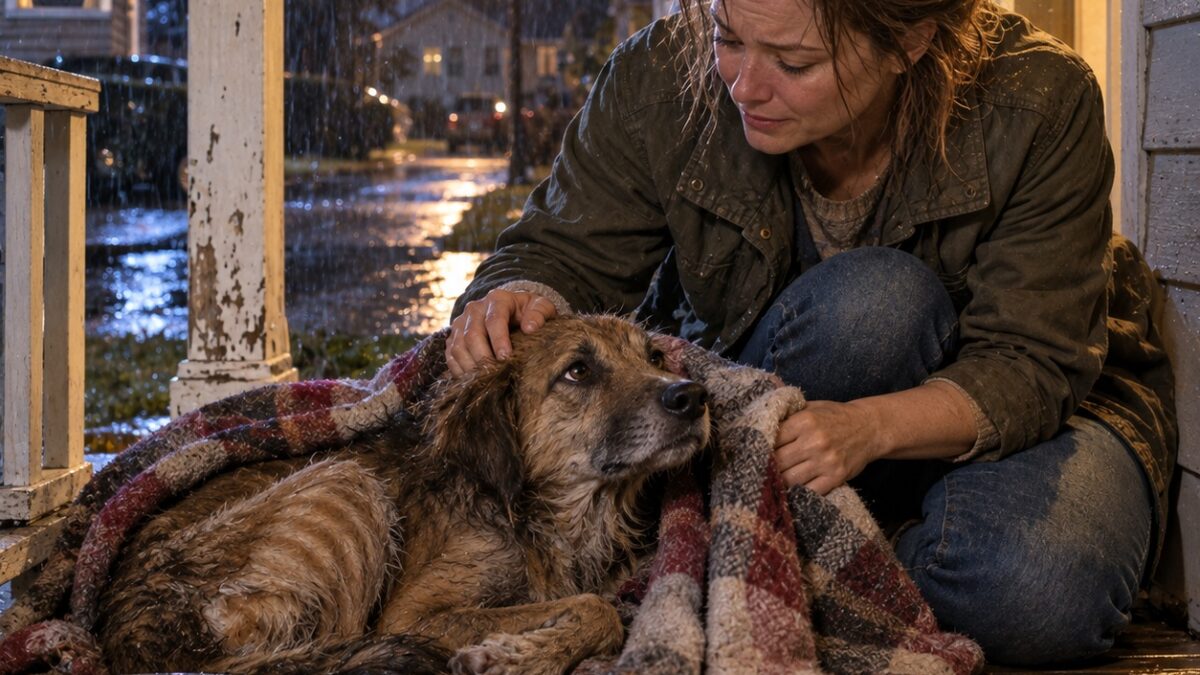
I stayed on the porch until almost midnight.
At first, I sat several feet away.
I didn’t try to touch him.
Every instinct I had told me to wrap him in the quilt, carry him inside, put him somewhere warm, and solve everything immediately.
But he had spent weeks teaching me one important thing about himself.
He stayed only as long as he believed he could leave.
So I spread the quilt near the corner where he always slept.
Then I backed away.
“You can use it or not,” I said.
He stared.
I felt ridiculous.
“You don’t have to decide right now.”
Another long stare.
“I’m apparently negotiating with a dog.”
One ear twitched.
That felt almost like an answer.
Rain began tapping softly against the porch roof.
The wind pushed cold air through the railing.
After several minutes, he shifted.
One paw touched the edge of the quilt.
Then another.
He sniffed it.
Circled once.
And finally lowered himself onto it.
I nearly cried.
Not because lying on a blanket was some great accomplishment.
Because I suddenly understood how little comfort he expected from the world.
A folded quilt felt like trust.
I put the bowl beside him.
He drank.
Then he rested his chin on his paws.
I sat against the wall.
For the next hour, I talked.
About nothing.
Work.
The weather.
My terrible habit of forgetting laundry in the washing machine.
The maple tree that dropped leaves faster than I could rake them.
I told him about Max, the yellow mutt I had when I was a kid.
Max had been terrified of thunderstorms and used to sneak into my bedroom even though my father insisted dogs belonged downstairs.
“I always let him stay,” I said.
The dog’s eyes were half closed.
“Don’t tell my dad.”
My father had been dead for nine years.
Somehow, speaking to that nameless dog brought back the way Dad used to pretend not to notice Max sleeping against my bed.
I smiled.
“You would’ve liked him.”
The rain grew harder.
The dog didn’t leave.
Around midnight, I finally stood.
His head lifted.
“I’m going inside.”
His body tensed.
The reaction hurt.
It was subtle, but I saw it.
My standing up meant the good part was ending.
Maybe that was what every door had meant to him lately.
People leaving.
Lights going off.
Shelter disappearing.
“I’ll be right there.”
I pointed through the window.
“You can see me.”
He obviously did not understand English.
Still, I wanted him to hear the promise.
I went inside and left the porch light on.
For nearly an hour, I watched him through the front window.
At first, he remained curled tightly.
Then slowly, his body loosened.
His breathing became steadier.
At 1:17 in the morning, he stretched one hind leg out behind him.
It was such a normal sleeping position that it broke something in me.
For once, he wasn’t bracing to run.
I went upstairs.
I slept badly.
At 5:42, I came down wearing slippers and a sweatshirt.
The porch was empty.
The quilt was damp.
The bowl was empty.
The plate had been licked completely clean.
I stepped outside.
No dog.
My disappointment embarrassed me.
He had never promised to stay.
I had known him for a few weeks and touched him exactly zero times.
Yet the empty corner felt wrong.
At work, I accomplished almost nothing.
I answered emails.
Made phone calls.
Sat through a meeting.
But in the back of my mind was one question.
Where does he go?
By lunchtime, I had searched local lost-pet pages.
Nothing.
I checked the animal shelter’s posts.
Nothing that looked like him.
I searched community groups.
No missing scruffy brown dog.
No family begging for his return.
No photo from happier days.
That frightened me.
Because there are two kinds of lost dogs.
Dogs someone is desperately trying to find.
And dogs nobody is looking for.
I began to think mine was the second kind.
Mine.
The word came into my mind before I could stop it.
I pushed it away.
He wasn’t mine.
He might never be.
That evening, I pulled into the driveway and immediately looked at the porch.
Empty.
My heart sank.
I sat in the car for maybe thirty seconds.
“Good,” I whispered.
Maybe somebody helped him.
Maybe he found his owner.
Maybe—
Movement beneath the maple tree.
A small figure stepped from the shadows.
My chest tightened.
He stood there watching the car.
Then his tail moved.
Once.
Barely.
But it moved.
I opened the door slowly.
“Hey.”
He came halfway across the yard.
Stopped.
I crouched beside the driveway.
“You came back.”
His nose worked.
I extended my hand.
He approached enough to sniff my fingers.
Then backed away.
Progress.
Tiny.
But real.
I went inside and brought out a small plate of chicken mixed with rice.
This time, he didn’t wait thirty seconds.
Maybe ten.
He approached.
Ate.
Still quickly, but not desperately enough to choke himself.
I sat several feet away.
When he finished, he licked the plate and looked at me.
“You want more?”
I knew I shouldn’t overfeed a badly underweight animal all at once.
I had spent half my lunch hour reading veterinary websites.
“Tomorrow.”
He sat down.
Didn’t leave.
That surprised me.
For the next hour, I stayed beside him.
As darkness settled over the street, he moved to the quilt.
I moved a little closer.
He allowed it.
At some point, Mrs. Turner crossed the street.
She was seventy-two, widowed, and knew every piece of neighborhood information approximately seven minutes before everyone else.
She stopped at the bottom of my steps.
“That dog is still here?”
His body immediately stiffened.
I put one hand up.
“Don’t come closer.”
Mrs. Turner froze.
“I wasn’t going to.”
“You absolutely were.”
“I brought something.”
She held up a plastic container.
“What?”
“Turkey.”
“Mrs. Turner.”
“What?”
“We can’t feed him everything in town.”
“He’s skinny.”
“I noticed.”
The dog stared at her.
Mrs. Turner softened.
“Oh, sweetheart.”
His head lowered.
She put the container on the sidewalk.
“I’ll leave this with you.”
“Thank you.”
She looked at me.
“You calling animal control?”
“I don’t know.”
“You should get him checked.”
“I know.”
“He could have fleas.”
“I know.”
“Worms.”
“I know.”
“Parvo.”
“He’s not a puppy.”
“Dogs can carry diseases.”
“Mrs. Turner.”
“All right.”
She turned.
Then looked back.
“You’re keeping him, aren’t you?”
“No.”
She smiled.
“Sure.”
“I haven’t even touched him.”
“You bought him a quilt.”
“It was old.”
“Sure.”
She walked home.
The dog’s eyes followed her until she closed her door.
Then he looked at me.
“Don’t listen to her.”
He rested his head on the quilt.
The next morning, I woke before sunrise and crept downstairs.
He was still there.
That had never happened.
I froze behind the curtain.
The street was pale gray.
The porch boards were damp with dew.
He slept curled against the quilt.
For a moment, he looked peaceful.
Then his eyes opened.
He saw movement behind the glass.
His head lifted.
I opened the door carefully.
“Morning.”
His tail tapped the wood.
Once.
Then again.
I stepped outside.
He stood.
I expected him to leave.
Instead, he came toward me.
Not all the way.
Maybe three feet.
I crouched.
His nose touched my knuckles.
I didn’t move.
He sniffed.
Then he sat.
“Wow.”
His eyes held mine.
“Look at you.”
I went inside to prepare breakfast.
Eggs.
Rice.
A little plain chicken.
When I returned, he was still waiting.
He ate.
Then something happened that nearly made me stop breathing.
He approached my knee.
Sniffed the fabric of my sweatpants.
And stayed.
I slowly lowered my hand.
Not onto his head.
Beside him.
He could close the distance.
Or not.
He stared at my fingers.
Then leaned forward.
The side of his muzzle brushed them.
Warm.
Real.
I moved one finger along his cheek.
He flinched.
I stopped.
He didn’t run.
“That’s okay.”
I lowered my hand.
“You decide.”
He stared.
A few seconds later, he leaned toward me again.
That time, I stroked his cheek once.
His eyes closed.
Just for a second.
That tiny surrender broke my heart more completely than seeing his ribs ever had.
Somebody had touched him before.
He knew what a hand was supposed to feel like.
He remembered kindness.
Which meant he had also learned, somewhere afterward, that hands could not always be trusted.
That morning, I called a veterinary clinic.
“I found a stray.”
The receptionist asked if I could bring him in.
“I don’t know.”
“Is he aggressive?”
“No.”
“Can you handle him?”
“Barely.”
“Collar?”
“No.”
“Leash?”
“No.”
She paused.
“You may need animal control assistance.”
My stomach tightened.
I imagined a truck.
A catch pole.
A frightened dog running into traffic.
“Can I take this slowly?”
“If he’s stable, yes. But if he’s lethargic, vomiting, struggling to breathe, bleeding, or unable to stand, he needs immediate help.”
“He’s eating.”
“Good.”
“Drinking.”
“Good.”
“Very thin.”
“Then small frequent meals. Avoid rich food. Fresh water. Keep him warm.”
I wrote everything down.
“How soon should I bring him?”
“As soon as you safely can.”
Safely.
That became the word.
Not quickly.
Safely.
For him.
For me.
For everyone.
I stopped at a pet store after work.
I had not entered one since Max died when I was seventeen.
The smell of kibble, rubber toys, shampoo, and cedar bedding hit me with an unexpected wave of nostalgia.
I stood in the dog aisle far longer than necessary.
Soft bed.
Stainless-steel bowls.
Adjustable collar.
Lightweight leash.
Brush.
Flea comb.
A stuffed squeaky fox.
The cashier looked at the pile.
“New dog?”
I hesitated.
“Maybe.”
She smiled.
“First one?”
“First in a long time.”
“What breed?”
“I have absolutely no idea.”
“Best kind.”
I liked her immediately.
When I got home, he was on the porch.
Tail wagging.
More than twice this time.
I set the bed several feet from him.
He approached.
Sniffed.
Circled.
Then curled onto it.
No hesitation.
I laughed.
“Well, apparently that passed inspection.”
I showed him the toy.
Squeak.
He jumped backward.
I immediately set it down.
“Sorry.”
He stared at the fox as if it had insulted his ancestors.
Five minutes later, he crept toward it.
Sniff.
Paw.
Another sniff.
Then a cautious bite.
The toy squeaked.
He jumped again.
But this time he didn’t retreat.
He bit it.
Squeak.
His ears lifted.
He bit harder.
Squeak.
And suddenly, for maybe three seconds, the starving animal disappeared.
There was a dog.
Just a dog.
Curious.
Playful.
Confused by a ridiculous toy.
I laughed until my eyes filled.
He looked at me.
His tail wagged.
That evening, he let me touch the top of his head.
The next night, behind one ear.
Two nights after that, under his chin.
Trust arrived in inches.
I learned not to rush it.
I also learned his fears.
Sudden reaching.
Raised voices.
Metal clanging.
The sound of a garbage truck braking.
Anyone standing directly over him.
And doors.
Doors fascinated him.
Every evening, once I began leaving mine open while I sat on the porch, he watched the opening.
Warm light spilled across the boards.
He could see the rug.
The hallway.
My shoes.
The bottom of the staircase.
He would approach the threshold.
Sniff.
Then retreat.
Never inside.
The first time he placed one paw beyond the sill, I didn’t breathe.
He looked down.
Then at me.
Then pulled it back.
“Okay.”
I kept my voice casual.
“No big deal.”
It was a big deal.
To me.
Maybe to him too.
The cold deepened.
By the third week, I had begun worrying about the weather.
He was gaining some weight, but not enough.
His coat was thicker after I brushed away several mats, yet he still looked vulnerable.
One Friday, the forecast predicted temperatures in the twenties overnight.
I decided I could not keep pretending the porch was enough.
When I came home, he was waiting.
I fed him.
Sat with him.
Then opened the front door.
Warm air moved outward.
“You need to come in tonight.”
He looked at the doorway.
“I know you hate it.”
No response.
“I also know you’re going to freeze.”
His ears moved.
I placed his bed just inside.
He stared.
Then turned away.
For the next hour, nothing changed.
I tried treats.
Nothing.
I tried moving away.
Nothing.
I tried sitting inside where he could see me.
He stayed outside.
At ten, the temperature dropped to twenty-nine.
I carried another blanket out.
He accepted it.
But he would not cross the door.
At eleven, I sat on the floor directly inside the threshold.
He lay six feet away.
“This is ridiculous.”
Tail movement.
“I could pick you up.”
His head rose.
“I’m not going to.”
Head lowered.
“You know why?”
Nothing.
“Because if I scare you tonight, you may never trust me tomorrow.”
I rested my head against the wall.
Cold air filled my living room.
Heating bill be damned.
At 11:42, he stood.
I went completely still.
He approached.
One step.
Two.
Stopped at the sill.
He sniffed.
Looked at me.
Then behind him.
The porch.
The yard.
The street.
Escape routes.
I understood.
“If you come in, I’m not closing it.”
I had no idea how long I could actually keep that promise in twenty-eight-degree weather.
But for now, I meant it.
He placed one paw inside.
Then another.
His front half crossed the doorway.
He froze.
I stared at the floor instead of him.
Three seconds.
Five.
Ten.
Then his back paws crossed.
He was inside.
Fully.
For the first time.
He stood on my entry rug trembling harder than he had outside.
Not from cold.
Fear.
I didn’t move.
“You did it.”
He sniffed the floor.
One step.
Then another.
He turned and looked at the open door.
Still there.
He backed toward it.
I stayed quiet.
He went outside.
My heart sank.
Then, less than a minute later, he came back.
Four paws inside.
This time he sniffed his bed.
Circled.
Lay down.
Still watching the door.
I pulled a blanket around my shoulders and sat beside the wall.
At midnight, he was still inside.
At 12:30, still inside.
At one, I reached slowly toward the door.
His head lifted.
I stopped.
“Okay.”
Another twenty minutes.
I moved again.
He watched.
I closed the door halfway.
He remained on the bed.
Another ten minutes.
Three-quarters.
His breathing quickened.
I stopped.
Then finally, at 1:18 in the morning, I closed it.
Click.
He jumped to his feet.
My stomach dropped.
He rushed toward the door.
I backed away.
“It’s okay.”
He pawed once.
Then looked at me.
I reached for the handle.
Before I touched it, he stepped backward.
Paused.
Turned.
Walked to the bed.
Circled.
Lay down.
I cried.
Quietly.
Like an idiot sitting on my hallway floor at one in the morning.
I don’t know what happened in that dog’s life before my porch.
Maybe a door closed and someone never opened it again.
Maybe he had been pushed out.
Maybe he had escaped.
Maybe doors simply represented traps after weeks or months on the street.
But that night, he let one close behind him.
And stayed.
At three, I woke on the couch.
He was still on the bed.
At six, he stood beside the front door.
I let him outside.
He walked into the yard.
I expected him to disappear.
He sniffed the maple tree.
Walked to the sidewalk.
Turned.
Came back.
I laughed.
“Okay.”
He climbed the porch steps.
Waited at the door.
Something had changed.
Not everything.
But enough.
A few days later, I introduced the collar.
I placed it on the floor first.
He sniffed it.
I picked it up.
He backed away.
“Not today.”
The next morning, I tried again.
This time he let me touch it to his neck.
No fastening.
Just contact.
The next evening, I clipped it loosely.
He froze.
His eyes widened.
I immediately put two fingers beneath it so he could feel the space.
“Not trapped.”
I unclipped it.
The next attempt lasted thirty seconds.
Then five minutes.
Eventually, he wore it without thinking.
The leash was harder.
The metallic click of the clasp made him recoil.
I started by leaving it beside his bed.
Then touching it to the collar.
Then clipping and immediately unclipping.
Two days later, I attached it while sitting beside him.
He stood.
Took one step.
Felt resistance.
Panic flashed across his face.
I dropped the leash.
He ran to the other side of the room.
“Okay.”
I sat on the floor.
“Bad idea.”
He stared at me.
I waited.
Eventually he returned.
We tried again the next day.
This time I let the leash drag.
He stepped on it once and startled himself.
By Saturday, he walked beside me to the sidewalk.
The world changed.
He had always wandered alone.
Now he had a person on the other end.
At first, his body stayed low.
Every sound made him look around.
But he kept walking.
One house.
Two.
Three.
Mrs. Turner stepped outside.
“Oh my goodness.”
He froze.
She stayed by her door.
“Look at him.”
“Don’t make it weird.”
“I’m not making it weird.”
“You’re absolutely making it weird.”
She smiled.
“He looks better.”
He did.
Ribs still visible.
But less sharply.
Coat cleaner.
Eyes brighter.
“Does he have a name?”
“Not yet.”
“You’ve had him nearly a month.”
“I’m aware.”
“Max Junior.”
“No.”
“Charlie.”
“No.”
“Frank.”
I stared at her.
“Frank?”
“He looks like a Frank.”
“He does not look like a Frank.”
The dog looked between us.
Mrs. Turner laughed.
“See? He likes it.”
“He’s concerned about you.”
We walked home.
His tail wagged.
That afternoon, I brushed him.
Slowly.
There were mats behind his ears and along his hindquarters that took patience.
Every time he tensed, I stopped.
Eventually, he leaned against my knee.
The brush moved through his fur.
Loose hair collected beside us.
Under the dirt and tangles, his coat was beautiful.
Brown along his back.
Gray around his face.
White patch on his chest.
He looked older than I first thought.
Maybe five.
Maybe seven.
The gray muzzle could have been age.
Or genetics.
Or simply hardship.
At the end, he rested his head on my shoe.
I stayed there until my foot fell asleep.
I did not move.
By then, getting him to the veterinarian had become unavoidable.
His paws were healing.
His appetite was improving.
But I needed to know whether he had a microchip.
Whether someone owned him.
Whether he had medical problems I couldn’t see.
That question frightened me more than I expected.
Because if he had an owner, what then?
Part of me hoped desperately that somebody loved him.
Another part hated the idea that he might be taken away.
That felt selfish.
I knew it.
Love can become selfish quickly when fear gets involved.
I called the clinic.
The receptionist remembered me.
“Porch dog?”
“That’s apparently his legal name now.”
She laughed.
“You can bring him Tuesday at four.”
“Any advice?”
“Secure leash. Harness if possible. Bring treats. Don’t crowd him.”
The car was the next challenge.
He did not want to get inside.
At all.
When I opened the rear door, he backed away until the leash tightened.
I immediately loosened it.
“Okay.”
He stared at the seat.
I put treats near the threshold.
Nothing.
One on the floor.
He ate that.
One on the running board.
He stretched forward.
Ate it.
One inside.
No.
We spent twenty minutes negotiating.
Finally he placed two paws inside.
Then all four.
I praised him so softly I probably sounded insane.
The drive to the vet took twelve minutes.
He stood the entire way.
Panting.
Watching every window.
At the clinic, he refused to leave the car.
A veterinary technician named Melissa came outside.
She crouched several feet away.
“Hi, handsome.”
No reaction.
“What’s his name?”
I looked at him.
“Still working on that.”
She smiled.
“Okay, mystery man.”
She scattered treats on the pavement.
Eventually he stepped out.
Inside, everything terrified him.
The scale.
The stainless-steel table.
Barking from another room.
A door slamming.
He pressed against my legs.
That was the first time he had ever used me as protection.
I put my hand on his shoulder.
“I’m here.”
The veterinarian, Dr. Patel, examined him mostly on the floor.
She moved carefully.
“Underweight.”
“How bad?”
“Not catastrophic anymore, from what you’ve described. You’ve already helped.”
She checked his teeth.
“Adult. Probably around six.”
Heart.
Lungs.
Paws.
Ears.
Skin.
“Old scars.”
My chest tightened.
“From what?”
“Could be anything.”
She looked at me.
“Don’t build a story we can’t prove.”
That advice mattered.
I had already imagined abandonment.
Neglect.
Cruelty.
Maybe all of it was true.
Maybe not.
“What can you tell?”
“He’s been underfed.”
“Yes.”
“He’s spent significant time outdoors.”
“Yes.”
“Some paw damage consistent with long walking.”
I swallowed.
“Anything else?”
“Old pressure wear around the neck.”
“Collar?”
“Possibly.”
My eyes burned.
“So he belonged to somebody.”
“Likely at some point.”
She scanned him for a microchip.
Nothing.
Again.
Nothing.
“No chip.”
Relief and sadness hit me together.
They took photographs.
Checked lost-pet databases.
The clinic agreed to post a found-dog notice without publishing my exact address.
Legally, I needed to report him to the local shelter as found.
I did.
The shelter placed him in their system while allowing me to hold him temporarily rather than surrendering him physically, provided I remained reachable if an owner came forward.
Seven days.
Then longer under local policy if no one claimed him.
Those days were harder than I expected.
Every unknown phone number made my stomach drop.
I wanted an owner to appear if that owner loved him.
I also wanted nobody to appear.
Both feelings could be true.
On day two, a woman called claiming he might be hers.
She described a black dog with a white nose.
Not him.
On day three, a man emailed a photo.
Different ears.
Day five.
Nothing.
Day seven.
Nothing.
The shelter extended the hold while completing their procedure.
During that time, the dog settled deeper into my house.
He began sleeping inside every night.
At first on the entry bed.
Then the living-room rug.
One evening, during heavy rain, I sat on the couch watching television.
He stood beside me.
Looked at the cushion.
Then at me.
“No.”
He tilted his head.
“You are filthy.”
Tail wag.
“You know what you are.”
He put one front paw on the couch.
I tried not to smile.
“No.”
Second paw.
“This is manipulation.”
He climbed up.
Turned three circles.
Curled against my thigh.
I stared at him.
“You’re terrible.”
His eyes closed.
I rested my hand on his back.
The rain hit the roof.
His breathing slowed.
Twenty minutes later, his head slid onto my lap.
That became his couch.
I lost the argument permanently.
Weeks passed.
We walked farther.
At first just around the block.
Then to the park.
He was cautious around other dogs.
Not aggressive.
He simply watched.
One afternoon, a golden retriever approached with an owner who asked permission.
“Friendly?”
“I think so.”
“That inspires confidence.”
“I’m still learning.”
The dogs sniffed.
My boy stiffened.
The golden wagged.
Then turned sideways.
After several seconds, my dog’s tail moved.
The golden bounced.
My dog jumped backward.
Then forward.
A play bow.
I nearly cried in public.
The owner smiled.
“First friend?”
“Maybe.”
They ran in a small circle.
Only for a minute.
But it was enough.
At home, I began trying names.
“Charlie?”
Nothing.
“Ben?”
Nothing.
“Murphy?”
Ear twitch.
“Scout?”
His head lifted.
I paused.
“Scout?”
Tail movement.
Interesting.
I didn’t decide yet.
Names felt important.
He had survived without one that I knew.
I wanted his new one to mean something.
Scout kept returning to me.
The way he had.
The way he explored cautiously.
The way he always looked ahead before deciding a place was safe.
Scout.
But I waited.
One Saturday, I took him to an open field outside town.
By then he rode in the car willingly.
Not joyfully.
But willingly.
He climbed onto the back seat and lay down after several minutes.
At the field, I kept him on a long training lead.
He sniffed the grass.
Then suddenly ran.
Not away.
Around me.
A huge circle.
His ears flattened backward in the wind.
His mouth opened.
Tail high.
He ran with an energy I had never seen.
I laughed.
Actually laughed.
Out loud.
He circled again.
Then raced back and almost collided with my knees.
I caught his shoulders.
“You’re insane.”
He licked my chin.
The first time.
I sat in the grass.
He leaned against me.
For a while, we watched clouds move.
I thought about my life before him.
Work.
Groceries.
Dinner.
Television.
Sleep.
Weekends filled with chores I invented because empty time made me restless.
I had not considered myself lonely.
That word felt too dramatic.
But sitting in the field with a scruffy dog pressed against my side, I realized my house had been quiet in a way I no longer noticed.
He had changed that.
Not with barking.
He rarely barked.
With presence.
Paws in the hallway.
A tag eventually clicking against a bowl.
Breathing beside the couch.
A nose appearing whenever I opened the refrigerator.
A warm body waiting at the door.
He had filled spaces I didn’t know were empty.
Maybe rescue worked both directions.
I hated that phrase because it sounded like something printed on a coffee mug.
Unfortunately, it was true.
The legal hold ended.
No owner came forward.
The shelter called.
“If you want to adopt him formally, we can finish the paperwork.”
I looked down.
He was sleeping beneath my kitchen table.
My kitchen table.
Like he had been there for years.
“Yes.”
The word came without hesitation.
“You’re sure?”
I almost laughed.
“Yes.”
The next step was neuter status confirmation, vaccinations, licensing, and paperwork.
Normal things.
Boring things.
Wonderful things.
When the shelter worker asked for his name, I looked at him.
“Scout.”
His head lifted.
Tail thump.
She smiled.
“Scout it is.”
I drove home with a folder on the passenger seat.
ADOPTION RECORD.
OWNER: LAURA HAYES.
DOG: SCOUT.
For some reason, seeing it typed made my throat close.
At home, I put the folder on the table.
Scout sniffed it.
“That says you’re stuck with me.”
Tail wag.
“Terrible news.”
He sneezed.
“Exactly.”
I bought him an engraved tag.
SCOUT.
My phone number.
I stood in the pet store parking lot holding that tiny metal oval.
There are objects that carry more meaning than their size deserves.
Wedding rings.
House keys.
Hospital bracelets.
Dog tags.
That tag meant if Scout wandered, someone would know where he belonged.
If someone found him on a porch, they would know somebody was looking.
That mattered to me almost unbearably.
When I clipped it onto his collar, he shook his head.
The tag jingled.
He tried to bite it.
I laughed.
“You’ll get used to it.”
He did.
The next phase of our life was not perfect.
That is important.
Stories about rescue sometimes skip from frightened animal to magical happy dog.
Real healing is messier.
Scout had nightmares.
At least, I think they were nightmares.
His paws ran in his sleep.
Sometimes he whimpered.
Once he woke barking so violently that I nearly fell off the couch.
He looked around the room as though he didn’t recognize it.
“Scout.”
Nothing.
“Scout, it’s me.”
His eyes found mine.
His body lowered.
I sat on the floor.
He approached.
Pressed his head against my chest.
We stayed that way until his breathing settled.
He hated people carrying long sticks.
Brooms.
Rakes.
Umbrellas.
The first time I opened an umbrella in the hallway, he ran behind the couch.
After that, I practiced.
Umbrella on floor.
Treat.
Umbrella moved.
Treat.
Umbrella open across room.
Treat.
Weeks.
Eventually he ignored it.
He hated shouting.
One afternoon, two teenagers argued loudly on the sidewalk.
Scout ran to the back of the house.
I found him beneath my desk.
“It’s okay.”
He looked at me.
“I know.”
I sat nearby.
Did not pull him out.
Five minutes later, he emerged.
Trust was not a straight line.
He had good days.
Bad days.
Days when every sound was normal.
Days when a trash can tipping over sent him shaking.
I learned patience differently.
Not as waiting for him to become the dog I wanted.
As accepting the dog he was that day.
That changed me.
I had always liked fixing things.
Broken chair?
Glue it.
Loose cabinet hinge?
Replace it.
Problem at work?
List steps.
Complete steps.
Move on.
Scout could not be fixed like that.
He wasn’t broken machinery.
Fear wasn’t a screw I could tighten.
Trust had to be offered.
Then offered again.
And again.
Until repetition became safety.
Winter arrived.
Snow came in early December.
Only two inches.
Scout stepped outside.
Stopped.
Stared at the yard.
I waited.
He touched one paw to the snow.
Pulled it back.
Sniffed.
Tried again.
Then suddenly launched himself forward.
He ran in circles.
Bit at snow.
Buried his nose.
Sneezed.
Looked offended.
Ran again.
I stood on the porch laughing so hard Mrs. Turner came outside.
“What happened?”
“He discovered snow.”
Scout sprinted toward her fence.
She laughed.
“He looks like a puppy.”
He did.
For ten minutes, whatever years had come before disappeared.
There was no abandoned dog.
No starving animal.
No doorstep.
Just Scout.
Alive.
Happy.
Covered in snow.
Christmas was stranger.
I bought him gifts.
Of course I did.
A new rope toy.
Chews.
A ridiculous plaid blanket.
Mrs. Turner gave him a stocking with his name embroidered on it.
“You had this made?”
“He’s family.”
I looked at her.
She shrugged.
“What?”
“Nothing.”
“Don’t get emotional.”
“I’m not.”
“You are.”
“Go home.”
She laughed.
Scout adored her by then.
The same woman whose porch light once clicked on while I knelt beside him in the cold became one of his favorite people.
She kept treats inside her coat pocket.
He knew.
Every walk, he tried to turn toward her house.
“You’re being bribed.”
He did not care.
One evening after Christmas, I sat beside the tree.
Scout lay with his chin across my ankle.
The lights reflected softly in his eyes.
I thought about the first night.
He had been outside that window.
Cold.
Wet.
So thin.
I had been inside.
Warm.
Separated by glass and a door.
Now he slept with one paw touching my foot as if physical contact confirmed I still existed.
I reached down.
“You know you live here, right?”
His eyes opened.
“You don’t have to keep checking.”
He sighed.
Eyes closed again.
Months passed.
His body changed.
Weight returned.
His shoulders filled out.
His coat became soft.
The dull brown-gray color deepened into warm sable with silver around his muzzle.
People who remembered the porch dog barely recognized him.
One spring morning, a woman stopped us near the park.
“Is that the stray who used to sleep on Hayes Street?”
“Yeah.”
“Oh my God.”
She crouched.
Scout approached.
Sniffed her.
Accepted a scratch.
“He looks completely different.”
I smiled.
“He feels different too.”
She looked up.
“What happened to him?”
“I don’t know.”
“You never found the owner?”
“No.”
“You think somebody dumped him?”
“Maybe.”
That was still the unanswered question.
For a while, it bothered me.
I wanted a past.
A villain.
An explanation.
Something that would make the story neat.
Then I remembered Dr. Patel.
Don’t build a story we can’t prove.
So I stopped.
Maybe Scout got lost.
Maybe somebody died.
Maybe he escaped a bad situation.
Maybe someone abandoned him.
Maybe a hundred small events brought him to my street.
His past mattered because it shaped him.
But it did not need to be solved for his future to be real.
That realization gave me peace.
The first anniversary of the night I finally fed him arrived almost without my noticing.
Late October.
Cold air.
Wet leaves.
Same kind of clouds.
I came home from work.
Scout was inside the house.
Of course.
He met me at the door.
Tail wagging so hard his whole body moved.
He grabbed his stuffed fox.
The original one.
Patched twice.
One ear missing.
He carried it toward me.
“Hey.”
I knelt.
He pushed his head against my chest.
I looked past him.
Through the open doorway.
At the porch corner.
Empty.
The old quilt was gone.
The dog bed was inside.
The water bowl beside the kitchen.
For a moment, I saw both versions of my life at once.
Then.
Now.
I took Scout onto the porch.
We sat in the same place where I first stayed with him through rain.
He leaned against my leg.
“You know what today is?”
Tail thump.
“Of course you don’t.”
I stroked his head.
“One year.”
The street was quiet.
Mrs. Turner’s television glowed across the road.
Leaves moved along the curb.
A car passed.
Ordinary night.
I thought about how rescue is often described as a single event.
Someone sees suffering.
Opens a door.
Saves a life.
That wasn’t what happened with Scout.
I did not save him in one moment.
I failed him first.
For weeks, I saw him and did nothing.
Then I gave him food.
Then water.
Then a blanket.
Then time.
He gave me nothing at first except the chance to try again tomorrow.
That became everything.
He taught me that kindness is not always dramatic.
Sometimes it is sitting outside when you want to go to bed.
Sometimes it is leaving a door open and letting the heating bill climb.
Sometimes it is not touching an animal because your need to comfort him matters less than his need to feel safe.
Sometimes it is accepting that progress looks like one paw across a threshold.
Or a tail moving once.
Or a dog choosing not to disappear at sunrise.
I looked down at him.
He had fallen asleep.
On the porch.
Again.
But this time the front door stood open behind us.
And I knew when he woke, he would walk through it.
Not because he was trapped.
Because he was home.
The following summer, I took Scout to the lake.
It was one of those Midwestern mornings that begins cool and turns warm by ten.
I packed water.
Lunch.
His leash.
The old stuffed fox, because apparently every trip required it now.
Scout jumped into the car before I finished loading.
“That’s new.”
Tail wag.
“You used to make me negotiate for twenty minutes.”
He put his nose near the window.
“Ungrateful.”
At the lake, the water was calm.
He approached cautiously.
Water had always interested him from a distance.
This time, he stepped in.
One paw.
Two.
A small wave touched his front legs.
He jumped backward.
I laughed.
He stared at me as if I had personally arranged the lake to betray him.
“It’s water.”
He barked.
A real bark.
Loud.
Offended.
I threw a stick into the shallows.
He looked at me.
Then the stick.
Then me.
“No pressure.”
He stepped forward.
Water reached his knees.
He grabbed the stick.
Trotted back.
Dropped it.
I threw again.
Farther.
He followed.
Within twenty minutes, Scout was splashing through the shallows like he had been born there.
A little girl nearby laughed every time he shook water onto me.
Eventually he lay beside me on a blanket.
Wet.
Exhausted.
Happy.
I shared small pieces of chicken from my sandwich.
He rested his head on my thigh.
Wind moved over the lake.
I looked down at the tag on his collar.
SCOUT.
The metal was scratched now.
Not shiny anymore.
Better.
Used.
Real.
I remembered clipping it on.
The fear that someday he might vanish again.
He hadn’t.
Not once.
Even off leash in fenced fields, he always looked back.
Checking.
Not desperately anymore.
Just habit.
I was still there.
He was still there.
That was enough.
Over the next few years, Scout became known throughout the neighborhood.
Children asked to pet him.
Mail carriers carried biscuits.
Mrs. Turner claimed shared custody.
She did not have shared custody.
Scout disagreed.
He visited her porch almost every afternoon.
Sometimes I would look through my window and see him sitting beside her chair while she read.
The irony never escaped me.
He had once wandered from porch to porch looking for survival.
Now he had two homes within fifty yards.
I eventually installed a small gate in my front yard.
Not because Scout ran.
Because he liked lying in the sun.
He would stretch beneath the maple tree, old stuffed fox near his paws, while people walked past.
Sometimes strangers stopped.
“Beautiful dog.”
“Thank you.”
“What breed?”
“No idea.”
“Rescue?”
“Yes.”
“How long?”
I would glance at Scout.
“Feels like forever.”
That answer became truer each year.
When I first met him, I measured our life in days.
First night.
Third morning.
Second week.
Sixth week.
Three months.
Then time stopped feeling fragile.
His things accumulated.
Leashes.
Bowls.
Blankets.
Veterinary records.
Toys.
Photographs.
His hair on every surface I owned.
He became ordinary.
That may be the greatest gift a rescued animal can receive.
Not to remain forever “the poor stray.”
Not to be defined by suffering.
To become ordinary family.
Scout was annoying sometimes.
He stole socks.
He developed a strange hatred for the vacuum cleaner.
He learned exactly which cabinet held treats.
If dinner was seven minutes late, he stared at me like a labor organizer preparing a strike.
He took up most of the couch despite weighing forty-eight pounds.
He snored.
Loudly.
Once, he stole an entire hamburger from my plate when I turned to answer the phone.
I found him beneath the table licking mustard from his nose.
“You were starving once,” I told him.
“That excuse has expired.”
No remorse.
Not even slightly.
And I loved that.
Because mischief meant security.
A dog worried about survival doesn’t steal hamburgers for fun.
Scout did.
Good.
Let him.
Well.
Not literally.
But I understood what it meant.
Three years after he first appeared, Mrs. Turner became ill.
Nothing sudden.
Age.
Heart trouble.
She spent two weeks in the hospital.
Scout noticed her absence immediately.
Every walk, he pulled toward her house.
Empty porch.
Dark windows.
He sat at the bottom of her steps.
Waiting.
The sight hurt.
“She’s coming back.”
He looked at me.
“I promise.”
When she returned, her daughter drove her home.
Scout saw the car.
He lost his mind.
He pulled so hard I almost dropped the leash.
Mrs. Turner stepped slowly from the passenger side.
“Is that my boy?”
My boy.
I decided not to argue about custody that day.
Scout reached her.
Did not jump.
Somehow, he knew.
He pressed himself against her legs.
She bent carefully.
Wrapped both arms around his neck.
And cried.
I looked away.
That dog had entered more than one quiet house.
Mrs. Turner later told me the first thing she thought during the hospital stay was that she needed to get home because Scout would be wondering where she was.
“He waited for me?”
“Every day.”
She touched his head.
“He knows what it is to wait.”
That sentence stayed with me.
Years passed.
Scout’s muzzle became truly gray.
Not hunger-gray.
Age.
He slowed.
The dog who once ran full circles through an open field began choosing shorter routes.
Dr. Patel called it normal.
Mild arthritis.
Nothing dramatic.
Supplements.
Weight management.
Movement.
Warm bed.
Scout had several.
Of course.
One on the porch.
One in the living room.
One beside my bed.
He used none consistently because the couch remained superior.
I built a small ramp so he could climb onto it.
The first time he used the ramp, I felt absurdly emotional.
He looked back at me.
“What?”
Tail wag.
“You’re old.”
He sighed.
“So am I.”
That became another stage of trust.
Caring for an animal who once needed food and shelter was easy compared with accepting that time kept moving after safety arrived.
When Scout was young—or younger—I had imagined home as the end of his story.
It wasn’t.
Home was where the rest happened.
Snow.
Lakes.
Fields.
Vet visits.
Bad weather.
Christmas mornings.
Hamburger theft.
Mrs. Turner.
Long naps.
A thousand evenings when nothing important happened.
Those evenings became the most important part.
One late autumn afternoon, almost seven years after the first night, I sat on the porch with Scout beside me.
He was slower now.
His eyes had a faint cloudy cast.
Still brown.
Still gentle.
He rested his chin on my shoe.
The same gesture he had given me once when touching me was still frightening.
I remembered that night vividly.
I had been afraid to move because I thought he might disappear.
Now I knew he wouldn’t.
Not voluntarily.
I stroked behind his ears.
“You picked this porch.”
His tail moved once.
“Good choice.”
Another movement.
“Your standards were low.”
He sighed.
I smiled.
The sun went down.
Porch lights appeared across the street.
For a moment, I imagined the skinny dog I once saw beneath that maple tree.
Walking toward me.
Hesitant.
Tail moving once.
I wished I could reach backward through time and tell that version of myself something.
Don’t wait so long.
Don’t assume somebody else will help.
Don’t confuse noticing suffering with doing something about it.
But regret can become another form of selfishness if you let it.
Scout didn’t need me to spend his good years apologizing for the nights before I helped him.
He needed me present.
So I stayed present.
When winter came, we no longer took long walks.
We walked one block.
Sometimes half.
Scout stopped often to sniff.
I stopped too.
No hurry.
He had spent enough of his life moving because he had to.
Now he could move because he wanted.
One morning, snow covered the yard.
Scout stepped outside.
Looked at it.
Then looked at me.
“You used to love this.”
He touched the snow.
No running.
No wild circles.
Just a slow walk to the maple tree.
I followed.
He finished what he needed to do.
Then headed back.
At the porch, he stopped.
Stared at the corner where his first quilt had once been.
Maybe I imagined significance where none existed.
Humans do that.
But he stood there for several seconds.
Then climbed inside.
I closed the door behind us.
He did not look back.
That night, I pulled the old quilt from a closet.
I had kept it.
Washed.
Folded.
Stored.
I don’t know why.
Maybe I always knew I would want it again.
I placed it over his bed.
Scout sniffed.
Turned twice.
Lay down.
His eyes closed.
I sat beside him.
The fabric looked smaller than I remembered.
Or maybe the life around it had become larger.
“Good night, buddy.”
His tail tapped once.
Years earlier, those words had been a promise I hoped he understood.
Now they were routine.
I turned off the light.
Walked upstairs.
Halfway up, I heard paws behind me.
Slow.
Careful.
Scout had left the bed.
He climbed the first step.
Then another.
I went back down.
“You don’t have to.”
He looked at me.
I laughed softly.
“Of course.”
I helped him upstairs.
He settled beside my bed.
Just as he had years before, when he first became brave enough to sleep there.
I rested my hand on his back.
Steady breathing.
Warm fur.
Home.
The next morning, he woke me before sunrise.
Not with scratching.
Not with barking.
He simply stood beside the bed.
I opened my eyes.
“Outside?”
He looked toward the hallway.
We went downstairs.
I opened the front door.
Cold air entered.
Scout stepped onto the porch.
He stood beneath the pale sky.
Then lowered himself beside my chair.
I made coffee.
Brought a blanket.
Sat with him.
No emergency.
No tragedy.
Just morning.
His head rested against my leg.
Birds began calling from the maple tree.
The neighborhood woke slowly.
A garage door opened.
A car started.
Somebody walked past with another dog.
Scout watched.
Tail moving faintly.
I looked at his face.
The eyes were older now.
But they were the same eyes.
The ones that had looked at me from the corner of my porch asking a question I took too long to understand.
Can I stay here?
At least for tonight?
I scratched his cheek.
“Yes.”
He closed his eyes.
“You can.”
That answer had once meant one blanket.
One bowl of water.
One night.
Then another.
Eventually it meant everything.
Later that spring, I took Scout back to the open field.
Not because he could run anymore.
He couldn’t.
I took him because that place belonged to us.
The grass was green.
Wildflowers had started appearing along the fence.
I brought a blanket.
Chicken.
Water.
The old stuffed fox.
Scout stepped from the car slowly.
Sniffed the air.
Tail wagged.
I unclipped the leash.
He walked maybe twenty yards.
Stopped.
Looked back.
I was there.
He continued.
Not far.
He didn’t need far.
We sat beneath the same tree we had used years earlier.
I fed him small pieces of chicken.
He accepted each carefully.
When the afternoon light turned gold, he placed his head in my lap.
I stroked the silver fur around his ears.
“I love you, Scout.”
His eyes opened.
Tail thump.
“I know. Embarrassing.”
Another thump.
“You’re my family.”
I looked across the field.
Years earlier, I had brought him there when running freely seemed miraculous.
That day, sitting peacefully was the miracle.
Safety changes shape over time.
At first, it meant food.
Then a blanket.
Then being touched without fear.
Then crossing a doorway.
Then returning from walks.
Then sleeping through storms.
Then knowing every morning would begin in the same home.
Now safety meant growing old without ever again wondering where he belonged.
I clipped my fingers around his tag.
The engraving was worn.
Still readable.
SCOUT.
My number.
I smiled.
“You never needed this much.”
He sighed.
“You always came back.”
The sun lowered.
Eventually, we drove home.
Scout slept in the back seat.
Just like the first lake trip years before.
I watched him in the mirror.
Every rise and fall of his chest.
Every gray hair.
Every scar buried beneath healthy fur.
I still did not know where he had been before my porch.
I no longer needed to.
His story did not begin with me.
But I had been lucky enough to become part of the chapter where wandering ended.
That night, Scout walked through the front door ahead of me.
No hesitation.
No checking the exit.
No fear when it closed.
He went to the living room.
Climbed slowly up his ramp.
Circled once on the couch.
And looked at me as if wondering why dinner had not already appeared.
I laughed.
“There you are.”
That was Scout.
Not the starving dog.
Not the stray.
Not the abandoned animal.
Just Scout.
Impatient for dinner.
Waiting for his person.
At home.
Exactly where he belonged.
And sometimes, when rain hits the porch roof late at night, I still remember the first evening I truly saw him.
Not noticed.
Saw.
A thin body curled against old boards.
Scratched paws.
Shallow breathing.
Eyes tired enough to make a young dog look ancient.
I remember sitting in the cold beside a creature I barely knew and promising him something I had no idea whether I could deliver.
You don’t have to keep sleeping out here forever.
At the time, I meant the porch.
I understand it differently now.
I was promising him that he would not have to live on the edge of somebody else’s life forever.
Not outside the door.
Not outside love.
Not outside belonging.
It took him weeks to believe me.
Maybe longer.
That was okay.
He had learned distrust through repetition.
It only made sense that trust would have to be learned the same way.
Meal after meal.
Night after night.
Walk after walk.
A thousand quiet proofs that I would still be there.
People like dramatic rescue stories.
The dangerous highway.
The flood.
The burning building.
The last-second save.
Scout’s rescue didn’t look like that.
There was no single heroic moment.
There was a porch.
A bowl.
An old quilt.
An open door.
And two living things slowly deciding that neither of them needed to be alone anymore.
That was enough.
More than enough.
Because the dog who once disappeared before every sunrise eventually stopped leaving at all.
And the woman who once thought she was simply giving a starving stray somewhere warm to sleep discovered that he had quietly made her old house feel like home too.








